Category Archives: Science

A Specter is Haunting the Pulps #47: “The Incredible Formula” by Paul Ernst, Amazing Stories, v. 6, n. 3, June 1931

Getting to be nearly that Best of All Seasons (Hallowe’en), so I want to get back into the ol’ pulp strainer world and talk about some neat weird horror…BUT, the previous post about Automata and weird fiction has me still thinkin’ ’bout those ‘bots, and a story I’ve wanted to tackle for a while! Luckily, there’s a real horror element to today’s story, and I think it’ll actually bridge nicely the discussion of automata in weird fiction and the upcoming spook-em-up binge I want to do for October. Plus, as you may have gleaned from the title of this particular post, it’s a good chance to talk labor and Marx in the pulps! So, without further ado: “The Incredible Formula” by Paul Ernst, from the June 1931 issue of Amazing Stories!

Paul Ernst (1899-1985) was, simply put, a workhorse, first in the pulps and then, when that particular world faded away, in the slicks, writing stories well into the 70s for magazines as varied as Redbook, The Saturday Evening Post, Woman’s Home Companion, and Cosmopolitan. As a pulp writer, he was prolific – he published thirty-eight stories in Weird Tales, including a big five-part serial “The Black Monarch” in the 1930s issues of The Unique Magazine. His real specialty, though, was in creating extremely pulpy characters and writing their recurring adventures; he wrote eight “Dr. Satan” stories for Weird Tales (classic “weird menace” style tales from ’35 – ’36), and even more famously went on to create and write, between 1939 and 1944, the twenty four “Avenger” novels (under the house name of Kenneth Robeson) for Street & Smith. “The Avenger” is interesting because, despite being a blatant cash grab by the publishers to bottle the Doc Savage lightning twice, Ernst was a good enough writer to actually make ’em interesting and entertaining. For instance, Ernst gives his weird avenger an actually tragic and compelling backstory – a “child of the depression,” Richard Benson has made a fortune as a globetrotting adventurer, but one day his wife and daughter are murdered by criminals, and the horror of the event transforms Benson, literally. His hair turns white, his eyes become pale and staring, his skin becomes dead and grey, and his facial muscles become paralyzed in a unique fashion, allowing Benson to literally mold his face into any disguise he needs. He vows revenge on all crime, everywhere, and the proceeds to fuck shit up for ne’er-do-wells the world over. (Eventually, his weird appearance and squishy face power gets “fixed” and he returns to normal, though he keeps being a master of disguise albeit of a more mundane variety). Anyway, like I said, Ernst is a good enough writer they’re much better stories than they have any right to be, and if you’re into extremely pulpy adventures in the style of Doc Savage, then they’re worth a read!

But we’re here today for a different story from the vaunted pages of Amazing Stories!
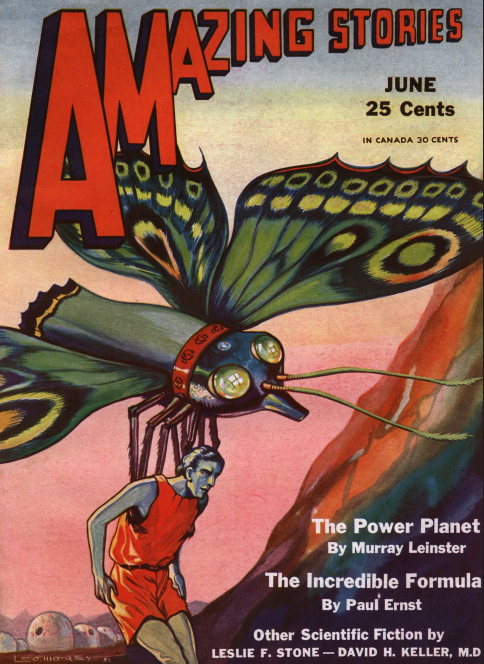
A gorgeous cover this issue – I love that big ass moth! Amazing Stories is one of giants of the pulp era, the first sci-fi pulp and, in many ways, the first real competition that Weird Tales faced, the fallout of which led to the eventual ossification of “science fiction” and “weird tales” as two distinct genres. We’re in 1931, a couple years after founder and titan Hugo Gernsback has bought out and sent off into the wilderness – for now, Amazing Stories is being published by Teck, a MacFadden subsidiary, and overseen by longtime editor T. O’Connor Sloane. Spiritually, though, this is still a strongly Gernsbackian magazine, including an emphasis on sci-fi as an educative or at least “improving” literature. You can see this is the science education editorials they include with every issue; these were (under Gernsback) originally used to justify the magazines existence, a way to show how all these ray-guns and bug-eyed menaces from the stars were, ACTUALLY, instructive literature for the science-minded. This issue’s editorial, written as always by Sloane, is a very strange mishmash of physical geography and extremely poorly reasoned reductive geomorphology about the earth:
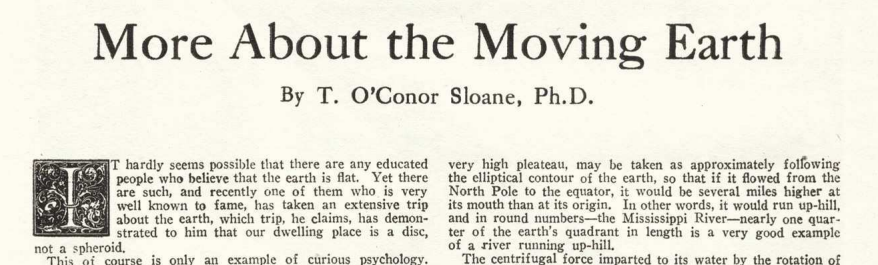
As a geologist I felt the need to the include it in this little essay, but it turns out to be mostly a waste of time. What is odd, and what I wanted to throw out to the wider world, is Sloane’s statement in the first paragraph there, about someone “well known to fame” who recently claimed the world is a disc, not round. Anybody know who the fuck he’s talking about? For a minute I thought he might be talkin’ Auguste Piccard, a Swiss physicist who went up in a balloon in 1930 (and in ’31, actually), and famously described the earth’s curvature as a “disc,” but a) he’s not THAT famous, b) he’s not a flat-(or disc-) earther, and c) he went up in a balloon, not on an “extensive trip about the earth.” Anybody know who Sloane is talking about here?

Anyway, let’s dig into the story!
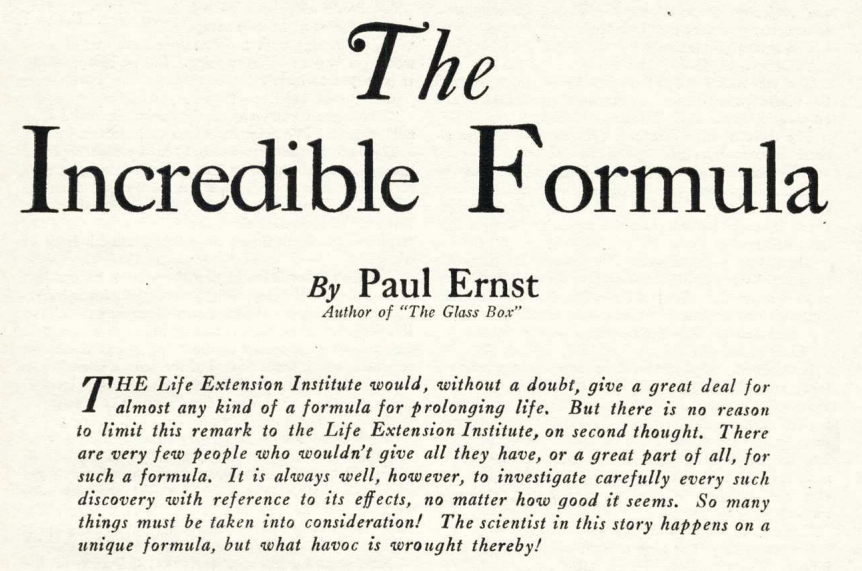
The summary paragraph included in the story is kind of funny; it centers the crux of the tale around a scientist failing to consider the social/political ramifications of his work, which fair enough that is a *part* of what happens here, but in fact there’s a much larger target of Ernst’s ire in this story, as we’ll soon see. I reckon the framing of the paragraph comes out of the the editorial ethos that Amazing Stories is providing not mere escapism but actual important scientific content.

Our story proper begins with a kind of fun framing device:
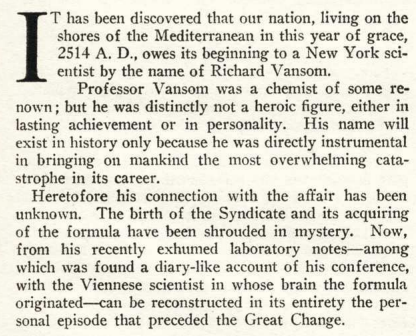
This is a kind of historical essay, narrated from the distant world of 2514 A.D. where a nameless nation on the Mediterranean is examining its own origins. I like the way they cut Vansom down immediately – he’s important, but not in the sense of having been a Great Man; rather, he was just the fulcrum around which history turned, almost by accident. Apparently, some recently discovered papers written by Vansom are going to shed some light on this “most overwhelming catastrophe.” We begin in the hoary, ancient age of the barbaric 1980s:
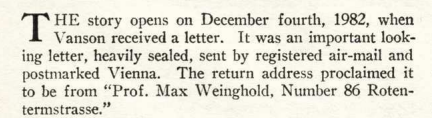
Vansom had, per these newly unearthed documents, received a summons to Vienna from his ol’ teacher, Prof. Weinghold. This letter, among the papers, tells us why:
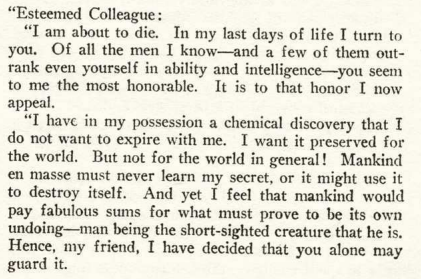
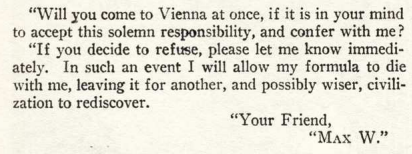
The bell is tolling for ol’ Prof W., and he wants to entrust his last, greatest work in the hands of someone he feels can protect this most incredible of formulae. Unfortunately, the guy he picks is Vansom (as we’ll soon find out). But, anyway, Vansom, after some hemming-and-hawing, realizes he must attend to his former teacher’s (and friend’s) last wishes, and so he zips on over to Vienna, where he meets Weinghold’s factotum/major domo, Rudolph…

…but this Rudolph is strangely changed.
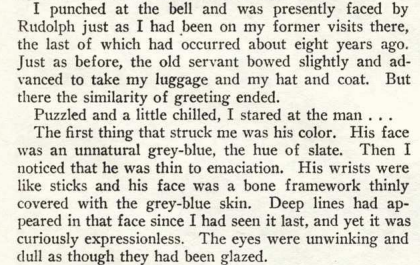
And he doesn’t just look weird…he’s acting odd, too!
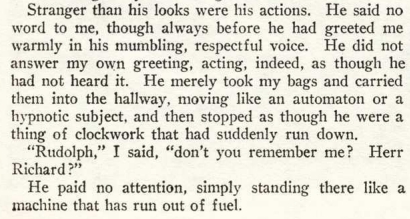
Vansom describes how he notices that Rudolph is wearing a small steel-band around his head, which holds a set of headphones; these headphones must’ve been cranked all the way up to 11, because Vansom can hear the loud blast of Weinghold’s voice, ordering Rudolph to bring his guest up immediately. Helluva illness in ol’ Rudy, thinks Vansom, and he’s gone deaf to boot! The order engages Rudolph though, who bows like “a mechanical doll” and leads Vansom up to the study, where we meet ol’ Doc W:
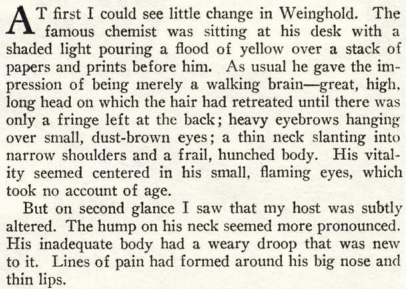
Sounds like somebody needs a ginger ale and some saltines!

Weinghold, speaking into a transmitter, orders the weirdly stiff, slate-faced, utterly silent Rudolph to bring lunch for Vansom, and some egg and milk for himself. Vansom comments on how sad it is to see Rudolph lookin’ like shit and all, which leads Weinghold to make some very gnomic utterances about that indeed. After the meal it’s on with business. Prof W explains that he’s dying of intestinal cancer, and there’s nothing to be done about it; in fact, he’s going to kill himself after this little meeting! And what does he want Vansom for?
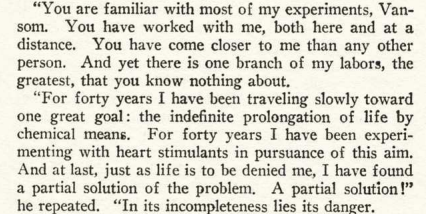
It turns out Prof W has discovered a compound (which, in a footnote from the future, out 26th century friends refer to as “ephedrine-X”) that can keep the human heart beating well beyond death! Originally, Weinghold thought that this was the secret to immortality; with a beating heart as the motor, the rest of the bits of the body should be able to function too. But, it turns out:
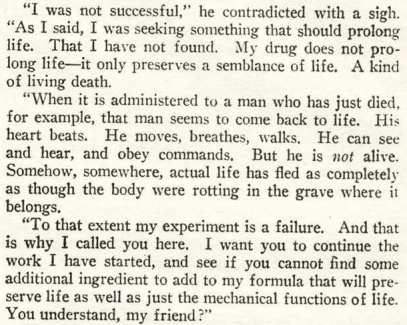
In a somewhat Herbert West-ian fashion, this injection makes, basically, a zombie – a walking corpse that can move, that obeys commands, but is devoid of intellect or will of its own. Weinghold feels like he’s CLOSE to cracking the problem, that his ephedrine-X is something that, perfected, might be the thing that does, in fact, lead to immortality, but it’s too late for him. He needs Vansom to safeguard it, because it’d be dangerous otherwise. Vansom, honored, agrees, and so he learns, via oral recitation, the secret of the incredible formula.

But then, just as they’re finishing up:
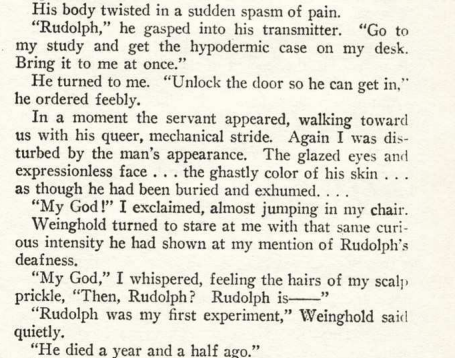
Turns out that zombie-lookin’ motherfucker was a goddamn zombie! This is the inspiration for the single piece of art for this story:
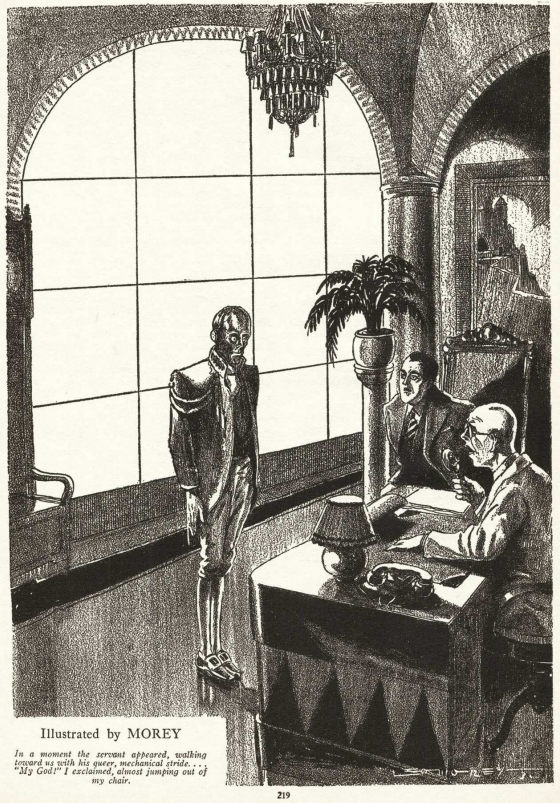
It’s a haunting image; I like the framing of the cadaverous Rudolph against the stark white expanse of the window. It’s also interesting that Rudolph is portrayed as noticeably dark here – in the story, he’s described as slate-colored, very much the pallor of death, but you can dissect this image in a different way, particularly given what we’ve learned. Rudolph could be said to be strangely racialized here, presented as a black servant in his livery; given the fact that we’ve just learned that he’s been effectively enslaved after death, that doesn’t really seem like an accident. Given the year of this story’s publication – 1931 – that seems very possible; the Caribbean voodoo (and zombie) stories of Henry S. Whitehead were beloved fixtures in the pages of Weird Tales by then, in fact he was almost single-handedly responsible for their entry into horror literature. It might be that the artist here, Leo Morey, had internalized that representation. Anyway, it’s worth keeping in mind!

Back to the story: Vansom spends the evening learning more about the details and techniques of ephedrine-X. It has to be administered quickly, within the first seven minutes of death, and it requires continuous reapplication in ever increasing quantities to continue the revivification process. The resultant zombies are mobile, feel no pain, and are capable of work, but totally unintelligent and machine-like; they also have much reduced senses, which is why Rudolph had to be fitted with a set of headphones to scream the transmitted orders into his skull.

And then, Doc W dies, having taken his poison during supper.

Vansom jets back to the states, taking with him a bottle of ephedrine-X, the knowledge of its manufacture and usage, and also Rudolph, which seems quite creepy, actually. It’s here that the far-future narrators cut in, hilariously:
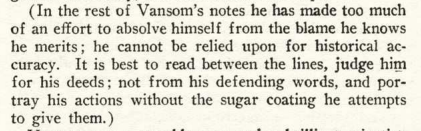
Up to now, we’ve been reading transcripts from Vansom’s papers, unedited and as he wrote them. But now, as we enter the grim and cataclysmic phase of the story, the future narrators cut him off, explaining that he’s unreliable beyond here. What follows then is to be considered the objective history, as best as they could reconstruct it, derived from reading against the grain of Vansom’s own self-serving (and self-absolving) narrative. It’s a fun bit of verisimilitude here, reminding us that we’re reading an interpretation of history based on recently discovered historical material.

Vansom, the historians state, was not as discrete as he should’ve been. Somehow, hints and rumors begin to trickle out, and people begin to believe that Vansom has come into a secret formula that will extend life. The media, more concerned with sales and circulation, begin publishing crazy-ass stories about how ephedrine-X was a miracle drug that had cured hopeless cases, that Vansom’s servant Rudolph was a 104-year old man kept hale and hearty by the drug; they make up quotes that Vansom has claimed that he could live a thousand years if he wanted to.

The country goes bonkers! They want ephedrine X! The scientific community demands answers, fanatics threaten his life, mothers of dying children beg him for his miracle drug. Vansom remains resolute in his promise, however.

That is, until the billionaires get involved:
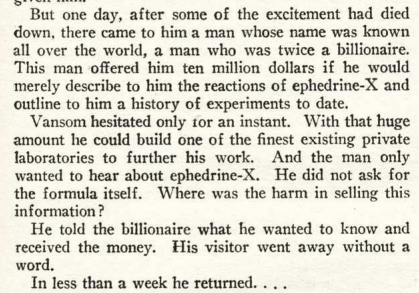
Vansom meets the devil, and signs the hell up. At first, for a cool ten mil, he sells a description of the effects of ephedrine-X to this twice-over billionaire. And when this billionaire comes back a week later:
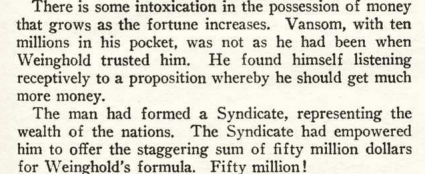
I really love that first paragraph – the intoxication of money, and they way its possession has changed Vansom irrevocably is really great, and something that has largely entered the popular consciousness today, the idea of money as this poison that warps a person. It’s fun to think about the fact that again, in this story, we’re now reading the analysis of the primary document of Vansom’s account – you can imagine the twisty, defensive logic Vansom, writing this account after the fact, engages in to try and exculpate himself, and the way the historians have extracted this judgement from that text here for us.

Anyway, this billionaire and his other billionaire friends have formed a Syndicate, and they’re willing to buy the incredible formula from Vansom for a big ol’ sack of fifty millions of dollars.
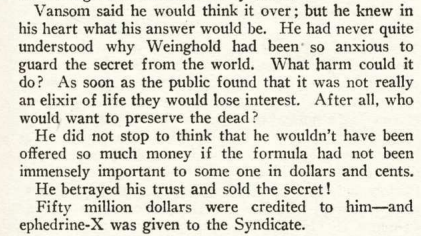
Boo to Vansom, huh? That line, about how he’d never have been offered a payment like that if it wasn’t worth so much is a pretty great one, a nice indictment of dumb ol’ Vansom. And now the Syndicate has the zombie potion.

At this point, the narrative voice of the historian underlines the fact that we’re about to be presented with the highlights of a well known history:
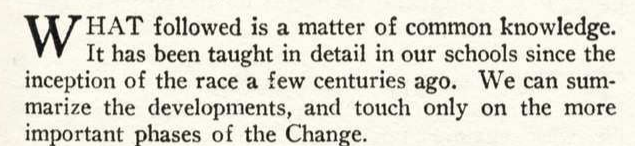
Ernst very interestingly introduces the then relatively new development in industry from his own time, the rigorous and scientifically-informed advertising:
The Syndicate creates a several floor models of the undead, dispatching the revivified corpses to the cities of the world as part of a public exhibition At first, this seems to be a disastrous PR move; as the story states, the ages-old prejudice against seeing and interacting the dead produced a visceral repugnance at all levels of society. Newspapers, politicians, preachers – everyone condemns these zombies being paraded before them.
That’s an important point – Ernst is still keeping us, alongside the whole world of his story, in the dark as to what the Syndicate’s purpose is with these corpses, exactly. This is by design – the psychologists in the employ of the Syndicate are methodically breaking down what they know to be the kneejerk horror at these zombies piece by piece.
And what, exactly, is the promise of these marvelous, liberatory “Livies?” Why, nothing less than the freedom from work:
The billionaires of the Syndicate KNOW that the Livies represent a total breakdown of what Marx called the social reproduction of labor – they are fundamentally overthrowing the relationship between labor and productivity, the same way that industrialization and modern machinery had overthrown the social and class relationships of the 18th and 19th centuries. Because, obviously, if you’re talking about replacing workers across a huge variety of industries and businesses, then what, exactly is to become of the living workers?

Well, the Syndicate has a deeply sinister answer to this. First, in the section excerpted above, the Syndicate plays that ol’ chestnut of industry – increased automation will mean more leisure for the common man, a freedom from toil and drudgery both in the office and at home! But, of course, the question becomes: if Livies are going to take all of the jobs, what’ll people do to make a living? Oh, the Syndicate has an answer there too:
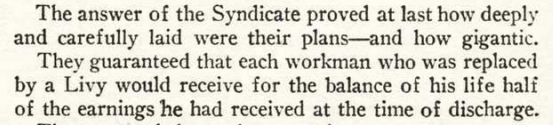
It’s a good ol’ fashioned buy out! Lose a job to a Livie? No worries, you’re now going to receive half-wages gratis, for no work, for the rest of your life! But wait, there’s more:
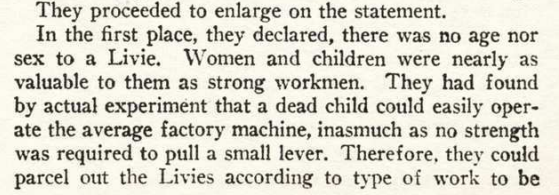
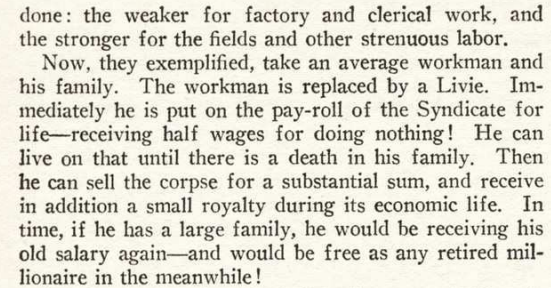
There ya go – let’s say you get laid off from the dingus factory because they’re replacing you with a Livy. Well, no worries, because while you’re off the job, you’ll receive, from the Syndicate, half-wages in perpetuity. And what’s that? Your wife is sick, and a kid of yours dies suddenly? Sell those useless bodies to the Syndicate, and get a royalty on those fresh Livies too! Now you’re living on easy street!

Pretty horrific, and at first is seems like everybody agrees. But the Syndicate knows its business:
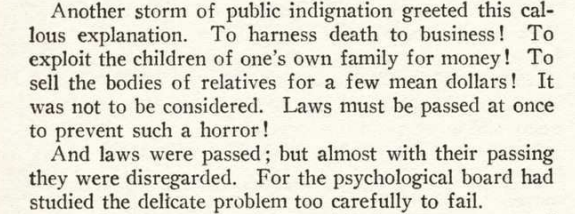
The Syndicate swarps up a bunch of corpses from the lowest lumpenproles they can find, and use them in their own factories; sure, they pay a premium for the corpses up front at first, but they’re labor costs become negligible, which means they can sell their dinguses for cheaper than the competition. People are mad, there’s all sorts of anger and demonstrations, but the toe is in the door now; labor has been broken.
Supply chains based on cheap goods become dominated by those using Livies, because their goods are the cheapest. Thus, industries became reliant on the Livies, and those that refused to use them faltered or went under; workers, seeing unemployment spreading, demanded their bosses replace them with Livies, as a half-wage for life was better than no wage. By controlling production via their unnatural labor supply, the Syndicate basically takes over.
The Livies become an indispensable part of the economy, and so the Syndicate can afford to lower the cost of corpse-procurement and, rather than selling them, rents the Livies to businesses. Whole service industries spring up around the Livy workforce, and what little reticence there was towards using the living dead as slave labor vanishes as the economy becomes entangled with the Syndicate.
This new era is the total domination of the world by the Syndicate; they come to, basically, own everything, commanding as they do the entirety of the labor force, and with it the mechanisms of the economic life of the planet and everyone on it. Workers in this system become perfectly alienated laborers; they are transformed by death into absolutely efficient non-consumers. The living, meanwhile, exist merely as consumers, eventually transforming their own dead into commodities that they can sell to the Syndicate so they can consume more. It’s grim as hell!

The historical narrative says that things are pretty paradisical for the first twenty years or so (excepting the whole “you might buy a widget from your dead relative down at the shop” thing, I suppose), but then the inevitable happens. With such an iron grip on the economy, the Syndicate starts to tighten the leash in order to make themselves MORE money; hilariously, Ernst lays this blame squarely on the billionaire’s failsons who have inherited their position within the Syndicate, a nice little condemnation of inhereted wealth.

Anyway, these zillionaire scions decide that they need to make more money, so they start reducing the unemployment stipends being paid out to people who aren’t working because of the Livies. They jack up the rental fees of the livies, and proclaim that businesses must accept as many Livies as the Syndicate sells ’em, or else. Finally, they even start slashing the salaries of the PMCs working for the Syndicate, the overseers and administrators and even the chemists who make the miracle drug ephedrine X.

Famine stalks the land; people can’t afford to eat, not with all the jobs taken by Livies and with the stipends slashed. Some people try to go back to work – afterall, Livy rental is now almost as much as a worker’s wage would be. But the Syndicate won’t allow it – they own the police, after all, and use them to break strikes and riots of the living.

And now the stage is set for the last act of the Great Cataclysm.

First, the chemists of the Syndicate, with their salaries slashed, leak the formula, resulting in non-Syndicate Livies which, kind of hilariously, are used in various crimes. Robberies and murders, perpetrated by the undead, are rampant, and even Vansom is killed by a Livie during a break in. The whole social order is breaking down, and people begin to demand restitution and dissolution of the all-powerful Syndicate. Rather than bowing to the demands, the Syndicate declares war on humanity; they recall all their Livies, bringing the world to a screeching halt. The Peoples’ response is a good one (one we today should emulate, I’d say), but it comes too late:
The Syndicate ends up militarizing their Livies and turning them on the living. The undead armies are unstoppable, and the dead of the masses just swell their ranks. Meanwhile, the Syndicate, floating high above the earth in airships, looses hell on earth, bombing cities, sending their armies of the undead against the living until, after five years:
Everyone except for the Syndicate and their family is dead, and the whole world has become theirs. And what’s their relationship to this historical narrative we’ve been reading?


And that’s the end of the Incredible Formula by Paul Ernst!

The ending there *is* a little weak – much better to just leave it grim and hopeless, with the 5000+ assholes and a world of the dead, but from the structure of the story I reckon he had to end it in the fashion that he did – after all, we’re reading a narrative from the year 2500 or whatever about the shit that happened in the late 20th and early 21st century, so we have to have some kind of human civilization to make that work. You can also very plausibly argue that this isn’t really much of a story, per say – after the first few pages of Vansom stuff, there’re no real characters, and the rest of the piece is really more world-building essay than a narrative. And that’s fair! But to me, what’s interesting about this story is the fact that it’s actually a pretty sharp and pretty good Marxist analysis of labor and alienation and industrialization…in a goddamn pulp sci fi mag!

This story in unescapably linked to the Great Depression and presents a pretty scathing analysis of the abuses of capitalism. The Syndicate is as sharp an indictment of the robber barons of the 20th century as it is of the technofascists of today – billionaires who make nothing but who use their wealth to bludgeon the world into a financial fiefdom that they can extract limitless wealth from, all while immiserating everyone else. The Livies are also fascinating, aren’t they? They’re the perfect work – a totally homogenized workforce, perfectly docile, perfectly efficient, and perfectly fungible. One the one hand, they’re a clear stand in for simple industrialization, right? Machinery that we’re promised will increase productivity, but there’s a real incisive commentary here on the OWNERSHIP of that productive machinery – it’s not merely factory owners anymore, it’s huge transnational capitalists that RENT the machinery to other, smaller capitalists. What’s remarkable is how much that applies to the bullshit a.i. slopworld of today, and the vision of the technofascists, down to their ideas of forcing its adoption and a dependency that would provide them, the “owners,” with limitless rents.

I don’t know about Ernst’s politics, but he must’ve been reading (and, more impressively) understanding Marx to write this story. His labor fable of the Livies is remarkably sophisticated – eschewing a simpler “mega-industrialization” narrative, his Livies represent the ultimate alienation of the worker from their labor. Furthermore, he literalizes the capitalists’ dreams of the perfectly fungible worker. The Livy is the transformation of labor into a perfect commodity, so much so that the living are selling their dead (or near dying) to the Syndicate in the story in order to make money.

And how about the living? They don’t come off much better here, do they? Feckless, they’re bought off by consumer luxuries, trading their dignity (and, again, their own family members) for more purchasing power! There’s no solidarity, and the Syndicate gets the Livies into society because the workers can’t stand together; it’s telling that politicians are nowhere to be seen in this story, and that the one brief mention of laws sees them brushed aside as irrelevant. Ernst understands what economic power is, and gives us a good example of how one group (the capitalists) use it effectively in their own interests while another group (the workers) fail to do the same.

As a parable of exploitation and the abuses of capitalism, it’s pretty great! And beyond that, there’s some real good glimpses of horror here – there’re several places where Ernst really dwells on the idea of running into a relative or friend or loved one working behind a counter as a corpse, and the final image of someone being killed in the Last War by their zombified relatives is a grim and ugly one. Honestly, as tired as we are of zombie stories, this isn’t a bad take on the genre, and the simple horror of the undead is magnified by the indifference and cruelty of capitalism – these walking corpses don’t wanna munch on your brains at all, they’re just being ordered to murder you by a middle manager type who is worried about their benefits plan if they lose their job.

It’s also interesting in the context of the last post – automation and automata as a symbol of radically evolving social conditions. Last time I was mostly focused on the scientific (and, therefore, ontological) implications of automata, and how changes in the world of science were reflected in the weirdification of the literature of automata; there’s a similar economic story too, one which takes up the Marxist analysis of material conditions and uses automata as a way to explore class and society and power. And Ernst’s story belongs alongside Asimov’s I, Robot tales in that regard, I think!
Automata in Weird Fiction

To celebrate (and *ahem* advertise) the fact that my short story, “Vaucanson’s Canard,” is available for preorder as an absolutely gorgeous pamphlet from Paradise Editions (with international shipping available from Asterism), I thought I’d write somethin’ up about one of my absolute favorite things ever: automata! And, specifically, automata… in weird fiction!

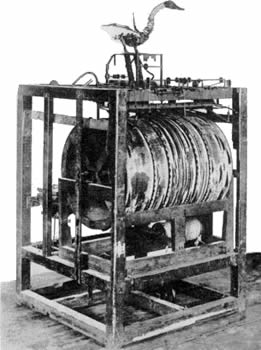
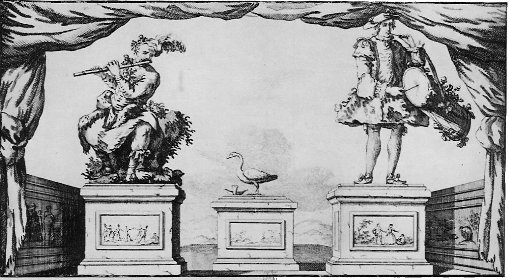
Vaucanson’s famous automata, include the Shitting Duck!

As a child of the 80s, I reckon my first exposure to automata were those classic dinosaur animatronic exhibits that were all the rage at the time – they used to be everywhere, a part of that era’s dino-mania that would, ultimately, culminate in Jurassic Park. As a paleo-obsessed kid, I recall enjoying the displays, but never in the same way as a fossil mount. The artificiality of them was always front and center, the repetitive clockwork motion of the figures shattering the verisimilitude; they never achieved the awesome dignity of those austere ambassadors from the gulfs of deep time, the actual fossils.

BUT! I have a vivid memory of a display at one of these things where the dinosaur had been stripped of its skin, at least in part, to allow you to see the machinery underneath the rubber, and that was a surprising and fascinating thing to little ol’ Eric. Covered, the thing was stilted and underwhelming, but with its pneumatic skeleton exposed, full of wires and electronics and with the unmuffled mechanism operating loudly, it was a much weirder, much more striking thing! Someone more mechanically inclined might’ve been inspired to a career in engineering, but for me it was all about the frisson of being shown simultaneously the illusion *and* the trick, and it produced a real moment of uncanniness.

The oddity of the simulacrum would be underlined by my evolving reading habits – I was a sci-fi kid, especially of the classic 50s-70s era, and boy if that ain’t a literature chockful o’ robots of all sorts. And, while living in an era of shitty a.i. slop means it’s harder than ever to write fiction about machine intelligence, I’ll never not have a fondness for a good robot story! Luckily, there’s a looooong history of automata to pick from!

Ancient Automata

Before we get into fictional ‘bots, it’s worth examining the long history of automata, real and imagined. There’s a deep history to the fascination people have with mechanisms, wrapped up as it is with ideas about knowledge (technical, secret, or divine), as well as questions of authority, labor and, eventually, life itself. Which means that our look at automata starts with those most introspective weirdos of the ancient world: the Greeks.

The word itself comes from Greek αὐτόματα, meaning “acting of one’s own will.” A subtle but important point – an aspect of these things is that the mechanisms must behave as if (or, among the mythic examples, because they have) their own individual motive impulse, power, and directive; in other words, they must appear to be alive. The earliest examples are in those foundational cornerstones of Western lit, the Illiad and the Odyssey. Homer tells us how Hephaestus, god of Smiths, had built mobile tripods to serve the Gods their ambrosia, and he famously had a gaggle of gold girls who, importantly, were in possession of an artificial intellect and skill that let them help out around the forge. In the Odyssey, we’re introduced to the Metal Dogs of Alcinous, gifts from Hephaestus to the King of the Phaeacians to help guard his palace.

It’s all good and well that a divine being like ol’ Festus there can create gold girlbots and robo-dogs, but there is also in the Odyssey at least one example of human(ish)-made automata. When doomed Alcinous is offering to help Odysseus get back home, he explains how their marvelous ships operate independently, without pilot or rudder; rather, the boats “understand” what it is their passengers want, reacting at the speed of thought, and are themselves aware of every city and port and can travel the various sea routes to get to them in a single day. These boats are not gifts from the gods; they’re manufactured right there by Phaeacians (who, admittedly, are descended from semi-divine giants). This seems like an important distinction: sure, the Gods can of course manufacture wonders, but if you have the skill and knowledge, you too can make these living (or at least, life-like) machines.

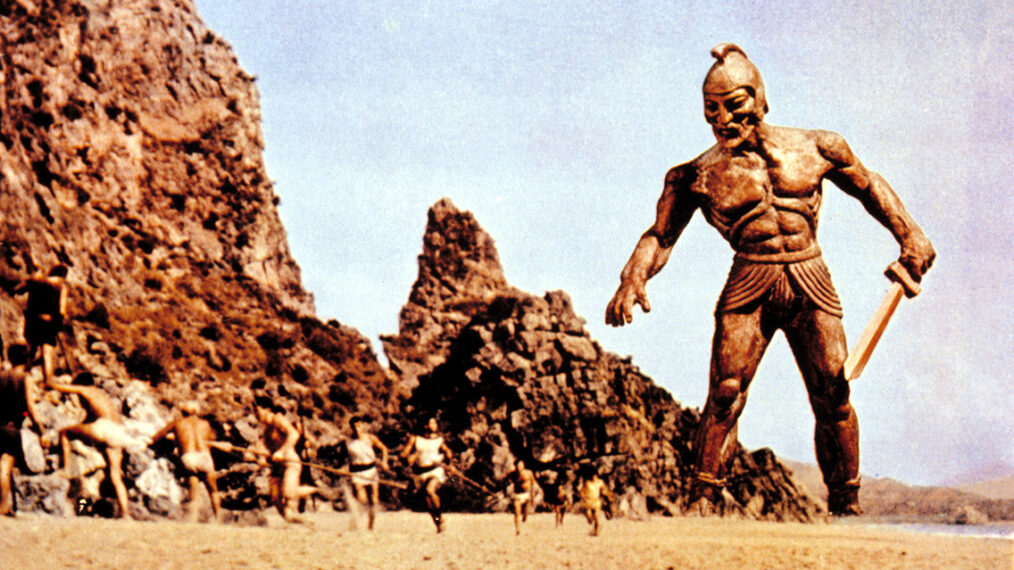
I’d be remiss if I didn’t mention Talos, one of the most famous examples of an automaton from Greek mythology, immortalized by divine wondersmith Ray Harryhausen (who could make inanimate matter appear to behave as if alive) in Jason and the Argonauts:

It’s super cool looking, a great part of a great movie, but I do have to point out that the tradition of Talos being a robot (and, actually, a giant) is not the whole story. In the earliest work in which he appears (the Argonautica of Apollonius, from ~3rd c. BCE), Talos is actually the last surviving member of the warlike Bronze Race who came before the current Iron Age people. It’s actually pretty eldritch when you think about it – an alien being from a lost world, the last of his kind, killable only through sorcery. It isn’t until a much later version of the story (from the 2nd century CE) that a writer says Talos was given to Minos by Hephaestus, suggesting that he was manufactured by the god.

These fantastical automata are fascinating, because they actually illustrate an important function of the whole idea of “automata” within the societies imagining them. There’s actually a really interesting literature out there about how these stories, a species of “science fiction” in the ancient world if you want to call it that, were received and how they influenced the history of technology in the Hellenistic world; it’s beyond the scope of this little free-form essay I’m writing, but there’s a great paper by Martin Devecka (“Did the Greeks Believe in their Robots” 2013, the Cambridge Classics Journal v.59) that makes the argument that these conceptual robots were an important part of the Greek world view, used to explore questions of work and slavery and contrast the world as it was with an idealized utopia. This is the same argument Aristotle made, by the way, and which Marx commented on in Capital v. 1; per Aristotle:

If every tool, when summoned, or even of its own accord, could do the work that befits it, just as the creations of Daedalus moved of themselves, or the tripods of Hephaestus went of their own accord to their sacred work, if the weavers’ shuttles were to weave of themselves, then there would be no need either of apprentices for the master workers, or of slaves for the lords.

(Marx, of course, disagreed with this rosy techno-positivist assessment, pointing out how “labor-saving devices” just resulted in more work for the worker, as demonstrated by the industrial revolution merely expanding the working day in the name of ever-increasing productivity).

Grecian mechanical knowledge was not merely mythic, of course; there were a lot of very advanced, very technically adroit thinkers working in the Hellenistic world, producing some really remarkable things. Ctesibius, a mathematician and engineer from 2nd c. BCE Ptolemaic Egypt is said to have basically invented pneumatics and hydraulics for use in things as widely divergent as pipe organs and water clocks; none of his work survivors, but he was a huge influence on later Greek mechanists, including Hero of Alexandria (1st or 2nd c. CE) who, in addition to inventing a rudimentary steam engine, also wrote a treatise on automata as wonders, describing robots that poured wine at banquets or that could be used in theatrical productions. He also documented and described automata for religious festivals, including a robotic Dionysius that was at the center of a major religious festival; this suggests that not only were his automata luxury objects for the parties of the rich, but that they existed in the public/civic/religious sphere as well, which is fascinating! Hero’s writing, which did survive, was later enormously influential on early modern European machinists.

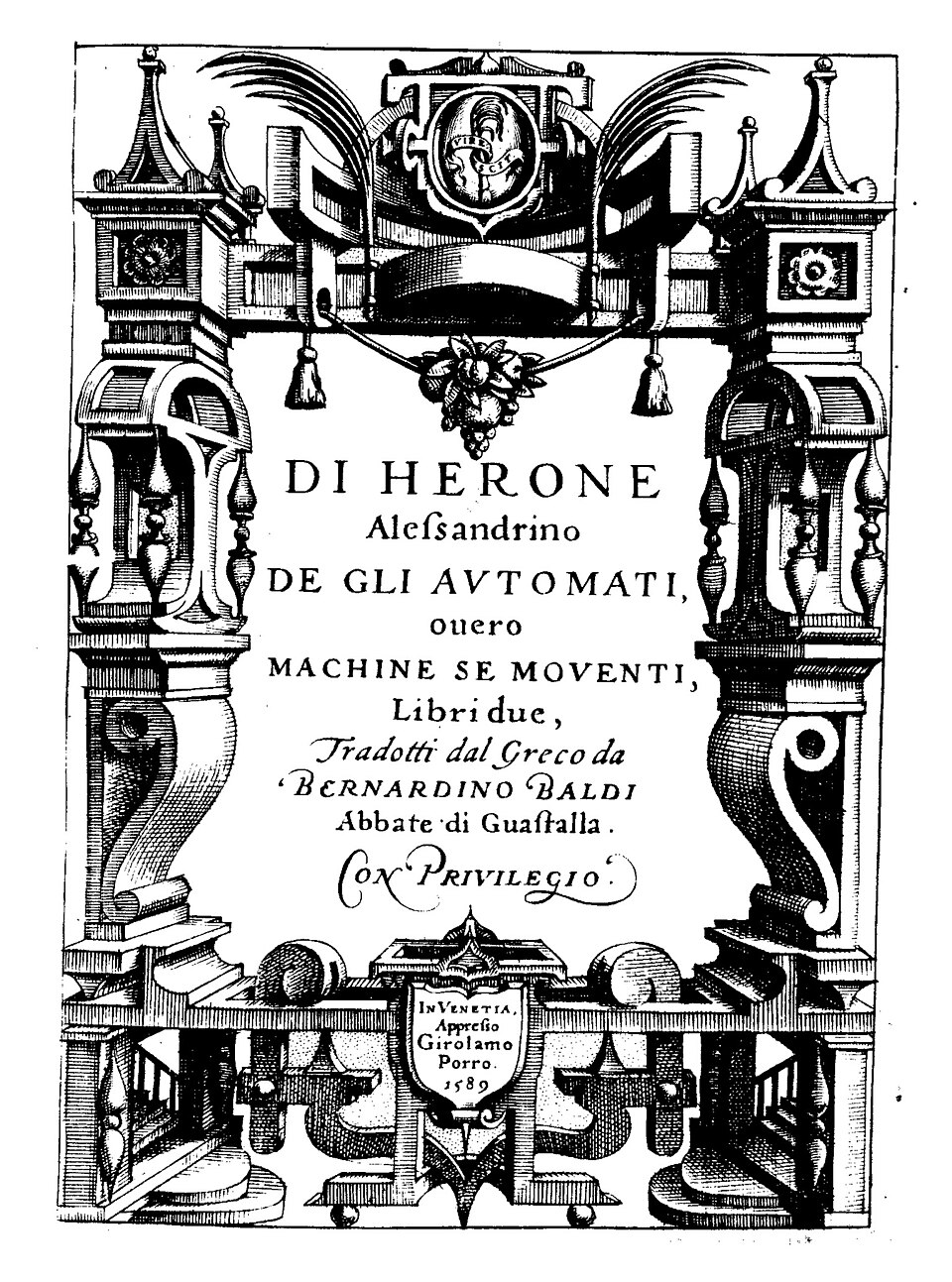
A 1589 edition of Hero of Alexandria’s book “About Automata”

Ancient Greek automata, if not necessarily common, seemed to be a least extremely well known. There’re a number of Greco-Roman travel writers who described the wonders of Greek robots, including descriptions of the city of Rhodes that makes it sound like an animatronic park – moving statues on every corner, mechanical fountains, water clocks, a kind of ancient world steampunk scene (sans steam, of course). The fame of Greek automata builders extended beyond the Mediterranean, too – there’s a tradition in northern India that the secrets of robot-building were stolen from the Greeks, brought home, and used to build an army of automata to guard the relics of Buddha (admittedly, most scholars believe this story arose out of Middle Eastern or Islamic sources in the middle ages, but still!)

The idea and, in some cases, literal existence of automata in the ancient world is an important predecessor to both the technical and conceptual developments of later ages; it lays the foundation for both the science and literature of subsequent life-like mechanisms. The technical writing on automata was preserved in Arabic and Persian sources, and would influence both the development of mechanical wonders in those cultures as well as become an important part of the Exoticizing Orientalism of later Western concepts of the “Mysterious East.” And, even if Europe lost access to the mechanical knowledge and skills of the ancient Greek artificers, there remained a thread of automata throughout their literature – the Alexander Romances, medieval retellings of the life of Alexander the Great liberally spiced-up with all kinds of fantastical elements, included a number of encounters with deadly automata, both human- and beast-like.

But what’s interesting is how, even where the ancient Greeks were musing on the social ramifications of automata in the workshop, there’s nothing really “weird” about them, you know what I mean? To use Todorov’s terminology, even when these automata are presented as killer robots built by mysterious artificers with secret knowledge, they largely remain merely “marvelous,” remarkable and possibly unique, but not *outside* the bounds of the world, as it were. It isn’t until much later, with the development of Enlightenment ideas about bodies and nature, that automata become uncanny.

The Uncanny Machine

Automata become weird when they stop merely mimicking life and start being mistaken for it. This blurring between the biological and the mechanical can only occur when you abandon the idea of some divine or numinous attribute, unique to life, that categorically and irrevocably separates life from non-life. In other words, when bodies begin to be conceived of as mechanisms, then mechanisms can begin to become bodies. In seventeenth century Europe, the development of modern science, with its rationalist approach to observation and experimentation, resulted in a new, mechanistic view of the world. And if planets revolved under the operation of physical laws and matter behaved with chemical predictability, then there must be sensical laws fundamental to the operation of the body too!

That’s actually a pretty radical idea, if you think about it. There had been theories of the body before, of course, and while we’re quick to scoff at humors and bleedings, they were a part of a largely consistent (if poorly informed) theoretical structure of how bodies were believed to work. But as medical and biological knowledge grew, guided by new techniques and instruments of experimentation and observation, a model began to form that analogized the human body with the operation of a mechanism. In particular, thinkers like Descartes and William Harvey explored the operation of the heart and its role in circulating blood, providing an important step forward in the material understanding of the operation of animal (and, by analogy, human) bodies. Descartes explicitly referred to the “animal-machine,” and used it as the basis for a new framework for life.

Hearts as pumps, lungs as bellows, eyes as lenses…and then it’s a short step to minds as material things, isn’t it? While we’re familiar with the Creationists’ argument about the Divine Watchmaker, it’s important to recognize that that rhetorical gambit only came about well into the 19th Century, when religion had had to cede so much territory to science already. In the 17th and 18th centuries, the Church (meaning all of Western Religion) was much less enthusiastic about all this mechanistic talk BECAUSE it seemed to remove God from the equation – after all, if bodies become explicable through purely material, mechanistic processes, then there’s no real reason to invoke the divine, is there?

(As an aside, if you’re interested in the topic of the development of this bio-mechanistic world view, including the role of automata in its development, I’d strongly recommend Jessica Riskin’s “The Restless Clock: A History of the Centuries-Long Argument over What Makes Living Things Tick” from the University of Chicago Press. It’s great!)

It was into this brave new world of men and machines that Jacques Vaucanson (the honorific “de” would be added later, in recognition of his achievements) was born in 1709. The tenth son of a glovemaker, Jacques was sent to study with the Jacobins in Grenoble and joined the Order of the Minims in Lyon as a young man; it was here that he learned the math, natural philosophy, and engineering that would serve him through his life. He left the Minims after his first attempt at automata was met with hostility, and he travelled to Paris to pursue his studies in mechanics. He learned anatomy from Claude-Nicolas Le Cat, a famous surgeon of the day, and developed a keen interest in the mechanical operation of the body from his lectures.

At the time, there was a bit of a fad around automata in Europe, though they were often displayed as toys or wonders of novel engineering, rather than as anything scholarly or profound. Vaucanson, however, envisioned the development of a machine that would mimic not merely the actions of a living being, but the processes too. His first famous automaton was a flute-player which he built in 1737. Rather than appearing to play the flute, the figure ACTUALLY played it, with a convoluted throat architecture that relied on a complex system of pumps to generate the differing air pressures necessary to change octaves on the flute. Furthermore, the figure actually pressed its fingers against the holes of the flute to play the notes it was programmed with; in order to achieve the necessary pliability, Vaucanson actually clothed the automaton’s hands in skin. This was no toy; scholars viewed it as a remarkable (and instructive) model of how a human being could play music, and an important lesson in circulation, breath regulation, and coordination. Indeed, the failings of the mechanism were even discussed as instructive, with an emphasis on how the subtle muscles of the lips and mouth must likewise operate.

Vaucanson’s interest in attacking the question of biological processes via analogy to engineering explains his most famous automaton (and the inspiration behind my little story): his famous “Digesting Duck.”

The Duck in the 1800s

This little guy was, simply, a small mechanical duck that dabbled around in a small pool, flicked its feathers, flapped its wings, ate corn from peoples’ hands…and then shat it out afterwards in neat, green little plops. And people fuckin’ LOVED it.

It’s easy to laugh about (because it IS kind of goofy), but people thought this was the most amazing thing they’d ever seen. Voltaire called it one of France’s singular contributions to the world, and it was discussed and written about all; Poe even discussed it in his essay “Maelzal’s Chess Player” (which is mostly about an exhibition of the famous “Turk” chess playing automaton). Why so much excitement over a shitting duck robot? Because, it was believed, Vaucanson had solved one of the truly great mysteries of life: digestion.

Think about it; people obviously knew you had to eat to live, but what exactly happened to the food once you mashed it up with your teeth and swallowed it down your gullet? How did it sustain life, and why was it eliminated from the body as waste? These are huge, fundamental questions about life, and here comes little Jacques Vaucanson with his shitting duck, apparently in possession of this remarkable secret.

Vaucanson positioned his duck as an instructive example of his scholarly knowledge on the subject; interestingly, much like the dinosaur I mentioned way back at the beginning of this little essay, Vaucanson’s Duck was presented naked, unfeathered and with (some of) the mechanisms visible, as a way of demonstrating both the subtly of his mechanical skill as well as the transparency of the operation. What was NOT visible, of course, was the way this “digestion” took place; this was because it was all a trick. Vaucanson would preload his duck with a mashed up lump of breadcrumbs soaked in green dye, which the duck would produce in the course of its normal operation.

In my opinion, I don’t think Vaucanson was really trying to pull one over on people – I think he probably really thought that he could, EVENTUALLY, figure this whole digestion thing out with more time and more effort. In this scenario, the Shitting Duck is a place holder for future work, a kind of mock up prototype or early draft that defined the problem without offering a solution. Just my two sous on the subject, of course.

In my story (available here!) I use this history, and the historical fascination with automata as models for understanding life, to push on the idea of Vaucanson’s little trick, and explore to what further (and extreme) ends it might have been deployed. Fantastical as it may be, it’s not too far off, because Vaucanson’s work with the duck was recognized as revolutionary; he was awarded a role as the inspector of silk works for France, a position that provided him ample funds and influence to pursue other work. These included an early prototype of the punch-card driven automated loom (which, 50 years after his death and perfected by Jacquard, would become a major part of the industrial revolution). He also invented the lathe, the “tool for making other tools” that was likewise of incredible importance in the history of technology. Finally, he also received a commission from the King of France to see if he couldn’t build an automaton that would mimic the circulation of blood in veins and arteries, which would lead Vaucanson to basically invent rubber tubing. All in all, the slightly skewed events of my story don’t seem that much out of character!

In many ways, it’s Vaucanson’s work, most especially with the duck, that changes the way automata are thought about and discussed. Before him, they were amusing if complex toys, clever feats of engineering to be sure, but not objects of existential contemplation. After Vaucanson, the question of what can and cannot be considered alive becomes something that can be asked and discussed; this is why Von Kempelen’s chess-playing automaton The Turk (built in 1770, long after Vaucanson’s Duck) became such a sensation. Von Kempelen never claimed that it actually “played” chess, nor did any of its later exhibitors, but people couldn’t help but look at it performing a complex, seemingly intellectual task, and ask “what is it To Think?” While the Turk, much like the Duck, is little more than a sophisticated side-show gaff, it forced people to confront the uncertainly around the division of life from non-life, and that’s when things can get weird!

Weird Automata in Fiction

The first modern weird automaton appears in the work of E.T.A. Hoffmann (1776-1822). Now, Hoffmann wasn’t the first modern writer to use automata in their fiction; François-Félix Nogaret had some in his “Le Miroir des événements actuels” from 1770, though they were of a much more “marvelous” sort than weird and menacing. But Hoffmann was the first writer to really understand and approach automata as objects steeped in uncertainty and ambiguity, and because of this, he’s had a prominent role in the literature since.

Hoffmann is an absolute favorite of mine; I think he was one of the rare authentic geniuses out there, a really epochal talent whose work radically changed the literary landscape. He had an enormous influence on Poe, actually, who read him in translation and who, on several occasions, explicitly tried to wrest outré literature out from under the shadow of German “phantasy.” In the preface of his Tales of the Grotesque and Arabesque (1840), Poe wrote:

I am led to think that it is the prevalence of the Arabesque in my serious tales which has induced one or two of my critics to tax me, in all friendliness, with what they have been pleased to call Germanism and gloom. The charge is in bad taste and the grounds of the accusation have not been sufficiently considered. Let us admit for the moment that the “phantasy pieces” now given are Germanic or what not. But the truth is that with a single exception there is no one of the stories in which the scholar should recognize the distinctive features of that species of pseudo-horror which we are taught to call Germanic for no better reason than that some of the secondary names of German literature have become identified with its folly. If in many of my productions terror has been the thesis, I maintain that terror is not of Germany, but of the soul.

To my eye, there’s a bit of protesting too much here from little Eddie Poe, but regardless I think we can very much see how, in 1840, the world of “phantasy” literature was dominated by German writers, including (and certainly at the top of the list), Hoffmann. And a dive into his automata stories shows why!

Hoffmann’s first automata story is, appropriately enough, titled “The Automata” (“Die Automate” auf Deutsch), which actually name drops Vaucanson and his pipe-playing robot. The story, first published in 1814 and later collected in “The Serapion Brotherhood,” is a fascinating piece, dealing directly with that very dynamic moment of epistemological revolution in science that we were talking about above. It’s a nested tale about a bunch of sensitive, educated German bros hanging out, investigating and arguing over the various different and new Ways of Knowing Things, basically. They’re introduced trying to use their Willpower to force a ring suspended on a string between them to move, and they go on to discuss the aesthetical implications of supernaturalism afterwards via an odd and portentous ghost story. It’s written with that classic Hoffmannian verve, simultaneously funny and mysterious.

The third nested tale is where we’re introduced to the titular automata. One of these Deutscher Bros, by the name of Theodore, has a fragment of a story he’s been working on and which he shares. It’s the tale of a group of German college bros (sensing a theme?) who go to visit a mysterious, marvelous robot being displayed in town, “the Talking Turk.” Now, this Turk (clearly inspired by von Kempelen’s chess-playing robot) is a kind of oracular automaton. People come up, whisper a question in its ear, and then the Turk speaks an answer back. This advice depends, of course, on the question; banal queries receive banal answers, but when prompted the Turk has become famous for seemingly possessing knowledge it cannot otherwise have had, and for having a deep and probing wisdom to boot! In fact, there’s an implication that the mechanism of the Turk is so finely tuned and expertly adjusted that it is able to access supernatural realms of knowledge – in effect, its machine brain is better than an organic one at using psychic power!

There’s a love story and a mysterious (and menacing) professor involved, and there is no real ending because, diegetically, it is a fragment of a story, but there’s a real sense of oddness and mystery about the Turk and the Professor and the Singing Woman, and a kind of brooding doom that is never resolved – it’s spectacular writing (come on, it’s Hoffmann) but the relevant thing is that Hoffmann is using the story to really explore what we now call “the uncanny valley.” First off, he has one character express his disgust at the idea of simulacra:

“All figures of this sort,” said Lewis, “which can scarcely ne said to counterfeit humanity so much as to travesty it – mere images of living death or inanimate life – are most distasteful to me. […] When I see the staring, lifeless, glassy eyes […] I feel disposed to cry with Macbeth ‘Thou hast no speculation in those eyes/ Which thou dost glare with.’ […] it is the oppressive sense of being in the presence of something unnatural and gruesome; and what I detest most of all is the mechanical imitation of human motions…”

I’ve excerpted the above from a much longer passage, but Hoffmann is really laying out a vision of the unsettling experience of seeing something that is almost-but-not-quite-right; he’s articulating one of the absolute cornerstones of modern horror, and he’s doing it with automata as the exemplars of this terrible eeriness in a story from 1814!

What’s ALSO amazing is how, again in 1814, Hoffmann is articulating a very modern anti-AI perspective in the voice of one of his characters:

“All that machine music…makes every bone in my body ache. I am sure I don not know when I shall get over it! The fact that any human being’s doing anything in association with those lifeless figures which counterfeit the appearance and movements of humanity has always, to me, something fearful, unnatural, and may I say terrible, about it. I suppose it would be possible, by means of certain mechanical arrangements inside them, to construct automata which would dance, and then to set them to dance with human beings, and twist and turn about in all sorts of figures; so that we should have a living man putting his arms about a lifeless partner of wood, and whirling round and round with her, or rather it. Could you look at such a sight, for an instant, without horror?”

(I’ll pause here to send you to another remarkable pamphlet, also available at Paradise Editions, that includes an essay by the inimitable Heinrich von Kleist, translated by Matthew Spencer, that offers an interesting counterpoint to this argument! You can even get it as part of an “AUTOMATON BUNDLE” from them!)

Hoffmann, via his character Lewis, continues expressing the anti-AI argument with a point that gets to the nub of much of the artistic arguments against slop today:

“The gravest reproach you can make to a musician is that he plays without expression; because, by so doing he is marring the whole essence of the matter. Yet the coldest and most unfeeling executant will always be far in advance of the most perfect machines. For it is impossible that any impulse whatever from the inner man shall not, even for a moment, animate his rendering; whereas, in the case of a machine, no such impulse can ever do so. The attempts of mechanicians to imitate[…] the human organs in the production of musical sounds […] I consider tantamount to a declaration of war against the spiritual element in music. […] I infinitely prefer the commonest barrel-organ, in which the mechanical attempts nothing but to be mechanical, to Vaucanson’s flute player, or the harmonica girl.”

As you can see, it’s a rich text…and it’s not even the only time Hoffmann talks about automata! Hoffman’s remarkable 1816 story “The Sandman” has an automaton that helps drive a man mad. Famously, this is the story that Freud addressed in his famous essay “The Uncanny,” citing an earlier paper by another German head-shrinker who described the unnatural and unsettling nature of Hoffmann’s girlbot Olimpia. (Freud, interestingly, actually argues that there’s nothing uncanny about Olimpia because there’s no ambiguity about her status as robot in the story. He, for obvious reasons, preferred to focus on Nathaniel’s childhood trauma.) I don’t want this to turn into a Hoffmann lovefest, so I’ll just recommend you read everything that Hoffmann ever wrote, or at least what’s been translated if you’re a monolingual dummy like me, because it really is foundational to both weird horror and science fiction (as well as being remarkable literature on its own).

There’re other important automata stories in the history of weird lit too. Auguste Villiers de l’Isle-Adam’s “L’Ève future” (“Tomorrow’s Eve” in the English translation) from 1880 is a very strange, very interesting, and very misogynistic piece of work; it’s notable for including Thomas fuckin’ Edison as a character, joining the ranks of Hoffmann’s Professor X______ and Mary Shelley’s Dr. Frankenstein as mysterious creator-figures in these kinds of stories. In particular, there’s a very unsettling part of Villiers de I’sle-Adam’s novel where Edison basically vivisects a fembot, very much akin to the kind of surgical presentations of Vaucanson’s day (which I included in my story), as well as a striking example of the unsettling effect a robot can have on our categories of life and what is acceptable to do to a living being. This is also importantly a story about sex and gender and reproductive roles, something that is always flitting around the edge of any robot tale, even when it’s not explicitly acknowledged.

Jerome K. Jerome, one of my favorite writers of all time, wrote what we’d call a weird story about an automaton on 1893, one that actually reflects on the “dancing partner” section in Hoffmann’s “The Automata.” It could’ve been inspired by Jerome having read it, for all I know; after all, he set his sequel to Three Men in a Boat in Germany, and his family hosted a famous Hungarian general (who certainly would’ve spoke German), so it’s possible he’d read Hoffmann. Anyway, JKJ’s story, “The Dancing Partner” is a fun “the dangers of automation” tale, but I think there’s some real uncanniness in story, particularly in the climax, when the robot is whirling its partner madly around the dance floor.

Leaping to 1899, another automaton story worthy of your consideration is “Moxon’s Master” by good ol’ Ambrose Bierce. This story opens with the line “Do you really believe machines can think?” and proceeds to not only explore “thinking” in the form of chess-playing, but also whether machines can feel and hate as well. It’s a fun, grim little tale, classic Bierce all around!

In those heady days before the ossification of genre, you can see the fun way automata let writers use both horror and wonder in their stories. The uncanniness of automata let writers unite terror and supernaturalism with the breakneck pace of science and technology, a powerful set of lenses to bring to bear on the world. As genre was born in the pages of the pulps, and science fiction became separated from weird fiction, there’s a little bit of a custody battle over robots that, ultimately, finds them slotted in with Sci-Fi.

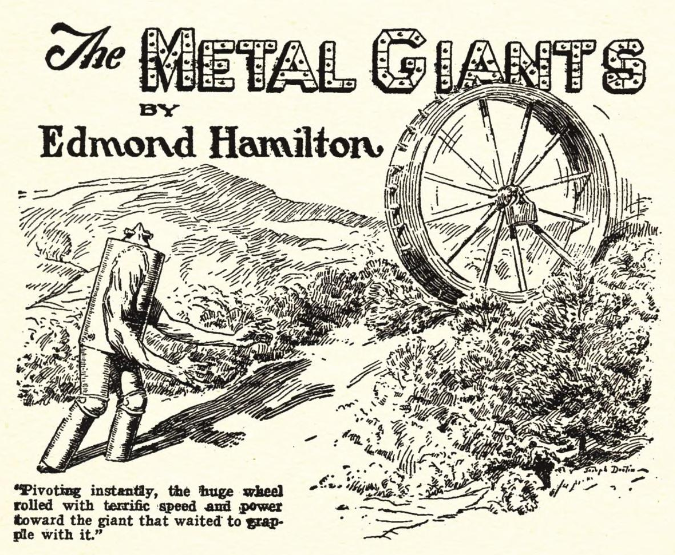
However, before all that got locked in, Weird Tales was actually trying to make an argument that “pseudo-scientific stories” belonged in *their* pages, and so we do occasionally run across an automaton tale in the magazine. One of these that I think is worth mentioning is Edmond Hamilton’s “The Metal Giants” from the December 1926 issue of Weird Tales.

Hamilton is an interesting character, one of the most prolific writers in Weird Tales who went on to become one of the early masters of big, bombastic space opera style sci-fi. He was popular with readers, though his style is often a bit affected for our modern tastes. But his origins in the pages of the Unique Magazine were something he never forgot – in even his most nuts-and-bolts sci fi stories there’s often a hint of cosmicism and weirdness in there somewhere.

And in “The Metal Giants” Hamilton really lands on something strange and interesting, I think. While the story is about giant robots, the real weird science aspect of the story is in the creation of the thing’s BRAIN. The inventor, some schmuck named Detmold, creates a totally artificial brain, and it’s here that Hamilton really lands on a fun bit of alien-ness. The brain, while obviously vastly intelligent, is totally inhuman and cannot truly communicate with us. The incommensurability of our evolved (and, Hamilton states, ensouled) brains with a machine, no matter how complex, is a really interesting idea, and not really one you see much of in sci-fi. Super potent A.I.s in sci-fi are often archly supercilious and capable of ridiculously powerful feats of intellect, sure, but they’re almost always portrayed as human-like, at least superficially. We can communicate with them, at least; not so here, where Detmold’s artificial brain is truly, awfully alien. It of course goes rogue and there’s lots of gee-whiz action, but the core of Hamilton’s story, about a machine brain being something fundamentally inhuman, is a really fun, interesting idea.

We’ve been explicitly talking about mechanical robots here, but in the realm of weird fiction there’s another class of artificial beings that are worth mentioning: the non-mechanical. There’s Frankenstein’s monster, a hugely influential figure in the literature, but there’s also Karel Capek’s R.U.R. to contend with; Capek invents the word “robot” in its modern usage, but his robots are biological, artificial beings built via the industrialized production of synthetic body parts. Perhaps most important, though, is the theme of revolt of the enslaved, artificial underclass, in the course of which the slave masters are actually rendered extinct by those they had brutally created for lives of drudgery and oppression. That sounds familiar, eh? Ever hear tell of a shoggoth?

I’m not sure Lovecraft read Capek, though it is possible he was at least familiar with the play – it was pretty famous, and by 1923 it had had a pretty successful and well-publicized run in translation in North America. But there is ANOTHER automaton that we KNOW Lovecraft appreciated…Gustav Meyrink’s THE GOLEM! Now, Lovecraft hadn’t read it by the time he wrote “At the Mountains of Madness,” but he HAD seen the movie in 1921 or so. What’s interesting is that the movie “Golem” is pretty different from Meyrink’s novel (which Lovecraft LOVED when he got to read it in ’35); the movie is much more of a monster flick, with a literal artificially created thing at the center of the story that, ultimately, revolts and causes all kinds of havoc in the Prague ghetto.

Of course, labor actions and violent revolt were pretty major stories of Lovecraft’s day – he looked with horror on the Bolshevik revolution in Russia, and was famously deeply offended by the social upheaval and implied violent unrest brought around by foreign workers moving into New England’s industrial towns, so his shoggoths and their eventual revolt are undoubtably sourced from lots of things. But it is interesting to note that they are, basically, automata – as presented, they’re biological robots, and one of their core functions is explicitly imitative (as wonderfully expressed by their piping “tekeli-li” sounds). Lovecraft even approaches some of the same questions that the previously mentioned automata do; it’s implied that all native life on earth came about as a result of these shoggoths, forcing us to confront questions of authenticity and “realness” as a species. In that, shoggoths are fulfilling the same rhetorical function as Hoffman’s Olimpia, Bierce’s Chess-Playing Robot, or Vaucanson’s shitting duck.

Conclusion

Well, this has gone on for a while, hasn’t it? That’s the danger (and pleasure) of free writing, I suppose. But I think automata are a topic worthy of even long-winded, meandering discussion. When I wrote Vaucanson’s Canard (what’s that? why yes, it IS available for preorder from Paradise Editions!) I was scratchin’ an itch I’d had for a while about ol’ Jacques and his weird duck machine, but the more I thought and read about it, the more I realized that there’s a lot to unpack about these mechanisms. Their place in the history of science and technology (and medicine) is a fascinating one, but they also represent important symbols of industrial automation and the role of people in both labor AND creation. There’re questions of agency and aesthetics and economics and, honestly, even metaphysics wrapped up in their clockwork bodies, and they’re worthy of serious study and contemplation.

In terms of the history of weird fiction, I think they’re as important a figure as the Vampire, for instance – Hoffmann’s automata mark a change in the world of the weird, and are as good a place as any to pin the invention of the unsettled, uncanny, uncertain type of horror that typifies one flavor of the modern genre. And, of course, their influence on science fiction goes without saying – the uses that writers like Dick or Asimov put their automata redefined the genre and changed forever the way speculative fiction approached questions of life and materiality and creation.

Finally, in these dark days of A.I. slop, there’s a lot to be learned from automatons both literary and literal. In a lot of ways, there’s something reflective of our own times in contemplating a mechanical duck presented as a wonder of the age that would revolutionize our world…but that is really just shitting out some secretly pre-loaded crap.

Robert E. Howard and Evolution

Having returned from Robert E. Howard Days up in Cross Plains, TX (where I was nominated for but did not win The Hyrkanian award, ah, c’est le awards), I find the ol’ skull is all a-swirl with a lot of REH/S&S these days. I’ll try and space it out (and maybe save some for my annual S&S celebration time around the Yule), but I think I’ve got to exorcise SOME of it now, so today I’d like to talk about a bit of science that undergirds Robert E. Howard’s fiction: evolution.

This was inspired by the 1998 REH biopic THE WHOLE WIDE WORLD, which was screened at REH Days, and which includes a very strange exchange between Howard (played extremely D’Onofriolly by Vincent D’Onofrio) and Novalyne Price (played extremely cute-as-a-buttonly by Renee Zellweger). The scene in question occurs at around the 53 minute mark or so (you can see it right here). The two lovebirds have just had a picnic where Howard tells Novalyne that his mom thinks she must have some “Indian blood” in her, maybe as much as “half Indian.” Novalyne, confused and amused, asks why Howard’s mom had thought that. There’s a cut and the two of them are in the car, with REH taking up the topic:

HOWARD: It’s the shape of your face. Do you know how much Indian blood you have?

PRICE: None that I know of –

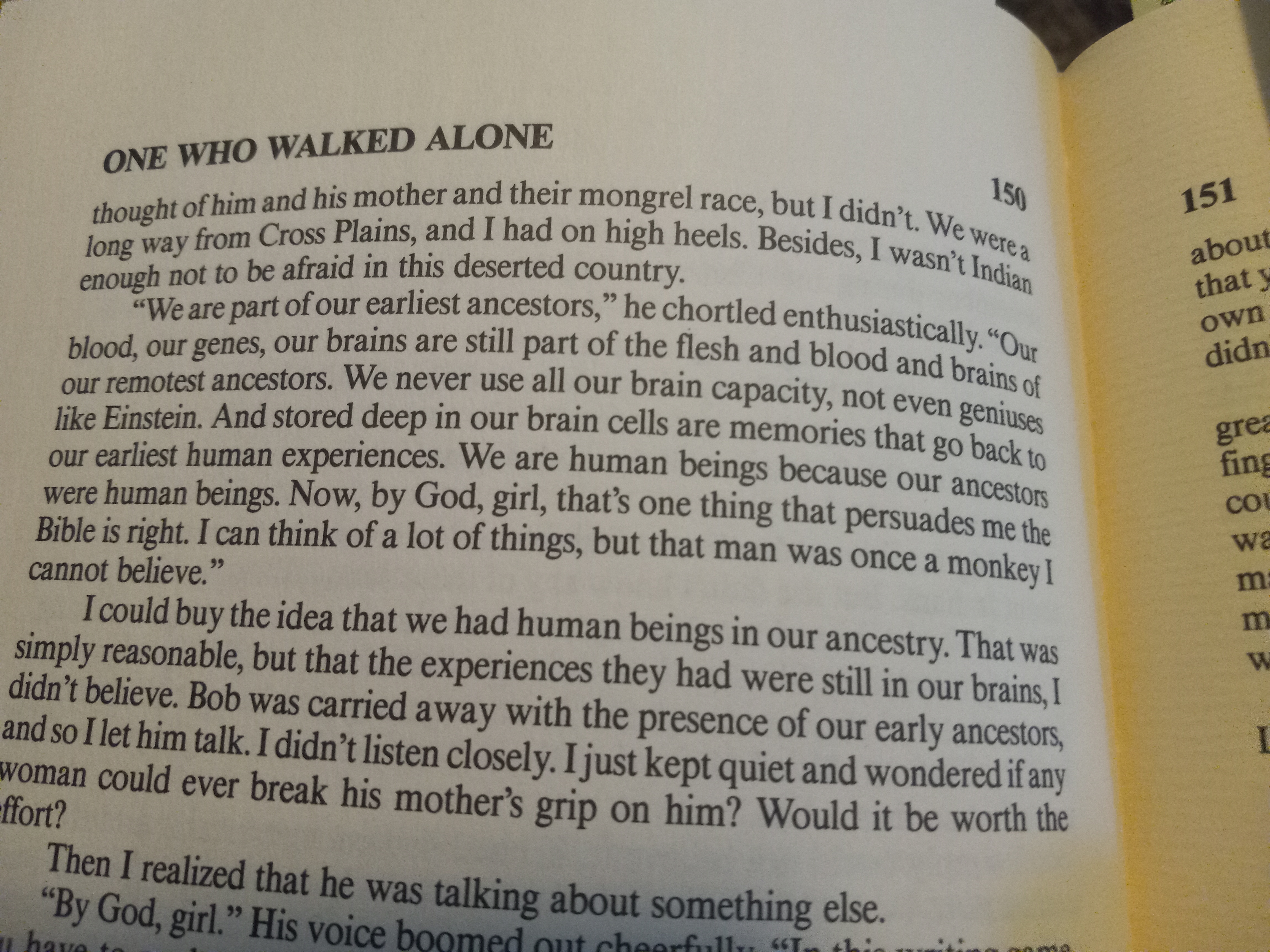
HOWARD: I bet you got a drop or two. We are human because our ancestors were human. That’s the one thing that persuades me that the Bible was right. I can imagine a lot of things, but I can’t imagine Man was once a monkey.

Now, there’s a lot of bonkers-ass shit to unpack in that short exchange! Setting aside (for the moment) the weird interest in race and miscegenation (one of Howard’s favorite topics in his fiction), the fact that the movie has Howard say that a) he believes in a biblically informed divine origin for humanity and b) the he “can’t imagine Man was once a monkey” is absolutely crazy, something totally incommensurate with both his fiction as well as many statements in his letters to different people.

When I got back home, I broke out my copy of Novalyne Price Ellis’s One Who Walked Alone, her memoir of her couple-o-years-long relationship with REH, written in 1986 and the source for much of the movie. Perhaps, I thought, the movie had invented the exchange for some strange reason? Afterall, coming out in ’98, the movie would’ve been right smack in the middle of one of the big Creationist waves that periodically sweep this benighted nation – perhaps they’d felt the need to situate Howard, a southerner through and through, within a comfortable southern archetype? But, there on page 150 of my copy of the book (the edition w/ Renee Zellweger on the cover), was the exact lines:

Again: this is insane. There is no possible way to reconcile this statement, that REH was a bible-believin’ Creationist, with the fiction he wrote, where the centrality of evolution is key, not merely to the biological nature of individuals, but to whole civilizations and cultures! Similarly, it is contracted directly by his own words in his letters! So let’s take a look!

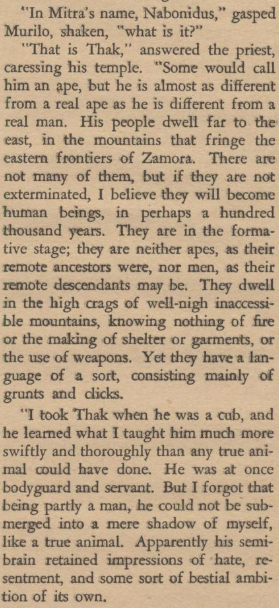
The first and most obvious counterexample in REH’s fiction is in the Conan story “Rogues in the House.” This was published in the January 1934 issue of Weird Tales, so it appeared not that far in time from when the weird exchange in the movie is supposed to have happened. In it, Conan is engaged by a patriotic rebel to help kill the vile Red Priest Nabonidus (who is, basically, the scheming and clever Cardinal Richelieu from “The Three Musketeers”). In the course of infiltrating his death-trap of a house, they learn that something is amiss – one of Nabonidus’s servants, an ape-man named Thak, has taken over the compound, dressing in his robes and using his crude but effective knowledge of the various death-dealing mechanisms in the house to kill all comers. When the heroes get their first good look at Thak (via a series of complex mirrors), we get introduced to Thak’s history by the Red Priest:

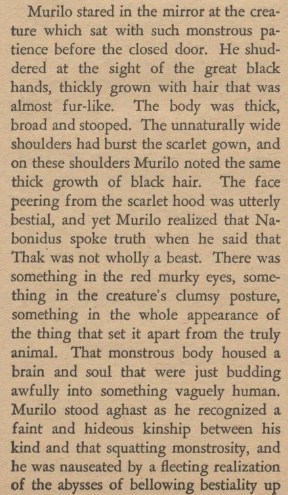
Later, when Murilo, the rebel instigator, gets a good, long look at Thak’s face, Howard takes the opportunity to further underline the proto-humaness of Thak:

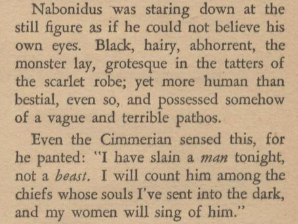
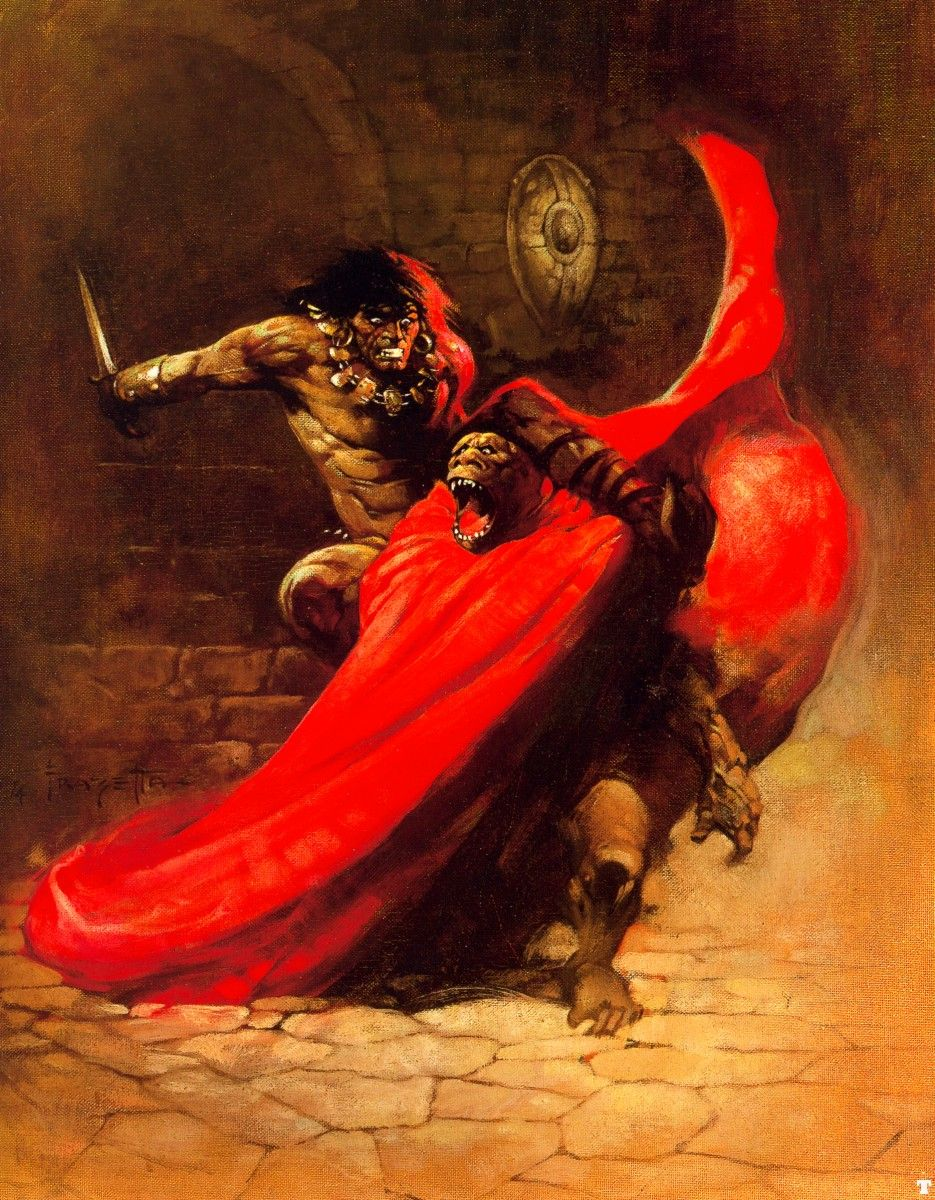
Thak is explicitly portrayed as part of a chain of beings leading progressively towards a kind of archetypal humanity, one that furthermore (and most horribly) suggests to Murilo that humans themselves had experienced just such a stage of life in the distant past. Howard revisits Thak’s fundamental and evolutionarily-informed idea of “human-ness” in the climactic battle between Conan and the ape-man, making sure we understand that this is not merely an ape, but a sentient being close to our own “kind.”

Let us pause briefly to admire Frazetta’s portrayal of this fight in one of his inimitable paintings:

Badass.

The important thing about Thak is that he is explicitly positioned within an evolutionary context – Nabonidus, while certainly a villain, is also portrayed as a deeply and indeed uniquely profound thinker for his age, and we are meant to take his insights into the evolutionary history and potential of Thak at face value. Furthermore, Thak’s ambitions, his wearing of the robe, and his usurpation of Nabonidus in his own home are not mere apings; rather, Thak is possessed of a sense of self and of others that is human-like, a result of his heritage as a kind of developmentally and evolutionarily intermediate man-ape.

This interest in evolution and the deep history of humans in geological time isn’t anything new for lil’ Bobby Howard either – way back in 1925, his very first professionally published story in Weird Tales (“Spear and Fang”) was all about the conflict between Cro-Magnon and Neanderthals. There is no room within a strict, fundamentalist worldview for different members of the genus Homo to be waging war on one another. Interestingly, for all its eventual violence, the story begins with a Cro Magnon character making cave paintings of extinct animals, a scene placing art, an aesthetic sensibility, and an appreciation of beauty explicitly within an evolutionary framework. But, like so many of Howard’s ancient wildernesses, this is no Edenic garden; it’s a savage and brutal landscape where violence and survival are the engines of evolution.

Indeed, over and over again, Howard portrays the past as a grim evolutionary climb, calling out specifically the rise from apedom to semi-apedom and, eventually, full humanity. In fact, taking cues from both contemporary geological literature as well as esoteric theories of human history, Howard makes these events explicitly cyclical – Kull’s Atlanteans rise from apehood into their barbaric splendor, only to be hurled back again down the evolutionary ladder by their Age’s terminal cataclysm; slowly they rise to become fully human again in the fullness of geological time where, it is implied, they become the Cimmerians. Bran Mak Morn’s Picts are likewise a people with a long and troubled past that stretches into prehistory, and Atla, the were-woman of Dagon Moor, explicitly tells Bran that the Worms of the Earth could’ve been people, were very nearly human in fact, when the Picts drove them back into atavism and subterranean degeneracy. This sort of evolutionary thinking is integral to Howard’s fiction, both mechanically as part of plots as well as conceptually, as something key to his worldview.

Howard’s exposure to evolutionary thinking can be traced from two sources. The first is in the books he owned and which, on his death, were donated to the Howard Payne University library by his father. This collection, originally something approaching 300 books, was eventually taken out of special collections and put into general circulation, the result being that there are now less than 50 or so actual books left due to loss, theft, etc. However, a group of dedicated workers over the years have put together the original accession list and chased down references in Howard’s letters, meaning we now have a pretty decent idea of the books available to REH in his home. For more on this incredible work (including a handy history), and to peruse the book list, check out The Robert E. Howard Booklist!

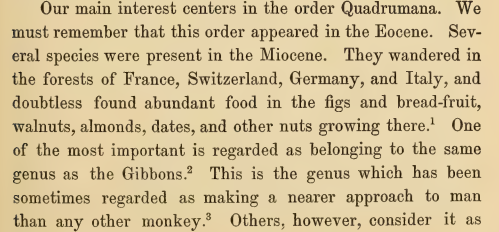
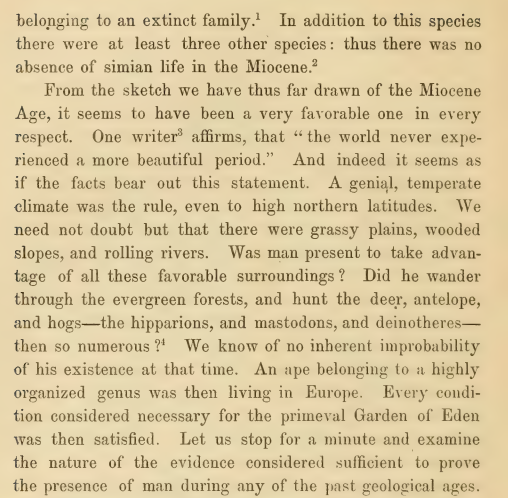
To cut to the chase there’s one book in particular that is extremely relevant on the list: E. A. Allen’s The Prehistoric World or, Vanished Races originally published in 1885. It’s an odd and interesting book, actually; Allen, while an obscure writer now, was a prolific popularizer of natural history, with a particular interest in anthropology and ethnography. The book that Howard owned is a helluva doorstop, 800 pages or so, that begins in prehistory and moves through the iron age in Europe before leaping over to the Americas, with chapters on the Mound Builders, on the Nahua, on the Maya, etc. It’s a remarkably interesting historical document, a snapshot of both the broadly consensus natural history scholarship of the day as well as the then popular “stadial” version of anthropology (a decidedly progressivist and positivist framework that placed “civilizations” in a developmental hierarchy; guess what sort of people were on the top?). Honestly, I suspect this books is enormously important to a lot of Howard’s thinking and writing, but I want to focus on the second chapter “Early Geological Periods.”

This chapter is a kind of speed run through geology and paleontology, giving the reader a thumbnail of 1880s vintage earth science. There’s some great bits in there, especially if you’re interested in the history of geology – this is, after all, a pre plate tectonics world, and so there are some amusing gaps in both the interpretations and the detailed stories. However, this book IS firmly post Darwin (Origin of the Species was published in 1859). That means evolution is front and center:

Like I said, there’s some fun goofy stuff in there – the old-ass taxonomic term “Quadrumana,” a paleobiogeography that predates the Out of Africa model of human origins, and the to-us-now shocking attempts to extend the presence humans back to the Miocene! (just for context, Allen’s work of course predates radiometric dating [it predates the discovery of radiation, in fact] so they’re using a relative chronostratigraphic approach; even so, a Miocene origin is wild! The Miocene *ended* ~5 million years ago, and the oldest extant example of the genus Homo is 2 million years old!) But this section is interesting when compared to the “Rogues in the House” excerpt. Here, a Miocene primate is explicitly stated to have made “a nearer approach to man than any other monkey,” which sounds very much like what Nabonidus said of Thak. Later in the passage Allen refers to a “highly organized genus” (meaning “evolutionarily advanced”) of ape as living in the Edenic Europe of the Miocene. Non-humans “ascending” towards humanness in the fathomless depths of time – this is extremely REH’s bag, you know?

It’s a bit too much to get into now (though it’s a topic I’ll definitely be returning to in the future) but there’s another relevant library in the Howard household that bears on this discussion – his dad’s bonkers collection of esoterica! That Howard was familiar with at least a popular gloss of Theosophical concepts is obvious from his work; the ideas of cyclical catastrophes, of the struggle of “root races” to ascend the ladder of progress over and over again, these concepts out of Theosophy are probably just as important as his understanding of geology and biology. Of course, the reality is that the Theosophists were actually responding to the science of day, drawing their myths and mysticism out of the mid-19th century scientific milieu the same as Allen (and everyone else). Geological catastrophism, deep time, sinking and rising lands (like Lemuria!), comparative religion, all of these ideas were taken out of their scientific and scholarly context and massaged into a new mystical quasi-religion, one that Howard’s dad was EXTREMELY well read in. But that’s for another post!

Leaving the Howards’ libraries behind, there’s an even more direct source for REH’s views on evolution we can tap: his letters! Thanks to the tireless effort of a bunch of editors, we’ve got an embarrassment of riches when it comes to the letters of REH. And, given the voluminousness of his correspondence, there’s a lot to choose from! Let’s hit a big one right away:

Let us consider the insect Man. How many specimens of this creature are willing to believe that they came from the same root stem as the elephant, the garter snake and the leopard? No, they must have a special creative act, a special Divine process to account for their godlike beings – bah, either Haeckel’s right and there is no such thing as a “soul” in the accepted sense or else everything has a soul, whether organic or inorganic. Let the theologians seek to refute the theory of spontaneous generation all they wish – I admit it is rather difficult to grasp in a cosmological sense, but biologically speaking, the scientific world has as a whole, I think, accepted the unicellular theory as a positive fact. The facts boiled down are these: theology must accept evolution both in ontogeny and in phylogeny if it accepts geology.

REH to Tevis Clyde Smith, March 1928, The Collected Letters of Robert E. Howard, volume 1: 1923-1929, Rob Roehm and John Bullard (eds)

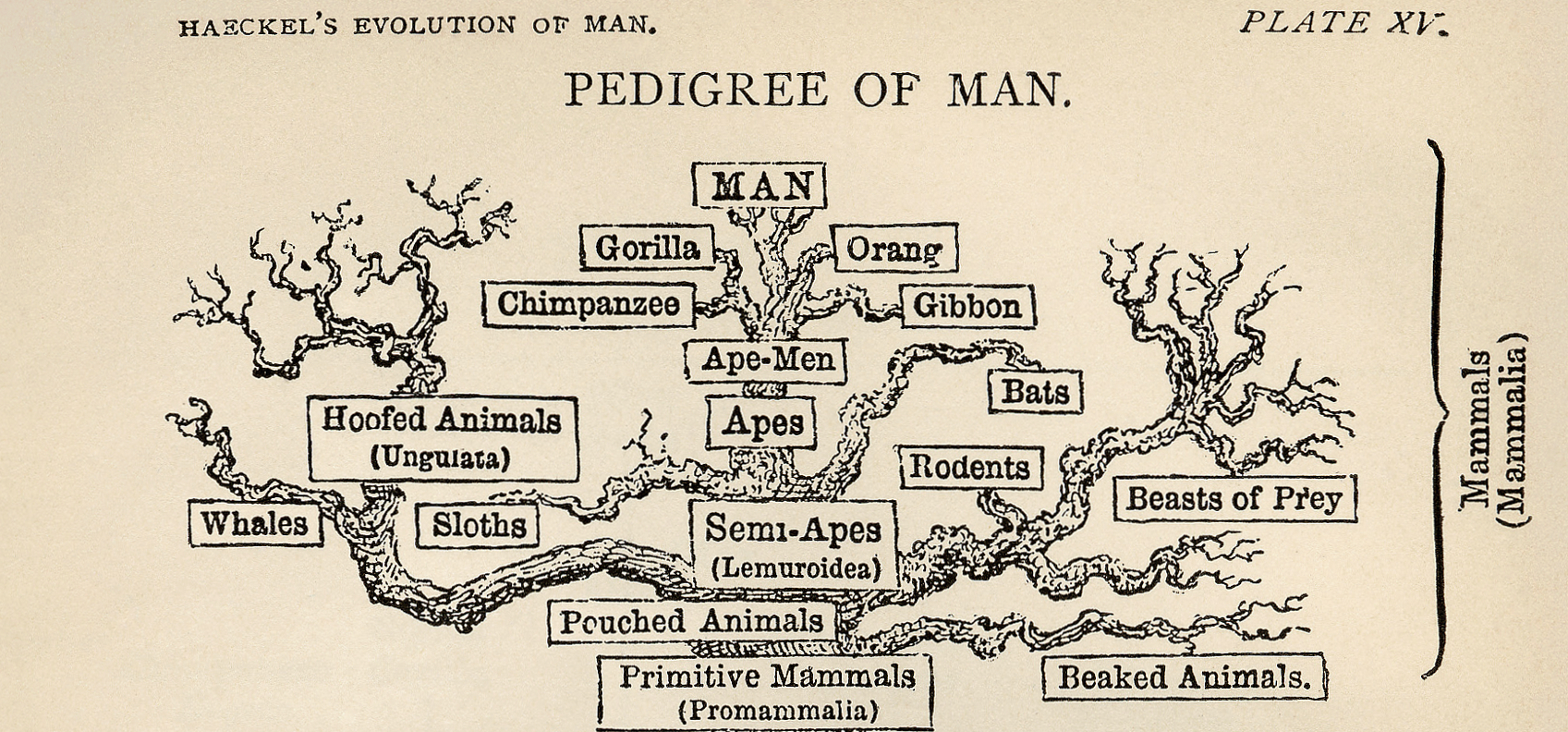
That’s a pretty definitive statement, and one completely antithetical to the quote from the movie. Howard is 100% rejecting a special creation for humanity (and, indeed, for all of life). The “spontaneous generation” he’s referencing is not the “flies from meat” thing you might’ve heard about, but rather the idea of life originating on its own from inorganic matter via natural processes in the deep past. This, in particular, was one of Haeckel’s (many) research interests – taking up a topic that Darwin himself had not dealt with, he posited that highly organized but inorganic matter (like crystals) may have given rise to simple organic life, the “unicellular theory” REH mentions later. Howard is also explicitly rejecting biblical authority on theological matters in this letter too – theologians have to reckon with Haeckel’s biogenic law as well as the reality of Deep Time, rather than the other way around!

The prominence of Haeckel in Howard’s thinking is fascinating, and it’s something I’d never appreciated until I read his letters. He’s easily the biologist most mentioned by REH, and he seems to have seriously engaged with ol’ Ernst pretty heavily at some point (though, in a later letter to Lovecraft, he admits that he’d forgotten a lot of about the details of his work). Presumably, his exposure to Haeckel was in school, where Howard was part of a “science course” which, presumably, operated as a kind of theme or special focus in his curricula. It’s striking the effect it must’ve had on Howard; Haeckel comes up a lot (alongside famous scientific racist Herbert Spencer), whereas Darwin is mentioned only once…in a list of people who have “grasped the cosmic” that also includes Haeckel and Spencer and Huxley. What’s interesting in particular is that in addition to Haeckel’s biological and evolutionary work (he was a major popularizer of Darwin), REH seems enamored of Haeckel’s strange brand of monism, which provides a kind of romantic and pantheistic underpinning to the natural world (in opposition to a strictly materialist view). This same kind of vaguely mystical biology is something also seen in Herbert Spencer, another of REH’s favorite thinkers – he in particular seems to enjoy Spencer’s ideas of the “Ultimate Unknowable,” which much like Haeckel leaves room for some sort of ineffable energy or drive behind the mechanical operation of the universe and life.

Of course, the other things that Howard undoubtably took from both Haeckel and Spencer were their scientific racism and polygenism. Both men were, like many people of the age, eugenicists; Spencer, who as mentioned above was name-checked by REH a lot in his letters, originated the term and idea of “Social Darwinism;” he also coined the term “survival of the fittest,” an obvious and important part of Howard’s philosophy and ethos. Additionally, Haeckel was a vocal and powerful proponent of scientific polygenism, the idea that the various human races arose separately from different ancestors and at different times. In fact, part of Haeckel’s theories about the origins of life, the “spontaneous generation” mentioned in the letter, was that life itself was potentially polygenetic, having arisen multiple times out of inorganic matter on earth. While REH never outright states his support for polygenist views in his letters, the idea is clearly present in his fiction – there are multiple examples of different “races” rising up out of semi-apedom into humanity in his essay “The Hyborian Age,” for example, and the idea is implicit in the way he writes about Thak and the Worms of the Earth. It’s probably also a part of his horror of miscegenation: Howard clearly believes that there is something fundamentally biologically wrong with race-mixing, in addition to the moral decadence that he felt it represented.

It’s worth taking a look at Haeckel’s visual representation of this idea, because it’s a subtle but important point that illustrates REH’s thinking. The below figure is a portion of a plate from the English translation of one of Haeckel’s books, his 1879 Evolution of Man:

A few things are worth noting here: first, the placement of MAN atop the tree, crowning the progressive hierarchy implicit in the history of life. More important, however, is the very subtle way Haeckel conveys his idea that the human races arise out of different ancestors. A forking branch proceeds from APE-MEN, with single branches leading to GIBBON, ORANG, etc. But then look at the MULTIPLE BRANCHES (six of them!) leading into MAN. Like I said, it’s a subtle but very important point with some extremely unpleasant implications, namely that the various races of humans represent distinct biological species arising out of a common ape-man ancestor. It’s foul stuff, but it’s also recognizable as a very common belief among people in Howard’s time, and within Howard’s work; put “Cimmerian,” “Stygian,” “Hyborian,” etc on each of those branches and you’ve got a good representation of Howard’s ideas.

Another letter, this one part of the interminable HPL-REH Civilization-vs-Barbarism running gun battle that they had for years and years, interestingly provides some insight into Howard’s opinion of religious anti-evolutionists. The context of this short excerpt from their (unending and tedious) argument focuses on HPL’s view that REH doesn’t hold artistic endeavors in as high of esteem as he should. Regardless, the relevant section is interesting as regards our topic here today:

Between the fundamental religionist who goes into foaming rages over the idea of evolution, because he can not stand the thought of kinship with a monkey, and the artists who strains his guts to prove his distance from the protozoa, I see no basic difference; both seem outcroppings of the idea concerning the divinity of man.

REH to HPL, September or October 1933, letter 259, The Collected Letters of Robert E. Howard Volume 3: 1933-1936, Rob Roehm and John Bullard (eds)

It’s a pretty funny statement; I love to imagine a tortured poète maudit weeping over the need to distinguish themselves from protists in the eyes of the posterity. But it’s also a helluva rejoinder to the weird statement from Novalyne’s memoir and in the movie, isn’t it?

One last letter excerpt, because they’re fun and more people need to read ’em! This one is from a letter to August Derleth, and in addition to its relevance to our discussion here, it is also one of those great examples of REH really playing up rurality for his non-western interlocutors:

A friend of mine was trapping once […] He thought he had a muskrat and climbed carelessly up and stuck his head over the ledge, and there was a skunk in the trap and it let him have a full volley smack in the face […] My friend fell off the ledge with an ear-splitting shriek and rolled on the ground for some time after the exact fashion of a hound-dog […] Nobody could doubt evolution after watching the antics of a man who has just been slapped in the mush by a polecat.

REH to August Derleth, July 4 1935, letter 319, The Collected Letters of Robert E. Howard Volume 3: 1933-1936, Rob Roehm and John Bullard (eds)

In addition to just being a funny story, it also shows how, even beyond the eugenicist background of his thinking, Howard’s worldview (and his fiction) was founded on an philosophical framework of what was “natural,” a view informed strongly by a belief in evolution. There’s also present the idea that this “naturalness” reflects the fundamental biological order of the world – a man, for all his sophistication, is no different than a dog when confronted with the same problem (of getting their shit rocked by a pissed-off skunk). There’s really no way to imagine Robert E. Howard without a belief in evolution – the idea is as central to his work and worldview as it is for Lovecraft, and having him question it in the movie (rejecting it in favor of the bible even!) is truly bizarre!

So what’s going in Novalyne Price Ellis’s memoir, One Who Walked Alone and the movie it inspired? Well, there’re a few options, I reckon:

1 – Novalyne Price made it up whole cloth. It’s a possibility, certainly – as described by Bobby Derie the creation of One Who Walked Alone remains opaque, with the author dead and her notes and materials unavailable, leaving us merely with the book. A key motive for Price writing it was to counter negative portrayals of Howard; perhaps she felt a definitive statement of belief in the Bible was important (including a statement of Creationist faith) and so inserted it into the narrative. As far as I can tell, we don’t know anything specific about Novalyne Price’s religious leanings, though she does write about attending church and believing in God (and in everyone’s right to worship God in whatever way they see fit) in the book. But who knows? An older Southern lady writing in the late 70s-80s, she very easily could’ve held Creationist beliefs, and decided to put REH in the camp of the angels. Without access to her diaries and journals, we’ll never know! But this is clearly the very darkest option – it puts her memoirs, as a source of sincere recollection, into *very* shaky, shady territory!

2 – Novalyne Price misunderstood/misinterpreted something REH had said. Reading Price suggests (to me at least) that she *thought* she understood REH better than she actually did. There’re numerous places in the book where she seems to be confused by what is, plainly, REH making a joke or poking fun or being ironical. Additionally, Howard could clearly be kind of a combative asshole, picking at people or arguing for argument’s sake. The exchange in the book is actually a good deal more contentious than is presented in the movie; Howard, at least to my reading, absolutely understands that his mother was talking shit about Novalyne, and he’s getting a kick needling her and watching her reaction (a very common thing in the book). If so, the odd statement about the bible and creationism becomes legible as just more of REH’s situational weirdness, where he’s trying to offer biblical support for his position, knowing that it’d annoy her.

3 – REH said it because he thought it was something Novalyne wanted to hear. Like I said, the discussion around miscegenation that REH and Price are having is a bit of a strange, heated one. Maybe Howard wanted to change the subject, or in the moment felt like he was offering an olive branch by claiming to be a bible-believer (something clearly important to Price, from sections elsewhere in the book). It would mean he was straight up lying of course, since his letters seem to make his position very clear. Also, it’d be an odd moment of him backing down too; he seemed to love scrapin’ and arguin’ with Novalyne in particular!

4 – REH said it because he believed it. The weirdest and hardest-to-swallow option, but there it is. We contain multitudes, and maybe Howard had had a strange religious epiphany. I knew a devout Mormon paleontologist who described his life this way: six days of the week, he believed in evolution and geochronology and the fossil record, but on Sunday, he didn’t. Maybe Howard separated himself from his work like that, though that seems extremely unlikely given the whole “he put a bit of himself into everything he wrote” paean from Lovecraft and all. It’s again also a statement completely at odds with his own words, both fictional and in his letters!

As to which one it is, who the Hell knows? What I think is very certain, however, is that contrary to the statement reported by Price, Howard absolutely believed in evolution. In particular, the concept was central to his whole world view, both in his life and in his work. This is not to say that he had no religion; the scientists from whom he had drawn his understanding of evolution, Ernst Haeckel and Herbert Spencer, were themselves certainly not atheists; both of them believed in a kind of pantheistic drive that, while operating within the realm of the mundane and through the laws of biology and physics, nonetheless held something of wonder and, if not divine, then at least something more-than-mechanistic about it. Given his father’s own unusual religious milieu, something like that, a combination of Haeckelean monism with pop Theosophy, makes a lot of sense. Afterall, Jesus was an Ascended Master in a lot of New Age religious movements, so there’s even room for a (nondenominational) kind of appreciation for the Bible in there.

What there ISN’T room for is creationism – time and time again, the centrality of evolution to Howard’s writing is made abundantly clear. The battle between Cro Magnon and Neanderthal at the dawn of human history, the punctuated cataclysms of Howard’s Atlantis and Hyboria, the aspirational evolutionism of Thak and the thwarted phylogenetics of the Worms of the Earth, all of these are just as much evidence for Howard’s deep commitment to the reality of evolution as are his literal statements of the same in his letters.