Category Archives: Uncategorized

Robert E. Howard and Evolution

Having returned from Robert E. Howard Days up in Cross Plains, TX (where I was nominated for but did not win The Hyrkanian award, ah, c’est le awards), I find the ol’ skull is all a-swirl with a lot of REH/S&S these days. I’ll try and space it out (and maybe save some for my annual S&S celebration time around the Yule), but I think I’ve got to exorcise SOME of it now, so today I’d like to talk about a bit of science that undergirds Robert E. Howard’s fiction: evolution.

This was inspired by the 1998 REH biopic THE WHOLE WIDE WORLD, which was screened at REH Days, and which includes a very strange exchange between Howard (played extremely D’Onofriolly by Vincent D’Onofrio) and Novalyne Price (played extremely cute-as-a-buttonly by Renee Zellweger). The scene in question occurs at around the 53 minute mark or so (you can see it right here). The two lovebirds have just had a picnic where Howard tells Novalyne that his mom thinks she must have some “Indian blood” in her, maybe as much as “half Indian.” Novalyne, confused and amused, asks why Howard’s mom had thought that. There’s a cut and the two of them are in the car, with REH taking up the topic:

HOWARD: It’s the shape of your face. Do you know how much Indian blood you have?

PRICE: None that I know of –

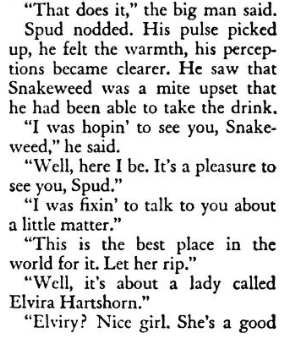
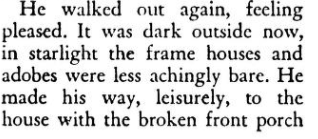
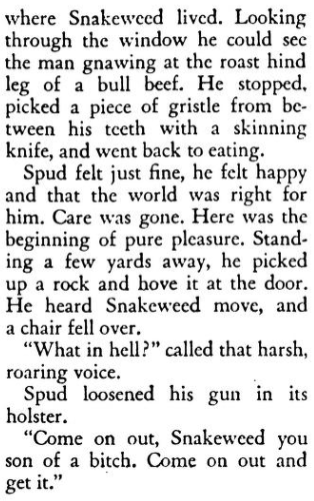
HOWARD: I bet you got a drop or two. We are human because our ancestors were human. That’s the one thing that persuades me that the Bible was right. I can imagine a lot of things, but I can’t imagine Man was once a monkey.

Now, there’s a lot of bonkers-ass shit to unpack in that short exchange! Setting aside (for the moment) the weird interest in race and miscegenation (one of Howard’s favorite topics in his fiction), the fact that the movie has Howard say that a) he believes in a biblically informed divine origin for humanity and b) the he “can’t imagine Man was once a monkey” is absolutely crazy, something totally incommensurate with both his fiction as well as many statements in his letters to different people.

When I got back home, I broke out my copy of Novalyne Price Ellis’s One Who Walked Alone, her memoir of her couple-o-years-long relationship with REH, written in 1986 and the source for much of the movie. Perhaps, I thought, the movie had invented the exchange for some strange reason? Afterall, coming out in ’98, the movie would’ve been right smack in the middle of one of the big Creationist waves that periodically sweep this benighted nation – perhaps they’d felt the need to situate Howard, a southerner through and through, within a comfortable southern archetype? But, there on page 150 of my copy of the book (the edition w/ Renee Zellweger on the cover), was the exact lines:
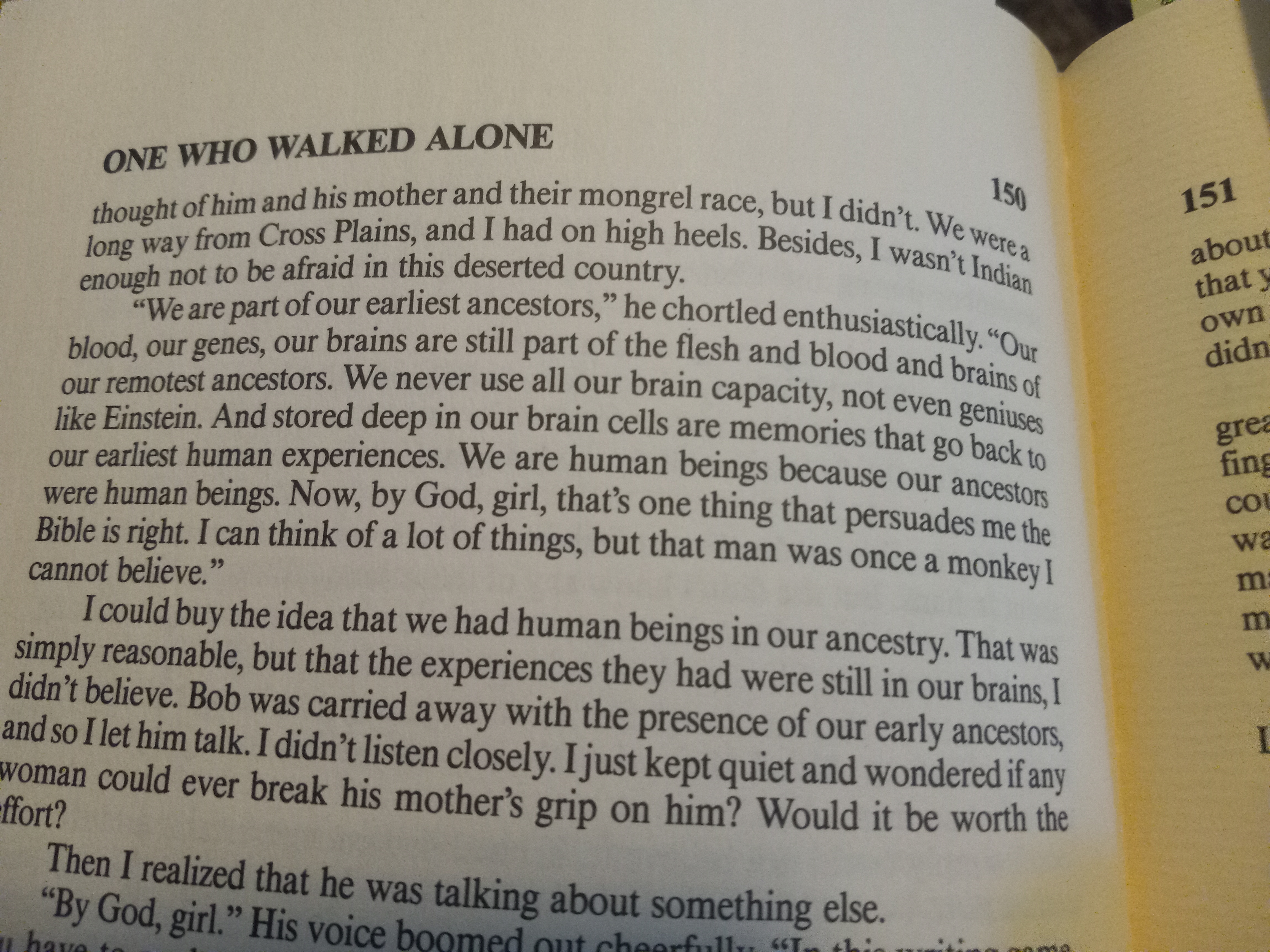
Again: this is insane. There is no possible way to reconcile this statement, that REH was a bible-believin’ Creationist, with the fiction he wrote, where the centrality of evolution is key, not merely to the biological nature of individuals, but to whole civilizations and cultures! Similarly, it is contracted directly by his own words in his letters! So let’s take a look!

The first and most obvious counterexample in REH’s fiction is in the Conan story “Rogues in the House.” This was published in the January 1934 issue of Weird Tales, so it appeared not that far in time from when the weird exchange in the movie is supposed to have happened. In it, Conan is engaged by a patriotic rebel to help kill the vile Red Priest Nabonidus (who is, basically, the scheming and clever Cardinal Richelieu from “The Three Musketeers”). In the course of infiltrating his death-trap of a house, they learn that something is amiss – one of Nabonidus’s servants, an ape-man named Thak, has taken over the compound, dressing in his robes and using his crude but effective knowledge of the various death-dealing mechanisms in the house to kill all comers. When the heroes get their first good look at Thak (via a series of complex mirrors), we get introduced to Thak’s history by the Red Priest:
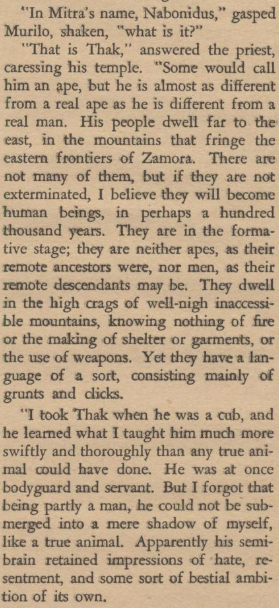
Later, when Murilo, the rebel instigator, gets a good, long look at Thak’s face, Howard takes the opportunity to further underline the proto-humaness of Thak:
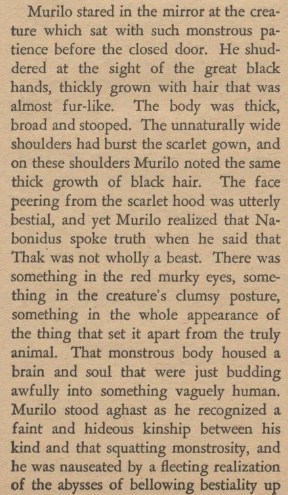

Thak is explicitly portrayed as part of a chain of beings leading progressively towards a kind of archetypal humanity, one that furthermore (and most horribly) suggests to Murilo that humans themselves had experienced just such a stage of life in the distant past. Howard revisits Thak’s fundamental and evolutionarily-informed idea of “human-ness” in the climactic battle between Conan and the ape-man, making sure we understand that this is not merely an ape, but a sentient being close to our own “kind.”
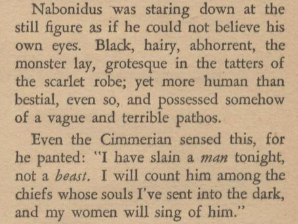
Let us pause briefly to admire Frazetta’s portrayal of this fight in one of his inimitable paintings:
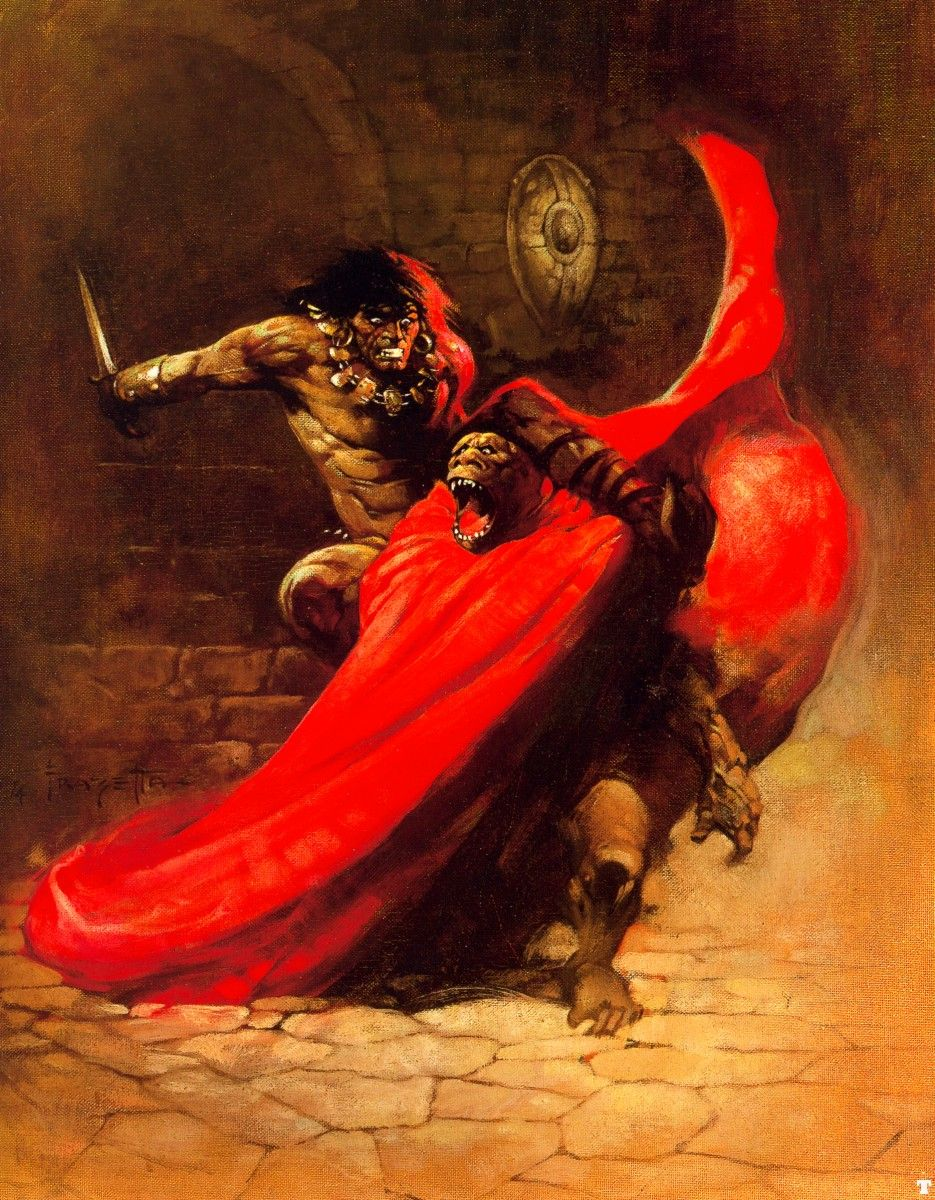
Badass.

The important thing about Thak is that he is explicitly positioned within an evolutionary context – Nabonidus, while certainly a villain, is also portrayed as a deeply and indeed uniquely profound thinker for his age, and we are meant to take his insights into the evolutionary history and potential of Thak at face value. Furthermore, Thak’s ambitions, his wearing of the robe, and his usurpation of Nabonidus in his own home are not mere apings; rather, Thak is possessed of a sense of self and of others that is human-like, a result of his heritage as a kind of developmentally and evolutionarily intermediate man-ape.

This interest in evolution and the deep history of humans in geological time isn’t anything new for lil’ Bobby Howard either – way back in 1925, his very first professionally published story in Weird Tales (“Spear and Fang”) was all about the conflict between Cro-Magnon and Neanderthals. There is no room within a strict, fundamentalist worldview for different members of the genus Homo to be waging war on one another. Interestingly, for all its eventual violence, the story begins with a Cro Magnon character making cave paintings of extinct animals, a scene placing art, an aesthetic sensibility, and an appreciation of beauty explicitly within an evolutionary framework. But, like so many of Howard’s ancient wildernesses, this is no Edenic garden; it’s a savage and brutal landscape where violence and survival are the engines of evolution.

Indeed, over and over again, Howard portrays the past as a grim evolutionary climb, calling out specifically the rise from apedom to semi-apedom and, eventually, full humanity. In fact, taking cues from both contemporary geological literature as well as esoteric theories of human history, Howard makes these events explicitly cyclical – Kull’s Atlanteans rise from apehood into their barbaric splendor, only to be hurled back again down the evolutionary ladder by their Age’s terminal cataclysm; slowly they rise to become fully human again in the fullness of geological time where, it is implied, they become the Cimmerians. Bran Mak Morn’s Picts are likewise a people with a long and troubled past that stretches into prehistory, and Atla, the were-woman of Dagon Moor, explicitly tells Bran that the Worms of the Earth could’ve been people, were very nearly human in fact, when the Picts drove them back into atavism and subterranean degeneracy. This sort of evolutionary thinking is integral to Howard’s fiction, both mechanically as part of plots as well as conceptually, as something key to his worldview.

Howard’s exposure to evolutionary thinking can be traced from two sources. The first is in the books he owned and which, on his death, were donated to the Howard Payne University library by his father. This collection, originally something approaching 300 books, was eventually taken out of special collections and put into general circulation, the result being that there are now less than 50 or so actual books left due to loss, theft, etc. However, a group of dedicated workers over the years have put together the original accession list and chased down references in Howard’s letters, meaning we now have a pretty decent idea of the books available to REH in his home. For more on this incredible work (including a handy history), and to peruse the book list, check out The Robert E. Howard Booklist!

To cut to the chase there’s one book in particular that is extremely relevant on the list: E. A. Allen’s The Prehistoric World or, Vanished Races originally published in 1885. It’s an odd and interesting book, actually; Allen, while an obscure writer now, was a prolific popularizer of natural history, with a particular interest in anthropology and ethnography. The book that Howard owned is a helluva doorstop, 800 pages or so, that begins in prehistory and moves through the iron age in Europe before leaping over to the Americas, with chapters on the Mound Builders, on the Nahua, on the Maya, etc. It’s a remarkably interesting historical document, a snapshot of both the broadly consensus natural history scholarship of the day as well as the then popular “stadial” version of anthropology (a decidedly progressivist and positivist framework that placed “civilizations” in a developmental hierarchy; guess what sort of people were on the top?). Honestly, I suspect this books is enormously important to a lot of Howard’s thinking and writing, but I want to focus on the second chapter “Early Geological Periods.”

This chapter is a kind of speed run through geology and paleontology, giving the reader a thumbnail of 1880s vintage earth science. There’s some great bits in there, especially if you’re interested in the history of geology – this is, after all, a pre plate tectonics world, and so there are some amusing gaps in both the interpretations and the detailed stories. However, this book IS firmly post Darwin (Origin of the Species was published in 1859). That means evolution is front and center:
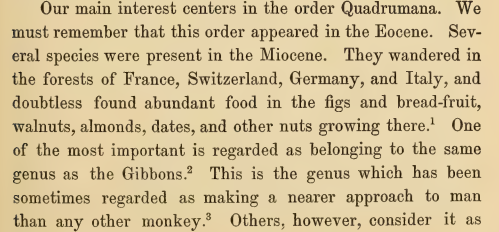
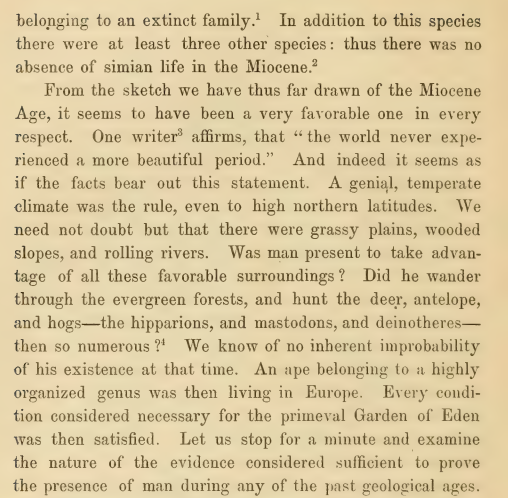
Like I said, there’s some fun goofy stuff in there – the old-ass taxonomic term “Quadrumana,” a paleobiogeography that predates the Out of Africa model of human origins, and the to-us-now shocking attempts to extend the presence humans back to the Miocene! (just for context, Allen’s work of course predates radiometric dating [it predates the discovery of radiation, in fact] so they’re using a relative chronostratigraphic approach; even so, a Miocene origin is wild! The Miocene *ended* ~5 million years ago, and the oldest extant example of the genus Homo is 2 million years old!) But this section is interesting when compared to the “Rogues in the House” excerpt. Here, a Miocene primate is explicitly stated to have made “a nearer approach to man than any other monkey,” which sounds very much like what Nabonidus said of Thak. Later in the passage Allen refers to a “highly organized genus” (meaning “evolutionarily advanced”) of ape as living in the Edenic Europe of the Miocene. Non-humans “ascending” towards humanness in the fathomless depths of time – this is extremely REH’s bag, you know?

It’s a bit too much to get into now (though it’s a topic I’ll definitely be returning to in the future) but there’s another relevant library in the Howard household that bears on this discussion – his dad’s bonkers collection of esoterica! That Howard was familiar with at least a popular gloss of Theosophical concepts is obvious from his work; the ideas of cyclical catastrophes, of the struggle of “root races” to ascend the ladder of progress over and over again, these concepts out of Theosophy are probably just as important as his understanding of geology and biology. Of course, the reality is that the Theosophists were actually responding to the science of day, drawing their myths and mysticism out of the mid-19th century scientific milieu the same as Allen (and everyone else). Geological catastrophism, deep time, sinking and rising lands (like Lemuria!), comparative religion, all of these ideas were taken out of their scientific and scholarly context and massaged into a new mystical quasi-religion, one that Howard’s dad was EXTREMELY well read in. But that’s for another post!

Leaving the Howards’ libraries behind, there’s an even more direct source for REH’s views on evolution we can tap: his letters! Thanks to the tireless effort of a bunch of editors, we’ve got an embarrassment of riches when it comes to the letters of REH. And, given the voluminousness of his correspondence, there’s a lot to choose from! Let’s hit a big one right away:

Let us consider the insect Man. How many specimens of this creature are willing to believe that they came from the same root stem as the elephant, the garter snake and the leopard? No, they must have a special creative act, a special Divine process to account for their godlike beings – bah, either Haeckel’s right and there is no such thing as a “soul” in the accepted sense or else everything has a soul, whether organic or inorganic. Let the theologians seek to refute the theory of spontaneous generation all they wish – I admit it is rather difficult to grasp in a cosmological sense, but biologically speaking, the scientific world has as a whole, I think, accepted the unicellular theory as a positive fact. The facts boiled down are these: theology must accept evolution both in ontogeny and in phylogeny if it accepts geology.

REH to Tevis Clyde Smith, March 1928, The Collected Letters of Robert E. Howard, volume 1: 1923-1929, Rob Roehm and John Bullard (eds)

That’s a pretty definitive statement, and one completely antithetical to the quote from the movie. Howard is 100% rejecting a special creation for humanity (and, indeed, for all of life). The “spontaneous generation” he’s referencing is not the “flies from meat” thing you might’ve heard about, but rather the idea of life originating on its own from inorganic matter via natural processes in the deep past. This, in particular, was one of Haeckel’s (many) research interests – taking up a topic that Darwin himself had not dealt with, he posited that highly organized but inorganic matter (like crystals) may have given rise to simple organic life, the “unicellular theory” REH mentions later. Howard is also explicitly rejecting biblical authority on theological matters in this letter too – theologians have to reckon with Haeckel’s biogenic law as well as the reality of Deep Time, rather than the other way around!

The prominence of Haeckel in Howard’s thinking is fascinating, and it’s something I’d never appreciated until I read his letters. He’s easily the biologist most mentioned by REH, and he seems to have seriously engaged with ol’ Ernst pretty heavily at some point (though, in a later letter to Lovecraft, he admits that he’d forgotten a lot of about the details of his work). Presumably, his exposure to Haeckel was in school, where Howard was part of a “science course” which, presumably, operated as a kind of theme or special focus in his curricula. It’s striking the effect it must’ve had on Howard; Haeckel comes up a lot (alongside famous scientific racist Herbert Spencer), whereas Darwin is mentioned only once…in a list of people who have “grasped the cosmic” that also includes Haeckel and Spencer and Huxley. What’s interesting in particular is that in addition to Haeckel’s biological and evolutionary work (he was a major popularizer of Darwin), REH seems enamored of Haeckel’s strange brand of monism, which provides a kind of romantic and pantheistic underpinning to the natural world (in opposition to a strictly materialist view). This same kind of vaguely mystical biology is something also seen in Herbert Spencer, another of REH’s favorite thinkers – he in particular seems to enjoy Spencer’s ideas of the “Ultimate Unknowable,” which much like Haeckel leaves room for some sort of ineffable energy or drive behind the mechanical operation of the universe and life.

Of course, the other things that Howard undoubtably took from both Haeckel and Spencer were their scientific racism and polygenism. Both men were, like many people of the age, eugenicists; Spencer, who as mentioned above was name-checked by REH a lot in his letters, originated the term and idea of “Social Darwinism;” he also coined the term “survival of the fittest,” an obvious and important part of Howard’s philosophy and ethos. Additionally, Haeckel was a vocal and powerful proponent of scientific polygenism, the idea that the various human races arose separately from different ancestors and at different times. In fact, part of Haeckel’s theories about the origins of life, the “spontaneous generation” mentioned in the letter, was that life itself was potentially polygenetic, having arisen multiple times out of inorganic matter on earth. While REH never outright states his support for polygenist views in his letters, the idea is clearly present in his fiction – there are multiple examples of different “races” rising up out of semi-apedom into humanity in his essay “The Hyborian Age,” for example, and the idea is implicit in the way he writes about Thak and the Worms of the Earth. It’s probably also a part of his horror of miscegenation: Howard clearly believes that there is something fundamentally biologically wrong with race-mixing, in addition to the moral decadence that he felt it represented.

It’s worth taking a look at Haeckel’s visual representation of this idea, because it’s a subtle but important point that illustrates REH’s thinking. The below figure is a portion of a plate from the English translation of one of Haeckel’s books, his 1879 Evolution of Man:
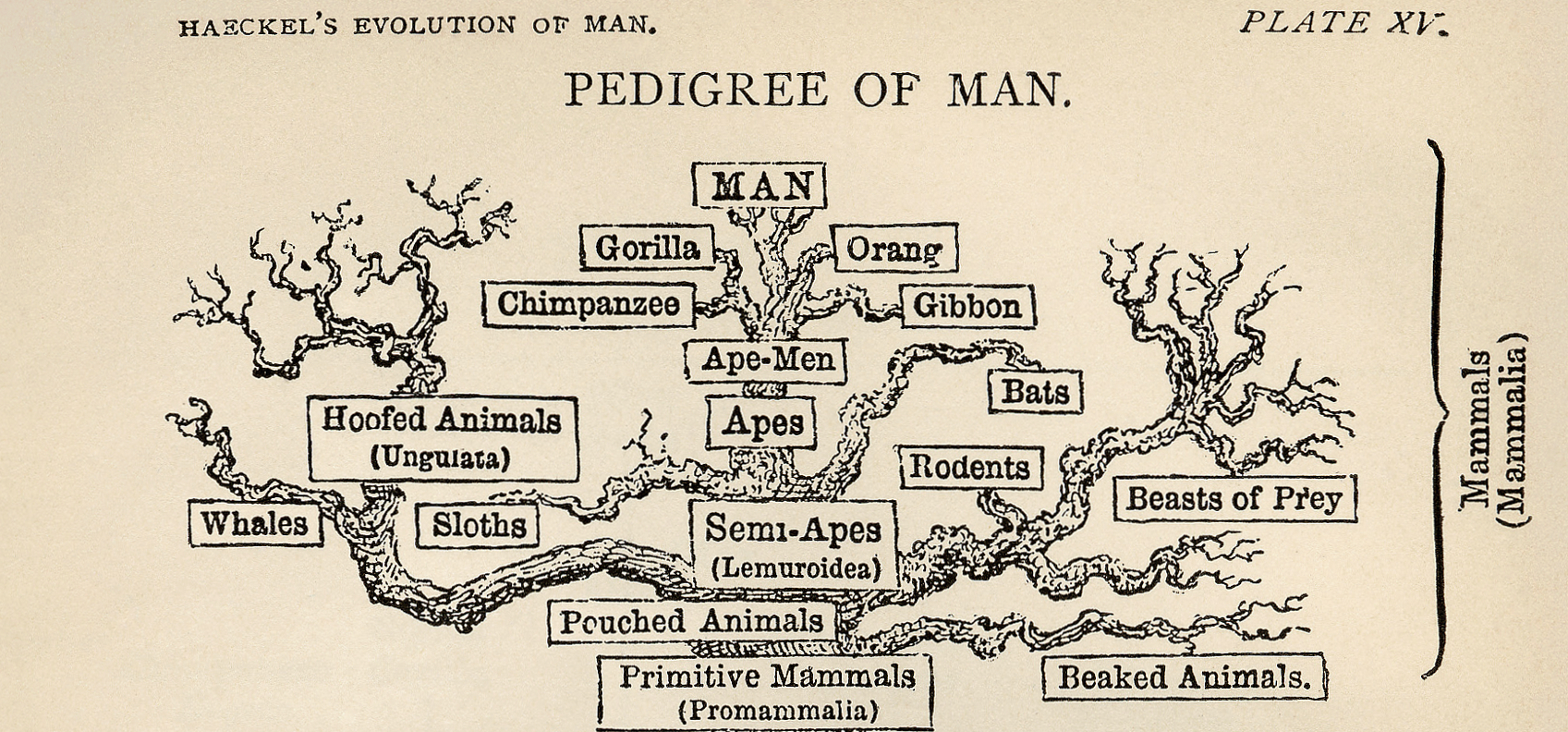
A few things are worth noting here: first, the placement of MAN atop the tree, crowning the progressive hierarchy implicit in the history of life. More important, however, is the very subtle way Haeckel conveys his idea that the human races arise out of different ancestors. A forking branch proceeds from APE-MEN, with single branches leading to GIBBON, ORANG, etc. But then look at the MULTIPLE BRANCHES (six of them!) leading into MAN. Like I said, it’s a subtle but very important point with some extremely unpleasant implications, namely that the various races of humans represent distinct biological species arising out of a common ape-man ancestor. It’s foul stuff, but it’s also recognizable as a very common belief among people in Howard’s time, and within Howard’s work; put “Cimmerian,” “Stygian,” “Hyborian,” etc on each of those branches and you’ve got a good representation of Howard’s ideas.

Another letter, this one part of the interminable HPL-REH Civilization-vs-Barbarism running gun battle that they had for years and years, interestingly provides some insight into Howard’s opinion of religious anti-evolutionists. The context of this short excerpt from their (unending and tedious) argument focuses on HPL’s view that REH doesn’t hold artistic endeavors in as high of esteem as he should. Regardless, the relevant section is interesting as regards our topic here today:

Between the fundamental religionist who goes into foaming rages over the idea of evolution, because he can not stand the thought of kinship with a monkey, and the artists who strains his guts to prove his distance from the protozoa, I see no basic difference; both seem outcroppings of the idea concerning the divinity of man.

REH to HPL, September or October 1933, letter 259, The Collected Letters of Robert E. Howard Volume 3: 1933-1936, Rob Roehm and John Bullard (eds)

It’s a pretty funny statement; I love to imagine a tortured poète maudit weeping over the need to distinguish themselves from protists in the eyes of the posterity. But it’s also a helluva rejoinder to the weird statement from Novalyne’s memoir and in the movie, isn’t it?

One last letter excerpt, because they’re fun and more people need to read ’em! This one is from a letter to August Derleth, and in addition to its relevance to our discussion here, it is also one of those great examples of REH really playing up rurality for his non-western interlocutors:

A friend of mine was trapping once […] He thought he had a muskrat and climbed carelessly up and stuck his head over the ledge, and there was a skunk in the trap and it let him have a full volley smack in the face […] My friend fell off the ledge with an ear-splitting shriek and rolled on the ground for some time after the exact fashion of a hound-dog […] Nobody could doubt evolution after watching the antics of a man who has just been slapped in the mush by a polecat.

REH to August Derleth, July 4 1935, letter 319, The Collected Letters of Robert E. Howard Volume 3: 1933-1936, Rob Roehm and John Bullard (eds)

In addition to just being a funny story, it also shows how, even beyond the eugenicist background of his thinking, Howard’s worldview (and his fiction) was founded on an philosophical framework of what was “natural,” a view informed strongly by a belief in evolution. There’s also present the idea that this “naturalness” reflects the fundamental biological order of the world – a man, for all his sophistication, is no different than a dog when confronted with the same problem (of getting their shit rocked by a pissed-off skunk). There’s really no way to imagine Robert E. Howard without a belief in evolution – the idea is as central to his work and worldview as it is for Lovecraft, and having him question it in the movie (rejecting it in favor of the bible even!) is truly bizarre!

So what’s going in Novalyne Price Ellis’s memoir, One Who Walked Alone and the movie it inspired? Well, there’re a few options, I reckon:

1 – Novalyne Price made it up whole cloth. It’s a possibility, certainly – as described by Bobby Derie the creation of One Who Walked Alone remains opaque, with the author dead and her notes and materials unavailable, leaving us merely with the book. A key motive for Price writing it was to counter negative portrayals of Howard; perhaps she felt a definitive statement of belief in the Bible was important (including a statement of Creationist faith) and so inserted it into the narrative. As far as I can tell, we don’t know anything specific about Novalyne Price’s religious leanings, though she does write about attending church and believing in God (and in everyone’s right to worship God in whatever way they see fit) in the book. But who knows? An older Southern lady writing in the late 70s-80s, she very easily could’ve held Creationist beliefs, and decided to put REH in the camp of the angels. Without access to her diaries and journals, we’ll never know! But this is clearly the very darkest option – it puts her memoirs, as a source of sincere recollection, into *very* shaky, shady territory!

2 – Novalyne Price misunderstood/misinterpreted something REH had said. Reading Price suggests (to me at least) that she *thought* she understood REH better than she actually did. There’re numerous places in the book where she seems to be confused by what is, plainly, REH making a joke or poking fun or being ironical. Additionally, Howard could clearly be kind of a combative asshole, picking at people or arguing for argument’s sake. The exchange in the book is actually a good deal more contentious than is presented in the movie; Howard, at least to my reading, absolutely understands that his mother was talking shit about Novalyne, and he’s getting a kick needling her and watching her reaction (a very common thing in the book). If so, the odd statement about the bible and creationism becomes legible as just more of REH’s situational weirdness, where he’s trying to offer biblical support for his position, knowing that it’d annoy her.

3 – REH said it because he thought it was something Novalyne wanted to hear. Like I said, the discussion around miscegenation that REH and Price are having is a bit of a strange, heated one. Maybe Howard wanted to change the subject, or in the moment felt like he was offering an olive branch by claiming to be a bible-believer (something clearly important to Price, from sections elsewhere in the book). It would mean he was straight up lying of course, since his letters seem to make his position very clear. Also, it’d be an odd moment of him backing down too; he seemed to love scrapin’ and arguin’ with Novalyne in particular!

4 – REH said it because he believed it. The weirdest and hardest-to-swallow option, but there it is. We contain multitudes, and maybe Howard had had a strange religious epiphany. I knew a devout Mormon paleontologist who described his life this way: six days of the week, he believed in evolution and geochronology and the fossil record, but on Sunday, he didn’t. Maybe Howard separated himself from his work like that, though that seems extremely unlikely given the whole “he put a bit of himself into everything he wrote” paean from Lovecraft and all. It’s again also a statement completely at odds with his own words, both fictional and in his letters!

As to which one it is, who the Hell knows? What I think is very certain, however, is that contrary to the statement reported by Price, Howard absolutely believed in evolution. In particular, the concept was central to his whole world view, both in his life and in his work. This is not to say that he had no religion; the scientists from whom he had drawn his understanding of evolution, Ernst Haeckel and Herbert Spencer, were themselves certainly not atheists; both of them believed in a kind of pantheistic drive that, while operating within the realm of the mundane and through the laws of biology and physics, nonetheless held something of wonder and, if not divine, then at least something more-than-mechanistic about it. Given his father’s own unusual religious milieu, something like that, a combination of Haeckelean monism with pop Theosophy, makes a lot of sense. Afterall, Jesus was an Ascended Master in a lot of New Age religious movements, so there’s even room for a (nondenominational) kind of appreciation for the Bible in there.

What there ISN’T room for is creationism – time and time again, the centrality of the concept to Howard’s writing is made abundantly clear. The battle between Cro Magnon and Neanderthal at the dawn of human history, the punctuated cataclysms of Howard’s Atlantis and Hyboria, the aspirational evolutionism of Thak and the thwarted phylogenetics of the Worms of the Earth, all of these are just as much evidence for Howard’s deep commitment to the reality of evolution as are his literal statements of the same in his letters.
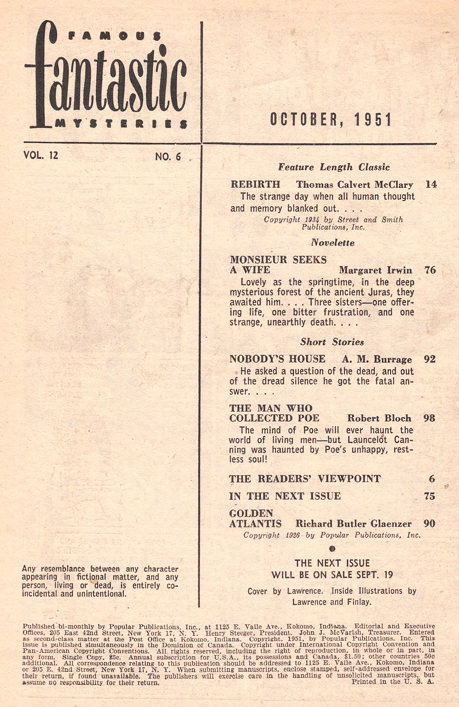
The Man who Strained Pulp #45: “The Man who Collected Poe” by Robert Bloch, Famous Fantastic Mysteries v. 12, n. 6, Oct 1951

January 19th, which was last Monday, was Edgar Allan Poe’s birthday, one of the high holy days for weird fiction! Poe, of course, is hugely important, not merely as an antecedent to what would coalesce into the genre of “Weird Fiction,” but also beyond it in the larger world of literature; for starters, just look at the huge impact his work had in other languages once it was translated – Baudelaire’s translations of (and essays on) Poe in the 1850s and 1860s were epochal in French (and Continental) literature, while Konstantin Balmont’s translation of Poe in 1895 ushered in the Russian Symbolist movement. Similarly, Arno Schmidt’s love of Poe, whom he (with Hans Wollschläger) translated and celebrated in his insanely fun (and insanely huge) novel Bottom’s Dream (which is, among other things, a novel about Poe), was an important part of mid-century German lit. There’s Edogawa Ranpo in Japan, Borges and Cortazar in 20th century Spanish lit (preceded by Landa and Alarcon who similarly revolutionized 19th century Spanish literature with Poe as a major factor), I mean, the list goes on and on! Poe was a big deal!

There’s even a fun bit of Poe-in-translation history in the story of Weird Tales – as a college student at the University of Nevada, Farnsworth Wright translated Poe’s “The Tell-Tale Heart” into Esperanto and published it in the Esperantist magazine La Simbolo in the ‘teens! Wright, who would go on to become the single most powerful editor in the history of the genre of Weird Fiction, would often cite Poe as a foundational figure for the genre. And, of course, there’s Lovecraft, for whom Poe was a god; point is, Poe is hugely important to literature, both highfalutin’ AND pulpy, so how about we spend some time reading and enjoying and thinking about a very fun story by Robert Bloch about ol’ Ed A. Poe? It’s “The Man Who Collected Poe” from Famous Fantastic Mysteries 1951!

We’ve talked out little Bobby Bloch before, specifically while looking at “Notebook Found in a Deserted House,” his great Lovecraftian story and one of the few non-HPL mythos stories that rises above homage and pastiche to be something interesting, spooky, and good in itself. Interestingly, that story is also from 1951; in both of those it sort of feels like Bloch is looking back on the great influences of his writing career one last time, waving goodbye to them fondly as he begins to really develop his own voice and style.

What we haven’t talked about, though, is the magazine that this story was published in: Famous Fantastic Mysteries was one of the great sci-fi-ish mags that came around as the genre really got going, a major competitor to Weird Tales. It was first published in ’39, when it was owned by the Munsey company, who had a great backlog of weird- and science fictional stories from it’s older mags, like Argosy, that it decided to exploit. For the first few years of its existence, into the 40s, FFM was mostly a reprint magazine, focusing on classics, but it later got bought by another company (I wanna say Popular, but I’m not 100% sure of that right now, and checking would run counter to the spirit of these off-the-cuff essays!) which promptly changed the policy and began publishing new fiction. Some good writers showed up in its pages, Moore, Kuttner, Arthur C. Clarke, some big names. The editor for its entire run was Mary Gnaedinger, who was a HUGE name in sci-fi back then, famous for her deep knowledge of the field.

Oh, hey, it was “Popular” who bought ’em from Muncey then; you can see that on the ToC, above. Margaret Irwin is an interesting character – she was an English writer most famous for her historical novels, mostly set in Elizabethan times, but she (like so many writers from the UK) also wrote “ghost” stories (a term the brits use to cover both traditional spooky tales as well as what we’d call weird fic, too). You can see, though, that FFM focused on longer work with their reprints – that big ol’ “Rebirth,” originally from ’34, is a hefty un! But, luckily, they filled the nooks and crannies with shorter work, and that’s what we’re looking at today!

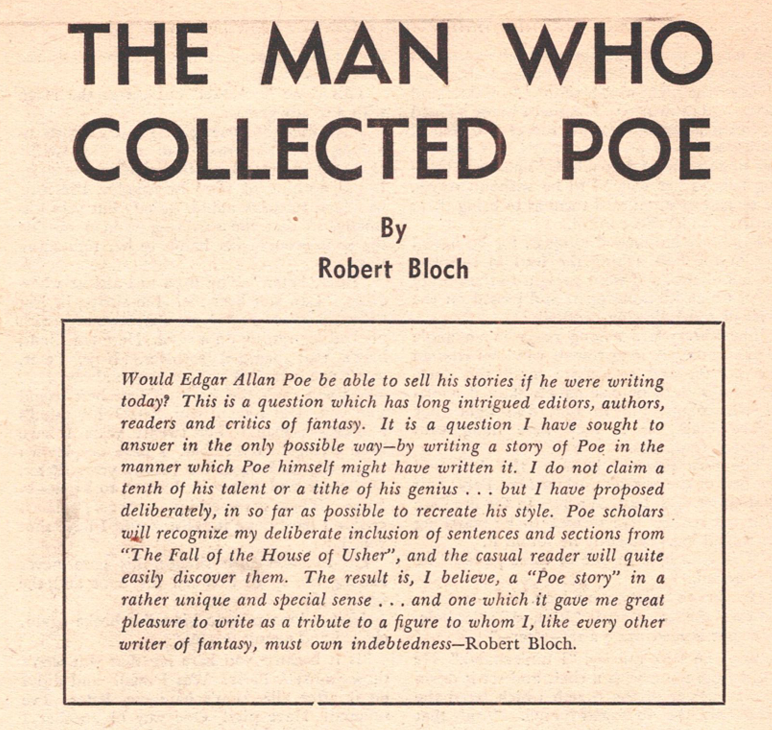
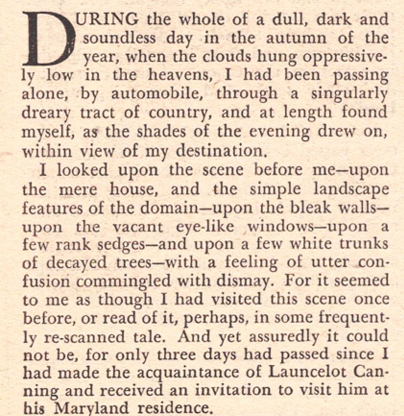
I love these little writer’s statements up front of the stories in FFM, fun little glimpses into the processes and how the author views their work. It’s a little odd because, as we’ll see, I don’t think this story really does address the question Bloch raises there (goofy and ahistorical as it is) – it’s not about whether Poe would’ve sold his work today at all, so it’s a little strange to see that point raised here. But what IS fun is that Bloch tells you, up front, that he’s grabbed a LOT of text straight from Poe’s “The Fall of the House of Usher” and, by God, he’s right! Here’s the first two paragraphs of this story:

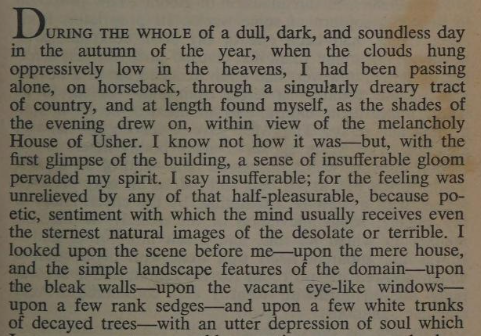
And for comparison, here’s the opening of Poe’s story:

I mean, that’s super fun, isn’t it? What I really like is the way Bloch hangs a lampshade on the whole thing in the story by suggesting that our nameless narrator seems to recognize the whole scene – which of course he would, since he’s a Poe expert who happens to be entering into a Poe(esque) story about all things Poe! It’s fun and playful, which is one of the hallmarks of Bloch’s writing (and why he’s such a good horror writer).

Anyway, we do get a name here, and it’s another deep cut from Poe’s story: Launcelot Canning, who is the fictional author of the fake book (The Mad Trist) that Roderick Usher reads aloud while his sister, Madeleine, is clawing her way to freedom in the tomb beneath the house. As an aside, that part of “Usher” is a lot of fun and is an interesting earlier example of what would become a hallmark of Lovecraft and his circle of weird writers – the inclusion of a fake book in among a some real ancient texts.

Again, Bloch was very sincere in saying he was mining “Usher” directly here – the allusions come thick n’ fast in this story! It makes for a fun read after reading “Usher” honestly, and I’d recommend you do that too! But, anyway, back to the story:

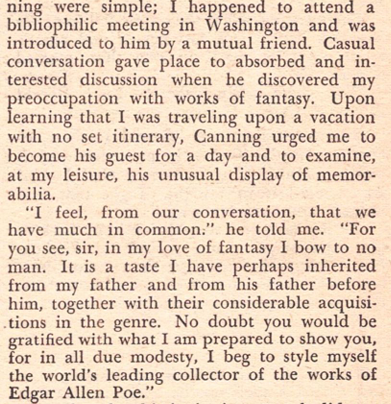
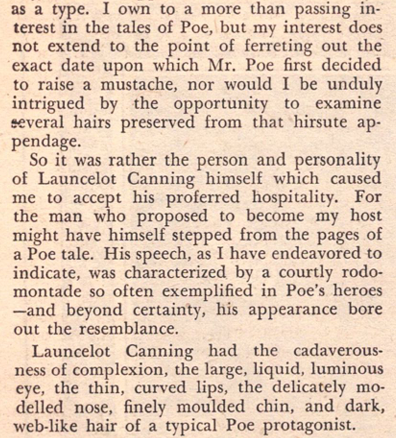
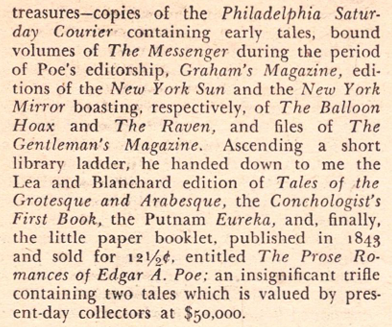
A good weird intro to the character – ol’ Lance Canning here is the world’s greatest collector of Poe-mobilia, something that, while interesting enough to the narrator, isn’t the real hook that reels him into Canning’s orbit. Rather, it is Canning himself, who is just a straight-up oddball seemingly right our of a Poe tale:

I really like that little joke at the expense of people with obsessive interests – the bit about wanting to figure out EXACTLY when Poe first grew a mustache is a funny line!

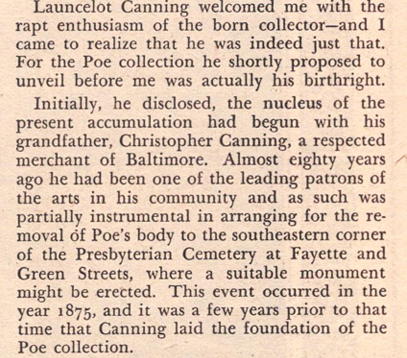
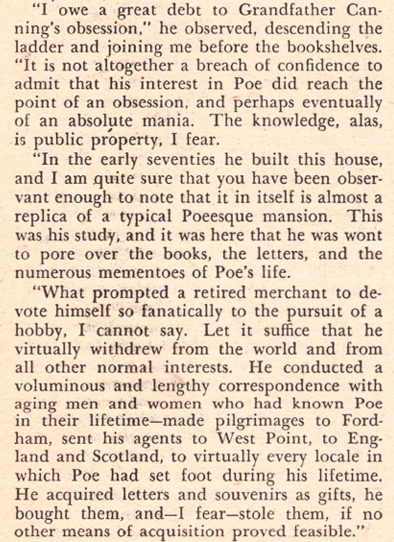
Anyway, our narrator accepts Canning’s invite out to the ol’ home place in Maryland (the state where Poe died and is buried, an important point to this story). The house is, of course, the Usher mansion, though without moat and tarn, and the rooms are straight outta the story too. Canning is languidly reclining on a couch, and our narrator feels like there’s something forced, or maybe manic, about his greeting, but our guy here just chalks it up to his weirdness. Moreover, he comes to realize that Canning is, literally, a BORN collector:

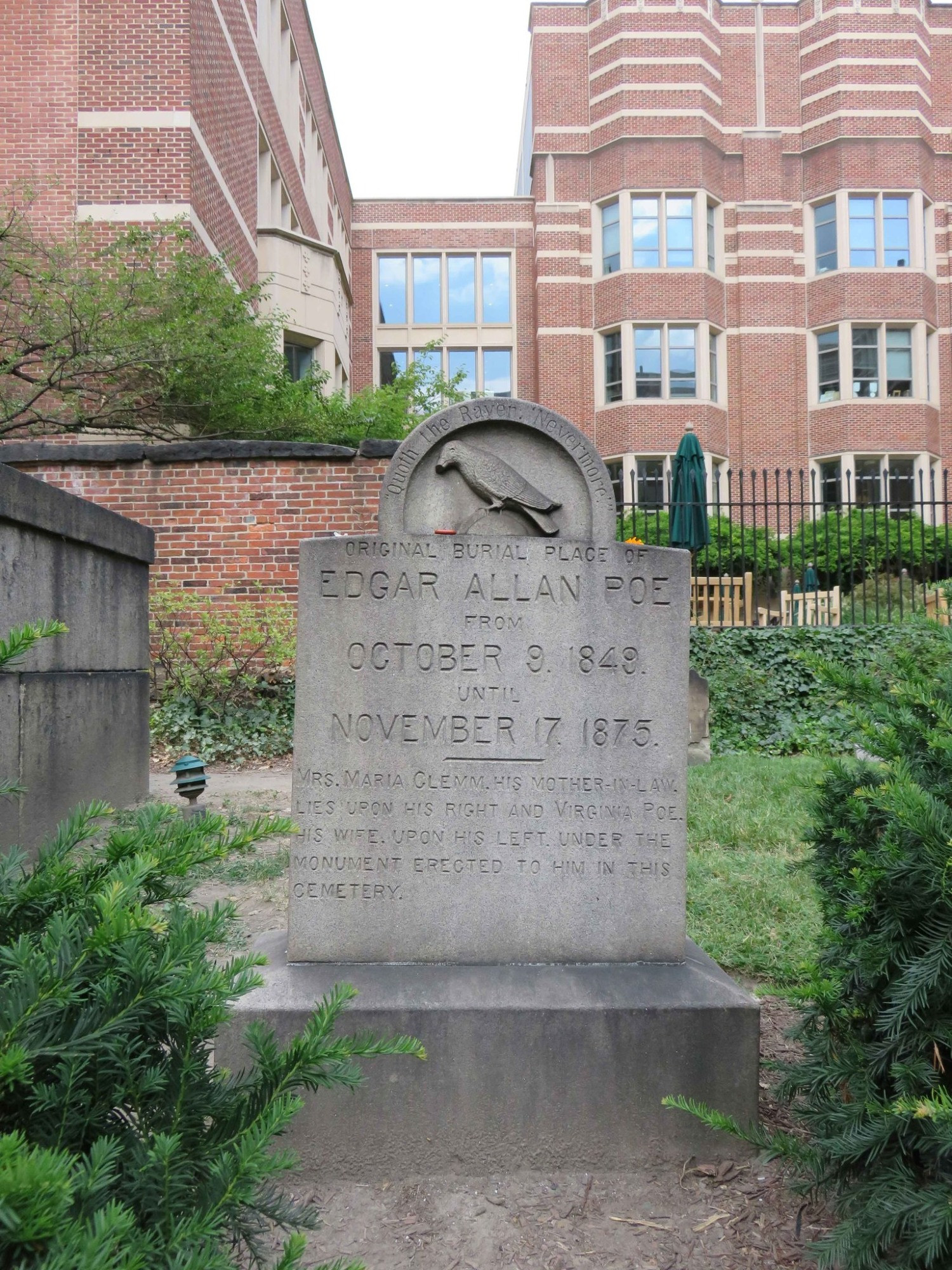
As a brief interlude, here are the graves themselves in Baltimore, which I visited during a conference in Baltimore a few years ago. This first one is the original monument:

And here’s the newer one, which was indeed commissioned by notable and literary members of Baltimore’s citizenry in 1875 and which necessitated an exhumation and reburial of Poe’s remains:

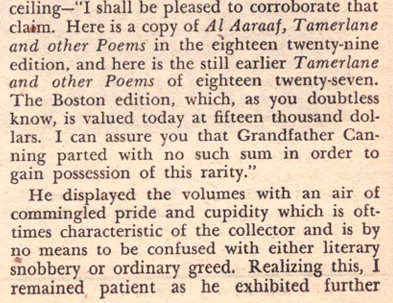
In particular, it’s this grandfather, Christopher Canning, the one who helped fund the new monument, that built the bulk of the Canning collection. Lance shows off some of the insanely rare and insanely valuable pieces:

This is some fun bibliomania, and the “commingled pride and cupidity” is a great line that really conveys the very specific affect of Canning here. It’s not merely greed or snobbery – it’s a kind of all-consuming obsession, something Poe wrote about often. It’s also fun to see the long list of Poe works here, especially the weird Conchologist’s First Book, which is a real fun deep cut in Poe’s oeuvre. And this obsessiveness seems to run in the family too:

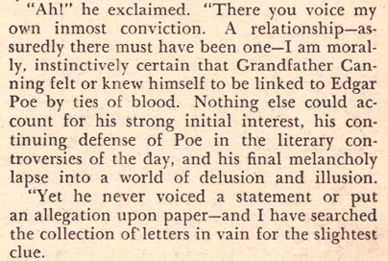
Some fun metacommentary on the kind of mania that can develop around a subject of study, as well as an important part of the story – we learn that ol’ Grandpappy Canning was not above rank thievery to get what he wanted for his Poe collection! Our narrator tries to explain Canning’s grandfather’s truly all-consuming obsession with Poe by asking if there wasn’t some deeper reason behind it? Perhaps the old man thought he’d been related to Poe in someway?

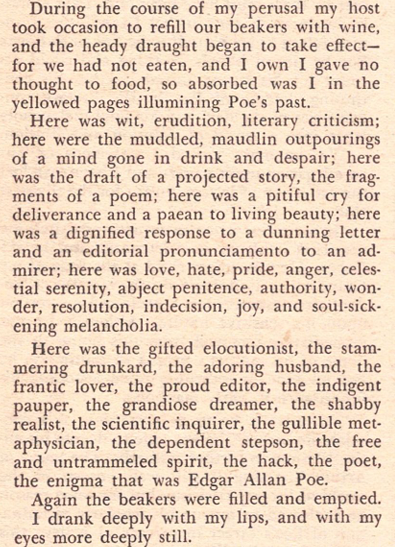
Canning then goes on to talk of his father who followed in Grandpa’s footsteps and became a reclusive scholar and collector of all things Poe, in particular focusing on letters either from, to, or about ol’ Edgard Allan Poe. While Lance gathers these particular pieces, he pours them some amontillado (natch), and the two of them proceed to get increasingly toasted as they look over the collection.

Aside from the fact that the above passages are just good writing, I like the kind of mounting (or, perhaps “deepening” is more appropriate here) intensity here – Canning began with his Grandfather’s collection, a remarkable but still very MATERIAL kind of thing, full of rare and valuable books. But now we’ve moved beyond the man’s work to the man himself. Canning’s father was obsessed with the letters, little glimpses into Poe the person, and that kind of voyeuristic and intimate examination of a person’s life is a very intoxicating thing, you know, just as much as the wine they’re drinking. It ALSO nicely sets up a kind of generational escalation to this Poe obsession that afflicts the family Canning, right? Grandpa was all about the material of the man, his son was getting into the psychology and life of Poe…so what does that leave for the grandson, Launcelot Canning?

A fun little nod in the text there to Arthur Quinn who wrote, in 1941, the excellent and still definitive biography of Poe (you can read the 1960 edition over on archive.org here, btw).

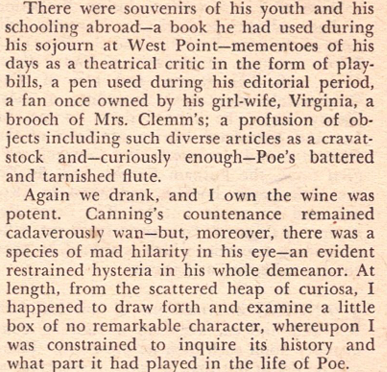
Lance cracks open a chest and shows our narrator the intimate objects of Poe’s life, a helluva collection. And while he’s doing so, Lance seems to be afflicted with a mounting panic or dread, like he’s juuuuuuust barely tamping down some kinda freak-out.

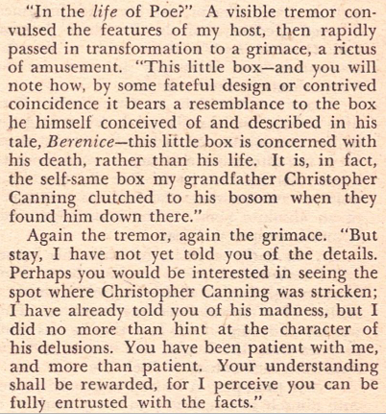
His reserve almost cracks when our narrator asks about a small box in the chest.

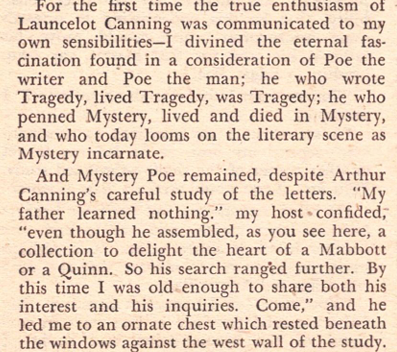
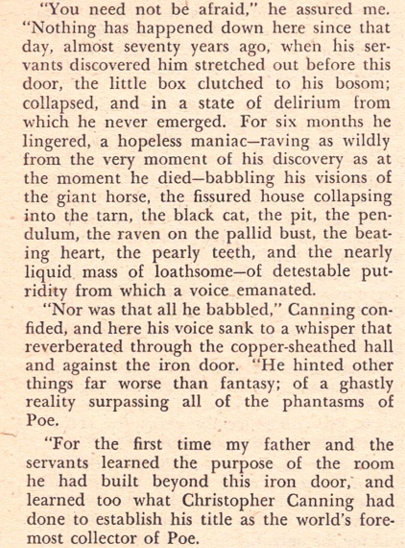
So now we’re getting to the details of the hinted-at mysterious death of ol’ Grandpappy Canning. The two of them take a trip (with more wine) into the weird Poe-themed fun-house mansion that is Canning Manor, wandering down a dark hallway and dismal stairs into the bowels of the castle-like edifice before coming to a huge, copper-lined door:

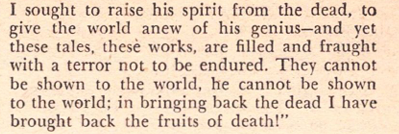
I mean, that’s excellent stuff right there. Love the wildly Poe-flavored rantings of the madman, for one thing – it’s fun to see ’em purely as allusions, but within the text it’s interesting because we, as the readers, can’t be sure WHAT exactly is happening here – did ol’ Christopher’s Poe-obsessed brain break, and THAT’S why his rantings are all Poe-flavored…or is something else happening, something darker and much weirder? We don’t get an answer immediately, but we do get a nice reveal of Christopher Canning’s ghoulishness:

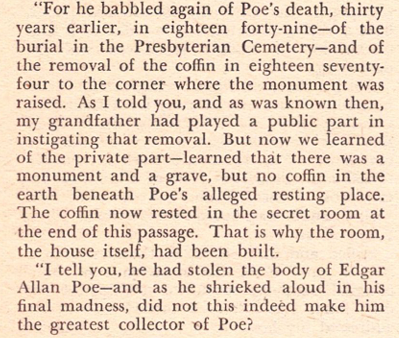
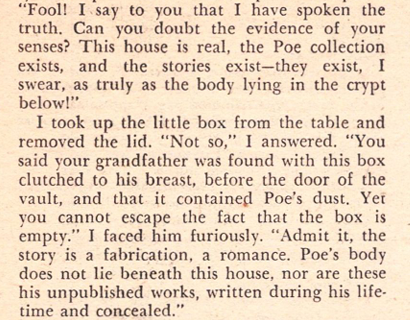
Just wonderful! It’s really fun to use the Real Life exhumation and movement of Poe’s body as the seed for a story of body theft, isn’t it? It also suggests the joke (or a joke, as we’ll see…) behind the title of this piece. Christopher Canning did, indeed quite literally, Collect Poe.

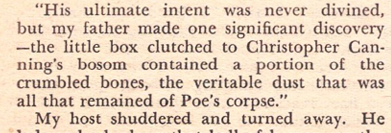
And what of the little box, which he was clutching when they found him mad and raving before the door of the secret tomb of Edgar Allan Poe?

If you’re a fan of Lovecraft (as Bloch was), you might have an inkling of where this story is heading, but if not, we’ll come back to it shortly.

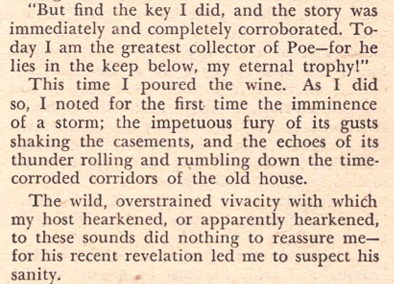
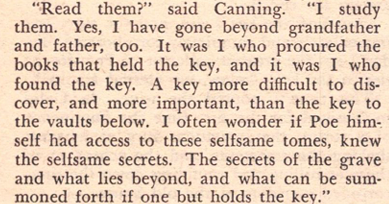
Lance leads the narrator back to the study, where he continues his tale – his Father kept secret the fact that Poe’s corpse lay in the tomb beneath the house, and only told Lance about it as he lay dying. Even so, it was several years before Lance even found the key that would unlock the door to the secret, shameful tomb. And yet, with that key, somehow, Launcelot Canning is confident in stating that now HE, more than his grandfather or father, is in fact the Greatest Collector of Poe! Wait, what’s that now?

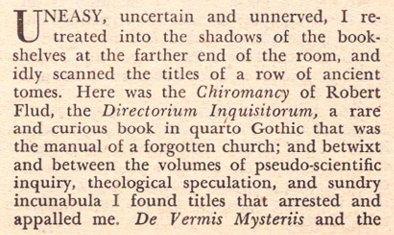
The storm builds in fury, and Lance takes up Poe’s childhood flute and begins to play madly on it, in a scene reminiscent of Roderick Usher’s guitar-playin’ while the storm (and his sister) creep upon the doomed house. Seems like a weird scene, but I guess the wine must be good because, rather than gettin’ the Hell out of Dodge, our narrator decides to peruse the bookshelves of his obviously mad host (as you do when you’re in a weird tale):

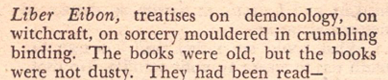
Oh hell yes. That’s right – this is Bloch before he’d shed himself entirely of his Lovecraftianisms, so of course there’re forbidden books of dark lore and evil magic here…and they’ve been well-thumbed too!

“…what can be summoned forth if one but hold the key.” hmm…

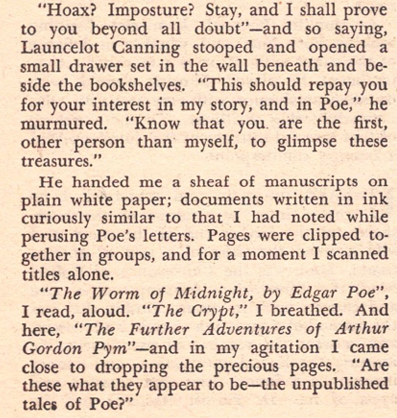
Anyway, THIS is apparently enough for the narrator, who refuses his ninth glass of wine and says he must, at last, be on his way. This panics poor ol Lance, who seems to desperately want to have someone there with him, particularly on this stormy night. Our narrator demands that Canning admit that all this stuff about the stolen body and the tomb and all is a hoax, but Canning says its all real. And, in fact, he can PROVE it:

A very fun reveal – secret Poe stories that no one has ever read! But how can this be?

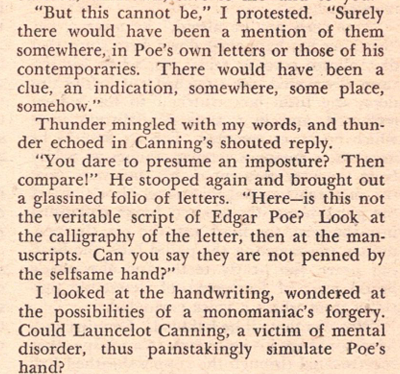
Super fun, isn’t it? And if it weren’t for those magical Lovecraftian tomes mentioned earlier, you might think that the Narrator has hit on the solution here, right? That Lance Canning, a la Norman Bates (who hasn’t been written about yet) has monomaniacally BECOME the dead person who is the focus of their obsession. Maybe Canning has so steeped himself in Poe that he has, in some mad way, convinced himself that he IS Poe, right?

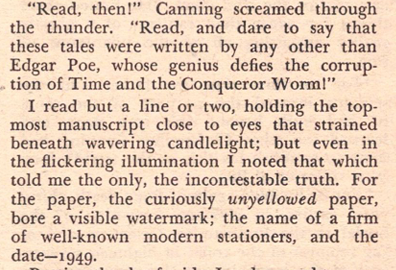
Well, surely that IS what has happened, right? New paper, one of the stories is dated 1949…clearly Canning is just nuts and thinks he Poe. MYSTERY SOLVED!

But Canning persists in his denial:

A boxful of dust, you say…what does that sound like…

That’s right – this IS a Lovecraftian mythos tale after all! Canning, like Charles Dexter Ward, has used the essential salts of the corpse to REANIMATE the dead!

It’s a pretty fun little twist, and one you might not have seen coming – after all, even knowing that Bloch began his writing life as a Lovecraft acolyte, you might assume that, by ’51, he’d transformed himself into the writer who was more interested in the twists and turns of a fucked-up mind than in weird gibbering cosmic entities from behind. And it’s fun to see him set that up here – the idea that this family, so obsessed with Poe, would eventually produce a deranged member that believed himself to actually BE Poe is a perfectly good bit of weird horror, you know what I mean? But in many ways this is not merely a story ABOUT Poe…rather, it’s a story about the influence of Poe, of the way an older writer can still impact people from beyond the grave. And, of course, Bloch is also thinking about how that influence was felt by Lovecraft, and how he was, in many ways, the grandson of Poe and the son of Lovecraft, at least from a writing perspective. It’s a neat, weird mediation on influence and writerly genealogies!

AND it’s got an undead Poe writing impossibly horrific stories from beyond the grave!

We’re rapidly approaching the end, so of course we start hearing the metallic pounding on the tomb door below echoing through the house!

A chilling image, and a great, horrific concept too: Poe’s new material is informed by concrete knowledge of what he could only have imagined in life. His old published work is merest preamble to the true horror of his undead writings! It’s all so huge and over the top that it really can’t be beat, it’s so much fun!

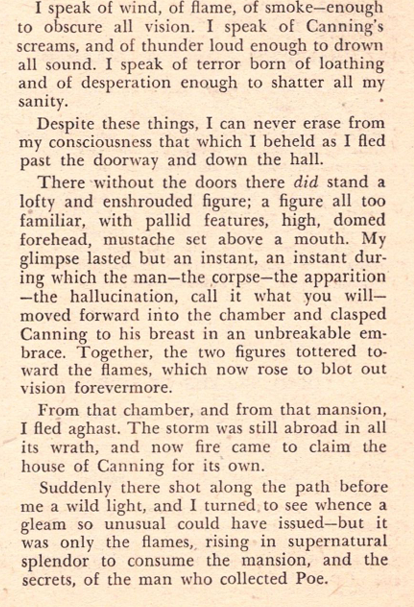
Of course, Poe has escaped the Tomb and has been making his way up the stairs and through the house towards the study. Our narrator pushes aside the panicking Canning (knocking over a flaming candelabra) and flings open the door!

And that’s the end of Robert Bloch’s “The Man Who Collected Poe!”

This story has some great art with it that sorta kinda gives away the plot, so I’ve saved it for last:

A wonderful piece by the great Lawrence Stevens showing the moment of the revivified Poe’s appearance. I really like the border there, full of little allusions to Poe’s works. A great piece all around!

Obviously, I love this story. It’s just a blast, and you can really see Bloch is having fun writing it, playing with the original text from “Usher,” really relishing the language and vivacity of Poe’s words. But beyond that, I think it’s a really interesting example of a writer very explicitly exploring both their genre in general and those in it who influenced them very specifically. And, not to be schmaltzy, but I think there’s a real affection and appreciation on display here, both for Poe and Lovecraft, writers who were very important to Bloch at one time but whose work he’s moved (and will continue to move) away from as he develops and grows and ages.

And, like I said above, it is interesting to see Bloch musing on his changing interests in his writing – there’s still the Lovecraftian weirdness here, of course, but there’s also a preoccupation with minds and psychology, highlighted both in his own writing as well as in the sections of “Usher” he chose to use. It’s also reflective of Bloch’s deeply Freudian impulse to look his progenitors square in the face and, if not reject them, at least put them to bed. Poe is the grandfather of all horror writers, and for Bloch Lovecraft was a sort of literary father – for Bloch to grow he has to step out of the shadows, otherwise he’d be in the shoes of Launcelot Canning, brooding over his collection, unable to live his own life and write his own work.

Poe is a writer who often suffers from peoples’ assumptions – the idea that he wrote only horrible, macabre, freaky shit is a common one, and tends to color most peoples’ views of his work. But a careful reading of Poe shows, I think, that he’s deeply interested in consolation after the horror, in looking for solace in the face of unimaginable terror and tragedy. And while he’s mostly just a Monster in this story, I think that there is a kind of catharsis here – Poe is, of course, freed at last, but so too is Canning. The conflagration that consumes him and his collection (and its centerpiece, Poe himself) is a cleansing fire, in more ways than one!

The Death of Robert E. Howard in the Pages of Weird Tales

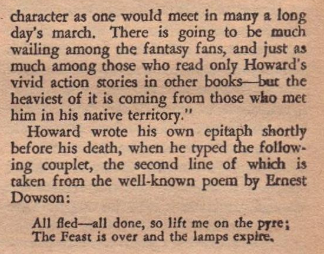
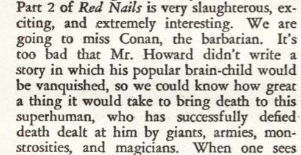
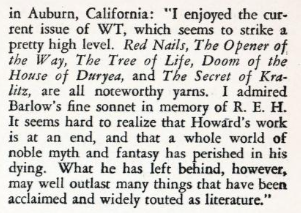
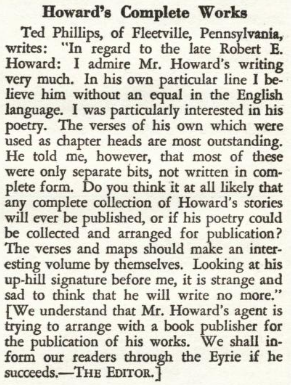
In the “Thief of Forthe” discussion, I posted Clifford Ball’s brief encomium to REH from The Eyrie, Weird Tales‘s enormously important and incredibly interesting letter section, where readers, writers, and editors wrangled with Weird Fiction and discussed the stories, characters, and aesthetics of the genre. It’s an interesting little letter, mostly because it explicitly couches Howard’s death in terms of the loss of stories that readers would never see (one of the most gratifying types of mourning a writer can imagine, honestly). And ol’ Ball wasn’t alone – Howard’s death really rocked the Weird Tales readership, and elicited a lot of shocked and saddened letters from a lot of fans.

What’s fun about ’em, though, is that these letters offer a really interesting ground-level view of both fandom and the way it mediates genre-ification – in a lot of ways, the death of Howard is a crisis that forces people to reckon not only with his work as it was, but the future of both it and writing allied with it. It’s a fascinating archive!

But, before we dive in, here’s a pic of the Big Man himself, enjoying a refreshing big ass beer:

my favorite REH pic

Howard died on June 11th, 1936, and the announcement was made in Weird Tales in the v 28, n. 2 Aug/Sept issue’s Eyrie:

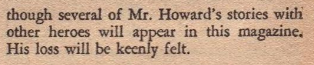
A short but heartfelt tribute from Wright and the Weird Tales staff, highlighting both his imagination as well as his dedication to his craft (something that would get lost in certain later reevaluations of his work; much like what happened with Lovecraft, there were certain parties later on interested in portraying both of them as being weirdo savants who, by accident rather than careful work, produced important and interesting fiction). I’d also point out that, right away, we begin to see certain inaccuracies creeping into the Official Biography – REH did not attend the University of Texas. He took business courses at Howard Payne College, a private Baptist college in Brownwood, TX. By the way, one of those posthumous stories promised in forthcoming issues of Weird Tales included what many consider to be his very best horror story, “Pigeons from Hell.”

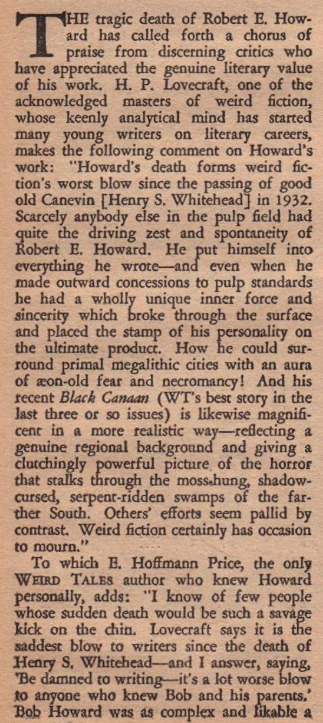
The next issue of Weird Tales, v 28, n.3 October 1936, had further semi-official remembrances of Howard’s life and work published in the Eyrie, this time from his friend and voluminous correspondent HPL, as well as E. Hoffmann Price, who actually met him in person:

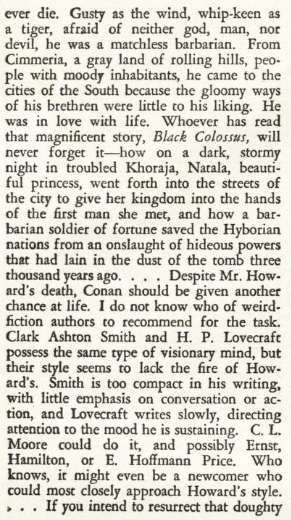
The Lovecraft excerpt is a pretty important one, I think, and sort of sets the tone for the way Howard has entered the annals of weird literature. His line about Howard having “put himself into everything he wrote” is key, and a point HPL would make over and over (it forms the center of the long in memorium he wrote for the fanzine Fantasy in their Sept 1936 issue too). The idea that Howard was deeply engaged with his writing, producing art even in spite of the commercial conditions, is high praise from someone like HPL. Too, I think both he and REH shared a deep appreciation for their roles as REGIONAL authors, people interested in their specific environments and backgrounds and what it meant for them as both people and writers. And there’s certainly something to HPL statement that Howard had a “unique inner force and sincerity” in his work – read Kuttner’s Elak story or Ball’s Rald stories and you have to admit that, no matter how fun and possibly good they are, there IS certainly something missing from them.

Also interesting is the appearance (and misattribution) of REH’s death poem there. It’s a bit of a convoluted story, and I’d point you towards Todd Vick’s biography of REH “Renegades & Rogues” for more detail, but it became a major part of REH’s mythology, a suitably literary (and barbaric) poem to mark his passing.

Even more interesting, though, is that the Eyrie is still working through fan letters from people who had written them before they’d known of REH. Take, for example, this letter from Irvin Gould of PA, asking about a map of Conan’s world:

An interesting letter that sheds some light on the way people were reading and enjoying Conan – they love the hints and callbacks and history peppered throughout the stories, suggestive details about the larger world and deeper lore that imbued Howard’s writing with such vitality and sincerity, and want to know more about it! Specifically, they want a damn fantasy world map! While something like that is de rigueur in fantastic fiction now, back then it was a pretty novel request, I think. I know that there were maps in Haggard’s King Solomon’s Mine novel, for instance, and the Oz books famously had fantastic maps, but it’s fun to see people yearning for fantasy cartography because of the stories themselves and the sense of the scale and sweep of Howard’s vision. And maybe even MORE interesting is Mr. Gould’s recognition that asking for such concrete canonicity from weird fiction might not be appropriate! It’s a fun glimpse into the way READERS were engaging with both weird fiction AND Howard’s work particularly, navigating new genre conventions.

In this same issue there’s also a letter from the famously idiosyncratic fan, Gertrude Hemken. These letters from “Trudy” would become a beloved part of the Eyrie, mostly because she wrote in an absolutely delightful and totally fannish style – they’re a lot of fun, and it’s always fun to run into her in the pages of Weird Tales. Anyway, in the midst of a longer letter, she has this to say about Howard (unaware of his death, of course):

“So-o-o happy. I could gurgle!” should be the blurb they use on any and all Howard books henceforth. But it again speaks the clarity with which Howard presented Conan to the readers – he’s instantly and clearly defined, and folks like what they see!

The November 1936 issue (v. 28 n.4) includes the first fans letter reacting to the death announcement from a few issues back.

This letter’s request for a reprinting of his “best stories” as selected by the WT readership isn’t a bad one, honestly, and shows that, while the pulps were an ephemeral medium, there was a real desire to ensure that their contents lived on and were accessible to readers new and old alike. Later, in the same letter, Hopkins has an interesting thing to say:

It’s an interesting daydream: “The Death of Conan the Cimmerian!” And this musing about what could’ve been, and the extension of the character’s adventures beyond the pen of the creator, is an interesting seed that we’ll see explored more in later letters.
But the desire for a collection of Howard’s work was a common one:

I wonder if Clark’s personally bound collection of Conan stories exists in some attic somewhere?

The December ’36 issues (v. 28, n.5) is mostly dedicated to wranglin’ about the covers and whether they’re too risqué or not, but that leads into an interesting letter from Robert Lowndes about the artistic representations of Conan in The Unique Magazine:

It’d be worthwhile collecting these all together and doing a careful interrogation of each, but there’s no room (or time!) here for it…maybe later. I will grab the Rankin piece that Lowndes speaks so highly of, though, from the Jan 34 issue:

I find the sexualization of Conan by readers (and, to be fair, by Howard) hugely interesting, so the way this letter-writer highlights what it was the women found so damn hot about Conan in the stories is pretty fascinating!

I’ll just highlight one more prescient letter about REH from this issue, by the great Clark Ashton Smith:

The next issue, Jan 1937 v. 29 n.1, opens with Wright reflecting on the “necrology” of Weird Tales:

It’s a sad editorial, particularly in the way Wright’s hopes that no one else will die are pretty quickly about to be dashed. But, as he said, they’ve been getting a lot of letters about REH, and this issue includes some very fascinating ones!

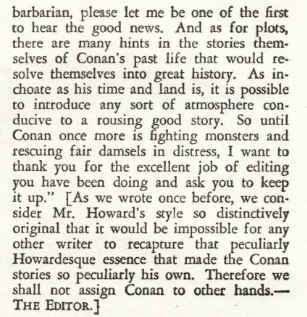
I mean, that’s fascinating, isn’t it? Can’t Weird Tales find someone else to keep writing Conan for them? What a wild question, and I can’t think of any precedent for it at all, can you? On the one hand, there must’ve been fairly widespread knowledge that some “writers” in the pulps were house names with lots of different individuals contributing stories under them (a fairly common practice in particular in the western pulps), but the idea that a writer as singular as REH could be replaced is a wild one. On the OTHER hand, though, weird fiction DID have shared universes, if not shared characters – what is Lovecraft’s Mythos but a shared world with the same gods and aliens and dark books showing up in different stories by different authors? Is that the model this letter writer is drawing from when they talk about Conan continuing without REH? I think you have to give credit to Wright here, who very clearly and definitively answers that no one can write a Conan story except Howard…something later paperback authors should’ve kept in mind, in my opinion!

This same issue includes the Ball letter that we talked about in the last Pulp Strainer blog post, and while Ball certainly isn’t asking for someone else to write Conan stories, as we discussed there is a clear expression of the desire for more stories LIKE Conan’s.

Skipping ahead a couple of issues to March ’37 (v. 29 n.3) we get another plea for a book-length collection of Howard’s work:

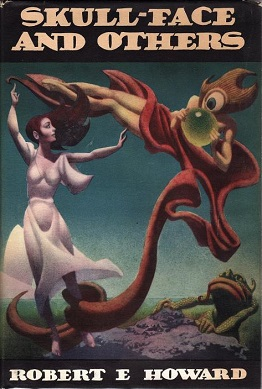
These calls for a collection of Howard’s work to be published are pretty insistent, and it’s a shame that Weird Tales got so brutally burned on their one and only book publishing adventure (The Moon Terror) that they couldn’t do something with Howard’s work. Derleth’s Arkham House would, in ’46, put out Skull-Face and Others in 1946, complete with a badass Hannes Bok cover:

This book included some good Conan stories, but it wouldn’t be until the Gnome Press paperbacks of the mid-50s that you’d see a dedicated Conan series. Interestingly, those same Gnome Press editions would see just the sort of “Continuing Adventures of Conan” pastiche stories that (some) people were DEMANDING in there letters:

People LOVED Conan man, and that’s all there is to it. Howard had made something new and exciting, had carved out a real niche for himself in weird fiction, and the idea that there wouldn’t be any more Conan stories was a hard pill for some people to swallow. It’s interesting that everyone is explicitly couching these as more CONAN stories…they don’t want imitations, they don’t want other characters by other people, they want CONAN doing CONAN things. In some ways, then, it’s actually quite laudable that people like Kuttner tried to do SOMETHING a little different, even while trying to reverse engineer REH’s own unique approaches to his stories. Also, again, I think you have to salute Wright’s firm “nope” here too – he has a very clear aesthetic vision for weird fiction, and it doesn’t include the bloodless imitators of an inimitable writer like Robert E. Howard.

In the next issue of the Eyrie (v29 n.4) Wright publishes a letter from H. Warner Munn, a Weird Tales author famous for his “Werewolf of Ponkert” story, which was a favorite with readers, that really offers the Last Word on whether Conan should have further adventures written by other people:

Pretty succinctly and strongly put, I’d say, and a position I support. Wright obviously thought so too, and even seems to have used Munn’s letter as the punctuation on the chapter of Official Mourning for Howard. In the next issue (May 1937, v. 29 n.5), there’s only a single, passing mention of “the late Robert E. Howard” in one of the letters, and it’s clear that they’re turning the page on the sorrowful demise of a beloved author…

…and then, in v.29 n.6, the June ’37 issue of Weird Tales:

Goddammit!

With regards to REH, I think there’s something really interesting in getting to read these letters from readers of his stories; you can see the huge enthusiasm for his work and his creations, Conan in particular, a real glimpse into the phenomenon that would become fantasy literature in general and sword & sorcery in particular. There’s a little tinge of sadness here, though – you can only hope that Howard had a sense of just how beloved his work was while he was still alive. Writers are a touchy, morose lot in general, given much to self-recrimination and disappointment, often absolutely certain that they’ve wasted their time and largely failed to achieve what they wanted to with their work. It’s something REH certainly struggled with – his letters include many gloomy reflections on his work and the struggle of writing, even when he’s arguably at the height of his career. It’s something people always talk about, but it bears repeating: if there’s someone out there whose work you like, tell ’em! Even something as simple as a nice note can mean a lot to someone, and you never know when it’ll be too late to tell them!

There’s also something extremely valuable to be had by reading these letters in the Eyrie, I think – they’re such a rich archive of READERS and their reactions to/thoughts about the stories and authors and genre as a whole. In the wake of REH’s death you really start to see the way they were ENGAGING with his work, and with Conan in particular, and it’s a real granular way to interrogate the formation of what would, eventually, become “Sword & Sorcery.” There’s ALSO a really interesting tension between what people want (more Conan!) and what they would eventually get (some pastiche-y early attempts by Kuttner, for example, and then Fafhrd & the Gray Mouser – but not in Weird Tales, of course…).

Some other stray observations – it’s interesting how CONAN focused the readers’ letters generally are, isn’t it? I mean, there’s other stuff mentioned for sure, but the Cimmerian is front-and-center, and it’s his adventures that people are clamoring for more of. Partly that’s got to be simple chronology – after all, Howard’s death is announced with “Red Nails,” one of the best Conan stories of all time, and there’d been a lot of Conan recently too, while his other characters like Solomon Kane and Bran Mak Morn hadn’t appeared for years. But there’s something about Conan’s special alchemy at work there, I think, and particularly the sense of a real, lived in, vital WORLD around him that just grabbed readers.

Finally, I’d point out how often people with talent and knowledge would point out just how inimitable Howard was as a writer. Wright is very firm in his explanations about why there’d be no more Conan stories by other people – he was a singular talent writing singular tales, and no one else could do them. Similarly, I think HPL’s oft-cited “there’s a piece of Howard in every one of his stories” is a perfect way to capture the kind of ineffable qualities of his work (and HPL’s, for that matter). It’s easiest recognized by its absence in, for instance, Kuttner’s S&S work, and really underlines the absolutely necessary quality of a writer finding their authentic voice if they want to produce art. For all the problems with Howard’s work (and there’re a lot!), the one thing you can absolutely say is that they are the products of a writer who was absolutely sincere in his efforts at communicating the things he thought were important and interesting. That he succeeded is shown by the many heartfelt letters we see in The Eyrie.

Thieves’ Pulp #40: Thieves’ House by Fritz Leiber Jr., Unknown Worlds, v. 6 n. 5, February 1943

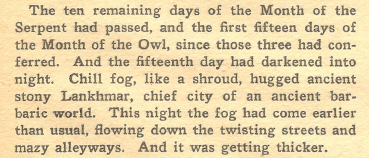
Know, O Reader, that in the time after the Great Turkey Slaughter and before the sinking of the Year there is a month undreamt of, a month of Sword & Sorcery where the Yule, a time of gigantic mirth and gigantic melancholies, strides forth to tread the jeweled wrapping paper beneath its buckle-booted feet!

Yes, that’s right, it is once again time for my annual celebration of the Best of all Genres, Sword & Sorcery! As I’ve mentioned before, the Xmas season is, for me, the most Heroic and Sorcerous of times, one where I like to kick back and read about the derring-do of various mightily thewed types. And while things have been busy down here in Austin, December has come in like a Nemedian Lion finally, bringing cold temperatures and, with them, a resultant coziness that is PERFECT reading weather. So let’s get to it!

This time around we’ve got a true classic too, foundational in terms of Leiber’s Lankhmar stories AS WELL AS the genre as a whole, for today’s story has the very first example of a fantasy “Thieves Guild” that I’ve ever come across! The idea of organized thieves operating as a cohesive and hierarchical medieval-style guild is a core concept in fantasy, as much a part of the genre as evil wizards and scimitar-wielding bad guys, yet another cornerstone laid by the genre’s greatest mason, Fritz Leiber, Jr. Without further ado, the story this time around is Thieves’ House, from the Feb 1943 issue of Unknown Worlds!

A few years ago, we talked about the very first Fafhrd and the Gray Mouser story, “Two Sought Adventure,” and of course we’ve also talked about Leiber as a weird fic writer, so we won’t spend too much time on bio and background. So let’s dive in!

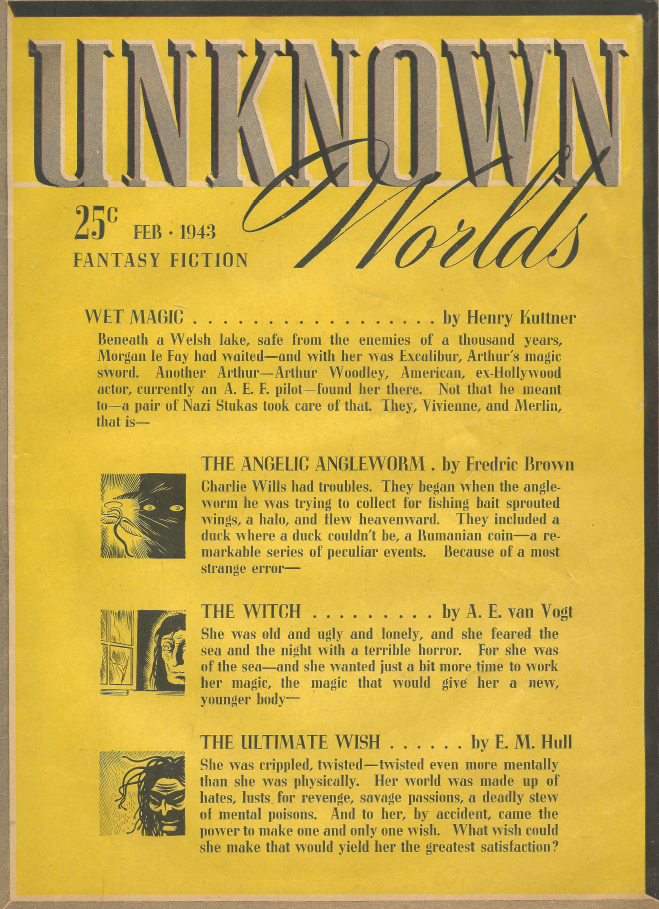
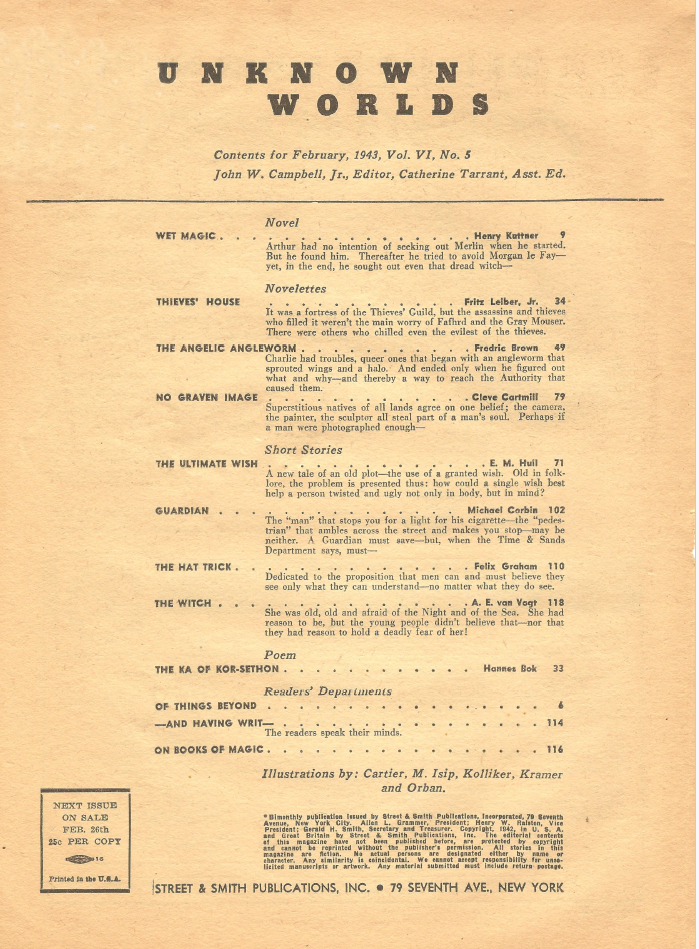
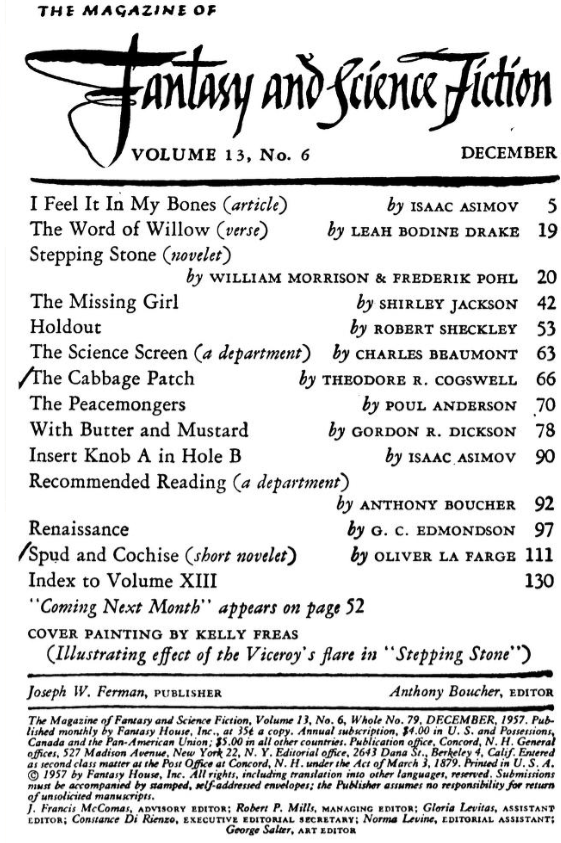
The cover of this issue of Unknown Worlds is a bit underwhelming, huh? I do like the little thumbnails, but it’s hard to imagine that utilitarian little summaries of some of the stories are going to do a better job than a big, crazy cover by one of the many talented artists available for hire at the time. We’re nearing the end of the run for the magazine, though; it’s been losing money for a while and, what with war time paper rationing, it’d soon go under completely, so I imagine the decision to do the covers like this might’ve been influenced by those realities. What’s weird though is that they don’t just put the WHOLE ToC on the cover – these are just a selection of the stories in this issue, plus editor’s columns and letters etc. If you weren’t familiar with the magazine, you might think that all you’re getting for your two bits are these four stories, when, in fact:

A pretty respectable list of work! It’s an odd decision to have only a sampling of the ToC on the cover… maybe based on perceived popularity of the writers, although it seems like a new Fafhrd and the Gray Mouser story should’ve warranted inclusion if that was the case? But, oh well! What is interesting is how Unknown Worlds was really positioning itself as the “fantasy” magazine here. There’s some modern day stuff in here, but a LOT of this issue is devoted to what you’d call classic fantasy, either in the (as-yet-unnamed) sword-and-sorcery genre or in the more broadly defined medieval-ish vein.

Anyway: onto the story!

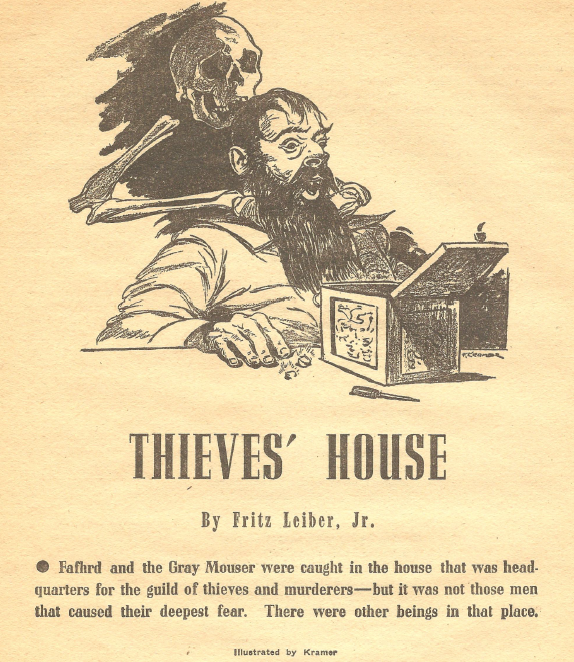
Title illustration is of a guy getting a back massage from a skeleton, good workmanlike art I’d say, and a fun bit of sword-and-sorcerous menace to start it off – you know something macabre and outre is in the works, but the picture here doesn’t really give anything away, which is good!

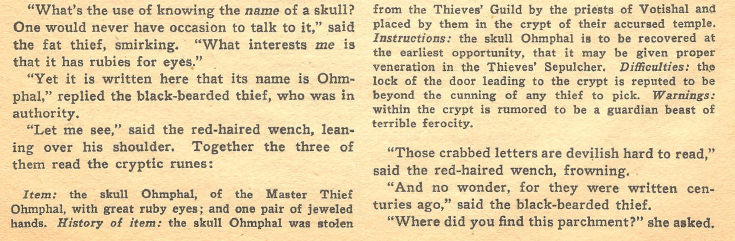
An absolutely killer way to start a story, isn’t it? Leiber can really set the hook – a skull with its own name, gilded and gem-encrusted, being discussed by some thieves, and then a brief precis or interior thieves’ memo about the skull of Ohmphal, with a nice little summary of its history AND the difficulties involved in retrieving the stolen item. Really, truly: if you’re interested in the history of tabletop fantasy roleplaying in general and D&D in particular, then you’ve simply gotta read Leiber. Fafhrd and the Gray Mouser are absolutely the ideal dungeon delvers, and Leiber’s stories lay out so much of the tone and flavor (and, honestly, mechanics) that Gygax and Arneson would mine for their game. The note, the weird factional aspects (with the Priests of Votishal stealing a skull from the Thieves’ Guild), the dungeon-y aspect of the lost temple, and even the need for a well-balanced party – this is a Dungeons & Dragons adventure! Hell, even the format of the memo on the skull is a diegetic DM’s entry, you know what I mean?

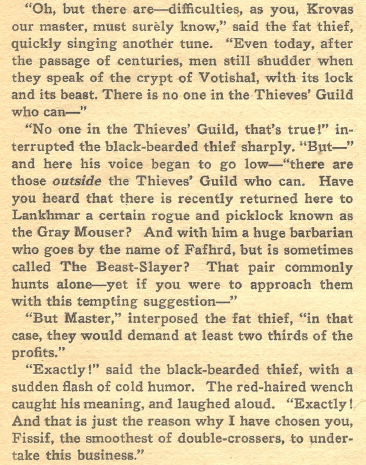
Over the next few paragraphs, we get a very nice, efficient explication of these thieves and the “red-haired wench” – they’re mulling over an ancient parchment that the black-bearded boss-thief discovered in a hidden compartment in an ancient chest at the Thieves’ Guild HQ. Now, piqued by the description of the bejeweled skull, they’re planning on liberating the skull of Ohmphal. Fissif, the fat thief, balks a bit at the challenge, though – the hidden temple is a grim and perilous place, and there’s the whole “guardian beast of terrible ferocity” thing too. Luckily, Krovas, master of the Thieves’ Guild, knows just the rogues to help them out:

A double cross! Man, if you can’t trust the Thieves’ Guild…

But what a rousing adventure is in the offing, hey? An ancient crypt, full of traps and ingenious locks, a jewel-skull guarded by a horrific monster, and a planned betrayal. Can’t wait to read about all that, huh? Let’s get RIGHT INTO IT!

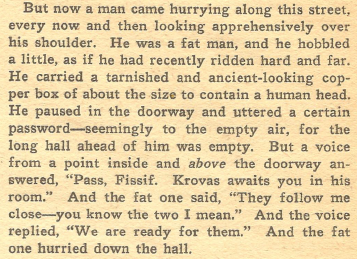
Oh, seems like we’ve cut to 25 days later, and we’re suddenly in a foggy, disreputable street somewhere in the winding streets and alleys of Lankhmar. And what’s this fat, scuttling figure making his way to the Thieves’ House?

Fissif, carrying an ancient box and looking a little worse-for-wear, hurries up and slips inside, warning Krovas that “the two” are following quickly! And it’s true, they are, because very shortly we hear a bunch of secretive whistling warnings, and two figures approach!

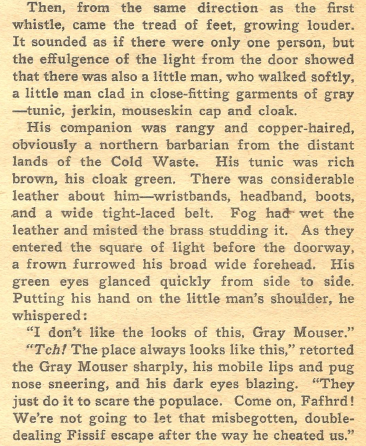
That’s right, it’s our two “heroes,” Fafhrd and the Gray Mouser, and they’re hot on the trail of the traitorous Fissif!

We’ve completely skipped over the whole dungeon dive that was introduced in the beginning of the story, leaping directly to the betrayal and its aftermath – it’s a bold, strong choice from Leiber, and the right one too, because while it would be fun to see the Mouser matching wits with ancient traps and Fafhrd slaughtering a horrible monster, the real action is in the betrayal. Leiber’s always much more interested in the way his two adventurers deal with the scrapes, schemes, and hardships they encounter, more so than in the threats themselves – fighting a monster is one thing, but having to chase after a thief who has betrayed these two is where the real meat of the story is at. It’s also reflects Leiber’s interest in urban settings, I think; he passes over a fairly straightforward “dungeon” portion of this story to leap right into the twists and turns of the city, because compared to the wily, evil ways of the city, a dark and dangerous dungeon is nothing!

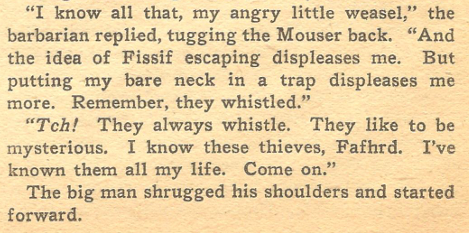
There’s also a great example of what is one of the most fun parts of these two characters: the dialog between Fafhrd and the Mouser. Both characters have very clear voices, with very well-developed perspectives, and the comradely rapport between them is always great and often quite funny.

Discussing Two Sought Adventure I mentioned how these two are such fun and unique S&S characters because, in a lot of ways, they know that they’re S&S characters – both of them envision themselves as daring swashbucklers with steely nerves and unmatched skill, true heroes of their Age. They are, literally and consciously, adventurers, and this fully informs the view of both themselves and the world around them. Because of that, their motivation is never in doubt or has to be hand-waved away – Fafhrd and The Gray Mouser will always behave “heroically” in their stories, because they are (and they KNOW they are) the “heroes.” Of course, they’re also very well-developed characters, with Leiber writing with very clearly defined characters in mind.

Mechanically, their interactions are also interesting – so many great S&S stories are centered around hard-bitten lone wolf types, which by necessity means that there tends not to be too much interiority on display with the main characters – Conan is almost always an enigma, really, and we as readers rarely get to see WHY and HOW he’s deciding on what he wants to do. That limitation is why the best Conan stories all have a secondary character that interacts with Conan, questions him, gets him to explain himself and his plans, etc. With Leiber, there’s no need for that – he’s given us two characters that are intimately bound together, and who are always very consciously playing a part for both themselves and one another. Leiber, son of actors and an actor himself (as well as someone very interested literarily in Elizabethean dramas) has made a very conscious, very deliberate decision in the way he portrays these two, and it lets him generate these interesting and fun bits of dialog and scenarios, like we’re seeing here.

The Mouser, always (and often hilariously) the more hot-headed of the two of them, cools himself sufficiently to agree that they should at least be PREPARED to meet with some resistance in attacking the Thieves’ Guildhall directly. This is wise, because they are immediately confronted with sneaky ambushes! Each of them neutralizes the other’s threats in kind, which is another neat little benefit of having two equal participants in the adventure as your protagonists. Then, menaced from the street, the pair are forced to head deeper into the Guild’s inner chambers where, strangely, they meet no further resistance; it’s almost like something has happened, and these two are just stumbling into it. But what else can they do? They make there way to Krovas’s rooms, hoping to find Fissif and the stolen skull there.

The red-haired woman flees through a secret door, taking the skull and locking the passage behind her. Frustrated in their pursuit, our two heroes are busy contemplating the barred passage behind thick curtains when, suddenly, Fafhrd remembers Krovas, who they left, oddly motionless and oddly complexioned, at the desk in the room. They approach him slowly and with needless caution for, of course, he’s dead, mysteriously strangled to death. This puts it a crimp in the Mouser’s half-formed plan of holding Krovas hostage in order to escape, something of immediate concern because now they hear voices approaching! They sneak behind the curtains just as a bunch of cutthroats arrive, including the betrayer Fissif and another thief they recognize as Slevyas, the #2 in the Guild. But something is going down – the thieves are all nervous and seemingly scared, and Fissif is in deep shit with Slevyas, who demands to know where the Jeweled Skull is.

Slevyas orders a Thief’s Trial of Fissif, whom he obviously believes has betrayed the Guild and connived with Fafhrd and The Mouser to steal the skull for themselves. It’s a fun bit of formal procedure that really hammers home the bureaucratic nature of the Thieves’ Guild. We get a nice little scene summarizing the mission, including some fun bits where our heroes get to hear themselves talked about graciously, and Fissif gets to reiterate what happened – the fuckin’ skull killed Krovas! Judgment is postponed, however, when a thief runs in to let Sleyvas know that the watchers on the roof haven’t seen ANYBODY leave…which means Fafhrd and the Gray Mouser are STILL in the building!

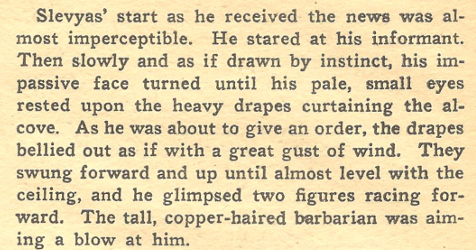
I mean, what a great image, huh? The drapes billowing out, the onrushing Mouser and Fafhrd leaping into action, it’s very dramatic! But of course, you don’t get to be a Master Thief without learning a few tricks; Sleyvas is nimble as a cat, and he ducks and dodges and avoids Fafrhd’s murderous blow. The whole room is in chaos, but Fissif throws a knife at Fafrhd, bonking him on the head with the pommel and muddling the poor barbarian mightily as he and the Mouser dart out the door and into the labyrinthine interior of the Guild Hall.

The Mouser knows the layout, so he leads them in their flight, pursuit hot on their heels. Fafhrd’s head is just starting to clear when he bonks it again against a low doorframe – he’s having a rough night. Fuddled again with a severe head injury, he stumbles one way, leaving the Mouser behind to face an assailant on his own (which he handily dispatches). But the rest of the thieves are hot on his heels, and he splits, heading in a different direction than Fafhrd.

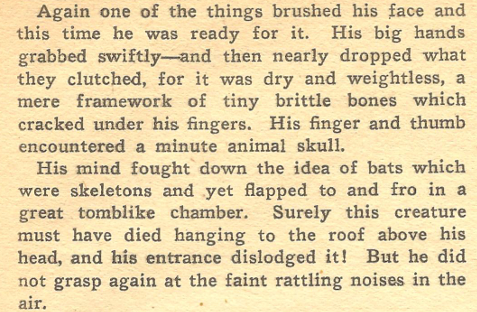
We cut to poor Fafhrd, stumbling around with a concussion – he’s been sick and is having trouble ordering events, and he feels at least three lumps on his head as he bumbles his way through what must be a disused and forgotten deep cellar in the Thieves’ HQ. At some point he stumbles of a secret passage. Everything is dusty and strangely hot, and he’s got no light, instead crawling around blindly, prey to the sorts of weird illusions you get if you’ve ever spent anytime in pure lightless dark. He seems to catch a strange, sepulchral scent, a sort of tomb-ish spiciness, and there are strange whirring things in the air and around his head, bats presumably. It’s very spooky and claustrophobic and unearthly.

Bone bats! That’s great, isn’t it?

Fafhrd then catches another sound, and when he shouts he hears from the echoes that he has come upon a very large chamber of some sort. And he’s not alone!

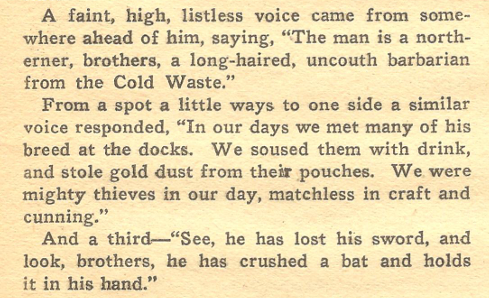
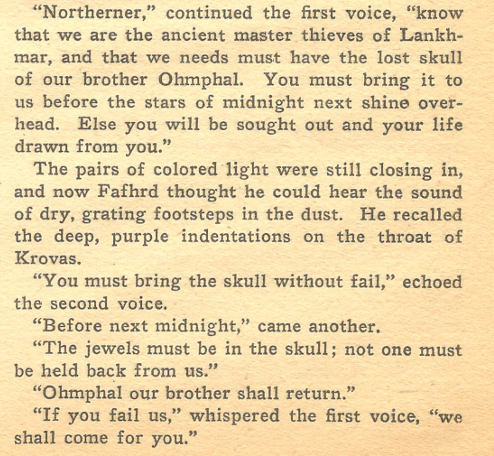
Great, weird scene, with Fafhrd in the dark, unable to see anything, and yet obviously able to be seen by whatever is in the tomb with him. Already we the readers have a sense of what these things are, of course: the spicy, dry, hot air has primed us for tombs or crypts, and the undead skeletal bats flitting around have got us in a very necromantic frame of mind too, so there’s little surprise that these sepulchral voices are the undead liches of long dead Master Thieves, compatriots of the late Ohmphal. Long ago they demanded the return of the lost skull, and their dark sorcery informs them that Fafhrd was one of the three who HAD finally done as they wished…though of course, he hasn’t brought the skull back with him. And that’s a problem:

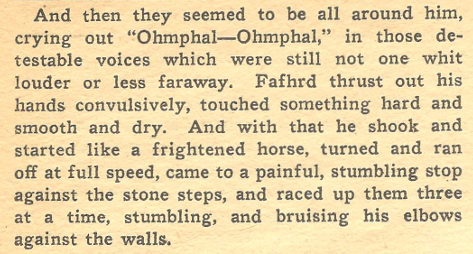
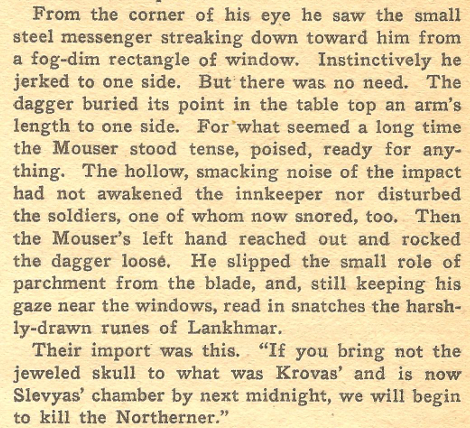
Justifiably spooked, Fafhrd flees wildly off into the dark, charged (on pain of horrible death) with returning the skull by next midnight! And then, having escaped the secret tomb and finally making his way back to the dusty cellars, Fafhrd gets one more traumatic brain injury when he gets bonked on the head by Fissif, who was skulking around down there. Fafhrd is brought before Sleyvas and, seeing as how he doesn’t have the skull, the Thieves decide that that means the Mouser MUST have it…so they make some plans and send a message to the Mouser, who is waiting in vain for his friend back at their favorite bar, the Silver Eel:

The bar scene is a fun one – Leiber is interested in all the little background stuff happening in his fantasy city, really just as much as the main action, and so every scene is populated by these fun little vignettes that do so much to enrich the world he’s created. The drunken soldiers, the barkeep, the squalid surroundings, it’s a lot of fun. And then, of course, when we have to get back to the Real Action, Leiber doesn’t dissapoint; the line “we will begin to kill the Northerner” is really great, a grim and brutal threat of torture and eventual death. It’s fun!

Of course, the Mouser is in a bit of a bind here, what with not actually having the Skull of Ohmphal. But, being the Mouser, he’s got a very cunning plan.

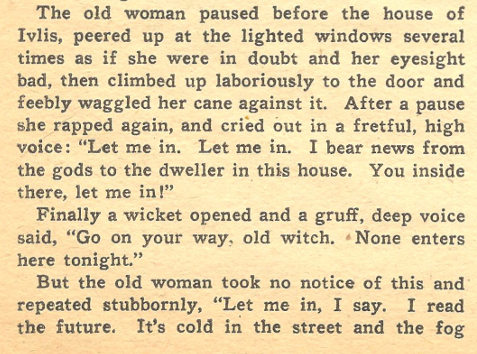
We smash cut back to the misty, murky streets of Lankhmar, where a little old lady is making her way slowly and carefully towards the house where a certain red-haired woman lives. There’re, again, more great scenes of the city and the people in it, and some fun interactions between them as this frail old woman picking her way through the dark. Finally, the old woman reaches her destination:

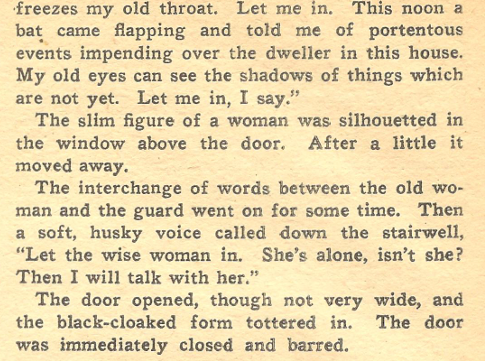
Thus does the Mouser, disguised as a mysterious and witchy old woman, gains entrance to the fortress-like House of Ivlis!

The whole scene between the Mouser and Ivlis is really fun, as our hero tries to bluff his way into her confidence and trick her into betraying the location of the Skull. He also notices the signs of a secret door at the back of the room, presumably one that connects with the Thieves’ Guild next door, a very handy thing for him what with midnight coming on. It’s always fun when the Mouser goes into full on theatrical mode, and Leiber is having fun here, making his character revel in every lie and trick as he wrangles what he needs out of the besieged Ivlis. Equally fun is when the Mouser overplays his hand, which happens when he screams out about smelling the bones of a dead man; Ivlis glances up at an unlit lamp on the wall, but the Mouser’s triumphant look betrays him. There’s a brief, silent struggle, but the Mouser succeeds in overpowering and tying up Ivlis, and claiming the Skull from it’s hiding place!

Smash cut back to the Thieves Guide, where a water clock is dripping its way to midnight; Fafhrd, tied up in a chair, is surrounded by grim thieves who, when midnight comes round, will begin to kill him slowly and painfully. But while they’re waiting, Sleyvas is browbeating his underlings, one of whom got perilously close to the horrible tombs below the guildhall.

The strange events, the uncanny halls beneath the guild that none knew about, the strange marks on the late Krovas’s neck…all of these things are beginning to spook the thieves a bit. And, like a good skald, Fafhrd seizes on the moment to both perform some Northern Tale-Telling AND buy himself some time:

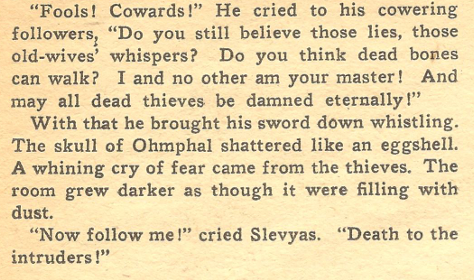
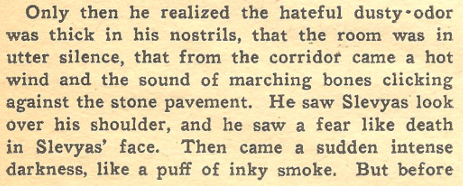
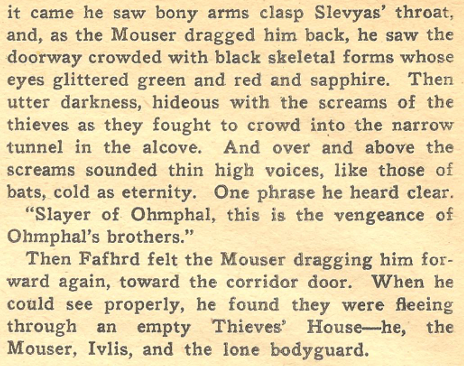
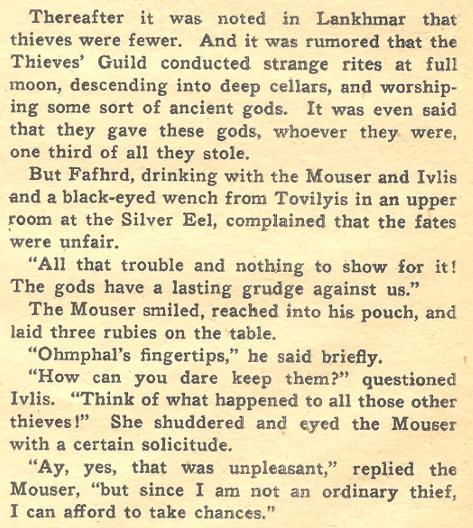
Fun stuff – Sword & Sorcery is sometimes accused of being overly reliant on physicality and violence, and while Fafhrd and the Gray Mouser certainly slaughter their fair share of mooks, you can ALSO see the way Leiber highlights their wits and, in particular, their ability to perform as part of their heroic repertoire. The Mouser’s disguise as a Wise Woman, and now Fafhrd’s skaldic recitation of his adventure in the crypt are just as much moments of heroism and derring-do as any fight or scramble up a cliff, for instance, and Leiber (who again was himself an actor) revels in them. It’s a real fun part of these stories, both a part of their charm AS WELL AS a key to understanding their importance to the development of the genre.

Anyway, Fafhrd has totally captured the attention of his audience with his grim tale of undead horror deep beneath this very guildhall! The water clock has long since run out, and yet they have let him continue talking, and they don’t even notice the slight skritching and scratching coming from the wall behind the curtains.

ANOTHER performance, this time from The Mouser who, having snuck back into the hall via the secret passage in Ivlis’s room, is now pretending to be the ghost of Ohmphal come to pronounce judgement on them all! It’s really fun, particularly in the way the Mouser/Ohmphal engineers Fafhrd’s release, which has all the hallmarks of a hasty improvisation:

I mean, c’mon, that’s fun! And, spooked all to hell as they are, the thieves comply, cutting Fafhrd’s bonds and sending him forward. But, before he can reach the safety of the curtain, there’s an animal scream of rage from the curtains, which begin billowing and flapping, as if some great struggle were happening. Ivlis has broken her bonds and followed the Mouser down the hall, and now she (and her guards) have attacked him!

And then all hell breaks loose! The thieves attack, the bodyguards attack, Ivlis attacks, our Heroes attack, everybody is whomping on everybody, though shortly Ivlis (and her last remaining guard) side with Fafhrd and the Mouser when they see that they are being attacked by Sleyvas and the thieves. There’s dead and wounded everywhere, but the thieves are more numerous and things look grim for our heroes when, suddenly:

But Slevyas is a staunch materialist, right to the end:

But no one does follow Slevyas, and he alone charges in, meeting Fafhrd and the Mouser in battle. A furious combat ensues, though one curiously quiet and lonely – for the rest of the thieves have shrunk back against the wall in silent fear!

A grim doom has descended on the thieves!

And then, we reach the end of the story:

And that’s the end of Fritz Leiber’s “Thieves’ House,” from 1943.

It’s a blast; Leiber is such a fun writer, and he’s got a very strong hand on the tiller in these stories, writing them exactly the way he wants and producing exactly the sort of effect he’s looking for, I think. Now, some people I’ve spoken to find Leiber, and his S&S stories in particular, a little too self-aware for their tastes, and that’s fine – the heart wants what it wants, after all. But you can’t deny that Leiber succeeds in doing exactly what he wants to do with these stories, even if they’re not to your particular taste.

Of course, I think that while it’s true that Leiber was certainly aware of the genre he was writing in (even if it didn’t have a name yet) and was, in fact, often commenting on it, he’s also sincerely writing excellent adventure stories about two very interesting characters. Fafhrd and the Gray Mouser are spectacular fantasy protagonists, rough and ready but also very much interested in having a good time and cultivating a myth about themselves while they do it. In fact, so much of the fun in these stories comes from the way both characters are constantly trying to reassure themselves and each other that they are truly real life heroic adventurers in a world of sorcery and peril. There’s an existential quality to these two that’s fairly rare in the world of fantasy fiction – they are constantly evaluating themselves, interrogating their place in their world in relation to this Ideal Adventurer. Often, the comedy in the series comes from them twisting themselves in knots as they try to JUSTIFY their less-than-heroic actions within this same S&S hero framework. They’re just a lot of fun, and it’s something that I think the genre would benefit from if more writers today tried to emulate Leiber’s approach.

I mentioned above that this story also seems to be the first to introduce the idea of a thieves’ guild into the genre. This is a pretty big deal, one of those huge gravitational sort of pulls that end up dominating the genre, to the point that they’re kind of invisible and taken for granted. The idea that there is a craft guild of criminals operating within a fantasy city is a huge part of the genre’s landscape, providing a lot of narrative potential energy as well as giving writers the chance to engine in some light mafia-style highjinks if they want to. With respect to fantasy TTRPG’s this story, like so much of Leiber’s fantasy, is absolutely foundational – imagine D&D or WFRP without Thieves’ Guilds; it can’t be done!

Now, I don’t know where exactly ol’ Fritz got the idea for his Thieves’ Guild; as far I know no one has every found a letter or notes or anything where he explained its origin. In some ways, it might just be a natural outgrowth of his obviously somewhat skewed and satirical approach to Lankhmar – the idea of a guild of criminals is a funny, weird idea, and it fits perfectly in with the other absurdities he’d go on to invent for his secondary world of Nehwon.

HOWEVER, to me, I can’t help but see the shadow of Cervantes here, particularly from his short story Riconete y Cortadillo which is about two extremely self-important and self-aggrandizing thieves who meet on the road, become fast friends and devoted comrades, and then are inducted into an extremely ridiculous and comedically bureaucratic Thieves’ Guild in the great port city of Seville. In particular, it’s interesting to me how, in Leiber’s story, the Guild starts out atheistic and materialistic, only to end up deeply religious and cultish about their Dead Masters deep in the Tombs beneath the Guildhall; in Cervantes’ story, the Guild is rife with superstitions and complex rituals, like all good secret societies. That Leiber would’ve been familiar with the story seems extremely likely; after all, he was a devoted lover of that era’s literature, and if you’re going to read any 17th century Spanish lit in translation, you’ll certainly be familiar with THE MOST FAMOUS WRITER OF THAT PLACE AND TIME. I know that Fafhrd and the Mouser were modeled on Leiber and his pal (and cocreator of Lankhmar) Harry Fischer, but I think there’s a lot of Rincon and Cortado in the two, particularly in their ridiculous grandiloquence and self-conceit, as well as in their deep loyalty to one another. Anyway, it’s interesting, and if true it puts Cervantes in the lineage of Sword & Sorcery’s deep ancestors, which I really like.

But, regardless, I think this is a very fun story, and it’s importance in the history of the genre can’t be denied. A good way to start of the Yule Season’s S&S, I think!

Strained Pulp Page

A quick note: I made a page where I’ll be able to chronologically list the pulp story dissection/free writing exercises I like to do, because it was getting impossible to either find or, in some case, even remember what stories I’d already done! So, anyway, you can see it here, with links to all the posts, or navigate to it in the menu bar over head! Neat, huh? Like livin’ in the future.

Guest Post over on Adam’s Notes

Just a short little post to point you in the direction of a guest post I did for the great newsletter Adam’s Notes. It’s titled “Robert E. Howard, Grettir the Outlaw, and the origins of two-fisted Weird Fiction,” and if you like the sort of thing I write here in the Pulp Straining posts, then I reckon you’ll like it too!

Adam’s Notes is a really fun thing too, and you should subscribe (for free!) to it, too – Adam is a great writer with interests in some wide-ranging and really fun topics. He does a regular series in the Notes on the letters of Samuel Pepys, a real highlight, but he’s also interested in the Chansons de Geste and related writing. He’s also a great reviewer and interviewer, things he does both in the Notes as well as other places. It’s great, I highly recommend ya’ll sign up for it!

Straining pulp…and souls! “Soul-Catcher” by Robert S. Carr, Weird Tales v. 9, n. 3, 1927!

Generally, when I pick a story to muse about here, I go for one that I really love, a story that I feel like has really got something going on or does something interesting or provocative. Alternatively, I sometimes pick stories that I think are historically interesting, or that represent a facet of the genre, beyond just the fiction in itself. But sometimes I just like to indulge in a little bit of gawking, pointing out something odd or strange or interesting (at least to me), and that’s what today’s (hopefully short – I free write these things stream of consciousness style, so who the hell knows!?) lil’ essay thing is. The story in question is “Soul-Catcher” by Robert S. Carr, from the March 1927 issue of Weird Tales!

Now, I actually DO like this story; it’s got some fun weirdness, and I’m a sucker for a first person narrative with a good voice, and it’s also very short and to-the-point. It’s an example of perfectly fine weird fiction from the 20s, not anything VITAL to your understanding of the genre or anything, and I’d never argue it should be anthologized or anything; it’s a decent little bit of weird writing. But what struck me when I found it, during a recent re-perusal of The Unique Magazine’s ToCs, was the author, Robert S. Carr.

It’s a deep cut, but if you’re interested in creaky old UFO lore, particularly the history of it as a social phenomenon, you might recognize that name. You see, in the 70s, long after his Weird Tales days, lil’ Bobby Carr got into the Saucer Scene in a big way, as evidenced by this little newspaper story in the Tampa Tribune, Wed Jan 16, 1974:

I think this is the first mention of Hangar 18, a place that, along with Area 51 and Roswell, would have to be one of those geographical locales that basically underpins all of modern UFO mythology. And Weird Fiction author Robert S. Carr created it! He’s the one who turned a secret hangar at Wright Patterson Air Force Base into one of the shadowy foundations of modern saucer conspiracism!!! And that’s not all! Here’s Carr again, this time from the Nov 1, 1974 issue of the Ann Arbor Sun:

That’s right, not only did Carr create Hangar 18, but he also appears to have created the modern Alien Autopsy plot that would, in the 90s, explode among UFOlogy! It’s also interesting to see that Carr, saucerizing in the 70s before Roswell had become a thing, leans into the Aztec New Mexico crash as the origin of the Saucer and its crewsicles. It’s a unique moment in paranoid outre american history.

Carr isn’t unique in that regard, of course. You might notice, in the first news clipping above there, the name of Donald Keyhoe. Even a dilletante of Saucerology would recognize that name – he, and his book “The Flying Saucers are Real” are one of the biggest reasons for the explosion in Saucer interest in 1947, tying together a new Nuts-n-Bolts approach (which treated the saucers as machines from alien worlds, in contrast to the more spiritualist Contactee movement that had dominated saucer fandom to that point) with grim suggestions of a conspiracy of silence from the u.s. gov’t about them. But what’s interesting is that, like Carr, Keyhoe was ALSO a Weird Tales writer! He’d had four stories published in the magazine in the 20s, before moving on to specialize in air adventure stories. Eventually he’d transition into a fairly lucrative article writing and “journalism” career, focusing especially on pilots and aeronautics, which is how he ended up connecting with Kenneth Arnold and the early Saucer community. Funny to see two major legs of the many-legged hydra(?) that is modern UFOlogy coming out of Weird Tales, isn’t it?

Just to wrap up the Saucer portion of the show, here’s a link to a Skeptical Inquirer article written about Carr by his son, giving some very important context to his dad, who sounds like a complex, conflicted individual. It’s kind of sad reading, but it sounds like Carr pere was, basically, one of those weird pathological liars who had a hard time distinguishing reality from his lies. Perhaps unsurprisingly, he found a home in UFO circles. Anyway, a fascinating guy, and a very weird connection!

But what about his fiction, you ask? Ah, let us dive in!

A nice little title illustration from an artist I don’t immediately recognize, “G.O.Olimick” maybe? Anyway, it’s good, competently done…but doesn’t that profile look familiar? I swear it’s copied from a Renaissance portrait of some some venetian doge or evil cardinal, a Medici or Borgia or someone like that. Doesn’t it look familiar? If you have any ideas, let me know, I can see the portrait in profile in my mind very clearly, but I can’t find it! (EDIT: I reached out to Adam McPhee, all around Renaissance Man and a Writer of Note, and asked him if, in his extensive studies of Renaissance Italy, he’d seen this visage before, and he thinks it IS Cosimo de Medici! As thanks, I now insist everybody subscribe to Adam’s substack, Adam’s Notes!)

A quick, efficient intro – it’s a hospital story, and right away we’re introduced to ol’ Doc Dorsey, a quiet fellow who seems to specialize in emergency work. We learn that he’s a diligent enough doctor, trying hard to help these case even though, of course, it’s not always possible. Yet there are a couple of oddities about his practice. First off, he works alone, ALWAYS.

So there you go, Doc Dorsey would leap into action with every new case, but he never had an assistant and did all his doctorin’ behind closed doors. The narrator lets us know that that’s not too strange, when you think about it – I mean, these emergency cases are either straight forward or the person dies, not a lot of room for consultation or consideration or discussion. So of course the doctor likes to work alone, it’s just the efficient choice. But it kind of strange; for instance, sometimes they bring in a case that’s obviously hopeless, the person is 100% dead or dying with no hope for any other outcome, and still Dorsey has ’em brought in, shoos everybody out, and then spends time behind closed doors with them. And what’s even odder is that, while the interns and orderlies standing outside his room will hear him bustling around and working, they’ll sometimes see that, when he comes out, its obvious that he wasn’t doing any sort of examination or whatever – no gloves, no mess. So, what the hell was he doin’ in there?

Ah, who cares, says our narrator:

Dorsey does his best, after all, so a bit of eccentricity is to be excused!

Anyway, one day, our narrator, who is an orderly, is asked by Doc Dorsey to head down to supply and get him some surgical gloves, which he does. But while he’s doing this, a car wreck victim is brought in and Dorsey goes to work. Our narrator doesn’t know this, however, and without thinking, enters into Dorsey’s operating room, apparently the first person ever to do so while he’s with a patient. And what does he see?

I mean, that’s pretty good, isn’t it? For one thing, Dorsey has, apparently, decided that this guy is a goner – he ain’t doin’ shit for him at all. Instead, he’s got some kind of weird device, a web-filled frame with what sounds like a grounding wire running into a big glass jar. That’s an evocative scene, isn’t it? And then it gets better!

Good weird shit, in my opinion, and I love the little self-satisfied “got ’em!” from Dorsey there. But it’s all too much for our narrator, who must’ve moaned or made some sort of noise.

It’s good tension here, I think – the narrator (and we) don’t know what the hell is happening here, but it’s obviously something weird and occult. I mean, he’s got a weird net that funnels smokey essence from corpses into jars…that’s a helluva thing to just walk in on. And the look in Dorsey’s eyes when he realizes he’s been caught is concerning, to say the least! But then it all settles down, and Dorsey explains:

Dude’s been jarring souls for a while, apparently – he’s got a big ol’ cabinet full of smoky jars. And he explains that, if he can’t help ’em survive whatever accident or trouble their body is in, he at least tries to save their souls. Literally. In jars.

There’s some good writing on Carr’s part here, where our narrator explains that, upon seeing the jars, he gets a very strange, very distinct sensation of being observed, like what he used to experience when he worked backstage at a theater and would, sometimes, have to step out in front of an audience to do something. It conveys the creepiness of the situation well, I think, and also really captures the weird way our brains work when they’re confronted with something odd – we grope around in our memories for some kind of analogous situation to make sense of what we’re experiencing, and the results are often equal parts illuminating and confounding. Anyway, it’s good.

Dorsey doesn’t seem troubled by his soul collection, however. He accepts that he’s been found out, and even seems to come around to the idea that it’s a good thing; it was bound to happen eventually, and Dorsey is glad that it wasn’t a prissy, smug internist, at least. In fact, Dorsey seems to come to the decision that he might need some help after all, and he asks our narrator if he’s interested in the job.

No time for discussion or thought – an ambulance is bringing in a new victim right away! Talk about on the job training!

Another hint that something not all together copacetic is going on here – that glimmer in Dorsey’s eyes is, to put it simply, menacing. But our narrator can’t do anything about it, barely has time to reflect, as Dorsey calls him over to help with the weird net thing. They catch another soul, and the narrator notices that, briefly, the body weight of the corpse decrees by a few ounces when they snag the smoke. Dorsey explains that there is a physical aspect to the smoke; it weighs about four ounces or so, and the weight discrepancy is compensated for by air filling in the soul vacuum left behind in the corpse. It’s weird and I love it.

The next day, the narrator comes across Dorsey seemingly in a kind of weird trance in his rooms. Eventually he wakes up and explains to the narrator that he was “astralizing,” basically projecting his own consciousness out of his body? Where to, and to what ends, we’re never told…just more weirdness from Doc Dorsey!

And then, sometimes later…Dorsey is found dead:

A mechanical fault in the elevators had made the hospital shake, and as a result all those jars had fallen and shattered and, presumably, all those souls had…gotten out. Our narrator goes over to the body and pulls the cloth off the face, and gets a bit of fright…

I mean, damn…that’s gruesome! His head, and especially his face, had ruptured, as if it had sudden been full of some very argumentative critters.
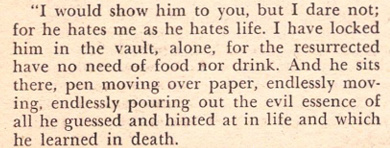
Well, our orderly puts it together, same way as we did:

And that’s the end of “Soul-Catcher” by Robert S. Carr!

Freaky shit, huh? Dorsey had left his body behind, and when those souls got out, they poured into his vacant corpus, filled it up, maybe fought for control, and it was too much, physically, for the body to withstand. After all, there is some kind of weight and substance to the souls…four ounces of soul stuff, and how many souls had Dorsey been jarring up over the years. Just straight up Scanners-ed his head! And what happened to Dorsey’s astralized soul, anyway?
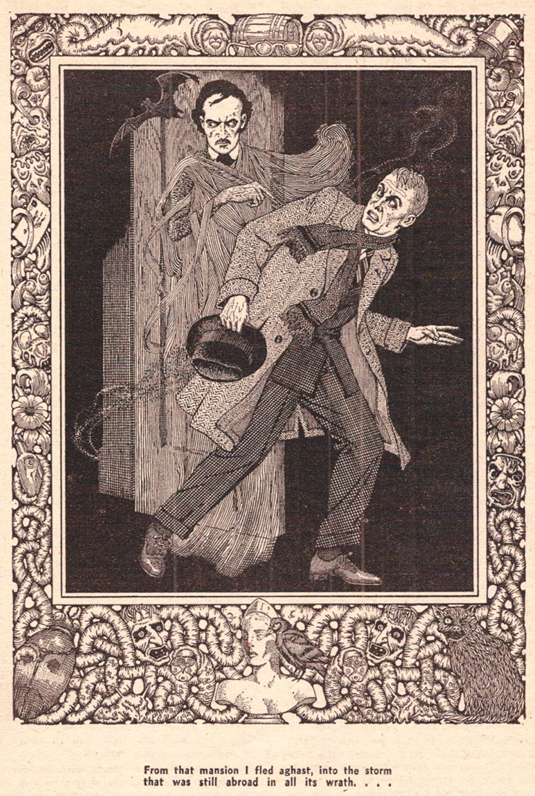
The key to weird fiction is the unanswered question, you know what I mean? The way a story creates a framework where the characters can, plausibly, come to conclusions based on hints within their own story, a kind of semi-certainty about the events that they’ve experienced; meanwhile, we, the reader, have to have just a little bit MORE certainty, shared with us by the author, that yeah, for sure, 100% some weird stuff had been going down. But what makes it all work is the unanswered parts of the story. What was Dorsey doing here? He’d been collecting a bunch of souls, but why? Was he doing it out of some twisted altruism, the idea that he was preserving something of these people that would’ve vanished otherwise? Or did he have sinister motives afterall? His “astralizing” seems to suggest an occult knowledge and interest that could imply that there’s more to Dorsey’s work, that those flashes of mad, manic glee at the chance to get a soul were about more than we realize. Was he doing something with these souls? And was his death an accident, a sudden influx of souls looking for a new body, or was it a deliberate thing, an act of revenge on their jailor?

Who knows? That’s the sort of stuff that makes great weird fiction! I also really love that last line…the OTHER key to weird fiction is the imposition of these weird events and unanswered question on the otherwise banal, everyday life of a normal person. This poor orderly has had a brief glimpse behind the curtain, and they don’t know what the hell it all means beyond the very real fact that it is unsettling and upsetting. So they’ll just have to start looking at the want ads again. Great stuff!

Anyway, fairly quick little story, and even my long-winded thoughts got put down fairly quick. A fun little tale, I think, with a bonus interest factor brought about by the weird connections the author would have much later in life to the big, unanswered questions about UFOs.
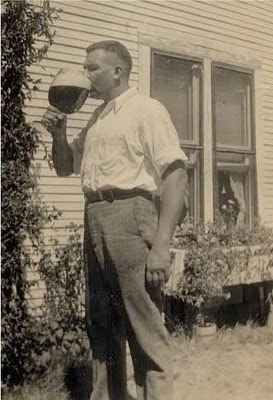
Weird Pulp of the Old West #33: “Spud and Cochise” by Oliver La Farge, (originally published in The Forum, January 1936, but reprinted in Fantasy & Science Fiction Magazine v.13, n.6, Dec. 1957)
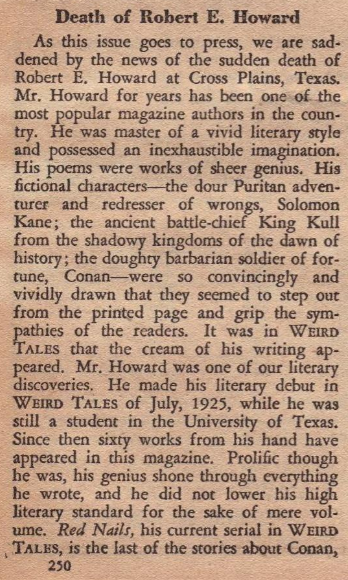
Howdy Pardners! Been a dog’s age, ain’t it? Lotta shit happening, so I ain’t had the time to scratch out as much writin’ and musin’ as I’d like to for this here blog, but still! Catch as catch can, so here we are again, and it’s a rip-snorter this time, a wonderful little story that one could very easily classify as an early example of the “Weird Western” genre originally from 1936: it’s “Spud and Cochise” by Oliver La Farge, originally published in The Forum but republished nearly 20 yrs later in good ol’ Fantasy & Science Fiction!

First thing to touch on – is this, truly, really, actually, pulp? Well, frankly…no. The magazine it was published in originally, back in ’36, was a slick called The Forum, a long-lived magazine first published in the late 1800s and running well into the middle of the 20th century. It’s early iteration took its name very seriously, hosting dueling essays on the major news topics of the day – it famously had a whole issue devoted to American Imperialism and whether it was Good or Bad following the 1898 expansion of U.S. holdings into the Caribbean and the Pacific, for instance. Beginning sometime in the teens, though, The Forum began to publish more fiction, although it never truly abandoned its “Ripped from the Headlines” essays and articles.

I called it a “slick,” by which I mean it was published on higher quality paper, had pretentions of greater literary/intellectual/social merit, and also had a lot more advertising. In fact, during some of its run, particularly in the 30s and 40s, it might’ve actually graded into the storied heights of the “glossies,” since it had circulation and distribution comparable to Harper’s and The Atlantic at the time, with whom they also shared a number of authors. With regards to the fiction it published, it also never focused on a specific genre, which is something else it had in common with the glossies and fancier slicks. In general, the fiction in The Forum was of a more serious, literary bent, though of course you’ll see that today’s story was republished in Fantasy & Science Fiction Magazine in ’57, and it is very definitely a work of fantasy.

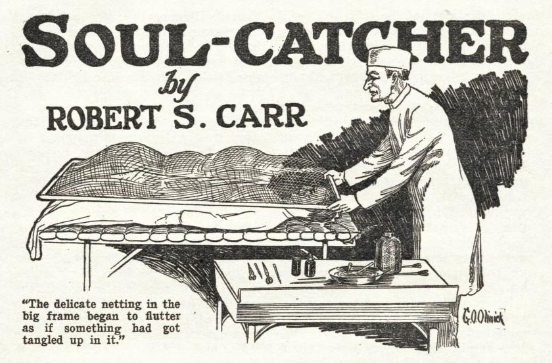
Of course, F&SF isn’t exactly a pulp either; it was first published in ’49, a period that, really, can’t be said to be truly of the pulp era, at least not classically. The post-war publishing boom had changed that landscape irreparably (along with changes in printing and mail distribution), resulting in very different magazine business and newsstand culture. Similarly, radio and teevee totally changed the nature of popular entertainment. Gone were the heady days of dozens of magazines battling it out for a vast audience of readers hungry for more short stories. Now, genres were firmly cemented, and only those with sturdy, reliable fandoms could survive in the hardscrabble world of magazine publishing.

In fact, F&SF was clearly meant to be seen as a break from the pulpy past. It had no interior illustrations, for one thing, focusing instead on the stories, something that immediately stands out in contrast to, say, Astounding or Weird Tales. It was also created by and associated with a very specific group of editors and writers, people who had basically split with what I call the “Ray Palmer” school of sci-fi. There’s a whole story there, a fascinating (but also, sadly, a constantly recapitulating) one too, but to make it short, there had been an aesthetic and philosophic break with classic “gee whiz ray-guns-and-bug-eyed-monsters” sci fi, starting in the 30s and accelerated by WWII; guys like Pohl, Asimov, etc had pushed sci-fi into headier, more literary territory, ushering in a classic era of thoughtful, introspective, and frankly modern (sometimes to a fault!) stories that defined the genre. F&SF was a publication by and for those sorts of stories, as evidenced by its authors and editors; for instance, Anthony Boucher, the editor of this issue, was one of the first English-language translators of Borges. These serious literary chops are evident from a glance at the ToC:

It’s just ringer after ringer, both in terms of straight sci-fi (Asimov, Pohl, Anderson, Dickson) as well as the fuckin’ Master herself, Shirley Jackson. I mean, this is a scorching table of contents, some great stories by some great writers, including the reprint we’re interested in today, “Spud and Cochise” by Oliver La Farge!

But, before we get stuck in, let’s briefly introduce our author, since it’s A) extremely possible that you’ve never heard of him and B) his biography is relevant to this story. La Farge, born in 1901, was originally an anthropologist, doing important work on Olmec sites in Mexico before shifting his focus to the desert southwest and, specifically, the Navajo. He learned to speak Navajo, and wrote several scholarly works on both Navajo lifeways and their language. It was this experience, particularly in living in the southwest with the Navajo, that informed the majority of his writing. He’s probably most famous for a novel, Laughing Boy, which is set on a Navajo reservation and represents an important record of Navajo life and culture from the time; it won the Pulitzer in ’29 and set La Farge off on his career as a novelist. He also wrote a fair number of short stories, publishing a couple of collection in his lifetime and one volume posthumously. I’ve not read any of his novels, nor his autobiographical memoir “Behind the Mountain,” but after I found this story (in an old 60s paperback “best of” collection of F&SF) I chased his stuff down. He’s a good writer, interesting and with a lot of keen descriptions of people and places in the southwest, worth reading! But, I will say, today’s story is easily my favorite thing he’s done, a real masterpiece. I’ll link it again here just in case, and strongly urge you to read it before I go and spoil everything. It’s really honestly great!

Anyway, we’re burning daylight, so let’s mount up and get into the story!

Incredible western writing…you can smell the desert air, taste the dust, feel the sun, it’s great stuff. The tone is wonderful too; that little bit at the end, about the dead horse being a godsend for the ants, just a perfect encapsulation of the desolate and alien nature of the desert, you know? Balzac wrote that “In the desert you see there is everything and nothing – it is God without mankind” and La Farge gets it, you know what I mean?

Our dusty, weary feller, identified simply as Spud, rides up a ridge and sees a cloud of dust moving towards him. What’s the western equivalent of hard-boiled? Raw-hide? Whatever it is, that’s what we get, the sort of spare, efficient prose that lets you know Spud is an old hand at western living, wary of the dust, knowing it could be dangerous, particularly when it vanishes.

It’s interesting the way the medium in which we read things mediates our experience, isn’t it? I mean, think about someone reading this in The Forum in ’36 – you’d hit these first few scenes, these first few paragraphs, and think “okay, we’ve got some kind of cowboy story here.” But us, reading it in a science fiction magazine, we know there’s more than just a cow opera in the offing here, so we’re primed and waiting for the weirdness, reading between the lines…why did that dust cloud vanish?

Spud rides on, and eventually comes across the source, a weary, dusty woman who he greets with all the tact and graciousness of a true Gentleman of the Range.

Great stuff, perfect tone, perfect edge to everything. This woman is, very definitively, heading away from the town of Spareribs; there’s obviously something there, some reason that this exhausted woman has lit out of town in such a hurry, and Spud simply must know what’s going on. It turns out that, beneath the dirt and dust and grimness, he recognizes this woman!

Man, but “came out flat with what moved in him” is a perfect line, isn’t it? The western genre is the perfect, natural home of the valiant Paladin, particularly if you like your chivalric hero a little dusty and trail weary, and in this section La Farge is presenting us with an all time Cowboy Knight Errant in Spud. Just a really wonderful bit of character work here.

And then it turns out that this woman, a prostitute, actually recognizes Spud!

Plotwise, there it is: this woman, hoping to start a new life, bought up a mine and figured on settling in Spareribs, only to end up getting menaced by someone names Snakeweed. Stylistically, I think this is great stuff – very western, very gritty, but then the way these two know each other, the way they share a geography, it’s very mythic, you know what I mean, like a greek myth, or from the chansons. And they way she just has to ask “Do you know Snakeweed?” and he only has to answer “I do” well, I mean, c’mon, that’s fantastic. We’re immediately transported into a world, although we don’t know yet what kind of world it is, exactly. But damn if I don’t love it! Also, just as an aside, I love her statement “I tried to get out o’ the corral, but I guess it’s too high for me.” What a great line, full of despair at her inability to escape her past. Wonderful stuff!

Seeing and hearing her despair, Spud tells her not to worry – he’s been around the block a bit and seen many a woman like her find happiness. Then, moved by the weird that dominates his life as a heroic wanderer, Spud tells her to hold off going all the way to Tucson. Instead, she should take another trail, head to a place where she can hole up for a while and give him a chance to take care of Snakeweed.

Flawless stuff, in my opinion. The woman worries Spud will get killed, what with him being a wiry little feller and Snakeweed a great big bear of a man, but Spud tells her not to worry, telling what we think in the moment is a Pecos Bill style tall tale about himself. Anyway, there’s something in his bearing and words that convinces her that she oughta let him try, at least. They make an agreement to meet at an appointed time, and then she gives him a gift.

Two whole bottles of Four-Eye Monongahela! Now, at this point in the story, this is just some fancy liquor (Monongahela, by the way, is a valley in Pennsylvania, were the tradition of making whiskey with a mash of 80% rye and 20% barley originated), though you’ll want to just tuck these two blue bottles away for now in the back of your mind.

Spud rides off, there’s more wonderful desert description, and then he reaches Spareribs, a rough patch in the middle of nowhere. He’s been here before, as evidenced by the fact that the corral boss knows him and hands him a key. There some fantastic western writing here, a clearly painted picture of a dusty mining town in the middle of the desert, complete with saloon and fancy faro table. Spud gets a drink, eats a steak, and gets the feel of the place.

And then: enter, Snakeweed.

What’s Tiger Bone, you ask? Well,

So already, we’ve got some stuff going on, right? The whiskey earlier, a kind of heavenly drink, and now we’re introduced to its opposite, Tiger Bone, a Left Handed liquor, if you will. And it has effects!

Just gonna come clean – I love this, it’s perfect. “You know me. I’m Snakeweed; that’s what they call me and they better like it.” War talk indeed! And Spud has the sense (perhaps influenced by the preternatural Tiger Bone he’s been drinking) that he too has become a part of this myth cycle, back when he made his own war talk and Named himself in the same way. We’ve stepped out of the West, per say, and into some real Wizard shit now. And it just gets better!

Spud recognizes the truth of the thing – there’s magic in this world, Spud and Snakeweed both partake of it and use it and understand it. Without that bullet, Spud knows he can’t kill Snakeweed. He briefly contemplates trying to drink him under the table, but he calculates that it’d take a lot, more by far than he could handle himself. Similarly, there’s the sense that the Four Eye booze, powerful as it is, wouldn’t help him here either – there’s a great line about how the Tiger Bone didn’t make Spud mean, and in the same way the Four Eye wouldn’t make Snakeweed kind. This is my favorite kind of magic, a sort of Taoist point-counterpoint, forces-in-balance sort of thing.

Spud retires for the night, turning over the problem in his head. Spareribs is too small for both Spud and Snakeweed, but so long as Snakeweed has that bullet, there’s no way to get rid of him. Spud mulls it over, letting the Tiger Bone roil in his veins, and then he comes on a memory of a time when, once, he’d had a horse stolen out from under him by an Apache, a man who clearly could steal anything. And so, in the morning, Spud heads off in search of the great leader of the Apache resisting the Americans and the Mexicans both, Cochise.

Spud does some magic to learn where he has to go and then, after the manner of a hero, travels through the borders of the known world and into the unknown. La Farge spent a lot of time in the desert, and it shows again in the way he writes about the landscape and pure magic of it. Eventually Spud reaches his goal, confronts the Apache, and meets Cochise.

And then begins what is, in my estimation, the finest wizard’s duel ever written.

The thing about magic is that it’s hard to write, you know what I mean? What does it represent it? How is it expressed? You look at the classics of fantasy literature, your Conan or your Lord of The Rings, and you’ll find a paucity of magic, at least of the flashy, spectacular, D&D style spell-flinging; Gandalf lights a stick on fire in the blizzard magically, and that’s about it. Now, he does some other stuff too, but its all about will power and determination, a kind of intrinsic magic, hidden from mortal eyes. Similarly, in Howard’s S&S, the magic is either hypnotism and suggestion and alchemy, fancy psychological trickery, or it’s demon-powered and inhuman; either way, it’s rarely the focus of the story, since Howard knew if you dwelled on it too much it tended to strain the verisimilitude.

As for having two wizards go at it, well, forget about it. I mean, honestly, two old bearded dudes hurling fireballs at each other is boring as hell. That’s why people either subvert it, like Jack Vance and his ridiculous (and very limited) ultra-scholastic magic, or they go back to a real old-school kind of mythic “duel” like Le Guin in her great “The Rule of Names,” or White in The Once and Future King. Here the wizards are trying to one-up each other in a kind of escalating game, to see who can be trapped. That’s fun, for sure, and in both Le Guin and White’s work it is presented really effectively, but in all honesty: once you’ve seen two wizards trying to out rock-paper-scissors each other, there’s nothing really more to add, you know?

Which is why La Farge’s work here is so exciting – this is a fantastic wizards’ duel, with rules that are evident but obscure, and it feels both old and mythic while also being new and totally unprecedented. I’ll not paste any of it here, because otherwise I’d just end up putting pages of the story here, but I really hope you’ve already gone through and read this story; I really can’t say it enough – this is a great story, and this part in particular is fantastic.

Their duel starts with Cochise stopping the sun and sending it back along its track, a horrible thing (as no one can live in the past) and an awe inspiring display of power. Spud counters with a stream of mystic cursing in a range of languages, transforming his words into pure power that sends warriors fleeing and makes a buzzard drop, scorched to death, from the air. Cochise’s magic was flashy, but Spud’s demonstrated his power to actually affect things in the world permanently. Cochise responds by literally cutting a hole in the sky, and Spud nearly loses himself in the otherworldly emptiness exposed, and only with difficulty does he shake it off. Spud ties a knot in a string, a powerful spell that binds and traps Cochise. Both are left wearied.

The two wizards, Cochise and Spud, have some more magical fun – the contest is over, and by their exertions they have bound each other in friendship. There’s more mythic goodness from the buzzard, who threatens the two if they won’t share their booze, and then they get down to brass tacks – Spud came here to find a great thief to steal Snakeweed’s magic bullet. Cochise knows just the man. The thief is eager for the challenge, and agrees to help Spud. Cochise and Spud discuss deep, mystic matters long into the night, finishing off the Four Eye, and they part as friends and comrades, brother wizards both.

Spud and the Thief return to Spareribs, and he gets to work:

Again, the portrayal of magic in here is just so goddamned perfect, matter-of-fact but never banal, and the implication of it is always one of long study, serious dedication, and deep skill. It’s some of the best examples of magic I’ve ever read in any fantasy anywhere. It’s really great!

The thief returns with the bullet, and Spud, in thanks, says he can loot the town of its horses, which the thief cheerfully does. Meanwhile, Spud takes the malachite bullet, fixes it so it’ll work as a center-fire round, and then goes and loses some money at faro (in some obscure, mystical way, this is a magical act too, and its that easy ambiguity that La Farge captures that makes his magical writing so good, I think). And then he goes to kill Snakeweed:

And that’s the end of the story!

Look, obviously, I fuckin’ love this story. It’s great; Spud Flynn is a goddamn trail-worn paladin, easily my favorite kind of character, and La Farge has given him a vital voice that works perfectly in this kind of story. I love the way the world is just absolutely steeped in magic, too; like I said, this is the best wizards’ duel I’ve ever read, and the weirdness of Snakeweed and Spud’s own wizard duel in the saloon is fun too. There’s a real rugged realness to this world’s magic that I love too; it feels organically like a part of the story, you know? I reckon that’s because La Farge, a writer who loved the Southwest, was intimately familiar with the folklore and tall tales of that place, as well as the legends and folklore of the Native Americans of the region.

His familiarity and first-hand knowledge of the land and the people of that region is evident, particularly in the way he writes Cochise, I think, and it’s a goddamn relief to read something that treats the Indians as real people and not mere props; it’s sadly rare NOW, let alone from something in 1936!

As an example of a “Weird Western,” I think it’s really great – there’s a real tendency, especially know, to lean heavily into “cowboy vs monster” and, don’t get me wrong, that’s great too, but man I love the fable-like quality on display here, and the emphasis on magic and the conflict between two Cunning Men (in the sense of them being wizards) on display here; it’s a much rare kind of weird western, I think, and that’s always refreshing.

Reckon I’ve jabbered on enough about it; it’s a good story, and I hope to see ya’ll somewhere down the trail. Adios!

Greater Austin Book Festival 2025 Recap

Blowin’ the dust off the ol’ blog to, hopefully, start to begin to approach maybe writin’ more on here. I was all primed for Sword & Sorcery posting last Xmas, but, as always, life and such took precedence. But, while things have been quiet on here, I have not been vegetating (as nice as that sounds); I’ve been using my scant spare time to put together another collection of weird short stories that, hopefully, will find a publisher and be available for people to read at some point. Also got a few stories published here and there (check out the Writing page for links). And, most recently, I took part in the Greater Austin Book Festival, a really fun event the library foundation does here in Austin. Had a great time, sold some books, met some folks, moderated a panel, got some free beer and lunch…all in all, a success!

This is the second year of the festival; you might recall that I did a write-up of the first year’s event too, wherein I was suitably impressed by the fact that everything ran as smoothly and went as well as it did! Well, I’m pleased to report that this year was no different; in fact the heroic library staff who put on the festival made it bigger and better than last years!

As someone with exceptionally poor organizational skills, it really is impressive to me to see people get something like a book fest, with so many moving parts, humming along with no hitches. Speaks really well to the skill and resilience of the Austin Public Library and its tireless workers and volunteers!

The night before the festival, the library hosted a reception with snacks and free beer/wine for all the participating authors, which was a lot of fun. Rain meant we couldn’t use the (really beautiful) rooftop garden, but even trapped indoors it was still a fun chance to get to meet other local writers (and drink free beer). It’s always interesting to meet other writers, because it’s a pretty wide-ranging and diverse field – everything from MFA types to hobbyists, and from traditionally published to self-published (although it feels like small, indie-press published books were in the majority).

It’s also interesting to encounter writers and learn why they write – I’d say a fair number of them entertain dreams of a particularly remunerative cast with regards to their writing, which is really an alien view to me. I mean, if I could pull down mid-five figures writing my dumb little stories, I’d love it, but that said the money a book pulls down isn’t ever a metric I’d want to reckon success by. And I’d certainly never want to write anything with that in mind – there were a few folks skirting dangerously close to marketeering talk there, which bums me out when I encounter it.

As I’m writing this I realize there might be some conflict in what I just said and my avowed love of the pulps – after all, some of my favorite writers approached their work with at least one foot in the “write for $$$” camp. But, when I look at it, I think what’s frustrating NOW versus back THEN is the scale of the problem, as well as the nature of the publishing world – I mean, back in the glory days of the short story, you could absolutely crank out some work explicitly for some quick cash, and use that to subsidize your more artistically-satisfying work. Also, the whole nature of pulp publishing was just this big ol’ bubbling mass, you know – lots of change, very dynamic, if one market didn’t work for you there were others, that sort of thing. You contrast that to today, and it feels very different, everyone seems to be chasing the exact same market-tested-and-approved thing, for one, with very little room for real experimentation or diversity. And, of course, the idea of someone being able to write potboilers for cash and then work for themselves just doesn’t really make sense today, not with the idea of a unified “brand identity” that publishers all seem to have bought into. Of course, in the indie world, none of that applies, but then that’s probably because nobody is making any money at all.

A bit of a discursion there, sorry! And really, the majority of the authors I met were doin’ it for the love of the game, which is always a refreshing thing to encounter out there. And it was something that several readers/browsers at the Festival said too – the fun thing about GABFest is it really *does* expose people to books that they might otherwise have had a hard time encountering, and people really do love it when that happens!

And there were a lot of really nice people who were genuinely excited to see my books. A huge thanks to Alan Good at Malarkey and Matthew Spencer at Paradise Editions once again for doing such great work on the covers – they grabbed folks’ eyeballs from a fair distance, that’s for sure, and there were a lot of excited exclamations of “Oh! Horror!” as they came up.

There were also, hilariously, a fair number of people who came over just to let me know they *didn’t* read horror, which is a bit odd. Like they felt like I needed to know that they had instituted a widespread ban in their own reading on spooky stuff. Do other genres get that? Like do people make an effort to physically come over and tell authors “ugh, memoir? not for me!” or “sorry, I don’t read sci-fi?” It’s a strange phenomenon; happened to me several times. And when I asked them why not, they really didn’t have much of an answer for me, though several people said the real world was scary enough, which is a weird one. Like, if my books were titled “The Fascist Who Became President” or “Night of the Tariffs” I could understand that position, but, like, my book has weird monsters in it. There’re haunted atomic mannequins, fungus mimics, an ancient roman liche! That’s pure escapism man!

That bit of goofiness aside, a productive horror discussion was had in the Horror Panel, which I got to moderate. Three authors (originally four, but one had to drop out at the last minute) and me, chattin’ up in a conference room on the fourth floor of the Central Library, a great time with a great crowd. I really enjoy panels, and honestly I think I’ll only ever do conventions if I’m on one – for one thing, they’re just fun, but on another practical level, they’re also the best way a nobody like me can convince someone to take a chance on the books.

I like a pretty loose and free-flowing sort of panel, more like a broadly directed conversation than anything else, so I opted to start with a Lovecraft quote: “The oldest and strongest emotion of mankind is fear…” and then asked the panelists (Brendon Vayo, Burke de Boer, and Julius Crow) how their work approached and engaged with fear. The resultant discussion was a lot of fun, and I think we got into some pretty neat areas, thinking about ways fear, as both a very idiosyncratic thing as well as a kind of universal experience, can be used both thematically and, frankly, mechanically in writing. The audience seemed to dig it too – we talked for about a half-an-hour or so, and then I opened it up to the audience for questions. There were a bunch of ’em, and one really heartening thing was that, when the inevitable question about AI and writing came up, the audience was 100% in agreement that AI sucked and they would never read anything that used it, let alone something produced explicitly by it. Great to hear!

All in all, it was a lot of fun, sold some books, met some folks, got to talk about books, free beer (and lunch), what more can anyone ask. It’s a neat thing that the library here does, and I’m really glad that it seems to be settling into an annual event – there were plenty of folks there walking around, taking advantage of the space and programming of a great little community institution, which is just a really nice thing to see. If you’re ever in Austin in the spring time, late April/early May, it’s a fun event and worth seeing!

I’ll just close out with the reminder that, yes Virginia, there *are* books left over from the Fest, and if you want to buy one, why not contact me?

Lookit ’em, cute little things in need of a good home…

What is to be done?

Well, here we are, at the end of all things. Trump, moron, rapist, fascist, has returned to power. More to the point, he’s the first Republican to win the “popular” vote (a bit of a misnomer, because of course for the 47th consecutive time, the actual winner of the presidential race was “did not/can not vote” in a landslide). There’s a whole lot of stuff already written about the utter fucking catastrophe of the 2024 election, and I don’t want to be repetitive, but sufficed to say: fuck all fascists, and fuck the corporate soulless monsters of the official “opposition” who lost to one of the stupidest, vilest pieces of shit in history.

Trying to elaborate for myself what exactly Trump’s victory means helps explain it, in part. For example, Harris, VP to a president who oversaw the largest expansion in domestic hydrocarbon production in history (something her boss’s old boss, Obama, bragged about back when HE held the previous record), explicitly refused to follow through on an older promise to ban fracking, promising that oil and gas “had a place” in the “clean energy transition.” It’s hard to see how Trump could do any worse than Biden did and Harris promised to do, honestly; the only real difference between them is that Trump won’t try and hoodwink people with a greenwashing “Infrastructure Renewal Act” like the previous bosses did. Hell, Biden didn’t even lift a finger on one of Trump’s previous oil giveaway cornerstones, the ANWR drilling scheme, until literally hours AFTER Trump won reelection (guaranteeing that he’ll just reverse it after Jan).

You can go down the list and do the same with almost every position: Border Security? Well, Harris was flabbergasted at how the Republicans had the crass gall to REFUSE to vote for the Dem’s hard right anti-migrant bill, so now we get worse than that with the addition of nonstop cruelty theater alongside it. FDA is tanked, so the listeria outbreaks that happened under Biden/Harris will just accelerate and expand, plus we get vaccine denialism!

And, of course, there’s Gaza, which just sums up the whole fucking thing really. Smugly dismissing peace protestors, refusing to even appear to be considering arms reductions let alone embargos to the israelis while giving carte blanche to their well documented genocide and ethnic cleansing, and then being shocked when the good little boys and girls don’t line up to vote for them anyway. Grim, ugly stuff, and now it’ll be grimmer and uglier.

Hell, the Dem’s had a slamdunk in the immensely unpopular overturning of Roe and subsequent surge in abortion bans and resultant fatalities and misery. But, of course, Biden has a well-documented history of anti-abortion sentiments and statements, so he didn’t do shit when he could, and beyond some dolorous platitudes and solemn declarations of vague support, what, exactly, was Harris et al.’s plan? The conspiracist on my shoulder whispers stuff about “a perpetual fund-raising grift” while the grim realist, who is pretty loud these days, shouts “they’re just dumb as hell!”

The big story, of course, is the rightward shift of the “working class” electorate, at least at the national level – we get another four years of navel-gazey punditry about “the working class” and what “they” want. Now, there’re very real material concerns in this country – housing is an insane pipedream for most, rents eat up half or people’s monthly income, and the cost of food is through the roof; only an idiot or a flak would tell you differently. But the idea that the Republican trickle-down bootstrappers in general and Trump and his billionaire buddies in particular are going to do shit about it is maybe one of the darkest jokes I’ve ever heard.

Which brings us to Lenin.

I titled this one “What is to be done?” because, in addition to it being my favorite bit of ol’ Vlad’s writing, it seems pretty goddamn relevant today. If you’ve read it (which you should, it’s good and important), then it’s no surprise why I’m talking about it – the whole point of Lenin’s essay is to clarify that the workers are not going to just spontaneously achieve real class consciousness sittin’ under the Bodhi tree and worrying about wages and the cost of living and their trouble with the bosses. Unconnected, uneducated, and uncoordinated, they’re ripe for the plucking by parasites like Trump and Musk and Thiel, who have a million “explanations” for why the workers are struggling; pointy-headed profs worried about land acknowledgements, perfidious and ambiguously-gendered people that make you feel funny, scary immigrants with their weird customs, alien languages, and willingness to work for less, anyone and everyone but capitalism and the vampires empowered by it. Not even unionism helps here, according to Lenin: you might get concessions and better conditions, but ultimately trade-unionism is just more sectionalism and rank self-interest embedded in capitalist structures of exploitation.

What is to be done is this: active, energetic, and aggressive education about socialism. Strident and uncompressing anti-capitalism, anti-fascism, and anti-imperialism. A clear enunciation of not only economic themes, but also the theoretical underpinnings of capitalist oppression and socialist liberation. Armchair (or, these days, Gaming Chair) Marxists aren’t enough – actual people have to be enrolled in their own liberation, have to be given the opportunity to learn and understand where their alienation and immiseration is coming from in order to fight it.

Now, I’m no vanguardist – I’m right there with El Sup and the Zapatistas in saying that I shit on all the revolutionary vanguards on this planet. The idea of a permanent vanguard is both theoretically loathsome and historically dubious. But no one can deny that americans are enormously and disastrously ignorant – their votes for Trump, a conman whose economic policies are explicitly constructed to help capitalists maximally exploit workers, proves it. The idea that the workers of america are capable of arising to some sort of actually informed understanding of political economy is just patently false, because american society, institutions, and education have been built around actively suppressing that possibility. They can’t even identify their own self interest, so successfully have they been propagandized to by capitalists, instead blaming imaginary immigrant hordes and fictionalized trans student athletes for getting lavish gov’t funding while they can’t feed their families or own a home. The only way to combat that deep-seated bullshit is to make people recognize that truth – that they’ve been lied to their whole damn lives, all in service of shoring up and securing capitalist domination. And only by making it clear how capitalists have used division, prejudice, and hate to cement their own rule and wealth can we hope for any actual liberation.

Now, what that looks like in actual practice is something I don’t know, and I’d guess no one does really, or they’d be doing it. I mean, we remember the debacles of the DSA in the shadow of the first Trump term and how that all turned out, so there’s no easy organizational checklist we can just run down. But with everybody kind of waving their hands and telling us all to “build community,” I feel like this at least offers a little more structure, you know? Like, sure, build community with your neighbors, but you gotta wear your socialism on your sleeve when you’re doing it (and socialism of whatever stripe, mind you – that’s why I keep using the lower-case “s” in socialism [I myself am an anarcho-communist, a fan of Kropotkin and Zapatismo] but, honestly, I don’t give a shit about our cute little internecine theoretical conflicts; so long as we’re all devoutly and sincerely anti-capitalist and anti-imperialist, I will call you comrade).

I’d also say that, as important as building community is, sometimes destroying them is just as important. I cannot emphasize it enough – you absolutely cannot be committed to change and liberation and improvement while ALSO maintaining relationships with Trumpists, fascists, vile “respectable” right-wingers, and mealy-mouthed Liberals – if they will not change their minds and denounce their old beliefs, you must break community with those people immediately. Now, I understand that there might be safety or survival issues here, and if you cannot safely escape, then do what you must (but at least piss in their coffee or something). Otherwise, if you can, you must disengage from these people totally. No Holidays, no “can’t we just have a nice family dinner,” no “stop making things awkward,” all of that is why we’re where we’re at today. By all means, give ’em the ol’ socialist pitch, but if they remain unmoved, there has to be consequences, you know? Tell these people to go fuck themselves, loudly and in no uncertain terms, and then move on with your life. There is no other way forward, because these people have already shown that they are immoral, cruel, uncaring monsters who do not respect or love you in any way. Cut them out of your lives like they cancer they are, permanently.

Anyway, that’s about it – just doin’ my usual thing and using this blog to muse via the ol’ “writing is thinking” approach. Not much in the way of catharsis or hope, and I’m sorry about that, but if we can’t live for hope, then let’s live for revenge. And part of that is living well! Get in with your people and stand together, we’re definitely in for some dark times ahead. Oh and buy some damn dried beans and rice and stuff – very easily see the U.S. shifting into mega-ultra-hyperinflation under Secretary of the Treasury Musk very VERY quickly, so you’ll wanna be prepared.

Stay strong, Comrades!