Category Archives: Bran Mak Morn

Robert E. Howard and Evolution

Having returned from Robert E. Howard Days up in Cross Plains, TX (where I was nominated for but did not win The Hyrkanian award, ah, c’est le awards), I find the ol’ skull is all a-swirl with a lot of REH/S&S these days. I’ll try and space it out (and maybe save some for my annual S&S celebration time around the Yule), but I think I’ve got to exorcise SOME of it now, so today I’d like to talk about a bit of science that undergirds Robert E. Howard’s fiction: evolution.

This was inspired by the 1998 REH biopic THE WHOLE WIDE WORLD, which was screened at REH Days, and which includes a very strange exchange between Howard (played extremely D’Onofriolly by Vincent D’Onofrio) and Novalyne Price (played extremely cute-as-a-buttonly by Renee Zellweger). The scene in question occurs at around the 53 minute mark or so (you can see it right here). The two lovebirds have just had a picnic where Howard tells Novalyne that his mom thinks she must have some “Indian blood” in her, maybe as much as “half Indian.” Novalyne, confused and amused, asks why Howard’s mom had thought that. There’s a cut and the two of them are in the car, with REH taking up the topic:

HOWARD: It’s the shape of your face. Do you know how much Indian blood you have?

PRICE: None that I know of –

HOWARD: I bet you got a drop or two. We are human because our ancestors were human. That’s the one thing that persuades me that the Bible was right. I can imagine a lot of things, but I can’t imagine Man was once a monkey.

Now, there’s a lot of bonkers-ass shit to unpack in that short exchange! Setting aside (for the moment) the weird interest in race and miscegenation (one of Howard’s favorite topics in his fiction), the fact that the movie has Howard say that a) he believes in a biblically informed divine origin for humanity and b) the he “can’t imagine Man was once a monkey” is absolutely crazy, something totally incommensurate with both his fiction as well as many statements in his letters to different people.

When I got back home, I broke out my copy of Novalyne Price Ellis’s One Who Walked Alone, her memoir of her couple-o-years-long relationship with REH, written in 1986 and the source for much of the movie. Perhaps, I thought, the movie had invented the exchange for some strange reason? Afterall, coming out in ’98, the movie would’ve been right smack in the middle of one of the big Creationist waves that periodically sweep this benighted nation – perhaps they’d felt the need to situate Howard, a southerner through and through, within a comfortable southern archetype? But, there on page 150 of my copy of the book (the edition w/ Renee Zellweger on the cover), was the exact lines:
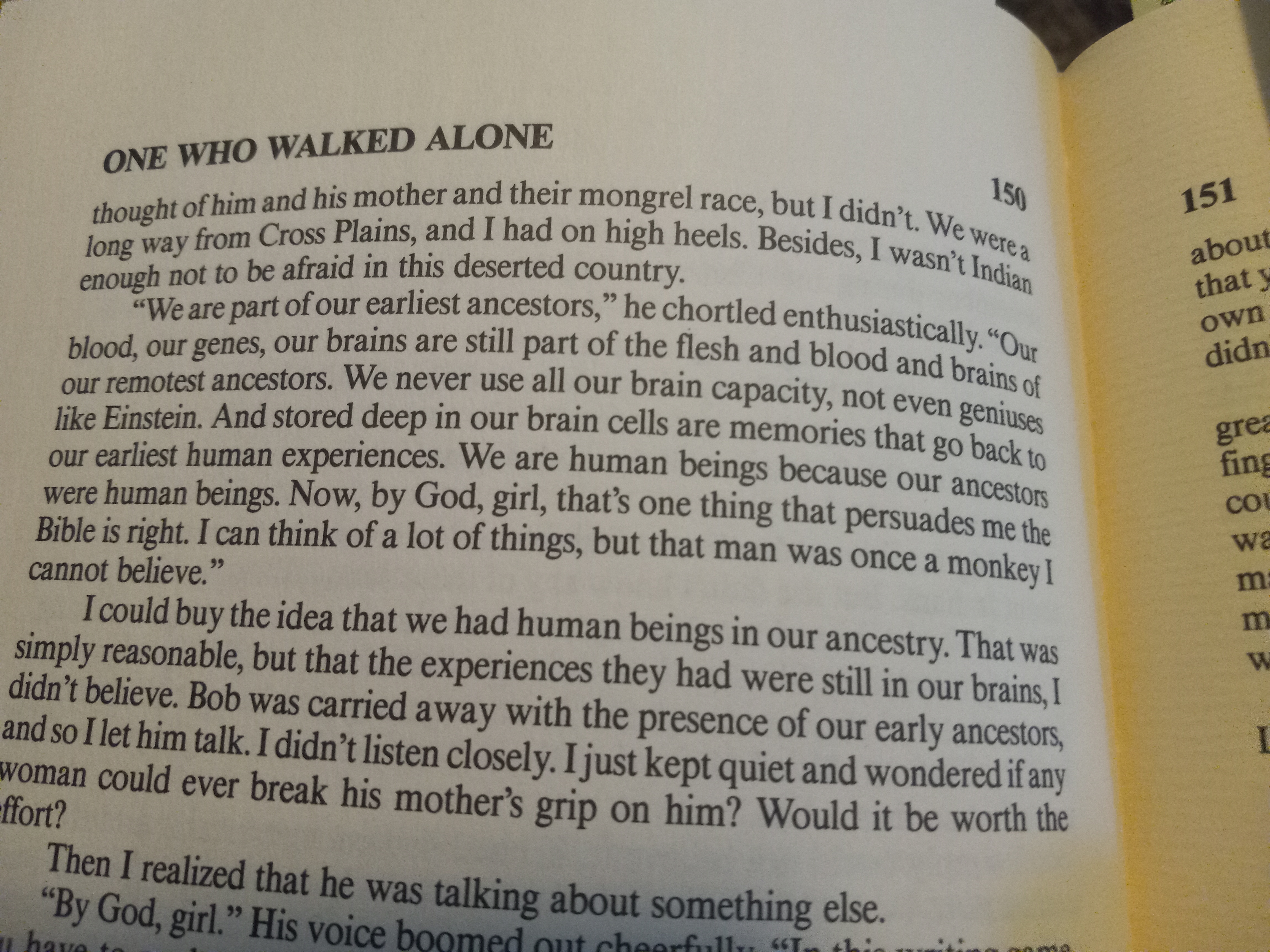
Again: this is insane. There is no possible way to reconcile this statement, that REH was a bible-believin’ Creationist, with the fiction he wrote, where the centrality of evolution is key, not merely to the biological nature of individuals, but to whole civilizations and cultures! Similarly, it is contracted directly by his own words in his letters! So let’s take a look!

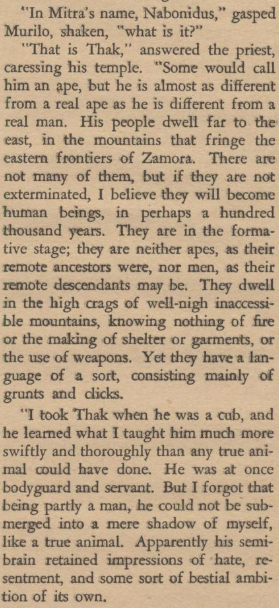
The first and most obvious counterexample in REH’s fiction is in the Conan story “Rogues in the House.” This was published in the January 1934 issue of Weird Tales, so it appeared not that far in time from when the weird exchange in the movie is supposed to have happened. In it, Conan is engaged by a patriotic rebel to help kill the vile Red Priest Nabonidus (who is, basically, the scheming and clever Cardinal Richelieu from “The Three Musketeers”). In the course of infiltrating his death-trap of a house, they learn that something is amiss – one of Nabonidus’s servants, an ape-man named Thak, has taken over the compound, dressing in his robes and using his crude but effective knowledge of the various death-dealing mechanisms in the house to kill all comers. When the heroes get their first good look at Thak (via a series of complex mirrors), we get introduced to Thak’s history by the Red Priest:
Later, when Murilo, the rebel instigator, gets a good, long look at Thak’s face, Howard takes the opportunity to further underline the proto-humaness of Thak:
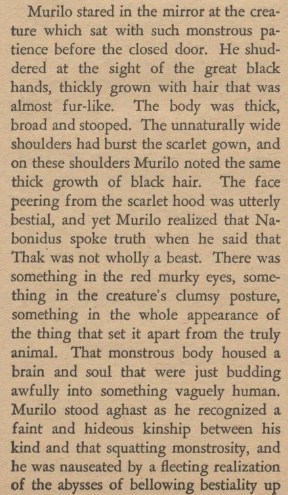

Thak is explicitly portrayed as part of a chain of beings leading progressively towards a kind of archetypal humanity, one that furthermore (and most horribly) suggests to Murilo that humans themselves had experienced just such a stage of life in the distant past. Howard revisits Thak’s fundamental and evolutionarily-informed idea of “human-ness” in the climactic battle between Conan and the ape-man, making sure we understand that this is not merely an ape, but a sentient being close to our own “kind.”
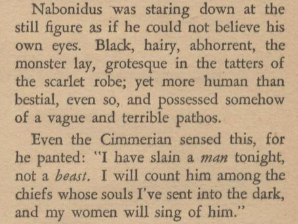
Let us pause briefly to admire Frazetta’s portrayal of this fight in one of his inimitable paintings:
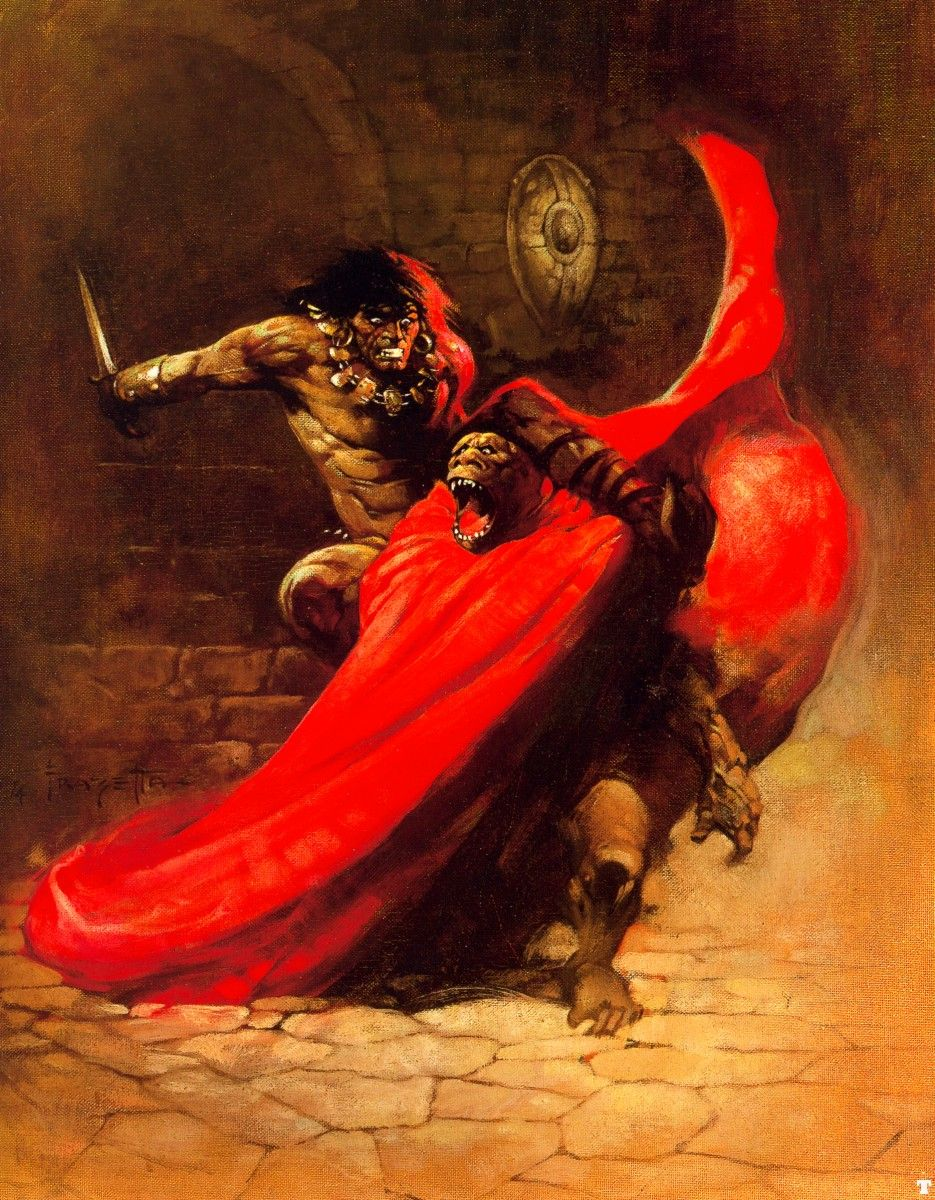
Badass.

The important thing about Thak is that he is explicitly positioned within an evolutionary context – Nabonidus, while certainly a villain, is also portrayed as a deeply and indeed uniquely profound thinker for his age, and we are meant to take his insights into the evolutionary history and potential of Thak at face value. Furthermore, Thak’s ambitions, his wearing of the robe, and his usurpation of Nabonidus in his own home are not mere apings; rather, Thak is possessed of a sense of self and of others that is human-like, a result of his heritage as a kind of developmentally and evolutionarily intermediate man-ape.

This interest in evolution and the deep history of humans in geological time isn’t anything new for lil’ Bobby Howard either – way back in 1925, his very first professionally published story in Weird Tales (“Spear and Fang”) was all about the conflict between Cro-Magnon and Neanderthals. There is no room within a strict, fundamentalist worldview for different members of the genus Homo to be waging war on one another. Interestingly, for all its eventual violence, the story begins with a Cro Magnon character making cave paintings of extinct animals, a scene placing art, an aesthetic sensibility, and an appreciation of beauty explicitly within an evolutionary framework. But, like so many of Howard’s ancient wildernesses, this is no Edenic garden; it’s a savage and brutal landscape where violence and survival are the engines of evolution.

Indeed, over and over again, Howard portrays the past as a grim evolutionary climb, calling out specifically the rise from apedom to semi-apedom and, eventually, full humanity. In fact, taking cues from both contemporary geological literature as well as esoteric theories of human history, Howard makes these events explicitly cyclical – Kull’s Atlanteans rise from apehood into their barbaric splendor, only to be hurled back again down the evolutionary ladder by their Age’s terminal cataclysm; slowly they rise to become fully human again in the fullness of geological time where, it is implied, they become the Cimmerians. Bran Mak Morn’s Picts are likewise a people with a long and troubled past that stretches into prehistory, and Atla, the were-woman of Dagon Moor, explicitly tells Bran that the Worms of the Earth could’ve been people, were very nearly human in fact, when the Picts drove them back into atavism and subterranean degeneracy. This sort of evolutionary thinking is integral to Howard’s fiction, both mechanically as part of plots as well as conceptually, as something key to his worldview.

Howard’s exposure to evolutionary thinking can be traced from two sources. The first is in the books he owned and which, on his death, were donated to the Howard Payne University library by his father. This collection, originally something approaching 300 books, was eventually taken out of special collections and put into general circulation, the result being that there are now less than 50 or so actual books left due to loss, theft, etc. However, a group of dedicated workers over the years have put together the original accession list and chased down references in Howard’s letters, meaning we now have a pretty decent idea of the books available to REH in his home. For more on this incredible work (including a handy history), and to peruse the book list, check out The Robert E. Howard Booklist!

To cut to the chase there’s one book in particular that is extremely relevant on the list: E. A. Allen’s The Prehistoric World or, Vanished Races originally published in 1885. It’s an odd and interesting book, actually; Allen, while an obscure writer now, was a prolific popularizer of natural history, with a particular interest in anthropology and ethnography. The book that Howard owned is a helluva doorstop, 800 pages or so, that begins in prehistory and moves through the iron age in Europe before leaping over to the Americas, with chapters on the Mound Builders, on the Nahua, on the Maya, etc. It’s a remarkably interesting historical document, a snapshot of both the broadly consensus natural history scholarship of the day as well as the then popular “stadial” version of anthropology (a decidedly progressivist and positivist framework that placed “civilizations” in a developmental hierarchy; guess what sort of people were on the top?). Honestly, I suspect this books is enormously important to a lot of Howard’s thinking and writing, but I want to focus on the second chapter “Early Geological Periods.”
This chapter is a kind of speed run through geology and paleontology, giving the reader a thumbnail of 1880s vintage earth science. There’s some great bits in there, especially if you’re interested in the history of geology – this is, after all, a pre plate tectonics world, and so there are some amusing gaps in both the interpretations and the detailed stories. However, this book IS firmly post Darwin (Origin of the Species was published in 1859). That means evolution is front and center:
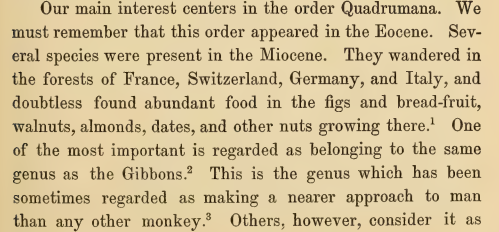
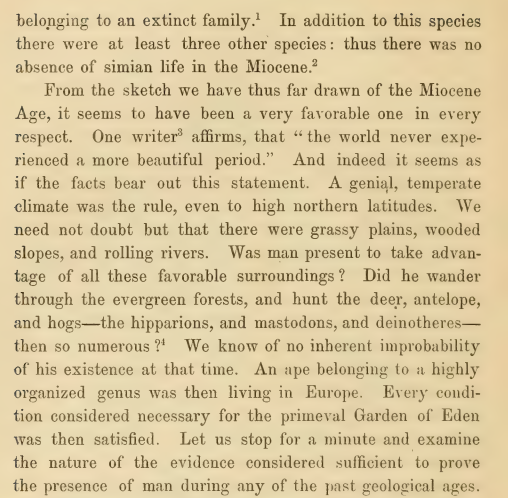
Like I said, there’s some fun goofy stuff in there – the old-ass taxonomic term “Quadrumana,” a paleobiogeography that predates the Out of Africa model of human origins, and the to-us-now shocking attempts to extend the presence humans back to the Miocene! (just for context, Allen’s work of course predates radiometric dating [it predates the discovery of radiation, in fact] so they’re using a relative chronostratigraphic approach; even so, a Miocene origin is wild! The Miocene *ended* ~5 million years ago, and the oldest extant example of the genus Homo is 2 million years old!) But this section is interesting when compared to the “Rogues in the House” excerpt. Here, a Miocene primate is explicitly stated to have made “a nearer approach to man than any other monkey,” which sounds very much like what Nabonidus said of Thak. Later in the passage Allen refers to a “highly organized genus” (meaning “evolutionarily advanced”) of ape as living in the Edenic Europe of the Miocene. Non-humans “ascending” towards humanness in the fathomless depths of time – this is extremely REH’s bag, you know?

It’s a bit too much to get into now (though it’s a topic I’ll definitely be returning to in the future) but there’s another relevant library in the Howard household that bears on this discussion – his dad’s bonkers collection of esoterica! That Howard was familiar with at least a popular gloss of Theosophical concepts is obvious from his work; the ideas of cyclical catastrophes, of the struggle of “root races” to ascend the ladder of progress over and over again, these concepts out of Theosophy are probably just as important as his understanding of geology and biology. Of course, the reality is that the Theosophists were actually responding to the science of day, drawing their myths and mysticism out of the mid-19th century scientific milieu the same as Allen (and everyone else). Geological catastrophism, deep time, sinking and rising lands (like Lemuria!), comparative religion, all of these ideas were taken out of their scientific and scholarly context and massaged into a new mystical quasi-religion, one that Howard’s dad was EXTREMELY well read in. But that’s for another post!

Leaving the Howards’ libraries behind, there’s an even more direct source for REH’s views on evolution we can tap: his letters! Thanks to the tireless effort of a bunch of editors, we’ve got an embarrassment of riches when it comes to the letters of REH. And, given the voluminousness of his correspondence, there’s a lot to choose from! Let’s hit a big one right away:

Let us consider the insect Man. How many specimens of this creature are willing to believe that they came from the same root stem as the elephant, the garter snake and the leopard? No, they must have a special creative act, a special Divine process to account for their godlike beings – bah, either Haeckel’s right and there is no such thing as a “soul” in the accepted sense or else everything has a soul, whether organic or inorganic. Let the theologians seek to refute the theory of spontaneous generation all they wish – I admit it is rather difficult to grasp in a cosmological sense, but biologically speaking, the scientific world has as a whole, I think, accepted the unicellular theory as a positive fact. The facts boiled down are these: theology must accept evolution both in ontogeny and in phylogeny if it accepts geology.

REH to Tevis Clyde Smith, March 1928, The Collected Letters of Robert E. Howard, volume 1: 1923-1929, Rob Roehm and John Bullard (eds)

That’s a pretty definitive statement, and one completely antithetical to the quote from the movie. Howard is 100% rejecting a special creation for humanity (and, indeed, for all of life). The “spontaneous generation” he’s referencing is not the “flies from meat” thing you might’ve heard about, but rather the idea of life originating on its own from inorganic matter via natural processes in the deep past. This, in particular, was one of Haeckel’s (many) research interests – taking up a topic that Darwin himself had not dealt with, he posited that highly organized but inorganic matter (like crystals) may have given rise to simple organic life, the “unicellular theory” REH mentions later. Howard is also explicitly rejecting biblical authority on theological matters in this letter too – theologians have to reckon with Haeckel’s biogenic law as well as the reality of Deep Time, rather than the other way around!

The prominence of Haeckel in Howard’s thinking is fascinating, and it’s something I’d never appreciated until I read his letters. He’s easily the biologist most mentioned by REH, and he seems to have seriously engaged with ol’ Ernst pretty heavily at some point (though, in a later letter to Lovecraft, he admits that he’d forgotten a lot of about the details of his work). Presumably, his exposure to Haeckel was in school, where Howard was part of a “science course” which, presumably, operated as a kind of theme or special focus in his curricula. It’s striking the effect it must’ve had on Howard; Haeckel comes up a lot (alongside famous scientific racist Herbert Spencer), whereas Darwin is mentioned only once…in a list of people who have “grasped the cosmic” that also includes Haeckel and Spencer and Huxley. What’s interesting in particular is that in addition to Haeckel’s biological and evolutionary work (he was a major popularizer of Darwin), REH seems enamored of Haeckel’s strange brand of monism, which provides a kind of romantic and pantheistic underpinning to the natural world (in opposition to a strictly materialist view). This same kind of vaguely mystical biology is something also seen in Herbert Spencer, another of REH’s favorite thinkers – he in particular seems to enjoy Spencer’s ideas of the “Ultimate Unknowable,” which much like Haeckel leaves room for some sort of ineffable energy or drive behind the mechanical operation of the universe and life.

Of course, the other things that Howard undoubtably took from both Haeckel and Spencer were their scientific racism and polygenism. Both men were, like many people of the age, eugenicists; Spencer, who as mentioned above was name-checked by REH a lot in his letters, originated the term and idea of “Social Darwinism;” he also coined the term “survival of the fittest,” an obvious and important part of Howard’s philosophy and ethos. Additionally, Haeckel was a vocal and powerful proponent of scientific polygenism, the idea that the various human races arose separately from different ancestors and at different times. In fact, part of Haeckel’s theories about the origins of life, the “spontaneous generation” mentioned in the letter, was that life itself was potentially polygenetic, having arisen multiple times out of inorganic matter on earth. While REH never outright states his support for polygenist views in his letters, the idea is clearly present in his fiction – there are multiple examples of different “races” rising up out of semi-apedom into humanity in his essay “The Hyborian Age,” for example, and the idea is implicit in the way he writes about Thak and the Worms of the Earth. It’s probably also a part of his horror of miscegenation: Howard clearly believes that there is something fundamentally biologically wrong with race-mixing, in addition to the moral decadence that he felt it represented.

It’s worth taking a look at Haeckel’s visual representation of this idea, because it’s a subtle but important point that illustrates REH’s thinking. The below figure is a portion of a plate from the English translation of one of Haeckel’s books, his 1879 Evolution of Man:
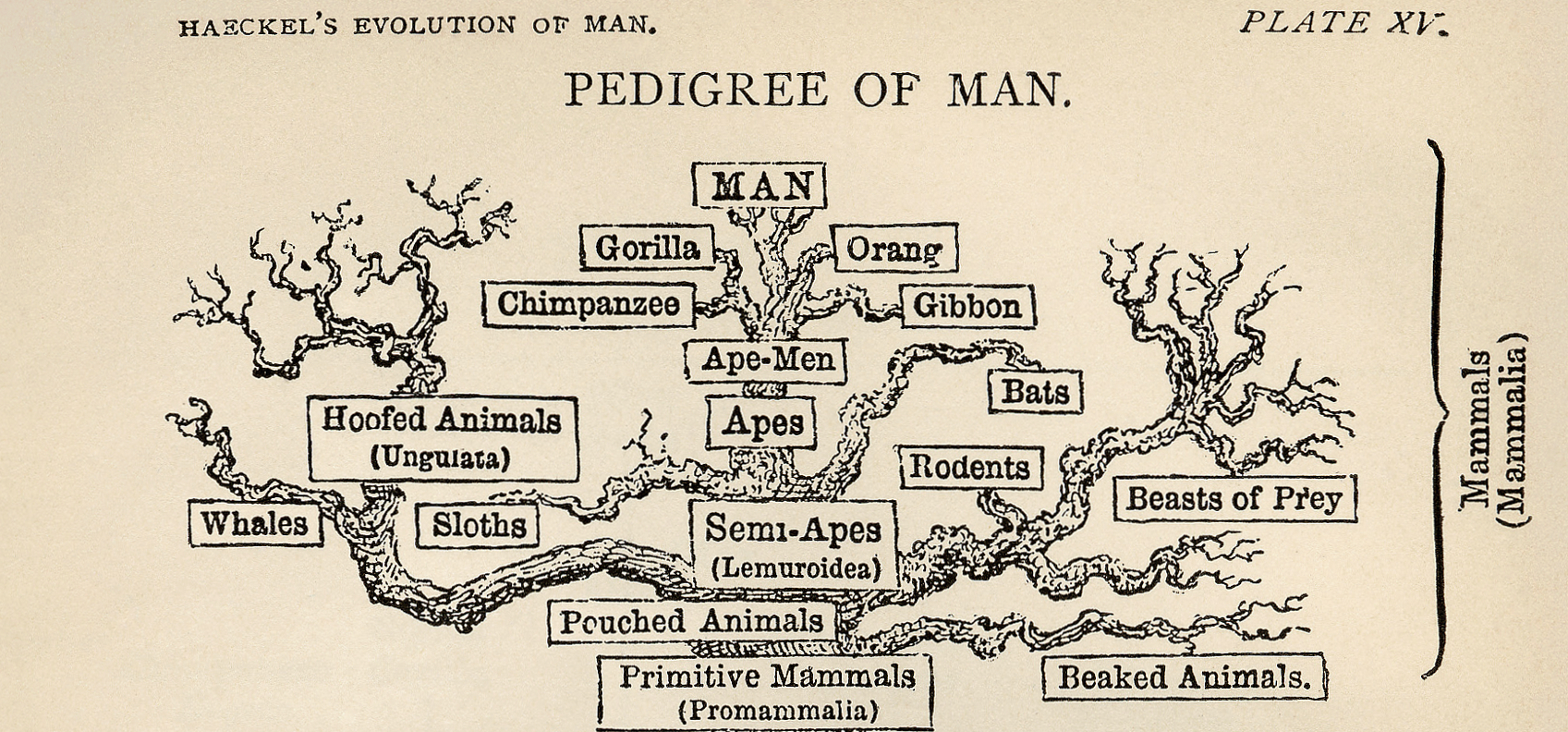
A few things are worth noting here: first, the placement of MAN atop the tree, crowning the progressive hierarchy implicit in the history of life. More important, however, is the very subtle way Haeckel conveys his idea that the human races arise out of different ancestors. A forking branch proceeds from APE-MEN, with single branches leading to GIBBON, ORANG, etc. But then look at the MULTIPLE BRANCHES (six of them!) leading into MAN. Like I said, it’s a subtle but very important point with some extremely unpleasant implications, namely that the various races of humans represent distinct biological species arising out of a common ape-man ancestor. It’s foul stuff, but it’s also recognizable as a very common belief among people in Howard’s time, and within Howard’s work; put “Cimmerian,” “Stygian,” “Hyborian,” etc on each of those branches and you’ve got a good representation of Howard’s ideas.

Another letter, this one part of the interminable HPL-REH Civilization-vs-Barbarism running gun battle that they had for years and years, interestingly provides some insight into Howard’s opinion of religious anti-evolutionists. The context of this short excerpt from their (unending and tedious) argument focuses on HPL’s view that REH doesn’t hold artistic endeavors in as high of esteem as he should. Regardless, the relevant section is interesting as regards our topic here today:

Between the fundamental religionist who goes into foaming rages over the idea of evolution, because he can not stand the thought of kinship with a monkey, and the artists who strains his guts to prove his distance from the protozoa, I see no basic difference; both seem outcroppings of the idea concerning the divinity of man.

REH to HPL, September or October 1933, letter 259, The Collected Letters of Robert E. Howard Volume 3: 1933-1936, Rob Roehm and John Bullard (eds)

It’s a pretty funny statement; I love to imagine a tortured poète maudit weeping over the need to distinguish themselves from protists in the eyes of the posterity. But it’s also a helluva rejoinder to the weird statement from Novalyne’s memoir and in the movie, isn’t it?

One last letter excerpt, because they’re fun and more people need to read ’em! This one is from a letter to August Derleth, and in addition to its relevance to our discussion here, it is also one of those great examples of REH really playing up rurality for his non-western interlocutors:

A friend of mine was trapping once […] He thought he had a muskrat and climbed carelessly up and stuck his head over the ledge, and there was a skunk in the trap and it let him have a full volley smack in the face […] My friend fell off the ledge with an ear-splitting shriek and rolled on the ground for some time after the exact fashion of a hound-dog […] Nobody could doubt evolution after watching the antics of a man who has just been slapped in the mush by a polecat.

REH to August Derleth, July 4 1935, letter 319, The Collected Letters of Robert E. Howard Volume 3: 1933-1936, Rob Roehm and John Bullard (eds)

In addition to just being a funny story, it also shows how, even beyond the eugenicist background of his thinking, Howard’s worldview (and his fiction) was founded on an philosophical framework of what was “natural,” a view informed strongly by a belief in evolution. There’s also present the idea that this “naturalness” reflects the fundamental biological order of the world – a man, for all his sophistication, is no different than a dog when confronted with the same problem (of getting their shit rocked by a pissed-off skunk). There’s really no way to imagine Robert E. Howard without a belief in evolution – the idea is as central to his work and worldview as it is for Lovecraft, and having him question it in the movie (rejecting it in favor of the bible even!) is truly bizarre!

So what’s going in Novalyne Price Ellis’s memoir, One Who Walked Alone and the movie it inspired? Well, there’re a few options, I reckon:

1 – Novalyne Price made it up whole cloth. It’s a possibility, certainly – as described by Bobby Derie the creation of One Who Walked Alone remains opaque, with the author dead and her notes and materials unavailable, leaving us merely with the book. A key motive for Price writing it was to counter negative portrayals of Howard; perhaps she felt a definitive statement of belief in the Bible was important (including a statement of Creationist faith) and so inserted it into the narrative. As far as I can tell, we don’t know anything specific about Novalyne Price’s religious leanings, though she does write about attending church and believing in God (and in everyone’s right to worship God in whatever way they see fit) in the book. But who knows? An older Southern lady writing in the late 70s-80s, she very easily could’ve held Creationist beliefs, and decided to put REH in the camp of the angels. Without access to her diaries and journals, we’ll never know! But this is clearly the very darkest option – it puts her memoirs, as a source of sincere recollection, into *very* shaky, shady territory!

2 – Novalyne Price misunderstood/misinterpreted something REH had said. Reading Price suggests (to me at least) that she *thought* she understood REH better than she actually did. There’re numerous places in the book where she seems to be confused by what is, plainly, REH making a joke or poking fun or being ironical. Additionally, Howard could clearly be kind of a combative asshole, picking at people or arguing for argument’s sake. The exchange in the book is actually a good deal more contentious than is presented in the movie; Howard, at least to my reading, absolutely understands that his mother was talking shit about Novalyne, and he’s getting a kick needling her and watching her reaction (a very common thing in the book). If so, the odd statement about the bible and creationism becomes legible as just more of REH’s situational weirdness, where he’s trying to offer biblical support for his position, knowing that it’d annoy her.

3 – REH said it because he thought it was something Novalyne wanted to hear. Like I said, the discussion around miscegenation that REH and Price are having is a bit of a strange, heated one. Maybe Howard wanted to change the subject, or in the moment felt like he was offering an olive branch by claiming to be a bible-believer (something clearly important to Price, from sections elsewhere in the book). It would mean he was straight up lying of course, since his letters seem to make his position very clear. Also, it’d be an odd moment of him backing down too; he seemed to love scrapin’ and arguin’ with Novalyne in particular!

4 – REH said it because he believed it. The weirdest and hardest-to-swallow option, but there it is. We contain multitudes, and maybe Howard had had a strange religious epiphany. I knew a devout Mormon paleontologist who described his life this way: six days of the week, he believed in evolution and geochronology and the fossil record, but on Sunday, he didn’t. Maybe Howard separated himself from his work like that, though that seems extremely unlikely given the whole “he put a bit of himself into everything he wrote” paean from Lovecraft and all. It’s again also a statement completely at odds with his own words, both fictional and in his letters!

As to which one it is, who the Hell knows? What I think is very certain, however, is that contrary to the statement reported by Price, Howard absolutely believed in evolution. In particular, the concept was central to his whole world view, both in his life and in his work. This is not to say that he had no religion; the scientists from whom he had drawn his understanding of evolution, Ernst Haeckel and Herbert Spencer, were themselves certainly not atheists; both of them believed in a kind of pantheistic drive that, while operating within the realm of the mundane and through the laws of biology and physics, nonetheless held something of wonder and, if not divine, then at least something more-than-mechanistic about it. Given his father’s own unusual religious milieu, something like that, a combination of Haeckelean monism with pop Theosophy, makes a lot of sense. Afterall, Jesus was an Ascended Master in a lot of New Age religious movements, so there’s even room for a (nondenominational) kind of appreciation for the Bible in there.

What there ISN’T room for is creationism – time and time again, the centrality of the concept to Howard’s writing is made abundantly clear. The battle between Cro Magnon and Neanderthal at the dawn of human history, the punctuated cataclysms of Howard’s Atlantis and Hyboria, the aspirational evolutionism of Thak and the thwarted phylogenetics of the Worms of the Earth, all of these are just as much evidence for Howard’s deep commitment to the reality of evolution as are his literal statements of the same in his letters.

Strainers of the Pulp #19, Three Kings’ Day edition: “Worms of the Earth” by Robert E. Howard, Weird Tales, Nov. 1932, v.20 n.5

We’ve drained the mead horns, reduced the great roast boar to gnawed bones, and watched the vast bonfire around which we defied winter’s darkness smolder into mere ashes, but we’re not done with sword and sorcery yet! No indeed, not on this, the most sword-and-sorcerous sounding holiday of the year…Three Kings’ Day! And what better way to celebrate it than by talking about the Last King of the Picts, Bran Mak Morn! It’s Robert E. Howard’s “Worms of the Earth” from Weird Tales, November 1932!

We’ve talked about ol’ REH a lot during the sword and sorcery festivities; how can you not? We’ve encountered both Solomon Kane and Conan in some great stories already, but for me, personally, I think Howard’s single greatest character is Bran Mak Morn – there’s something really compelling about him, this very last ruler of Pictdom, presiding over a declining and dying people and watching the Romans marching over his homeland. Howard loved to indulge in a certain Celtic gloominess, both personally and literarily, and that’s fully on display in the Bran stories. It lends them a poignancy that’s not often present in his other works; Conan’s barbarism and Kane’s zealotry are portrayed as powerful and vital forces, elemental and therefore permanent, but Bran is the last of his kind, and we know that he is destined to be ground down by the millstone of implacable history.
Aside from the purely aesthetic appeal of this Pictish mono no aware, it’s also a chance to see Howard examining a different point in the Spenglerian cyclicity he believed in; Kull and Conan are barbarians who, in Howard’s weird racialist worldview, revitalize their respective nations by taking up the crown and injecting their own wild vitality into civilized kingship. But here we see a people at the end of their “natural” lifespan, senescent and impoverished, struggling vainly against an ascendant Empire. And, to top it all off, in this story Bran glimpses the possible fate of his own Picts when he confronts the twisted and degraded remnants of a people his own ancestors had conquered and displaced! Bran Mak Morn is Howard’s greatest, most interesting character, which makes this story, “Worms of the Earth,” his greatest sword and sorcery story ever, at least for me. Hell, I’d put it up there as one of the all time greatest stories in the genre ever!

Worth keeping in mind is that the readers of Weird Tales had yet to be introduced to Conan at this point; Kane had made it to the pages of The Unique Magazine already, of course, and Kull had shown up in a previous Bran story from 1930 (“Kings of the Earth”), so readers were certainly familiar with Howard’s blood-and-thunder style and approach. The Cimmerian himself wouldn’t show up until the NEXT issue of Weird Tales, when “Phoenix on the Sword” would be published (Dec 1932), and after that, of course, Howard’s career and writing really changes; I think “Worms of the Earth” is still very much a weird tale, with its emphasis on inhuman horrors, atavism, and vast sweeps of time embodied in ancient landscapes. It’s still very much sword and sorcery, of course, but I think that it isn’t until Conan that Howard tips the balance more towards adventure and away from the Lovecraftian-influenced cosmicism on display here. But enough jibber jabber, let’s get to it!

A great swashbuckling cover, but this isn’t Bran fighting a Loch Monster or anything…it’s Kline’s heroic Venusian he-man Grandon fighting some swamp-dwelling space devil! Kline is an interesting guy; along with Farnsworth Wright, he had been an early editorial assistant to the first editor of the magazine, Baird, and had stayed on as an editor and reader under Wright, as well as writing his own weird fiction, fantasy, detective stories, and science fiction. He would shortly leave off writing, focusing more on becoming a literary agent for a number of big names in the pulps, including Howard himself! In fact, after Howard’s death by suicide in ’36, Kline would continue to represent his estate, helping Howard’s father get the many thousands of dollars still owed to REH by Weird Tales (and some other magazines, too). The scene illustrated here on this cover is interesting; first off, it’s from what would end up being a novel-length work that would stretch over seven issues of the magazine. It’s obviously a pastiche on Burroughs’ “John Carter of Mars” novels, largely successfully so too, I might add; if you liked those novels, then you’ll almost certainly like Kline’s planetary romances, which are often more-Burroughs than Burroughs in execution. But this cover also illustrates that, while Howard is rightfully identified as the creator of sword-and-sorcery, there was both a lineage of swashbuckling weird fiction that predated and inspired him AS WELL AS a clear hunger from readers for that kind of thing.

Nothing too noteworthy in the ToC (other than our story today), but the Weird Story Reprint is interesting; they’d reprinted “Frankenstein,” with this issue’s segment being the penultimate entry in an eight-issue long stretch that really annoyed a lot of people. There had always been some annoyance with multi-part stories among the readers, because of the dangers of missing an issue, but in particular a lot of people felt that reprinting a classic that almost everyone had read or could have easily gotten a copy of was a waste of good magazine space. It would actually lead to a change in policy for Wright and the magazine, which would in response to those complaints rededicate itself to reprinting more obscure work (for more about the history of the “Weird Story Reprint” series in the magazine, you should read my introduction to the collection “Night Fears: Weird Tales in Translation” from Paradise Edition books).

And now, on to the story itself!

A great title illustration, as usual, and one that doesn’t even spoil the story or anything! Just a great scene from one of the best parts of the story, in my opinion, with a really subtly devilish Atla and a grim and haunted looking Bran… wonderful stuff! The shadows are a nice touch, too, very moody and pensive and weird. It’s signed “MW,” but based on the style I’m pretty sure it’s J.M. Wilcox’s work (sometimes known as Jayem Wilcox, or JMW). Wilcox would go on to produce the very first illustration of Conan when he did the title art for “The Phoenix on the Sword” next issue, making him an important part of sword and sorcery history.

Pumped up with that great bit of art, we’re ready to dive into the text of the story!

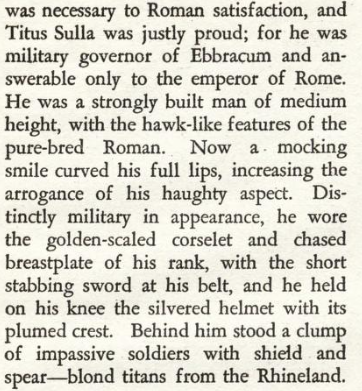
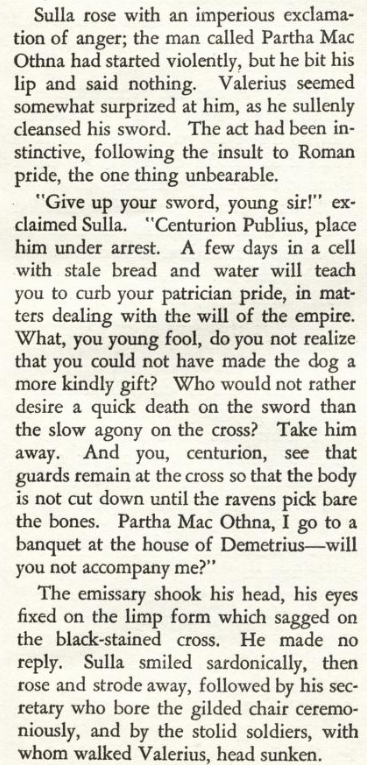
Love a story that starts with dialog; gives it an immediacy that can’t be beat, in my opinion. And this dialog starts off strong – nothing good is going on, you can be sure of that, and that conclusion is further supported by the imperial haughtiness of Titus Sulla, lounging in his chair of office, surrounded by a guard of Teutonic legionaries. You can again see Howard’s preoccupation with bodies and physicality here, too – Sulla is a Roman, but he’s no weak, lisping functionary, made soft by bureaucracy and civilization. No, he’s a soldier, a conqueror with a strong body and cruel countenance, and he’s surrounded by other huger bodies, “blond titans” from Germania, further symbol of the power and decadence of Rome. These powerful bodies are immediately contrasted with another body, this one made abject:

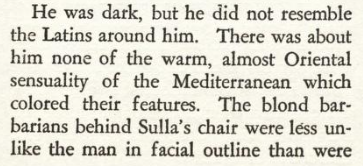
It’s a crucifixion party, one apparently being put on for the sake of the “guest” mentioned above, a dark man identified later “Partha Mac Othna.” But before we get this name, we get a very Ellsworth Huntington-esque discourse of race, civilization, and climate that contrasts this dark somber man with the Romans and Germans that surround him.

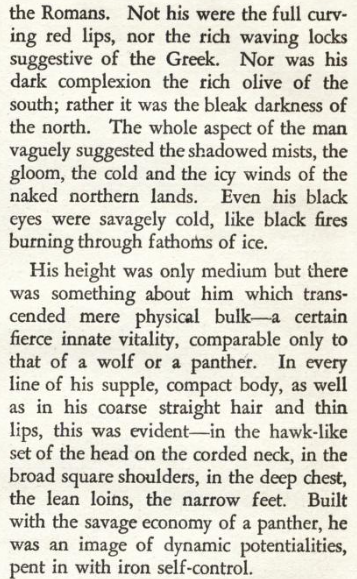
A “supple, compact body” with “broad square shoulders,” a “deep chest,” “lean loins…” you can joke all you want, but Howard’s fascination with and interest in masculinity and its physicality is certainly enthusiastic and sincere. Similarly expressed in this story is REH’s belief in the importance of racial purity, as made clear by the comparison of this dark, northern barbarian with his two compatriots, one at his feet and one on the cross:

There’s some kinship between these three, though it’s clear that the man on the cross and the “stunted crouching giant” represent a “lower type” than the clean-limbed and well-knit dark man. This racial hierarchy stuff is a central part of Bran’s pathos, for Howard at least, and it’s something that we’ll come back to in the story later. But for now, let’s get this guy crucified!

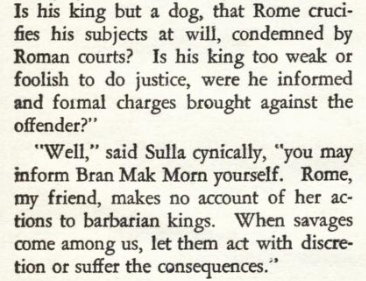
There’s some more verbal sparring, almost as if the Sulla is trying to goad his “guest” into something, but the strange, noble-looking Pict seems to reserve his ire for the Pictish King:

Takin’ it kinda personally, isn’t he? Almost weirdly so…oh well.

Anyway, they crucify the guy, who doesn’t scream out in pain or anything, only staring at Partha Mac Othna with a strange and plaintive intensity. Seeking to mock their victim’s suffering, a Roman solider offers the dying man a cup of wine and receives a defiant loogie in the eyes instead. Enraged, the soldier stabs the man with his sword, which pisses of Sulla something fierce.

The Pictish emissary stays awhile, contemplating the dead body hanging on its cross against a reddening sky, before turning back and heading to the Roman fortress city. A grim and perilous beginning to the story indeed!

How about that little bit of Yog-Sothery there, huh? “Black gods of R’yleh” is great, and the fact that “Partha” here would evoke even THEM speaks to his anger and despair at Rome. But why does this feller feel such animus towards to the Romans, you ask? Well…

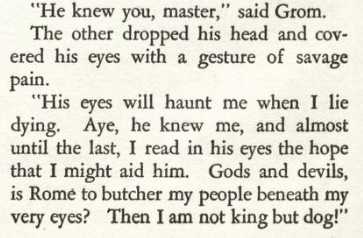
What a twist! Partha Mac Othna is, in fact, Bran Mak Morn, King of Picts, posing as an emissary to gather intelligence on these his most hated of foes! Grom, his gnarled companion, begs his master to keep his voice down; the Romans would hang him from a cross if they knew who he really was. Rather, why not let faithful ol’ Grom ice the Roman dick?

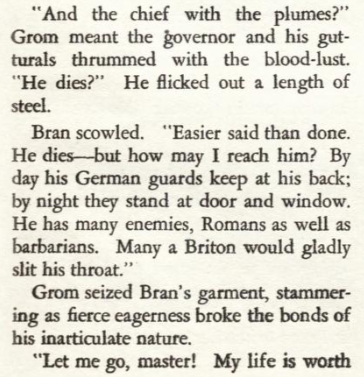
I mean, that’s some top notch, grade-A badassery right there, isn’t it? Grom’ll happily run a suicide mission for his King, vowing to kill Sulla anyway, even if he is surrounded by bodyguards. But Bran knows that won’t work, and instead is already working on another plan…

It turns out that Sulla is frickin’ terrified of a certain Gael by the name of Cormac na Conacht who has vowed to eat Sulla’s heart raw. Showing sensible caution vis a vis having his heart eaten, Sulla tends to stick to the impenetrable fortress known at the Tower of Trajan when there’s trouble along the Wall. This knowledge inspires Bran to some dark, fearful plan…he sends Grom out of town with some gold and his diplomatic pass; he’s to ride to Cormac and get him to start raiding, sending Sulla off to the Tower. Then Bran takes a quick nap, where in a dream he meets his faithful advisor the Wizard Gonar who, having divined Bran’s yet-to-me-specified plan, is absolutely freaking the hell out:

What “this thought” is exactly will remain obscure, for now, but it does lead to a pretty great speech from Bran explaining why he has been pushed to this extreme measure (whatever it is):

It’s some real “burden of kingship” shit, sure, but damn if it doesn’t get me. In particular, the stuff about their shared experiences I find pretty moving…both of them listened to the same tales and songs, and that forged an unbreakable bond of shared heritage that held them together. And that final statement is, again, just a perfect encapsulation of a sword-and-sorcery ethos: by those bonds, Bran had the responsibility to protect him, and if he cannot do that, then he will avenge him. Shivery, noble stuff, great fantasy writing, some of the best Howard ever did in my opinion. And there’s more to come!

But Gonar is still scared. Why not just chop some dudes up like usual, he asks, ride along with the Gaels and slaughter Romans from sun-up to sun-down. Oh, don’t worry, Bran replies, I’ll definitely be doing that…BUT FIRST he wants something special for Sulla.

We’re spending A LOT of time on this early part of the story, I know, but I think it’s worth it to see Howard really doing some great work establishing Bran Mak Morn and the world of the Picts and Romans here. Bran has been fighting these Romans for a long time, and we feel his desperation and struggle – you get the sense that it’s not been going great for the Picts. After all, why else would their goddamn King risk himself to sneak into their stronghold? Things must’ve gotten pretty dire back in Pictland. And then, to have seen his man crucified and forced to confront his failures as King and Protector…he’s gone a little crazy now, and nothing is off limits in his war against the Romans.

Gonar tries one last desperate gamble: the things Bran is planning on using have gone from the world, they’ve dwelled apart for countless ages and no one knows where they are now. But Bran is sure that that can’t be true…somewhere, there is some sign, some thread of a connection that will lead him to them.

Really appreciate the care Howard is taking here – right now, we have no fuckin’ clue as to what exactly it is that Bran is planning, but it’s been made clear that it is dire as hell and going to be extremely dangerous. From a story telling perspective, I just don’t think REH ever hits this level of mastery again, it’s so good and sharp and propulsive. Bran is desperate, his back to the wall, and capable of anything in his quest for vengeance; to him, there’s nothing foul enough for the Romans, no act so base or vile that he wouldn’t stoop to, just so long as Sulla gets his. And even though he’s talked this good game about his responsibilities as king and all that, you see that there’s more there – it’s a deep, personal affront that he wants to avenge, so much so that Gonar basically calls him out for putting this personal hatred ahead of the actual needs of the Picts. It’s great stuff, isn’t it?

Before Bran heads out on his insane and horrific mission, he takes a brief moment to sneak over to the prison to murder the roman soldier that stabbed the Pict on the cross. It’s yet another scene of great badass action, particularly in the way Howard described Bran’s dark chuckle, the slash through the barred windows, and the blood welling up from Valerius’s throat as he dies. Ticking that chore off his to-do list, Bran then rides out of the city and into the wilderness, searching for…them.

There’s some great, evocative environmental writing in this section, wildernesses and border regions and ancient landscapes all lovingly described by ol’ REH. The romanticism of landscapes, and their hidden dangers, are something Howard is really well-equipped to work with in his fiction, having reflected extensively on his own wildernesses and frontiers back in Cross Plains, Texas. I’m also a sucker for ancient, nameless earthworks – these curiously regular hillocks and mysterious monoliths are wonderfully potent images, suggestive of deep time and lost civilizations.

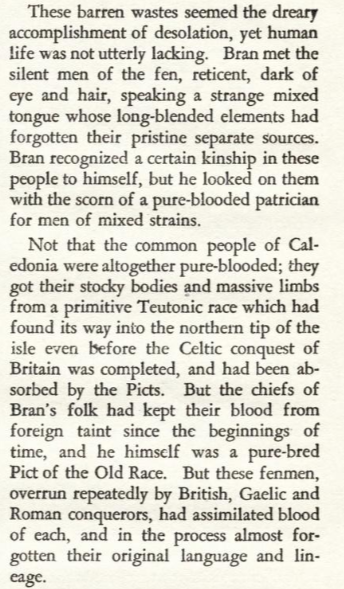
There is also in this section another long paean to racial purity from Howard. As we’ve already mentioned, Howard was an unapologetic and enthusiastic racist, something that strongly informed his fictional stories, as we see here:

A big part of Howard’s disdain for “civilization” comes from his belief in racial purity – with civilization comes miscegenation, which for Howard is both unnatural and decadent. What’s funny, though, is how all this talk of Bran being a pure-blooded noble from a long-line of reproductively isolated aristocrats strikes us today; far from the strong limbed and lean-loined pantherish ubermensch Howard described, talking about Bran’s paternity like that immediately evokes the Hapsburgs, at least for me. The idea of Bran looking like Charles II of Spain during all this stuff going on is hilarious, and makes his revulsion at the fenmen, Atla, and the Worms of the Earth themselves later in the story all the funnier.

But anyway, Bran is spending some time wandering around the wastelands, searching for any sign of the horrible things that once dwelt there. He gets news from the fen dwellers, and learns that his Gaelic buddy Cormac has begun raiding, spreading terror all along the Wall and sending Sulla scurrying off to the Tower of Trajan, just like Bran said he would. Meanwhile Bran, all alone, keeps up his hunt, until one day he spies a distant daub-and-wattle hut in a particularly lonely corner of the fens. He goes to investigate, and meets one of the greatest characters in sword-and-sorcery history.

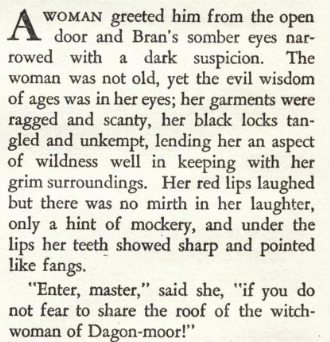
This is Atla, and she’s 100% rad as hell. Howard lets us know immediately that she’s not entirely human, too – she’s got fang-like teeth, almost pointed ears, oddly-shaped yellow eyes, and all her movements are sinuous, lithe, and serpentine. Bran recognizes all the signs, and since he’s one of the Old Picts, he knows the stories, guesses her heritage, and knows she can help him.

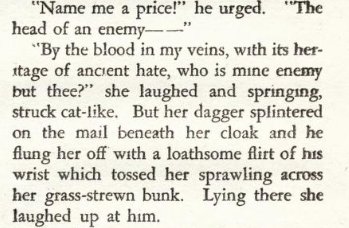
There’s so much to love about this – the fencing between Atla and Bran, and the shock and horror that even she feels to hear Bran speak so openly and blithely about forbidden things, it’s really fantastic. But even more, there’s a real grimness and sorrow to Atla, something strange and sad and special that you makes her character so interesting and unique. For one thing, she’s utterly and completely ostracized, living way the hell out in a place called the Dagon-Moor which you KNOW is not exactly on any of the major bus routes. She’s been exiled out here because of her heritage; it’s implied that she’s the product of a rape, a human mother attacked by one of them out on the moors, and that her inhuman blood has meant that she’s been driven to the very edge of the human world. And that revulsion is definitely something Bran feels too, even though she is the only thing that can help him find the Worms of the Earth.

Atla’s recklessness and scorn is just fantastic here, and the way she laughs at Bran’s threat is wonderful. Her mocking question “Do you think that such life as mine is so sweet that I would cling to it” is really great, an absolute gut-punch. And Bran’s realization that he’ll have to try different means of persuasion is met with equal scorn!

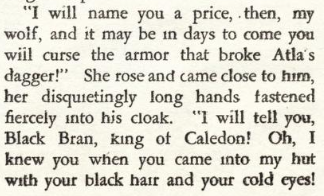
Atla is such a badass! But, after all that, Atla does have a price.

I think this is some of the best writing Howard ever did. There’s a real and aching loneliness to Atla, and it’s tempting to think that Howard, an artistic and romantic young man living way the hell out in an oil boomtown in central Texas, might’ve been mining something of himself when he’s having Atla express this deep and heartfelt yearning. There’s real humanity in Atla, probably the most you’ll ever see in a Howard character honestly – the only other example that I feel like even comes close to this is Balthus’ reminiscing about home from the Conan story “Beyond the Black River.”

Anyway, Bran swallows his revulsion and agrees to have sex with the snake lady, and Howard tastefully draws the curtains on the scene.

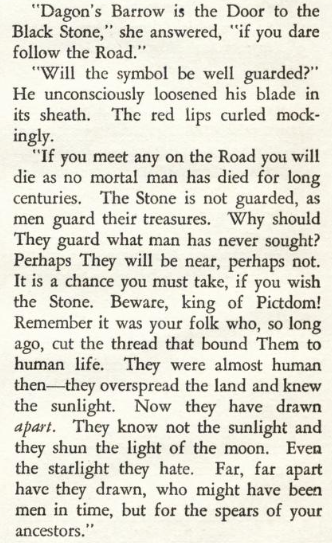
The next morning, while Bran is dressing for his walk of shame, Atla tells him that what he needs to do is steal the Black Stone; with that, he can force them to do whatever he wants. The Stone is deep beneath Dagon’s Barrow, which, again, love that Lovecraft connection.

There’s some fun stuff here for sure, and I can’t help but wonder if Tolkien (who certainly had read some Howard) read this one in particular – between the faces in the mere that Atla mentions, and then this whole shunning of sunlight and moonlight and even starlight, there’s some real Gollum resonances here, you know? But, regardless, this is prime sword-and-sorcery stuff, especially that last sentence; the idea that the Picts and these subterranean horrors have history really nicely sharpens the threat and danger of Bran’s scheme.

Bran, armed with the knowledge that Atla has given him, heads out, finds the strange prehuman stone circle atop Dagon’s Barrow, lifts the stone, and plunges into the deep darkness of the Earth. The path he’s on mirror the devolution of the Worms themselves, going from rough hewn steps to a smooth and almost slimy tunnel at the base. There, in a dark chamber, he finds the Black Stone, and is able to abscond with it. He decides to stash it in Dagon’s Mere, chunking the rock out into the center of the eerie pond.

Bran returns to Atla, who is not unsurprised to see him both alive and sane after his trip into the darkness beneath the Earth. Bran informs her that not only has he safely secreted away the Black Stone, but that he has become aware of things hunting him…his horse trod on something unnatural in its stable one night, and he’s been hearing a faint scrabbling beneath the earthen floor of his hut. They’re hunting him, using whatever strange senses and powers they’ve developed over their long exile in the dark. Now he’s ready to deal, and so Atla takes him to a forlorn range of hills that border the fen where the black mouth of a cave yawns wide to take them in.

Howard really paints the landscape here, conveying both its distance from humanity in both space and time – this is an old place, and the things that live here are older than the Romans, the Celts, and even the Picts. That sense of Deep Time, a key part of weird fiction, is really well-expressed here, a testament to Howard’s own appreciation of the earth and the tiny, transient things that call its surface home.

Bran and Atla plunge into the cave, and its somewhat shocking to both us and Bran that Atla herself is scared here – in lesser hands, the snake woman would be a one-off monster lady, but Howard makes sure we understand that she meant it when she said she was “half human, at least.” This place and the things that live there are scary as hell and fully alien, even to her.

And then they meet the Worms of the Earth.

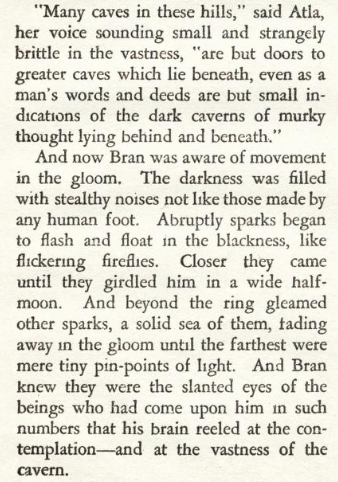
Spectacular writing from Howard here, this sea of glowing eyes in the dark. It’s really truly an eerie and uncanny scene, but does it spook Bran?

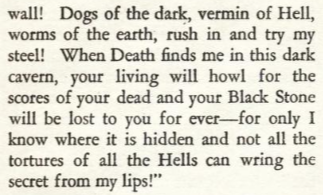
Fuckin’ bad ass, man! And these horrible subterranean things think so too – Bran rolls a nat 20 on his intimidation check, and the Worms of the Earth are fully cowed by his killer speech. They hiss and mutter with Atla, and she’s shocked to report that they’re actually scared of Bran, and will do whatever he wants in exchange for the stolen the Black Stone. Bran wants them to take Sulla from the Tower of Trajan, and he agrees to meet them at Dagon’s Ring tomorrow and exchange the stone for the Roman.

Bran goes for a swim in Dagon’s Mere, recovering the Stone that he chucked in there earlier, which is heroic enough in my opinion – I once dropped something in Barton Creek Pool here in Austin, which is a natural spring fed pool with crystal clear water, and I never found it again…and there’s not even monsters in Barton Creek Pool! That’s actually a really fun little piece of this story too – there IS a monster in Dagon’s Mere, something huge and threatening which Bran only catches a glimpse and a ripple of. It reminds me a lot of the scene in Lovecraft’s “Call of Cthulhu” where we learn that there’s some kind of huge white polypus thing in the swamps of Louisiana that the cultists commune with…you can’t beat these little hints of other weird shit and scary monsters on the periphery of a main story, in my opinion. It’s an evocative and effective tool in weird fiction’s box, and I appreciate it here because, in addition to just being fun, it’s also part of Bran’s mounting realization that he actually doesn’t know this landscape or its history as well as he thought he did.

Black Stone in hand, Bran rides towards Dagon’s Ring, making a brief stop over to see what’s happening at Trajan’s Tower, just out of idle curiosity.

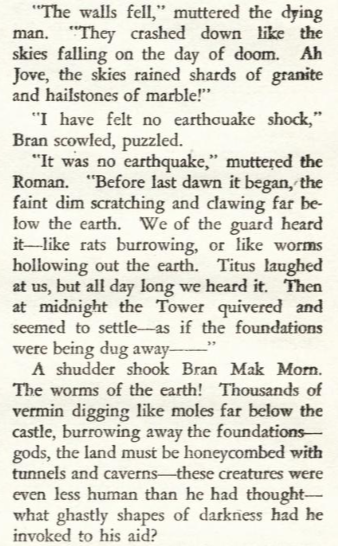
He finds a dying Legionary amid the ruins, and from him he hears a tale of horror.

Bran realizing that he might’ve fucked up here is pretty great – he forced these things to involve themselves in the surface world again, and maybe he doesn’t have as much control as he thought he did over this situation. It’s a grim moment for Bran, who had been expecting to get this great triumphant revenge on his hated enemy…and it’s only going to get worse…

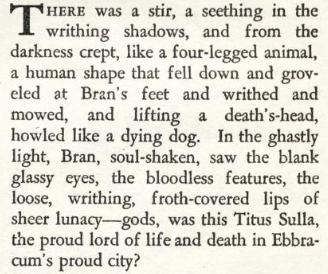
Bran, horrified at the destruction he’s wrought, hurries on to Dagon’s Ring, where he meets Atla and sees a seething, shadowy tide of the things approaching through the grass. And mingled in with the susurrus of their hissing is a lone human voice, gibbering and tittering. Bran demands that they give him Sulla, and Atla, with a smirk, presents him.

Sulla has been driven mad, not by anything they did to him, but by the simple brain-shattering realization of the true nature of a world honeycombed by tunnels through which inhuman horrors swarm and thrive. Bran kills Sulla, not in rage but rather out of mercy, realizing that there are in fact some weapons too foul and terrible to use. He hurls the Black Stone into the seething mass of shadows, and for a moment gets a clear view of them:

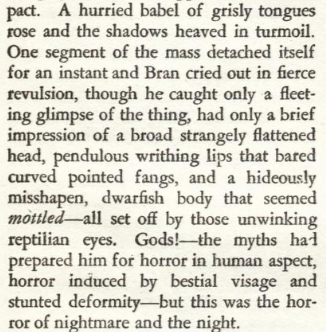
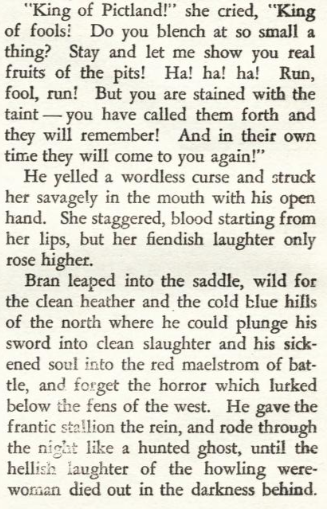
If Lovecraft’s synecdoche of horror is the deep sea, with its tentacles and slime, then Howard’s is the reptile, particularly the snake, with all its symbolism of ancient and pre-mammalian life and potency. The Worms of the Earth, the things that were once almost men before being driven underground and sinking deeper in atavism, are basically hellish snake-things, subtly human perhaps, but mostly all cold scales and merciless coils and hissing, flickering tongues. Sick with terror, Bran flees, but not before Atla gets a final mocking shot off.

And that’s the end of Robert E. Howard’s masterpiece, “The Worms of the Earth.”

It’s just so good, isn’t it? I mean, the characters are great, the setting is a blast, the action is killer, and the ending is perfect and horrible, with Bran having unleashed something that should’ve been left well enough alone. I love basically everything about this story; the pacing is even good, which can be tough in a short story that’s trying to deal with such a wide scope of geography and action.

Unfortunately, Howard never did take up the semi-cliffhanger he left there at the end, though. For all intents and purposes, this is the last Bran Mak Morn story he ever wrote – he’s mentioned again in a later, modern horror tale (“The Children of the Night”), but REH never again gives us a story about the Last King of the Picts. Karl Edward Wagner, most famous for his grim n’ gritty Kane stories DID write a sequel novel based on the premise that Bran had awakened a horror in the hills; it’s called “Legion of Shadows” from the 70s, and I remember liking it well enough as a pastiche, although I don’t think it nails the real weirdness or tragedy of REH’s original story.

I’ve gone on and on about what I like in this story, so I won’t repeat myself, but I really do think this is one of the greatest sword and sorcery stories ever written. There’s a real depth to this one, with a lot of actually meditative moments from Bran, something that’s sometimes lost in the wilder and more action-packed Conan stories to come. And while the Cimmerian would end up defining the genre, I think Bran Mak Morn and his tragic, dying Picts illustrate some of its strengths better than Conan ever does, exploring history, memory, violence, obsession, and regret while also delivering a rollicking, tense adventure story full of flashing swords and horrible snakemen. I mean, what more could you want!?