Category Archives: The Pulps

A Specter is Haunting the Pulps #47: “The Incredible Formula” by Paul Ernst, Amazing Stories, v. 6, n. 3, June 1931

Getting to be nearly that Best of All Seasons (Hallowe’en), so I want to get back into the ol’ pulp strainer world and talk about some neat weird horror…BUT, the previous post about Automata and weird fiction has me still thinkin’ ’bout those ‘bots, and a story I’ve wanted to tackle for a while! Luckily, there’s a real horror element to today’s story, and I think it’ll actually bridge nicely the discussion of automata in weird fiction and the upcoming spook-em-up binge I want to do for October. Plus, as you may have gleaned from the title of this particular post, it’s a good chance to talk labor and Marx in the pulps! So, without further ado: “The Incredible Formula” by Paul Ernst, from the June 1931 issue of Amazing Stories!

Paul Ernst (1899-1985) was, simply put, a workhorse, first in the pulps and then, when that particular world faded away, in the slicks, writing stories well into the 70s for magazines as varied as Redbook, The Saturday Evening Post, Woman’s Home Companion, and Cosmopolitan. As a pulp writer, he was prolific – he published thirty-eight stories in Weird Tales, including a big five-part serial “The Black Monarch” in the 1930s issues of The Unique Magazine. His real specialty, though, was in creating extremely pulpy characters and writing their recurring adventures; he wrote eight “Dr. Satan” stories for Weird Tales (classic “weird menace” style tales from ’35 – ’36), and even more famously went on to create and write, between 1939 and 1944, the twenty four “Avenger” novels (under the house name of Kenneth Robeson) for Street & Smith. “The Avenger” is interesting because, despite being a blatant cash grab by the publishers to bottle the Doc Savage lightning twice, Ernst was a good enough writer to actually make ’em interesting and entertaining. For instance, Ernst gives his weird avenger an actually tragic and compelling backstory – a “child of the depression,” Richard Benson has made a fortune as a globetrotting adventurer, but one day his wife and daughter are murdered by criminals, and the horror of the event transforms Benson, literally. His hair turns white, his eyes become pale and staring, his skin becomes dead and grey, and his facial muscles become paralyzed in a unique fashion, allowing Benson to literally mold his face into any disguise he needs. He vows revenge on all crime, everywhere, and the proceeds to fuck shit up for ne’er-do-wells the world over. (Eventually, his weird appearance and squishy face power gets “fixed” and he returns to normal, though he keeps being a master of disguise albeit of a more mundane variety). Anyway, like I said, Ernst is a good enough writer they’re much better stories than they have any right to be, and if you’re into extremely pulpy adventures in the style of Doc Savage, then they’re worth a read!

But we’re here today for a different story from the vaunted pages of Amazing Stories!
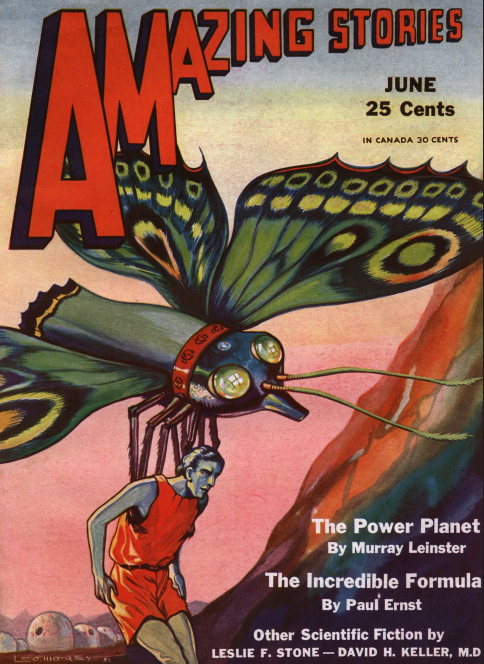
A gorgeous cover this issue – I love that big ass moth! Amazing Stories is one of giants of the pulp era, the first sci-fi pulp and, in many ways, the first real competition that Weird Tales faced, the fallout of which led to the eventual ossification of “science fiction” and “weird tales” as two distinct genres. We’re in 1931, a couple years after founder and titan Hugo Gernsback has bought out and sent off into the wilderness – for now, Amazing Stories is being published by Teck, a MacFadden subsidiary, and overseen by longtime editor T. O’Connor Sloane. Spiritually, though, this is still a strongly Gernsbackian magazine, including an emphasis on sci-fi as an educative or at least “improving” literature. You can see this is the science education editorials they include with every issue; these were (under Gernsback) originally used to justify the magazines existence, a way to show how all these ray-guns and bug-eyed menaces from the stars were, ACTUALLY, instructive literature for the science-minded. This issue’s editorial, written as always by Sloane, is a very strange mishmash of physical geography and extremely poorly reasoned reductive geomorphology about the earth:
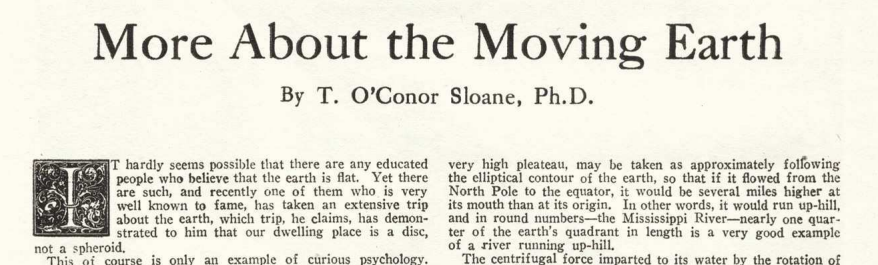
As a geologist I felt the need to the include it in this little essay, but it turns out to be mostly a waste of time. What is odd, and what I wanted to throw out to the wider world, is Sloane’s statement in the first paragraph there, about someone “well known to fame” who recently claimed the world is a disc, not round. Anybody know who the fuck he’s talking about? For a minute I thought he might be talkin’ Auguste Piccard, a Swiss physicist who went up in a balloon in 1930 (and in ’31, actually), and famously described the earth’s curvature as a “disc,” but a) he’s not THAT famous, b) he’s not a flat-(or disc-) earther, and c) he went up in a balloon, not on an “extensive trip about the earth.” Anybody know who Sloane is talking about here?

Anyway, let’s dig into the story!
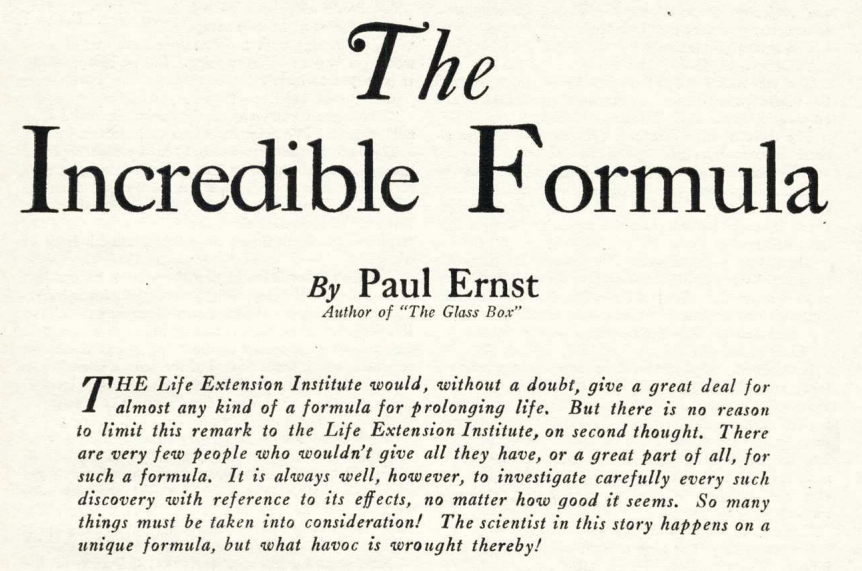
The summary paragraph included in the story is kind of funny; it centers the crux of the tale around a scientist failing to consider the social/political ramifications of his work, which fair enough that is a *part* of what happens here, but in fact there’s a much larger target of Ernst’s ire in this story, as we’ll soon see. I reckon the framing of the paragraph comes out of the the editorial ethos that Amazing Stories is providing not mere escapism but actual important scientific content.

Our story proper begins with a kind of fun framing device:
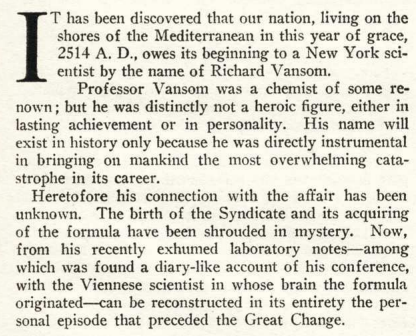
This is a kind of historical essay, narrated from the distant world of 2514 A.D. where a nameless nation on the Mediterranean is examining its own origins. I like the way they cut Vansom down immediately – he’s important, but not in the sense of having been a Great Man; rather, he was just the fulcrum around which history turned, almost by accident. Apparently, some recently discovered papers written by Vansom are going to shed some light on this “most overwhelming catastrophe.” We begin in the hoary, ancient age of the barbaric 1980s:
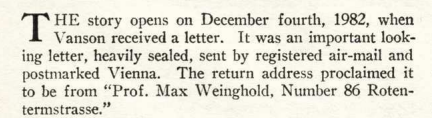
Vansom had, per these newly unearthed documents, received a summons to Vienna from his ol’ teacher, Prof. Weinghold. This letter, among the papers, tells us why:
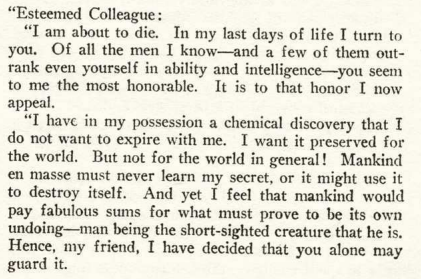
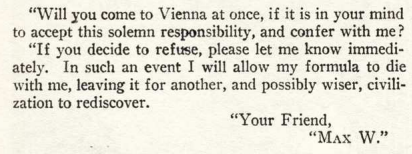
The bell is tolling for ol’ Prof W., and he wants to entrust his last, greatest work in the hands of someone he feels can protect this most incredible of formulae. Unfortunately, the guy he picks is Vansom (as we’ll soon find out). But, anyway, Vansom, after some hemming-and-hawing, realizes he must attend to his former teacher’s (and friend’s) last wishes, and so he zips on over to Vienna, where he meets Weinghold’s factotum/major domo, Rudolph…

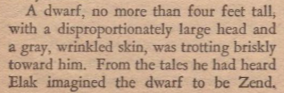
…but this Rudolph is strangely changed.
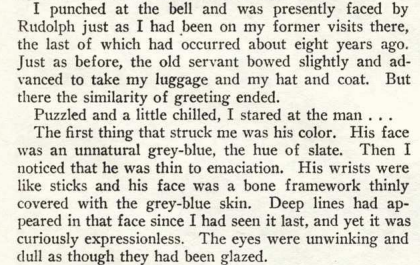
And he doesn’t just look weird…he’s acting odd, too!
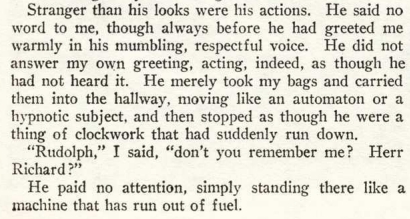
Vansom describes how he notices that Rudolph is wearing a small steel-band around his head, which holds a set of headphones; these headphones must’ve been cranked all the way up to 11, because Vansom can hear the loud blast of Weinghold’s voice, ordering Rudolph to bring his guest up immediately. Helluva illness in ol’ Rudy, thinks Vansom, and he’s gone deaf to boot! The order engages Rudolph though, who bows like “a mechanical doll” and leads Vansom up to the study, where we meet ol’ Doc W:
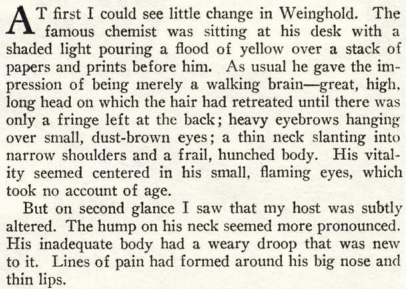
Sounds like somebody needs a ginger ale and some saltines!

Weinghold, speaking into a transmitter, orders the weirdly stiff, slate-faced, utterly silent Rudolph to bring lunch for Vansom, and some egg and milk for himself. Vansom comments on how sad it is to see Rudolph lookin’ like shit and all, which leads Weinghold to make some very gnomic utterances about that indeed. After the meal it’s on with business. Prof W explains that he’s dying of intestinal cancer, and there’s nothing to be done about it; in fact, he’s going to kill himself after this little meeting! And what does he want Vansom for?
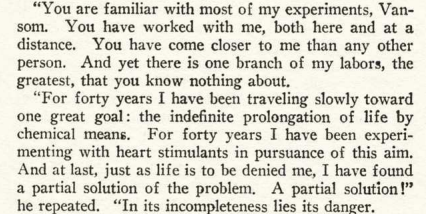
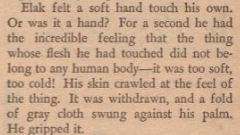
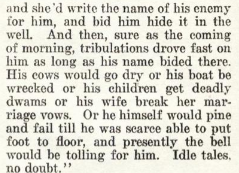
It turns out Prof W has discovered a compound (which, in a footnote from the future, out 26th century friends refer to as “ephedrine-X”) that can keep the human heart beating well beyond death! Originally, Weinghold thought that this was the secret to immortality; with a beating heart as the motor, the rest of the bits of the body should be able to function too. But, it turns out:
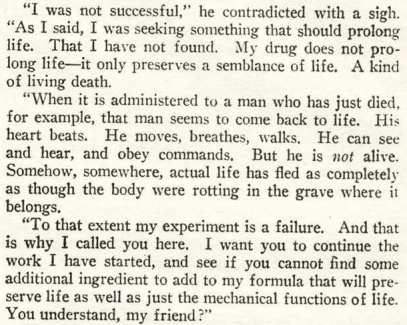
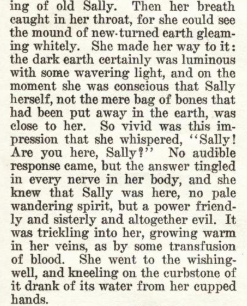
In a somewhat Herbert West-ian fashion, this injection makes, basically, a zombie – a walking corpse that can move, that obeys commands, but is devoid of intellect or will of its own. Weinghold feels like he’s CLOSE to cracking the problem, that his ephedrine-X is something that, perfected, might be the thing that does, in fact, lead to immortality, but it’s too late for him. He needs Vansom to safeguard it, because it’d be dangerous otherwise. Vansom, honored, agrees, and so he learns, via oral recitation, the secret of the incredible formula.

But then, just as they’re finishing up:
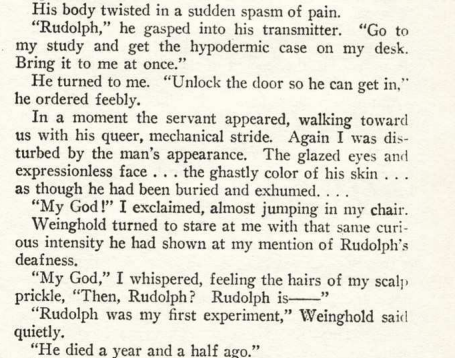
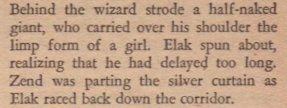
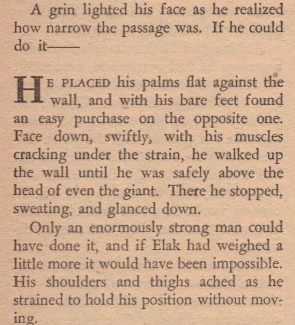
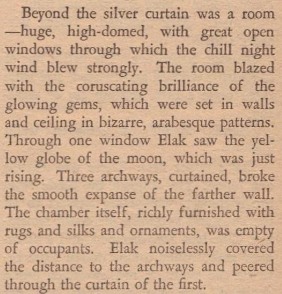
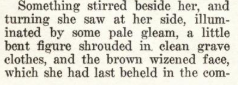
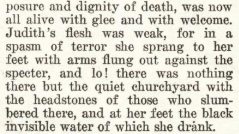
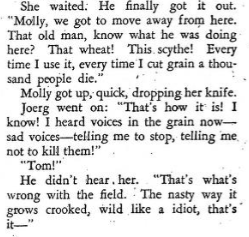
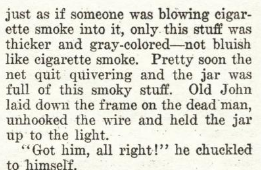
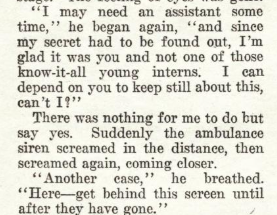
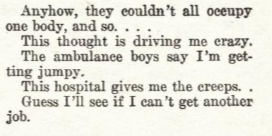
Turns out that zombie-lookin’ motherfucker was a goddamn zombie! This is the inspiration for the single piece of art for this story:
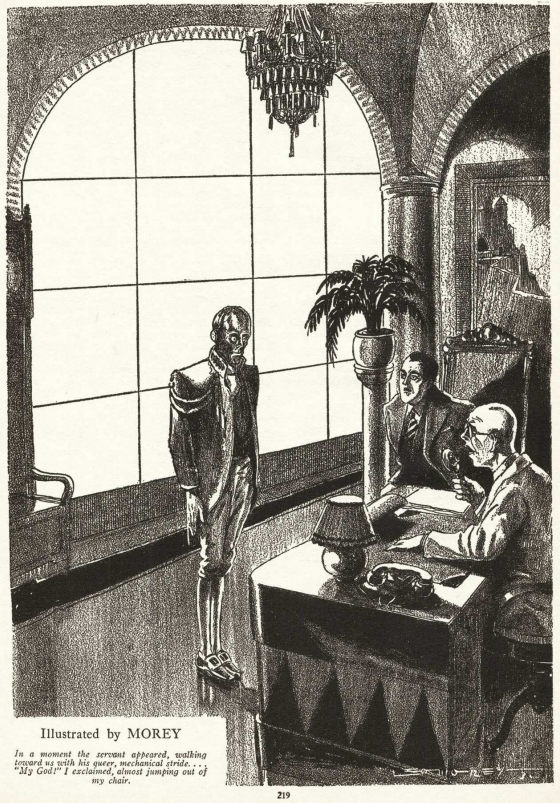
It’s a haunting image; I like the framing of the cadaverous Rudolph against the stark white expanse of the window. It’s also interesting that Rudolph is portrayed as noticeably dark here – in the story, he’s described as slate-colored, very much the pallor of death, but you can dissect this image in a different way, particularly given what we’ve learned. Rudolph could be said to be strangely racialized here, presented as a black servant in his livery; given the fact that we’ve just learned that he’s been effectively enslaved after death, that doesn’t really seem like an accident. Given the year of this story’s publication – 1931 – that seems very possible; the Caribbean voodoo (and zombie) stories of Henry S. Whitehead were beloved fixtures in the pages of Weird Tales by then, in fact he was almost single-handedly responsible for their entry into horror literature. It might be that the artist here, Leo Morey, had internalized that representation. Anyway, it’s worth keeping in mind!

Back to the story: Vansom spends the evening learning more about the details and techniques of ephedrine-X. It has to be administered quickly, within the first seven minutes of death, and it requires continuous reapplication in ever increasing quantities to continue the revivification process. The resultant zombies are mobile, feel no pain, and are capable of work, but totally unintelligent and machine-like; they also have much reduced senses, which is why Rudolph had to be fitted with a set of headphones to scream the transmitted orders into his skull.

And then, Doc W dies, having taken his poison during supper.

Vansom jets back to the states, taking with him a bottle of ephedrine-X, the knowledge of its manufacture and usage, and also Rudolph, which seems quite creepy, actually. It’s here that the far-future narrators cut in, hilariously:
Up to now, we’ve been reading transcripts from Vansom’s papers, unedited and as he wrote them. But now, as we enter the grim and cataclysmic phase of the story, the future narrators cut him off, explaining that he’s unreliable beyond here. What follows then is to be considered the objective history, as best as they could reconstruct it, derived from reading against the grain of Vansom’s own self-serving (and self-absolving) narrative. It’s a fun bit of verisimilitude here, reminding us that we’re reading an interpretation of history based on recently discovered historical material.

Vansom, the historians state, was not as discrete as he should’ve been. Somehow, hints and rumors begin to trickle out, and people begin to believe that Vansom has come into a secret formula that will extend life. The media, more concerned with sales and circulation, begin publishing crazy-ass stories about how ephedrine-X was a miracle drug that had cured hopeless cases, that Vansom’s servant Rudolph was a 104-year old man kept hale and hearty by the drug; they make up quotes that Vansom has claimed that he could live a thousand years if he wanted to.

The country goes bonkers! They want ephedrine X! The scientific community demands answers, fanatics threaten his life, mothers of dying children beg him for his miracle drug. Vansom remains resolute in his promise, however.

That is, until the billionaires get involved:
Vansom meets the devil, and signs the hell up. At first, for a cool ten mil, he sells a description of the effects of ephedrine-X to this twice-over billionaire. And when this billionaire comes back a week later:
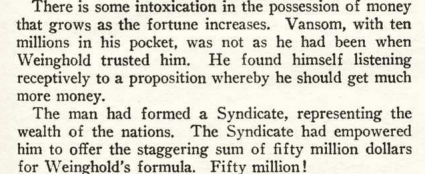
I really love that first paragraph – the intoxication of money, and they way its possession has changed Vansom irrevocably is really great, and something that has largely entered the popular consciousness today, the idea of money as this poison that warps a person. It’s fun to think about the fact that again, in this story, we’re now reading the analysis of the primary document of Vansom’s account – you can imagine the twisty, defensive logic Vansom, writing this account after the fact, engages in to try and exculpate himself, and the way the historians have extracted this judgement from that text here for us.

Anyway, this billionaire and his other billionaire friends have formed a Syndicate, and they’re willing to buy the incredible formula from Vansom for a big ol’ sack of fifty millions of dollars.
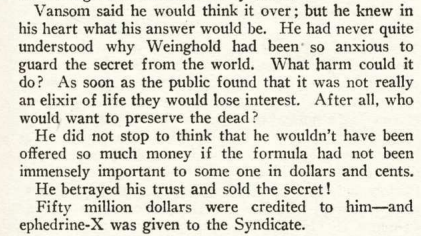
Boo to Vansom, huh? That line, about how he’d never have been offered a payment like that if it wasn’t worth so much is a pretty great one, a nice indictment of dumb ol’ Vansom. And now the Syndicate has the zombie potion.

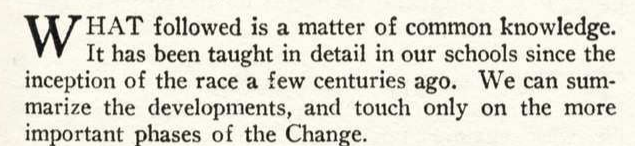
At this point, the narrative voice of the historian underlines the fact that we’re about to be presented with the highlights of a well known history:
Ernst very interestingly introduces the then relatively new development in industry from his own time, the rigorous and scientifically-informed advertising:
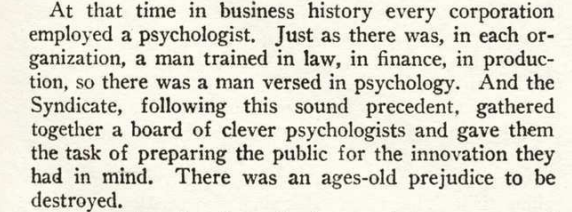
The Syndicate creates a several floor models of the undead, dispatching the revivified corpses to the cities of the world as part of a public exhibition At first, this seems to be a disastrous PR move; as the story states, the ages-old prejudice against seeing and interacting the dead produced a visceral repugnance at all levels of society. Newspapers, politicians, preachers – everyone condemns these zombies being paraded before them.
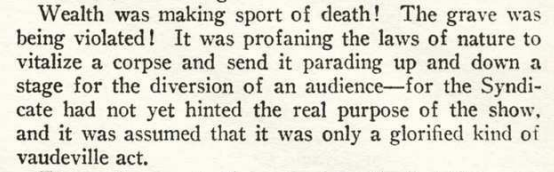
That’s an important point – Ernst is still keeping us, alongside the whole world of his story, in the dark as to what the Syndicate’s purpose is with these corpses, exactly. This is by design – the psychologists in the employ of the Syndicate are methodically breaking down what they know to be the kneejerk horror at these zombies piece by piece.
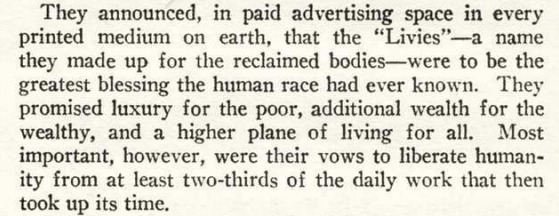
And what, exactly, is the promise of these marvelous, liberatory “Livies?” Why, nothing less than the freedom from work:
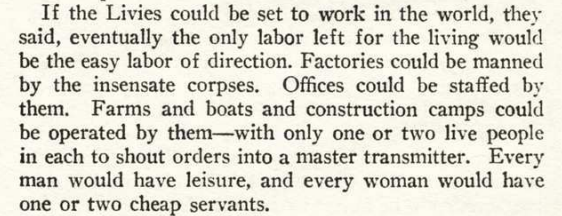
The billionaires of the Syndicate KNOW that the Livies represent a total breakdown of what Marx called the social reproduction of labor – they are fundamentally overthrowing the relationship between labor and productivity, the same way that industrialization and modern machinery had overthrown the social and class relationships of the 18th and 19th centuries. Because, obviously, if you’re talking about replacing workers across a huge variety of industries and businesses, then what, exactly is to become of the living workers?

Well, the Syndicate has a deeply sinister answer to this. First, in the section excerpted above, the Syndicate plays that ol’ chestnut of industry – increased automation will mean more leisure for the common man, a freedom from toil and drudgery both in the office and at home! But, of course, the question becomes: if Livies are going to take all of the jobs, what’ll people do to make a living? Oh, the Syndicate has an answer there too:
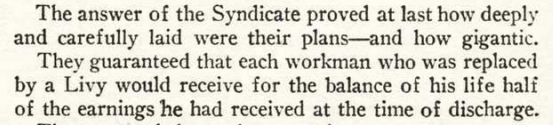
It’s a good ol’ fashioned buy out! Lose a job to a Livie? No worries, you’re now going to receive half-wages gratis, for no work, for the rest of your life! But wait, there’s more:
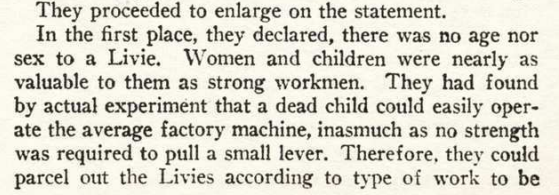
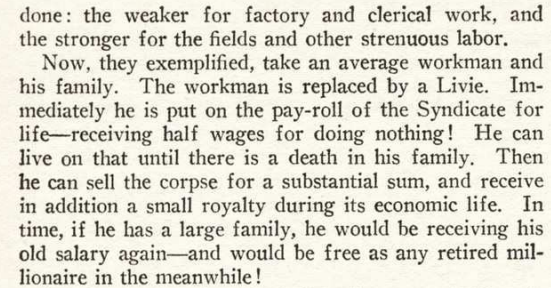
There ya go – let’s say you get laid off from the dingus factory because they’re replacing you with a Livy. Well, no worries, because while you’re off the job, you’ll receive, from the Syndicate, half-wages in perpetuity. And what’s that? Your wife is sick, and a kid of yours dies suddenly? Sell those useless bodies to the Syndicate, and get a royalty on those fresh Livies too! Now you’re living on easy street!

Pretty horrific, and at first is seems like everybody agrees. But the Syndicate knows its business:
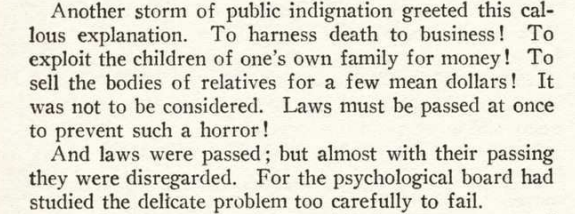
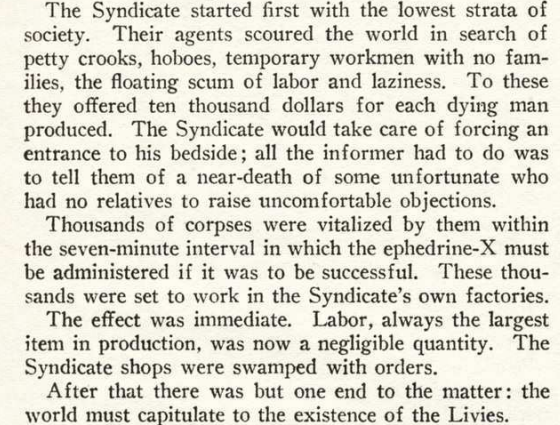
The Syndicate swarps up a bunch of corpses from the lowest lumpenproles they can find, and use them in their own factories; sure, they pay a premium for the corpses up front at first, but they’re labor costs become negligible, which means they can sell their dinguses for cheaper than the competition. People are mad, there’s all sorts of anger and demonstrations, but the toe is in the door now; labor has been broken.
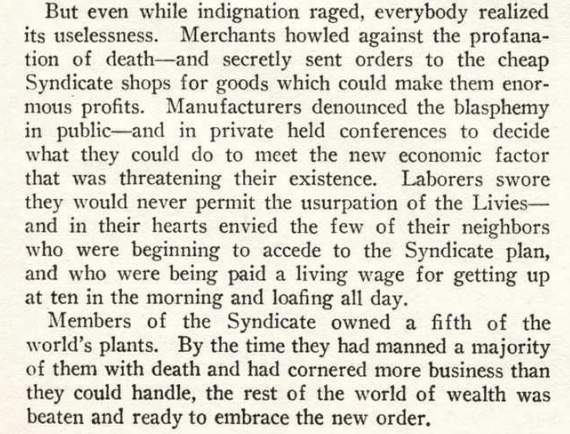
Supply chains based on cheap goods become dominated by those using Livies, because their goods are the cheapest. Thus, industries became reliant on the Livies, and those that refused to use them faltered or went under; workers, seeing unemployment spreading, demanded their bosses replace them with Livies, as a half-wage for life was better than no wage. By controlling production via their unnatural labor supply, the Syndicate basically takes over.
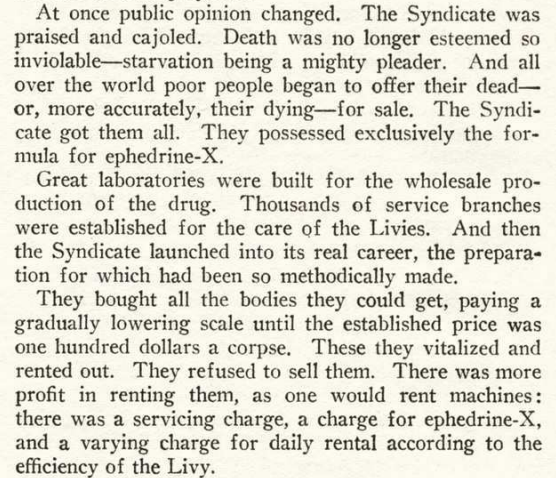
The Livies become an indispensable part of the economy, and so the Syndicate can afford to lower the cost of corpse-procurement and, rather than selling them, rents the Livies to businesses. Whole service industries spring up around the Livy workforce, and what little reticence there was towards using the living dead as slave labor vanishes as the economy becomes entangled with the Syndicate.
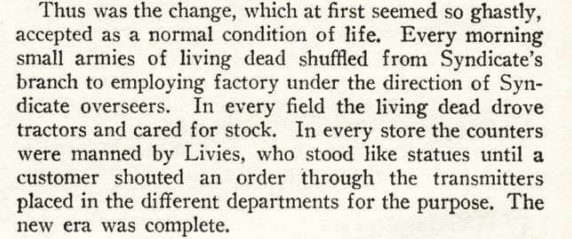
This new era is the total domination of the world by the Syndicate; they come to, basically, own everything, commanding as they do the entirety of the labor force, and with it the mechanisms of the economic life of the planet and everyone on it. Workers in this system become perfectly alienated laborers; they are transformed by death into absolutely efficient non-consumers. The living, meanwhile, exist merely as consumers, eventually transforming their own dead into commodities that they can sell to the Syndicate so they can consume more. It’s grim as hell!

The historical narrative says that things are pretty paradisical for the first twenty years or so (excepting the whole “you might buy a widget from your dead relative down at the shop” thing, I suppose), but then the inevitable happens. With such an iron grip on the economy, the Syndicate starts to tighten the leash in order to make themselves MORE money; hilariously, Ernst lays this blame squarely on the billionaire’s failsons who have inherited their position within the Syndicate, a nice little condemnation of inhereted wealth.

Anyway, these zillionaire scions decide that they need to make more money, so they start reducing the unemployment stipends being paid out to people who aren’t working because of the Livies. They jack up the rental fees of the livies, and proclaim that businesses must accept as many Livies as the Syndicate sells ’em, or else. Finally, they even start slashing the salaries of the PMCs working for the Syndicate, the overseers and administrators and even the chemists who make the miracle drug ephedrine X.

Famine stalks the land; people can’t afford to eat, not with all the jobs taken by Livies and with the stipends slashed. Some people try to go back to work – afterall, Livy rental is now almost as much as a worker’s wage would be. But the Syndicate won’t allow it – they own the police, after all, and use them to break strikes and riots of the living.

And now the stage is set for the last act of the Great Cataclysm.

First, the chemists of the Syndicate, with their salaries slashed, leak the formula, resulting in non-Syndicate Livies which, kind of hilariously, are used in various crimes. Robberies and murders, perpetrated by the undead, are rampant, and even Vansom is killed by a Livie during a break in. The whole social order is breaking down, and people begin to demand restitution and dissolution of the all-powerful Syndicate. Rather than bowing to the demands, the Syndicate declares war on humanity; they recall all their Livies, bringing the world to a screeching halt. The Peoples’ response is a good one (one we today should emulate, I’d say), but it comes too late:
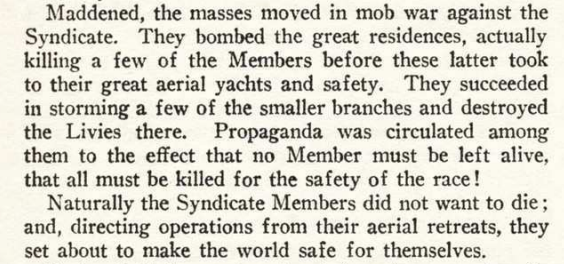
The Syndicate ends up militarizing their Livies and turning them on the living. The undead armies are unstoppable, and the dead of the masses just swell their ranks. Meanwhile, the Syndicate, floating high above the earth in airships, looses hell on earth, bombing cities, sending their armies of the undead against the living until, after five years:
Everyone except for the Syndicate and their family is dead, and the whole world has become theirs. And what’s their relationship to this historical narrative we’ve been reading?


And that’s the end of the Incredible Formula by Paul Ernst!

The ending there *is* a little weak – much better to just leave it grim and hopeless, with the 5000+ assholes and a world of the dead, but from the structure of the story I reckon he had to end it in the fashion that he did – after all, we’re reading a narrative from the year 2500 or whatever about the shit that happened in the late 20th and early 21st century, so we have to have some kind of human civilization to make that work. You can also very plausibly argue that this isn’t really much of a story, per say – after the first few pages of Vansom stuff, there’re no real characters, and the rest of the piece is really more world-building essay than a narrative. And that’s fair! But to me, what’s interesting about this story is the fact that it’s actually a pretty sharp and pretty good Marxist analysis of labor and alienation and industrialization…in a goddamn pulp sci fi mag!

This story in unescapably linked to the Great Depression and presents a pretty scathing analysis of the abuses of capitalism. The Syndicate is as sharp an indictment of the robber barons of the 20th century as it is of the technofascists of today – billionaires who make nothing but who use their wealth to bludgeon the world into a financial fiefdom that they can extract limitless wealth from, all while immiserating everyone else. The Livies are also fascinating, aren’t they? They’re the perfect work – a totally homogenized workforce, perfectly docile, perfectly efficient, and perfectly fungible. One the one hand, they’re a clear stand in for simple industrialization, right? Machinery that we’re promised will increase productivity, but there’s a real incisive commentary here on the OWNERSHIP of that productive machinery – it’s not merely factory owners anymore, it’s huge transnational capitalists that RENT the machinery to other, smaller capitalists. What’s remarkable is how much that applies to the bullshit a.i. slopworld of today, and the vision of the technofascists, down to their ideas of forcing its adoption and a dependency that would provide them, the “owners,” with limitless rents.

I don’t know about Ernst’s politics, but he must’ve been reading (and, more impressively) understanding Marx to write this story. His labor fable of the Livies is remarkably sophisticated – eschewing a simpler “mega-industrialization” narrative, his Livies represent the ultimate alienation of the worker from their labor. Furthermore, he literalizes the capitalists’ dreams of the perfectly fungible worker. The Livy is the transformation of labor into a perfect commodity, so much so that the living are selling their dead (or near dying) to the Syndicate in the story in order to make money.

And how about the living? They don’t come off much better here, do they? Feckless, they’re bought off by consumer luxuries, trading their dignity (and, again, their own family members) for more purchasing power! There’s no solidarity, and the Syndicate gets the Livies into society because the workers can’t stand together; it’s telling that politicians are nowhere to be seen in this story, and that the one brief mention of laws sees them brushed aside as irrelevant. Ernst understands what economic power is, and gives us a good example of how one group (the capitalists) use it effectively in their own interests while another group (the workers) fail to do the same.

As a parable of exploitation and the abuses of capitalism, it’s pretty great! And beyond that, there’s some real good glimpses of horror here – there’re several places where Ernst really dwells on the idea of running into a relative or friend or loved one working behind a counter as a corpse, and the final image of someone being killed in the Last War by their zombified relatives is a grim and ugly one. Honestly, as tired as we are of zombie stories, this isn’t a bad take on the genre, and the simple horror of the undead is magnified by the indifference and cruelty of capitalism – these walking corpses don’t wanna munch on your brains at all, they’re just being ordered to murder you by a middle manager type who is worried about their benefits plan if they lose their job.

It’s also interesting in the context of the last post – automation and automata as a symbol of radically evolving social conditions. Last time I was mostly focused on the scientific (and, therefore, ontological) implications of automata, and how changes in the world of science were reflected in the weirdification of the literature of automata; there’s a similar economic story too, one which takes up the Marxist analysis of material conditions and uses automata as a way to explore class and society and power. And Ernst’s story belongs alongside Asimov’s I, Robot tales in that regard, I think!
Automata in Weird Fiction

To celebrate (and *ahem* advertise) the fact that my short story, “Vaucanson’s Canard,” is available for preorder as an absolutely gorgeous pamphlet from Paradise Editions (with international shipping available from Asterism), I thought I’d write somethin’ up about one of my absolute favorite things ever: automata! And, specifically, automata… in weird fiction!

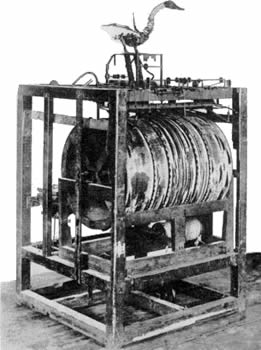
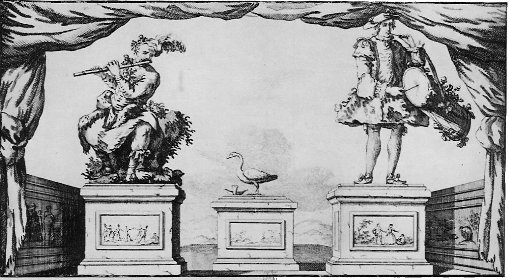
Vaucanson’s famous automata, include the Shitting Duck!

As a child of the 80s, I reckon my first exposure to automata were those classic dinosaur animatronic exhibits that were all the rage at the time – they used to be everywhere, a part of that era’s dino-mania that would, ultimately, culminate in Jurassic Park. As a paleo-obsessed kid, I recall enjoying the displays, but never in the same way as a fossil mount. The artificiality of them was always front and center, the repetitive clockwork motion of the figures shattering the verisimilitude; they never achieved the awesome dignity of those austere ambassadors from the gulfs of deep time, the actual fossils.

BUT! I have a vivid memory of a display at one of these things where the dinosaur had been stripped of its skin, at least in part, to allow you to see the machinery underneath the rubber, and that was a surprising and fascinating thing to little ol’ Eric. Covered, the thing was stilted and underwhelming, but with its pneumatic skeleton exposed, full of wires and electronics and with the unmuffled mechanism operating loudly, it was a much weirder, much more striking thing! Someone more mechanically inclined might’ve been inspired to a career in engineering, but for me it was all about the frisson of being shown simultaneously the illusion *and* the trick, and it produced a real moment of uncanniness.

The oddity of the simulacrum would be underlined by my evolving reading habits – I was a sci-fi kid, especially of the classic 50s-70s era, and boy if that ain’t a literature chockful o’ robots of all sorts. And, while living in an era of shitty a.i. slop means it’s harder than ever to write fiction about machine intelligence, I’ll never not have a fondness for a good robot story! Luckily, there’s a looooong history of automata to pick from!

Ancient Automata

Before we get into fictional ‘bots, it’s worth examining the long history of automata, real and imagined. There’s a deep history to the fascination people have with mechanisms, wrapped up as it is with ideas about knowledge (technical, secret, or divine), as well as questions of authority, labor and, eventually, life itself. Which means that our look at automata starts with those most introspective weirdos of the ancient world: the Greeks.

The word itself comes from Greek αὐτόματα, meaning “acting of one’s own will.” A subtle but important point – an aspect of these things is that the mechanisms must behave as if (or, among the mythic examples, because they have) their own individual motive impulse, power, and directive; in other words, they must appear to be alive. The earliest examples are in those foundational cornerstones of Western lit, the Illiad and the Odyssey. Homer tells us how Hephaestus, god of Smiths, had built mobile tripods to serve the Gods their ambrosia, and he famously had a gaggle of gold girls who, importantly, were in possession of an artificial intellect and skill that let them help out around the forge. In the Odyssey, we’re introduced to the Metal Dogs of Alcinous, gifts from Hephaestus to the King of the Phaeacians to help guard his palace.

It’s all good and well that a divine being like ol’ Festus there can create gold girlbots and robo-dogs, but there is also in the Odyssey at least one example of human(ish)-made automata. When doomed Alcinous is offering to help Odysseus get back home, he explains how their marvelous ships operate independently, without pilot or rudder; rather, the boats “understand” what it is their passengers want, reacting at the speed of thought, and are themselves aware of every city and port and can travel the various sea routes to get to them in a single day. These boats are not gifts from the gods; they’re manufactured right there by Phaeacians (who, admittedly, are descended from semi-divine giants). This seems like an important distinction: sure, the Gods can of course manufacture wonders, but if you have the skill and knowledge, you too can make these living (or at least, life-like) machines.

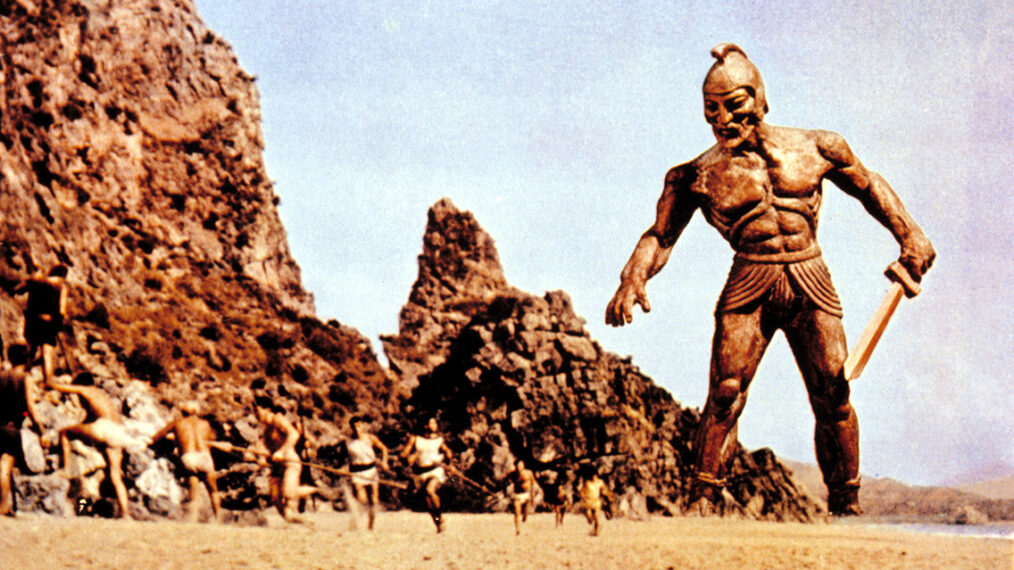
I’d be remiss if I didn’t mention Talos, one of the most famous examples of an automaton from Greek mythology, immortalized by divine wondersmith Ray Harryhausen (who could make inanimate matter appear to behave as if alive) in Jason and the Argonauts:

It’s super cool looking, a great part of a great movie, but I do have to point out that the tradition of Talos being a robot (and, actually, a giant) is not the whole story. In the earliest work in which he appears (the Argonautica of Apollonius, from ~3rd c. BCE), Talos is actually the last surviving member of the warlike Bronze Race who came before the current Iron Age people. It’s actually pretty eldritch when you think about it – an alien being from a lost world, the last of his kind, killable only through sorcery. It isn’t until a much later version of the story (from the 2nd century CE) that a writer says Talos was given to Minos by Hephaestus, suggesting that he was manufactured by the god.

These fantastical automata are fascinating, because they actually illustrate an important function of the whole idea of “automata” within the societies imagining them. There’s actually a really interesting literature out there about how these stories, a species of “science fiction” in the ancient world if you want to call it that, were received and how they influenced the history of technology in the Hellenistic world; it’s beyond the scope of this little free-form essay I’m writing, but there’s a great paper by Martin Devecka (“Did the Greeks Believe in their Robots” 2013, the Cambridge Classics Journal v.59) that makes the argument that these conceptual robots were an important part of the Greek world view, used to explore questions of work and slavery and contrast the world as it was with an idealized utopia. This is the same argument Aristotle made, by the way, and which Marx commented on in Capital v. 1; per Aristotle:

If every tool, when summoned, or even of its own accord, could do the work that befits it, just as the creations of Daedalus moved of themselves, or the tripods of Hephaestus went of their own accord to their sacred work, if the weavers’ shuttles were to weave of themselves, then there would be no need either of apprentices for the master workers, or of slaves for the lords.

(Marx, of course, disagreed with this rosy techno-positivist assessment, pointing out how “labor-saving devices” just resulted in more work for the worker, as demonstrated by the industrial revolution merely expanding the working day in the name of ever-increasing productivity).

Grecian mechanical knowledge was not merely mythic, of course; there were a lot of very advanced, very technically adroit thinkers working in the Hellenistic world, producing some really remarkable things. Ctesibius, a mathematician and engineer from 2nd c. BCE Ptolemaic Egypt is said to have basically invented pneumatics and hydraulics for use in things as widely divergent as pipe organs and water clocks; none of his work survivors, but he was a huge influence on later Greek mechanists, including Hero of Alexandria (1st or 2nd c. CE) who, in addition to inventing a rudimentary steam engine, also wrote a treatise on automata as wonders, describing robots that poured wine at banquets or that could be used in theatrical productions. He also documented and described automata for religious festivals, including a robotic Dionysius that was at the center of a major religious festival; this suggests that not only were his automata luxury objects for the parties of the rich, but that they existed in the public/civic/religious sphere as well, which is fascinating! Hero’s writing, which did survive, was later enormously influential on early modern European machinists.

A 1589 edition of Hero of Alexandria’s book “About Automata”

Ancient Greek automata, if not necessarily common, seemed to be a least extremely well known. There’re a number of Greco-Roman travel writers who described the wonders of Greek robots, including descriptions of the city of Rhodes that makes it sound like an animatronic park – moving statues on every corner, mechanical fountains, water clocks, a kind of ancient world steampunk scene (sans steam, of course). The fame of Greek automata builders extended beyond the Mediterranean, too – there’s a tradition in northern India that the secrets of robot-building were stolen from the Greeks, brought home, and used to build an army of automata to guard the relics of Buddha (admittedly, most scholars believe this story arose out of Middle Eastern or Islamic sources in the middle ages, but still!)

The idea and, in some cases, literal existence of automata in the ancient world is an important predecessor to both the technical and conceptual developments of later ages; it lays the foundation for both the science and literature of subsequent life-like mechanisms. The technical writing on automata was preserved in Arabic and Persian sources, and would influence both the development of mechanical wonders in those cultures as well as become an important part of the Exoticizing Orientalism of later Western concepts of the “Mysterious East.” And, even if Europe lost access to the mechanical knowledge and skills of the ancient Greek artificers, there remained a thread of automata throughout their literature – the Alexander Romances, medieval retellings of the life of Alexander the Great liberally spiced-up with all kinds of fantastical elements, included a number of encounters with deadly automata, both human- and beast-like.

But what’s interesting is how, even where the ancient Greeks were musing on the social ramifications of automata in the workshop, there’s nothing really “weird” about them, you know what I mean? To use Todorov’s terminology, even when these automata are presented as killer robots built by mysterious artificers with secret knowledge, they largely remain merely “marvelous,” remarkable and possibly unique, but not *outside* the bounds of the world, as it were. It isn’t until much later, with the development of Enlightenment ideas about bodies and nature, that automata become uncanny.

The Uncanny Machine

Automata become weird when they stop merely mimicking life and start being mistaken for it. This blurring between the biological and the mechanical can only occur when you abandon the idea of some divine or numinous attribute, unique to life, that categorically and irrevocably separates life from non-life. In other words, when bodies begin to be conceived of as mechanisms, then mechanisms can begin to become bodies. In seventeenth century Europe, the development of modern science, with its rationalist approach to observation and experimentation, resulted in a new, mechanistic view of the world. And if planets revolved under the operation of physical laws and matter behaved with chemical predictability, then there must be sensical laws fundamental to the operation of the body too!

That’s actually a pretty radical idea, if you think about it. There had been theories of the body before, of course, and while we’re quick to scoff at humors and bleedings, they were a part of a largely consistent (if poorly informed) theoretical structure of how bodies were believed to work. But as medical and biological knowledge grew, guided by new techniques and instruments of experimentation and observation, a model began to form that analogized the human body with the operation of a mechanism. In particular, thinkers like Descartes and William Harvey explored the operation of the heart and its role in circulating blood, providing an important step forward in the material understanding of the operation of animal (and, by analogy, human) bodies. Descartes explicitly referred to the “animal-machine,” and used it as the basis for a new framework for life.

Hearts as pumps, lungs as bellows, eyes as lenses…and then it’s a short step to minds as material things, isn’t it? While we’re familiar with the Creationists’ argument about the Divine Watchmaker, it’s important to recognize that that rhetorical gambit only came about well into the 19th Century, when religion had had to cede so much territory to science already. In the 17th and 18th centuries, the Church (meaning all of Western Religion) was much less enthusiastic about all this mechanistic talk BECAUSE it seemed to remove God from the equation – after all, if bodies become explicable through purely material, mechanistic processes, then there’s no real reason to invoke the divine, is there?

(As an aside, if you’re interested in the topic of the development of this bio-mechanistic world view, including the role of automata in its development, I’d strongly recommend Jessica Riskin’s “The Restless Clock: A History of the Centuries-Long Argument over What Makes Living Things Tick” from the University of Chicago Press. It’s great!)

It was into this brave new world of men and machines that Jacques Vaucanson (the honorific “de” would be added later, in recognition of his achievements) was born in 1709. The tenth son of a glovemaker, Jacques was sent to study with the Jacobins in Grenoble and joined the Order of the Minims in Lyon as a young man; it was here that he learned the math, natural philosophy, and engineering that would serve him through his life. He left the Minims after his first attempt at automata was met with hostility, and he travelled to Paris to pursue his studies in mechanics. He learned anatomy from Claude-Nicolas Le Cat, a famous surgeon of the day, and developed a keen interest in the mechanical operation of the body from his lectures.

At the time, there was a bit of a fad around automata in Europe, though they were often displayed as toys or wonders of novel engineering, rather than as anything scholarly or profound. Vaucanson, however, envisioned the development of a machine that would mimic not merely the actions of a living being, but the processes too. His first famous automaton was a flute-player which he built in 1737. Rather than appearing to play the flute, the figure ACTUALLY played it, with a convoluted throat architecture that relied on a complex system of pumps to generate the differing air pressures necessary to change octaves on the flute. Furthermore, the figure actually pressed its fingers against the holes of the flute to play the notes it was programmed with; in order to achieve the necessary pliability, Vaucanson actually clothed the automaton’s hands in skin. This was no toy; scholars viewed it as a remarkable (and instructive) model of how a human being could play music, and an important lesson in circulation, breath regulation, and coordination. Indeed, the failings of the mechanism were even discussed as instructive, with an emphasis on how the subtle muscles of the lips and mouth must likewise operate.

Vaucanson’s interest in attacking the question of biological processes via analogy to engineering explains his most famous automaton (and the inspiration behind my little story): his famous “Digesting Duck.”

The Duck in the 1800s

This little guy was, simply, a small mechanical duck that dabbled around in a small pool, flicked its feathers, flapped its wings, ate corn from peoples’ hands…and then shat it out afterwards in neat, green little plops. And people fuckin’ LOVED it.

It’s easy to laugh about (because it IS kind of goofy), but people thought this was the most amazing thing they’d ever seen. Voltaire called it one of France’s singular contributions to the world, and it was discussed and written about all; Poe even discussed it in his essay “Maelzal’s Chess Player” (which is mostly about an exhibition of the famous “Turk” chess playing automaton). Why so much excitement over a shitting duck robot? Because, it was believed, Vaucanson had solved one of the truly great mysteries of life: digestion.

Think about it; people obviously knew you had to eat to live, but what exactly happened to the food once you mashed it up with your teeth and swallowed it down your gullet? How did it sustain life, and why was it eliminated from the body as waste? These are huge, fundamental questions about life, and here comes little Jacques Vaucanson with his shitting duck, apparently in possession of this remarkable secret.

Vaucanson positioned his duck as an instructive example of his scholarly knowledge on the subject; interestingly, much like the dinosaur I mentioned way back at the beginning of this little essay, Vaucanson’s Duck was presented naked, unfeathered and with (some of) the mechanisms visible, as a way of demonstrating both the subtly of his mechanical skill as well as the transparency of the operation. What was NOT visible, of course, was the way this “digestion” took place; this was because it was all a trick. Vaucanson would preload his duck with a mashed up lump of breadcrumbs soaked in green dye, which the duck would produce in the course of its normal operation.

In my opinion, I don’t think Vaucanson was really trying to pull one over on people – I think he probably really thought that he could, EVENTUALLY, figure this whole digestion thing out with more time and more effort. In this scenario, the Shitting Duck is a place holder for future work, a kind of mock up prototype or early draft that defined the problem without offering a solution. Just my two sous on the subject, of course.

In my story (available here!) I use this history, and the historical fascination with automata as models for understanding life, to push on the idea of Vaucanson’s little trick, and explore to what further (and extreme) ends it might have been deployed. Fantastical as it may be, it’s not too far off, because Vaucanson’s work with the duck was recognized as revolutionary; he was awarded a role as the inspector of silk works for France, a position that provided him ample funds and influence to pursue other work. These included an early prototype of the punch-card driven automated loom (which, 50 years after his death and perfected by Jacquard, would become a major part of the industrial revolution). He also invented the lathe, the “tool for making other tools” that was likewise of incredible importance in the history of technology. Finally, he also received a commission from the King of France to see if he couldn’t build an automaton that would mimic the circulation of blood in veins and arteries, which would lead Vaucanson to basically invent rubber tubing. All in all, the slightly skewed events of my story don’t seem that much out of character!

In many ways, it’s Vaucanson’s work, most especially with the duck, that changes the way automata are thought about and discussed. Before him, they were amusing if complex toys, clever feats of engineering to be sure, but not objects of existential contemplation. After Vaucanson, the question of what can and cannot be considered alive becomes something that can be asked and discussed; this is why Von Kempelen’s chess-playing automaton The Turk (built in 1770, long after Vaucanson’s Duck) became such a sensation. Von Kempelen never claimed that it actually “played” chess, nor did any of its later exhibitors, but people couldn’t help but look at it performing a complex, seemingly intellectual task, and ask “what is it To Think?” While the Turk, much like the Duck, is little more than a sophisticated side-show gaff, it forced people to confront the uncertainly around the division of life from non-life, and that’s when things can get weird!

Weird Automata in Fiction

The first modern weird automaton appears in the work of E.T.A. Hoffmann (1776-1822). Now, Hoffmann wasn’t the first modern writer to use automata in their fiction; François-Félix Nogaret had some in his “Le Miroir des événements actuels” from 1770, though they were of a much more “marvelous” sort than weird and menacing. But Hoffmann was the first writer to really understand and approach automata as objects steeped in uncertainty and ambiguity, and because of this, he’s had a prominent role in the literature since.

Hoffmann is an absolute favorite of mine; I think he was one of the rare authentic geniuses out there, a really epochal talent whose work radically changed the literary landscape. He had an enormous influence on Poe, actually, who read him in translation and who, on several occasions, explicitly tried to wrest outré literature out from under the shadow of German “phantasy.” In the preface of his Tales of the Grotesque and Arabesque (1840), Poe wrote:

I am led to think that it is the prevalence of the Arabesque in my serious tales which has induced one or two of my critics to tax me, in all friendliness, with what they have been pleased to call Germanism and gloom. The charge is in bad taste and the grounds of the accusation have not been sufficiently considered. Let us admit for the moment that the “phantasy pieces” now given are Germanic or what not. But the truth is that with a single exception there is no one of the stories in which the scholar should recognize the distinctive features of that species of pseudo-horror which we are taught to call Germanic for no better reason than that some of the secondary names of German literature have become identified with its folly. If in many of my productions terror has been the thesis, I maintain that terror is not of Germany, but of the soul.

To my eye, there’s a bit of protesting too much here from little Eddie Poe, but regardless I think we can very much see how, in 1840, the world of “phantasy” literature was dominated by German writers, including (and certainly at the top of the list), Hoffmann. And a dive into his automata stories shows why!

Hoffmann’s first automata story is, appropriately enough, titled “The Automata” (“Die Automate” auf Deutsch), which actually name drops Vaucanson and his pipe-playing robot. The story, first published in 1814 and later collected in “The Serapion Brotherhood,” is a fascinating piece, dealing directly with that very dynamic moment of epistemological revolution in science that we were talking about above. It’s a nested tale about a bunch of sensitive, educated German bros hanging out, investigating and arguing over the various different and new Ways of Knowing Things, basically. They’re introduced trying to use their Willpower to force a ring suspended on a string between them to move, and they go on to discuss the aesthetical implications of supernaturalism afterwards via an odd and portentous ghost story. It’s written with that classic Hoffmannian verve, simultaneously funny and mysterious.

The third nested tale is where we’re introduced to the titular automata. One of these Deutscher Bros, by the name of Theodore, has a fragment of a story he’s been working on and which he shares. It’s the tale of a group of German college bros (sensing a theme?) who go to visit a mysterious, marvelous robot being displayed in town, “the Talking Turk.” Now, this Turk (clearly inspired by von Kempelen’s chess-playing robot) is a kind of oracular automaton. People come up, whisper a question in its ear, and then the Turk speaks an answer back. This advice depends, of course, on the question; banal queries receive banal answers, but when prompted the Turk has become famous for seemingly possessing knowledge it cannot otherwise have had, and for having a deep and probing wisdom to boot! In fact, there’s an implication that the mechanism of the Turk is so finely tuned and expertly adjusted that it is able to access supernatural realms of knowledge – in effect, its machine brain is better than an organic one at using psychic power!

There’s a love story and a mysterious (and menacing) professor involved, and there is no real ending because, diegetically, it is a fragment of a story, but there’s a real sense of oddness and mystery about the Turk and the Professor and the Singing Woman, and a kind of brooding doom that is never resolved – it’s spectacular writing (come on, it’s Hoffmann) but the relevant thing is that Hoffmann is using the story to really explore what we now call “the uncanny valley.” First off, he has one character express his disgust at the idea of simulacra:

“All figures of this sort,” said Lewis, “which can scarcely ne said to counterfeit humanity so much as to travesty it – mere images of living death or inanimate life – are most distasteful to me. […] When I see the staring, lifeless, glassy eyes […] I feel disposed to cry with Macbeth ‘Thou hast no speculation in those eyes/ Which thou dost glare with.’ […] it is the oppressive sense of being in the presence of something unnatural and gruesome; and what I detest most of all is the mechanical imitation of human motions…”

I’ve excerpted the above from a much longer passage, but Hoffmann is really laying out a vision of the unsettling experience of seeing something that is almost-but-not-quite-right; he’s articulating one of the absolute cornerstones of modern horror, and he’s doing it with automata as the exemplars of this terrible eeriness in a story from 1814!

What’s ALSO amazing is how, again in 1814, Hoffmann is articulating a very modern anti-AI perspective in the voice of one of his characters:

“All that machine music…makes every bone in my body ache. I am sure I don not know when I shall get over it! The fact that any human being’s doing anything in association with those lifeless figures which counterfeit the appearance and movements of humanity has always, to me, something fearful, unnatural, and may I say terrible, about it. I suppose it would be possible, by means of certain mechanical arrangements inside them, to construct automata which would dance, and then to set them to dance with human beings, and twist and turn about in all sorts of figures; so that we should have a living man putting his arms about a lifeless partner of wood, and whirling round and round with her, or rather it. Could you look at such a sight, for an instant, without horror?”

(I’ll pause here to send you to another remarkable pamphlet, also available at Paradise Editions, that includes an essay by the inimitable Heinrich von Kleist, translated by Matthew Spencer, that offers an interesting counterpoint to this argument! You can even get it as part of an “AUTOMATON BUNDLE” from them!)

Hoffmann, via his character Lewis, continues expressing the anti-AI argument with a point that gets to the nub of much of the artistic arguments against slop today:

“The gravest reproach you can make to a musician is that he plays without expression; because, by so doing he is marring the whole essence of the matter. Yet the coldest and most unfeeling executant will always be far in advance of the most perfect machines. For it is impossible that any impulse whatever from the inner man shall not, even for a moment, animate his rendering; whereas, in the case of a machine, no such impulse can ever do so. The attempts of mechanicians to imitate[…] the human organs in the production of musical sounds […] I consider tantamount to a declaration of war against the spiritual element in music. […] I infinitely prefer the commonest barrel-organ, in which the mechanical attempts nothing but to be mechanical, to Vaucanson’s flute player, or the harmonica girl.”

As you can see, it’s a rich text…and it’s not even the only time Hoffmann talks about automata! Hoffman’s remarkable 1816 story “The Sandman” has an automaton that helps drive a man mad. Famously, this is the story that Freud addressed in his famous essay “The Uncanny,” citing an earlier paper by another German head-shrinker who described the unnatural and unsettling nature of Hoffmann’s girlbot Olimpia. (Freud, interestingly, actually argues that there’s nothing uncanny about Olimpia because there’s no ambiguity about her status as robot in the story. He, for obvious reasons, preferred to focus on Nathaniel’s childhood trauma.) I don’t want this to turn into a Hoffmann lovefest, so I’ll just recommend you read everything that Hoffmann ever wrote, or at least what’s been translated if you’re a monolingual dummy like me, because it really is foundational to both weird horror and science fiction (as well as being remarkable literature on its own).

There’re other important automata stories in the history of weird lit too. Auguste Villiers de l’Isle-Adam’s “L’Ève future” (“Tomorrow’s Eve” in the English translation) from 1880 is a very strange, very interesting, and very misogynistic piece of work; it’s notable for including Thomas fuckin’ Edison as a character, joining the ranks of Hoffmann’s Professor X______ and Mary Shelley’s Dr. Frankenstein as mysterious creator-figures in these kinds of stories. In particular, there’s a very unsettling part of Villiers de I’sle-Adam’s novel where Edison basically vivisects a fembot, very much akin to the kind of surgical presentations of Vaucanson’s day (which I included in my story), as well as a striking example of the unsettling effect a robot can have on our categories of life and what is acceptable to do to a living being. This is also importantly a story about sex and gender and reproductive roles, something that is always flitting around the edge of any robot tale, even when it’s not explicitly acknowledged.

Jerome K. Jerome, one of my favorite writers of all time, wrote what we’d call a weird story about an automaton on 1893, one that actually reflects on the “dancing partner” section in Hoffmann’s “The Automata.” It could’ve been inspired by Jerome having read it, for all I know; after all, he set his sequel to Three Men in a Boat in Germany, and his family hosted a famous Hungarian general (who certainly would’ve spoke German), so it’s possible he’d read Hoffmann. Anyway, JKJ’s story, “The Dancing Partner” is a fun “the dangers of automation” tale, but I think there’s some real uncanniness in story, particularly in the climax, when the robot is whirling its partner madly around the dance floor.

Leaping to 1899, another automaton story worthy of your consideration is “Moxon’s Master” by good ol’ Ambrose Bierce. This story opens with the line “Do you really believe machines can think?” and proceeds to not only explore “thinking” in the form of chess-playing, but also whether machines can feel and hate as well. It’s a fun, grim little tale, classic Bierce all around!

In those heady days before the ossification of genre, you can see the fun way automata let writers use both horror and wonder in their stories. The uncanniness of automata let writers unite terror and supernaturalism with the breakneck pace of science and technology, a powerful set of lenses to bring to bear on the world. As genre was born in the pages of the pulps, and science fiction became separated from weird fiction, there’s a little bit of a custody battle over robots that, ultimately, finds them slotted in with Sci-Fi.

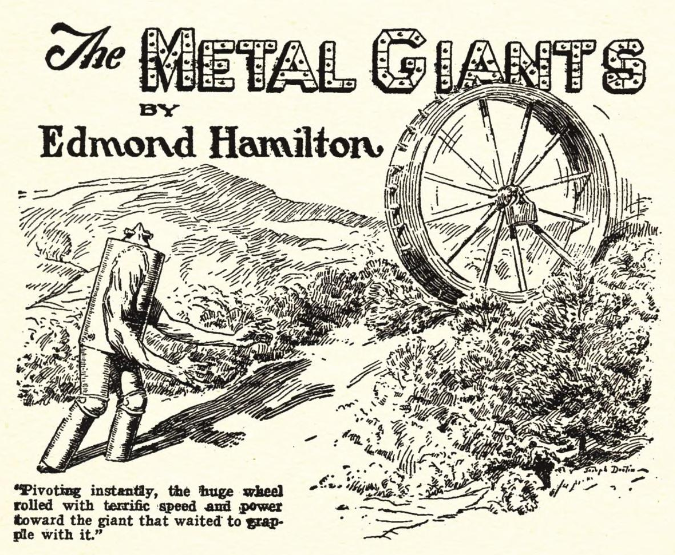
However, before all that got locked in, Weird Tales was actually trying to make an argument that “pseudo-scientific stories” belonged in *their* pages, and so we do occasionally run across an automaton tale in the magazine. One of these that I think is worth mentioning is Edmond Hamilton’s “The Metal Giants” from the December 1926 issue of Weird Tales.

Hamilton is an interesting character, one of the most prolific writers in Weird Tales who went on to become one of the early masters of big, bombastic space opera style sci-fi. He was popular with readers, though his style is often a bit affected for our modern tastes. But his origins in the pages of the Unique Magazine were something he never forgot – in even his most nuts-and-bolts sci fi stories there’s often a hint of cosmicism and weirdness in there somewhere.

And in “The Metal Giants” Hamilton really lands on something strange and interesting, I think. While the story is about giant robots, the real weird science aspect of the story is in the creation of the thing’s BRAIN. The inventor, some schmuck named Detmold, creates a totally artificial brain, and it’s here that Hamilton really lands on a fun bit of alien-ness. The brain, while obviously vastly intelligent, is totally inhuman and cannot truly communicate with us. The incommensurability of our evolved (and, Hamilton states, ensouled) brains with a machine, no matter how complex, is a really interesting idea, and not really one you see much of in sci-fi. Super potent A.I.s in sci-fi are often archly supercilious and capable of ridiculously powerful feats of intellect, sure, but they’re almost always portrayed as human-like, at least superficially. We can communicate with them, at least; not so here, where Detmold’s artificial brain is truly, awfully alien. It of course goes rogue and there’s lots of gee-whiz action, but the core of Hamilton’s story, about a machine brain being something fundamentally inhuman, is a really fun, interesting idea.

We’ve been explicitly talking about mechanical robots here, but in the realm of weird fiction there’s another class of artificial beings that are worth mentioning: the non-mechanical. There’s Frankenstein’s monster, a hugely influential figure in the literature, but there’s also Karel Capek’s R.U.R. to contend with; Capek invents the word “robot” in its modern usage, but his robots are biological, artificial beings built via the industrialized production of synthetic body parts. Perhaps most important, though, is the theme of revolt of the enslaved, artificial underclass, in the course of which the slave masters are actually rendered extinct by those they had brutally created for lives of drudgery and oppression. That sounds familiar, eh? Ever hear tell of a shoggoth?

I’m not sure Lovecraft read Capek, though it is possible he was at least familiar with the play – it was pretty famous, and by 1923 it had had a pretty successful and well-publicized run in translation in North America. But there is ANOTHER automaton that we KNOW Lovecraft appreciated…Gustav Meyrink’s THE GOLEM! Now, Lovecraft hadn’t read it by the time he wrote “At the Mountains of Madness,” but he HAD seen the movie in 1921 or so. What’s interesting is that the movie “Golem” is pretty different from Meyrink’s novel (which Lovecraft LOVED when he got to read it in ’35); the movie is much more of a monster flick, with a literal artificially created thing at the center of the story that, ultimately, revolts and causes all kinds of havoc in the Prague ghetto.

Of course, labor actions and violent revolt were pretty major stories of Lovecraft’s day – he looked with horror on the Bolshevik revolution in Russia, and was famously deeply offended by the social upheaval and implied violent unrest brought around by foreign workers moving into New England’s industrial towns, so his shoggoths and their eventual revolt are undoubtably sourced from lots of things. But it is interesting to note that they are, basically, automata – as presented, they’re biological robots, and one of their core functions is explicitly imitative (as wonderfully expressed by their piping “tekeli-li” sounds). Lovecraft even approaches some of the same questions that the previously mentioned automata do; it’s implied that all native life on earth came about as a result of these shoggoths, forcing us to confront questions of authenticity and “realness” as a species. In that, shoggoths are fulfilling the same rhetorical function as Hoffman’s Olimpia, Bierce’s Chess-Playing Robot, or Vaucanson’s shitting duck.

Conclusion

Well, this has gone on for a while, hasn’t it? That’s the danger (and pleasure) of free writing, I suppose. But I think automata are a topic worthy of even long-winded, meandering discussion. When I wrote Vaucanson’s Canard (what’s that? why yes, it IS available for preorder from Paradise Editions!) I was scratchin’ an itch I’d had for a while about ol’ Jacques and his weird duck machine, but the more I thought and read about it, the more I realized that there’s a lot to unpack about these mechanisms. Their place in the history of science and technology (and medicine) is a fascinating one, but they also represent important symbols of industrial automation and the role of people in both labor AND creation. There’re questions of agency and aesthetics and economics and, honestly, even metaphysics wrapped up in their clockwork bodies, and they’re worthy of serious study and contemplation.

In terms of the history of weird fiction, I think they’re as important a figure as the Vampire, for instance – Hoffmann’s automata mark a change in the world of the weird, and are as good a place as any to pin the invention of the unsettled, uncanny, uncertain type of horror that typifies one flavor of the modern genre. And, of course, their influence on science fiction goes without saying – the uses that writers like Dick or Asimov put their automata redefined the genre and changed forever the way speculative fiction approached questions of life and materiality and creation.

Finally, in these dark days of A.I. slop, there’s a lot to be learned from automatons both literary and literal. In a lot of ways, there’s something reflective of our own times in contemplating a mechanical duck presented as a wonder of the age that would revolutionize our world…but that is really just shitting out some secretly pre-loaded crap.

The Pulp of Yondo #43: “The Abominations of Yondo” by Clark Ashton Smith (Overland Monthly, v. 84, n. 4, April 1926)

A very merry Solstice to you and yours! On this, the darkest day of the year, let us enjoy some deep, indulgent fiction, the work of an author who was an important antecedent to Sword-and-Sorcery, the rich and evocative Clark Ashton Smith! Today’s story is maybe my favorite thing he ever wrote: The Abominations of Yondo, originally published in the April 1926 issue of the Overland Monthly!

For some reason or another, this S&Smas I’ve been focusing on the genre after Howard’s death; this has included a story by the great Fritz Leiber and the not-so-great but still interesting work of Henry Kuttner and Clifford Ball. Important points in the genre’s evolution all, of course, but no genre springs ab nihlio! There’s stuff before it, points of reference or experimentation that are pushing at (or solidifying) boundaries! And while I do think Howard’s work is uniquely important and an epochal invention, he was but part of a milieu that was exploring the newly created genre of Weird Fiction. Clark Ashton Smith was an important figure in that group, helping to define the aesthetic and move the genre in new and interesting directions, an important bridge between pre-genre writers like Dunsany and Howard’s eventual creation of Sword-and-Sorcery.

Which is not to say that this story in particular was a key influence on anything; hell, I’m not even sure that Howard ever read this one. It’s entirely possible he did – he and Smith were correspondents, of course, and there’s a chance he got a copy from him or HPL or something like that, but I don’t have any evidence at hand about that (remember – I’m writing these things off-the-cuff and straight-from-the-hip, with no time for looking things up in the multi-volume letter collections of these people). Like I said up top, this is just one of my favorite of Smith’s, and I’m allowed to indulge myself every now and then! BUT I do think this story is incredibly illustrative of one of the very important parts of both the creation of weird fiction AND the sub-genre that would come to be S&S, which we’ll get to later.

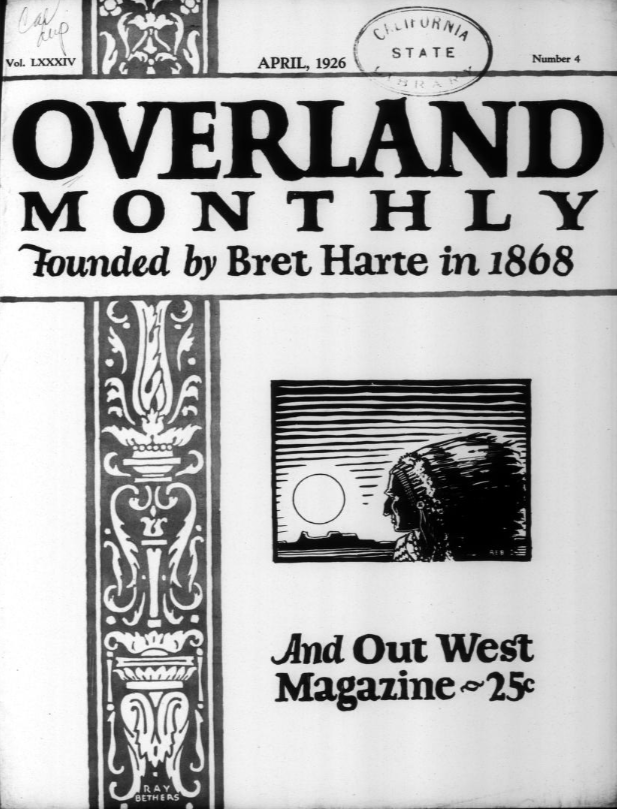
Now, you’ll also note that this story is not, per se, from a pulp…it’s from what was very much a storied literary magazine, The Overland Monthly, a magazine founded in the 1860s to advance the literary culture of the West broadly and California in particular. It included famous writers as Mark Twain, Ambrose Bierce, and Willa Cather, and ALSO published work by early nature writing by people like Muir and the famous geologist Clarence King, which makes Smith’s bonkers little story an interesting addition to its body of work. I think there’s plenty of reasons for why it was published here, HOWEVER it is important to note that “The Abominations of Yondo” was originally submitted to Weird Tales, representing as it did Smith’s first foray into weird fic. Farnsworth Wright rejected it, doubtless because it’s not really a “story” as such. Which is fair! This is, as I hope you’ll see when you read it (it’s quite short!) very much more of a vignette, moody and evocative (and trippy) but without much of a plot or character. Doesn’t mean it’s not rad as hell, of course, and I’m sure Wright liked it – it just wasn’t a comfortable fit as a story. So, while “The Abominations of Yondo” ended up in a high-falutin’ hoity-toity literature mag, it was absolutely and unequivocally written within the tradition of the weird tale as created in the magazine, Weird Tales. Also, it’s Clark Ashton Smith, gimme a break! He’s one of the Big Three! It counts!

Anyway, let’s dive in:

Much like Weird Tales, you can see that this magazine was not cheap! Twenty-five cents in 1926 was no joke – that’s like $5 now, a decently priced bit o’ culture! It’s also very clearly positioning itself as a Western magazine of culture and literature too, isn’t it, a very solemn bit of romantic appropriation on its cover and all. As for the ToC:

You can see George Sterling, CAS’s mentor and friend, is on here too, both as a contributor AND as an editor (explaining how “Yondo” endued up here, in part). But the best part, in my opinion, is the brief little author’s bios on the side. Take a closer at Smith’s:

I mean, that’s pretty funny, isn’t it? Smith is absolutely a California Poet, of course; this story today is only his third piece of prose ever published, and his first bit of outré fiction too. Prior to that he’d had several collections of his poetry collected, so this IS the beginning of a new phase for him, artistically (and economically – he took to weird fic largely as a way to make money). But it’s also a fun, oblique way to acknowledge that this is a bit of a departure content-wise for ol’ Overland Monthly.

You can tell this is a Serious Magazine because there’s no art. No buxom ladies being menaced here, no sirree, just cold hard text!

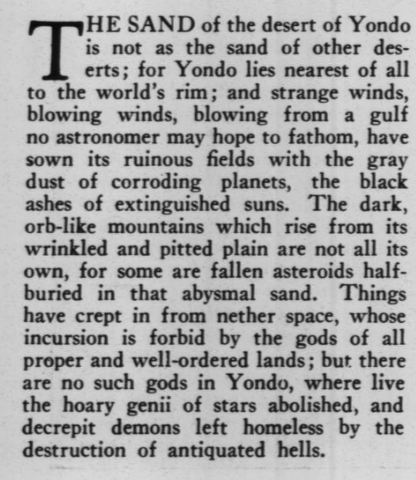
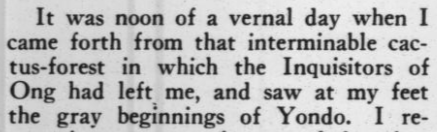
Smith is even more purple and rich than Lovecraft, but I’ll be goddamned if it doesn’t work! His background as a romantic poet, and particularly someone interested in the decadents, really shows through in his over-the-top, hyperbolic language, but (like Lovecraft) he comes by it honestly – there’s no affectation here, it’s all a deeply considered and hard-wrung aesthetic that he’s employing, one which is sumptuous and suggestive and decadent, and it works! Come on! Yondo (which we learn immediately is a place, which means that the title is about Abominations in Yondo, or perhaps from there) is a desert on the edge of reality, covered in the dust and ash of dead planets and rotting suns. I love the orb-like mountains, which Smith tells us are asteroids plunked down in the sands, a wonderfully outre image. Also wonderful is the menace and terror of the fact that this borderland on the edge of the world is open to incursions from all sorts of things from Outside, a wonderful bit of Lovecraftian horror derived from discussions and readings of HPLs work with the Old Gent himself.

Great, smoothly efficient introduction of both the narrator and the world we’re reading about. Our nameless dude, a heretic, has been tortured by the Inquisitors of the Lion-Headed Ong and, his punishment done, he’s been “freed” on the edge of the vast, hellish wilderness of Yondo. There’s great descriptions of both cacti- and fungi-forests (suggesting a very strange hydrologic regime at work here), and wonderful landscape writing too, lichen-mottled soils and grimy tarns, all evocative of real, hostile, untouched wilderness.

We get very sparse background on our heretic – he pissed off the Priests and Magicians of Ong, and as punishment he faced tortures both physical (stretched on adamant-dusted dragon-gut racks) and psychological (oublietted in a dark hole with huge fat corpse worms dropping in on him). But, eventually, they finish with him:

Now, we’re told that Yondo is a terrifying, mysterious, and all together evil place – very few people have gone there, and even fewer have returned. Those who have? Driven mad of course, palsied with the horrors they encountered there! Fantastic stuff! And our guy is a little trepidatious about entering Yondo…but what else can he do? So, ignoring the horrible insects that seem to be following him, he marches into the Wastes of Yondo, hoping to get through it and fall in with some nomads who live on its northern borders.

Again, wonderful weird landscape writing here. Smith is highlighting the sheer alienness of this landscape, and also wants us to think about its vast, incomprehensible age, and the way time has ground down whole civilizations:

The “fat chameleons” creeping with “royal pearls” in there mouths are nice inversions of the “dragons with pearls” motifs of a Chinese imperial art, and the endless ruins given over to hyenas and snakes makes for a wonderfully rich sense of decay and collapse. Also, great geology terms, even if they are extremely archaic – no one has used psammite for sandstone (or, possibly, metamorphic rock with a sand rich protolith) since the 1850s, man! Porphyry is also a rock name freighted with meaning – “imperial porphyry” was the term for the rock used in a lot of Pharaonic monuments.

Our heretic spots a bitter lake fringed with salt bars below him, and hustles down for a refreshing dip…unfortunately the water stings his hand, and he realizes this puddle is the last remnants of a sea! And ideal picnic spot! He sits down and rests, eating some bread and sipping some water, gathering his strength.

Man, c’mon…the MINUTE you start thinking like that, you KNOW some shit is going to go down!

Told ya, dummy!

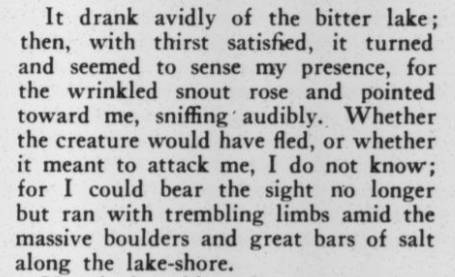
The unearthly chuckling (like the “mirth of an idiotic demon”) goes on and on, and out heretic realizes its coming from the speleothem-fanged mouth of a cave he hadn’t noticed before.

I mean THAT’S a damn monster, isn’t it? Pale, hairless, egg-shaped body, NINE goddamn legs, but fer my money the weirdest thing is the things Bat-ness, a hint of Smith’s horrible elder god Tsathoggua, maybe? Like both HPL (sea-life/fungi) and REH (reptiles but especially snakes), CAS often uses bats (or a furry bat-ishness) as a kind of signifier of deep, outer evil. I love the thing’s blindness, and the suggestion that the thing’s “eternal chuckle” might be some kind of echolocation. But the Big Fella is just thirsty!

He runs as far and as long as he can until, exhausted, he reaches a boulder field in a vast sandy sea. But he doesn’t get much of a chance to rest:

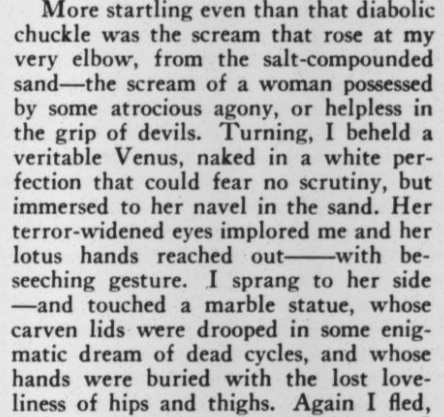
The fuck is going on here!? Some kind of figure screaming in horror, but when he approaches it, it becomes a statue, the terror-widened eyes now closed, the outstretched plaintive hands now hidden in the sand…extremely, beautifully weird stuff! Of course he runs, and takes particular care NOT to look back behind him when he hears the terror-filled shriek again.

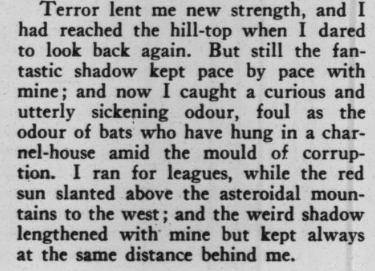
He runs deeper into Yondo, but eventually notices that he’s picked up a strange shadow that is keeping pace with his own! It’s an odd, inhuman shape, this second shadow, with an elongated head and maybe five limbs, but it is also relentless, neither gaining nor losing ground, but always following him as he runs into the wastes.

I love it! The smell building around him as the pursuit continues, the fact that he (and we) have no idea what this thing is – is it a monster invisible save for its shadow, or is it some of shadow monster? Is the threat physical or spiritual? What will happen if the shadow CATCHES his shadow? It’s great, scary stuff never answered, and even its eventual departure is menacing and weird:

He waits in the weird circle, exhausted and terrified, but eventually he rises. Night is threatening, but he has to go on – his only hope is to push on northward. If he can get to the border country he can leave this unearthly place behind him…but that’s a helluva “if!” He gets up and heads out! The powdered dust of millennia-dead civilizations makes for pretty sunsets, apparently: the horizon is ablaze with miasmal scarlet, lending the already bizarre landscape of Yondo a particularly phantasmagoric cast. And then:

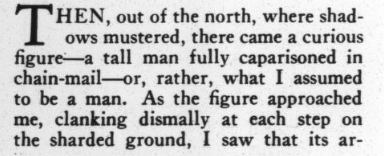
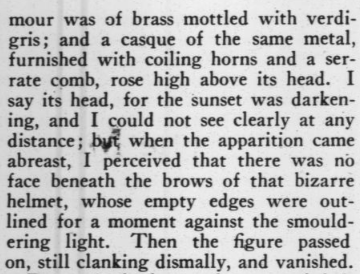
Very Nazgûl-ly, huh? Faceless, with an empty helmet and ancient rotting armor, apparently just going out for a walk. I love the way it clanks “dismally” as it goes, too, a wonderful bit of description. But our heretic can’t spend much time considering this Witch King of Angmar lookin’ motherfucker, because there’s a second, even more horrible apparition!

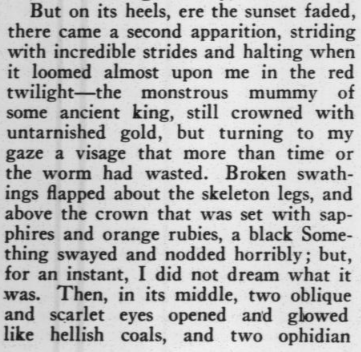
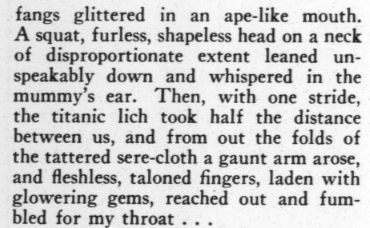
A perfect monster, in my opinion – a huge figure, the monstrous mummy of some ancient king, and the way he describes its face as being ruined by MORE than time or the worm is wonderful. What the fuck is this thing! And then it’s got another little monster in its crown! The way the ape-headed serpent thing is introduced as first a shape, only for its eyes to open and reveal it as another being, is perfectly done, a flawless bit of weird writing. And then it whispers in the giant lich’s ear! It’s so horrible! And then, like in a nightmare, the huge mummy closes the distance between them SUDDENLY, reaching out for the heretic’s throat!

And that’s the end of “The Abominations of Yondo!”

The Inquisitors waiting for him, knowing that he’ll be back, is great; this whole ridiculous thing has been another bit of psychological torture, something straight from Orwell’s Room 101. Smith’s stories often have a sadistic streak to them, sometimes too much so, but here it’s the perfect capper to this little fable, a real nice bit o’ meanness on top of the weird monsters and landscape of Yondo.

In addition to this being full of great monsters, it’s also an important bit of fantasy-flavored weird fiction, very much part and parcel with Lovecraft’s Sarnath or the Cats of Ulthar; while Lovecraft would leave that sort of writing behind him in a year or two, Smith would keep it alive, pushing the boundaries of weird fantasy with his Hyperborean stories or his Zothique tales. I also think this is a fun one because it’s got some fun hints of things to come – the bat monster, the second shadow, the horrible liches. There’re some fun “first draft” kinds of things in here, Smith finding ideas that he would polish and refine over time in its writing.

Maybe more importantly, though, and the real valuable thing in this story, is what it illustrates about one (of the many) underappreciated parts of Sword & Sorcery – namely, S&S as a literature of landscape and environment!

Smith was a Californian through and through, in the same way HPL was a New Englander and REH was a Texan – regional writers whose backgrounds and environments shaped them fundamentally! And Smith lived in a particularly striking landscape, surrounded by the Sierra Mountains and, in particular, the spectacular scenery (and geology) of the Long Valley caldera!

From Bailey 1989, Geologic Map of Long Valley Caldera

I told you I was going to be indulgent! Now, if you’re not familiar with geologic maps, no worries – what you’re seeing here is the underlying geology of CAS’s ol’ stomping grounds, a vast and complex terrain of extensive volcanics squished up and extruded out onto a region of heavily extended Basin-and-Range mountains. It’s chock full of huge craters, thick ash tuffs, and weird hydrothermal systems, mountainous and broken and wild! Here’s a simplified map:

Craters, lava flows, ashfall tuff, faults…it’s a busy landscape! In fact, here’s what it LOOKS like on the ground (all these pics were grabbed from the USGS’s Long Valley Caldera Field Guide):

That’s a hydrothermally fed creek, full of weird plants, strange precipitated minerals, and weird geochemistry…you can just imagine a strange bat-headed nine-legged hellbeast creeping down for a sip on the banks there, can’t you?

Above is a pic of the famous “Devil’s Postpile,” a basaltic lava flow that fractured into the columnar patterns you see while cooling. Real “ancient ruins of a lost civilization” vibe too, dontcha think?

The whole area is volcanically active and pocked with weird craters. These are explosions from within the earth, but you can imaginatively reinterpret them as asteroid craters, if you were a weird fiction writer!

The volcanism is expressed on the surface by a lot of raw, fresh looking rock, the product of active eruptions, that often contrast markedly with the surrounding landscape. Remember the weird monster-backed mountains from the story? Well, I mean, these are them:

There’s even a deadly aspect to this landscape – the active volcanism means there’s a lot of volcanic gases leaking out here and there, with CO2 plumes killing plants and people over the years. It’s a wild, woolly landscape, visually and psychically striking, a clear influence on both this story and the way Smith approaches his weird fiction. Whereas HPL was often focused on decay and decadence in the landscape, the environment reflecting rottenness and perversion, I think Smith’s use of the environment highlights its alienness and inhumanity. There’s surely ancient decay in Yondo, but it’s sort of ancillary, the product of humans trying to live in this place at one time, a place fundamentally and existentially antagonistic to the vanities and illusions of mayfly-like people and their temporary civilizations. For Smith Nature is both Red in Tooth and Claw, but it’s also Purply and Green and Ultraviolet in Tentacles and Too-Many-Jointed Legs and Weird Minerals.

What I think is important about this story is that Smith is showing us a key part of weird fiction – twisting and skewing and finding strangeness in the world around us. Interestingly, Smith is always playing with that idea, too, suggesting that perhaps our idea of weirdness is a result of our limited perspective. For weird nine-legged bat monsters, Yondo might be a perfectly nice place to live – it’s just not so for us humans! That glancing contact with outer realms is what makes weird fiction work, and really anchors Smith’s fiction in a very visceral, very strange world.

And importantly, Sword & Sorcery is a sub-genre of WEIRD FICTION! Which is why this Smith-ian approach to landscape, one that Howard would also pursue, is so important – S&S confront its heroes with weirdness, first and foremost, for them to conquer (or at least survive). The immersion of a characters (and readers) in a weird landscape, one where there is alien agency and alien rules, is such an important, fundamental part of the genre, and Smith is a master of it! His poetical aesthetic is important, but so is his having lived in a truly stunning landscape, one dynamic and alive and strangely active beyond anything a human can really grasp. “The Abominations of Yondo” is weird fiction, but the way it centers not the human, but rather the human experience of the unhuman, is a perfect crystallization of both weird fic AND S&S’s power and scope!

PLUS, goddamn but those are some great monsters!!!!

Pulp & Pastiche #42: “The Thief of Forthe” by Clifford Ball, Weird Tales v.30 n.1, July 1937

Since I broke the (cursed Lemurian) seal on it, why not continue to plumb the depths of Swordly & Sorcerous fiction that appeared in Weird Tales in the years immediately following Howard’s death? We talked Kuttner and Elak last time, focusing on the differences in character and approach between ol’ Hank and REH, so this time we’re going to look at an example of Post-Howard S&S that adheres a bit closer to the formula perfected by ol’ Two-Gun Bob. It’s Clifford Ball’s “The Thief of Forthe” from the July 1937 issue of Weird Tales!

Interestingly, Clifford Ball’s first appearance in the magazine wasn’t as a writer, but as a Weird Tales reader mourning the loss of Howard and the stories he’d never write. His letter appeared in “The Eyrie” letter section of the January 1937:

This is only one of many such letters sent in to the Unique Magazine following Howard’s death (as I’m writing this, I think I might devote the next entry here on the blog to those letters, so stay tuned!); what’s interesting about Ball’s is that it really seems like the End of Conan struck him so deeply that he decided to try and Do Something About It – namely, Clifford Ball went and wrote some Sword & Sorcery himself! What’s more (and much like Kuttner), Ball also appreciated that one of the Keys to the success of Howard (and Conan) was the establishment of a fun, living secondary world – for Ball, this is (for lack of a better term) Ygoth, which is either a city or a country (it’s not exactly clear), and which is mentioned in all three of Ball’s S&S stories, tying them all together into a loose, unrestricted canon, much like Howard’s Hyboria.

Ball’s first story, “Duar the Accursed” would appear in the May ’37 issue; it’s an odd little work, very Theosophical honestly, about an amnesiac mightily-thewed barbarian hero who had been a mercenary, become a king, lost his crown, and then become a wanderer. There’s some interesting weirdness in it – in addition to having no memories of his early life, Duar’s accursedness is manifested as terrifying rains of blood and an ominous, unearthly raven that heralded his army. We’re also introduced to a strange, shimmering, extra-dimensional spirit that follows Duar and provides him magical support (whether he wants it or not), and has some kind of relationship with him from the past. There’s suggestions that Duar is himself some sort of Ascended Being trapped in a fleshy prison. It’s all very cosmic and, like I said, Blavatsky-ian; there’s pretty heavy foreshadowing that Duar is a kind of recurring spirit reborn as a hero or champion throughout time. But it’s also very much in keeping with Howard’s idea of the Manly Ideal of a S&S Protagonist – confident, physically powerful, fearless, and not interested in the niceties of civilization. There’s some good Gygaxian D&D flavored stuff in it too – the MacGuffin is a jeweled rose that’s actually a demon, and there’s a weird “Force” at work that drives people to their deaths in the depths of a dungeon. If you’re a completist for this sort of thing, it’s worth a read, but Duar never shows up again.

Ball thankfully (and correctly) drops the hints of “Chosen One” bullshit from his later (and last) two S&S tales, the much better and more fun Rald the Thief stories, the first of which we’ll be looking at today. But you should definitely temper your expectations here – they’re perfectly fine C-level work, I’d say, pastiches of what Ball obviously loved about Howard (and weird adventure writing), the sort of stories you expect from someone early in their writing career and looking for their voice. Unfortunately, Ball never got that chance – he wrote three more stories, though these are more straight weird fic than S&S. The last of these, a werewolf tale, was published in ’41, and then it appears Clifford enlists in the Navy. He ends up dying in, apparently, an accidental drowning in ’47, never having written anything else. It’s sad, especially because I think he had at least a sincere love of S&S, as I think you’ll see in the story today.

So let’s get to it already, sheesh:

That’s right, Rald the Thief gets the Finlay cover treatment, quite remarkable and, much like the Elak covers, it speaks to the deep love that the new and as-yet-unnamed genre of Howardian-historico-fantastique-adventure tales had garnered. The iconography is interesting here, and gets to the heart of the appeal of these stories – a sword, a Man of Action, a damsel, and a mysterious threat. There’s not even a real background – the whole scene takes place in an indistinct void, really highlighting that the whole thing is a very literal psychodrama. Simple, but effective!

A good ToC, including a reprint of what’s probably Long’s most famous story, “The Hounds of Tindalos.” Also worth noting is CAS’s memorial poem to HPL, who had died in March of the year. It’s been a rough few years for Weird Tales fans, who’ve lost some giants in quick succession! Anyway, on to today’s tale!

A pretty straightforward summary here, and truthful too – this is a brisk tale indeed, rolling along at a decent clip with very little downtime. Case in point, our story opens in medias res, with a business meeting happening in a dank, drippy, disused dungeon. Two figures are conversing:

We’re introduced to a wizard with an apparently top-notch moisturization regime – their slender womanish hands a sure sign of sorcerous puissance and subtlety. This is in contrast to the other as-yet unnamed figure, who is immediately portrayed as a forceful, man’s-man kind of dude – he grumbles, he strikes the table with a meaty fist, and he’s suspicious of all this wizardly bandying of words about the King, named (oddly) Thrall. Yes, these two are surely quite different from one another, so much so that we get two more paragraphs describing them. First, our wizard:

Good, strange wizard physiognomy, I think, and the insanely hairy face is fun (and, obvious) foreshadowing of something. The “what’s under those robes!?” is a little thickly ladled on here, but honestly it’s not too bad, and it’s perfectly fine to hammer it home given where the story will end up. “Karlk” is a decent evil sorcerer name too, I think, short and sharp and menacingly strange. All in all, a top-tier evil magician, I think. And what’s the beefy fellow Karlk has been talking to like, you ask? Well:

No mincing words here, this is just Conan. Naked and muscular in a loincloth and sandals, obviously of a kind with the Cimmerian, strong, violent, and cunning (as evidenced by phrenology). What is interesting is that Ball calls out Rald’s scars, which is a detail I don’t think I’ve read about in Howard’s loving descriptions of Conan’s rough-and-rugged body. Ball wants to highlight the history of macho violence embedded in Rald’s body, because this, along with his near-nakedness, muscular bigness, and clean-shaven face, marks him as diametrically opposed to Karlk the Magician.

There’s some fun back-and-forth arguing between Rald and Karlk about King Thrall; Karlk seems to have it in for in him, but Rald points out the King has done alright by Karlk, covering up a mishap when one of Karlk’s “experiments” escaped. All in all, Rald seems disgusted by the wizard and their planned treachery. I’m no business guy, but it really seems like at this stage of the negotiations (along in a dripping dungeon), you’d want to have this kind of stuff ironed out. Karlk seems put out by Rald’s apparent lack-of-fear; he is a weird, menacing wizard, after all, and is used to a modicum of cringing respect. So Karlk decides to show Rald some of his power:

And how does Rald react to Kralk’s laser beam?

I mean, fair enough, right?

Regardless, Rald wants to get down to business…what IS it that Kralk wants to hire him to do, anyway?

Rald’s professional pride is fun, as is his discussion of what the possible targets of his thieving might be. I like the little “No women, mind you!” bit too, it’s all very material and earthy, a lived-in detail that captures Rald pretty well and gives him a bit of depth.

That is solid wizard shit there, you know what I mean? Kralk is steeped in black lore, and has moved beyond mere jewels and such. Kralk wants Rald to steal THE VERY KINGDOM ITSELF!!!! which is so bonkers, I love it. Rald’s reaction is fun too – how can you steal a whole kingdom, particularly one which is, in some way, divinely ordained. King Thrall is the King of Forthe, simple as? How would Kralk take over, even?

Very fun stuff; Rald is thinking about the Realpolitik of Kralk seizing the throne of Forthe, how impossible it would be to hold it given how everyone hates and fears him, but Karlk leapfrogs over that problem by the simple expediency of having RALD be the king, with Karlk a hands-off power behind the throne. Rald’s realization, and the temptation, are handled really well; Ball has constructed a convincing web for his Prince of Thieves to get enmeshed in!

I love the whole “wizard practicing the blackest of sciences” angle to these early S&S stories – it’s something Howard did himself, with a lot of his evil wizards relying on drugs and alchemy and hypnotism more than thunderous bolts of power. Similarly, Kuttner had his weird little wizard Zend behaving more like a scientist, using occult forces and magic-technology to keep Atlantis from sinking, for instance. Karlk’s claim that they are merely a scientist is a lot of fun, and something that I feel like you don’t see as much of in fantasy these days – wizards are a lot more mystical and esoteric, which is a very different characterization from experimental and technical approaches to even blasphemous sorcerous knowledge.

It’s also menacing as hell, isn’t it? We had that little story about the dog-man thing that had to be executed after it escaped, a very strange and unsettling story, and Karlk seems to be mostly interested in being allowed to expand his research program, something that would necessitate a friendly king willing to turn a blind eye to whatever horrors he’s planning. Of course Rald is disgusted…but…

It’s a solid Faustian bargain – Rald puts up a good front, but he’s quickly broken down by Karlk’s tempting him with not merely wealth and power, but immortality as a dynast! It’s fun and unique, making Rald a bit darker and more morally ambivalent (for now, at least) than his literary progenitor Conan. The story is a bit grimmer and grittier too; Conan had lots of adventures motivated purely by greed, but he never stooped so low as to ally himself with an obviously evil wizard! Credit where credit is due, Ball has come up with a fun and novel plot!

The next section opens on Rald beginning his infiltration of the Palace of Thrall. There’s some fun world building in here, among some admittedly clumsy and overwritten sentences. The walls of the palace, both inner and outer, are crumbling and in poor repair, and the patrols of the guards are fairly cursory and easily evaded. Similarly, the jagged bits of metal embedded at the top of the walls are rusty and easily pushed aside. But most importantly:

That’s a nice touch, and conveys a lot about this place and its history. They don’t need to maintain the walls or a tight guard – the sanctity of the palace is exactly that: sacrosanct, the product of cultural and religious scruple that sees the King and his power as a holy, divine thing, which NO ONE in their right mind would ever violate! Luckily, Rald is free of such scruples. This is more than just a nice bit of flavor, too – it will explain what exactly Karlk’s plan is, and how a whole kingdom can be stolen.

There’s a really nice bit of writing around Rald’s skulk through the garden here:

The statue he mistakes for a person, and the annoyance of the wet sandal are great, nice little bits of very realistic detail that lend Rald some interiority as well as highlighting his real physical experiences sneaking through the forbidden grounds. Equally fun is the fact that Rald knows the layout of the castle absolutely, due to the simple fact that everyone does, from servant’s gossip. The way Ball tells us that the simple peasants would be horrified at the use their gossip is being put to is fun writing. There’s a lot of nice details in this story, I think, and Ball is very much taking his time trying to develop the scene and evoke the setting, and it’s (largely) paying off, I think.

Rald makes in into the castle and encounters a drunk guard and, in a room beyond, a sleeping woman whom he takes to be a courtesan of some sort. Finally, he reaches a door that, via the clarity of narrative convenience, Rald realizes must be his goal:

Might be a real “Marge_Potato.jpg” moment here, but look: I just think this is neat. It’s extremely fun that Rald is an atheist in a magical world with gods, and that it’s this atheism that allows him to lift the magically warded lockbar without being struck down by the mighty curse woven into its very matter. That’s good stuff, and it works nicely with the whole thing going on in this story – the decrepit theocracy being vulnerable to One Atheist Thief!

Rald pushes through the door and enters some kind of sacred council chamber where the King and his sister hold court. More importantly, there’s the sacred necklace that is the goal of his quest hanging there!

So potent a symbol is this necklace that merely possessing it makes one, functionally and practically, the ruler of Forte. It might seem like a goofy system of gov’t, but who the hell am I, an Amerikkkan, to judge? More importantly, it’s in keeping with the whole tenor of this country/city-state, right? This religiosity that seems to rule here would absolutely imbue an object, and whoever happened to be holding it, with absolute political power; it makes sense! And it seems to have worked out just like Kralk imagined it would…or has it!? For, while Rald is admiring the sparkle of the diamonds that make up the necklace, he’s interrupted by a voice!

Do I wish Ball had given Rald a better swear than “faith?” Of course I do. Do I love this mysterious person telling Rald to knock it off with all the jumping around like some damn ape? Absolutely. It’s funny! The whole thing is very swashbuckly, and I love it.

The newcomer is the King’s sister, the Lady Thrine (apparently a real, if rare, Danish girl’s name, by the way), and she’s aghast at the temerity of Rald to not only break taboo by touching (and proposing to steal) the Sacred Necklace, but also by DARING to enter her bedchamber and peer at her sleeping. Yes, she was the “courtesan” from earlier, and its the whole shock of the boldness of Rald’s crimes that have lead her here, rather than, say, calling out all the guard. There’s some flirty banter, honestly not badly done, particularly since Ball is working on his own here in a Pre-Mouser world, but it’s cut short by the sudden arrival of Karlk!

Again, it’s a really great part here that Karlk, a magician and therefore intimately familiar with the reality of occultic forces, couldn’t move the magical bar with its potent spell, so he hired an atheist thief to do it. That’s good, a solid interesting premise for a S&S story, and also an interesting “mechanic” (if you’re excuse the vulgarism) for a S&S world, where magical potency is in some way related to belief. It’s fun, and something you don’t see much of these days!

Anyway, Kalrk prepares to zap Thrine, something the besotted Rald CANNOT ALLOW TO HAPPEN…but it’s all put on hold by the arrival of King Thrall, in full battle armor. There’s a funny bit where Rald, again in Mouser fashion, asks exasperatedly “doesn’t anybody SLEEP in this castle?” which is a funny, solid joke for a S&S story. There’s more banter, some guards show up, and the Kralk and Rald are bound up with ropes. They’re left, unguarded, in the council room (with the necklace) while Thrall, having sent his sister back to her room, orders a quick search of the gardens, in case there are more conspirators. Left alone, Rald and Kralk bicker a bit, with Karlk realizing that Rald has scruples he hadn’t imagined.

And then Karlk does something weird:

Khalk unties himself with an extra pair of small, white furred arms that emerge from his robes! I mean, that’s absolutely great! Equally fun in the kind of nonchalance with which Karlk assures Rald that there’s a LOT about him no one knows. It’s a great scene, and very weird.

Also fun is how Karlk, while having to leave Rald behind, still proposes to honor their partnership – he’ll kill the people Rald can’t, and then Rald can become King, with Karlk the power behind the throne. It’s very logical and straightforward and, honestly, makes Karlk out to be even more inhuman and mysterious. Afterall, while he’s disappointed Rald didn’t just kill the Princess, he can still use him. It’s fun, weird, stuff, and honestly between that and the extra arms, Karlk is up there with the evil wizards in S&S lit, in my opinion.

Rald doesn’t waste time, however. After Karlk has left, he painfully hoists himself up, knocks a torch from its sconce, and uses it to free himself. In the corridor he finds a guard, horribly magicked to death by Karlk. Grabbing the dead man’s sword, Rald rushes down the corridor, hearing a woman’s sobbing scream of terror from somewhere ahead. Rald comes upon a deadly, dangerous scene – Karlk, crouched horribly over the bound and terrified figure of Thrine, preparing to blast the unsuspecting King Thrall with evil magic. Rald leaps into action, slicing into the surprised Karlk with his sword:

Thrine tells the king that Rald saved him, indeed saved them all from Karlk’s deadly magic, which the King grants, though of course he DID plan on seizing the throne himself. With a modicum of contrition, Rald foreswears his earlier actions:

Rald agrees that an evil, murderous wizard can never be a man, but hilariously he has misunderstood Thrine. For, in fact…

Karlk was a GIRL all along!!!! The fake beard, the scrupulous flowing robes, all a trick! But that’s not her only secret…

How came she to have royal blood, you might ask, and King Thrall certainly does. Well, it’s a funny story:

Kind of grim, and with an unfortunate amount of “monstrous ape rape” (a surprisingly popular theme in early Weird Fiction). Also, you might not recognize it, but the “white apes of Sorjoon” are basically the multi-armed white apes of Barsoom, from Burrough’s John Carter of Mars stories; in the earlier Duar the Accursed story, Ball refers to them as the white apes of the “hills of barsoom,” even. Maybe it was an editorial decision to change them, or perhaps he thought in hindsight that that was a little too on the nose. Still, everybody reading Weird Tales would’ve immediately recognized the Great White Apes for what the were, horrific multi-armed ape monsters from a classic swashbuckling sword-and-planet tale. It’s interesting that Ball uses them here; speaks to the importance of Burroughs for the readers of these more action-oriented, thrilling adventure weird tales, I think, and is in keeping with Ball’s letter eulogizing Howard too; he mentions “a thousand international Tarzans” as being unable to make up for the thrill and power of Conan, suggesting the lens through which he was being read, by some at least.

Anyway! Karlk’s extra arms come from her White Ape parentage. There’s a bit of Howard’s Atla in Karlk here too, from “Worms of the Earth.” Both of them are outsiders, cursed by their lineages to belong to neither of their parents’ worlds. Cursing all of mankind, Karlk devoted herself to evil and the eventual overthrow of Forte. There’s some great, creepy writing as Karlk’s laments her poor experiment back in her hut, and then she dies.

The story wraps up with a nice little bow – the King roars that, for his great deeds this night, he’ll make Rald a baron, but the thief is gone. But don’t worry, says Thrine, he’ll be back…for her!

And that’s the end of “The Thief of Forte!”

From a Sword & Sorcery perspective, I think this story is pretty decent. There’s good world building, and Karlk is a fun and interesting character that, honestly, I would’ve liked to spend more time with. Rald is basically and blandly a species of Conan, though maybe just that much more avaricious than the original – like I said, working with an obviously evil wizard seems a bit too much for ol’ Conan, though Rald readily agrees (even if he does have second thoughts later).

It’s not some lost masterpiece of the genre by any stretch, but it’s at least as good as Kuttner’s Elak stories, I’d say. What is interesting is that both of them, Ball and Kuttner alike, offer different perspectives of the post-Conan and post-Howard genre. Ball’s is much more straightforwardly a pastiche, I’d say, with Rald simply being Conan, or at least much closer than Kuttner slim and amoral Elak. Ball also seems interested in the women in S&S stories, more so than Kuttner at least; perhaps he’s influenced by Moore’s Jirel stories there, probably the most important non-Conan S&S character to emerge in the 30s. Ball has a bunch of tough amazons in the second Rald story, and there’s a pretty tough queen in the Duar story, though of course all end up conforming to comfortable 30s heteronormative roles by the ends of their respective tales. By far the most interesting character in Ball’s slender oeuvre is Karlk, though, and I think the story is worth reading for them alone!

Maybe more to the point, I think it’s worthwhile to read these attempts at carrying the torch forward in the post-Howard days of Weird Tales, particularly because they’re wrestling with something that would dog the genre well into today, namely: where do homage, tradition, pastiche, and out-and-out cribbing fit in the genre, and how do we push at the boundaries and make something new? Obviously there’s a deep love of Howard and his work here, but how do you build on it without simply (and more weakly) recapitulating the same tired old themes and plots and characters. I don’t think there’re answers in these stories, but I do think it’s fruitful to read them and think about these questions!

Spawn of Pulp #41: “Spawn of Dagon” by Henry Kuttner, Weird Tales v.32 n.1, July 1938!

Sword & Sorcery is a wonderful genre, inventive and vital, and the way it’s grounded intimately within the materiality of its world and characters lets you investigate issues of the body, of the environment, of class and wealth and oppression and violence, in surprising and often insightful ways. That being said…there are, like all genres, some, ah, lesser works, where the promise of the form is not entirely fulfilled. C’est la littérature! And that’s what we’re going to be looking at today, a very middling story that, none-the-less, helps illustrate some important things about the genre. And what story is that, you ask? It’s Henry Kuttner’s “Spawn of Dagon” from the July 1938 issue of Weird Tales!

Now, I don’t wanna be too rough on ol’ Hank here – Kuttner is a hugely important figure in the history of speculative fiction, much more so than may be immediately evident, given both his untimely death at age 42 (in ’58, juuuuust on the cusp of a big explosion in science fiction that he would’ve been a huge part of) AND the fact that he wrote under so many goddamn pseudonyms. He was a good writer, with an interesting perspective on complex, psychological science fiction in particular, laying the foundation for what would eventually become the New Wave much later. And when he was working with his wife, C.L. Moore, on one of their collaborations? Well, there are some exceptional bits of work there, sharp and thoughtful, some of the best stories from the time (we’ve talked about a few of ’em on this here blog, even – check ’em out here, here, and here!)

Similarly, Kuttner has the distinction of being a part of the Lovecraft Circle, writing some good Lovecraftian fiction (“The Invaders” is a fun and weird one) as well as his own distinct weird horror too (“The Shadow on the Screen” and “The Graveyard Rats” in particular are worth checking out). He’s a good, fun writer, and he likes a weird monster and a horrible scenario as much as the next guy, so don’t let my forthcoming criticisms of his S&S scare you off of him, okay? Because I think there’s some important context here for Kuttner’s approach to these types of stories.

For one thing, the genre that we call “Sword & Sorcery” didn’t exist yet, not really – there wasn’t a corpus to point to, for instance, though it was in the process of gelling. Robert E. Howard, who died in ’36, left a body of work in Weird Tales that was, in some inchoate way, obviously it’s own thing; two-fisted adventures full of monsters, magic, and peril, centered around recurring, rough-and-ready characters and told in blood-and-thunder prose. They were popular stories, the Conan tales in particular, and the combination of lost prehistories, exotic locales, and grim violence was something new and exciting and vibrant, so it makes sense that Kuttner would chase after ’em; he was a working writer, after all, perfectly happy to go after a market if it meant a check. Also, like Howard, Kuttner was an inveterate Lovecraftian Circler, sharing with REH the same general interests with regards to alien gods and mind-shattering horror, so he’s got a toe in the Howardian door already. But, given that it’s only a couple of years Post-Howard, you can forgive Kuttner for his somewhat clumsy attempts here, I think.

Similarly, something I think you’ll see in today’s story, is that Kuttner is actually in some ways writing against Howard’s work. Kuttner was good friends (and sometimes collaborator) with another Lovecraft Circle writer, Robert Bloch who, somewhat famously, absolutely positively with deep fiery conviction 100% HATED Conan. Hated the character, hated the stories, hated everything about them, thought Howard was wasting his time and ink writing ’em. It was a minority opinion in the magazine, but it was there! Now, I don’t think Kuttner had a similar animus towards the nascent genre as Bloch did – he wouldn’t have written the stories if he had – but I do think he very consciously wrote his Elak stories as a slightly skewed reaction to Conan. That alone makes them interesting, examples of people doing the boundary definition work necessary to creating a genre.

But, we’ll talk about all that when we get there! First – the Cover!

Yes indeed, lookit that, ol’ Hank got himself a cover, and one by the Master Finlay too! Perfectly serviceable cover, Tor Johnson-lookin’ goon luggin a scantily clad unconscious lady, weird little freak at the front, Errol Flynn watchin’ em there. Kind of a shame, though, that Finlay didn’t get a chance to do the monsters in this story – they’re very much in his wheelhouse, and would’ve been neat to see in his inimitable style. Kind of feels like this cover speaks to the popularity of the late Howard’s Conan tales, though; real hunger for anything even approaching The Master’s Work, so Wright et al. would’ve definitely jumped at the chance to highlight a weird fantasy tale. Not the last time Kuttner’s Elak would appear on the cover of WT either – in fact, only the first Elak story failed to get a cover! Crazy!

Solid ToC this time – the real highlight is the Smith story, “Mother of Toads,” which is a classic. But there’s Bloch on here, Gans Field (aka Manly Wade Wellman), a Price reprint, posthumous verse from Lovecraft and Howard… even the Quinn here is better than his usual stuff (i.e., it’s not a Jules de Grandin story). All in all a solid late Wright issue, I’d say!

So this is the second Elak story the readers of Weird Tales would’ve come across; the first was a two-parter, “Thunder in the Dawn,” and had appeared in the May and June issues of the same year. Unlike Howard’s introduction of Conan, Kuttner had provided a clear and fairly well defined biography of our pal Elak of Atlantis in his first outing. To orient us all: In a time undreamt of (etc etc), the continent of Atlantis, with many cities and many kings, is out there, being all fantastical and suchlike. One of the many city-states on the continent is Cyrena, the northernmost kingdom that was, once, ruled by some guy named Norian. This king, Norian, had two stepsons, Orander and Zeulas. Zeulas ends up killing his stepfather Norian in an apparently aboveboard duel for which both sides had good cause (we’re told this by a druid, so you know it’s solid info) BUT, as a result of this patricide, Zeulas refuses the crown that is his by birthright and leaves the city in (voluntary, it seems) exile, with his younger brother Orander assuming the crown. Zeulas takes the name Elak and becomes a stateless, homeless adventurer. In the first story, Elak and his drunken thief buddy Lycon are summoned back to save Cyrena from an evil wizard, restore Elak/Zeulas’s brother to the throne, and then voluntarily resume the life of a wandering adventurer. Just stick a pin in that “rightful king in voluntary exile with a complex relationship to his family” stuff for now, because I’ll be mentioning it later.

Anyway, that’s basically the gist of Elak’s life before now; it’s not really relevant to today’s story, but I *do* think it’s probably important to the point I’ll be making at the end (and I also doubt if I’ll ever talk about another Elak story again on here), so just keep it in mind for later. Regardless, now we can get into today’s story “Spawn of Dagon!”

And how does Hank open his tale? Why, with an epigraph from G.K. Chesterton, of course!

An interesting quote for a couple of reasons; first, it’s from Chesterton’s “Ballad of the White Horse” which was one of REH’s favorite poems, and it’s easy to see why – it’s a super heroic epic about Alfred the Great fighting the Danes in England, full of wild roaring poetry, the force of destiny, civilizational clashes, magic weapons, very much in the mode of what would become sword and sorcery (even if it is super Christian). In fact, REH liked it so much that he used excerpts from it as epigraphs in some of HIS stories too (off the top of my head I *think* it was in the Solomon Kane story “The Moon of Skulls” but I might be wrong). So it’s notable that Kuttner chooses to include a passage from the same work in his story here. He ends up using a lot of Chesterton, all from the same poem, in subsequent Elak tales too. It’s a little funny, of course; after all, this is a tale of Lost Atlantis, from the misty prehistory of the world…so it’s a bit jarring to see it opening up with a poem from Chesterton, very much a contemporary writer.

It’s also interesting because it underlines that Chesterton is in the lineage leading up to modern fantasy literature, something people sometimes forget. There’s his famous essay “Ethics in Elfland” (which *is* great honestly; it’s so frustrating that it came from the pen of a reactionary and sympathetic-to-fascism asshole like Chesterton) of course, but his “Ballad of the White Horse” is a huge and influential part of the genre’s story too – I’ve even read that Tolkien had, at least, a few positive things to say about it.

Anyway, with Chesterton out of the way, we can finally get into the story proper:

There’s a LOT to unpack here, right off the bat. First – our “hero” Elak is squatting over a corpse with his buddy Lycon, watching two streams of blood oozing from its wounds winding across the floor towards an arbitrary objective…that’s right, they’re gambling over which blood stream reaches a crack in the floor first. I mean, that’s wild, callous shit, truly outrageous! Even crazier, the prize they’re gambling for is the right to loot the body! AND it seems like they killed this guy specifically to rob him – Elak castigates Lycon for picking a fight with a pauper when he doesn’t find any money on him. That’s some grim stuff!

You sometimes see knuckleheads describe Conan as an “anti-hero” which, of course, is nonsense; Conan is 100% a barbarian HERO, rough and uncivilized, but ruled by a strict code of honor and with a clear moral framework. And while it’s true that Conan was a pirate and reaver professionally and therefore certainly must’ve been killing (or at least threatening to kill) folks for their money, he at least had the narrative decency to do it all off camera. Not so with Elak! Here we are, in some Atlantean pub, and right off the bat he’s watching a guy they butchered bleed out, for kicks!

The other interesting thing here is Kuttner’s description of Elak. He’s tall and “extremely slender” with an almost boneless suppleness, a far cry from the mightily-thewed and hairy-chested Conan. To be sure, Elak is strong; we’ll have scenes later in the story demonstrating his superlative physicality (one of the core attributes of S&S character), but it’s of a different sort than the tigerish, muscular dominance of Conan.

Not to harp on it, but I do think that, since Kuttner is writing in the shadow of Howard, it’s worthwhile to see how different he’s making his sword & sorcery hero from the epochal example of the Cimmerian. It’s relevant also because, in terms of plot, Kuttner is clearly cribbing from Howard – there’s a bit of “Tower of the Elephant” in this one, and there’s a later story that is a pretty blatant riff on Howard’s “The Phoenix on the Sword” story. So, in differentiating his stuff from REH, Kuttner has chosen to have a VERY different hero – a willowy, amoral ex-prince…

Hm, who does that sound like?

Honestly, if he had albinism (and an evil sword), he’d *be* Elric; even the names are suspiciously similar, aren’t they? I’ve never encountered Moorcock talking about Kuttner or Elak of Atlantis, but it’s a fair bet that he’s read ’em before, of course, given his deep presence in the genre. And, to be clear, I’m not saying he grabbed Elak or anything; in fact, it’s entirely likely that he independently came up with an anti-Conan the same way Kuttner did, as a direct response to REH’s own work. After all, Howard’s S&S is steeped in his particular interests – clean-bodied and noble barbarism against decadent and effete civilization, rugged frontier individualism, the power of the body to impose one’s will over an unruly world. If you’re taking part in that conversation, there’s a natural counterpoint in a character like Elak (or Elric).

Back to the story: it turns out that Lycon has already pilfered the dead man’s purse, making the blood race game meaningless…but because he’s drunk, he passes out, and Elak is forced to lug his blacked-out buddy out of the tavern and into the night, since the innkeeper has returned with guards who, for some reason, frown on wanton murder. Fleeing through the dark streets, they’re suddenly attacked by a guard!

(Brief aside for weapon talk – our boy Elak is armed with a rapier, as befits a slender, supple warrior, emphasizing speed and precision and skill over the brute butchery of a barbarian’s broadsword. It’s an interesting development!)

So, what was it that spooked that guard?

Well, there you go, everything seems to be perfectly in order and extremely normal: the guard was, of course, scared by the sudden appearance of Some Guy. This strangely blank-faced, robed fellow offers help, and Elak is forced to accept it unhesitatingly, since more guards are thundering down the road. A secret passage in the wall yawns wide, and Elak, bearing his drunken pal Lycon, follows the mysterious stranger in.

Again, perfectly normal – some people, even robed people with strange, unmoving faces, just have cold, clammy hands! Nothing untoward at all!

Elak follows his new (and normal) friend through a dark tunnel – there’s strange, unnatural sounds in the dark around them, but when they reach a hollow in the earth, there’s light:

The line “amid chuckles of goblin laughter” is fun, isn’t it? There’s some good flourishes in here, and Kuttner has certainly got a flair for atmosphere. I love a nitred chamber deep in the earth, myself, particularly if there’re mysterious impossible sounds of the sea about.

Anyway, Elak’s mysterious benefactor introduces themselves: they’re Gesti, and please pay no attention to their chalk white complexion or their curiously glazed eyes. In fact, the only thing that does matter is that Gesti would like to hire Elak for a little job:

I do kind of like Lycon’s glibly cornball vaudeville schtick, though I also 100% accept that some might find it a bit grating – it is basically his entire character, other than drinking, so it can be a little repetitive. Elak asks for some more details about the job:

It turns out Gesti and his vaguely defined band have tunneled a secret passage up through the VERY LIVING ROCK OF ATLANTIS and into one of Zend’s basements in his Mighty Tower of Sorcery. All they need is a brave and violent assassin to use their passage, kill the wizard, and smash a red ball up there. Easy peasy, 1000 gold coins. Plus there’s a pile of loot in the tower too, and Elak can have all that too. Seems suspicious, but like we saw earlier: Elak is an amoral and extremely greedy guy. Plus he’s probably still drunk. Gesti offers to babysit Lycon while he sleeps it off, and that’s pretty much it. Elak, our hero, agrees to murder Zend for money! They give him a weird tube-like weapon which will play no part whatsoever in the story, and then they part ways, Gesti unable to advance farther; as he goes, he gives Elak a strange farewell:

Eh, it’s probably nothing.

Elak pushes up through the secret door into the tower basement, which is dusty and mouse-riddled, obviously a space rarely used by the mysterious Zend. He sneaks his way through the dim, empty halls, knowing he must make it to the very top minaret to destroy the Red Sphere there (presumably killing Zend on the way). But as he’s sneaking:

Helluva security system! A living (in some fashion) disembodied head sitting on a pedestal! I mean, that’s pretty gruesome, isn’t it, especially the way Elak spears it (through the eye! yuck!) and “kills” it! Reckon it’s some kind of weird undead horror, maybe, a product of Zend’s dark sorcery. Very strange and a great image, which ol’ Virgil Finlay drew up for us:

It’s a fun, weird scene…BUT it’s kind of a shame that it doesn’t really amount to anything. The alarm call of the freaky head doesn’t summon any guards or even seem to reach Zend; nothing happens at all, which is a real shame. Personally, if you’ll indulge me, as a writer of S&S myself I 100% would’ve had the headless body of the thing shamble out and fight Elak, directed BY the head on the pedestal. I mean, SOMETHING should’ve happened, you know what I mean? That kind of missed opportunity, and other events-for-no-reason, is a real problem that dogs all of Kuttner’s S&S, so much so that you might be tempted to think he’s actively subverting the expectations from the leanly efficient structures employed by Howard in his stories…but I honestly kinda believe he’s just a little lazy and writing extremely fast, for cash.

Elak continues down the dark corridor, parting a curtain, only to see a group of grotesqueries coming towards him!

Yes indeed, Kuttner is engaging in the tried-and-true-and-tired convention of having an evil wizard exhibiting some physical deformity, just to really highlight the contrast between them and the clean-limbed and hard-bodied S&S protagonist. It’s unfortunate, but it’s something that goes hand-in-hand with this era of literature, so you have to get use to recognizing it.

Anyway, you might assume that Zend and his Big Guy are coming to get Elak, alerted by the head, but that’s not it at all. They don’t know about Elak, and in fact are out on business of their own, vis-a-vis the unconscious girl being carried by the huge giant. Via some clumsy exposition, we learn that Elak recognizes the giant…he’s a criminal he saw getting beheaded at a public execution, transformed into a monstrous servitor by Zend’s necromantic power! Elak decides that he doesn’t like the thought of fighting a dead man, and reckons he ought to hide, waiting for a chance when Zend is alone to stab him in the back. Unfortunately for him, the best laid plans gang aft agley…for Zend and the Giant turn up the VERY CORRIDOR where Elak is hiding! What’s he to do now!?

That’s right: Elak mutherfuckin’ Batmans it there in the passage way.

Defining “Sword & Sorcery” as a genre can be a fraught thing, especially if you’re trying to argue it’s something different from other types of Fantasy (which, to go on the record, it is), but this sort of thing is probably the easiest and most important difference to point out, I think: Sword & Sorcery stories are about the heroes’ ability to physically impose their will on a recalcitrant and hostile world, relying on the native strength, grit, endurance, and willpower inherent in their bodies to do so. They don’t have to have physiques of superheroic proportions (though it helps, and often narratively coincides with other themes important to the literature if they do), but they all have to confront threats through the use of their body; even Elric, who is defined as a sickly figure with little bodily strength, still relies on an inborn strength of will (who else could endure the corrupting and murderous effects of his evil sword?) to perform his epic feats. Here, we have Elak, whom we know is a supple, muscular man capable of fighting and running and such, demonstrate even further the superlative prowess of his body by holding himself perfectly still high up in the ceiling of a tunnel while his foes pass by beneath him, all unawares.

Elak gets a chance to ogle the girl while they pass beneath him, wryly musing on how she would express her gratitude if he saves her, but he lets them pass untroubled: that big ol’ giant is still awful threatening. When it’s safe, he drops to the ground; his hands and feet are bruised and bleeding, but he has successfully evaded detection and is able to sneak on after his prey. He enters a chamber with a window to the outside and three curtained doorways, which he peers through in order.

In the first room he encounters a strange, steel-walled room, where an odd mud-colored rock sits absolutely pulsing with terrible, frightful power. Good wizard shit here, I think, with lots of mysterious and unexplained details. Behind the second curtain he sees Zend at work in a sort of wizard’s laboratory, preparing to Do Something Evil to the unconscious girl:

Again, excellent ambient weird wizardry in this section; I especially like the detail that Zend is going to send the girl’s soul to some planet around the star Antares in case there’s some magic he can learn there. It’s fun stuff! But Elak has no time for that; he leaves the girl to her dark fate and checks out the third curtain, where he encounters a rosy glowing light…the chamber of the red sphere! And it’s filled with weird techno-sorcery too, tubes and wires and pipes and things; it reminds me a little of the robo-tower from Leiber’s Fafhrd and the Gray Mouser story “Two Sought Adventure” and, I think, speaks to Kuttner’s more sci-fi interests. But, just as Elak is about to get to work destroying the macguffin, the giant rushes up the stairs and into the room!

So, a couple of things – first and most importantly for the story, the Red Sphere is unplugged and powered down BUT NOT DESTROYED in the fight. Secondly, it’s a fun fight, honestly – the rapier, bending dangerously as it pierces the giant’s heart, but to no avail, is good stuff, as is the eventual wrestling match that sees Elak pitching the giant out the window. Also, as an aside: I think Kuttner uses “his body fell as a tree falls” or some variant in EVERY SINGLE S&S story he wrote, all the Elaks and even in the two Prince Raynor stories, every single time. Something about the image that he liked, I guess, or it just felt very actiony and sword-and-sorcerous to him, or something. It’s an odd tic. Everybody is always crashing to the ground like a felled tree.

As he’s recovering from the fight, he hears a shriek from the room below; running to investigate, he encounters Zend, fleeing in terror, and hears a babble or horrible voices coming up the passage.

I mean, they’re great monsters, aren’t they? Bubbling, semi-solid tentacle monsters with parrot- (or octopus-) like beaks, slimy and oozy and terrible. Good weird critters, for sure, and much more interesting than the gillmen you might’ve expected, given the title of the story. The Dagon of this story is no Biblical Philistine Fish God; this is Lovecraft’s Dagon, for sure, but these ain’t Innsmouth Deep Ones at all. It’s fun, and nice to see Kuttner really going for a much more alien, deep sea kind of monstrosity here, you know?

Anyway, Elak is quickly trussed up with cords by the Jelly Monsters, and sees that Zend is similarly tied up. Hilariously, Elak seems to be an obstinate optimist because he asks Gesti, who came in with the monsters, for his money.

Betrayal! Who could’ve foreseen such a turn of events, particularly since Gesti seemed so nice and normal, a real bro.

This is why you gotta ask ALL prospective employees if they’re the hellish spawn of an alien god. They gotta tell you if they are, like cops. Zend seems a little surprised that Elak is so dumb:

While he’s wrangling unsuccessfully with the ropes around Elak’s wrists, Zend is able to provide some more exposition with regards to the jellymen’s motivations. Following the state of the art pre-tectonics ideas about the evolution of the earth then current in Kuttner’s day, Zend explains how the Earth was once one vast ocean, ruled by the Spawn of Dagon. The rising of the Continents, in addition to reducing their sovereignty are also an affront to their dignity, and so they have worked tirelessly to sink all the land and return the world to a state of Primal Ocean. There’s some fun bits in here about ancient, prehuman races that got dumped in the drink by the Dagonians, big ol’ weirdos and sphinxes, good ancient fantasy stuff. Zend then explains that, without his intervention, Atlantis would’ve long ago been sunk – it’s his magic alone that keeps the island above water, and the monsters know it. “How’re those bonds coming,” asks Elak:

I really wanted Zend to make an aside to Elak here: “Oh, by the way, you’re, uh, sterile now.” Yes, the weird radiations of the Red Sphere kill the Jellyfish Guys instantly; that’s why they needed a foolish catspaw to break it, so they could get at Zend and bring about a return of their Oceanic Empire. Real shame those ropes are holding strong, an adventurer like Elak might be able to thwart them if he wasn’t trussed up like a Yule Goose.

Yes, despite harboring an insane hatred of all dirt-grubbing humans, the horrors below didn’t bother to kill Lycon when they had a chance or even, apparently, tie him up. So he, rested and sufficiently sobered up, has arrived in the nick of time! Oh, and the sexy girl Zend had kidnapped wakes up, just in time for Elak to promise to help her escape…if they survive!

It seems like our heroes are doomed, however – there are too many of the monsters, and their weapons seem powerless against their gelatinous unearthly bodies…but then they begin to melt away! Zend has gotten his Red Sphere back online, bathing them all in its strange radiation!

Having learned a lesson from Gesti’s betrayal, Elak grabs the girl and the three of them skedaddle, ending up in one of the city’s many municipal parks. Lycon leaves Elak and Coryllis in search of some grog.

And that’s how Kuttner ends his story “Spawn of Dagon,” with his hero having public sex in a park.

Perfectly breezy little story. Are there some problems? Absolutely – the writing in places is sloppy and rushed (the geography of the tower is a bit strange), things happen for no reason and have no impact on the story (the alarm head, the weird weapon that never comes into play), and there’s TWO dei ex machina in here: Lycon’s sudden arrival to cut the ropes and Zend’s offscreen repair job on the Red Sphere. These same problems crop up again and again in Kuttner’s S&S stories too, by the way – there’s lots of unsatisfying action and narrative hops that, frankly, just don’t work very well. So why the hell should you read these, then?

Well, as I mentioned in several places, I really think these Elak stories are interesting historical documents that capture a very specific moment in the S&S genre. Howard is dead, but he’s left behind something new in his stories, something unique and interesting. And so Kuttner is engaging with it, trying to figure out what works and the ways he can make it his own, and while the experiments might not WORK, they are interesting and important failures.

Kuttner recognizes that he can’t (and doesn’t want to) just write a Conan clone, so he makes a decision to create a different protagonist. A strong, physical, brave character, sure, but one without the Noble Savage trappings of Howard’s heroes. Moreover, rather than Conan’s rough but iron-clad sense of honor, Kuttner makes Elak a sneaky, amoral, and largely dissipated character – Conan’s pristine wilderness is discarded for a world-weary urban cynic. Moreover, whereas Conan’s arc is, broadly, defined as the ascent of a vital barbarian to the pinnacle of power as a king, Elak has REJECTED kingship outright, before his stories even begin!

Kuttner simply isn’t interested in the same things that a rural hayseed from Cross Plains TX is – he’s a son of the city, living in Chicago and LA and New York, huge metropolises at the height of the Great Depression! His sword and sorcery is much more interested in cities and power and corruption, something very different from Howard’s preoccupation with nature and wilderness. And I think Kuttner DOES see that there’s something in the genre that lets him wrestle with those topics in a new and interesting way.

So, while I don’t think the Elak stories are necessarily good, they are important. Kuttner’s grasping mercenary characters having adventures in well-developed (or at least, more well-developed than Howard’s) fantasy cities IS a new direction in ’38, part of the current that would produce Fafhrd and the Gray Mouser and Elric later on, evolving out of and in response to Howard’s very sui generis Conan stories. Elak isn’t nearly as well developed or interesting as those later creations, of course, but he’s an important stepping stone leading to them, and therefore an interesting part of the genre’s history!

Thieves’ Pulp #40: Thieves’ House by Fritz Leiber Jr., Unknown Worlds, v. 6 n. 5, February 1943

Know, O Reader, that in the time after the Great Turkey Slaughter and before the sinking of the Year there is a month undreamt of, a month of Sword & Sorcery where the Yule, a time of gigantic mirth and gigantic melancholies, strides forth to tread the jeweled wrapping paper beneath its buckle-booted feet!

Yes, that’s right, it is once again time for my annual celebration of the Best of all Genres, Sword & Sorcery! As I’ve mentioned before, the Xmas season is, for me, the most Heroic and Sorcerous of times, one where I like to kick back and read about the derring-do of various mightily thewed types. And while things have been busy down here in Austin, December has come in like a Nemedian Lion finally, bringing cold temperatures and, with them, a resultant coziness that is PERFECT reading weather. So let’s get to it!

This time around we’ve got a true classic too, foundational in terms of Leiber’s Lankhmar stories AS WELL AS the genre as a whole, for today’s story has the very first example of a fantasy “Thieves Guild” that I’ve ever come across! The idea of organized thieves operating as a cohesive and hierarchical medieval-style guild is a core concept in fantasy, as much a part of the genre as evil wizards and scimitar-wielding bad guys, yet another cornerstone laid by the genre’s greatest mason, Fritz Leiber, Jr. Without further ado, the story this time around is Thieves’ House, from the Feb 1943 issue of Unknown Worlds!

A few years ago, we talked about the very first Fafhrd and the Gray Mouser story, “Two Sought Adventure,” and of course we’ve also talked about Leiber as a weird fic writer, so we won’t spend too much time on bio and background. So let’s dive in!

The cover of this issue of Unknown Worlds is a bit underwhelming, huh? I do like the little thumbnails, but it’s hard to imagine that utilitarian little summaries of some of the stories are going to do a better job than a big, crazy cover by one of the many talented artists available for hire at the time. We’re nearing the end of the run for the magazine, though; it’s been losing money for a while and, what with war time paper rationing, it’d soon go under completely, so I imagine the decision to do the covers like this might’ve been influenced by those realities. What’s weird though is that they don’t just put the WHOLE ToC on the cover – these are just a selection of the stories in this issue, plus editor’s columns and letters etc. If you weren’t familiar with the magazine, you might think that all you’re getting for your two bits are these four stories, when, in fact:

A pretty respectable list of work! It’s an odd decision to have only a sampling of the ToC on the cover… maybe based on perceived popularity of the writers, although it seems like a new Fafhrd and the Gray Mouser story should’ve warranted inclusion if that was the case? But, oh well! What is interesting is how Unknown Worlds was really positioning itself as the “fantasy” magazine here. There’s some modern day stuff in here, but a LOT of this issue is devoted to what you’d call classic fantasy, either in the (as-yet-unnamed) sword-and-sorcery genre or in the more broadly defined medieval-ish vein.

Anyway: onto the story!

Title illustration is of a guy getting a back massage from a skeleton, good workmanlike art I’d say, and a fun bit of sword-and-sorcerous menace to start it off – you know something macabre and outre is in the works, but the picture here doesn’t really give anything away, which is good!

An absolutely killer way to start a story, isn’t it? Leiber can really set the hook – a skull with its own name, gilded and gem-encrusted, being discussed by some thieves, and then a brief precis or interior thieves’ memo about the skull of Ohmphal, with a nice little summary of its history AND the difficulties involved in retrieving the stolen item. Really, truly: if you’re interested in the history of tabletop fantasy roleplaying in general and D&D in particular, then you’ve simply gotta read Leiber. Fafhrd and the Gray Mouser are absolutely the ideal dungeon delvers, and Leiber’s stories lay out so much of the tone and flavor (and, honestly, mechanics) that Gygax and Arneson would mine for their game. The note, the weird factional aspects (with the Priests of Votishal stealing a skull from the Thieves’ Guild), the dungeon-y aspect of the lost temple, and even the need for a well-balanced party – this is a Dungeons & Dragons adventure! Hell, even the format of the memo on the skull is a diegetic DM’s entry, you know what I mean?

Over the next few paragraphs, we get a very nice, efficient explication of these thieves and the “red-haired wench” – they’re mulling over an ancient parchment that the black-bearded boss-thief discovered in a hidden compartment in an ancient chest at the Thieves’ Guild HQ. Now, piqued by the description of the bejeweled skull, they’re planning on liberating the skull of Ohmphal. Fissif, the fat thief, balks a bit at the challenge, though – the hidden temple is a grim and perilous place, and there’s the whole “guardian beast of terrible ferocity” thing too. Luckily, Krovas, master of the Thieves’ Guild, knows just the rogues to help them out:

A double cross! Man, if you can’t trust the Thieves’ Guild…

But what a rousing adventure is in the offing, hey? An ancient crypt, full of traps and ingenious locks, a jewel-skull guarded by a horrific monster, and a planned betrayal. Can’t wait to read about all that, huh? Let’s get RIGHT INTO IT!

Oh, seems like we’ve cut to 25 days later, and we’re suddenly in a foggy, disreputable street somewhere in the winding streets and alleys of Lankhmar. And what’s this fat, scuttling figure making his way to the Thieves’ House?

Fissif, carrying an ancient box and looking a little worse-for-wear, hurries up and slips inside, warning Krovas that “the two” are following quickly! And it’s true, they are, because very shortly we hear a bunch of secretive whistling warnings, and two figures approach!

That’s right, it’s our two “heroes,” Fafhrd and the Gray Mouser, and they’re hot on the trail of the traitorous Fissif!

We’ve completely skipped over the whole dungeon dive that was introduced in the beginning of the story, leaping directly to the betrayal and its aftermath – it’s a bold, strong choice from Leiber, and the right one too, because while it would be fun to see the Mouser matching wits with ancient traps and Fafhrd slaughtering a horrible monster, the real action is in the betrayal. Leiber’s always much more interested in the way his two adventurers deal with the scrapes, schemes, and hardships they encounter, more so than in the threats themselves – fighting a monster is one thing, but having to chase after a thief who has betrayed these two is where the real meat of the story is at. It’s also reflects Leiber’s interest in urban settings, I think; he passes over a fairly straightforward “dungeon” portion of this story to leap right into the twists and turns of the city, because compared to the wily, evil ways of the city, a dark and dangerous dungeon is nothing!

There’s also a great example of what is one of the most fun parts of these two characters: the dialog between Fafhrd and the Mouser. Both characters have very clear voices, with very well-developed perspectives, and the comradely rapport between them is always great and often quite funny.

Discussing Two Sought Adventure I mentioned how these two are such fun and unique S&S characters because, in a lot of ways, they know that they’re S&S characters – both of them envision themselves as daring swashbucklers with steely nerves and unmatched skill, true heroes of their Age. They are, literally and consciously, adventurers, and this fully informs the view of both themselves and the world around them. Because of that, their motivation is never in doubt or has to be hand-waved away – Fafhrd and The Gray Mouser will always behave “heroically” in their stories, because they are (and they KNOW they are) the “heroes.” Of course, they’re also very well-developed characters, with Leiber writing with very clearly defined characters in mind.

Mechanically, their interactions are also interesting – so many great S&S stories are centered around hard-bitten lone wolf types, which by necessity means that there tends not to be too much interiority on display with the main characters – Conan is almost always an enigma, really, and we as readers rarely get to see WHY and HOW he’s deciding on what he wants to do. That limitation is why the best Conan stories all have a secondary character that interacts with Conan, questions him, gets him to explain himself and his plans, etc. With Leiber, there’s no need for that – he’s given us two characters that are intimately bound together, and who are always very consciously playing a part for both themselves and one another. Leiber, son of actors and an actor himself (as well as someone very interested literarily in Elizabethean dramas) has made a very conscious, very deliberate decision in the way he portrays these two, and it lets him generate these interesting and fun bits of dialog and scenarios, like we’re seeing here.

The Mouser, always (and often hilariously) the more hot-headed of the two of them, cools himself sufficiently to agree that they should at least be PREPARED to meet with some resistance in attacking the Thieves’ Guildhall directly. This is wise, because they are immediately confronted with sneaky ambushes! Each of them neutralizes the other’s threats in kind, which is another neat little benefit of having two equal participants in the adventure as your protagonists. Then, menaced from the street, the pair are forced to head deeper into the Guild’s inner chambers where, strangely, they meet no further resistance; it’s almost like something has happened, and these two are just stumbling into it. But what else can they do? They make there way to Krovas’s rooms, hoping to find Fissif and the stolen skull there.

The red-haired woman flees through a secret door, taking the skull and locking the passage behind her. Frustrated in their pursuit, our two heroes are busy contemplating the barred passage behind thick curtains when, suddenly, Fafhrd remembers Krovas, who they left, oddly motionless and oddly complexioned, at the desk in the room. They approach him slowly and with needless caution for, of course, he’s dead, mysteriously strangled to death. This puts it a crimp in the Mouser’s half-formed plan of holding Krovas hostage in order to escape, something of immediate concern because now they hear voices approaching! They sneak behind the curtains just as a bunch of cutthroats arrive, including the betrayer Fissif and another thief they recognize as Slevyas, the #2 in the Guild. But something is going down – the thieves are all nervous and seemingly scared, and Fissif is in deep shit with Slevyas, who demands to know where the Jeweled Skull is.

Slevyas orders a Thief’s Trial of Fissif, whom he obviously believes has betrayed the Guild and connived with Fafhrd and The Mouser to steal the skull for themselves. It’s a fun bit of formal procedure that really hammers home the bureaucratic nature of the Thieves’ Guild. We get a nice little scene summarizing the mission, including some fun bits where our heroes get to hear themselves talked about graciously, and Fissif gets to reiterate what happened – the fuckin’ skull killed Krovas! Judgment is postponed, however, when a thief runs in to let Sleyvas know that the watchers on the roof haven’t seen ANYBODY leave…which means Fafhrd and the Gray Mouser are STILL in the building!

I mean, what a great image, huh? The drapes billowing out, the onrushing Mouser and Fafhrd leaping into action, it’s very dramatic! But of course, you don’t get to be a Master Thief without learning a few tricks; Sleyvas is nimble as a cat, and he ducks and dodges and avoids Fafrhd’s murderous blow. The whole room is in chaos, but Fissif throws a knife at Fafrhd, bonking him on the head with the pommel and muddling the poor barbarian mightily as he and the Mouser dart out the door and into the labyrinthine interior of the Guild Hall.

The Mouser knows the layout, so he leads them in their flight, pursuit hot on their heels. Fafhrd’s head is just starting to clear when he bonks it again against a low doorframe – he’s having a rough night. Fuddled again with a severe head injury, he stumbles one way, leaving the Mouser behind to face an assailant on his own (which he handily dispatches). But the rest of the thieves are hot on his heels, and he splits, heading in a different direction than Fafhrd.

We cut to poor Fafhrd, stumbling around with a concussion – he’s been sick and is having trouble ordering events, and he feels at least three lumps on his head as he bumbles his way through what must be a disused and forgotten deep cellar in the Thieves’ HQ. At some point he stumbles of a secret passage. Everything is dusty and strangely hot, and he’s got no light, instead crawling around blindly, prey to the sorts of weird illusions you get if you’ve ever spent anytime in pure lightless dark. He seems to catch a strange, sepulchral scent, a sort of tomb-ish spiciness, and there are strange whirring things in the air and around his head, bats presumably. It’s very spooky and claustrophobic and unearthly.

Bone bats! That’s great, isn’t it?

Fafhrd then catches another sound, and when he shouts he hears from the echoes that he has come upon a very large chamber of some sort. And he’s not alone!

Great, weird scene, with Fafhrd in the dark, unable to see anything, and yet obviously able to be seen by whatever is in the tomb with him. Already we the readers have a sense of what these things are, of course: the spicy, dry, hot air has primed us for tombs or crypts, and the undead skeletal bats flitting around have got us in a very necromantic frame of mind too, so there’s little surprise that these sepulchral voices are the undead liches of long dead Master Thieves, compatriots of the late Ohmphal. Long ago they demanded the return of the lost skull, and their dark sorcery informs them that Fafhrd was one of the three who HAD finally done as they wished…though of course, he hasn’t brought the skull back with him. And that’s a problem:

Justifiably spooked, Fafhrd flees wildly off into the dark, charged (on pain of horrible death) with returning the skull by next midnight! And then, having escaped the secret tomb and finally making his way back to the dusty cellars, Fafhrd gets one more traumatic brain injury when he gets bonked on the head by Fissif, who was skulking around down there. Fafhrd is brought before Sleyvas and, seeing as how he doesn’t have the skull, the Thieves decide that that means the Mouser MUST have it…so they make some plans and send a message to the Mouser, who is waiting in vain for his friend back at their favorite bar, the Silver Eel:

The bar scene is a fun one – Leiber is interested in all the little background stuff happening in his fantasy city, really just as much as the main action, and so every scene is populated by these fun little vignettes that do so much to enrich the world he’s created. The drunken soldiers, the barkeep, the squalid surroundings, it’s a lot of fun. And then, of course, when we have to get back to the Real Action, Leiber doesn’t dissapoint; the line “we will begin to kill the Northerner” is really great, a grim and brutal threat of torture and eventual death. It’s fun!

Of course, the Mouser is in a bit of a bind here, what with not actually having the Skull of Ohmphal. But, being the Mouser, he’s got a very cunning plan.

We smash cut back to the misty, murky streets of Lankhmar, where a little old lady is making her way slowly and carefully towards the house where a certain red-haired woman lives. There’re, again, more great scenes of the city and the people in it, and some fun interactions between them as this frail old woman picking her way through the dark. Finally, the old woman reaches her destination:

Thus does the Mouser, disguised as a mysterious and witchy old woman, gains entrance to the fortress-like House of Ivlis!

The whole scene between the Mouser and Ivlis is really fun, as our hero tries to bluff his way into her confidence and trick her into betraying the location of the Skull. He also notices the signs of a secret door at the back of the room, presumably one that connects with the Thieves’ Guild next door, a very handy thing for him what with midnight coming on. It’s always fun when the Mouser goes into full on theatrical mode, and Leiber is having fun here, making his character revel in every lie and trick as he wrangles what he needs out of the besieged Ivlis. Equally fun is when the Mouser overplays his hand, which happens when he screams out about smelling the bones of a dead man; Ivlis glances up at an unlit lamp on the wall, but the Mouser’s triumphant look betrays him. There’s a brief, silent struggle, but the Mouser succeeds in overpowering and tying up Ivlis, and claiming the Skull from it’s hiding place!

Smash cut back to the Thieves Guide, where a water clock is dripping its way to midnight; Fafhrd, tied up in a chair, is surrounded by grim thieves who, when midnight comes round, will begin to kill him slowly and painfully. But while they’re waiting, Sleyvas is browbeating his underlings, one of whom got perilously close to the horrible tombs below the guildhall.

The strange events, the uncanny halls beneath the guild that none knew about, the strange marks on the late Krovas’s neck…all of these things are beginning to spook the thieves a bit. And, like a good skald, Fafhrd seizes on the moment to both perform some Northern Tale-Telling AND buy himself some time:

Fun stuff – Sword & Sorcery is sometimes accused of being overly reliant on physicality and violence, and while Fafhrd and the Gray Mouser certainly slaughter their fair share of mooks, you can ALSO see the way Leiber highlights their wits and, in particular, their ability to perform as part of their heroic repertoire. The Mouser’s disguise as a Wise Woman, and now Fafhrd’s skaldic recitation of his adventure in the crypt are just as much moments of heroism and derring-do as any fight or scramble up a cliff, for instance, and Leiber (who again was himself an actor) revels in them. It’s a real fun part of these stories, both a part of their charm AS WELL AS a key to understanding their importance to the development of the genre.

Anyway, Fafhrd has totally captured the attention of his audience with his grim tale of undead horror deep beneath this very guildhall! The water clock has long since run out, and yet they have let him continue talking, and they don’t even notice the slight skritching and scratching coming from the wall behind the curtains.

ANOTHER performance, this time from The Mouser who, having snuck back into the hall via the secret passage in Ivlis’s room, is now pretending to be the ghost of Ohmphal come to pronounce judgement on them all! It’s really fun, particularly in the way the Mouser/Ohmphal engineers Fafhrd’s release, which has all the hallmarks of a hasty improvisation:

I mean, c’mon, that’s fun! And, spooked all to hell as they are, the thieves comply, cutting Fafhrd’s bonds and sending him forward. But, before he can reach the safety of the curtain, there’s an animal scream of rage from the curtains, which begin billowing and flapping, as if some great struggle were happening. Ivlis has broken her bonds and followed the Mouser down the hall, and now she (and her guards) have attacked him!

And then all hell breaks loose! The thieves attack, the bodyguards attack, Ivlis attacks, our Heroes attack, everybody is whomping on everybody, though shortly Ivlis (and her last remaining guard) side with Fafhrd and the Mouser when they see that they are being attacked by Sleyvas and the thieves. There’s dead and wounded everywhere, but the thieves are more numerous and things look grim for our heroes when, suddenly:

But Slevyas is a staunch materialist, right to the end:

But no one does follow Slevyas, and he alone charges in, meeting Fafhrd and the Mouser in battle. A furious combat ensues, though one curiously quiet and lonely – for the rest of the thieves have shrunk back against the wall in silent fear!

A grim doom has descended on the thieves!

And then, we reach the end of the story:

And that’s the end of Fritz Leiber’s “Thieves’ House,” from 1943.

It’s a blast; Leiber is such a fun writer, and he’s got a very strong hand on the tiller in these stories, writing them exactly the way he wants and producing exactly the sort of effect he’s looking for, I think. Now, some people I’ve spoken to find Leiber, and his S&S stories in particular, a little too self-aware for their tastes, and that’s fine – the heart wants what it wants, after all. But you can’t deny that Leiber succeeds in doing exactly what he wants to do with these stories, even if they’re not to your particular taste.

Of course, I think that while it’s true that Leiber was certainly aware of the genre he was writing in (even if it didn’t have a name yet) and was, in fact, often commenting on it, he’s also sincerely writing excellent adventure stories about two very interesting characters. Fafhrd and the Gray Mouser are spectacular fantasy protagonists, rough and ready but also very much interested in having a good time and cultivating a myth about themselves while they do it. In fact, so much of the fun in these stories comes from the way both characters are constantly trying to reassure themselves and each other that they are truly real life heroic adventurers in a world of sorcery and peril. There’s an existential quality to these two that’s fairly rare in the world of fantasy fiction – they are constantly evaluating themselves, interrogating their place in their world in relation to this Ideal Adventurer. Often, the comedy in the series comes from them twisting themselves in knots as they try to JUSTIFY their less-than-heroic actions within this same S&S hero framework. They’re just a lot of fun, and it’s something that I think the genre would benefit from if more writers today tried to emulate Leiber’s approach.

I mentioned above that this story also seems to be the first to introduce the idea of a thieves’ guild into the genre. This is a pretty big deal, one of those huge gravitational sort of pulls that end up dominating the genre, to the point that they’re kind of invisible and taken for granted. The idea that there is a craft guild of criminals operating within a fantasy city is a huge part of the genre’s landscape, providing a lot of narrative potential energy as well as giving writers the chance to engine in some light mafia-style highjinks if they want to. With respect to fantasy TTRPG’s this story, like so much of Leiber’s fantasy, is absolutely foundational – imagine D&D or WFRP without Thieves’ Guilds; it can’t be done!

Now, I don’t know where exactly ol’ Fritz got the idea for his Thieves’ Guild; as far I know no one has every found a letter or notes or anything where he explained its origin. In some ways, it might just be a natural outgrowth of his obviously somewhat skewed and satirical approach to Lankhmar – the idea of a guild of criminals is a funny, weird idea, and it fits perfectly in with the other absurdities he’d go on to invent for his secondary world of Nehwon.

HOWEVER, to me, I can’t help but see the shadow of Cervantes here, particularly from his short story Riconete y Cortadillo which is about two extremely self-important and self-aggrandizing thieves who meet on the road, become fast friends and devoted comrades, and then are inducted into an extremely ridiculous and comedically bureaucratic Thieves’ Guild in the great port city of Seville. In particular, it’s interesting to me how, in Leiber’s story, the Guild starts out atheistic and materialistic, only to end up deeply religious and cultish about their Dead Masters deep in the Tombs beneath the Guildhall; in Cervantes’ story, the Guild is rife with superstitions and complex rituals, like all good secret societies. That Leiber would’ve been familiar with the story seems extremely likely; after all, he was a devoted lover of that era’s literature, and if you’re going to read any 17th century Spanish lit in translation, you’ll certainly be familiar with THE MOST FAMOUS WRITER OF THAT PLACE AND TIME. I know that Fafhrd and the Mouser were modeled on Leiber and his pal (and cocreator of Lankhmar) Harry Fischer, but I think there’s a lot of Rincon and Cortado in the two, particularly in their ridiculous grandiloquence and self-conceit, as well as in their deep loyalty to one another. Anyway, it’s interesting, and if true it puts Cervantes in the lineage of Sword & Sorcery’s deep ancestors, which I really like.

But, regardless, I think this is a very fun story, and it’s importance in the history of the genre can’t be denied. A good way to start of the Yule Season’s S&S, I think!

Straining the Folk Horror Pulp #39: “The Wishing-Well” by E.F. Benson, Weird Tales v14, n.1, 1929

Hallowe’en eve, so why not take a break from building your wicker men or hanging thorny wreaths from the old Druid Oak to read some more pulp weird fic! And it’s a fun, haunting one today: “The Wishing-Well” by E.F. Benson, from the July 1929 issue of Weird Tales!
Looking back at the previous Hallowe’en flavored Pulp Strainers this time around, it kind of seems like I’ve been on a Classic Monsters kick, for the most part. Ghosts and Vampires and scary Subway Ghouls; it’s been a regular mash, or perhaps bash, around here. And who am I to buck against the momentum we’ve been building up? So, having reflected on the previous stories, I decided I wanted to do a witchy one today, and after careful consideration (’cause there’s a LOT of ’em out there!) I landed on this story by E.F. Benson, a particular favorite story from a particularly good writer.

Now, I’m a weird fiction guy – I love it strange, I love it confusing, I love the peek through the crack in reality that the genre strives for. So what the heck are we doin’ focusing on TradMonsters like ghosts and witches, you may be asking? I mean, didn’t Lovecraft chuck all the tired old cliches out the window? After all, as the Old Gent said, Weird fiction is “more than secret murder, bloody bones, or a sheeted form clanking chains according to rule.” So where do these matinee monsters fit in?

Well, Lovecraft actually kind of answers that in the very next sentence in his “Supernatural Horror in Literature” essay: successful weird fiction is characterized by a “certain atmosphere of breathless and unexplainable dread of outer, unknown forces.” In other words, the problem isn’t yer wolfmans and draculas per se…it’s the hackneyed and trite conventions around them that turn a horror story into a dull, rote recitation of banal familiarity. Even the most overused horror mook has SOME kind of vein of weirdness that can be mined – take Lovecraft’s own “The Dreams in the Witch House,” complete with a cackling crone and satanic pacts and sabbaths, and you’ll see that it is possible to take a stock Halloween character and turn them into something interesting and strange and truly weird. And I think that’s the case in today’s story too, which takes a very thoughtful and modern approach to witchcraft.

Which is par for the course for our author today. E.F. Benson was a writer not only of spook-em-ups, but of “society” literature, essays, and biographies as well – he was extremely prolific, with hundreds of short stories to this name. He was also gay, a fact that is relevant when reading his work, which often have either subtextual gay relationships in them or, more broadly, deal with themes of romantic and social alienation. There’re a lot of outsiders in his stories, particularly in his ghost/horror/weird stories, as we’ll see shortly.

While he’s fairly well represented in anthologies, particularly those published in England, he’s probably most well known today among weird fictioneers because Lovecraft singled him out for specific praise in his essay “Supernatural Horror in Literature:”

That’s high praise, and well deserved, I think; Benson could, when he wanted to, get pretty weird, occasionally producing some truly otherworldly and alien monsters. The weird Hell Slug in “Negotium Perambulans” would be a worthy addition to the mythos, I’ve always said (and it seems like it was a huge influence on Brian Lumley, who had a darkness generating extradimensional slug in some of his Titus Crow stories).

But, even when ol’ Benson WASN’T going all cosmic, I think he still had a streak of the Outside about him, you know? Even in his most conventional ghost story, there’s always a hint that there were deep shadows both within people and outside in the wider world, and I think that’s what I like about the story we’re going to talk about today.

But first, lets take a peep at the cover and the ToC!

An excellent Senf this time, very weird and menacing. Love the corpse-white lady contrasted with the riot of colors, and the sneaky lil’ feller on the left, leering and with dagger drawn, is fun – it’s all very lurid and decadent, a perfect Weird Tales cover in my opinion. As for the ToC:

Quinn and Whitehead are probably the Big Names on here if you were a fan in ’29 reading the magazine – both of them were popular, though they can be tough reading these days (Whitehead because of the uncomfortable paternalism and exoticism of his “voodoo tales,” Quinn because the Jules de Grandin stories are just not that good). There are some interesting oddities in here, though! Hamilton writing a “planet story,” the sort of thing that would eventually get shifted over to the science fiction pulps once they get a little more firmly established. There’s the poems, including some vintage REH, but there’s also a very strange little story by Lt. Edgar Gardiner, “The Cruise of the Vega,” which is an enjoyable little bit of metafictive fun, ostensibly an essay written by Gardiner about his hugely lucrative and wildly popular novel “The Cruise of the Vega” (which isn’t real, of course) and the REAL story of how he came by the tale. It’s fun, and speaks both the inventiveness of writers at the time and the fact that the genre has always been playful about itself and the writing profession.

But enough! On to the story!!

A great title illustration by the inimitable Hugh “Doak” Rankin! It’s a great, atmospheric piece, beautiful shadows and light, and the slightly translucent specter getting smooched, coupled with the creepy line from the story, is basically perfect. Points also for not giving anything away in the story! Rankin was one of the big interior illustrators, and did important work on Lovecraft and Howard stories, among others, so it’s fun to see him here too!

Our story opens with a very Dunwich-ian geographic summary, situating us on the Cornish Moors and in the tiny, out-of-the-way, remote little village of St. Gervase. People don’t come to the town, and those in the town seldom leave it. It’s mostly cut off from the world, and the people of St. Gervase like it that way:

Yes indeed, it seems there was, and perhaps still are, followers of The Old Ways in town here, hedge witches and wise women, part of a long matrilineal tradition of secret knowledge. Of course, every light casts its shadow, and for all the healing and wisdom, there’s also a darker cast to these powers, a tradition of affliction and evil that is, apparently spoken of only in one house in St. Gervase. And what house is that?

That’s right, St. Gervase has a very M.R. Jamesean vicar, a bookish and independently wealthy scholar who, in between some light preaching and bake sales, has become an academic authority on magic and folklore and witchcraft.

What’s fun about this character is that, while he’s this vaunted authority on witches who lives in a town with a vibrant and apparently thriving witch scene, he’s curiously removed from the living tradition in St. Gervase. He knows of the history of the town, and even apparently has some reports from locals on older traditions, but (as we’ll see) he is one of those academically informed types who can’t seem to see the forest for the trees. His patriarchal (and paternalistic) view of the world has cut him off from the cultural underground that is, quite literally, all around him.

But you know who IS making use of all of the Good Reverend’s research? His spinster daughter (she’s 40, and unmarried) and unpaid research assistant, Judith!

There’s some fun writing, just above this except, where Benson is taking pains to really situate Judith in the Cornish landscape of St. Gervase. He’s also interested in taking pains to explicate her complicated relationship to the town and the people and her own life – she has been isolated “from her own class” and, therefore, never had any serious prospects for marriage or a life outside of her Father’s home, and while that has (and does) engender some bitterness in her, for all that she IS in love with the town and the land and the strange undercurrents of older, matriarchal traditions and knowledge (as we’ll see).

The bitterness in Judith might be stronger than even she realizes, however – without putting too fine a point on it, Benson takes some pains to really show how Judith is absolutely fascinated by the darker, more retributive side of the magical lore that her old dad is researching. And now, down through the months and months, she was taking dictation from him on his researches about wishing-wells, and in particular, the famous Well of St. Gervase!

Rev. Euster’s helpfully expository declamations tell us that the best and most famous of these strange, satanic wells is in St. Gervase and that its power is still respected, though of course no one in town actually uses it these days. With regards to this, however, Judith knows better:

The shift from the landscape to the Reverend and then, finally, to his daughter Judith as the main character of the story is a neat little trick, a very fun way to sink the reader deeper and deeper into the story, as well as providing a sense of nice, comfortable disorientation, which of course is one of the pleasurable aspects of weird fiction. The uncertainty of the direction of the story, even as we begin to get little glimmers of familiar witchy-ness here and there, is an extremely masterful touch, part of Benson’s strength as a writer.

Judith, her head full of her father’s research of wishing-wells, heads on out into the countryside to visit a particular acquaintance, a Mrs. Penarth, who we quickly learn is something of a wise woman, indeed may have been The Wise Woman in St. Gervase, because in addition to her fame as a healer, also seems to have been the only person in town not afraid of Old Sally Trenair, the spooky witch we were introduced to earlier. In fact:

We also learn that Mrs. Penarth has a strapping son named Steven who has just returned from overseas. Judith remembers him as a boy, and is interested to see the kind of man he’s become, though the main reason for her visit is to pick the brain of Mrs. Penarth about the scholarly materials she’s been learning about at her father’s side.

On her walk there, Benson gives us some good description of Judith who, for lack of a better word, sounds hot as hell:

I call out this particular bit of description for a couple of reasons. First, it’s interesting to see Benson making sure we’re not thinking of Judith as mousy or shabby or a shrinking violet – she’s tall, she’s robust, she’s vital and active and sharp. That’s important to the story because otherwise, if she were this drab little thing, the tale becomes rather conventional and uninteresting. Instead, there’s a real sense of Judith as a forceful personality with an, if not imposing, then at least vibrant presence. Also interesting is the bit about the eyes – the slight inward turning as both a physical AND mental aspect, and not as a disfigurement, but rather as simply a part of who Judith is, warts and all.

The second reason I bring it up is because, as a writer myself, I generally eschew descriptions of characters (except for my villains, who are almost uniformly towheaded aryans) because as a reader I usually find them boring and pointless. Here’s a good example of a description used well, though – Benson is DOING something in the story with Judith’s physical description, in the same way as he was DOING something with the shift from the landscape of St. Gervase to the Reverend to, finally, Judith. It’s a very neat writerly trick, and speaks to Benson’s mastery.

Anyway, Judith arrives at the Penarth’s and find Mrs. Penarth knitting (a perfectly witchy activity, putting together the threads of fate and all) on her front steps.

Good bit of Cornish cadence, I reckon, and an immediate sense that Mrs. Penarth is as wily and cunning as we’ve been lead to believe – the bit about being hatless and making friends of the sun and wind is just perfect. And then, to really hammer home Judith’s somewhat protean nature (and her need to belong), we get the next bit:

It’s already been mentioned that Judith is of a different class than the native St. Gervasers; it’s why she never married, after all, and you can bet that the Ol’ Rev never slips into a Cornish accent around the house.

Judith’s mentioning of the death of Old Sally Trenair brings up a sly remark from Mrs. Penarth:

Perfect, perfect, perfect; just such a smooth and unobtrusive way to paint Mrs. Penarth as knowing certain things and secrets, and seeing in Judith a similar yearning. It’s really great. And, of course, it also efficiently serves the interests of the story, for we get another bit of exposition about the Well, though unlike the removed and scholarly musing of her father, Mrs. Penarth knows of which she speaks:

Mrs. Penarth’s quick-n-dirty user’s guide to wishing-wells is interrupted by the arrival of Steven, and goddamn if he didn’t grow up hunky as hell. Judith is immediately smitten with this big blonde slab of corned beef. Between her learning some pretty startling things about the Wishing-Well in town and meeting Steven Penarth, her brain is all a-bubblin’ like a witch’s cauldron.

After an evening of dictation, she takes a nighttime walk through the village, the air sultry and the sky overcast. She gets a little thrill when she catches sight of Steven walking into town. When he’s out of sight, she turns into the churchyard where the wishing-well yawns in the dark. Beyond it, she catches sight of Sally Trenair’s freshly filled grave:

The spirit of the old witch IS there, “friendly and sisterly and altogether evil.” I mean, how is that for a turn of phrase, huh? Helluva writer, ol E.F. Benson, and the way he’s building this atmosphere of mystery and deep, earthy magic, it’s just really incredible, isn’t it? Judith drinks from the occult well, and is granted a glimpse of the ghost of Sally:

Judith’s fear seems to banish the ghost, and the horror of her vision of the dead haunts her for a few days – she seems to be both annoyed that she, perhaps, squandered her chance to commune with something powerful, and also a bit trepidatious about her glimpse beyond the veil.

She throws herself into the banalities of day to day life in order to find some respite, and in particular begins to make subtle efforts to come into contact with Steven Penarth, making sure she’s out gardening when he delivers milk, for instance. As music director of her father’s church choir she starts singling out Steven for praise, and also seems to have taken a jealous dislike to a pretty young villager by the name of Nance. Judith takes to calling on the Penarth farm more and more, no more merely seeking Mrs. Penarth’s witchy wisdom but also hoping to catch Steven at home. It’s clear that Judith thinks she’s being very clever and discrete, but Benson makes sure we get the hint with a phrase rich with double meaning: “In a hundred infinitesimal ways she betrayed herself.” Because not only is she being insanely obvious with her infatuation, but she is also, step by step, moving towards Doing Something about it:

Judith makes her way to the churchyard and the Well, but just as she arrives she comes across something Fateful:

Oof, right? Sad stuff, and embarrassing as hell too, to find out that all your clever dissembling was seen through immediately. The part about Mrs. Penarth laughing at her is particularly bitter, isn’t it? And then, to hear Steven propose marriage to Nance after all that? Well, it’s a grim moment for poor ol’ Judith.

Grim and spooky stuff! Judith takes the slip of paper to the churchyard and the wishing-well, and feels the tide of her power rising:

I mean, what a great bit of writing, murky and grim and just freighted with occult power, isn’t it? The ghost that appears before her now is a rotting, decayed thing, appropriate for the use to which Judith plans to put its power. And how about that smooch that seals the deal? Honestly an incredible image!

Say what you will about the dark powers of the earth, but they fuckin’ deliver, man! Right away, next morning, it’s not Steven who delivers the fresh produce to the vicarage, but his mother, Mrs. Penarth. Seems poor lil Stevey is feeling a bit under the weather, real shame that, what with his marriage to Nance coming up and all.

Judith had leaned into her Evil Sorceress phase, but we the reader see the fatal flaw in her plan – as we learned, there were Two witches in town, and the stronger of them is not only still around, but also the mother of Judith’s victim. Oh, and also, SHE WAS THE ONE WHO TAUGHT YOU ABOUT THE POWER OF THE WELL!!! So, of course, as a canny and wise witch, Mrs. Penarth lies in wait in the churchyard, to see if someone hasn’t been screwing around with forces they can’t comprehend.

Steven is almost immediately better, while Judith, with similar alacrity, starts wasting away. She feels the dark power that had filled her being drained away too, taking her life with it. Even the ghost of Old Sally is taken from her, leaving her weak and alone and dying. Steven is back to delivering the milk, and asking after Judith’s health on behalf of his mother. Judith doesn’t understand what’s happening – has she missed some important step in the spell, or failed to fulfil some expected action, and that is why she is now being afflicted by the curse she had laid on Steven. Only one thing for it – gotta check on the well, and the slip of paper she had put there. Stumblingly, she makes her way to well, and when she gets there, she finds Mrs. Penarth!

And that’s the end of “The Wishing-Well” by E.F. Benson!

Potent stuff, huh? Mrs. Penarth’s vengeance is swift and terrible, something poor ol’ Judith might’ve expected given the well known history between her and Ol’ Sally. And while sure, she DID try to kill someone through dark sorcery, you can’t help but feel a little bad about Judith’s end, you know? The solitude and longing and shame of her life – Benson makes us see all that, makes it a deep part of Judith’s being, and there’s a real pitiful quality to it. Particularly so, now that I think about it, because as was established at the beginning of the story, witchcraft was a passed down mother to daughter, a tradition of secret knowledge held by women; Mrs. Penarth had a son, though, so to whom was she expecting to pass on the wisdom and power of the strongest witch in St. Gervase? Sure does seem like she was maybe sounding out poor Judith for the role, doesn’t it, the way she was quick to spot something intriguing in her questioning and the way her mind worked, as well as her willingness to share the lore and traditions with her. It kind of explains her obvious anger at Judith – not only has she attacked her son, but she also has betrayed her, trying to use the little knowledge she had been given in such an irresponsible and dangerous way.

The view of witchcraft in fiction today is almost uniformly a feminist one, and there’s a strong thread of that in this story from 1929: witchcraft as a tradition of women of course, but also in the way Judith, though seemingly content, has been denied a full life by the patriarchal class-based rigidity of society. Furthermore, the breakdown of the relationship between Judith and Mrs. Penarth, one that would have had full consummation in the sharing of witchy tradition, is brought about by the advent of a conventional marriage, with Judith trying to corrupt it and Mrs. Penarth trying to preserve it.

This feminist reading of witchcraft is one taken up by a lot of modern “folk horror” (a term I’m not enamored with, but oh well), which makes for an interesting tension because, of course, the other major axis in folk horror is almost always something along the line of Deep Tradition. That kind of battle between empowerment and traditional gender roles makes for some unique frisson in works of that sort, and I think that’s something at work here – Judith’s desire for liberation undone by her rage at the most conventional expression of heteronormativity.

Benson’s interest in women and their role in society is well documented; his novel “Dodo” (and its sequels) is all about an Edwardian proto-flapper spitfire and the ways one can twist and wiggle through society’s hoops to get what one wants. There is some biographical aspect to this, I reckon; as mentioned above, Benson was gay, but ALSO of a social and economic class that, while not necessarily allowing him to live openly, did give him a certain freedom to quietly and politely live his life without being arrested. In other words, he wasn’t exactly closeted – it was more of a don’t ask, don’t tell kind of gentlemen’s agreement where everybody (within that stratum of society) knew he was gay but had the good taste not to mention it, and he reciprocated by not wearing it on his sleeve.

This kind of fluidity and ambiguity is something that Benson explores in a lot of his fiction, and it makes this particular story an interesting one – he’s really captured something in Judith’s lonely outsider status, a woman seemingly resigned to her life rather than liberated by it. There’s also a simple parable about the destructive nature of both sexual inexperience and infatuation here – in a lot of ways, Judith is an incel, isn’t she? She’s been forced (by society) into spinsterhood, and then when her affection isn’t reciprocated, she fuckin’ tries to kill the guy with evil magic!

The sheer amount of off-the-cuff musing going on here just speaks to how great of a writer Benson is, I think – his stories are always full of interesting little threads and diversions, stuff you can mull over and pick at and think about long after you’ve finished reading, the sign of great fiction. And on a mechanical level, he’s worthy of emulation too, I think – the deftness of his characterizations, the structure of his plotting, the way he sets a scene and efficiently cuts through to the heart of the matter with a short, sharp line, all of it is just spot on. Too, his ability to construct legitimate bit of witchcraftiness without getting bogged down in detail is admirable. He’s one of my favorite writers, and I think this witchy little tale is a great bit of weird fiction, and a good way to celebrate Hallowe’en!

Sowing the Pulp, Straining the Whirlwind #38! “The Scythe” by Ray Bradbury, Weird Tales v.36 n.12, 1943

We’re in the home stretch for Hallowe’en now, so lets try and get some good chilling pulp fiction discussions going on, shall we? It’s nice here in Austin now, too – we finally got some rain, our first in like forty days, and in addition to filling up the rain tanks (we’ve got about 950 gallons of water storage now, which we put in right as the drought started, so it’s nice to finally have it full!) it has also gotten almost seasonable – low 70s as I write this, with overnight temps promising to hit crisp 60s and 50s. Not really what most people think of when we start talkin’ October country and all, but by Satan, I’ll take it!

The sudden shift to Fall(ish) weather and thoughts of The Season inspired the choice of stories today: it’s from the Mayor of October Country himself, Ray Bradbury, and his fun, mythopoetical story “The Scythe” from the July 1943 issue of Weird Tales!

Bradbury, of course, needs no introduction – a truly major figure in sci-fi, and he’s one of the rare genre guys it’s ok for your Very Serious Literary Types to praise, fer chrissake, someone who gets a pass for writing imaginative fiction because it’s got such heart and verve and style. And it’s all very justified; Bradbury is one of the greats (though Fahrenheit 451 sucks), and he’d be rightly numbered among the Titans for The Martian Chronicles, easily one of the greatest short story collections in history, a true masterpiece. And, while he’s often remembered mostly as a sci-fi guy, he’s also got some serious Weird Fic chops too (I’d argue that’s why his sci-fi was so successful, actually; there’s a vital strain of weirdness, and all that implies, when he’s writing about Martians, for instance)!

In fact, Bradbury got his start in the pages of Weird Tales, writing something like 20 or 25 stories between 1942 and 1948, if I remember correctly. This is all post-Wright, of course, and I think Bradbury benefited from Dorothy McIllwraith’s tenure as Editor; his weird fic seems to fit nicely into her vision of the genre, I think, a slightly sentimental (though rarely sappy) atmosphere shot through with real glimmers of coal-black darkness. And, of course, Bradbury’s first collection, Dark Carnival, was published by August Derleth’s Arkham House in 1947. That’s what you call a serious Weird pedigree!

(As an aside, if you’re interested in a great and extremely granular biography of ol’ Ray, I’d highly recommend John Eller’s THREE VOLUME biography from University of Illinois Press, Becoming Ray Bradbury, Ray Bradbury Unbound, and Bradbury Beyond Apollo. They’re great, very interesting and with considerable attention to the details of his papers, correspondence, and archives, as well as putting his work and life in important historical contexts. I will say, though, that you should be prepared for Bradbury’s extremely bad politics, particularly later in life – he was a Reagan fan and was extremely anti-affirmative action, basically your bog standard boot-straps-and-elbow-grease small gov’t libertarian, not as ugly or as bad as, say Niven, but still dumb as hell! It’s shocking, until you start thinking about his deep nostalgia for midwestern childhood. Oh well!)

Anyway, let’s look at this issues cover and ToC:

A quiet, contemplative cover for this July 1943 issue, particularly interesting given the date that this issue came out. The cover is for the Bedford-Jones story, “His Last Appearance,” and it posits an old soldier returning to the Pacific theater after the end of World War II. Of course, in 1943, WWII was still raging, with the siege of Stalingrad finally coming to an end, the beginning of the long brutal retreat of the Nazis westward, and the start of Allied plans for the invasion of Europe at the Casablanca conference. For Americans, WWII didn’t start until the Japanese bombing of Pearl Harbor in Dec 1941, and the war in the Pacific had been a long and brutal one in ’42, with the Fall of Manila and rapid Japanese advances in a number of places, including the Aleutians. But here we are, in 1943, with a story that is already imagining the war over!

It’s interesting to see the way the war was being interrogated in the public sphere and within the pages of the speculative fiction magazines at the time, imagining an end to the war and return to a more “normal” status quo in the near future. What’s missing from all these stories, of course, are the horrific specificities of future history, death camps and the Holocaust, V2 rockets and the Atomic Bomb, and the global detente of the Cold War. It makes for fascinating reading, glimpses into how people are grappling with such dramatic and profound events and changes. The Pulps give you a chance to really see the world and the people at very specific times, and they’re just fascinating!

As for the ToC:

The big story here is Bloch’s “Yours Truly – Jack the Ripper,” probably one of his best and most famous stories. Bloch by this point in his career has basically exorcised Lovecraft from his work, having found his own style, tone, and topics of interest outside of the shadow of the Old Gent. Bloch’s “Ripperverse” work is an important part in his career, both because it laid the groundwork for his intensely psychological interest in murderers/serial killers, but also because it would lead his to write “A Toy for Juliette” in Harlan Ellison’s epochal anthology Dangerous Visions; so taken with the story was Ellison that he would write a sequel, “The Prowler in the City at the Edge of the World,” which he put in right after Bloch’s story in the collection. Anyway, it’s fun to see the beginnings of all that right here in Weird Tales!

Enough jibber-jabber, on to our story today, “The Scythe” by Ray Bradbury!

Look, the art in WT at this time…it ain’t what it used to be, okay? This is a perfectly evocative image, a little rough maybe, but it gets the job done I suppose. Still, makes you dream of the days of Finlay, don’t it? Also, I’ll just point out, that this is yet another example of the art giving too much away from the story; combined with the little blurb thing at the top of the pic, you definitely start this story with far too much information, in my opinion. Oh well! We’re used to it by now, but it’s still annoying as hell!

There’s no denying it – Bradbury knows what he’s doing. Great sudden in medias res opening here, and the short, percussive first sentence (“Quite suddenly there was no more road.”) is nigh on a perfect way to start the story, evocative and sharp and perfect, and a great lonely image. A road winding on through farmland, leading past trees and the stones and then a farmhouse and a wheatfield and then, as if it’s job were done, the road dies. Great, great stuff!

We’re introduced to some characters who might’ve escaped from the “Grapes of Wrath,” or maybe they’re just off-broad versions. “Tom Joerg” seems awfully close to “Tom Joad,” doesn’t it? And, like their Oakie comrades in Steinbeck’s book, they’re having a rough time of it, having followed this road that goes nowhere and running out of gas. A long-suffering wife and some hungry kids – that’s what you call prairie pathos, man.

What’s also interesting is that section there in the middle, where Tom starts looking at his hands. The writing is great of course (“farm blown out from under them” is a gem), but it also very specifically evokes the image of the dust bowl, doesn’t it? Now, while the droughts and soil loss and economic collapses continued into the 40s, it was even then very strongly associated with the 30s. Bradbury is priming us for the fact that, while this story was published in ’43, it probably took place earlier. The timeline is very important to this story, indeed is one of it’s major points, so we’re being prepped here. A neat bit of mechanical work, is my point, that Bradbury is doing here.

Starved, lost, and without anything else to do, Molly suggests to Tom that he head on up to the little farmhouse and see if they couldn’t spare a bite for the travelers. Tom swallows his pride and stumps on up to the house:

The knocking three times has some kind of mystical resonances, doesn’t it? There’s the trifold symmetry of time, Past-Present-Future, there, but there’s also a sense of “asking three times” being the amount that signifies contractual obligation in magical relationships. Anyway, Tom enters the house and his spidey-senses start tingling immediately. Sure enough, he finds a dead body, an old man clutching a single blade of ripe wheat and a scythe leaning against the wall. Weird as that is, Tom finds that the old man apparently anticipated his death, and left behind what amounts to a will:

A lot here! First, and of most immediate importance, is the fact that the Joerg’s are now landowners – the old man has bequeathed the house and land to whoever has found him. What would give me pause, of course, is the next bit, which comes off as a little weird: take the farm AND THE TASK ORDAINED THERETO, and take ’em freely and unquestioningly. That’s a magical compact right there, a binding of Joerg to the land and some unspecified job that has to be done.

Also, we get a date here – April 1939. Note it!

Tom seems a bit spooked, but he and Molly quickly accept this lucky twist of fate. They take the farm as offered, and plan to start living the good life there in the middle of nowhere.

Not quite sure what the economic benefit of growing a fast-dying/fast-sprouting variety of wheat is! Also, it’s planted on a vast scale, and it seems to ripen in weird, localized clusters or zones. But he seems driven to cut it!

It’s strange, and it makes me wonder how exactly the farm is supporting this family, but after a while Tom decides that this preternatural wheat can go fuck itself, and he decides to stop cutting it. How’s that work out for him, you ask? Well:

He took the farm, and with it the APPOINTED TASK which, apparently, is to cut the weird wheat, day in and day out, unceasingly. Or else! The details of the task elude him, save for the necessity of it, the necessity of cutting the grain down when and where it is ripe in this strange stretch of field, not harvesting, not tilling, not planting, just cutting it down as it comes up, over and over again, letting it sprout and grow where and when it does. Extremely strange and mythic, isn’t it? And then, when he’s harvesting, he suddenly has a very strange, very mysterious reveleation:

Great writing, the sudden vertiginous sense of disorder and confusion that Tom feels is very ably conveyed to the reader – what is going on? Why’s he freaking out now? Tom runs into the house, half-panicked, but eventually he can get the words out to Molly:

Pretty spectacularly weird isn’t it – he’s literally a grim reaper, ending a thousand lives every time he cuts a single stalk of wheat in that uncanny field. It seems like maybe his exposure to the work has, slowly, given him insight into its nature, or maybe the fact that he had some relationship to one of the lives he just cut down has triggered his illumination, but it doesn’t matter – Molly thinks he’s nuts, and Tom knows he’s not. Molly tells him to shut up, that they’ve got a good thing going with this farm (I guess there must be other food crops, and a cow or two, so that’s how they’re eating?). And she reads the Bible at him all week, I guess trying to get him to settling down, until of course a telegram arrives letting Tom know his Mom DID die, on the very day that he had his wheat-based freak out.

Tom wants to leave, but Molly is made of sterner stuff. She shoots his California plan down and tells him that by God they’re staying right there, where they’ve got a home and food and future! And, realistically, what can Tom do – we (and he) must know that he’s made the deal, he’s accepted the job, and the job HAS to be done.

With a certain mid-western pragmatism, Tom begins to accept the inevitability of his task. He communes with the grave of his predecessor and contemplates the long-line of harvesters that must’ve come before him, down to prehistory. (As and aside, the idea of the Cro-Magnon harvester is funny and strange – so like, before agriculture there were cavemen forced to chop down the Magic Sheaves of Life and Death? It’s an odd, incongruous image, but one we’ll just have to forgive Bradbury for).

Now we’re getting into the real interesting part of the story – there’s a little musing here about what Tom’s relation to the Work is. He’s not KILLING the people, not maliciously – he’s just doing a job, taking care of his family. An interesting bit of ethics to consider, maybe, though Tom abandons it when he has the brain flash that, if he could find his and his family’s wheat stalks, why, could they live forever? I’m sure this magical wheat never considered that loophole before!

No sooner thought than answered – Molly and his kids’ time HAS come, he HAS to cut them down…and he can’t! He decides to fight fate!

Over supper Molly asks some questions about the wheat, even suggesting that Tom oughta call in the Extension boys from the local Ag Dept to have a look – what the hell good is this weird wheat that rots immediately, anyway? Tom is horrified – what might the GOV’T do with the Grain of Life and Death, after all? It’s a neat little part of the story, another of those little asides that Bradbury raises and which run a chill up and down the ol’ spine as you regard them in the story. It’s fun! Of course Tom is having no part of it. Molly doesn’t think the Wheat of Fate is real, but Tom KNOWS it is.

Grim stuff, and Tom again tries to abandon the work, locking up the Scythe and choosing to ignore the wheat…but then Molly begins to suffer from a strange kind of lassitude, and his kids seem to whither and fade a bit too, afflicted with a kind of odd malaise. He doesn’t know what will happen to them, or to the countless thousands he has refused to reap, but he’s going to wait and see…

…and of course he wakes in the middle of the night out in the field, with the scythe in his hand, being driven by a mad compulsion to DO THE JOB. He fights it, struggles mightily…

…and then the house fuckin’ blows up!

Horribly, Molly and Susie and Tom Junior AREN’T dead…they’re trapped behind horrible walls of flame a smoke between life and death, unresponsive, unaware, undying. It’s a horrible scene, and there’s some very fine writing here as Tom is forced to confront the implacable nature of Life and Death. He brings his family out onto the lawn, cold and sleeping beyond death, and realizes that he cannot abandon the task, that he cannot have a life anymore – he is the grim reaper.

Pretty horrible scene, isn’t it, the image of his family just out of sight screaming and dying as Tom, chained to the merciless scythe, cuts through the wheat in the night. Grim as hell!

There’s the significance of the date of the story coming around: 1939, and the beginning of the Second World War.

Is Tom *causing* it, do you think? Is he heedlessly cutting, maybe cutting more than he should, causing a horrible war and its aftermath out of his grief? Or is he simply, heedlessly, heeding the wheat, cutting madly because that is what has been Fated? It’s not clear, and that ambiguity is troubling and, of course, probably the point.

And as for Tom?

And that’s the end of “The Scythe” by Ray Bradbury!

Tom keeps on cutting – again, is he causing the accelerating deaths, the horror of modern warfare and conflict and imperialism and transnational capitalism, or is he merely the instrument of it, his feverish monomania and ceaseless toil a product of OUR horrible times?

It’s a nice little story, I think, and it really captures a very pure strain of myth that Bradbury often mined in his work. It’s also an interesting time capsule, a writer watching the world around him ending and reflecting on it, what it meant to him and society. A good reminder of the power and possibility of pulp literature!

Psychically Strained Tourist Pulp #35: “Chinese Processional” by Arthur J. Burks, Weird Tales, 1933, number 1, vol 21

The shittiest, dumbest fascists in all of history may be crowing (for now) about their reactionary censorship, but we shan’t let their weepy, whining bullshit deter us – fuck them and fuck all fascists forever! And so, pushing them out of our minds and into the dustbins of history, we shall instead turn our attention to fun, useful, and interesting topics; namely, WEIRD FICTION.

Been a good couple of months since the last of these posts, but we always come back to the topic of classic weird fiction here at the ol’ blog. And, as the most Hallowed of all Eves looms in our future (a scant month-and-a-half away!) it’s time to get down to brass tacks and dive back into the pages of the Unique Magazine, Weird Tales. And this story today is an interesting one, though not without some problematic content, of course. It’s Arthur Burks’ “Chinese Processional” from the 1933!

Burks is an interesting guy, one of the absolute machines of the pulp era who came to be known as a “million-words-a-year” guy for his insane productivity. He wrote something like 800 short stories in his long career, and was famous for his methodical approach to his fiction. That being said, I think there’s actually some fairly nice writing in some of his work (today’s story included), a vibrancy and thoughtfulness to the descriptions and mood he’s trying to invoke.

Doubtless, this is because ol’ Burks actually lived in China. Most of the biographies of Burks focus on his time stationed in the Dominican Republic during the brutal occupation there, a period of his life that inspired him to write some (often shockingly racist) “voodoo” stories that were immensely popular with pulp readers of the day. However, in 1927 he resigned his commission while in China and ended up living there for a while, a period of his life that was an equally strong influence on his writing; I think it gave him a bit more depth and insight into the period and place at least, which we’ll talk about below. His deep connection to China, and specifically to the Manchu dynasts who oversaw the collapse of the Empire in the face of European Imperialism, is evident in the fact that he wrote the preface for a memoir by one of the Dowager Empress’s Ladies-in-Waiting (“Old Buddha” by Princess Der Ling).

But, before we dive in, let’s take a look at the cover and the ToC!

A nice painterly action scene curtesy of ol’ J. Allen St. John. It’s a nice one; I like the shocked look of the goon getting shanked there, and the Venusian beast has a nice sense of motion and heft to it. The only problem with it is that it’s an illustration of one of ol’ Kline’s pretty cash-grabby and pastiche-y “Venus” stories. As far as sword-n-planet fiction, it’s not *bad* per se; you’ll just be unable to shake the feeling that you’ve read basically all this same stuff about another guy, Carter was it? And didn’t it take place of Mars? Oh well; c’est les pulps, after all!

The ToC has some fun stuff here – a work-a-day Leinster story with some Big Ass Bugs, which is always fun, as well as what’s probably my favorite Conan-the-King story, “The Scarlet Citadel.” Also neat to see them reprinting “The Night Wire” again! That’s absolutely one of my favorite weird stories of all time; we talked about it a couple of years ago, if you remember.

But enough of this! On to the story: “Chinese Processional” by Arthur J. Burks!

A pretty brutal title illustration by ol’ “Jay Em” Wilcox here! Also notable in that it’s not *particularly* racist, although of course it is definitely grounded in the pulp orientalism of the day, trading in the brutish menace and cruel savagery of a racialized other. Interestingly, I don’t think you can say the same about the story, and even the tone of the violence, which in this illustration seems to be of a particularly barbaric nature, is different in Burks’ writing. But we’ll get to that!

Our story opens with our narrator musing upon his subtle, innate psychic abilities, something that it seems like Burks also thought – his later life, in the 50s and 60s, included a fair bit of writing about psychic phenomena and supernaturalism. But, our narrator is quick to assure us, even his psychic gifts cannot FULLY explain what we’re about to read!

Right of the bat, we’re introduced to some history about the Summer Palace outside of Peking, a royal retreat where the Dowager Empress Tzu Hsi (known more commonly as Cixi today) went into retirement. Cixi is, of course, a real person, a powerful and fascinating figure who, through a combination of political acumen, ruthless realpolitik, and versatile diplomacy, ruled China for fifty something years, pitting European powers against one another while brutally suppressing reform and dissent. Here’s a picture of her, btw, from 1904:

Burks’ familiarity with the history of the Manchu court is on display in this short but sweet first section; it provides a nice sense of the power of the Chinese Empire and the monumental weightiness of the Summer Palace, I think, particularly where Burks’ points out to us the artificial, engineered nature of the landscape – the hill is human made, as is the vast Kun Ming Lake, speaking to the power of the Emperors who can reorder the surface of the Earth to fit their whims:

It also introduces a major theme that will run through this story: tourism, and in particular the way a we interact with the past when visiting these places. The little aside about a guide showing you where the (much reviled) “Emperor” Piyu was locked away in the Summer Palace, for instance, orients us within a framework of tourism and exploitation.

There’s a real sensuous delight that our narrator is taking from the Summer Palace; indeed it seems like he’s really just fascinated by Imperial China, and particularly of the grand palatial complexes that represented both the temporal power AND spiritual centrality of the Emperors. This yearning to steep himself in this history is such that our dude here wants to spend the night in the Summer Palace, just like he did in the Forbidden City, a very intimate connection to history, don’t you think? Our revere is interrupted, however, by the reminder that he (and us, by extension) are tourists here, and can’t just wander about and do as we please.

Our guy, unable to duck off and hide away in the Palace during the day, sneaks back in after hours and ends up swimming through the lake towards the boathouse he visited earlier. I think there’s some nice writing here, the way the lake is made into this mysterious, mythical place that our “hero” must cross:

We get great sensory writing here, the moonlight like glaring eyes, the fish and the lotus roots, a real “spell of the past” sort of thing…that is AGAIN broken by the reminder that there’s a thriving tourist industry here, that our guy first encountered these stories and images as a tourist being told these things. It’s a great little writerly trick, a very conscious and effective stylistic flourish that produces a marvelous mood; as weird fiction readers, we’re quite familiar with ruins and decay and the hoary tales of the past, but then to have them all contextualized as part of a modern tourist complex transforms the “mythic” landscape in a remarkable way – there’s even an explicit mention of the crass commodification of these cultural/historical/mythic tales, with anyone who can afford to being able to engage in what had previously been the sole privledge of royalty! It’s good stuff!

Our guy makes his way across the lake and up a canal towards the boathouse:

Good spectral writing in this section as our narrator investigates the forbidden boathouse. Invisible pigeons cooing overhead, the ancient boats (one half-sunk in the water), the sense of age and the weight of memory…it’s good environmental writing, real pleasurable. Burks, as mentioned above, was famous for his prolific output, but I do think you can tell when a writer is *into* what they’re writing, and this is such a clearly envisioned scene with such sharp emotional resonance that it’s impossible for me to think he was ONLY adding words up for money here. It’s honestly good stuff!

Anyway, our guy hangs out in the boathouse, musing upon history and the Emperors of China deeply and profoundly and, possibly, a little psychically? He feels like that, if he just puts his mind to it, he can summon up, in some misty, numinous way, a shadow of that glorious age…

Who could’ve foreseen such a weird turn of events!

Yes, our guy seems gripped by some vision…but is it an internal expression of his desire to imagine the past, or is it something more, something external to him? Regardless, and luckily blessed with the ability to understand Mandarin, he slips into one of the barges (the one still afloat) and watches a strange scene unfold before him!

First, and very nicely described in the prose, there wrecked barge rising from the water, mended and restored to its original glory. Then, a marvelous procession of people enter the boathouse:

A lot to unpack here – first off, the spectral figures are a stately procession of an Imperial Chinese household led, we can safely assume, by the shade of the powerful Empress Dowager Cixi herself. Alongside her is a powerfully built man armed with a beheading knife, an example of Chekov’s Executioner. But even MORE interesting is the way the narrators attempts to justify this scene transforms into a commentary of Ugly American Tourists. Perhaps these are but actors, hired by crass Americans to enact some kind of historical play for their delight and amusement.

It’s incredible how bitter this idea is expressed here, isn’t it? Our guy expects these Americans to appear any minute now “to pay their money, and watch, and laugh over” the show they paid for. “Tourists had no sentiment” is a remarkably condemning statement, and one apparently very strongly felt by the narrator. “The aura of heart-ache which shrouded this old place,” all the old “sorrows and tears” would mean nothing to a bunch of loud, rowdy Americans come to gawk and consume and generally disrespect history and the dead.

Our narrator is, presumably, also an American; only an American can have such sharply specific contempt for their countrymen, after all. It is interesting though that our guy here, of course, is also acting somewhat disrespectfully though, isn’t it? He swam the lake and broke into the boathouse after all – is the fact that he has reverence for the history (or so he claims) enough to absolve of, basically, doing exactly the same thing he’s cursing the hypothetical American tourists for doing?

It is a somewhat moot point however, because of course no tourists come in – this is not a reenactment at all. The Imperial entourage continues to pack into the boathouse, with the Empress and her favorites taking their place in the restored boat, while the rest of the crew piles into the boat in which our narrator is hiding (though they take no notice of him at all…). Then, in a very ghostly fashion, the chains slip from the boathouse doors, the gate opens, and the Imperial Barges sail once again the surface of Kun Ming lake.

There’s some very dreamlike writing here as they glide across the lake, whispers of mysterious conversation, the dilapidated ruins of the Summer Palace restored to their former glory, lights in windows and so forth. Our guy has clearly entered into another time, a spectral memory of China at its Imperial height, but even so he persists in thinking “any moment those crass American tourists will show up.” It’s a little funny, but perhaps the resilience of belief in the face of the mysterious is stronger than we can imagine.

Anyway, something happens which brings all this to a head for our narrator:

A man has been found within the grounds of the Summer Palace, and he’s in some serious trouble. The Empress, regal and terrible, steps from the barge to the shore, and confronts the man, who trembles before her. He’s beaten with bamboo rods, his blood mingling with the earth and staining the grass, and then, having confessed to his crime, the Empress orders him executed.

Now, before we go on, let’s take a moment to interrogate the usage of the offensive slur “coolie.” It’s a definitely racialized (and class-based) term, used to refer to laborers, particularly “unskilled” manual laborers, from south east Asia (generally India or China). The origins of the term go as far back as the 16th century, a Europeanized spelling of a Tamil word “kūli” which means “wages” or “hire.” It came into prominence and achieved its deeply racist connotation with the abolition of slavery by the British in the 1800s; needing a replacement for the vast labor needed to prop up the Empire and their colonial holdings, they took to hiring huge amounts of cheap workers and shipping them across the world from China or India to places like the Caribbean. These were, ostensibly, free people (mostly men) who had been contracted for their work, though in practice they were often little more than indentured servants, having signed contracts that basically enslaved them for a period of time. The labor trade was a major commercial enterprise of the era, both for the British and China, and is a hugely important part of the brutal exploitation of the age. It also carried over into the English language, and became a catch all term meant to convey a particular racial and class-based identity for the people being referred to. Interestingly, there is some relatively recent reclamation of the term, with working class heroes proudly proclaiming their identity as such in more recent movies and books. One of those things you have to be aware of and confront when reading old literature.

Anyway, our guy is troubled by what he sees – a brutal beating is one thing, but is seems clear that they’re going to kill this guy. He runs around trying to get them to stop, but he can’t actually interact with anybody – just like on the boat, they don’t seem able to see him, and when he tries to grab the Empress’s sleeve he simply can’t; it’s as if she’s incorporeal.

A grisly scene indeed!

Everybody, including our narrator, clambers back into the boats and continues their sailing around the lake, though it has become a decidedly weird experience for our guy.

The barges wheel about and make for the boathouse…and as they travel, everything seems to subtly begin to change:

Everything is returning to its ruined, dark, abandoned state as they travel the lake – whatever spell had restored the Summer Palace to its previous glory has vanished, apparently. There’s a wonderful line about the lights on the shore extinguishing as the boats sail by, a great and very spooky image, and when they arrive at the dock of the boat house there’s a shadow waiting for them, a kind of presence that seems to swallow up one by one the figures of the night’s haunting. When the shadow touches our guy, he feels a terrible coldness…and suddenly everything was as it was before in the boathouse; a barge sunk, everything dirty and dusty and abandoned.

He doesn’t swim back; he runs.

The coda to the story is a newspaper story that he comes across later:

And that’s THE END of “Chinese Processional” by Arthur Burks!

Now, as weird fiction, the ending is, admittedly, a little lackluster – the Empress returned to punish the guy who had tried to loot her tomb in the Summer Palace, simple supernatural vengeance story, pretty standard ghost fare. And the scene of the beheading is fine, though I wish it had been a bit more nightmarish, given the dreamlike quality of the prose that characterized the scenes on the lake.

But, all things considered, I like it. There’s good writing in here, like I said, and the fact that it’s a story set in China by a white guy and it’s not MORE racist or MORE “exotic” is actually pretty remarkable – Weird Tales, readers, writers, and editors alike, all LOVED a good ol’ “Mysterious Inscrutable Orient!” story, which can be quite rough going these days. But the tone that the author takes here is, shockingly, respectful, at least of the Imperial past of China. And the way he attacks tourism, and AMERICAN tourists at that, is very interesting and, honestly, fairly atypical for the era. Just goes to show you that there’s often SOMETHING interesting in the stories that showed up in these magazines!

Straining pulp…and souls! “Soul-Catcher” by Robert S. Carr, Weird Tales v. 9, n. 3, 1927!

Generally, when I pick a story to muse about here, I go for one that I really love, a story that I feel like has really got something going on or does something interesting or provocative. Alternatively, I sometimes pick stories that I think are historically interesting, or that represent a facet of the genre, beyond just the fiction in itself. But sometimes I just like to indulge in a little bit of gawking, pointing out something odd or strange or interesting (at least to me), and that’s what today’s (hopefully short – I free write these things stream of consciousness style, so who the hell knows!?) lil’ essay thing is. The story in question is “Soul-Catcher” by Robert S. Carr, from the March 1927 issue of Weird Tales!

Now, I actually DO like this story; it’s got some fun weirdness, and I’m a sucker for a first person narrative with a good voice, and it’s also very short and to-the-point. It’s an example of perfectly fine weird fiction from the 20s, not anything VITAL to your understanding of the genre or anything, and I’d never argue it should be anthologized or anything; it’s a decent little bit of weird writing. But what struck me when I found it, during a recent re-perusal of The Unique Magazine’s ToCs, was the author, Robert S. Carr.

It’s a deep cut, but if you’re interested in creaky old UFO lore, particularly the history of it as a social phenomenon, you might recognize that name. You see, in the 70s, long after his Weird Tales days, lil’ Bobby Carr got into the Saucer Scene in a big way, as evidenced by this little newspaper story in the Tampa Tribune, Wed Jan 16, 1974:

I think this is the first mention of Hangar 18, a place that, along with Area 51 and Roswell, would have to be one of those geographical locales that basically underpins all of modern UFO mythology. And Weird Fiction author Robert S. Carr created it! He’s the one who turned a secret hangar at Wright Patterson Air Force Base into one of the shadowy foundations of modern saucer conspiracism!!! And that’s not all! Here’s Carr again, this time from the Nov 1, 1974 issue of the Ann Arbor Sun:

That’s right, not only did Carr create Hangar 18, but he also appears to have created the modern Alien Autopsy plot that would, in the 90s, explode among UFOlogy! It’s also interesting to see that Carr, saucerizing in the 70s before Roswell had become a thing, leans into the Aztec New Mexico crash as the origin of the Saucer and its crewsicles. It’s a unique moment in paranoid outre american history.

Carr isn’t unique in that regard, of course. You might notice, in the first news clipping above there, the name of Donald Keyhoe. Even a dilletante of Saucerology would recognize that name – he, and his book “The Flying Saucers are Real” are one of the biggest reasons for the explosion in Saucer interest in 1947, tying together a new Nuts-n-Bolts approach (which treated the saucers as machines from alien worlds, in contrast to the more spiritualist Contactee movement that had dominated saucer fandom to that point) with grim suggestions of a conspiracy of silence from the u.s. gov’t about them. But what’s interesting is that, like Carr, Keyhoe was ALSO a Weird Tales writer! He’d had four stories published in the magazine in the 20s, before moving on to specialize in air adventure stories. Eventually he’d transition into a fairly lucrative article writing and “journalism” career, focusing especially on pilots and aeronautics, which is how he ended up connecting with Kenneth Arnold and the early Saucer community. Funny to see two major legs of the many-legged hydra(?) that is modern UFOlogy coming out of Weird Tales, isn’t it?

Just to wrap up the Saucer portion of the show, here’s a link to a Skeptical Inquirer article written about Carr by his son, giving some very important context to his dad, who sounds like a complex, conflicted individual. It’s kind of sad reading, but it sounds like Carr pere was, basically, one of those weird pathological liars who had a hard time distinguishing reality from his lies. Perhaps unsurprisingly, he found a home in UFO circles. Anyway, a fascinating guy, and a very weird connection!

But what about his fiction, you ask? Ah, let us dive in!

A nice little title illustration from an artist I don’t immediately recognize, “G.O.Olimick” maybe? Anyway, it’s good, competently done…but doesn’t that profile look familiar? I swear it’s copied from a Renaissance portrait of some some venetian doge or evil cardinal, a Medici or Borgia or someone like that. Doesn’t it look familiar? If you have any ideas, let me know, I can see the portrait in profile in my mind very clearly, but I can’t find it! (EDIT: I reached out to Adam McPhee, all around Renaissance Man and a Writer of Note, and asked him if, in his extensive studies of Renaissance Italy, he’d seen this visage before, and he thinks it IS Cosimo de Medici! As thanks, I now insist everybody subscribe to Adam’s substack, Adam’s Notes!)

A quick, efficient intro – it’s a hospital story, and right away we’re introduced to ol’ Doc Dorsey, a quiet fellow who seems to specialize in emergency work. We learn that he’s a diligent enough doctor, trying hard to help these case even though, of course, it’s not always possible. Yet there are a couple of oddities about his practice. First off, he works alone, ALWAYS.

So there you go, Doc Dorsey would leap into action with every new case, but he never had an assistant and did all his doctorin’ behind closed doors. The narrator lets us know that that’s not too strange, when you think about it – I mean, these emergency cases are either straight forward or the person dies, not a lot of room for consultation or consideration or discussion. So of course the doctor likes to work alone, it’s just the efficient choice. But it kind of strange; for instance, sometimes they bring in a case that’s obviously hopeless, the person is 100% dead or dying with no hope for any other outcome, and still Dorsey has ’em brought in, shoos everybody out, and then spends time behind closed doors with them. And what’s even odder is that, while the interns and orderlies standing outside his room will hear him bustling around and working, they’ll sometimes see that, when he comes out, its obvious that he wasn’t doing any sort of examination or whatever – no gloves, no mess. So, what the hell was he doin’ in there?

Ah, who cares, says our narrator:

Dorsey does his best, after all, so a bit of eccentricity is to be excused!

Anyway, one day, our narrator, who is an orderly, is asked by Doc Dorsey to head down to supply and get him some surgical gloves, which he does. But while he’s doing this, a car wreck victim is brought in and Dorsey goes to work. Our narrator doesn’t know this, however, and without thinking, enters into Dorsey’s operating room, apparently the first person ever to do so while he’s with a patient. And what does he see?

I mean, that’s pretty good, isn’t it? For one thing, Dorsey has, apparently, decided that this guy is a goner – he ain’t doin’ shit for him at all. Instead, he’s got some kind of weird device, a web-filled frame with what sounds like a grounding wire running into a big glass jar. That’s an evocative scene, isn’t it? And then it gets better!

Good weird shit, in my opinion, and I love the little self-satisfied “got ’em!” from Dorsey there. But it’s all too much for our narrator, who must’ve moaned or made some sort of noise.

It’s good tension here, I think – the narrator (and we) don’t know what the hell is happening here, but it’s obviously something weird and occult. I mean, he’s got a weird net that funnels smokey essence from corpses into jars…that’s a helluva thing to just walk in on. And the look in Dorsey’s eyes when he realizes he’s been caught is concerning, to say the least! But then it all settles down, and Dorsey explains:

Dude’s been jarring souls for a while, apparently – he’s got a big ol’ cabinet full of smoky jars. And he explains that, if he can’t help ’em survive whatever accident or trouble their body is in, he at least tries to save their souls. Literally. In jars.

There’s some good writing on Carr’s part here, where our narrator explains that, upon seeing the jars, he gets a very strange, very distinct sensation of being observed, like what he used to experience when he worked backstage at a theater and would, sometimes, have to step out in front of an audience to do something. It conveys the creepiness of the situation well, I think, and also really captures the weird way our brains work when they’re confronted with something odd – we grope around in our memories for some kind of analogous situation to make sense of what we’re experiencing, and the results are often equal parts illuminating and confounding. Anyway, it’s good.

Dorsey doesn’t seem troubled by his soul collection, however. He accepts that he’s been found out, and even seems to come around to the idea that it’s a good thing; it was bound to happen eventually, and Dorsey is glad that it wasn’t a prissy, smug internist, at least. In fact, Dorsey seems to come to the decision that he might need some help after all, and he asks our narrator if he’s interested in the job.

No time for discussion or thought – an ambulance is bringing in a new victim right away! Talk about on the job training!

Another hint that something not all together copacetic is going on here – that glimmer in Dorsey’s eyes is, to put it simply, menacing. But our narrator can’t do anything about it, barely has time to reflect, as Dorsey calls him over to help with the weird net thing. They catch another soul, and the narrator notices that, briefly, the body weight of the corpse decrees by a few ounces when they snag the smoke. Dorsey explains that there is a physical aspect to the smoke; it weighs about four ounces or so, and the weight discrepancy is compensated for by air filling in the soul vacuum left behind in the corpse. It’s weird and I love it.

The next day, the narrator comes across Dorsey seemingly in a kind of weird trance in his rooms. Eventually he wakes up and explains to the narrator that he was “astralizing,” basically projecting his own consciousness out of his body? Where to, and to what ends, we’re never told…just more weirdness from Doc Dorsey!

And then, sometimes later…Dorsey is found dead:

A mechanical fault in the elevators had made the hospital shake, and as a result all those jars had fallen and shattered and, presumably, all those souls had…gotten out. Our narrator goes over to the body and pulls the cloth off the face, and gets a bit of fright…

I mean, damn…that’s gruesome! His head, and especially his face, had ruptured, as if it had sudden been full of some very argumentative critters.

Well, our orderly puts it together, same way as we did:

And that’s the end of “Soul-Catcher” by Robert S. Carr!

Freaky shit, huh? Dorsey had left his body behind, and when those souls got out, they poured into his vacant corpus, filled it up, maybe fought for control, and it was too much, physically, for the body to withstand. After all, there is some kind of weight and substance to the souls…four ounces of soul stuff, and how many souls had Dorsey been jarring up over the years. Just straight up Scanners-ed his head! And what happened to Dorsey’s astralized soul, anyway?

The key to weird fiction is the unanswered question, you know what I mean? The way a story creates a framework where the characters can, plausibly, come to conclusions based on hints within their own story, a kind of semi-certainty about the events that they’ve experienced; meanwhile, we, the reader, have to have just a little bit MORE certainty, shared with us by the author, that yeah, for sure, 100% some weird stuff had been going down. But what makes it all work is the unanswered parts of the story. What was Dorsey doing here? He’d been collecting a bunch of souls, but why? Was he doing it out of some twisted altruism, the idea that he was preserving something of these people that would’ve vanished otherwise? Or did he have sinister motives afterall? His “astralizing” seems to suggest an occult knowledge and interest that could imply that there’s more to Dorsey’s work, that those flashes of mad, manic glee at the chance to get a soul were about more than we realize. Was he doing something with these souls? And was his death an accident, a sudden influx of souls looking for a new body, or was it a deliberate thing, an act of revenge on their jailor?

Who knows? That’s the sort of stuff that makes great weird fiction! I also really love that last line…the OTHER key to weird fiction is the imposition of these weird events and unanswered question on the otherwise banal, everyday life of a normal person. This poor orderly has had a brief glimpse behind the curtain, and they don’t know what the hell it all means beyond the very real fact that it is unsettling and upsetting. So they’ll just have to start looking at the want ads again. Great stuff!

Anyway, fairly quick little story, and even my long-winded thoughts got put down fairly quick. A fun little tale, I think, with a bonus interest factor brought about by the weird connections the author would have much later in life to the big, unanswered questions about UFOs.