
Getting to be nearly that Best of All Seasons (Hallowe’en), so I want to get back into the ol’ pulp strainer world and talk about some neat weird horror…BUT, the previous post about Automata and weird fiction has me still thinkin’ ’bout those ‘bots, and a story I’ve wanted to tackle for a while! Luckily, there’s a real horror element to today’s story, and I think it’ll actually bridge nicely the discussion of automata in weird fiction and the upcoming spook-em-up binge I want to do for October. Plus, as you may have gleaned from the title of this particular post, it’s a good chance to talk labor and Marx in the pulps! So, without further ado: “The Incredible Formula” by Paul Ernst, from the June 1931 issue of Amazing Stories!
Paul Ernst (1899-1985) was, simply put, a workhorse, first in the pulps and then, when that particular world faded away, in the slicks, writing stories well into the 70s for magazines as varied as Redbook, The Saturday Evening Post, Woman’s Home Companion, and Cosmopolitan. As a pulp writer, he was prolific – he published thirty-eight stories in Weird Tales, including a big five-part serial “The Black Monarch” in the 1930s issues of The Unique Magazine. His real specialty, though, was in creating extremely pulpy characters and writing their recurring adventures; he wrote eight “Dr. Satan” stories for Weird Tales (classic “weird menace” style tales from ’35 – ’36), and even more famously went on to create and write, between 1939 and 1944, the twenty four “Avenger” novels (under the house name of Kenneth Robeson) for Street & Smith. “The Avenger” is interesting because, despite being a blatant cash grab by the publishers to bottle the Doc Savage lightning twice, Ernst was a good enough writer to actually make ’em interesting and entertaining. For instance, Ernst gives his weird avenger an actually tragic and compelling backstory – a “child of the depression,” Richard Benson has made a fortune as a globetrotting adventurer, but one day his wife and daughter are murdered by criminals, and the horror of the event transforms Benson, literally. His hair turns white, his eyes become pale and staring, his skin becomes dead and grey, and his facial muscles become paralyzed in a unique fashion, allowing Benson to literally mold his face into any disguise he needs. He vows revenge on all crime, everywhere, and the proceeds to fuck shit up for ne’er-do-wells the world over. (Eventually, his weird appearance and squishy face power gets “fixed” and he returns to normal, though he keeps being a master of disguise albeit of a more mundane variety). Anyway, like I said, Ernst is a good enough writer they’re much better stories than they have any right to be, and if you’re into extremely pulpy adventures in the style of Doc Savage, then they’re worth a read!
But we’re here today for a different story from the vaunted pages of Amazing Stories!
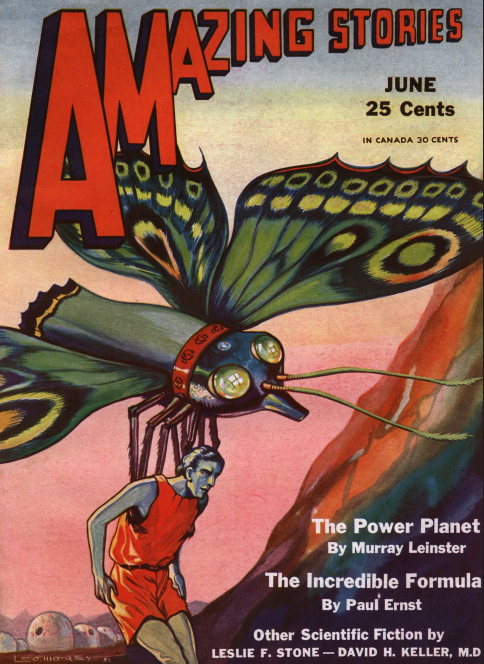
A gorgeous cover this issue – I love that big ass moth! Amazing Stories is one of giants of the pulp era, the first sci-fi pulp and, in many ways, the first real competition that Weird Tales faced, the fallout of which led to the eventual ossification of “science fiction” and “weird tales” as two distinct genres. We’re in 1931, a couple years after founder and titan Hugo Gernsback has bought out and sent off into the wilderness – for now, Amazing Stories is being published by Teck, a MacFadden subsidiary, and overseen by longtime editor T. O’Connor Sloane. Spiritually, though, this is still a strongly Gernsbackian magazine, including an emphasis on sci-fi as an educative or at least “improving” literature. You can see this is the science education editorials they include with every issue; these were (under Gernsback) originally used to justify the magazines existence, a way to show how all these ray-guns and bug-eyed menaces from the stars were, ACTUALLY, instructive literature for the science-minded. This issue’s editorial, written as always by Sloane, is a very strange mishmash of physical geography and extremely poorly reasoned reductive geomorphology about the earth:
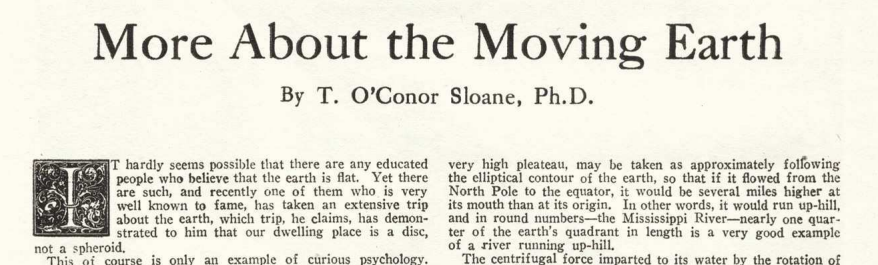
As a geologist I felt the need to the include it in this little essay, but it turns out to be mostly a waste of time. What is odd, and what I wanted to throw out to the wider world, is Sloane’s statement in the first paragraph there, about someone “well known to fame” who recently claimed the world is a disc, not round. Anybody know who the fuck he’s talking about? For a minute I thought he might be talkin’ Auguste Piccard, a Swiss physicist who went up in a balloon in 1930 (and in ’31, actually), and famously described the earth’s curvature as a “disc,” but a) he’s not THAT famous, b) he’s not a flat-(or disc-) earther, and c) he went up in a balloon, not on an “extensive trip about the earth.” Anybody know who Sloane is talking about here?
Anyway, let’s dig into the story!
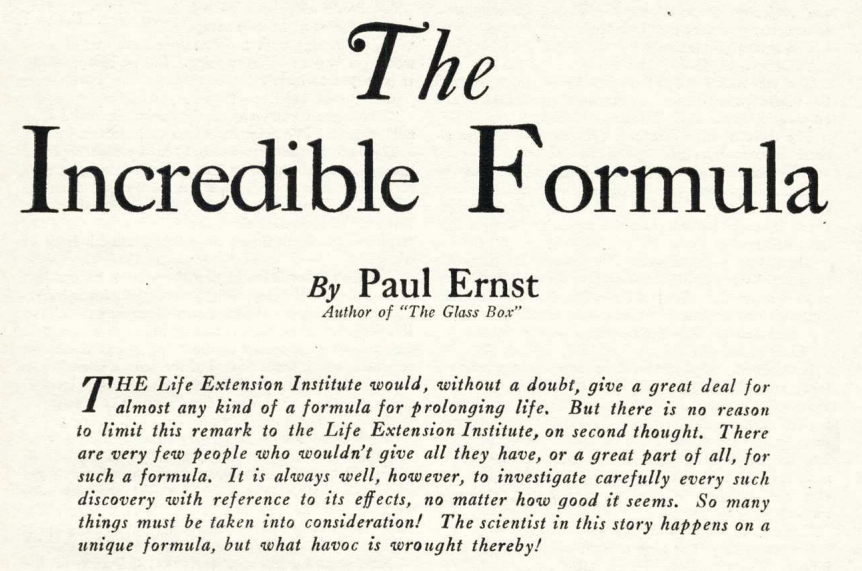
The summary paragraph included in the story is kind of funny; it centers the crux of the tale around a scientist failing to consider the social/political ramifications of his work, which fair enough that is a *part* of what happens here, but in fact there’s a much larger target of Ernst’s ire in this story, as we’ll soon see. I reckon the framing of the paragraph comes out of the the editorial ethos that Amazing Stories is providing not mere escapism but actual important scientific content.
Our story proper begins with a kind of fun framing device:
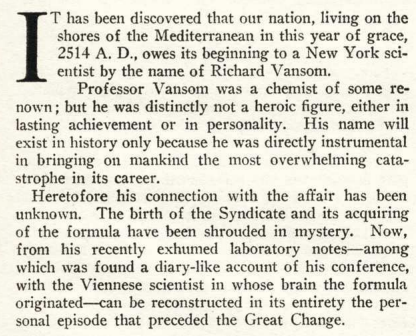
This is a kind of historical essay, narrated from the distant world of 2514 A.D. where a nameless nation on the Mediterranean is examining its own origins. I like the way they cut Vansom down immediately – he’s important, but not in the sense of having been a Great Man; rather, he was just the fulcrum around which history turned, almost by accident. Apparently, some recently discovered papers written by Vansom are going to shed some light on this “most overwhelming catastrophe.” We begin in the hoary, ancient age of the barbaric 1980s:
Vansom had, per these newly unearthed documents, received a summons to Vienna from his ol’ teacher, Prof. Weinghold. This letter, among the papers, tells us why:
The bell is tolling for ol’ Prof W., and he wants to entrust his last, greatest work in the hands of someone he feels can protect this most incredible of formulae. Unfortunately, the guy he picks is Vansom (as we’ll soon find out). But, anyway, Vansom, after some hemming-and-hawing, realizes he must attend to his former teacher’s (and friend’s) last wishes, and so he zips on over to Vienna, where he meets Weinghold’s factotum/major domo, Rudolph…
…but this Rudolph is strangely changed.
And he doesn’t just look weird…he’s acting odd, too!
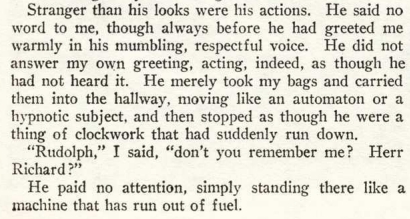
Vansom describes how he notices that Rudolph is wearing a small steel-band around his head, which holds a set of headphones; these headphones must’ve been cranked all the way up to 11, because Vansom can hear the loud blast of Weinghold’s voice, ordering Rudolph to bring his guest up immediately. Helluva illness in ol’ Rudy, thinks Vansom, and he’s gone deaf to boot! The order engages Rudolph though, who bows like “a mechanical doll” and leads Vansom up to the study, where we meet ol’ Doc W:
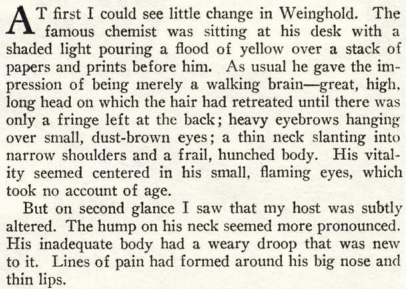
Sounds like somebody needs a ginger ale and some saltines!
Weinghold, speaking into a transmitter, orders the weirdly stiff, slate-faced, utterly silent Rudolph to bring lunch for Vansom, and some egg and milk for himself. Vansom comments on how sad it is to see Rudolph lookin’ like shit and all, which leads Weinghold to make some very gnomic utterances about that indeed. After the meal it’s on with business. Prof W explains that he’s dying of intestinal cancer, and there’s nothing to be done about it; in fact, he’s going to kill himself after this little meeting! And what does he want Vansom for?
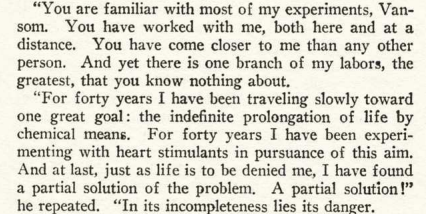
It turns out Prof W has discovered a compound (which, in a footnote from the future, out 26th century friends refer to as “ephedrine-X”) that can keep the human heart beating well beyond death! Originally, Weinghold thought that this was the secret to immortality; with a beating heart as the motor, the rest of the bits of the body should be able to function too. But, it turns out:
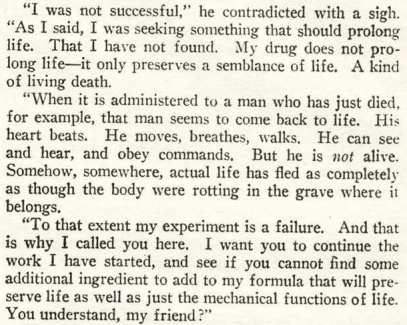
In a somewhat Herbert West-ian fashion, this injection makes, basically, a zombie – a walking corpse that can move, that obeys commands, but is devoid of intellect or will of its own. Weinghold feels like he’s CLOSE to cracking the problem, that his ephedrine-X is something that, perfected, might be the thing that does, in fact, lead to immortality, but it’s too late for him. He needs Vansom to safeguard it, because it’d be dangerous otherwise. Vansom, honored, agrees, and so he learns, via oral recitation, the secret of the incredible formula.
But then, just as they’re finishing up:
Turns out that zombie-lookin’ motherfucker was a goddamn zombie! This is the inspiration for the single piece of art for this story:
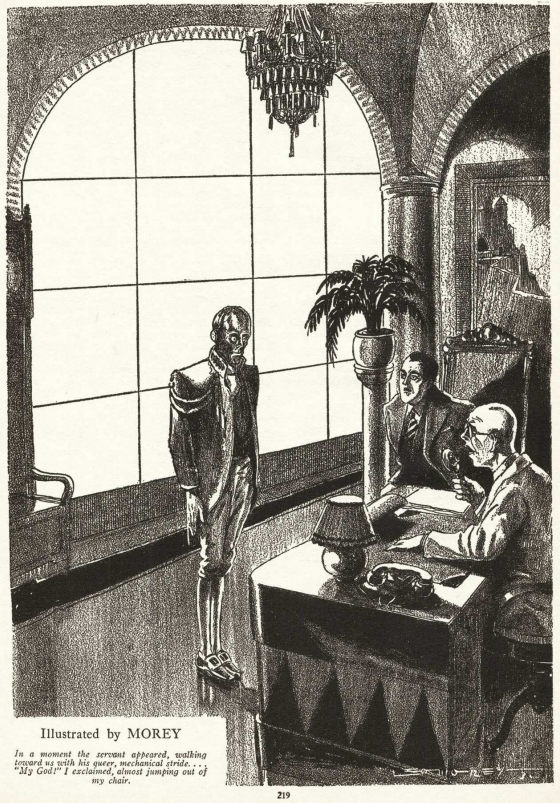
It’s a haunting image; I like the framing of the cadaverous Rudolph against the stark white expanse of the window. It’s also interesting that Rudolph is portrayed as noticeably dark here – in the story, he’s described as slate-colored, very much the pallor of death, but you can dissect this image in a different way, particularly given what we’ve learned. Rudolph could be said to be strangely racialized here, presented as a black servant in his livery; given the fact that we’ve just learned that he’s been effectively enslaved after death, that doesn’t really seem like an accident. Given the year of this story’s publication – 1931 – that seems very possible; the Caribbean voodoo (and zombie) stories of Henry S. Whitehead were beloved fixtures in the pages of Weird Tales by then, in fact he was almost single-handedly responsible for their entry into horror literature. It might be that the artist here, Leo Morey, had internalized that representation. Anyway, it’s worth keeping in mind!
Back to the story: Vansom spends the evening learning more about the details and techniques of ephedrine-X. It has to be administered quickly, within the first seven minutes of death, and it requires continuous reapplication in ever increasing quantities to continue the revivification process. The resultant zombies are mobile, feel no pain, and are capable of work, but totally unintelligent and machine-like; they also have much reduced senses, which is why Rudolph had to be fitted with a set of headphones to scream the transmitted orders into his skull.

And then, Doc W dies, having taken his poison during supper.
Vansom jets back to the states, taking with him a bottle of ephedrine-X, the knowledge of its manufacture and usage, and also Rudolph, which seems quite creepy, actually. It’s here that the far-future narrators cut in, hilariously:
Up to now, we’ve been reading transcripts from Vansom’s papers, unedited and as he wrote them. But now, as we enter the grim and cataclysmic phase of the story, the future narrators cut him off, explaining that he’s unreliable beyond here. What follows then is to be considered the objective history, as best as they could reconstruct it, derived from reading against the grain of Vansom’s own self-serving (and self-absolving) narrative. It’s a fun bit of verisimilitude here, reminding us that we’re reading an interpretation of history based on recently discovered historical material.
Vansom, the historians state, was not as discrete as he should’ve been. Somehow, hints and rumors begin to trickle out, and people begin to believe that Vansom has come into a secret formula that will extend life. The media, more concerned with sales and circulation, begin publishing crazy-ass stories about how ephedrine-X was a miracle drug that had cured hopeless cases, that Vansom’s servant Rudolph was a 104-year old man kept hale and hearty by the drug; they make up quotes that Vansom has claimed that he could live a thousand years if he wanted to.
The country goes bonkers! They want ephedrine X! The scientific community demands answers, fanatics threaten his life, mothers of dying children beg him for his miracle drug. Vansom remains resolute in his promise, however.
That is, until the billionaires get involved:
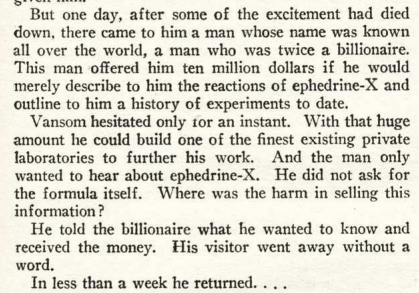
Vansom meets the devil, and signs the hell up. At first, for a cool ten mil, he sells a description of the effects of ephedrine-X to this twice-over billionaire. And when this billionaire comes back a week later:
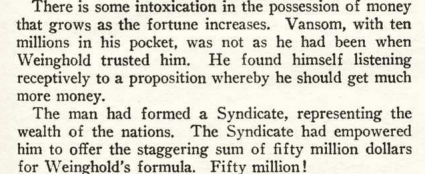
I really love that first paragraph – the intoxication of money, and they way its possession has changed Vansom irrevocably is really great, and something that has largely entered the popular consciousness today, the idea of money as this poison that warps a person. It’s fun to think about the fact that again, in this story, we’re now reading the analysis of the primary document of Vansom’s account – you can imagine the twisty, defensive logic Vansom, writing this account after the fact, engages in to try and exculpate himself, and the way the historians have extracted this judgement from that text here for us.
Anyway, this billionaire and his other billionaire friends have formed a Syndicate, and they’re willing to buy the incredible formula from Vansom for a big ol’ sack of fifty millions of dollars.
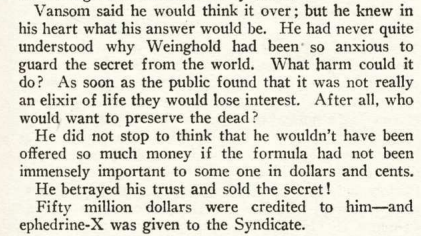
Boo to Vansom, huh? That line, about how he’d never have been offered a payment like that if it wasn’t worth so much is a pretty great one, a nice indictment of dumb ol’ Vansom. And now the Syndicate has the zombie potion.
At this point, the narrative voice of the historian underlines the fact that we’re about to be presented with the highlights of a well known history:
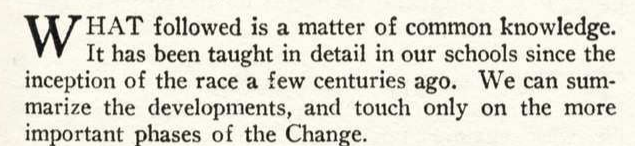
Ernst very interestingly introduces the then relatively new development in industry from his own time, the rigorous and scientifically-informed advertising:
The Syndicate creates a several floor models of the undead, dispatching the revivified corpses to the cities of the world as part of a public exhibition At first, this seems to be a disastrous PR move; as the story states, the ages-old prejudice against seeing and interacting the dead produced a visceral repugnance at all levels of society. Newspapers, politicians, preachers – everyone condemns these zombies being paraded before them.
That’s an important point – Ernst is still keeping us, alongside the whole world of his story, in the dark as to what the Syndicate’s purpose is with these corpses, exactly. This is by design – the psychologists in the employ of the Syndicate are methodically breaking down what they know to be the kneejerk horror at these zombies piece by piece.
And what, exactly, is the promise of these marvelous, liberatory “Livies?” Why, nothing less than the freedom from work:
The billionaires of the Syndicate KNOW that the Livies represent a total breakdown of what Marx called the social reproduction of labor – they are fundamentally overthrowing the relationship between labor and productivity, the same way that industrialization and modern machinery had overthrown the social and class relationships of the 18th and 19th centuries. Because, obviously, if you’re talking about replacing workers across a huge variety of industries and businesses, then what, exactly is to become of the living workers?
Well, the Syndicate has a deeply sinister answer to this. First, in the section excerpted above, the Syndicate plays that ol’ chestnut of industry – increased automation will mean more leisure for the common man, a freedom from toil and drudgery both in the office and at home! But, of course, the question becomes: if Livies are going to take all of the jobs, what’ll people do to make a living? Oh, the Syndicate has an answer there too:
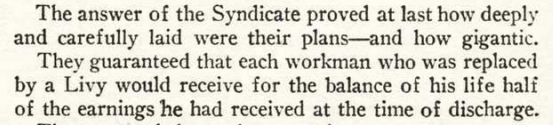
It’s a good ol’ fashioned buy out! Lose a job to a Livie? No worries, you’re now going to receive half-wages gratis, for no work, for the rest of your life! But wait, there’s more:
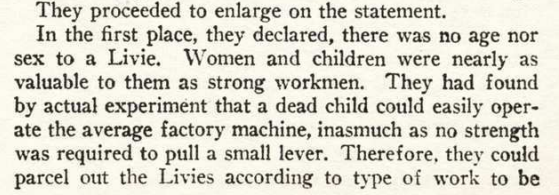
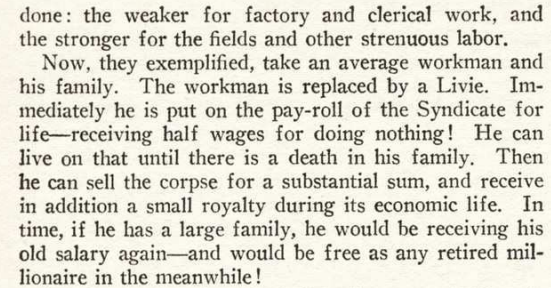
There ya go – let’s say you get laid off from the dingus factory because they’re replacing you with a Livy. Well, no worries, because while you’re off the job, you’ll receive, from the Syndicate, half-wages in perpetuity. And what’s that? Your wife is sick, and a kid of yours dies suddenly? Sell those useless bodies to the Syndicate, and get a royalty on those fresh Livies too! Now you’re living on easy street!
Pretty horrific, and at first is seems like everybody agrees. But the Syndicate knows its business:
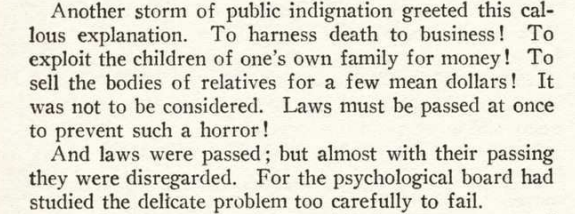
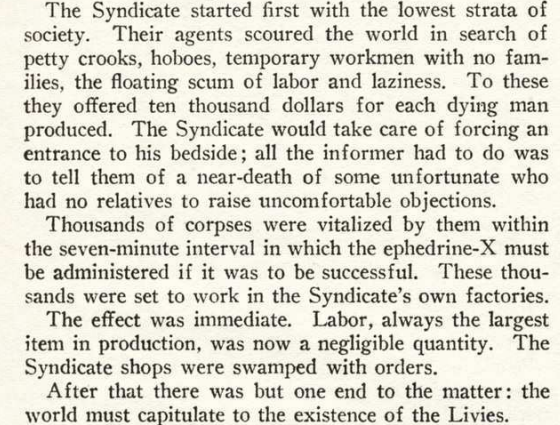
The Syndicate swarps up a bunch of corpses from the lowest lumpenproles they can find, and use them in their own factories; sure, they pay a premium for the corpses up front at first, but they’re labor costs become negligible, which means they can sell their dinguses for cheaper than the competition. People are mad, there’s all sorts of anger and demonstrations, but the toe is in the door now; labor has been broken.
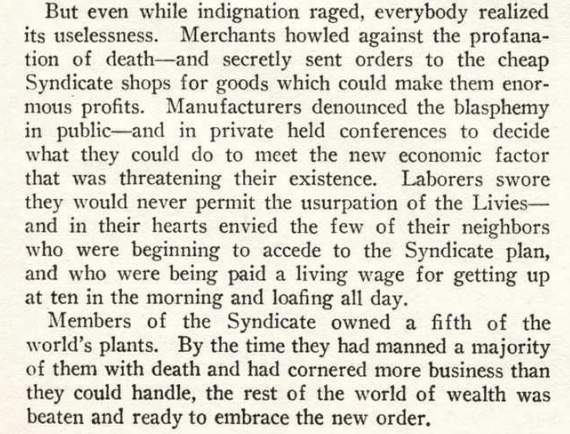
Supply chains based on cheap goods become dominated by those using Livies, because their goods are the cheapest. Thus, industries became reliant on the Livies, and those that refused to use them faltered or went under; workers, seeing unemployment spreading, demanded their bosses replace them with Livies, as a half-wage for life was better than no wage. By controlling production via their unnatural labor supply, the Syndicate basically takes over.
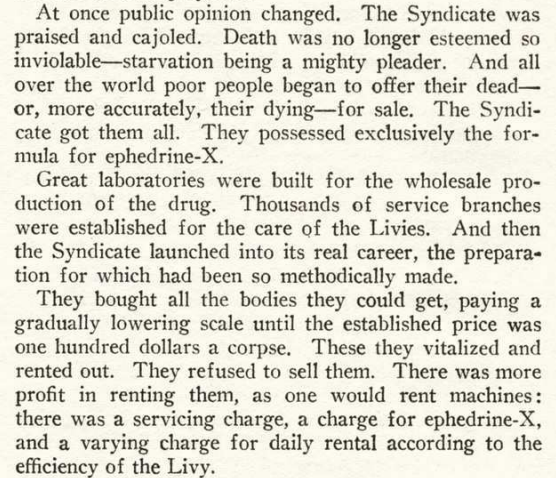
The Livies become an indispensable part of the economy, and so the Syndicate can afford to lower the cost of corpse-procurement and, rather than selling them, rents the Livies to businesses. Whole service industries spring up around the Livy workforce, and what little reticence there was towards using the living dead as slave labor vanishes as the economy becomes entangled with the Syndicate.
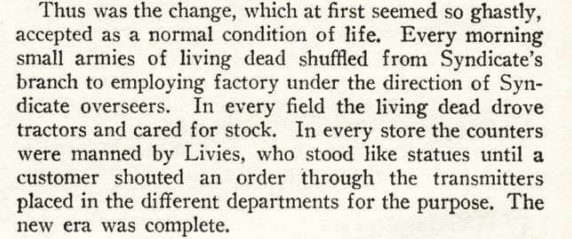
This new era is the total domination of the world by the Syndicate; they come to, basically, own everything, commanding as they do the entirety of the labor force, and with it the mechanisms of the economic life of the planet and everyone on it. Workers in this system become perfectly alienated laborers; they are transformed by death into absolutely efficient non-consumers. The living, meanwhile, exist merely as consumers, eventually transforming their own dead into commodities that they can sell to the Syndicate so they can consume more. It’s grim as hell!
The historical narrative says that things are pretty paradisical for the first twenty years or so (excepting the whole “you might buy a widget from your dead relative down at the shop” thing, I suppose), but then the inevitable happens. With such an iron grip on the economy, the Syndicate starts to tighten the leash in order to make themselves MORE money; hilariously, Ernst lays this blame squarely on the billionaire’s failsons who have inherited their position within the Syndicate, a nice little condemnation of inhereted wealth.
Anyway, these zillionaire scions decide that they need to make more money, so they start reducing the unemployment stipends being paid out to people who aren’t working because of the Livies. They jack up the rental fees of the livies, and proclaim that businesses must accept as many Livies as the Syndicate sells ’em, or else. Finally, they even start slashing the salaries of the PMCs working for the Syndicate, the overseers and administrators and even the chemists who make the miracle drug ephedrine X.
Famine stalks the land; people can’t afford to eat, not with all the jobs taken by Livies and with the stipends slashed. Some people try to go back to work – afterall, Livy rental is now almost as much as a worker’s wage would be. But the Syndicate won’t allow it – they own the police, after all, and use them to break strikes and riots of the living.
And now the stage is set for the last act of the Great Cataclysm.
First, the chemists of the Syndicate, with their salaries slashed, leak the formula, resulting in non-Syndicate Livies which, kind of hilariously, are used in various crimes. Robberies and murders, perpetrated by the undead, are rampant, and even Vansom is killed by a Livie during a break in. The whole social order is breaking down, and people begin to demand restitution and dissolution of the all-powerful Syndicate. Rather than bowing to the demands, the Syndicate declares war on humanity; they recall all their Livies, bringing the world to a screeching halt. The Peoples’ response is a good one (one we today should emulate, I’d say), but it comes too late:
The Syndicate ends up militarizing their Livies and turning them on the living. The undead armies are unstoppable, and the dead of the masses just swell their ranks. Meanwhile, the Syndicate, floating high above the earth in airships, looses hell on earth, bombing cities, sending their armies of the undead against the living until, after five years:
Everyone except for the Syndicate and their family is dead, and the whole world has become theirs. And what’s their relationship to this historical narrative we’ve been reading?


And that’s the end of the Incredible Formula by Paul Ernst!
The ending there *is* a little weak – much better to just leave it grim and hopeless, with the 5000+ assholes and a world of the dead, but from the structure of the story I reckon he had to end it in the fashion that he did – after all, we’re reading a narrative from the year 2500 or whatever about the shit that happened in the late 20th and early 21st century, so we have to have some kind of human civilization to make that work. You can also very plausibly argue that this isn’t really much of a story, per say – after the first few pages of Vansom stuff, there’re no real characters, and the rest of the piece is really more world-building essay than a narrative. And that’s fair! But to me, what’s interesting about this story is the fact that it’s actually a pretty sharp and pretty good Marxist analysis of labor and alienation and industrialization…in a goddamn pulp sci fi mag!
This story in unescapably linked to the Great Depression and presents a pretty scathing analysis of the abuses of capitalism. The Syndicate is as sharp an indictment of the robber barons of the 20th century as it is of the technofascists of today – billionaires who make nothing but who use their wealth to bludgeon the world into a financial fiefdom that they can extract limitless wealth from, all while immiserating everyone else. The Livies are also fascinating, aren’t they? They’re the perfect work – a totally homogenized workforce, perfectly docile, perfectly efficient, and perfectly fungible. One the one hand, they’re a clear stand in for simple industrialization, right? Machinery that we’re promised will increase productivity, but there’s a real incisive commentary here on the OWNERSHIP of that productive machinery – it’s not merely factory owners anymore, it’s huge transnational capitalists that RENT the machinery to other, smaller capitalists. What’s remarkable is how much that applies to the bullshit a.i. slopworld of today, and the vision of the technofascists, down to their ideas of forcing its adoption and a dependency that would provide them, the “owners,” with limitless rents.
I don’t know about Ernst’s politics, but he must’ve been reading (and, more impressively) understanding Marx to write this story. His labor fable of the Livies is remarkably sophisticated – eschewing a simpler “mega-industrialization” narrative, his Livies represent the ultimate alienation of the worker from their labor. Furthermore, he literalizes the capitalists’ dreams of the perfectly fungible worker. The Livy is the transformation of labor into a perfect commodity, so much so that the living are selling their dead (or near dying) to the Syndicate in the story in order to make money.
And how about the living? They don’t come off much better here, do they? Feckless, they’re bought off by consumer luxuries, trading their dignity (and, again, their own family members) for more purchasing power! There’s no solidarity, and the Syndicate gets the Livies into society because the workers can’t stand together; it’s telling that politicians are nowhere to be seen in this story, and that the one brief mention of laws sees them brushed aside as irrelevant. Ernst understands what economic power is, and gives us a good example of how one group (the capitalists) use it effectively in their own interests while another group (the workers) fail to do the same.
As a parable of exploitation and the abuses of capitalism, it’s pretty great! And beyond that, there’s some real good glimpses of horror here – there’re several places where Ernst really dwells on the idea of running into a relative or friend or loved one working behind a counter as a corpse, and the final image of someone being killed in the Last War by their zombified relatives is a grim and ugly one. Honestly, as tired as we are of zombie stories, this isn’t a bad take on the genre, and the simple horror of the undead is magnified by the indifference and cruelty of capitalism – these walking corpses don’t wanna munch on your brains at all, they’re just being ordered to murder you by a middle manager type who is worried about their benefits plan if they lose their job.
It’s also interesting in the context of the last post – automation and automata as a symbol of radically evolving social conditions. Last time I was mostly focused on the scientific (and, therefore, ontological) implications of automata, and how changes in the world of science were reflected in the weirdification of the literature of automata; there’s a similar economic story too, one which takes up the Marxist analysis of material conditions and uses automata as a way to explore class and society and power. And Ernst’s story belongs alongside Asimov’s I, Robot tales in that regard, I think!

