
To celebrate (and *ahem* advertise) the fact that my short story, “Vaucanson’s Canard,” is available for preorder as an absolutely gorgeous pamphlet from Paradise Editions (with international shipping available from Asterism), I thought I’d write somethin’ up about one of my absolute favorite things ever: automata! And, specifically, automata… in weird fiction!
As a child of the 80s, I reckon my first exposure to automata were those classic dinosaur animatronic exhibits that were all the rage at the time – they used to be everywhere, a part of that era’s dino-mania that would, ultimately, culminate in Jurassic Park. As a paleo-obsessed kid, I recall enjoying the displays, but never in the same way as a fossil mount. The artificiality of them was always front and center, the repetitive clockwork motion of the figures shattering the verisimilitude; they never achieved the awesome dignity of those austere ambassadors from the gulfs of deep time, the actual fossils.
BUT! I have a vivid memory of a display at one of these things where the dinosaur had been stripped of its skin, at least in part, to allow you to see the machinery underneath the rubber, and that was a surprising and fascinating thing to little ol’ Eric. Covered, the thing was stilted and underwhelming, but with its pneumatic skeleton exposed, full of wires and electronics and with the unmuffled mechanism operating loudly, it was a much weirder, much more striking thing! Someone more mechanically inclined might’ve been inspired to a career in engineering, but for me it was all about the frisson of being shown simultaneously the illusion *and* the trick, and it produced a real moment of uncanniness.
The oddity of the simulacrum would be underlined by my evolving reading habits – I was a sci-fi kid, especially of the classic 50s-70s era, and boy if that ain’t a literature chockful o’ robots of all sorts. And, while living in an era of shitty a.i. slop means it’s harder than ever to write fiction about machine intelligence, I’ll never not have a fondness for a good robot story! Luckily, there’s a looooong history of automata to pick from!
Ancient Automata
Before we get into fictional ‘bots, it’s worth examining the long history of automata, real and imagined. There’s a deep history to the fascination people have with mechanisms, wrapped up as it is with ideas about knowledge (technical, secret, or divine), as well as questions of authority, labor and, eventually, life itself. Which means that our look at automata starts with those most introspective weirdos of the ancient world: the Greeks.
The word itself comes from Greek αὐτόματα, meaning “acting of one’s own will.” A subtle but important point – an aspect of these things is that the mechanisms must behave as if (or, among the mythic examples, because they have) their own individual motive impulse, power, and directive; in other words, they must appear to be alive. The earliest examples are in those foundational cornerstones of Western lit, the Illiad and the Odyssey. Homer tells us how Hephaestus, god of Smiths, had built mobile tripods to serve the Gods their ambrosia, and he famously had a gaggle of gold girls who, importantly, were in possession of an artificial intellect and skill that let them help out around the forge. In the Odyssey, we’re introduced to the Metal Dogs of Alcinous, gifts from Hephaestus to the King of the Phaeacians to help guard his palace.
It’s all good and well that a divine being like ol’ Festus there can create gold girlbots and robo-dogs, but there is also in the Odyssey at least one example of human(ish)-made automata. When doomed Alcinous is offering to help Odysseus get back home, he explains how their marvelous ships operate independently, without pilot or rudder; rather, the boats “understand” what it is their passengers want, reacting at the speed of thought, and are themselves aware of every city and port and can travel the various sea routes to get to them in a single day. These boats are not gifts from the gods; they’re manufactured right there by Phaeacians (who, admittedly, are descended from semi-divine giants). This seems like an important distinction: sure, the Gods can of course manufacture wonders, but if you have the skill and knowledge, you too can make these living (or at least, life-like) machines.
I’d be remiss if I didn’t mention Talos, one of the most famous examples of an automaton from Greek mythology, immortalized by divine wondersmith Ray Harryhausen (who could make inanimate matter appear to behave as if alive) in Jason and the Argonauts:
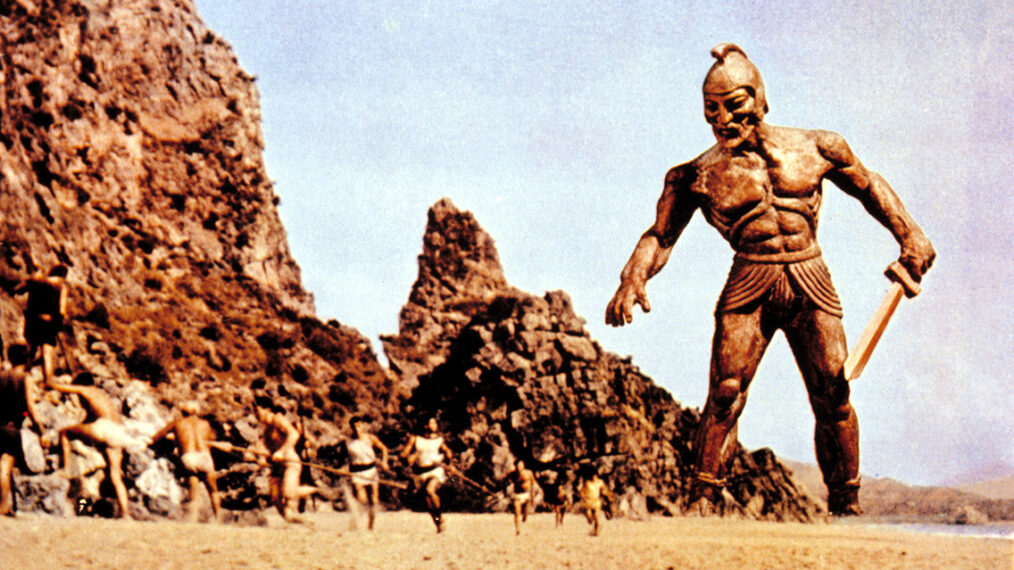
It’s super cool looking, a great part of a great movie, but I do have to point out that the tradition of Talos being a robot (and, actually, a giant) is not the whole story. In the earliest work in which he appears (the Argonautica of Apollonius, from ~3rd c. BCE), Talos is actually the last surviving member of the warlike Bronze Race who came before the current Iron Age people. It’s actually pretty eldritch when you think about it – an alien being from a lost world, the last of his kind, killable only through sorcery. It isn’t until a much later version of the story (from the 2nd century CE) that a writer says Talos was given to Minos by Hephaestus, suggesting that he was manufactured by the god.
These fantastical automata are fascinating, because they actually illustrate an important function of the whole idea of “automata” within the societies imagining them. There’s actually a really interesting literature out there about how these stories, a species of “science fiction” in the ancient world if you want to call it that, were received and how they influenced the history of technology in the Hellenistic world; it’s beyond the scope of this little free-form essay I’m writing, but there’s a great paper by Martin Devecka (“Did the Greeks Believe in their Robots” 2013, the Cambridge Classics Journal v.59) that makes the argument that these conceptual robots were an important part of the Greek world view, used to explore questions of work and slavery and contrast the world as it was with an idealized utopia. This is the same argument Aristotle made, by the way, and which Marx commented on in Capital v. 1; per Aristotle:
If every tool, when summoned, or even of its own accord, could do the work that befits it, just as the creations of Daedalus moved of themselves, or the tripods of Hephaestus went of their own accord to their sacred work, if the weavers’ shuttles were to weave of themselves, then there would be no need either of apprentices for the master workers, or of slaves for the lords.
(Marx, of course, disagreed with this rosy techno-positivist assessment, pointing out how “labor-saving devices” just resulted in more work for the worker, as demonstrated by the industrial revolution merely expanding the working day in the name of ever-increasing productivity).
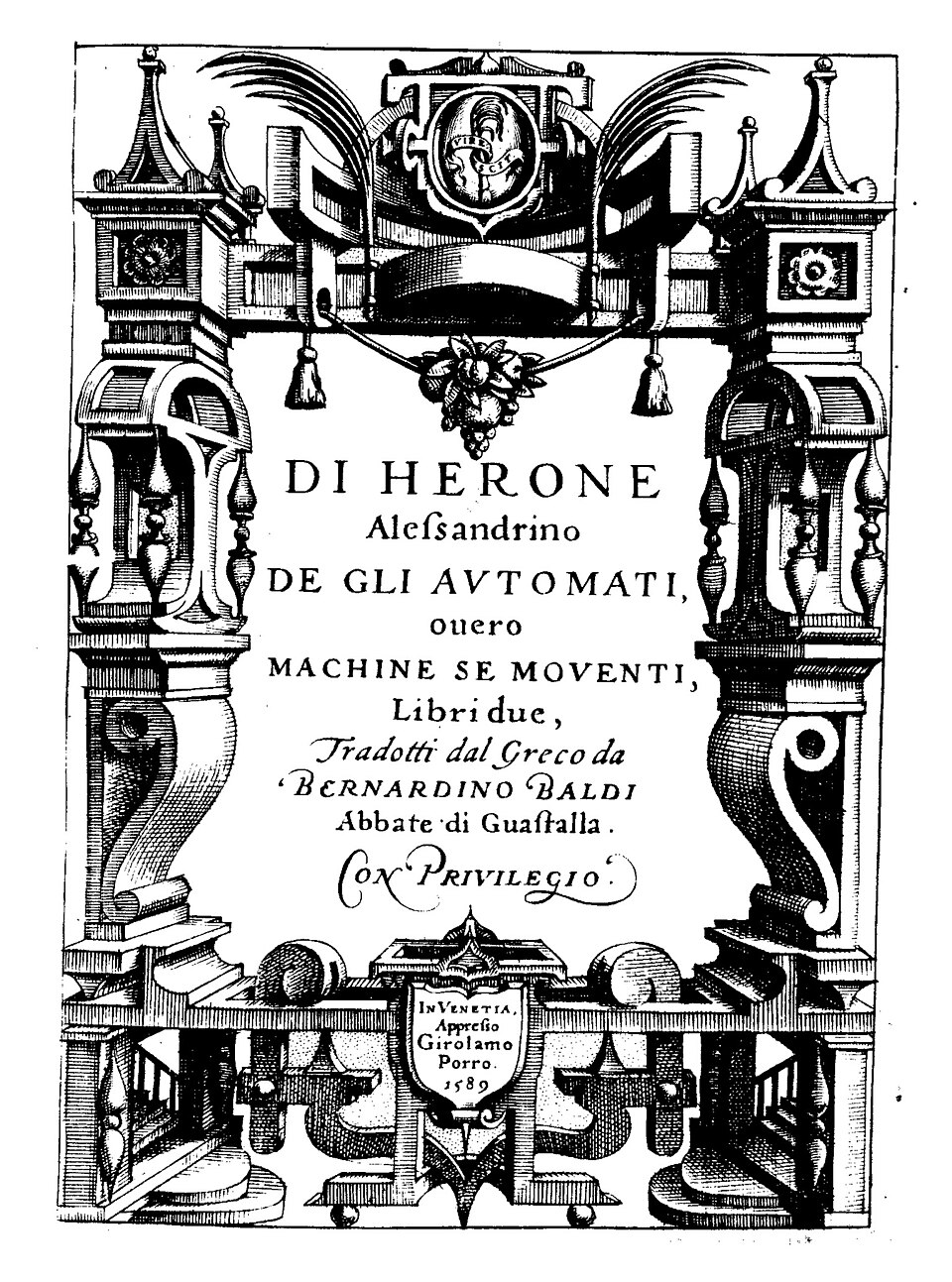
Grecian mechanical knowledge was not merely mythic, of course; there were a lot of very advanced, very technically adroit thinkers working in the Hellenistic world, producing some really remarkable things. Ctesibius, a mathematician and engineer from 2nd c. BCE Ptolemaic Egypt is said to have basically invented pneumatics and hydraulics for use in things as widely divergent as pipe organs and water clocks; none of his work survivors, but he was a huge influence on later Greek mechanists, including Hero of Alexandria (1st or 2nd c. CE) who, in addition to inventing a rudimentary steam engine, also wrote a treatise on automata as wonders, describing robots that poured wine at banquets or that could be used in theatrical productions. He also documented and described automata for religious festivals, including a robotic Dionysius that was at the center of a major religious festival; this suggests that not only were his automata luxury objects for the parties of the rich, but that they existed in the public/civic/religious sphere as well, which is fascinating! Hero’s writing, which did survive, was later enormously influential on early modern European machinists.
Ancient Greek automata, if not necessarily common, seemed to be a least extremely well known. There’re a number of Greco-Roman travel writers who described the wonders of Greek robots, including descriptions of the city of Rhodes that makes it sound like an animatronic park – moving statues on every corner, mechanical fountains, water clocks, a kind of ancient world steampunk scene (sans steam, of course). The fame of Greek automata builders extended beyond the Mediterranean, too – there’s a tradition in northern India that the secrets of robot-building were stolen from the Greeks, brought home, and used to build an army of automata to guard the relics of Buddha (admittedly, most scholars believe this story arose out of Middle Eastern or Islamic sources in the middle ages, but still!)
The idea and, in some cases, literal existence of automata in the ancient world is an important predecessor to both the technical and conceptual developments of later ages; it lays the foundation for both the science and literature of subsequent life-like mechanisms. The technical writing on automata was preserved in Arabic and Persian sources, and would influence both the development of mechanical wonders in those cultures as well as become an important part of the Exoticizing Orientalism of later Western concepts of the “Mysterious East.” And, even if Europe lost access to the mechanical knowledge and skills of the ancient Greek artificers, there remained a thread of automata throughout their literature – the Alexander Romances, medieval retellings of the life of Alexander the Great liberally spiced-up with all kinds of fantastical elements, included a number of encounters with deadly automata, both human- and beast-like.
But what’s interesting is how, even where the ancient Greeks were musing on the social ramifications of automata in the workshop, there’s nothing really “weird” about them, you know what I mean? To use Todorov’s terminology, even when these automata are presented as killer robots built by mysterious artificers with secret knowledge, they largely remain merely “marvelous,” remarkable and possibly unique, but not *outside* the bounds of the world, as it were. It isn’t until much later, with the development of Enlightenment ideas about bodies and nature, that automata become uncanny.
The Uncanny Machine
Automata become weird when they stop merely mimicking life and start being mistaken for it. This blurring between the biological and the mechanical can only occur when you abandon the idea of some divine or numinous attribute, unique to life, that categorically and irrevocably separates life from non-life. In other words, when bodies begin to be conceived of as mechanisms, then mechanisms can begin to become bodies. In seventeenth century Europe, the development of modern science, with its rationalist approach to observation and experimentation, resulted in a new, mechanistic view of the world. And if planets revolved under the operation of physical laws and matter behaved with chemical predictability, then there must be sensical laws fundamental to the operation of the body too!
That’s actually a pretty radical idea, if you think about it. There had been theories of the body before, of course, and while we’re quick to scoff at humors and bleedings, they were a part of a largely consistent (if poorly informed) theoretical structure of how bodies were believed to work. But as medical and biological knowledge grew, guided by new techniques and instruments of experimentation and observation, a model began to form that analogized the human body with the operation of a mechanism. In particular, thinkers like Descartes and William Harvey explored the operation of the heart and its role in circulating blood, providing an important step forward in the material understanding of the operation of animal (and, by analogy, human) bodies. Descartes explicitly referred to the “animal-machine,” and used it as the basis for a new framework for life.
Hearts as pumps, lungs as bellows, eyes as lenses…and then it’s a short step to minds as material things, isn’t it? While we’re familiar with the Creationists’ argument about the Divine Watchmaker, it’s important to recognize that that rhetorical gambit only came about well into the 19th Century, when religion had had to cede so much territory to science already. In the 17th and 18th centuries, the Church (meaning all of Western Religion) was much less enthusiastic about all this mechanistic talk BECAUSE it seemed to remove God from the equation – after all, if bodies become explicable through purely material, mechanistic processes, then there’s no real reason to invoke the divine, is there?
(As an aside, if you’re interested in the topic of the development of this bio-mechanistic world view, including the role of automata in its development, I’d strongly recommend Jessica Riskin’s “The Restless Clock: A History of the Centuries-Long Argument over What Makes Living Things Tick” from the University of Chicago Press. It’s great!)
It was into this brave new world of men and machines that Jacques Vaucanson (the honorific “de” would be added later, in recognition of his achievements) was born in 1709. The tenth son of a glovemaker, Jacques was sent to study with the Jacobins in Grenoble and joined the Order of the Minims in Lyon as a young man; it was here that he learned the math, natural philosophy, and engineering that would serve him through his life. He left the Minims after his first attempt at automata was met with hostility, and he travelled to Paris to pursue his studies in mechanics. He learned anatomy from Claude-Nicolas Le Cat, a famous surgeon of the day, and developed a keen interest in the mechanical operation of the body from his lectures.
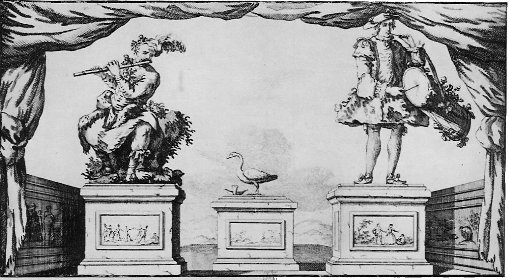
At the time, there was a bit of a fad around automata in Europe, though they were often displayed as toys or wonders of novel engineering, rather than as anything scholarly or profound. Vaucanson, however, envisioned the development of a machine that would mimic not merely the actions of a living being, but the processes too. His first famous automaton was a flute-player which he built in 1737. Rather than appearing to play the flute, the figure ACTUALLY played it, with a convoluted throat architecture that relied on a complex system of pumps to generate the differing air pressures necessary to change octaves on the flute. Furthermore, the figure actually pressed its fingers against the holes of the flute to play the notes it was programmed with; in order to achieve the necessary pliability, Vaucanson actually clothed the automaton’s hands in skin. This was no toy; scholars viewed it as a remarkable (and instructive) model of how a human being could play music, and an important lesson in circulation, breath regulation, and coordination. Indeed, the failings of the mechanism were even discussed as instructive, with an emphasis on how the subtle muscles of the lips and mouth must likewise operate.
Vaucanson’s interest in attacking the question of biological processes via analogy to engineering explains his most famous automaton (and the inspiration behind my little story): his famous “Digesting Duck.”
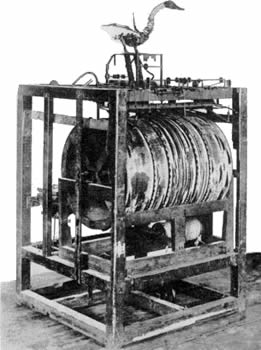
This little guy was, simply, a small mechanical duck that dabbled around in a small pool, flicked its feathers, flapped its wings, ate corn from peoples’ hands…and then shat it out afterwards in neat, green little plops. And people fuckin’ LOVED it.
It’s easy to laugh about (because it IS kind of goofy), but people thought this was the most amazing thing they’d ever seen. Voltaire called it one of France’s singular contributions to the world, and it was discussed and written about all; Poe even discussed it in his essay “Maelzal’s Chess Player” (which is mostly about an exhibition of the famous “Turk” chess playing automaton). Why so much excitement over a shitting duck robot? Because, it was believed, Vaucanson had solved one of the truly great mysteries of life: digestion.
Think about it; people obviously knew you had to eat to live, but what exactly happened to the food once you mashed it up with your teeth and swallowed it down your gullet? How did it sustain life, and why was it eliminated from the body as waste? These are huge, fundamental questions about life, and here comes little Jacques Vaucanson with his shitting duck, apparently in possession of this remarkable secret.
Vaucanson positioned his duck as an instructive example of his scholarly knowledge on the subject; interestingly, much like the dinosaur I mentioned way back at the beginning of this little essay, Vaucanson’s Duck was presented naked, unfeathered and with (some of) the mechanisms visible, as a way of demonstrating both the subtly of his mechanical skill as well as the transparency of the operation. What was NOT visible, of course, was the way this “digestion” took place; this was because it was all a trick. Vaucanson would preload his duck with a mashed up lump of breadcrumbs soaked in green dye, which the duck would produce in the course of its normal operation.
In my opinion, I don’t think Vaucanson was really trying to pull one over on people – I think he probably really thought that he could, EVENTUALLY, figure this whole digestion thing out with more time and more effort. In this scenario, the Shitting Duck is a place holder for future work, a kind of mock up prototype or early draft that defined the problem without offering a solution. Just my two sous on the subject, of course.
In my story (available here!) I use this history, and the historical fascination with automata as models for understanding life, to push on the idea of Vaucanson’s little trick, and explore to what further (and extreme) ends it might have been deployed. Fantastical as it may be, it’s not too far off, because Vaucanson’s work with the duck was recognized as revolutionary; he was awarded a role as the inspector of silk works for France, a position that provided him ample funds and influence to pursue other work. These included an early prototype of the punch-card driven automated loom (which, 50 years after his death and perfected by Jacquard, would become a major part of the industrial revolution). He also invented the lathe, the “tool for making other tools” that was likewise of incredible importance in the history of technology. Finally, he also received a commission from the King of France to see if he couldn’t build an automaton that would mimic the circulation of blood in veins and arteries, which would lead Vaucanson to basically invent rubber tubing. All in all, the slightly skewed events of my story don’t seem that much out of character!
In many ways, it’s Vaucanson’s work, most especially with the duck, that changes the way automata are thought about and discussed. Before him, they were amusing if complex toys, clever feats of engineering to be sure, but not objects of existential contemplation. After Vaucanson, the question of what can and cannot be considered alive becomes something that can be asked and discussed; this is why Von Kempelen’s chess-playing automaton The Turk (built in 1770, long after Vaucanson’s Duck) became such a sensation. Von Kempelen never claimed that it actually “played” chess, nor did any of its later exhibitors, but people couldn’t help but look at it performing a complex, seemingly intellectual task, and ask “what is it To Think?” While the Turk, much like the Duck, is little more than a sophisticated side-show gaff, it forced people to confront the uncertainly around the division of life from non-life, and that’s when things can get weird!
Weird Automata in Fiction
The first modern weird automaton appears in the work of E.T.A. Hoffmann (1776-1822). Now, Hoffmann wasn’t the first modern writer to use automata in their fiction; François-Félix Nogaret had some in his “Le Miroir des événements actuels” from 1770, though they were of a much more “marvelous” sort than weird and menacing. But Hoffmann was the first writer to really understand and approach automata as objects steeped in uncertainty and ambiguity, and because of this, he’s had a prominent role in the literature since.
Hoffmann is an absolute favorite of mine; I think he was one of the rare authentic geniuses out there, a really epochal talent whose work radically changed the literary landscape. He had an enormous influence on Poe, actually, who read him in translation and who, on several occasions, explicitly tried to wrest outré literature out from under the shadow of German “phantasy.” In the preface of his Tales of the Grotesque and Arabesque (1840), Poe wrote:
I am led to think that it is the prevalence of the Arabesque in my serious tales which has induced one or two of my critics to tax me, in all friendliness, with what they have been pleased to call Germanism and gloom. The charge is in bad taste and the grounds of the accusation have not been sufficiently considered. Let us admit for the moment that the “phantasy pieces” now given are Germanic or what not. But the truth is that with a single exception there is no one of the stories in which the scholar should recognize the distinctive features of that species of pseudo-horror which we are taught to call Germanic for no better reason than that some of the secondary names of German literature have become identified with its folly. If in many of my productions terror has been the thesis, I maintain that terror is not of Germany, but of the soul.
To my eye, there’s a bit of protesting too much here from little Eddie Poe, but regardless I think we can very much see how, in 1840, the world of “phantasy” literature was dominated by German writers, including (and certainly at the top of the list), Hoffmann. And a dive into his automata stories shows why!
Hoffmann’s first automata story is, appropriately enough, titled “The Automata” (“Die Automate” auf Deutsch), which actually name drops Vaucanson and his pipe-playing robot. The story, first published in 1814 and later collected in “The Serapion Brotherhood,” is a fascinating piece, dealing directly with that very dynamic moment of epistemological revolution in science that we were talking about above. It’s a nested tale about a bunch of sensitive, educated German bros hanging out, investigating and arguing over the various different and new Ways of Knowing Things, basically. They’re introduced trying to use their Willpower to force a ring suspended on a string between them to move, and they go on to discuss the aesthetical implications of supernaturalism afterwards via an odd and portentous ghost story. It’s written with that classic Hoffmannian verve, simultaneously funny and mysterious.
The third nested tale is where we’re introduced to the titular automata. One of these Deutscher Bros, by the name of Theodore, has a fragment of a story he’s been working on and which he shares. It’s the tale of a group of German college bros (sensing a theme?) who go to visit a mysterious, marvelous robot being displayed in town, “the Talking Turk.” Now, this Turk (clearly inspired by von Kempelen’s chess-playing robot) is a kind of oracular automaton. People come up, whisper a question in its ear, and then the Turk speaks an answer back. This advice depends, of course, on the question; banal queries receive banal answers, but when prompted the Turk has become famous for seemingly possessing knowledge it cannot otherwise have had, and for having a deep and probing wisdom to boot! In fact, there’s an implication that the mechanism of the Turk is so finely tuned and expertly adjusted that it is able to access supernatural realms of knowledge – in effect, its machine brain is better than an organic one at using psychic power!
There’s a love story and a mysterious (and menacing) professor involved, and there is no real ending because, diegetically, it is a fragment of a story, but there’s a real sense of oddness and mystery about the Turk and the Professor and the Singing Woman, and a kind of brooding doom that is never resolved – it’s spectacular writing (come on, it’s Hoffmann) but the relevant thing is that Hoffmann is using the story to really explore what we now call “the uncanny valley.” First off, he has one character express his disgust at the idea of simulacra:
“All figures of this sort,” said Lewis, “which can scarcely ne said to counterfeit humanity so much as to travesty it – mere images of living death or inanimate life – are most distasteful to me. […] When I see the staring, lifeless, glassy eyes […] I feel disposed to cry with Macbeth ‘Thou hast no speculation in those eyes/ Which thou dost glare with.’ […] it is the oppressive sense of being in the presence of something unnatural and gruesome; and what I detest most of all is the mechanical imitation of human motions…”
I’ve excerpted the above from a much longer passage, but Hoffmann is really laying out a vision of the unsettling experience of seeing something that is almost-but-not-quite-right; he’s articulating one of the absolute cornerstones of modern horror, and he’s doing it with automata as the exemplars of this terrible eeriness in a story from 1814!
What’s ALSO amazing is how, again in 1814, Hoffmann is articulating a very modern anti-AI perspective in the voice of one of his characters:
“All that machine music…makes every bone in my body ache. I am sure I don not know when I shall get over it! The fact that any human being’s doing anything in association with those lifeless figures which counterfeit the appearance and movements of humanity has always, to me, something fearful, unnatural, and may I say terrible, about it. I suppose it would be possible, by means of certain mechanical arrangements inside them, to construct automata which would dance, and then to set them to dance with human beings, and twist and turn about in all sorts of figures; so that we should have a living man putting his arms about a lifeless partner of wood, and whirling round and round with her, or rather it. Could you look at such a sight, for an instant, without horror?”
(I’ll pause here to send you to another remarkable pamphlet, also available at Paradise Editions, that includes an essay by the inimitable Heinrich von Kleist, translated by Matthew Spencer, that offers an interesting counterpoint to this argument! You can even get it as part of an “AUTOMATON BUNDLE” from them!)
Hoffmann, via his character Lewis, continues expressing the anti-AI argument with a point that gets to the nub of much of the artistic arguments against slop today:
“The gravest reproach you can make to a musician is that he plays without expression; because, by so doing he is marring the whole essence of the matter. Yet the coldest and most unfeeling executant will always be far in advance of the most perfect machines. For it is impossible that any impulse whatever from the inner man shall not, even for a moment, animate his rendering; whereas, in the case of a machine, no such impulse can ever do so. The attempts of mechanicians to imitate[…] the human organs in the production of musical sounds […] I consider tantamount to a declaration of war against the spiritual element in music. […] I infinitely prefer the commonest barrel-organ, in which the mechanical attempts nothing but to be mechanical, to Vaucanson’s flute player, or the harmonica girl.”
As you can see, it’s a rich text…and it’s not even the only time Hoffmann talks about automata! Hoffman’s remarkable 1816 story “The Sandman” has an automaton that helps drive a man mad. Famously, this is the story that Freud addressed in his famous essay “The Uncanny,” citing an earlier paper by another German head-shrinker who described the unnatural and unsettling nature of Hoffmann’s girlbot Olimpia. (Freud, interestingly, actually argues that there’s nothing uncanny about Olimpia because there’s no ambiguity about her status as robot in the story. He, for obvious reasons, preferred to focus on Nathaniel’s childhood trauma.) I don’t want this to turn into a Hoffmann lovefest, so I’ll just recommend you read everything that Hoffmann ever wrote, or at least what’s been translated if you’re a monolingual dummy like me, because it really is foundational to both weird horror and science fiction (as well as being remarkable literature on its own).
There’re other important automata stories in the history of weird lit too. Auguste Villiers de l’Isle-Adam’s “L’Ève future” (“Tomorrow’s Eve” in the English translation) from 1880 is a very strange, very interesting, and very misogynistic piece of work; it’s notable for including Thomas fuckin’ Edison as a character, joining the ranks of Hoffmann’s Professor X______ and Mary Shelley’s Dr. Frankenstein as mysterious creator-figures in these kinds of stories. In particular, there’s a very unsettling part of Villiers de I’sle-Adam’s novel where Edison basically vivisects a fembot, very much akin to the kind of surgical presentations of Vaucanson’s day (which I included in my story), as well as a striking example of the unsettling effect a robot can have on our categories of life and what is acceptable to do to a living being. This is also importantly a story about sex and gender and reproductive roles, something that is always flitting around the edge of any robot tale, even when it’s not explicitly acknowledged.
Jerome K. Jerome, one of my favorite writers of all time, wrote what we’d call a weird story about an automaton on 1893, one that actually reflects on the “dancing partner” section in Hoffmann’s “The Automata.” It could’ve been inspired by Jerome having read it, for all I know; after all, he set his sequel to Three Men in a Boat in Germany, and his family hosted a famous Hungarian general (who certainly would’ve spoke German), so it’s possible he’d read Hoffmann. Anyway, JKJ’s story, “The Dancing Partner” is a fun “the dangers of automation” tale, but I think there’s some real uncanniness in story, particularly in the climax, when the robot is whirling its partner madly around the dance floor.
Leaping to 1899, another automaton story worthy of your consideration is “Moxon’s Master” by good ol’ Ambrose Bierce. This story opens with the line “Do you really believe machines can think?” and proceeds to not only explore “thinking” in the form of chess-playing, but also whether machines can feel and hate as well. It’s a fun, grim little tale, classic Bierce all around!
In those heady days before the ossification of genre, you can see the fun way automata let writers use both horror and wonder in their stories. The uncanniness of automata let writers unite terror and supernaturalism with the breakneck pace of science and technology, a powerful set of lenses to bring to bear on the world. As genre was born in the pages of the pulps, and science fiction became separated from weird fiction, there’s a little bit of a custody battle over robots that, ultimately, finds them slotted in with Sci-Fi.
However, before all that got locked in, Weird Tales was actually trying to make an argument that “pseudo-scientific stories” belonged in *their* pages, and so we do occasionally run across an automaton tale in the magazine. One of these that I think is worth mentioning is Edmond Hamilton’s “The Metal Giants” from the December 1926 issue of Weird Tales.
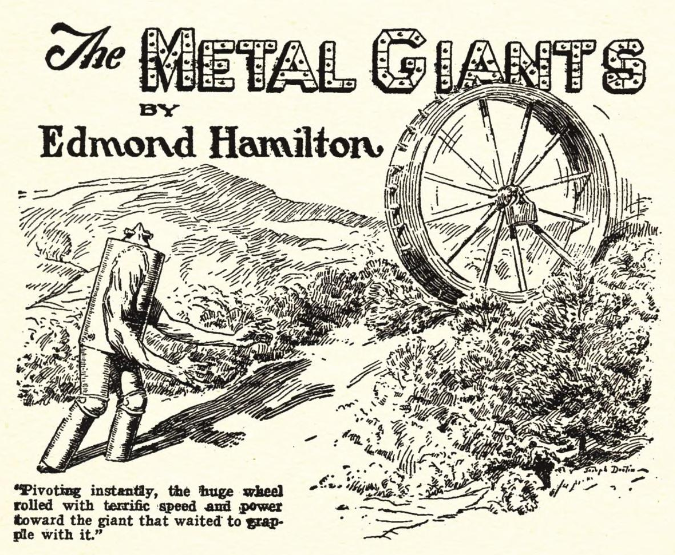
Hamilton is an interesting character, one of the most prolific writers in Weird Tales who went on to become one of the early masters of big, bombastic space opera style sci-fi. He was popular with readers, though his style is often a bit affected for our modern tastes. But his origins in the pages of the Unique Magazine were something he never forgot – in even his most nuts-and-bolts sci fi stories there’s often a hint of cosmicism and weirdness in there somewhere.
And in “The Metal Giants” Hamilton really lands on something strange and interesting, I think. While the story is about giant robots, the real weird science aspect of the story is in the creation of the thing’s BRAIN. The inventor, some schmuck named Detmold, creates a totally artificial brain, and it’s here that Hamilton really lands on a fun bit of alien-ness. The brain, while obviously vastly intelligent, is totally inhuman and cannot truly communicate with us. The incommensurability of our evolved (and, Hamilton states, ensouled) brains with a machine, no matter how complex, is a really interesting idea, and not really one you see much of in sci-fi. Super potent A.I.s in sci-fi are often archly supercilious and capable of ridiculously powerful feats of intellect, sure, but they’re almost always portrayed as human-like, at least superficially. We can communicate with them, at least; not so here, where Detmold’s artificial brain is truly, awfully alien. It of course goes rogue and there’s lots of gee-whiz action, but the core of Hamilton’s story, about a machine brain being something fundamentally inhuman, is a really fun, interesting idea.
We’ve been explicitly talking about mechanical robots here, but in the realm of weird fiction there’s another class of artificial beings that are worth mentioning: the non-mechanical. There’s Frankenstein’s monster, a hugely influential figure in the literature, but there’s also Karel Capek’s R.U.R. to contend with; Capek invents the word “robot” in its modern usage, but his robots are biological, artificial beings built via the industrialized production of synthetic body parts. Perhaps most important, though, is the theme of revolt of the enslaved, artificial underclass, in the course of which the slave masters are actually rendered extinct by those they had brutally created for lives of drudgery and oppression. That sounds familiar, eh? Ever hear tell of a shoggoth?
I’m not sure Lovecraft read Capek, though it is possible he was at least familiar with the play – it was pretty famous, and by 1923 it had had a pretty successful and well-publicized run in translation in North America. But there is ANOTHER automaton that we KNOW Lovecraft appreciated…Gustav Meyrink’s THE GOLEM! Now, Lovecraft hadn’t read it by the time he wrote “At the Mountains of Madness,” but he HAD seen the movie in 1921 or so. What’s interesting is that the movie “Golem” is pretty different from Meyrink’s novel (which Lovecraft LOVED when he got to read it in ’35); the movie is much more of a monster flick, with a literal artificially created thing at the center of the story that, ultimately, revolts and causes all kinds of havoc in the Prague ghetto.
Of course, labor actions and violent revolt were pretty major stories of Lovecraft’s day – he looked with horror on the Bolshevik revolution in Russia, and was famously deeply offended by the social upheaval and implied violent unrest brought around by foreign workers moving into New England’s industrial towns, so his shoggoths and their eventual revolt are undoubtably sourced from lots of things. But it is interesting to note that they are, basically, automata – as presented, they’re biological robots, and one of their core functions is explicitly imitative (as wonderfully expressed by their piping “tekeli-li” sounds). Lovecraft even approaches some of the same questions that the previously mentioned automata do; it’s implied that all native life on earth came about as a result of these shoggoths, forcing us to confront questions of authenticity and “realness” as a species. In that, shoggoths are fulfilling the same rhetorical function as Hoffman’s Olimpia, Bierce’s Chess-Playing Robot, or Vaucanson’s shitting duck.
Conclusion
Well, this has gone on for a while, hasn’t it? That’s the danger (and pleasure) of free writing, I suppose. But I think automata are a topic worthy of even long-winded, meandering discussion. When I wrote Vaucanson’s Canard (what’s that? why yes, it IS available for preorder from Paradise Editions!) I was scratchin’ an itch I’d had for a while about ol’ Jacques and his weird duck machine, but the more I thought and read about it, the more I realized that there’s a lot to unpack about these mechanisms. Their place in the history of science and technology (and medicine) is a fascinating one, but they also represent important symbols of industrial automation and the role of people in both labor AND creation. There’re questions of agency and aesthetics and economics and, honestly, even metaphysics wrapped up in their clockwork bodies, and they’re worthy of serious study and contemplation.
In terms of the history of weird fiction, I think they’re as important a figure as the Vampire, for instance – Hoffmann’s automata mark a change in the world of the weird, and are as good a place as any to pin the invention of the unsettled, uncanny, uncertain type of horror that typifies one flavor of the modern genre. And, of course, their influence on science fiction goes without saying – the uses that writers like Dick or Asimov put their automata redefined the genre and changed forever the way speculative fiction approached questions of life and materiality and creation.
Finally, in these dark days of A.I. slop, there’s a lot to be learned from automatons both literary and literal. In a lot of ways, there’s something reflective of our own times in contemplating a mechanical duck presented as a wonder of the age that would revolutionize our world…but that is really just shitting out some secretly pre-loaded crap.


Pingback: HPLinks #102 – Lovecraft on modernity and optimism, Fungi chapbook, 1975 “Shadow” adaptation, Lovecraftian film and more… | Tentaclii
Pingback: A Specter is Haunting the Pulps #47: “The Incredible Formula” by Paul Ernst, Amazing Stories, v. 6, n. 3, June 1931 | Eric Williams