
Having returned from Robert E. Howard Days up in Cross Plains, TX (where I was nominated for but did not win The Hyrkanian award, ah, c’est le awards), I find the ol’ skull is all a-swirl with a lot of REH/S&S these days. I’ll try and space it out (and maybe save some for my annual S&S celebration time around the Yule), but I think I’ve got to exorcise SOME of it now, so today I’d like to talk about a bit of science that undergirds Robert E. Howard’s fiction: evolution.
This was inspired by the 1998 REH biopic THE WHOLE WIDE WORLD, which was screened at REH Days, and which includes a very strange exchange between Howard (played extremely D’Onofriolly by Vincent D’Onofrio) and Novalyne Price (played extremely cute-as-a-buttonly by Renee Zellweger). The scene in question occurs at around the 53 minute mark or so (you can see it right here). The two lovebirds have just had a picnic where Howard tells Novalyne that his mom thinks she must have some “Indian blood” in her, maybe as much as “half Indian.” Novalyne, confused and amused, asks why Howard’s mom had thought that. There’s a cut and the two of them are in the car, with REH taking up the topic:
HOWARD: It’s the shape of your face. Do you know how much Indian blood you have?
PRICE: None that I know of –
HOWARD: I bet you got a drop or two. We are human because our ancestors were human. That’s the one thing that persuades me that the Bible was right. I can imagine a lot of things, but I can’t imagine Man was once a monkey.
Now, there’s a lot of bonkers-ass shit to unpack in that short exchange! Setting aside (for the moment) the weird interest in race and miscegenation (one of Howard’s favorite topics in his fiction), the fact that the movie has Howard say that a) he believes in a biblically informed divine origin for humanity and b) the he “can’t imagine Man was once a monkey” is absolutely crazy, something totally incommensurate with both his fiction as well as many statements in his letters to different people.
When I got back home, I broke out my copy of Novalyne Price Ellis’s One Who Walked Alone, her memoir of her couple-o-years-long relationship with REH, written in 1986 and the source for much of the movie. Perhaps, I thought, the movie had invented the exchange for some strange reason? Afterall, coming out in ’98, the movie would’ve been right smack in the middle of one of the big Creationist waves that periodically sweep this benighted nation – perhaps they’d felt the need to situate Howard, a southerner through and through, within a comfortable southern archetype? But, there on page 150 of my copy of the book (the edition w/ Renee Zellweger on the cover), was the exact lines:
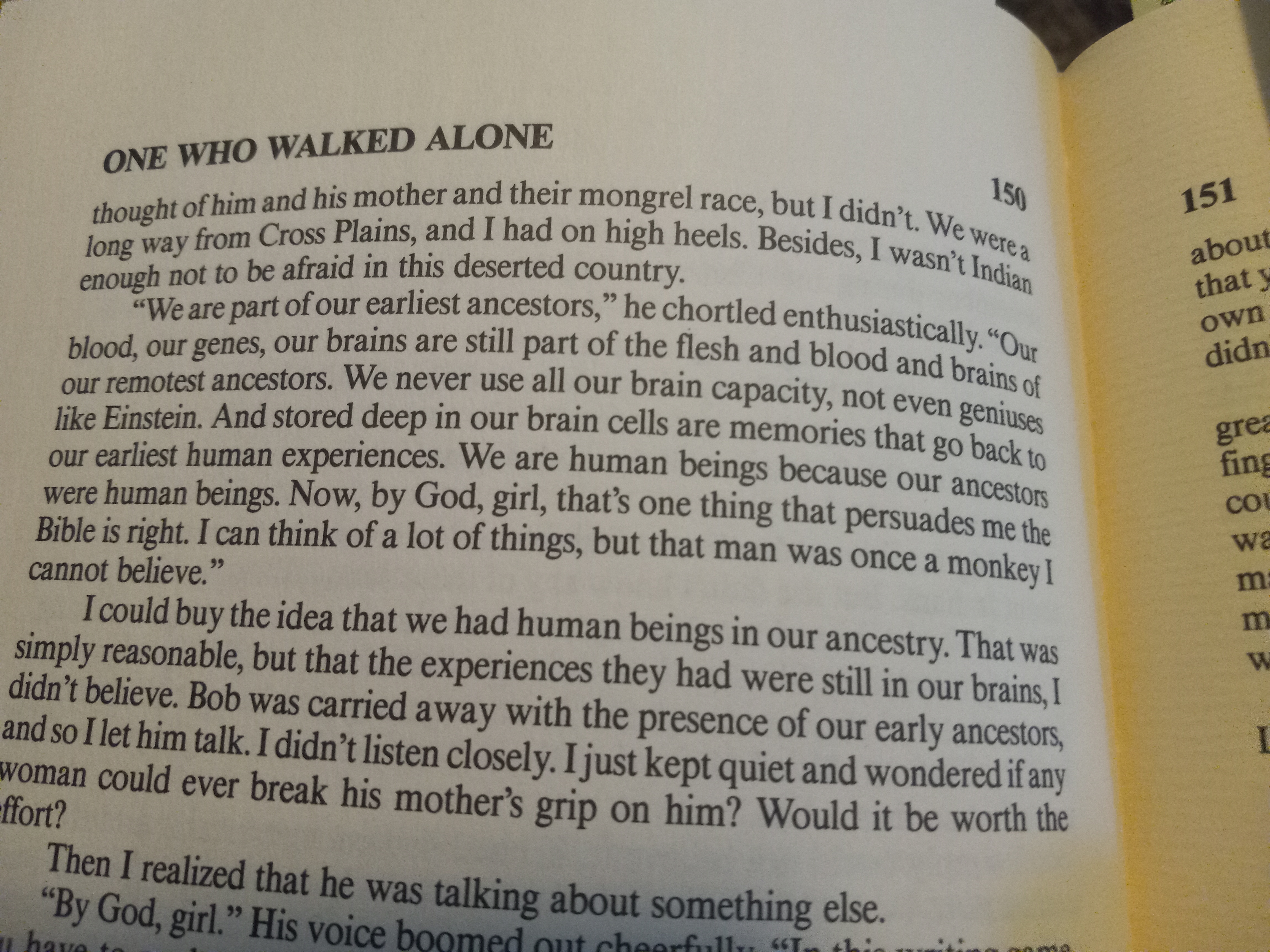
Again: this is insane. There is no possible way to reconcile this statement, that REH was a bible-believin’ Creationist, with the fiction he wrote, where the centrality of evolution is key, not merely to the biological nature of individuals, but to whole civilizations and cultures! Similarly, it is contracted directly by his own words in his letters! So let’s take a look!
The first and most obvious counterexample in REH’s fiction is in the Conan story “Rogues in the House.” This was published in the January 1934 issue of Weird Tales, so it appeared not that far in time from when the weird exchange in the movie is supposed to have happened. In it, Conan is engaged by a patriotic rebel to help kill the vile Red Priest Nabonidus (who is, basically, the scheming and clever Cardinal Richelieu from “The Three Musketeers”). In the course of infiltrating his death-trap of a house, they learn that something is amiss – one of Nabonidus’s servants, an ape-man named Thak, has taken over the compound, dressing in his robes and using his crude but effective knowledge of the various death-dealing mechanisms in the house to kill all comers. When the heroes get their first good look at Thak (via a series of complex mirrors), we get introduced to Thak’s history by the Red Priest:
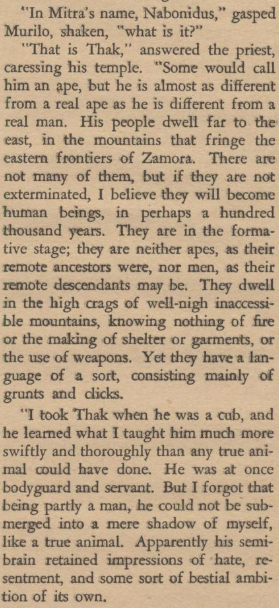
Later, when Murilo, the rebel instigator, gets a good, long look at Thak’s face, Howard takes the opportunity to further underline the proto-humaness of Thak:
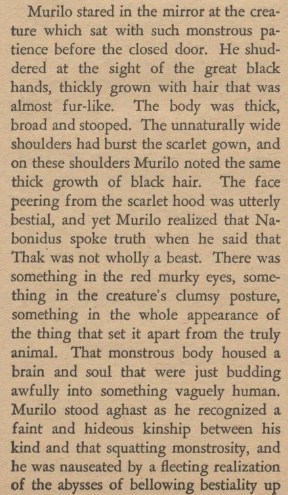

Thak is explicitly portrayed as part of a chain of beings leading progressively towards a kind of archetypal humanity, one that furthermore (and most horribly) suggests to Murilo that humans themselves had experienced just such a stage of life in the distant past. Howard revisits Thak’s fundamental and evolutionarily-informed idea of “human-ness” in the climactic battle between Conan and the ape-man, making sure we understand that this is not merely an ape, but a sentient being close to our own “kind.”
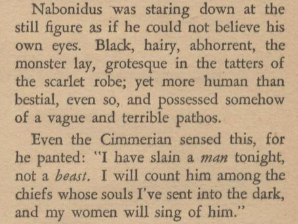
Let us pause briefly to admire Frazetta’s portrayal of this fight in one of his inimitable paintings:
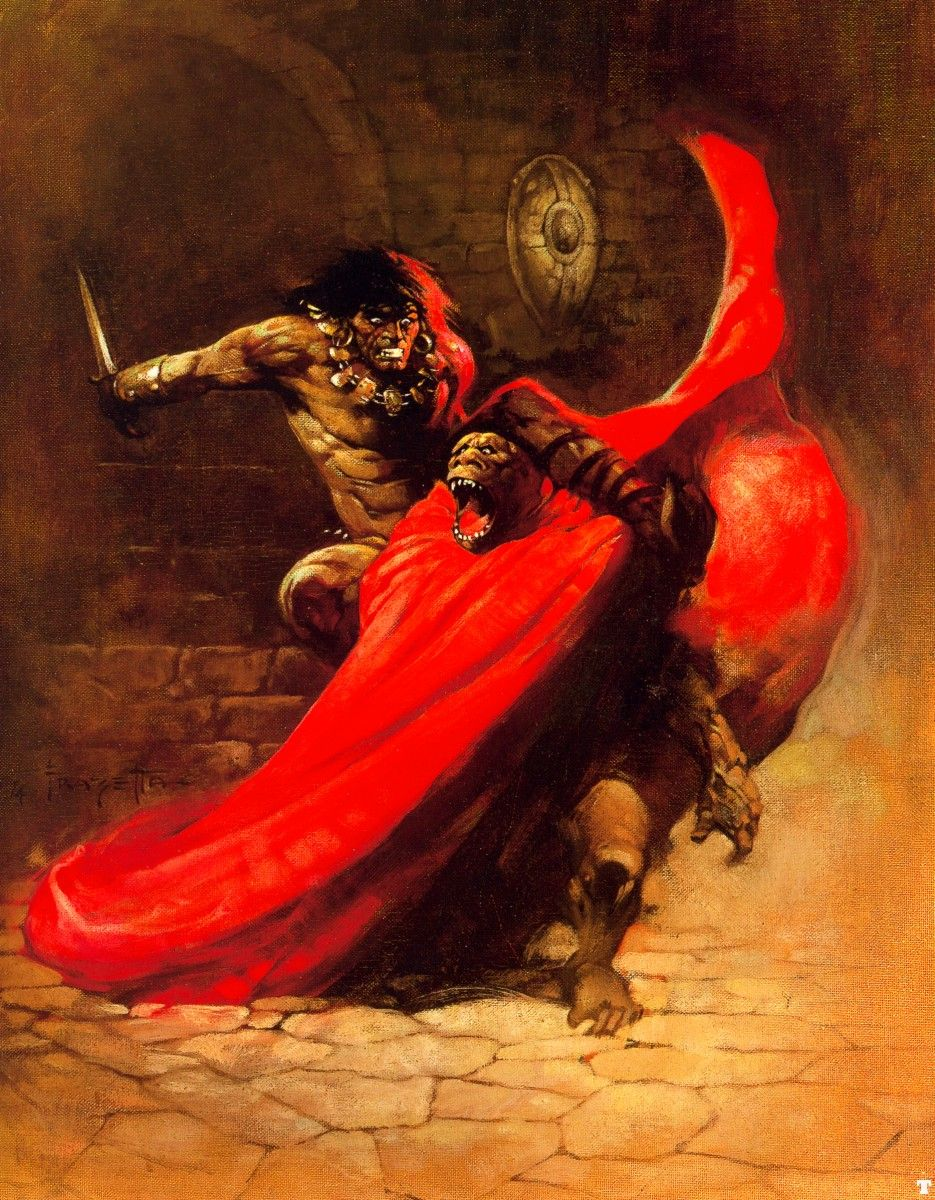
Badass.
The important thing about Thak is that he is explicitly positioned within an evolutionary context – Nabonidus, while certainly a villain, is also portrayed as a deeply and indeed uniquely profound thinker for his age, and we are meant to take his insights into the evolutionary history and potential of Thak at face value. Furthermore, Thak’s ambitions, his wearing of the robe, and his usurpation of Nabonidus in his own home are not mere apings; rather, Thak is possessed of a sense of self and of others that is human-like, a result of his heritage as a kind of developmentally and evolutionarily intermediate man-ape.
This interest in evolution and the deep history of humans in geological time isn’t anything new for lil’ Bobby Howard either – way back in 1925, his very first professionally published story in Weird Tales (“Spear and Fang”) was all about the conflict between Cro-Magnon and Neanderthals. There is no room within a strict, fundamentalist worldview for different members of the genus Homo to be waging war on one another. Interestingly, for all its eventual violence, the story begins with a Cro Magnon character making cave paintings of extinct animals, a scene placing art, an aesthetic sensibility, and an appreciation of beauty explicitly within an evolutionary framework. But, like so many of Howard’s ancient wildernesses, this is no Edenic garden; it’s a savage and brutal landscape where violence and survival are the engines of evolution.
Indeed, over and over again, Howard portrays the past as a grim evolutionary climb, calling out specifically the rise from apedom to semi-apedom and, eventually, full humanity. In fact, taking cues from both contemporary geological literature as well as esoteric theories of human history, Howard makes these events explicitly cyclical – Kull’s Atlanteans rise from apehood into their barbaric splendor, only to be hurled back again down the evolutionary ladder by their Age’s terminal cataclysm; slowly they rise to become fully human again in the fullness of geological time where, it is implied, they become the Cimmerians. Bran Mak Morn’s Picts are likewise a people with a long and troubled past that stretches into prehistory, and Atla, the were-woman of Dagon Moor, explicitly tells Bran that the Worms of the Earth could’ve been people, were very nearly human in fact, when the Picts drove them back into atavism and subterranean degeneracy. This sort of evolutionary thinking is integral to Howard’s fiction, both mechanically as part of plots as well as conceptually, as something key to his worldview.
Howard’s exposure to evolutionary thinking can be traced from two sources. The first is in the books he owned and which, on his death, were donated to the Howard Payne University library by his father. This collection, originally something approaching 300 books, was eventually taken out of special collections and put into general circulation, the result being that there are now less than 50 or so actual books left due to loss, theft, etc. However, a group of dedicated workers over the years have put together the original accession list and chased down references in Howard’s letters, meaning we now have a pretty decent idea of the books available to REH in his home. For more on this incredible work (including a handy history), and to peruse the book list, check out The Robert E. Howard Booklist!
To cut to the chase there’s one book in particular that is extremely relevant on the list: E. A. Allen’s The Prehistoric World or, Vanished Races originally published in 1885. It’s an odd and interesting book, actually; Allen, while an obscure writer now, was a prolific popularizer of natural history, with a particular interest in anthropology and ethnography. The book that Howard owned is a helluva doorstop, 800 pages or so, that begins in prehistory and moves through the iron age in Europe before leaping over to the Americas, with chapters on the Mound Builders, on the Nahua, on the Maya, etc. It’s a remarkably interesting historical document, a snapshot of both the broadly consensus natural history scholarship of the day as well as the then popular “stadial” version of anthropology (a decidedly progressivist and positivist framework that placed “civilizations” in a developmental hierarchy; guess what sort of people were on the top?). Honestly, I suspect this books is enormously important to a lot of Howard’s thinking and writing, but I want to focus on the second chapter “Early Geological Periods.”
This chapter is a kind of speed run through geology and paleontology, giving the reader a thumbnail of 1880s vintage earth science. There’s some great bits in there, especially if you’re interested in the history of geology – this is, after all, a pre plate tectonics world, and so there are some amusing gaps in both the interpretations and the detailed stories. However, this book IS firmly post Darwin (Origin of the Species was published in 1859). That means evolution is front and center:
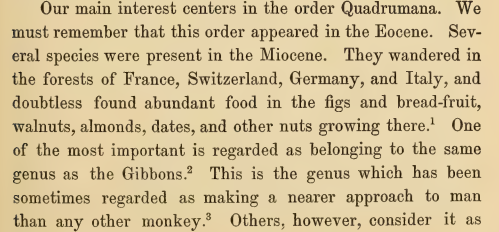
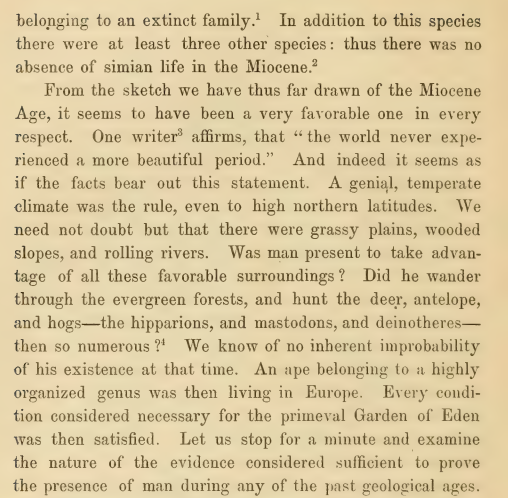
Like I said, there’s some fun goofy stuff in there – the old-ass taxonomic term “Quadrumana,” a paleobiogeography that predates the Out of Africa model of human origins, and the to-us-now shocking attempts to extend the presence humans back to the Miocene! (just for context, Allen’s work of course predates radiometric dating [it predates the discovery of radiation, in fact] so they’re using a relative chronostratigraphic approach; even so, a Miocene origin is wild! The Miocene *ended* ~5 million years ago, and the oldest extant example of the genus Homo is 2 million years old!) But this section is interesting when compared to the “Rogues in the House” excerpt. Here, a Miocene primate is explicitly stated to have made “a nearer approach to man than any other monkey,” which sounds very much like what Nabonidus said of Thak. Later in the passage Allen refers to a “highly organized genus” (meaning “evolutionarily advanced”) of ape as living in the Edenic Europe of the Miocene. Non-humans “ascending” towards humanness in the fathomless depths of time – this is extremely REH’s bag, you know?
It’s a bit too much to get into now (though it’s a topic I’ll definitely be returning to in the future) but there’s another relevant library in the Howard household that bears on this discussion – his dad’s bonkers collection of esoterica! That Howard was familiar with at least a popular gloss of Theosophical concepts is obvious from his work; the ideas of cyclical catastrophes, of the struggle of “root races” to ascend the ladder of progress over and over again, these concepts out of Theosophy are probably just as important as his understanding of geology and biology. Of course, the reality is that the Theosophists were actually responding to the science of day, drawing their myths and mysticism out of the mid-19th century scientific milieu the same as Allen (and everyone else). Geological catastrophism, deep time, sinking and rising lands (like Lemuria!), comparative religion, all of these ideas were taken out of their scientific and scholarly context and massaged into a new mystical quasi-religion, one that Howard’s dad was EXTREMELY well read in. But that’s for another post!
Leaving the Howards’ libraries behind, there’s an even more direct source for REH’s views on evolution we can tap: his letters! Thanks to the tireless effort of a bunch of editors, we’ve got an embarrassment of riches when it comes to the letters of REH. And, given the voluminousness of his correspondence, there’s a lot to choose from! Let’s hit a big one right away:
Let us consider the insect Man. How many specimens of this creature are willing to believe that they came from the same root stem as the elephant, the garter snake and the leopard? No, they must have a special creative act, a special Divine process to account for their godlike beings – bah, either Haeckel’s right and there is no such thing as a “soul” in the accepted sense or else everything has a soul, whether organic or inorganic. Let the theologians seek to refute the theory of spontaneous generation all they wish – I admit it is rather difficult to grasp in a cosmological sense, but biologically speaking, the scientific world has as a whole, I think, accepted the unicellular theory as a positive fact. The facts boiled down are these: theology must accept evolution both in ontogeny and in phylogeny if it accepts geology.
REH to Tevis Clyde Smith, March 1928, The Collected Letters of Robert E. Howard, volume 1: 1923-1929, Rob Roehm and John Bullard (eds)
That’s a pretty definitive statement, and one completely antithetical to the quote from the movie. Howard is 100% rejecting a special creation for humanity (and, indeed, for all of life). The “spontaneous generation” he’s referencing is not the “flies from meat” thing you might’ve heard about, but rather the idea of life originating on its own from inorganic matter via natural processes in the deep past. This, in particular, was one of Haeckel’s (many) research interests – taking up a topic that Darwin himself had not dealt with, he posited that highly organized but inorganic matter (like crystals) may have given rise to simple organic life, the “unicellular theory” REH mentions later. Howard is also explicitly rejecting biblical authority on theological matters in this letter too – theologians have to reckon with Haeckel’s biogenic law as well as the reality of Deep Time, rather than the other way around!
The prominence of Haeckel in Howard’s thinking is fascinating, and it’s something I’d never appreciated until I read his letters. He’s easily the biologist most mentioned by REH, and he seems to have seriously engaged with ol’ Ernst pretty heavily at some point (though, in a later letter to Lovecraft, he admits that he’d forgotten a lot of about the details of his work). Presumably, his exposure to Haeckel was in school, where Howard was part of a “science course” which, presumably, operated as a kind of theme or special focus in his curricula. It’s striking the effect it must’ve had on Howard; Haeckel comes up a lot (alongside famous scientific racist Herbert Spencer), whereas Darwin is mentioned only once…in a list of people who have “grasped the cosmic” that also includes Haeckel and Spencer and Huxley. What’s interesting in particular is that in addition to Haeckel’s biological and evolutionary work (he was a major popularizer of Darwin), REH seems enamored of Haeckel’s strange brand of monism, which provides a kind of romantic and pantheistic underpinning to the natural world (in opposition to a strictly materialist view). This same kind of vaguely mystical biology is something also seen in Herbert Spencer, another of REH’s favorite thinkers – he in particular seems to enjoy Spencer’s ideas of the “Ultimate Unknowable,” which much like Haeckel leaves room for some sort of ineffable energy or drive behind the mechanical operation of the universe and life.
Of course, the other things that Howard undoubtably took from both Haeckel and Spencer were their scientific racism and polygenism. Both men were, like many people of the age, eugenicists; Spencer, who as mentioned above was name-checked by REH a lot in his letters, originated the term and idea of “Social Darwinism;” he also coined the term “survival of the fittest,” an obvious and important part of Howard’s philosophy and ethos. Additionally, Haeckel was a vocal and powerful proponent of scientific polygenism, the idea that the various human races arose separately from different ancestors and at different times. In fact, part of Haeckel’s theories about the origins of life, the “spontaneous generation” mentioned in the letter, was that life itself was potentially polygenetic, having arisen multiple times out of inorganic matter on earth. While REH never outright states his support for polygenist views in his letters, the idea is clearly present in his fiction – there are multiple examples of different “races” rising up out of semi-apedom into humanity in his essay “The Hyborian Age,” for example, and the idea is implicit in the way he writes about Thak and the Worms of the Earth. It’s probably also a part of his horror of miscegenation: Howard clearly believes that there is something fundamentally biologically wrong with race-mixing, in addition to the moral decadence that he felt it represented.
It’s worth taking a look at Haeckel’s visual representation of this idea, because it’s a subtle but important point that illustrates REH’s thinking. The below figure is a portion of a plate from the English translation of one of Haeckel’s books, his 1879 Evolution of Man:
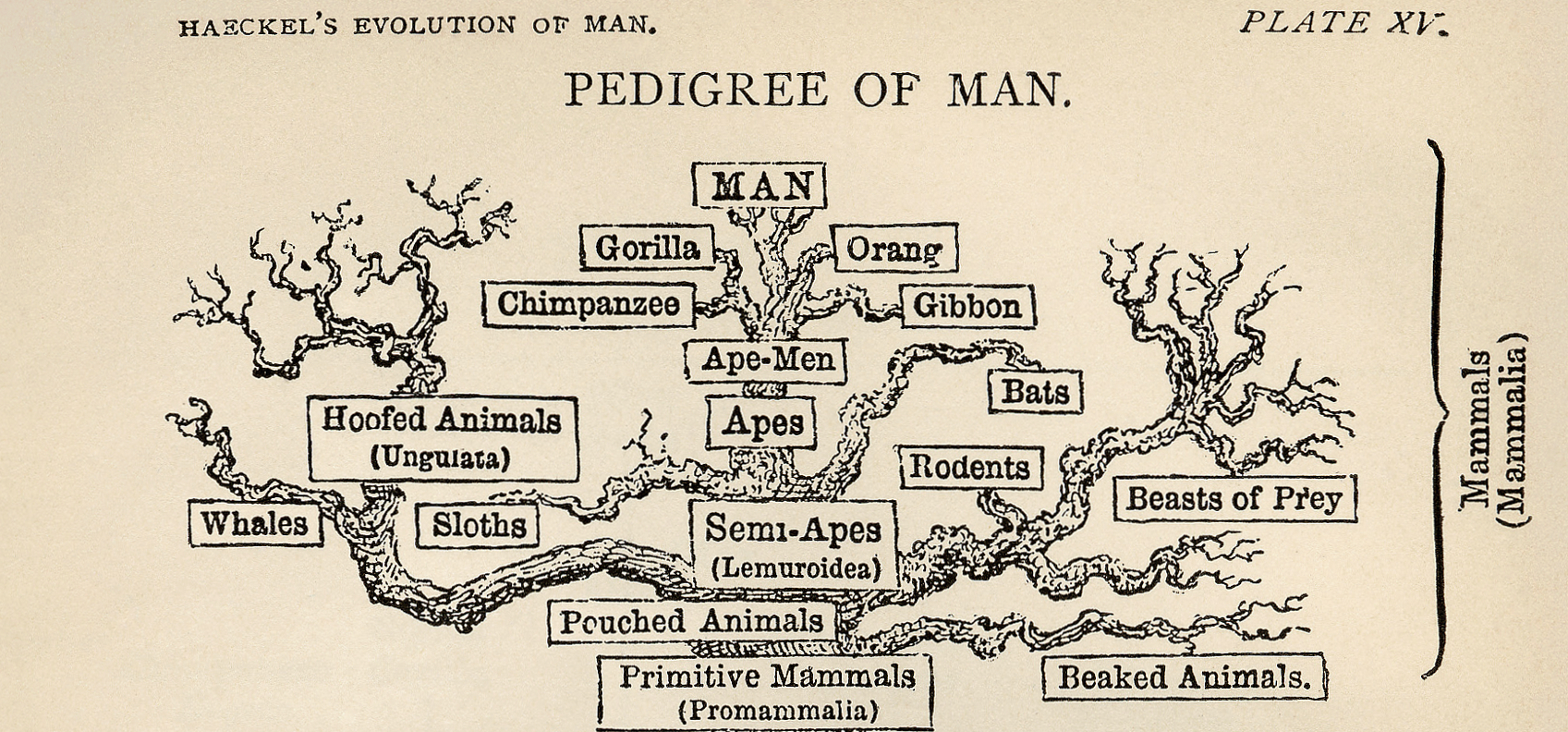
A few things are worth noting here: first, the placement of MAN atop the tree, crowning the progressive hierarchy implicit in the history of life. More important, however, is the very subtle way Haeckel conveys his idea that the human races arise out of different ancestors. A forking branch proceeds from APE-MEN, with single branches leading to GIBBON, ORANG, etc. But then look at the MULTIPLE BRANCHES (six of them!) leading into MAN. Like I said, it’s a subtle but very important point with some extremely unpleasant implications, namely that the various races of humans represent distinct biological species arising out of a common ape-man ancestor. It’s foul stuff, but it’s also recognizable as a very common belief among people in Howard’s time, and within Howard’s work; put “Cimmerian,” “Stygian,” “Hyborian,” etc on each of those branches and you’ve got a good representation of Howard’s ideas.
Another letter, this one part of the interminable HPL-REH Civilization-vs-Barbarism running gun battle that they had for years and years, interestingly provides some insight into Howard’s opinion of religious anti-evolutionists. The context of this short excerpt from their (unending and tedious) argument focuses on HPL’s view that REH doesn’t hold artistic endeavors in as high of esteem as he should. Regardless, the relevant section is interesting as regards our topic here today:
Between the fundamental religionist who goes into foaming rages over the idea of evolution, because he can not stand the thought of kinship with a monkey, and the artists who strains his guts to prove his distance from the protozoa, I see no basic difference; both seem outcroppings of the idea concerning the divinity of man.
REH to HPL, September or October 1933, letter 259, The Collected Letters of Robert E. Howard Volume 3: 1933-1936, Rob Roehm and John Bullard (eds)
It’s a pretty funny statement; I love to imagine a tortured poète maudit weeping over the need to distinguish themselves from protists in the eyes of the posterity. But it’s also a helluva rejoinder to the weird statement from Novalyne’s memoir and in the movie, isn’t it?
One last letter excerpt, because they’re fun and more people need to read ’em! This one is from a letter to August Derleth, and in addition to its relevance to our discussion here, it is also one of those great examples of REH really playing up rurality for his non-western interlocutors:
A friend of mine was trapping once […] He thought he had a muskrat and climbed carelessly up and stuck his head over the ledge, and there was a skunk in the trap and it let him have a full volley smack in the face […] My friend fell off the ledge with an ear-splitting shriek and rolled on the ground for some time after the exact fashion of a hound-dog […] Nobody could doubt evolution after watching the antics of a man who has just been slapped in the mush by a polecat.
REH to August Derleth, July 4 1935, letter 319, The Collected Letters of Robert E. Howard Volume 3: 1933-1936, Rob Roehm and John Bullard (eds)
In addition to just being a funny story, it also shows how, even beyond the eugenicist background of his thinking, Howard’s worldview (and his fiction) was founded on an philosophical framework of what was “natural,” a view informed strongly by a belief in evolution. There’s also present the idea that this “naturalness” reflects the fundamental biological order of the world – a man, for all his sophistication, is no different than a dog when confronted with the same problem (of getting their shit rocked by a pissed-off skunk). There’s really no way to imagine Robert E. Howard without a belief in evolution – the idea is as central to his work and worldview as it is for Lovecraft, and having him question it in the movie (rejecting it in favor of the bible even!) is truly bizarre!
So what’s going in Novalyne Price Ellis’s memoir, One Who Walked Alone and the movie it inspired? Well, there’re a few options, I reckon:
1 – Novalyne Price made it up whole cloth. It’s a possibility, certainly – as described by Bobby Derie the creation of One Who Walked Alone remains opaque, with the author dead and her notes and materials unavailable, leaving us merely with the book. A key motive for Price writing it was to counter negative portrayals of Howard; perhaps she felt a definitive statement of belief in the Bible was important (including a statement of Creationist faith) and so inserted it into the narrative. As far as I can tell, we don’t know anything specific about Novalyne Price’s religious leanings, though she does write about attending church and believing in God (and in everyone’s right to worship God in whatever way they see fit) in the book. But who knows? An older Southern lady writing in the late 70s-80s, she very easily could’ve held Creationist beliefs, and decided to put REH in the camp of the angels. Without access to her diaries and journals, we’ll never know! But this is clearly the very darkest option – it puts her memoirs, as a source of sincere recollection, into *very* shaky, shady territory!
2 – Novalyne Price misunderstood/misinterpreted something REH had said. Reading Price suggests (to me at least) that she *thought* she understood REH better than she actually did. There’re numerous places in the book where she seems to be confused by what is, plainly, REH making a joke or poking fun or being ironical. Additionally, Howard could clearly be kind of a combative asshole, picking at people or arguing for argument’s sake. The exchange in the book is actually a good deal more contentious than is presented in the movie; Howard, at least to my reading, absolutely understands that his mother was talking shit about Novalyne, and he’s getting a kick needling her and watching her reaction (a very common thing in the book). If so, the odd statement about the bible and creationism becomes legible as just more of REH’s situational weirdness, where he’s trying to offer biblical support for his position, knowing that it’d annoy her.
3 – REH said it because he thought it was something Novalyne wanted to hear. Like I said, the discussion around miscegenation that REH and Price are having is a bit of a strange, heated one. Maybe Howard wanted to change the subject, or in the moment felt like he was offering an olive branch by claiming to be a bible-believer (something clearly important to Price, from sections elsewhere in the book). It would mean he was straight up lying of course, since his letters seem to make his position very clear. Also, it’d be an odd moment of him backing down too; he seemed to love scrapin’ and arguin’ with Novalyne in particular!
4 – REH said it because he believed it. The weirdest and hardest-to-swallow option, but there it is. We contain multitudes, and maybe Howard had had a strange religious epiphany. I knew a devout Mormon paleontologist who described his life this way: six days of the week, he believed in evolution and geochronology and the fossil record, but on Sunday, he didn’t. Maybe Howard separated himself from his work like that, though that seems extremely unlikely given the whole “he put a bit of himself into everything he wrote” paean from Lovecraft and all. It’s again also a statement completely at odds with his own words, both fictional and in his letters!
As to which one it is, who the Hell knows? What I think is very certain, however, is that contrary to the statement reported by Price, Howard absolutely believed in evolution. In particular, the concept was central to his whole world view, both in his life and in his work. This is not to say that he had no religion; the scientists from whom he had drawn his understanding of evolution, Ernst Haeckel and Herbert Spencer, were themselves certainly not atheists; both of them believed in a kind of pantheistic drive that, while operating within the realm of the mundane and through the laws of biology and physics, nonetheless held something of wonder and, if not divine, then at least something more-than-mechanistic about it. Given his father’s own unusual religious milieu, something like that, a combination of Haeckelean monism with pop Theosophy, makes a lot of sense. Afterall, Jesus was an Ascended Master in a lot of New Age religious movements, so there’s even room for a (nondenominational) kind of appreciation for the Bible in there.
What there ISN’T room for is creationism – time and time again, the centrality of evolution to Howard’s writing is made abundantly clear. The battle between Cro Magnon and Neanderthal at the dawn of human history, the punctuated cataclysms of Howard’s Atlantis and Hyboria, the aspirational evolutionism of Thak and the thwarted phylogenetics of the Worms of the Earth, all of these are just as much evidence for Howard’s deep commitment to the reality of evolution as are his literal statements of the same in his letters.


Pingback: HPLinks #90 – Innsmouth Lit Fest, new Poe book, Cross Plain pictures, Beastarium book, and more… | Tentaclii