The annual Wow-it’s-finally-Livable-in-Austin-again turning of the seasons has happened here – gone are 100+ October days, replaced with crisp mid-80s and frosty overnight lows in the 60s, and for me it’s just in the nick of time! The lingering heat is extremely destructive to one’s health and sanity, so it’s kind of a big deal that we can finally have windows open and don’t immediately wilt upon stepping outside. And, with Texan autumn comes a marked increase in my personal sense of Halloweenishness, so I wanted to do something fun and muse upon about what is probably the single most important horror story of the 20th century, H.P. Lovecraft’s Call of Cthulhu, which is (from a certain perspective) 100 years old this year!
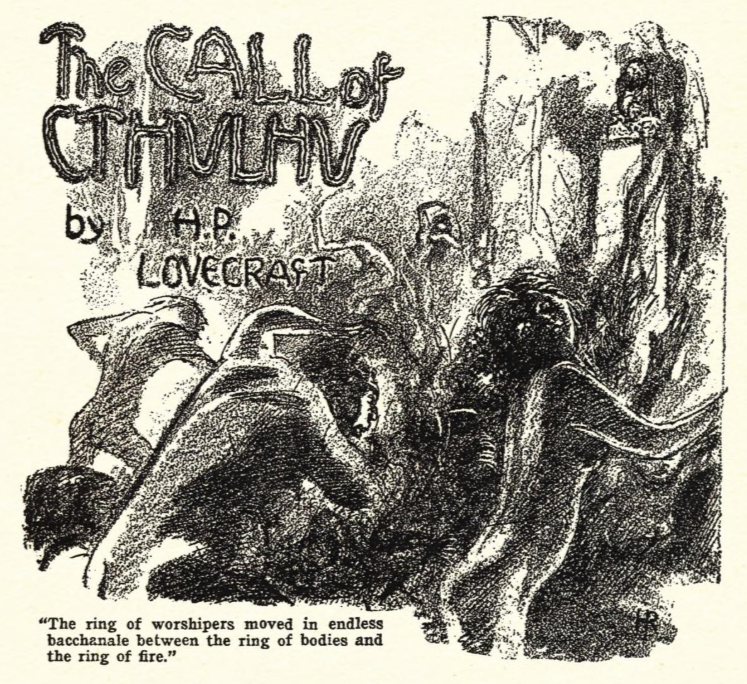
Now, I say it’s “sorta” the centenary of this story because of course it wasn’t actually PUBLISHED until 1928 (we’ll do this again in a couple of years maybe!), which is of perhaps greater technical importance – after all, its influence on people couldn’t start until it was available to be read! That said, we do know, based on his letters, that Lovecraft finished the story in 1926, probably in the summertime, after leaving New York City and returning home to his burrow in Providence. In an October ’26 letter to his buddy, Clark Ashton Smith, he mentions that he’d just wrapped up a couple of tales, including a “sunken-land thing” that he’d described “last year.”
Its route to eventual publication in 1928 is a little arduous; Farnsworth Wright rejected it when it was first submitted (presumably in late ’26 or early ’27) and we know that Lovecraft had earned another rejection for it from a Mystery pulp too; that’s an interesting point, because Lovecraft had wracked up another rejection from a Crime pulp for his story “The Horror at Red Hook,” and later on he’d write a version (sadly lost) of “The Shadow Over Innsmouth” that had been much more in the vein of a pulp detective story. There’s an interesting history, one I’ve never seen explored, in Lovecraft’s rejections, a kind of counter-factual Lovecraft oeuvre that’s fun to imagine.
But, of course, “The Call of Cthulhu” was eventually published in Weird Tales. Famously, Donald Wandrei, writer and Lovecraft Circle member, claimed that he was responsible for its acceptance by Wright in late ’27. According to Wandrei, he went into the offices of Weird Tales and, in the course of gossiping with Farnsworth, dropped the juicy bit of news that HE’D heard that HPL had been sending his stories out to other magazines (which was true), and in particular that he had a great one that he was shopping around, and Wandrei just *couldn’t* understand why Lovecraft was looking to move beyond the august pages of Weird Tales, which *really* was the perfect place for his work. In other words, he made it seem like HPL was on the verge of slipping out of Wright’s grasp. Now, this account comes from the 50s, in a retrospective essay Wandrei wrote that was published in the Peter Cannon edited volume Lovecraft Remembered, but it’s a good story and regardless, Wright did accept “The Call of Cthulhu” when it was resubmitted in ’27.
I’m not going to do a full read through of this story – this ain’t a pulp strainer entry after all – but I do want to highlight some bits and pieces that I find interesting, and then we’ll talk about what I, a humble weird fiction writer and reader, think is important about the story.
The very first thing that stands out right away is the a little note appended to the story stating that the document you’re about to read was “found among the papers of the late Francis Wayland Thurston, of Boston.” You can see it In the original manuscript, right between the title and HPL’s name, added as a parenthetical:
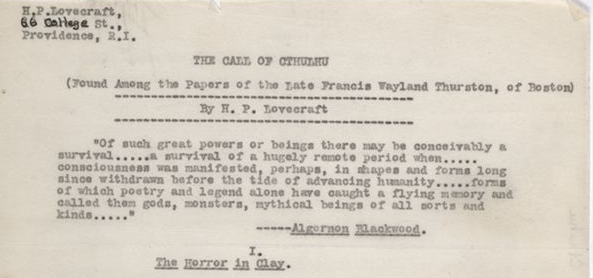
That little parenthetical is doing some heavy conceptual lifting, and is a hugely important part of both this story as well as more broadly within Lovecraft’s broadly defined “mythos!”
First off, within the context of the story and as a mechanism of the plot, it’s absolute gold. It immediately gives the story a very clear narratorial voice, one that lets Lovecraft give background and editorialize as needed without any clumsy expository shoe-horning. It’s a perfect frame for a weird story too – this is the result of a very specific investigation, by a specific guy, into a specific thing, which means again that background and asides and explanations can appear diegetically within the story. That’s important, because it preserves the verisimilitude of the story, letting the reader really immerse themselves fully within the tale. It’s also a nice weird touch that the document we’re about to read is positioned as being the posthumous work of this Thurston fella – we know that the narrator of this story has died, and we’re immediately put into a kind of tense paranoia about how he died, and why.
It’s not anything Lovecraft had control over, but I actually think the presentation of this parenthetical in the pages of Weird Tales is pretty great and really adds to the story. Like you see above in the manuscript, Lovecraft just stuck it in there between the title and his name, which is the way it’s often displayed in collections. For example, here it is in the Penguin Classics The Call of Cthulhu and Other Weird Stories:
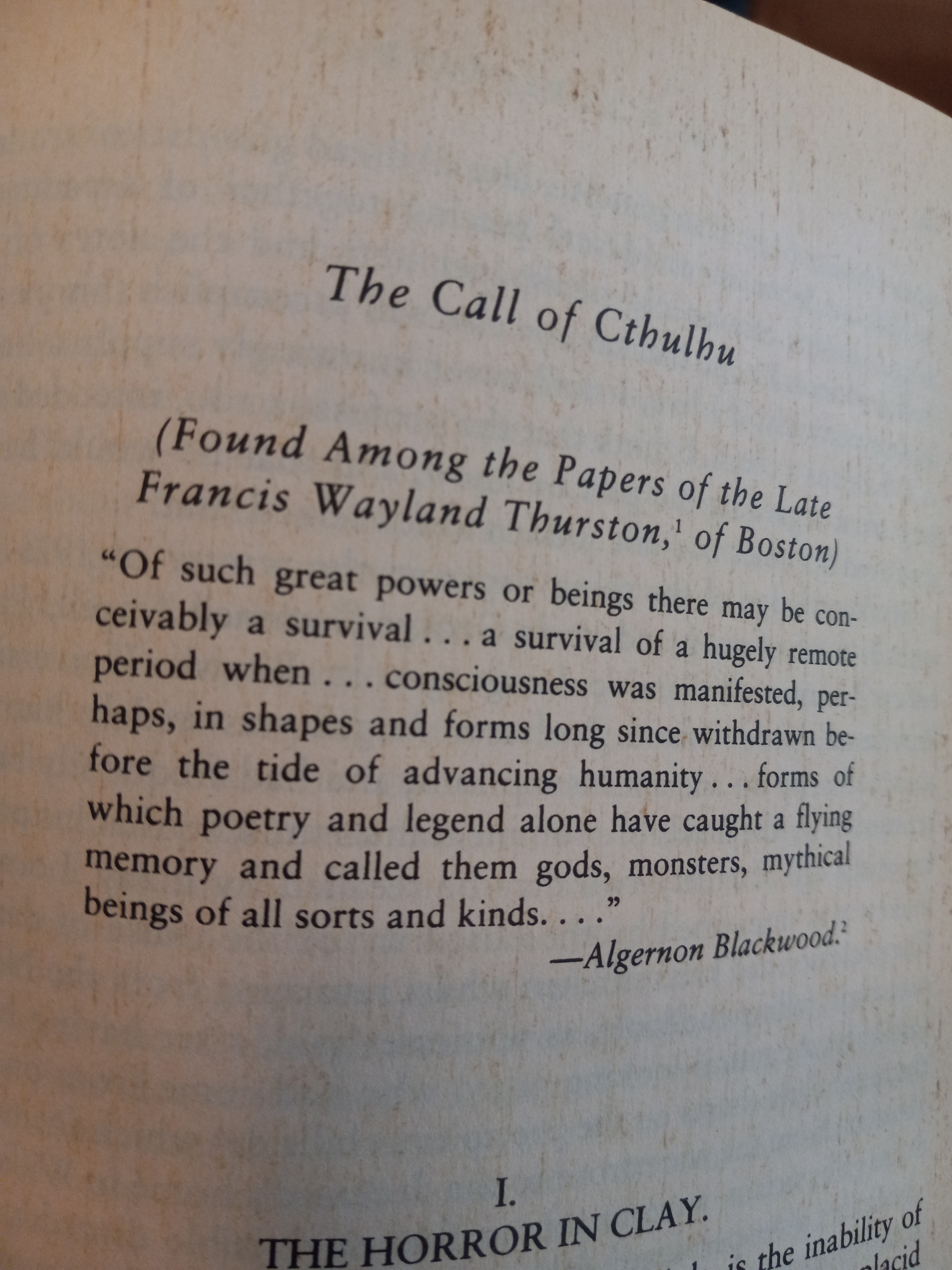
Likewise, here it is in the Joyce Carol Oates’ edited Tales of H.P. Lovecraft:
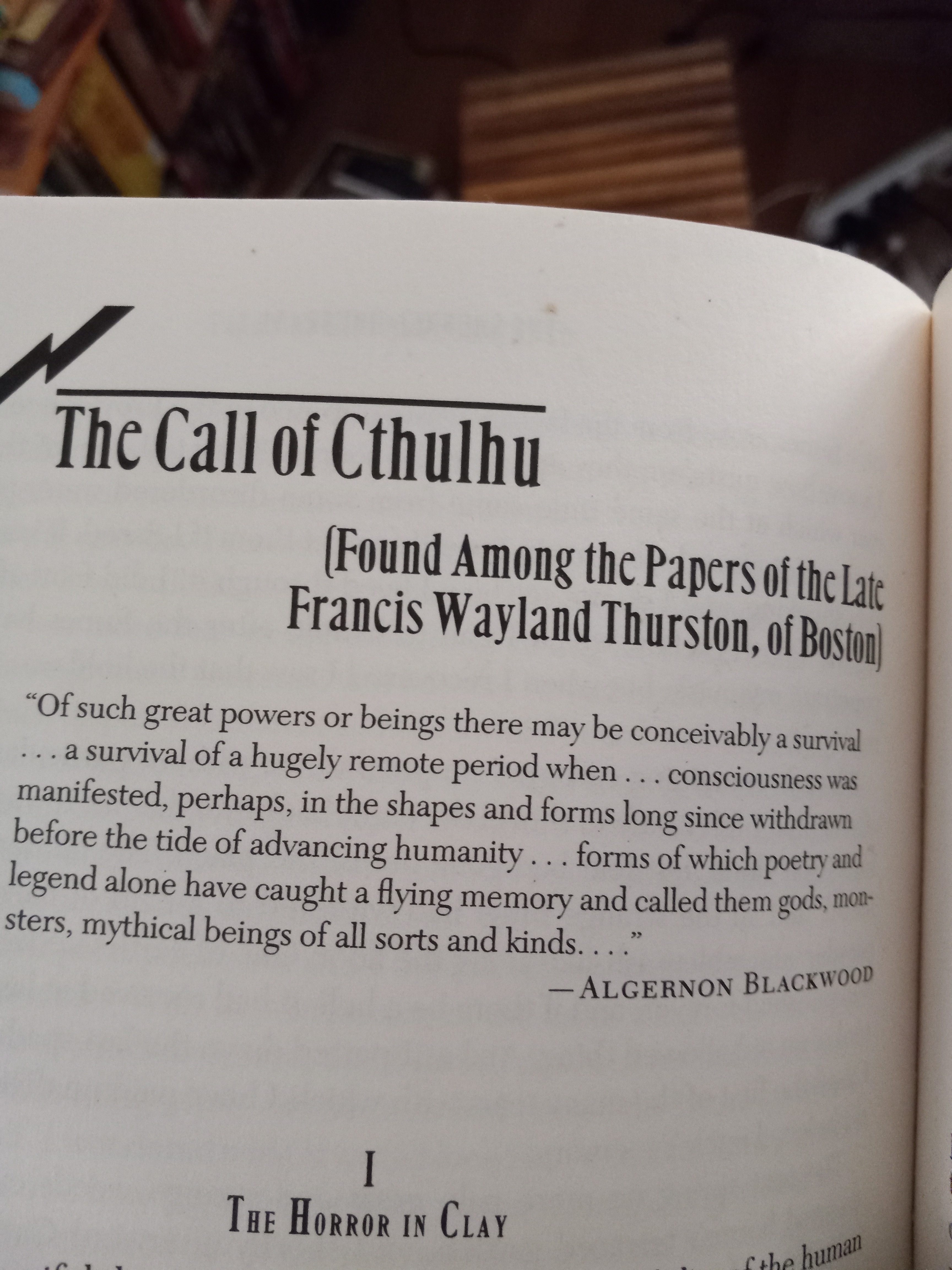
Both of these examples follow Lovecraft’s lead in the original manuscript. But take a look at how it appeared in Weird Tales in 1926:
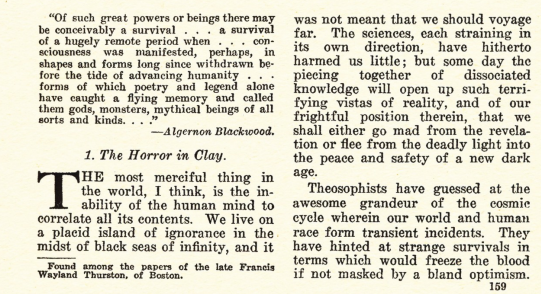
Here, this clever little framing device is put as a footnote on the first page. This feels VERY different – if that same statement is placed up near the title, it’s immediately apprehended as part of the story. But as a footnote, it’s now a different thing – the frame of the story is somehow realer, since it’s borrowing the greater authority of a footnote. And compare it to another footnote from a different story in this same issue, Gautier’s “Clairmonde:”
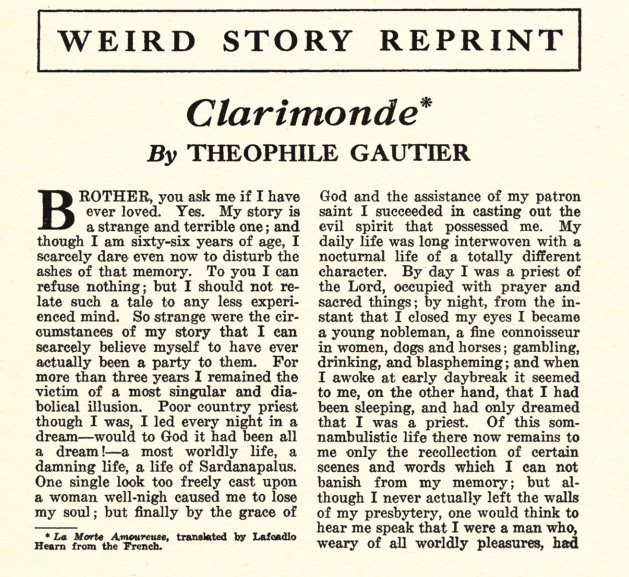
Here, the very real translator’s footnote, identifying the original French title and the fact that it was translated by Lafcadio Hearn, is in the exact same position as the fictional provenance given for “The Call of Cthulhu.” That’s actually a really fun bit of blurring! Certainly no one is being tricked by this – it’s very clear that Lovecraft’s footnote is part of the fiction, whereas the translator’s note is not. But again, the placement as a footnote makes it that much more fun and conspiratorial and somehow more real than the same framing statement presented as a kind of subtitle.
(As an aside, if you’re interested in the history of these translations in Weird Tales, then buddy, have I got a book for you! And a paper too!)
Anyway, all of this is a great example of Lovecraft’s “hoax” approach to weird fiction, which he articulated in a letter to Clark Ashton Smith in October of 1930:
My own rule is that no weird story can truly produce terror unless it is devised with all the care & verisimilitude of an actual hoax. The author must forget all about “short story technique,” & build up a stark, simple account, full of homely corroborative details, just as if he were actually trying to “put across” a deception in real life – a deception clever enough to make adults believe it. My own attitude in writing is always that of the hoax-weaver.
You can see that Lovecraft had been working on this idea in pursuit a similar effect for a while in his previous work. “The Statement of Randolph Carter” is basically a transcript of a police statement, and similarly “Pickman’s Model” is entirely a one-sided conversation between the narrator and a second silent friend; superficially these are similar to “The Call of Cthulhu,” in that they’re not merely first person accounts (like in “The Music of Erich Zann,” for example) – rather, they’re presented as kinds of metafictive “documents” within the world of that weird story. However, in both “Carter” and “Pickman,” there’s no formatting to formalize the stories as documents – Carter is just talking to the cops, for instance, and there’s no time stamp or institutional affiliation (“Gainesville PD Official Witness Statement” or something like that) to give the story that specific hoax-like quality that Lovecraft was talking about.
Lovecraft does have “found document” stories that predate “Cthulhu” of course: “Dagon” is a suicide note, though a reader is only informed of that within the story. More explicitly, the tale of submarine madness in “The Temple” is stated as having been found in a bottle “off the coast of the Yucatan.” It’s interesting that another “sunken land thing” story is likewise being presented as a found document, isn’t it? The “found” framing of “The Temple” is an important antecedent for “The Call of Cthulhu,” just as much as the themes of the lost, sunken world of eldritch horror – Lovecraft uses a distinct voice to present us with lots of (potentially) verifiable details (the names of ships and dates of u-boat action, details of shipping routes, etc), loading this fictive message in a bottle with real verisimilitudinous weight.
But “The Call of Cthulhu” is a different beast. For one thing, it’s more than just a single, continuous statement from one solitary character. Structurally, it’s Lovecraft’s Dracula: an epistolary tale about an investigation, organized retrospectively by a character within the story and preserved as a document for posterity. It includes not just a single narrator’s account of their experience, but also newspaper clippings and excerpts from ANOTHER character’s personal retrospective diary, alongside summaries of nested stories told to other characters. It’s really incredibly immersive, and you’re hard pressed not to get sucked into the weird, conspiratorial fun of the whole thing!
The nesting structure of the story is really pretty sophisticated, and works like a trap to ensnare the reader. The story starts with Thurston examining his Uncles’ papers, finding the locked box that Thurston implies holds material that would have been destroyed if his uncle hadn’t died mysteriously. Then we enter into the account of the Horror in Clay, a modern bas-relief that, for some reason, got his uncle quite excited and sent him chasing after more mysteries. Thurston doesn’t understand why the bas-relief and the dreams of the weird artist were so interesting to his uncle until *he* reads further into the account, where there’s an EARLIER story of a conference his uncle attended where another mysterious piece of art was presented, accompanied by TWO separate but corroborating stories from two different people! In other words, we’ve been reading Thruston’s story about his uncle’s story about Wilcox’s dreams which are important in the context of a different story from Thurston’s uncle about a conference where he saw a weird statue that would later remind him of the bas-relief AND where he heard strange tales of a horrific cult in Greenland that seem to be the same cult that a New Orleans policeman encountered much later. It’s pretty dizzying, but utterly seamless. And we’re not even half-way through the story!
I really think this kind of knotty, convoluted, intercalating narrative does something to the reader, or maybe it’s just that it forces the reader to really focus and sink themselves into the text. It’s just more fun to read, kind of like the concept of elegance in mathematics – there’s pleasure in seeing the puzzle come together, and the more complex the pieces (and picture), the more fun it is. What’s really remarkable to me is that the other examples of this kind of convolved text are all much, much longer works; Potocki’s The Manuscript Found in Saragossa, Stoker’s Dracula (which, famously, has a part where the characters in the novel all stop to read the novel up to the point where you, the reader, are at, so that everyone is on the same page!), or Machen’s The Three Imposters. But all of these are novels, and they take advantage of the novel’s more languorous pace and spacious form to engage in their self-referential hijinks or, in the case of Dracula, to insert the disparate materials for consideration. But “The Call of Cthulhu” is like 11,000 words long, a very lean story for all the complex tricks and nested stories it’s doing!
This is all to say that, structurally, I think this is Lovecraft’s most complex and ambitious work. That’s worth considering on it’s own, but likewise I think that Lovecraft is using this complex structure to reinforce a similarly complex and ambitious concept here, and one very important to the genre of weird horror.
First off all, there’s that famous beginning, as nice a summation of Lovecraftian cosmicism as you could ever want. “The most merciful thing in the world,” writes Thurston, “is the inability of the human mind to correlate all its contents.” That’s the heart of Lovecraftian fiction and one of the major legacies of his work, this idea that we’re just steeped in horror, the world brimful of awful realities that we, luckily, are just too stupid or distracted or plain incapable of apprehending in their annihilating totality. This is something Lovecraft has played with in previous stories; he’s written (but not published yet) “From Beyond,” where this is the central conceit of the tale, and similarly both “The Temple” and “The Horror at Red Hook” are both about hidden realities beneath our own, but this is the first published story of his to really lay down what will become a cornerstone of weird fiction in the 20th century.
While this idea of secret occult forces bubbling beneath the placid surface of everyday life is not unique to Lovecraft (Machen in particular plumbed those depths, and indeed the whole history of Western Esoterism is predicated on that worldview), I do think you can see HPL doing something new and different with it in this story. While Machen and others had already articulated a vision of hidden preternatural forces at work in the world, Lovecraft develops a true paranoid style in weird fiction in “The Call of Cthulhu.” Take, for contrast, Machen’s “The Great God Pan.” Superficially, this is very similar to “The Call of Cthulhu;” the cosmic horror of the entity termed “Pan,” whatever it is, is pretty firmly “naturalized” or “scientized” in the story, a kind of force that exists outside our normal sphere of engagement and is approachable only through a fairly drastic bit of brain surgery. Compare this to the way Lovecraft’s Great Old Ones can communicate with certain members of the human race who possess hypersensitive brains. Also, the corrupting influence of Pan, like the Great Old Ones, is fundamental to their nature as entities beyond humanity – for Machen, Pan harkens back to a time of bestial barbarism in human history, while the Great Old Ones wait for a time when humanity will be like them (“beyond good and evil”).
But the difference, and it’s a major one, between Machen’s Pan and Lovecraft’s Cthulhu is that the former is *simply* a kind of force that we rarely perceive, like radiation, whereas the latter is an *active* force with a definite plan and agency and directive, seeking to impose its will on reality. We share the world with Pan, or with Machen’s monstrous “little people,” but we’re actually at war with Cthulhu (even if we by and large don’t know it). That’s a huge difference! Pan or Machen’s little people are just out there, and if *we* impinge on them we’re in danger of being destroyed, but they’re not actively trying to infiltrate our world. This is the difference between encountering the vampire in his castle versus seeing him transplanted to London; Cthulhu and the Great Old Ones *are* actively pursuing a conquest of a reality that we have accidently and temporarily misidentified as our own.
What I’m calling the paranoid style in weird fiction extends beyond the broad theme embedded in monsters to the actions (and reactions) of the characters as well. Machen’s “The Great God Pan” has a correlating of contents that sees two characters, Clarke and Austen, eventually realizing the hideous truth about Helen Vaughn. This knowledge, however, is empowering – it lets them DO something about the monster among them. Likewise, in Dracula, Mina’s correlating of the data collected by her Husband, Seward, Van Helsing, etc, is what lets them attack and ultimately defeat the vampire. This is totally antithetical to Thurston’s experience in “The Call of Cthulhu” where, in fact, the correlating of a mind’s contents, the piecing together of disparate and seemingly unrelated data, results in madness and destruction. This is a revolutionary difference between Lovecraft’s writing and that of his antecedents, and it’s something that would come to underpin modern weird fiction. And here it is, being introduced largely for the first time, a hundred years ago (well, 98 years ago…)
This implicit paranoia is, or at least has been, the dominant mode of weird fiction (and its related genres of sci-fi, sword & sorcery, etc) ever since, and in fact is so dominant that it can feel a little trite to point it out. But I think that speaks to the foundational importance of Lovecraft – his work is in the DNA of Bradbury, of Harlan Ellison, of Philip K. Dick, of Robert E. Howard, of Michael Moorcock, of William S. Burroughs and Joyce Carol Oates and Borges! Cthulhu is the dominant model of transcosmic monstrosity, not merely in horror fiction but in comic books, sci-fi, and pop culture. Cthulhu, like Dracula, is a character that people recognize and understand, even if they haven’t read the source material – what other character in 20th century horror can that be said of? (The nearest I can think of is Pennywise, but that’s down to Tim Curry more than the book he’s from). The reason for this cultural dominance is because Lovecraft united all his interests and ideas together in one superlative package: “The Call of Cthulhu.” It’s a story with everything you can think of in terms of Lovecraft: ancient god-like aliens, reality warping architecture, ancient books, secret cults. But it’s more than the sum of its parts, because Lovecraft welded them to this paranoid literary style and organized it like a hoax.
It’s important to pause here and acknowledge some ugly truths, too – a key part of Lovecraft’s paranoid style in his weird fiction comes from his time spent in New York City, where his racism and xenophobia were both sharpened and ossified. When you look at his “New York” stories, particularly “The Horror at Red Hook” (which is, in parts, a sort of rough draft for “The Call of Cthulhu”), you see Lovecraft modernizing the model of occult influences that he had been writing about. The kind of quaint, traditionalist, almost folksy worm-that-walk cultists in “The Festival” for instance are gone, replaced by hordes of foreigners speaking unintelligible languages and working furiously to destroy Anglo-Saxondom. Lovecraft was just as much a “clash of civilizations” guy as his pal Robert E. Howard, explicitly stating in several letters well into the 30s that he does not believe cultures (which he racializes) can survive mixing – this is a foundational part of not merely this story, but of the whole mythos. That’s why it’s ALSO important to recognize the centrality of Lovecraft and “The Call of Cthulhu” in literature and culture. These kinds of prejudices are baked into it, and it’s important to trace out who, for instance, is being portrayed as the corrupting and corrupted “other” in the stories being written in Cthulhu’s shadow.
But, taking the ugliness for what it is, this is still a remarkable story that I really think you should read (a clean version, not a scan from Weird Tales, can be found here). I didn’t even get to talk about how neat R’lyeh is, or how crazy Legrasse’s tale gets! There’s a lot of richness in the text, and it’s also just a fun, snaky, wriggly story that really perfectly builds dread and paranoia, AND it changed fiction (not just weird fic!) forever. It is, as I said at the beginning of this rambling essay, easily the most important horror story of the 20th century, and even if we’ve maybe moved beyond it here in the dismal 21st, there’s still a lot to learn from (and about) it. It’s really a perfect read for Halloween, and even if you’ve already read it, there’s fun in re-engaging with it. It really is one of the key texts of the genre!

