Author Archives: Eric Williams

Unknown's avatar

About Eric Williams

i live on the lithified remains of a cretaceous seaway in austin texas

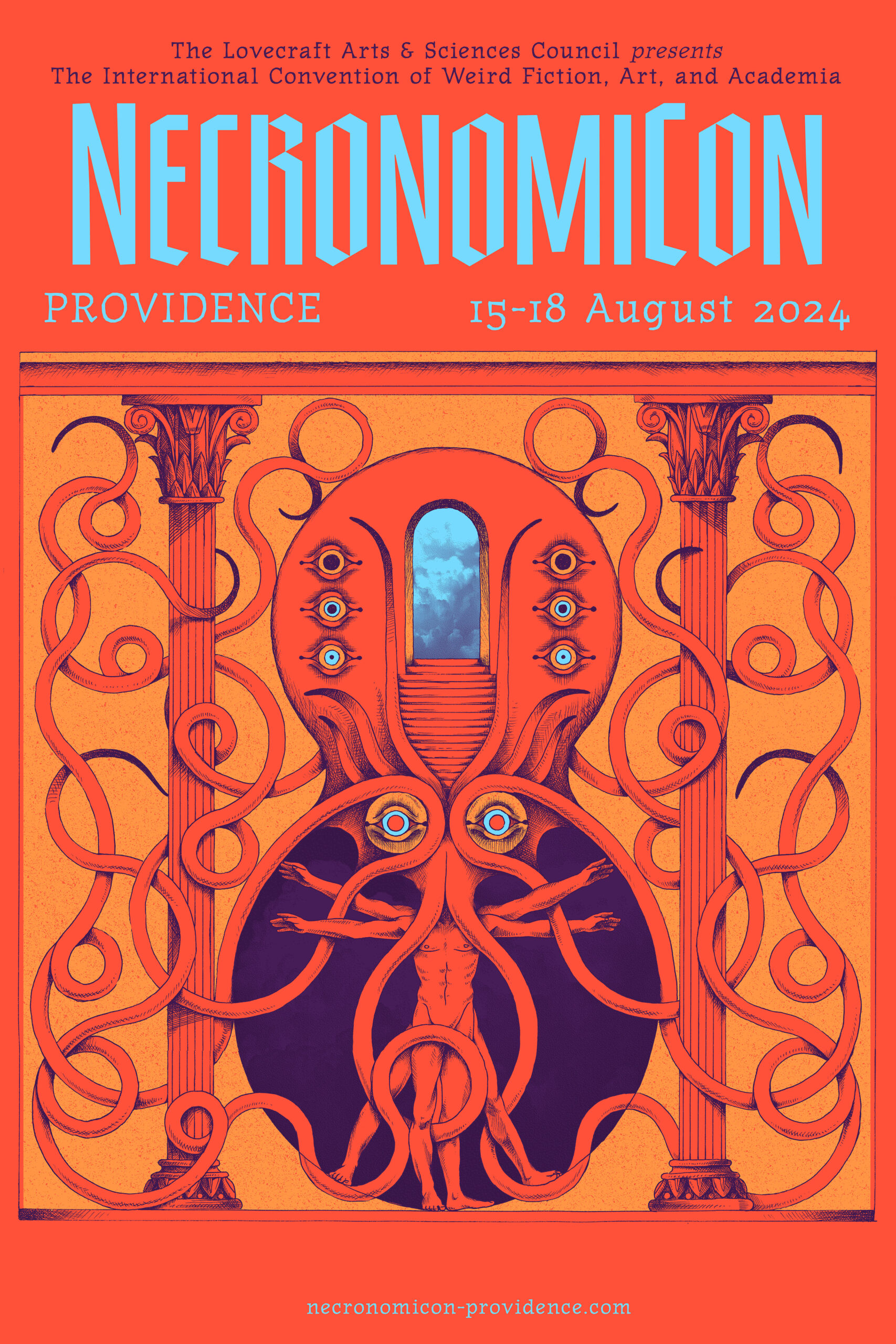
NecronomiCon Providence ’24: After Action Report

I was far from home, and the spell of the eastern sea was upon me. In the twilight I heard it pounding on the rocks, and I knew it lay just over the hill where the twisting willows writhed against the clearing sky and the first stars of evening. And because my fathers had called me to the old town beyond, I pushed on through the shallow, new-fallen snow along the road that soared lonely up to where Aldebaran twinkled among the trees; on toward the very ancient town I had never seen but often dreamed of.
-H.P. Lovecraft, "The Festival"

Much like Lovecraft’s narrator in “The Festival,” I too have recently sojourned to the haunted landscape of New England to partake in (un)hallowed rites kept by the mysterious adherent of a strange and ancient faith. But while Lovecraft’s narrator was celebrating a pagan Yule with ambulatory coffin-worms and subterranean evil, I was in Providence, R.I. for the biennial celebration of weird fiction that is NecronomiCon! Less flopping writhing hordes of unspeakable winged things, more Narragansett beer and (affectionately) nerds!

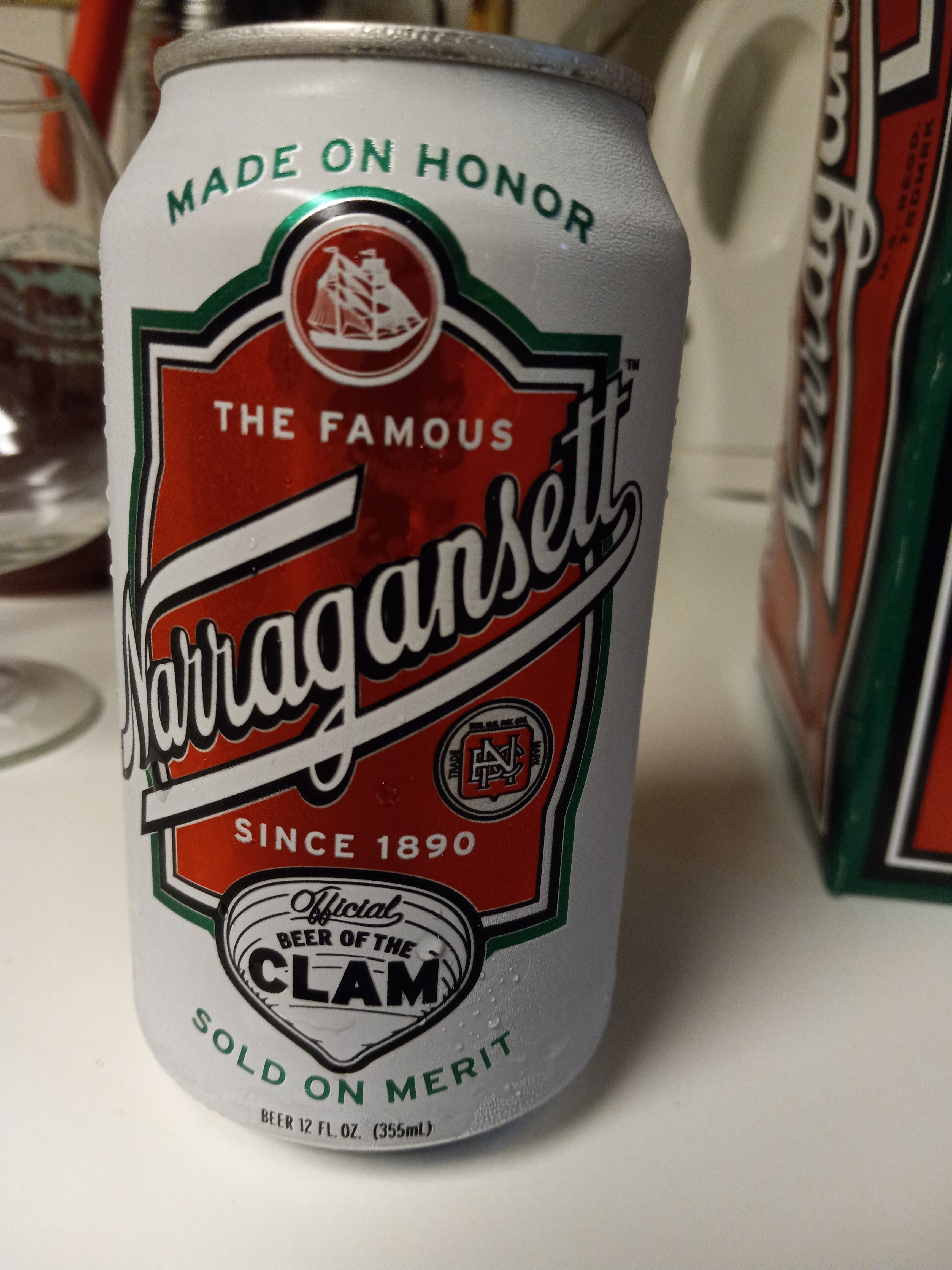
Official beer of the Lamellibranchs!

Now, I’m not much of convention-goer – been to lots of academic conferences, of course, mostly geology- or (these days) soil science-related affairs, extremely nerdy, sure, but not really what you’d call “fan” conventions. Never been to one of them, not even a sci-fi convention! As for my work as a writer, the first convention I experienced was this past spring’s Greater Austin Book Fair, a decidedly small and local effort (though very fun). So this one was really jumping into the deep end for me – I mean, this is a BIG conference, with 2000+ people!

In fact, it’s so outside my wheelhouse, I wouldn’t ever have thought to go if not for Rick Claypool, friend, comrade, writer; he contacted me out of the blue in the spring and suggested that I should A) attend and B) split a table with him. It was an awfully generous gesture, something that I would soon learn is the norm at NecronomiCon, which, not to spoil it, had probably the absolute best vibes, atmosphere, and programming imaginable. Anyway, huge thanks to Rick, and I am going to demand ya’ll head over to his site and use the links he’s provided to buy his books; if you like strange, goopy, heartfelt weird horror with a heavy dollop of absurdism and surreality, you’ll love his stuff.

Rick was also helpful in that he, being an old hand at NecronomiCons, understood the somewhat idiosyncratic (at least, to me) ways in which the convention was organized. The first and strangest hurdle for me was understanding how paneling works there. Now, like I said, I’m used to academic conferences; the way those work, there’s a host committee, see, and at some point you and some folks put together a panel suggestion, a topic or problem you want to talk about, say “Tectonics of the Delaware Basin” or “Soil Chelates and Contamination.” This gets approved by the committee, and then other workers (who you’ve mostly already alerted to the fact that there’ll be a relevant panel) submit papers to those panels, which are then evaluated and included or rejected. Well, and perhaps this shows my naivete with regard to fan cons, that ain’t the way things happen in Providence.

Instead, panel topics are decided by the organizers, and then everybody who has paneled before or expressed an interest in paneling gets a list, scans ’em, and says if they’d like to be involved in any. I guess it’s a little different because, unlike academic conferences, you’re not presenting a paper, you’re a panelist having a discussion – less prep, I suppose, and less formality, a bit freer-form. What’s interesting to me is that the moderators of the panel are likewise drawn from the population of people who say they’d be interested in paneling on the topic. So you could go in expecting that you’re going to just sit up there and wax moronic about some topic or another, but end up being forced to ride herd on a bunch of other people who you’ve likely never met or interacted with! A strange scene!

My only prior experience was the Greater Austin Book Festival, where I’d said I’d love to be on a panel…and didn’t get on one. This makes sense, it’s much smaller, there’s lots of horror and genre people, so of course I didn’t get on there. However, what that meant for me was this: I really wanted to be on a panel, so I put myself down for a LOT of panels, assuming that’d give me a chance to get on ONE of them. Similarly, this same form had a spot you could check if you wanted to do a reading. “Why the hell not?” I thought, and clicked the button.

Simultaneously, there IS also an academic track to NecronomiCon. It’s called “The Armitage Symposium,” and rather than discussion panels, it’s a more traditional 15-min presentations of a scholarly sort. I had written a lightly scholarly intro to Night Fears, about Farnsworth Wright and the fiction-in-translation that appeared in Weird Tales magazine in the 20s and 30s, so I figured I could write an abstract based on that and submit it. The whole plan was, with so many chances, surely I’d get something! I’m a nobody author who wanted to sell some books at this Con, and I figured getting on a panel or giving a talk or reading would be necessary for that to work out – otherwise I’d just be some guy at a table.

Well, ask and ye shall receive: I ended up being a moderator for a panel of Translations in Weird Fiction, a panelist on three others (one on Belgian weird writer Jean Ray, one on the letters of Robert E. Howard and H.P. Lovecraft, and one on The Hollow Earth in Weird Fiction)…and the abstract for my paper “Translating the Weird: Farnsworth Wright, World Literature, and the Creation of Weird Fiction” was accepted to the symposium…and I got reading slot. Six scheduled events for a three day conference! Yeesh!

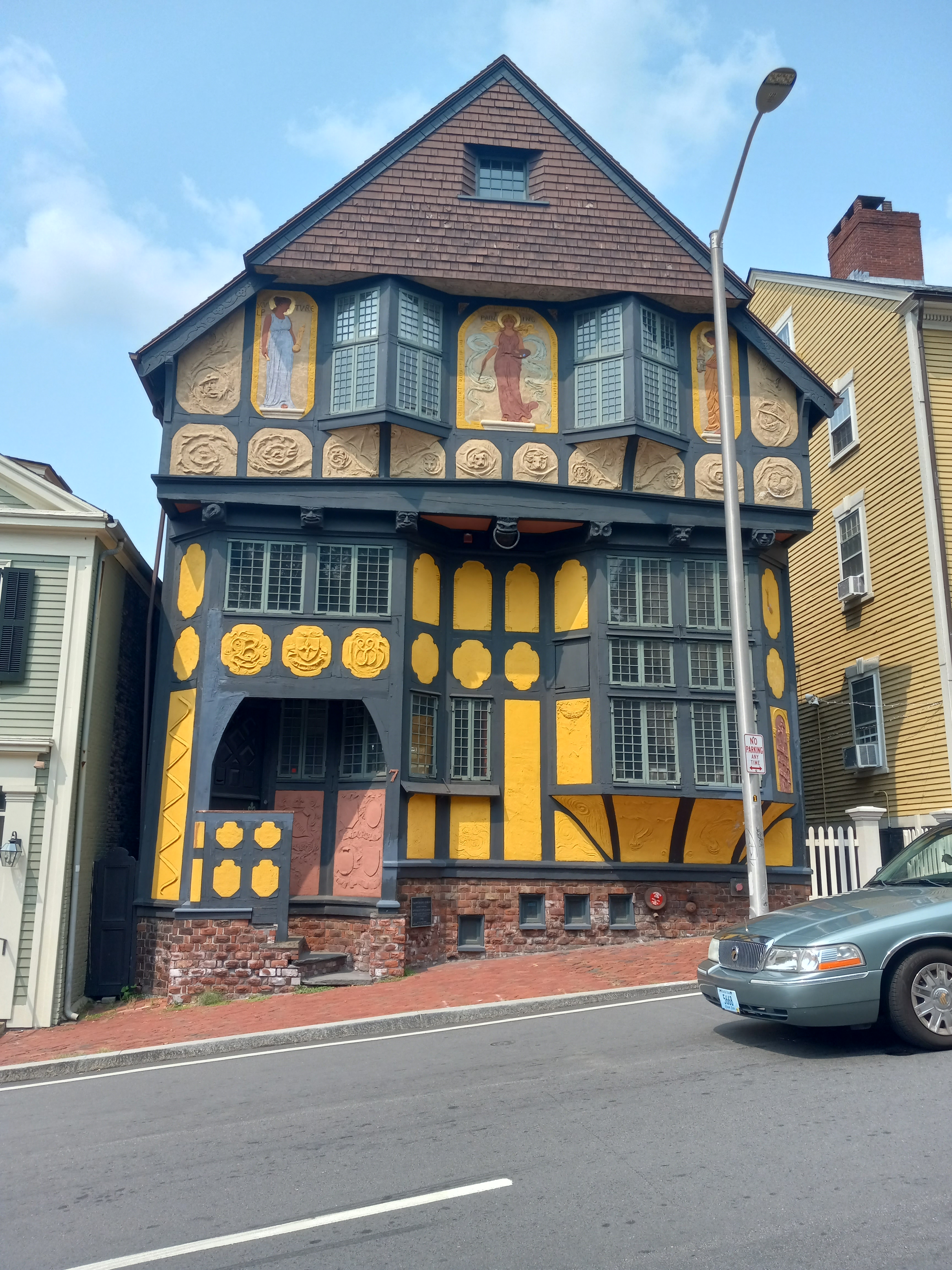
Anyway, the 15th was mostly an open day – I hadn’t moved fast enough to get a walking tour ticket, so instead I used the very helpful map provided by the Con to do one on my own. Lovecraft is an important figure for me personally, so it was a lot of fun to wander around and see some of the important locales from his life and stories live and in person. The first thing I actually saw on the way from the train station, walking up College Hill to the bus stop that would take me to where I was staying in East Providence…it’s the famous Fleur de Lys building from Lovecraft’s “The Call of Cthulhu,” where the psychically sensitive artist Wilcox lived and dreamt of a great lumbering horror.

Fluer de Lys Building, Providence RI

Famously Lovecraft, a bit of a conservative architecture snob, thought this building was ugly as hell…and he might have a point. It is neat looking, in a gaudy, over-the-top kind of way. My understanding is that it’s owned by the Rhode Island School of Design, and they rent out studio space in it to artists, which is fun.

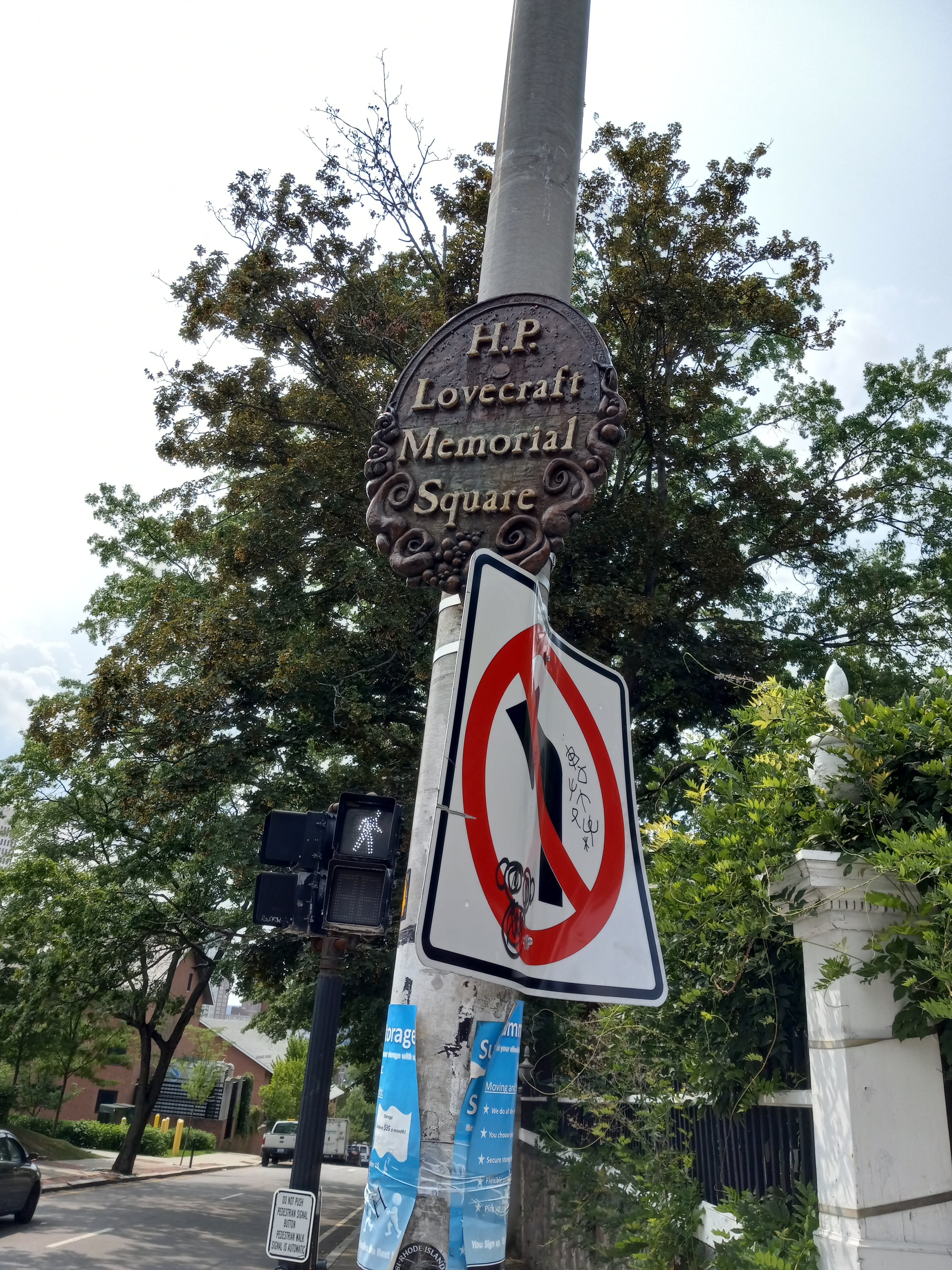
Anyway, I continued up the big ol’ hill to the intersection of Prospect and Angell streets, on the corner of which lil’ Howie Phillips Lovecraft was born in 1890. Now, it’s the “H.P. Lovecraft Memorial Square” which is kind of grandiose for an intersection, but still, nice sign!

Not exactly a picnic spot!

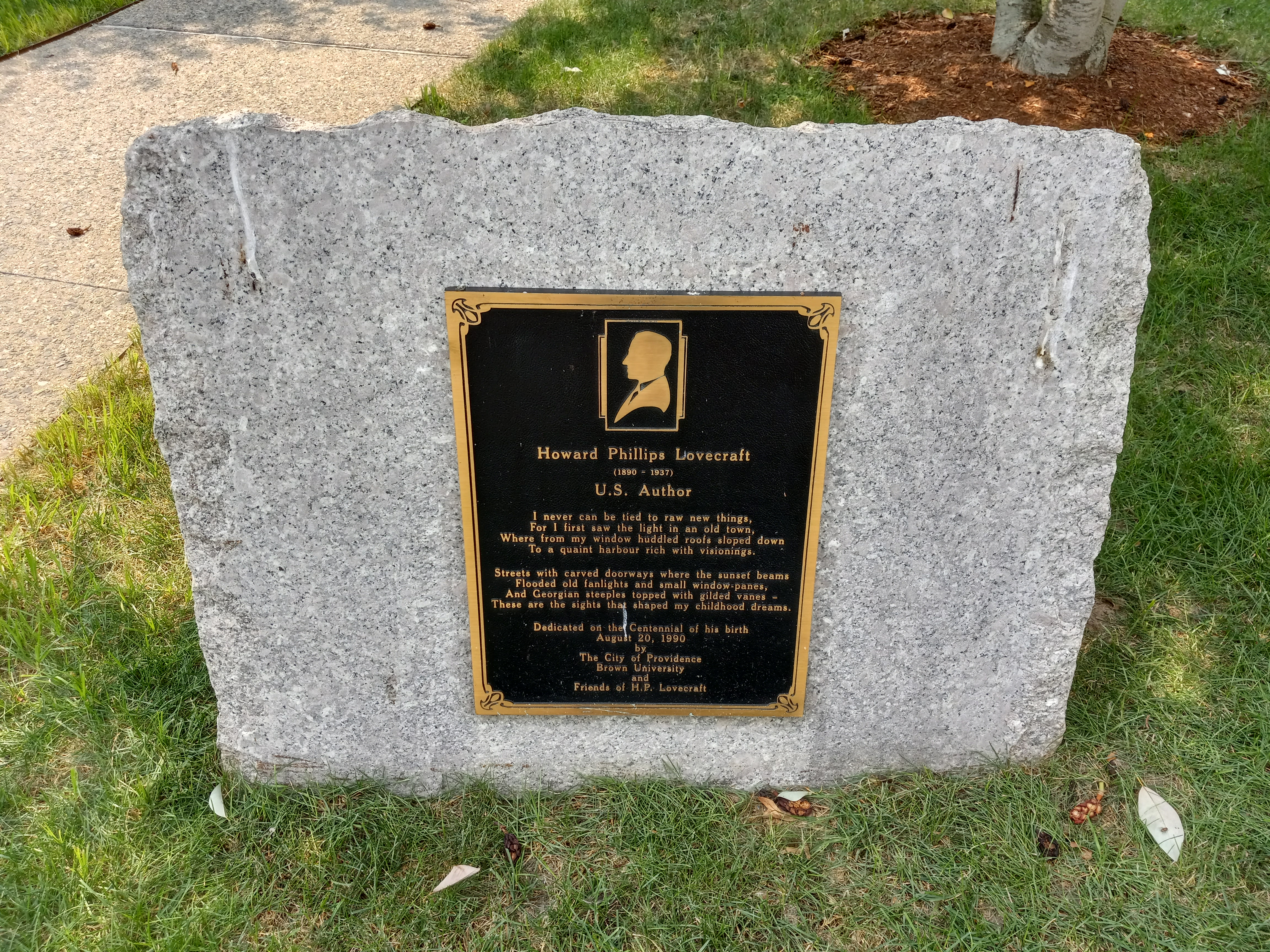
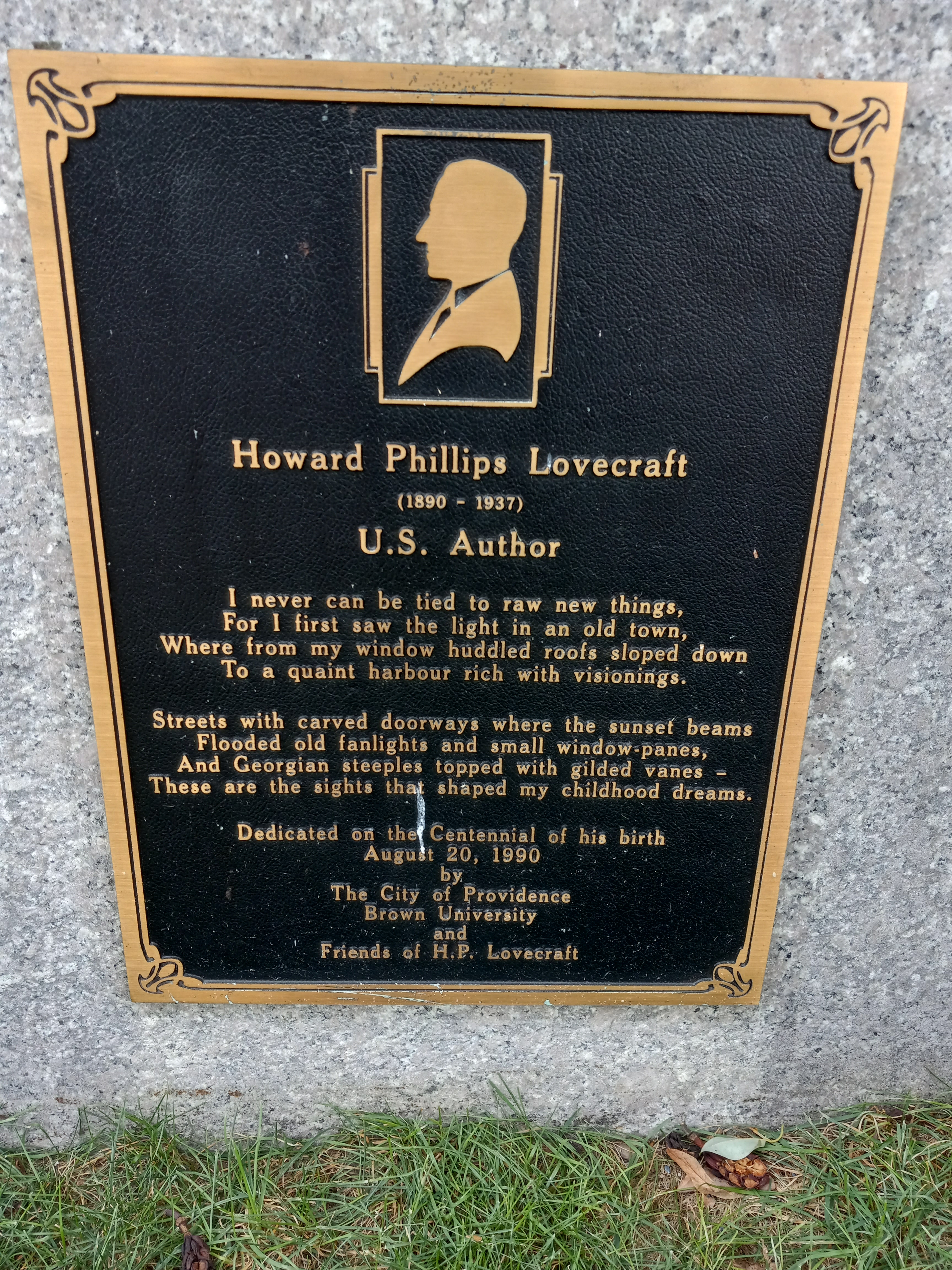
Continuing down Prospect street towards Brown University, I came across a nice little plaque-n-plinth put up near the John Hay Library (itself a Lovecraftian destination). The Hay Library is also where most of Lovecraft’s papers and original manuscripts are housed, something that would probably tickle the Old Gent to no end. It was put up in 1990 on the centennial of his birth, and honestly is remarkably restrained and tasteful!

Here’s the text a little clearer – it’s Sonnet XXX from his long poem cycle “The Fungi from Yuggoth” (which, in my opinion, is a clear response from Lovecraft to modernist poetry in general and T.S. Eliot in particular):

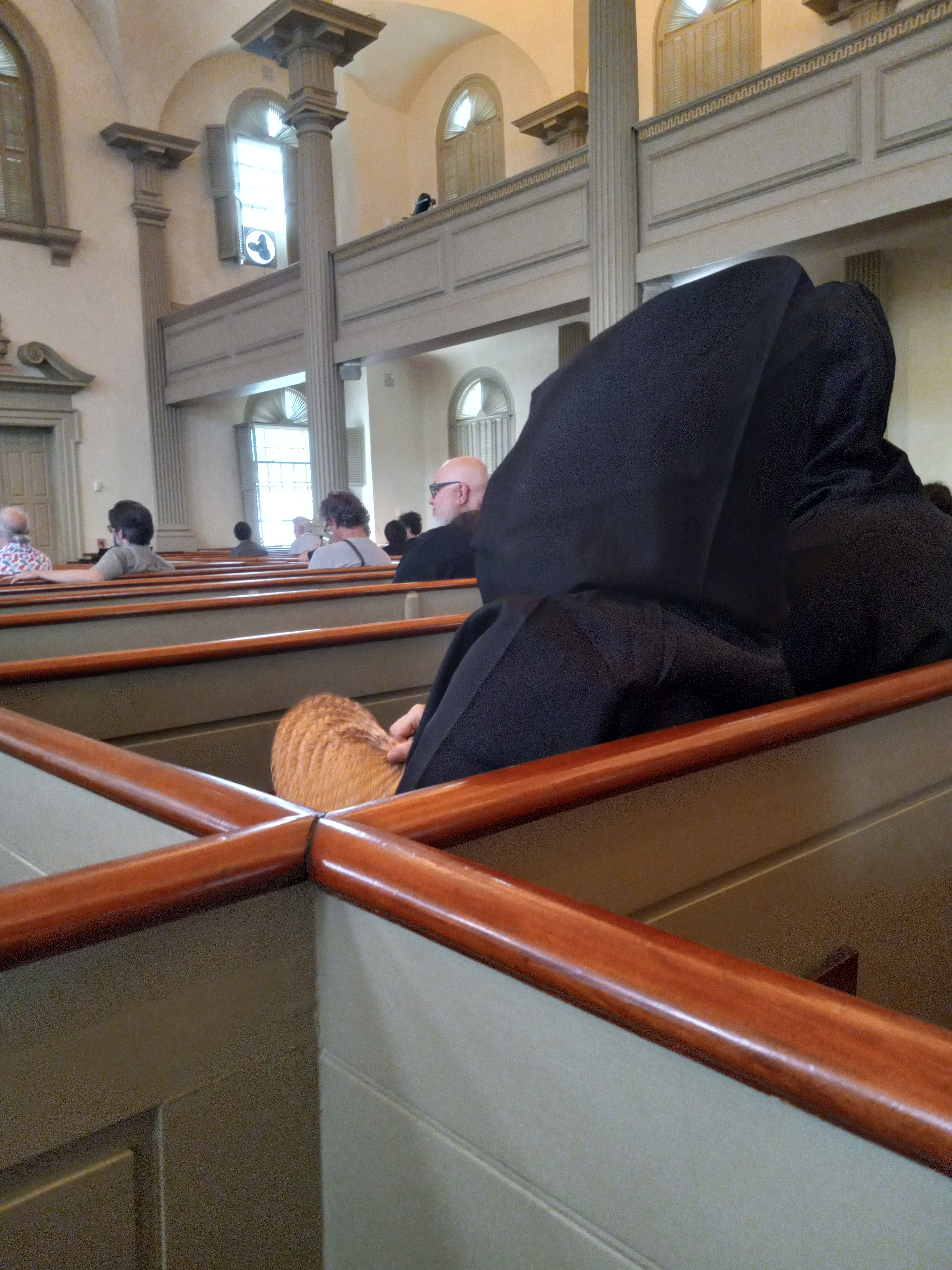
After some more trompin’ about gawkin’ at stuff, I made my way over to the First Baptist Church (literally, it’s the very First Baptist Church in the U.S., ever), where they held the opening ceremonies for the conference. It’s a wild building, huge and with these very strange, box-like pews, so the whole seating arrangement is this odd, chambered affair.

And, if you were wondering, yes, there were cultists there:

Now, like I said, by this point I’d had very little in the way of interactions with the convention or my fellow attendees; I’d registered and got my name tag and program, had gone in and set up my books at the vendors’ table, been to a beer thing out at Narragansett Brewing, all great and fun, but you know how it is…this was my first time there, I didn’t really know what was going on, per say. And with Lovecraft, a reactionary and truly vile racist, that’s kind of important – how was this convention positioning itself with regards to a guy who, basically, represented the aesthetic origins of modern weird fiction? Famously, Lovecraft scholar and one of the architects of the weird revival, S.T. Joshi, was kind of a prick about peoples’ attempts to wrestle with this legacy in any way (sincerely, fuck that guy). Would this conference be more of the same?

I’m happy and heartened to say that was not the case; NecronomiCon in fact very deliberately and proactively sets itself not merely in opposition to the racism, sexism, and homophobia of the Old Ways, but in confrontation with it. The head honcho in charge of organizing the whole Con (and also the head of the Lovecraft Arts and Sciences organization) Niels-Viggo Hobbs got up and, almost immediately, proceeded to articulate a vision of weird horror that specifically sought to correct the biases and prejudices of the past, centering individuals who were exactly the sort of people that Lovecraft would’ve been horrified to see given prominence in the community. Case in point: the poet laureate of the conference was Brandon O’Brien, a poet of the weird from Trinidad and Tobago who gave a great reading of a piece he’d written specifically for the convention, and who represents a new and vital evolution of the weird genre that was really exciting to see in action.

I want to be clear – we’ve all seen the sort of “here’s the land acknowledgement, now we’re done and everybody needs to shut up about it” approach to these problems. As a geologist, one of the whitest and malest of the sciences (seriously, it gives fucking PHYSICS a run for its money in that regard), I’m VERY familiar with this “we’ve tried NOTHING and we’re out of ideas!” approach to fixing this problem. But at the Con, there was constant confrontation with the past, reckoning with Lovecraft and his era at all levels of weird fiction. And it was very clear, from the panels, from the readings, from interactions with people in the hotels or in the big Vendors’ Hall, that this was something integral to the way everyone was thinking about weird fic.

Refreshingly, it went beyond the individualistic “I’m okay, you’re okay” sort of acceptance that dominates a lot of the broadly apolitical and politely centrist neoliberal public sphere – this was an explicitly political program, both among the organizers and among the attendees, who all recognized that the community of weird fiction people could not merely tolerate or accept difference, but rather had to foster it by publicly confronting the past while also encouraging new and underrepresented people to get into the field. More needs to be done, certainly – there are not enough black and brown people there, but nowhere have I seen such a proactive recognition of that fact.

Case in point, so many of the panels were devoted to expanding the canon of weirdness by introducing attendees to new and often non-anglophone writers. That’s remarkable! I moderated a fantastic panel on weird fiction in translation, with five panelists, translators or editors of weird fic in translation, who led a great discussion on the art and science of translation, on their own approaches to the problems, and on the underrepresented literatures of the world. It was really well attended (including by Matthew Spencer, the publisher behind Paradise Editions, who drove all the way up to Providence from PA to support our book, Night Fears) and there was a real excitement about both translations as well as translation as a practice. It was great! Similarly, the academic portion of the conference, the Armitage Symposium, had an entire panel devoted to Weird Fiction in Translation/National Literatures – I gave my talk on Farnsworth Wright and the translations in Weird Tales alongside scholars giving talks on Mariana Enriquez and the Bhagavad Gita. There’s a real hunger for new work out there, and a recognition that there’s more to literature than the traditional english-language stuff. It’s exciting times!

The same forward-thinking approach was applied to the other historical panels I encountered as well. I was on a panel about the “Belgian Poe” Jean Ray, and there were great discussions about his fiction and aesthetic, of course, but also a serious and productive exploration of his truly vile anti-Semitism, something the audience was clearly interested and happy to participate in. And during another panel I was on, about the letters of Robert E. Howard and H.P. Lovecraft, we also were able to integrate the discussion of these two artists’ bad politics and racism into their work, without giving short shrift to either. Same thing in the Hollow Earth panel, which had a lot to discuss regarding both modern conspiracism as well as the poisoned utopias of the older literature. I guess what I’m saying is that I was surprised at how mature and serious these panels were being taken by everybody involved, panelists and audiences alike. These were serious discussions of literature that were being informed by history and placed in context! Nothing at all like what I expected from a “fan” convention! It was remarkable.

I’ll just say I had similar conversations with people outside of the panels too. Folks would stop by the table or get talking in the hallways, and everyone was eager to have a real conversation about these things. Sometimes, particularly in nerd-heavy situations, you’ll encounter the “shut up and let me talk at you!” approach to the conversational arts, but goddammit I didn’t see or experience a single instance of that! Everyone wanted to talk WITH you about something, a rare occurrence these days. But it was definitely the norm at NecronomiCon. Everyone was also just so goddamn friendly and welcoming – really, it was an amazing experience! None of the aloofness or cliquishness you see at conferences, just everybody coming together in celebration of something they love. Honestly heartwarming to see.

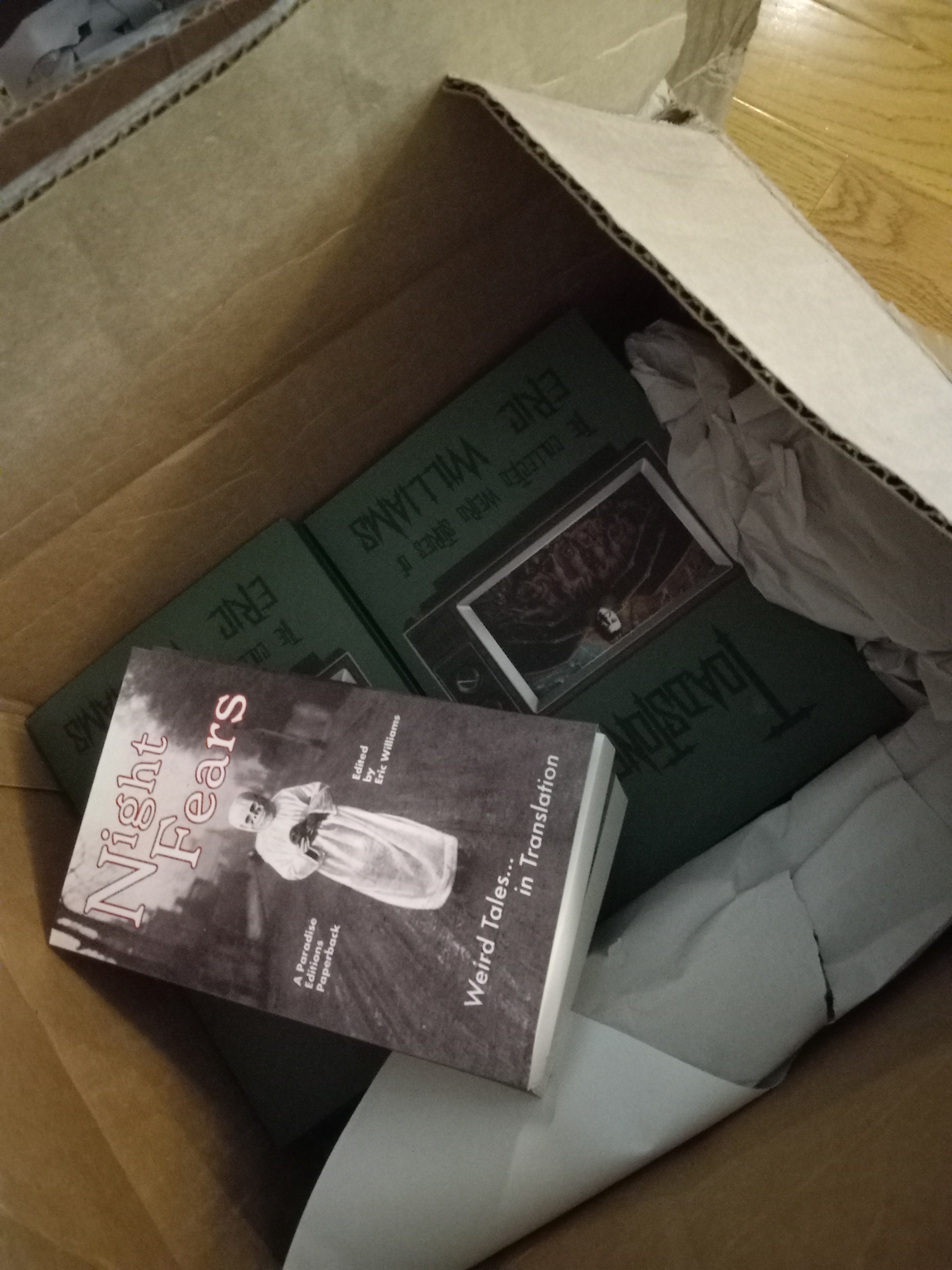
I don’t think it’s rose-colored glasses, although maybe I’m in such a good mood because I sold out of all the books I brought (like 40 all together, twenty copies of each) and didn’t have to haul any back home with me on the plane.

All of these! Sold!

In hindsight, I think being on a million panels plus doing a reading and giving a symposium talk are definitely why I was able to sell these books – I’m just some schmuck nobody has ever heard of, but all of those gave people a chance to see me, hear me, get a sense of me and my writing that, otherwise, would be very heard to come across in the scrum of a vendors’ hall. At first I was thinking I’d want to not do half as much as I did in terms of panels, but honestly I think I’d happily take on a load like that again.

I’ve gone on really long, just trying to unpack my thoughts about this conference which surpassed everything I expected it to be. Really, sincerely, honestly: it was so much fun, everyone was so friendly and welcoming, the community is such a joyful and vibrant one, the programming is absolutely some of the best literary discussions you’ll ever see, and there’s also a pile of amazing shit to buy in the vendors’ hall. And Providence is a great little town! If you’re a weird fic fan (or a gaming fan – there’s like a parallel ttrpg convention that ran concurrently) then it’s absolutely a must. If you’re a weird fic author, I’d really strongly recommend you attend and get on as many panels as you can comfortably do. I had an absolute blast and will definitely be attended the next on in ’26.

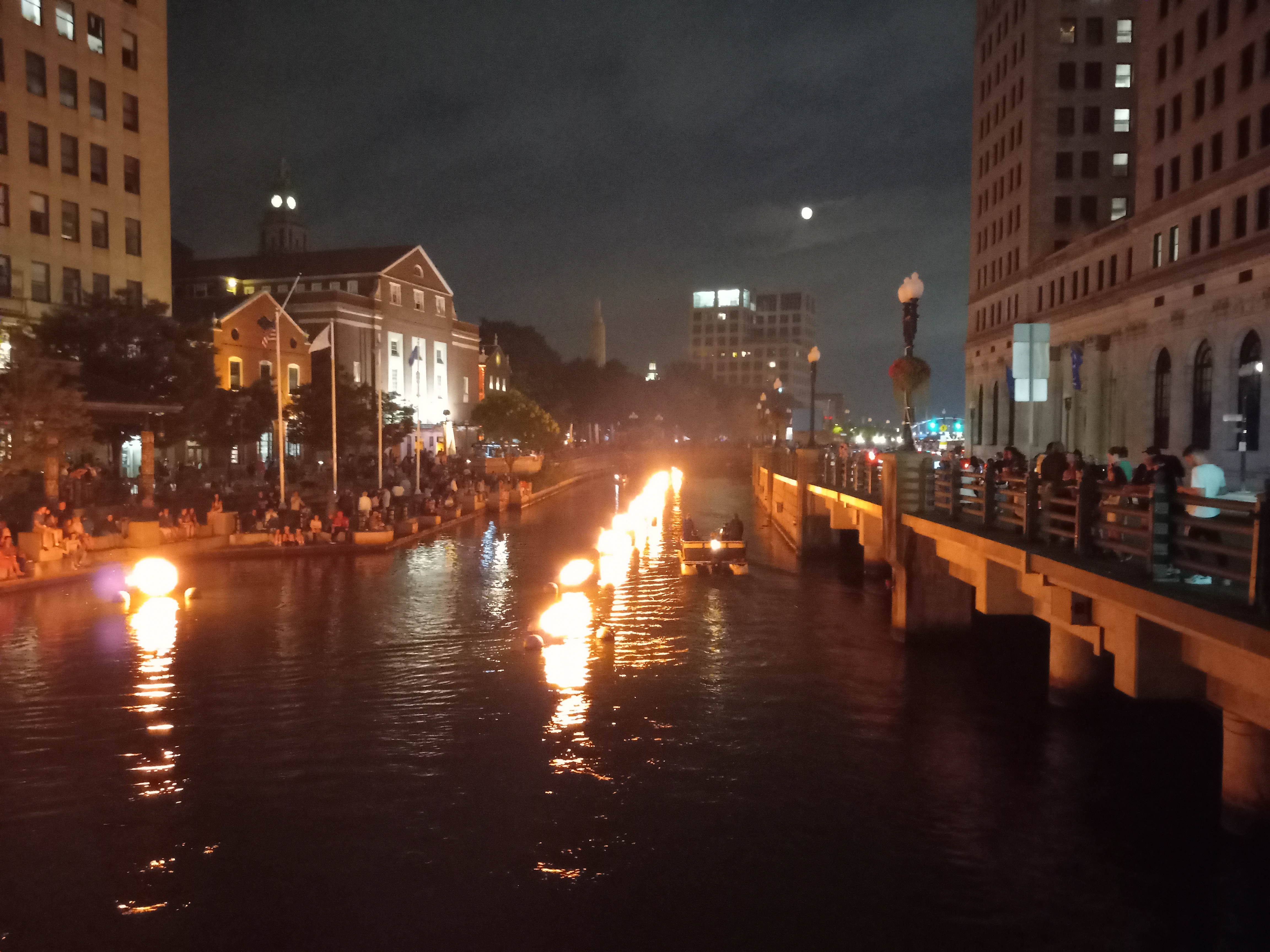
Anyway, let’s end on a picture of the weird thing Providence does sometimes, when they set these braziers in the river on fire amid a carnivalesque scene of revelry and debauchery. Like I said, it’s a fun town!

Dead Writers

For some reason, I’ve taken to collecting pictures of the graves of writers I admire; it started, somewhat accidently, during a conference in Baltimore when I happened to learn from a brochure in the hotel that Poe was buried in the city. Now I’m not particularly goth or anything, but I DO love a good graveyard. In a lot of American cities they’re often the best kept green spaces – there was a gorgeous one in Bozeman MT high up on a ridge overlooking the town with some very nice junipers and cedars, a very peaceful quiet place good for strolling around. So visiting them is often a lot of fun, but in this case it was particularly necessary, because of course I love Poe – he’s probably one of the top three most important American writers, I’d say, right up there with Melville and Twain in terms of artistry and influence. So of course I took some time to go hunt up ol’ Edgar, and found that he had TWO markers in Baltimore, one for his original burial site and a larger, more lavish monument a few yards away, put up in 1875 as his reputation grew posthumously.

The Original Burial Site
Poe’s actual grave

As you can see, it’s not a particularly pretty graveyard. It’s cramped and not at all green, in a smallish churchyard surrounded by the rest of the city, but still, it was fun to see the final resting place of a writer whose work is so important to me.

Now, at the time, it was just kind of a one off – I didn’t have any plans to starts accumulating dead writers’ graves or anything. Just had happened to find Poe there, and that was plenty. But here in early June I went to Berlin, and as I was looking around for stuff to do, I discovered that there’re a lot of famous dead writers planted in the city. And some of them were, like Poe, enormously important to me and my reading! So I took some time to hunt ’em up and get some pictures, and I thought I’d share em here.

First stop on the list was the Dorotheenstadt Cemetery, a one-stop shop for dead famous writers, as well as other prominent Germans of a certain era. It’s a nice cemetery, very pretty with good trees, a lot of sculpture, and nice quiet little paths, right in the middle of the bustling Mitte neighborhood. It’s a storied cemetery that became, for a variety of reasons, the final resting place of a lot of intellectuals, so I spent a fair amount of time there, just strolling around and bathing in all the Germanic mono no aware of the place.

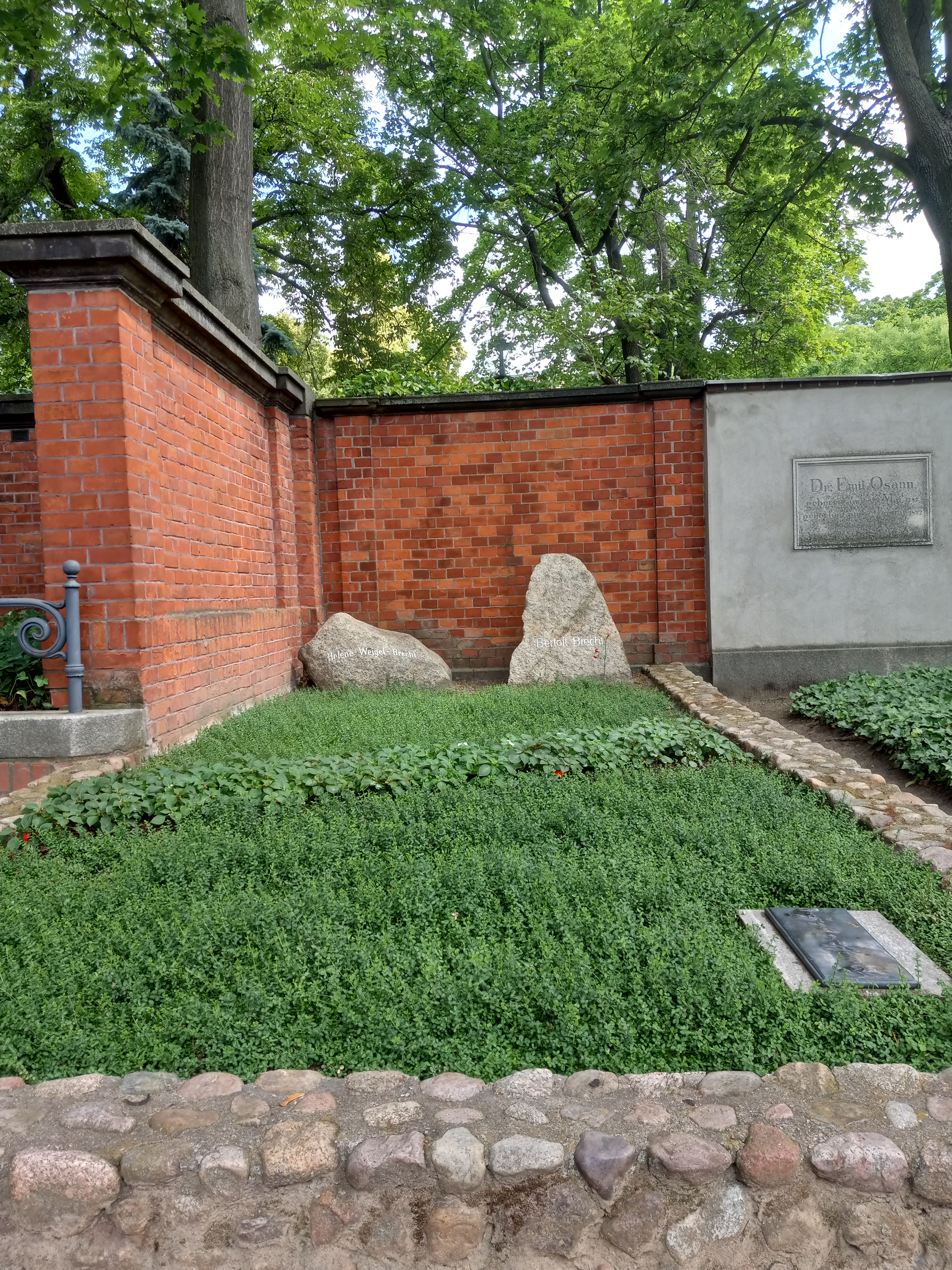
The grave I was most interested in seeing was Brecht’s, of course; Threepenny Opera, Life of Galileo, his Turandot…c’mon, ol’ Bert was one of the greatest playwrights of the 20th century. He’s also a tragic figure, fleeing the Nazis only to get HUAC’d in the states, and then returning to East Berlin only to face the crushing disillusionment of Stalinist purges and oppression. But at least his grave is a peaceful spot – I’d say it’s the best in the whole cemetery, a long green plot with beautiful rough granite markers for his wife Helene and himself.

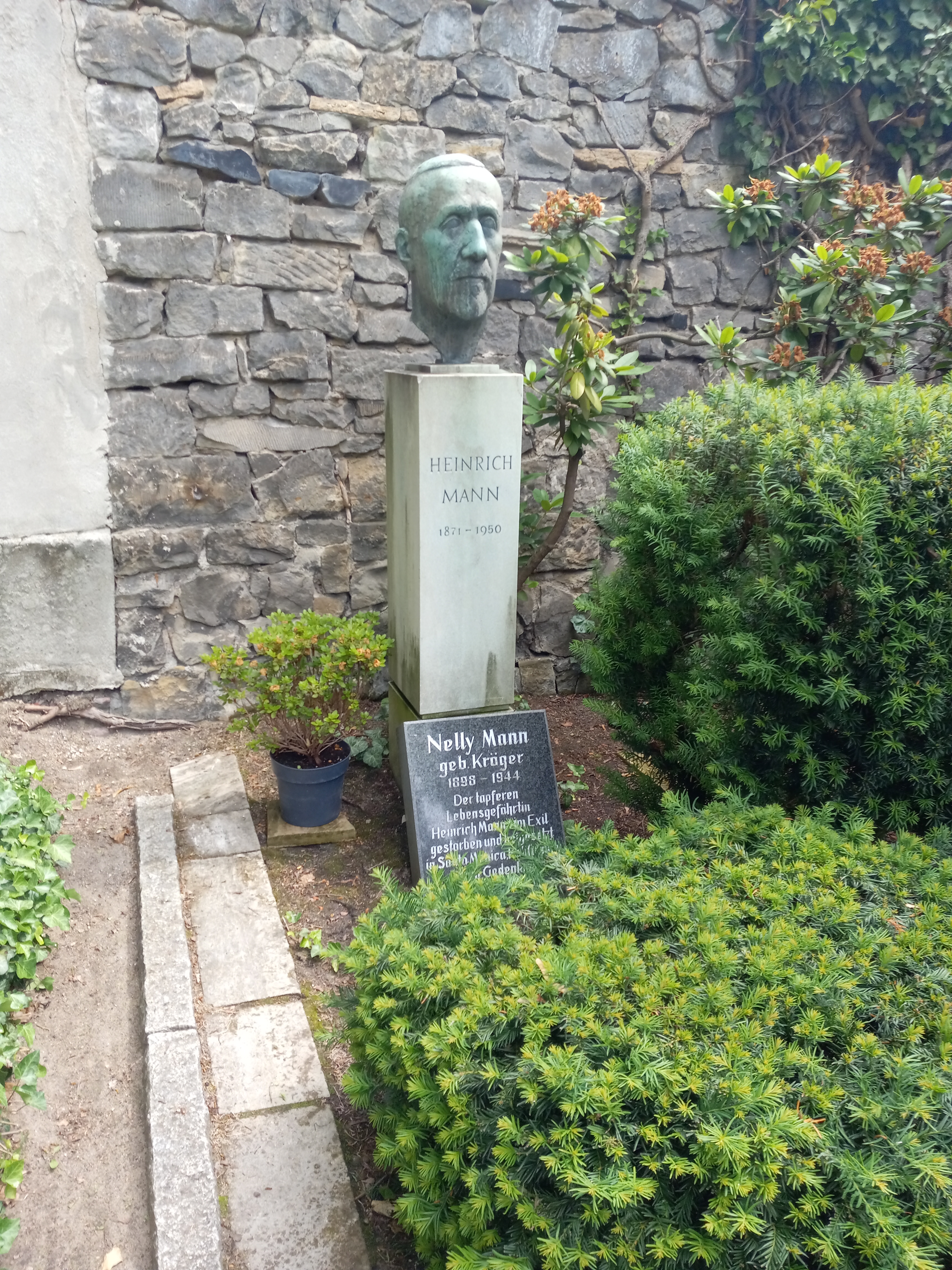
Paying my respects to Bert, I strolled along the wall and was surprised to run into ol’ Heinrich Mann, brother of Thomas. I’ll always have a soft spot for Heinrich who, despite never receiving the accolades or wealth of his more famous nobel laureate brother, DID have better and more consistent politics. He was a staunch internationalist and anti-war socialist as well a helluva writer, and I’ve always loved his Small Town Tyrant (the novel Dietrich’s “The Blue Angel” was based on); it’s way better and more interesting than Thomas’s The Magic Mountain, in my humblest of opinions. Nice marker with a dignified bust:

Continuing my tour, I next found the austere marker of writer and Stasi informant Christa Wolf (and her husband). She’s an important East German writer who has recently sort of come back into vogue; if you’re unfamiliar with her work, I’d strongly recommend her novel Cassandra, about the Prophetess and the Trojan War, and the collection What Remains and Other Stories.

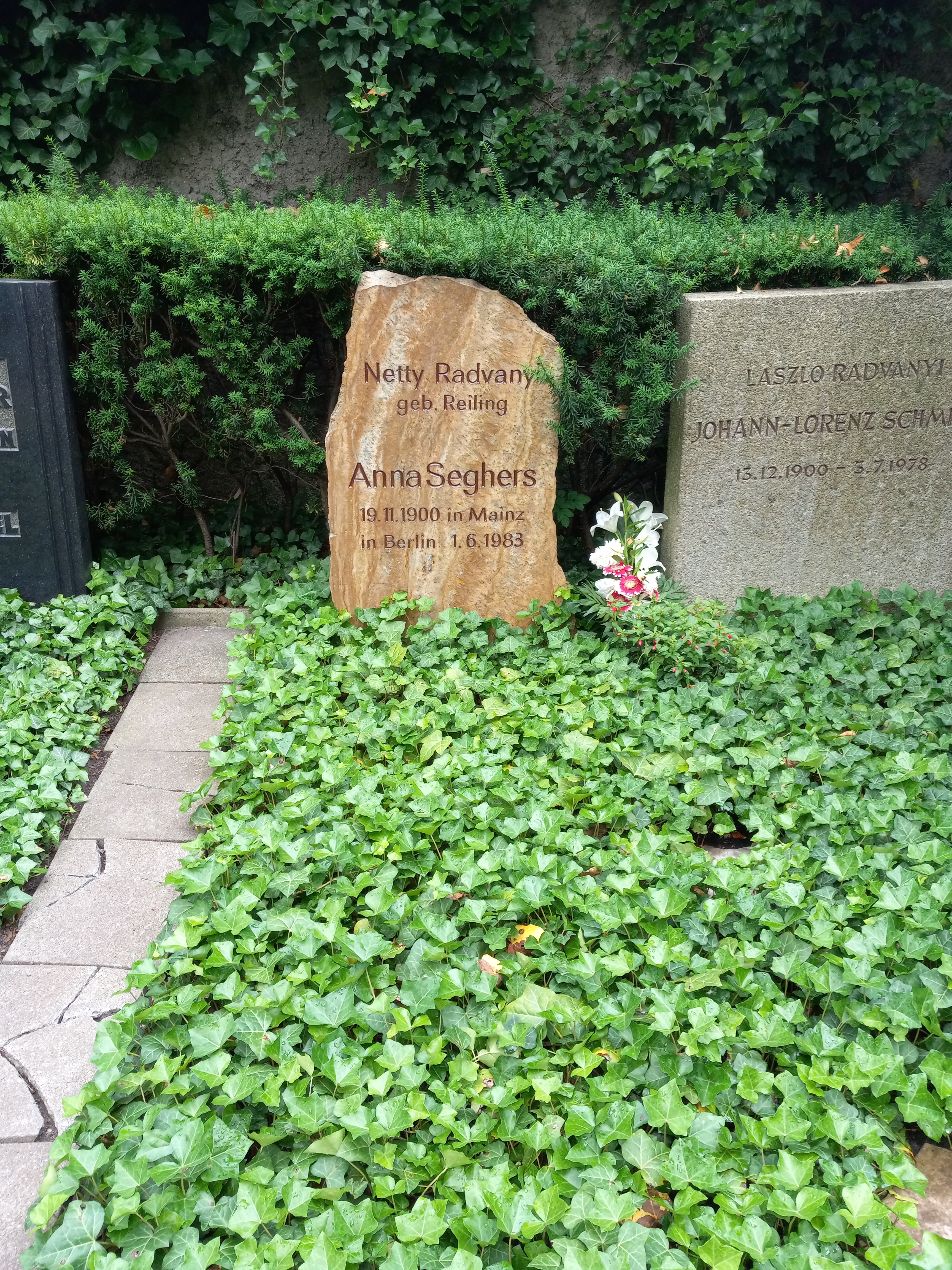
Next up on the hit parade is Anna Seghers, author of one of my favorite novels of all time, Transit. She was one of the big names in German diasporic literature during Nazi times, and her work is intimately interested in how people survive under the cruel oppression of dictatorships. She was writing about Nazi concentration camps in the late 30s, one of the first to introduce the horrors of fascism to the wider public. She’s a great writer, and I had no idea she was here in Dorotheenstadt.

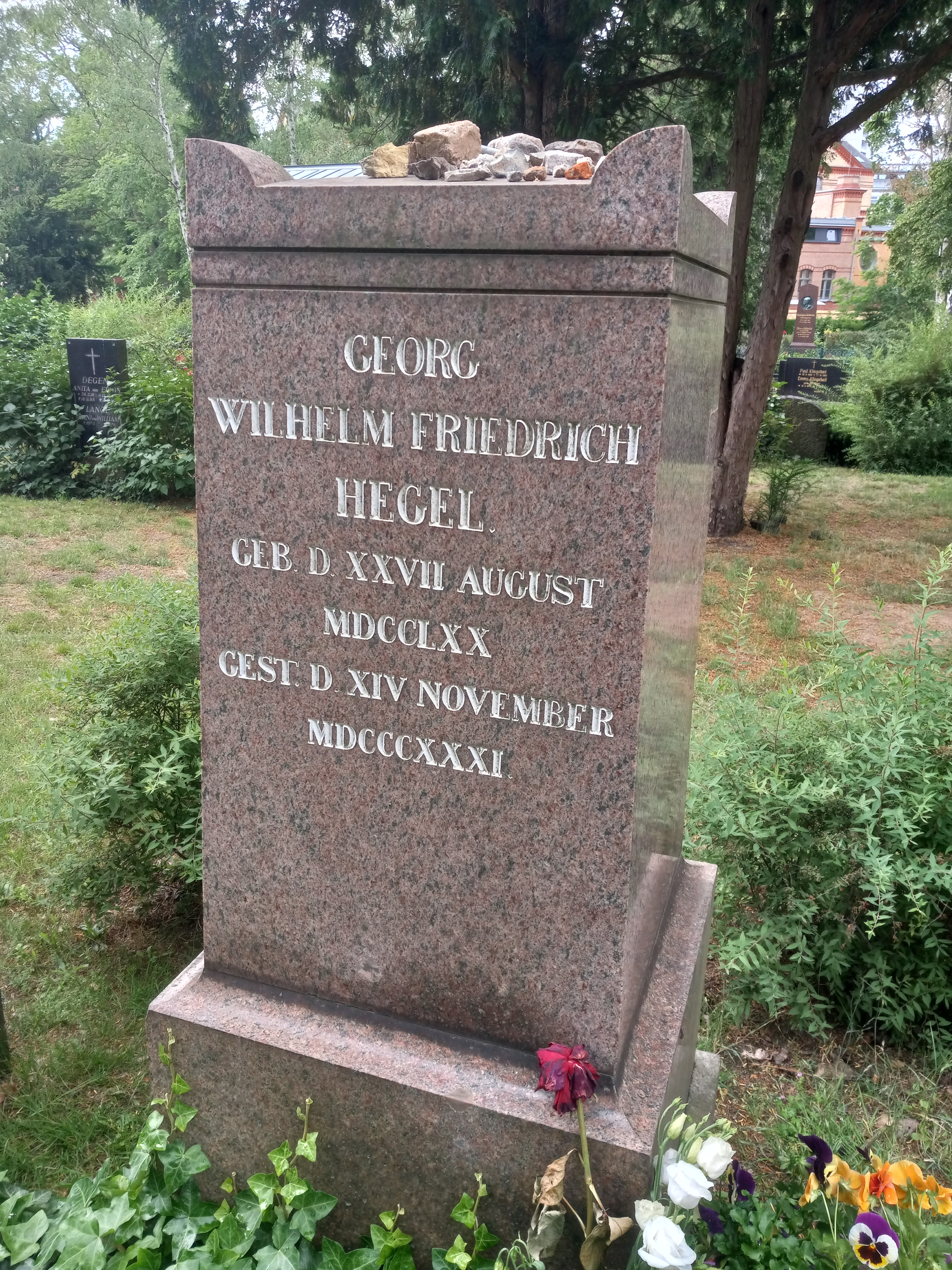
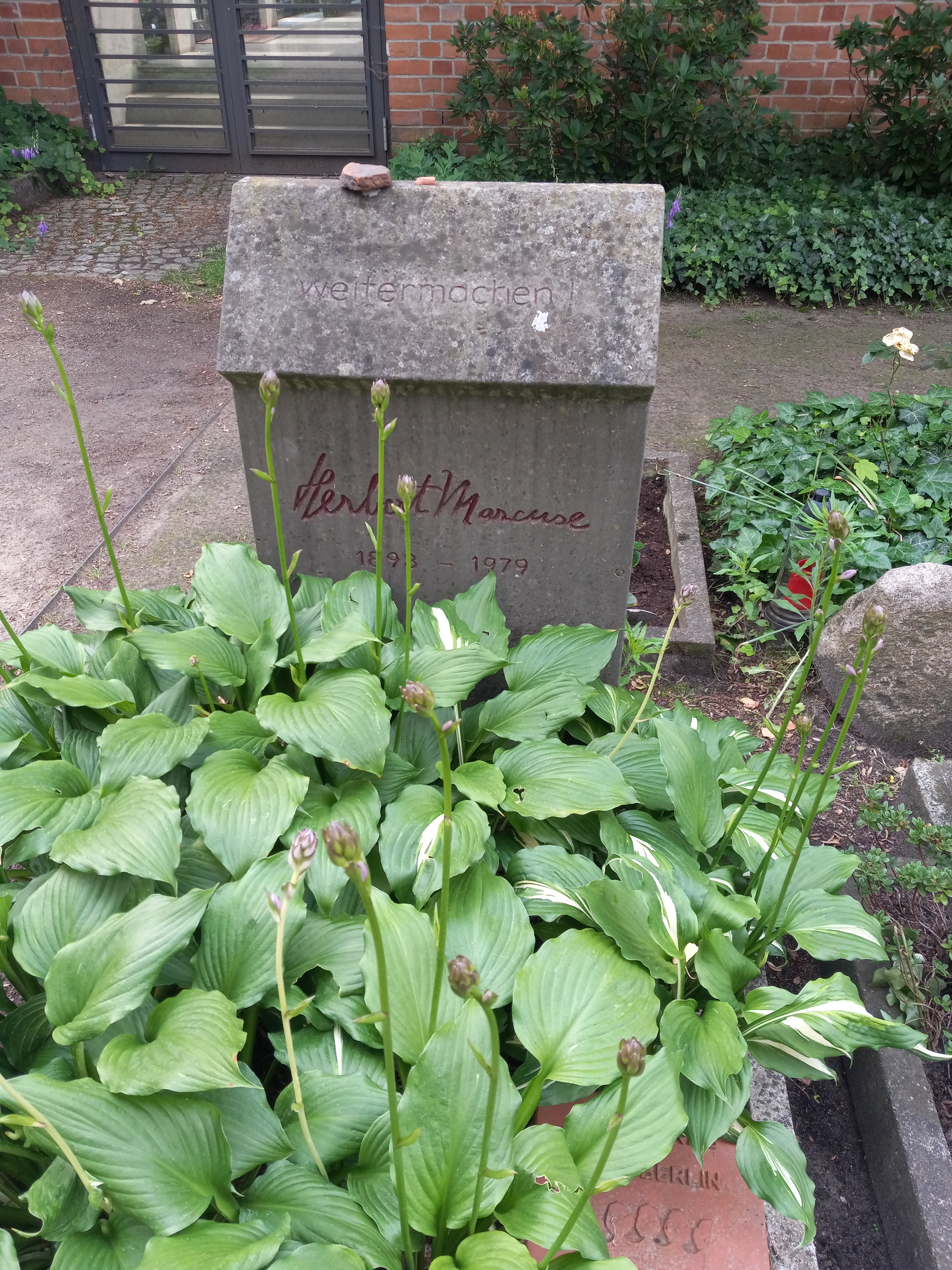
And just to wrap up Dorotheenstadt, ol’ Herbert Marcuse and Hegel are there too. Hegel’s grave was by far the most visited while I was there – a number of wan young nerds swanned in to take a picture of his marker while I was strolling around, and there were by far the most number of memorial pebbles left on his grave. A sign of our disordered times, no doubt.

In contrast, Marcuse’s grave was both smaller and tucked away in a crowded corner. It had better plants, though, and a few folks had left a pebble or two there. The weird cursive used for his name reminds me of divorcee wine bars (I swear I’ve seen a “It’s Wine o’clock Somewhere!” sign in the same font), but I do like the engraved “weitermachen” (“keep going”) on the upper part of his marker.

Thus ended the first day of my morbid picture-takin’ adventure. Later during the trip, I went down to the Wannsee, a cute little lakeside district full of weird German yachting clubs and rowing organizations, a center of internal tourism for the region. It’s a pretty spot!

Wannsee sunset

But, of course, I was there for one reason – Heinrich von Kleist.

Kleist is one of my favorite writers, broadly defined as a Romantic although, like all labels, that one fails to capture the wild, wide-ranging, and often truly weird sensibilities that you find his work. There’s a real furious imagination in his writing, underscored by a biting and hilarious absurdity; if you haven’t had a chance, you should really read him! Michael Kohlhaas and The Marquis of O are incredible and vital, and there’s an excellent recent edition of his shorter works translated by Matthew Spencer (published by Sublunary Press) that I highly recommend (buy it here immediately).

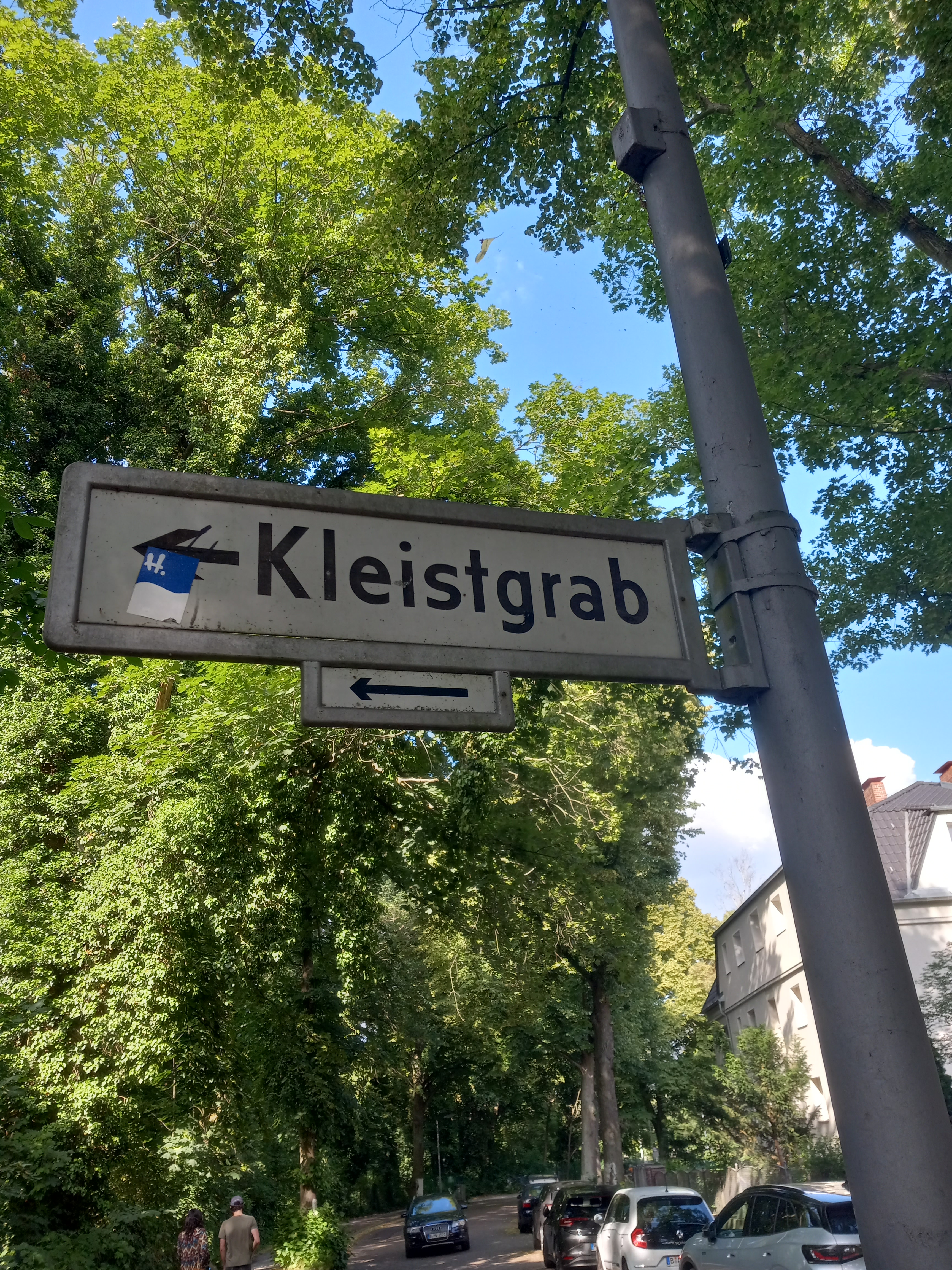
As is all too common, though, poor ol’ Kleist had a rough time of it – money and artistic woes dogged him through his life, and he came to a tragic end with a murder-suicide pact on the shore of the Wannsee in 1811, shooting his friend Henriette Vogel, a woman suffering from terminal cancer, before turning the gun on himself. Now there’s a nice little park with a lot of informational signage there, as well as a marker for the two of them, at the spot near where their bodies were found.

It’s a nice, peaceful little spot, lots of maples and oaks, but the (appropriately) funny/weird bit is that it’s right between these big rowing club buildings. When we were there, some kind of party was going on, with kids out rowing and rave music thumping, a very funny scene in which to contemplate Kleist and his life. Also got to watch a fox hunt some voles in the thickets nearby, so that was fun.

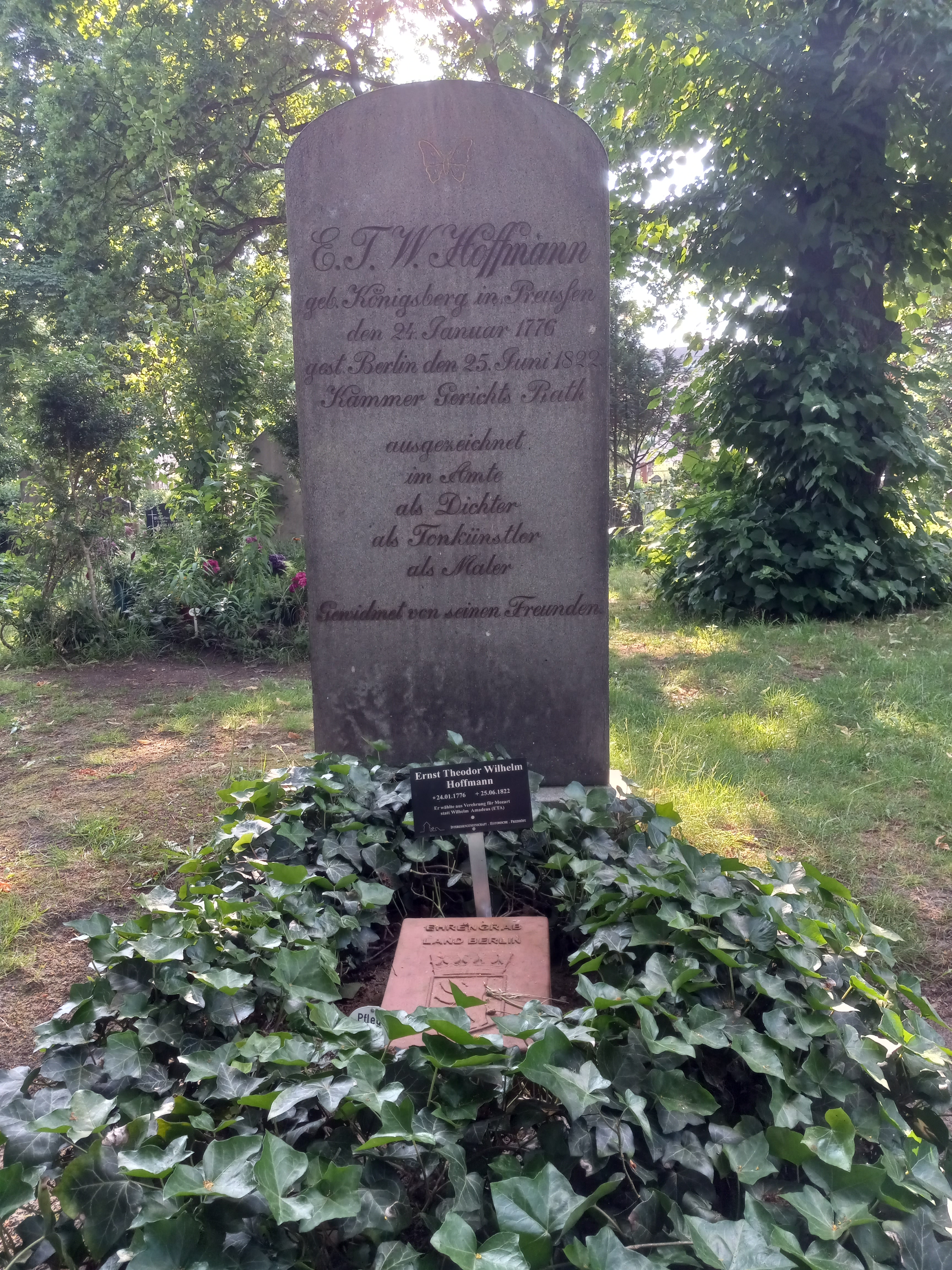
My third and final graveside pilgrimage was a big one. Travelling to the Kruezberg kiez in Berlin, I tromped around the Kirchhof Jerusalem und Neue Kirche III, a large and very attractive cemetery full of trees and extremely cute European squirrels (those red ones with the tufty ears) until I found the grave of E.T.A. Hoffmann (under his real name of E.T.W. Hoffmann – he changed his name from Wilhelm to Amadeus out of admiration for Mozart.

Hoffmann is a special writer for me, one of my own personal favorites whose work I absolutely and unabashedly love. Full of imagination and weirdness and hilarity, he’s one of the rare true geniuses of literature, in my opinion; he wrote in the late 18th and early 19th century, but like so many things from that (and earlier) eras of literature, there’s a shocking and striking “modernity” to his work. For instance, take The Life and Opinions of The Tomcat Murr, a hilarious and fantastic novel that purports to be the autobiography of a cat written on the backs of the pages of his owner’s own autobiography – that means that the way it’s printed, you cut from one narrative to the other, right in the middle of a sentence, moving from Murr’s hilarious musings to the soppy life of Hoffmann’s heightened alter-ego, the sentimental knucklehead Johannes Kreisler. It’s the sort of thing that, published now, would be heralded as a postmodern masterpiece of avant-garde experimental literature…but it was written in the early 1800s. Kinda puts things into perspective, you know?

His short stories are equally wonderful, and often verge into what we would today call Weird Fiction. You’ll find automata, gruesome murder, weird morbidity, and occultism in a lot of his stories, as well as some really insightful character studies and city descriptions (particularly of Berlin and Dresden and Nuremberg). He’s just a delightful writer, an absolutely essential artist in my opinion. It was a treat to visit his gravesite, though I wish I’d brought a beer with me to give him a proper salute.

Writing this up and enumerating the graves I’ve visited, I have to ask myself why I enjoy doing these things. I don’t feel any particularly strong emotions when I’m visiting these markers, even when the circumstances of their deaths, like in Kleist’s case, are objectively tragic. Nor do I experience any kind of numinous awe – that’s reserved for their work. Maybe that’s what I find interesting, the contrast between their work, which lives inside the reader, and the kind of underwhelming final punctuation mark of their physical graves? Getting to know someone through their writing, reading and rereading their work and learning about their lives, you already have a kind of memorial to them built up in yourself, so their grave’s don’t add anything “new” to that. But then, maybe it’s just kind of nice to see their graves and be reminded of their work, which gives so much pleasure still? Or maybe the impulse to visit their graves is no different from the impulse to put their books up on the shelf? A collector and completist’s natural inclination? I dunno.

Regardless, it’s certainly something I’ll probably keep doing. I’m going to Providence Rhode Island in August for a Lovecraft/weird fic convention, and you KNOW I’m going to visit the Old Gent’s grave. But who else would I like to see? Paris would yield a bumper crop – Wilde, Huysmans, Lautreamont, Maupassant, Hugo, Balzac. Prague for Kafka of course. Hard to envision it, but Lafcadio Hearn in Tokyo would be special. In the states there’s PKD, Ellison, Butler, Le Guin. When I went up to Cross Plains TX, I didn’t know that ol’ Robert E. Howard was actually buried in Brownwood, about 40 miles south, so that’s one I’ll have to collect one of these days.

Anyway, tempus fugit and all that. Life is short; read something fun!

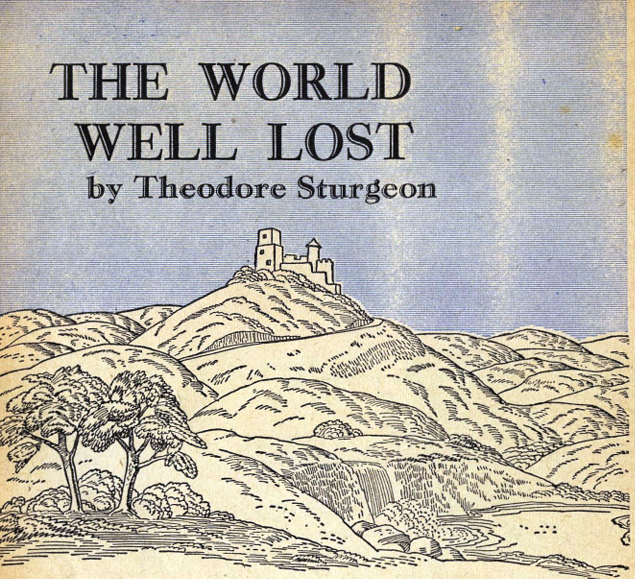
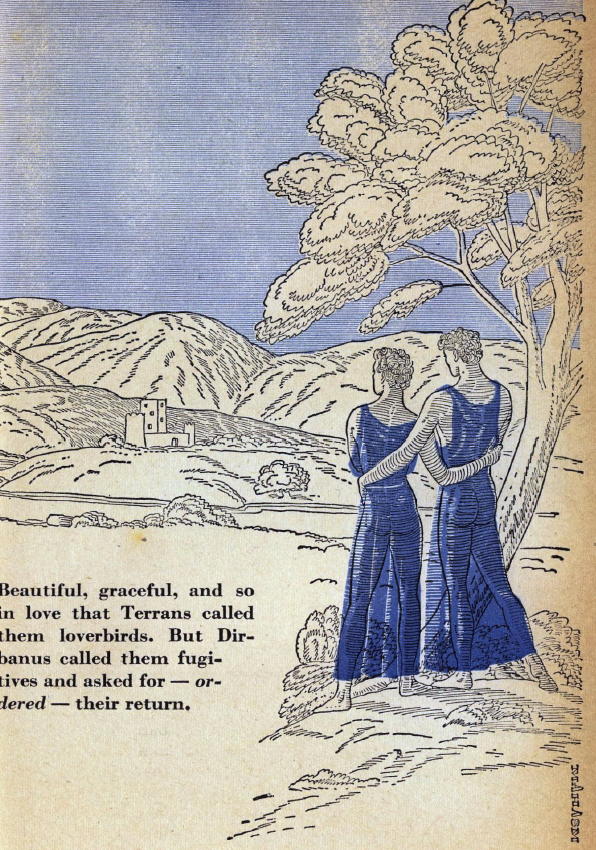
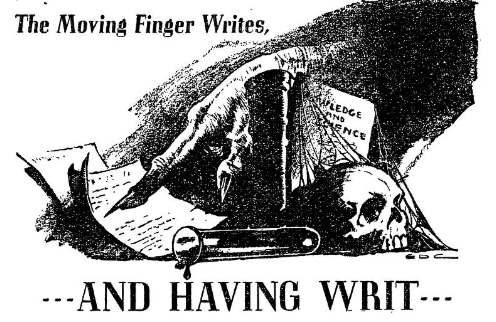
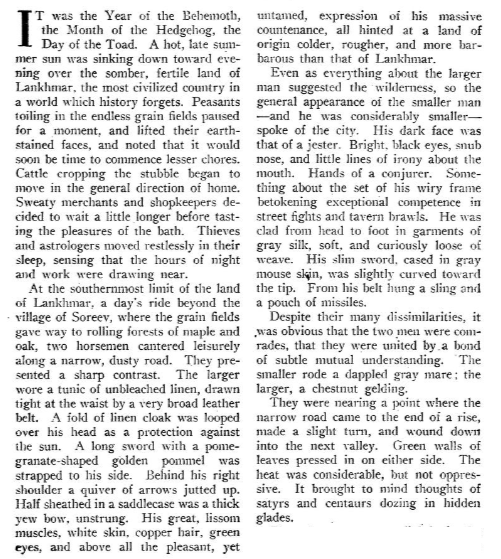
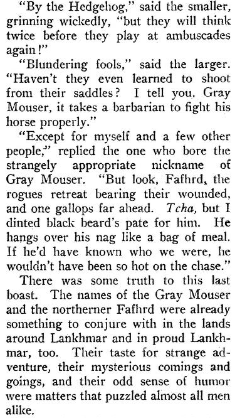
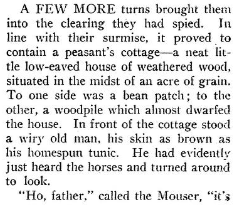
Straining the Pulp to the Breaking Point #20: “When the Bough Breaks” by Lewis Padgett, Astounding Science Fiction, Vol.34 No. 3, Nov. 1944

Been a while since we strained some pulp, but hey, here we are, charging once more unto the breach of some classic short stories. And this week we’ve got a great, complex, conflicted, and all around wonderful piece of fiction from one of the greatest pulps of all time, Astounding Science Fiction. It’s “When the Bough Breaks” from November 1944, by “Lewis Padgett” which, of course, was actually the pen name of the husband-and-wife team of Henry Kuttner and C.L. Moore.

Now, it’s no secret: Moore is one of my favorite writers of all time, and we’ve spent a lot of time with her on the ol’ blog here. She’s a tremendously powerful writer and hugely important to the history of genre fiction, a towering figure indeed. We haven’t talked much about ol’ Hank Kuttner, her husband (met through the letter writin’ circle of H.P. Lovecraft, by the way), and we’ll definitely have to change that, at some point – he was himself an interesting writer, with fun Sword & Sorcery and Lovecraftian horror stories to his name, but for my money his greatest work was done in collaboration with Moore, a process so seamless that the two of them would claim that, at the end of it all, neither could really tell who had written what in a finished story. That might be the case, although I feel like you can get a sense for the themes and styles and approaches each one brought to the stories – Kuttner has a flair for goofy humor, while Moore’s subtly and grasp of the uncanny always shines through. Regardless, the two of them had some kind of strange alchemy, since none of their work ever reads like a mash-up between two writers, a pretty amazing result, all things considered.

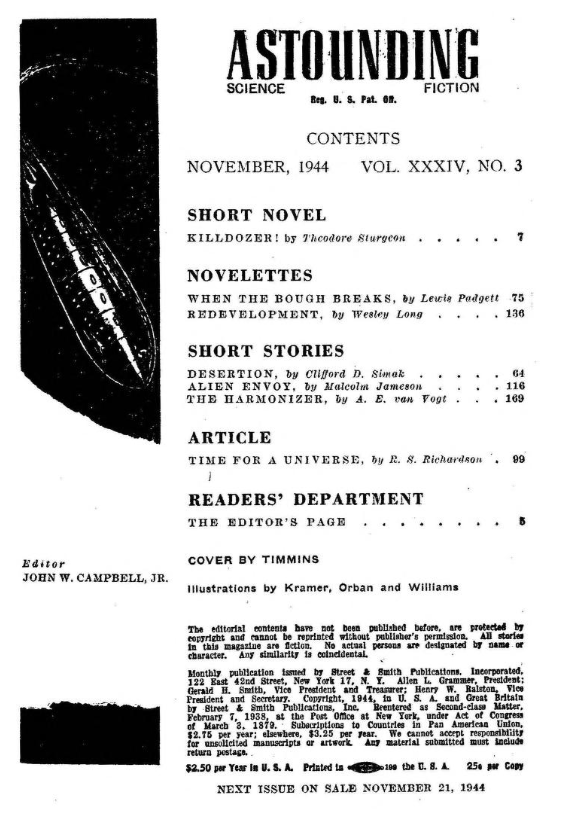
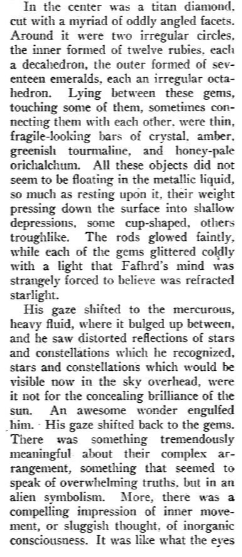
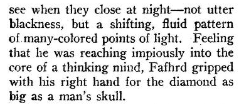
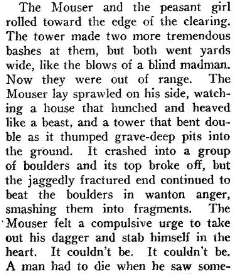
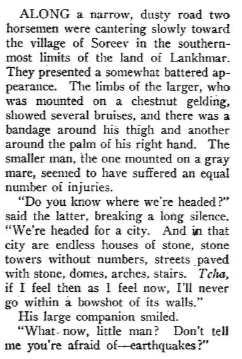
But, before we get into the story, let’s take a look at and REALLY APPRECIATE the cover art of this issue of Astounding! It’s KILLDOZER, and it’s fuckin’ great. The artist is William Timmins, one of the main pulp cover painters of the day – he was all over, and his style really evokes that 40s – 50s era pulp aesthetic, to me. Very “painterly,” but dynamic and energetic. I also love that “Killdozer” got the cover – it’s a great novella by another one of the truly great writers of the era, Theodore Sturgeon (who was, fyi, the inspiration for Vonnegut’s Kilgore Trout). We’ll definitely have to do some stuff by Sturgeon at some point – hugely influential figure.

As always with Astounding, it’s a hell of a ToC this issue: Sturgeon, “Padgett,” Simak, van Vogt…titans all! Malcom Jameson and Wesley Long are less well known today, although at the time both were well-known luminaries in the sci-fi world. Jameson was famous for his navy-influenced space operas and left his imprint on military and ship-focused science fiction, while Long is one of the pseudonyms used by George O. Smith, famous for his hard sci-fi “Venus Equilateral” stories (a fun series about a communications station at the L4 Lagrange of the Sun-Venus system) AS WELL AS having his wife leave him for the editor of Astounding, John W. Campbell, Jr. Astounding at this time really was the preeminent science fiction magazine, a remarkable archive of the “Golden Age” of that genre.

But, anyway, on to the story!

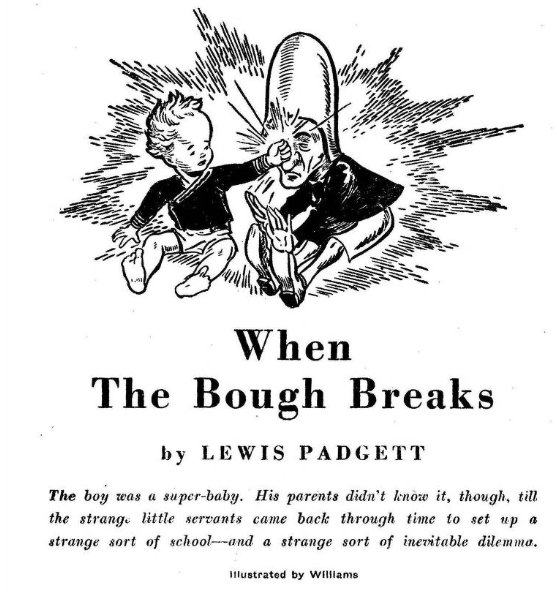
Now, based on the art and summary, you might be inclined to skip this story. The art is good, don’t get me wrong; credited to “Williams” in the annoying surname-only style affected by Astounding, it’s almost certainly Arthur Williams, one of the stable of usual artists used by the magazine (and that’s almost all I know about him, too). It’s a fun, clean style, and here he gets to embrace a certain cartoony flair for the little weird goblin-men (that we’ll meet soon). But, goddammit, a baby konking a weird little dude in the eye just doesn’t seem to promise much, does it?

The summary is the culprit real here, though – “super-baby” is absolutely a red flag, a warning that you might be in store for one of those fuckin’ hyuck-hyuck cutesy cornball stories that are just so awful. If you, like me, listen to a lot of Old Time Radio, you know exactly what I’m talking about – the show Dimension X, which adapted stories from Astounding Science Fiction, was perversely fond of the “humorous” stories that appeared in its pages, often about exasperated everymen confronting the madness of the push-button era. They’re almost always often firmly entrenched in what Joanna Russ called the “Galactic Suburbia” too, a kind of broad assumption by a lot of writers of the era that the standard white, middle-american nuclear family was as inevitable and immutable as gravity. Execrable, teeth-grinding stuff.

Now, there’re two reasons why you should persevere here, despite the warning signs of the art and the summary we’ve just talked about. First off: this story is from 1944, and the really egregious examples of glib “Galactic Suburbia” shit don’t show up until the post-war boom really starts to take off, mostly in the 50s. Secondly, and more importantly, this is “Lewis Padgett” we’re talking about, and anything associated with C.L. Moore, a master of thoughtful subversion, is absolutely worth your time! So let’s dive in!

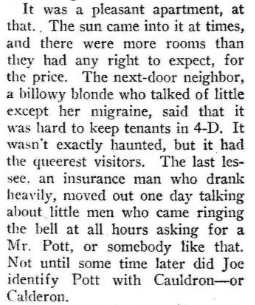
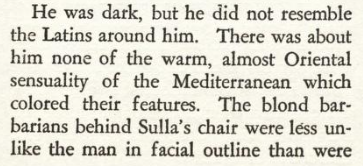
The first paragraphs of the story introduce to two young parents, Joe and Myra Calderon. Joe is a physicist at a nearby University, and Myra is his ever-lovin’ red-haired housewife. The two of them have, through extraordinary luck, been able to get an apartment in the city, despite the crushing housing crisis (that would, in real life, soon get worse after the war, leaving an indelible mark on the literature of that era). Their luck seems to arise from this particular apartment:

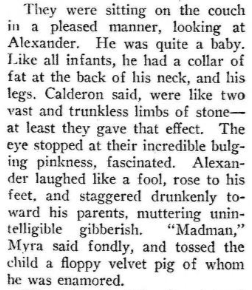
Weird figures have been showing up to “4-D” (a pun you’ll soon get) at all hours, apparently looking for someone. Odd! But, moving right along, we’re soon introduced to the third member of the Calderon family, Alexander:

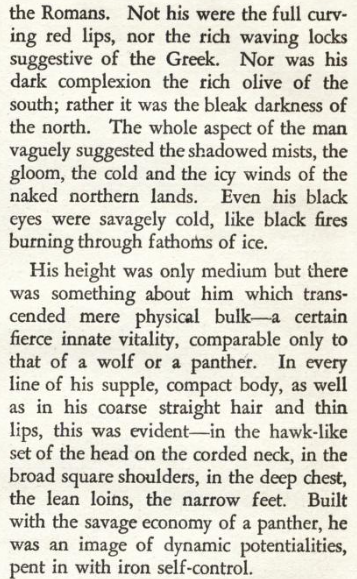
A very normal baby, to all appearances, although we know better from the story summary above. Joe and Myra engage in some expository banter, well-written and with a warmth that, I think, speaks to the easiness that C.L. Moore and Henry Kuttner must’ve had with one another in their own life. They talk briefly about the need for a nurse or a maid, focusing our attention on the hard labor that goes into raising a kid. And then:

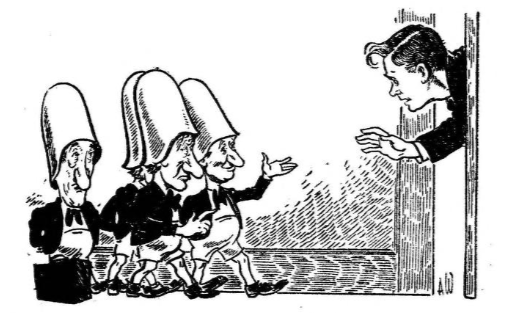
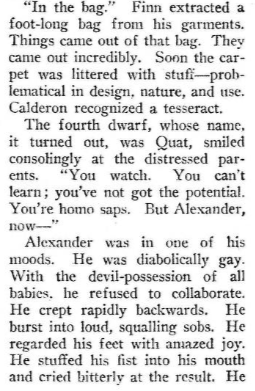
Four weird little dudes show up at the Calderon’s door, claiming to be the descendants of Alexander Calderon from the future. It’s an odd scene, to be sure, and comes with a funny lil illustration and everything:

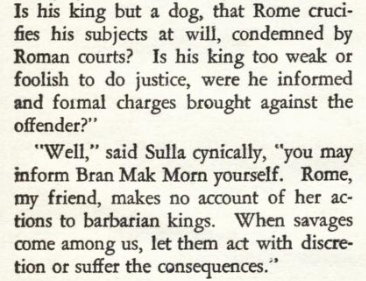
The little guys scurry into the room, evading Joe’s attempts to stop them, and gather reverently around baby Alexander, using the strange and exotic verbiage of an unknown superscience to describe attributes of his development and skull shape and potential. Alarmed and confused, the parents demand an explanation from the apparent leader of the tiny gang, Bordent.

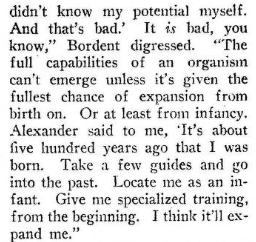
So, some 500+ years in the future, Alexander, then a fully mature superbeing, sends this four little guys back into the past in order to give himself a developmental boost via educational methods as a baby. These four little guys represent the future of humanity, a species now dominated genetically by their descent from these “homo superior” specimens.

So, that’s a pretty chilling statement there at the end, isn’t it. These little guys aren’t anything like the true Homo superior that Alexander is – if they were, the Calderon’s couldn’t “stand there and talk” to them, or even look at them. You could, at this point in the story, interpret that to mean some kind of transcendence on the part of future-Alexander and his super-ilk – like, they’re literally noncorporeal or something. What we’ll learn in the story is that it’s likely much more sinister, however. It’s also interesting to see that Alexander is, apparently, an “X Free type” or an “X Free super;” kind of neat to see both “homo superior” and “X” as a specific genetic aspect used here, isn’t it? Future influence on Marvel comic aside, there’s also a fascinating bit of history of science/history of medicine going on here, with Moore and Kuttner clearly aware of then current work being done on mutations and sex-linked inheritance of traits.

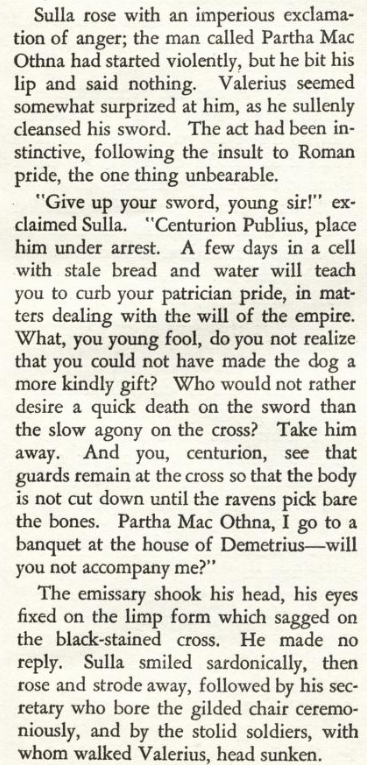
Of course, in the story, Joe and Myra tell this little goblins to fuck off – there’s no way you’d ever believe a story like that, even if a tiny huge-headed weirdo told it to you. In order to convince them, the little guys use their ultratech to paralyze the Calderons. One of the little guys then pries the baby free from Myra’s grasp and, promising that they’re not going to hurt him, they begin “instructing” him:

Following the lesson, the little guys leave, un-freezing the parents as they do. Aghast, the two parents try and cope with the obviously strange situation and their relative powerlessness.

The next day, in an attempt to evade the little weirdos, they take Alexander out to a movie. However, in the middle of the picture, Alexander simply vanishes. They search the aisle, hoping that they just dropped him, but they both know the score soon enough – they decide that he’s obviously been grabbed by the little guys, and that he’s probably back at their apartment. They hurry on over, and sure enough:

Bordent menaces them with paralyzation, but the Calderons promise to behave – it’s evident that they’re going to have to adapt to this new situation.

Again, there’s a *hint* of some darkness here, with the future Alexander apparently capable of instilling a healthy fear in his underlings. The Calderons watch Alexander going through his lessons, babbling happily while weird devices execute strange programs designed to enhance a superbaby’s development. There’s weird lights and sounds and technical jargon, but the little guys seem pleased enough with his progress. But, of course, Alexander is STILL a baby:

An interesting insight into just how much the genetic revolution and the Modern Synthesis in biology had permeated (albeit imperfectly) into pop culture of the time – exposure to the byproducts of modernity have influenced the Calderon’s genetics, resulting in the first of what will, inevitably, be more mutants born to the human race. Of similar impact is the revolution in psychology as well, because the story immediately begins to talk about the importance of childhood development:

It’s interesting to get this glimpse of two of the big changes in parenting that came about in the mid-20th century: a concern about environmental impacts on reproduction AND a technocratic interest in the “right” way to enrich a child (and, especially, a baby) for optimal results. Myra, the mother, wants to know what this means for their family:

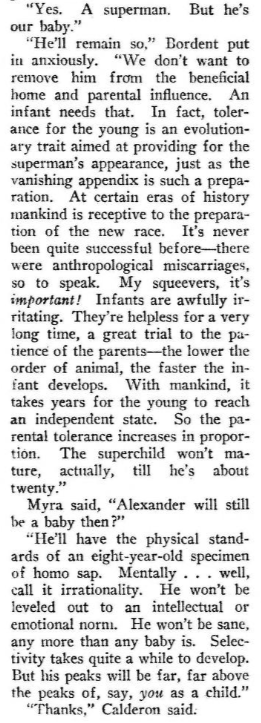
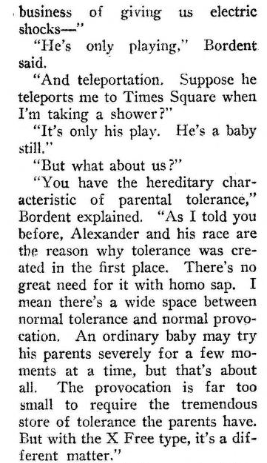
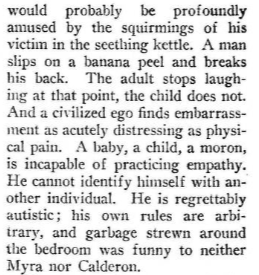
A lot to unpack here in the long section quoted above. First off all, the idea that tolerating a baby, which are by nature extremely irritating entities, is an aspect of human evolution is a lot of fun. Babies ARE a pain, and there’s got to be a mechanism, social or biological or some combination of the two, that prevents parents from throttling the yowling, smelly little things. What Bordent is saying here is that the next step in human evolution had to wait around for this tolerance mechanism to develop sufficiently, because if regular babies are aggravating, superbabies are more so!

Secondly, there’s a VERY interesting thing going on in the last bit of the quoted section, where Bordent is explaining that Alexander is going to be, basically, a child, at least until he’s around twenty or so. We’ll come back to this point at the end, but keep it in mind – the question of what is developmentally “normal” (or, perhaps…”typical?”) for children is being raised here, and it’s a large part of the story. Like I said, we’ll talk about it later.

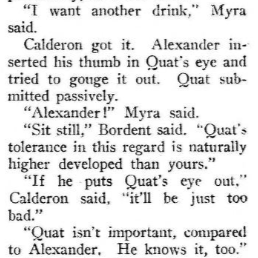
This discussion of Alexander’s future development is curtailed when Alexander starts acting like a baby again:

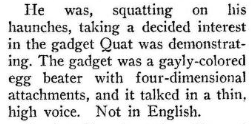
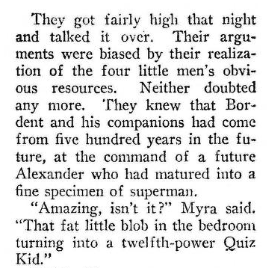
Luckily, Alexander is distracted by something, and Quat gets to keep his eyeball in his socket. The lessons done for the day, the Calderons spend the evening getting drunk and trying to wrestle with the world they’ve been introduced to.

I just wanna highlight the “Quiz Kid” reference there, because its an interesting glimpse into the prevalence of “kid geniuses” in the popular culture at the time. “Quiz Kids” was a radio (and later, TV) show that had a rotating panel of child “prodigies” who answered esoteric questions about various arcane subjects, a kind of genteel freak show/kids-say-the-darndest-thing/game show. It’s a really fascinating piece of popular culture, and was hugely influential at the time; you see references to it all the time if you’re reading magazines or books from the era. There’s also an absolutely amazing memoir/biography/personal history graphic novel by artist/writer/comics god Michael Kupperman about his father, Joel Kupperman, one of the more famous of the Quiz Kids from the era. It’s called “All the Answers” and it’s really an incredible book. Click that link and, seriously, get yourself a copy, it’s great.

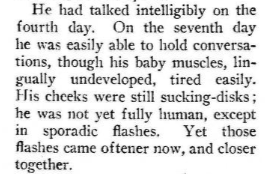
The daily super-education lessons continue, and over the next week they start to bear fruit:

Joe is watching his son bustling around among the futuristic learning toys that have been left in their house, waiting for the arrival of the four little weirdos for their daily edification session. He’s nursing a highball and considering how strange his child has become, obviously contemplating how much farther he has to go.

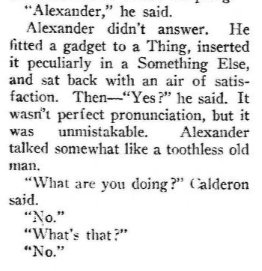
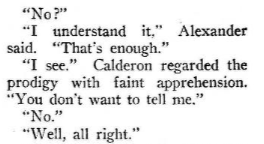
Pausing here, let’s consider this exchange. On the face of it, it’s evident that this superbaby is, basically, becoming disdainful of his merely-mortal parents. But what struck me when reading this is the repeated “No,” which reminded me of Donald Triplett who in 1943 (a year before this story came out), was the very first person ever diagnosed as autistic. As a child, he would often only give “yes” or “no” answers, regardless of the question, and often used “no” as a means of shutting down a conversation or line of questioning. The doctor who worked with Triplett was Leo Kanner, considered one of the founders of modern child psychiatry whose work on childhood brains and development was of substantial interest in the wider popular culture of the time. There’s no direct proof, but it’s hard to imagine this story being written without Kanner’s work being part of the larger conversation around children at the time. In particular, Kanner’s identification of childhood autism and his description of its symptoms, seems to be a large part of the background of this story, as we’ll see.

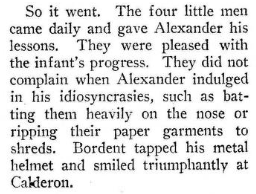
In the meantime, Alexander becomes harder to deal with. He decides to test his digestive system by puking wildly all over the place, tersely demanding his mother clean it up once he’s done. He decides he wants to understand his lung capacity and vocal abilities more, so he institutes a regime of nonstop screaming all day and night. As his lessons continue his powers likewise expand, and with it, his demands.

On the one hand, these are generally just the demands of a baby, right? I mean, babies DO make a mess, shitting and puking all over the place, and a parent DOES have to clean up after them. Similarly, babies cry! Babies want things they can’t have! They have tantrums! What makes them troubling, though, is that Alexander is not merely an irrational baby – he’s a super baby, and his hungers and desires and rages are all expressed in English (and, of course, backed up with super powers). There’s certainly as aspect of weirdness-for-weirdness sake here, at work here, but it also stands in for concerns and uneasiness about parenting and children. And of course, it’s also very hard to NOT read this story in the light of our modern day, contemporary discussions of autism and neurodivergence and parenting.

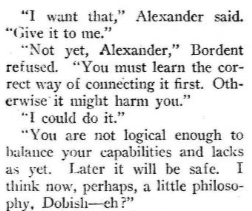
Alexander’s lessons continue, and in the light of his past behaviors, Calderon raises the subject of discipline.

Bordent tries to assuage Joe and Myra’s concerns, explaining that, as a super being, Alexander requires very different kinds of discipline, and that they cannot provide it. They must simply be patient and tolerant of their super child. And then, there’s some foreshadowing:

I’m sure THAT’LL never come up again.

Moving on, Alexander’s powers continue to develop – he flaunts his intellectual superiority at ever turn, happily pumping his parents for information and then using his advanced brain to make complex, intuitive leaps that leave them in the dust. And that’s not all. One day he wants candy, and when his mother tells him she doesn’t have any he simply teleports her to the candy store. Later, for his own amusement, he electrically shocks his mother and father, just to see their dumb faces when they fall down. The Calderons try again to talk to the four little guys, but they’re just pleased that Alexander is advancing so quickly.

Bordent makes it very clear that the Calderons are not going to be allowed to discipline Alexander – they will protect him, at all costs, and if that means incapacitating his semi-divine parents, well, so be it.

Two months pass, and Alexander continues to develop his powers, and life continues to become less and less tolerable for his parents. The shocks, the random teleportation, the constant demands, and Alexander’s cruel sense of humor are making things very difficult for Joe and Myra. Joe is unable to do his work at the University, and Myra is clearly getting worn down from taking care of Alexander during the day.

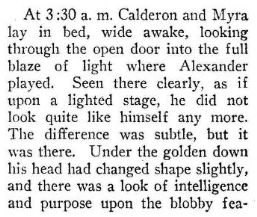
Interesting to see the use of the word “autistic” there; like I said above, there’re clear finger prints of the complexification of peoples’ understanding of childhood development all over this story.

The Calderons are being pushed to the edge by their superbaby – both of the parents are wrecks, sleep-deprived and harried by the constant demands of their superbaby. And it’s about to get worse – Bordent informs them that a great milestone has been reached! Alexander will no longer need to sleep! Instead, he’ll be active 24 hours a day, advancing that much faster now that the biological weakness of fatigue has been surpassed. Dumb with horror, the parents can accept their fate as the caretakers of this little monster.

Alexander has a sudden tantrum, scattering his crystals, screaming in rage, using his mind powers to make the windows slam. The phone rings, and Joe is informed that, because of the constant noise and bother, they’re being evicted. By this point, however, both Myra and Joe are numb to the outside world; they’re prisoners of their superbaby, and they’re reaching a breaking point. They talk about how they’re supposed to do this, how anybody could do it, and they again wonder if anybody else ever has…HAS there been a superbaby before? There couldn’t have been, right? I mean, they’d have HEARD about it…right?

Alexander demands milk (warm, not hot this time, dammit!) and Joe rises to serve him. When he returns, he finds Myra deep in thought.

I mean, wow, right? Straight up veiled discussions of fuckin’ infanticide right there in the pages of Astounding Science Fiction from 1944. Wild stuff! But it gets at what this story is mostly about – the delicate, dangerous balancing act of “tolerance” needed to care for a baby.

Joe and Myra are distracted from their dark train of thought by a crash from the living room, followed by the sounds of splintering wood and Alexander’s cruel chuckling. And then:

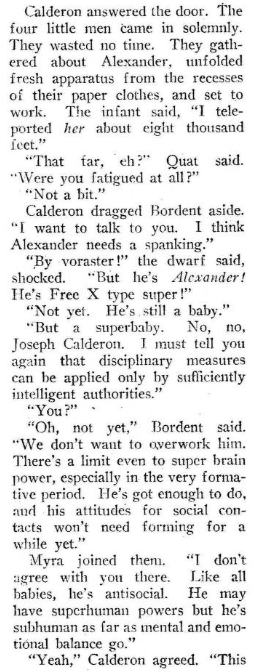
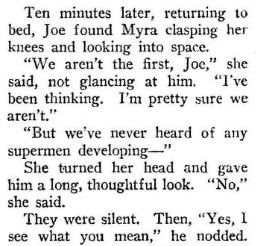
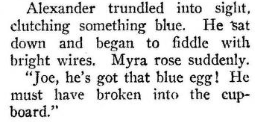
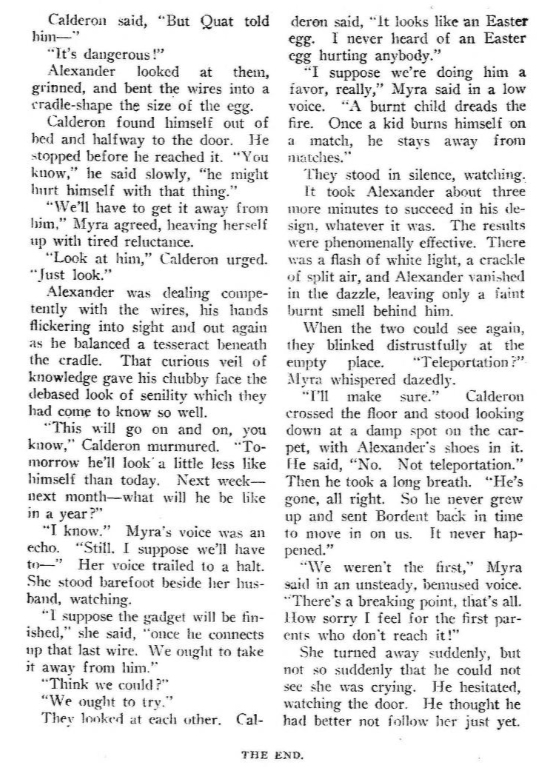
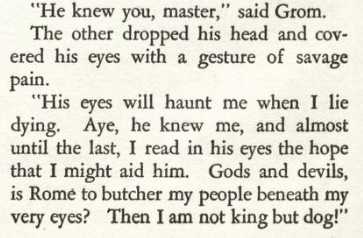
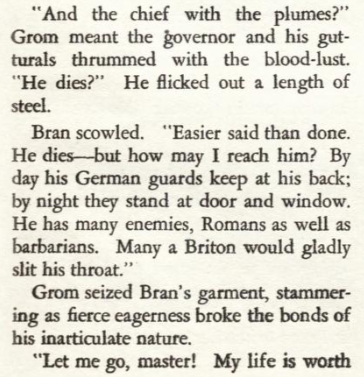
The blue egg! Remember that? Who could’ve foreseen that it would come back again!? Still, I’ll just reproduce the whole final page, because it’s pretty amazing and, honestly, kind of moving.

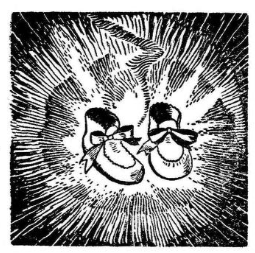
From a writing stand point, that’s some remarkably economical prose, isn’t it? I mean, look how much Moore and Kuttner convey with just a few choice verbs and some dialog. Joe’s mention of the future gets Myra on the same page very quickly, and then their self-justification that, well, maybe we should let him burn himself, so he learns a lesson…it’s all so good, eliding the real conversation that they’re having. And then, of course, the fuckin’ super baby kills itself, which is WILD; it’s definitely NOT one of those cutesy “family” sci fi stories you might’ve been worried about, is it? It’s also followed by a genuinely conflicted (and very much a C.L. Moore-ean) scene of sadness and resignation at the very end, with Myra and Joe’s silent little interaction communicating a particular poignancy.

The time travel stuff is a little odd at the end – I mean, it’s a classic paradox, right? It doesn’t really matter, but I hope Joe and Myra don’t have to answer TOO many questions from the cops about where their baby got to…of course, it’s 1944 and they’ve just been evicted, so I’m sure they can just start over again somewhere else without Detective Joe Friday hounding them or anything.

More interestingly, from our perspective today it’s hard not to read “autism” onto this story, and that’s not entirely incorrect, I think – this story is about complex and difficult childhood development, and the strains parents face. The details of autism, and our understanding of it today, are of course different and much deeper, but even without that specific diagnostic modality there’s lots of evidence that Moore and Kuttner were interested in atypical childhood development in this work. And, importantly, there’s lots in the text showing that questions about childhood psychology, environmental effects on reproduction, the functioning of families under stress, are all at the topics of interest for American culture in the 40s. That makes it a VERY dark story, of course; overwhelmed by the task of parenting an “abnormal” baby, Joe and Myra basically murder Alexander, their son, through a very deliberate act of neglect. That’s grim shit!

I think it’s also trying to explore the particularly insidious societal expectations around parenting, too; like the assumption that OF COURSE you want your baby – the constant refrains from Bordent about how Joe and Myra are genetically predisposed towards “tolerance” of their child sounds very similar to the assumption that parents MUST (and of course WILL) love their children unconditionally. It’s all part of a very pervasive (and corrosive) assumption about life roles too, isn’t it? That the highest calling is parenting a precious baby that must, at all costs, become the center of the universe for you. I mentioned Russ’s “Galactic Suburbia” earlier – this story presciently seems to be right there with her, arguing against the oppressive, pervasive heteronormativity that Russ had identified as being foundational to a lot of the (bad) sci fi of the 50s and 60s.

More broadly, I think it’s also a part of Moore’s interrogation of love as a destructive force. In “Shambleau” and “Black God’s Kiss” we saw how interested she is in the idea of love as a dangerous and sometimes deadly impulse. Of course, as a collaboration between Moore and Kuttner, it’s not ALL just C.L. doin’ the writin’ and whatnot, but she’s definitely shown an interest in that line, more so than anything I’ve seen in Kuttner’s work.

All in all, I think it’s a provocative, interesting, and (most importantly) good piece of science fiction, one that shows how remarkable Moore and Kuttner’s partnership was!

Greater Austin Book Fair Recap

This past weekend, on the 11th, I took part in the Greater Austin Book Fair, a brand new event held at the (pretty schmancy) Central Library here in Austin. I had a good time, sold/traded some books, got some free beer, met some folks. It was my first time attending anything like that, so I thought I’d just jot down some thoughts/reflections here, a kind of after-action report.

First off, the library system here in Austin is really incredible, and what a cool thing that they had the funds, space, and gumption to put something like this together. In particular, the whole thing was free for me – no tabling fee, no registration, free beer and appetizers for the writers the night before, free lunch/snacks/coffee the day off, hell they even validated parking, something almost unheard of in downtown Austin these days. Also, for it being the first time they’ve put this thing on, they did a really nice job – lots of volunteers, everything worked like it was supposed to. Good work all around!

The organizing principle of the whole shebang was to get writers from the “Greater Austin” area involved, which included Travis, Hays, and Williamson counties, and it seems like they held to it. About 80 or so authors were involved, and they were all central Texans, as far as I could tell. It’s a neat idea, and really speaks to our library’s commitment to the whole “community” thing. As an approach, I think it worked really well – people who wandered in seemed to really enjoy the fact that they were, by default, welcomed.

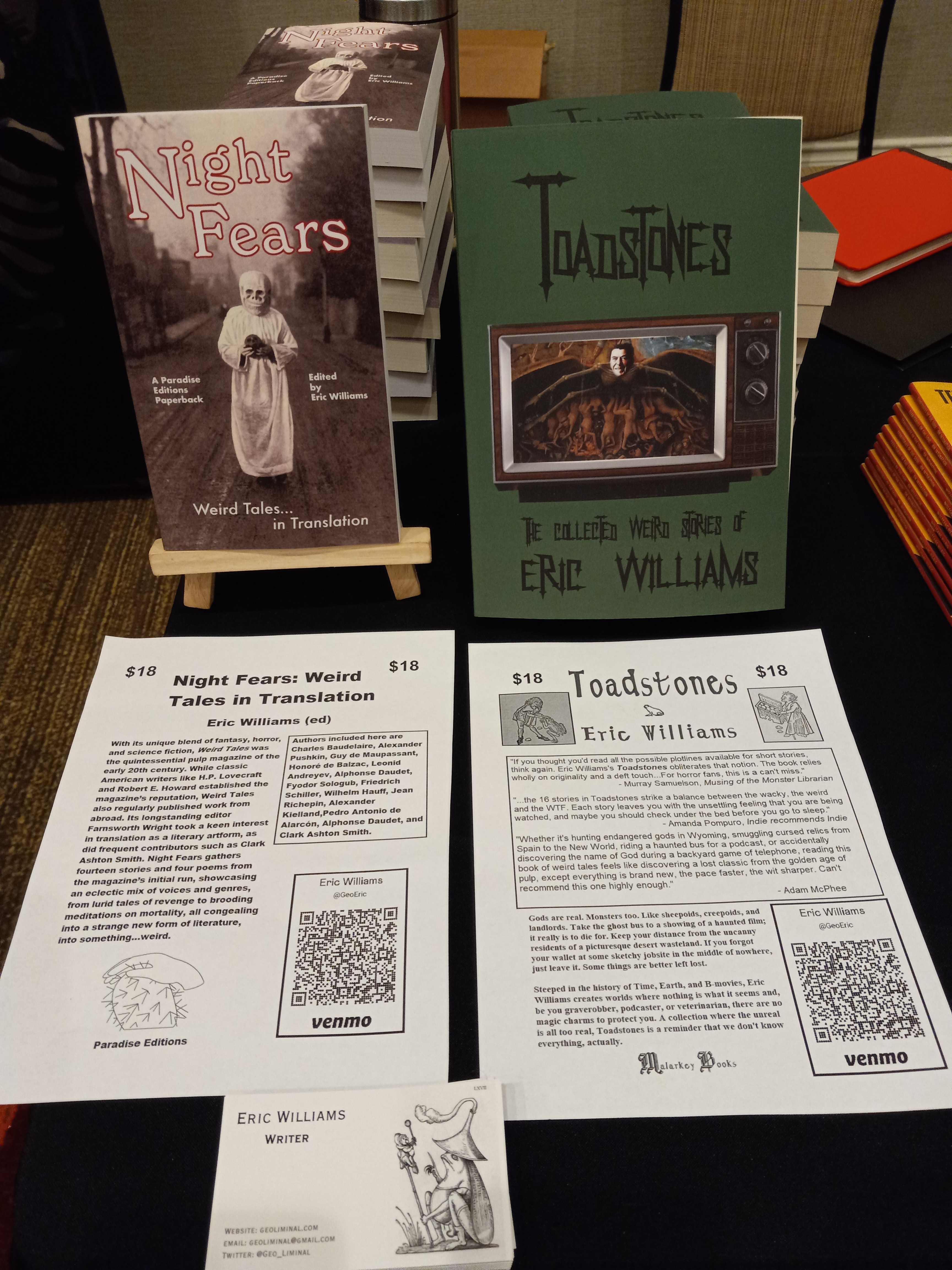
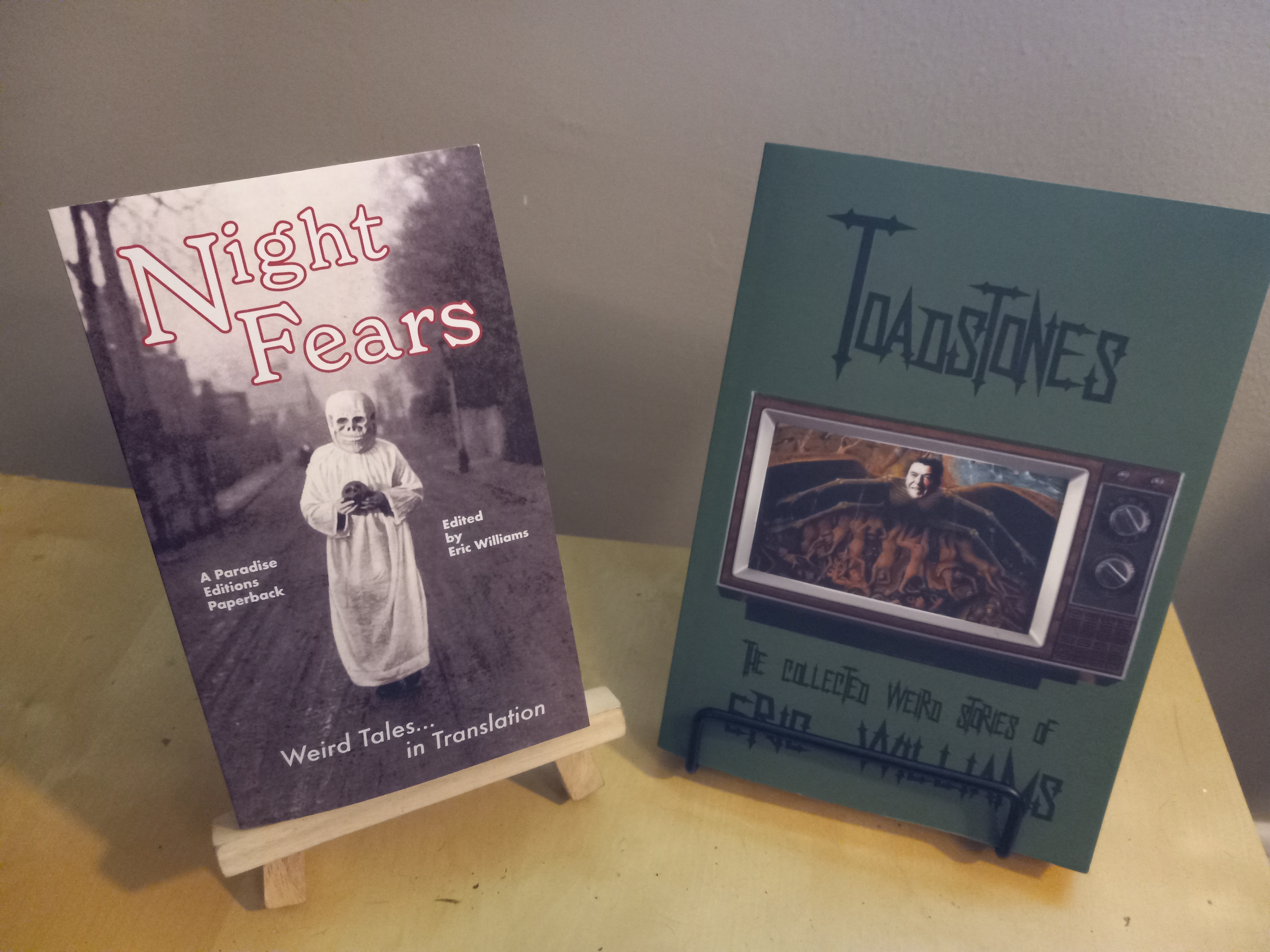
What that produced, in terms of the books on display, was a pretty eclectic floor. Graphic novels, children’s picture books (a surprisingly lot of these!), YA, all alongside the full sweep of adult fiction, literary, genre; it was all roughly spatially organized with similar stuff close together, but it did result in some kind of funny interactions. For instance, a lot of people would come off of the historical/speculative fiction folks next to me and then get spooked out by my books; I had several people say that the covers to both Toadstones and Night Fears were TOO scary, which just speaks to the skill and care that Malarkey Books and Paradise Editions lavished on them.

spookiness is a feature, not a bug

Made me realize, though, that there’s probably a pretty big difference between the Greater Austin Book Fair and a more focused, genre-specific event. Had to spend a lot of time orienting people within the genre itself, something that might be easier if everybody comes in with the idea of lookin’ at spooky books already. Then again, you might be just exchanging one set of explanations for another, in that in a genre-defined setting, I’d have to work to highlight why THESE books deserve attention among all the other spook-em-ups there. We’ll see, I’m planning on doing a very specifically horror-genre convention later this summer.

It was also interesting for me, because I’ve never been to a non-academic conference before – the biggest difference is in the way panels are done, which was kind of odd in that there was just sort of a broad topic, with a mediator asking a few questions and then the panelists kind of just going down the line and answering them. Maybe that’s atypical and just the way this one worked out, but I feel like it could be done better. Not necessarily people coming in to give presentations, but maybe something more structured like a conversation. I dunno, it’s tricky, and I have to admit that I’m also not ever *really* all that interested in hearing writers talk about writing, so maybe that was just on me.

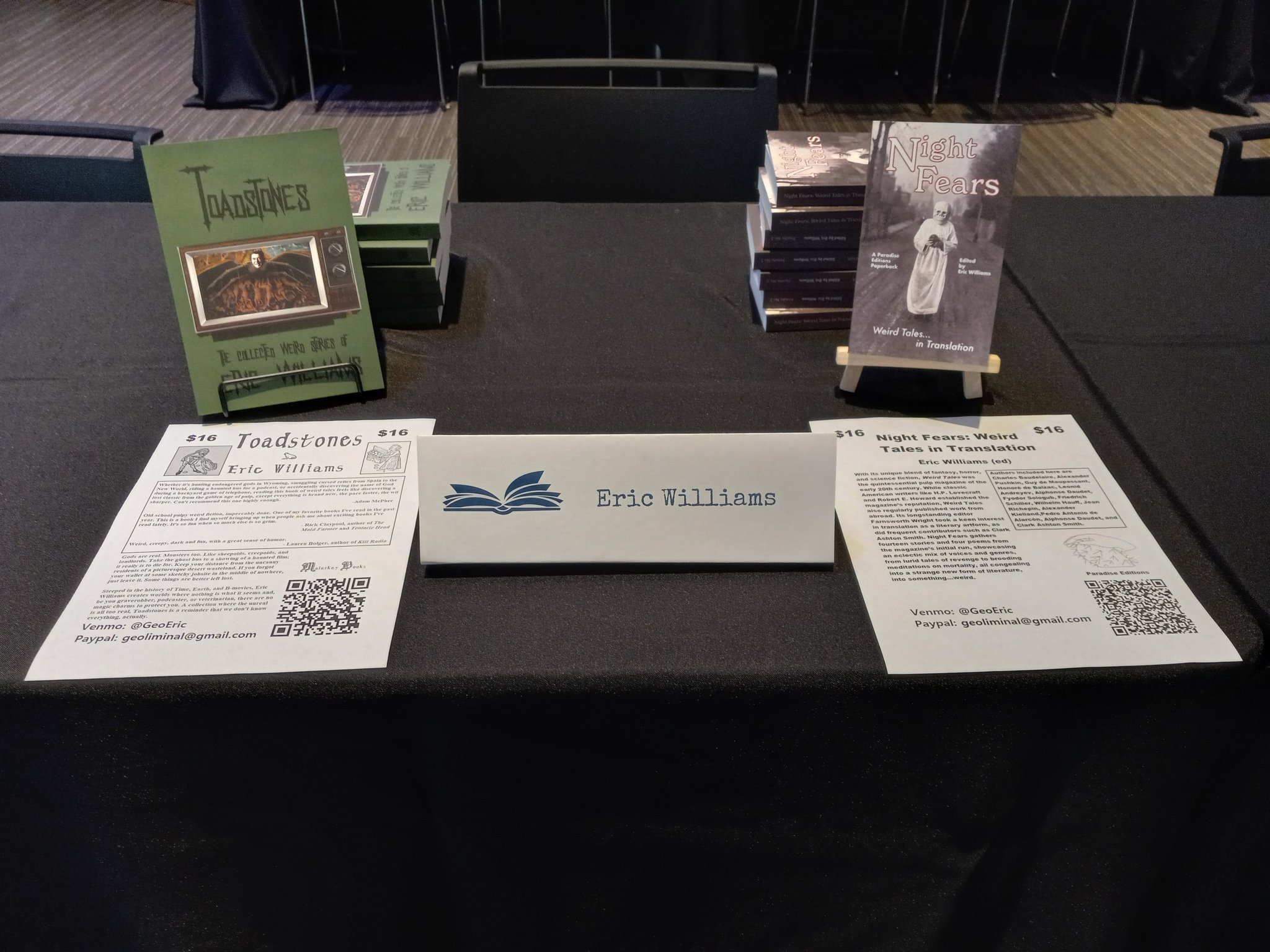
I suppose I should get down to brass tacks, thought: how many books did I sell? Grand total of seven, or about 1/hr for the whole day. Three Toadstones and four Night Fears, and I swapped four (two of each) to folks for copies of their books. I brought twenty of each, which meant I hauled a lot back, but that’s okay… although if anybody out there wants a copy of either (or both) of them, I’d be happy to sell em for, lets say, $20 each? Feel free to shoot me an email at geoliminal [at] gmail [dot] com if that’s the case!

for real, help me out – i got cats to feed, man

What did I learn about conventioning? First off, HUGE thanks to Lauren Bolger (buy her book, Kill Radio!) who, as a veteran of many conventions, gave me so solid advice: in particular, getting some bookstands and printing out papers with book info and QR codes on ’em and such was extremely helpful. In the future, I think I’ll have some cards printed up too, mostly so I could hand over my contact info to other writers I met more easily.

But, all in all, I had a lot of fun, and I’d encourage people to attend these sorts of things, if they can – I don’t think they’re any kind of career-making event, but this one was fun and I’d definitely do it again.

Corman the Cult King

You can’t call dying at 98 a tragedy, but I definitely had a sense of the Passing of a Heroic Age when I heard that Roger Corman, B-Movie Impresario Extraordinaire, had died. There’re a lot of paths for people to find his work; in terms of monster films, his aesthetic (and sheer output) makes him one of the greats, but “serious” film fans probably also know him for his (sometimes exploitative) role in giving some heavy-hitters their first jobs in the movies. Or they might appreciate the work he did in distributing art-house foreign films through his company New Worlds – Fellini, Kurosawa, Herzog, a bunch of huge international names got work into American theaters because of Corman. And, of course, you’ve probably seen a number of his movies if you’re an MST3K fan (which, apparently, Corman himself was not).

I’m a huge fan of 50s/60s era sci-fi and horror, so of course Corman is one of my favorites. He made cheap, fast movies designed to turn a profit, a very pulp approach to entertainment that I find endearing, but there’s another key to his success that I think got lost in the obits and retrospectives that’ve come out since his death. Corman movies are often slyly and subversively fun. Partly I suspect that’s down to material considerations; teeny tiny budgets meant that they needed to find other ways to engage an audience’s interest, often relying on bonkers ass weird shit to paper over some of the cracks and rough edges. Jack Nicholson’s work in Corman movies is a great example of this: The Terror (1963) is a terrible, barely coherent movie, but Nicholson is absolutely unhinged in it, and his screaming and confusion kicks it into almost transcendent weirdness.

Subversion in Corman’s work is also important. I think there’re often more legitimate and sincere revolutionary ideas and attitudes in popular entertainment than in high-brow art – the simple fact that the former have to be a little more sneaky about their subversion makes that almost a given. But also, I think the ludic qualities of pulp/pop entertainment underscores and reinforces the subversion – you can make a dour and self-serious meditation on Debordian spectacle and commodification of the body under capitalism that nobody will ever see, or you can make Deathrace 2000. And beyond those sorts of societal-scale ideas, a lot of Corman movies proceed from the assumption that “normal” people don’t exist, that there’s a lot of strangeness and oddity in each of us, a refreshing and important reminder I think.

Don’t get me wrong, Corman wasn’t some kind of secret Dadaist using his films for culture jamming or anything like that; dude liked money and found a niche in Hollywood that let him make a lot of it! And of course there’s plenty of laughably bad shit in the Corman oeuvre – if you ever do a marathon of em, the cat fights or women showering scenes will get real old, real fast – but I do think that he (as director and later producer) sometimes created an environment where fun work could be made that used the limitations of production and the conventions of genre in very interesting and, honestly, instructive ways. I mean, goddamn, there’s almost no comparison between the “B” movies of Corman’s heyday and the absolutely vile shit being put out now!

Anyway, he’s obviously an important figure in film history, but in order to help spread some appreciation of the FILMS themselves, I thought I’d put out a little list of some of my personal favorites that you might wanna check out!

Not of this Earth (1955) – This is a spooky, atmospheric bit of paranoid sci-fi, with an alien that presages the MiBs of Point Pleasant and the Saucer era. Weird medical horror and a strange and interesting premise make this one one of Corman’s best, even if he did torture Paul Birch with awful contact lenses.

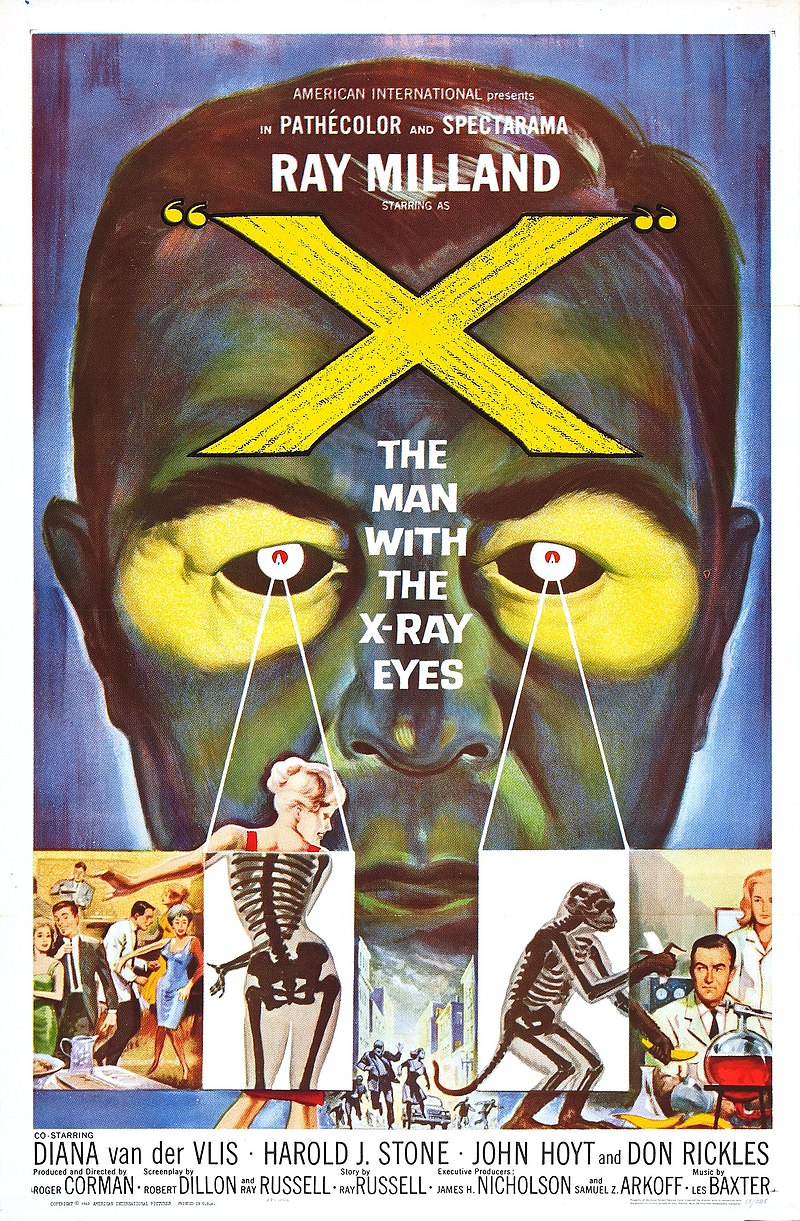
X: The Man with X-Ray Eyes (1963) – a legit classic! Corman often drew water from the same well, and this is a good example. He clearly thought the deadly eyeball stuff in Not of the Earth was an effective bit, so it gets expanded into this wild and very odd story. All sorts of interesting commentary in this one; industry research, snake oil salesmen, and organized religion all get picked apart, and it’s all capped off by a really great cosmic horror ending, one of the few things I’d call truly “Lovecraftian” to ever appear in any movie anywhere!

The Haunted Palace (1963) – ostensibly one of the famous Corman “Poe” series, this one is actually based on the Lovecraft novel (never published in his lifetime) “The Case of Charles Dexter Ward.” Extremely fun to see the Lovecraft stuff get name-checked here of course, but it’s also got a great performance by the master Vincent Price as well as a very brief but very effective glimpse of something living in the pit below the palace. Great stuff!

The Masque of the Red Death (1965) – probably the best of the “Poe” flavored adaptations that Corman did, with beautiful and evocative photography and scenes plus, again, Price is just one of the best actors ever. There’s a lot of atmosphere and menace in this one, and the totentanz scene is one of the great horror set pieces in movie history.

The Dunwich Horror (1970) – probably my favorite Lovecraft adaptation of all time (after the silent Call of Cthulhu from 2005, of course). Dean Stockwell’s Wilbur Whatley is incredible, strange and alien and alluring, a real departure from the source material that nevertheless does manage to keep some of the repulsion in there. Plus this is another great example of the Corman “there’s no money so be creative” school of special effects – turning Yog Sothoth into a writhing mass of hippies is actually pretty inspired and a zillion times more interesting and effective than whatever CGI bullshit they’d try now.

Death Race 2000 (1975) – I mean, holy smokes, this is a masterpiece. Violent, convoluted, and campy as hell. Madcap cornball fun, highly recommended.

My own Dumb List…of SHORT STORIES!?

Before it got eclipsed by the Oyler stuff, the nascent lit twitter discourse that threatened to get good and roiling was about whether novels were, inherently, a bourgeois form. I don’t care about that, and neither should you, but it did get me thinking about how novels ARE afforded too much deference, especially given that they’re decidedly the lesser form of prose literature, vastly inferior to the stately and transcendent Short Story. And then THAT got me thinking about the dumb novel list from last post and how you never (or rarely, at least) see a list of favorite SHORT STORIES out there.

So, anyway, I thought I’d take a swing, and make a list of my favorite Short Stories (in no particular order). Here’s 25, and maybe I’ll add some more in future posts as they come to me.

1 – Red Wind (Raymond Chandler, 1938) – This is the short story that immediately comes to mind for me when I start mullin’ over the form. There’s a tightness to this, and even though it’s a bit on the longish side it’s super efficient, packing in a huge amount of characterization and style and depth into something readable in a single sitting. It’s got some great Chandler flourishes too, both in the descriptions of the Santa Ana winds and in the dialog, AND it has one of the greatest endings in all of literature, genre or no. Just a really masterful example of the power of the short story!

2 – The Gutting of Couffignal (Dashiell Hammett, 1925) – while we’re on hard-boiled detectives, we might as well talk about the greatest writer of the genre, Hammett. Fer my money, this is his masterpiece, an inventive and exciting crime story that has another really fantastic ending that springs a sudden depth and humanity on the reader that, I think, a lot of people might not expect.

3 – Neighbors (Raymond Carver, 1971) – I dunno if this is one of the Lish-ed up stories or not, but it’s absolutely my favorite Carver work; nothing else of his even comes close, in my opinion. A real lived-experience kind of story, extremely perceptive and real, that captures something about our innate and sometimes obsessive curiosity about other people.

4 – The Killers (Ernest Hemingway, 1927) – I mean this one doesn’t need a lot of explication, I think; it’s great, a story about gangsters and crime and murder told via a strange interlude before all the more “traditional” action and violence and whatnot.

5 – The Lovely Leave (Dorothy Parker, 1943) – Parker is, of course, a master of the short story, and while there’s a bunch of her funnier ones that belong here, I think this rather serious and wistful story is probably my favorite. The tension and anxiety of expectation, and the way even in the midst of huge earth shattering events our little lives must go in…it’s just really fantastic.

6 – Boule de Suif (Guy de Maupassant, 1880) – THIS was a hard choice, probably the hardest that I’ll be forced to make on this list, because in my opinion Maupassant is the greatest short story writer who ever lived. An absolute MASTER of the form with, like, a hundred stories that belong on a list like this. This one, translated as “Ball of Fat,” is a profound meditation on hypocrisy, cowardice, and dignity, everything precise and perfect and wonderful. Being a monolingual dummy I’ve only ever read it in translation, of course, but given how many home runs ol’ Guy here hit in his tragic lifetime, I think it’s safe to say that his genius shines through in English too. Really, if you haven’t, read some Maupassant, this one and as many others as you can find!

7 – The Overcoat (Nikolai Gogol, 1842) – I mean, look, sometimes things are a classic for a reason, right? Gogol is the greatest Russian writer of all time, and this is his best story. What more can I say?

8 – The Crop (Flannery O’Connor, originally in her ’47 thesis, but not available until 1971) – In terms of American short story writers, O’Connor is definitely near the front of the pack, a genuinely innovative talent. And while she’s certainly famous for her big, apocalyptic, visionary works, I think this littler, quieter, and funnier story is her very best piece. There’s a real playfulness here, which is something that’s in a lot of her work but rarely as centrally placed as it is in “The Crop.” Plus, there’s a precision on display here, with everything humming along in service to story itself, that makes it a joy to just read.

9 – The Last Man Left in the Bar (C.M. Kornbluth, 1957) – Kornbluth is one of the major figures in mid-20th century science fiction, a member of the (vaguely socialistic) Futurians who, despite his small body of work, had an outsized influence on the genre. Anyway, this is a weird little bit of esoterica that I just love, an absolute gem that’s almost experimental in form, something really out of the ordinary for Kornbluth. It’s a lot of fun, kind of weird, and really captures a flavor of the otherwordliness that typifies some of the best of that era’s science ficiton.

10 – And the Moon Be Still as Bright (Ray Bradbury, 1948) – Bradbury’s greatest work was all in his short stories, and his collection “The Martian Chronicles” is absolutely essential reading. This story, which was originally published in the pulps before getting collected, is a a great and very satisfying take down of Western (and, especially, American) colonialist attitudes and behaviors. Bradbury always wore his heart on his sleeve, but here it serves him well, and the sadness and bitterness on display in this story elevates it into something special, in my opinion.

11 – Thanasphere (Kurt Vonnegut, 1950) – unlike Bradbury, Vonnegut’s short stories are generally not his strongest work. They’re often pretty one-note, in my opinion, and oftentimes that note is kind of unpleasant (i.e., Harrison Bergeron). But I do really like “Thanasphere,” which takes the time to really explore its weird conceit.

12 – Major Pugachov’s Last Battle (Varlam Shalamov, 1973) – Shalamov’ collection “Kolyma Tales” is essential reading, grim and humane and wonderful, and this is my favorite story from it, about an escape attempt from the prison colony of Kolyma. What’s so great about Shalamov is that his writing, intense and almost journalistic, is ALSO extremely stylized and vibrant, and the stories he tells are rich, deep, full of a kind of terrible majesty in their unflinching examination of humanity.

13 – The Night-Wire (H.F. Arnold, 1926) – I’ve written at length about this, one of my favorite pieces of weird fiction ever, so I’ll just once again state that the pulp era was THE golden age of the short story, with a huge number of venues publishing short fiction and a truly staggering number of people actually reading them! A wonderful bygone age!

14 – No Woman Born (C.L. Moore, 1944) – In fact, why not just get a few of these stories that I’ve already written about knocked out, eh? I wrote a bunch about this story, too, an example of some great early feminist sci-fi from one of the masters, C.L. Moore!

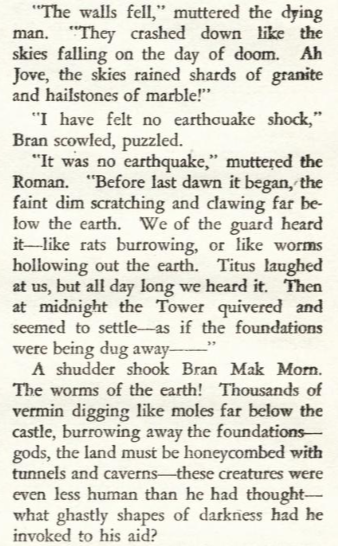
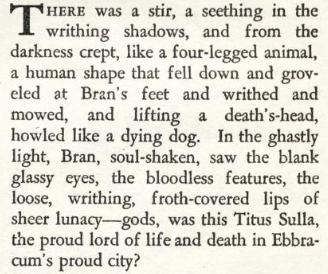
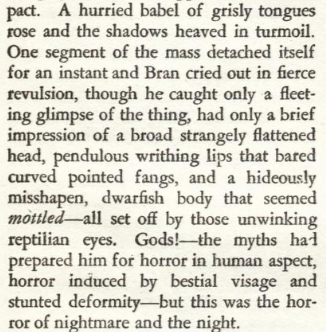
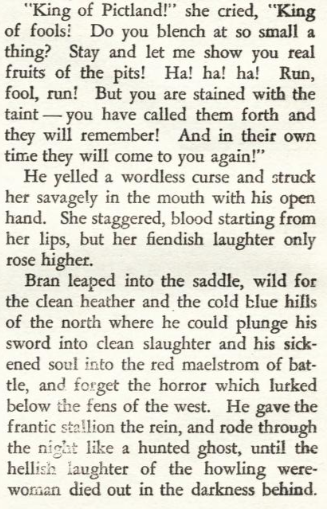
15 – Worms of the Earth – (Robert E. Howard, 1932) – One more from the blog; I make no apologies for my love of Sword & Sorcery, a unique, vital, and inventive literary genre born in the pages of Weird Tales magazine, and this is the single greatest story in that genre ever written, period.

16 – “Aye, and Gomorrah…” (Samuel R. Delany, 1967) – An unbelievable debut story (it was his FIRST story he ever sold…) from one of the truly great writers of the past 100 years. This appeared in Ellison’s “Dangerous Visions” volume, a seminal piece of literature, and even so it’s probably the best story among a bunch of really phenomenal pieces in there.

17 – Enoch Soames (Max Beerbohm, 1916) – One of the funniest stories ever written, and the weirdness and fantastical elements are really smoothly integrated into a piece that, really, is a send-up of artistic vanity and solipsism.

18 – Jeeves and the Old School Chum (P.G. Wodehouse, 1930) – Speaking of humor, any list of the best short stories absolutely must include Wodehouse, one of the greatest practitioners of The Art ever. In addition to offering, in each story, a master class on the art of plotting, characterization, and dialog, he is also a comedy genius. All of his stuff is remarkable, but this story made me collapse with laughter all alone out in the field in Wyoming once, confusing the hell out of a coyote pack that lived in the next wash over.

19 – The Bloody Chamber (Angela Carter, 1979) – Carter is great, and you should read everything she ever wrote, but this retelling of the Bluebeard legend is one of my favorites. The ending in particular is just a great, liberatory moment in feminist writing, really wonderful stuff!

20 – The Colour Out of Space (H.P. Lovecraft, 1927) – Certainly the greatest writer of weird fiction in the 20th century (and also enormously influential; his fingerprints are all over the past 70 years of pop culture, not just in horror, but in sci-fi, fantasy, comics, games, you name it!), and this is probably his best story (it was certainly HIS favorite).

21 – Gunslinger (Ed Gorman, 1988) – Gorman writes in a variety of genres, but his westerns are my favorite; he’s got both a strong sense of the genre traditions as well as the skill to tweak ’em just enough to make ’em interesting. Highly recommended!

22 – Another Story or A Fisherman of the Inland Sea (Ursula K. Le Guin, 1994) – A beautiful, meditative piece on life and the choices that go into making it, executed by a great artist at the height of her powers.

23 – The Drowned Giant (J.G. Ballard, 1964) – This is one of those stories thats faceted like a gem, with lots of different ways to approach and understand it. Ballard is always wonderful, grotesque and profound in equal (and complementary) ways, and this story basically condenses everything he ever wanted to write about down into one punchy little piece.

24 – Subsoil (Nicholson Baker, 1994) – You’ll never look at ‘taters the same way again!

25 – Second Variety (Phillip K. Dick, 1953) – My favorite Dick short story, one that neatly encapsulates all of his biological/ecological musings along side his (mostly dim) view of human nature.

Anyway, that’s probably enough for now. Go read some short fiction!

Dumb lists

Frustratingly, I find myself thinking about the goofy 100+ entry list of “The Great American Novels” that The Atlantic put out last week (I’m not going to link to it…I’ll not give them that satisfaction, at least). It’s not the WORST one of those things I’ve ever seen, of course – I mean, at least it has some genre stuff on there. The inclusion of Shirley Jackson’s The Haunting of Hill House is a relief, and Djuna Barnes is good and correct (Nightwood is legitimately one of the great novels of the 20th c for sure), but there’s also a lot of dumbness on there. For one thing, the restriction of the list to the last 100 years is just plain ridiculous, even with the weakass “modernism!” excuse they offer. I recognize that I’ve definitely got some serious biases; I’m by nature and inclination a very historically-minded reader, but even if you’re not it still seems like a kind of pointless obfuscation of whatever the fuck “American” literature is to not have Jack London, Booth Tarkington, or James Branch Cabell, all of whom were enormously influential writers in America that had a major impact on 20th century literature.

Like I said above, it IS nice to see some genre stuff on the list, but I kind of feel like some of it is rather poorly thought out, a quick grab of some Big Names rather than any serious attempt at identifying any of the actually important or interesting books by some of these folks. I mean, they picked The Dispossessed over The Lathe of Heaven or The Left Hand of Darkness? That’s just dumb “ah but you see this must be SERIOUS sci-fi because it is about Something Else” bullshit. Ditto for PKD’s Do Androids Dream of Electric Sheep? which is, while a fine book, nowhere near his greatest or most quintessentially “American” novels (that’d be A Scanner Darkly, UBIK, or Dr. Bloodmoney). ALSO, with regards to “American lit” and genre: where the fuck are the westerns!? (Blood Meridian doesn’t count).

Anyway, to exorcise my annoyance, I figured I might list up a handful (or two) or some of the more egregious absences on the Atlantic List, with of course the caveat that I’m just a simple country geologist what likes to read.

Dhalgren (1975, Samuel R. Delany) – Right off the bat I text searched “Dhalgren” on the Atlantic List, and when I saw it wasn’t included I knew it was Amateur Night over there. This is the most important novel of the 20th century, period, AND one that is quintessentially about America; Bellona is every city facing deliberate policies of urban decay, and The Kidd is every American trying to navigate them. It’s complex, stylistic, enigmatic, and while it is certainly anchored in Delany’s experiences of 60s/70s America, it is also utterly timeless and mystical and just plain rad as hell.

The Stars My Destination (1957, Al Bester) – yeah yeah, I know, it was originally published in England in ’56 (as Tiger, Tiger!) which precludes it from the original list b/c of the dumb rules the Atlantic made for themselves, but I mean, c’mon…Bester IS an American and this book is a turning point in science fiction, a clear break from older technopositivist and space operatic-modes that had dominated the genre. It’s an early example of science fiction seriously examining cultural, economic, psychological, and social questions, all while reveling in (and taking seriously) the imaginative framework of the genre. It’s a masterpiece that fundamentally changed one of the 20th century’s most important genres!

Lord of Light (1967, Roger Zelazny) – Look, if the Atlantic is gonna put Lincoln in the Bardo (a dumb-as-hell book) on their dumb list, then I get to put Zelazny’s story of religion, rebellion, and neo-mystical culture jamming on MY list, dammit!

Ragtime (1975, E.L. Doctorow) – I mean, ostensibly this list of “Great American Novels” is supposed to be concerned with novels that are written “about” or somehow in conversation with a muzzy, muddled kind of “American-ness,” right? If that’s the case there’s no excuse for NOT including Ragtime on there, which in addition to being all about America, is also very good and interesting to boot. Leaving it off their list smacks of rank contrariness, and it shall not stand!

The Monkey Wrench Gang (1975, Edward Abbey) – Again, if you’re makin’ a list about American literature, not having Abbey on there seems to require some kind of explanation. This is a great novel, vibrant and fun and dynamic, AND it also is talking about some of the quintessential debates of the 20th century, namely wilderness, the history of the Western U.S., conservation, and again, rebellion. It’s weird that it’s NOT on their list!

The Circus of Dr. Lao (1935, Charles Finney) – a wild, weird fantasy book set in a 30s desert town? A meditation on exoticism, early 20th C consumer-culture, myths, religion, and carnies? Fairly obscure, not really read by a lot of people? It’s fuckin’ MADE for this list!

Cugel’s Saga (1983, Jack Vance) – I just like sword and sorcery, okay? No, fuck YOU!

The Vanishing American (1925, Zane Grey) – ANY list about the Great Novels of American Literature that DOESN’T have a real western on it (not just a deconstructionist one like Blood Meridian) is simply wrong. Grey didn’t create the modern genre, but he did perfect it, and this book (his best) shows both his technical prowess as an adventure writer AS WELL AS a keen observer of western history and exploitation. In addition to being an exemplar of a hugely important genre in American Literature, it’s ALSO a remarkable novel that recognizes and condemns the violence and acquisitiveness inherent in white settlers in America. It’s a book of its time, of course, and there’s some uncomfortable bits, but its a remarkable document nonetheless as well as a good novel.

Rum Punch (1992, Elmore Leonard) – speaking of books that incisively and sharply dissect “America,” Elmore Leonard’s absence from the Atlantic List is yet ANOTHER sign that the compilers weren’t taking seriously the “American” part of “The Great American Novel.” For my money, there’s no finer writer about America than Leonard, and while we might disagree which of his novels belongs on here, I think he certainly HAS to be included in the list. Rum Punch in particular is an excellent meditation of the American Dream, warts and all.

Dog Soldiers (1974, Robert Stone) – This one is so obvious that it feels like a provocation that it’s not on the original list. A novel about the way the American war machine chews up and spits out the poor suckers who do the fighting, the death of American optimism, the poisoning of the counter culture, this novel has it all!

Almanac of the Dead (1991, Leslie Marmon Silko) – A legit masterpiece that is also one of those big, sprawling novels that are so impressive to reviewers (Silko earns it here, though, in my opinion). It’s also one of the rare works that takes seriously the idea that “America” is not just the Estados Unidos sensu stricto. It’s weird that the Atlantic put Silko on the list with her earlier book The Ceremony, which is fine but, honestly, feels a little bit like they picked the “arsty” book over the “better” one. Almanac of the Dead is a great novel and should’ve been on the list.

Yo-Yo Boing! (1998, Giannina Braschi) – The only book to rival Joyce in terms of language, intensity, invention, and transcendence, in my opinion.

There you go, a dozen novels that 100% belong on any list of the “Great American Novel” (whatever the fuck that means). They’re all really good, and you should read them if you haven’t. Anyway, hopefully that has exorcised my annoyance with the Execrable List as Presented by The Atlantic.

Strainers of the Pulp #19, Three Kings’ Day edition: “Worms of the Earth” by Robert E. Howard, Weird Tales, Nov. 1932, v.20 n.5

We’ve drained the mead horns, reduced the great roast boar to gnawed bones, and watched the vast bonfire around which we defied winter’s darkness smolder into mere ashes, but we’re not done with sword and sorcery yet! No indeed, not on this, the most sword-and-sorcerous sounding holiday of the year…Three Kings’ Day! And what better way to celebrate it than by talking about the Last King of the Picts, Bran Mak Morn! It’s Robert E. Howard’s “Worms of the Earth” from Weird Tales, November 1932!
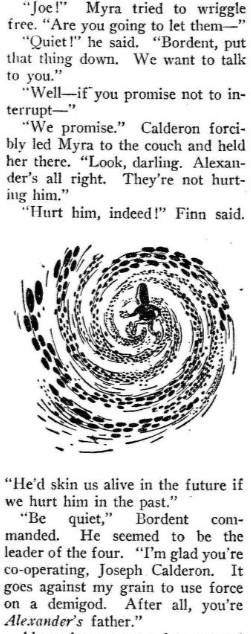
We’ve talked about ol’ REH a lot during the sword and sorcery festivities; how can you not? We’ve encountered both Solomon Kane and Conan in some great stories already, but for me, personally, I think Howard’s single greatest character is Bran Mak Morn – there’s something really compelling about him, this very last ruler of Pictdom, presiding over a declining and dying people and watching the Romans marching over his homeland. Howard loved to indulge in a certain Celtic gloominess, both personally and literarily, and that’s fully on display in the Bran stories. It lends them a poignancy that’s not often present in his other works; Conan’s barbarism and Kane’s zealotry are portrayed as powerful and vital forces, elemental and therefore permanent, but Bran is the last of his kind, and we know that he is destined to be ground down by the millstone of implacable history.

Aside from the purely aesthetic appeal of this Pictish mono no aware, it’s also a chance to see Howard examining a different point in the Spenglerian cyclicity he believed in; Kull and Conan are barbarians who, in Howard’s weird racialist worldview, revitalize their respective nations by taking up the crown and injecting their own wild vitality into civilized kingship. But here we see a people at the end of their “natural” lifespan, senescent and impoverished, struggling vainly against an ascendant Empire. And, to top it all off, in this story Bran glimpses the possible fate of his own Picts when he confronts the twisted and degraded remnants of a people his own ancestors had conquered and displaced! Bran Mak Morn is Howard’s greatest, most interesting character, which makes this story, “Worms of the Earth,” his greatest sword and sorcery story ever, at least for me. Hell, I’d put it up there as one of the all time greatest stories in the genre ever!

Worth keeping in mind is that the readers of Weird Tales had yet to be introduced to Conan at this point; Kane had made it to the pages of The Unique Magazine already, of course, and Kull had shown up in a previous Bran story from 1930 (“Kings of the Earth”), so readers were certainly familiar with Howard’s blood-and-thunder style and approach. The Cimmerian himself wouldn’t show up until the NEXT issue of Weird Tales, when “Phoenix on the Sword” would be published (Dec 1932), and after that, of course, Howard’s career and writing really changes; I think “Worms of the Earth” is still very much a weird tale, with its emphasis on inhuman horrors, atavism, and vast sweeps of time embodied in ancient landscapes. It’s still very much sword and sorcery, of course, but I think that it isn’t until Conan that Howard tips the balance more towards adventure and away from the Lovecraftian-influenced cosmicism on display here. But enough jibber jabber, let’s get to it!

A great swashbuckling cover, but this isn’t Bran fighting a Loch Monster or anything…it’s Kline’s heroic Venusian he-man Grandon fighting some swamp-dwelling space devil! Kline is an interesting guy; along with Farnsworth Wright, he had been an early editorial assistant to the first editor of the magazine, Baird, and had stayed on as an editor and reader under Wright, as well as writing his own weird fiction, fantasy, detective stories, and science fiction. He would shortly leave off writing, focusing more on becoming a literary agent for a number of big names in the pulps, including Howard himself! In fact, after Howard’s death by suicide in ’36, Kline would continue to represent his estate, helping Howard’s father get the many thousands of dollars still owed to REH by Weird Tales (and some other magazines, too). The scene illustrated here on this cover is interesting; first off, it’s from what would end up being a novel-length work that would stretch over seven issues of the magazine. It’s obviously a pastiche on Burroughs’ “John Carter of Mars” novels, largely successfully so too, I might add; if you liked those novels, then you’ll almost certainly like Kline’s planetary romances, which are often more-Burroughs than Burroughs in execution. But this cover also illustrates that, while Howard is rightfully identified as the creator of sword-and-sorcery, there was both a lineage of swashbuckling weird fiction that predated and inspired him AS WELL AS a clear hunger from readers for that kind of thing.

Nothing too noteworthy in the ToC (other than our story today), but the Weird Story Reprint is interesting; they’d reprinted “Frankenstein,” with this issue’s segment being the penultimate entry in an eight-issue long stretch that really annoyed a lot of people. There had always been some annoyance with multi-part stories among the readers, because of the dangers of missing an issue, but in particular a lot of people felt that reprinting a classic that almost everyone had read or could have easily gotten a copy of was a waste of good magazine space. It would actually lead to a change in policy for Wright and the magazine, which would in response to those complaints rededicate itself to reprinting more obscure work (for more about the history of the “Weird Story Reprint” series in the magazine, you should read my introduction to the collection “Night Fears: Weird Tales in Translation” from Paradise Edition books).

And now, on to the story itself!

A great title illustration, as usual, and one that doesn’t even spoil the story or anything! Just a great scene from one of the best parts of the story, in my opinion, with a really subtly devilish Atla and a grim and haunted looking Bran… wonderful stuff! The shadows are a nice touch, too, very moody and pensive and weird. It’s signed “MW,” but based on the style I’m pretty sure it’s J.M. Wilcox’s work (sometimes known as Jayem Wilcox, or JMW). Wilcox would go on to produce the very first illustration of Conan when he did the title art for “The Phoenix on the Sword” next issue, making him an important part of sword and sorcery history.

Pumped up with that great bit of art, we’re ready to dive into the text of the story!
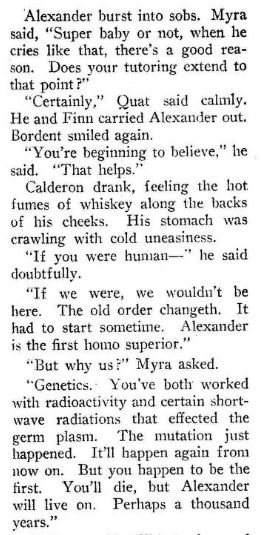
Love a story that starts with dialog; gives it an immediacy that can’t be beat, in my opinion. And this dialog starts off strong – nothing good is going on, you can be sure of that, and that conclusion is further supported by the imperial haughtiness of Titus Sulla, lounging in his chair of office, surrounded by a guard of Teutonic legionaries. You can again see Howard’s preoccupation with bodies and physicality here, too – Sulla is a Roman, but he’s no weak, lisping functionary, made soft by bureaucracy and civilization. No, he’s a soldier, a conqueror with a strong body and cruel countenance, and he’s surrounded by other huger bodies, “blond titans” from Germania, further symbol of the power and decadence of Rome. These powerful bodies are immediately contrasted with another body, this one made abject:

It’s a crucifixion party, one apparently being put on for the sake of the “guest” mentioned above, a dark man identified later “Partha Mac Othna.” But before we get this name, we get a very Ellsworth Huntington-esque discourse of race, civilization, and climate that contrasts this dark somber man with the Romans and Germans that surround him.

A “supple, compact body” with “broad square shoulders,” a “deep chest,” “lean loins…” you can joke all you want, but Howard’s fascination with and interest in masculinity and its physicality is certainly enthusiastic and sincere. Similarly expressed in this story is REH’s belief in the importance of racial purity, as made clear by the comparison of this dark, northern barbarian with his two compatriots, one at his feet and one on the cross:

There’s some kinship between these three, though it’s clear that the man on the cross and the “stunted crouching giant” represent a “lower type” than the clean-limbed and well-knit dark man. This racial hierarchy stuff is a central part of Bran’s pathos, for Howard at least, and it’s something that we’ll come back to in the story later. But for now, let’s get this guy crucified!

There’s some more verbal sparring, almost as if the Sulla is trying to goad his “guest” into something, but the strange, noble-looking Pict seems to reserve his ire for the Pictish King:

Takin’ it kinda personally, isn’t he? Almost weirdly so…oh well.

Anyway, they crucify the guy, who doesn’t scream out in pain or anything, only staring at Partha Mac Othna with a strange and plaintive intensity. Seeking to mock their victim’s suffering, a Roman solider offers the dying man a cup of wine and receives a defiant loogie in the eyes instead. Enraged, the soldier stabs the man with his sword, which pisses of Sulla something fierce.

The Pictish emissary stays awhile, contemplating the dead body hanging on its cross against a reddening sky, before turning back and heading to the Roman fortress city. A grim and perilous beginning to the story indeed!

How about that little bit of Yog-Sothery there, huh? “Black gods of R’yleh” is great, and the fact that “Partha” here would evoke even THEM speaks to his anger and despair at Rome. But why does this feller feel such animus towards to the Romans, you ask? Well…

What a twist! Partha Mac Othna is, in fact, Bran Mak Morn, King of Picts, posing as an emissary to gather intelligence on these his most hated of foes! Grom, his gnarled companion, begs his master to keep his voice down; the Romans would hang him from a cross if they knew who he really was. Rather, why not let faithful ol’ Grom ice the Roman dick?

I mean, that’s some top notch, grade-A badassery right there, isn’t it? Grom’ll happily run a suicide mission for his King, vowing to kill Sulla anyway, even if he is surrounded by bodyguards. But Bran knows that won’t work, and instead is already working on another plan…

It turns out that Sulla is frickin’ terrified of a certain Gael by the name of Cormac na Conacht who has vowed to eat Sulla’s heart raw. Showing sensible caution vis a vis having his heart eaten, Sulla tends to stick to the impenetrable fortress known at the Tower of Trajan when there’s trouble along the Wall. This knowledge inspires Bran to some dark, fearful plan…he sends Grom out of town with some gold and his diplomatic pass; he’s to ride to Cormac and get him to start raiding, sending Sulla off to the Tower. Then Bran takes a quick nap, where in a dream he meets his faithful advisor the Wizard Gonar who, having divined Bran’s yet-to-me-specified plan, is absolutely freaking the hell out:

What “this thought” is exactly will remain obscure, for now, but it does lead to a pretty great speech from Bran explaining why he has been pushed to this extreme measure (whatever it is):

It’s some real “burden of kingship” shit, sure, but damn if it doesn’t get me. In particular, the stuff about their shared experiences I find pretty moving…both of them listened to the same tales and songs, and that forged an unbreakable bond of shared heritage that held them together. And that final statement is, again, just a perfect encapsulation of a sword-and-sorcery ethos: by those bonds, Bran had the responsibility to protect him, and if he cannot do that, then he will avenge him. Shivery, noble stuff, great fantasy writing, some of the best Howard ever did in my opinion. And there’s more to come!

But Gonar is still scared. Why not just chop some dudes up like usual, he asks, ride along with the Gaels and slaughter Romans from sun-up to sun-down. Oh, don’t worry, Bran replies, I’ll definitely be doing that…BUT FIRST he wants something special for Sulla.

We’re spending A LOT of time on this early part of the story, I know, but I think it’s worth it to see Howard really doing some great work establishing Bran Mak Morn and the world of the Picts and Romans here. Bran has been fighting these Romans for a long time, and we feel his desperation and struggle – you get the sense that it’s not been going great for the Picts. After all, why else would their goddamn King risk himself to sneak into their stronghold? Things must’ve gotten pretty dire back in Pictland. And then, to have seen his man crucified and forced to confront his failures as King and Protector…he’s gone a little crazy now, and nothing is off limits in his war against the Romans.

Gonar tries one last desperate gamble: the things Bran is planning on using have gone from the world, they’ve dwelled apart for countless ages and no one knows where they are now. But Bran is sure that that can’t be true…somewhere, there is some sign, some thread of a connection that will lead him to them.

Really appreciate the care Howard is taking here – right now, we have no fuckin’ clue as to what exactly it is that Bran is planning, but it’s been made clear that it is dire as hell and going to be extremely dangerous. From a story telling perspective, I just don’t think REH ever hits this level of mastery again, it’s so good and sharp and propulsive. Bran is desperate, his back to the wall, and capable of anything in his quest for vengeance; to him, there’s nothing foul enough for the Romans, no act so base or vile that he wouldn’t stoop to, just so long as Sulla gets his. And even though he’s talked this good game about his responsibilities as king and all that, you see that there’s more there – it’s a deep, personal affront that he wants to avenge, so much so that Gonar basically calls him out for putting this personal hatred ahead of the actual needs of the Picts. It’s great stuff, isn’t it?

Before Bran heads out on his insane and horrific mission, he takes a brief moment to sneak over to the prison to murder the roman soldier that stabbed the Pict on the cross. It’s yet another scene of great badass action, particularly in the way Howard described Bran’s dark chuckle, the slash through the barred windows, and the blood welling up from Valerius’s throat as he dies. Ticking that chore off his to-do list, Bran then rides out of the city and into the wilderness, searching for…them.

There’s some great, evocative environmental writing in this section, wildernesses and border regions and ancient landscapes all lovingly described by ol’ REH. The romanticism of landscapes, and their hidden dangers, are something Howard is really well-equipped to work with in his fiction, having reflected extensively on his own wildernesses and frontiers back in Cross Plains, Texas. I’m also a sucker for ancient, nameless earthworks – these curiously regular hillocks and mysterious monoliths are wonderfully potent images, suggestive of deep time and lost civilizations.

There is also in this section another long paean to racial purity from Howard. As we’ve already mentioned, Howard was an unapologetic and enthusiastic racist, something that strongly informed his fictional stories, as we see here:

A big part of Howard’s disdain for “civilization” comes from his belief in racial purity – with civilization comes miscegenation, which for Howard is both unnatural and decadent. What’s funny, though, is how all this talk of Bran being a pure-blooded noble from a long-line of reproductively isolated aristocrats strikes us today; far from the strong limbed and lean-loined pantherish ubermensch Howard described, talking about Bran’s paternity like that immediately evokes the Hapsburgs, at least for me. The idea of Bran looking like Charles II of Spain during all this stuff going on is hilarious, and makes his revulsion at the fenmen, Atla, and the Worms of the Earth themselves later in the story all the funnier.

But anyway, Bran is spending some time wandering around the wastelands, searching for any sign of the horrible things that once dwelt there. He gets news from the fen dwellers, and learns that his Gaelic buddy Cormac has begun raiding, spreading terror all along the Wall and sending Sulla scurrying off to the Tower of Trajan, just like Bran said he would. Meanwhile Bran, all alone, keeps up his hunt, until one day he spies a distant daub-and-wattle hut in a particularly lonely corner of the fens. He goes to investigate, and meets one of the greatest characters in sword-and-sorcery history.

This is Atla, and she’s 100% rad as hell. Howard lets us know immediately that she’s not entirely human, too – she’s got fang-like teeth, almost pointed ears, oddly-shaped yellow eyes, and all her movements are sinuous, lithe, and serpentine. Bran recognizes all the signs, and since he’s one of the Old Picts, he knows the stories, guesses her heritage, and knows she can help him.

There’s so much to love about this – the fencing between Atla and Bran, and the shock and horror that even she feels to hear Bran speak so openly and blithely about forbidden things, it’s really fantastic. But even more, there’s a real grimness and sorrow to Atla, something strange and sad and special that you makes her character so interesting and unique. For one thing, she’s utterly and completely ostracized, living way the hell out in a place called the Dagon-Moor which you KNOW is not exactly on any of the major bus routes. She’s been exiled out here because of her heritage; it’s implied that she’s the product of a rape, a human mother attacked by one of them out on the moors, and that her inhuman blood has meant that she’s been driven to the very edge of the human world. And that revulsion is definitely something Bran feels too, even though she is the only thing that can help him find the Worms of the Earth.

Atla’s recklessness and scorn is just fantastic here, and the way she laughs at Bran’s threat is wonderful. Her mocking question “Do you think that such life as mine is so sweet that I would cling to it” is really great, an absolute gut-punch. And Bran’s realization that he’ll have to try different means of persuasion is met with equal scorn!

Atla is such a badass! But, after all that, Atla does have a price.

I think this is some of the best writing Howard ever did. There’s a real and aching loneliness to Atla, and it’s tempting to think that Howard, an artistic and romantic young man living way the hell out in an oil boomtown in central Texas, might’ve been mining something of himself when he’s having Atla express this deep and heartfelt yearning. There’s real humanity in Atla, probably the most you’ll ever see in a Howard character honestly – the only other example that I feel like even comes close to this is Balthus’ reminiscing about home from the Conan story “Beyond the Black River.”

Anyway, Bran swallows his revulsion and agrees to have sex with the snake lady, and Howard tastefully draws the curtains on the scene.

The next morning, while Bran is dressing for his walk of shame, Atla tells him that what he needs to do is steal the Black Stone; with that, he can force them to do whatever he wants. The Stone is deep beneath Dagon’s Barrow, which, again, love that Lovecraft connection.

There’s some fun stuff here for sure, and I can’t help but wonder if Tolkien (who certainly had read some Howard) read this one in particular – between the faces in the mere that Atla mentions, and then this whole shunning of sunlight and moonlight and even starlight, there’s some real Gollum resonances here, you know? But, regardless, this is prime sword-and-sorcery stuff, especially that last sentence; the idea that the Picts and these subterranean horrors have history really nicely sharpens the threat and danger of Bran’s scheme.

Bran, armed with the knowledge that Atla has given him, heads out, finds the strange prehuman stone circle atop Dagon’s Barrow, lifts the stone, and plunges into the deep darkness of the Earth. The path he’s on mirror the devolution of the Worms themselves, going from rough hewn steps to a smooth and almost slimy tunnel at the base. There, in a dark chamber, he finds the Black Stone, and is able to abscond with it. He decides to stash it in Dagon’s Mere, chunking the rock out into the center of the eerie pond.

Bran returns to Atla, who is not unsurprised to see him both alive and sane after his trip into the darkness beneath the Earth. Bran informs her that not only has he safely secreted away the Black Stone, but that he has become aware of things hunting him…his horse trod on something unnatural in its stable one night, and he’s been hearing a faint scrabbling beneath the earthen floor of his hut. They’re hunting him, using whatever strange senses and powers they’ve developed over their long exile in the dark. Now he’s ready to deal, and so Atla takes him to a forlorn range of hills that border the fen where the black mouth of a cave yawns wide to take them in.

Howard really paints the landscape here, conveying both its distance from humanity in both space and time – this is an old place, and the things that live here are older than the Romans, the Celts, and even the Picts. That sense of Deep Time, a key part of weird fiction, is really well-expressed here, a testament to Howard’s own appreciation of the earth and the tiny, transient things that call its surface home.

Bran and Atla plunge into the cave, and its somewhat shocking to both us and Bran that Atla herself is scared here – in lesser hands, the snake woman would be a one-off monster lady, but Howard makes sure we understand that she meant it when she said she was “half human, at least.” This place and the things that live there are scary as hell and fully alien, even to her.

And then they meet the Worms of the Earth.

Spectacular writing from Howard here, this sea of glowing eyes in the dark. It’s really truly an eerie and uncanny scene, but does it spook Bran?

Fuckin’ bad ass, man! And these horrible subterranean things think so too – Bran rolls a nat 20 on his intimidation check, and the Worms of the Earth are fully cowed by his killer speech. They hiss and mutter with Atla, and she’s shocked to report that they’re actually scared of Bran, and will do whatever he wants in exchange for the stolen the Black Stone. Bran wants them to take Sulla from the Tower of Trajan, and he agrees to meet them at Dagon’s Ring tomorrow and exchange the stone for the Roman.

Bran goes for a swim in Dagon’s Mere, recovering the Stone that he chucked in there earlier, which is heroic enough in my opinion – I once dropped something in Barton Creek Pool here in Austin, which is a natural spring fed pool with crystal clear water, and I never found it again…and there’s not even monsters in Barton Creek Pool! That’s actually a really fun little piece of this story too – there IS a monster in Dagon’s Mere, something huge and threatening which Bran only catches a glimpse and a ripple of. It reminds me a lot of the scene in Lovecraft’s “Call of Cthulhu” where we learn that there’s some kind of huge white polypus thing in the swamps of Louisiana that the cultists commune with…you can’t beat these little hints of other weird shit and scary monsters on the periphery of a main story, in my opinion. It’s an evocative and effective tool in weird fiction’s box, and I appreciate it here because, in addition to just being fun, it’s also part of Bran’s mounting realization that he actually doesn’t know this landscape or its history as well as he thought he did.

Black Stone in hand, Bran rides towards Dagon’s Ring, making a brief stop over to see what’s happening at Trajan’s Tower, just out of idle curiosity.

He finds a dying Legionary amid the ruins, and from him he hears a tale of horror.

Bran realizing that he might’ve fucked up here is pretty great – he forced these things to involve themselves in the surface world again, and maybe he doesn’t have as much control as he thought he did over this situation. It’s a grim moment for Bran, who had been expecting to get this great triumphant revenge on his hated enemy…and it’s only going to get worse…

Bran, horrified at the destruction he’s wrought, hurries on to Dagon’s Ring, where he meets Atla and sees a seething, shadowy tide of the things approaching through the grass. And mingled in with the susurrus of their hissing is a lone human voice, gibbering and tittering. Bran demands that they give him Sulla, and Atla, with a smirk, presents him.

Sulla has been driven mad, not by anything they did to him, but by the simple brain-shattering realization of the true nature of a world honeycombed by tunnels through which inhuman horrors swarm and thrive. Bran kills Sulla, not in rage but rather out of mercy, realizing that there are in fact some weapons too foul and terrible to use. He hurls the Black Stone into the seething mass of shadows, and for a moment gets a clear view of them:

If Lovecraft’s synecdoche of horror is the deep sea, with its tentacles and slime, then Howard’s is the reptile, particularly the snake, with all its symbolism of ancient and pre-mammalian life and potency. The Worms of the Earth, the things that were once almost men before being driven underground and sinking deeper in atavism, are basically hellish snake-things, subtly human perhaps, but mostly all cold scales and merciless coils and hissing, flickering tongues. Sick with terror, Bran flees, but not before Atla gets a final mocking shot off.

And that’s the end of Robert E. Howard’s masterpiece, “The Worms of the Earth.”

It’s just so good, isn’t it? I mean, the characters are great, the setting is a blast, the action is killer, and the ending is perfect and horrible, with Bran having unleashed something that should’ve been left well enough alone. I love basically everything about this story; the pacing is even good, which can be tough in a short story that’s trying to deal with such a wide scope of geography and action.

Unfortunately, Howard never did take up the semi-cliffhanger he left there at the end, though. For all intents and purposes, this is the last Bran Mak Morn story he ever wrote – he’s mentioned again in a later, modern horror tale (“The Children of the Night”), but REH never again gives us a story about the Last King of the Picts. Karl Edward Wagner, most famous for his grim n’ gritty Kane stories DID write a sequel novel based on the premise that Bran had awakened a horror in the hills; it’s called “Legion of Shadows” from the 70s, and I remember liking it well enough as a pastiche, although I don’t think it nails the real weirdness or tragedy of REH’s original story.

I’ve gone on and on about what I like in this story, so I won’t repeat myself, but I really do think this is one of the greatest sword and sorcery stories ever written. There’s a real depth to this one, with a lot of actually meditative moments from Bran, something that’s sometimes lost in the wilder and more action-packed Conan stories to come. And while the Cimmerian would end up defining the genre, I think Bran Mak Morn and his tragic, dying Picts illustrate some of its strengths better than Conan ever does, exploring history, memory, violence, obsession, and regret while also delivering a rollicking, tense adventure story full of flashing swords and horrible snakemen. I mean, what more could you want!?

Pulp and the Gray Strainer #18: “Two Sought Adventure” by Fritz Leiber, Jr., Unknown, Aug 1939, v.1 n.6

Many names of Great Renown grace the Annals of the Heroic Age of the Pulps, but even in that ancient age of mighty deeds, three names tower above all others with regard to sword and sorcery. Howard we have touched upon twice (and we’ll revisit him soon enough), and we devoted a whole month to the incomparable C.L. Moore, so I reckon it’s high time we hit the final member of the classical sword and sorcery trinity! That’s right, we’re finally going to encounter Fritz Leiber’s foundational duo, Fafhrd and the Gray Mouser in their very first published story, “Two Sought Adventure,” from the August 1939 issue of Unknown!
Of course, we’ve already talked about ol’ Fritz, but that was in regards to his weird fiction story “The Automatic Pistol” from 1940 in Weird Tales, which is good and a lot of fun, you should read it. But undoubtedly Fritz’s greatest creations and most lasting renown come from the Fafhrd and the Gray Mouser stories. Given that, AND the fact that he’s the one who actually coined “Sword and Sorcery” for this the best of all genres, I think it’s appropriate to give him another fanfare and more detailed biographical info this time around.

Leiber is, for my money, one of the best writers of genre fiction from the 40s through the 60s, in many ways a predecessor to the New Wave that would revolutionize science fiction in the 70s. His background and various experiences give his writing a depth and vitality that’s really unparalleled, especially for the time; he was the son of Shakespearean actors (and he himself acted on the stage), he was a fencer and an expert chess player, studied for (but did not get) a graduate degree in Philosophy, studied for but did not become a minister at a seminary, read and wrote for technical encyclopedias as a day job, taught as a drama instructor at Occidental college…I mean, the list pretty well sums up Leiber’s interests and the themes he explored in his writing. He also had a brief but important correspondence with Lovecraft near the end of the Old Gent’s life, and in many of his memoirs/recollections he attributed much of his development as a writer to HPL’s encouragement and advice. He wrote a lot of great stuff; his 1947 collection, “Night’s Black Agents” is simply one of the best short story collections of the era, in addition to having just the coolest fucking title of all time (a line from Macbeth, Leiber again subtly showing off his erudition).

Unfortunately, like a lot of writers in the post-pulp era, Leiber had a hard time of it financially. He lived in some apparently truly squalid apartments in California, and there’s some great anecdotes from the 70s of Harlan Ellison raging about how Leiber was forced to do his writing on a shitty typewriter propped up over the kitchen sink. Actually, it wasn’t until TSR, the company that made Dungeons & Dragons, licensed the rights to Fafhrd and The Gray Mouser that he was able to live somewhat more securely and comfortably. Frankly, and as we’ll see in today’s story, even if they hadn’t made official Leiber products, TSR 100% should have just been sending checks to Leiber (and Wellman and Vance) because a shockingly large amount of fantasy tabletop roleplaying is taken directly from his work.

Leiber wrote in a lot of different genres, although you might be surprised at how few times his work showed up in Weird Tales, despite his association with Lovecraft and horror. Case in point, today’s story was published in Unknown, the short-lived fantasy-focused companion to Astounding Science Fiction created and edited by lil’ Johnny W. Campbell himself. Campbell, as we’ve mentioned before, considered himself an intellectual and so he envisioned a a similarly intellectual fantasy magazine that would compete with Weird Tales. Unknown was therefore less lurid, more realistic (or at least the magic and monsters where supposed to be more internally rational), and generally more literary and sophisticated, even going so far as to allow for humor! That said, apparently Campbell would often tell Leiber that his Fafhrd and the Gray Mouser stories were more like “Weird Tales stories, but…” he would accept them anyway. In fact, no Fafhrd and the Gray Mouser story would ever appear in the pages of Weird Tales, which is kind of interesting.

That’s right, the cover of this issue went to Thelemite and future Founder of Scientology, L. Ron Hubbard. It’s a fairly bland cover, in my opinion, kind of lacking the *punch* you’d see in, say, a Brundage cover from Weird Tales. Very much more main stream looking, in my opinion.

The ToC shows Campbell’s editorial perspective too – fewer stories, but longer. That Hubbard is 90 pages (stretching somewhat the definition of “novel” perhaps, but still…that’s a long ‘un for a magazine)! You’ve got some of Campbell’s heavy hitters here too, del Rey and Kuttner, both important in the pulps and (del Rey as an editor in particular) in the paper back revolution that would come post WWII. Also neat are the two “Readers’ Departments,” integral parts of the participatory fandom that played a huge role in the development of modern genre literature. Unknown had a fun readers’ letters section; taking the title from the famous lines of Omar Khayyam is a very evocative, stylish, and literary thing to do, and the illo is good too:

Very E.C. Comics, isn’t it? But, godammit, let’s get to the story! Fritz Leiber’s first ever published short story AND also the very first adventure of that incomparable duo, Fafhrd and the Gray Mouser!

And more comic-book style art, though this time maybe it’s more “Prince Valiant” than “Vault of Horror.” Honestly not really my cup-o-tea, if’n ye ask me…just a fairly bland fantasy scene, though at least Unknown has enough sense NOT to toss in an illustration from the climax of the story right off the bat. Still, I wish the artists had had a little more verve or style or something, especially for such great and visually distinct characters (and situations) that appear here. Oh Well!

First thing first, I love fantasy calendrics like that…”Year of the Behemoth, Month of the Hedgehog, the Day of the Toad…” it’s just really fun, an easy and striking bit of genre semiotics that immediately shifts the reader into a “fantasy adventure” mode. Leiber keeps ladling on that fantastical flavor with more and more little flourishes, scenes of bucolic yeoman farmers, medieval-esque mercantilism, followed by the promise of a shift-change to astrologers and thieves; it’s great writing that sets a specific scene AS WELL AS positioning the whole of the story within a certain genre-space. And then it’s followed by a couple of paragraphs that introduce the main characters.

The tall northern barbarian is, of course, Fafhrd, while the small dark man is The Gray Mouser. As far as introductions go, these can’t be beat. Their gear, their appearance, their movements, everything is in service of explaining and presenting their characteristics – Fafhrd is a bluff and forthright barbarian in rough linen, bearing a sword and bow, and with a hint of wildness to him, while The Mouser is sneaky, clever, sharp, and secretive. It’s frankly just a perfect intro, efficient and effective.

Of course, we haven’t actually learned their names yet, although that’s not too far off in this story. Still, they’re very well developed and, for the most part, fully formed, the same characters that we’ll meet in their future adventures – this is due to the fact that Leiber, with his friend Harry Fischer (who actually created and named Fafhrd and the Gray Mouser, basing them off of Leiber and himself) had been exploring the two and their world for several years already. Leiber in fact had already written several of their adventures already, and that background had practice has given Leiber a good handle on these two.

Anyway, as these two are riding along they’re suddenly ambushed! Bows twang, arrows fly, and the pair spur their horses onward, pursued by a band of eight or so well-armed and similarly equipped ruffians. But, unfortunately for the thugs, these two guys are characters in a sword and sorcery story who have JUST been introduced, so they use this convenient ambush to demonstrate their unparalleled skill and toughness.

Fafhrd executes a flawless Parthian shot and the Mouser zings a leaden ball back at their pursuers, striking two riders down and sending the rest scattering. That done, it’s time we got PROPERLY introduced to these two bad-asses:

There’s a cool efficiency to these two that Leiber likes to play with, particularly in their dialog and the way they speak to each other about what’s going on, always commenting on the action and characters around them. Their friendship is really compelling and very lived in and is, honestly, probably pretty familiar to a lot of people; these two are the kind of friends who, confronted with dangers or troubles, tend to minimize all the challenges they face, kidding around and making fun of the “blundering fools” who would dare challenge them, always talking each other up. It’s a great bit, honestly, and helps reinforce the central idea of Fafhrd and the Gray Mouser: they are self-mythologizers that are always confident that they are the main characters in a story. Sometimes this self-awareness comes awfully close to metafictive fourth-wall breaking, but where Hamlet struggles against the role he’s cast in, the Mouser and Fafhrd relish it – they are swashbuckling sword-and-sorcery heroes, the very best possible thing to be, and they’re having a great time (even when they’re not, really).

Having dealt with the ambush, the two realize that this very valley is most likely the one they’ve been searching for. The Mouser unrolls an ancient vellum, and we’re introduced to their quest:

Certainly a taunting tone to Urgaan of Angarngi’s missive, isn’t there? He’s daring treasure-hungry fools to come and face the challenge of his mysterious treasure tower, but that doesn’t daunt these two. Rather, as they ride on, The Mouser reflects on how similarly equipped and armed the ambushers they faced were, suggesting that they might have been Lord Rannarsh’s men. It turns out that the Mouser cut the vellum sheet about the treasure tower out of an ancient book in Rannarsh’s library, and that the Lord, famously avaricious, might’ve taken notice of the theft and sent his boys out to kill them and claim the treasure for himself. Fafhrd scoffs at the idea, which of course means that The Mouser will turn out to be 100% correct.

The two adventurers come across a small cottage not far from the stumpy ruins of the tower, meeting a hilariously taciturn old farmer and his large extended family.

I like the farmer, and the later scenes with his whole family are really great, but for now Fafhrd and The Mouser decide to reconnoiter the tower in the fading light. It takes them a strangely long time to reach the tower, which seemed so close, and when they get there they find a skull and shattered bones just inside the treasure house. A strange sensation of foreboding and danger settles over The Mouser.

Very good foreshadowing, I think; the sense that there is very much something unnatural going on in this treasure tower, something watching and waiting and certainly at least a little sorcerous is conveyed well, but we’re still wondering what exactly is going on.

Heading back to the cabin, the two have a great and boisterous evening with the farmer and his family. Mouser does magic tricks, Fafhrd roars his wild sagas, and they get the whole lot of ’em drunk on wine. It’s probably my favorite scene in the whole story, actually, a wonderful little slice of life scene that really evokes the strangeness of these two adventurers showing up out of nowhere and throwing the normal humdrum pattern of these people’s lives pleasantly off kilter. Leiber is of course just as interested in adventures and swordplay and derring-do as Howard, but he’s ALSO interested in the little material things of life that define the world; his stories are steeped in this kind of rich, lived-in detail, with an interest in the way people spend their downtime. In addition to just being flat-out a lot of fun to read, I think it’s also an important development in sword-and-sorcery literature, a real key moment. Here, back in ’39, Leiber is illustrating to people a kind of “fantasy realism” that uses realistic, naturalistic details to deepen and enrich a secondary world setting.

Of course, it also serves a nice narrative function, because the ancient old man, roused by wine and sing, manages to croak out an enigmatical little statement:

“Maybe beast won’t get you” and then he konks out…great stuff! And it’s echoed again the next day when, striking out early in the morning, they’re stopped by the gangly and shy farmer’s daughter, who has a warning for them.

This family of farmers live right next door to a death trap, apparently, and have learned to give the place a wide berth and keep a respectful distance. I really like how Leiber uses the peasants here – again, they have had to live next to this tower. Whatever danger dwells within, they’ve learned how to avoid it, getting on with their own life in the shadow of its threat. It’s only interlopers and outsiders who blunder into the tower who get killed. It’s a fun, subtle inversion of what a fantasy hero armed with cunning and expertise and knowledge and all that.

But of course no warning, no matter how blood-curdling or threatening, would cause Fafhrd and the Gray Mouser to turn aside from a quest. They continue on through the woods, reflecting merrily (and perhaps a bit unconvincingly) on the remarkable imagination of the farmer’s daughter. Then they meet a very material threat: the men who had ambushed them yesterday have regrouped and reformed at the tower. It’s obvious that they know about the treasures rumored to kept in there, since they’ve also brought shovels and picks.

There’s a long (and good!) scene of sneaking and combat, with Fafhrd and The Mouser getting the drop on these guys. Now, I find the “Fantasy Combat Discourse” generally pretty boring, but I DO like the way Leiber does his fights. To be fair, if you’re one of those HEMA nerds who pours over fechtbücher and owns a broadsword, you’re going to be annoyed with Leiber; he’s a fencer, apparently a very good one, and so the way his heroes fight is very much informed by that. In particular, Fafhrd tends to wield his enormous sword a lot like a rapier, something that might strike some as silly. Deal with it, though, is all I can say, because the combat in this section is fun, and also better than any swordplay that Howard wrote – Conan might hew his way through twenty dudes, but Fafhrd is having to be realistically careful fighting two guys who have him flanked. There’s a sharper sense of danger, is what I’m getting at, probably because Leiber at least has a sense from actual fencing practice about the ways someone can get overextended or leave themselves vulnerable. Makes his fighting descriptions that much scrappier, I think.

A certain red-haired fellow among the ambushers confirms what The Mouser had suspected: these were Rannarsh’s men, and the venal lord had certainly hoped to get the fabled gems himself. Following the battle, there’s a great bit of Fafhrd barbarism – the combat over, becomes first almost hysterically hilarious, and then deeply, almost ridiculously, solemn about a man he’d just killed.

This is contrasted with The Mouser’s own reaction – he may be feeling a little sick and anxious now, but he knows that the force of the combat won’t come on him for some time. It’s another of these Leiber flourishes, a deep and abiding interest in the interiority of his characters and the often very different ways people can react to or experience extreme things. It is simultaneously taking a part in and commenting on the Howardian tropes of sword-and-sorcery, in particular the way Fafhrd’s barbarism is being contrasted with The Mouser’s more urbane reaction.

Entering the tower, The Mouser is relieved that he no longer feels the dread that had oppressed him the night before. They explore the first chamber of the tower, and run across more smashed skeletons – it seems like something indeed has been pulverizing interlopers here, although it may have been a very long time ago. Interestingly, however, the two find a scroll case on one of the corpses that includes a note very similar to their own!

This note, along with the many other skeletons strewn about Urgaan’s treasure house, reveal the truth: the dude has made some kind of death trap, and is luring people here with tales of unbelievable treasures.

Undeterred, the two advance up the stairs, determined to search out discover the treasure. As they reach the top of the stairs, steel glitters in the dark as a knife is hurled from a doorway, nicking the Mouser in the shoulder! Enraged, he darts into the room, sword drawn, and discovers Lord Rannarsh hiding there.

Unmanned by fear, Rannarsh seems only to be interested in escaping, even abandoning all claims to the treasure. However, confronted by his hated enemies, he masters himself enough to try a second dagger, which earns him a skewering at the hands of The Gray Mouser. Following his death, Fafhrd muses on how Rannarsh seemed to be seeking death, which The Mouser says was simply because he had appeared weak and afraid in front of witnesses. It’s another trademark of this duo, always willing to believe that others are as awed of them as they are of themselves, conveniently ignoring all other contradicting information, like when Rannash refered to a “thing” that had been playing “cat and mouse” with him. But, just as The Mouser makes this pronouncement, a sudden and horrific pall of fear falls upon them!

Having failed their saving throw vs fear, the two of them are frozen to the spot, listening to the steady footfall of someone approaching through the tower, up the stairs, and coming towards them. Eventually, a new NPC is introduced, an ancient looking holy man who looks grimly over the room before greeting them.

This man is Arvlan, a direct descendant of Urgaan, here to destroy the horror that his ancestor has left behind. Not letting them speak, Arvlan explains his purpose and history, and then sweeps out of the room on his holy mission.

Arvlan, we hardly knew ye! But, interestingly, once Arvlan gets mashed offscreen, the paralyzing fear that had held the two of them in thrall lifts, and they’re able to move again. Swords out, they rush into the room and see the red ruin left behind of the holy man, crushed and splattered in the middle of the room. But their attention is soon drawn away from the corpse and towards a stone marked with the words “Here rests the treasure of Urgaan of Angarngi.”

The two of them set to work, using pick, mattock, and pry-bar to begin their excavations. Weirdly, they quickly encounter some kind of strange, tarry substance in among the masonry, though not even that gives them pause; they keep gauging away, eventually exposing enough of raw stone that they can get their pry-bar in and wiggle it around, loosening and gouging alternatively. As they keep at the work, though, a new strange feeling of revulsion comes over The Mouser, a sensation clearly related to this dark, foul smelling glop that they’re working on. Nauseated, he goes to a window for a breath of fresh air, and sees down below them the farmer’s daughter. The young girl is clearly trying to screw her courage to the sticking place to come in and warn them of their danger.

A kind of mania descends on everyone now – The Mouser has seen something in the ceiling, but he can’t articulate it even to himself, and instead lurches sick and fearful out of the room, focused only on keeping the girl from entering the tower. Meanwhile, Fafhrd seems possessed, blind and deaf to everything else expect the stone that hides the treasure. Like the weird fear aura the place had earlier, it seems like the tower is projecting some kind of weird psychic effect, and everyone is mostly powerless to resist it. As the Mouser reaches the bottom of the stairs, his muddled mind steadies itself enough to realize that what he’d seen on the ceiling was a corresponding smear of gore, the counterpart to the blood on the floor. What could it mean!? And why is the tower suddenly vibrating!?

Meanwhile, Fafhrd has finally cracked into the treasure chest!

In the moment, this is all extremely strange and weird and not entirely clear. A weird basin full of dark celestial mercury, upon which floats a weird tangle of glittering geometric shapes, including the huge diamond promised in Urgaan’s message. Everything sparkles with a strange inner light, and Fafhrd weirdly seems to sense that he’s gripping a piece of a thinking mind in his hand as he grabs for the diamond. Meanwhile, the tower is beginning to twist and undulate; The Mouser thinks at first it is toppling, but he realizes there’re no fissures or breaks…rather, it’s like it’s wiggling or bending! Back in the treasure chamber, the weird gems start jittering in the black mercury, and Fafhrd is having a hard time holding on to the skull-sized diamond in his hand. Doors and windows begin to clamp shut, closing like a sphincter, and Fafhrd realizes that the room itself is changing shape.

The Mouser reaches the girl, and they dive for safety beyond the clearing outside of the tower, while Fafhrd confronts the realization that, basically, he’s inside an insane robot.

The diamond, strangely mobile and very hostile, flings itself at Fafhrd’s own skull as he tries to escape, eventually exploding into a cloud of sparkling dust. At that, the tower begins its death throes, with Fafhrd only just escaping before the door slams hut.

There’s a break in the story, resuming after some time has passed.

And that’s the end of the story!

It’s a pretty strange one, isn’t it? I think it’s true to Leiber’s own proclivities, but you can see the Campbellian “rationality” in the tower/robot. Urgaan’s tower is not merely magical; it’s some kind of weird magical technology, complete with what is obviously a kind of high-tech gem-based brain. Presumably, Urgaan has built this conscious robotower as some kind of horrible death trap – lured in, the computer then smooshes all interlopers, it’s weird stone body lubricated by that odd tarry goop. It’s a fun and fully bonkers idea, although it’s not too wildly different from Howard’s magic, which is often more occulto-scientific that pure magic. Why Urgaan would do that is left mysterious, which is actually kind of fun – people can be real assholes, and if you’re some kind of ancient technomancer then maybe that’s the sort of the thing you’d do!

You can also really see the influence Leiber had on Dungeons and Dragons in this story, too. It’s almost exactly the kind of thing Gary Gygax would write, right down to the dungeon built around a weirdly complex and almost certainly fatal death trap. But even beyond the setting and the trappings of the dungeon, I think you get a sense that Gygax et al. ALSO certainly styled their adventurers after Fafhrd and the Gray Mouser.

And it’s the characters of Fafhrd and the Gray Mouser that are so important and foundational to the genre, in my opinion. Even Conan at his most avaricious (say, in “The Jewels of Ghwalur”) ends up shifting gears, exploring a mystery, saving a girl, and engaging in heroics, whereas Fafhrd and The Gray Mouser are almost single-mindedly focused on this tower, ignoring countless warnings and obvious signs that something is amiss. That stubbornness and single-minded selfishness is key to their motivation and characters, and Leiber is really the first writer of the genre to really explore that aspect of sword-and-sorcery. Even though they envision themselves as heroes, any actual heroism that they end up doing is often in spite of themselves. It’s often funny, although only rarely does Leiber play that purely for laughs; rather, their self-importance and unassailable confidence gives them the boost they need to persevere in the face of insane odds. Mostly, Leiber is interested in the way these characters, who clearly see themselves in a certain light, are actually a little more complicated and gray than we might expect. Particularly in the post-Howard world, most of the sword and sorcery heroes are painfully noble barbarians; guys like Elak of Atlantis are even Kings who (despite renouncing a throne) always carry with them a sense of portentousness and destiny. Fafhrd and the Gray Mouser are different, wanderers and adventurers and thieves, just a couple of scrappy normal dudes who are going to carve their destiny and wealth out of the carcass of the world. Fafhrd and The Gray Mouser are an interesting counterpart to Conan and Jirel, and represent a key part of the evolution of the genre.

Sword & Sorcery & Straining #17! “The Tower of the Elephant” by Robert E. Howard, Weird Tales, March 1933, v. 13, n. 6

Like a true Barbarian Hero I am currently adventuring in distant lands, having braved the cursed tomb of Newark Airport to arrive in the bleak, windswept hills of Pennsylvania, where death and danger lurk in the shadows of every tree, mountain, and Wawa. But that doesn’t mean an end to my long-as-hell ramblings, no, far from it indeed! For hark! Another edition of Pulp Strainer (Sword & Sorcery Edition) is upon us, and we’re continuing our REH lovefest with probably my favorite Conan story of all time: The Tower of the Elephant from the March 1933 issue of Weird Tales!

“The Tower of the Elephant” is an interesting story because, aside from being rad as hell, it was also the first Conan story where he’s an adventurer, wandering through civilized lands in search of fortune and excitement. The previous two stories published in Weird Tales, “The Phoenix and the Sword” (Dec ’32) and and “The Scarlet Citadel” (Jan ’33) both take place when Conan is wearing the crown of Aquilonia upon his troubled brow (my least favorite phase of Conan’s chronology, personally). Interestingly, the first tranche of three stories that REH submitted to Weird Tales included “The Frost Giant’s Daughter” which had Conan as a young wanderer up among the viking-flavored berserkers of Hyboria; it was rejected by Farnsworth Wright, however, and wouldn’t be published until the 70s, if I recall correctly. “The Phoenix and the Sword” story is a reworking of an unsubmitted Kull story anyway, swapping out Kull for Conan and expanding the evil sorcerer Thoth-Amon a bit, but still it’s mostly concerned with Conan’s tenuous hold on the throne as a barbarian usurper. “Scarlet Citadel” is a similar (but better) story, this time with King Conan betrayed and imprisoned (in a legitimately cool-as-hell dungeon full of awesome monsters) while his kingdom totters.

Both are fun and all, and they certainly have good sword-and-sorcery action, but for my money Conan is at his most interesting when he’s just a rogue and a reaver, a barbarian wandering among “civilized” people, relying on his wits and his strength to survive. According to some histories I’ve read, following the positive response to the first two Conan stories, Wright encouraged Howard to work up an essay on the world of “Hyboria” that he’d created and glancingly mentioned; the result of that work would be important for Howard, who got interested in exploring more of these lands in greater detail, leading him to write “The Tower of the Elephant,” a very different sort of Conan story from those he’d written previously.

But, as always, before we can get into that let’s take a look at the cover! And damn if it ain’t a spicy one this time!

That’s a Brundage, of course, still obscuring her gender behind the semi-pseudonym of “M. Brundage.” Just a straight-up buck-ass naked lady hanging out her wolf pack, what’s it to ya buddy, huh? You some kinda prude or something!? The story is a perfectly serviceable Jules de Grandin adventure from ol’ Quinn, this time with some interesting werewolfery thrown in. As for the ToC, there’s some interesting stuff here too:

Kline, Smith and Ernst here too, all solid fellows, but the interesting thing here (besides from our Conan story) is the “In Memoriam” for Henry Whitehead. Whitehead is an interesting guy, an Episcopalian minister who lived and worked for most of his life in the Virgin Islands (specially St. Croix) and used that setting and island folklore for his weird fiction. He was a good friend of Lovecraft, who actually visited Whitehead in Florida after he’d retired and spent several weeks with him and his family; it’s actually HPL who wrote the “In Memoriam” here, and the affection he felt for his friend is evident, I think. Whitehead is also interesting from a horror perspective because he’s basically the guy who introduced a lot of what would become the dominant pop cultural understanding of “Voodoo” into weird literature. An interesting and important figure, though little known these days.

But enough of that, there’re Towers to be scaled, Threats to be overcome, and Fabled Gems to be plundered! Let’s get into it!

A neat title illustration to this one, by ol’ Jayem Wilcox again. As is usual in Weird Tales, this illustration is based on a scene near the climax of story; it’s a bad habit of theirs and has in the past given away too much of the story, but here it’s okay since the way the story unfolds is a bit more complex than what is shown here. But, regardless, it’s fun to see the way the artists were envisioning Conan at a time when the visual iconography hadn’t been invented yet for sword and sorcery; we’re so used to Frank Frazetta’s iconic paintings from the 70s that these early Conans can be a bit jarring. They always remind me of Douglas Fairbanks, more like a dashingly handsome swashbuckler than the dark and brooding barbarian we’re used to. In particular, the vaguely Celto-roman tunic thing is an interesting touch, especially since Conan is explicitly described as being stripped to the loin cloth for much of this story.

Like I mentioned up top, REH wrote this story hot on the heels of a personal history/geography of his secondary world, something that really comes through in the beginning of this story, I think:

I mean, c’mon; that’s just some incredible sword-n-sorc stuff, right? A thieves’ quarter called The Maul where all the rough bastards and real assholes like to party, a real grim and grimy scene; the sensory language is so rich here, and the combination of visual (torches flaring, steel glinting), auditory (roaring thieves, shrill laughter, scufflings and strugglings, fists-hammering), tactile (sloppy puddles), and especially olfactory (heaped refuse, stale wine and “rank sweaty bodies”) descriptors perfectly evoke a rough neighborhood on a Saturday night in a fantasy city. And all in a single introductory paragraph! There’s a danger of reading REH and thinking he’s cliche, but that’s simply because he invented the things that would later become cliche in the hands of lesser writers, but even so, I think everyone can appreciate the sweep and power of his writing. This is simply good sword and sorcery writing.

The second paragraph seems born from the supplementary writing that REH had been doing. He’s obviously been thinking a lot about the geography and history of his secondary world, inspired by Farnsworth Wright to elaborate and develop some coherency for his fantasy setting. Now Howard never got into the depths of codification than Tolkien did; that’s a good thing in my opinion, since he had neither the expertise nor the time that Tolkien did to do a job of that size. Also, honestly, I think Howard’s rough-sketch or thumbnailed approach is actually much richer and more productive than the strict and set-in-stone “series bible” that a lot of later fantasy writers use. I mean, Howard apparently never even made a map until some fans wrote and asked for one, and I think that kind of hazy uncertainty, in addition to having much more verisimilitude, also gives a lot more freedom to the writer. Howard could slap Conan into a high seas galleons-and-pirates adventure one story and then drop him into a ziggurat full of demon-worshipers the next, and that’s important to the freshness of a series of short stories helmed by the same character. Maybe a novel requires more secondary world discipline, although if so I’d say that’s yet another point in favor of my “short story is the superior prose format” argument.

The other thing that strikes you immediately in that second paragraph is the very obvious racial/ethnonationalist reductionism that Howard uses. The Zamorans are all dark and guileful, there’s a very uncomfortably described Shemitish counterfiter, there’re tawny-headed Gundermen, etc. It is important to acknowledge that Howard was 100% a dyed-in-the-wool and absolutely committed racist, and that it played a huge part in his writing and his world view. A lot has been made of Howard’s love of the barbarian and his belief, quite sincerely, that civilization was largely an accidental configuration of society, fragile and unstable and always temporary, and that the natural state of humanity was the noble savage. Civilization poisons the individual, makes them soft and sneaky and duplicitous and decadent, and part of that decadence for Howard is the mingling of races, both socially and, horror of horrors for a white southerner like him, reproductively.

Equally important for Howard is his belief in a Spencerian hierarchy of the races, meaning that all barbarians are not created equally. The Cimmerians, Conan’s people, represent the highest and best of the barbarians – white, rough, hardy, savage but with an inborn sense of fair-play and nobility about them. Next down the hierarchy for Howard are the Picts who, in the Conan stories, are basically an early 20th century pop cultural expression of the Native Americans, almost as good as a white barbarian but given over to superstition and cruelty. It is notable that Howard never introduced a black barbarian, and even in the stories where Conan is running around the fantastical precursor of modern Africa, the northern barbarian’s woodcraft, survival skills, and martial prowess always trump the natives, even in the depths of their own home territories. As an aside, let me pause here to plug the late Charles Saunder’s “Imaro” and “Dossouye” series of books, truly great sword-and-sorcery by a black writer who loved the genre and also thought deeply and insightfully about its history, politics, and shortcomings.

But it’s important to recognize that this racism is a big part of Howard’s writing, and it will not be going away – it is integral to how he envisions the world and creates his stories, even more so than in the works of his friend and fellow racist, Lovecraft. And here, where Howard has begun to really think about the world of Conan, those beliefs and prejudices are getting baked into Hyboria.

But anyway, let us continue. Our synoptic view of The Maul narrows down to a specific corner of a specific bar, where a Kothic slaver is giggling sloppily about the Brythunian girl he’s going to kidnap and sell into sexual slavery in Ophir – grim stuff!

And it is this mention of the Elephant Tower that causes the ears of a tall barbarian youth to perk up…

That’s our boy for sure, but this is a much different Conan than the readers’ of Weird Tales were used to. The previous stories had centered on Conan the King, a middle aged, experienced, and supremely confident ruler and warrior king. This is a youth, seemingly fresh from Cimmeria and perhaps experiencing for the first time the decadent and dangerous cities of the south. I think this is also the only time Conan is described as having an accent, a signifier of both his inexperience and his barbaric foreignness.

ALSO I might as well point out here the loving and expressive attention paid to Conan’s body, a hallmark of Howard’s sword-and-sorcery in particular. Howard’s interest in masculinity and the body is clear in all his work, but with Conan in particular it’s an important part of the stories. For one thing, diegetically it’s the key to how he makes his living; Conan as warrior, thief, and survivor relies on his body above all else, and its stamina, its strength, and its smooth and powerful functioning are all central to his adventures. Secondly, it’s a signifier of his barbarity; his body is hard and lean and disciplined from his life and background; his strength is inherent and native to his body, which is very different from the civilized people in the stories, who are either soft and weak from easy living or who, it is implied, must train and work and practice to attain physical fitness in spite of their surroundings. This is a key difference, because again, for Conan, his strength, his muscular coordination, and his reflexes are all natural, honed from the life-or-death struggle that is a barbarian’s lot. No amount of training or expertise or practice can ever match it, because even the most diligent body-builder or swordsman or thief is, at core, artificially attempting to mimic what is pure and natural to the barbarian. Finally, it’s worth pointing out the homoeroticism inherent here. I’ve never done it, but an analysis of Howard’s use of superlatives and adjectives to describe specific characters would be extremely telling; even in stories with women characters, dollars to donuts Howard lavishes at least twice as much ink on Conan’s broad hairy chest and mighty thews as on heaving bosoms and curvaceous hips. I’m not saying Howard was gay, but I am saying that it is clear from the stories that what he is interested in is masculinity, pure and simple, it’s perceived strength and ruggedness and the way it’s expressed in the idealized masculine form.

Lotta damn theorizin’ and philosphizin’ there, sorry! Let’s get back to the damn story!

This young barbarian, still unintroduced formally, has heard this the man’s strange statement, and wants to know what is the secret of the Elephant Tower? The Kothic slaver, well in his cups and enjoying the role of an in-the-know city slicker, decides to set this rube from the sticks straight.

Heedless of his danger, our Kothic drunkard gets on his high horse and deigns to explain to this Cimmerian hick that Zamora is the City of Thieves, and if someone could have stolen the Heart of the Elephant then it would already have been done. But Yara the Priest, whose magic is unparalleled, guards his prize with both steel and dangerous sorcery. But what of climbing the tower and coming in from above, asks the Cimmerian?

The threat of a fight sends the crowd surging backwards, and the single candle illuminating the scene is snuffed out. Chaos erupts, there’s shouting and screaming and a single strident yell…and when the candle is relit the barbarian is gone and the Kothic slaver lies dead, ripped open by a sword stroke unerringly delivered in the dark.

I’ve spent a LOT of time on this first section because I think it warrants it. First of all, it’s just great, thrilling stuff, full of flavor and rich descriptions that really capture the scene; it’s very visceral and exciting! But also, I think this is a key moment in sword and sorcery’s history. Remember, the previous Conan stories have been set later in his life, as a King, and while there’s some great blood-and-thunder stuff there for sure, it’s here in this opening section of the Tower of the Elephant that we are introduced to the very first Barbarian Hero in the whole of the genre, and the way it’s done is so important and impactful on what would come later that it warrants some attention.

The good stuff continues in the next section, where Conan is striding towards to the temple district and the Tower of the Elephant, reflecting on his time among civilized people. It’s pure undiluted barbarian hero backstory, and it’s great:

In particular, that last line summing up barbarian theology is basically a primer on both Howard’s view of the world as well as sword and sorcery as a genre – it’s all about a character alone and armed only with their courage and willpower taking on the world!

Conan (or, rather, the Cimmerian, because he hasn’t YET been named in this story) arrives at the Tower of the Elephant, a silvery spire with glassy outer walls and rimmed with gems that dominates the Zamoran skyline. It’s from here that Yara the Priest dwells and performs his strange magical rites.

Just fantastic evil magic stuff, really hammering home how this weird and mysterious force is quintessentially and elementally is opposed to the clean and natural strength of a barbarian. It’s also fun to see the inexplicableness of the tower AND gem’s names…they’re just named after Elephants, for some reason, and no one knows or remembers why. While Conan is musing on all this, he suddenly hears a noise from beyond the outer – the sound of someone tromping by. A guard, Conan thinks, but instead of hearing him come by again on his patrol, all is silent within.

Succumbing to his curiosity (and avarice), Conan clambers easily over the wall and drops down into the first of the inner rings surrounding the Tower. This one is wide and mostly open, with only some shrubberies near the far inner wall. Gliding pantherishly, Conan makes his way towards that inner wall, when he stumbles across the dead body of solider who has been strangled from behind. Somewhat unnerved by the uncanniness of the murder, Conan continues forward cautiously, his sword drawn and his senses alert. He spies a strange bulk near the wall, a shadowy figure who, somehow (and perhaps for the only time in any of these stories) actually hears Conan’s stealthy approach. The shape whirls around, resolving itself into a big-bellied but strangely lithe man!

There, finally, is Conan’s name. And we’re introduced to one of the first in a long-line of important and entertaining side characters in a Conan story. In this one its Taurus of Nemedia, the Prince of Thieves, but it could just as well be Balthus from “Beyond the Black River” or “Murilo” from “Rogues in the House.” Actually, it’s kind of interesting, but the very best Conan stories generally have a strong secondary character; Conan doesn’t have a lot of interiority, honestly, so it’s useful to have another POV that lets the reader see both Conan and how he fits into the world at the same time. Also, mechanically, it’s handy to have someone who can throw out exposition or explanations, which Taurus of Nemedia does here.

He quickly explains that Yara’s defenses rely on what lies beyond the inner wall, in the second garden. The human guards, like the man he killed, all hunker down for the night behind sealed doors in the lower chambers of the tower, leaving the garden to be defended by deadly, nonhuman sentinels. It’s these that baffled Taurus for so long, but he’s figured out some kind of scheme or plan for taking care of them. Once they’re neutralized, they’ll climb the tower, enter through the roof, murder Yara and take his Gem. Easy peasy!

Conan and his new best friend hop the wall and land in a lush inner garden. Conan prepares to stride forward, but Taurus, tense and on edge, pushes him back and tells him that, as he values his life, he must stay behind him. They wait; everything is silent at first, and then there’s movement in the bushes and among the trees, and terrible blazing eyes suddenly glare out at them from the foliage!

It turns out Taurus had a tube full of black lotus powder, a horrifically toxic substance that kills with the merest whiff. As an aside, Howard’s reliance on lotuses in these stories is really one of my favorite things. The black lotus shows up a lot, as does a white and (I think) a yellow lotus, all with strange and mysterious powers and properties. It’s a lot of fun, and puts Howard in a lineage with Homer and the Odyssey, as far as strange botanicals go.

Conan gets to display his prowess by killing one more lion with his sword, and then he and Taurus get to the tower itself, a metallic mass with smooth, glassy sides, seemingly unclimbable. But the wily Prince of Thieves has a solution to this problem, too!

Sometimes it seems like sword and sorcery is as much a genre about climbing as anything else – it’s such a common way to demonstrate the hero’s prowess, strength, courage, tenacity, AND their connection to wild landscapes and untamed nature. Of course a Cimmerian can climb like a cat, they live in a rocky, hilly landscape of towering precipices and foreboding cliffs! Taurus and Conan get to the tower, and that’s when Taurus gets a little tricksy. He tells Conan to go to the edge of the tower and check to see if the guards are alert. Conan is no dummy and thinks its an odd request, but he complies, and while he does Taurus slips in through the door, leaving his buddy behind. I guess he’s decided that he doesn’t want to share the spoils with Conan, but it doesn’t work out so well for our Nemedian Prince of Thieves:

With a gurgle and a dumb look on his face, poor ol’ Taurus dies, apparently without even knowing what it was that had killed him! Examining his late compatriot’s body, Conan discovers a wound on the base of Taurus’s neck, like three nails that had been driven in and then pulled out. Already the edges of these marks are turning black, and there’s a faint smell of putrefaction. Cautiously Conan prods the door open, and inside the chamber he sees a bunch of fainting couches and several chests full of glittering gems. Already he’s found more wealth than he could’ve imagined existed in all the world! But, while he’s contemplating it, the guardian of the chamber attacks!

It’s a good ol’ fashioned giant spider fight, an encounter appropriate for one level 3-5 barbarian! Again, a little cliched now, but remember, Howard was writing this stuff in 1933! Give him a break! Besides, it’s a fun fight – the spider is super nimble, and it’s fun to think of it swinging through the chamber, trying sink its venomous fangs into Conan. When that doesn’t work, the spider then starts darting all around, roping off the chamber with thick cords of rough, sticky webbing that threatens to trap Conan. Finally, unable to come to grips with the monster using his sword, Conan lifts a huge chest full of gems and splatters the big crawlie with it. It’s neat!

Conan is nothing if not dogged, and despite the fact that he’s twice now encountered a king’s ransom in gems just lying around, he’s committed to finding the Heart of the Elephant. After all, if Yara was willing to just leave chests of gems sitting around in his rumpus room, imagine what the Heart must be like! So on he goes, venturing through the door and deeper into the silent, uncanny tower. Eventually he finds a huge ivory door with strange markings on it. He enters, and sees something truly strange:

An elephant headed horror sits enthroned in this strange chamber, and its no mere idol…it’s a living thing! Conan is horrified, struck dumb and seemingly paralyzed by what can only be an elder demon of the old world. But then, Conan notices that the great amber eyes stare out blankly, and the trunk of the thing grope forward…the monster on the throne is blind. And then, it speaks with an unearthly voice!

It’s both a surprising reveal and an honestly moving bit of writing; Conan’s realization that this thing which he had been so horrified at has been made to suffer, has in fact been tortured, moves him to both deep pity and profound shame.

Possessed of senses beyond humankind, the elephant-heading thing senses that Conan has killed this evening, up to and including the man in the tavern. And it also knows that a man lies died above at the top of the tower. These two deaths seem to have some occult significance for the thing, who begins to share its story with Conan, explaining that he and others like him had come from a weird green planet called Yag, rebels against their king there. Seeking refuge on earth their wings withered and so they came to live in the primordial world, warring against the prehuman monsters that dwelt there. They conquered, and watched humans rise from ape-dom to the kingdoms of Valusia and Atlantis, and they saw the cataclysm that swallowed those ancient lands and gave rise to the world of Conan and his people. One by one his people died throughout the long ages, until only he, Yag-Kosha, was left, worshipped as a god far in the east. But it was there that Yara found him and, feigned to be his acolyte, learned magic from Yag-Kosha. But, like all evil wizards, he wanted to know Dark Sorcery, which Yag-Kosha would not teach him. Using forbidden magic he’d learned in Stygia, Yara was able to trap and enslave Yag-Kosha, forcing him to use his magic to fulfill Yara’s every whim.

Conan takes up the gem, a great clear crimson crystal, the Heart of the Elephant. Yag-Kosha has a plan, and Conan is now a part of it.

It’s really good, and Yag-Kosha’s story and in particular his speech here is some great, eldritch stuff, truly weird and unearthly and hinting at much stranger stuff. It also nicely demonstrates the importance of weirdness in sword-and-sorcery (which is, of course, a subgenre of the larger genre of weird fiction). Rather than just pure supernaturalism, Yag-Kosha is, basically, a Lovecraftian alien-god, made of different stuff and possessing alien powers, sure, but in a way that’s consistent with a vision of a material (if strange and magical) universe.

Conan complies with Yag-Kosha’s wishes, cutting out its heart and then squeezing the blood onto the gem, where it gets soaked up, like a sponge. As he’s leaving, he senses that there’s something strange and marvelous going on with Yag-Kosha’s remains, but he averts his eyes, not sure whether he could safely witness it.

The gem has become murky and pulses with a strange power that seems to draw and trap Yara’s attention. The wizard stoops over and grips the gem, staring into its depths, and Conan realizes with a start that the wizard is shrinking. Soon he is no larger than a child, and its only when he’s baby-sized and standing on the table that the evil sorcerer seems to realize his danger. He drops the gem and tries to flee, but some kind of weird magnetism has trapped him; he can only run in ever tightening circles around the jewel, drawing closer and closer with each circuit. Eventually, big as a mouse, Yara ends up atop the gem, and then his final doom comes upon him:

Conan turns and hauls ass out of the tower, running downward through the lower halls, seeing the guard room full of suddenly and mysteriously killed guards. Yag-Kosha had said the way would be made clear for him, and if there’s one thing weird elephant-headed space gods are, it’s honest. Conan finds it all to be a bit too much though, and decides to get out of Dodge:

And, with that crashing apocalyptic collapse, so ends “The Tower of the Elephant.”

It’s really almost the perfect sword-and-sorcery tale, inventive and thrilling and action-packed, but also moody and contemplative and a little sad. There’s real cosmic sorrow in Yag-Kosha, and Conan’s sense of humankind’s collective shame for his imprisonment is particularly poignant; it’s probably the most introspective Conan ever gets, unfortunately. Don’t get me wrong, there’re some truly great Conan stories yet to come, full of great ideas and inventive plots and fun characters, but I really think that this is my favorite of the series. It’s so effortlessly fun (and weird!), and it really lays out what makes for great sword-and-sorcery. It’s been a lot of fun re-reading it and thinking about it, and I hope ya’ll have enjoyed both it AND my ridiculously wordy musings about it too. Anyway, stay tuned, we’re only half-way through Sword and Sorcery month, and I’m thinkin’ I’ll do a fun one for the solstice next week. See ya’ll then!