Tag Archives: Reviews

Pulp & Pastiche #42: “The Thief of Forthe” by Clifford Ball, Weird Tales v.30 n.1, July 1937

Since I broke the (cursed Lemurian) seal on it, why not continue to plumb the depths of Swordly & Sorcerous fiction that appeared in Weird Tales in the years immediately following Howard’s death? We talked Kuttner and Elak last time, focusing on the differences in character and approach between ol’ Hank and REH, so this time we’re going to look at an example of Post-Howard S&S that adheres a bit closer to the formula perfected by ol’ Two-Gun Bob. It’s Clifford Ball’s “The Thief of Forthe” from the July 1937 issue of Weird Tales!

Interestingly, Clifford Ball’s first appearance in the magazine wasn’t as a writer, but as a Weird Tales reader mourning the loss of Howard and the stories he’d never write. His letter appeared in “The Eyrie” letter section of the January 1937:

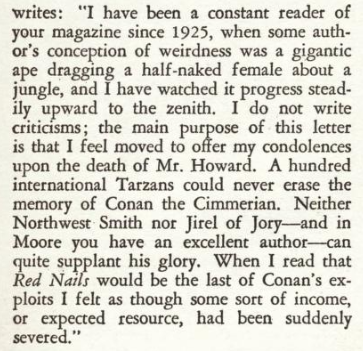
This is only one of many such letters sent in to the Unique Magazine following Howard’s death (as I’m writing this, I think I might devote the next entry here on the blog to those letters, so stay tuned!); what’s interesting about Ball’s is that it really seems like the End of Conan struck him so deeply that he decided to try and Do Something About It – namely, Clifford Ball went and wrote some Sword & Sorcery himself! What’s more (and much like Kuttner), Ball also appreciated that one of the Keys to the success of Howard (and Conan) was the establishment of a fun, living secondary world – for Ball, this is (for lack of a better term) Ygoth, which is either a city or a country (it’s not exactly clear), and which is mentioned in all three of Ball’s S&S stories, tying them all together into a loose, unrestricted canon, much like Howard’s Hyboria.

Ball’s first story, “Duar the Accursed” would appear in the May ’37 issue; it’s an odd little work, very Theosophical honestly, about an amnesiac mightily-thewed barbarian hero who had been a mercenary, become a king, lost his crown, and then become a wanderer. There’s some interesting weirdness in it – in addition to having no memories of his early life, Duar’s accursedness is manifested as terrifying rains of blood and an ominous, unearthly raven that heralded his army. We’re also introduced to a strange, shimmering, extra-dimensional spirit that follows Duar and provides him magical support (whether he wants it or not), and has some kind of relationship with him from the past. There’s suggestions that Duar is himself some sort of Ascended Being trapped in a fleshy prison. It’s all very cosmic and, like I said, Blavatsky-ian; there’s pretty heavy foreshadowing that Duar is a kind of recurring spirit reborn as a hero or champion throughout time. But it’s also very much in keeping with Howard’s idea of the Manly Ideal of a S&S Protagonist – confident, physically powerful, fearless, and not interested in the niceties of civilization. There’s some good Gygaxian D&D flavored stuff in it too – the MacGuffin is a jeweled rose that’s actually a demon, and there’s a weird “Force” at work that drives people to their deaths in the depths of a dungeon. If you’re a completist for this sort of thing, it’s worth a read, but Duar never shows up again.

Ball thankfully (and correctly) drops the hints of “Chosen One” bullshit from his later (and last) two S&S tales, the much better and more fun Rald the Thief stories, the first of which we’ll be looking at today. But you should definitely temper your expectations here – they’re perfectly fine C-level work, I’d say, pastiches of what Ball obviously loved about Howard (and weird adventure writing), the sort of stories you expect from someone early in their writing career and looking for their voice. Unfortunately, Ball never got that chance – he wrote three more stories, though these are more straight weird fic than S&S. The last of these, a werewolf tale, was published in ’41, and then it appears Clifford enlists in the Navy. He ends up dying in, apparently, an accidental drowning in ’47, never having written anything else. It’s sad, especially because I think he had at least a sincere love of S&S, as I think you’ll see in the story today.

So let’s get to it already, sheesh:

That’s right, Rald the Thief gets the Finlay cover treatment, quite remarkable and, much like the Elak covers, it speaks to the deep love that the new and as-yet-unnamed genre of Howardian-historico-fantastique-adventure tales had garnered. The iconography is interesting here, and gets to the heart of the appeal of these stories – a sword, a Man of Action, a damsel, and a mysterious threat. There’s not even a real background – the whole scene takes place in an indistinct void, really highlighting that the whole thing is a very literal psychodrama. Simple, but effective!
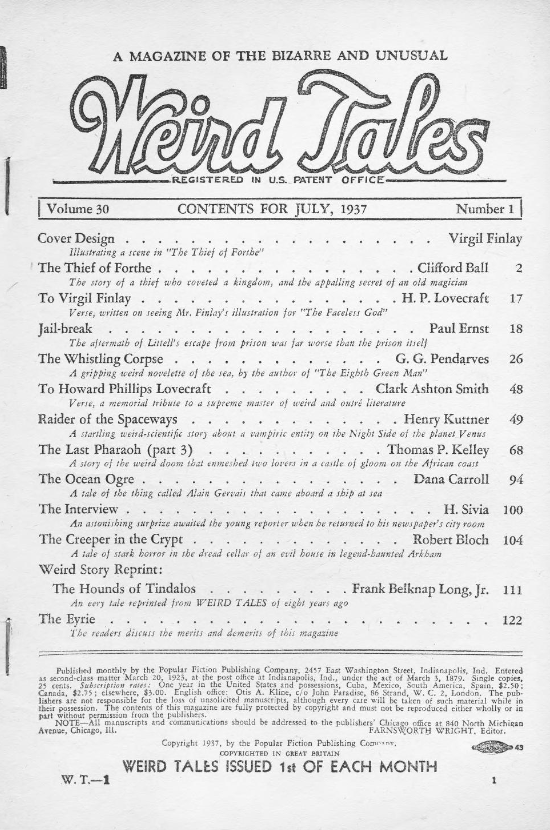
A good ToC, including a reprint of what’s probably Long’s most famous story, “The Hounds of Tindalos.” Also worth noting is CAS’s memorial poem to HPL, who had died in March of the year. It’s been a rough few years for Weird Tales fans, who’ve lost some giants in quick succession! Anyway, on to today’s tale!
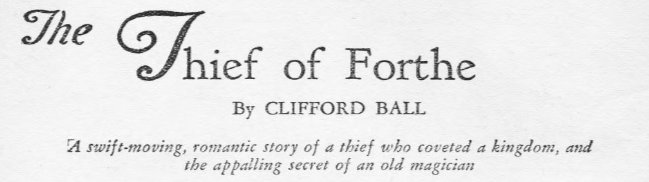
A pretty straightforward summary here, and truthful too – this is a brisk tale indeed, rolling along at a decent clip with very little downtime. Case in point, our story opens in medias res, with a business meeting happening in a dank, drippy, disused dungeon. Two figures are conversing:

We’re introduced to a wizard with an apparently top-notch moisturization regime – their slender womanish hands a sure sign of sorcerous puissance and subtlety. This is in contrast to the other as-yet unnamed figure, who is immediately portrayed as a forceful, man’s-man kind of dude – he grumbles, he strikes the table with a meaty fist, and he’s suspicious of all this wizardly bandying of words about the King, named (oddly) Thrall. Yes, these two are surely quite different from one another, so much so that we get two more paragraphs describing them. First, our wizard:
Good, strange wizard physiognomy, I think, and the insanely hairy face is fun (and, obvious) foreshadowing of something. The “what’s under those robes!?” is a little thickly ladled on here, but honestly it’s not too bad, and it’s perfectly fine to hammer it home given where the story will end up. “Karlk” is a decent evil sorcerer name too, I think, short and sharp and menacingly strange. All in all, a top-tier evil magician, I think. And what’s the beefy fellow Karlk has been talking to like, you ask? Well:
No mincing words here, this is just Conan. Naked and muscular in a loincloth and sandals, obviously of a kind with the Cimmerian, strong, violent, and cunning (as evidenced by phrenology). What is interesting is that Ball calls out Rald’s scars, which is a detail I don’t think I’ve read about in Howard’s loving descriptions of Conan’s rough-and-rugged body. Ball wants to highlight the history of macho violence embedded in Rald’s body, because this, along with his near-nakedness, muscular bigness, and clean-shaven face, marks him as diametrically opposed to Karlk the Magician.

There’s some fun back-and-forth arguing between Rald and Karlk about King Thrall; Karlk seems to have it in for in him, but Rald points out the King has done alright by Karlk, covering up a mishap when one of Karlk’s “experiments” escaped. All in all, Rald seems disgusted by the wizard and their planned treachery. I’m no business guy, but it really seems like at this stage of the negotiations (along in a dripping dungeon), you’d want to have this kind of stuff ironed out. Karlk seems put out by Rald’s apparent lack-of-fear; he is a weird, menacing wizard, after all, and is used to a modicum of cringing respect. So Karlk decides to show Rald some of his power:

And how does Rald react to Kralk’s laser beam?

I mean, fair enough, right?

Regardless, Rald wants to get down to business…what IS it that Kralk wants to hire him to do, anyway?
Rald’s professional pride is fun, as is his discussion of what the possible targets of his thieving might be. I like the little “No women, mind you!” bit too, it’s all very material and earthy, a lived-in detail that captures Rald pretty well and gives him a bit of depth.

That is solid wizard shit there, you know what I mean? Kralk is steeped in black lore, and has moved beyond mere jewels and such. Kralk wants Rald to steal THE VERY KINGDOM ITSELF!!!! which is so bonkers, I love it. Rald’s reaction is fun too – how can you steal a whole kingdom, particularly one which is, in some way, divinely ordained. King Thrall is the King of Forthe, simple as? How would Kralk take over, even?

Very fun stuff; Rald is thinking about the Realpolitik of Kralk seizing the throne of Forthe, how impossible it would be to hold it given how everyone hates and fears him, but Karlk leapfrogs over that problem by the simple expediency of having RALD be the king, with Karlk a hands-off power behind the throne. Rald’s realization, and the temptation, are handled really well; Ball has constructed a convincing web for his Prince of Thieves to get enmeshed in!

I love the whole “wizard practicing the blackest of sciences” angle to these early S&S stories – it’s something Howard did himself, with a lot of his evil wizards relying on drugs and alchemy and hypnotism more than thunderous bolts of power. Similarly, Kuttner had his weird little wizard Zend behaving more like a scientist, using occult forces and magic-technology to keep Atlantis from sinking, for instance. Karlk’s claim that they are merely a scientist is a lot of fun, and something that I feel like you don’t see as much of in fantasy these days – wizards are a lot more mystical and esoteric, which is a very different characterization from experimental and technical approaches to even blasphemous sorcerous knowledge.

It’s also menacing as hell, isn’t it? We had that little story about the dog-man thing that had to be executed after it escaped, a very strange and unsettling story, and Karlk seems to be mostly interested in being allowed to expand his research program, something that would necessitate a friendly king willing to turn a blind eye to whatever horrors he’s planning. Of course Rald is disgusted…but…

It’s a solid Faustian bargain – Rald puts up a good front, but he’s quickly broken down by Karlk’s tempting him with not merely wealth and power, but immortality as a dynast! It’s fun and unique, making Rald a bit darker and more morally ambivalent (for now, at least) than his literary progenitor Conan. The story is a bit grimmer and grittier too; Conan had lots of adventures motivated purely by greed, but he never stooped so low as to ally himself with an obviously evil wizard! Credit where credit is due, Ball has come up with a fun and novel plot!

The next section opens on Rald beginning his infiltration of the Palace of Thrall. There’s some fun world building in here, among some admittedly clumsy and overwritten sentences. The walls of the palace, both inner and outer, are crumbling and in poor repair, and the patrols of the guards are fairly cursory and easily evaded. Similarly, the jagged bits of metal embedded at the top of the walls are rusty and easily pushed aside. But most importantly:

That’s a nice touch, and conveys a lot about this place and its history. They don’t need to maintain the walls or a tight guard – the sanctity of the palace is exactly that: sacrosanct, the product of cultural and religious scruple that sees the King and his power as a holy, divine thing, which NO ONE in their right mind would ever violate! Luckily, Rald is free of such scruples. This is more than just a nice bit of flavor, too – it will explain what exactly Karlk’s plan is, and how a whole kingdom can be stolen.

There’s a really nice bit of writing around Rald’s skulk through the garden here:
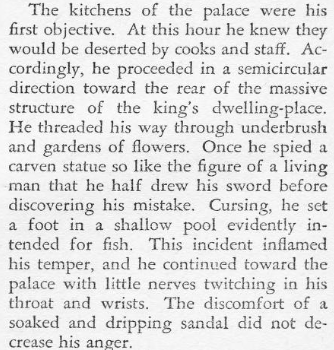
The statue he mistakes for a person, and the annoyance of the wet sandal are great, nice little bits of very realistic detail that lend Rald some interiority as well as highlighting his real physical experiences sneaking through the forbidden grounds. Equally fun is the fact that Rald knows the layout of the castle absolutely, due to the simple fact that everyone does, from servant’s gossip. The way Ball tells us that the simple peasants would be horrified at the use their gossip is being put to is fun writing. There’s a lot of nice details in this story, I think, and Ball is very much taking his time trying to develop the scene and evoke the setting, and it’s (largely) paying off, I think.

Rald makes in into the castle and encounters a drunk guard and, in a room beyond, a sleeping woman whom he takes to be a courtesan of some sort. Finally, he reaches a door that, via the clarity of narrative convenience, Rald realizes must be his goal:

Might be a real “Marge_Potato.jpg” moment here, but look: I just think this is neat. It’s extremely fun that Rald is an atheist in a magical world with gods, and that it’s this atheism that allows him to lift the magically warded lockbar without being struck down by the mighty curse woven into its very matter. That’s good stuff, and it works nicely with the whole thing going on in this story – the decrepit theocracy being vulnerable to One Atheist Thief!

Rald pushes through the door and enters some kind of sacred council chamber where the King and his sister hold court. More importantly, there’s the sacred necklace that is the goal of his quest hanging there!

So potent a symbol is this necklace that merely possessing it makes one, functionally and practically, the ruler of Forte. It might seem like a goofy system of gov’t, but who the hell am I, an Amerikkkan, to judge? More importantly, it’s in keeping with the whole tenor of this country/city-state, right? This religiosity that seems to rule here would absolutely imbue an object, and whoever happened to be holding it, with absolute political power; it makes sense! And it seems to have worked out just like Kralk imagined it would…or has it!? For, while Rald is admiring the sparkle of the diamonds that make up the necklace, he’s interrupted by a voice!

Do I wish Ball had given Rald a better swear than “faith?” Of course I do. Do I love this mysterious person telling Rald to knock it off with all the jumping around like some damn ape? Absolutely. It’s funny! The whole thing is very swashbuckly, and I love it.

The newcomer is the King’s sister, the Lady Thrine (apparently a real, if rare, Danish girl’s name, by the way), and she’s aghast at the temerity of Rald to not only break taboo by touching (and proposing to steal) the Sacred Necklace, but also by DARING to enter her bedchamber and peer at her sleeping. Yes, she was the “courtesan” from earlier, and its the whole shock of the boldness of Rald’s crimes that have lead her here, rather than, say, calling out all the guard. There’s some flirty banter, honestly not badly done, particularly since Ball is working on his own here in a Pre-Mouser world, but it’s cut short by the sudden arrival of Karlk!

Again, it’s a really great part here that Karlk, a magician and therefore intimately familiar with the reality of occultic forces, couldn’t move the magical bar with its potent spell, so he hired an atheist thief to do it. That’s good, a solid interesting premise for a S&S story, and also an interesting “mechanic” (if you’re excuse the vulgarism) for a S&S world, where magical potency is in some way related to belief. It’s fun, and something you don’t see much of these days!

Anyway, Kalrk prepares to zap Thrine, something the besotted Rald CANNOT ALLOW TO HAPPEN…but it’s all put on hold by the arrival of King Thrall, in full battle armor. There’s a funny bit where Rald, again in Mouser fashion, asks exasperatedly “doesn’t anybody SLEEP in this castle?” which is a funny, solid joke for a S&S story. There’s more banter, some guards show up, and the Kralk and Rald are bound up with ropes. They’re left, unguarded, in the council room (with the necklace) while Thrall, having sent his sister back to her room, orders a quick search of the gardens, in case there are more conspirators. Left alone, Rald and Kralk bicker a bit, with Karlk realizing that Rald has scruples he hadn’t imagined.

And then Karlk does something weird:

Khalk unties himself with an extra pair of small, white furred arms that emerge from his robes! I mean, that’s absolutely great! Equally fun in the kind of nonchalance with which Karlk assures Rald that there’s a LOT about him no one knows. It’s a great scene, and very weird.

Also fun is how Karlk, while having to leave Rald behind, still proposes to honor their partnership – he’ll kill the people Rald can’t, and then Rald can become King, with Karlk the power behind the throne. It’s very logical and straightforward and, honestly, makes Karlk out to be even more inhuman and mysterious. Afterall, while he’s disappointed Rald didn’t just kill the Princess, he can still use him. It’s fun, weird, stuff, and honestly between that and the extra arms, Karlk is up there with the evil wizards in S&S lit, in my opinion.

Rald doesn’t waste time, however. After Karlk has left, he painfully hoists himself up, knocks a torch from its sconce, and uses it to free himself. In the corridor he finds a guard, horribly magicked to death by Karlk. Grabbing the dead man’s sword, Rald rushes down the corridor, hearing a woman’s sobbing scream of terror from somewhere ahead. Rald comes upon a deadly, dangerous scene – Karlk, crouched horribly over the bound and terrified figure of Thrine, preparing to blast the unsuspecting King Thrall with evil magic. Rald leaps into action, slicing into the surprised Karlk with his sword:

Thrine tells the king that Rald saved him, indeed saved them all from Karlk’s deadly magic, which the King grants, though of course he DID plan on seizing the throne himself. With a modicum of contrition, Rald foreswears his earlier actions:
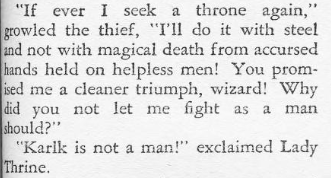
Rald agrees that an evil, murderous wizard can never be a man, but hilariously he has misunderstood Thrine. For, in fact…

Karlk was a GIRL all along!!!! The fake beard, the scrupulous flowing robes, all a trick! But that’s not her only secret…

How came she to have royal blood, you might ask, and King Thrall certainly does. Well, it’s a funny story:

Kind of grim, and with an unfortunate amount of “monstrous ape rape” (a surprisingly popular theme in early Weird Fiction). Also, you might not recognize it, but the “white apes of Sorjoon” are basically the multi-armed white apes of Barsoom, from Burrough’s John Carter of Mars stories; in the earlier Duar the Accursed story, Ball refers to them as the white apes of the “hills of barsoom,” even. Maybe it was an editorial decision to change them, or perhaps he thought in hindsight that that was a little too on the nose. Still, everybody reading Weird Tales would’ve immediately recognized the Great White Apes for what the were, horrific multi-armed ape monsters from a classic swashbuckling sword-and-planet tale. It’s interesting that Ball uses them here; speaks to the importance of Burroughs for the readers of these more action-oriented, thrilling adventure weird tales, I think, and is in keeping with Ball’s letter eulogizing Howard too; he mentions “a thousand international Tarzans” as being unable to make up for the thrill and power of Conan, suggesting the lens through which he was being read, by some at least.

Anyway! Karlk’s extra arms come from her White Ape parentage. There’s a bit of Howard’s Atla in Karlk here too, from “Worms of the Earth.” Both of them are outsiders, cursed by their lineages to belong to neither of their parents’ worlds. Cursing all of mankind, Karlk devoted herself to evil and the eventual overthrow of Forte. There’s some great, creepy writing as Karlk’s laments her poor experiment back in her hut, and then she dies.

The story wraps up with a nice little bow – the King roars that, for his great deeds this night, he’ll make Rald a baron, but the thief is gone. But don’t worry, says Thrine, he’ll be back…for her!

And that’s the end of “The Thief of Forte!”

From a Sword & Sorcery perspective, I think this story is pretty decent. There’s good world building, and Karlk is a fun and interesting character that, honestly, I would’ve liked to spend more time with. Rald is basically and blandly a species of Conan, though maybe just that much more avaricious than the original – like I said, working with an obviously evil wizard seems a bit too much for ol’ Conan, though Rald readily agrees (even if he does have second thoughts later).

It’s not some lost masterpiece of the genre by any stretch, but it’s at least as good as Kuttner’s Elak stories, I’d say. What is interesting is that both of them, Ball and Kuttner alike, offer different perspectives of the post-Conan and post-Howard genre. Ball’s is much more straightforwardly a pastiche, I’d say, with Rald simply being Conan, or at least much closer than Kuttner slim and amoral Elak. Ball also seems interested in the women in S&S stories, more so than Kuttner at least; perhaps he’s influenced by Moore’s Jirel stories there, probably the most important non-Conan S&S character to emerge in the 30s. Ball has a bunch of tough amazons in the second Rald story, and there’s a pretty tough queen in the Duar story, though of course all end up conforming to comfortable 30s heteronormative roles by the ends of their respective tales. By far the most interesting character in Ball’s slender oeuvre is Karlk, though, and I think the story is worth reading for them alone!

Maybe more to the point, I think it’s worthwhile to read these attempts at carrying the torch forward in the post-Howard days of Weird Tales, particularly because they’re wrestling with something that would dog the genre well into today, namely: where do homage, tradition, pastiche, and out-and-out cribbing fit in the genre, and how do we push at the boundaries and make something new? Obviously there’s a deep love of Howard and his work here, but how do you build on it without simply (and more weakly) recapitulating the same tired old themes and plots and characters. I don’t think there’re answers in these stories, but I do think it’s fruitful to read them and think about these questions!

Strainers of the Pulp #19, Three Kings’ Day edition: “Worms of the Earth” by Robert E. Howard, Weird Tales, Nov. 1932, v.20 n.5

We’ve drained the mead horns, reduced the great roast boar to gnawed bones, and watched the vast bonfire around which we defied winter’s darkness smolder into mere ashes, but we’re not done with sword and sorcery yet! No indeed, not on this, the most sword-and-sorcerous sounding holiday of the year…Three Kings’ Day! And what better way to celebrate it than by talking about the Last King of the Picts, Bran Mak Morn! It’s Robert E. Howard’s “Worms of the Earth” from Weird Tales, November 1932!

We’ve talked about ol’ REH a lot during the sword and sorcery festivities; how can you not? We’ve encountered both Solomon Kane and Conan in some great stories already, but for me, personally, I think Howard’s single greatest character is Bran Mak Morn – there’s something really compelling about him, this very last ruler of Pictdom, presiding over a declining and dying people and watching the Romans marching over his homeland. Howard loved to indulge in a certain Celtic gloominess, both personally and literarily, and that’s fully on display in the Bran stories. It lends them a poignancy that’s not often present in his other works; Conan’s barbarism and Kane’s zealotry are portrayed as powerful and vital forces, elemental and therefore permanent, but Bran is the last of his kind, and we know that he is destined to be ground down by the millstone of implacable history.

Aside from the purely aesthetic appeal of this Pictish mono no aware, it’s also a chance to see Howard examining a different point in the Spenglerian cyclicity he believed in; Kull and Conan are barbarians who, in Howard’s weird racialist worldview, revitalize their respective nations by taking up the crown and injecting their own wild vitality into civilized kingship. But here we see a people at the end of their “natural” lifespan, senescent and impoverished, struggling vainly against an ascendant Empire. And, to top it all off, in this story Bran glimpses the possible fate of his own Picts when he confronts the twisted and degraded remnants of a people his own ancestors had conquered and displaced! Bran Mak Morn is Howard’s greatest, most interesting character, which makes this story, “Worms of the Earth,” his greatest sword and sorcery story ever, at least for me. Hell, I’d put it up there as one of the all time greatest stories in the genre ever!

Worth keeping in mind is that the readers of Weird Tales had yet to be introduced to Conan at this point; Kane had made it to the pages of The Unique Magazine already, of course, and Kull had shown up in a previous Bran story from 1930 (“Kings of the Earth”), so readers were certainly familiar with Howard’s blood-and-thunder style and approach. The Cimmerian himself wouldn’t show up until the NEXT issue of Weird Tales, when “Phoenix on the Sword” would be published (Dec 1932), and after that, of course, Howard’s career and writing really changes; I think “Worms of the Earth” is still very much a weird tale, with its emphasis on inhuman horrors, atavism, and vast sweeps of time embodied in ancient landscapes. It’s still very much sword and sorcery, of course, but I think that it isn’t until Conan that Howard tips the balance more towards adventure and away from the Lovecraftian-influenced cosmicism on display here. But enough jibber jabber, let’s get to it!

A great swashbuckling cover, but this isn’t Bran fighting a Loch Monster or anything…it’s Kline’s heroic Venusian he-man Grandon fighting some swamp-dwelling space devil! Kline is an interesting guy; along with Farnsworth Wright, he had been an early editorial assistant to the first editor of the magazine, Baird, and had stayed on as an editor and reader under Wright, as well as writing his own weird fiction, fantasy, detective stories, and science fiction. He would shortly leave off writing, focusing more on becoming a literary agent for a number of big names in the pulps, including Howard himself! In fact, after Howard’s death by suicide in ’36, Kline would continue to represent his estate, helping Howard’s father get the many thousands of dollars still owed to REH by Weird Tales (and some other magazines, too). The scene illustrated here on this cover is interesting; first off, it’s from what would end up being a novel-length work that would stretch over seven issues of the magazine. It’s obviously a pastiche on Burroughs’ “John Carter of Mars” novels, largely successfully so too, I might add; if you liked those novels, then you’ll almost certainly like Kline’s planetary romances, which are often more-Burroughs than Burroughs in execution. But this cover also illustrates that, while Howard is rightfully identified as the creator of sword-and-sorcery, there was both a lineage of swashbuckling weird fiction that predated and inspired him AS WELL AS a clear hunger from readers for that kind of thing.

Nothing too noteworthy in the ToC (other than our story today), but the Weird Story Reprint is interesting; they’d reprinted “Frankenstein,” with this issue’s segment being the penultimate entry in an eight-issue long stretch that really annoyed a lot of people. There had always been some annoyance with multi-part stories among the readers, because of the dangers of missing an issue, but in particular a lot of people felt that reprinting a classic that almost everyone had read or could have easily gotten a copy of was a waste of good magazine space. It would actually lead to a change in policy for Wright and the magazine, which would in response to those complaints rededicate itself to reprinting more obscure work (for more about the history of the “Weird Story Reprint” series in the magazine, you should read my introduction to the collection “Night Fears: Weird Tales in Translation” from Paradise Edition books).

And now, on to the story itself!

A great title illustration, as usual, and one that doesn’t even spoil the story or anything! Just a great scene from one of the best parts of the story, in my opinion, with a really subtly devilish Atla and a grim and haunted looking Bran… wonderful stuff! The shadows are a nice touch, too, very moody and pensive and weird. It’s signed “MW,” but based on the style I’m pretty sure it’s J.M. Wilcox’s work (sometimes known as Jayem Wilcox, or JMW). Wilcox would go on to produce the very first illustration of Conan when he did the title art for “The Phoenix on the Sword” next issue, making him an important part of sword and sorcery history.

Pumped up with that great bit of art, we’re ready to dive into the text of the story!

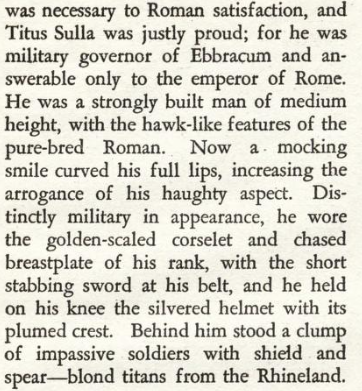
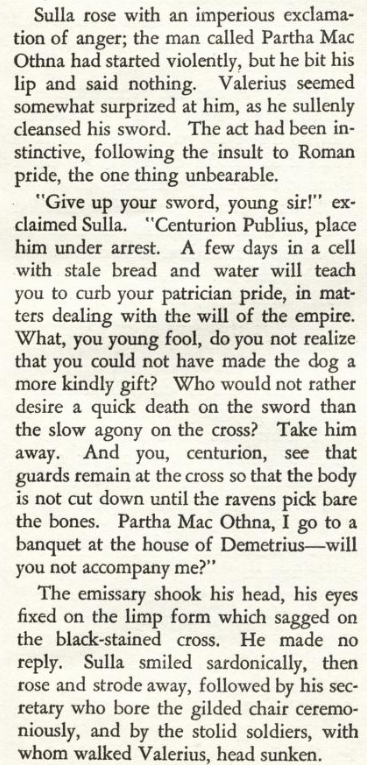
Love a story that starts with dialog; gives it an immediacy that can’t be beat, in my opinion. And this dialog starts off strong – nothing good is going on, you can be sure of that, and that conclusion is further supported by the imperial haughtiness of Titus Sulla, lounging in his chair of office, surrounded by a guard of Teutonic legionaries. You can again see Howard’s preoccupation with bodies and physicality here, too – Sulla is a Roman, but he’s no weak, lisping functionary, made soft by bureaucracy and civilization. No, he’s a soldier, a conqueror with a strong body and cruel countenance, and he’s surrounded by other huger bodies, “blond titans” from Germania, further symbol of the power and decadence of Rome. These powerful bodies are immediately contrasted with another body, this one made abject:

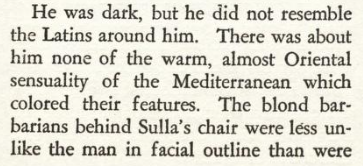
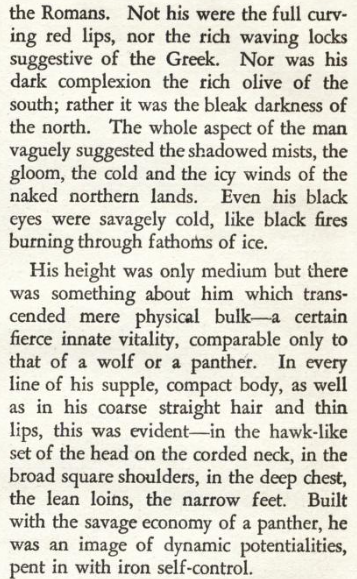
It’s a crucifixion party, one apparently being put on for the sake of the “guest” mentioned above, a dark man identified later “Partha Mac Othna.” But before we get this name, we get a very Ellsworth Huntington-esque discourse of race, civilization, and climate that contrasts this dark somber man with the Romans and Germans that surround him.

A “supple, compact body” with “broad square shoulders,” a “deep chest,” “lean loins…” you can joke all you want, but Howard’s fascination with and interest in masculinity and its physicality is certainly enthusiastic and sincere. Similarly expressed in this story is REH’s belief in the importance of racial purity, as made clear by the comparison of this dark, northern barbarian with his two compatriots, one at his feet and one on the cross:

There’s some kinship between these three, though it’s clear that the man on the cross and the “stunted crouching giant” represent a “lower type” than the clean-limbed and well-knit dark man. This racial hierarchy stuff is a central part of Bran’s pathos, for Howard at least, and it’s something that we’ll come back to in the story later. But for now, let’s get this guy crucified!

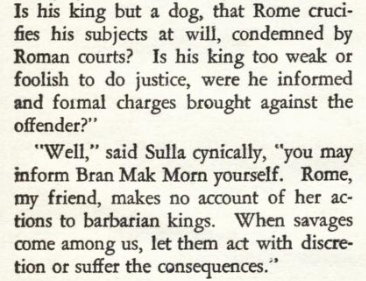
There’s some more verbal sparring, almost as if the Sulla is trying to goad his “guest” into something, but the strange, noble-looking Pict seems to reserve his ire for the Pictish King:

Takin’ it kinda personally, isn’t he? Almost weirdly so…oh well.

Anyway, they crucify the guy, who doesn’t scream out in pain or anything, only staring at Partha Mac Othna with a strange and plaintive intensity. Seeking to mock their victim’s suffering, a Roman solider offers the dying man a cup of wine and receives a defiant loogie in the eyes instead. Enraged, the soldier stabs the man with his sword, which pisses of Sulla something fierce.

The Pictish emissary stays awhile, contemplating the dead body hanging on its cross against a reddening sky, before turning back and heading to the Roman fortress city. A grim and perilous beginning to the story indeed!

How about that little bit of Yog-Sothery there, huh? “Black gods of R’yleh” is great, and the fact that “Partha” here would evoke even THEM speaks to his anger and despair at Rome. But why does this feller feel such animus towards to the Romans, you ask? Well…

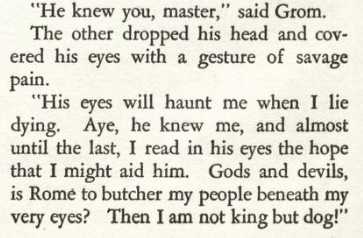
What a twist! Partha Mac Othna is, in fact, Bran Mak Morn, King of Picts, posing as an emissary to gather intelligence on these his most hated of foes! Grom, his gnarled companion, begs his master to keep his voice down; the Romans would hang him from a cross if they knew who he really was. Rather, why not let faithful ol’ Grom ice the Roman dick?
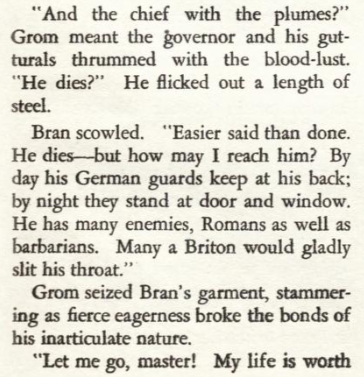
I mean, that’s some top notch, grade-A badassery right there, isn’t it? Grom’ll happily run a suicide mission for his King, vowing to kill Sulla anyway, even if he is surrounded by bodyguards. But Bran knows that won’t work, and instead is already working on another plan…

It turns out that Sulla is frickin’ terrified of a certain Gael by the name of Cormac na Conacht who has vowed to eat Sulla’s heart raw. Showing sensible caution vis a vis having his heart eaten, Sulla tends to stick to the impenetrable fortress known at the Tower of Trajan when there’s trouble along the Wall. This knowledge inspires Bran to some dark, fearful plan…he sends Grom out of town with some gold and his diplomatic pass; he’s to ride to Cormac and get him to start raiding, sending Sulla off to the Tower. Then Bran takes a quick nap, where in a dream he meets his faithful advisor the Wizard Gonar who, having divined Bran’s yet-to-me-specified plan, is absolutely freaking the hell out:

What “this thought” is exactly will remain obscure, for now, but it does lead to a pretty great speech from Bran explaining why he has been pushed to this extreme measure (whatever it is):

It’s some real “burden of kingship” shit, sure, but damn if it doesn’t get me. In particular, the stuff about their shared experiences I find pretty moving…both of them listened to the same tales and songs, and that forged an unbreakable bond of shared heritage that held them together. And that final statement is, again, just a perfect encapsulation of a sword-and-sorcery ethos: by those bonds, Bran had the responsibility to protect him, and if he cannot do that, then he will avenge him. Shivery, noble stuff, great fantasy writing, some of the best Howard ever did in my opinion. And there’s more to come!
But Gonar is still scared. Why not just chop some dudes up like usual, he asks, ride along with the Gaels and slaughter Romans from sun-up to sun-down. Oh, don’t worry, Bran replies, I’ll definitely be doing that…BUT FIRST he wants something special for Sulla.

We’re spending A LOT of time on this early part of the story, I know, but I think it’s worth it to see Howard really doing some great work establishing Bran Mak Morn and the world of the Picts and Romans here. Bran has been fighting these Romans for a long time, and we feel his desperation and struggle – you get the sense that it’s not been going great for the Picts. After all, why else would their goddamn King risk himself to sneak into their stronghold? Things must’ve gotten pretty dire back in Pictland. And then, to have seen his man crucified and forced to confront his failures as King and Protector…he’s gone a little crazy now, and nothing is off limits in his war against the Romans.

Gonar tries one last desperate gamble: the things Bran is planning on using have gone from the world, they’ve dwelled apart for countless ages and no one knows where they are now. But Bran is sure that that can’t be true…somewhere, there is some sign, some thread of a connection that will lead him to them.

Really appreciate the care Howard is taking here – right now, we have no fuckin’ clue as to what exactly it is that Bran is planning, but it’s been made clear that it is dire as hell and going to be extremely dangerous. From a story telling perspective, I just don’t think REH ever hits this level of mastery again, it’s so good and sharp and propulsive. Bran is desperate, his back to the wall, and capable of anything in his quest for vengeance; to him, there’s nothing foul enough for the Romans, no act so base or vile that he wouldn’t stoop to, just so long as Sulla gets his. And even though he’s talked this good game about his responsibilities as king and all that, you see that there’s more there – it’s a deep, personal affront that he wants to avenge, so much so that Gonar basically calls him out for putting this personal hatred ahead of the actual needs of the Picts. It’s great stuff, isn’t it?

Before Bran heads out on his insane and horrific mission, he takes a brief moment to sneak over to the prison to murder the roman soldier that stabbed the Pict on the cross. It’s yet another scene of great badass action, particularly in the way Howard described Bran’s dark chuckle, the slash through the barred windows, and the blood welling up from Valerius’s throat as he dies. Ticking that chore off his to-do list, Bran then rides out of the city and into the wilderness, searching for…them.

There’s some great, evocative environmental writing in this section, wildernesses and border regions and ancient landscapes all lovingly described by ol’ REH. The romanticism of landscapes, and their hidden dangers, are something Howard is really well-equipped to work with in his fiction, having reflected extensively on his own wildernesses and frontiers back in Cross Plains, Texas. I’m also a sucker for ancient, nameless earthworks – these curiously regular hillocks and mysterious monoliths are wonderfully potent images, suggestive of deep time and lost civilizations.

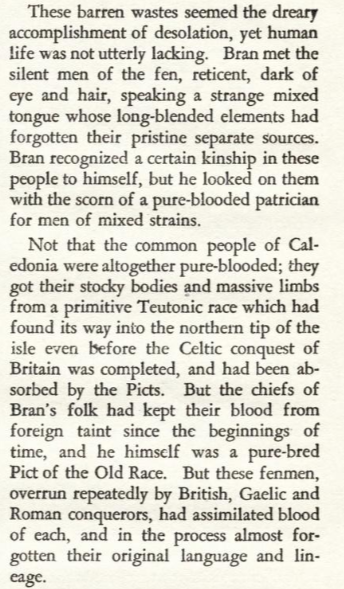
There is also in this section another long paean to racial purity from Howard. As we’ve already mentioned, Howard was an unapologetic and enthusiastic racist, something that strongly informed his fictional stories, as we see here:

A big part of Howard’s disdain for “civilization” comes from his belief in racial purity – with civilization comes miscegenation, which for Howard is both unnatural and decadent. What’s funny, though, is how all this talk of Bran being a pure-blooded noble from a long-line of reproductively isolated aristocrats strikes us today; far from the strong limbed and lean-loined pantherish ubermensch Howard described, talking about Bran’s paternity like that immediately evokes the Hapsburgs, at least for me. The idea of Bran looking like Charles II of Spain during all this stuff going on is hilarious, and makes his revulsion at the fenmen, Atla, and the Worms of the Earth themselves later in the story all the funnier.

But anyway, Bran is spending some time wandering around the wastelands, searching for any sign of the horrible things that once dwelt there. He gets news from the fen dwellers, and learns that his Gaelic buddy Cormac has begun raiding, spreading terror all along the Wall and sending Sulla scurrying off to the Tower of Trajan, just like Bran said he would. Meanwhile Bran, all alone, keeps up his hunt, until one day he spies a distant daub-and-wattle hut in a particularly lonely corner of the fens. He goes to investigate, and meets one of the greatest characters in sword-and-sorcery history.

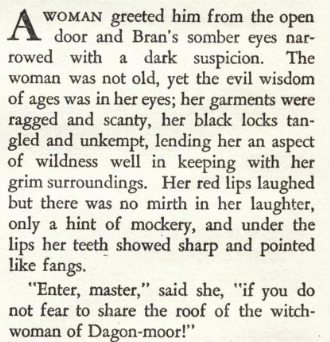
This is Atla, and she’s 100% rad as hell. Howard lets us know immediately that she’s not entirely human, too – she’s got fang-like teeth, almost pointed ears, oddly-shaped yellow eyes, and all her movements are sinuous, lithe, and serpentine. Bran recognizes all the signs, and since he’s one of the Old Picts, he knows the stories, guesses her heritage, and knows she can help him.

There’s so much to love about this – the fencing between Atla and Bran, and the shock and horror that even she feels to hear Bran speak so openly and blithely about forbidden things, it’s really fantastic. But even more, there’s a real grimness and sorrow to Atla, something strange and sad and special that you makes her character so interesting and unique. For one thing, she’s utterly and completely ostracized, living way the hell out in a place called the Dagon-Moor which you KNOW is not exactly on any of the major bus routes. She’s been exiled out here because of her heritage; it’s implied that she’s the product of a rape, a human mother attacked by one of them out on the moors, and that her inhuman blood has meant that she’s been driven to the very edge of the human world. And that revulsion is definitely something Bran feels too, even though she is the only thing that can help him find the Worms of the Earth.

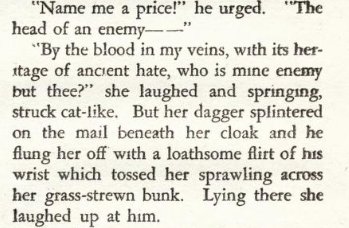
Atla’s recklessness and scorn is just fantastic here, and the way she laughs at Bran’s threat is wonderful. Her mocking question “Do you think that such life as mine is so sweet that I would cling to it” is really great, an absolute gut-punch. And Bran’s realization that he’ll have to try different means of persuasion is met with equal scorn!

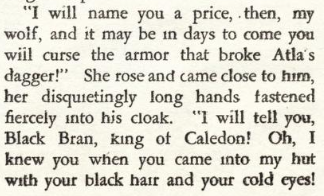
Atla is such a badass! But, after all that, Atla does have a price.

I think this is some of the best writing Howard ever did. There’s a real and aching loneliness to Atla, and it’s tempting to think that Howard, an artistic and romantic young man living way the hell out in an oil boomtown in central Texas, might’ve been mining something of himself when he’s having Atla express this deep and heartfelt yearning. There’s real humanity in Atla, probably the most you’ll ever see in a Howard character honestly – the only other example that I feel like even comes close to this is Balthus’ reminiscing about home from the Conan story “Beyond the Black River.”

Anyway, Bran swallows his revulsion and agrees to have sex with the snake lady, and Howard tastefully draws the curtains on the scene.

The next morning, while Bran is dressing for his walk of shame, Atla tells him that what he needs to do is steal the Black Stone; with that, he can force them to do whatever he wants. The Stone is deep beneath Dagon’s Barrow, which, again, love that Lovecraft connection.

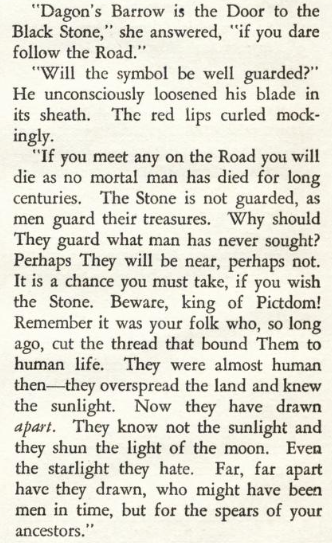
There’s some fun stuff here for sure, and I can’t help but wonder if Tolkien (who certainly had read some Howard) read this one in particular – between the faces in the mere that Atla mentions, and then this whole shunning of sunlight and moonlight and even starlight, there’s some real Gollum resonances here, you know? But, regardless, this is prime sword-and-sorcery stuff, especially that last sentence; the idea that the Picts and these subterranean horrors have history really nicely sharpens the threat and danger of Bran’s scheme.

Bran, armed with the knowledge that Atla has given him, heads out, finds the strange prehuman stone circle atop Dagon’s Barrow, lifts the stone, and plunges into the deep darkness of the Earth. The path he’s on mirror the devolution of the Worms themselves, going from rough hewn steps to a smooth and almost slimy tunnel at the base. There, in a dark chamber, he finds the Black Stone, and is able to abscond with it. He decides to stash it in Dagon’s Mere, chunking the rock out into the center of the eerie pond.

Bran returns to Atla, who is not unsurprised to see him both alive and sane after his trip into the darkness beneath the Earth. Bran informs her that not only has he safely secreted away the Black Stone, but that he has become aware of things hunting him…his horse trod on something unnatural in its stable one night, and he’s been hearing a faint scrabbling beneath the earthen floor of his hut. They’re hunting him, using whatever strange senses and powers they’ve developed over their long exile in the dark. Now he’s ready to deal, and so Atla takes him to a forlorn range of hills that border the fen where the black mouth of a cave yawns wide to take them in.

Howard really paints the landscape here, conveying both its distance from humanity in both space and time – this is an old place, and the things that live here are older than the Romans, the Celts, and even the Picts. That sense of Deep Time, a key part of weird fiction, is really well-expressed here, a testament to Howard’s own appreciation of the earth and the tiny, transient things that call its surface home.

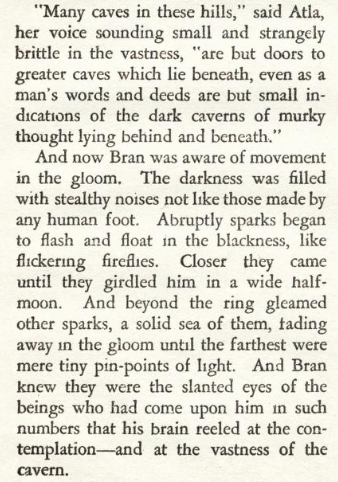
Bran and Atla plunge into the cave, and its somewhat shocking to both us and Bran that Atla herself is scared here – in lesser hands, the snake woman would be a one-off monster lady, but Howard makes sure we understand that she meant it when she said she was “half human, at least.” This place and the things that live there are scary as hell and fully alien, even to her.

And then they meet the Worms of the Earth.

Spectacular writing from Howard here, this sea of glowing eyes in the dark. It’s really truly an eerie and uncanny scene, but does it spook Bran?

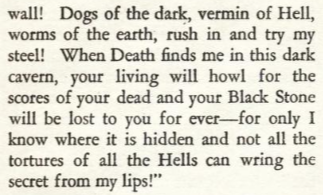
Fuckin’ bad ass, man! And these horrible subterranean things think so too – Bran rolls a nat 20 on his intimidation check, and the Worms of the Earth are fully cowed by his killer speech. They hiss and mutter with Atla, and she’s shocked to report that they’re actually scared of Bran, and will do whatever he wants in exchange for the stolen the Black Stone. Bran wants them to take Sulla from the Tower of Trajan, and he agrees to meet them at Dagon’s Ring tomorrow and exchange the stone for the Roman.

Bran goes for a swim in Dagon’s Mere, recovering the Stone that he chucked in there earlier, which is heroic enough in my opinion – I once dropped something in Barton Creek Pool here in Austin, which is a natural spring fed pool with crystal clear water, and I never found it again…and there’s not even monsters in Barton Creek Pool! That’s actually a really fun little piece of this story too – there IS a monster in Dagon’s Mere, something huge and threatening which Bran only catches a glimpse and a ripple of. It reminds me a lot of the scene in Lovecraft’s “Call of Cthulhu” where we learn that there’s some kind of huge white polypus thing in the swamps of Louisiana that the cultists commune with…you can’t beat these little hints of other weird shit and scary monsters on the periphery of a main story, in my opinion. It’s an evocative and effective tool in weird fiction’s box, and I appreciate it here because, in addition to just being fun, it’s also part of Bran’s mounting realization that he actually doesn’t know this landscape or its history as well as he thought he did.

Black Stone in hand, Bran rides towards Dagon’s Ring, making a brief stop over to see what’s happening at Trajan’s Tower, just out of idle curiosity.

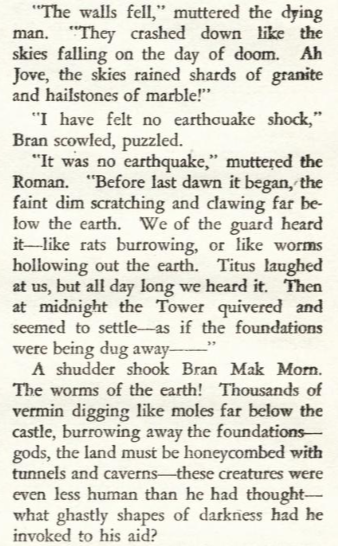
He finds a dying Legionary amid the ruins, and from him he hears a tale of horror.

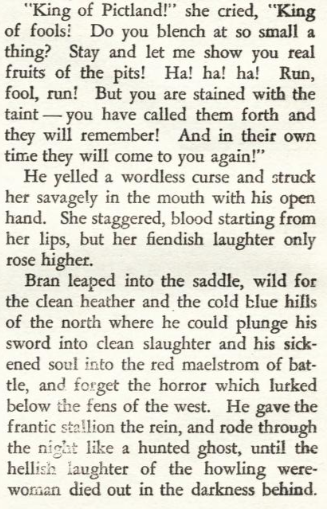
Bran realizing that he might’ve fucked up here is pretty great – he forced these things to involve themselves in the surface world again, and maybe he doesn’t have as much control as he thought he did over this situation. It’s a grim moment for Bran, who had been expecting to get this great triumphant revenge on his hated enemy…and it’s only going to get worse…

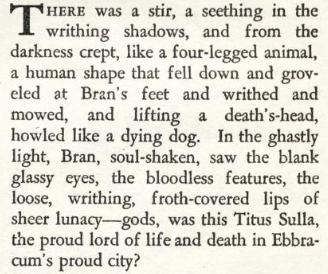
Bran, horrified at the destruction he’s wrought, hurries on to Dagon’s Ring, where he meets Atla and sees a seething, shadowy tide of the things approaching through the grass. And mingled in with the susurrus of their hissing is a lone human voice, gibbering and tittering. Bran demands that they give him Sulla, and Atla, with a smirk, presents him.

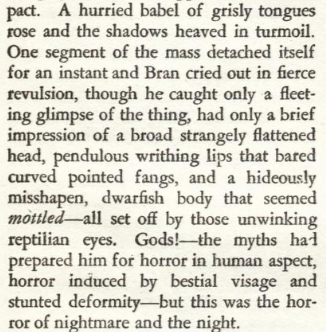
Sulla has been driven mad, not by anything they did to him, but by the simple brain-shattering realization of the true nature of a world honeycombed by tunnels through which inhuman horrors swarm and thrive. Bran kills Sulla, not in rage but rather out of mercy, realizing that there are in fact some weapons too foul and terrible to use. He hurls the Black Stone into the seething mass of shadows, and for a moment gets a clear view of them:

If Lovecraft’s synecdoche of horror is the deep sea, with its tentacles and slime, then Howard’s is the reptile, particularly the snake, with all its symbolism of ancient and pre-mammalian life and potency. The Worms of the Earth, the things that were once almost men before being driven underground and sinking deeper in atavism, are basically hellish snake-things, subtly human perhaps, but mostly all cold scales and merciless coils and hissing, flickering tongues. Sick with terror, Bran flees, but not before Atla gets a final mocking shot off.

And that’s the end of Robert E. Howard’s masterpiece, “The Worms of the Earth.”

It’s just so good, isn’t it? I mean, the characters are great, the setting is a blast, the action is killer, and the ending is perfect and horrible, with Bran having unleashed something that should’ve been left well enough alone. I love basically everything about this story; the pacing is even good, which can be tough in a short story that’s trying to deal with such a wide scope of geography and action.

Unfortunately, Howard never did take up the semi-cliffhanger he left there at the end, though. For all intents and purposes, this is the last Bran Mak Morn story he ever wrote – he’s mentioned again in a later, modern horror tale (“The Children of the Night”), but REH never again gives us a story about the Last King of the Picts. Karl Edward Wagner, most famous for his grim n’ gritty Kane stories DID write a sequel novel based on the premise that Bran had awakened a horror in the hills; it’s called “Legion of Shadows” from the 70s, and I remember liking it well enough as a pastiche, although I don’t think it nails the real weirdness or tragedy of REH’s original story.

I’ve gone on and on about what I like in this story, so I won’t repeat myself, but I really do think this is one of the greatest sword and sorcery stories ever written. There’s a real depth to this one, with a lot of actually meditative moments from Bran, something that’s sometimes lost in the wilder and more action-packed Conan stories to come. And while the Cimmerian would end up defining the genre, I think Bran Mak Morn and his tragic, dying Picts illustrate some of its strengths better than Conan ever does, exploring history, memory, violence, obsession, and regret while also delivering a rollicking, tense adventure story full of flashing swords and horrible snakemen. I mean, what more could you want!?