Tag Archives: fantasy

Pulp and the Gray Strainer #18: “Two Sought Adventure” by Fritz Leiber, Jr., Unknown, Aug 1939, v.1 n.6

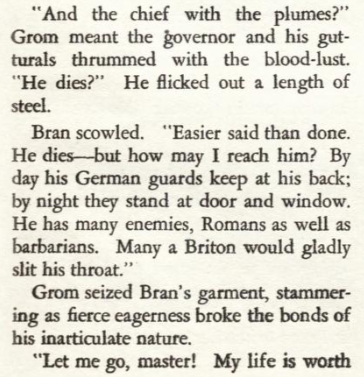
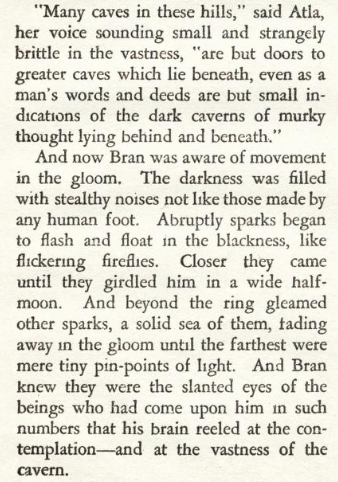
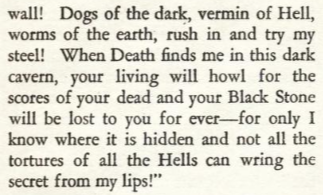
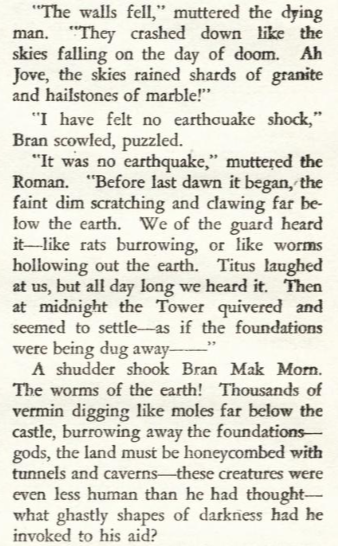
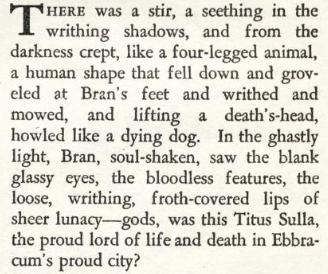
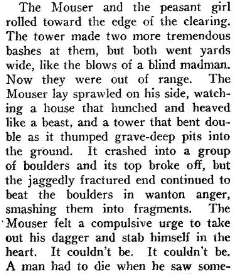
Many names of Great Renown grace the Annals of the Heroic Age of the Pulps, but even in that ancient age of mighty deeds, three names tower above all others with regard to sword and sorcery. Howard we have touched upon twice (and we’ll revisit him soon enough), and we devoted a whole month to the incomparable C.L. Moore, so I reckon it’s high time we hit the final member of the classical sword and sorcery trinity! That’s right, we’re finally going to encounter Fritz Leiber’s foundational duo, Fafhrd and the Gray Mouser in their very first published story, “Two Sought Adventure,” from the August 1939 issue of Unknown!

Of course, we’ve already talked about ol’ Fritz, but that was in regards to his weird fiction story “The Automatic Pistol” from 1940 in Weird Tales, which is good and a lot of fun, you should read it. But undoubtedly Fritz’s greatest creations and most lasting renown come from the Fafhrd and the Gray Mouser stories. Given that, AND the fact that he’s the one who actually coined “Sword and Sorcery” for this the best of all genres, I think it’s appropriate to give him another fanfare and more detailed biographical info this time around.

Leiber is, for my money, one of the best writers of genre fiction from the 40s through the 60s, in many ways a predecessor to the New Wave that would revolutionize science fiction in the 70s. His background and various experiences give his writing a depth and vitality that’s really unparalleled, especially for the time; he was the son of Shakespearean actors (and he himself acted on the stage), he was a fencer and an expert chess player, studied for (but did not get) a graduate degree in Philosophy, studied for but did not become a minister at a seminary, read and wrote for technical encyclopedias as a day job, taught as a drama instructor at Occidental college…I mean, the list pretty well sums up Leiber’s interests and the themes he explored in his writing. He also had a brief but important correspondence with Lovecraft near the end of the Old Gent’s life, and in many of his memoirs/recollections he attributed much of his development as a writer to HPL’s encouragement and advice. He wrote a lot of great stuff; his 1947 collection, “Night’s Black Agents” is simply one of the best short story collections of the era, in addition to having just the coolest fucking title of all time (a line from Macbeth, Leiber again subtly showing off his erudition).

Unfortunately, like a lot of writers in the post-pulp era, Leiber had a hard time of it financially. He lived in some apparently truly squalid apartments in California, and there’s some great anecdotes from the 70s of Harlan Ellison raging about how Leiber was forced to do his writing on a shitty typewriter propped up over the kitchen sink. Actually, it wasn’t until TSR, the company that made Dungeons & Dragons, licensed the rights to Fafhrd and The Gray Mouser that he was able to live somewhat more securely and comfortably. Frankly, and as we’ll see in today’s story, even if they hadn’t made official Leiber products, TSR 100% should have just been sending checks to Leiber (and Wellman and Vance) because a shockingly large amount of fantasy tabletop roleplaying is taken directly from his work.

Leiber wrote in a lot of different genres, although you might be surprised at how few times his work showed up in Weird Tales, despite his association with Lovecraft and horror. Case in point, today’s story was published in Unknown, the short-lived fantasy-focused companion to Astounding Science Fiction created and edited by lil’ Johnny W. Campbell himself. Campbell, as we’ve mentioned before, considered himself an intellectual and so he envisioned a a similarly intellectual fantasy magazine that would compete with Weird Tales. Unknown was therefore less lurid, more realistic (or at least the magic and monsters where supposed to be more internally rational), and generally more literary and sophisticated, even going so far as to allow for humor! That said, apparently Campbell would often tell Leiber that his Fafhrd and the Gray Mouser stories were more like “Weird Tales stories, but…” he would accept them anyway. In fact, no Fafhrd and the Gray Mouser story would ever appear in the pages of Weird Tales, which is kind of interesting.

That’s right, the cover of this issue went to Thelemite and future Founder of Scientology, L. Ron Hubbard. It’s a fairly bland cover, in my opinion, kind of lacking the *punch* you’d see in, say, a Brundage cover from Weird Tales. Very much more main stream looking, in my opinion.

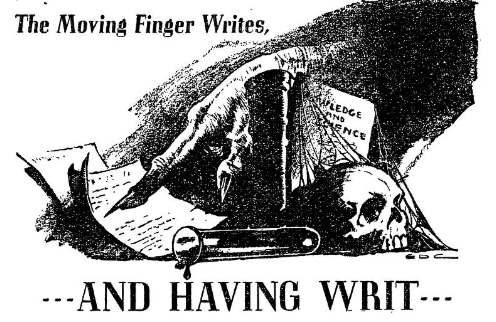
The ToC shows Campbell’s editorial perspective too – fewer stories, but longer. That Hubbard is 90 pages (stretching somewhat the definition of “novel” perhaps, but still…that’s a long ‘un for a magazine)! You’ve got some of Campbell’s heavy hitters here too, del Rey and Kuttner, both important in the pulps and (del Rey as an editor in particular) in the paper back revolution that would come post WWII. Also neat are the two “Readers’ Departments,” integral parts of the participatory fandom that played a huge role in the development of modern genre literature. Unknown had a fun readers’ letters section; taking the title from the famous lines of Omar Khayyam is a very evocative, stylish, and literary thing to do, and the illo is good too:

Very E.C. Comics, isn’t it? But, godammit, let’s get to the story! Fritz Leiber’s first ever published short story AND also the very first adventure of that incomparable duo, Fafhrd and the Gray Mouser!

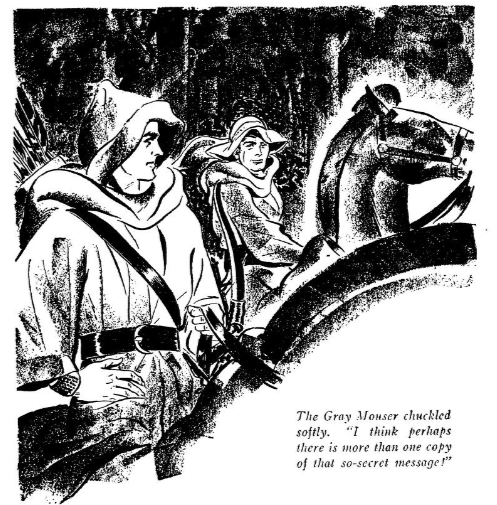
And more comic-book style art, though this time maybe it’s more “Prince Valiant” than “Vault of Horror.” Honestly not really my cup-o-tea, if’n ye ask me…just a fairly bland fantasy scene, though at least Unknown has enough sense NOT to toss in an illustration from the climax of the story right off the bat. Still, I wish the artists had had a little more verve or style or something, especially for such great and visually distinct characters (and situations) that appear here. Oh Well!

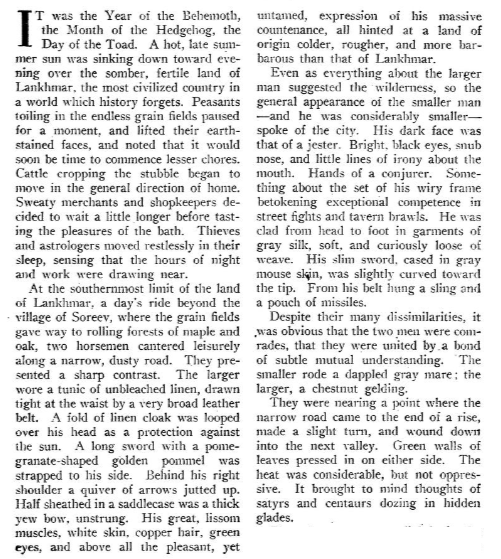
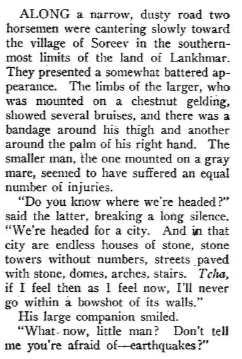
First thing first, I love fantasy calendrics like that…”Year of the Behemoth, Month of the Hedgehog, the Day of the Toad…” it’s just really fun, an easy and striking bit of genre semiotics that immediately shifts the reader into a “fantasy adventure” mode. Leiber keeps ladling on that fantastical flavor with more and more little flourishes, scenes of bucolic yeoman farmers, medieval-esque mercantilism, followed by the promise of a shift-change to astrologers and thieves; it’s great writing that sets a specific scene AS WELL AS positioning the whole of the story within a certain genre-space. And then it’s followed by a couple of paragraphs that introduce the main characters.

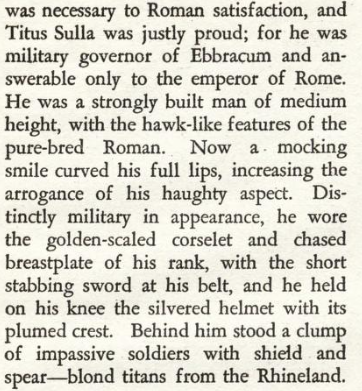
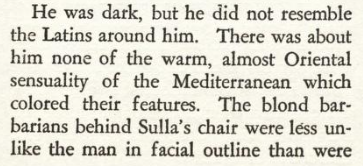
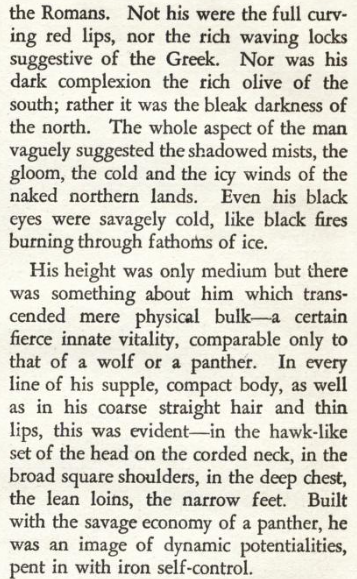
The tall northern barbarian is, of course, Fafhrd, while the small dark man is The Gray Mouser. As far as introductions go, these can’t be beat. Their gear, their appearance, their movements, everything is in service of explaining and presenting their characteristics – Fafhrd is a bluff and forthright barbarian in rough linen, bearing a sword and bow, and with a hint of wildness to him, while The Mouser is sneaky, clever, sharp, and secretive. It’s frankly just a perfect intro, efficient and effective.

Of course, we haven’t actually learned their names yet, although that’s not too far off in this story. Still, they’re very well developed and, for the most part, fully formed, the same characters that we’ll meet in their future adventures – this is due to the fact that Leiber, with his friend Harry Fischer (who actually created and named Fafhrd and the Gray Mouser, basing them off of Leiber and himself) had been exploring the two and their world for several years already. Leiber in fact had already written several of their adventures already, and that background had practice has given Leiber a good handle on these two.

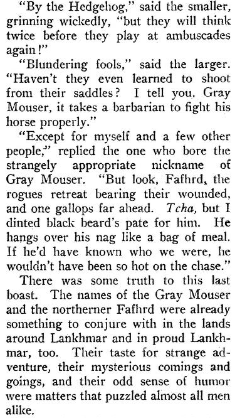
Anyway, as these two are riding along they’re suddenly ambushed! Bows twang, arrows fly, and the pair spur their horses onward, pursued by a band of eight or so well-armed and similarly equipped ruffians. But, unfortunately for the thugs, these two guys are characters in a sword and sorcery story who have JUST been introduced, so they use this convenient ambush to demonstrate their unparalleled skill and toughness.

Fafhrd executes a flawless Parthian shot and the Mouser zings a leaden ball back at their pursuers, striking two riders down and sending the rest scattering. That done, it’s time we got PROPERLY introduced to these two bad-asses:

There’s a cool efficiency to these two that Leiber likes to play with, particularly in their dialog and the way they speak to each other about what’s going on, always commenting on the action and characters around them. Their friendship is really compelling and very lived in and is, honestly, probably pretty familiar to a lot of people; these two are the kind of friends who, confronted with dangers or troubles, tend to minimize all the challenges they face, kidding around and making fun of the “blundering fools” who would dare challenge them, always talking each other up. It’s a great bit, honestly, and helps reinforce the central idea of Fafhrd and the Gray Mouser: they are self-mythologizers that are always confident that they are the main characters in a story. Sometimes this self-awareness comes awfully close to metafictive fourth-wall breaking, but where Hamlet struggles against the role he’s cast in, the Mouser and Fafhrd relish it – they are swashbuckling sword-and-sorcery heroes, the very best possible thing to be, and they’re having a great time (even when they’re not, really).

Having dealt with the ambush, the two realize that this very valley is most likely the one they’ve been searching for. The Mouser unrolls an ancient vellum, and we’re introduced to their quest:

Certainly a taunting tone to Urgaan of Angarngi’s missive, isn’t there? He’s daring treasure-hungry fools to come and face the challenge of his mysterious treasure tower, but that doesn’t daunt these two. Rather, as they ride on, The Mouser reflects on how similarly equipped and armed the ambushers they faced were, suggesting that they might have been Lord Rannarsh’s men. It turns out that the Mouser cut the vellum sheet about the treasure tower out of an ancient book in Rannarsh’s library, and that the Lord, famously avaricious, might’ve taken notice of the theft and sent his boys out to kill them and claim the treasure for himself. Fafhrd scoffs at the idea, which of course means that The Mouser will turn out to be 100% correct.

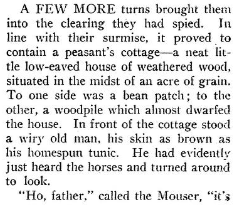
The two adventurers come across a small cottage not far from the stumpy ruins of the tower, meeting a hilariously taciturn old farmer and his large extended family.

I like the farmer, and the later scenes with his whole family are really great, but for now Fafhrd and The Mouser decide to reconnoiter the tower in the fading light. It takes them a strangely long time to reach the tower, which seemed so close, and when they get there they find a skull and shattered bones just inside the treasure house. A strange sensation of foreboding and danger settles over The Mouser.

Very good foreshadowing, I think; the sense that there is very much something unnatural going on in this treasure tower, something watching and waiting and certainly at least a little sorcerous is conveyed well, but we’re still wondering what exactly is going on.

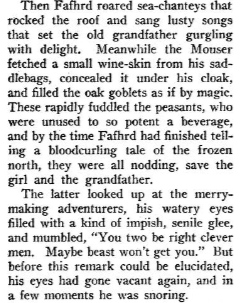
Heading back to the cabin, the two have a great and boisterous evening with the farmer and his family. Mouser does magic tricks, Fafhrd roars his wild sagas, and they get the whole lot of ’em drunk on wine. It’s probably my favorite scene in the whole story, actually, a wonderful little slice of life scene that really evokes the strangeness of these two adventurers showing up out of nowhere and throwing the normal humdrum pattern of these people’s lives pleasantly off kilter. Leiber is of course just as interested in adventures and swordplay and derring-do as Howard, but he’s ALSO interested in the little material things of life that define the world; his stories are steeped in this kind of rich, lived-in detail, with an interest in the way people spend their downtime. In addition to just being flat-out a lot of fun to read, I think it’s also an important development in sword-and-sorcery literature, a real key moment. Here, back in ’39, Leiber is illustrating to people a kind of “fantasy realism” that uses realistic, naturalistic details to deepen and enrich a secondary world setting.

Of course, it also serves a nice narrative function, because the ancient old man, roused by wine and sing, manages to croak out an enigmatical little statement:

“Maybe beast won’t get you” and then he konks out…great stuff! And it’s echoed again the next day when, striking out early in the morning, they’re stopped by the gangly and shy farmer’s daughter, who has a warning for them.

This family of farmers live right next door to a death trap, apparently, and have learned to give the place a wide berth and keep a respectful distance. I really like how Leiber uses the peasants here – again, they have had to live next to this tower. Whatever danger dwells within, they’ve learned how to avoid it, getting on with their own life in the shadow of its threat. It’s only interlopers and outsiders who blunder into the tower who get killed. It’s a fun, subtle inversion of what a fantasy hero armed with cunning and expertise and knowledge and all that.

But of course no warning, no matter how blood-curdling or threatening, would cause Fafhrd and the Gray Mouser to turn aside from a quest. They continue on through the woods, reflecting merrily (and perhaps a bit unconvincingly) on the remarkable imagination of the farmer’s daughter. Then they meet a very material threat: the men who had ambushed them yesterday have regrouped and reformed at the tower. It’s obvious that they know about the treasures rumored to kept in there, since they’ve also brought shovels and picks.

There’s a long (and good!) scene of sneaking and combat, with Fafhrd and The Mouser getting the drop on these guys. Now, I find the “Fantasy Combat Discourse” generally pretty boring, but I DO like the way Leiber does his fights. To be fair, if you’re one of those HEMA nerds who pours over fechtbücher and owns a broadsword, you’re going to be annoyed with Leiber; he’s a fencer, apparently a very good one, and so the way his heroes fight is very much informed by that. In particular, Fafhrd tends to wield his enormous sword a lot like a rapier, something that might strike some as silly. Deal with it, though, is all I can say, because the combat in this section is fun, and also better than any swordplay that Howard wrote – Conan might hew his way through twenty dudes, but Fafhrd is having to be realistically careful fighting two guys who have him flanked. There’s a sharper sense of danger, is what I’m getting at, probably because Leiber at least has a sense from actual fencing practice about the ways someone can get overextended or leave themselves vulnerable. Makes his fighting descriptions that much scrappier, I think.

A certain red-haired fellow among the ambushers confirms what The Mouser had suspected: these were Rannarsh’s men, and the venal lord had certainly hoped to get the fabled gems himself. Following the battle, there’s a great bit of Fafhrd barbarism – the combat over, becomes first almost hysterically hilarious, and then deeply, almost ridiculously, solemn about a man he’d just killed.

This is contrasted with The Mouser’s own reaction – he may be feeling a little sick and anxious now, but he knows that the force of the combat won’t come on him for some time. It’s another of these Leiber flourishes, a deep and abiding interest in the interiority of his characters and the often very different ways people can react to or experience extreme things. It is simultaneously taking a part in and commenting on the Howardian tropes of sword-and-sorcery, in particular the way Fafhrd’s barbarism is being contrasted with The Mouser’s more urbane reaction.

Entering the tower, The Mouser is relieved that he no longer feels the dread that had oppressed him the night before. They explore the first chamber of the tower, and run across more smashed skeletons – it seems like something indeed has been pulverizing interlopers here, although it may have been a very long time ago. Interestingly, however, the two find a scroll case on one of the corpses that includes a note very similar to their own!

This note, along with the many other skeletons strewn about Urgaan’s treasure house, reveal the truth: the dude has made some kind of death trap, and is luring people here with tales of unbelievable treasures.

Undeterred, the two advance up the stairs, determined to search out discover the treasure. As they reach the top of the stairs, steel glitters in the dark as a knife is hurled from a doorway, nicking the Mouser in the shoulder! Enraged, he darts into the room, sword drawn, and discovers Lord Rannarsh hiding there.

Unmanned by fear, Rannarsh seems only to be interested in escaping, even abandoning all claims to the treasure. However, confronted by his hated enemies, he masters himself enough to try a second dagger, which earns him a skewering at the hands of The Gray Mouser. Following his death, Fafhrd muses on how Rannarsh seemed to be seeking death, which The Mouser says was simply because he had appeared weak and afraid in front of witnesses. It’s another trademark of this duo, always willing to believe that others are as awed of them as they are of themselves, conveniently ignoring all other contradicting information, like when Rannash refered to a “thing” that had been playing “cat and mouse” with him. But, just as The Mouser makes this pronouncement, a sudden and horrific pall of fear falls upon them!

Having failed their saving throw vs fear, the two of them are frozen to the spot, listening to the steady footfall of someone approaching through the tower, up the stairs, and coming towards them. Eventually, a new NPC is introduced, an ancient looking holy man who looks grimly over the room before greeting them.

This man is Arvlan, a direct descendant of Urgaan, here to destroy the horror that his ancestor has left behind. Not letting them speak, Arvlan explains his purpose and history, and then sweeps out of the room on his holy mission.

Arvlan, we hardly knew ye! But, interestingly, once Arvlan gets mashed offscreen, the paralyzing fear that had held the two of them in thrall lifts, and they’re able to move again. Swords out, they rush into the room and see the red ruin left behind of the holy man, crushed and splattered in the middle of the room. But their attention is soon drawn away from the corpse and towards a stone marked with the words “Here rests the treasure of Urgaan of Angarngi.”

The two of them set to work, using pick, mattock, and pry-bar to begin their excavations. Weirdly, they quickly encounter some kind of strange, tarry substance in among the masonry, though not even that gives them pause; they keep gauging away, eventually exposing enough of raw stone that they can get their pry-bar in and wiggle it around, loosening and gouging alternatively. As they keep at the work, though, a new strange feeling of revulsion comes over The Mouser, a sensation clearly related to this dark, foul smelling glop that they’re working on. Nauseated, he goes to a window for a breath of fresh air, and sees down below them the farmer’s daughter. The young girl is clearly trying to screw her courage to the sticking place to come in and warn them of their danger.

A kind of mania descends on everyone now – The Mouser has seen something in the ceiling, but he can’t articulate it even to himself, and instead lurches sick and fearful out of the room, focused only on keeping the girl from entering the tower. Meanwhile, Fafhrd seems possessed, blind and deaf to everything else expect the stone that hides the treasure. Like the weird fear aura the place had earlier, it seems like the tower is projecting some kind of weird psychic effect, and everyone is mostly powerless to resist it. As the Mouser reaches the bottom of the stairs, his muddled mind steadies itself enough to realize that what he’d seen on the ceiling was a corresponding smear of gore, the counterpart to the blood on the floor. What could it mean!? And why is the tower suddenly vibrating!?
Meanwhile, Fafhrd has finally cracked into the treasure chest!

In the moment, this is all extremely strange and weird and not entirely clear. A weird basin full of dark celestial mercury, upon which floats a weird tangle of glittering geometric shapes, including the huge diamond promised in Urgaan’s message. Everything sparkles with a strange inner light, and Fafhrd weirdly seems to sense that he’s gripping a piece of a thinking mind in his hand as he grabs for the diamond. Meanwhile, the tower is beginning to twist and undulate; The Mouser thinks at first it is toppling, but he realizes there’re no fissures or breaks…rather, it’s like it’s wiggling or bending! Back in the treasure chamber, the weird gems start jittering in the black mercury, and Fafhrd is having a hard time holding on to the skull-sized diamond in his hand. Doors and windows begin to clamp shut, closing like a sphincter, and Fafhrd realizes that the room itself is changing shape.

The Mouser reaches the girl, and they dive for safety beyond the clearing outside of the tower, while Fafhrd confronts the realization that, basically, he’s inside an insane robot.

The diamond, strangely mobile and very hostile, flings itself at Fafhrd’s own skull as he tries to escape, eventually exploding into a cloud of sparkling dust. At that, the tower begins its death throes, with Fafhrd only just escaping before the door slams hut.

There’s a break in the story, resuming after some time has passed.

And that’s the end of the story!

It’s a pretty strange one, isn’t it? I think it’s true to Leiber’s own proclivities, but you can see the Campbellian “rationality” in the tower/robot. Urgaan’s tower is not merely magical; it’s some kind of weird magical technology, complete with what is obviously a kind of high-tech gem-based brain. Presumably, Urgaan has built this conscious robotower as some kind of horrible death trap – lured in, the computer then smooshes all interlopers, it’s weird stone body lubricated by that odd tarry goop. It’s a fun and fully bonkers idea, although it’s not too wildly different from Howard’s magic, which is often more occulto-scientific that pure magic. Why Urgaan would do that is left mysterious, which is actually kind of fun – people can be real assholes, and if you’re some kind of ancient technomancer then maybe that’s the sort of the thing you’d do!

You can also really see the influence Leiber had on Dungeons and Dragons in this story, too. It’s almost exactly the kind of thing Gary Gygax would write, right down to the dungeon built around a weirdly complex and almost certainly fatal death trap. But even beyond the setting and the trappings of the dungeon, I think you get a sense that Gygax et al. ALSO certainly styled their adventurers after Fafhrd and the Gray Mouser.

And it’s the characters of Fafhrd and the Gray Mouser that are so important and foundational to the genre, in my opinion. Even Conan at his most avaricious (say, in “The Jewels of Ghwalur”) ends up shifting gears, exploring a mystery, saving a girl, and engaging in heroics, whereas Fafhrd and The Gray Mouser are almost single-mindedly focused on this tower, ignoring countless warnings and obvious signs that something is amiss. That stubbornness and single-minded selfishness is key to their motivation and characters, and Leiber is really the first writer of the genre to really explore that aspect of sword-and-sorcery. Even though they envision themselves as heroes, any actual heroism that they end up doing is often in spite of themselves. It’s often funny, although only rarely does Leiber play that purely for laughs; rather, their self-importance and unassailable confidence gives them the boost they need to persevere in the face of insane odds. Mostly, Leiber is interested in the way these characters, who clearly see themselves in a certain light, are actually a little more complicated and gray than we might expect. Particularly in the post-Howard world, most of the sword and sorcery heroes are painfully noble barbarians; guys like Elak of Atlantis are even Kings who (despite renouncing a throne) always carry with them a sense of portentousness and destiny. Fafhrd and the Gray Mouser are different, wanderers and adventurers and thieves, just a couple of scrappy normal dudes who are going to carve their destiny and wealth out of the carcass of the world. Fafhrd and The Gray Mouser are an interesting counterpart to Conan and Jirel, and represent a key part of the evolution of the genre.

Sword & Sorcery & Straining #17! “The Tower of the Elephant” by Robert E. Howard, Weird Tales, March 1933, v. 13, n. 6

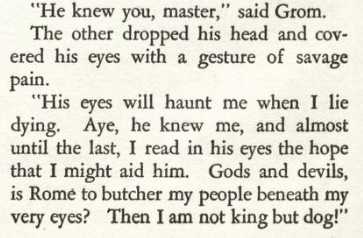
Like a true Barbarian Hero I am currently adventuring in distant lands, having braved the cursed tomb of Newark Airport to arrive in the bleak, windswept hills of Pennsylvania, where death and danger lurk in the shadows of every tree, mountain, and Wawa. But that doesn’t mean an end to my long-as-hell ramblings, no, far from it indeed! For hark! Another edition of Pulp Strainer (Sword & Sorcery Edition) is upon us, and we’re continuing our REH lovefest with probably my favorite Conan story of all time: The Tower of the Elephant from the March 1933 issue of Weird Tales!

“The Tower of the Elephant” is an interesting story because, aside from being rad as hell, it was also the first Conan story where he’s an adventurer, wandering through civilized lands in search of fortune and excitement. The previous two stories published in Weird Tales, “The Phoenix and the Sword” (Dec ’32) and and “The Scarlet Citadel” (Jan ’33) both take place when Conan is wearing the crown of Aquilonia upon his troubled brow (my least favorite phase of Conan’s chronology, personally). Interestingly, the first tranche of three stories that REH submitted to Weird Tales included “The Frost Giant’s Daughter” which had Conan as a young wanderer up among the viking-flavored berserkers of Hyboria; it was rejected by Farnsworth Wright, however, and wouldn’t be published until the 70s, if I recall correctly. “The Phoenix and the Sword” story is a reworking of an unsubmitted Kull story anyway, swapping out Kull for Conan and expanding the evil sorcerer Thoth-Amon a bit, but still it’s mostly concerned with Conan’s tenuous hold on the throne as a barbarian usurper. “Scarlet Citadel” is a similar (but better) story, this time with King Conan betrayed and imprisoned (in a legitimately cool-as-hell dungeon full of awesome monsters) while his kingdom totters.

Both are fun and all, and they certainly have good sword-and-sorcery action, but for my money Conan is at his most interesting when he’s just a rogue and a reaver, a barbarian wandering among “civilized” people, relying on his wits and his strength to survive. According to some histories I’ve read, following the positive response to the first two Conan stories, Wright encouraged Howard to work up an essay on the world of “Hyboria” that he’d created and glancingly mentioned; the result of that work would be important for Howard, who got interested in exploring more of these lands in greater detail, leading him to write “The Tower of the Elephant,” a very different sort of Conan story from those he’d written previously.

But, as always, before we can get into that let’s take a look at the cover! And damn if it ain’t a spicy one this time!

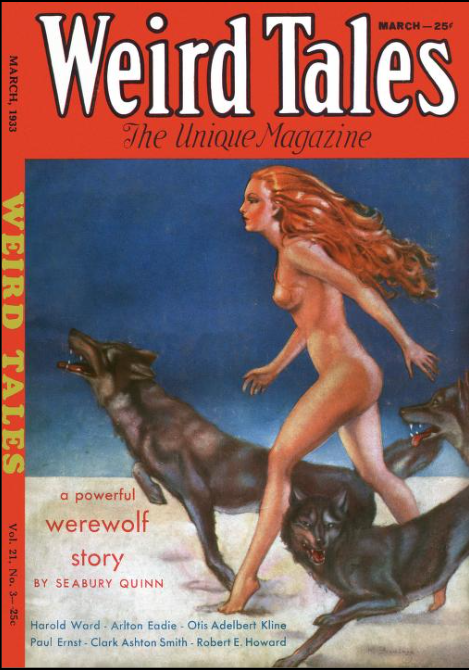
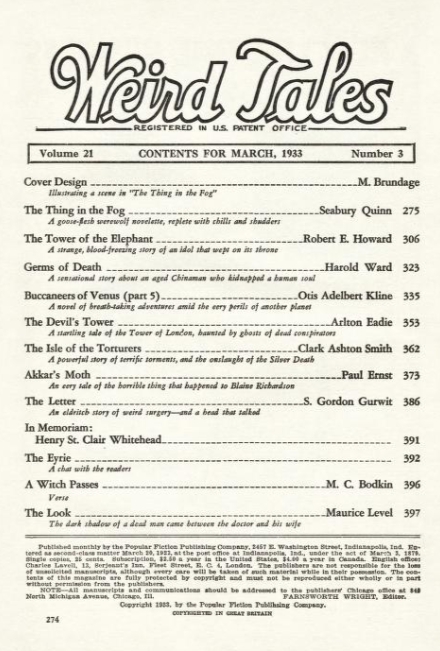
That’s a Brundage, of course, still obscuring her gender behind the semi-pseudonym of “M. Brundage.” Just a straight-up buck-ass naked lady hanging out her wolf pack, what’s it to ya buddy, huh? You some kinda prude or something!? The story is a perfectly serviceable Jules de Grandin adventure from ol’ Quinn, this time with some interesting werewolfery thrown in. As for the ToC, there’s some interesting stuff here too:
Kline, Smith and Ernst here too, all solid fellows, but the interesting thing here (besides from our Conan story) is the “In Memoriam” for Henry Whitehead. Whitehead is an interesting guy, an Episcopalian minister who lived and worked for most of his life in the Virgin Islands (specially St. Croix) and used that setting and island folklore for his weird fiction. He was a good friend of Lovecraft, who actually visited Whitehead in Florida after he’d retired and spent several weeks with him and his family; it’s actually HPL who wrote the “In Memoriam” here, and the affection he felt for his friend is evident, I think. Whitehead is also interesting from a horror perspective because he’s basically the guy who introduced a lot of what would become the dominant pop cultural understanding of “Voodoo” into weird literature. An interesting and important figure, though little known these days.

But enough of that, there’re Towers to be scaled, Threats to be overcome, and Fabled Gems to be plundered! Let’s get into it!

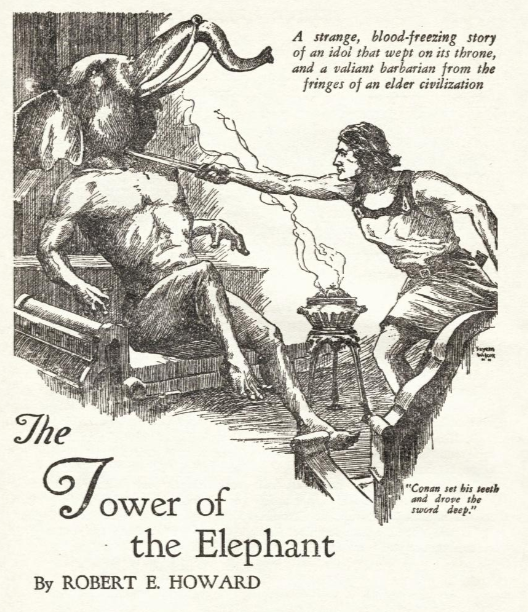
A neat title illustration to this one, by ol’ Jayem Wilcox again. As is usual in Weird Tales, this illustration is based on a scene near the climax of story; it’s a bad habit of theirs and has in the past given away too much of the story, but here it’s okay since the way the story unfolds is a bit more complex than what is shown here. But, regardless, it’s fun to see the way the artists were envisioning Conan at a time when the visual iconography hadn’t been invented yet for sword and sorcery; we’re so used to Frank Frazetta’s iconic paintings from the 70s that these early Conans can be a bit jarring. They always remind me of Douglas Fairbanks, more like a dashingly handsome swashbuckler than the dark and brooding barbarian we’re used to. In particular, the vaguely Celto-roman tunic thing is an interesting touch, especially since Conan is explicitly described as being stripped to the loin cloth for much of this story.

Like I mentioned up top, REH wrote this story hot on the heels of a personal history/geography of his secondary world, something that really comes through in the beginning of this story, I think:

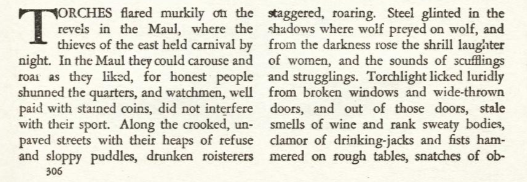
I mean, c’mon; that’s just some incredible sword-n-sorc stuff, right? A thieves’ quarter called The Maul where all the rough bastards and real assholes like to party, a real grim and grimy scene; the sensory language is so rich here, and the combination of visual (torches flaring, steel glinting), auditory (roaring thieves, shrill laughter, scufflings and strugglings, fists-hammering), tactile (sloppy puddles), and especially olfactory (heaped refuse, stale wine and “rank sweaty bodies”) descriptors perfectly evoke a rough neighborhood on a Saturday night in a fantasy city. And all in a single introductory paragraph! There’s a danger of reading REH and thinking he’s cliche, but that’s simply because he invented the things that would later become cliche in the hands of lesser writers, but even so, I think everyone can appreciate the sweep and power of his writing. This is simply good sword and sorcery writing.

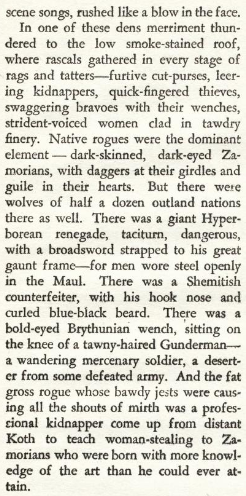
The second paragraph seems born from the supplementary writing that REH had been doing. He’s obviously been thinking a lot about the geography and history of his secondary world, inspired by Farnsworth Wright to elaborate and develop some coherency for his fantasy setting. Now Howard never got into the depths of codification than Tolkien did; that’s a good thing in my opinion, since he had neither the expertise nor the time that Tolkien did to do a job of that size. Also, honestly, I think Howard’s rough-sketch or thumbnailed approach is actually much richer and more productive than the strict and set-in-stone “series bible” that a lot of later fantasy writers use. I mean, Howard apparently never even made a map until some fans wrote and asked for one, and I think that kind of hazy uncertainty, in addition to having much more verisimilitude, also gives a lot more freedom to the writer. Howard could slap Conan into a high seas galleons-and-pirates adventure one story and then drop him into a ziggurat full of demon-worshipers the next, and that’s important to the freshness of a series of short stories helmed by the same character. Maybe a novel requires more secondary world discipline, although if so I’d say that’s yet another point in favor of my “short story is the superior prose format” argument.

The other thing that strikes you immediately in that second paragraph is the very obvious racial/ethnonationalist reductionism that Howard uses. The Zamorans are all dark and guileful, there’s a very uncomfortably described Shemitish counterfiter, there’re tawny-headed Gundermen, etc. It is important to acknowledge that Howard was 100% a dyed-in-the-wool and absolutely committed racist, and that it played a huge part in his writing and his world view. A lot has been made of Howard’s love of the barbarian and his belief, quite sincerely, that civilization was largely an accidental configuration of society, fragile and unstable and always temporary, and that the natural state of humanity was the noble savage. Civilization poisons the individual, makes them soft and sneaky and duplicitous and decadent, and part of that decadence for Howard is the mingling of races, both socially and, horror of horrors for a white southerner like him, reproductively.

Equally important for Howard is his belief in a Spencerian hierarchy of the races, meaning that all barbarians are not created equally. The Cimmerians, Conan’s people, represent the highest and best of the barbarians – white, rough, hardy, savage but with an inborn sense of fair-play and nobility about them. Next down the hierarchy for Howard are the Picts who, in the Conan stories, are basically an early 20th century pop cultural expression of the Native Americans, almost as good as a white barbarian but given over to superstition and cruelty. It is notable that Howard never introduced a black barbarian, and even in the stories where Conan is running around the fantastical precursor of modern Africa, the northern barbarian’s woodcraft, survival skills, and martial prowess always trump the natives, even in the depths of their own home territories. As an aside, let me pause here to plug the late Charles Saunder’s “Imaro” and “Dossouye” series of books, truly great sword-and-sorcery by a black writer who loved the genre and also thought deeply and insightfully about its history, politics, and shortcomings.

But it’s important to recognize that this racism is a big part of Howard’s writing, and it will not be going away – it is integral to how he envisions the world and creates his stories, even more so than in the works of his friend and fellow racist, Lovecraft. And here, where Howard has begun to really think about the world of Conan, those beliefs and prejudices are getting baked into Hyboria.

But anyway, let us continue. Our synoptic view of The Maul narrows down to a specific corner of a specific bar, where a Kothic slaver is giggling sloppily about the Brythunian girl he’s going to kidnap and sell into sexual slavery in Ophir – grim stuff!

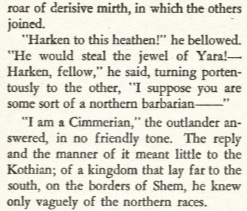
And it is this mention of the Elephant Tower that causes the ears of a tall barbarian youth to perk up…

That’s our boy for sure, but this is a much different Conan than the readers’ of Weird Tales were used to. The previous stories had centered on Conan the King, a middle aged, experienced, and supremely confident ruler and warrior king. This is a youth, seemingly fresh from Cimmeria and perhaps experiencing for the first time the decadent and dangerous cities of the south. I think this is also the only time Conan is described as having an accent, a signifier of both his inexperience and his barbaric foreignness.

ALSO I might as well point out here the loving and expressive attention paid to Conan’s body, a hallmark of Howard’s sword-and-sorcery in particular. Howard’s interest in masculinity and the body is clear in all his work, but with Conan in particular it’s an important part of the stories. For one thing, diegetically it’s the key to how he makes his living; Conan as warrior, thief, and survivor relies on his body above all else, and its stamina, its strength, and its smooth and powerful functioning are all central to his adventures. Secondly, it’s a signifier of his barbarity; his body is hard and lean and disciplined from his life and background; his strength is inherent and native to his body, which is very different from the civilized people in the stories, who are either soft and weak from easy living or who, it is implied, must train and work and practice to attain physical fitness in spite of their surroundings. This is a key difference, because again, for Conan, his strength, his muscular coordination, and his reflexes are all natural, honed from the life-or-death struggle that is a barbarian’s lot. No amount of training or expertise or practice can ever match it, because even the most diligent body-builder or swordsman or thief is, at core, artificially attempting to mimic what is pure and natural to the barbarian. Finally, it’s worth pointing out the homoeroticism inherent here. I’ve never done it, but an analysis of Howard’s use of superlatives and adjectives to describe specific characters would be extremely telling; even in stories with women characters, dollars to donuts Howard lavishes at least twice as much ink on Conan’s broad hairy chest and mighty thews as on heaving bosoms and curvaceous hips. I’m not saying Howard was gay, but I am saying that it is clear from the stories that what he is interested in is masculinity, pure and simple, it’s perceived strength and ruggedness and the way it’s expressed in the idealized masculine form.

Lotta damn theorizin’ and philosphizin’ there, sorry! Let’s get back to the damn story!

This young barbarian, still unintroduced formally, has heard this the man’s strange statement, and wants to know what is the secret of the Elephant Tower? The Kothic slaver, well in his cups and enjoying the role of an in-the-know city slicker, decides to set this rube from the sticks straight.

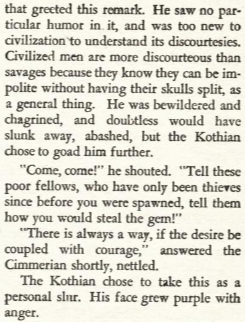
Heedless of his danger, our Kothic drunkard gets on his high horse and deigns to explain to this Cimmerian hick that Zamora is the City of Thieves, and if someone could have stolen the Heart of the Elephant then it would already have been done. But Yara the Priest, whose magic is unparalleled, guards his prize with both steel and dangerous sorcery. But what of climbing the tower and coming in from above, asks the Cimmerian?

The threat of a fight sends the crowd surging backwards, and the single candle illuminating the scene is snuffed out. Chaos erupts, there’s shouting and screaming and a single strident yell…and when the candle is relit the barbarian is gone and the Kothic slaver lies dead, ripped open by a sword stroke unerringly delivered in the dark.

I’ve spent a LOT of time on this first section because I think it warrants it. First of all, it’s just great, thrilling stuff, full of flavor and rich descriptions that really capture the scene; it’s very visceral and exciting! But also, I think this is a key moment in sword and sorcery’s history. Remember, the previous Conan stories have been set later in his life, as a King, and while there’s some great blood-and-thunder stuff there for sure, it’s here in this opening section of the Tower of the Elephant that we are introduced to the very first Barbarian Hero in the whole of the genre, and the way it’s done is so important and impactful on what would come later that it warrants some attention.

The good stuff continues in the next section, where Conan is striding towards to the temple district and the Tower of the Elephant, reflecting on his time among civilized people. It’s pure undiluted barbarian hero backstory, and it’s great:

In particular, that last line summing up barbarian theology is basically a primer on both Howard’s view of the world as well as sword and sorcery as a genre – it’s all about a character alone and armed only with their courage and willpower taking on the world!

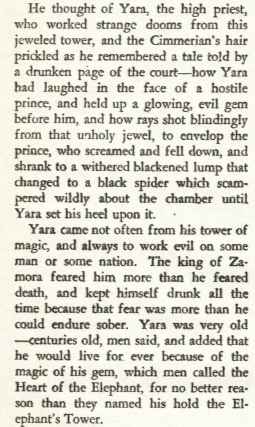
Conan (or, rather, the Cimmerian, because he hasn’t YET been named in this story) arrives at the Tower of the Elephant, a silvery spire with glassy outer walls and rimmed with gems that dominates the Zamoran skyline. It’s from here that Yara the Priest dwells and performs his strange magical rites.

Just fantastic evil magic stuff, really hammering home how this weird and mysterious force is quintessentially and elementally is opposed to the clean and natural strength of a barbarian. It’s also fun to see the inexplicableness of the tower AND gem’s names…they’re just named after Elephants, for some reason, and no one knows or remembers why. While Conan is musing on all this, he suddenly hears a noise from beyond the outer – the sound of someone tromping by. A guard, Conan thinks, but instead of hearing him come by again on his patrol, all is silent within.

Succumbing to his curiosity (and avarice), Conan clambers easily over the wall and drops down into the first of the inner rings surrounding the Tower. This one is wide and mostly open, with only some shrubberies near the far inner wall. Gliding pantherishly, Conan makes his way towards that inner wall, when he stumbles across the dead body of solider who has been strangled from behind. Somewhat unnerved by the uncanniness of the murder, Conan continues forward cautiously, his sword drawn and his senses alert. He spies a strange bulk near the wall, a shadowy figure who, somehow (and perhaps for the only time in any of these stories) actually hears Conan’s stealthy approach. The shape whirls around, resolving itself into a big-bellied but strangely lithe man!

There, finally, is Conan’s name. And we’re introduced to one of the first in a long-line of important and entertaining side characters in a Conan story. In this one its Taurus of Nemedia, the Prince of Thieves, but it could just as well be Balthus from “Beyond the Black River” or “Murilo” from “Rogues in the House.” Actually, it’s kind of interesting, but the very best Conan stories generally have a strong secondary character; Conan doesn’t have a lot of interiority, honestly, so it’s useful to have another POV that lets the reader see both Conan and how he fits into the world at the same time. Also, mechanically, it’s handy to have someone who can throw out exposition or explanations, which Taurus of Nemedia does here.

He quickly explains that Yara’s defenses rely on what lies beyond the inner wall, in the second garden. The human guards, like the man he killed, all hunker down for the night behind sealed doors in the lower chambers of the tower, leaving the garden to be defended by deadly, nonhuman sentinels. It’s these that baffled Taurus for so long, but he’s figured out some kind of scheme or plan for taking care of them. Once they’re neutralized, they’ll climb the tower, enter through the roof, murder Yara and take his Gem. Easy peasy!

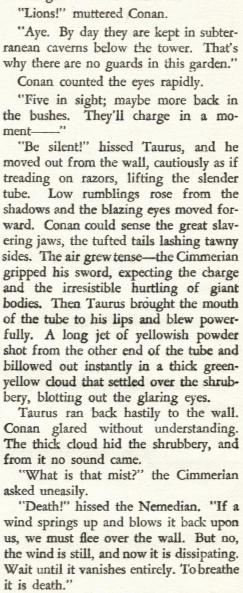
Conan and his new best friend hop the wall and land in a lush inner garden. Conan prepares to stride forward, but Taurus, tense and on edge, pushes him back and tells him that, as he values his life, he must stay behind him. They wait; everything is silent at first, and then there’s movement in the bushes and among the trees, and terrible blazing eyes suddenly glare out at them from the foliage!

It turns out Taurus had a tube full of black lotus powder, a horrifically toxic substance that kills with the merest whiff. As an aside, Howard’s reliance on lotuses in these stories is really one of my favorite things. The black lotus shows up a lot, as does a white and (I think) a yellow lotus, all with strange and mysterious powers and properties. It’s a lot of fun, and puts Howard in a lineage with Homer and the Odyssey, as far as strange botanicals go.

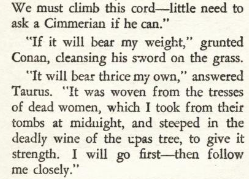
Conan gets to display his prowess by killing one more lion with his sword, and then he and Taurus get to the tower itself, a metallic mass with smooth, glassy sides, seemingly unclimbable. But the wily Prince of Thieves has a solution to this problem, too!

Sometimes it seems like sword and sorcery is as much a genre about climbing as anything else – it’s such a common way to demonstrate the hero’s prowess, strength, courage, tenacity, AND their connection to wild landscapes and untamed nature. Of course a Cimmerian can climb like a cat, they live in a rocky, hilly landscape of towering precipices and foreboding cliffs! Taurus and Conan get to the tower, and that’s when Taurus gets a little tricksy. He tells Conan to go to the edge of the tower and check to see if the guards are alert. Conan is no dummy and thinks its an odd request, but he complies, and while he does Taurus slips in through the door, leaving his buddy behind. I guess he’s decided that he doesn’t want to share the spoils with Conan, but it doesn’t work out so well for our Nemedian Prince of Thieves:

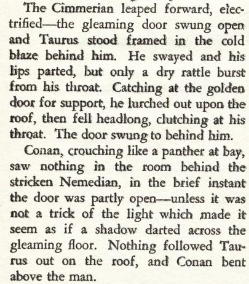
With a gurgle and a dumb look on his face, poor ol’ Taurus dies, apparently without even knowing what it was that had killed him! Examining his late compatriot’s body, Conan discovers a wound on the base of Taurus’s neck, like three nails that had been driven in and then pulled out. Already the edges of these marks are turning black, and there’s a faint smell of putrefaction. Cautiously Conan prods the door open, and inside the chamber he sees a bunch of fainting couches and several chests full of glittering gems. Already he’s found more wealth than he could’ve imagined existed in all the world! But, while he’s contemplating it, the guardian of the chamber attacks!

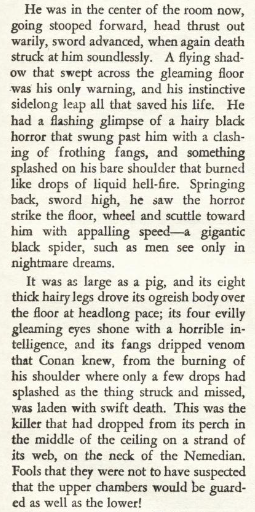
It’s a good ol’ fashioned giant spider fight, an encounter appropriate for one level 3-5 barbarian! Again, a little cliched now, but remember, Howard was writing this stuff in 1933! Give him a break! Besides, it’s a fun fight – the spider is super nimble, and it’s fun to think of it swinging through the chamber, trying sink its venomous fangs into Conan. When that doesn’t work, the spider then starts darting all around, roping off the chamber with thick cords of rough, sticky webbing that threatens to trap Conan. Finally, unable to come to grips with the monster using his sword, Conan lifts a huge chest full of gems and splatters the big crawlie with it. It’s neat!

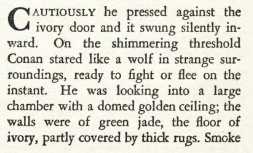
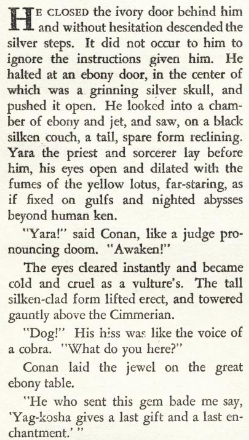
Conan is nothing if not dogged, and despite the fact that he’s twice now encountered a king’s ransom in gems just lying around, he’s committed to finding the Heart of the Elephant. After all, if Yara was willing to just leave chests of gems sitting around in his rumpus room, imagine what the Heart must be like! So on he goes, venturing through the door and deeper into the silent, uncanny tower. Eventually he finds a huge ivory door with strange markings on it. He enters, and sees something truly strange:

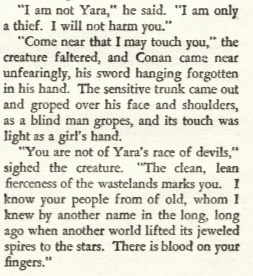
An elephant headed horror sits enthroned in this strange chamber, and its no mere idol…it’s a living thing! Conan is horrified, struck dumb and seemingly paralyzed by what can only be an elder demon of the old world. But then, Conan notices that the great amber eyes stare out blankly, and the trunk of the thing grope forward…the monster on the throne is blind. And then, it speaks with an unearthly voice!

It’s both a surprising reveal and an honestly moving bit of writing; Conan’s realization that this thing which he had been so horrified at has been made to suffer, has in fact been tortured, moves him to both deep pity and profound shame.

Possessed of senses beyond humankind, the elephant-heading thing senses that Conan has killed this evening, up to and including the man in the tavern. And it also knows that a man lies died above at the top of the tower. These two deaths seem to have some occult significance for the thing, who begins to share its story with Conan, explaining that he and others like him had come from a weird green planet called Yag, rebels against their king there. Seeking refuge on earth their wings withered and so they came to live in the primordial world, warring against the prehuman monsters that dwelt there. They conquered, and watched humans rise from ape-dom to the kingdoms of Valusia and Atlantis, and they saw the cataclysm that swallowed those ancient lands and gave rise to the world of Conan and his people. One by one his people died throughout the long ages, until only he, Yag-Kosha, was left, worshipped as a god far in the east. But it was there that Yara found him and, feigned to be his acolyte, learned magic from Yag-Kosha. But, like all evil wizards, he wanted to know Dark Sorcery, which Yag-Kosha would not teach him. Using forbidden magic he’d learned in Stygia, Yara was able to trap and enslave Yag-Kosha, forcing him to use his magic to fulfill Yara’s every whim.

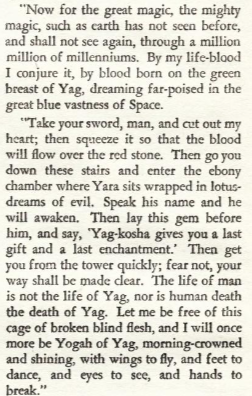
Conan takes up the gem, a great clear crimson crystal, the Heart of the Elephant. Yag-Kosha has a plan, and Conan is now a part of it.

It’s really good, and Yag-Kosha’s story and in particular his speech here is some great, eldritch stuff, truly weird and unearthly and hinting at much stranger stuff. It also nicely demonstrates the importance of weirdness in sword-and-sorcery (which is, of course, a subgenre of the larger genre of weird fiction). Rather than just pure supernaturalism, Yag-Kosha is, basically, a Lovecraftian alien-god, made of different stuff and possessing alien powers, sure, but in a way that’s consistent with a vision of a material (if strange and magical) universe.

Conan complies with Yag-Kosha’s wishes, cutting out its heart and then squeezing the blood onto the gem, where it gets soaked up, like a sponge. As he’s leaving, he senses that there’s something strange and marvelous going on with Yag-Kosha’s remains, but he averts his eyes, not sure whether he could safely witness it.

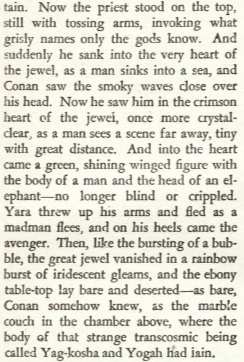
The gem has become murky and pulses with a strange power that seems to draw and trap Yara’s attention. The wizard stoops over and grips the gem, staring into its depths, and Conan realizes with a start that the wizard is shrinking. Soon he is no larger than a child, and its only when he’s baby-sized and standing on the table that the evil sorcerer seems to realize his danger. He drops the gem and tries to flee, but some kind of weird magnetism has trapped him; he can only run in ever tightening circles around the jewel, drawing closer and closer with each circuit. Eventually, big as a mouse, Yara ends up atop the gem, and then his final doom comes upon him:

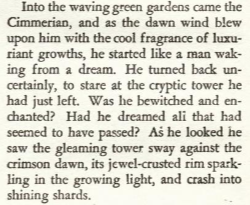
Conan turns and hauls ass out of the tower, running downward through the lower halls, seeing the guard room full of suddenly and mysteriously killed guards. Yag-Kosha had said the way would be made clear for him, and if there’s one thing weird elephant-headed space gods are, it’s honest. Conan finds it all to be a bit too much though, and decides to get out of Dodge:

And, with that crashing apocalyptic collapse, so ends “The Tower of the Elephant.”

It’s really almost the perfect sword-and-sorcery tale, inventive and thrilling and action-packed, but also moody and contemplative and a little sad. There’s real cosmic sorrow in Yag-Kosha, and Conan’s sense of humankind’s collective shame for his imprisonment is particularly poignant; it’s probably the most introspective Conan ever gets, unfortunately. Don’t get me wrong, there’re some truly great Conan stories yet to come, full of great ideas and inventive plots and fun characters, but I really think that this is my favorite of the series. It’s so effortlessly fun (and weird!), and it really lays out what makes for great sword-and-sorcery. It’s been a lot of fun re-reading it and thinking about it, and I hope ya’ll have enjoyed both it AND my ridiculously wordy musings about it too. Anyway, stay tuned, we’re only half-way through Sword and Sorcery month, and I’m thinkin’ I’ll do a fun one for the solstice next week. See ya’ll then!

Straining the Pulp beneath my sandaled feet #16: “Rattle of Bones” by Robert E. Howard, Weird Tales June 1929, V.13 n.6

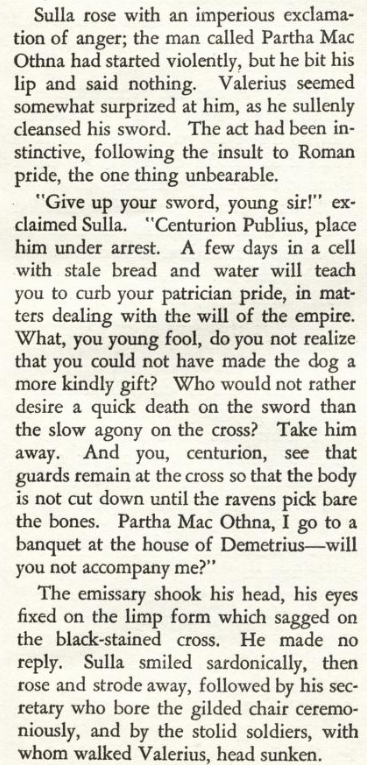
Gathered ’round the red glow of the fire at night, its feeble flame keeping wolves (and worse…) at bay while we discuss the weighty topic of The Pulps, one name looms larger than all others, a name of ancient renown steeped in glory and deep lore: the Man from Cross Plains himself, Robert E. Howard. And while I don’t want to get bogged down JUST talking about him, it is the fact that, in addition to basically creating the genre that Fritz Lieber would later name “Sword and Sorcery,” ol’ REH is also one of its indisputable masters, having written some of the best examples of the genre ever. So, while we ARE going to be eventually talking about OTHER people, there will be at least THREE of these pieces that focus on my fellow Texan, Big Bob Howard. And for today, that story is “Rattle of Bones” from the June 1929 issue of Weird Tales.

That’s right, we’re saving Conan for later and STARTING with Howard’s first indisputably successful series-spanning character, the two-fisted, sword-swinging, berserker-Puritan himself, Solomon Kane! I’ve always liked Kane (shame about the movie though…) and I think he’s an important step in Howard’s career. In addition to being a real recurring character, he also seems to have helped Howard crystalize some of his ideas about what he was interested in as a writer, per say.

But wait, I can hear you saying, didn’t I *just* say last time that sword and sorcery wasn’t created until the Conan story “The Phoenix and The Sword” was published in 1932!? What’s this 1929 story doing here in Sword and Sorcery month!? Read on, O Prince (or Princess, as the case may be)!

Leading up to this issue of Weird Tales, Howard was already an established writer: his first professional story ever was “Spear and Fang” from ’25 in Weird Tales, a lusty, action-packed caveman yarn that was extremely well-received. He wrote some more traditional, gothic-style horror tales, in particular “Wolfshead” in ’26, which was another huge success with the readers of Weird Tales and established him as a talent in Farnsworth Wright’s stable of writers. All of these stories are very much in the vein of Howard’s early horror writing, tortured protagonists struggling manfully against a hostile world full of occult threats, rich in historical (or prehistorical) trappings and settings. Importantly, he has introduced the Picts in “The Lost Race” from 1927; these dark, gnomish figures of a forgotten age who lurk in the twilight on the edge of our world are, for Howard, a synecdoche. They represent all of his literary preoccupations: civilization and barbarism, history drenched landscapes, violence, empire, decadence, atavism, and race. While these previous stories are very much still in the weird fiction tradition, focused on moody reflections of doom-laden fate and ancient knowledge, they are nonetheless grasping towards what would eventually become sword and sorcery, where weird horrors exist to be confronted rather than merely suffered. And Kane, as a brave and violent character that can appear in different stories and different settings over and over again, is an important part of bridging that gap from the early “weird fiction” Howard to the “blood and thunder” Howard that we know and love later.

That’s a long preamble, so we’ll save REH biography talk for later. Now, let’s take a look at this issue of Weird Tales!

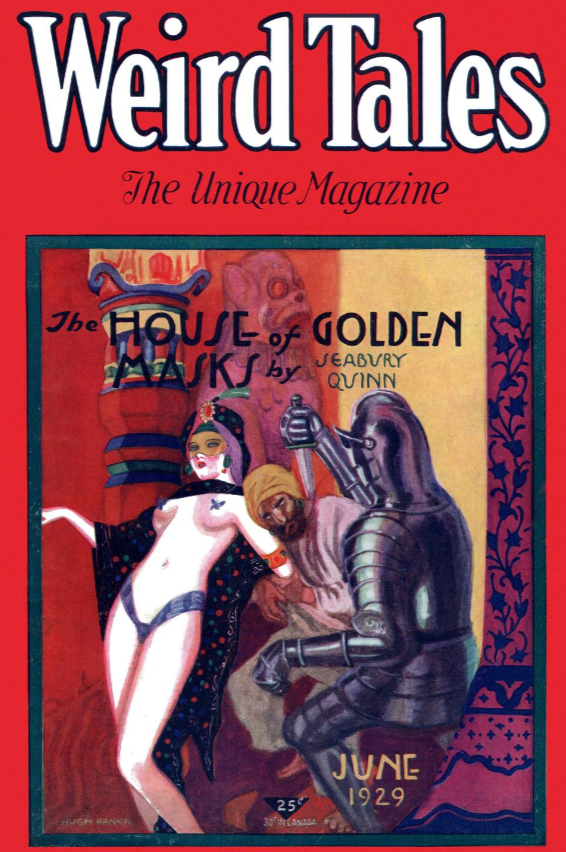
An excellent and very risque cover from Hugh Rankin, illustrating (vaguely) a scene from a Jules de Grandin story by Seabury Quinn. It’s got a great, almost art deco style cover to it, doesn’t it, and the nearly naked woman is particularly stylish and evocative (he said, looking respectfully). Probably way more interesting that the story it’s illustrating, I’m sure – Quinn was a HUGELY popular writer at Weird Tales, surpassing Lovecraft at this point, and his occult detective Jules de Grandin was one of the most popular characters in the magazine. The stories themselves are perfectly fine, but it’s always baffled me HOW bonkers people were for them back then. Changing tastes, I guess. Anyway, the ToC:

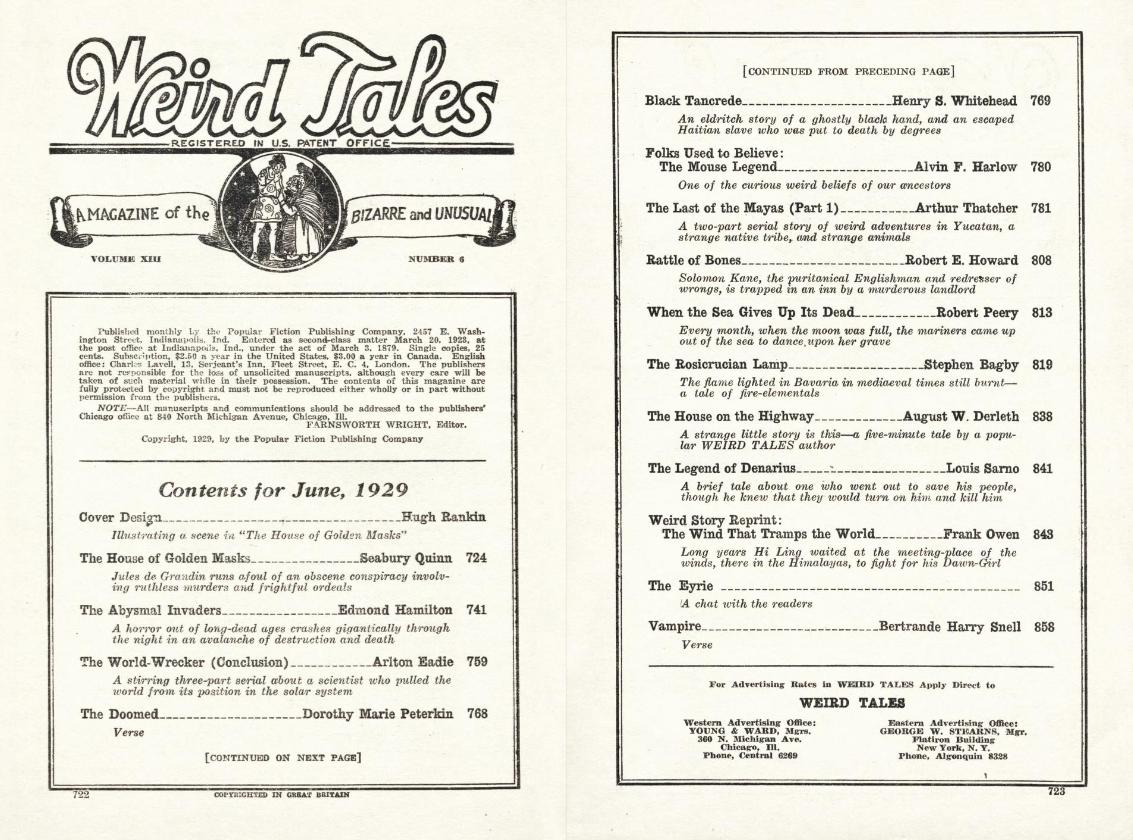
Not TOO much to write home about in this issue – Derleth and Whitehead are very much second-stringers in the Lovecraft Circle, and the big names at the time were definitely Quinn and Hamilton; they’re right up right up front in this issue, with a bullet. Howard is comfortably in the middle of the issue, and Wright took particular care to call out that “Rattle of Bones” is a Solomon Kane story; they’d given Howard’s first Kane story, “Red Shadows,” a cover earlier in 1928, and there’d been a second Kane story earlier in 1929, so they’re working hard to make sure people know that this is a recurring character. So let’s get into it, shall we!

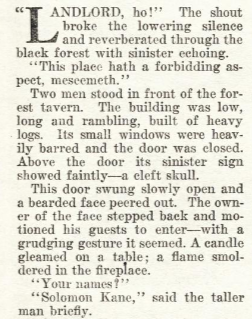
Unique typesetting on the title this time, huh? It spreads across two pages too, but there’s just one word over there on the second page, kind of spaced weirdly. The title font is only used for this story in this issue, which is interesting. Weird Tales was always financially strapped, generally just skating by, so I kind of wonder if they were trying to get some visual interest on the cheap here? But, that’s not to say that they couldn’t afford an illustration!

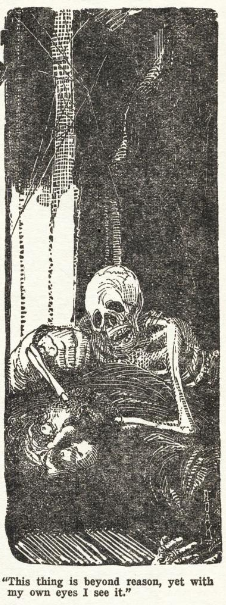
Ah yes, Weird Tales, the magazine never afraid to spoil a story with an illustration right off the goddamn bat. Of course, this one isn’t the worst offender, but still, c’mon ya’ll, let a story breath, would ya?

Efficient and evocative, Howard wastes no time here. Two men travelling through the dark, silent, shadowy black forest approach the Tavern of the Cleft Skull. The landlord is suspicious, and demands to know who these guys wandering the deep forest are. One is, of course, the English Puritan Solomon Kane, and the other is a Frenchman with the unlikely name of Gaston l’Armon. The sullen, suspicious, secretive landlord lets them in, and we get a brief description of our characters: Kane is a goth, all in black with a black featherless hat that sets of his pallid, intense face. Gaston is of a different sort entirely; he’s very much a French Poppinjay, all in lace and finery. And our landlord?

So he’s obviously a deeply sinister motherfucker, even without that last little “few come twice,” thing which, I mean, jeez man. Way to give away the game, although when you have two small red eyes that stare unblinkingly at people, maybe there’s not much dissembling to do? Kane and l’Armon finish up their meal and head on up to bed.

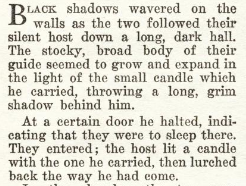
This is a pretty short story with pretty spare descriptions, but I think Howard uses his words to good effect here – the wavering shadows on the walls of the long dark hall and the broad, stocky body of the weird innkeeper shambling ahead of them…it’s a really nice picture, the sparse language helping to convey the silence and the stillness and the emptiness of the Inn of the Cleft Skull.

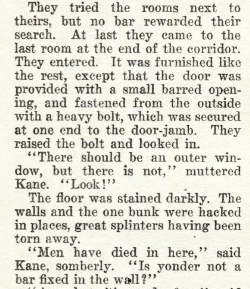
Inside their room, Kane notices that there isn’t a bar for the lock. There’s a bit of banter between l’Armon and Kane, and we learn that the two of them met by chance a mere hour before coming across this lonely inn out in the middle of the German black forest. Still, they decide that they might like to be able to lock their door, so they go out in search of a bolt in one of the other rooms. This trope of an inn as a trap, and in particular one where the trapping is done via locks (or the absence of them) appears in two other big famous stories. One is Howard’s Conan story “Shadows in Zamboula” from 1935 (a good but controversial story that showcases some of the worst of Howard’s casual racism) and, interestingly, it plays a major part in Lovecraft’s “The Shadow over Innsmouth” from 1931 (where it precipitates one of the few action scenes in a Lovecraft, actually). It’s an effective bit of horror stuff, though – vulnerable and unprotected in your sleep, not even a locked door between you and whatever threat is out there…it’s spooky stuff! Kane and l’Armon agree that they’d like to be able to lock the door, so they set off to search the other empty rooms of the inn for a bar to lock their door with. But, they find them all similarly unlockable. And then they come to the very last room at the faaaaaaar end of the dark hallway.

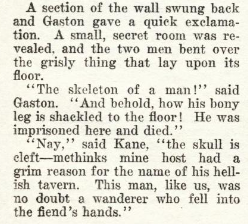
They find the Inn’s murder room which of course we were all expecting. Bloodstained floors, smashed furniture, and even a secret passage!

That’s pretty wild, huh? The inn keeper cleaves some poor bastard’s head clean through AND THEN chains up his corpse in a secret chamber? Confronted with the evidence of their murderous host’s past actions and his immanent threat to them, what do they do? They start screwin’ around with the skeleton, of course:

Perfectly normal thing to say, Gaston l’Armon, I’m sure it’ll have no bearing whatsoever on the rest of the story! But Kane has had enough; he wants to confront the innkeeper with the evidence of his crimes! He turns, preparing to leave, when the unthinkable happens!

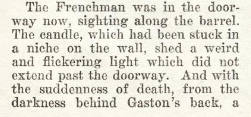
Betrayed! And now Kane recognizes him…he’s Gaston the Butcher, a famously murderous brigand! He had planned to murder Kane in the night, the treacherous dog, but a chance came along and he took it! Now he’s going to kill Kane and take his gold. It’s a solid plan, simple and straightforward, and Kane seems to be facing his imminent death (and at the hands of a Frenchman, no less) when, suddenly…

That’s right! Looming up behind Gaston in the hallway, the inn keeper cleaves himself another skull, thereby saving (albeit briefly, as we’ll see) Solomon Kane’s life! By the way, the “hanger” that the innkeeper uses to chop Gaston’s head open is a type of sword, a very short sabre that was popular with woodsmen and hunters before making the jump to the navy and artillery officers of the 17th and 18th centuries. It’s called a hanger for the way it hanged from the belt.

Kane moves forward, but is quickly menaced back by the innkeeper, who has a long-barreled pistol in his OTHER hand. If it’s not one thing it’s another, you know what I mean?

First off all, the innkeeper is a nice and effective example of escalation, one of the staples of adventure literature. Gaston was bad, sure, but now Kane is face with a worse threat, a man driven to murderous insanity by the brutality of a Continental prison. The line, “And deep in my brain, the wounds of the years…” is really great, and it instantly turns the Host of the Inn of the Cleft Skull into something wilder and weirder and more tragic than a simple homicidal maniac. He’s been broken irrevocably, to the point that he’s now hiding out in the woods and waging a murderous war on all humanity. It’s great stuff, real dire threat.

But what, you ask, of sorcery? Well, there’s that strange sound again. Gaston had heard something scrabbling around in the chamber with the shackled skeleton, noises that Kane had dismissed as rats bothering dry bones. But the innkeeper has a different interpretation of the sound.

The madman continues with his ranting, explaining that the skeleton had belonged to a Russian sorcerer who had stopped at the inn and whom he had, of course, killed. But the wizard had vowed that his dead body would rise up and avenge him, so the Innkeeper stripped his bones and shackled his skeleton to the floor in the secret chamber. “His sorcery was not powerful enough to save him from me, but all men know that a dead magician is more evil than a living one,” says the innkeeper, sidling around to check on his prisoner.

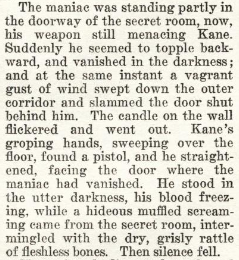
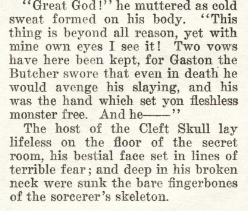
I mean, that’s a great scene, isn’t it? A door to death yawning wide, then the man suddenly toppling backwards in a panic! A gust of wind that snuffs out the candle and shuts the door to the secret room where, sealed away, all Kane can hear is muffled screaming and the rattle of bones! Just top notch stuff, really simple and direct and effective. Kane kindles a light and sees a sight that horrifies him:

And that’s the end of the story!

So, first thing first, this is definitely a horror story, and not even a particularly weird one – there’s nothing cosmic or mind-bending about the monster here…it’s a wizard’s skeleton, and it literally just strangles a guy to death. In fact, the Innkeeper is a much weirder threat; he’s been brutalized so thoroughly that he’s lost all humanity, becoming an engine of destruction and murder who lays in wait for any and all who happen to come his way.

Similarly, the proto-sword and sorcery elements might seem to be thin on the ground here. Kane is mostly held at gunpoint the whole story, and he doesn’t even get a weapon of his own until the very last bit of the story. He doesn’t fight anybody or anything, and mostly just watches as the events of the story unfold around him. In fact, if you haven’t read the previous two Kane stories, you might be a little skeptical of the whole “Kane is a sword-and-sorcery hero” thing here (it’s much clearer in those stories, though – he’s sword-fighting and ranging all over the place in those, and generally a lot more active and dynamic than here, as well as menaced by sorcery and horrors).

But! I think that this story nicely illustrates Howard’s changing direction and the way he’s developing a distinct aesthetic. First of all, there’s an interesting use of the environment. The black forest setting is gloomy and threatening, and this ramshackle inn with a terrible name is, rather than a welcome sign of civilization in a wilderness, actually much wilder and more lonely than the woods themselves. The threats of the forest, wolves and weather and such, are after all natural, while the canker of the inn is wholly unnatural, a blight on the face of the earth. And the origins of that blight are sunk in the brutal degradation that Man visits of His Fellow Man, which is a very Howardian perspective that underpins many of the Conan stories.

You’re also beginning, I think, to see the tell-tale interest in the specific settings and materiality that makes for good sword and sorcery. Howard is always interested in making you believe that the places he’s setting his stories are real; now, that might be easier when the place IS real, like the black forest, but the work he’s doing is still substantial – after all, he’s just said “black forest” and “Germany,” it’s not like he’s providing an in-depth primer on the socio-economics of Baden-Württemberg. BUT I think there is an obvious interest in conveying that this landscape is real, and that the people and places in it are historically contingent. By playing around with those ideas in stories like this one, he’s practicing for the quick but evocative realizations that he’ll need to make Aquilonia or Turania seem like real places with real histories and economies and cultures, the sort of backgrounding that makes the Conan stories work.

There’s also a brutality to the characters that is interesting and important. The innkeeper, who is insane, is certainly a grim enough fellow, but Gaston’s depravity might be even worse. After all, the innkeeper at least has an ethos, man, but Gaston is straight up just a greedy murderer. Both of them have been degraded and turned into monsters, in fact; the innkeeper by a cruel and crude “justice” and Gaston by his own avarice. In the Kane stories, it’s implied that he is a volcanic, passionate man whose natural tendencies are kept in check not by his strict Puritanism but rather by his single-minded obsession with his own ideas of justice and righteous violence. In fact, over the course of the stories, you could very easily say that Kane is very similar to the poor mad murderous innkeeper, the only difference being that Kane’s endless war is being directed at the right people, brigands and murderers and inhuman monsters. That kind of psychological depth, and in particular the emphasis on the darker side of human beings, is certainly one of the poles holding up the sword and sorcery tent, and it’s in the Kane stories that Howard really starts to explore it.

I obviously really like this story – in fact, it might be my favorite Kane story. Don’t get me wrong, there’s good swash-buckling in a bunch of ’em, although you do have to prepare yourself for Howard’s paternalistic take on Africa for a lot of them (“Wings in the Night” is probably worth a read, though). And Kane is probably Howard’s first Great character, a dynamic and forceful and interesting personality, a Puritan who is, actually, a Barbarian hero, subject to gigantic melancholies and gigantic mirths. And while it’s short and Kane doesn’t get to do much in it, I still like the tone and mood of this piece – it’s a horror story, yes, much more so than sword-and-sorcery, but it’s almost there too, just teetering on the edge of a new genre. I think it really is a good key to understanding the evolution of Howard’s writing and thinking, and how all of, his interest in history and civilization and people, is going to blossom very soon into something special and epochal.

End of Moorevember #15: Sword and Sorcery edition! “The Black God’s Kiss” by C.L. Moore, Weird Tales Oct 1934 (v.24, n.4)

CONTENT WARNING: the story we’re talking about today includes sexual assault.

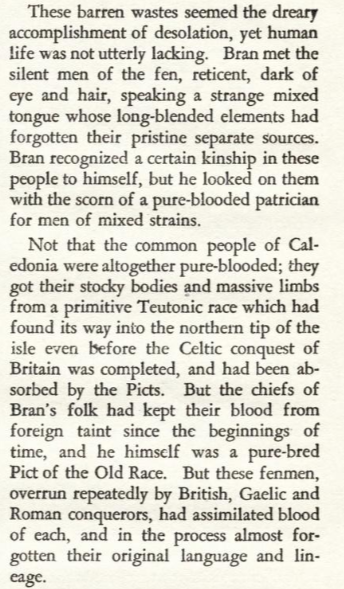
The Yuletide draws nigh, and for me, that means one thing: sword and sorcery! Growing up, for some reason or another, I would often find myself reading fantasy novels around this time of year; Lord of the Rings, The Enchanted Forest Chronicles, Book of the New Sun, big fat books that travelled well for holiday trips and suchlike. But one day I picked up a Fritz Lieber Fafhrd and the Grey Mouser collection, and ever since my xmas time fantasy reading has bent towards the sword-and-sorcery end of the spectrum. That might not be too surprising given that sword-and-sorcery is a subgenre of weird fiction anyway. But it’s decidedly my favorite flavor of fantasy, so it’s a unique pleasure to be able to end Moorevember and begin my annual sword-and-sorcery appreciation month with the very first Jirel of Joiry story from one of the genre’s masters, C.L. Moore! That’s right…it’s “The Black God’s Kiss” from Weird Tales, October 1934.

It’s gonna be wall-to-wall adventuring around here from now through January so we’ll talk the history of sword and sorcery as a genre later, but to lay some groundwork for you: sword and sorcery is the ONE genre that people all definitively agree began in Weird Tales. Specifically, we can point to the publication in December 1932 of the Conan story “The Phoenix and the Sword” as its definitive birthdate. It’s not the first fantasy in the magazine, of course; some of Lovecraft’s dreamlands stories veer dangerously close to the genre, Clark Ashton Smith had already published a number of fantasy-flavored horror stories (including, importantly, “The Tale of Satampra Zeiros” in ’31), and REH had even had a couple of “King Kull” stories in the 20s in Weird Tales, but for most people the genre crystalized in ’32 with that Conan story. Mostly that’s because Conan as a character would come to dominate the genre, but I think there’re good literary reasons to pin it there too. A lot of the weird fantasy that had appeared previously was, mostly, very much more in the weird fiction tradition, focusing on horror or mood or lyricism; even Howard’s Kull stories were more mythic than anything else, with very little of the action or adventure we associate with classic S&S. Also, with the Conan story, we get a glimpse at the first really well developed “secondary world” in literature, a pseudo-historical approach to presenting fantastic lands as real political entities with histories and agendas and material concerns, rather than as timeless magical kingdoms. But perhaps most importantly, Howard’s Conan represents the first clear articulation of the central theme of sword and sorcery: a singular human character relying on their strength and cunning in an active struggle with unnatural and dangerously inhuman forces.

The 80s sword and sorcery revival (and backlash), particularly in the movies, has given us a very jaundiced and cynical view of the genre; you say “sword n’sorcery” and what most people envision is a meat-headed barbarian carving his way through a sea of enemies, followed by some gratuitous sex with an uncomfortably exoticized dancing girl. And I mean, sure, that’s a part of it, but in the finest examples of the genre, what you actually have is a story about a person confronting dangers with only themselves (and, in particular, their bodies) to rely on. It’s a literature preoccupied with the ways a person will push their strength, will, and courage to the limits in pursuit of a goal, despite the presence of weird inhuman threats.

That this had an appeal to both readers and writers of weird fiction is understandable, I think…even the most dyed-in-the-wool weird horror fan must eventually confront the fact that, sometimes, you want to see someone punch a gibbering horror right in its non-euclidian face, and that’s precisely the itch Sword and Sorcery scratches. The horrors are real and chilling and soul-shattering in S&S, but not every protagonist has to be a Lovecraftian character that embraces merciful oblivion by fainting at the most narratively convenient moment. And as we know from our very first entry in this year’s Moorevember, that kind of tough, no-nonsense character was something C.L. Moore specialized in writing! So let’s get to it!

Moore got the cover for this story, and it’s one of Brundage’s most famous pieces. The strange, enigmatical expression of the statue is really good, and while Brundage has of course cheesecaked up Jirel of Joiry (giving her longer and more feminine hair and putting her in lingerie), I think the picture actually does a good job at capturing some of the weirdness of Moore’s story. I wonder if there are any interviews or letters from Moore where she says what she thought of the cover?

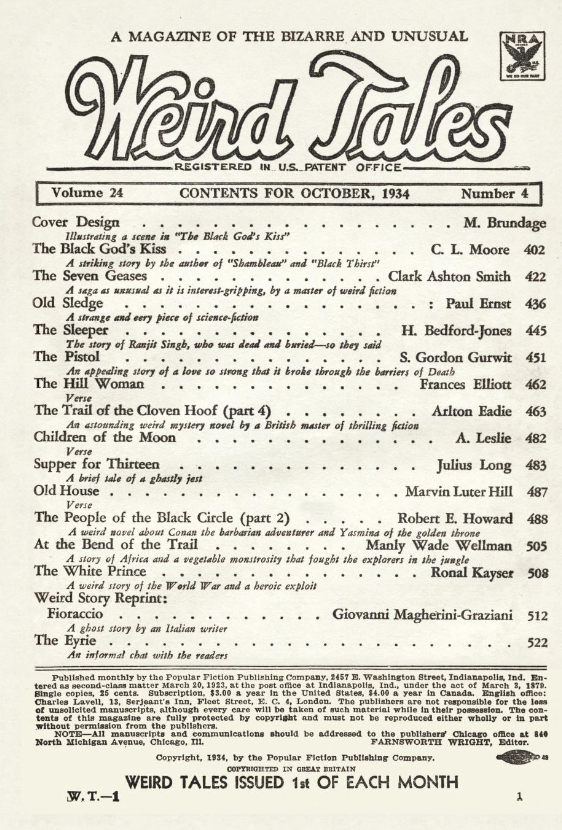
The ToC this issue is pretty solid, too:

It’s a sword-and-sorcery smorgasbord! Moore, followed immediately by a great Hyperborean story from Clark Ashton Smith (which includes a wizard with an archaeopteryx familiar) AND there’s also the second part (of three) of a pretty great Conan tale (also with some of the raddest evil wizards he ever wrote)! Great fantasy stuff here, plus more straightforward weird fic from Ernst, Wellman, and Julius Long…hell of an issue, honestly!

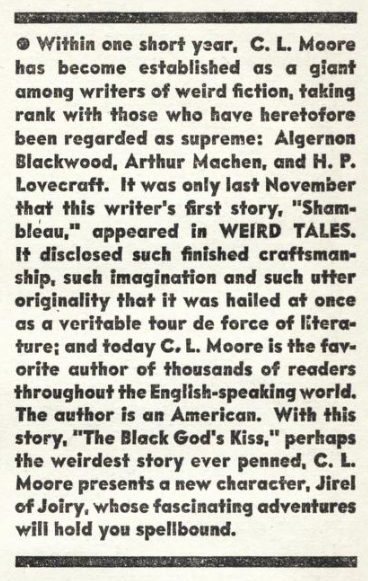
The esteem that Wright and the readers felt for Moore is evident from a nifty (and atypical) little sidebar that was inserted on the first full page of text from the story. Here it is:

Some incredible praise, and puts Moore right in there with truly towering figures of weird literature. It also illustrates just how epochal “Shambleau” was for the magazine and the genre. A real shame that she ever fell off the radar of readers, since she’s absolutely one of the major writers of genre fiction from the early 20th century.

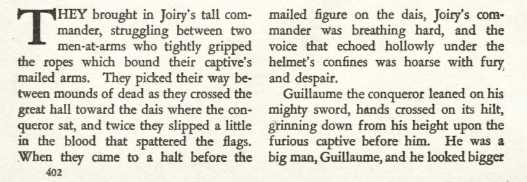
Big giant title illustration that, along with the italicized caption, UNFORTUNELY undercuts the beginning of the story by giving away the fact that Jirel of Joiry is, in fact a woman. It’s a real shame, because Moore clearly begins the story with the idea of surprising the Weird Tales audience with that fact:

Not until the fifth paragraph is Jirel identified as “Joiry’s lady,” after descriptions that paint “Joiry’s tall commander” as martial, physically powerful, and very defiant. It’s a shame that Weird Tales undercuts the reveal with the art and the intro, although hopefully some readers had sped through that and encountered the surprise naturally. It’s a great scene, one of the iconic gender reveals in literature, right up there with Éowyn confronting the Witch-King of Angmar.

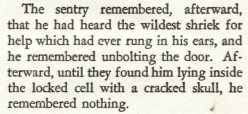
Guillaume is, of course, struck by the sudden sight of this warrior woman, one who by his own admission put up a truly valiant fight against him and his men. It’s kind of funny that he besieged Joiry and went through all that without knowing who it was he was facing, isn’t it? Guess he was busy, what with the pillaging and conquest and all. And this leads into the scene that warranted the trigger warning above, because he demands a kiss from his captive. The immediate result is that Jirel curses him out and, despite having her hands bound, lashes out with her spurred boots and her knees and elbows, walloping the men holding her and even succeeding in briefly braking free. But Guillaume descends from his captured throne, grabs her, and forcibly kisses her.

Jirel is a grade-A badass, though, trying to fucking bite him to death like that. But she’s knocked unconscious and dragged away to what had been her own dungeons.

Pausing briefly, let’s talk about the sexual assault here. This is the only actually portrayed assault in the story, though the implied threat of rape looms large in the story and is explicitly discussed a little later; still, I think it’s worth pointing out that it’s not meant to be titillating to the reader, but rather is described as an actual and serious affront to Jirel’s person and dignity. Similarly, Jirel’s reaction is not typical for a woman in a pulp story facing an outrage like this; she is furious, and tries to kill Guillaume with her goddamn teeth, after all. We’ll talk about it more at the end, but I think it’s important to note that Jirel’s actions in the story are motivated by this assault, much more so than the simple fact that she lost her castle and position. Just keep that in mind as we read on.

Jirel wakes from her stupor in a lightless dungeon deep beneath her castle. She surveys the room in the dark, feeling her way along the edge of the room and finding a small wooden stool which will serve her as a weapon. Then, action-oriented as always, she makes her move:

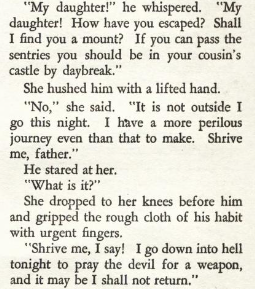
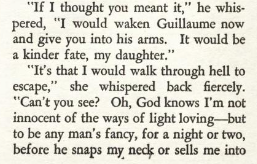
Jirel creeps through her silent castle carefully, wracked with furious hate at the memory of Guilliaume and the kiss. Jirel, like all true sword and sorcery heroes, is always a hair’s breadth away from titanic berserker rages, and it’s only with effort that she forces her volcanic fury back down into the pit of her stomach. A plan is forming, as told by a wolfish grin she wears as she seeks out her rooms.

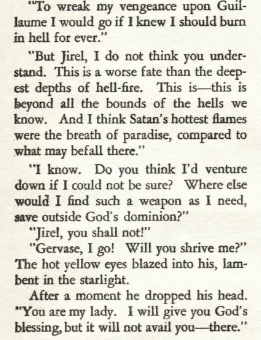
The Roman greaves are a nice touch, and help situate us in time and place (even if it doesn’t make a lot of strict sense). Between the name of Guillaume and the “not long past” days of Rome, we’re in France, although there’s definitely more of a high medieval feel to Jirel and her adventures than, say, a Merovingian setting. But still, there are two important points here. First, we’re in a savage age of warlords, lawlessness, and violence, the kind of thing that arises after the fall of an orderly and powerful Empire like Rome. Secondly and much more importantly, I’d argue that this brief scene subverts the important fantasy trope of the Chivalric Hero’s arming ceremony, and is in some ways the first clear and explicit articulation of sword-and-sorcery’s difference from traditional fantasy.

A chivalric hero is defined their equipment – they bear armor and arms that, in addition to signifying social status and prestige, also serve to symbolically elevate and separate their heroes from the rest of the world. A chivalric hero encased in steel contrasts with and indeed rejects the softness and vulnerability of the human body, while also placing them within a milieu of honorable and romantic combat. Similarly, the investiture of a chivalric hero with their armor and often special or ancient weapon represents a numinous, spiritual aspect of their being; again, they are transformed into something more than human.

Contrast this with the hero of sword and sorcery – yes, they have armor and weapons, but they are interchangeable, tools to be used and discarded, mere accessories to the true strength of the the S&S hero, their body and its native, inherent strength and vitality. A chivalric hero is strong, of course, but their heroism is superhuman, signified by the rejection of the body in favor of a manufactured, expensive, and inhuman carapace of metal. The S&S hero embraces their (often admittedly nearly mythic) body. And here, in this scene, we have Jirel explicitly inverting the famous arming ceremony of chivalric romances – she is unattended, and must strip her battered armor off on her own, a difficult task that requires considerable effort and contortions to achieve. You can envision her casting off her grand gothic armor, all fluted edges and glittering layers, the sort of thing that takes a lot of people to put on and take off properly. And what does she replace it with? Doeskins, utilitarian chain mail, and the greaves of a dead empire. These are the trapping of a reaver rather than a grand and noble leader of men! I think it’s a key scene in the history of fantasy in general and sword-and-sorcery in particular, a masterful and efficient expression of a break with the romantic ideal, replacing it with a grim, brutal, and hard-boiled expression of rugged heroism instead.

Emerging from her room as a true sword-and-sorcery hero, Jirel creeps through her dark and silent castle, realizing that her enemies must have spent the night feasting and partying and are now probably sleeping it off. She briefly considers just wrecking their shit while they sleep, but she puts it aside – Guillaume must’ve left SOME sentries, and she figures she wouldn’t be able to kill him without getting captured. She’s got a different plan in mind. She seeks out her priest, Father Gervase, who is praying at his shrine.

Jirel could possibly flee, but she’s chosen a different path, one that horrifies her priest.

An important fact is revealed here: Jirel is not one of these virginal sword and sorcery heroines. It’s not sex per say that she fears; rather, it’s victimization that she is fighting against. That’s an important point, I think. We aren’t told explicitly what Jirel is up to, but it’s clearly a grim and perilous thing she plans to do. Gervase says he would rather give her up to Guillaume than see her do whatever it is she is planning to do, but she is resolute; she will make a deal with the devil himself for vengeance!

Shriven, Jirel descends again to the dungeons, this time seeking out a secret passage that only she and Father Gervase know about. Both had explored it some before, the priest farther than she, and it is a terrible, unearthly place, full or horror and inhuman evil, and it is into this that Jirel will venture! Just fantastic sword and sorcery stuff, isn’t it? And Moore, who has real keen eye for weirdness, really delivers here; Jirel enters a weird corkscrewing tunnel, experiencing strange sensations, altered gravity, and weird animate clouds of darkness that seem to emanate purest sorrow. It’s a great section, and Moore spends the time necessary to convey that Jirel is not merely crawling through a tunnel – she is leaving our world behind and going someplace else.

She reaches the end of the tunnel and feels an immensity around her, as if the tunnel had opened into a great and limitless space. Everything is still perfectly and oppressively dark around her, and she actually feels a constriction around her throat when she tries to step into it, nearly choking until she removes the crucifix at her throat. And while some may balk at the mundanity of a cross having some power over this place, I think it works on a different level – it is only when Jirel rejects this symbol of the normal world and casts it aside that she can see this new, strange world, a very thematically appropriate thing for the story.

First off, she’s crawled down a tunnel into another world – there’s a sky and stars and topography. That tunnel has led her out of the known world into some place very different from our own. And secondly, she’s immediately attack by a bunch of horrible little freaks gnashing at her heels. Her blade goes snicker-snack and she squishes a bunch of the gross little things, disgusted at the sensation of their bursting bodies. Then she steps out into this weird unearthly world, and discovers that the gravity is indeed different; she’s soon leaping with great bounding strides that would be impossible back home, speeding away across the plains towards a weird shaft of light that she’s spotted in the distance.

This is a long section, and I hope you have the patience to enjoy it; it’s basically a description of this weird-as-shit place and the strange, horrible things that live there. Strange pale naked women with sightless and senseless eyes leap froglike through a marsh, rivers murmur with terrible voices in alien languages, and other horrors abound. It’s a very Boschian vision of Hell, uncanny and very weird. Jirel eventually arrives at a the light, which turns out to be a tower made of weird, solid light, where she finds a horrible demon-thing that takes her shape. She senses its menace but still persists in her quest and demands a weapon that she can use against Guillaume, and the mirror devil tells her that what she seeks is in a temple on an island in a lake.

There’s more travel descriptions, and she encounters more horrible things as she goes, including a herd of blind horses that scream the names of women as gallop across the plains. It’s all extremely phantasmagoric, just top-notch weirdness in my opinion. Then, she finds a lake, and spots an island with a building on it in the distance. She crosses a strange bridge of solidified darkness and comes to the temple on the island in the lake.

So this is the titular Black God: a weird, sexless cyclops carved of unearthly stone, its alien lips pursed for a kiss. Oddly phallic too, a one-eyed monster and all. But it’s pretty fuckin’ weird for all that, huh!? A strange consciousness seems to live in the statue, and a horrible compulsion steals over her. Even the architecture of the little temple seems to draw her in, towards the smoochin’ statue.

There’s the scene that inspired the cover! It’s a strange one, for sure, Jirel kissing a weird statue; good weird image, huh?

Something is given to Jirel through the kiss, something terrible and alien and deadly. She flees, sickened and terrified, sensing that she is now bearing something horrible within her from the statue’s kiss. But eventually the panic subsides, and she smiles with grim satisfaction, knowing that she has her weapon.

She flees the twilight land, fearing instinctively the coming of its alien dawn. She also seems to know that there’s a ticking clock with this weapon, that she must pass it along to its target or it will destroy her. The fuse has been lit! She arrives back at the tunnel, slaughters more horrific little things, and then clambers through the weird passage, again experiencing weird dizziness and odd gravity as she travels between worlds. Eventually, she arrives back in the dungeon of her own castle, and what does she find there?

Weak with the strange evil inside her, she stumbles towards Guillaume.

As they kiss, Jirel feels her strength and peace of mind returning as she passes on the Black God’s Kiss. And, similarly, she witnesses the effect that it has on Guillaume.

The horror spreads over Guillaume – his body grows rigid and grey, he shudders and bleeds. He utters an inhuman and unholy cry of some alien emotion as the kiss destroys him. And then, a horrible realization comes over Jirel.

And that’s the End of the Story.

Now, right off the bat, we have to confront the kind of uncomfortable nature of this ending. Jirel, in fact, had been in love with Guillaume, had confused her passion for hatred, and in so doing had destroyed the man she actually loved. It’s not an easy thing to talk about, because of course Guillaume is not a good guy, what with the unwanted kiss and all, and a woman falling in love with her rapist is, of course, a pretty vile trope. But compare it to Moore’s debut story, “Shambleau,” where the female monster and Northwest Smith share a romance that is absolutely destructive. Love as a deadly and destructive force is obviously something that Moore had thought a great deal about and was a source of much inspiration for her, so I think we have to take it seriously in this story; she’s not simply recapitulating a sexist trope here, but rather trying to dissect and examine power and love and relationships, like she does for many of her stories.

I think there’s an important resonance here between this work and Moore’s sci-fi story that we talked about last week too. In “No Woman Born,” the central conflict of the story arises out of the inability of the men in Deirdre’s life to understand or even communicate effectively with her. A similar thing is happening here, I think. Jirel, a woman, a warrior, a ruler, is in a position of absolute power, one held through sheer force of her body and will. This position is upended at the very beginning of the story, Jirel put in a position of weakness and at the mercy of Guillaume, who has led his army to victory against the castle of Joiry and its ruler, Jirel. Neither of them are capable of dealing with the other as equals in this case; Guillaume treats her as mere spoils, which of course Jirel rejects. Both are violent warlords who live lives of violence – in later stories, it’s made clear that Jirel rules through strength, and that her men (all rough warriors themselves) follow her because she is a ruthless and powerful soldier. Trapped in these roles, they cannot see that they are very much alike.

And importantly, it is not sex that Jirel fears, a departure from a lot of fantasy (and fiction), where a woman’s virginity is a sacred thing. Jirel has fucked, she says as much to her priest. What she rejects is that she would be a mere plaything for a man, used and then disposed of. The conflict here is about power and dominance, and how these two people are undone by the structure of their society and their positions in a martial culture and time. You don’t want to get TOO biography-minded when pulling apart a story, but this theme of a strong woman coming into conflict with men and the world of men is such a prominent part of Moore’s writing that it would disingenuous not to say that there’s probably something very personal there, right? An obviously powerful and talented writer having to battle her way through a very sexist industry is something that Moore certainly experienced. Perhaps there’s a message in here about not letting your rage at assholes force you into doing something you regret later.

You might understandably find the ending rough, but you can’t deny that Jirel is a fantastic character, and the fact that she was written in ’34 at the HEIGHT of Conan-mania is really truly remarkable. A woman warrior that is not some weird virginal or sexless monster and who does not rely on magic or some cop-out bullshit is rare today, let alone back then. Jirel is a fuckin’ badass warrior, strong and tough and deadly all on her own because, presumably, she’s just good at killing things. That’s incredible! No wizard or magic chastity vow has given her her powers – she’s just Jirel of Joiry, warrior and warlord, and she will straight up kill your dumb ass if you get in her way. Moore wrote six stories about her, and while they’re all good, I think this is very much the best of the bunch. There’s just something really vital and exciting about the character, and she steps fully formed into the story right away.

And as weird fiction, I think this story delivers too. The scenes of the weird hell world that she travels to are really very strange and mysterious, and they make an interesting counterpoint to the Lovecraftian alien-gods that are more common (especially now) in both weird fic and its subgenre of sword and sorcery. I mean, there’s something very alien about the statue and, phallomorphism aside, I think it’s a very successful evocation of weirdness there, genderless and puckered up in the middle of a strange temple in a lake. Moore is really unparalleled at conveying a sense of oddness without recourse to the more cliched approaches you sometimes come across in Weird Tales. Similarly, her inventiveness and thematic approaches to her stories are just endlessly interesting to me.

I’ve had a really great time with this Moorevember stuff, and have really had fun rereading these absolute classics of hers. Farnsworth Wright was very much correct about putting her name up there with Blackwood and Lovecraft – she’s really one of the 20th century’s greatest genre writers, a true master of the art of the weird! But of course adventure calls, so we’ll have to leave C.L. Moore behind as we wade into some more yuletide sword-and-sorcery in the weeks ahead! See ya’ll next time!