Category Archives: Weird Fiction

Straining the Pulp beneath my sandaled feet #16: “Rattle of Bones” by Robert E. Howard, Weird Tales June 1929, V.13 n.6

Gathered ’round the red glow of the fire at night, its feeble flame keeping wolves (and worse…) at bay while we discuss the weighty topic of The Pulps, one name looms larger than all others, a name of ancient renown steeped in glory and deep lore: the Man from Cross Plains himself, Robert E. Howard. And while I don’t want to get bogged down JUST talking about him, it is the fact that, in addition to basically creating the genre that Fritz Lieber would later name “Sword and Sorcery,” ol’ REH is also one of its indisputable masters, having written some of the best examples of the genre ever. So, while we ARE going to be eventually talking about OTHER people, there will be at least THREE of these pieces that focus on my fellow Texan, Big Bob Howard. And for today, that story is “Rattle of Bones” from the June 1929 issue of Weird Tales.

That’s right, we’re saving Conan for later and STARTING with Howard’s first indisputably successful series-spanning character, the two-fisted, sword-swinging, berserker-Puritan himself, Solomon Kane! I’ve always liked Kane (shame about the movie though…) and I think he’s an important step in Howard’s career. In addition to being a real recurring character, he also seems to have helped Howard crystalize some of his ideas about what he was interested in as a writer, per say.

But wait, I can hear you saying, didn’t I *just* say last time that sword and sorcery wasn’t created until the Conan story “The Phoenix and The Sword” was published in 1932!? What’s this 1929 story doing here in Sword and Sorcery month!? Read on, O Prince (or Princess, as the case may be)!

Leading up to this issue of Weird Tales, Howard was already an established writer: his first professional story ever was “Spear and Fang” from ’25 in Weird Tales, a lusty, action-packed caveman yarn that was extremely well-received. He wrote some more traditional, gothic-style horror tales, in particular “Wolfshead” in ’26, which was another huge success with the readers of Weird Tales and established him as a talent in Farnsworth Wright’s stable of writers. All of these stories are very much in the vein of Howard’s early horror writing, tortured protagonists struggling manfully against a hostile world full of occult threats, rich in historical (or prehistorical) trappings and settings. Importantly, he has introduced the Picts in “The Lost Race” from 1927; these dark, gnomish figures of a forgotten age who lurk in the twilight on the edge of our world are, for Howard, a synecdoche. They represent all of his literary preoccupations: civilization and barbarism, history drenched landscapes, violence, empire, decadence, atavism, and race. While these previous stories are very much still in the weird fiction tradition, focused on moody reflections of doom-laden fate and ancient knowledge, they are nonetheless grasping towards what would eventually become sword and sorcery, where weird horrors exist to be confronted rather than merely suffered. And Kane, as a brave and violent character that can appear in different stories and different settings over and over again, is an important part of bridging that gap from the early “weird fiction” Howard to the “blood and thunder” Howard that we know and love later.

That’s a long preamble, so we’ll save REH biography talk for later. Now, let’s take a look at this issue of Weird Tales!

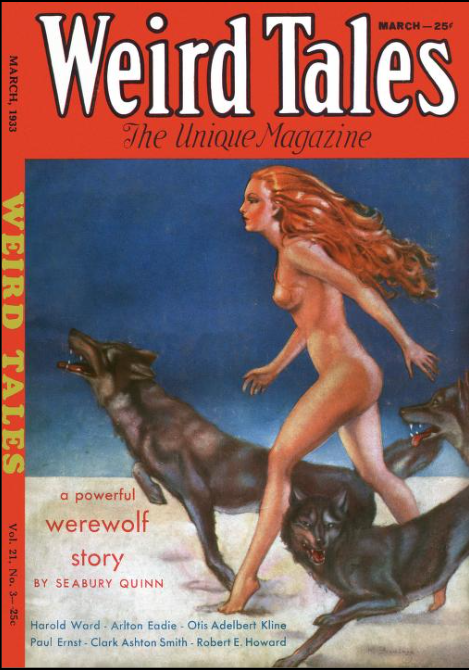
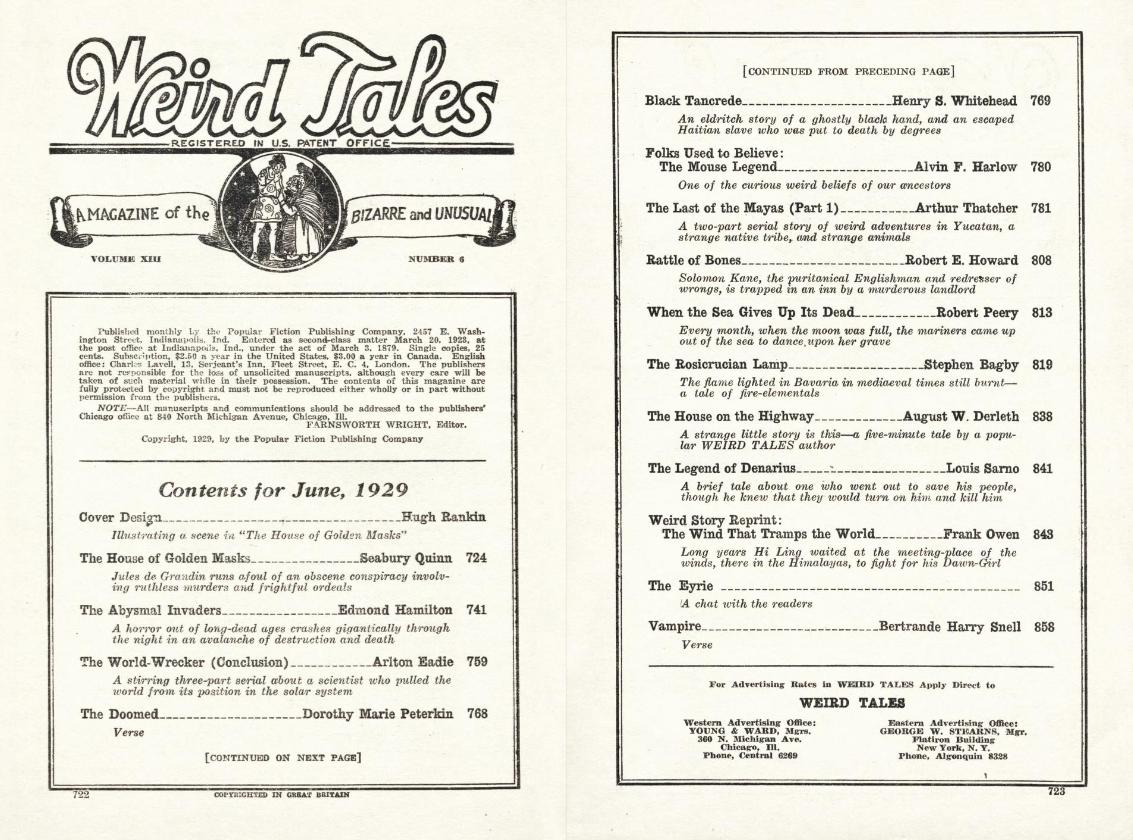
An excellent and very risque cover from Hugh Rankin, illustrating (vaguely) a scene from a Jules de Grandin story by Seabury Quinn. It’s got a great, almost art deco style cover to it, doesn’t it, and the nearly naked woman is particularly stylish and evocative (he said, looking respectfully). Probably way more interesting that the story it’s illustrating, I’m sure – Quinn was a HUGELY popular writer at Weird Tales, surpassing Lovecraft at this point, and his occult detective Jules de Grandin was one of the most popular characters in the magazine. The stories themselves are perfectly fine, but it’s always baffled me HOW bonkers people were for them back then. Changing tastes, I guess. Anyway, the ToC:

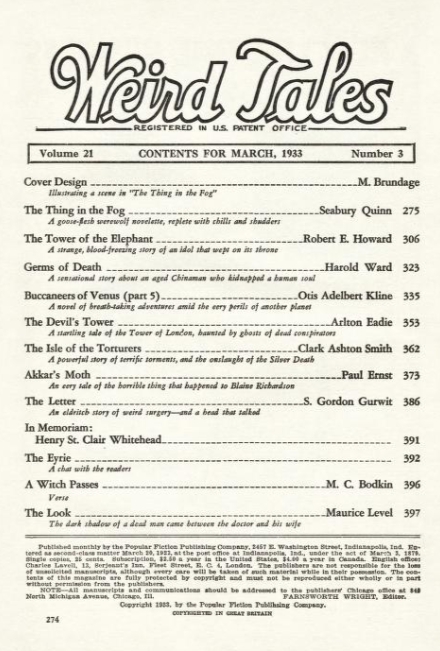
Not TOO much to write home about in this issue – Derleth and Whitehead are very much second-stringers in the Lovecraft Circle, and the big names at the time were definitely Quinn and Hamilton; they’re right up right up front in this issue, with a bullet. Howard is comfortably in the middle of the issue, and Wright took particular care to call out that “Rattle of Bones” is a Solomon Kane story; they’d given Howard’s first Kane story, “Red Shadows,” a cover earlier in 1928, and there’d been a second Kane story earlier in 1929, so they’re working hard to make sure people know that this is a recurring character. So let’s get into it, shall we!

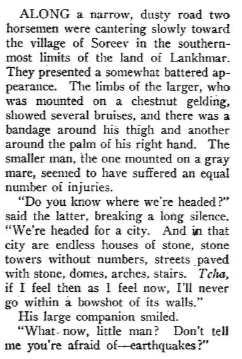
Unique typesetting on the title this time, huh? It spreads across two pages too, but there’s just one word over there on the second page, kind of spaced weirdly. The title font is only used for this story in this issue, which is interesting. Weird Tales was always financially strapped, generally just skating by, so I kind of wonder if they were trying to get some visual interest on the cheap here? But, that’s not to say that they couldn’t afford an illustration!

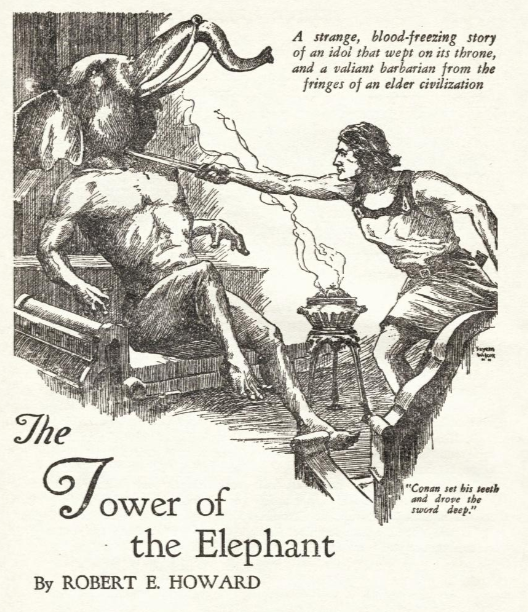
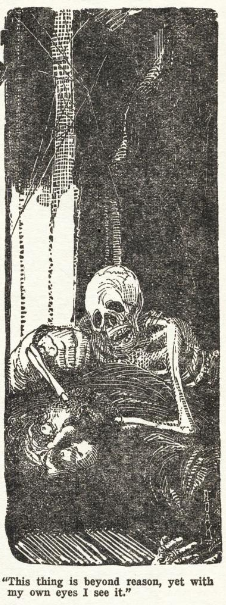
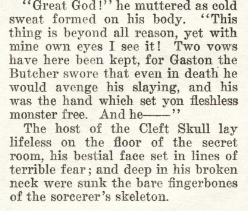
Ah yes, Weird Tales, the magazine never afraid to spoil a story with an illustration right off the goddamn bat. Of course, this one isn’t the worst offender, but still, c’mon ya’ll, let a story breath, would ya?

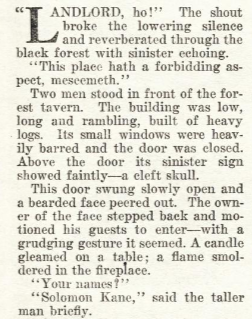
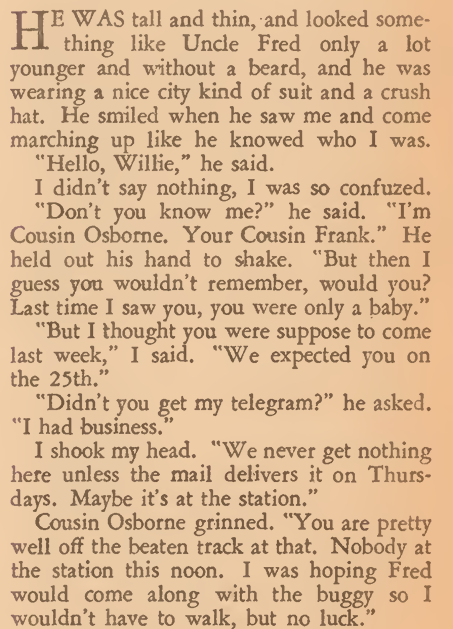
Efficient and evocative, Howard wastes no time here. Two men travelling through the dark, silent, shadowy black forest approach the Tavern of the Cleft Skull. The landlord is suspicious, and demands to know who these guys wandering the deep forest are. One is, of course, the English Puritan Solomon Kane, and the other is a Frenchman with the unlikely name of Gaston l’Armon. The sullen, suspicious, secretive landlord lets them in, and we get a brief description of our characters: Kane is a goth, all in black with a black featherless hat that sets of his pallid, intense face. Gaston is of a different sort entirely; he’s very much a French Poppinjay, all in lace and finery. And our landlord?

So he’s obviously a deeply sinister motherfucker, even without that last little “few come twice,” thing which, I mean, jeez man. Way to give away the game, although when you have two small red eyes that stare unblinkingly at people, maybe there’s not much dissembling to do? Kane and l’Armon finish up their meal and head on up to bed.

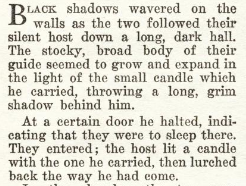
This is a pretty short story with pretty spare descriptions, but I think Howard uses his words to good effect here – the wavering shadows on the walls of the long dark hall and the broad, stocky body of the weird innkeeper shambling ahead of them…it’s a really nice picture, the sparse language helping to convey the silence and the stillness and the emptiness of the Inn of the Cleft Skull.

Inside their room, Kane notices that there isn’t a bar for the lock. There’s a bit of banter between l’Armon and Kane, and we learn that the two of them met by chance a mere hour before coming across this lonely inn out in the middle of the German black forest. Still, they decide that they might like to be able to lock their door, so they go out in search of a bolt in one of the other rooms. This trope of an inn as a trap, and in particular one where the trapping is done via locks (or the absence of them) appears in two other big famous stories. One is Howard’s Conan story “Shadows in Zamboula” from 1935 (a good but controversial story that showcases some of the worst of Howard’s casual racism) and, interestingly, it plays a major part in Lovecraft’s “The Shadow over Innsmouth” from 1931 (where it precipitates one of the few action scenes in a Lovecraft, actually). It’s an effective bit of horror stuff, though – vulnerable and unprotected in your sleep, not even a locked door between you and whatever threat is out there…it’s spooky stuff! Kane and l’Armon agree that they’d like to be able to lock the door, so they set off to search the other empty rooms of the inn for a bar to lock their door with. But, they find them all similarly unlockable. And then they come to the very last room at the faaaaaaar end of the dark hallway.

They find the Inn’s murder room which of course we were all expecting. Bloodstained floors, smashed furniture, and even a secret passage!

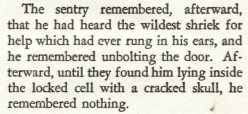
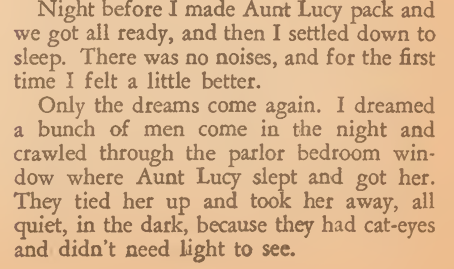
That’s pretty wild, huh? The inn keeper cleaves some poor bastard’s head clean through AND THEN chains up his corpse in a secret chamber? Confronted with the evidence of their murderous host’s past actions and his immanent threat to them, what do they do? They start screwin’ around with the skeleton, of course:

Perfectly normal thing to say, Gaston l’Armon, I’m sure it’ll have no bearing whatsoever on the rest of the story! But Kane has had enough; he wants to confront the innkeeper with the evidence of his crimes! He turns, preparing to leave, when the unthinkable happens!

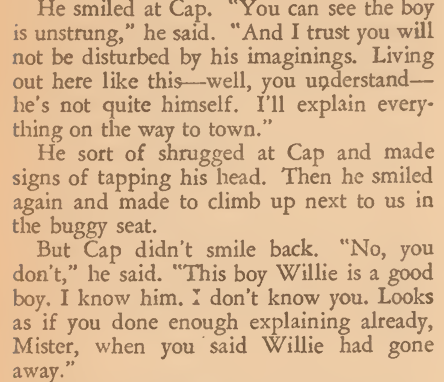
Betrayed! And now Kane recognizes him…he’s Gaston the Butcher, a famously murderous brigand! He had planned to murder Kane in the night, the treacherous dog, but a chance came along and he took it! Now he’s going to kill Kane and take his gold. It’s a solid plan, simple and straightforward, and Kane seems to be facing his imminent death (and at the hands of a Frenchman, no less) when, suddenly…

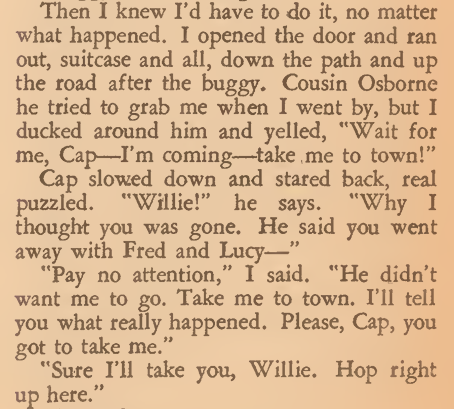
That’s right! Looming up behind Gaston in the hallway, the inn keeper cleaves himself another skull, thereby saving (albeit briefly, as we’ll see) Solomon Kane’s life! By the way, the “hanger” that the innkeeper uses to chop Gaston’s head open is a type of sword, a very short sabre that was popular with woodsmen and hunters before making the jump to the navy and artillery officers of the 17th and 18th centuries. It’s called a hanger for the way it hanged from the belt.

Kane moves forward, but is quickly menaced back by the innkeeper, who has a long-barreled pistol in his OTHER hand. If it’s not one thing it’s another, you know what I mean?

First off all, the innkeeper is a nice and effective example of escalation, one of the staples of adventure literature. Gaston was bad, sure, but now Kane is face with a worse threat, a man driven to murderous insanity by the brutality of a Continental prison. The line, “And deep in my brain, the wounds of the years…” is really great, and it instantly turns the Host of the Inn of the Cleft Skull into something wilder and weirder and more tragic than a simple homicidal maniac. He’s been broken irrevocably, to the point that he’s now hiding out in the woods and waging a murderous war on all humanity. It’s great stuff, real dire threat.

But what, you ask, of sorcery? Well, there’s that strange sound again. Gaston had heard something scrabbling around in the chamber with the shackled skeleton, noises that Kane had dismissed as rats bothering dry bones. But the innkeeper has a different interpretation of the sound.

The madman continues with his ranting, explaining that the skeleton had belonged to a Russian sorcerer who had stopped at the inn and whom he had, of course, killed. But the wizard had vowed that his dead body would rise up and avenge him, so the Innkeeper stripped his bones and shackled his skeleton to the floor in the secret chamber. “His sorcery was not powerful enough to save him from me, but all men know that a dead magician is more evil than a living one,” says the innkeeper, sidling around to check on his prisoner.

I mean, that’s a great scene, isn’t it? A door to death yawning wide, then the man suddenly toppling backwards in a panic! A gust of wind that snuffs out the candle and shuts the door to the secret room where, sealed away, all Kane can hear is muffled screaming and the rattle of bones! Just top notch stuff, really simple and direct and effective. Kane kindles a light and sees a sight that horrifies him:

And that’s the end of the story!

So, first thing first, this is definitely a horror story, and not even a particularly weird one – there’s nothing cosmic or mind-bending about the monster here…it’s a wizard’s skeleton, and it literally just strangles a guy to death. In fact, the Innkeeper is a much weirder threat; he’s been brutalized so thoroughly that he’s lost all humanity, becoming an engine of destruction and murder who lays in wait for any and all who happen to come his way.

Similarly, the proto-sword and sorcery elements might seem to be thin on the ground here. Kane is mostly held at gunpoint the whole story, and he doesn’t even get a weapon of his own until the very last bit of the story. He doesn’t fight anybody or anything, and mostly just watches as the events of the story unfold around him. In fact, if you haven’t read the previous two Kane stories, you might be a little skeptical of the whole “Kane is a sword-and-sorcery hero” thing here (it’s much clearer in those stories, though – he’s sword-fighting and ranging all over the place in those, and generally a lot more active and dynamic than here, as well as menaced by sorcery and horrors).

But! I think that this story nicely illustrates Howard’s changing direction and the way he’s developing a distinct aesthetic. First of all, there’s an interesting use of the environment. The black forest setting is gloomy and threatening, and this ramshackle inn with a terrible name is, rather than a welcome sign of civilization in a wilderness, actually much wilder and more lonely than the woods themselves. The threats of the forest, wolves and weather and such, are after all natural, while the canker of the inn is wholly unnatural, a blight on the face of the earth. And the origins of that blight are sunk in the brutal degradation that Man visits of His Fellow Man, which is a very Howardian perspective that underpins many of the Conan stories.

You’re also beginning, I think, to see the tell-tale interest in the specific settings and materiality that makes for good sword and sorcery. Howard is always interested in making you believe that the places he’s setting his stories are real; now, that might be easier when the place IS real, like the black forest, but the work he’s doing is still substantial – after all, he’s just said “black forest” and “Germany,” it’s not like he’s providing an in-depth primer on the socio-economics of Baden-Württemberg. BUT I think there is an obvious interest in conveying that this landscape is real, and that the people and places in it are historically contingent. By playing around with those ideas in stories like this one, he’s practicing for the quick but evocative realizations that he’ll need to make Aquilonia or Turania seem like real places with real histories and economies and cultures, the sort of backgrounding that makes the Conan stories work.

There’s also a brutality to the characters that is interesting and important. The innkeeper, who is insane, is certainly a grim enough fellow, but Gaston’s depravity might be even worse. After all, the innkeeper at least has an ethos, man, but Gaston is straight up just a greedy murderer. Both of them have been degraded and turned into monsters, in fact; the innkeeper by a cruel and crude “justice” and Gaston by his own avarice. In the Kane stories, it’s implied that he is a volcanic, passionate man whose natural tendencies are kept in check not by his strict Puritanism but rather by his single-minded obsession with his own ideas of justice and righteous violence. In fact, over the course of the stories, you could very easily say that Kane is very similar to the poor mad murderous innkeeper, the only difference being that Kane’s endless war is being directed at the right people, brigands and murderers and inhuman monsters. That kind of psychological depth, and in particular the emphasis on the darker side of human beings, is certainly one of the poles holding up the sword and sorcery tent, and it’s in the Kane stories that Howard really starts to explore it.

I obviously really like this story – in fact, it might be my favorite Kane story. Don’t get me wrong, there’s good swash-buckling in a bunch of ’em, although you do have to prepare yourself for Howard’s paternalistic take on Africa for a lot of them (“Wings in the Night” is probably worth a read, though). And Kane is probably Howard’s first Great character, a dynamic and forceful and interesting personality, a Puritan who is, actually, a Barbarian hero, subject to gigantic melancholies and gigantic mirths. And while it’s short and Kane doesn’t get to do much in it, I still like the tone and mood of this piece – it’s a horror story, yes, much more so than sword-and-sorcery, but it’s almost there too, just teetering on the edge of a new genre. I think it really is a good key to understanding the evolution of Howard’s writing and thinking, and how all of, his interest in history and civilization and people, is going to blossom very soon into something special and epochal.

End of Moorevember #15: Sword and Sorcery edition! “The Black God’s Kiss” by C.L. Moore, Weird Tales Oct 1934 (v.24, n.4)

CONTENT WARNING: the story we’re talking about today includes sexual assault.

The Yuletide draws nigh, and for me, that means one thing: sword and sorcery! Growing up, for some reason or another, I would often find myself reading fantasy novels around this time of year; Lord of the Rings, The Enchanted Forest Chronicles, Book of the New Sun, big fat books that travelled well for holiday trips and suchlike. But one day I picked up a Fritz Lieber Fafhrd and the Grey Mouser collection, and ever since my xmas time fantasy reading has bent towards the sword-and-sorcery end of the spectrum. That might not be too surprising given that sword-and-sorcery is a subgenre of weird fiction anyway. But it’s decidedly my favorite flavor of fantasy, so it’s a unique pleasure to be able to end Moorevember and begin my annual sword-and-sorcery appreciation month with the very first Jirel of Joiry story from one of the genre’s masters, C.L. Moore! That’s right…it’s “The Black God’s Kiss” from Weird Tales, October 1934.

It’s gonna be wall-to-wall adventuring around here from now through January so we’ll talk the history of sword and sorcery as a genre later, but to lay some groundwork for you: sword and sorcery is the ONE genre that people all definitively agree began in Weird Tales. Specifically, we can point to the publication in December 1932 of the Conan story “The Phoenix and the Sword” as its definitive birthdate. It’s not the first fantasy in the magazine, of course; some of Lovecraft’s dreamlands stories veer dangerously close to the genre, Clark Ashton Smith had already published a number of fantasy-flavored horror stories (including, importantly, “The Tale of Satampra Zeiros” in ’31), and REH had even had a couple of “King Kull” stories in the 20s in Weird Tales, but for most people the genre crystalized in ’32 with that Conan story. Mostly that’s because Conan as a character would come to dominate the genre, but I think there’re good literary reasons to pin it there too. A lot of the weird fantasy that had appeared previously was, mostly, very much more in the weird fiction tradition, focusing on horror or mood or lyricism; even Howard’s Kull stories were more mythic than anything else, with very little of the action or adventure we associate with classic S&S. Also, with the Conan story, we get a glimpse at the first really well developed “secondary world” in literature, a pseudo-historical approach to presenting fantastic lands as real political entities with histories and agendas and material concerns, rather than as timeless magical kingdoms. But perhaps most importantly, Howard’s Conan represents the first clear articulation of the central theme of sword and sorcery: a singular human character relying on their strength and cunning in an active struggle with unnatural and dangerously inhuman forces.

The 80s sword and sorcery revival (and backlash), particularly in the movies, has given us a very jaundiced and cynical view of the genre; you say “sword n’sorcery” and what most people envision is a meat-headed barbarian carving his way through a sea of enemies, followed by some gratuitous sex with an uncomfortably exoticized dancing girl. And I mean, sure, that’s a part of it, but in the finest examples of the genre, what you actually have is a story about a person confronting dangers with only themselves (and, in particular, their bodies) to rely on. It’s a literature preoccupied with the ways a person will push their strength, will, and courage to the limits in pursuit of a goal, despite the presence of weird inhuman threats.

That this had an appeal to both readers and writers of weird fiction is understandable, I think…even the most dyed-in-the-wool weird horror fan must eventually confront the fact that, sometimes, you want to see someone punch a gibbering horror right in its non-euclidian face, and that’s precisely the itch Sword and Sorcery scratches. The horrors are real and chilling and soul-shattering in S&S, but not every protagonist has to be a Lovecraftian character that embraces merciful oblivion by fainting at the most narratively convenient moment. And as we know from our very first entry in this year’s Moorevember, that kind of tough, no-nonsense character was something C.L. Moore specialized in writing! So let’s get to it!

Moore got the cover for this story, and it’s one of Brundage’s most famous pieces. The strange, enigmatical expression of the statue is really good, and while Brundage has of course cheesecaked up Jirel of Joiry (giving her longer and more feminine hair and putting her in lingerie), I think the picture actually does a good job at capturing some of the weirdness of Moore’s story. I wonder if there are any interviews or letters from Moore where she says what she thought of the cover?

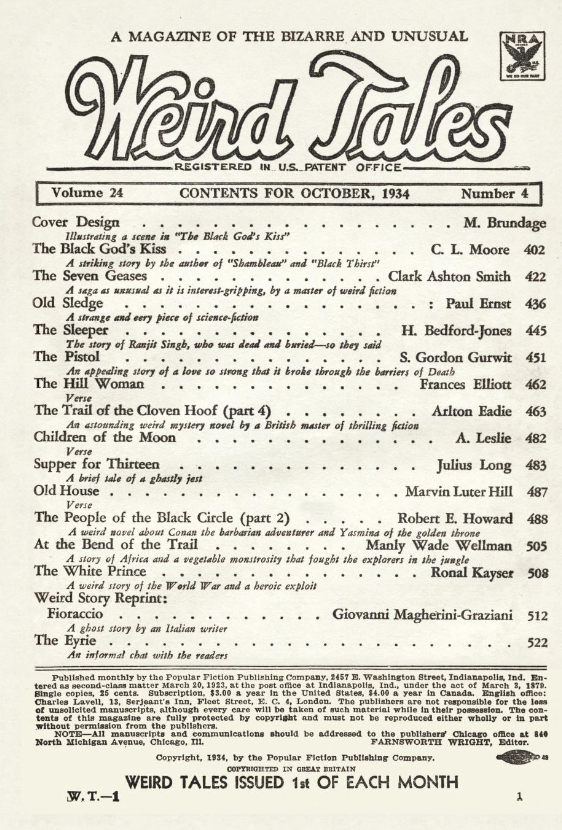
The ToC this issue is pretty solid, too:

It’s a sword-and-sorcery smorgasbord! Moore, followed immediately by a great Hyperborean story from Clark Ashton Smith (which includes a wizard with an archaeopteryx familiar) AND there’s also the second part (of three) of a pretty great Conan tale (also with some of the raddest evil wizards he ever wrote)! Great fantasy stuff here, plus more straightforward weird fic from Ernst, Wellman, and Julius Long…hell of an issue, honestly!

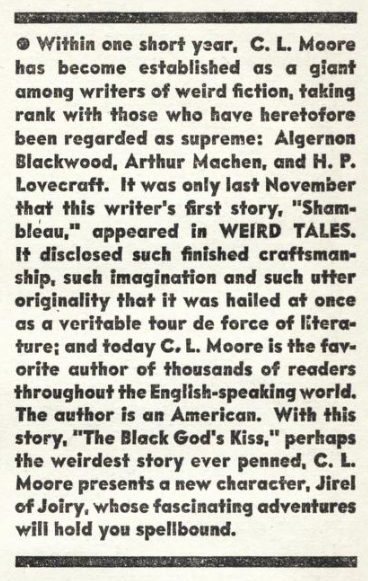
The esteem that Wright and the readers felt for Moore is evident from a nifty (and atypical) little sidebar that was inserted on the first full page of text from the story. Here it is:

Some incredible praise, and puts Moore right in there with truly towering figures of weird literature. It also illustrates just how epochal “Shambleau” was for the magazine and the genre. A real shame that she ever fell off the radar of readers, since she’s absolutely one of the major writers of genre fiction from the early 20th century.

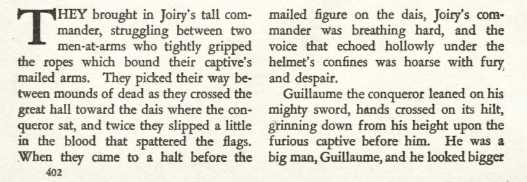
Big giant title illustration that, along with the italicized caption, UNFORTUNELY undercuts the beginning of the story by giving away the fact that Jirel of Joiry is, in fact a woman. It’s a real shame, because Moore clearly begins the story with the idea of surprising the Weird Tales audience with that fact:

Not until the fifth paragraph is Jirel identified as “Joiry’s lady,” after descriptions that paint “Joiry’s tall commander” as martial, physically powerful, and very defiant. It’s a shame that Weird Tales undercuts the reveal with the art and the intro, although hopefully some readers had sped through that and encountered the surprise naturally. It’s a great scene, one of the iconic gender reveals in literature, right up there with Éowyn confronting the Witch-King of Angmar.

Guillaume is, of course, struck by the sudden sight of this warrior woman, one who by his own admission put up a truly valiant fight against him and his men. It’s kind of funny that he besieged Joiry and went through all that without knowing who it was he was facing, isn’t it? Guess he was busy, what with the pillaging and conquest and all. And this leads into the scene that warranted the trigger warning above, because he demands a kiss from his captive. The immediate result is that Jirel curses him out and, despite having her hands bound, lashes out with her spurred boots and her knees and elbows, walloping the men holding her and even succeeding in briefly braking free. But Guillaume descends from his captured throne, grabs her, and forcibly kisses her.

Jirel is a grade-A badass, though, trying to fucking bite him to death like that. But she’s knocked unconscious and dragged away to what had been her own dungeons.

Pausing briefly, let’s talk about the sexual assault here. This is the only actually portrayed assault in the story, though the implied threat of rape looms large in the story and is explicitly discussed a little later; still, I think it’s worth pointing out that it’s not meant to be titillating to the reader, but rather is described as an actual and serious affront to Jirel’s person and dignity. Similarly, Jirel’s reaction is not typical for a woman in a pulp story facing an outrage like this; she is furious, and tries to kill Guillaume with her goddamn teeth, after all. We’ll talk about it more at the end, but I think it’s important to note that Jirel’s actions in the story are motivated by this assault, much more so than the simple fact that she lost her castle and position. Just keep that in mind as we read on.

Jirel wakes from her stupor in a lightless dungeon deep beneath her castle. She surveys the room in the dark, feeling her way along the edge of the room and finding a small wooden stool which will serve her as a weapon. Then, action-oriented as always, she makes her move:

Jirel creeps through her silent castle carefully, wracked with furious hate at the memory of Guilliaume and the kiss. Jirel, like all true sword and sorcery heroes, is always a hair’s breadth away from titanic berserker rages, and it’s only with effort that she forces her volcanic fury back down into the pit of her stomach. A plan is forming, as told by a wolfish grin she wears as she seeks out her rooms.

The Roman greaves are a nice touch, and help situate us in time and place (even if it doesn’t make a lot of strict sense). Between the name of Guillaume and the “not long past” days of Rome, we’re in France, although there’s definitely more of a high medieval feel to Jirel and her adventures than, say, a Merovingian setting. But still, there are two important points here. First, we’re in a savage age of warlords, lawlessness, and violence, the kind of thing that arises after the fall of an orderly and powerful Empire like Rome. Secondly and much more importantly, I’d argue that this brief scene subverts the important fantasy trope of the Chivalric Hero’s arming ceremony, and is in some ways the first clear and explicit articulation of sword-and-sorcery’s difference from traditional fantasy.

A chivalric hero is defined their equipment – they bear armor and arms that, in addition to signifying social status and prestige, also serve to symbolically elevate and separate their heroes from the rest of the world. A chivalric hero encased in steel contrasts with and indeed rejects the softness and vulnerability of the human body, while also placing them within a milieu of honorable and romantic combat. Similarly, the investiture of a chivalric hero with their armor and often special or ancient weapon represents a numinous, spiritual aspect of their being; again, they are transformed into something more than human.

Contrast this with the hero of sword and sorcery – yes, they have armor and weapons, but they are interchangeable, tools to be used and discarded, mere accessories to the true strength of the the S&S hero, their body and its native, inherent strength and vitality. A chivalric hero is strong, of course, but their heroism is superhuman, signified by the rejection of the body in favor of a manufactured, expensive, and inhuman carapace of metal. The S&S hero embraces their (often admittedly nearly mythic) body. And here, in this scene, we have Jirel explicitly inverting the famous arming ceremony of chivalric romances – she is unattended, and must strip her battered armor off on her own, a difficult task that requires considerable effort and contortions to achieve. You can envision her casting off her grand gothic armor, all fluted edges and glittering layers, the sort of thing that takes a lot of people to put on and take off properly. And what does she replace it with? Doeskins, utilitarian chain mail, and the greaves of a dead empire. These are the trapping of a reaver rather than a grand and noble leader of men! I think it’s a key scene in the history of fantasy in general and sword-and-sorcery in particular, a masterful and efficient expression of a break with the romantic ideal, replacing it with a grim, brutal, and hard-boiled expression of rugged heroism instead.

Emerging from her room as a true sword-and-sorcery hero, Jirel creeps through her dark and silent castle, realizing that her enemies must have spent the night feasting and partying and are now probably sleeping it off. She briefly considers just wrecking their shit while they sleep, but she puts it aside – Guillaume must’ve left SOME sentries, and she figures she wouldn’t be able to kill him without getting captured. She’s got a different plan in mind. She seeks out her priest, Father Gervase, who is praying at his shrine.

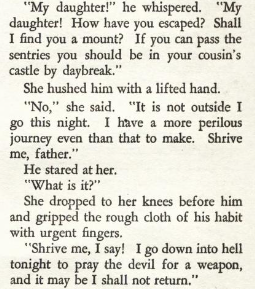
Jirel could possibly flee, but she’s chosen a different path, one that horrifies her priest.

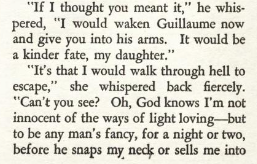
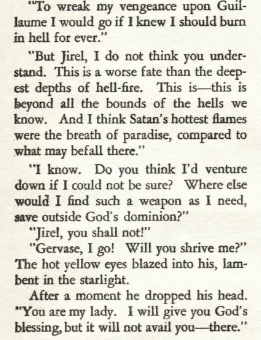
An important fact is revealed here: Jirel is not one of these virginal sword and sorcery heroines. It’s not sex per say that she fears; rather, it’s victimization that she is fighting against. That’s an important point, I think. We aren’t told explicitly what Jirel is up to, but it’s clearly a grim and perilous thing she plans to do. Gervase says he would rather give her up to Guillaume than see her do whatever it is she is planning to do, but she is resolute; she will make a deal with the devil himself for vengeance!

Shriven, Jirel descends again to the dungeons, this time seeking out a secret passage that only she and Father Gervase know about. Both had explored it some before, the priest farther than she, and it is a terrible, unearthly place, full or horror and inhuman evil, and it is into this that Jirel will venture! Just fantastic sword and sorcery stuff, isn’t it? And Moore, who has real keen eye for weirdness, really delivers here; Jirel enters a weird corkscrewing tunnel, experiencing strange sensations, altered gravity, and weird animate clouds of darkness that seem to emanate purest sorrow. It’s a great section, and Moore spends the time necessary to convey that Jirel is not merely crawling through a tunnel – she is leaving our world behind and going someplace else.

She reaches the end of the tunnel and feels an immensity around her, as if the tunnel had opened into a great and limitless space. Everything is still perfectly and oppressively dark around her, and she actually feels a constriction around her throat when she tries to step into it, nearly choking until she removes the crucifix at her throat. And while some may balk at the mundanity of a cross having some power over this place, I think it works on a different level – it is only when Jirel rejects this symbol of the normal world and casts it aside that she can see this new, strange world, a very thematically appropriate thing for the story.

First off, she’s crawled down a tunnel into another world – there’s a sky and stars and topography. That tunnel has led her out of the known world into some place very different from our own. And secondly, she’s immediately attack by a bunch of horrible little freaks gnashing at her heels. Her blade goes snicker-snack and she squishes a bunch of the gross little things, disgusted at the sensation of their bursting bodies. Then she steps out into this weird unearthly world, and discovers that the gravity is indeed different; she’s soon leaping with great bounding strides that would be impossible back home, speeding away across the plains towards a weird shaft of light that she’s spotted in the distance.

This is a long section, and I hope you have the patience to enjoy it; it’s basically a description of this weird-as-shit place and the strange, horrible things that live there. Strange pale naked women with sightless and senseless eyes leap froglike through a marsh, rivers murmur with terrible voices in alien languages, and other horrors abound. It’s a very Boschian vision of Hell, uncanny and very weird. Jirel eventually arrives at a the light, which turns out to be a tower made of weird, solid light, where she finds a horrible demon-thing that takes her shape. She senses its menace but still persists in her quest and demands a weapon that she can use against Guillaume, and the mirror devil tells her that what she seeks is in a temple on an island in a lake.

There’s more travel descriptions, and she encounters more horrible things as she goes, including a herd of blind horses that scream the names of women as gallop across the plains. It’s all extremely phantasmagoric, just top-notch weirdness in my opinion. Then, she finds a lake, and spots an island with a building on it in the distance. She crosses a strange bridge of solidified darkness and comes to the temple on the island in the lake.

So this is the titular Black God: a weird, sexless cyclops carved of unearthly stone, its alien lips pursed for a kiss. Oddly phallic too, a one-eyed monster and all. But it’s pretty fuckin’ weird for all that, huh!? A strange consciousness seems to live in the statue, and a horrible compulsion steals over her. Even the architecture of the little temple seems to draw her in, towards the smoochin’ statue.

There’s the scene that inspired the cover! It’s a strange one, for sure, Jirel kissing a weird statue; good weird image, huh?

Something is given to Jirel through the kiss, something terrible and alien and deadly. She flees, sickened and terrified, sensing that she is now bearing something horrible within her from the statue’s kiss. But eventually the panic subsides, and she smiles with grim satisfaction, knowing that she has her weapon.

She flees the twilight land, fearing instinctively the coming of its alien dawn. She also seems to know that there’s a ticking clock with this weapon, that she must pass it along to its target or it will destroy her. The fuse has been lit! She arrives back at the tunnel, slaughters more horrific little things, and then clambers through the weird passage, again experiencing weird dizziness and odd gravity as she travels between worlds. Eventually, she arrives back in the dungeon of her own castle, and what does she find there?

Weak with the strange evil inside her, she stumbles towards Guillaume.

As they kiss, Jirel feels her strength and peace of mind returning as she passes on the Black God’s Kiss. And, similarly, she witnesses the effect that it has on Guillaume.

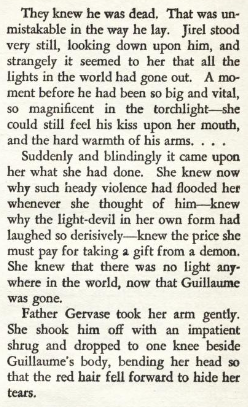
The horror spreads over Guillaume – his body grows rigid and grey, he shudders and bleeds. He utters an inhuman and unholy cry of some alien emotion as the kiss destroys him. And then, a horrible realization comes over Jirel.

And that’s the End of the Story.

Now, right off the bat, we have to confront the kind of uncomfortable nature of this ending. Jirel, in fact, had been in love with Guillaume, had confused her passion for hatred, and in so doing had destroyed the man she actually loved. It’s not an easy thing to talk about, because of course Guillaume is not a good guy, what with the unwanted kiss and all, and a woman falling in love with her rapist is, of course, a pretty vile trope. But compare it to Moore’s debut story, “Shambleau,” where the female monster and Northwest Smith share a romance that is absolutely destructive. Love as a deadly and destructive force is obviously something that Moore had thought a great deal about and was a source of much inspiration for her, so I think we have to take it seriously in this story; she’s not simply recapitulating a sexist trope here, but rather trying to dissect and examine power and love and relationships, like she does for many of her stories.

I think there’s an important resonance here between this work and Moore’s sci-fi story that we talked about last week too. In “No Woman Born,” the central conflict of the story arises out of the inability of the men in Deirdre’s life to understand or even communicate effectively with her. A similar thing is happening here, I think. Jirel, a woman, a warrior, a ruler, is in a position of absolute power, one held through sheer force of her body and will. This position is upended at the very beginning of the story, Jirel put in a position of weakness and at the mercy of Guillaume, who has led his army to victory against the castle of Joiry and its ruler, Jirel. Neither of them are capable of dealing with the other as equals in this case; Guillaume treats her as mere spoils, which of course Jirel rejects. Both are violent warlords who live lives of violence – in later stories, it’s made clear that Jirel rules through strength, and that her men (all rough warriors themselves) follow her because she is a ruthless and powerful soldier. Trapped in these roles, they cannot see that they are very much alike.

And importantly, it is not sex that Jirel fears, a departure from a lot of fantasy (and fiction), where a woman’s virginity is a sacred thing. Jirel has fucked, she says as much to her priest. What she rejects is that she would be a mere plaything for a man, used and then disposed of. The conflict here is about power and dominance, and how these two people are undone by the structure of their society and their positions in a martial culture and time. You don’t want to get TOO biography-minded when pulling apart a story, but this theme of a strong woman coming into conflict with men and the world of men is such a prominent part of Moore’s writing that it would disingenuous not to say that there’s probably something very personal there, right? An obviously powerful and talented writer having to battle her way through a very sexist industry is something that Moore certainly experienced. Perhaps there’s a message in here about not letting your rage at assholes force you into doing something you regret later.

You might understandably find the ending rough, but you can’t deny that Jirel is a fantastic character, and the fact that she was written in ’34 at the HEIGHT of Conan-mania is really truly remarkable. A woman warrior that is not some weird virginal or sexless monster and who does not rely on magic or some cop-out bullshit is rare today, let alone back then. Jirel is a fuckin’ badass warrior, strong and tough and deadly all on her own because, presumably, she’s just good at killing things. That’s incredible! No wizard or magic chastity vow has given her her powers – she’s just Jirel of Joiry, warrior and warlord, and she will straight up kill your dumb ass if you get in her way. Moore wrote six stories about her, and while they’re all good, I think this is very much the best of the bunch. There’s just something really vital and exciting about the character, and she steps fully formed into the story right away.

And as weird fiction, I think this story delivers too. The scenes of the weird hell world that she travels to are really very strange and mysterious, and they make an interesting counterpoint to the Lovecraftian alien-gods that are more common (especially now) in both weird fic and its subgenre of sword and sorcery. I mean, there’s something very alien about the statue and, phallomorphism aside, I think it’s a very successful evocation of weirdness there, genderless and puckered up in the middle of a strange temple in a lake. Moore is really unparalleled at conveying a sense of oddness without recourse to the more cliched approaches you sometimes come across in Weird Tales. Similarly, her inventiveness and thematic approaches to her stories are just endlessly interesting to me.

I’ve had a really great time with this Moorevember stuff, and have really had fun rereading these absolute classics of hers. Farnsworth Wright was very much correct about putting her name up there with Blackwood and Lovecraft – she’s really one of the 20th century’s greatest genre writers, a true master of the art of the weird! But of course adventure calls, so we’ll have to leave C.L. Moore behind as we wade into some more yuletide sword-and-sorcery in the weeks ahead! See ya’ll next time!

Pulp straining #13…MOOREVEMBER EDITION! “Dust of Gods” by C.L. Moore, Weird Tales, v.24, n.2, Aug, 1934

Everything seems to stand still when the pale autumnal sun shines wan through gray and misty days, but wise ones know that the millstone of time grinds on. The flight of geese, the yawping of the coyotes in the creeks, the rattle of dry leaves, all these speak the truth: Moorevember is indeed upon us! So stoke the fire, bolt the door, and prepare yourselves for a fun one! It’s “Dust of Gods” by C.L. Moore!

This story is one of MANY that Moore published in 1934, probably her most productive year in terms of publishing – by my count she put FIVE notches on her gun belt that year, all to Weird Tales. That’s three NW Smith stories (including today’s) as well as two Jirel of Joiry stories (which, don’t worry, we’ll get there!), not too bad for someone just starting out! I’m not sure about this, but I have a feeling that Moore must have one of the best batting averages of any Weird Tales author in the famously exacting Farnsworth Wright era – I can only think of one or two stories off the top of my head that got rejected and ended up in the smaller fanzines of the day. For comparison, several of what we consider Lovecraft’s masterpieces were rejected by Wright (mostly for formatting and length issues), and similarly ol’ Robert E. Howard himself had a string of “thanks, but no” from Wright, even when he was writing the immensely popular Conan stories. Moore’s approach, theme, and writing must’ve just resonated with Wright and the readers of Weird Tales, and I think “Dust of Gods” is a good illustration of why that was!

But first, let’s take a look at this issue’s cover!

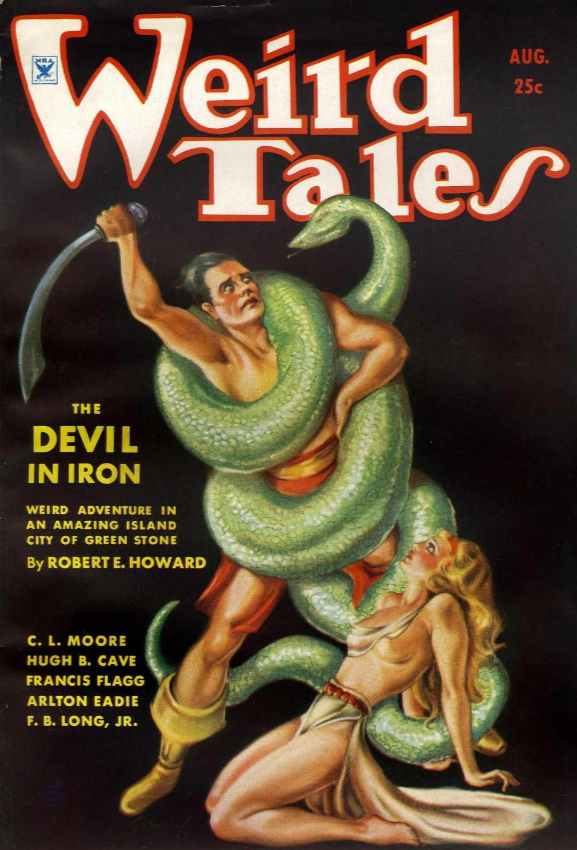
A Brundage Classic! Conan (looking a LOT like Douglas Fairbanks to me) battling a huge and suspiciously phallic snake while a nearly naked blonde girl looks on. REH’s story has a great title here, but it’s only a so-so Conan yarn, in my opinion, fairly bland and straightforward with a kind of improbable deus-ex-machina-esque magic weapon resolution that is extremely unsatisfying to me, personally. BUT I think you can see that ol’ REH was a quick study and had already figured out how to ensure his story got the cover work – he’s WELL into the mode of adding a gratuitous scene of a woman being menaced, well aware that THAT was exactly the sort of thing the mag liked to have for it’s covers. And it worked!

Not a bad ToC – there’s that Mary Counselman story I mentioned last time, the one that at some point was voted by the readers of Weird Tales as the BEST STORY EVER PUBLISHED in the magazine. Honestly kind of inexplicable, to me. Got some Long and some Smith in their two, but again, for my tastes, top-o-the-heap belongs to Moore this issue! So let’s dive in!

The title illustration here is really interesting and, I think, reveals something important about Moore’s work. The composition is great, a figure hanging precariously from a rope and descending into darkness and the unknown. You get a real sense of danger and foreboding, and the menace and mystery of the cave is also well portrayed – with the man hanging helpless over the a pit and the small figure in perspective holding the light and the rope drawn, you get an almost agoraphobic sensation, a feeling that the darkness framing the scene extends on and on (and on) into illimitable gulfs just beyond the edge of the picture. It’s a fantastic illustration for an adventure story, but what’s interesting is that this particular tale is… science fiction!

“Dust of Gods” is a Northwest Smith story; it’s set on Mars, they’ve got heat guns and space ships and such, there’re aliens and planets and all that. But that illustration is a sword and sorcery scene! It wouldn’t be out of place in a dungeons and dragons adventure! They’ve got strange tunic/tabard things, there’s a dagger on his belt, and those helmets are 100% fantasy man-at-arms style basinets, you know? The one incontrovertibly “high technological” piece of equipment is the flashlight the one figure is holding, but that’s it – this is a fantasy illustration, which is fitting because the story is actually all about gods and magic. I think this illustration actually captures something that C.L. Moore did really well, which is the blending of different genres, using their conventions and approaches in interesting ways, something that’s perhaps easier to do in first decade or so after a genre’s establishment. But keep it in mind, this sci-fi/fantasy melding, because we’ll talk about it at the end of this one.

But for now, let’s get into it! We join Northwest Smith and his Venusian buddy Yarol doing what they do best: getting drunk in a Martian dive bar!

That’s the dream, isn’t it? Day-drinkin’ on Mars! What a life! Except, of course, NW and Yarol are broke as hell, carefully nursing their bottle of martian whiskey in the saloon. So great is Yarol’s thirst that he actually suggests they fuckin’ knock the bar over – his heat gun has a fresh charge, so why not? Luckily, NW calms his friend down and suggests they try and find someone to hire them instead:

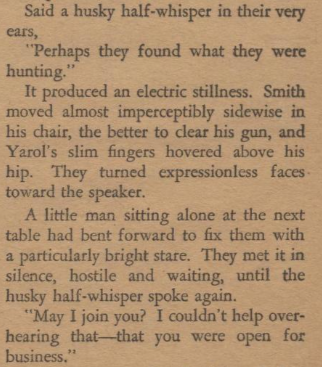
But it seems like everybody in the bar is as hard up as they are, honestly. Everybody looks pretty hardscabble, especially a pair of roughnecks a table over, a “little red-faced earthman” and a one-eyed martian drylander, that Yarol seems to recognize. The two of them are “hunters,” presumably tough guys who go out into the unforgiving martian wastelands on tough and (most likely) illegal jobs. But NW notes that these two bad asses look less like hunters, and more like the hunted themselves; they’re nervous, looking over their shoulders and watching the door, generally actin’ a little squirrely. What could’ve gotten them like that, he wonders…and a mysterious stranger answers him:

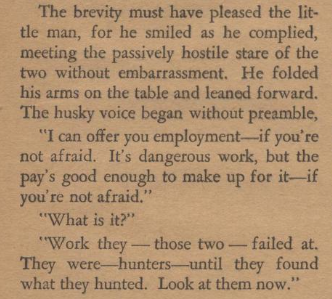
Hangin’ around a bar is better than LinkedIn! Northwest gives the little man the ol’ once over, and is intrigued that he can’t place his species or origin at all – he could be human, venusian, canal-martian or drylander, and his words seems to be carefully generic, utilizing enough spaceman slang to obliterate any telltale idioms of speech that might betray his origin. All in all a mysterious guy, and hey! He’s hiring!

Credit where credit is due, this little weirdo is at least trying to make sure Northwest and Yarol know what they’re getting into. Those other guys were good, but they failed and look at them now. It’s a grim and perilous adventure that is in the offing here.

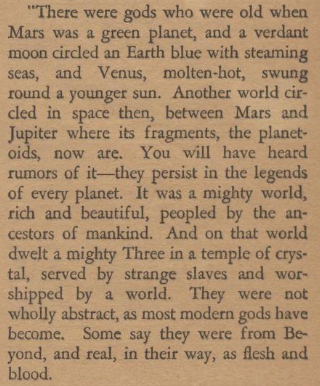
Smith asks the little guy about the job, and he gets a little bit of space theology as preamble:

These are some very Lovecraftian gods, in that they’re materially and physically real, albeit in a weird, transcosmic way – their flesh and blood ain’t like ours, and they come from Somewhere Else. Continuing with Sunday School, the little guy explains that these mighty Three reigned over the planet between Mars and Jupiter and are the ultimate source of all the gods and myths on all the other planets. Two of the triumvirate, Saig and Lsa, are long gone and forgotten, but the most powerful member of their ménage yet remains in the minds and myths of people today…Pharol!

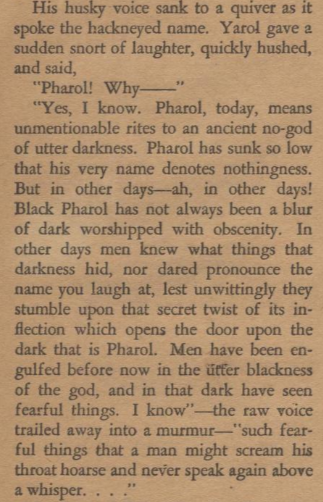
If you read the previous story in Moorevember, “Shambleau,” then you might recognize the name “Pharol.” It was used as an explicative a couple times, and it was hinted that Pharol-worship was an evil and secretive thing that people did in the dark.

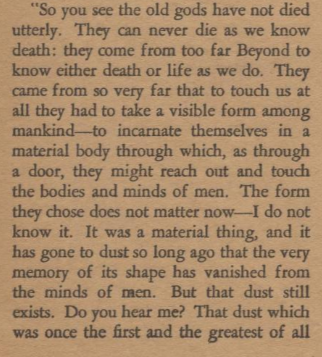
This is just some top-notch “ancient evil gods” stuff, really perfectly done. It has all the hallmarks you want in something like this, ancient mysteries, lost civilizations, hints of secret truths and dark magic…but what, exactly, is the job that this little freak wants done?

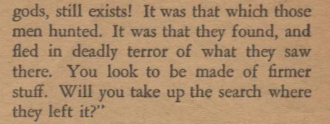
Sounds like a job for Conan, honestly, but if he’s unavailable, maybe Northwest Smith and Yarol the Venusian will do? Now, going in and dustbustering up the remains of a god SEEMS pretty straightforward, but those two hunters look pretty rough…NW asks if the little feller would mind very much if they took a moment to consult with those two about it, and the little guy shrugs and says “go ahead.”

The two hunters are a pretty ragged pair, and up close the madness that seems to be afflicting them is all the more evident – they’ve seen some shit, and even drunk as they are there’s still a sense that these two hunters have gone over the edge and won’t be coming back anytime soon. They mumble about caves and tunnels and polar mountains, and some kind of horrible “white thing” that menaced them. NW and Yarol realize that, aside from spook stories and a general sense of unease, they’re going to have to go in blind on this one. But still, Smith is interested:

Smith and Yarol do end up wanting to know exactly why this little weird dude wants the dust of a dead god, and they get a perfect “mad sorcerer” answer:

To normal folks like you or me, this answer might give us pause; perhaps the obviously insane guy should not be allowed to rend the veil between realities and enslave an ancient hell god? But for NW and Yarol, it’s just business – a guarantee of $50K for the dust, and they’re off, streaking northward to the Martian pole in search of the remains of Pharol.

Moore is great at describing environments; she imbues the Martian landscape with a lot of portentousness and significance as the two of them spend many days flying over the planet…you get a sense of the weight of time and depth of changes that’re sunk into Mars, the epic grandeur of a dying world. That Deep Time perspective is a key attribute of weird fiction, but I think Moore does a nice job giving us the chance to see and experience it through the characters eyes. I also think that sword and sorcery (a subgenre of weird fiction) is where that environmental kind of writing finds its best expression, so it’s not too surprising that she nails it here, since this is more of a S&S story than a sci-fi or straight weird tale.

They find their million-year old city, a ruin wracked by Martian tectonism. In the twisted cliffs of the polar mountains they spot a cavern and, guns drawn and “Tomlinson tubes” (Martian flashlights) ablaze, they cautiously pierce the darkness and begin their trek.

The darkness that has crashed over them is clearly unnatural; Smith feels the end of his light and notes that it is both warm and still slightly vibrating, indicating that it’s still on. Something alien has engulfed them, a pure and almost tangible darkness. Prepared in a vague way by the maddened hunters they spoke to in the bar, Smith and Yarol wait, guns drawn.

We knew we were deep into Cosmic Weirdness when Moore introduced ancient, alien, unknowable gods back in the bar, but this White Thing in the tunnel is a really perfect example of a real weird menace, isn’t it? I mean, what even is it? Preceded by a shroud of pure, almost elemental darkness, and something so bright and blazingly white that it almost sickens Smith to look at it…that’s some strange stuff!! It’s obviously dangerous, but how? What is the threat this thing represents? Smith and Yarol have, in some way, transgressed a cosmic boundary in the tunnel, leaving our world behind and entering a space where, somehow, different rules apply. Truly gorgeous weirdness.

Smith and Yarol are frozen to the spot, watching this White Thing advance through the perfect darkness towards them. Smith notes that it seems to be moving through the cave floor beneath it, extending below the rock despite have some kind of tangible form. There’s also something else, some kind of dangerous, madness-inducing aura in the thing that seems to be threatening Smith and Yarol’s very minds by being in the Thing’s presence.

Smith, noticing that there’s no shadow on the White Thing and that it seems to be moving through the real world rather than in it, does what any red-blooded amoral space smuggler would so, and blasts the thing with his heat gun. It has no effect, of course, but that’s telling in itself! The ray has NO effect, with even the deadly blue light from the gun’s blasts failing to be reflected on its surface; the cavern flashes blue, the rocks are tinged with color, but there’s no change in the White Thing’s color or form or shade or nuthin’ which, to Smith, means that the Thing is beyond our reality and incapable of interacting with it. So he grabs Yarol, shouts “come one!” and plunges INTO and THROUGH the White Thing!

That’s some solid sword-and-sorcery hero shit from Northwest Smith there – just fuckin’ GO FOR IT, what, you wanna live forever? And it succeeds, somehow! Now, this is legit kind of confusing, but I think it works thematically, and it gets reinforced by the rest of the story later on, too. What happened was that, like Smith intuited, the White Thing wasn’t physically real; it was something From Beyond, and presumably the madness effect that got the previous hunters and ALMOST got Smith and Yarol is, basically, just the incommensurability inherent to stuff from our universe experiencing stuff from another “dimension” or whatever. This jives with what the wizard at the beginning of the story said about the gods – they had to incarnate in some kind of material sense to actually interact with our worlds, and that that matter produced some kind of connection between our universe and theirs.

This is further elaborated when Smith and Yarol trek further down the tunnel. They encounter a huge stone door sealing the rest of the temple away, burn through it with their heat guns, and release a torrent of liquid-like light that flows out of the chambers and into the tunnel (which is a great, weird image, isn’t it?). Smith suddenly realizes that this inner chamber must be an asteroid, exploded off of the lost planet between Jupiter and Mars, and that that was how the gods arrived on the planet. It also explains the weird White Thing and the strange river of light that’s oozing out into the tunnel – it’s alien stuff, the last little glimmer of whatever alien dimensional weirdness that dwelled with the gods in this asteroid temple chamber.

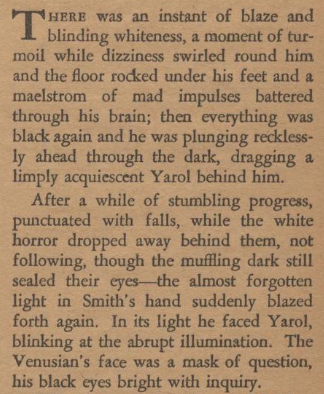
Smith and Yarol have to contend with ANOTHER threat from beyond, this time the inverse of the White Thing; a thing of perfect and terrible darkness this time that, Smith realizes, is basically bobbing along and caught up in the flow of light pouring out as the asteroid “drains.” Then, finally, they reach the central chamber, a vast crystalline room with three strange, inhuman thrones in the middle. Two are empty, but on the largest central throne-pillar lies a mound of strange gray dust.

Yarol, irreverent Venusian that he is, scrambles up the pillar and calls to Smith to toss him up the box; he’s ready to sweep up the dust and get out of there. But Smith hesitates, and in a moment of nearly telepathic simpatico, both of them realize that they’re dealing with some Serious Shit here. There really is weird ultradimensional stuff in this million-year old temple, and the implication is dire. That wizard seemed kinda bonkers, right? Might not be the best guy to give absolute power to, you know? And what if he CAN’T control the dead god like he thinks he can, and instead just opens up a doorway that he can’t close to whatever bizarro hell dimension Pharol calls home?

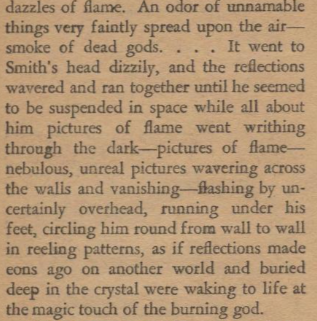
In the end, Smith and Yarol decide this dust is too dangerous, and so they train their heat guns on it and roast the stuff. Maybe shoulda taken it outside in the open air and done it, though, because as the stuff slowly burns it releases roiling clouds of hallucinogenic smoke.

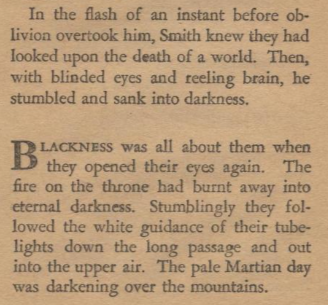
Drunk off the fumes, Smith witnesses vast psychedelic vistas of time and space, the entire history of the vanished and destroyed world that the Three ancient alien gods had ruled over for so long. Ancient cities razed by nameless weapons wielded by strange beings all in lost, distant ages, and finally the destruction of the world.

And that’s the end!

Obviously, I like this story a lot. I’m a fan of sword and sorcery, of course, and I really think that, sci-fi trappings aside, this one is absolutely a sword-and-sorcery story. It ticks all the boxes in the genre, for sure: the heroes are down on their luck opportunists just trying to make their way through a hard life; the “sorcery” in this story is 100% inimical to human life and ultimately totally alien; and the threats the heroes face are overcome through sheer will, strength, and cunning on their own. Hell, they even start their adventure in a tavern! The fact that it takes place on Mars, that they’ve got heat rays rather than broadswords…none of that really matters, because the themes are there: raw, rugged Humanity (and Venutianity, I guess, in Yarol’s case) ultimately standing bravely against an alien and unnatural force. Smith’s strength is the force of his very human will that lets him both survive the maddening alien energies of the weird monsters he meets as well as realize the correct course of action regarding the god dust at the end of the story.

That said, I think the sci-fi aspect of it DOES give it something that would be missing if it took place in Hyboria or whatever. A big part of this story is about time, particularly at a geological or astronomical scale, and the smallness of civilization in the face of that reality. Now that’s a theme that’s often in sword and sorcery; REH’s stuff, for instance, is explicitly set in a pre-Ice Age world well before anything like recorded history (a common enough idea in a lot of fantasy), and there’re often ancient ruins and lost civilizations of an elder age involved, sure, but I think there’s a difference. By setting it in the future, on another planet, you immediately anchor the story in a way that’s more concrete than just saying “eh, a long-ass time ago.” There’s also, I think, something in the way people engage with sci-fi that is fundamentally different than the way they engage with fantasy – the counternarrative aspect of fictionalized history immediately breaks absolute verisimilitude, which is fine, that’s often the point. But a story set in the future CAN’T be counterfactual since it hasn’t happened yet, and that lets the reader immerse themselves in a different and more realistic way, I think, with the events of the story.

Furthermore, I think there’s an interesting “step-up” effect going on here. Obviously, Smith lives in the future – there’s interplanetary travel, ray guns, all sorts of highly advanced technology, but more importantly there’s very little connecting the world of NW Smith to any of the political, social, or technological entities a reader would be familiar with, right? No “North American League” or “Earth-Venus War of 2122” whatever, right? I mean, they don’t even have flashlights…they have “Tomlinson tubes.” Because of all that, my brain has been eased into something where the time difference feels like many hundreds of years, maybe close to a thousand years, in the future! That’s a long time! But then in the story you’re confronted with even LONGER time frames, millions of years, which makes that first time difference paltry and, realistically, inconsequential. The Martian temple turns out to be a fragment from an exploded planet…it’s LITERALLY older than the mountains it’s trapped in. That kind of kaleidoscopic sense of temporal scale is something that I think you’d struggle to evoke in a pure fantasy story, where you’d just have to tell me “ah this temple is Atlanean” or “it’s from the ancient lost Empire of Magokai,” both of which I as a reader wouldn’t have a visceral connection to, right? There’s no reference point for me to stand on and take in the vast sweep of time there. It takes a science fiction framing, a “realer” world by default, to construct a dialectic of time that REALLY contrasts the future with the past.

There are some similarities in this story to other Moore works, even ones that came out this very same year; in particular, the “tunnel to another world, where alien rules apply” gets cranked up to eleven in the Jirel story “Black God’s Kiss” (which we’ll be doing soon, don’t worry!), but I don’t mind it. Every writer has their themes and interests, and I think Moore wants to play with the way people confront and experience the alien. As weird fiction, the story is a blast too – the strange threats are TRULY bizarre, with nothing you can really hang an interpretation on. They don’t even appear to be made of matter as we understand it, and yet they’re described seriously and hauntingly; I think it’s a real triumph of the genre, something people can spend a lifetime trying to capture in their own writing.

Whew, another long one this week, but I really think Moore is worth the effort, and that she rewards you in the end for thoughtfully enjoying her work. And, aside from the genre tropes and themes, I think honestly the writing is just really good – there’s some good descriptions and evocative language, and the way Smith and Yarol act is natural and believable and real and, honestly, fun. In conclusion, all hail C.L. Moore, I guess!

Strainin’ the Pulp, number…12, I think? “Shambleau” by C.L. Moore!!! (Weird Tales, v.22, n.5, Nov 1933)

Well, another Hallowe’en in the books – here we are, well into November, but BY AZATHOTH we’re STILL going to be talking about pulp stories from Weird Tales! And today’s story is, honestly, one of the best ever published in the magazine, written by one of the True Masters…”Shambleau” by the incomparable C.L. Moore herself!

Catherine Lucille Moore is one of those towering figures who emerged from the pulps and became this hugely important figure in the history of genre literature, both because of the kinds of stories she wrote as well as the fact that she was a woman while she wrote ’em. Now, she’s not the first woman to appear in Weird Tales, of course – Clare Harris had written under her own name in Weird Tales, and Greye La Spina and G.G. Pendarves had appeared in the magazine before her – but she is probably the most famous member of that early pioneering generation. Moore was extremely popular with the readers of Weird Tales (and other magazines, when she branched out), and her works have also been more durable than most of her contemporaries (regardless of their gender), and continue to be anthologized today.

This speaks primarily to the quality of her writing; in my opinion, Moore is one of the greatest genre writers of all time, capably combining complex characters and interesting ideas to make some really remarkable pieces of fiction. We WILL be talking about her sword and sorcery masterpiece “Jirel of Joiry” in December, and we’ll probably have to leap forward in time to talk about her story “No Woman Born” from Astounding (which is one of the greatest short stories of ALL TIME)…in fact, maybe we should just declare a C.L. Moore month right now!

That would be fitting because apparently, when Farnsworth Write pulled “Shambleau” out of the slush pile and read it, he declared it “C.L. Moore Day” at the offices of Weird Tales, closed up shop, and took everybody out for drinks. He thought it was that good and, honestly, he’s right, particularly when you compare it to the other stuff in the magazine around that time. Don’t get me wrong, there’s plenty of good writing in Weird Tales – but Moore is just head-and shoulders above most of it.

Since I’ve convinced myself that we’re doin’ Moorevember this month, we’ll spread her bio and suchlike out over the next few week…so let’s get into it!

Just a Girl and her Skull, that classic pairing. It’s a Brundage, of course, although a fairly chaste one for her…lotta leg and a generous helping of sideboob, but nothing too spicy. She’s not even tied up! It’s also kind of odd that there’s no titles or authors or anything on this cover, and I don’t even think the painting is meant to reflect a story in this issue at all. I don’t know why that is, to tell you the truth. Maybe they were trying something new out? It’s a shame, because I actually would’ve liked to have seen a full Brundage take on “Shambleau.”

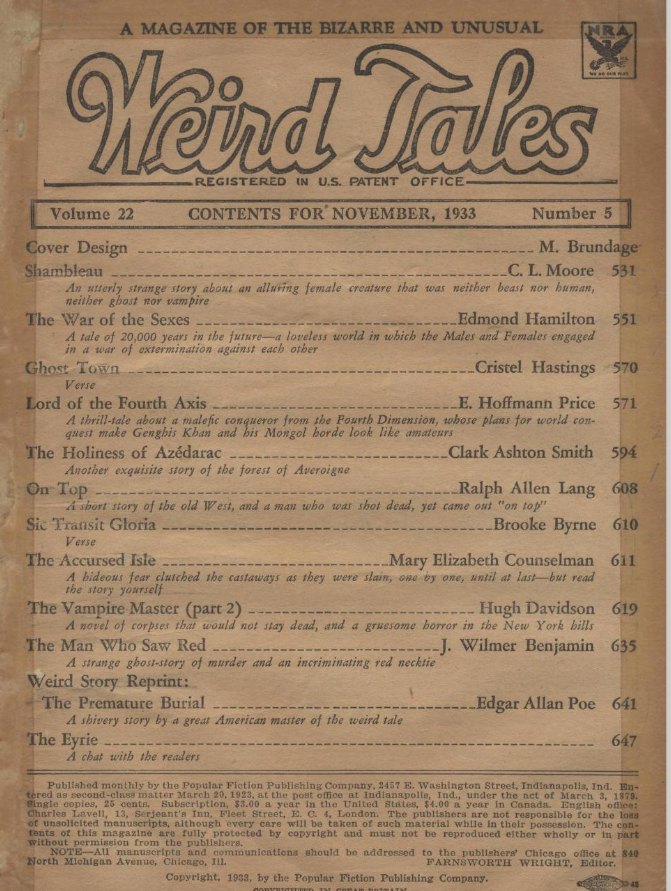
But, anyway, the ToC for this Nov 1933 issue:

Speaking of women writers in Weird Tales, check out Mary Elizabeth Counselman here…she’s a pretty famous pulp writer, did a lot of poetry and short stories in a lot of different magazines. Mostly she’s known for the story “Three Marked Pennies,” which was one of the most popular stories in Weird Tales history, weirdly – it’s fine, but just goes to show how hard-to-pin-down the tastes of readers can be, in my opinion. She seems like a rad lady though because she lived on a houseboat in Alabama with a zillion cats. Sounds great to me!

There’s also some Clark Ashton Smith with a (slightly silly) Averoigne tale and ol’ E. Hoffmann Price still crankin’ out some serious two-fisted cornball pulp, Yog-Sothoth bless him. But pride of place goes to Moore with this, her very first professional story! So let’s get into it!

Big ol’ title illo for this one, by Jayem Wilcox (aka J.M. Wilcox) which, while kind of giving away too much of the action from the story, is still fun. You can see why I wish Brundage had been able to take a swing at it, though – it’s a total reversal of her usual “woman in peril” scene, and it would’ve been neat to see her take on a seductive and deadly monster girl menacing a big tough space man. But Oh Well!

This story begins with a little italicized intro that I won’t reproduce here. To summarize, it basically says that Humans have been to space before now, that in the distant pass of Atlantis etc there were space ships and such, and what that means is that even after the fall of those starfaring civilizations, tales of space had influenced human culture, and that’s where our monster myths came from. It’s always struck me a little strange, but maybe it was Moore just wanting to set up that, yes, this is a “pseudo-science” story (the parlance that Weird Tales used for science fiction, which was still emerging at the time) BUT there’s weird monsters, so keep reading! I feel like it’s unnecessary though, and actually maybe detracts from the story, at least for me. A little to “here’s what we’re talking about today” for my tastes, I guess. But moving on:

Now THAT’S how you do hard-boiled space noir intros! Here we’re introduced to one of the two major, multi-story, recurring characters that Moore created. This one is Northwest Smith, a grim, cynical, hard-bitten, tough-as-hell spaceman from Earth. He’s a smuggler and a criminal, mostly amoral but with a little glint of heroism beneath all the grime that comes from fighting and surviving in an unforgiving universe. A little Hammett’s Continental Op, a little Han Solo. A great character, and also the sort of people Moore was interested in writing about: complicated but capable.

As a side-note, the name is worth talking about. Apparently Moore, who worked at a Trust Company as a Secretary, addressed an enveloped one day to a “Mr. N.W. Smith” and she just loved the name. She originally wrote him as a western hero, but kept the name (and the gun-slinger mannerisms) when he became a sci-fi hero because she thought it was funny for a guy in space to have a direction as a nickname.

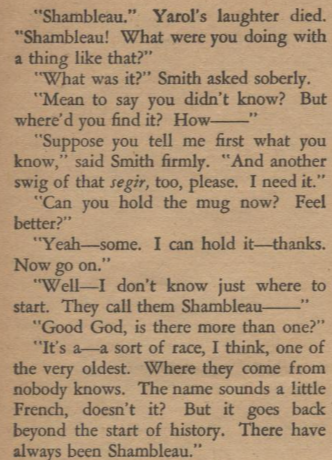
So Northwest Smith is hanging out on Mars in a real frontier town, when he hears a mob shouting the strange word “Shambleau!” in the distance. An odd word, and it really seems to hit you as a reader, doesn’t it? Compared to the harsher and more guttural Martian name of the town (Lakkdarol), it stands out! Smith has no idea what it means, but he knows trouble when he hears it – he steps into a doorway and pulls his ray gun. Then, he sees a girl:

Even a rough customer like Smith can’t help but be touched by the sight of a sexy scared girl! He tucks her behind him just as the mob comes around the corner, still bellowing “Shambleau!” and obviously hunting for her.

I mean, he’s just cool as hell, you know? Anyway, this mob turns and sees that Smith has the girl. An Earther, acting as a kind of leader of the mob shouts “Shambleau!” again and they rush forwards, apparently intent on taking the girl regardless of Smith’s obvious badassery.

You can see the cowboy influence in Northwest Smith’s literary heritage pretty strongly here. The crowd seems shockingly and specifically bloodthirsty; they want the girl, and demands that ol NW give her up to them, which he resolutely refuses to do. The mob seems almost confused by his defiance.

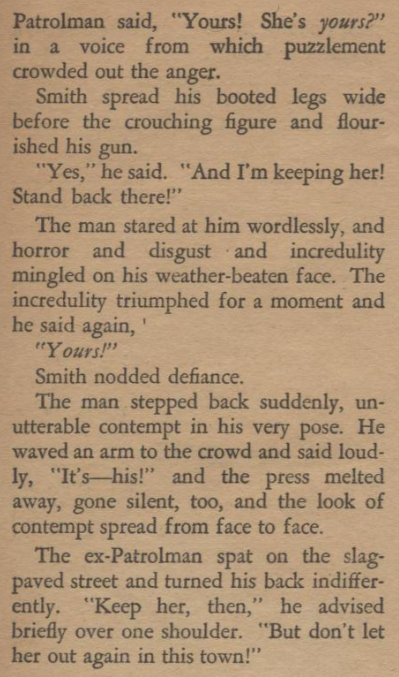
There’s some more back and forth, and things seem to be deteriorating. Smith knows he’s not going to die for this girl, but he is preparing himself to take a beating from this mob, when something odd happens; he shout’s “She’s mine!” and the mood of the mob shifts suddenly and surprisingly.

A really great, really weird scene, isn’t it? The furious mob turning suddenly away once NW has “claimed” this woman…it’s very sinister, something like out of one of the grimmer fairy tales, maybe. It’s also kind of upsetting, isn’t it? I mean, it’s a straight-up lynch mob, a very real and very unpleasant part of American life then. We’ll circle back around to the topic when we reach the end of the story, but it’s worth noting here, I think.

Smith is as puzzled by the mob’s reaction as we are. He particularly notes the open disgust the crowd now has for him, even as it melts quickly away. As he’s considering it, the girl rises from the slumped heap at his feet, and he gets his first good look at her.

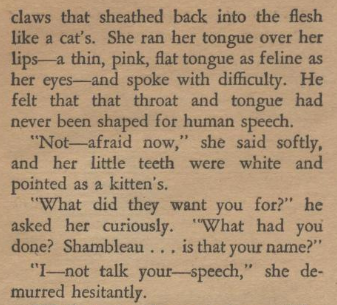
A weird hairless alien, sharp-toothed and with cat-like eyes and claws, but hey – she’s got curves in all the right place, amirite!? She don’t speak Earth language none too good, though, and NW has a kind of strange, confusing conversation with her.

NW asks her what her native language is; he’s an adventurer, after all, and has learned enough to get by in all sorts of alien tongues. This elicits an odd reaction from the alien woman:

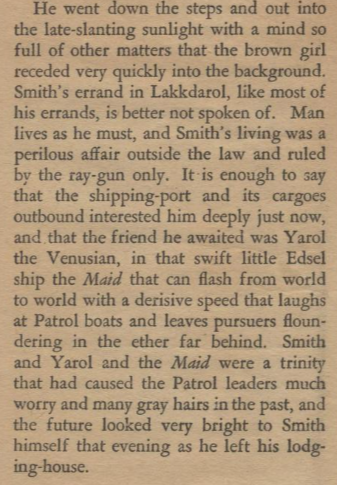
Gettin’ steamy in the filthy back alleys of Lakkdarol, huh? Anyway, there’s another encounter with a drunken Martian who apparently recognizes the Shambleau and reproduces in miniature the scene with the mob: fury, then disgust at NW for “claiming” the girl, with a warning to NW to keep her from “getting out.” Smith realizes that the girl isn’t safe on her own in the Martian town, and decides that the only thing he can reasonably do is get her indoors. Since she’s got no place to go, he takes her back to his lodging room. He asks if she’s eaten; she says she will not need to food “for some time” which is the space monster equivalent of dracula’s “I don’t drink…wine.” But he’s got business to attend to, so he leaves her there in his room, fully expecting her to be gone when he gets back.

There’s some great space noir writing here, so let’s just savor it, shall we?

Great stuff! Smith gets his drink on in town, and comes back feelin’ pretty darn good – he’s done the work he needed to do, drank a bunch of weird italicized space booze, and now he’s just got to wait around until his Venusian partner-in-crime Yarol comes back and they can start the obviously criminal enterprise they’re engaged in. But when he gets back to the room, he finds that the Shambleau is still there…and lookin’ pretty good…

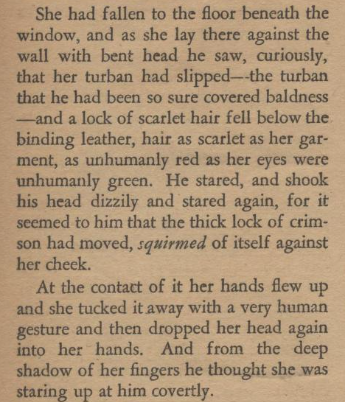
But just as things start to get hot and heavy, Smith experiences a sudden wave of revulsion! There’s a good bit of writerly skill on display here, as Moore describes Smith’s appraisal of this sexy alien girl with appropriately sexual and sensual imagery…but then takes that same imagery and recasts it as horrible and animalistic…sure, she’s sexy like a cat, but she’s also a scary predator like a cat. And maybe there’s something deeper there too, because Smith begins to see something truly alien and, maybe, truly loathsome in her weird cat-like eyes. Suddenly squicked out, Smith pushes her away and in the sudden violence her turban shifts a little:

She’s hidin’ some weird wiggly hair under there!

Smith attributes his lust, his revulsion, AND the weird sight of independently moving hair to all the Martian liquor he’d been sucking back all afternoon. He laughs, tosses the Shambleau a heap of blankets, points her to a spot on the floor for her very own, and then decides to sleep it off in his own bed. And then he dreams…

At this point it’s no secret what, broadly, is going on – this Shambleau-girl thing’s weird hard is doing something unnatural to Smith in the night. And he kinda digs it, though he experiences the same sort of weird revulsion at the pleasure he’s experiencing…there’s something deeply existentially wrong about what’s happening, perhaps made more so because it IS so pleasurable.

The weirdness of the dream fades, leaving only Smith with only a vague sense of both wrongness and titillation. He leaves to do some more vaguely crime or crime-adjacent type work, stopping to get a collection of food stuffs for the girl who, OF COURSE, must be getting hungry, right!? There’s also a brief scene that mentions a song that is kind of famous in the world of sci-fi:

The song mentioned here, The Green Hills of Earth, inspired Heinlein to write a story of the same name, about a wandering space bard whose greatest work is that very song. Heinlein’s story was published in the Saturday Evening Post in 1947, one of the first of the genre works to break out of the pulps and into the fancy slicks, a huge deal for the sci-fi world at the time. Kinda neat to see him calling back to Moore like that!

Anyway, turns out the girl doesn’t like roast beer OR Venusian frog-broth or anything at all! She’ll eat when she’s hungry, she says, don’t worry about it. Seems fine, right? Nothing weird at all going on, I’m sure. Anyway, Smith, exhausted from his hard day of crimes, konks out…and then awakens with a horrible (and yet, somehow, exciting!) sense of foreboding…

Smith watches, hypnotized, as her weird worm hair keeps growing, lengthening and extending out of her head, writhing and squirming as it keeps growing.

Wild! And gross! Wrapped in her weird wriggling red tendrils, she turns and hits Smith with the ol’ psychic whammy from her green cat-eyes. He’s paralyzed! There’s some great lingering descriptions of this tiny girl nearly lost in a cascade of scarlet, having to part the writhing mass on her head “like a swimmer” in order to move towards him.

That “I shall speak to you now in my own tongue” is pretty great – what IS going on here!?

Doesn’t get much more sexual than that, does it? I mean, he’s literally engulfed by this cascade of red organic matter.

And we fade out to tasteful black as Northwest Smith, wrapped in the pulsating red head tentacles of a horrible space monster experiences a mingling of pleasure and horror beyond all human comprehension.

Right away at the beginning of the next section we’re introduced to a sleekly dangerous Venusian, arriving at Smith’s room. This is Yarol, his partner in a crime, and a little further on we learn that he’s arrived to find that none of the footwork he was expecting has been done, and that no one has seen Smith for THREE WHOLE DAYS. Wowzers, huh? Worried, he’s come to check on his friend. And what does he find?

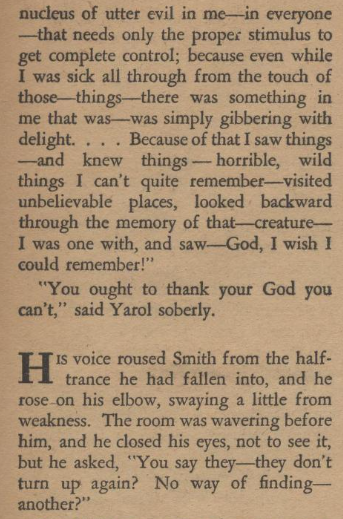
Should’ve put a tie on the doorknob, man! There follows some really great, really viscid description of the scene that Yarol congronts: Smith, entangled in the writhing tendrils, slick head-to-toe from their slime, seems lost to some kind of weird drugged out reverie. Yarol calls to him, and eventually Smith shambles to his feet, still wrapped in a wriggling mass of red wormy tentacles that caress and stroke him with seeming tenderness, but all he can say is “Get out,” over and over again, the words and intonation monotone and devoid of emotion. Undaunted, the Venusian keeps calling to his friend, and apparently annoys the Shambleau enough that it too emerges from the red wiggly lovenest:

Wave after wave of psychic force crash into Yarol, but the depth of Venusian folklore have given Yarol enough sense to know he’s in danger, and that gives him a desperate courage that lets him shake off the mental domination of the Shambleau. He somehow gets a hold of Smith’s shoulder and is able to bodily rip him from the strange embrace of the slimy worm-hair-things. As he does, Yarol comes in contact with the tendrils, and experiences the same confusing blend of pleasure-horror and the secret desire to yield to the lassitude and just sink into the folds of this giant red wiggly mass.

Yarol knows they’re in deadly danger, but luckily, a cracked mirror on the walls lets him pull a Perseus; he uses the mirror to aim his ray gun over his shoulder, and kills the horrible Shambleau!

Smith has been shaken to his core; afterall, he’s been in a clinch with the Shambleau for three goddamn days! Yarol pours more steadying space liquor into him, and then he and Smith do some talking.

There’s a couple of pages of Yarol talking about the lore and history and rumors of these strange, ancient, monstrous things. They’re an ancient and terrible evil, something whispered about on different worlds and by different peoples. But what ARE they, asks Smith, and Yarol answers:

So the Shambleau is a weird life-force draining predator, something that derives its sustenance from the emotional and vital energies of its victims. It’s good and weird and creepy…but is there more to it? Remember the “now I’ll talk to you in my language!” stuff? Well, seems that while Smith was in the things thrall, he was seeing and remembering things that weren’t his memories or experiences…

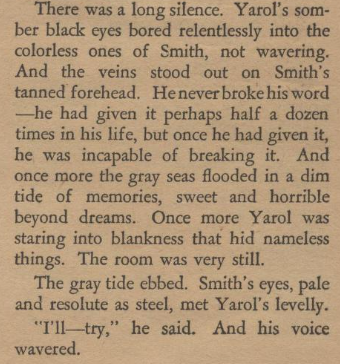
How’s that little quote at the end of that section there for chilling, huh? Has Smith become, in some way, addicted (or nearly so) to the Shambleau’s darkly pleasurable illumination. He can’t remember the strange, alien things he experienced…but has he been freed, actually? Yarol shakes his friend and, since he just saved his life, basically immediately calls in the favor and demands that Smith promise him that, if he EVER runs across a Shambleau again, he’ll cut it down with his ray gun immediately! And Smith’s answer?

And THAT’S the end of the story.

Hell of a ride, huh? Really some great writing in there, too – the Shambleau is a weird-as-hell monster, and the whole horror of it is so unusual and mysterious and alien. The communication aspect of its feeding mechanism is interesting – there’s an exchange of not just life force but also information, experience, and memory that happens. Is the dark drive that makes the horror of the Shambleau so pleasurable tied up in that, a kind of personal, existential oblivion that overwhelms the need for survival in an individual? Is the Shambleau even conventionally “evil?” There’s the usual “perhaps we are as ants to them” stuff in this story, but it’s so much better developed; the Shambleau is truly and weirdly alien enough that you actually CAN much more easily begin to question whether our morals and ethics can apply to something like that.

It’s SO alien, though, that I kind of think the “ah, it is the medusa of legend” detracts a little from it, you know? I think you could yank ALL that out of here and be left with at least as good of a story (if not a better one), but maybe that’s just me. I sort of feel like that, in an attempt to make it weirder, Moore kind of undercut it by adding all that in.

The attempted lynching is a rough spot though, particularly because in the story the mob is right. The Shambleau is a dangerous monster in their midst, after all, unequivocally so! It’ll hypno you and suck out all your life force, and you’ll beg it to do it! I don’t think Moore is saying anything about lynchings or mobs or trying to make any kind of argument about actual real racial violence, but as readers we’re still forced to confront it and its place in the history of literature. In fact, it’s kind of interesting that Northwest Smith, originally a cowboy character, is introduced in an extremely cowboy story fashion. Take out all the sci-fi trappings of that early section, and you could plop that whole scene into a pulp western story and never even know it had ever been anything else.

I do think that Moore is interested in female agency, though; it’s certainly a topic that comes up again and again in her stories, as we’ll see as we move through Moorevember. Particularly in the pulps of the 30s, there’s a dearth of women characters doing much more than being menaced and/or saved (and that’s when the even show up) so to have a female character AS the menace is interesting here. And while she’s a monster, the Shambleau is also very much portrayed as a woman (even if she’s maybe really a mass of weird worms) – her positionality with regards to Smith makes that clear, and the way that Moore describes her makes her out to be elementally and animalistically female. Importantly though, the Shambleau as written is not using sex to get what she wants, as some sort of trap or lure. It seems very clear that she is, if you’ll excuse my indelicacy, getting off on the weird life force sucking/mental link up too! Now, there’s a long history in lit of portraying how women’s pleasure, when unchecked, becomes monstrous and threatening; maybe this trucks in that same sort of stuff, but it does seem different somehow, doesn’t it? But even if it is as simple as “this sexpot is destructive!” I think there IS a difference in the way that the Shambleau is written – she’s not reductively monstrous, right, meaning that she’s not just this vagina dentata running around eating men because it’s fun – she’s an ancient and alien species, with pride and dignity, and that makes her a much deeper and more interesting threat.

Speaking of sex, you can’t ignore the strange homoerotic undertones to Yarol and Smith either, can you? It’s almost passé, but there IS a kind of rough tenderness between the two of them, particularly when Yarol is nursing Smith back to health.

What’s obvious is the richness of the text, though; I can understand why Wright declared a “C.L. Moore Day” after reading it. It’s really well written and, of course, there’s a good monster in there. But there’s a lot of depth to it, and I think Smith IS one of the great sci-fi characters of that era of writing. He’s hardboiled and two-fisted, but that’s never “the point” with him, and he’s even made the victim in this story, something that I’m sure made some readers at least uncomfortable. I haven’t done it, but it might be worth going through subsequent letter sections of Weird Tales to see what people wrote in about this story.

Anyway, I obviously can’t recommend this one enough! It’s a great story that stands up to anything written today, in my opinion, and I really hope ya’ll have taken the time to read it! And, having read it, I hope ya’ll are excited as me about Moorevember!

Pulp straining, Number the 11th! Hallowe’en Eve LOVECRAFT edition! “The Music of Erich Zann” by H.P. Lovecraft, Weird Tales, v. 5 n. 5, 1925

Try as you might, you can never really escape the shadow of H.P. Lovecraft when you’re talkin’ about weird fiction. Easily one of the 20th century’s most important figures in horror, science fiction, AND pop culture, his influence looms over basically everything – Borges, Bradbury, Harlan Ellison, Fantasy, Joyce Carol Oates, Horror, Stephen King, Video Games, Role Playing Games, Comic books…I mean hell, there’s even a Ghostbusters cartoon with Cthulhu in it! Tentacular horrors from beyond our dimension, cosmic nihilism, insane cultists making dark deals with incomprehensible forces…while these weren’t Lovecraft’s inventions, they were certainly perfected and, I daresay, communicated most effectively in his stories – there are strange gibbering horrors and alien gods and bizarre tales of a hostile inhuman universe before him, but his unique ability to synthesize these influences while developing his own aesthetic makes him kind of unique.

And, of course, he had the pulps, giving his stories an unprecedented audience – Weird Tales had an estimated distribution of 40,000 magazines per issue at its height! Can you imagine 40,000 people reading ANY single short story now? And that’s not counting the well-documented tradition of sharing single issues among multiple people, making that audience number a definite lowball estimate. Hard to even imagine short stories being that huge of a part of popular entertainment!

His popularity means there’s a glut of Lovecraft these days, both in terms of his own stories as well as scholarship on the man. Because of this, I was generally trying to avoid talking too much about him here…but when I did a previous installment on Long’s “Men Who Walk Upon the Air” and saw today’s story on the ToC, I knew I’d have to give in. My only defense is that, like I said in that previous post, I really do think today’s story is both A) extremely good and also B) not as appreciated as ol’ Howie Lovecraft’s other, tentacle-ier writing. So let’s take fifteen, ya’ll go read “The Music of Erich Zann” and, when you’re done, come back here for a little discussion/dissection/discursion on it, okay?

Great title image of the story from good ol’ Andrew Brosnatch there. The viol, the shabby garret, the wide-open window with the dark outside and the curtains billowing and the candle flickering in the wind…it’s great stuff, an atmospheric little illustration of what is, basically, the key element of this story.

“The Music of Erich Zann” was originally published (in ’22) in one of the countless amateur magazines that Lovecraft was a part of. I’ve seen some people describe these as basically the zines of their day, but I think that’s incorrect – while these were printed and put together by hand by individuals as an act of love and artistry, I think they were a lot more similar to the online literary mags we have today. They actively solicited articles, fiction, and prose from their members, and had well established lines of editorial practice and distribution. Lovecraft was a HUGE part of the amateur press scene, and it was only with great hesitation that he got into the pulp market, considering anything you got paid for as being, by definition, not something done for art. That being said, once Lovecraft DID start selling his stories, he was fairly quick to dive into his archives and submit his previously published stuff to Weird Tales.

But let’s get in there, shall we?

For me, that’s one of the great openings in not only Lovecraft, but all of weird fiction. We get right into things and are immediately introduced to the mystery of this missing street and, more fundamentally, the idea that it was there, in the Rue d’Auseil, that this narrator encountered the music of Erich Zann, something that must’ve profoundly affected him. Great, lean, efficient writing!

The narrator goes on to explain that he knows that his time on the Rue d’Auseil was kind of a rough patch for him both physically and mentally, and maybe it had an effect on his memory. Still, he goes on to say, it’s weird that he can’t find the place, because it was SO characteristic and idiosyncratic; it was very close to the University for one thing, but it was a strange, dark neighborhood full of ancient buildings and strange, seemingly very old people. And, interestingly, the river stank in a particularly unique way, something that might help him identify it if he ever smelled it again. This story relies on some kind of unique sensory descriptions to convey weirdness – there’s that smelly river for one thing, but also the central conceit of the story is the strange properties that Erich Zann’s music has. Speaking of which:

Our student of metaphysics does manage to meet Zann one night as the musician is coming home after his shift in the orchestra pit, but it’s an odd meeting. Zann is described as lean and goatish, and there’s a shabby furtiveness to him and, in fact, at first he seems kinda pissed off that this weird college student has been listening in to his music. Still, our narrator perseveres, and eventually the musician brings him up to his room waaaaay at the top of the house and starts playin’ on his viol.

The music is good, stuff that Zann has clearly written himself, but it’s got none of the weird wildness to it that he’d overheard before.

Zann’s freakout it pretty great and unexpected, and his sudden fearfulness of the closed and curtained window when the whistling starts is pretty remarkable. He even goes so far as to try and manhandle the student out of the room, an intolerable boorishness that makes our narrator a little huffy. Mollified, Zann tries a friendlier tact, setting the student down in a chair and writing a note to explain his actions.

A pretty strange note, all in all, and the contorted explanation of being strangely sensitive about his “weirder” music is pretty funny. As is his willingness to get the student to move to another room! Whatever it is about the music, Zann is serious about it! Moved by the old man’s obvious nuttiness, the student agrees, and soon moves to a different and more expensive room on the third floor, leaving Zann alone on the fifth and no one on the fourth.

But it turns out that maybe Zann’s apparent friendliness was a bit of a front – he doesn’t ever invite the student back up, and when the student goes out of his way to invite himself up there, the music is “listless” and kind of dull. And so, to get his weird music fix, our boy starts creeping up there secretly to listen in on Zann:

The building fury of Zann’s playing, and his concomitant physical and mental deterioration, are pretty great images, aren’t they? I mean, imagine it: you sneak up to listen to this crazy music that just keeps getting crazier and crazier, and every day the guy playing it looks rougher and rougher. Extremely evocative, extremely weird!

And then, one night…

Again, good use of aural information here, you can imagine the sound of the window being closed and the sashes drawn before the old man hobbles over to the door to let in our strangely persistent narrator. Zann looks like he’s been going ten rounds with the champ, and he’s preoccupied with that window, listening hard, only finally relaxing a little when he seems satisfied that nothing is happening outside. Then, Zann writes a quick note in his execrable French, imploring the narrator to wait while he writes out a full and detailed account of what has been happening in his native German. Our narrator spends a hour just sitting there in silence while Zann writes furiously, page after page stacking up on the table as he recounts the “marvels and terrors” that he’s been experiencing. Then, suddenly, horribly, there’s a sound from the closed window, and it sends Zann into a frenzy.

Zann’s playing is furious, wild, a kind of mad noisemaking that, the narrator realizes, is inspired by fear alone, fear of something on the other side of the window, something trying to get inside, perhaps? Sweating and contorted with the effort of playing, Zann is desperately sawing at his viol when, steadily, there rises a sound from outside.

A sudden gust catches up Zann manuscript and whirls it towards the window! Oh no!

Absolutely fantastic stuff, top shelf weird writing! Chasing the papers to the open window our narrator sees not Paris, but rather a vast expanse of interstellar space full of motion and music and strange, hostile agency. And it seems like it wants to come into the room, through the window.

The horror of whatever it is that lies beyond the window fills our narrator with terror. He gropes his way in the dark towards where Zann is still madly playing. He’s struck by the bow as Zann keeps sawing, and then feels, horribly, that Zann’s skin is ice cold – he’s been dead for a while, but still he plays on. Mad with terror, our narrator escapes, and the story ends:

What a story, huh? It’s short, but it’s packed with so much fantastic stuff, perhaps the best of which is the lost story within the story that Zann’s manuscript held. There were the answers to all our questions, and they’re just gone! I mean, it’s a perfect bit of metafiction, you know? There, in Zann’s manuscript, was a Weird Tales story, but Lovecraft has written a story around that story, and the loss of it just highlights the great mysterious pleasure of weird fiction.

Unsurprisingly, this was one of Lovecraft’s favorites of his own writing. It’s a really fine piece of work, and was actually anthologized in a Dashiell Hammett edited collection in 1931 titled Creeps by Night. Apparently, this was also the only Lovecraft story that famous snob Robert Aickman liked. There’s a real and legitimate understated quality in it that’s really rare – a lot of weird fiction tries to use that kind of “what’s happening!?” approach, but often they’re only winking at it, right? Like, a character might be confused, but we, the reader, generally have a sense of what’s happening, even if that sense is just “this is a lovecraftian story.” But here there’s really NO hint at what’s happening, is there? A musician is playing crazy music to try and do something related to a window that, apparently, opens up to Another Place. Has his music attracted it, or has he done something else to bring it here? Does his music keep it away? We’ll never know, because the answers flew out the window!

It’s a really unique piece of weird fiction, evocative and strange and a lot of fun packed into a very short little bit or writing. Really one of my favorites, both of Lovecraft’s work and the genre in general! Well worth a read this Halloween eve!

Pulp Strainin’ Number Ten: Hallowe’en edition! “Notebook Found in a Deserted House” by Robert Bloch, Weird Tales v. 43, n. 4, May, 1951

Well here were are again, propitiating the Gods of Halloween with another round of me scribblin’ down some thoughts about some of the best weird fiction ever published in Weird Tales. We’re still hanging out in the strange world of the latter half of the magazine’s run, this time with a story by the great Robert Bloch, “Notebook Found in a Deserted House.” Before we get to it, however, I do wanna give ya’ll a little heads up about a bit of unpleasantness in this story: at some point about half-way through or so the character transcribes a phonetic version of one of those classic Cthulhu cultist chants (you know, “Iä! Cthulhu ftagn,” things of that sort). Well, this chant in particular is to the Lovecraftian entity Shub-Niggurath, and the transliteration of the name includes the n-word. Now, it’s not being used as a racist slur but still, it’s kind of a shocking thing to just roll up on in the text, so be prepared.

Importantly, Bloch himself was emphatically and actively NOT a racist, something worth noting for both his time AND his role as a part of the Lovecraft Circle. Bloch’s parents ran a refugee resettlement house in Milwaukee, and there are numerous examples of Bloch taking explicitly anti-racist and anti-imperialist stances in his writing – there’re lots of characters who get called out for casual racism in his stories, he used evil KKK/racist groups as villains fairly often, and even wrote a weird sci-fi story explicitly condemning Apartheid in South Africa in 1960 – he was clearly of a progressive bent, an interesting counterpoint to his friend and mentor Lovecraft, who was of course a virulent racist. Why he decided to codify the pronunciation of what surely must be the unpronounceable name of an alien god thing in that particular way is a mystery.

Anyway, on to this issue’s Cover!

Yep, ol’ Bloch got himself the cover this issue by Lee Brown Coye, who did a number of covers for Weird Tales in the 40s and 50s. Generally I enjoy his work, although this one kind of leaves me a little cold, honestly. I dunno why, exactly; could just be the kind of blandly spookified house there. I kind of like the strange, ghostly figure in the sky, though, and if you envision the house and the little bearded guy as being a child’s drawing, maybe it’s better? Still, not my favorite of Coye’s work, but good on ol’ Bloch getting the cover this issue.

Interestingly, Coye got the Weird Tales work because he did some covers for August Derleth’s Arkham House anthologies that were quite spooky and good. I’ve actually got one from the 60s that Coye did the cover for, “Dagon and Other Macabre Tales,” and I think shows his talents off much better:

But back to Weird Tales! Here’s this issue’s ToC:

Not a bad list of stories – the Manly Wade Wellman is fun, one of his Appalachian stories that he’s so good at. The other thing to point out is how McIlwraith kept Weird Tales‘ dedication to publishing poetry going strong under her tenure, an underappreciated part of the history of weird fic, in my opinion. Oh, and also worth noting is how the magazine has slimmed down in these later issues: a scant 80 some pages every OTHER month, rather than the 100+ pages every SINGLE month of the previous era. C’est la magazine publishing, i guess!

And with that, let’s get into the story!

Full page title image, and holy smokes what a great monster! I really love this kind of old school comic style critter; again, this thing wouldn’t be out of place among the very DIY horrors from the original Dungeons and Dragons Monster Manual, you know what I mean? Mouths all over the torso, hooves AND tentacles, and I actually like the incongruously humanoid devil-head – it’s all that much weirder for having a recognizable noggin, you know what I mean? This piece of art is by Matt Fox, a VERY obscure illustrator who did a lot of internal art for Weird Tales, and I think it’s great!

Bloch makes fun use of the title, integrating it directly into the narrative. It’s a no-frills and, importantly, almost non-informative title, and that’s interesting to me. Of course there’s a long history of outré lit using this kind of metafictive titling scheme – The Narrative of Arthur Gordon Pym, Manuscript Found in a Bottle, The Statement of Randolph Carter, etc., all of them presenting the story as a document rather than a story. What’s interesting about this one is that there’s very little context given in this title; you know what you’re going to read is a text from a notebook found in a deserted house, and THAT’S IT. How old is the notebook? How long has the house been deserted? Where’s the house? All of that is kept from you, and that’s great.

And the story is true to its title – no preamble, no “this document was found among the blah blah” stuff, it’s right off the bat BAM: the notebook. And the tone and voice is great right away – the aggrieved, almost plaintive, statement that whoever is writing this ain’t never did nothin’ wrong. It’s very folksy and almost childlike, which is appropriate because we learn a little ways in that the writer of this notebook is, in fact, a child, Willie Osborne, age 12 last July. And he’s in some deep shit.

He’s been trapped by some “them” out there, and “they” have got some kind of hunt on for a gate which, if you ever find yourself in a horror story among people looking for a gate, you know you’re in for some trouble. This is just good spooky writing that plays to Bloch’s great strength, which is writing in a distinct voice in the first person. He gives lil’ Willie here a strongly realized characterization right off the bat with the way he writes and thinks. As for HORROR, it’s great, because we know from the title that despite Willie’s hopes, no help is going to be forthcoming, and this document he’s writing is going to be found in a deserted house long after he’s met his doom. It’s actually pretty chilling stuff!

Willie continues with his short little biographical sketch, explaining how he’d lived with his Grandma way out in the sticks, and how she’d tell him about them ones that lived even wayer outer in the real, deep wilderness.

The Indians by and large kept people away from this region full weirdos, and even to this very day there are only a few isolated farmsteads and such. And, it turns out, among the yeomanry hangin’ out in the strange zone are some of Willie’s relations, Uncle Fred and Aunt Lucy. And when Grandma kicks the bucket, Willie gets sent to live with them, the lucky little so-and-so.

Willie has a fun trip on a train, meets his Uncle at the station, and takes a ride through the deep still woods and ominous quiet hills to the distant farmhouse of his Aunt and Uncle. It’s an unsettling ride, because of course Willie’s Grandma told him all sorts of strange and unpleasant stories about the woods and the hills, but also because Uncle Fred seems a little scared to be in the woods himself – he drives the horse hard, like he’s trying to spend as little time out in there as possible.

A year goes by, and it sounds like a lonely one – the farm is miles from any neighbor, and they never go into town for supplies or anything, living off the things the farm provides. At first Willie steers clear of the woods, but slowly he starts to grow used to it.

Yipes, right? Willie’s out in the woods, doin’ chores one October evening, when he hears something strange stirrin’ among the trees. Now, Willie has established already that these woods are strangely silent – few birds and no larger critters, so when he hears something that isn’t the mailman or his aunt and uncle, he gets spooked. He hides and listens.

Good visceral writing of great, non-visual sensory horror, you know? The sound that reminds Willie of blood spattering in a bucket, the stench of death and decay, and the sense of it moving around, getting closer. He can’t see it, but the presence of the thing is felt strongly, isn’t it? Also, the scrabbling of lots and lots of feet, like a whole herd of people moving around. It’s spooky stuff, and then it gets worse!

This is the part with the unfortunate transcription description, which we’ll avoid, but sufficed to say it’s a full on cthulhu style chant being croaked by some unearthly and inhuman voice. And as it’s speaking the smell is getting worse and worse, until finally Willie is overcome and passes out. Eventually he wakes; night has fallen.

Weird voice chanting strange words, slimy hoofed tracks from a couple hundred feet…pretty good monster description, and it’s nicely strange and incomplete. Like Willie, we don’t have a clue what this thing looks like, but ye gods it must be weird as hell, right?

Back home, Willie doesn’t share his adventure with his aunt or uncle. However, he does get digging around in his aunt’s library – Willie doesn’t go to school, but his Aunt Lucy has been helping him do his reading in the evening, so it’s established that there’re a collection of books in the house. And, wouldn’t ya know it, Lucy happens to have a Mythos Book of the Month membership, because Willie finds a book that he thinks is relevant to all the shenanigans that’s been going on in the woods all these many thousands of years.

Willie must be some kinda comparative religion savant, the way he links Quetzalcoatl with some transatlantic Druids in the New England backwoods! At the very least, he deserves a show on the History Channel or something, alongside those “Did UFOs build the Pyramids” things. This is kinda the only false note in the story, and it’s funny to see this bad habit of overexplaining of Bloch’s (and a lot of other Lovecraftian writers, to be fair) still creeping in after all these years. Look, there’s a weird thing in the woods, there’re weird cultists, they’ve been there a long ass time…I don’t need it spelled out from the STRANGELY RELEVANT book in your aunt’s house, you know? Especially odd, because we’ve already established that Willie has a good grasp on the local lore from his Grandma. Like I said, it’s a weaker part, but oh well.

What he DOES remember from Grandma, though, is that Halloween time is the BIG time for them ones in the woods, and sure enough…it’s comin’ up!

The other thing that’s on the calendar is a visit from Cousin Osborne; there’s preparations and all, canning and carpentry in the disused spare room, and then one rainy day Uncle Fred hitches the buggy and rides the seven miles into town to get Cousin Osborne at the station. Willie is happy to stay home, since the woods are getting noisier and creepier every day.

Come afternoon though, Uncle Fred hasn’t returned. Maybe the train was late? But then it gets dark, so they go out to put a lantern by the gate. They hear some noises, it’s dark and spooky, and then suddenly the buggy appears, thudding along the road towards the farm. Aunt Lucy gives a sigh of relief…but…

Lucy faints, and Willie has to get her inside on his own. The next morning the horse has died, making a trip in to the station or to a neighbor’s house a very daunting trek. Lucy, terrified of the woods, insists that they’ll just have to wait for Cap Pritchard the mail man to come by later in the week; they can hitch a ride with him into town then.

It’s a grim scene, and the sense of dread is really something, isn’t it? This empty buggy running in on its own, the horse exhausted enough to die afterwards, and Fred and Osborne just plain vanished, no word or sign of ’em at all! Spooky stuff!

And it just gets worse, because despite having Aunt Lucy there with him, Willie is basically on his own; something has broken in Lucy. She just sits rocking, muttering that “Fred had always warned her” about the woods. Willie makes all the meals, and keeps listening for the drums from the forest, trying to stay awake because he’s been having terrible dreams about monstrous things with snaky hooves legs and countless mouths, chanting deep in the woods. But despite it all, they make it through the week, and its the night before the mail man is scheduled to come.

Rough times for lil’ Willie, huh? He decides he can’t wait around any longer, so that morning he collects a little money and gets the letter his cousin sent from Kingsport, and decides he’s going to walk to town and try to get help. But just as he’s about to leave, he hears footsteps from the road.

Ah, well, I’m sure everything is fine then, huh? Willie suspects something is off, though – where’s Cousin Osborne’s suitcase, for one thing (“oh, left it back at the station.”) But what’re you gonna do when you’re just a 12 year old kid? They head into the house and Willie tells his cousin most of what has happened, leaving out some of the stranger details, like what he heard in the woods that one time. Cousin Osborne agrees that it’s strange that Fred and Lucy have vanished, but that Willie mustn’t give in to these strange fancies about people in the woods and horrible monster, ha ha there young man, what an imagination you’ve got, why it reminds me of the nonsense I hear back in Arkham!

Waitaminute, says Willie, you live in Kingsport, don’t you Cousin Osborne. (Cut to cousin osborne pulling on his collar, saying “hamina hamina hamina”)

Willie still thinks they should go, but Cousin Osborne puts the kibosh on that plan. They hear a buggy coming up the road; it’s the mailman! Willie wants to run and meet him, but Osborne says no, you stay in here, I will go talk to him. Willie watches, and when the mail man starts to drive off, he runs out after him.

Osborne at first refuses, but in the face of Willie’s intransigence and the Mail Man’s skepticism, Cousin Osborne says fine, HE’LL come along too.

When he insists, Cap pulls a goddamn gun on him!

Cap ain’t fucking around!

They ride off, leaving an angry “Cousin Osborne” behind, and as they go Willie brings Cap up to speed. But it’s late in the day, and the woods are growing dark. A storm builds, there’s thunder and lighting, and something else…drums. The storm crashes over them, and they’re hurrying along in the rain and lightning. Cap has his pistol out, and Willie is trying to get answers from him about the things in the woods.

Willie is thrown from the buggy when they smash into the Thing squatting in the middle of the road. He runs, panicked, through the woods, and finds himself climbing a hill with a fire and an alter and lots of robed people with knives. He witnesses a horrible human sacrifice that summons something from the Hills.

Willie flees screaming into the night and, through luck or instinct, finds his way back to the farm. Afraid of the storm and the night, he runs inside, finds his uncles tools, and boards up the windows and doors. He hopes he can wait it out and try to escape come dawn, BUT next morning “Cousin Osborne” is outside, calling for Willie. He tries the doors and windows, but Willie’s carpentry is sound and he can’t get in. Then he hears “Cousin Osborne” talking to something…something with a strange, droning, buzzing, inhuman voice.

Willie realizes that they know he’s there in the farm house…who else would’ve boarded it up like that. All he can do is try and wait it out and hope that someone, investigating the disappearance of Cap or the real Cousin Osborne, comes and helps him. That catches us up to the beginning of the story, when Willie found the notebook and began writing all this down.

And that’s the End!

One of those famous weird fiction “I’m still writing this even as a horror is happening to me oh no it’s in the room argh it’s got me i’m being kil – ” sort of endings. Some people find those very silly, like the idea that you’d keep on scribbling away, and often times they CAN be a little odd, but I feel like this one works pretty good. Willie knows he’s trapped, he knows he’s not going to get away; he overheard the cultists planning to get him come dark, so all he can do is try and write everything down, leave some kind of record and warning for others. So it doesn’t bother me in that regard.

It’s a kind of lonely, grim story, and you really feel for poor ol’ Willie, trapped there, everyone he knows dead at the pseudopods of something awful. As far a Lovecraft homage go, I think it’s a pretty effective – it draws on a lot of the themes and styles of Lovecraft, but it diverges enough to keep it interesting, and making the narrator a little kid helps to break up what would otherwise be a fairly run-of-the-mill pastiche. I mean, if the main character was like a professor or an antiquarian, or even just an adult, I think this story wouldn’t work at all. It’s the helplessness of a child that makes this story interesting.

Bloch would eventually leave his Lovecraftian days behind him, finding his voice more in the psychologically twisted slashers-and-murderers kind of horror. But it is neat to see him, even as late as the 50s, still going back to the Lovecraftian fiction that he started with, way back in the 30s. Bloch, of course, began as a READER of Weird Tales first, writing letters to the editor and becoming something of a senior fan before trying his hand at fiction. His earliest attempts are straight Lovecraft mimics, and he would work in that vein (with varying success) on and off for much of his early career. “Notebook Found in a Deserted House” is interesting because, while it draws very heavily from Lovecraft, you can get glimmers of the later Bloch, including a focus on the deeper interiority of characters experiencing the horror, like poor Willie here. There’s also an explicit sense of the UNFAIRNESS of the horror, and while that is certainly something in Lovecraft and cosmic horror in general, I think Bloch REALLY hones in on it in his work.

I reckon I’ve gone on long enough, but to wrap it up, I think this story has some interesting lessons for any WRITERS of cosmic horror out there, especially of the explicitly Lovecraftian variety. I think you can see some interesting mechanical and story-telling decisions that Bloch has made in this one. He’s threading a needle through both the slimy (and fun) shoggoth-and-cultist stuff that Lovecraft was so good at AS WELL AS finding his own voice in there, and telling a story that is true to both.

Strained Pulp #9 (Halloweeeeeeen edition): “The Automatic Pistol” by Fritz Leiber, Weird Tales, v.35, n.3, May 1940

Folks, we’re drawing near to the Big Day itself…as I write this, Halloween is less than a full week away. Here, in Texas, it’s been rainy and muggy, although there’s a promise of a powerful cold front that’ll blow in over the weekend and bring temps down low. I like a crisp, wintery pumpkin day; we usually have a fire out in the front yard and hand-out candy, drink some beer, have a nice ol’ time, and I much prefer it to be cold than mosquito-y and sweaty. So, in honor of this gift from the dark gods of halloween, today we’re going to talk about a fantastic story from one of the greatest writers to have ever graced the pages of Weird Tales magazine. Fritz Leiber, Jr., and his story, “The Automatic Pistol.

But, before we get into the Leiber, it’s important to take a moment and note the changes that have come to dear ol’ Weird Tales. Most of the previous stories have been from it’s earlier incarnation; the first and second installments were from the Baird days, while the rest have all been under the (hugely important and very influential) editorship of Farnsworth Wright. But now, in the 40s, the magazine has been bought by Short Stories, Inc, and Wright, suffering from rapidly declining health (he dies in June of 1940 from complications related to Parkinson’s disease) has been replaced by Dorothy McIlwraith.

McIlwraith is an interesting character. A Canadian, McIlwraith had been the editor of Short Stories magazine for several years, successfully running a magazine that operated in a lot of different genres. When she comes in to Weird Tales, she’s confronted with an immediate problem – the magazine was perennially just skating by, always nearly running out of money. Additionally, the late 30s had been rough – Lovecraft died in 1937, Robert E. Howard died in 1936…these had been THE heavy hitters, the authors that, by and large, had defined Weird Tales artistically. Similarly, there were competitors in the weird fiction market; magazines like “Strange Stories,” “Unknown Worlds,” and the various sci-fi pulps has all bitten into the market that Weird Tales had dominated. Add to that the paper shortages of World War II and the general collapse of the magazine market post war, and you can appreciate the work McIlwraith did in keeping the magazine going all the way to 1954!

Now, I’ll admit that I do think there’s a real enormous importance to Wright’s work at Weird Tales; the fact of the matter is, before him, there really wasn’t a genre of “weird fiction,” and it was under his powerful editorship that the genre took shape and was defined. For that alone, his run editing Weird Tales is historically and literarily important (for more on this, see my Introduction in the forthcoming Night Fears from Paradise Editions…stay tuned for more info soon!) Interestingly, Wright was given a much freer hand during his tenure at the helm. McIlwraith was forced to “tone down” some of the scarier and gorier stuff at the orders of the publisher, and so the magazine she oversaw was a different one. That said, she DID exercise her power in interesting ways: she had a serious interest in science fiction, and made a concerted effort to bring it back into Weird Tales. Similarly, there were a number of prominent authors whose work she edited: Ray Bradbury, Robert Bloch, Margaret St. Clare, and today’s author, Fritz Leiber all appeared in the pages of McIlwraith’s Weird Tales.

Additionally, she also went all in on Hannes Bok for covers and interior art, and that’s surely gotta be worth something, right!? I mean, look at that cover up there – it’s incredible, and Bok’s style is so dynamic and vibrant and just plain weird, you know? In terms of illustrations and covers, I don’t think Weird Tales was ever better than the 40s run, for sure!

But I’ve rattled on too long! Let’s get stuck in to some two-fisted weird crime with Fritz Leiber’s “The Automatic Pistol!”

Lookit that spread, gosh! Weird menacing hands, the smoking pistol, the first paragraphs of the story sanwhiched in there between em…a great composition, and a great way to start Leiber’s very first story in Weird Tales magazine.

Leiber wrote in a number of genres, but he’s` probably most famous for his contributions to Sword & Sorcery, a term that he (according to some) actually invented. His Fafhrd and the Grey Mouser stories are legitimately some of the most important and influential fantasy of the 20th century, on equal footing with Robert E. Howard and J.R.R. Tolkien, although he hasn’t had the same popular appeal as either of them. We’ll talk more about that come my Xmas Sword & Sorcery series that I’m planning out, so we’ll leave it alone for now, but just know: Leiber is a big deal.

But before Lankhmar and Nehwon, Leiber was (briefly) a Lovecraft correspondent and wrote some great pure weird fiction. This is actually his FIRST story in Weird Tales, and immediately you know it’s great. Leiber has a wonderful style, more muscular than a lot of “classical” weird fiction. It’s also distinctly and vibrantly modern – right off that bat we’re talkin’ about a gun. And not just ANY gun…it’s that classic of the pulp detective mags, the .45! And it belongs to another classic of the pulps, an indeterminately foreign criminal!

Inky, whose gun it is, is partners with a rough character named Larsen; they run booze, and have hired the the narrator (who will be introduced as “No Nose” later on) and a semi-egghead named Glasses to help them, loading and unloading and driving, basic prohibition stuff. They’re all introduced in a real classic, hard-boiled bit of writing that is, simply, a pleasure to read:

Gosh that’s good stuff, isn’t it? “I was a local small-town policeman until I determined to lead a more honest life.” Fantastic writing. This whole first section in particular is just a really nice, tight little crime story told from the perspectives of the crook, and it’s rich with excellent world-building – there’s corrupt cops, there’s the business of rum running, all of it dropped casually and naturally and efficiently into the story.

As established, Inky loves his gun. He’s always fiddlin’ with it, even when they’re out on the job, running booze he’ll take it out, pet it, coo to it with words nobody can understand…

The thing is, this fascination with the gun seems to rub Larsen, Inky’s partner in rum running, the wrong way.

Eventually this leads to an altercation where Larsen suddenly loses his temper and tries to grab the gun; if it weren’t for a motorcycle cop looking for a bribe, there might’ve even been blood spilled over it. It’s the first sign that Larsen is strangely obsessed with Inky’s pistol.

A fair bit of this half of the story is concerned with the ups and downs of the business as the years go by. Our narrator and Glasses keep working for Inky and Larsen, and we learn about the dangers of hijacking and of rival bootlegger gangs. We also get a glimpse of the money involved, and the ways the men spend it:

This sets up nicely the latter half of the story. Glasses reads in the newspaper that Inky has been rubbed out; interestingly, there was no weapon on the body when the police found it, and that gives both Glasses and No Nose pause; feels kinda wrong for someone else to have the automatic that Inky had so doted over all those years. Eventually, Glasses and No Nose are called up by their old boss Larsen, who says his rival Luke Dugan had Inky killed and is now gunning for him. And Larsen wants the two of them to meet him at a safehouse.

Neither No Nose nor Glasses are particularly enamored of the idea, but Larsen ain’t the sorta guy you say “no” too, so they hunker down with him in a farmhouse way the hell out in the country. After a supper of canned corned beef hash and beer, they’re sitting around the table drinkin’ coffee, just hanging out, when Larsen reaches into his pocket and pulls out a gun. The Gun, in fact.

Right away Glasses, No Nose, and us, the readers, have got a bad feelin’ about all this. There’s more great hard-boiled stuff in here – unvoiced (and unwritten) suspicion that practically shouts at you the whole time, the threat of violence, claustrophobia, fear. And while Larsen is fuckin’ around with Inky’s gun, it suddenly goes off, nearly taking off one of No Nose’s toes. After some panic, Larsen sets the gun on a side table and goes to a back bedroom to sleep. Glasses and No Nose are a little wound up, though, so they stay there in the front and play some cards…and after an hour, they notice somethin’ strange…

No matter how they adjust it, the gun always ends up swinging itself around to point towards the back of the house, where Larsen is sleeping. They fiddle around with is some more and eventually Glasses decides that what’s happening, see, is that the safety right? It juts out a bit, and so it kinda pivots around whenever its set down, yeah? Perfectly reasonable explanation, but No Nose decides that maybe it’d be better if the wiggly gun wasn’t loaded, so he takes the rounds out and pockets em.

Eventually, the boys tire of their card game and go to sleep. Then, in the dark, No Nose hears something…a kinda metallic clicking…

The image of this gun rotating around and then repeatedly trying to fire, all on its own, is great isn’t it? And the fact that it’s empty makes it all the more menacing; the hate propelling this gun must be getting even hotter for all the futile attempts its making! Glasses tries to calm No Nose, telling him it’s nothing, and then laughing that No Nose is ascribing supernatural agency to a dumb gun.

Now that’s the classic Leiber twist – he’s always ziggin’ when you expect him to zagg! You might’ve expected that Inky’s ghost or something was animating the gun, pretty standard ghost story shit, but not when Leiber is writing it! How neat is he instead introduces the idea that the gun is some kind of malevolent thing in its own right, a liaison between Inky and the Dark Side with its own ideas and agency! Later, when No Nose is handling the gun, he notices that the metal feels strange, smooth and slick and strangely alluring in his hand…kinda makes you wanna keep touching it too.

No Nose and Glasses read in an early morning paper that Larsen is, unsurprisingly, wanted for the murder of Inky. Just as they’re discussing this, Larsen wakes up and comes back into the room. There’s more fantastic noirish writing here – the nervousness of the two men, trapped in a situation with a guy who they’re pretty sure killed his partner but who they don’t want to let know that they think that, is really well executed, taut and tense and fun. Larsen seems weirdly listless, like he’s preoccupied with something, or maybe like something is gnawing at his mind. He only really rouses himself when he finds the gun has been emptied and moved. He doesn’t want anybody else to touch the gun but him, see! He demands the bullets back from No Nose too, and reloads the gun. That part is fun – does he want the gun loaded and for himself because he’s planning on killing his two hired hands, or is he jealously fascinated by the weapon. No Nose remembers the weirdly seductive way the gun felt in his hand, and is certainly worried.

But there’s nothing they can do, really – Larsen has the gun, and they’re unarmed. They gotta stick with him and try and keep him calm. Larsen shaves and gets dressed, and then decides that they all oughta play some cards. It seems like things are coming to head:

They play poker, but its clear that both Glasses and No Nose aren’t really focusing on they game – understandably, since Larsen seems to have become real menacing, real fast. While they’re playing, No Nose hears a noise, a kinda faint scrabblin’ or rustling that he can’t place. They keep playing, Larsen winning from both of them. Then, dammit, there’s that noise again!

The guns wrigglin’ around in the suitcase, trying to orient itself properly! Glasses, whose kind of a chatterbox when he’s nervous, nearly fucks up big time by mentioning the sound:

They keep on playing, and it’s a horrible visual, isn’t it? Like there they are, crazily playing cards, two of them trapped with a fully murderous and crazed guy, all while the gun of a dead man is writchin’ around in a suitcase. It’s a great, weird image, a real horrible situation!

As they’re playing, Larsen finally starts to break down, whispering to No Nose that he did kill Inky because he wanted all that money he’d been putting away. He hadn’t brought it with, though, but Larsen knew where it was. How about him and No Nose go and get, it’ll be a cinch for two people, see…

And that’s the end of the story!

It’s just a peach, ain’t it? I mean, it’s a real straight forward story of betrayal and vengeance from beyond, but 1) it’s written really well, with a great tone and voice that successfully blends crime and weird fiction together, and 2) the weirdness is elevated by the whole “gun-as-familiar” bit. It’s maybe not as well developed as it could’ve been, but it’s enough to turn the story into something just *that* much weirder than it would’ve been if, like, Inky’s ghost was doing it, you know, or his lingering psychic obsession were to blame. I think you really get a good taste of Leiber’s style and sensibilities from this story too – his interest in lowlifes and crime, the morally grey quality of his characters, and the truly sinister tinge to his kind of weirdness all come through very strongly here. You get good character work, too – everybody is sharply and quickly drawn and distinguished from one another, something that a lot of writers have a surprisingly hard time doing. I guess don’t have much more to say about the story, really, except that I like it a lot, and it’s worth a read!

Straining some more pulp #8! Hallowe’en edition! “The Pale Man” by Julius Long, Weird Tales v. 24, n.3, Sept 1934

Look; the pulp ain’t gonna strain itself, you know what I mean!? So here we are, yet again, to enjoy some spooky season fun with another little horror tale that I personally dig. This time it’s Julius Long’s neat and very short story, “The Pale Man,” from 1934!

I kind of feel like the 30s, and especially the early 30s, are the real sweet spot for Weird Tales. Not to say that there’s not great stuff in the 20s and 40s, of course, but this block from, like, 30-36 or so is really when the magazine was at the height of its powers, in my opinion – it had figured out, by and large, what weird fiction was, it was probably at it’s most well-oiled in terms of editorial workflow, and of course it had developed a stable of consistently interesting and often very good writers. Chief among them are Lovecraft and Howard, of course, but there’s also a good body of second-stringers (no offense) that are getting to play around in the genre in interesting ways. Honestly, it feels like there’s a real Goldilocks Zone in genre stuff where the broad outlines of what makes a story a part of that genre are in place and tacitly understood BUT NOT YET ossified, so you get a flush of just crazy unbridled creativity that you’ll never see again. Early sci-fi is definitely like that, and I’d argue there’s a similar trend in detective fiction. It just feels like there’s an interesting artistic vitality that arises at that point, and the early-to-mid-30s are that for Weird Tales!

Speaking of Howard, check out that cover!

That is, of course, a Brundage classic. Love the impossible way that vest is hanging on! Really dig that snaky, dragony motif carved into the dark throne too. The story it’s illustrating is one of REH’s best, one of my personal favorite Conan adventures…in fact, so much so that I’ll probably write about it during my traditional sword & sorcery binge over christmas. So we’ll save it for now and instead, with tremulous steps and shaking hands, check into “The Pale Man” by Julius Long.

Julius Long is one of those enigmatic pulp authors with very little biographical information. He wrote a fair number of horror tales early on, but became much more active in detective and crime pulps, especially in the “two-fisted, investigatin’ lawyer” subgenre. I’ve seen some info online that suggests he himself was a lawyer, which makes sense! Today’s story, “The Pale Man,” is probably his best piece of fiction in Weird Tales, so let’s dive in:

The unnamed narrator immediately conveys a strange (some might say…morbid?) fascination with an extremely pale who, along with himself and an old lady, staying in a hotel somewhere. It’s good, quick narration, and the second paragraph immediately establishes that the narrator came here for “a rest” of some sort. The discussion of the pale guy’s paleness is interesting, though – it’s not sickly, but rather wholesome, and the narrator describes what seems like a fairly attractive, vibrant fellow.

Less salubrious, however, is the hotel itself!

Smelly, dark, decrepit little hotel seems like a weird place for some recuperation, but that’s probably because the narrator isn’t exactly in the greatest of financial health either; in a later paragraph, we learn that he’s a lowly assistant professor, even after 30 years of work at the university. This indignity he attributes at least partially to a lack of assertiveness on his part. Just a bit of character development that helps to paint a picture of a worn-out, sick-and-tired character, sent off by the University president for a rest somewhere nice and quiet for a while. The OTHER thing to point out, though, is that reference to a Hitler ‘stache! Even in 1934 everybody knew that it was both a stupid looking mustache AND a signifier of assholery. There’s also a good burn on grad students later:

The loneliness the narrator writes about is kind of affecting though, isn’t’ it? It gets worse for him, too – after a week, he haven’t been able to strike up a conversation with anyone in the town at all, and STILL hasn’t been able to meet the fascinatingly pale character he’d noticed. Interestingly enough, the pale man is no longer staying in 212 – he’s moved one door down, to 211. But despite this increase in proximity, they’re still only nodding acquaintances.

There’s a real seductive, sexual quality to our narrator’s interest here, and I don’t think that’s just my reading; he really seem to be thinking about it in those very terms. The “I am not the sort to run after anybody” line is really suggestive, and we the readers know it to be disingenuous, since this pale dude is obviously a huge focus of the narrator’s thoughts and attentions. In fact, after protesting to much, in the very next section the narrator is musing about where the pale man takes his meals, since he never seems to eat in the hotel. We also learn that he’s changed rooms AGAIN, this time to 210. The narrator even plays out a kind of flirtatious exchange in their mind that uses this information:

This continues, of course – the pale man moves one more room down, the narrator is obsessing over the pale man, wondering where he goes, what he does, why he can’t settle down. You can almost imagine him laying on his bed, kicking his feet, making a vision board of the palest motherfuckers in history surrounded by hearts and doves. Then the old lady in 208 dies, and the pale man moves from 209 into her room, closer still!

This is a romance, at least in the narrator’s mind. “He favored me with a smile,” “My man of mystery, “I like to imagine that he speaks the exotic tongue of some far-away country,” all of this is very dreamy and kind of surprisingly steamy, honestly. There’s real longing here, and also sadness, in the final lines – you get the feeling that his career troubles are a handy label for maybe larger regrets in his life.

But the narrator’s health troubles impinge on him suddenly. He awakens prone on the floor, and he cannot remember how he got there. We learn that, while he’s been sanguine about the whole thing, it seems like a lot of people consider him to have been quite sick, possibly even near death! But our narrator doesn’t think so:

As a note, I think that “the loneliness of a bachelor for the loneliness of a husband” line is where we get the confirmation that the narrator is a man.

But hey, it’s not all inexplicable comas and sickness! The pale man has leap-frogged down to 203, with only one room separating them! Everything’s comin’ up Milhouse!

The narrator has another attack and is bedridden for a few days. In fact, a local doctor comes by, and seems to make it very clear that the narrator is not doing good. Must be some kind of heart trouble (indeed!) because the doc advises our man to avoid stairs, that sort of thing. The clerk seems convinced that the man is on death’s door, which of course our narrator discounts. In fact, he seems primarily annoyed that his bedrest is going to keep him from learning about or even seeing the pale man.

But, walking the hall one day, our narrator happens to pass room 202, the one next to his own, and who do you think he sees?

Our narrator follows through on his resolution and demands the clerk tell him who this pale fucker is. I’m sure you’ve guessed his answer, but here it is:

Dun Dun DUN! Further questioning reveals that there’s never been anyone else but the narrator and the late and lamented old lady in 207. No other guests at all, and certainly not a pale guy who has been moving his rooms over and over again. And with that information, our narrator achieves enlightenment:

That’s the end of Julius Long’s “The Pale Man.”

I like it; it’s a good, quick tale, and although I think it’s pretty obvious what’s going on very early in the story, that’s not necessarily a weakness in weird fiction. There’s a certain pleasure in seeing HOW the story is going to navigate towards the foregone conclusion, and I think ol’ Julius Long here handles it well. The writing is good too, on a technical level – the narrator has a real voice, and the conversational tone is nicely balanced by the obvious fascination, weariness, aggravation, and regret that the poor narrator is feeling. Also, the scenes with the pale man are sufficiently strange without being too overly gothic. I mean, I feel like we know, immediately, that this pale man is the specter of death, so him just kind of smiling and then later smoking a cigarette, as opposed to huge spooky theatrics, is great. I do feel like the title should be changed, though, don’t you think? “The Pale Man” in conjunction with that first paragraph seems to give away the game too early.

The sexual subtext in the story IS interesting, though. You don’t want to overinterpret anything, of course; I honestly think there IS often a real naivete about sex and particularly male homosexuality in a lot of media from this era, a product of the practical realities of a strongly homosocial society, I reckon. Similarly, I think there’s an almost knee-jerk “Aha! Gay stuff!” reaction to reading these older works now that is equally unnecessary and often obfuscatory – the constant eyebrow waggling about H.P. Lovecraft comes to mind here. But it seems hard NOT to have a queer reading of this story, on some level. The language is so obviously romantic, and the narrator’s obsession seems almost giddy (for example, the way he’s worried that his opening line might be too corny, and his resolve to work out a better one). Like I said, we don’t know much about Julius Long, but this language feels very lived, you know what I mean?

There’s also a subtext in the constant refrain of the narrator’s professional failings that’s interesting – not to put too fine a point on it, but there’s a real sense that he never consummated his career, you know what I mean? And it’s often juxtaposed in the text with his failure to strike up a conversation with the pale man, a recognition that his ineffectiveness and failure to be assertive about his desires has caused pain in his life. It’s a subtle and affecting theme!

Now, I think you could make the argument that the longing that the narrator is feeling, the desire that he refuses to articulate outright, is for death – maybe he DOES actually suspect that he’s quite sick, and looks forward to meeting death and getting it over with. I think you’re still left with fairly frankly erotic language that you have to contend with, though. Regardless, I think it’d be a good inclusion in a volume of gay fiction.

As weird fiction, it’s also good – the steady building dread, the inexplicableness (to the narrator) of the pale man’s actions, and even the description of the pale man himself, are all very strange and uncanny. Plus, I like the ellipsis in the ending, which can be a joke if deployed poorly, but here I think it works. Similarly, the emotional aspect of the story is richer than just simple “woooo, spooky,” you know…there’s dread, of course, but also a kind of resignation, a recognition on the narrator’s part that some sublime process is finally coming to a head. I think that’s one of the great strengths of good weird fiction, the ability to portray the complexities of the strange and the uncanny, and the way people’s lives and experiences can become tangled up in weirdness, and I think Julius Long’s “The Pale Man” is an excellent and interesting example of the genre at its best.

Straining some more pulps, #7 (HALLOWEEN EDITION)! “Men Who Walk Upon The Air” by Frank Belknap Long, Weird Tales, v.5, n.5, May 1925

A real Hallowe’en treat for ya’ll today! We’re gonna be talkin’ about a tale by Frank Belknap Long that happens to have, as its main character, the great medieval poet, rakehell, and Master of Arts, François Villon! It’s Long’s short story “Men Who Walk Upon The Air!” Villon is one of my favorite poets, a real (and real interesting!) guy from the middle ages who is just this larger-than-life, enigmatic figure of fascination for me (and a lot of other people), so to have him in a weird tale! Well, it’s pretty fun!

But first, the Cover and ToC of this issue!

That’s a nice adventuresome painting by Andre Brosnatch, a raging sea, full sails and a billowing cloak, excellent imagery that the story it illustrates can’t live up to, I’m sure (I don’t actually remember anything about “Under the N-Ray,” so I can’t be SURE of that, of course, but it doesn’t bode well…). Brosnatch is an interesting and somewhat enigmatic figure – he was a huge part of the early days of Weird Tales, doing a lot of good covers that always struck me as very action-y and dynamic.

Not much is known about him, though – like a lot of the pulp guys, there’s little biographical information about him. What IS clear, though, is that he definitely benefited from the reorganization in the magazine that happened in 1924 and the subsequent editorship of Farnsworth Wright. Before that, under Baird, there hadn’t been much interior art, not even for titles. After Wright came on the scene he got rid of the silly “articles” and “news items” and shit that had been used to fill up space and replaced it with art, often little atmospheric sketches and such, unrelated to the stories but very much “weird.” Things like these:

Little space fillers, but they’re fun! A LOT of these were done by Brosnatch, and would be used long after he’d stopped painting covers for Weird Tales. He was also a big contributor of the Title art at the beginning of the stories too – all in all, there was a lot more art in the magazine after Wright took over, and Brosnatch made a lot of it!

Now, a quick look at the Table o’ Contents for this issue:

Some heavy hitters this month, right? Quinn, La Spina, and ol’ Grandpa himself, H.P. Lovecraft. Actually, we might have to come back to this issue another time – the Lovecraft story this month is one of my favorites, “The Music of Erich Zann.” Nothing of Lovecraft’s can be said to be “obscure,” of course, but I do think that that story in particular is just a real strong example of weird fiction in general and Lovecraft in particular, and its not talked about or anthologized enough. So we’ll see! But we’re here to talk about Frank Belknap Long!

Frank Belknap Long was a major figure in the pulps, although he outlived them and wrote paperbacks, comics, and scripts well in the 1970s. In the Golden Era of the 20s through the 40s he wrote a lot for Weird Tales and Astounding, and he’s an important figure in horror, fantasy, and sci-fi. Undoubtedly though he was most famous as part of the Lovecraft Circle, a loose knit group of writers who, broadly, wrote weird fiction in the Lovecraftian vein. This included guys like Robert E. Howard, Clark Ashton Smith, August Derleth, Robert Bloch, all big names in weird fiction. Long and Lovecraft actually “met” in the amateur presses when a young Frank wrote a Poe pastiche that Lovecraft liked; they exchanged numerous letters and even met in person a fair amount, in New York when Lovecraft was living there, as well as in Providence and around New England when Lovecraft travelled. As an aside, the image of Lovecraft as a weird friendless loner is mostly bullshit mythologizing from long after he died; he was an avid and dedicated letter writer with a huge number of friends and acquaintances and, importantly, was very generous with praise and encouragement for writing he liked, something Long was always grateful for.

Long’s most famous story has to be his Lovecraftian “The Hounds of Tindalos;” it’s got some good, weird monsters that Lovecraft actually namechecked in his story “The Whisperer in Darkness.” He wrote other things in that cosmic weird fiction style, but he didn’t just ape Lovecraft his entire career; case in point, the story we’re talking about today, a tale of 14th century France that stars the great medieval poet François Villon!

There’s that Brosnatch title art, letting you know right away what exactly the title is referring to!

That’s a good, painterly scene portrayed right there in the first paragraph – yellow in the ditches, yellow in the sky, furtive laden figures hustling along in the evening, everything is desolate and lonely and dark. And then we meet François Villon himself, sadly regarding the gibbetted body of a man softly swinging in the night air.

The real François Villon, poet, criminal, wanderer, was born in Paris either in 1431 or 1432. He was very poor, but was raised by a stepfather who was a professor of canon law which opened doors for him. He received a Master of Arts degree from the University of Paris in 1452. He ran into the first of many major legal troubles in his life in 1455 when he killed a man in a street brawl; he only just escaped punishment through the help of his friends who had to petition the King to save him from the gallows. Then, in 1456, Villon was implicated in the robbery of the chapel of the College de Navarre. He was banished from Paris and spent the next four years as a wanderer and, possibly, a member of a gang of thieves. He’s next heard from in 1461, when he’s in jail for an unknown crime. While imprisoned, he writes his most famous work, “Le Gran Testament.” He’s released, possibly as part of a general amnesty, but again is imprisoned for theft in 1462. Villon somehow scrapes together bail, is released again, but then gets into a street brawl that sees his arrested, tortured, and condemned to be hanged, although this is commuted to banishment in January of 1463, after which he vanishes from history.

He left behind a substantial body of work, which given the time in which he lived would be enough to make him an important historical figure, but the thing is that he was ALSO a truly great poet. His poems are wry and angry and funny and sarcastic and earthy, often skewering the grand themes and pious ideals that dominated the poetry of his age. He wrote about bars and dirtbags and prostitutes and real assholes he hated, and his life and experiences fill his work; a number of his pieces are obviously autobiographical, and are full of jokes and asides and braggadocio. He played with language a lot, and put a bunch of slang and thieves’ cant into his works; he also coined a bunch of new words, which apparently makes translating him quite a challenge. Probably his most famous line is from his “Ballade” (written in jail), where he wrote “Mais où sont les neiges d’antan!” which Dante Rossetti translated as “Oh, where are the snows of yesteryear!” coining and popularizing the word “yesteryear” in English. If you’re interested in his works, there’s a fairly recent good translation by Galway Kinnell for the University of New England Press titled, simply enough, “The Poems of François Villon” that’s worth checking out.

So that very real historical figure is who Long choses as his protagonist in this story. A wandering poet is, of course, a very romantic figure, perfect for an imaginative story, but right away Long does something kind of interesting:

This is certainly a figure from a medieval romance, indulging in some very poetical musings upon a hanged man, but this isn’t a young student, or even a lean weather beaten brigand-bard in exile; this is an old man, weary and worn down. He’s toothless, bald, threadbare, a figure of suffering who, perhaps, pities the dead bodies because he knows he’s nearly one himself. We’re meeting François Villon well after he’s vanished from our histories. It’s an interesting and poignant character, more so if you’re familiar with the hard life of the very real Villon.

That’s a great image, isn’t it, the gallows lonely and cold and striding across the countryside seeking warmth and companionship. There’s some very good, vital prose in this story, images and ideas that Long has really invested with a lot of doom-laden portentousness and mythic energy.

But while Villon is regarding the dead man and pitying him for his cold feet, he feels a tug at his clothes. He turns, and stares into a pair of horror-haunted blue eyes. A woman, with tears in her eyes, asks him for a favor. She drags him inexorably across the road and into a little house, where she explains: she is the hanged man’s wife, and she needs someone to climb up the gallows and cut him down. Villon, who has been admiring her beauty, readily agrees:

Villon suddenly realizes that he’s starving, and so he sits down to an insane feast.

He pigs out, making a mess as he devouring everything the woman puts on the table. It’s a strange feast though, isn’t it? I mean, rice and all those spices represent a considerable amount of wealth in the 14th century, and who the hell eats scrambled ostrich eggs, especially in a small house in rural France across from a gibbet? In particular he enjoys the ahistorical and anachronistic champagne a little too much, and becomes quite drunk. So much so that, when he totters to his feet to go and do the job he’s been contracted to do, he starts thinking that he might get another favor out of the bereaved widow.

Old man Villon sweeps her into his arms and takes more than the single kiss he’s been allotted. However, as he’s smooching her up, she suddenly throws him off and hurls herself terrified into the corner, shrieking with fright. You’ve probably guessed it; she points to the window and screams.

Villon thinks she’s nuts, at least until he hears a ghostly voice calling his name from outside the door. Terrified himself, he leaps into the corner with the woman and reminds her that his “intentions were honorable.” Then something starts straining and pushing against the door. Villon, unable to withstand the suspense, leaps up and flings the door open.

Villon stands stock still with fright, covering his eyes, trying to convince himself that the horrible revenant isn’t real. It bushes past him, running into the room and striking the wall and then, blindly begins to search the room for its wife. It’s a pretty good, horrifying scene, a blind undead monster scrabbling in the corners, feeling along the walls, hunting for you solely by touch. Shudersome stuff.

Villon watches it, horribly fascinated and feeling that he’s done nothing to deserve being put in a spot like this. Then, the corpse finds the woman, grips her with its terrible bony fingers, and then starts walking with her towards the door. Villon musters some courage to try and stop it, but gets knocked aside with casual contempt by the revenant. Collapsing with exhaustion and horror, Villon watched the undead thing drag the woman out into the night. The story ends thusly:

The horror might be a little traditional (the hanged man reuniting with his wife, one way or the other) but the weirdness isn’t, at least for me. First off, you’ve got my favorite kind of horror protagonist: some guy. Sure, this guy is François Villon, famous medieval poet, but as far as this story is concerned, he’s just Some Guy who has stumbled onto something he doesn’t understand or have any connection to. That’s a wonderful way to structure a horror story, in my opinion – an almost blank slate thrown into chaos and madness without any preparation or preamble. And Villon is good in this, he’s a tired hungry old man, down on his luck who leaps at the chance for a supper, but still a bit of a popinjay and observer of humanity for all that.

But WHO is this woman? I don’t think you can ignore the weirdness of the sumptuous, ridiculous supper. It smacks of a fairy banquet, or maybe a haunted funeral feast? It’s otherworldly and unnatural, whatever it is. And it’s made weirder by the woman’s behavior. She wants to help her husband, wants him cut down and brought inside for…what, exactly? And did she just take too long, or were Villon’s kisses to blame for making HIM come to HER? If that’s the case, why didn’t the dead husband revenge himself upon Villon? There’s a sense here that Villon is just being shown a play, some kind of shadowy undead drama that needs an audience.

I don’t know – at the end, the story just seems very moody and enigmatical, and I really enjoy it. Long has done a nice bit of weird writing here, taking what could be a pretty straightforward “corpse comes back” story and gilding it with enough mystery and description and personality that it becomes much weirder and much more interesting than you might expect! A masterful example of the weird tale, I think, worth a read this spooky season!

Pulp, and the Straining thereof, #6! Halloween Edition! “Mive” by Carl Jacobi, Weird Tales, v. 19, n. 1, January 1932

Like the merciless Juggernaut, Halloween season rolls ever onward, smooshing everything in its path beneath its powerful, unyielding spookiness. And so, to do my humble part and remind ya’ll of The Reason for The Season, here’s yet another entry in my continuing series of musings on the spook-em-ups of yesteryear. And it’s an odd one this time, too – Carl Jacobi’s “Mive” from the January 1932 issue of Weird Tales!

But first, as is traditional ’round these here parts, lets take a gander at the cover of this issue! And lucky for us, it’s a C.C. Senf classic!

I think last time I said I wasn’t sure if ol’ Clark Ashton Smith had ever had a cover and, well, by god, here it is! And by Senf, no less, one of my favorites of the early Weird Tales cover artists. Curtis Charles Senf did a pretty good number of the early covers for the magazine, a couple dozen at least, plus a lot of great interior art too. This is one of his last, though – I think he has a few more in 1932, but after that he goes on back to commercial illustration work, which I think you can see he clearly had a talent for. I like his style a lot; expressive faces, flapper haircut, weird-ass monster, trippy space background. It’s good! Wild thing is, it has pretty much nothing to do with the story, which is a very goofy space fantasy tale about a suicidal male poet who travels to an alien world, helps foment a revolution, and then makes it with a five-armed space empress babe. It’s not my favorite Smith, by a longshot, but it does have a lot of implied sex, so there’s that.
Of course, a lot of the covers had fuck all to do with the contents; it was practically a requirement! Still, I think the Senf image illustrates nicely one of the biggest draws that pulps had going for them – the cover art is honestly something, often dynamic and a little lurid, really something that grabs your eye! I harp on about how the pulp era was the golden age of the short story, when people could make a living writing fiction AND when millions of people got their entertainment by reading it, but I bet there’s a similar story in illustration – there were so many more markets for your work, and a huge number of people exposed to it too! A heroic age, never to be seen again, sadly.

Ah well, such is the turning of the wheel, huh? Anyway, here’s the ToC:

Smith, Pendarves, Derleth, Long, Wandrei – it’s a veritable Who’s-Who of Big Names That Few Now Would Recognize! All of them were fairly major Weird Tales authors; G.G. Pendarves in particular was very popular, and it wasn’t until her death in ’38 that Farnsworth Wright revealed in an obituary that her real name had been “Gladys Gordon.” Again – the pulps offered a chance for people who might otherwise have been stopped at the door to slip in and get their writing published and read!
Our author today, Carl Jacobi, was a prolific and long-lived writer of fiction, with a good number of stories in Weird Tales over his career. His style is good, a little florid for us today but nowhere near as elaborate or languorous as Smith or Lovecraft, for instance – in fact, if you compared his work to others at the time, you’d probably say it was rather fast-paced and propulsive! His work has been anthologized a lot over the years; he’s got a good sense of the creepy and the atmospheric, as well as a real imaginative streak, as we’ll see in today’s fairy short story, “Mive.”
That’s right! It’s a Big Bug story!

Bug fiction, of course, has an important place in the history of outre imaginative fiction; there’s Wells and his ants, and Lafcadio Hearn wrote numerous essays on the cultural and folkloric significance of insects in Japan. Within Weird Tales there’s a kind of interesting history, though, so I hope you’ll pardon a brief digression. In 1925, a few short years into Weird Tale‘s existence, they published a story by J.U. Giesy titled “The Wicked Flea.” Now, if you know yer bible, you might recognize that as a punning take on that old chesnut from Proverbs: “The wicked flee where no man pursueth.” Now, that’s bad enough, but take a quick peek at the cover of that issue:

A dog!? being chased!? BY A BIG FLEA!? Why the whole idea is PREPOSTEROUS!? What an amusing reversal!!!!

That’s right: it’s a COMEDY story.

What’s that? You’re asking how the Weird Tales audience received it? Readers, they hated it. Huge number of letters to The Eyrie where they begged Wright to never publish anything like it. A consensus soon built, and basically humor stories of all stripes were banned from the pages of Weird Tales forever. I feel like that actually had a huge effect of the development of the weird tale, too – there’s a deadly seriousness that descended on the genre and never really lifted, so much so that a lot of readers lost their ability to see the often slyly humorous parts of many stories, I think. For instance, when Lovecraft’s “Herbert West – Reanimator” was posthumously published in Weird Tales, a lot of people didn’t recognize that the constant over-the-top joking going on. Oh well!

Anyway, the upswing of it was that, following the furor over the goofy story, Wright kind of summed up the state of the genre in an editorial in The Eyrie in the December 1925 issue, trying to clarify what belonged in Weird Tales and what didn’t. Here’s what he wrote about Big Bug stories:

I dunno, I find this kind of stuff fascinating; the way Wright, in conjunction with an active and participatory fandom, are negotiating and mediating what is and isn’t weird fiction…it’s cool stuff! But on to “Mive!”

A kind of moody meditation on both wilderness and the way people perceive it – it’s a fun way to start a piece of pulp weird fiction, I think. The sublimity of the environment is a rich vein of weirdness that’s not mined often enough, for my tastes. Actually, this whole beginning, nearly a page, reminds me strongly of Algernon Blackwood’s “The Willows,” with its preoccupation with human interlopers in a wilderness setting; there’s a similar sense of the strange and inhuman atmosphere of this place, evoked by the description of its riotous plant life, its strange geography, AND by the fact that it’s got these really weird names. “Mive” is an odd one…sounds like one of those old, inexplicable celtic/saxon/welsh hold over names you run across in England, you know what I mean? Like it must have some meaning, but it’s just utterly lost to you, now. Similarly, the oddity of a cypress hammock called “the Flan” is notable…right off the bat there’s a real sense of disorientation produced by Jacobi here, really nicely done bit o’ weird fiction writing!

Quick note: “Rentharpian” is a funny word, but it just refers to Jacobi’s own version of “Lovecraft Country.” He mentions a “University of Rentharp” in another story, so it’s like the Miskatonic Valley and Arkham and all that, a generalized fictional location somewhere in the United States that gently connects his stories together. Absolutely love it, one of the best parts of weird fiction in my opinion!

Most people stay away from the Mive, but our narrator has submitted to his particular imp of the perverse and gone for a walk along a disused road that leads along side of the marsh. He reaches the swampy stretch where, for some reason, he’s drawn to the wilderness and plunges headlong into the green hell.

More excellent environmental writing, partaking of that peculiarly White Euro-American horror at the rampant fecundity of nature. This is something right out of 19th century tropical travel narratives, a kind of revulsion at just how furiously ALIVE a forest or a jungle or a swamp can be. Another noticeable undercurrent exists in both that genre of writing AND in our story here: the alienation an animal experiences in a place dominated by plants. In fact, here, in the Mive, the narrator notices the absence of all the usual swamp critters…until…

A Big Ass Bug! Kind of an uncalled-for burn on proboscises, though – it’s just a curly cue tongue man! What? Your gustatory apparatus is so much prettier and cooler? Jeez.

Operating under a kind of strange compulsion, the narrator grabs for the gigantic butterfly, but he succeeds only in getting a strange, powdery dust from its wings on his hands. Annoyed, he tries to brush it off, but the sweat from his hands has made it sticky and gooey and damn if it don’t smell good too!

Well, he fights it off as long as he can, but then sticks his fingers in his mouth, and is immediately struck by the foul, bitter taste, nothing at all like the sweet alluring scent. He coughs and sputters and is disgusted at himself; then he gets doubly annoyed because he didn’t catch the giant butterfly and so no one is going to believe that it exists. He decides it’s time to head home. But…

A human-sized cocoon, and it’s hatched too! Makes the previous butterfly seem positively rinky-dink in comparison! And, of course, there’s also the perfectly logical deduction that a big fuckin’ butterfly must’ve evolved carnivory and that’s why the swamp has been denuded of vertebrate life! Our narrator grabs a stick and, feeling a little nauseous, starts trudging his way home. A storm builds overhead, black clouds billowing to darken the sky…but IS it a storm?

What the fuck, right!? The clouds solidify into some kind of strange, phantasmagoric scene of a medieval city and an army in full retreat from a horde of the black-winged giant butterflies! The defenders fall and the whole city is swallowed by the roiling swarm. Then, the scene dissolved into more chaos, eventually coalescing into the form of a singularly huge butterfly, its vast wings filling the sky.

He turns and flees, crashing through the underbrush, squelching through the mud, trying to escape the horrendous vision he’s seen. The forest itself becomes monstrous, the reeds and grasses gripping him, slashing at his arms and legs, all of nature turned into a hellish, predatory monster that seeks to devour him. A storm fills the sky, and the waters of the Mive turn black and oily. Then, a giant butterfly descends from the blackness overhead, pursuing him!

He hides in the underbrush and it misses him; in a mad chase he flees the swamp, eventually reaching the road and collapsing with relief as the storm breaks and rain washes over him. What happened!? You’ve probably guessed, but let’s see what our narrator figures out:

Hallucinatory butterfly dust! Of course! What master insect indeed!
That’s the end. It’s short and to the point, a fairly simple series of events overlain by some weird hallucinatory imagery and descriptions. What I like about it is the way Jacobi approaches a world where people and, indeed, vertebrates, are superfluous interlopers. From other stories of his, I know Jacobi had an interest in geology and paleontology, particularly with regards to early Paleozoic stuff, so this vision of a primal swamp with giant insects seems positively Silurian, a vision of the world 420 million years ago. A geological perspective is, I’ve argued before, one of the main scientific ideas behind weird fiction – Deep Time’s dehumanizing and, indeed, de-mammalizing, perspective forces us to confront a universe that is perfectly happy with other orders of being and types of life. For Lovecraft and Howard and them, this is often oceanic or reptilian life, but here Jacobi has latched onto a vision of life that is botanical and insectoid, both truly strange and alien organisms, at least in comparison to our own particular clade.

The strange vision of a medieval cloud city destroyed by butterflies, as well as being just plain weird, also reinforces this idea, I think – the world of humans, with its projects and monuments and struggles, is just one ephemeral version of life on this planet. The contrast between the perceived fragility of a butterfly and the assumed solidity of a vast walled fortress full of mailed warriors is interesting in its juxtaposition, especially since both prove false – the triumph of the strange butterflies over the “superior” humans is of course a classic weird fiction inversion, but it also resonates with how easily our narrator is overcome by the hallucinatory dust. He’s immediately undone by a big ol’ butterfly, and is powerless in the face of this totally unexpected threat!
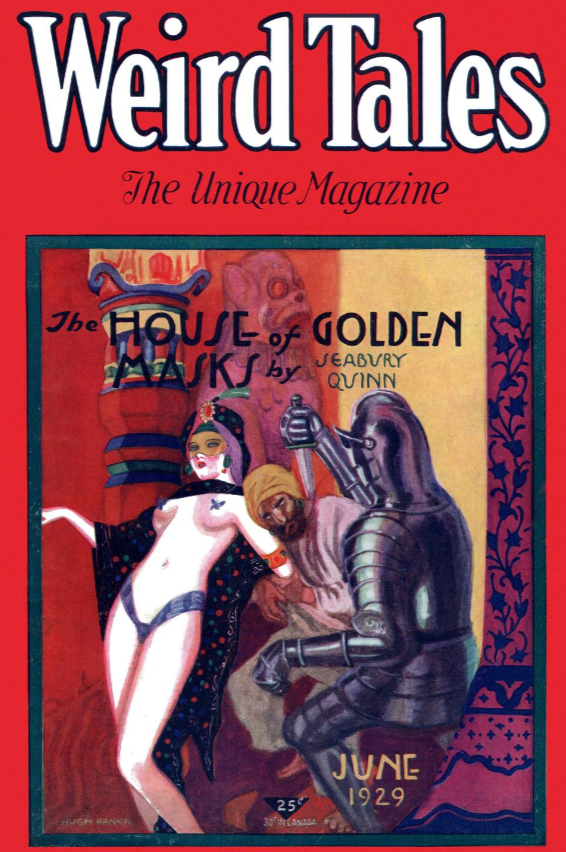
It might be a little predictable; I think once the wing dust is mentioned, you’re primed for something like this to happen, especially when he fuckin’ eats it. But for all that, I think it rises above the kind of trite “woah, what a trip!” sort of thing it might’ve become. Jacobi is interested in how people and nature intersect, and the ways the assumed roles of big critters like us might be upended totally. A fun story with a decidedly weird point of view!