Category Archives: fantasy

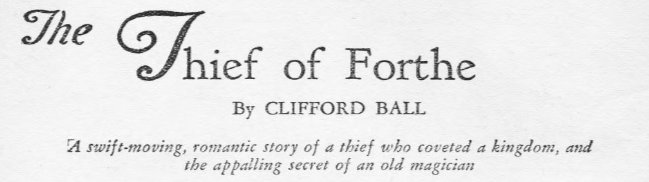
Pulp & Pastiche #42: “The Thief of Forthe” by Clifford Ball, Weird Tales v.30 n.1, July 1937

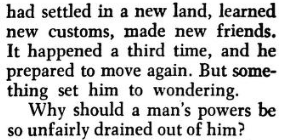
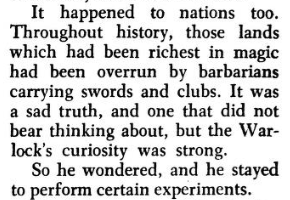
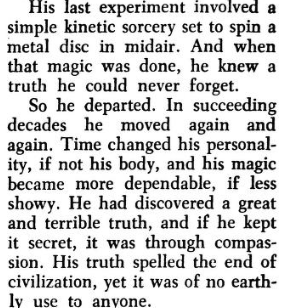
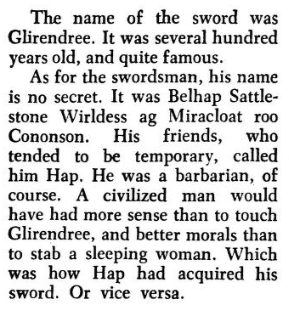
Since I broke the (cursed Lemurian) seal on it, why not continue to plumb the depths of Swordly & Sorcerous fiction that appeared in Weird Tales in the years immediately following Howard’s death? We talked Kuttner and Elak last time, focusing on the differences in character and approach between ol’ Hank and REH, so this time we’re going to look at an example of Post-Howard S&S that adheres a bit closer to the formula perfected by ol’ Two-Gun Bob. It’s Clifford Ball’s “The Thief of Forthe” from the July 1937 issue of Weird Tales!

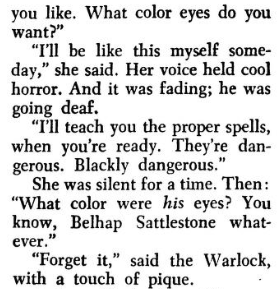
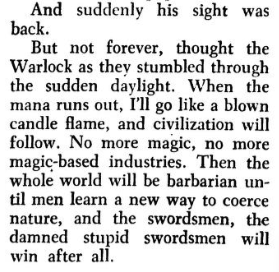
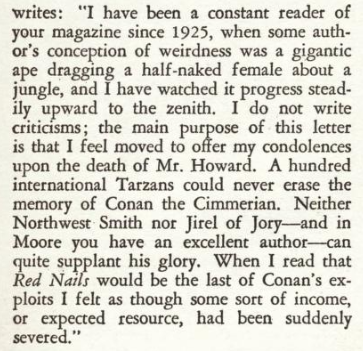
Interestingly, Clifford Ball’s first appearance in the magazine wasn’t as a writer, but as a Weird Tales reader mourning the loss of Howard and the stories he’d never write. His letter appeared in “The Eyrie” letter section of the January 1937:

This is only one of many such letters sent in to the Unique Magazine following Howard’s death (as I’m writing this, I think I might devote the next entry here on the blog to those letters, so stay tuned!); what’s interesting about Ball’s is that it really seems like the End of Conan struck him so deeply that he decided to try and Do Something About It – namely, Clifford Ball went and wrote some Sword & Sorcery himself! What’s more (and much like Kuttner), Ball also appreciated that one of the Keys to the success of Howard (and Conan) was the establishment of a fun, living secondary world – for Ball, this is (for lack of a better term) Ygoth, which is either a city or a country (it’s not exactly clear), and which is mentioned in all three of Ball’s S&S stories, tying them all together into a loose, unrestricted canon, much like Howard’s Hyboria.

Ball’s first story, “Duar the Accursed” would appear in the May ’37 issue; it’s an odd little work, very Theosophical honestly, about an amnesiac mightily-thewed barbarian hero who had been a mercenary, become a king, lost his crown, and then become a wanderer. There’s some interesting weirdness in it – in addition to having no memories of his early life, Duar’s accursedness is manifested as terrifying rains of blood and an ominous, unearthly raven that heralded his army. We’re also introduced to a strange, shimmering, extra-dimensional spirit that follows Duar and provides him magical support (whether he wants it or not), and has some kind of relationship with him from the past. There’s suggestions that Duar is himself some sort of Ascended Being trapped in a fleshy prison. It’s all very cosmic and, like I said, Blavatsky-ian; there’s pretty heavy foreshadowing that Duar is a kind of recurring spirit reborn as a hero or champion throughout time. But it’s also very much in keeping with Howard’s idea of the Manly Ideal of a S&S Protagonist – confident, physically powerful, fearless, and not interested in the niceties of civilization. There’s some good Gygaxian D&D flavored stuff in it too – the MacGuffin is a jeweled rose that’s actually a demon, and there’s a weird “Force” at work that drives people to their deaths in the depths of a dungeon. If you’re a completist for this sort of thing, it’s worth a read, but Duar never shows up again.
Ball thankfully (and correctly) drops the hints of “Chosen One” bullshit from his later (and last) two S&S tales, the much better and more fun Rald the Thief stories, the first of which we’ll be looking at today. But you should definitely temper your expectations here – they’re perfectly fine C-level work, I’d say, pastiches of what Ball obviously loved about Howard (and weird adventure writing), the sort of stories you expect from someone early in their writing career and looking for their voice. Unfortunately, Ball never got that chance – he wrote three more stories, though these are more straight weird fic than S&S. The last of these, a werewolf tale, was published in ’41, and then it appears Clifford enlists in the Navy. He ends up dying in, apparently, an accidental drowning in ’47, never having written anything else. It’s sad, especially because I think he had at least a sincere love of S&S, as I think you’ll see in the story today.

So let’s get to it already, sheesh:

That’s right, Rald the Thief gets the Finlay cover treatment, quite remarkable and, much like the Elak covers, it speaks to the deep love that the new and as-yet-unnamed genre of Howardian-historico-fantastique-adventure tales had garnered. The iconography is interesting here, and gets to the heart of the appeal of these stories – a sword, a Man of Action, a damsel, and a mysterious threat. There’s not even a real background – the whole scene takes place in an indistinct void, really highlighting that the whole thing is a very literal psychodrama. Simple, but effective!

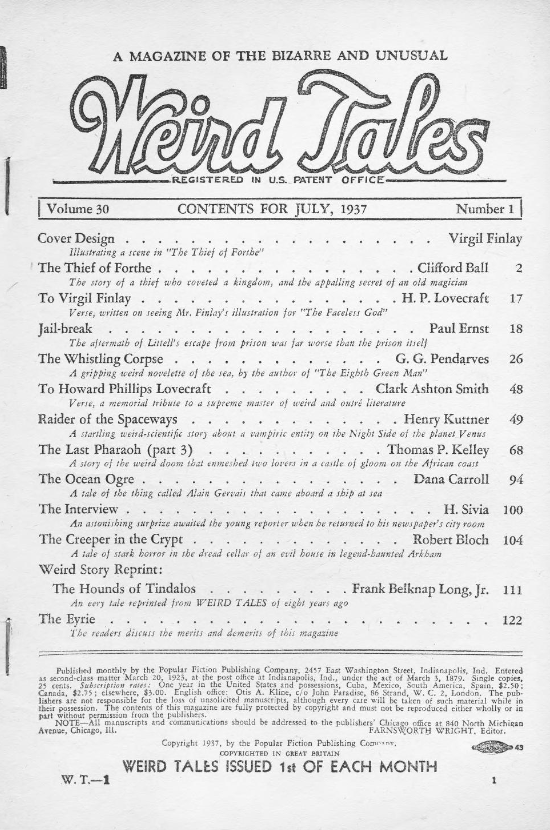
A good ToC, including a reprint of what’s probably Long’s most famous story, “The Hounds of Tindalos.” Also worth noting is CAS’s memorial poem to HPL, who had died in March of the year. It’s been a rough few years for Weird Tales fans, who’ve lost some giants in quick succession! Anyway, on to today’s tale!

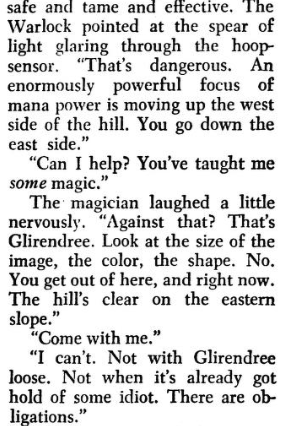
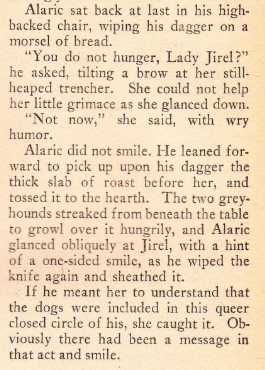
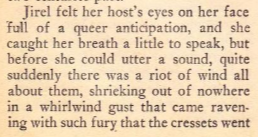
A pretty straightforward summary here, and truthful too – this is a brisk tale indeed, rolling along at a decent clip with very little downtime. Case in point, our story opens in medias res, with a business meeting happening in a dank, drippy, disused dungeon. Two figures are conversing:

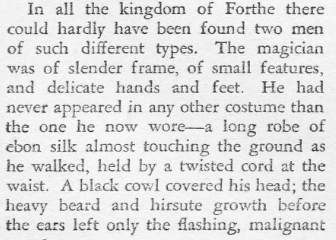
We’re introduced to a wizard with an apparently top-notch moisturization regime – their slender womanish hands a sure sign of sorcerous puissance and subtlety. This is in contrast to the other as-yet unnamed figure, who is immediately portrayed as a forceful, man’s-man kind of dude – he grumbles, he strikes the table with a meaty fist, and he’s suspicious of all this wizardly bandying of words about the King, named (oddly) Thrall. Yes, these two are surely quite different from one another, so much so that we get two more paragraphs describing them. First, our wizard:

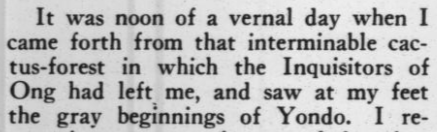
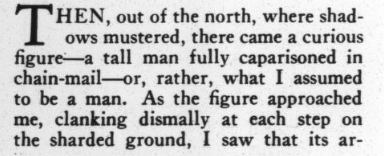
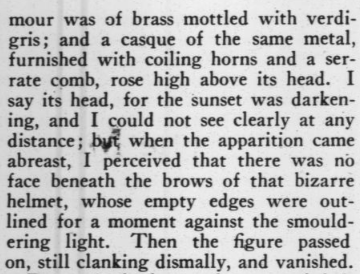
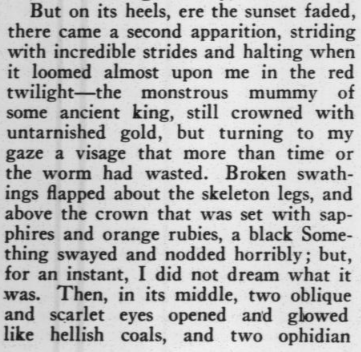
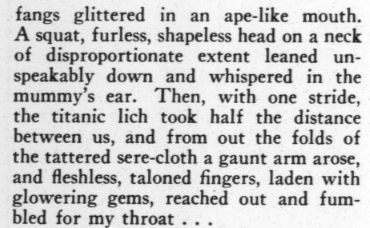
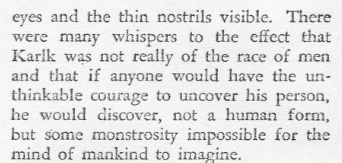
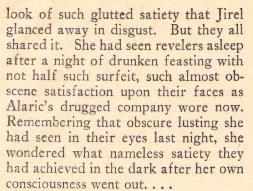
Good, strange wizard physiognomy, I think, and the insanely hairy face is fun (and, obvious) foreshadowing of something. The “what’s under those robes!?” is a little thickly ladled on here, but honestly it’s not too bad, and it’s perfectly fine to hammer it home given where the story will end up. “Karlk” is a decent evil sorcerer name too, I think, short and sharp and menacingly strange. All in all, a top-tier evil magician, I think. And what’s the beefy fellow Karlk has been talking to like, you ask? Well:

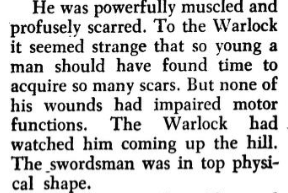
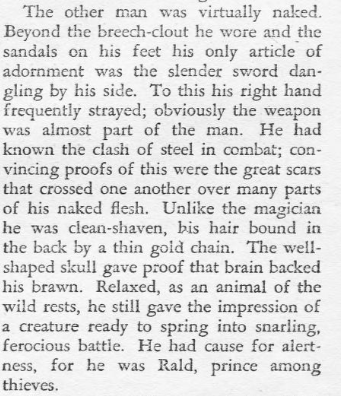
No mincing words here, this is just Conan. Naked and muscular in a loincloth and sandals, obviously of a kind with the Cimmerian, strong, violent, and cunning (as evidenced by phrenology). What is interesting is that Ball calls out Rald’s scars, which is a detail I don’t think I’ve read about in Howard’s loving descriptions of Conan’s rough-and-rugged body. Ball wants to highlight the history of macho violence embedded in Rald’s body, because this, along with his near-nakedness, muscular bigness, and clean-shaven face, marks him as diametrically opposed to Karlk the Magician.

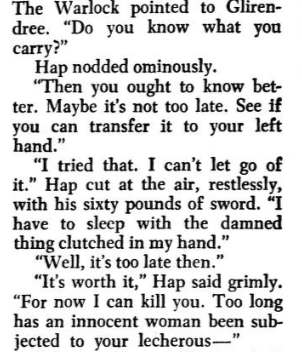
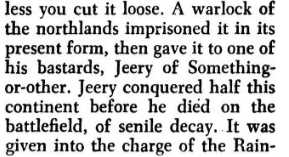
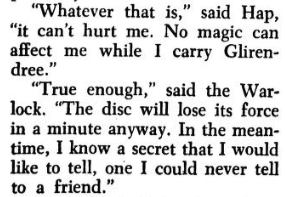
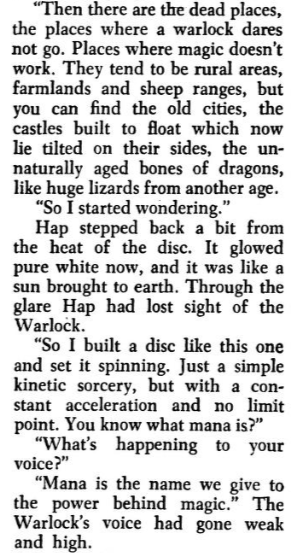
There’s some fun back-and-forth arguing between Rald and Karlk about King Thrall; Karlk seems to have it in for in him, but Rald points out the King has done alright by Karlk, covering up a mishap when one of Karlk’s “experiments” escaped. All in all, Rald seems disgusted by the wizard and their planned treachery. I’m no business guy, but it really seems like at this stage of the negotiations (along in a dripping dungeon), you’d want to have this kind of stuff ironed out. Karlk seems put out by Rald’s apparent lack-of-fear; he is a weird, menacing wizard, after all, and is used to a modicum of cringing respect. So Karlk decides to show Rald some of his power:

And how does Rald react to Kralk’s laser beam?

I mean, fair enough, right?

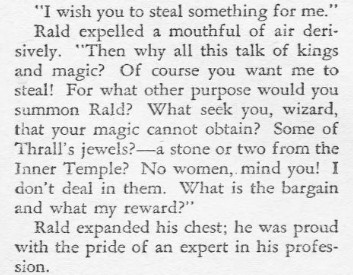
Regardless, Rald wants to get down to business…what IS it that Kralk wants to hire him to do, anyway?

Rald’s professional pride is fun, as is his discussion of what the possible targets of his thieving might be. I like the little “No women, mind you!” bit too, it’s all very material and earthy, a lived-in detail that captures Rald pretty well and gives him a bit of depth.

That is solid wizard shit there, you know what I mean? Kralk is steeped in black lore, and has moved beyond mere jewels and such. Kralk wants Rald to steal THE VERY KINGDOM ITSELF!!!! which is so bonkers, I love it. Rald’s reaction is fun too – how can you steal a whole kingdom, particularly one which is, in some way, divinely ordained. King Thrall is the King of Forthe, simple as? How would Kralk take over, even?

Very fun stuff; Rald is thinking about the Realpolitik of Kralk seizing the throne of Forthe, how impossible it would be to hold it given how everyone hates and fears him, but Karlk leapfrogs over that problem by the simple expediency of having RALD be the king, with Karlk a hands-off power behind the throne. Rald’s realization, and the temptation, are handled really well; Ball has constructed a convincing web for his Prince of Thieves to get enmeshed in!

I love the whole “wizard practicing the blackest of sciences” angle to these early S&S stories – it’s something Howard did himself, with a lot of his evil wizards relying on drugs and alchemy and hypnotism more than thunderous bolts of power. Similarly, Kuttner had his weird little wizard Zend behaving more like a scientist, using occult forces and magic-technology to keep Atlantis from sinking, for instance. Karlk’s claim that they are merely a scientist is a lot of fun, and something that I feel like you don’t see as much of in fantasy these days – wizards are a lot more mystical and esoteric, which is a very different characterization from experimental and technical approaches to even blasphemous sorcerous knowledge.

It’s also menacing as hell, isn’t it? We had that little story about the dog-man thing that had to be executed after it escaped, a very strange and unsettling story, and Karlk seems to be mostly interested in being allowed to expand his research program, something that would necessitate a friendly king willing to turn a blind eye to whatever horrors he’s planning. Of course Rald is disgusted…but…

It’s a solid Faustian bargain – Rald puts up a good front, but he’s quickly broken down by Karlk’s tempting him with not merely wealth and power, but immortality as a dynast! It’s fun and unique, making Rald a bit darker and more morally ambivalent (for now, at least) than his literary progenitor Conan. The story is a bit grimmer and grittier too; Conan had lots of adventures motivated purely by greed, but he never stooped so low as to ally himself with an obviously evil wizard! Credit where credit is due, Ball has come up with a fun and novel plot!

The next section opens on Rald beginning his infiltration of the Palace of Thrall. There’s some fun world building in here, among some admittedly clumsy and overwritten sentences. The walls of the palace, both inner and outer, are crumbling and in poor repair, and the patrols of the guards are fairly cursory and easily evaded. Similarly, the jagged bits of metal embedded at the top of the walls are rusty and easily pushed aside. But most importantly:

That’s a nice touch, and conveys a lot about this place and its history. They don’t need to maintain the walls or a tight guard – the sanctity of the palace is exactly that: sacrosanct, the product of cultural and religious scruple that sees the King and his power as a holy, divine thing, which NO ONE in their right mind would ever violate! Luckily, Rald is free of such scruples. This is more than just a nice bit of flavor, too – it will explain what exactly Karlk’s plan is, and how a whole kingdom can be stolen.

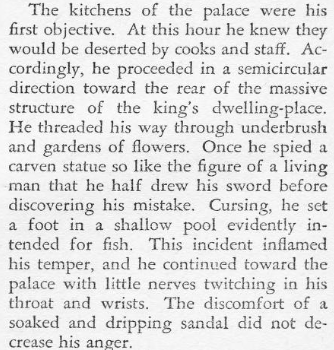
There’s a really nice bit of writing around Rald’s skulk through the garden here:

The statue he mistakes for a person, and the annoyance of the wet sandal are great, nice little bits of very realistic detail that lend Rald some interiority as well as highlighting his real physical experiences sneaking through the forbidden grounds. Equally fun is the fact that Rald knows the layout of the castle absolutely, due to the simple fact that everyone does, from servant’s gossip. The way Ball tells us that the simple peasants would be horrified at the use their gossip is being put to is fun writing. There’s a lot of nice details in this story, I think, and Ball is very much taking his time trying to develop the scene and evoke the setting, and it’s (largely) paying off, I think.

Rald makes in into the castle and encounters a drunk guard and, in a room beyond, a sleeping woman whom he takes to be a courtesan of some sort. Finally, he reaches a door that, via the clarity of narrative convenience, Rald realizes must be his goal:

Might be a real “Marge_Potato.jpg” moment here, but look: I just think this is neat. It’s extremely fun that Rald is an atheist in a magical world with gods, and that it’s this atheism that allows him to lift the magically warded lockbar without being struck down by the mighty curse woven into its very matter. That’s good stuff, and it works nicely with the whole thing going on in this story – the decrepit theocracy being vulnerable to One Atheist Thief!

Rald pushes through the door and enters some kind of sacred council chamber where the King and his sister hold court. More importantly, there’s the sacred necklace that is the goal of his quest hanging there!

So potent a symbol is this necklace that merely possessing it makes one, functionally and practically, the ruler of Forte. It might seem like a goofy system of gov’t, but who the hell am I, an Amerikkkan, to judge? More importantly, it’s in keeping with the whole tenor of this country/city-state, right? This religiosity that seems to rule here would absolutely imbue an object, and whoever happened to be holding it, with absolute political power; it makes sense! And it seems to have worked out just like Kralk imagined it would…or has it!? For, while Rald is admiring the sparkle of the diamonds that make up the necklace, he’s interrupted by a voice!

Do I wish Ball had given Rald a better swear than “faith?” Of course I do. Do I love this mysterious person telling Rald to knock it off with all the jumping around like some damn ape? Absolutely. It’s funny! The whole thing is very swashbuckly, and I love it.

The newcomer is the King’s sister, the Lady Thrine (apparently a real, if rare, Danish girl’s name, by the way), and she’s aghast at the temerity of Rald to not only break taboo by touching (and proposing to steal) the Sacred Necklace, but also by DARING to enter her bedchamber and peer at her sleeping. Yes, she was the “courtesan” from earlier, and its the whole shock of the boldness of Rald’s crimes that have lead her here, rather than, say, calling out all the guard. There’s some flirty banter, honestly not badly done, particularly since Ball is working on his own here in a Pre-Mouser world, but it’s cut short by the sudden arrival of Karlk!

Again, it’s a really great part here that Karlk, a magician and therefore intimately familiar with the reality of occultic forces, couldn’t move the magical bar with its potent spell, so he hired an atheist thief to do it. That’s good, a solid interesting premise for a S&S story, and also an interesting “mechanic” (if you’re excuse the vulgarism) for a S&S world, where magical potency is in some way related to belief. It’s fun, and something you don’t see much of these days!

Anyway, Kalrk prepares to zap Thrine, something the besotted Rald CANNOT ALLOW TO HAPPEN…but it’s all put on hold by the arrival of King Thrall, in full battle armor. There’s a funny bit where Rald, again in Mouser fashion, asks exasperatedly “doesn’t anybody SLEEP in this castle?” which is a funny, solid joke for a S&S story. There’s more banter, some guards show up, and the Kralk and Rald are bound up with ropes. They’re left, unguarded, in the council room (with the necklace) while Thrall, having sent his sister back to her room, orders a quick search of the gardens, in case there are more conspirators. Left alone, Rald and Kralk bicker a bit, with Karlk realizing that Rald has scruples he hadn’t imagined.

And then Karlk does something weird:

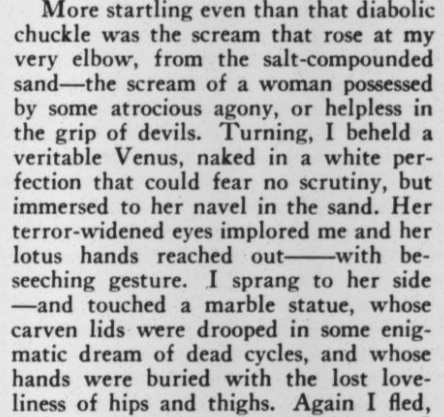
Khalk unties himself with an extra pair of small, white furred arms that emerge from his robes! I mean, that’s absolutely great! Equally fun in the kind of nonchalance with which Karlk assures Rald that there’s a LOT about him no one knows. It’s a great scene, and very weird.

Also fun is how Karlk, while having to leave Rald behind, still proposes to honor their partnership – he’ll kill the people Rald can’t, and then Rald can become King, with Karlk the power behind the throne. It’s very logical and straightforward and, honestly, makes Karlk out to be even more inhuman and mysterious. Afterall, while he’s disappointed Rald didn’t just kill the Princess, he can still use him. It’s fun, weird, stuff, and honestly between that and the extra arms, Karlk is up there with the evil wizards in S&S lit, in my opinion.

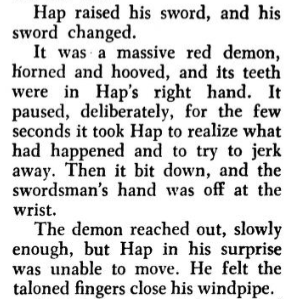
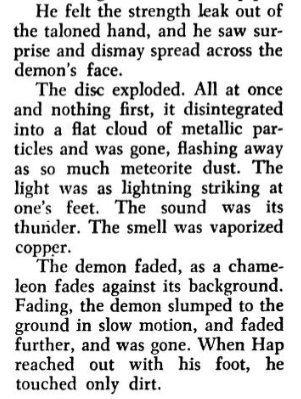
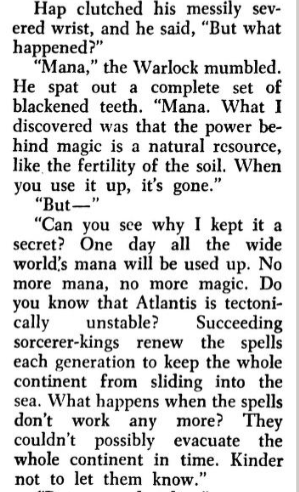
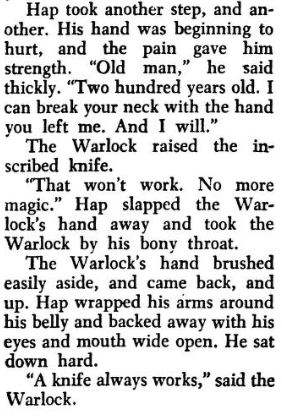
Rald doesn’t waste time, however. After Karlk has left, he painfully hoists himself up, knocks a torch from its sconce, and uses it to free himself. In the corridor he finds a guard, horribly magicked to death by Karlk. Grabbing the dead man’s sword, Rald rushes down the corridor, hearing a woman’s sobbing scream of terror from somewhere ahead. Rald comes upon a deadly, dangerous scene – Karlk, crouched horribly over the bound and terrified figure of Thrine, preparing to blast the unsuspecting King Thrall with evil magic. Rald leaps into action, slicing into the surprised Karlk with his sword:

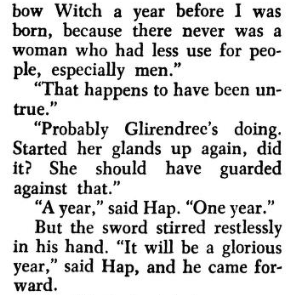
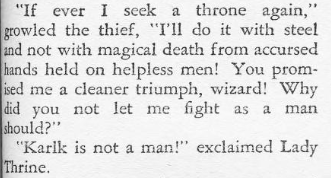
Thrine tells the king that Rald saved him, indeed saved them all from Karlk’s deadly magic, which the King grants, though of course he DID plan on seizing the throne himself. With a modicum of contrition, Rald foreswears his earlier actions:

Rald agrees that an evil, murderous wizard can never be a man, but hilariously he has misunderstood Thrine. For, in fact…

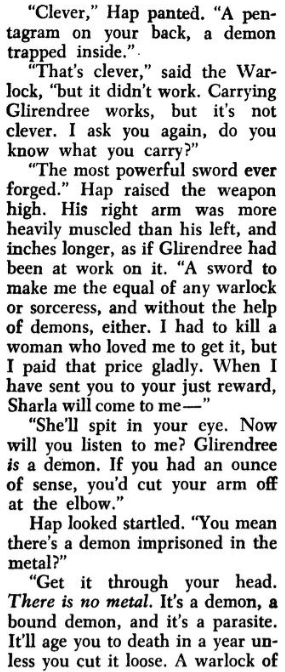
Karlk was a GIRL all along!!!! The fake beard, the scrupulous flowing robes, all a trick! But that’s not her only secret…

How came she to have royal blood, you might ask, and King Thrall certainly does. Well, it’s a funny story:

Kind of grim, and with an unfortunate amount of “monstrous ape rape” (a surprisingly popular theme in early Weird Fiction). Also, you might not recognize it, but the “white apes of Sorjoon” are basically the multi-armed white apes of Barsoom, from Burrough’s John Carter of Mars stories; in the earlier Duar the Accursed story, Ball refers to them as the white apes of the “hills of barsoom,” even. Maybe it was an editorial decision to change them, or perhaps he thought in hindsight that that was a little too on the nose. Still, everybody reading Weird Tales would’ve immediately recognized the Great White Apes for what the were, horrific multi-armed ape monsters from a classic swashbuckling sword-and-planet tale. It’s interesting that Ball uses them here; speaks to the importance of Burroughs for the readers of these more action-oriented, thrilling adventure weird tales, I think, and is in keeping with Ball’s letter eulogizing Howard too; he mentions “a thousand international Tarzans” as being unable to make up for the thrill and power of Conan, suggesting the lens through which he was being read, by some at least.

Anyway! Karlk’s extra arms come from her White Ape parentage. There’s a bit of Howard’s Atla in Karlk here too, from “Worms of the Earth.” Both of them are outsiders, cursed by their lineages to belong to neither of their parents’ worlds. Cursing all of mankind, Karlk devoted herself to evil and the eventual overthrow of Forte. There’s some great, creepy writing as Karlk’s laments her poor experiment back in her hut, and then she dies.

The story wraps up with a nice little bow – the King roars that, for his great deeds this night, he’ll make Rald a baron, but the thief is gone. But don’t worry, says Thrine, he’ll be back…for her!

And that’s the end of “The Thief of Forte!”

From a Sword & Sorcery perspective, I think this story is pretty decent. There’s good world building, and Karlk is a fun and interesting character that, honestly, I would’ve liked to spend more time with. Rald is basically and blandly a species of Conan, though maybe just that much more avaricious than the original – like I said, working with an obviously evil wizard seems a bit too much for ol’ Conan, though Rald readily agrees (even if he does have second thoughts later).

It’s not some lost masterpiece of the genre by any stretch, but it’s at least as good as Kuttner’s Elak stories, I’d say. What is interesting is that both of them, Ball and Kuttner alike, offer different perspectives of the post-Conan and post-Howard genre. Ball’s is much more straightforwardly a pastiche, I’d say, with Rald simply being Conan, or at least much closer than Kuttner slim and amoral Elak. Ball also seems interested in the women in S&S stories, more so than Kuttner at least; perhaps he’s influenced by Moore’s Jirel stories there, probably the most important non-Conan S&S character to emerge in the 30s. Ball has a bunch of tough amazons in the second Rald story, and there’s a pretty tough queen in the Duar story, though of course all end up conforming to comfortable 30s heteronormative roles by the ends of their respective tales. By far the most interesting character in Ball’s slender oeuvre is Karlk, though, and I think the story is worth reading for them alone!

Maybe more to the point, I think it’s worthwhile to read these attempts at carrying the torch forward in the post-Howard days of Weird Tales, particularly because they’re wrestling with something that would dog the genre well into today, namely: where do homage, tradition, pastiche, and out-and-out cribbing fit in the genre, and how do we push at the boundaries and make something new? Obviously there’s a deep love of Howard and his work here, but how do you build on it without simply (and more weakly) recapitulating the same tired old themes and plots and characters. I don’t think there’re answers in these stories, but I do think it’s fruitful to read them and think about these questions!

Spawn of Pulp #41: “Spawn of Dagon” by Henry Kuttner, Weird Tales v.32 n.1, July 1938!

Sword & Sorcery is a wonderful genre, inventive and vital, and the way it’s grounded intimately within the materiality of its world and characters lets you investigate issues of the body, of the environment, of class and wealth and oppression and violence, in surprising and often insightful ways. That being said…there are, like all genres, some, ah, lesser works, where the promise of the form is not entirely fulfilled. C’est la littérature! And that’s what we’re going to be looking at today, a very middling story that, none-the-less, helps illustrate some important things about the genre. And what story is that, you ask? It’s Henry Kuttner’s “Spawn of Dagon” from the July 1938 issue of Weird Tales!

Now, I don’t wanna be too rough on ol’ Hank here – Kuttner is a hugely important figure in the history of speculative fiction, much more so than may be immediately evident, given both his untimely death at age 42 (in ’58, juuuuust on the cusp of a big explosion in science fiction that he would’ve been a huge part of) AND the fact that he wrote under so many goddamn pseudonyms. He was a good writer, with an interesting perspective on complex, psychological science fiction in particular, laying the foundation for what would eventually become the New Wave much later. And when he was working with his wife, C.L. Moore, on one of their collaborations? Well, there are some exceptional bits of work there, sharp and thoughtful, some of the best stories from the time (we’ve talked about a few of ’em on this here blog, even – check ’em out here, here, and here!)

Similarly, Kuttner has the distinction of being a part of the Lovecraft Circle, writing some good Lovecraftian fiction (“The Invaders” is a fun and weird one) as well as his own distinct weird horror too (“The Shadow on the Screen” and “The Graveyard Rats” in particular are worth checking out). He’s a good, fun writer, and he likes a weird monster and a horrible scenario as much as the next guy, so don’t let my forthcoming criticisms of his S&S scare you off of him, okay? Because I think there’s some important context here for Kuttner’s approach to these types of stories.

For one thing, the genre that we call “Sword & Sorcery” didn’t exist yet, not really – there wasn’t a corpus to point to, for instance, though it was in the process of gelling. Robert E. Howard, who died in ’36, left a body of work in Weird Tales that was, in some inchoate way, obviously it’s own thing; two-fisted adventures full of monsters, magic, and peril, centered around recurring, rough-and-ready characters and told in blood-and-thunder prose. They were popular stories, the Conan tales in particular, and the combination of lost prehistories, exotic locales, and grim violence was something new and exciting and vibrant, so it makes sense that Kuttner would chase after ’em; he was a working writer, after all, perfectly happy to go after a market if it meant a check. Also, like Howard, Kuttner was an inveterate Lovecraftian Circler, sharing with REH the same general interests with regards to alien gods and mind-shattering horror, so he’s got a toe in the Howardian door already. But, given that it’s only a couple of years Post-Howard, you can forgive Kuttner for his somewhat clumsy attempts here, I think.

Similarly, something I think you’ll see in today’s story, is that Kuttner is actually in some ways writing against Howard’s work. Kuttner was good friends (and sometimes collaborator) with another Lovecraft Circle writer, Robert Bloch who, somewhat famously, absolutely positively with deep fiery conviction 100% HATED Conan. Hated the character, hated the stories, hated everything about them, thought Howard was wasting his time and ink writing ’em. It was a minority opinion in the magazine, but it was there! Now, I don’t think Kuttner had a similar animus towards the nascent genre as Bloch did – he wouldn’t have written the stories if he had – but I do think he very consciously wrote his Elak stories as a slightly skewed reaction to Conan. That alone makes them interesting, examples of people doing the boundary definition work necessary to creating a genre.

But, we’ll talk about all that when we get there! First – the Cover!

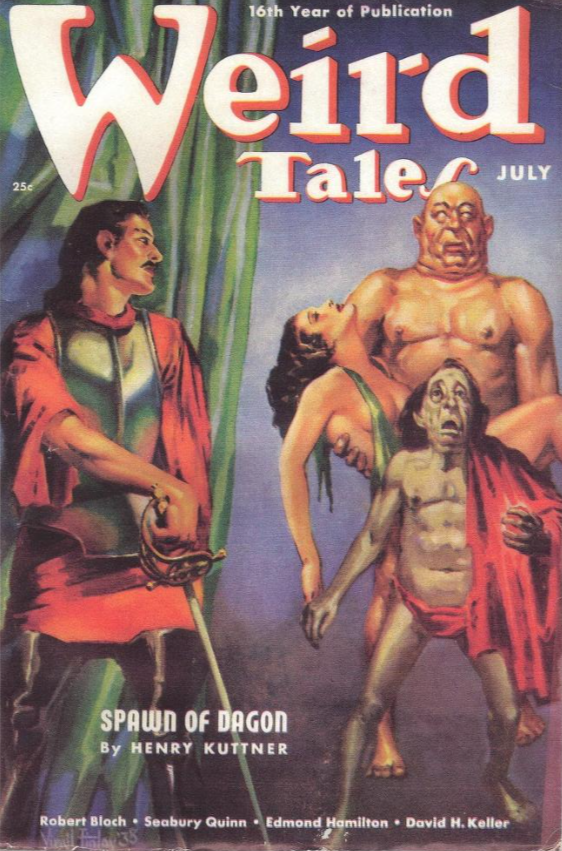
Yes indeed, lookit that, ol’ Hank got himself a cover, and one by the Master Finlay too! Perfectly serviceable cover, Tor Johnson-lookin’ goon luggin a scantily clad unconscious lady, weird little freak at the front, Errol Flynn watchin’ em there. Kind of a shame, though, that Finlay didn’t get a chance to do the monsters in this story – they’re very much in his wheelhouse, and would’ve been neat to see in his inimitable style. Kind of feels like this cover speaks to the popularity of the late Howard’s Conan tales, though; real hunger for anything even approaching The Master’s Work, so Wright et al. would’ve definitely jumped at the chance to highlight a weird fantasy tale. Not the last time Kuttner’s Elak would appear on the cover of WT either – in fact, only the first Elak story failed to get a cover! Crazy!

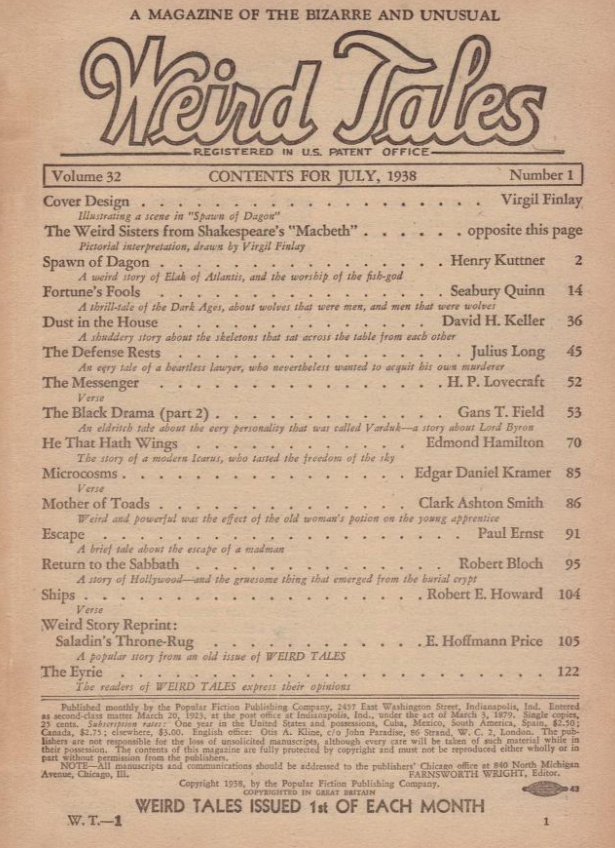
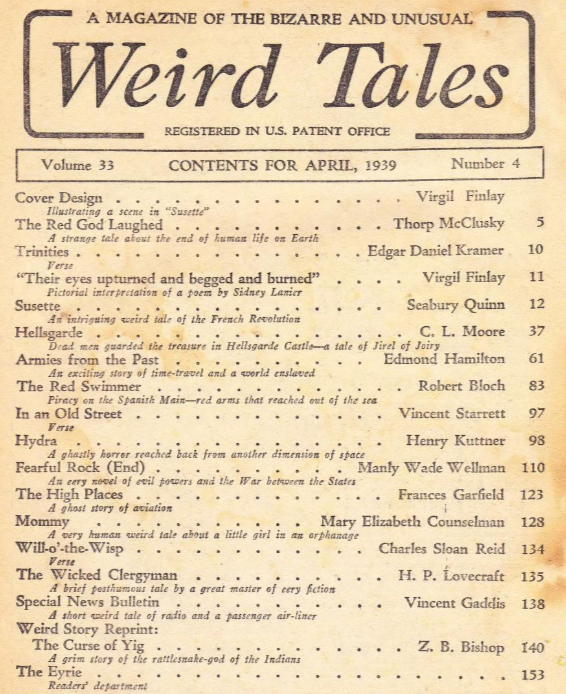
Solid ToC this time – the real highlight is the Smith story, “Mother of Toads,” which is a classic. But there’s Bloch on here, Gans Field (aka Manly Wade Wellman), a Price reprint, posthumous verse from Lovecraft and Howard… even the Quinn here is better than his usual stuff (i.e., it’s not a Jules de Grandin story). All in all a solid late Wright issue, I’d say!

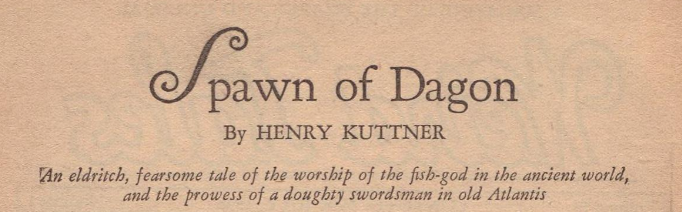
So this is the second Elak story the readers of Weird Tales would’ve come across; the first was a two-parter, “Thunder in the Dawn,” and had appeared in the May and June issues of the same year. Unlike Howard’s introduction of Conan, Kuttner had provided a clear and fairly well defined biography of our pal Elak of Atlantis in his first outing. To orient us all: In a time undreamt of (etc etc), the continent of Atlantis, with many cities and many kings, is out there, being all fantastical and suchlike. One of the many city-states on the continent is Cyrena, the northernmost kingdom that was, once, ruled by some guy named Norian. This king, Norian, had two stepsons, Orander and Zeulas. Zeulas ends up killing his stepfather Norian in an apparently aboveboard duel for which both sides had good cause (we’re told this by a druid, so you know it’s solid info) BUT, as a result of this patricide, Zeulas refuses the crown that is his by birthright and leaves the city in (voluntary, it seems) exile, with his younger brother Orander assuming the crown. Zeulas takes the name Elak and becomes a stateless, homeless adventurer. In the first story, Elak and his drunken thief buddy Lycon are summoned back to save Cyrena from an evil wizard, restore Elak/Zeulas’s brother to the throne, and then voluntarily resume the life of a wandering adventurer. Just stick a pin in that “rightful king in voluntary exile with a complex relationship to his family” stuff for now, because I’ll be mentioning it later.

Anyway, that’s basically the gist of Elak’s life before now; it’s not really relevant to today’s story, but I *do* think it’s probably important to the point I’ll be making at the end (and I also doubt if I’ll ever talk about another Elak story again on here), so just keep it in mind for later. Regardless, now we can get into today’s story “Spawn of Dagon!”

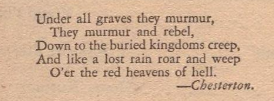
And how does Hank open his tale? Why, with an epigraph from G.K. Chesterton, of course!

An interesting quote for a couple of reasons; first, it’s from Chesterton’s “Ballad of the White Horse” which was one of REH’s favorite poems, and it’s easy to see why – it’s a super heroic epic about Alfred the Great fighting the Danes in England, full of wild roaring poetry, the force of destiny, civilizational clashes, magic weapons, very much in the mode of what would become sword and sorcery (even if it is super Christian). In fact, REH liked it so much that he used excerpts from it as epigraphs in some of HIS stories too (off the top of my head I *think* it was in the Solomon Kane story “The Moon of Skulls” but I might be wrong). So it’s notable that Kuttner chooses to include a passage from the same work in his story here. He ends up using a lot of Chesterton, all from the same poem, in subsequent Elak tales too. It’s a little funny, of course; after all, this is a tale of Lost Atlantis, from the misty prehistory of the world…so it’s a bit jarring to see it opening up with a poem from Chesterton, very much a contemporary writer.

It’s also interesting because it underlines that Chesterton is in the lineage leading up to modern fantasy literature, something people sometimes forget. There’s his famous essay “Ethics in Elfland” (which *is* great honestly; it’s so frustrating that it came from the pen of a reactionary and sympathetic-to-fascism asshole like Chesterton) of course, but his “Ballad of the White Horse” is a huge and influential part of the genre’s story too – I’ve even read that Tolkien had, at least, a few positive things to say about it.

Anyway, with Chesterton out of the way, we can finally get into the story proper:

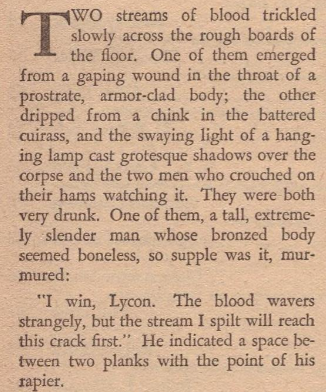
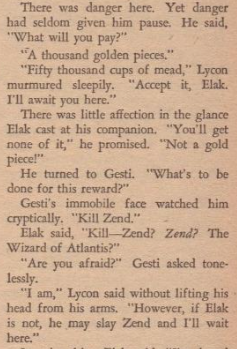
There’s a LOT to unpack here, right off the bat. First – our “hero” Elak is squatting over a corpse with his buddy Lycon, watching two streams of blood oozing from its wounds winding across the floor towards an arbitrary objective…that’s right, they’re gambling over which blood stream reaches a crack in the floor first. I mean, that’s wild, callous shit, truly outrageous! Even crazier, the prize they’re gambling for is the right to loot the body! AND it seems like they killed this guy specifically to rob him – Elak castigates Lycon for picking a fight with a pauper when he doesn’t find any money on him. That’s some grim stuff!

You sometimes see knuckleheads describe Conan as an “anti-hero” which, of course, is nonsense; Conan is 100% a barbarian HERO, rough and uncivilized, but ruled by a strict code of honor and with a clear moral framework. And while it’s true that Conan was a pirate and reaver professionally and therefore certainly must’ve been killing (or at least threatening to kill) folks for their money, he at least had the narrative decency to do it all off camera. Not so with Elak! Here we are, in some Atlantean pub, and right off the bat he’s watching a guy they butchered bleed out, for kicks!

The other interesting thing here is Kuttner’s description of Elak. He’s tall and “extremely slender” with an almost boneless suppleness, a far cry from the mightily-thewed and hairy-chested Conan. To be sure, Elak is strong; we’ll have scenes later in the story demonstrating his superlative physicality (one of the core attributes of S&S character), but it’s of a different sort than the tigerish, muscular dominance of Conan.

Not to harp on it, but I do think that, since Kuttner is writing in the shadow of Howard, it’s worthwhile to see how different he’s making his sword & sorcery hero from the epochal example of the Cimmerian. It’s relevant also because, in terms of plot, Kuttner is clearly cribbing from Howard – there’s a bit of “Tower of the Elephant” in this one, and there’s a later story that is a pretty blatant riff on Howard’s “The Phoenix on the Sword” story. So, in differentiating his stuff from REH, Kuttner has chosen to have a VERY different hero – a willowy, amoral ex-prince…

Hm, who does that sound like?

Honestly, if he had albinism (and an evil sword), he’d *be* Elric; even the names are suspiciously similar, aren’t they? I’ve never encountered Moorcock talking about Kuttner or Elak of Atlantis, but it’s a fair bet that he’s read ’em before, of course, given his deep presence in the genre. And, to be clear, I’m not saying he grabbed Elak or anything; in fact, it’s entirely likely that he independently came up with an anti-Conan the same way Kuttner did, as a direct response to REH’s own work. After all, Howard’s S&S is steeped in his particular interests – clean-bodied and noble barbarism against decadent and effete civilization, rugged frontier individualism, the power of the body to impose one’s will over an unruly world. If you’re taking part in that conversation, there’s a natural counterpoint in a character like Elak (or Elric).

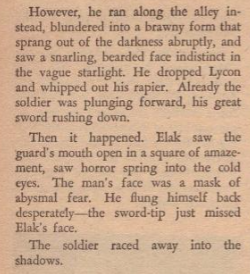
Back to the story: it turns out that Lycon has already pilfered the dead man’s purse, making the blood race game meaningless…but because he’s drunk, he passes out, and Elak is forced to lug his blacked-out buddy out of the tavern and into the night, since the innkeeper has returned with guards who, for some reason, frown on wanton murder. Fleeing through the dark streets, they’re suddenly attacked by a guard!

(Brief aside for weapon talk – our boy Elak is armed with a rapier, as befits a slender, supple warrior, emphasizing speed and precision and skill over the brute butchery of a barbarian’s broadsword. It’s an interesting development!)

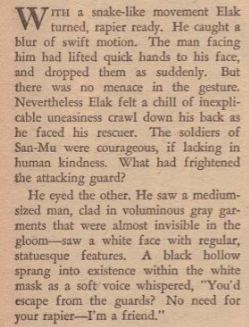
So, what was it that spooked that guard?

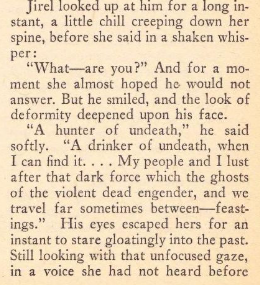
Well, there you go, everything seems to be perfectly in order and extremely normal: the guard was, of course, scared by the sudden appearance of Some Guy. This strangely blank-faced, robed fellow offers help, and Elak is forced to accept it unhesitatingly, since more guards are thundering down the road. A secret passage in the wall yawns wide, and Elak, bearing his drunken pal Lycon, follows the mysterious stranger in.

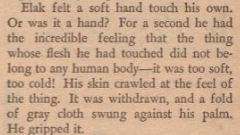
Again, perfectly normal – some people, even robed people with strange, unmoving faces, just have cold, clammy hands! Nothing untoward at all!

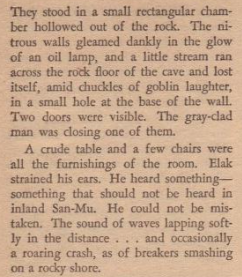
Elak follows his new (and normal) friend through a dark tunnel – there’s strange, unnatural sounds in the dark around them, but when they reach a hollow in the earth, there’s light:

The line “amid chuckles of goblin laughter” is fun, isn’t it? There’s some good flourishes in here, and Kuttner has certainly got a flair for atmosphere. I love a nitred chamber deep in the earth, myself, particularly if there’re mysterious impossible sounds of the sea about.

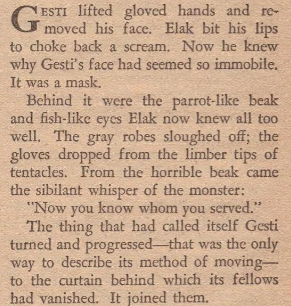
Anyway, Elak’s mysterious benefactor introduces themselves: they’re Gesti, and please pay no attention to their chalk white complexion or their curiously glazed eyes. In fact, the only thing that does matter is that Gesti would like to hire Elak for a little job:

I do kind of like Lycon’s glibly cornball vaudeville schtick, though I also 100% accept that some might find it a bit grating – it is basically his entire character, other than drinking, so it can be a little repetitive. Elak asks for some more details about the job:

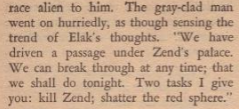
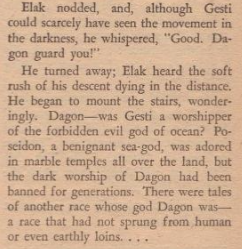
It turns out Gesti and his vaguely defined band have tunneled a secret passage up through the VERY LIVING ROCK OF ATLANTIS and into one of Zend’s basements in his Mighty Tower of Sorcery. All they need is a brave and violent assassin to use their passage, kill the wizard, and smash a red ball up there. Easy peasy, 1000 gold coins. Plus there’s a pile of loot in the tower too, and Elak can have all that too. Seems suspicious, but like we saw earlier: Elak is an amoral and extremely greedy guy. Plus he’s probably still drunk. Gesti offers to babysit Lycon while he sleeps it off, and that’s pretty much it. Elak, our hero, agrees to murder Zend for money! They give him a weird tube-like weapon which will play no part whatsoever in the story, and then they part ways, Gesti unable to advance farther; as he goes, he gives Elak a strange farewell:

Eh, it’s probably nothing.

Elak pushes up through the secret door into the tower basement, which is dusty and mouse-riddled, obviously a space rarely used by the mysterious Zend. He sneaks his way through the dim, empty halls, knowing he must make it to the very top minaret to destroy the Red Sphere there (presumably killing Zend on the way). But as he’s sneaking:

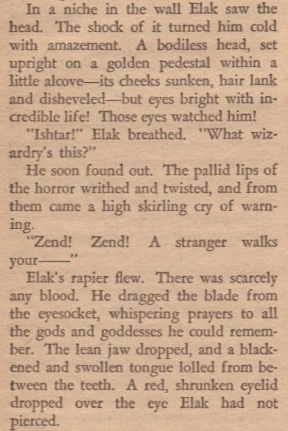
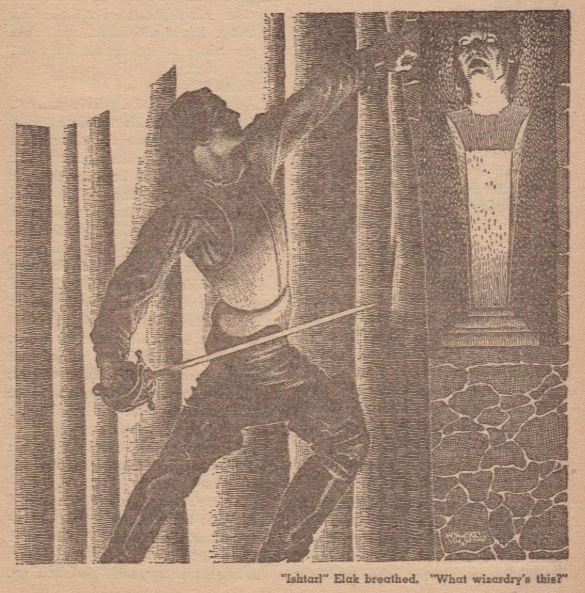
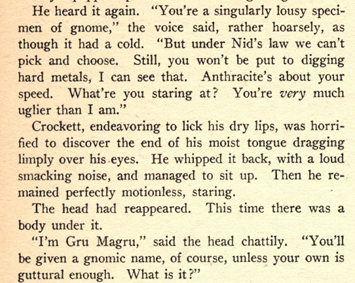
Helluva security system! A living (in some fashion) disembodied head sitting on a pedestal! I mean, that’s pretty gruesome, isn’t it, especially the way Elak spears it (through the eye! yuck!) and “kills” it! Reckon it’s some kind of weird undead horror, maybe, a product of Zend’s dark sorcery. Very strange and a great image, which ol’ Virgil Finlay drew up for us:

It’s a fun, weird scene…BUT it’s kind of a shame that it doesn’t really amount to anything. The alarm call of the freaky head doesn’t summon any guards or even seem to reach Zend; nothing happens at all, which is a real shame. Personally, if you’ll indulge me, as a writer of S&S myself I 100% would’ve had the headless body of the thing shamble out and fight Elak, directed BY the head on the pedestal. I mean, SOMETHING should’ve happened, you know what I mean? That kind of missed opportunity, and other events-for-no-reason, is a real problem that dogs all of Kuttner’s S&S, so much so that you might be tempted to think he’s actively subverting the expectations from the leanly efficient structures employed by Howard in his stories…but I honestly kinda believe he’s just a little lazy and writing extremely fast, for cash.

Elak continues down the dark corridor, parting a curtain, only to see a group of grotesqueries coming towards him!

Yes indeed, Kuttner is engaging in the tried-and-true-and-tired convention of having an evil wizard exhibiting some physical deformity, just to really highlight the contrast between them and the clean-limbed and hard-bodied S&S protagonist. It’s unfortunate, but it’s something that goes hand-in-hand with this era of literature, so you have to get use to recognizing it.

Anyway, you might assume that Zend and his Big Guy are coming to get Elak, alerted by the head, but that’s not it at all. They don’t know about Elak, and in fact are out on business of their own, vis-a-vis the unconscious girl being carried by the huge giant. Via some clumsy exposition, we learn that Elak recognizes the giant…he’s a criminal he saw getting beheaded at a public execution, transformed into a monstrous servitor by Zend’s necromantic power! Elak decides that he doesn’t like the thought of fighting a dead man, and reckons he ought to hide, waiting for a chance when Zend is alone to stab him in the back. Unfortunately for him, the best laid plans gang aft agley…for Zend and the Giant turn up the VERY CORRIDOR where Elak is hiding! What’s he to do now!?

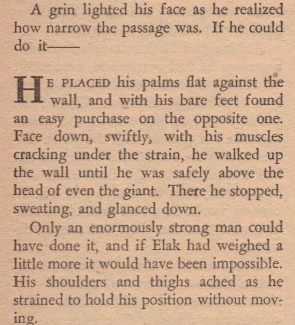
That’s right: Elak mutherfuckin’ Batmans it there in the passage way.

Defining “Sword & Sorcery” as a genre can be a fraught thing, especially if you’re trying to argue it’s something different from other types of Fantasy (which, to go on the record, it is), but this sort of thing is probably the easiest and most important difference to point out, I think: Sword & Sorcery stories are about the heroes’ ability to physically impose their will on a recalcitrant and hostile world, relying on the native strength, grit, endurance, and willpower inherent in their bodies to do so. They don’t have to have physiques of superheroic proportions (though it helps, and often narratively coincides with other themes important to the literature if they do), but they all have to confront threats through the use of their body; even Elric, who is defined as a sickly figure with little bodily strength, still relies on an inborn strength of will (who else could endure the corrupting and murderous effects of his evil sword?) to perform his epic feats. Here, we have Elak, whom we know is a supple, muscular man capable of fighting and running and such, demonstrate even further the superlative prowess of his body by holding himself perfectly still high up in the ceiling of a tunnel while his foes pass by beneath him, all unawares.

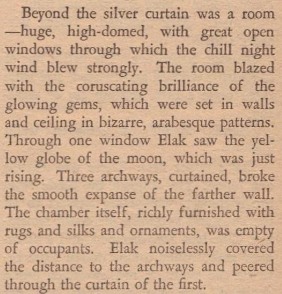
Elak gets a chance to ogle the girl while they pass beneath him, wryly musing on how she would express her gratitude if he saves her, but he lets them pass untroubled: that big ol’ giant is still awful threatening. When it’s safe, he drops to the ground; his hands and feet are bruised and bleeding, but he has successfully evaded detection and is able to sneak on after his prey. He enters a chamber with a window to the outside and three curtained doorways, which he peers through in order.

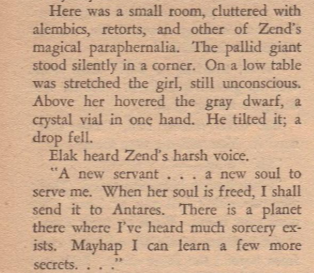
In the first room he encounters a strange, steel-walled room, where an odd mud-colored rock sits absolutely pulsing with terrible, frightful power. Good wizard shit here, I think, with lots of mysterious and unexplained details. Behind the second curtain he sees Zend at work in a sort of wizard’s laboratory, preparing to Do Something Evil to the unconscious girl:

Again, excellent ambient weird wizardry in this section; I especially like the detail that Zend is going to send the girl’s soul to some planet around the star Antares in case there’s some magic he can learn there. It’s fun stuff! But Elak has no time for that; he leaves the girl to her dark fate and checks out the third curtain, where he encounters a rosy glowing light…the chamber of the red sphere! And it’s filled with weird techno-sorcery too, tubes and wires and pipes and things; it reminds me a little of the robo-tower from Leiber’s Fafhrd and the Gray Mouser story “Two Sought Adventure” and, I think, speaks to Kuttner’s more sci-fi interests. But, just as Elak is about to get to work destroying the macguffin, the giant rushes up the stairs and into the room!

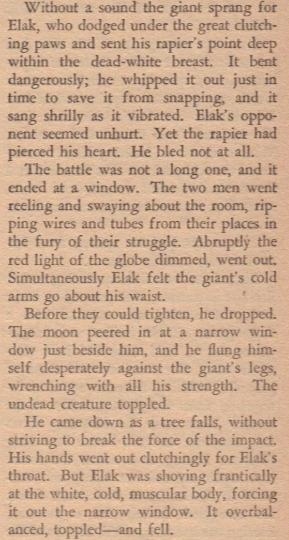
So, a couple of things – first and most importantly for the story, the Red Sphere is unplugged and powered down BUT NOT DESTROYED in the fight. Secondly, it’s a fun fight, honestly – the rapier, bending dangerously as it pierces the giant’s heart, but to no avail, is good stuff, as is the eventual wrestling match that sees Elak pitching the giant out the window. Also, as an aside: I think Kuttner uses “his body fell as a tree falls” or some variant in EVERY SINGLE S&S story he wrote, all the Elaks and even in the two Prince Raynor stories, every single time. Something about the image that he liked, I guess, or it just felt very actiony and sword-and-sorcerous to him, or something. It’s an odd tic. Everybody is always crashing to the ground like a felled tree.

As he’s recovering from the fight, he hears a shriek from the room below; running to investigate, he encounters Zend, fleeing in terror, and hears a babble or horrible voices coming up the passage.

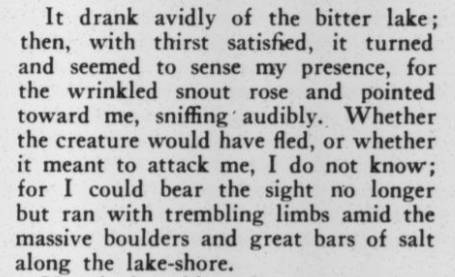
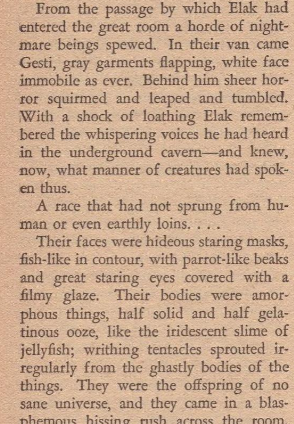
I mean, they’re great monsters, aren’t they? Bubbling, semi-solid tentacle monsters with parrot- (or octopus-) like beaks, slimy and oozy and terrible. Good weird critters, for sure, and much more interesting than the gillmen you might’ve expected, given the title of the story. The Dagon of this story is no Biblical Philistine Fish God; this is Lovecraft’s Dagon, for sure, but these ain’t Innsmouth Deep Ones at all. It’s fun, and nice to see Kuttner really going for a much more alien, deep sea kind of monstrosity here, you know?

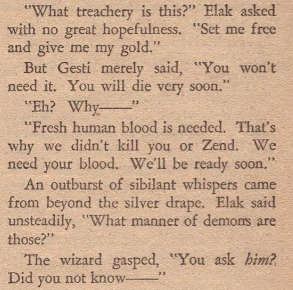
Anyway, Elak is quickly trussed up with cords by the Jelly Monsters, and sees that Zend is similarly tied up. Hilariously, Elak seems to be an obstinate optimist because he asks Gesti, who came in with the monsters, for his money.

Betrayal! Who could’ve foreseen such a turn of events, particularly since Gesti seemed so nice and normal, a real bro.

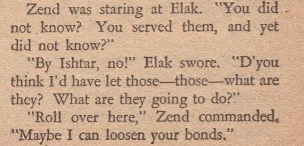
This is why you gotta ask ALL prospective employees if they’re the hellish spawn of an alien god. They gotta tell you if they are, like cops. Zend seems a little surprised that Elak is so dumb:

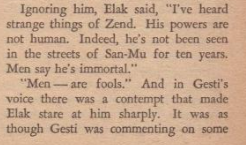
While he’s wrangling unsuccessfully with the ropes around Elak’s wrists, Zend is able to provide some more exposition with regards to the jellymen’s motivations. Following the state of the art pre-tectonics ideas about the evolution of the earth then current in Kuttner’s day, Zend explains how the Earth was once one vast ocean, ruled by the Spawn of Dagon. The rising of the Continents, in addition to reducing their sovereignty are also an affront to their dignity, and so they have worked tirelessly to sink all the land and return the world to a state of Primal Ocean. There’s some fun bits in here about ancient, prehuman races that got dumped in the drink by the Dagonians, big ol’ weirdos and sphinxes, good ancient fantasy stuff. Zend then explains that, without his intervention, Atlantis would’ve long ago been sunk – it’s his magic alone that keeps the island above water, and the monsters know it. “How’re those bonds coming,” asks Elak:

I really wanted Zend to make an aside to Elak here: “Oh, by the way, you’re, uh, sterile now.” Yes, the weird radiations of the Red Sphere kill the Jellyfish Guys instantly; that’s why they needed a foolish catspaw to break it, so they could get at Zend and bring about a return of their Oceanic Empire. Real shame those ropes are holding strong, an adventurer like Elak might be able to thwart them if he wasn’t trussed up like a Yule Goose.

Yes, despite harboring an insane hatred of all dirt-grubbing humans, the horrors below didn’t bother to kill Lycon when they had a chance or even, apparently, tie him up. So he, rested and sufficiently sobered up, has arrived in the nick of time! Oh, and the sexy girl Zend had kidnapped wakes up, just in time for Elak to promise to help her escape…if they survive!

It seems like our heroes are doomed, however – there are too many of the monsters, and their weapons seem powerless against their gelatinous unearthly bodies…but then they begin to melt away! Zend has gotten his Red Sphere back online, bathing them all in its strange radiation!

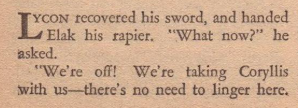
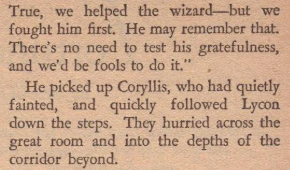
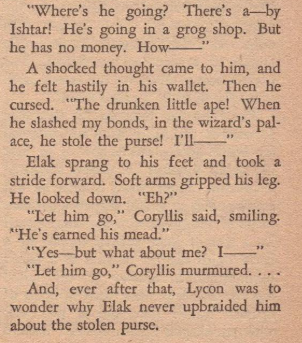
Having learned a lesson from Gesti’s betrayal, Elak grabs the girl and the three of them skedaddle, ending up in one of the city’s many municipal parks. Lycon leaves Elak and Coryllis in search of some grog.

And that’s how Kuttner ends his story “Spawn of Dagon,” with his hero having public sex in a park.

Perfectly breezy little story. Are there some problems? Absolutely – the writing in places is sloppy and rushed (the geography of the tower is a bit strange), things happen for no reason and have no impact on the story (the alarm head, the weird weapon that never comes into play), and there’s TWO dei ex machina in here: Lycon’s sudden arrival to cut the ropes and Zend’s offscreen repair job on the Red Sphere. These same problems crop up again and again in Kuttner’s S&S stories too, by the way – there’s lots of unsatisfying action and narrative hops that, frankly, just don’t work very well. So why the hell should you read these, then?

Well, as I mentioned in several places, I really think these Elak stories are interesting historical documents that capture a very specific moment in the S&S genre. Howard is dead, but he’s left behind something new in his stories, something unique and interesting. And so Kuttner is engaging with it, trying to figure out what works and the ways he can make it his own, and while the experiments might not WORK, they are interesting and important failures.

Kuttner recognizes that he can’t (and doesn’t want to) just write a Conan clone, so he makes a decision to create a different protagonist. A strong, physical, brave character, sure, but one without the Noble Savage trappings of Howard’s heroes. Moreover, rather than Conan’s rough but iron-clad sense of honor, Kuttner makes Elak a sneaky, amoral, and largely dissipated character – Conan’s pristine wilderness is discarded for a world-weary urban cynic. Moreover, whereas Conan’s arc is, broadly, defined as the ascent of a vital barbarian to the pinnacle of power as a king, Elak has REJECTED kingship outright, before his stories even begin!

Kuttner simply isn’t interested in the same things that a rural hayseed from Cross Plains TX is – he’s a son of the city, living in Chicago and LA and New York, huge metropolises at the height of the Great Depression! His sword and sorcery is much more interested in cities and power and corruption, something very different from Howard’s preoccupation with nature and wilderness. And I think Kuttner DOES see that there’s something in the genre that lets him wrestle with those topics in a new and interesting way.

So, while I don’t think the Elak stories are necessarily good, they are important. Kuttner’s grasping mercenary characters having adventures in well-developed (or at least, more well-developed than Howard’s) fantasy cities IS a new direction in ’38, part of the current that would produce Fafhrd and the Gray Mouser and Elric later on, evolving out of and in response to Howard’s very sui generis Conan stories. Elak isn’t nearly as well developed or interesting as those later creations, of course, but he’s an important stepping stone leading to them, and therefore an interesting part of the genre’s history!

Thieves’ Pulp #40: Thieves’ House by Fritz Leiber Jr., Unknown Worlds, v. 6 n. 5, February 1943

Know, O Reader, that in the time after the Great Turkey Slaughter and before the sinking of the Year there is a month undreamt of, a month of Sword & Sorcery where the Yule, a time of gigantic mirth and gigantic melancholies, strides forth to tread the jeweled wrapping paper beneath its buckle-booted feet!

Yes, that’s right, it is once again time for my annual celebration of the Best of all Genres, Sword & Sorcery! As I’ve mentioned before, the Xmas season is, for me, the most Heroic and Sorcerous of times, one where I like to kick back and read about the derring-do of various mightily thewed types. And while things have been busy down here in Austin, December has come in like a Nemedian Lion finally, bringing cold temperatures and, with them, a resultant coziness that is PERFECT reading weather. So let’s get to it!

This time around we’ve got a true classic too, foundational in terms of Leiber’s Lankhmar stories AS WELL AS the genre as a whole, for today’s story has the very first example of a fantasy “Thieves Guild” that I’ve ever come across! The idea of organized thieves operating as a cohesive and hierarchical medieval-style guild is a core concept in fantasy, as much a part of the genre as evil wizards and scimitar-wielding bad guys, yet another cornerstone laid by the genre’s greatest mason, Fritz Leiber, Jr. Without further ado, the story this time around is Thieves’ House, from the Feb 1943 issue of Unknown Worlds!

A few years ago, we talked about the very first Fafhrd and the Gray Mouser story, “Two Sought Adventure,” and of course we’ve also talked about Leiber as a weird fic writer, so we won’t spend too much time on bio and background. So let’s dive in!

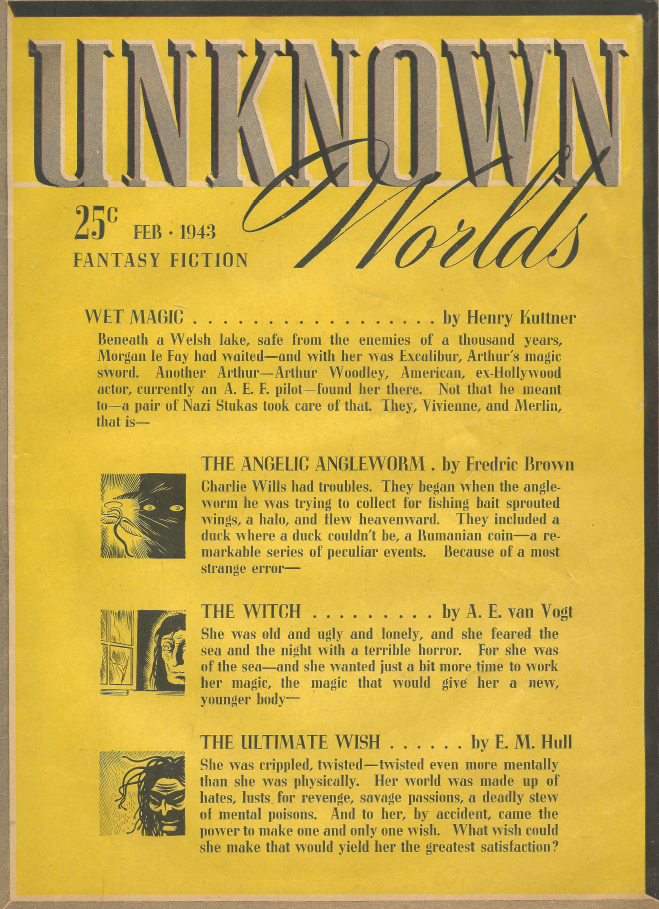
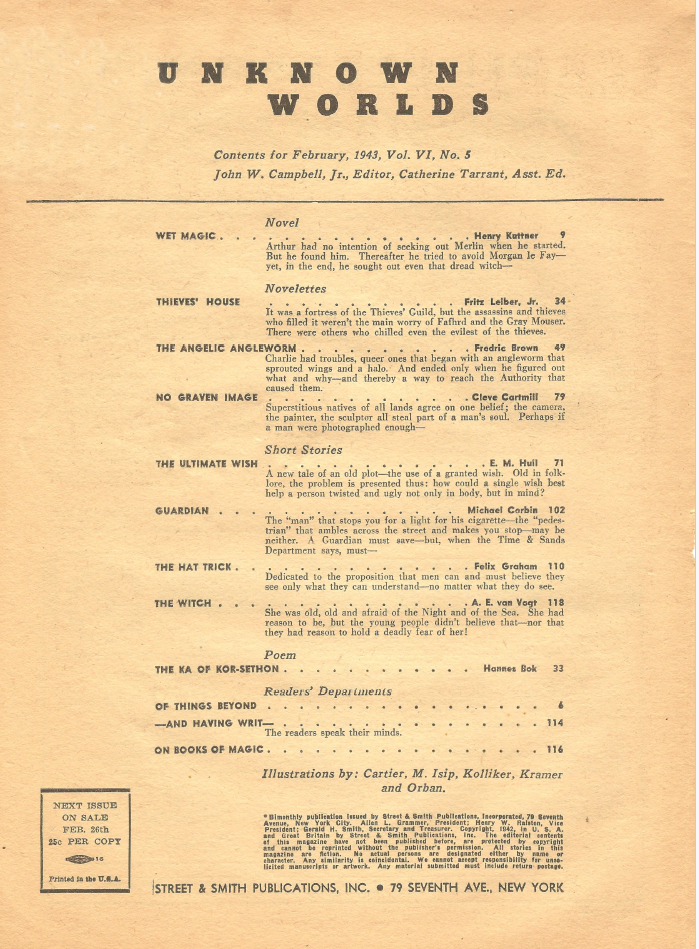
The cover of this issue of Unknown Worlds is a bit underwhelming, huh? I do like the little thumbnails, but it’s hard to imagine that utilitarian little summaries of some of the stories are going to do a better job than a big, crazy cover by one of the many talented artists available for hire at the time. We’re nearing the end of the run for the magazine, though; it’s been losing money for a while and, what with war time paper rationing, it’d soon go under completely, so I imagine the decision to do the covers like this might’ve been influenced by those realities. What’s weird though is that they don’t just put the WHOLE ToC on the cover – these are just a selection of the stories in this issue, plus editor’s columns and letters etc. If you weren’t familiar with the magazine, you might think that all you’re getting for your two bits are these four stories, when, in fact:

A pretty respectable list of work! It’s an odd decision to have only a sampling of the ToC on the cover… maybe based on perceived popularity of the writers, although it seems like a new Fafhrd and the Gray Mouser story should’ve warranted inclusion if that was the case? But, oh well! What is interesting is how Unknown Worlds was really positioning itself as the “fantasy” magazine here. There’s some modern day stuff in here, but a LOT of this issue is devoted to what you’d call classic fantasy, either in the (as-yet-unnamed) sword-and-sorcery genre or in the more broadly defined medieval-ish vein.

Anyway: onto the story!

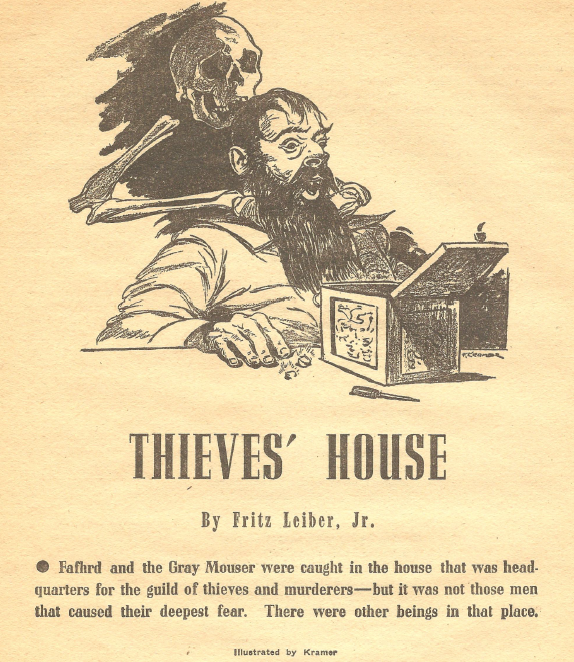
Title illustration is of a guy getting a back massage from a skeleton, good workmanlike art I’d say, and a fun bit of sword-and-sorcerous menace to start it off – you know something macabre and outre is in the works, but the picture here doesn’t really give anything away, which is good!

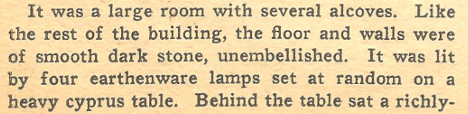
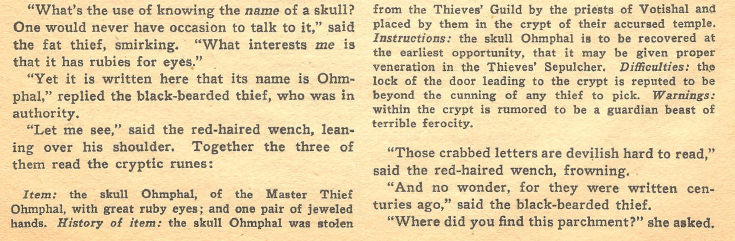
An absolutely killer way to start a story, isn’t it? Leiber can really set the hook – a skull with its own name, gilded and gem-encrusted, being discussed by some thieves, and then a brief precis or interior thieves’ memo about the skull of Ohmphal, with a nice little summary of its history AND the difficulties involved in retrieving the stolen item. Really, truly: if you’re interested in the history of tabletop fantasy roleplaying in general and D&D in particular, then you’ve simply gotta read Leiber. Fafhrd and the Gray Mouser are absolutely the ideal dungeon delvers, and Leiber’s stories lay out so much of the tone and flavor (and, honestly, mechanics) that Gygax and Arneson would mine for their game. The note, the weird factional aspects (with the Priests of Votishal stealing a skull from the Thieves’ Guild), the dungeon-y aspect of the lost temple, and even the need for a well-balanced party – this is a Dungeons & Dragons adventure! Hell, even the format of the memo on the skull is a diegetic DM’s entry, you know what I mean?

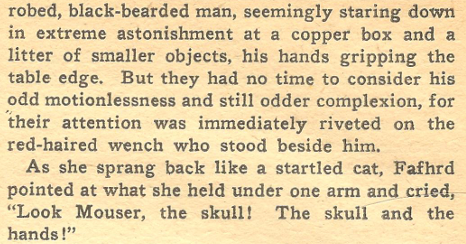
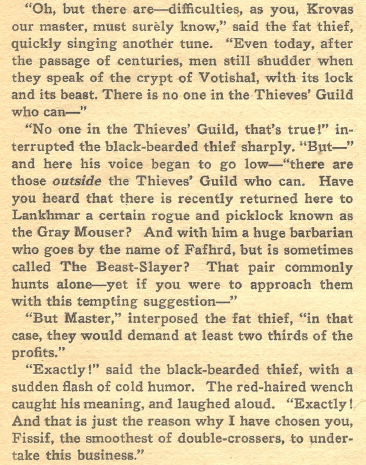
Over the next few paragraphs, we get a very nice, efficient explication of these thieves and the “red-haired wench” – they’re mulling over an ancient parchment that the black-bearded boss-thief discovered in a hidden compartment in an ancient chest at the Thieves’ Guild HQ. Now, piqued by the description of the bejeweled skull, they’re planning on liberating the skull of Ohmphal. Fissif, the fat thief, balks a bit at the challenge, though – the hidden temple is a grim and perilous place, and there’s the whole “guardian beast of terrible ferocity” thing too. Luckily, Krovas, master of the Thieves’ Guild, knows just the rogues to help them out:

A double cross! Man, if you can’t trust the Thieves’ Guild…

But what a rousing adventure is in the offing, hey? An ancient crypt, full of traps and ingenious locks, a jewel-skull guarded by a horrific monster, and a planned betrayal. Can’t wait to read about all that, huh? Let’s get RIGHT INTO IT!

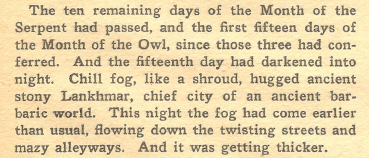
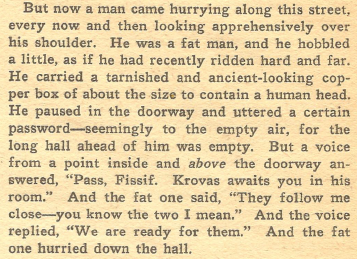
Oh, seems like we’ve cut to 25 days later, and we’re suddenly in a foggy, disreputable street somewhere in the winding streets and alleys of Lankhmar. And what’s this fat, scuttling figure making his way to the Thieves’ House?

Fissif, carrying an ancient box and looking a little worse-for-wear, hurries up and slips inside, warning Krovas that “the two” are following quickly! And it’s true, they are, because very shortly we hear a bunch of secretive whistling warnings, and two figures approach!

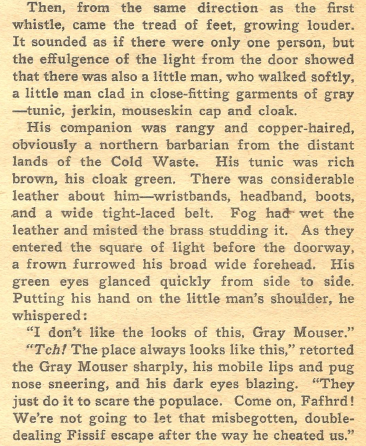
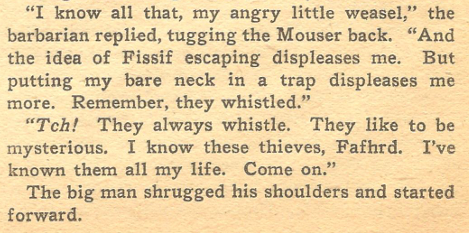
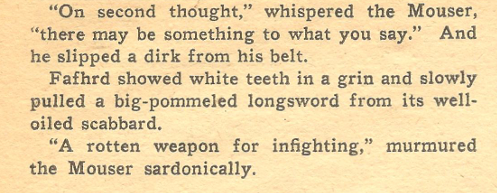
That’s right, it’s our two “heroes,” Fafhrd and the Gray Mouser, and they’re hot on the trail of the traitorous Fissif!

We’ve completely skipped over the whole dungeon dive that was introduced in the beginning of the story, leaping directly to the betrayal and its aftermath – it’s a bold, strong choice from Leiber, and the right one too, because while it would be fun to see the Mouser matching wits with ancient traps and Fafhrd slaughtering a horrible monster, the real action is in the betrayal. Leiber’s always much more interested in the way his two adventurers deal with the scrapes, schemes, and hardships they encounter, more so than in the threats themselves – fighting a monster is one thing, but having to chase after a thief who has betrayed these two is where the real meat of the story is at. It’s also reflects Leiber’s interest in urban settings, I think; he passes over a fairly straightforward “dungeon” portion of this story to leap right into the twists and turns of the city, because compared to the wily, evil ways of the city, a dark and dangerous dungeon is nothing!

There’s also a great example of what is one of the most fun parts of these two characters: the dialog between Fafhrd and the Mouser. Both characters have very clear voices, with very well-developed perspectives, and the comradely rapport between them is always great and often quite funny.

Discussing Two Sought Adventure I mentioned how these two are such fun and unique S&S characters because, in a lot of ways, they know that they’re S&S characters – both of them envision themselves as daring swashbucklers with steely nerves and unmatched skill, true heroes of their Age. They are, literally and consciously, adventurers, and this fully informs the view of both themselves and the world around them. Because of that, their motivation is never in doubt or has to be hand-waved away – Fafhrd and The Gray Mouser will always behave “heroically” in their stories, because they are (and they KNOW they are) the “heroes.” Of course, they’re also very well-developed characters, with Leiber writing with very clearly defined characters in mind.

Mechanically, their interactions are also interesting – so many great S&S stories are centered around hard-bitten lone wolf types, which by necessity means that there tends not to be too much interiority on display with the main characters – Conan is almost always an enigma, really, and we as readers rarely get to see WHY and HOW he’s deciding on what he wants to do. That limitation is why the best Conan stories all have a secondary character that interacts with Conan, questions him, gets him to explain himself and his plans, etc. With Leiber, there’s no need for that – he’s given us two characters that are intimately bound together, and who are always very consciously playing a part for both themselves and one another. Leiber, son of actors and an actor himself (as well as someone very interested literarily in Elizabethean dramas) has made a very conscious, very deliberate decision in the way he portrays these two, and it lets him generate these interesting and fun bits of dialog and scenarios, like we’re seeing here.

The Mouser, always (and often hilariously) the more hot-headed of the two of them, cools himself sufficiently to agree that they should at least be PREPARED to meet with some resistance in attacking the Thieves’ Guildhall directly. This is wise, because they are immediately confronted with sneaky ambushes! Each of them neutralizes the other’s threats in kind, which is another neat little benefit of having two equal participants in the adventure as your protagonists. Then, menaced from the street, the pair are forced to head deeper into the Guild’s inner chambers where, strangely, they meet no further resistance; it’s almost like something has happened, and these two are just stumbling into it. But what else can they do? They make there way to Krovas’s rooms, hoping to find Fissif and the stolen skull there.

The red-haired woman flees through a secret door, taking the skull and locking the passage behind her. Frustrated in their pursuit, our two heroes are busy contemplating the barred passage behind thick curtains when, suddenly, Fafhrd remembers Krovas, who they left, oddly motionless and oddly complexioned, at the desk in the room. They approach him slowly and with needless caution for, of course, he’s dead, mysteriously strangled to death. This puts it a crimp in the Mouser’s half-formed plan of holding Krovas hostage in order to escape, something of immediate concern because now they hear voices approaching! They sneak behind the curtains just as a bunch of cutthroats arrive, including the betrayer Fissif and another thief they recognize as Slevyas, the #2 in the Guild. But something is going down – the thieves are all nervous and seemingly scared, and Fissif is in deep shit with Slevyas, who demands to know where the Jeweled Skull is.

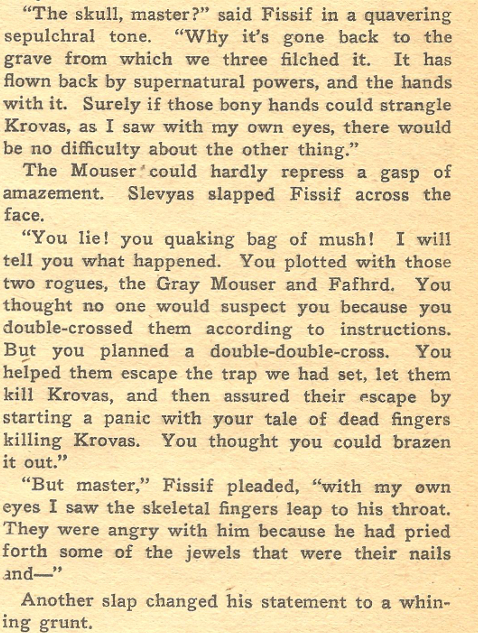
Slevyas orders a Thief’s Trial of Fissif, whom he obviously believes has betrayed the Guild and connived with Fafhrd and The Mouser to steal the skull for themselves. It’s a fun bit of formal procedure that really hammers home the bureaucratic nature of the Thieves’ Guild. We get a nice little scene summarizing the mission, including some fun bits where our heroes get to hear themselves talked about graciously, and Fissif gets to reiterate what happened – the fuckin’ skull killed Krovas! Judgment is postponed, however, when a thief runs in to let Sleyvas know that the watchers on the roof haven’t seen ANYBODY leave…which means Fafhrd and the Gray Mouser are STILL in the building!

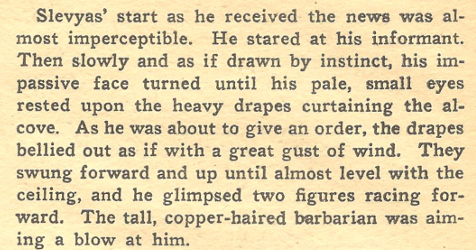
I mean, what a great image, huh? The drapes billowing out, the onrushing Mouser and Fafhrd leaping into action, it’s very dramatic! But of course, you don’t get to be a Master Thief without learning a few tricks; Sleyvas is nimble as a cat, and he ducks and dodges and avoids Fafrhd’s murderous blow. The whole room is in chaos, but Fissif throws a knife at Fafrhd, bonking him on the head with the pommel and muddling the poor barbarian mightily as he and the Mouser dart out the door and into the labyrinthine interior of the Guild Hall.

The Mouser knows the layout, so he leads them in their flight, pursuit hot on their heels. Fafhrd’s head is just starting to clear when he bonks it again against a low doorframe – he’s having a rough night. Fuddled again with a severe head injury, he stumbles one way, leaving the Mouser behind to face an assailant on his own (which he handily dispatches). But the rest of the thieves are hot on his heels, and he splits, heading in a different direction than Fafhrd.

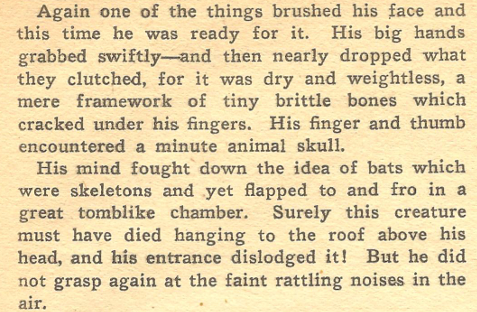
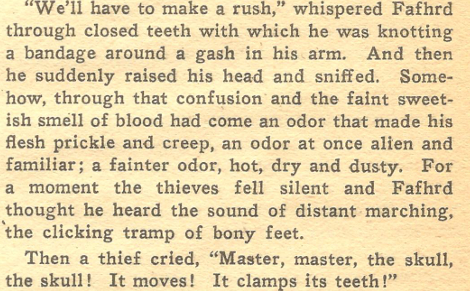
We cut to poor Fafhrd, stumbling around with a concussion – he’s been sick and is having trouble ordering events, and he feels at least three lumps on his head as he bumbles his way through what must be a disused and forgotten deep cellar in the Thieves’ HQ. At some point he stumbles of a secret passage. Everything is dusty and strangely hot, and he’s got no light, instead crawling around blindly, prey to the sorts of weird illusions you get if you’ve ever spent anytime in pure lightless dark. He seems to catch a strange, sepulchral scent, a sort of tomb-ish spiciness, and there are strange whirring things in the air and around his head, bats presumably. It’s very spooky and claustrophobic and unearthly.

Bone bats! That’s great, isn’t it?

Fafhrd then catches another sound, and when he shouts he hears from the echoes that he has come upon a very large chamber of some sort. And he’s not alone!

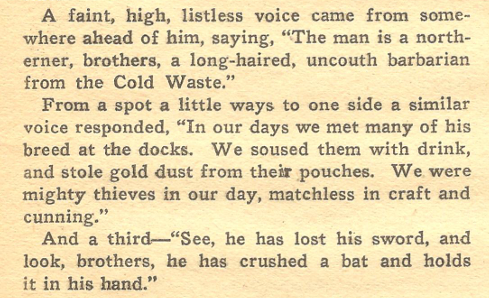
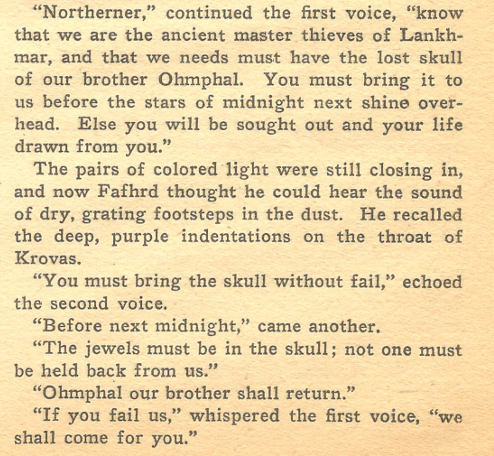
Great, weird scene, with Fafhrd in the dark, unable to see anything, and yet obviously able to be seen by whatever is in the tomb with him. Already we the readers have a sense of what these things are, of course: the spicy, dry, hot air has primed us for tombs or crypts, and the undead skeletal bats flitting around have got us in a very necromantic frame of mind too, so there’s little surprise that these sepulchral voices are the undead liches of long dead Master Thieves, compatriots of the late Ohmphal. Long ago they demanded the return of the lost skull, and their dark sorcery informs them that Fafhrd was one of the three who HAD finally done as they wished…though of course, he hasn’t brought the skull back with him. And that’s a problem:

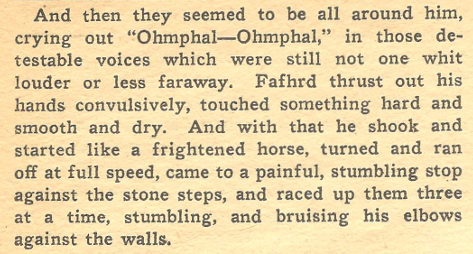
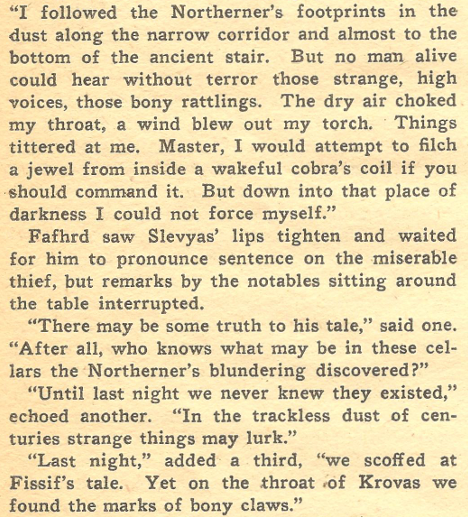
Justifiably spooked, Fafhrd flees wildly off into the dark, charged (on pain of horrible death) with returning the skull by next midnight! And then, having escaped the secret tomb and finally making his way back to the dusty cellars, Fafhrd gets one more traumatic brain injury when he gets bonked on the head by Fissif, who was skulking around down there. Fafhrd is brought before Sleyvas and, seeing as how he doesn’t have the skull, the Thieves decide that that means the Mouser MUST have it…so they make some plans and send a message to the Mouser, who is waiting in vain for his friend back at their favorite bar, the Silver Eel:

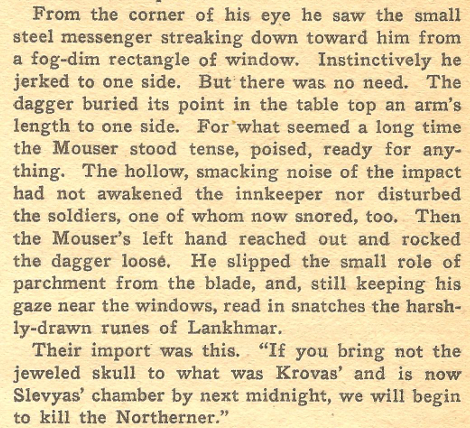
The bar scene is a fun one – Leiber is interested in all the little background stuff happening in his fantasy city, really just as much as the main action, and so every scene is populated by these fun little vignettes that do so much to enrich the world he’s created. The drunken soldiers, the barkeep, the squalid surroundings, it’s a lot of fun. And then, of course, when we have to get back to the Real Action, Leiber doesn’t dissapoint; the line “we will begin to kill the Northerner” is really great, a grim and brutal threat of torture and eventual death. It’s fun!

Of course, the Mouser is in a bit of a bind here, what with not actually having the Skull of Ohmphal. But, being the Mouser, he’s got a very cunning plan.

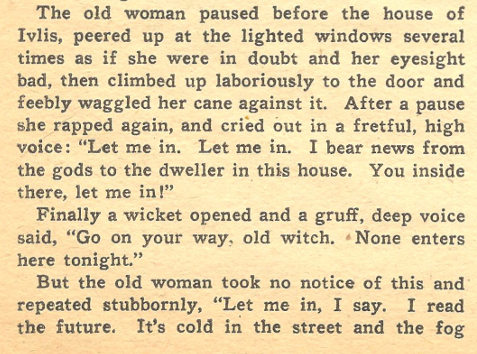
We smash cut back to the misty, murky streets of Lankhmar, where a little old lady is making her way slowly and carefully towards the house where a certain red-haired woman lives. There’re, again, more great scenes of the city and the people in it, and some fun interactions between them as this frail old woman picking her way through the dark. Finally, the old woman reaches her destination:

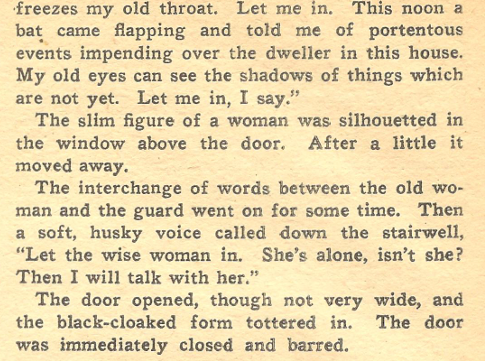
Thus does the Mouser, disguised as a mysterious and witchy old woman, gains entrance to the fortress-like House of Ivlis!

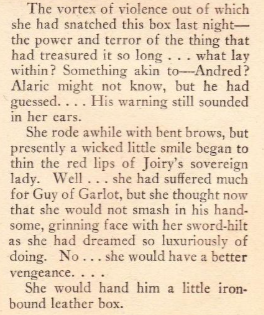
The whole scene between the Mouser and Ivlis is really fun, as our hero tries to bluff his way into her confidence and trick her into betraying the location of the Skull. He also notices the signs of a secret door at the back of the room, presumably one that connects with the Thieves’ Guild next door, a very handy thing for him what with midnight coming on. It’s always fun when the Mouser goes into full on theatrical mode, and Leiber is having fun here, making his character revel in every lie and trick as he wrangles what he needs out of the besieged Ivlis. Equally fun is when the Mouser overplays his hand, which happens when he screams out about smelling the bones of a dead man; Ivlis glances up at an unlit lamp on the wall, but the Mouser’s triumphant look betrays him. There’s a brief, silent struggle, but the Mouser succeeds in overpowering and tying up Ivlis, and claiming the Skull from it’s hiding place!

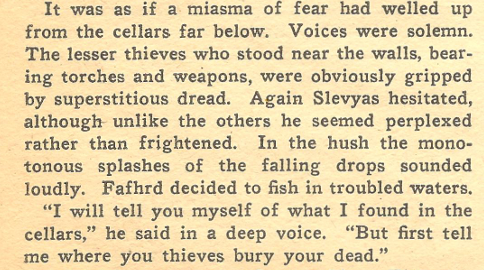
Smash cut back to the Thieves Guide, where a water clock is dripping its way to midnight; Fafhrd, tied up in a chair, is surrounded by grim thieves who, when midnight comes round, will begin to kill him slowly and painfully. But while they’re waiting, Sleyvas is browbeating his underlings, one of whom got perilously close to the horrible tombs below the guildhall.

The strange events, the uncanny halls beneath the guild that none knew about, the strange marks on the late Krovas’s neck…all of these things are beginning to spook the thieves a bit. And, like a good skald, Fafhrd seizes on the moment to both perform some Northern Tale-Telling AND buy himself some time:

Fun stuff – Sword & Sorcery is sometimes accused of being overly reliant on physicality and violence, and while Fafhrd and the Gray Mouser certainly slaughter their fair share of mooks, you can ALSO see the way Leiber highlights their wits and, in particular, their ability to perform as part of their heroic repertoire. The Mouser’s disguise as a Wise Woman, and now Fafhrd’s skaldic recitation of his adventure in the crypt are just as much moments of heroism and derring-do as any fight or scramble up a cliff, for instance, and Leiber (who again was himself an actor) revels in them. It’s a real fun part of these stories, both a part of their charm AS WELL AS a key to understanding their importance to the development of the genre.

Anyway, Fafhrd has totally captured the attention of his audience with his grim tale of undead horror deep beneath this very guildhall! The water clock has long since run out, and yet they have let him continue talking, and they don’t even notice the slight skritching and scratching coming from the wall behind the curtains.

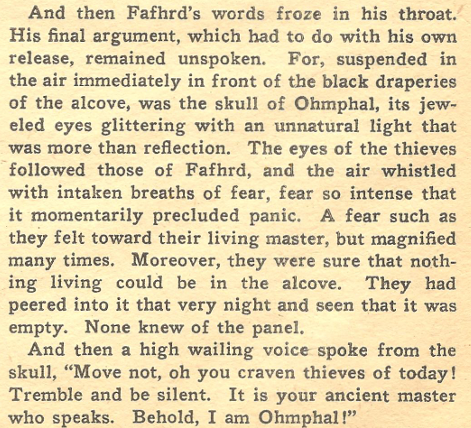
ANOTHER performance, this time from The Mouser who, having snuck back into the hall via the secret passage in Ivlis’s room, is now pretending to be the ghost of Ohmphal come to pronounce judgement on them all! It’s really fun, particularly in the way the Mouser/Ohmphal engineers Fafhrd’s release, which has all the hallmarks of a hasty improvisation:

I mean, c’mon, that’s fun! And, spooked all to hell as they are, the thieves comply, cutting Fafhrd’s bonds and sending him forward. But, before he can reach the safety of the curtain, there’s an animal scream of rage from the curtains, which begin billowing and flapping, as if some great struggle were happening. Ivlis has broken her bonds and followed the Mouser down the hall, and now she (and her guards) have attacked him!

And then all hell breaks loose! The thieves attack, the bodyguards attack, Ivlis attacks, our Heroes attack, everybody is whomping on everybody, though shortly Ivlis (and her last remaining guard) side with Fafhrd and the Mouser when they see that they are being attacked by Sleyvas and the thieves. There’s dead and wounded everywhere, but the thieves are more numerous and things look grim for our heroes when, suddenly:

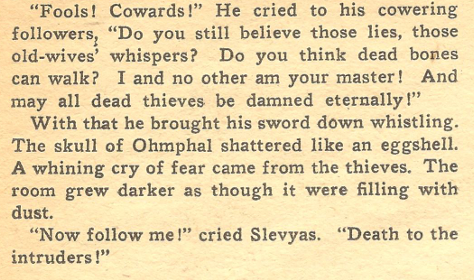
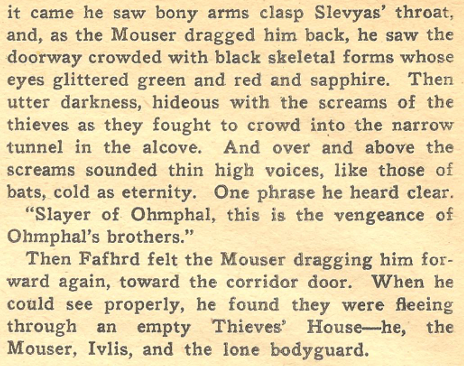
But Slevyas is a staunch materialist, right to the end:

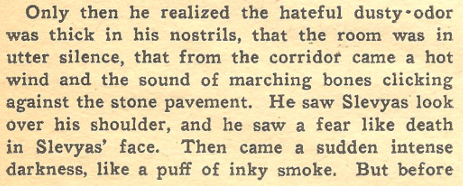
But no one does follow Slevyas, and he alone charges in, meeting Fafhrd and the Mouser in battle. A furious combat ensues, though one curiously quiet and lonely – for the rest of the thieves have shrunk back against the wall in silent fear!

A grim doom has descended on the thieves!

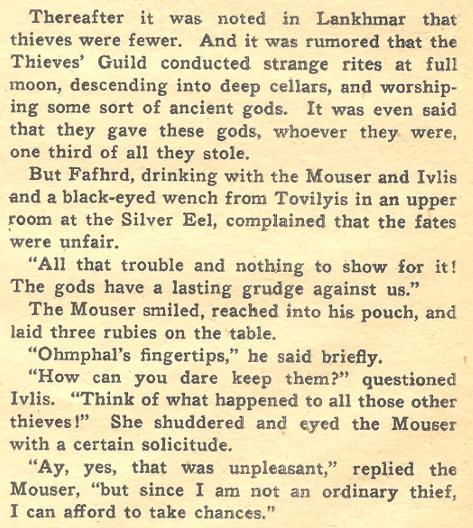
And then, we reach the end of the story:

And that’s the end of Fritz Leiber’s “Thieves’ House,” from 1943.

It’s a blast; Leiber is such a fun writer, and he’s got a very strong hand on the tiller in these stories, writing them exactly the way he wants and producing exactly the sort of effect he’s looking for, I think. Now, some people I’ve spoken to find Leiber, and his S&S stories in particular, a little too self-aware for their tastes, and that’s fine – the heart wants what it wants, after all. But you can’t deny that Leiber succeeds in doing exactly what he wants to do with these stories, even if they’re not to your particular taste.

Of course, I think that while it’s true that Leiber was certainly aware of the genre he was writing in (even if it didn’t have a name yet) and was, in fact, often commenting on it, he’s also sincerely writing excellent adventure stories about two very interesting characters. Fafhrd and the Gray Mouser are spectacular fantasy protagonists, rough and ready but also very much interested in having a good time and cultivating a myth about themselves while they do it. In fact, so much of the fun in these stories comes from the way both characters are constantly trying to reassure themselves and each other that they are truly real life heroic adventurers in a world of sorcery and peril. There’s an existential quality to these two that’s fairly rare in the world of fantasy fiction – they are constantly evaluating themselves, interrogating their place in their world in relation to this Ideal Adventurer. Often, the comedy in the series comes from them twisting themselves in knots as they try to JUSTIFY their less-than-heroic actions within this same S&S hero framework. They’re just a lot of fun, and it’s something that I think the genre would benefit from if more writers today tried to emulate Leiber’s approach.

I mentioned above that this story also seems to be the first to introduce the idea of a thieves’ guild into the genre. This is a pretty big deal, one of those huge gravitational sort of pulls that end up dominating the genre, to the point that they’re kind of invisible and taken for granted. The idea that there is a craft guild of criminals operating within a fantasy city is a huge part of the genre’s landscape, providing a lot of narrative potential energy as well as giving writers the chance to engine in some light mafia-style highjinks if they want to. With respect to fantasy TTRPG’s this story, like so much of Leiber’s fantasy, is absolutely foundational – imagine D&D or WFRP without Thieves’ Guilds; it can’t be done!

Now, I don’t know where exactly ol’ Fritz got the idea for his Thieves’ Guild; as far I know no one has every found a letter or notes or anything where he explained its origin. In some ways, it might just be a natural outgrowth of his obviously somewhat skewed and satirical approach to Lankhmar – the idea of a guild of criminals is a funny, weird idea, and it fits perfectly in with the other absurdities he’d go on to invent for his secondary world of Nehwon.

HOWEVER, to me, I can’t help but see the shadow of Cervantes here, particularly from his short story Riconete y Cortadillo which is about two extremely self-important and self-aggrandizing thieves who meet on the road, become fast friends and devoted comrades, and then are inducted into an extremely ridiculous and comedically bureaucratic Thieves’ Guild in the great port city of Seville. In particular, it’s interesting to me how, in Leiber’s story, the Guild starts out atheistic and materialistic, only to end up deeply religious and cultish about their Dead Masters deep in the Tombs beneath the Guildhall; in Cervantes’ story, the Guild is rife with superstitions and complex rituals, like all good secret societies. That Leiber would’ve been familiar with the story seems extremely likely; after all, he was a devoted lover of that era’s literature, and if you’re going to read any 17th century Spanish lit in translation, you’ll certainly be familiar with THE MOST FAMOUS WRITER OF THAT PLACE AND TIME. I know that Fafhrd and the Mouser were modeled on Leiber and his pal (and cocreator of Lankhmar) Harry Fischer, but I think there’s a lot of Rincon and Cortado in the two, particularly in their ridiculous grandiloquence and self-conceit, as well as in their deep loyalty to one another. Anyway, it’s interesting, and if true it puts Cervantes in the lineage of Sword & Sorcery’s deep ancestors, which I really like.

But, regardless, I think this is a very fun story, and it’s importance in the history of the genre can’t be denied. A good way to start of the Yule Season’s S&S, I think!

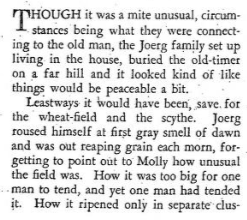
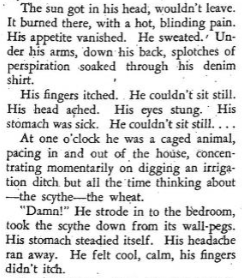
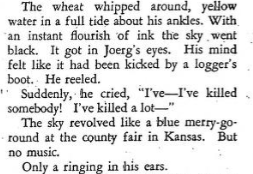
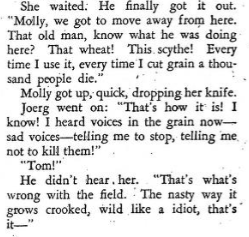
Sowing the Pulp, Straining the Whirlwind #38! “The Scythe” by Ray Bradbury, Weird Tales v.36 n.12, 1943

We’re in the home stretch for Hallowe’en now, so lets try and get some good chilling pulp fiction discussions going on, shall we? It’s nice here in Austin now, too – we finally got some rain, our first in like forty days, and in addition to filling up the rain tanks (we’ve got about 950 gallons of water storage now, which we put in right as the drought started, so it’s nice to finally have it full!) it has also gotten almost seasonable – low 70s as I write this, with overnight temps promising to hit crisp 60s and 50s. Not really what most people think of when we start talkin’ October country and all, but by Satan, I’ll take it!

The sudden shift to Fall(ish) weather and thoughts of The Season inspired the choice of stories today: it’s from the Mayor of October Country himself, Ray Bradbury, and his fun, mythopoetical story “The Scythe” from the July 1943 issue of Weird Tales!

Bradbury, of course, needs no introduction – a truly major figure in sci-fi, and he’s one of the rare genre guys it’s ok for your Very Serious Literary Types to praise, fer chrissake, someone who gets a pass for writing imaginative fiction because it’s got such heart and verve and style. And it’s all very justified; Bradbury is one of the greats (though Fahrenheit 451 sucks), and he’d be rightly numbered among the Titans for The Martian Chronicles, easily one of the greatest short story collections in history, a true masterpiece. And, while he’s often remembered mostly as a sci-fi guy, he’s also got some serious Weird Fic chops too (I’d argue that’s why his sci-fi was so successful, actually; there’s a vital strain of weirdness, and all that implies, when he’s writing about Martians, for instance)!

In fact, Bradbury got his start in the pages of Weird Tales, writing something like 20 or 25 stories between 1942 and 1948, if I remember correctly. This is all post-Wright, of course, and I think Bradbury benefited from Dorothy McIllwraith’s tenure as Editor; his weird fic seems to fit nicely into her vision of the genre, I think, a slightly sentimental (though rarely sappy) atmosphere shot through with real glimmers of coal-black darkness. And, of course, Bradbury’s first collection, Dark Carnival, was published by August Derleth’s Arkham House in 1947. That’s what you call a serious Weird pedigree!

(As an aside, if you’re interested in a great and extremely granular biography of ol’ Ray, I’d highly recommend John Eller’s THREE VOLUME biography from University of Illinois Press, Becoming Ray Bradbury, Ray Bradbury Unbound, and Bradbury Beyond Apollo. They’re great, very interesting and with considerable attention to the details of his papers, correspondence, and archives, as well as putting his work and life in important historical contexts. I will say, though, that you should be prepared for Bradbury’s extremely bad politics, particularly later in life – he was a Reagan fan and was extremely anti-affirmative action, basically your bog standard boot-straps-and-elbow-grease small gov’t libertarian, not as ugly or as bad as, say Niven, but still dumb as hell! It’s shocking, until you start thinking about his deep nostalgia for midwestern childhood. Oh well!)

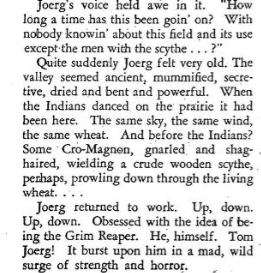
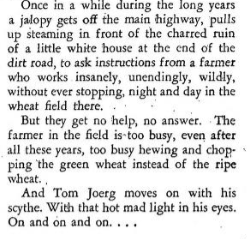
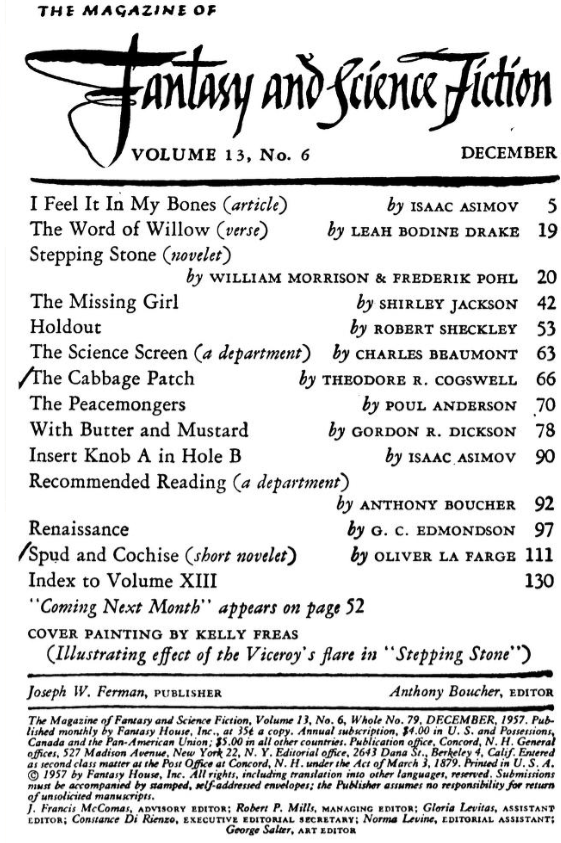
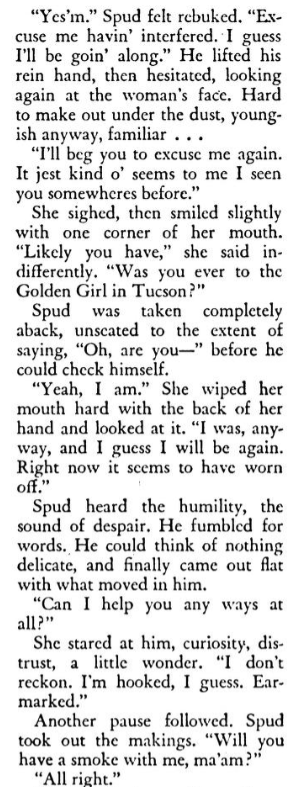
Anyway, let’s look at this issues cover and ToC:

A quiet, contemplative cover for this July 1943 issue, particularly interesting given the date that this issue came out. The cover is for the Bedford-Jones story, “His Last Appearance,” and it posits an old soldier returning to the Pacific theater after the end of World War II. Of course, in 1943, WWII was still raging, with the siege of Stalingrad finally coming to an end, the beginning of the long brutal retreat of the Nazis westward, and the start of Allied plans for the invasion of Europe at the Casablanca conference. For Americans, WWII didn’t start until the Japanese bombing of Pearl Harbor in Dec 1941, and the war in the Pacific had been a long and brutal one in ’42, with the Fall of Manila and rapid Japanese advances in a number of places, including the Aleutians. But here we are, in 1943, with a story that is already imagining the war over!

It’s interesting to see the way the war was being interrogated in the public sphere and within the pages of the speculative fiction magazines at the time, imagining an end to the war and return to a more “normal” status quo in the near future. What’s missing from all these stories, of course, are the horrific specificities of future history, death camps and the Holocaust, V2 rockets and the Atomic Bomb, and the global detente of the Cold War. It makes for fascinating reading, glimpses into how people are grappling with such dramatic and profound events and changes. The Pulps give you a chance to really see the world and the people at very specific times, and they’re just fascinating!

As for the ToC:

The big story here is Bloch’s “Yours Truly – Jack the Ripper,” probably one of his best and most famous stories. Bloch by this point in his career has basically exorcised Lovecraft from his work, having found his own style, tone, and topics of interest outside of the shadow of the Old Gent. Bloch’s “Ripperverse” work is an important part in his career, both because it laid the groundwork for his intensely psychological interest in murderers/serial killers, but also because it would lead his to write “A Toy for Juliette” in Harlan Ellison’s epochal anthology Dangerous Visions; so taken with the story was Ellison that he would write a sequel, “The Prowler in the City at the Edge of the World,” which he put in right after Bloch’s story in the collection. Anyway, it’s fun to see the beginnings of all that right here in Weird Tales!

Enough jibber-jabber, on to our story today, “The Scythe” by Ray Bradbury!

Look, the art in WT at this time…it ain’t what it used to be, okay? This is a perfectly evocative image, a little rough maybe, but it gets the job done I suppose. Still, makes you dream of the days of Finlay, don’t it? Also, I’ll just point out, that this is yet another example of the art giving too much away from the story; combined with the little blurb thing at the top of the pic, you definitely start this story with far too much information, in my opinion. Oh well! We’re used to it by now, but it’s still annoying as hell!

There’s no denying it – Bradbury knows what he’s doing. Great sudden in medias res opening here, and the short, percussive first sentence (“Quite suddenly there was no more road.”) is nigh on a perfect way to start the story, evocative and sharp and perfect, and a great lonely image. A road winding on through farmland, leading past trees and the stones and then a farmhouse and a wheatfield and then, as if it’s job were done, the road dies. Great, great stuff!

We’re introduced to some characters who might’ve escaped from the “Grapes of Wrath,” or maybe they’re just off-broad versions. “Tom Joerg” seems awfully close to “Tom Joad,” doesn’t it? And, like their Oakie comrades in Steinbeck’s book, they’re having a rough time of it, having followed this road that goes nowhere and running out of gas. A long-suffering wife and some hungry kids – that’s what you call prairie pathos, man.

What’s also interesting is that section there in the middle, where Tom starts looking at his hands. The writing is great of course (“farm blown out from under them” is a gem), but it also very specifically evokes the image of the dust bowl, doesn’t it? Now, while the droughts and soil loss and economic collapses continued into the 40s, it was even then very strongly associated with the 30s. Bradbury is priming us for the fact that, while this story was published in ’43, it probably took place earlier. The timeline is very important to this story, indeed is one of it’s major points, so we’re being prepped here. A neat bit of mechanical work, is my point, that Bradbury is doing here.

Starved, lost, and without anything else to do, Molly suggests to Tom that he head on up to the little farmhouse and see if they couldn’t spare a bite for the travelers. Tom swallows his pride and stumps on up to the house:

The knocking three times has some kind of mystical resonances, doesn’t it? There’s the trifold symmetry of time, Past-Present-Future, there, but there’s also a sense of “asking three times” being the amount that signifies contractual obligation in magical relationships. Anyway, Tom enters the house and his spidey-senses start tingling immediately. Sure enough, he finds a dead body, an old man clutching a single blade of ripe wheat and a scythe leaning against the wall. Weird as that is, Tom finds that the old man apparently anticipated his death, and left behind what amounts to a will:

A lot here! First, and of most immediate importance, is the fact that the Joerg’s are now landowners – the old man has bequeathed the house and land to whoever has found him. What would give me pause, of course, is the next bit, which comes off as a little weird: take the farm AND THE TASK ORDAINED THERETO, and take ’em freely and unquestioningly. That’s a magical compact right there, a binding of Joerg to the land and some unspecified job that has to be done.

Also, we get a date here – April 1939. Note it!

Tom seems a bit spooked, but he and Molly quickly accept this lucky twist of fate. They take the farm as offered, and plan to start living the good life there in the middle of nowhere.

Not quite sure what the economic benefit of growing a fast-dying/fast-sprouting variety of wheat is! Also, it’s planted on a vast scale, and it seems to ripen in weird, localized clusters or zones. But he seems driven to cut it!

It’s strange, and it makes me wonder how exactly the farm is supporting this family, but after a while Tom decides that this preternatural wheat can go fuck itself, and he decides to stop cutting it. How’s that work out for him, you ask? Well:

He took the farm, and with it the APPOINTED TASK which, apparently, is to cut the weird wheat, day in and day out, unceasingly. Or else! The details of the task elude him, save for the necessity of it, the necessity of cutting the grain down when and where it is ripe in this strange stretch of field, not harvesting, not tilling, not planting, just cutting it down as it comes up, over and over again, letting it sprout and grow where and when it does. Extremely strange and mythic, isn’t it? And then, when he’s harvesting, he suddenly has a very strange, very mysterious reveleation:

Great writing, the sudden vertiginous sense of disorder and confusion that Tom feels is very ably conveyed to the reader – what is going on? Why’s he freaking out now? Tom runs into the house, half-panicked, but eventually he can get the words out to Molly:

Pretty spectacularly weird isn’t it – he’s literally a grim reaper, ending a thousand lives every time he cuts a single stalk of wheat in that uncanny field. It seems like maybe his exposure to the work has, slowly, given him insight into its nature, or maybe the fact that he had some relationship to one of the lives he just cut down has triggered his illumination, but it doesn’t matter – Molly thinks he’s nuts, and Tom knows he’s not. Molly tells him to shut up, that they’ve got a good thing going with this farm (I guess there must be other food crops, and a cow or two, so that’s how they’re eating?). And she reads the Bible at him all week, I guess trying to get him to settling down, until of course a telegram arrives letting Tom know his Mom DID die, on the very day that he had his wheat-based freak out.

Tom wants to leave, but Molly is made of sterner stuff. She shoots his California plan down and tells him that by God they’re staying right there, where they’ve got a home and food and future! And, realistically, what can Tom do – we (and he) must know that he’s made the deal, he’s accepted the job, and the job HAS to be done.

With a certain mid-western pragmatism, Tom begins to accept the inevitability of his task. He communes with the grave of his predecessor and contemplates the long-line of harvesters that must’ve come before him, down to prehistory. (As and aside, the idea of the Cro-Magnon harvester is funny and strange – so like, before agriculture there were cavemen forced to chop down the Magic Sheaves of Life and Death? It’s an odd, incongruous image, but one we’ll just have to forgive Bradbury for).

Now we’re getting into the real interesting part of the story – there’s a little musing here about what Tom’s relation to the Work is. He’s not KILLING the people, not maliciously – he’s just doing a job, taking care of his family. An interesting bit of ethics to consider, maybe, though Tom abandons it when he has the brain flash that, if he could find his and his family’s wheat stalks, why, could they live forever? I’m sure this magical wheat never considered that loophole before!

No sooner thought than answered – Molly and his kids’ time HAS come, he HAS to cut them down…and he can’t! He decides to fight fate!

Over supper Molly asks some questions about the wheat, even suggesting that Tom oughta call in the Extension boys from the local Ag Dept to have a look – what the hell good is this weird wheat that rots immediately, anyway? Tom is horrified – what might the GOV’T do with the Grain of Life and Death, after all? It’s a neat little part of the story, another of those little asides that Bradbury raises and which run a chill up and down the ol’ spine as you regard them in the story. It’s fun! Of course Tom is having no part of it. Molly doesn’t think the Wheat of Fate is real, but Tom KNOWS it is.

Grim stuff, and Tom again tries to abandon the work, locking up the Scythe and choosing to ignore the wheat…but then Molly begins to suffer from a strange kind of lassitude, and his kids seem to whither and fade a bit too, afflicted with a kind of odd malaise. He doesn’t know what will happen to them, or to the countless thousands he has refused to reap, but he’s going to wait and see…

…and of course he wakes in the middle of the night out in the field, with the scythe in his hand, being driven by a mad compulsion to DO THE JOB. He fights it, struggles mightily…

…and then the house fuckin’ blows up!

Horribly, Molly and Susie and Tom Junior AREN’T dead…they’re trapped behind horrible walls of flame a smoke between life and death, unresponsive, unaware, undying. It’s a horrible scene, and there’s some very fine writing here as Tom is forced to confront the implacable nature of Life and Death. He brings his family out onto the lawn, cold and sleeping beyond death, and realizes that he cannot abandon the task, that he cannot have a life anymore – he is the grim reaper.

Pretty horrible scene, isn’t it, the image of his family just out of sight screaming and dying as Tom, chained to the merciless scythe, cuts through the wheat in the night. Grim as hell!

There’s the significance of the date of the story coming around: 1939, and the beginning of the Second World War.

Is Tom *causing* it, do you think? Is he heedlessly cutting, maybe cutting more than he should, causing a horrible war and its aftermath out of his grief? Or is he simply, heedlessly, heeding the wheat, cutting madly because that is what has been Fated? It’s not clear, and that ambiguity is troubling and, of course, probably the point.

And as for Tom?

And that’s the end of “The Scythe” by Ray Bradbury!

Tom keeps on cutting – again, is he causing the accelerating deaths, the horror of modern warfare and conflict and imperialism and transnational capitalism, or is he merely the instrument of it, his feverish monomania and ceaseless toil a product of OUR horrible times?

It’s a nice little story, I think, and it really captures a very pure strain of myth that Bradbury often mined in his work. It’s also an interesting time capsule, a writer watching the world around him ending and reflecting on it, what it meant to him and society. A good reminder of the power and possibility of pulp literature!

Weird Pulp of the Old West #33: “Spud and Cochise” by Oliver La Farge, (originally published in The Forum, January 1936, but reprinted in Fantasy & Science Fiction Magazine v.13, n.6, Dec. 1957)

Howdy Pardners! Been a dog’s age, ain’t it? Lotta shit happening, so I ain’t had the time to scratch out as much writin’ and musin’ as I’d like to for this here blog, but still! Catch as catch can, so here we are again, and it’s a rip-snorter this time, a wonderful little story that one could very easily classify as an early example of the “Weird Western” genre originally from 1936: it’s “Spud and Cochise” by Oliver La Farge, originally published in The Forum but republished nearly 20 yrs later in good ol’ Fantasy & Science Fiction!

First thing to touch on – is this, truly, really, actually, pulp? Well, frankly…no. The magazine it was published in originally, back in ’36, was a slick called The Forum, a long-lived magazine first published in the late 1800s and running well into the middle of the 20th century. It’s early iteration took its name very seriously, hosting dueling essays on the major news topics of the day – it famously had a whole issue devoted to American Imperialism and whether it was Good or Bad following the 1898 expansion of U.S. holdings into the Caribbean and the Pacific, for instance. Beginning sometime in the teens, though, The Forum began to publish more fiction, although it never truly abandoned its “Ripped from the Headlines” essays and articles.

I called it a “slick,” by which I mean it was published on higher quality paper, had pretentions of greater literary/intellectual/social merit, and also had a lot more advertising. In fact, during some of its run, particularly in the 30s and 40s, it might’ve actually graded into the storied heights of the “glossies,” since it had circulation and distribution comparable to Harper’s and The Atlantic at the time, with whom they also shared a number of authors. With regards to the fiction it published, it also never focused on a specific genre, which is something else it had in common with the glossies and fancier slicks. In general, the fiction in The Forum was of a more serious, literary bent, though of course you’ll see that today’s story was republished in Fantasy & Science Fiction Magazine in ’57, and it is very definitely a work of fantasy.

Of course, F&SF isn’t exactly a pulp either; it was first published in ’49, a period that, really, can’t be said to be truly of the pulp era, at least not classically. The post-war publishing boom had changed that landscape irreparably (along with changes in printing and mail distribution), resulting in very different magazine business and newsstand culture. Similarly, radio and teevee totally changed the nature of popular entertainment. Gone were the heady days of dozens of magazines battling it out for a vast audience of readers hungry for more short stories. Now, genres were firmly cemented, and only those with sturdy, reliable fandoms could survive in the hardscrabble world of magazine publishing.

In fact, F&SF was clearly meant to be seen as a break from the pulpy past. It had no interior illustrations, for one thing, focusing instead on the stories, something that immediately stands out in contrast to, say, Astounding or Weird Tales. It was also created by and associated with a very specific group of editors and writers, people who had basically split with what I call the “Ray Palmer” school of sci-fi. There’s a whole story there, a fascinating (but also, sadly, a constantly recapitulating) one too, but to make it short, there had been an aesthetic and philosophic break with classic “gee whiz ray-guns-and-bug-eyed-monsters” sci fi, starting in the 30s and accelerated by WWII; guys like Pohl, Asimov, etc had pushed sci-fi into headier, more literary territory, ushering in a classic era of thoughtful, introspective, and frankly modern (sometimes to a fault!) stories that defined the genre. F&SF was a publication by and for those sorts of stories, as evidenced by its authors and editors; for instance, Anthony Boucher, the editor of this issue, was one of the first English-language translators of Borges. These serious literary chops are evident from a glance at the ToC:

It’s just ringer after ringer, both in terms of straight sci-fi (Asimov, Pohl, Anderson, Dickson) as well as the fuckin’ Master herself, Shirley Jackson. I mean, this is a scorching table of contents, some great stories by some great writers, including the reprint we’re interested in today, “Spud and Cochise” by Oliver La Farge!

But, before we get stuck in, let’s briefly introduce our author, since it’s A) extremely possible that you’ve never heard of him and B) his biography is relevant to this story. La Farge, born in 1901, was originally an anthropologist, doing important work on Olmec sites in Mexico before shifting his focus to the desert southwest and, specifically, the Navajo. He learned to speak Navajo, and wrote several scholarly works on both Navajo lifeways and their language. It was this experience, particularly in living in the southwest with the Navajo, that informed the majority of his writing. He’s probably most famous for a novel, Laughing Boy, which is set on a Navajo reservation and represents an important record of Navajo life and culture from the time; it won the Pulitzer in ’29 and set La Farge off on his career as a novelist. He also wrote a fair number of short stories, publishing a couple of collection in his lifetime and one volume posthumously. I’ve not read any of his novels, nor his autobiographical memoir “Behind the Mountain,” but after I found this story (in an old 60s paperback “best of” collection of F&SF) I chased his stuff down. He’s a good writer, interesting and with a lot of keen descriptions of people and places in the southwest, worth reading! But, I will say, today’s story is easily my favorite thing he’s done, a real masterpiece. I’ll link it again here just in case, and strongly urge you to read it before I go and spoil everything. It’s really honestly great!

Anyway, we’re burning daylight, so let’s mount up and get into the story!

Incredible western writing…you can smell the desert air, taste the dust, feel the sun, it’s great stuff. The tone is wonderful too; that little bit at the end, about the dead horse being a godsend for the ants, just a perfect encapsulation of the desolate and alien nature of the desert, you know? Balzac wrote that “In the desert you see there is everything and nothing – it is God without mankind” and La Farge gets it, you know what I mean?

Our dusty, weary feller, identified simply as Spud, rides up a ridge and sees a cloud of dust moving towards him. What’s the western equivalent of hard-boiled? Raw-hide? Whatever it is, that’s what we get, the sort of spare, efficient prose that lets you know Spud is an old hand at western living, wary of the dust, knowing it could be dangerous, particularly when it vanishes.

It’s interesting the way the medium in which we read things mediates our experience, isn’t it? I mean, think about someone reading this in The Forum in ’36 – you’d hit these first few scenes, these first few paragraphs, and think “okay, we’ve got some kind of cowboy story here.” But us, reading it in a science fiction magazine, we know there’s more than just a cow opera in the offing here, so we’re primed and waiting for the weirdness, reading between the lines…why did that dust cloud vanish?

Spud rides on, and eventually comes across the source, a weary, dusty woman who he greets with all the tact and graciousness of a true Gentleman of the Range.

Great stuff, perfect tone, perfect edge to everything. This woman is, very definitively, heading away from the town of Spareribs; there’s obviously something there, some reason that this exhausted woman has lit out of town in such a hurry, and Spud simply must know what’s going on. It turns out that, beneath the dirt and dust and grimness, he recognizes this woman!

Man, but “came out flat with what moved in him” is a perfect line, isn’t it? The western genre is the perfect, natural home of the valiant Paladin, particularly if you like your chivalric hero a little dusty and trail weary, and in this section La Farge is presenting us with an all time Cowboy Knight Errant in Spud. Just a really wonderful bit of character work here.

And then it turns out that this woman, a prostitute, actually recognizes Spud!

Plotwise, there it is: this woman, hoping to start a new life, bought up a mine and figured on settling in Spareribs, only to end up getting menaced by someone names Snakeweed. Stylistically, I think this is great stuff – very western, very gritty, but then the way these two know each other, the way they share a geography, it’s very mythic, you know what I mean, like a greek myth, or from the chansons. And they way she just has to ask “Do you know Snakeweed?” and he only has to answer “I do” well, I mean, c’mon, that’s fantastic. We’re immediately transported into a world, although we don’t know yet what kind of world it is, exactly. But damn if I don’t love it! Also, just as an aside, I love her statement “I tried to get out o’ the corral, but I guess it’s too high for me.” What a great line, full of despair at her inability to escape her past. Wonderful stuff!

Seeing and hearing her despair, Spud tells her not to worry – he’s been around the block a bit and seen many a woman like her find happiness. Then, moved by the weird that dominates his life as a heroic wanderer, Spud tells her to hold off going all the way to Tucson. Instead, she should take another trail, head to a place where she can hole up for a while and give him a chance to take care of Snakeweed.

Flawless stuff, in my opinion. The woman worries Spud will get killed, what with him being a wiry little feller and Snakeweed a great big bear of a man, but Spud tells her not to worry, telling what we think in the moment is a Pecos Bill style tall tale about himself. Anyway, there’s something in his bearing and words that convinces her that she oughta let him try, at least. They make an agreement to meet at an appointed time, and then she gives him a gift.

Two whole bottles of Four-Eye Monongahela! Now, at this point in the story, this is just some fancy liquor (Monongahela, by the way, is a valley in Pennsylvania, were the tradition of making whiskey with a mash of 80% rye and 20% barley originated), though you’ll want to just tuck these two blue bottles away for now in the back of your mind.

Spud rides off, there’s more wonderful desert description, and then he reaches Spareribs, a rough patch in the middle of nowhere. He’s been here before, as evidenced by the fact that the corral boss knows him and hands him a key. There some fantastic western writing here, a clearly painted picture of a dusty mining town in the middle of the desert, complete with saloon and fancy faro table. Spud gets a drink, eats a steak, and gets the feel of the place.

And then: enter, Snakeweed.

What’s Tiger Bone, you ask? Well,

So already, we’ve got some stuff going on, right? The whiskey earlier, a kind of heavenly drink, and now we’re introduced to its opposite, Tiger Bone, a Left Handed liquor, if you will. And it has effects!

Just gonna come clean – I love this, it’s perfect. “You know me. I’m Snakeweed; that’s what they call me and they better like it.” War talk indeed! And Spud has the sense (perhaps influenced by the preternatural Tiger Bone he’s been drinking) that he too has become a part of this myth cycle, back when he made his own war talk and Named himself in the same way. We’ve stepped out of the West, per say, and into some real Wizard shit now. And it just gets better!

Spud recognizes the truth of the thing – there’s magic in this world, Spud and Snakeweed both partake of it and use it and understand it. Without that bullet, Spud knows he can’t kill Snakeweed. He briefly contemplates trying to drink him under the table, but he calculates that it’d take a lot, more by far than he could handle himself. Similarly, there’s the sense that the Four Eye booze, powerful as it is, wouldn’t help him here either – there’s a great line about how the Tiger Bone didn’t make Spud mean, and in the same way the Four Eye wouldn’t make Snakeweed kind. This is my favorite kind of magic, a sort of Taoist point-counterpoint, forces-in-balance sort of thing.

Spud retires for the night, turning over the problem in his head. Spareribs is too small for both Spud and Snakeweed, but so long as Snakeweed has that bullet, there’s no way to get rid of him. Spud mulls it over, letting the Tiger Bone roil in his veins, and then he comes on a memory of a time when, once, he’d had a horse stolen out from under him by an Apache, a man who clearly could steal anything. And so, in the morning, Spud heads off in search of the great leader of the Apache resisting the Americans and the Mexicans both, Cochise.

Spud does some magic to learn where he has to go and then, after the manner of a hero, travels through the borders of the known world and into the unknown. La Farge spent a lot of time in the desert, and it shows again in the way he writes about the landscape and pure magic of it. Eventually Spud reaches his goal, confronts the Apache, and meets Cochise.

And then begins what is, in my estimation, the finest wizard’s duel ever written.

The thing about magic is that it’s hard to write, you know what I mean? What does it represent it? How is it expressed? You look at the classics of fantasy literature, your Conan or your Lord of The Rings, and you’ll find a paucity of magic, at least of the flashy, spectacular, D&D style spell-flinging; Gandalf lights a stick on fire in the blizzard magically, and that’s about it. Now, he does some other stuff too, but its all about will power and determination, a kind of intrinsic magic, hidden from mortal eyes. Similarly, in Howard’s S&S, the magic is either hypnotism and suggestion and alchemy, fancy psychological trickery, or it’s demon-powered and inhuman; either way, it’s rarely the focus of the story, since Howard knew if you dwelled on it too much it tended to strain the verisimilitude.

As for having two wizards go at it, well, forget about it. I mean, honestly, two old bearded dudes hurling fireballs at each other is boring as hell. That’s why people either subvert it, like Jack Vance and his ridiculous (and very limited) ultra-scholastic magic, or they go back to a real old-school kind of mythic “duel” like Le Guin in her great “The Rule of Names,” or White in The Once and Future King. Here the wizards are trying to one-up each other in a kind of escalating game, to see who can be trapped. That’s fun, for sure, and in both Le Guin and White’s work it is presented really effectively, but in all honesty: once you’ve seen two wizards trying to out rock-paper-scissors each other, there’s nothing really more to add, you know?

Which is why La Farge’s work here is so exciting – this is a fantastic wizards’ duel, with rules that are evident but obscure, and it feels both old and mythic while also being new and totally unprecedented. I’ll not paste any of it here, because otherwise I’d just end up putting pages of the story here, but I really hope you’ve already gone through and read this story; I really can’t say it enough – this is a great story, and this part in particular is fantastic.

Their duel starts with Cochise stopping the sun and sending it back along its track, a horrible thing (as no one can live in the past) and an awe inspiring display of power. Spud counters with a stream of mystic cursing in a range of languages, transforming his words into pure power that sends warriors fleeing and makes a buzzard drop, scorched to death, from the air. Cochise’s magic was flashy, but Spud’s demonstrated his power to actually affect things in the world permanently. Cochise responds by literally cutting a hole in the sky, and Spud nearly loses himself in the otherworldly emptiness exposed, and only with difficulty does he shake it off. Spud ties a knot in a string, a powerful spell that binds and traps Cochise. Both are left wearied.

The two wizards, Cochise and Spud, have some more magical fun – the contest is over, and by their exertions they have bound each other in friendship. There’s more mythic goodness from the buzzard, who threatens the two if they won’t share their booze, and then they get down to brass tacks – Spud came here to find a great thief to steal Snakeweed’s magic bullet. Cochise knows just the man. The thief is eager for the challenge, and agrees to help Spud. Cochise and Spud discuss deep, mystic matters long into the night, finishing off the Four Eye, and they part as friends and comrades, brother wizards both.

Spud and the Thief return to Spareribs, and he gets to work:

Again, the portrayal of magic in here is just so goddamned perfect, matter-of-fact but never banal, and the implication of it is always one of long study, serious dedication, and deep skill. It’s some of the best examples of magic I’ve ever read in any fantasy anywhere. It’s really great!

The thief returns with the bullet, and Spud, in thanks, says he can loot the town of its horses, which the thief cheerfully does. Meanwhile, Spud takes the malachite bullet, fixes it so it’ll work as a center-fire round, and then goes and loses some money at faro (in some obscure, mystical way, this is a magical act too, and its that easy ambiguity that La Farge captures that makes his magical writing so good, I think). And then he goes to kill Snakeweed:

And that’s the end of the story!

Look, obviously, I fuckin’ love this story. It’s great; Spud Flynn is a goddamn trail-worn paladin, easily my favorite kind of character, and La Farge has given him a vital voice that works perfectly in this kind of story. I love the way the world is just absolutely steeped in magic, too; like I said, this is the best wizards’ duel I’ve ever read, and the weirdness of Snakeweed and Spud’s own wizard duel in the saloon is fun too. There’s a real rugged realness to this world’s magic that I love too; it feels organically like a part of the story, you know? I reckon that’s because La Farge, a writer who loved the Southwest, was intimately familiar with the folklore and tall tales of that place, as well as the legends and folklore of the Native Americans of the region.

His familiarity and first-hand knowledge of the land and the people of that region is evident, particularly in the way he writes Cochise, I think, and it’s a goddamn relief to read something that treats the Indians as real people and not mere props; it’s sadly rare NOW, let alone from something in 1936!

As an example of a “Weird Western,” I think it’s really great – there’s a real tendency, especially know, to lean heavily into “cowboy vs monster” and, don’t get me wrong, that’s great too, but man I love the fable-like quality on display here, and the emphasis on magic and the conflict between two Cunning Men (in the sense of them being wizards) on display here; it’s a much rare kind of weird western, I think, and that’s always refreshing.

Reckon I’ve jabbered on enough about it; it’s a good story, and I hope to see ya’ll somewhere down the trail. Adios!

What is good in life? To have your pulp strained, to drive the magazines before you and hear the lamentation of their editors! Pulp Strainer #32: Sword & Sorcery Month! “Hellsgarde” by C.L. Moore, Weird Tales v.33 n.4, April 1939

CONTENT WARNING: the story we’re talking about today includes sexual assault.

A hyperborean wind howls from the north, locking my Texan kingdom in the icy grip of mid-40 degree temperatures, which can only mean one thing: Sword & Sorcery month is upon us again!

As I mentioned last year, I have long associated the Yule with fantasy in general and sword & sorcery in particular – something about the atmospherics and the holiday free time lends itself to curling up with some rollicking barbarians-and-wizards action, you know what I mean? Last Sword & Sorcery month, we talked about a lot of fun stories either leading up to the genre – the Solomon Kane story Rattle of Bones for instance, or my favorite S&S tale of all time, Worms of the Earth – or those firmly within its walls, like the classic Conan adventure The Tower of the Elephant, Fafhrd and the Gray Mouser’s first story Two Sought Adventure, or Black God’s Kiss, the very first Jirel of Joiry tale.

That last one on the list above is relevant, because it strongly influenced which story I wanted to do today. Again, as is tradition, we gave November over to C.L. Moore stories, and like last year I moved from Moorevember into Sword & Sorcery month with the very first Jirel story. So, with frightful symmetry, let’s start of our celebration of all things sword-and-sorcerous with the LAST Jirel story that C.L. Moore ever wrote, the absolutely killer Hellsgarde!

As is clear if you’ve been reading these long rambles of mine, Moore is one of my favorite writers, and Jirel is one of my favorite characters – she’s really a singular creation, a badass swordswoman in full command of herself and her destiny; she’s not some wandering mercenary or exotic barbarian, she’s a goddamn robber baron(ess), ruling a castle and with a band of rough-and-ready slayers under her command. Interestingly, it’s that singular independence that serves as the instigating factor for most of her adventures – in the first story, we meet Jirel after her defeat, with her castle occupied and herself a prisoner. The threat to her autonomy that this represents leads her to take a drastic and blasphemous path towards vengeance, with a grim and tragic result. Jirel’s saga is bookended by a similar constraint in “Hellsgarde;” here, Jirel has been forced into dire action by the treachery of a (strangely attractive) man, and she also ends up facing strange, alien, and altogether blasphemous magic, a source of pervasive corruption that, I think, really sets the tone for a lot of sword & sorcery later.

But, before we dive into the story, let’s look over this issue of Weird Tales!

The cover, by Virgil Finlay, is a little disappointing and bland, a shame given what we know Finlay is capable of. In fact, there’s actually some killer Finlay art in the magazine, so let’s take a minute to wash the dullness of the cover out of our eyes with some of that, shall we?

I mean, holy smokes, lookit that! Great, weird art for McClusky’s (middling) story “The Red God Laughed. And lookit this:

Late Wright-era Weird Tales would do these one page spreads where an artist would take inspiration from a short passage, often of poetry, to create these marvelous full illustrations. I mean, jumpin’ cats, what a piece, huh? Baffling that Finlay’s cover is so dull when he’s capable of masterpieces like this, isn’t it? But oh well!

The ToC is interesting:

At first blush, there’s not a lot to recommend this big ol’ issue, is there? A lot of second-stringers, in my opinion; Moore’s Jirel story is the stand-out, from our perspective today at least. Folks back then loved Quinn though, which is probably why his (perfectly fine but nothin-to-write-home-about) story got the cover. Bloch is still working to find his niche – there’s a bit of gratuitous violence and gore in this one, hints of things to come for ol’ Bob Bloch. Moore’s husband and writing partner, Henry Kuttner, has a story in here, and it’s 100% a Lovecraft story, with two weirdos doin’ occult experiments to contact things from Beyond and all that. There’s some funny drug stuff here too, with the occultists using weed as part of their mystic preparations. It’s actually not a bad piece of Lovecraft inspired fiction, even if it does come off a bit derivative and pat. He even excerpts the same passage from Machen that H.P. used in “The Horror at Red Hook!”

But speaking of the Old Gent, there’s two Lovecraft pieces in this issue, pretty good for a guy who’d been dead for two years. “The Wicked Clergyman” is unusual, in that it’s an excerpt of a letter that Lovecraft sent to a friend, Bernard Dwyer, in 1933, and the part that became this story is basically him recounting a weird dream he’d had. Following Lovecraft’s death, Wright took some effort to gather up any remaining bits an pieces of his work and publish (or republish, in the case of the amateur press stuff) things like this in the magazine. On the one hand, it’s nice this stuff got preserved, but on the other, you can’t help but feel like a note about this story would’ve been nice, at least for Lovecraft’s sake – this isn’t a “story” per say, and not knowing its provenance might give a reader a weird idea about Lovecraft’s work and style.

The other Lovecraft piece is a reprint of Zelia Bishop’s 1929 story “The Curse of Yig.” Bishop is a very interesting character who hired (and occasionally actually paid) Lovecraft to do some revisionary/ghost writing work, which she then sold (or offered) under her name. By far theirs in the most “impactful” collaborations in the mythos world; these stories introduce Yig the Father of Serpents into the pantheon. They’re also interesting stories for their western flavor – they’re set in Oklahoma and have a decided “frontier” aspect.

A long ramble, but the point is that Moore’s “Hellsgarde” is coming in at a strange and chaning time for the pulp world – the old masters of Weird Fiction are, for the most part, dead or in decline, and the powerful editor of the magazine, Farnsworth Wright, would soon follow them. Simultaneously there’s more competition, particularly in the sci-fi (and fantasy) realm out there, magazines that had bigger budgets and could pay better prices than The Unique Magazine. Every Jirel story that Moore wrote appeared in Weird Tales, but the landscape of magazine publishing was changing, and Moore (and Kuttner) would expand their markets, particularly as sci-fi grew in popularity.

But, anyway, enough! Let’s get to “Hellsgarde” already, yeesh!

Good illo by Finlay, of course, although I can’t help but wish he’d taken on the weird “nobles” that Jirel meets in Hellsgarde, with their subtle but definite “wrongness.” Oh well! Also interesting how Moore is still being connected with “Shambleau” all these years later! It’s an important story, and it definitely had a very strong impact on ol’ Farnsworth and the Weird Tales world!

We open the story with Jirel, mounted upon her mighty steed, staring out over a strange and empty swampland just as the sun is setting. There’s some great environmental writing here – I think sword & sorcery is a genre uniquely suited to this sort of thing, landscapes and “wilderness” I mean, given the deep resonance they have with themes of natural vs unnatural, civilization vs barbarism, and the contrast between the smallness of the protagonist and the hugeness of the forces arrayed against them. Moore, who is simply a great writer, does this stuff really well too – the glassy unnatural stillness of the swamp, the silence, the long dying sunlight, it’s fantastic stuff, top-notch writing.

And why has Jirel come to this ruined castle of Hellsgarde in the lonely vastness of this swamp? Why, ’cause of a dude, of course:

So first off, there’s more of that strange sexual tension that Moore is so interested in. Jirel is, once again, obviously experiencing some complicated emotions – Guy of Garlot is a scumbag and a villain, but he’s easy on the eyes, that’s for sure! It’s an interesting bit of characterization for Jirel too, since she’s obviously at least appreciative of his physical attractiveness, even if he’s “ugly as sin itself” on the inside. But how’d this hot asshole get Jirel to agree to go questing for Hellgarde Keep in a haunted swamp?

Guy has, somehow, captured 20 of her best bullyboys, and unless Jirel, fearless and mighty swordswoman that she is, retrieves the treasure of the Lord of Hellsgarde, then they die! Guy apparently desires Andred’s treasure above all things (scorning even Jirel’s rockin’ bod!), and will only exchange her men for it; but it’s a deadly dangerous quest, for all who have gone into the ruins has vanished. And what is this treasure? Hilariously, Guy doesn’t know – it’s something small and said to be stored in a box, that’s it. I guess he’s just jazzed about it because it’s so rare a prize and no one has been able to get it? Jirel, pissed off, is forced to agree the bargain; after all, regarding her men:

Great bit of characterization there, huh? Jirel understands honor and the obligations she has to her soldiers – if she must, she’ll go into this preternatural swamp with its haunted ruin and search for a cursed, mysterious treasure, all for the sake of her twenty dudes.

Jirel rides down towards the castle, and we get some more great descriptive writing:

What a vision, huh? As she goes, she has an expository reverie that lets us learn, quickly, a little bit about Andred. A big, violent, mean fucker in life, the rumor of his weird little treasure box was enough to draw his enemies to his lonely castle, where they besieged and captured it. His treasure hidden, Andred was subjected to the most terrible of tortures, but his raw vitality and stubborn strength meant that, after long sufferings, he died and took its secret with him. No one found the treasure, and eventually the castle was abandoned…

Standard issue vengeful ghost guarding its treasure, although take note of the fact that Andred’s ghost is said to be a direct result of the vitality and force that he had in life.

The mists continue to rise around Jirel as she rides towards the castle along the causeway, and she thinks they must be playing tricks on her eyes, because it almost looks like there’s some guys stationed in front of the gate of this abandoned castle. That can’t be though…can it?

It is a bunch of guys…dead guys! All stuck by their own spears! It’s a gruesome as hell scene, and very uncanny. Jirel, of course, is no stranger to death and brutality; hell, honestly its easy enough to envision her ordering the same thing done to some guys she’d killed…but out here, in the swamps, something is making sport of death, and it’s damn spooky! While she’s regarding these dead men, the door to the castle suddenly groans open…and a weird little guy greets her.

Now, first thing to point out and mull over is the somewhat uncomfortable way Jirel articulates the wrongness of this fellow. He’s described in frankly ableist terms, something that we find a little offputting these days – the idea of a villain’s disability being used in some literary way to reflect their twisted soul is not only offensive, it’s cliche, a very common trope from the past. Now, within the context of this story, I think you can approach it as the way Jirel, an indeterminately medieval person, would view the world around her. I mean, within the context of stories and literature from the broadly defined medieval Europe, that was a common and self-evident view, moral decay or sin stamped on the body or face. In detail, it’s important to recognize that Jirel is perceiving a kind of moral deformity in this guy – he’s not actually a hunchback, after all, and the clumsy and uncomfortably language we can choose to read as diegetic here, Jirel articulating a strange new concept to herself. It’s also of a piece with her reflections on Guy from earlier in the story – she several times brought up the apparent contrast between him being grade-A beefcake and a vile asshole. This discourse on form and (evil) function is an interesting one here, a key theme of the story.

This weird creep says he works for the lord of Hellsgarde, a guy by the name of Alaric, who holds court here. That’s news to Jirel – as far as she knew, this pile was a ruin and no one lived here. Alaric, however, appears to claim some distant ancestry with Andred, and as such has taken the castle as his inheritance. Jirel is troubled by this – doubtless anybody living in Hellsgarde would have searched it thoroughly for the treasure. Has this Alaric found it? And even if he hadn’t, as a descendant of Andred, he would, ostensibly, have more of a claim on the treasure than anyone else. Either way, her plan is somewhat complicated by this development. And so, Jirel tries subterfuge. She’s just travelling through the swamp, will this fellow’s master give her shelter for the evening?

Inside the courtyard of the castle, Jirel sees a gaggle of extremely rough dudes. They’re obviously evil thugs, but at least their particular evil is something human and understandable to Jirel, in contrast to the majordomo and, as we’ll soon see, Alaric and his household.

Horse stowed, Jirel is led into the main hall where, at the far end, there’s a huge fire in the hearth and a semi-circle of people around it. Immediately though, Jirel catches a hint of “wrongness” about the scene. The fire seems merry enough, but there’s something about the people sitting around it, their faces and postures, that seems odd and strange. A man, obviously Alaric, sits in a highbacked chair, and a strange lute player (someone actually with a hump, it turns out) seems to be looming over the back of the chair. On cushions or benches there’s a “handful” of women and girls, as well as two small preternatural boys as well as a pair of scarlet-eyed greyhounds. All eyes are on her as she strides across the hall towards them, and knowing this, Jirel struts as she approaches them:

Again, Jirel is such a fun character. She’s a badass warrior AND a stone-cold fox, and she not only knows it, she revels in it! Honestly, a lot of warrior women in fantasy stuff aren’t allowed to have this much fun – they’re either weirdly (and coquettishly) virginal or absolutely sexless. But Jirel, in addition to obviously being someone who fucks, is allowed to have fun with it too; her sexuality is another weapon in her formidable arsenal, one that she deploys against men and women alike (I don’t think we’re meant to take that last little aside in the paragraph above as sapphic in any way, though – I mean she’s perfectly willing to let those 5s know that she’s a 10.) (Although you can put whatever the hell you want into your fanfiction, of course.)

Up close, the weirdness of these people is even more evident – there’s the same kind of spiritual deformity that she recognized in the doorman in Alaric and his jester, a hint of something twisted and off behind their eyes. And the rest of the household is no less strange. The women are strange beings, tall and with shockingly large and staring eyes, a similar shadow of evil hanging on them. The dogs are hellish things with red eyes and a foul disposition, and the two young boys, while silent and watchful, have the faces of devils with cruel, lusterless eyes. Equally weird is that it’s never made very clear how all these people are related to one another, despite the clear affinity for evil shared between them.

Despite the weirdness and menace of these oddballs, Jirel has a mission to do. She asks to stay the night, and Alaric graciously offers her room and board. She settles in among the throng, although she keeps her sword handy and her reflexes primed – she does not like these people and senses something is wrong and very dangerous here. She and Alaric fence verbally, although every time she asks a question about them or their experience at Hellsgarde, a ripple of subtle amusement runs through the whole company, as if they’re all sharing a secret joke. The whole scene is great and very weird; Alaric et al are just flat out odd; they’re clearly watching her hungrily the whole time, but we’re right there with Jirel in not understanding what it is that they’re after. She (and us, the readers) have to be thinking that this, in some way, orbits the question of the treasure; perhaps Alaric has guessed her errand, and is laying a trap for Jirel? Who knows! But then, supper is served, and Jirel’s brief relief at the normalcy of a meal is soon replaced by further unease:

But, when the table is set and the meal begins, it turns out everything is a little…off:

Brave woman to bite into whatever unrecognizable beast had been roasted. But then again, everything tastes bad and foul and rotten. Jirel is the only one who seems troubled, though – everyone else is digging in with gusto. And then Alaric notices Jirel isn’t eating:

Grade A weirdness! I love it! It’s particularly fun to take this hyper-competent character, a cunning and clever warrior, and put her in a situation where that really doesn’t matter, where something totally alien and strange is happening, and she’s just kinda gotta ride it out. And the menace behind these weirdos is good and palpable too – this strange group with their furtive jokes and their staring eyes and their evil auras. Solid stuff!

Following the bad meal, Alaric offers to show Jirel the great hall full of armor and banners and whatnot. It’s all rotted and rusted of course, what with being an abandoned castle in the swamp and all, but while they’re promenading Alaric escorts her to a huge stained patch of stone floor – the very spot where Andred died, dismembered and broken by the long tortures he’d endured. And, while Jirel is regarding the spot:

A sudden furious storm seems to descend on her, right there in the hall. The lights go out, she’s seized in an oddly disembodied grip, and a mouth is suddenly thrust upon hers, bestowing a “savagely violent, wetly intimate kiss” unlike anything she’s ever experienced (gross!). At the same time, she’s being bodily dragged across the hall by some kind of implacable, unstoppable force. It’s very weird! And maybe very uncomfortable for the reader, since Moore makes sure that we know that Jirel is 100% experiencing this kiss as a violation. Her mouth is “ravaged,” she’s gripped by an “insolent” hand, she can only make inarticulate sounds since her mouth is sealed by the “storming violation” of the kiss; it’s very much a sexual assault, and the suddenness and overwhelmingness of it is very shocking to the reader.

Anyway, as this is happening, Jirel is also experiencing a sense of claustrophobic confinement, as if she’s being dragged out of the hall and into a small room or closet. It’s pretty frightening, obviously, but just as suddenly as it appeared it vanishes. Suddenly there’s light in the hall again; one of the weird women has tossed a bunch of brush onto the doused fire and suddenly there’s a blaze going. Jirel sees that she’s standing alone in the far end of the hall – the rest of the people are by the fireplace, and Alaric himself is standing over the stain, at the other end of the hallway. She has been dragged across the room, although she was never “confined,” and it’s clear that Alaric, who had been near her at the beginning of the attack, had not been the person to grab and assault her.

It suddenly becomes clear that Alaric and the others had expected something like this to happen. They’re speaking in a weird language Jirel doesn’t understand, but they’re all very excited and running around with a strange, hungry look in all their eyes. Alaric questions her about what happened, and they all get very excited when she muses about it being the ghost of Andred.

We learn that Alaric and his weird crew have been waiting here for the ghost of Andred to appear, but it hadn’t come out until Jirel shows up – Alaric speculates that Jirel has a kindred fierceness that Andred’s spirit finds irresistible. Similarly, they, being Andred’s descendants, have not been able to get him to appear (an obvious lie, as we’ll see soon). When Jirel asks why they want to see this horrible ghost, Alaric stammers a bit before saying that, why, only with the help of this ghost can his treasure be found (another obvious lie, and one Jirel catches right away). Anyway, now that Jirel is here, they can get on with it. If she’d be so good as to go stand in the spot again…?

Jirel, of course, tells him to go fuck himself, but then suddenly she’d gripped from behind. No ghost this time, it’s the damn lute player, whose snuck up and pinned her arms. She struggles, but there’s a bunch of them and they quickly grab hold of her. Her sword is taken away, and she’s dragged over the blood stain again. Then, the fire is doused, the hall plunged into perfect darkness, and the people holding her melt away to the far corners of the room. Spookily, it becomes clear that, even though it’s pitch black in the hall, Alaric and pals can see her just fine – they react to her moving around, and even carefully and precisely deliver a pillow to her when she complains of how sitting on the cold floor for hours is uncomfortable.

They wait there in the dark for a long time, until sometime after midnight when it becomes clear that no second appearance of Andred’s ghost is forthcoming. With everything perfectly dark still, Alaric and company grab her up and, without striking a light, carry her off into the castle somewhere, tossing her into a small, locked room. It’s clear that they’re going to keep her imprisoned to try again later.

Then, through the cracks in the door of her cell, she sees a light, and realizes that they’ve summoned one of the human thugs from the courtyard, who has brought a lantern. She waits awhile until, eventually, the guard leans his bulk against the door to take a nap, and she shivs him through the door with the dagger in her greaves. She grabs the lantern and considers her options; there’s a fun bit of meta-fictive playfulness from Moore:

Jirel needs the treasure, and however unpleasant it was, she knows she needs to brave the horrible ghost of Andred again if she wants to get that treasure! So, she sneaks down into the hall, finds the weird stain and, steeling herself, she blows out the lantern.

The challenge apparently works, because she’s suddenly in the center of the supernatural vortex again! She’s grabbed and dragged again across the hall, and all the time the horrible ghostly mouth pressed against hers. And then things get real weird!

Jirel again experiences the sensation of walls closing in, as if she’s being confined in a small room. As this sensation builds, so to does the fury of the vortex, as if they storm is also confined, and therefore all the more terrible. In her struggles, she reaches out and feels cold, slimy, stone walls – she is in fact in a small chamber, one full of bones, the remains of previous treasure hunters! Somehow, this ghostly vortex is magically dragging her into a different space, a pocket dimension or whatever. As she struggles, she is aware of flickering back and forth between the extradimensional prison and the great hall – it’s as if her soul is in one and her body in another. In the prison, she stumbles and picks up the box, and then she fights against the vortex and is back in the hall and her own body, still holding the box – she’s somehow carried it from one space to another. But she’s weakening, the terrible tireless force of Andred’s ghost is beating her down; she knows she will soon be dragged back to the little dimensional prison place, where her bones will mingle with those of the thieves who came before her. As she begins to lose consciousness, she hears a dog barking…and then lute music!

The vortex is still raging, but it seems to have forgotten her, spinning angrily around the hall. But it seems to have been trapped, as spinning around it in a wild Bacchic dance is Alaric and the others, wild and weird and very sinister.

Extremely weird! And what a great bit of writing too, the sense of motion and the wild frenzy of Alaric and the others, and the way that they, suddenly, are much more menacing and dangerous and deadly than Andred’s ghost! Fantastic weird fiction!

Jirel grips the small box to her chest, but she realizes that Alaric and his coven have no interest in it or her – they’re focused solely on Andred’s ghost. The music and the dance wind down, and with it the fury of Andred’s ghost ebbs too. Something is happening, clearly, but Jirel doesn’t see the end, as she finally just konks out.

She wakes to daylight streaming into the hall. She’s sore from all the buffeting that she took, but she’s alive, and she has the small, worm-eaten casket that she grabbed out of Andred’s ghostly oubliette. She looks around, and sees the whole of Alaric’s coven sprawled out across the hall.

A special kind of grimness to the morning-after, isn’t there? And the obscene satiety on all their faces is just a cherry on the top of all this weirdness, isn’t it? There’s a real sense of disgusting, licentious, gluttonous, excess in the aftermath of whatever the fuck happened last night, made worse by the fact that we (and Jirel) don’t really understand anything about what’s been going on! Great weird fiction! And it gets better when she runs into Alaric, the first of his group to come out of their stupor.

I mean c’mon, that’s just fun, isn’t it? You can imagine Alaric, bleary-eyed, needs a shower and a cup of coffee, all cotton-mouthed and stale from last night’s debauch, suddenly being reminded that, oh yeah, that’s right, Jirel is still here. “No worries, I’ll have your horse brought around. Take it easy, bye!” And then of course the capper is that he doesn’t give a shit about the box, help yourself lady! It’s so much fun, and like all great weird fiction, it hinges on us getting a glimpse of something with its own rules and purpose and meaning that we can never really understand.

But of course Jirel demands SOME kind of answer. Alaric explains that they used the lure of the treasure to get her to play the part of the bait for the ghost, since they couldn’t explain what they REALLY wanted from Andred’ shade. Her getting the treasure was incidental to their purpose, as was her survival – she just got lucky that one of the weird dogs had heard her and roused the rest when she was down in the hall on her own. Alaric and the others had swooped in at the last minute almost accidently!

Truly wild stuff, huh? Alaric and his coven (dogs, little boys, and all!) go around eating ghosts, basically – something sweet about the furious dark energies created by their violent deaths. But it’s tricky; he admits that Andred was, rightly, afraid of them, and without Jirel’s own energy to draw him out they might never have had a chance to slurp him up. As thanks, Alaric offers Jirel a bit of advice:

As Jirel rides off, trying to put the memories of the night and the weird horror of the Hunters of Undeath behind her, Jirel regards the box, and considers Alaric’s warning.

And that’s the end of “Hellsgarde,” and the final entry in the original run of C.L. Moore’s Jirel of Joiry stories!

First off, right away, I think it’s great. Jirel is such a wonderful character, her attitude and sharpness and command are fantastic and always a lot of fun to encounter. As weird fiction (the genre that birthed and nurtured sword & sorcery), I think it is again another example of Moore’s command of weirdness and the uncanny; much like the strange hell world that Jirel journeys to in “Black God’s Kiss”, there’s a real undercurrent of alien-ness to everything here. Hellsgarde and its swamp are spooky, but the discover of it being inhabited, and particularly by the strange critters that Alaric and his coven seem to be, just elevates everything. I mean, these hunters of undeath are very strange – are they humans who’ve been changed by their weird appetites, or are they something else? The dogs seem to suggest that there’s something horrible and corrupting about ghost-munchin’ but it’s never explained (thankfully), so you can just kind of savor the weirdness of it all. Great stuff!

As a sword & sorcery story, it’s great, although I can appreciate that some might find Jirel here a little disappointing – she’s often just along for the ride for much of the story, although the fierce joy she feels when she considers her hidden dagger, and the iron determination she expresses by sneaking down to the hall when she’s escaped the prison is absolute top tier s&s heroics, in my opinion. Also, I feel like the threat here is so otherworldly that anything more would break the spell of the story, you know? The ghost is already very scary and strange and obviously something that a strong sword arm isn’t going to be much use against, let alone the weird threat posed by undeath hunters (whatever they are). It would be very dissatisfying if Jirel had been able to, conan-like, brute force her way out of these situations. Much more satisfying is the weird glimpse into an alien world that she got, in my humblest of opinions. Also, she’s got her own agenda here – she needs the treasure to get her guys out of a dungeon, and she’s focused on that above all else, very much in keeping with a s&s protag’s pragmatism!

Of course, we do have to talk about the sexual assault aspect of these stories, particularly since they’re not one-offs by any stretch. I mean, three of the five (ish, I’m not counting “Quest of the Starstone”) Jirel stories are directly about Jirel being violated or threatened with violation. In particular, there’s a strange symmetry between the first story, “Black God’s Kiss,” and this one, isn’t there? The central image of the kiss as violation, for one thing; Guillaume forcibly kisses Jirel when she’s his prisoner, and the outrage of it spurs her on to seek the deadly kiss of the black god to get her revenge. Here, Andred’s kiss is somewhat more straightforward, a violent and unwanted kiss for sure, but one from a ghost many hundreds of years dead; it’s even kind of implied that Andred’s atavistic tendencies are a result of his ghostliness – he’s a thing of violence, almost elemental in death now.

Some people make the argument that Moore, bowing to the realities of pulp publishing, uses “kiss” euphemistically for out-and-out rape in these stories. I mean, I don’t think we’re meant to read these stories, see the word “kiss,” and immediately think that Moore is eliding or winking at what *really* happened. I also think it kinda sorta doesn’t matter, in terms of the story – Jirel experiences these kisses as violations, after all, and that’s enough, although I will say that Moore dwells on the ghostly kiss and its violence a LOT in this story, to an uncomfortable degree. It makes for an odd reading experience, although at least in “Hellgarde” we’re not confronted with as complex an ending – again, the ghost is elemental in its violence, and Jirel can’t have a relationship to it beyond being subjected to it’s innate and impersonal violence.

But, like in so much of Moore’s fiction, there’s a definite fascination with sex and relationships, and an appreciation that there’s positive and negative aspects to all of it. Jirel’s obvious fascination with Guy in this story does make me think of Guillaume in “Black God’s Kiss.” The ending of “Hellsgarde” is also kind of funny, again in a symmetrical way, when compared to “Black God’s Kiss.” Jirel, having slain Guillaume with the horrible and obviously evil magic of the Black God’s Kiss, feels remorse (both for the act, which is tainted by alien forces, as well as because she realizes she had kind of loved Guillaume). But if she learned a lesson from that, she’s obviously forgotten it here! Again she has an obviously evil magic weapon, and sure as hell she’s gonna use it to horribly kill another hot (and evil) guy she has a complex relationship with! It’s pretty interesting that, again, Moore is drawing from that same well for another Jirel story, isn’t it?

It speaks to the strength of Moore’s writing that the stories engender so much discussion; really, there’s no one writing at that time who does so much in such little space. All of her stories are these subtle, complex things, not necessarily puzzles to be solved so much as koans to be appreciated, I think. And they’re sophisticated, to; she’s always diving into heady territory, and using the conventions of the genre (even ones as young as S&S and weird fiction) to really explore and highlight conversations that you otherwise couldn’t have really had (in “straight” lit fic, I mean). Howard (and Smith) clearly influenced Moore’s approach to what would later be called sword & sorcery, but she did something really magical with it, I think, recognizing in it a way to talk about people, environments, relationships, all in new and interesting ways.

Anyway, it’s a great story, Moore is a great writer, and it’s a great way to start of Sword and Sorcery month, I think!

Pulp Solidarity Forever! #31, “A Gnome There Was” by Henry Kuttner (and C.L. Moore), Unknown Worlds, v.5, n.3, Oct 1941

Moorevember is the cruelest month, at least this time around, so our posts have been a bit thin on the ground. Nonetheless, here we are on the eve of Thanksgiving to celebrate another great bit o’ pulp, this time a semi-silly story full about labor agitation, class struggle, and gnomes, by Henry Kuttner (and C.L. Moore – we’ll talk about the authorship below). It’s “A Gnome There Was” in the October 1941 issue of Unknown Worlds!

You might remember this issue, if you’ve been reading along – we’ve actually flipped through these very same pages when we talked about Fritz Leiber’s killer story “Smoke Ghost” last month. It’s an interesting pairing for a single issue of the magazine, given the subject matter; both stories are broadly concerned with industrial modernity and capitalist oppression, something on the minds of a lot of folks back in the late 30s-early 40s (twas ever thus…).

Anyway, since we’ve already been over the ToC and all that, let’s dive right in!

Great illustration on the title page by Edd Cartier, perfect little gnomish guys with great expressions and proportions. no notes! Cartier does some good illos in this one, and you really gotta appreciate Unknown Worlds art dept, just some top-notch talent all around.

First off, let’s talk authorship – right there on the title page, and on the ToC too, this story is attributed to Henry Kuttner solely and individually. The complication comes later, in 1950, when this story was included in a collection, “A Gnome There Was and Other Tales of Science Fiction and Fantasy” by Lewis Padgett.

The Padgett name, we know, was one of several noms de plume that Kuttner and Moore published under. Now, I’ve not read that collection – it’s entirely possible that Moore helped Kuttner revise the story in the intervening years, although that’s pure conjecture. More parsimoniously, I’ll just go with the idea that, given their incredibly close writing partnership and their self-admitted inability to tell who wrote what, this story was a Kuttner/Moore joint production that they just published under his name solely, for whatever reason.

Last time in discussing their collabs, I mentioned that I felt that, more often than not, you could spot the “Moore” parts and the “Kuttner” parts pretty easily; based on my gut-feelings-based-approach, I do think that there is a LOT of Kuttner in this one, particularly in the more slap-sticky bits. That being said, I think there’s plenty of (admittedly vibes-based) evidence for Moore in here too – the sense of menace, the alien-ness of the gnomic world, the oddly libidinal violence, and the sharper-edged social commentary are all just extremely Moore-esque, you know what I mean? But see for yourself and let me know what you think!

A scathing indictment right off the bat, of our main character specifically and a certain flavor of “activist” more generally, and damn if Kuttner and Moore don’t go for the throat right away! If you’ve ever spent any time inactivist spaces, you’ve definitely encountered someone like Tim Crockett – an entitled know-it-all bleeding heart with nothing but bottomless contempt for those they, ostensibly, are supposed to be helping. These sorts certainly know better than the workers what is needed and how to get it, and are bravely and selflessly willing to help these poor benighted souls out of the pit of their own oppression.

There’s a lot of very heavy-handed stuff in these first paragraphs, but there’s also a very nice, subtle dig in there too – the part where it’s mentioned that Crockett, a great giver of speeches and writer of articles, has chosen not to use his connections to get into law, a place where someone with real convictions and a drive could actually learn some stuff and do some good. It’s a good, sharp bit, and sets up Crockett right away a kind of feckless, spineless worm, more interested in the social capital gained from activism than from activism itself.

The mention of the “Kallikaks” deserves some explication, as it’s a fairly obscure but important bit of history. In the early 20th century, as the modern sciences of heredity and psychology were juuuuust starting to be teased out and explored, a fellow by the name of Henry Goddard published a seminal book titled The Kallikak Family: A Study in the Heredity of Feeble-Mindedness. Goddard was a eugenicist, like a great many educated people at the time, and ran a hospital for “feeble-minded” people. One of his “patients” there was a woman named Deborah Kallikak, and Goddard claimed to have discovered a clear-cut genealogy in her family basically proving the tenets of eugenics and hereditary hygiene. Basically, according to Goddard’s book, the Kallikak family could be divided into two halves, one “good” and “healthy” and the other cursed with disease and “feeble-mindedness,” traced back to a Revolutionary War era grandsire who had a “dalliance” with a bar maid while returning home one night. Thus, two branches of the Kallikak’s sprung from his loins, the upright and healthy side from his lawful marriage and a tainted lineage from his impure relations with a social and moral inferior. It’s all bullshit, of course, with copious amounts of lies and fabrications from Goddard (explored and explained in Gould’s great book The Mismeasure of Man, which everyone should read immediately). But at the time, and well in the 50s and 60s, Goddard was one of the titans of eugenics in America, and his “study” of the inheritance of the Kallikaks featured in all sorts of textbooks and papers and monographs.

Now, the use of “Kallikak” here is basically just saying that our character Crockett, a self-deluded meddler, probably believed that the workers he was “helping” were congenitally “lower class” and “feeble-minded” and, therefore, incapable of organizing themselves. Moore and Kuttner, of course, were interested in questions of heredity and the family; check out our discussion of their “When the Bough Breaks” from earlier in the year to read about all that. While I’m certainly not calling Moore and Kuttner eugenicists, I think sometimes we have a hard time recognizing just how ingrained into the mainstream those ideas were (and are still). The idea of genetic hygiene, of bloodlines mingling and diluting and passing on undesirable traits, was simply taken for granted – I mean, consider the whole of gothic literature and its preoccupation with congenital madness, for instance. The eugenic idea that, through careful and selective “hygiene” (i.e., choices of breeding) the human species could be “improved” was something that, likewise, was taken for granted at the time, and Moore and Kuttner were embedded in that milieu, same as everyone else.

A long digression, but that’s to be expected here, I reckon! Anyway, on with it!

We learn that Crockett has been jetting around, trying to infiltrate various industries to get the scoop on labor oppression, with a healthy dash of tragedy tourism in there too. He’s currently snuck into a coal mine in Pennsylvania where he’s disguised himself as a miner and descended deep into the earth. However, while he’s bumbling around and generally making a nuisance of himself, he accidently stumbles into a disused shaft that gets demolished, trapping him!

Waking after who-knows-how-long, Crockett slowly gets his bearings – he thinks he sees some kind of weird figure, but it vanishes and he decides that he must’ve been hallucinating. Then he starts to wonder how the hell he’s seeing anything anyway (radium, he decides, stupidly) and then begins to panic! Digging madly, he suddenly notices his hands:

Shocked, he continues the self-examination:

It would appear that Crockett has turned into a Weird Little Guy! His assumption, that his dying brain is causing him to hallucinate, would be a good one, if he weren’t in a pulp science fantasy story. Because, of course, the reality is that he’s been transformed into a Gnome, which he soon comes to realize when he hears a voice talking to him.

Crockett gets lifted up and hustled on his way, escorted by Gru Magru, who somewhat condescendingly explains to Crockett what’s happening:

It’s breezy and light, but a lot of fun – I like that kind of straight-forward fantasy stuff too, just enough exposition to get you situated and with some vague gestures towards a larger world to keep you interested, solid fantasy writing in my opinion.

Anyway, ol Gru Magru is hurrying Crockett along because he’s heard a fight has started, and he desperately wants to join it. This is a fun and weird bit of the story, because it turns out the fight is between gnomes, and it’s basically a form of recreation – we learn later that its the one unsanctioned non-work activity that they’re allowed, and they relish it. In fact, it’s almost a sensual experience for them, apparently – walloping and clobbering one another is a real, vital activity for the gnomes, and while it’s played for laughs there’s also a kind of deep strangeness going on here, where the gnomes, basically slaves to their emperor, can only connect with one another via violence. There’s a lot going on in there, I think!

In the brawl Crockett meets a girl gnome, Brockle Bhun, and learns about the important place the Brawl has in gnomish society. Then, the fight ended, Gru Magru grabs Crockett and drags him off to meet the Emperor, who likes to meet the new gnomes before they get put to work. In the throne room, they meet a gnomish servant of the emperor, who explains to Crockett (and us) that the emperor is basically a lazy indolent slug who luxuriates in mud baths all day – your standard senior managment, really, a characterization that is underscored when Crockett meets him. At first, he seems an easy-going sort, jovial even, getting Crockett oriented and admonishing him to work hard, but he finds a worm in his mud bath he becomes a roaring, bloviating, insulting bully. Basically, he’s a CEO.

Crockett is put on anthracite mining detail (and he’s told NOT to eat it, just mine it), where he again meets Brockle Bhun, a troublemaker who DOES like to eat the anthracite. More good art around this part, with a gnome hard at work:

While working, his new pal Brockle Bhun fills him in on life as a gnome – everybody works for the emperor, who rules through his powerful magic. That’s it. You work, you sleep, you work some more, there’s an official break after hour ten although you can fight as much as you want. A grim life of toil, although it’s taken as the simple, gospel truth. In other words, it is easier to imagine the end of the world than the end of mining, for a gnome.

Crockett, of course, finds the work difficult and exhausting, and so he begins to scheme a way out of it. If the emperor is a magician, perhaps he could transform Crockett back into a human and set him free? But how to convince him? The answer, of course, is a work strike.

Now, like a lot of this story, this solution is played for laughs, although I think it’s more than just a kind of shaggy-dog yuk-it-up sort of tale. Crockett was a labor organizer (of sorts…), so his mind turning in that direction is consistent with his character. Also keeping with his particular history is that he’s doing it solely to help himself. We know he’s actually kind of a snake and a parasite, unconcerned with the actual plight of the worker, so his plan for a strike that would force the emperor to negotiate is all in service of helping HIM, rather than the workers. Consistently satirical, a hallmark of Moore and Kuttner.

Anyway, that night there’s a secret planning committee meeting, where Crockett lays out the theoretical underpinnings of the labor strike and what they could get out of it. The other gnomes seem kind of half-hearted about it, until Crockett lies and says that the Emperor is planning on outlawing fighting; that makes them sit-up alright, since fighting is a cherished and beloved and, perhaps even vital, pastime for all gnomes. It’s that lie that convinces them to join in and agree to the strike. It’ll be dangerous, though:

The cockatrice eggs are the basis of the Emperor’s power – with them he can transform gnomes into all sorts of nasty things, including humans. Obviously, Crockett is very interested in the red human-transforming eggs. Everybody agrees to meet in the council chamber and declare a strike, and then the meeting devolves into a brawl.

Afterwards, and presumably in bed, Crockett engages in a bit of introspection:

An interesting bit of musing, on his part, and one that we, as readers, have to wrassle with. Is this alluding to the idea that, perhaps, there is a natural order to the universe, with some people being meant to be workers and others, naturally, bosses? Maybe Crockett’s dissatisfaction with his gnomish life is a left-over bit of his humanity that, given time, will be worn away? It seems possible:

Is Crockett simply struggling against being a worker, something that he secretly desires and, maybe, needs? There’re some complicating (and, honestly, reactionary) readings that could be made from this, although of course they are coming from Crockett, a character that we know is kinda dumb and untrustworthy. It’s a fun, complicated text, the sort of thing you expect from C.L. Moore (and Kuttner, when he’s working with her).

Anyway, after an exhausting day of work, Crockett and the rest of the gnomes assemble in the council chamber. The emperor barrels in, and Crockett declares the strike:

Crockett, laboring under the misapprehension that the cockatrice eggs are stored somewhere, tries to encourage his gnomish comrades to interpose themselves between the emperor and any doors that might lead to his stash. Gru Magru disabuses him of this notion – the emperor simply pulls the eggs out the ether, a kind of key tactical point that would’ve been nice to know about ahead of time.

The Mother of All Brawls erupts in the cavern, with all prole gnomes trying to wallop the emperor, who is just as scrappy as any of them, even without his magical weapons. Crockett tries to get everybody to sit down and negotiate, but the die has been cast and its a regular donnybrook in the council chamber. Finally, the emperor starts chuckin’ cockatrice eggs!

There’s some fun writing here – the image of this king hurling crystals into gnomes, and then the gnomes getting instantly turned into weird little critters by them, is a lot of fun. We get a good scene where some gnomes, caught on the edge of an explosion, are only partially transformed; one gets a mole head, another a worm’s lower half, and yet another gets turning into something unrecognizable, causing Crockett to realize that the cockatrice eggs aren’t restricted to the zoology he knows alone. It’s fun, and there’s a great illustration:

There’s also a fun bit where the emperor pulls out a red cockatrice egg; that, according to what Crockett has heard, turns gnomes into humans, as foul a fate as can be imagined. The emperor agrees apparently, because he thinks twice about throwing it and then, very carefully, sets it down behind him, rather than using it. Crockett, seeing his chance, darts forward and grabs it! Maybe he’s got his ticket back to humanity? Looking back on last time, Crockett sees a total bedlam in the council chamber:

Crockett wonders where it went wrong as he flees. Podrang should’ve negotiated, should’ve sat down and, recognizing that it was in his best interest, agreed to a compromise between himself and his workers. It’s an interesting bit of commentary, and you can read it how you like – maybe it’s a scathing indictment of Crockett and an organized labor movement that cannot see beyond its immediate needs and its relationship to management? Or maybe it’s saying that the bosses, and the system they serve, is not rational at all, that it would destroy itself and everything else rather than cede any power or control? At the very least, it’s clear that Crockett has misjudged the power of the gnomish proletariat and the determination of the gnomish emperor, because the latter has squashed the former and is now chasing after him! Crockett sprints through the earth, spots daylight, and runs hard, but he realizes that the emperor is RIGHT behind him – he won’t make it! So, he turns, and lifts the red egg over his head!

He wakes eventually, and is pleased to realize that he’s seeing the sunlight not as a dazzling and poisonous glare, but as a pleasant and healthful glow, like a human would. The emperor pulls himself out of the rubble, takes a look, and then flees back into the earth with a scream! Of course, Crockett remembers, gnomes are afraid of humans, that must be it. He’s free! He’s escaped!

And that’s the end of the IWW pamphlet “There was a Gnome” by Henry Kuttner (and C.L. Moore)!

There’re two ways you can read the ending, I guess. One is that he’s a weird mixed up monster, right? That the half-dozen or so spheres all interacted and left him some kind of chimera. The other interpretation, and the one that I prefer, is that the red one DID work first, but it’s just that red doesn’t make humans, but rather something else alien and horrible (like the thing he saw in the council chamber). Doesn’t really matter, of course – Crockett comes out, thinks he’s escaped, but he’s actually been transformed into something horrible and scary and weird.

It’s a fun and silly fantasy story, and even if that ISN’T your thing I think you can agree that it’s written well; the pace is brisk, there’s plenty of weirdness, and the gnome world and lifestyle is presented well and interestingly, without any superfluous nonsense and a lot of solid, good strangeness. The labor organizing aspect of it is interesting – it’s certainly making fun of that era of kinda dumb, feckless activists, people obviously more loyal to the aesthetics of organization than organization itself. There’s ambiguity there, of course – is Crockett meant to be a stand in for a particular kind of labor aristocrat organizer, or is he meant to indict the whole movement? Are the workers/gnomes actually happier in there “place,” or are they blinded by habituation to their own exploitation? It’s an interesting story because it doesn’t really come down on one side or the other, but I feel like the fact that it engages with these ideas and makes us think about them is, actually, a much better purpose for fiction (no one wants a didactic story, you know what I mean?)

It’s interesting that this issue of Unknown Worlds had “Smoke Ghost” and this story in it together – they both come off as pretty radical, honestly. “Smoke Ghost” of course is a bit harder edged; it explicitly evokes a decaying world prey to monsters as the direct result of capitalism and its handmaiden, fascism. But this one is clearly capturing a moment too. Obviously the depression had seen a lot of labor organizing, but with the build up to world war II (raging in europe at the time, though America wouldn’t join in until December of the year) there had been a substantial bit of tension in the country’s industrial base; there had been a huge steel worker strike earlier in the year, and the idea of social justice and unrest had been bubbling away. In that light, it’s interesting to see the ways pulp fiction reflected these ideas and concerns, and I think “There was a Gnome” makes for not only a fun story, but also an interesting historical document.

Anyway, that’s it for now! Hope ya’ll have a good holiday, if you’re in the states, or a good thursday if you’re not! Take ‘er easy, and see ya’ll next time!