
Generally, when I pick a story to muse about here, I go for one that I really love, a story that I feel like has really got something going on or does something interesting or provocative. Alternatively, I sometimes pick stories that I think are historically interesting, or that represent a facet of the genre, beyond just the fiction in itself. But sometimes I just like to indulge in a little bit of gawking, pointing out something odd or strange or interesting (at least to me), and that’s what today’s (hopefully short – I free write these things stream of consciousness style, so who the hell knows!?) lil’ essay thing is. The story in question is “Soul-Catcher” by Robert S. Carr, from the March 1927 issue of Weird Tales!
Now, I actually DO like this story; it’s got some fun weirdness, and I’m a sucker for a first person narrative with a good voice, and it’s also very short and to-the-point. It’s an example of perfectly fine weird fiction from the 20s, not anything VITAL to your understanding of the genre or anything, and I’d never argue it should be anthologized or anything; it’s a decent little bit of weird writing. But what struck me when I found it, during a recent re-perusal of The Unique Magazine’s ToCs, was the author, Robert S. Carr.
It’s a deep cut, but if you’re interested in creaky old UFO lore, particularly the history of it as a social phenomenon, you might recognize that name. You see, in the 70s, long after his Weird Tales days, lil’ Bobby Carr got into the Saucer Scene in a big way, as evidenced by this little newspaper story in the Tampa Tribune, Wed Jan 16, 1974:

I think this is the first mention of Hangar 18, a place that, along with Area 51 and Roswell, would have to be one of those geographical locales that basically underpins all of modern UFO mythology. And Weird Fiction author Robert S. Carr created it! He’s the one who turned a secret hangar at Wright Patterson Air Force Base into one of the shadowy foundations of modern saucer conspiracism!!! And that’s not all! Here’s Carr again, this time from the Nov 1, 1974 issue of the Ann Arbor Sun:

That’s right, not only did Carr create Hangar 18, but he also appears to have created the modern Alien Autopsy plot that would, in the 90s, explode among UFOlogy! It’s also interesting to see that Carr, saucerizing in the 70s before Roswell had become a thing, leans into the Aztec New Mexico crash as the origin of the Saucer and its crewsicles. It’s a unique moment in paranoid outre american history.
Carr isn’t unique in that regard, of course. You might notice, in the first news clipping above there, the name of Donald Keyhoe. Even a dilletante of Saucerology would recognize that name – he, and his book “The Flying Saucers are Real” are one of the biggest reasons for the explosion in Saucer interest in 1947, tying together a new Nuts-n-Bolts approach (which treated the saucers as machines from alien worlds, in contrast to the more spiritualist Contactee movement that had dominated saucer fandom to that point) with grim suggestions of a conspiracy of silence from the u.s. gov’t about them. But what’s interesting is that, like Carr, Keyhoe was ALSO a Weird Tales writer! He’d had four stories published in the magazine in the 20s, before moving on to specialize in air adventure stories. Eventually he’d transition into a fairly lucrative article writing and “journalism” career, focusing especially on pilots and aeronautics, which is how he ended up connecting with Kenneth Arnold and the early Saucer community. Funny to see two major legs of the many-legged hydra(?) that is modern UFOlogy coming out of Weird Tales, isn’t it?
Just to wrap up the Saucer portion of the show, here’s a link to a Skeptical Inquirer article written about Carr by his son, giving some very important context to his dad, who sounds like a complex, conflicted individual. It’s kind of sad reading, but it sounds like Carr pere was, basically, one of those weird pathological liars who had a hard time distinguishing reality from his lies. Perhaps unsurprisingly, he found a home in UFO circles. Anyway, a fascinating guy, and a very weird connection!
But what about his fiction, you ask? Ah, let us dive in!
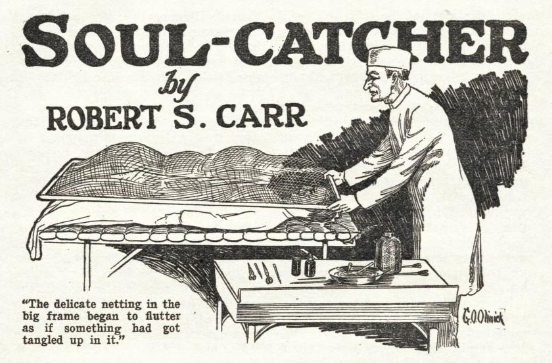
A nice little title illustration from an artist I don’t immediately recognize, “G.O.Olimick” maybe? Anyway, it’s good, competently done…but doesn’t that profile look familiar? I swear it’s copied from a Renaissance portrait of some some venetian doge or evil cardinal, a Medici or Borgia or someone like that. Doesn’t it look familiar? If you have any ideas, let me know, I can see the portrait in profile in my mind very clearly, but I can’t find it! (EDIT: I reached out to Adam McPhee, all around Renaissance Man and a Writer of Note, and asked him if, in his extensive studies of Renaissance Italy, he’d seen this visage before, and he thinks it IS Cosimo de Medici! As thanks, I now insist everybody subscribe to Adam’s substack, Adam’s Notes!)

A quick, efficient intro – it’s a hospital story, and right away we’re introduced to ol’ Doc Dorsey, a quiet fellow who seems to specialize in emergency work. We learn that he’s a diligent enough doctor, trying hard to help these case even though, of course, it’s not always possible. Yet there are a couple of oddities about his practice. First off, he works alone, ALWAYS.

So there you go, Doc Dorsey would leap into action with every new case, but he never had an assistant and did all his doctorin’ behind closed doors. The narrator lets us know that that’s not too strange, when you think about it – I mean, these emergency cases are either straight forward or the person dies, not a lot of room for consultation or consideration or discussion. So of course the doctor likes to work alone, it’s just the efficient choice. But it kind of strange; for instance, sometimes they bring in a case that’s obviously hopeless, the person is 100% dead or dying with no hope for any other outcome, and still Dorsey has ’em brought in, shoos everybody out, and then spends time behind closed doors with them. And what’s even odder is that, while the interns and orderlies standing outside his room will hear him bustling around and working, they’ll sometimes see that, when he comes out, its obvious that he wasn’t doing any sort of examination or whatever – no gloves, no mess. So, what the hell was he doin’ in there?
Ah, who cares, says our narrator:
Dorsey does his best, after all, so a bit of eccentricity is to be excused!
Anyway, one day, our narrator, who is an orderly, is asked by Doc Dorsey to head down to supply and get him some surgical gloves, which he does. But while he’s doing this, a car wreck victim is brought in and Dorsey goes to work. Our narrator doesn’t know this, however, and without thinking, enters into Dorsey’s operating room, apparently the first person ever to do so while he’s with a patient. And what does he see?
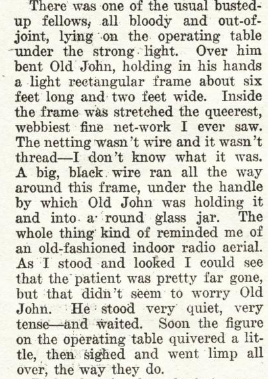
I mean, that’s pretty good, isn’t it? For one thing, Dorsey has, apparently, decided that this guy is a goner – he ain’t doin’ shit for him at all. Instead, he’s got some kind of weird device, a web-filled frame with what sounds like a grounding wire running into a big glass jar. That’s an evocative scene, isn’t it? And then it gets better!

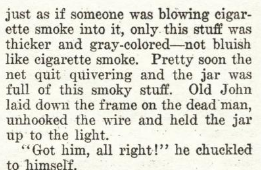
Good weird shit, in my opinion, and I love the little self-satisfied “got ’em!” from Dorsey there. But it’s all too much for our narrator, who must’ve moaned or made some sort of noise.

It’s good tension here, I think – the narrator (and we) don’t know what the hell is happening here, but it’s obviously something weird and occult. I mean, he’s got a weird net that funnels smokey essence from corpses into jars…that’s a helluva thing to just walk in on. And the look in Dorsey’s eyes when he realizes he’s been caught is concerning, to say the least! But then it all settles down, and Dorsey explains:


Dude’s been jarring souls for a while, apparently – he’s got a big ol’ cabinet full of smoky jars. And he explains that, if he can’t help ’em survive whatever accident or trouble their body is in, he at least tries to save their souls. Literally. In jars.
There’s some good writing on Carr’s part here, where our narrator explains that, upon seeing the jars, he gets a very strange, very distinct sensation of being observed, like what he used to experience when he worked backstage at a theater and would, sometimes, have to step out in front of an audience to do something. It conveys the creepiness of the situation well, I think, and also really captures the weird way our brains work when they’re confronted with something odd – we grope around in our memories for some kind of analogous situation to make sense of what we’re experiencing, and the results are often equal parts illuminating and confounding. Anyway, it’s good.
Dorsey doesn’t seem troubled by his soul collection, however. He accepts that he’s been found out, and even seems to come around to the idea that it’s a good thing; it was bound to happen eventually, and Dorsey is glad that it wasn’t a prissy, smug internist, at least. In fact, Dorsey seems to come to the decision that he might need some help after all, and he asks our narrator if he’s interested in the job.
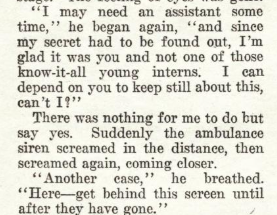
No time for discussion or thought – an ambulance is bringing in a new victim right away! Talk about on the job training!

Another hint that something not all together copacetic is going on here – that glimmer in Dorsey’s eyes is, to put it simply, menacing. But our narrator can’t do anything about it, barely has time to reflect, as Dorsey calls him over to help with the weird net thing. They catch another soul, and the narrator notices that, briefly, the body weight of the corpse decrees by a few ounces when they snag the smoke. Dorsey explains that there is a physical aspect to the smoke; it weighs about four ounces or so, and the weight discrepancy is compensated for by air filling in the soul vacuum left behind in the corpse. It’s weird and I love it.
The next day, the narrator comes across Dorsey seemingly in a kind of weird trance in his rooms. Eventually he wakes up and explains to the narrator that he was “astralizing,” basically projecting his own consciousness out of his body? Where to, and to what ends, we’re never told…just more weirdness from Doc Dorsey!
And then, sometimes later…Dorsey is found dead:


A mechanical fault in the elevators had made the hospital shake, and as a result all those jars had fallen and shattered and, presumably, all those souls had…gotten out. Our narrator goes over to the body and pulls the cloth off the face, and gets a bit of fright…

I mean, damn…that’s gruesome! His head, and especially his face, had ruptured, as if it had sudden been full of some very argumentative critters.
Well, our orderly puts it together, same way as we did:


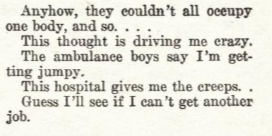
And that’s the end of “Soul-Catcher” by Robert S. Carr!
Freaky shit, huh? Dorsey had left his body behind, and when those souls got out, they poured into his vacant corpus, filled it up, maybe fought for control, and it was too much, physically, for the body to withstand. After all, there is some kind of weight and substance to the souls…four ounces of soul stuff, and how many souls had Dorsey been jarring up over the years. Just straight up Scanners-ed his head! And what happened to Dorsey’s astralized soul, anyway?
The key to weird fiction is the unanswered question, you know what I mean? The way a story creates a framework where the characters can, plausibly, come to conclusions based on hints within their own story, a kind of semi-certainty about the events that they’ve experienced; meanwhile, we, the reader, have to have just a little bit MORE certainty, shared with us by the author, that yeah, for sure, 100% some weird stuff had been going down. But what makes it all work is the unanswered parts of the story. What was Dorsey doing here? He’d been collecting a bunch of souls, but why? Was he doing it out of some twisted altruism, the idea that he was preserving something of these people that would’ve vanished otherwise? Or did he have sinister motives afterall? His “astralizing” seems to suggest an occult knowledge and interest that could imply that there’s more to Dorsey’s work, that those flashes of mad, manic glee at the chance to get a soul were about more than we realize. Was he doing something with these souls? And was his death an accident, a sudden influx of souls looking for a new body, or was it a deliberate thing, an act of revenge on their jailor?
Who knows? That’s the sort of stuff that makes great weird fiction! I also really love that last line…the OTHER key to weird fiction is the imposition of these weird events and unanswered question on the otherwise banal, everyday life of a normal person. This poor orderly has had a brief glimpse behind the curtain, and they don’t know what the hell it all means beyond the very real fact that it is unsettling and upsetting. So they’ll just have to start looking at the want ads again. Great stuff!
Anyway, fairly quick little story, and even my long-winded thoughts got put down fairly quick. A fun little tale, I think, with a bonus interest factor brought about by the weird connections the author would have much later in life to the big, unanswered questions about UFOs.
 Eric Williams