Blowin’ the dust off the ol’ blog to, hopefully, start to begin to approach maybe writin’ more on here. I was all primed for Sword & Sorcery posting last Xmas, but, as always, life and such took precedence. But, while things have been quiet on here, I have not been vegetating (as nice as that sounds); I’ve been using my scant spare time to put together another collection of weird short stories that, hopefully, will find a publisher and be available for people to read at some point. Also got a few stories published here and there (check out the Writing page for links). And, most recently, I took part in the Greater Austin Book Festival, a really fun event the library foundation does here in Austin. Had a great time, sold some books, met some folks, moderated a panel, got some free beer and lunch…all in all, a success!
This is the second year of the festival; you might recall that I did a write-up of the first year’s event too, wherein I was suitably impressed by the fact that everything ran as smoothly and went as well as it did! Well, I’m pleased to report that this year was no different; in fact the heroic library staff who put on the festival made it bigger and better than last years!
As someone with exceptionally poor organizational skills, it really is impressive to me to see people get something like a book fest, with so many moving parts, humming along with no hitches. Speaks really well to the skill and resilience of the Austin Public Library and its tireless workers and volunteers!
The night before the festival, the library hosted a reception with snacks and free beer/wine for all the participating authors, which was a lot of fun. Rain meant we couldn’t use the (really beautiful) rooftop garden, but even trapped indoors it was still a fun chance to get to meet other local writers (and drink free beer). It’s always interesting to meet other writers, because it’s a pretty wide-ranging and diverse field – everything from MFA types to hobbyists, and from traditionally published to self-published (although it feels like small, indie-press published books were in the majority).
It’s also interesting to encounter writers and learn why they write – I’d say a fair number of them entertain dreams of a particularly remunerative cast with regards to their writing, which is really an alien view to me. I mean, if I could pull down mid-five figures writing my dumb little stories, I’d love it, but that said the money a book pulls down isn’t ever a metric I’d want to reckon success by. And I’d certainly never want to write anything with that in mind – there were a few folks skirting dangerously close to marketeering talk there, which bums me out when I encounter it.
As I’m writing this I realize there might be some conflict in what I just said and my avowed love of the pulps – after all, some of my favorite writers approached their work with at least one foot in the “write for $$$” camp. But, when I look at it, I think what’s frustrating NOW versus back THEN is the scale of the problem, as well as the nature of the publishing world – I mean, back in the glory days of the short story, you could absolutely crank out some work explicitly for some quick cash, and use that to subsidize your more artistically-satisfying work. Also, the whole nature of pulp publishing was just this big ol’ bubbling mass, you know – lots of change, very dynamic, if one market didn’t work for you there were others, that sort of thing. You contrast that to today, and it feels very different, everyone seems to be chasing the exact same market-tested-and-approved thing, for one, with very little room for real experimentation or diversity. And, of course, the idea of someone being able to write potboilers for cash and then work for themselves just doesn’t really make sense today, not with the idea of a unified “brand identity” that publishers all seem to have bought into. Of course, in the indie world, none of that applies, but then that’s probably because nobody is making any money at all.
A bit of a discursion there, sorry! And really, the majority of the authors I met were doin’ it for the love of the game, which is always a refreshing thing to encounter out there. And it was something that several readers/browsers at the Festival said too – the fun thing about GABFest is it really *does* expose people to books that they might otherwise have had a hard time encountering, and people really do love it when that happens!
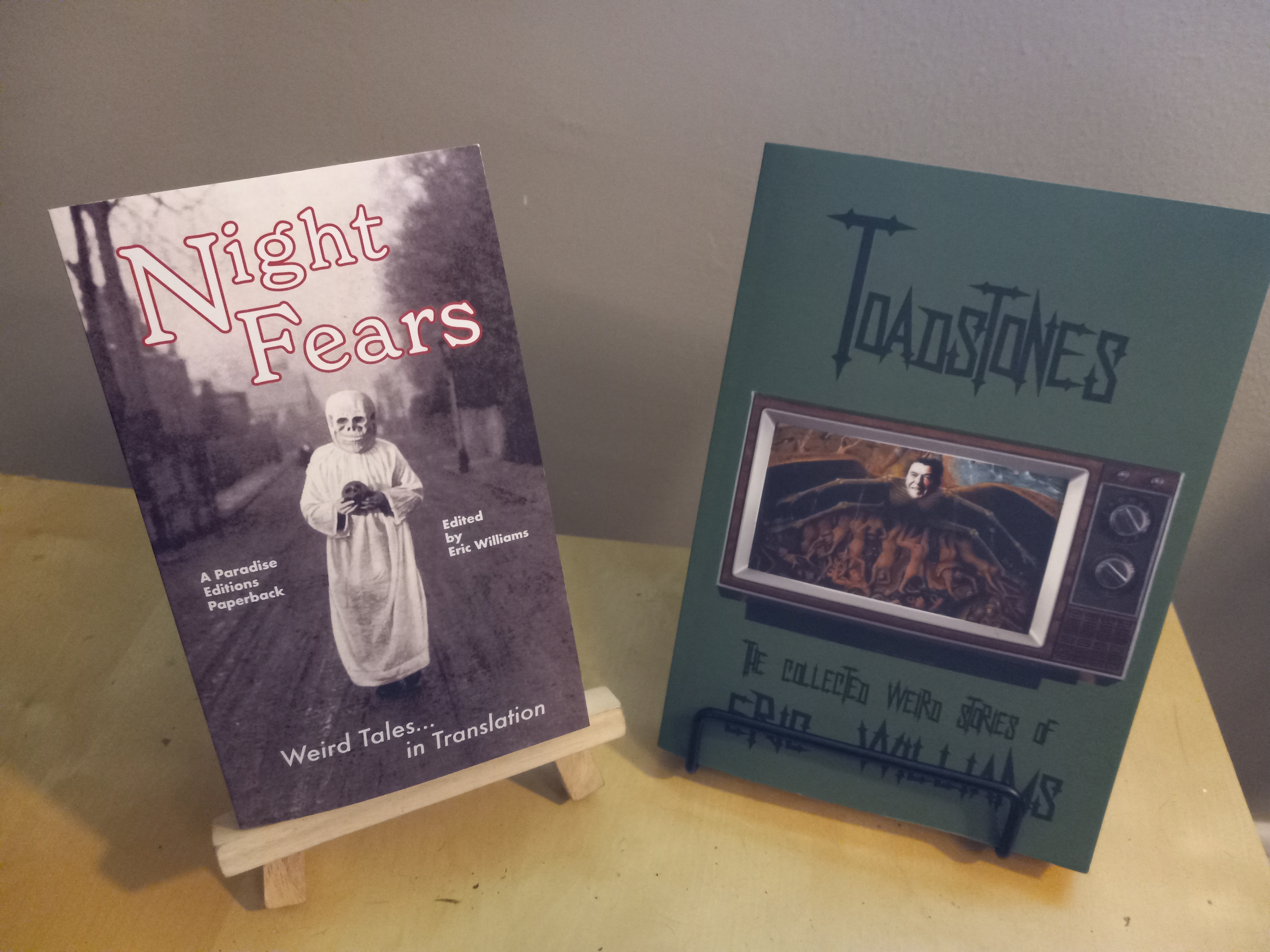
And there were a lot of really nice people who were genuinely excited to see my books. A huge thanks to Alan Good at Malarkey and Matthew Spencer at Paradise Editions once again for doing such great work on the covers – they grabbed folks’ eyeballs from a fair distance, that’s for sure, and there were a lot of excited exclamations of “Oh! Horror!” as they came up.
There were also, hilariously, a fair number of people who came over just to let me know they *didn’t* read horror, which is a bit odd. Like they felt like I needed to know that they had instituted a widespread ban in their own reading on spooky stuff. Do other genres get that? Like do people make an effort to physically come over and tell authors “ugh, memoir? not for me!” or “sorry, I don’t read sci-fi?” It’s a strange phenomenon; happened to me several times. And when I asked them why not, they really didn’t have much of an answer for me, though several people said the real world was scary enough, which is a weird one. Like, if my books were titled “The Fascist Who Became President” or “Night of the Tariffs” I could understand that position, but, like, my book has weird monsters in it. There’re haunted atomic mannequins, fungus mimics, an ancient roman liche! That’s pure escapism man!
That bit of goofiness aside, a productive horror discussion was had in the Horror Panel, which I got to moderate. Three authors (originally four, but one had to drop out at the last minute) and me, chattin’ up in a conference room on the fourth floor of the Central Library, a great time with a great crowd. I really enjoy panels, and honestly I think I’ll only ever do conventions if I’m on one – for one thing, they’re just fun, but on another practical level, they’re also the best way a nobody like me can convince someone to take a chance on the books.
I like a pretty loose and free-flowing sort of panel, more like a broadly directed conversation than anything else, so I opted to start with a Lovecraft quote: “The oldest and strongest emotion of mankind is fear…” and then asked the panelists (Brendon Vayo, Burke de Boer, and Julius Crow) how their work approached and engaged with fear. The resultant discussion was a lot of fun, and I think we got into some pretty neat areas, thinking about ways fear, as both a very idiosyncratic thing as well as a kind of universal experience, can be used both thematically and, frankly, mechanically in writing. The audience seemed to dig it too – we talked for about a half-an-hour or so, and then I opened it up to the audience for questions. There were a bunch of ’em, and one really heartening thing was that, when the inevitable question about AI and writing came up, the audience was 100% in agreement that AI sucked and they would never read anything that used it, let alone something produced explicitly by it. Great to hear!
All in all, it was a lot of fun, sold some books, met some folks, got to talk about books, free beer (and lunch), what more can anyone ask. It’s a neat thing that the library here does, and I’m really glad that it seems to be settling into an annual event – there were plenty of folks there walking around, taking advantage of the space and programming of a great little community institution, which is just a really nice thing to see. If you’re ever in Austin in the spring time, late April/early May, it’s a fun event and worth seeing!
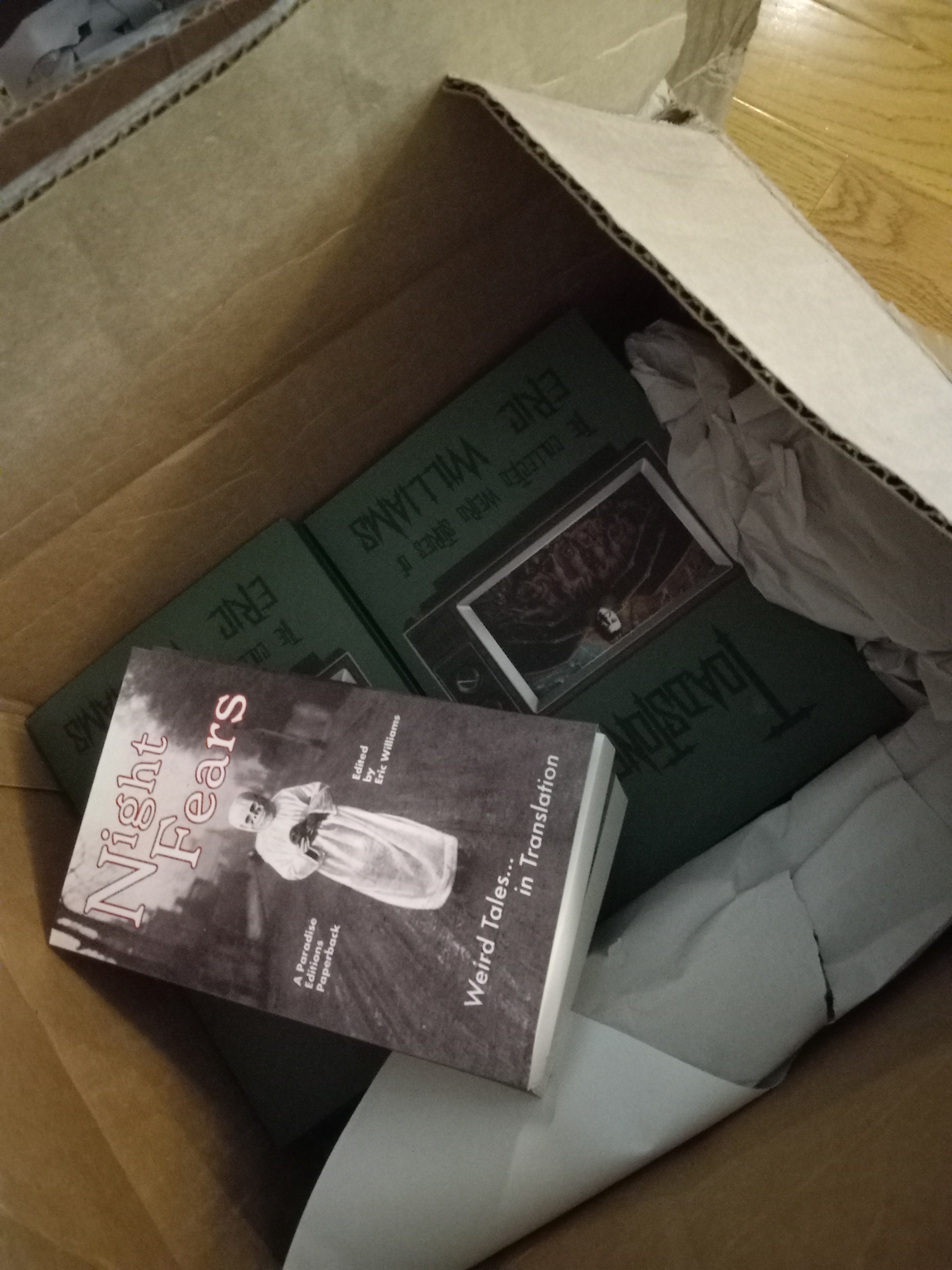
I’ll just close out with the reminder that, yes Virginia, there *are* books left over from the Fest, and if you want to buy one, why not contact me?
Lookit ’em, cute little things in need of a good home…
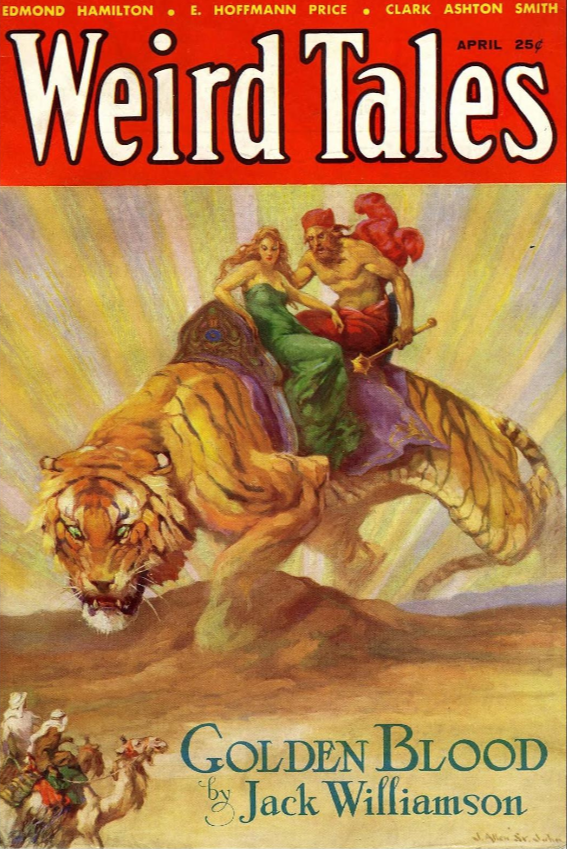
Roughly a quarter of the way through the Hallowe’en Season already, how the hell did that happen!? Ah, but let us forget the merciless march of time with some timeless Weird Fiction! And this time, we’re looking at Carl Jacobi’s “Revelations in Black” from the April 1933 issue of Weird Tales!
We’ve met Jacobi before, roughly around this same time last year, when we examined his weird forest/bug/hallucinations story “Mive,” another of ol’ Carl’s appearances in Weird Tales that I really liked. Today’s story is much more traditional and, frankly, staid in comparison to the out-and-out trippy action in “Mive,” but even so (and despite not having any geology or paleontology content) I think it IS a good example of Jacobi’s moody, atmospheric writing.
Jacobi had a VERY long writing career that stretched well into the 80s, and he had a longstanding relationship with August Derleth’s Arkham House that kept a lot of his work in circulation via collections. Interestingly, the Arkham House connection came about because of H.P. Lovecraft, who praised Jacobi’s “Mive” in a letter to ol’ Derleth as having the kind of real, vital weirdness that he (meaning Lovecraft) really dug. The feeling was obviously mutual, as Jacobi would often flit around the edge of the Lovecraft circle – he had been classmates in college with another of Lovecraft’s circle, Donald Wandrei, and as a fellow Midwesterner (Jacobi lived in Minneapolis his whole life) the two of them struck up quite the literary friendship.
With regards to the pulps, Jacobi was a pretty prominent figure – in addition to numerous appearances in Weird Tales, he also wrote detective fiction, adventure stories, and even a little sci-fi. He’s a good example of how a writer can be successful (artistically, at least – he was, like most pulpsters, crushingly poor for most of his life) and then kind of vanish from the scene. Honestly, for his weird fiction at least, I think he’s due for a revival.
Enough jibber-jabber! Onwards!
This month’s cover, by J. Allen St. John, isn’t particularly weird, unfortunately, although I like the snarl on that giant ass tiger’s face. Very orientalist, something that editor Farnsworth Wright (and the readership of Weird Tales) loved with a fierce undying passion, so it makes sense that Williamson’s “Arabian” style multi-part novel would be made the cover. Still, c’mon man – gimme a monster!
Still, some fun stuff in the ol’ ToC. I don’t remember the Price story, but I’d love a Perfect Strangers/Weird Tales bit of fanfiction about “The Return of Balki.” Hamilton, Smith, Kline, Counselman, all big names for the readers at the time, along with Jacobi of course. Solid issue, I feel like the reader is getting their twenty-five cents worth this month.
Now, on to “Revelations in Black!”
Classic “Jayem” Wilcox title illustration, down to the whole “we’re giving away most of the story to you right off the bat” aspect too. Yep, this here is a VAMPIRE story, specifically about a LADY VAMPIRE, one of the top tier kinds of Vampires out there. A nice, traditional approach to a Halloween staple, I think.
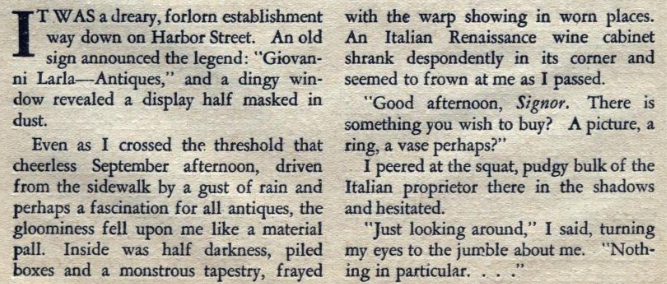
Our story opens with a narrator battling his seasonal affective disorder by going antiquing. What’s funny is that our dude exchanges a dreary rainy day for what is, apparently, an equally dreary shop – the description of the wine cabinet shrinking despondently into its corner is a good bit o’ writing that sets the tone for Larla’s shop, I think. Our guy’s not after anything in particular, of course, but Larla is COMMITTED to his pitch, and even after the narrator suggests he’d like to see some books, Larla makes him go through the whole shop, looking at furniture, paintings, a “muddle of yellowed statuettes,” all kinds of junk. But, eventually, they reach the Old Books in the back.
Carl lays it on a little thick here, I think – the whole “oh, if only I hadn’t done whatever, the horrors I could’ve avoided,” yadda yadda, it’s easily the weakest part of this story, although I DO think that it helps if you read this part (and the whole story) as something very FIRMALY within a certain stylistic tradition. Jacobi is writing a VAMPIRE STORY – he’s not interested in reinventing it or subverting anything, he’s just enjoying the languorous pleasure of playing in a very well-established sandbox, right? In that context, this kind of “ah, would that I hadn’t fucked up so badly back then” stuff is VERY MUCH a part of the genre. Take it for what it is, is what I’m telling you.
But anyway – our guy plucks an interesting book from a shelf, one that Larla the shop-owner says was placed there by mistake and isn’t for sale. In fact, the book was made (literally – we learn that he bound it himself) by his “poor” brother.
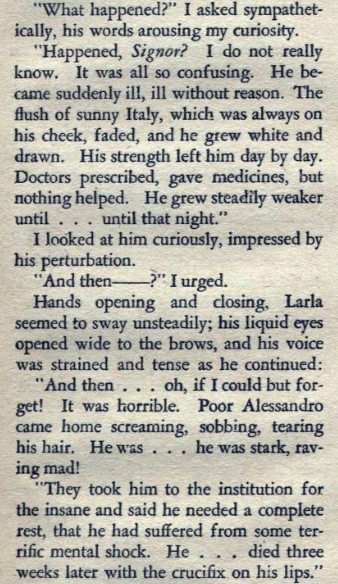
Am I a sucker for the “last ravings of lunatic” macguffin? Yes, and so is our narrator – when he learns it was written BY a guy IN an asylum, he wants it EVEN more badly. Larla explains the Sad Tale of his Brother, Alessandro:
We learn then that there are actually THREE volumes to the “Five Unicorns and a Pearl” series, books that Alessandro had filled with his mad scribblings in his time in the asylum. Now, his brother keeps them as a keepsake, trying to forget the tragedy of his death and remember happier times (something probably not helped by keeping the Black-bound and Skull-embossed Book of Horror he wrote while dying mysteriously, but then again the human mind is a labyrinth, right?).
Like I said, this sort of wild-ass story just makes our guy want these books even more. When he sees he can’t buy it, he ends up RENTING the book for a single night for TEN GODDAMN DOLLARS (that’s like $250 now). He has a single night, and he MUST return it the next day, in perfect condition. A crazy deal, huh?
So, having plunked down a pile of cash for a chance to examine the book, our hero settles in for the night in his apartment to do some readin’. First thing he notices is a weird inscription “in a feminine hand” on the inside of the front cover:
Shoulda signed it “XOXO – The Vampire” to make sure he got the point.
He reads on:
Our boy here is strangely moved by the kind of odd and obviously symbolism-rich language that poor Alessandro used when composing his last work. In fact, he’s so struck and, frankly, troubled by it that he decides to go for a midnight walk!
Indulging in this weird impulse, however, does little to alleviate his mania – in fact, if anything, it increases it. He feels like he’s looking for something, that he’s being drawn towards something, and there’s nothin’ fer it but to wander in search of whatever the hell it is.
Our guy pushes through the strangely unlocked gate and into the preternaturally alluring night garden.
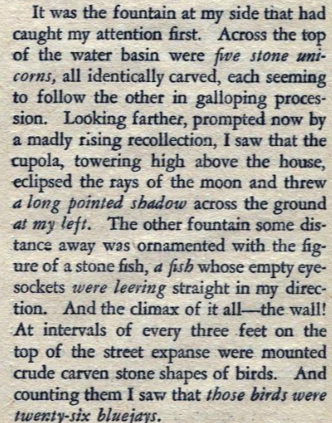
Quelle horreur! Our guy suddenly, shockingly realizes that this garden is, IN FACT, what poor mad Alessandro was writing about in Volume One of his book “Five Unicorns and Pearl,” the very book HE HAD JUST BEEN READING (*thundercrash*)!!!!!1!
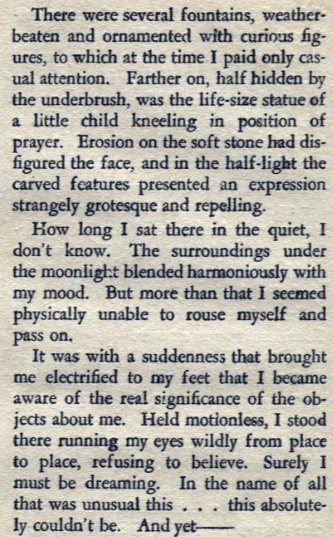
All kidding aside, I DO think that our guy’s entrance into the garden is an extremely well done bit of eerie writing – the scene perfectly captures, a dark, seemingly abandoned garden in the Fall, the plants dead or dormant, and full of odd architecture, ornamentation, and statuary. Gardens are strange places, after all, sites dedicated to specific ideas about aesthetics and nature, carefully curated and maintained, so seeing one at an “off” time (at night, in the autumn, and apparently not being “kept-up”) is automatically a disjointing and unsettling experience. I think Jacobi is one of the great landscape/scenery describers of the pulps, and this garden is a perfect example of his mastery.
While he’s musing about this place, and how perhaps Alessandro wasn’t the hopeless lunatic he’d been labeled as, a strange, pungent perfume assails his nostrils…it’s the scent of heliotrope, powerful and fulgent in the night air…and it’s comin’ from a goddamn LADY he hadn’t even noticed a minute again!
The way Jacobi describes this woman, all in black, veiled, and with only a pale white neck exposed, strikes me as very Arthur Rackham. I mean, everybody has probably guessed what’s happening here, right, but for me that doesn’t detract from the pleasure of the story – honestly, there’s a lot to be said for weird fic/horror that tips its hand early but keeps on heading steadily towards the already-spotted conclusion. You can’t get that kind of slow-burn consummation without letting the reader see the road ahead, and I think when it’s done well, like in Jacobi’s story here today, there’s a lot to appreciate.
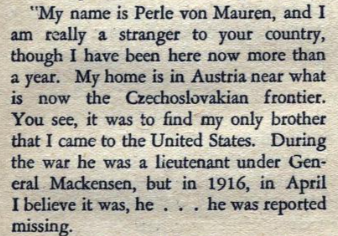
Anyway, this crazy vulpine woman and her enormous dog don’t seem bothered by the fact that some guy has just busted into their garden. In fact, the lady asks him to stay; she’s lonely, and would like someone to talk to. With a curt “fort mit dir, Johann!” she sends her dog away and bids the interloper join her by the fountains. Then, she introduces herself:
I’ll just break in here to post this picture of Field Marshal August von Mackensen, a WWI Imperial German general, because his picture is wild as hell:
Germans, yeesh!
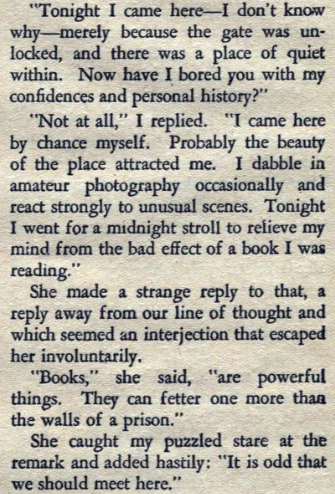
Perle von Mauren continues her tale of woe:
“…found him…no longer living” is one of those “I don’t drink…wine” statements that vampires just love – technically true but omitting certain key information. Fun stuff!
Fun bit of subtle weirdness here – she’s obviously the author of the “feminine hand” that our narrator spotted on the frontpiece of the book, but there’s an implication here that, somehow, the book and she are intimately and causally connected. It could just be dissembling on her part, of course, but it really seems like our guy reading the book has summoned both Him and Her to the garden, together, some kind of weird link being forged between them by the reading of the story. It’s good and interesting, and I don’t think I’ve ever seen anything like it with regards to vampires – the idea that they’re associated with some kind of cursed object like that is neat!
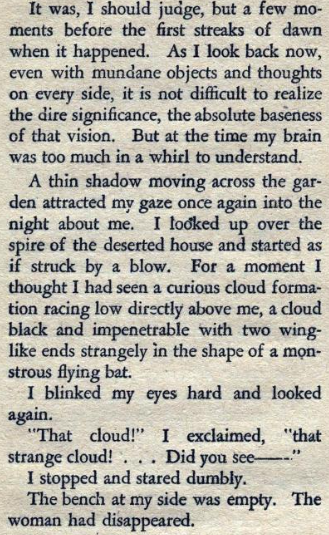
Anyway, our dude spends the whole night talking to this lady in the garden. He’s obviously enchanted by her, even if he has a mounting sense of unease the whole time…why won’t she remove her veil, for instance. Then, just as the night gives way to dawn, something weird (well, weirder) happens!
They call that a “Vampire’s Goodbye.”
The next day finds out guy increasingly preoccupied with Perle and the garden and the books of Larla. He describes himself as addicted to the mystery of the thing, and can’t help but go back to the shop where, despite not returning the first book, he procures the second volume at another ridiculous price. He rushes home, reads it, but the mystery merely deeps for him, and his weird craving to return to the garden grows stronger and stronger. He tries to resist it, to ignore it, but then, in a flash he has the sudden idea that the garden scene and her and all that moonlight would make one hell of a picture, something he could even submit to the International Camera Contest in Geneva next month! Is that a delusion on his part, or an excuse? Regardless, our shutterbug grabs his fancy camera with its newfangled flashbulb and hustles on out to the garden again.
She’s there, of course, and they chat for a long while – she seems weirdly reticent to talk about her brother, and yet simultaneously compelled to tell our narrator about him. There’s an interesting section of his time as a student in Vienna where, as is traditional, he’s considered a weird and potentially dangerous avant garde philosophy student with odd and offputting ideas. His experiences in the war, and in digging graves as a prisoner of war, seem to be a particular focus of her morbid interest. It feels like this is Jacobi gesturing towards an underutilized bit of Vampire Lore here, the idea that a vampire rises out of the grave of a sorcerer. Her brother’s background as a “weird philosophy” student matches that, and she also seems to be suggesting that his terrible experiences in the war somehow “tainted” his soul.
The sky clears and the moon comes out; a perfect time to take a picture. Our guy tells her not to move, hops up, and then snaps a pic.
Lady, I get it – I don’t like to have my picture taken either. But she’s REALLY pissed, because she vanishes into the house and sic’s her big ass dog on our guy! This huge hounds comes hurtling out at him and attacks! It’s only with the greatest difficulty and a bit of luck that our guy survives – he chokes the dog while it’s trying to kill him, then remembers the German Perle had used when ordering the dog to go in. “Fort mit dir, Johann!” he manages to croak out, and it’s enough to confuse the dog that he’s able to escape.
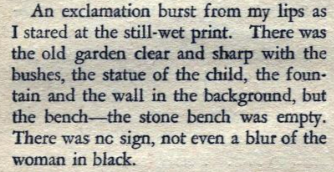
Our guys calls in sick to work the next day, and decides to develop the picture he took. I wonder how it turned out?
Get a clue dude!
Anyway, he’s so shaken by the experience of the picture that he goes to bed. He wakes hours later, seemingly out of some kind of a vague yet terrible nightmare, and he notices that the drapes are fluttering in the breeze from a window that he had thought he’d shut before going to bed. He grows weaker, and ends up staying there for THREE DAYS, worn out, weak, and sick. A doctor visits and tells him he needs to rest and recuperate and, oh, by the way, where’d those two marks on your neck come from?
But even this isn’t enough to curb his NEED to read the third book. He’s been through the first two, and as he lays there in bed a kind of feverish desire builds and builds until he is forced to head to the shop. He, of course, has not returned the first two volumes, and so Larla refuses to “rent” him the third. It’s like, dude, take them off the shelf if you don’t want to sell ’em, right? But our guy’s NEED for the book is too great and, when Larla’s back is turned, he steals it and runs.
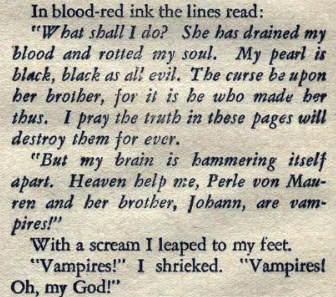
He reads through the mad yet damningly suggestive text of Alessandro Larla’s FINAL book, troubled and unnerved, until he reaches THE FINAL PAGE:
Yeah no shit man, jesus christ. I do like that the dog is her brother though, that’s neat.
He realizes that Alessandro had been ensnared by these things in some way and, although unable himself to escape, had written these books in hope of exposing and destroying them. Then our guy remembers the odd frontpiece…didn’t it say something about “stakes” in there…
He won’t be a victim, not like Larla! He smashes the legs of his tripod to make two sharp stakes and takes a taxi IN THE DAYTIME over to the house. Inside, he finds a room with coffins and the cloying, masking odor of Heliotrope…and does what needs to be done.
And then there’s a classic Hammer Horror style reveal:
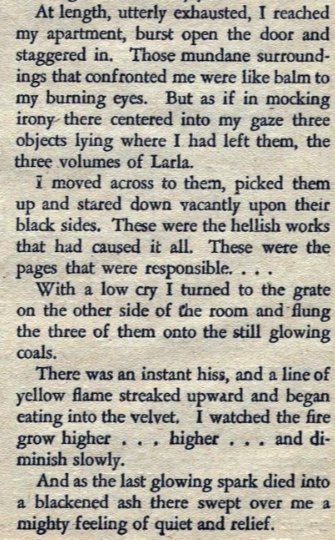
And then, a final coda:
And that’s the end! Hope ol’ Larla the shop keeper had some other stuff of his brother’s to remember him by, because this dude just burns those books.
This story, while very *classical* in format and execution, is still awfully evocative and atmospheric; Jacobi is great at scenes and environments, and I like the way in particular he describes the moonlit garden and the fountain. Apparently, this was a view shared by the editor of Weird Tales Farnsworth Wright – he originally and very firmly rejected this story, only to contact Jacobi a few weeks later to ask if he could publish it! Our narrator discovering the garden had stuck with ol’ Wright, so much so that he’d found himself thinking about that scene long after he’d rejected the story.
And, you know, for all the “seen it” stuff in here, I think there’s some interesting little glimmers of weirdness – the book aspect is inventive and cool, for instance, and I really like the way it seems to summon them ALL to the garden. And would they have returned if he *hadn’t* burned the books? And, of course, some things are a classic for a reason, you know, and damned if a straightforward Vampire Tale isn’t one of ’em! And I mean, c’mon, Jacobi does a GOOD job here with the genre.
Anyway, I hope ya’ll enjoyed a classic bit of Vampire fic fer Halloween. I know I did, but maybe next time around we’ll dig into some weirder stuff, eh? Until then!
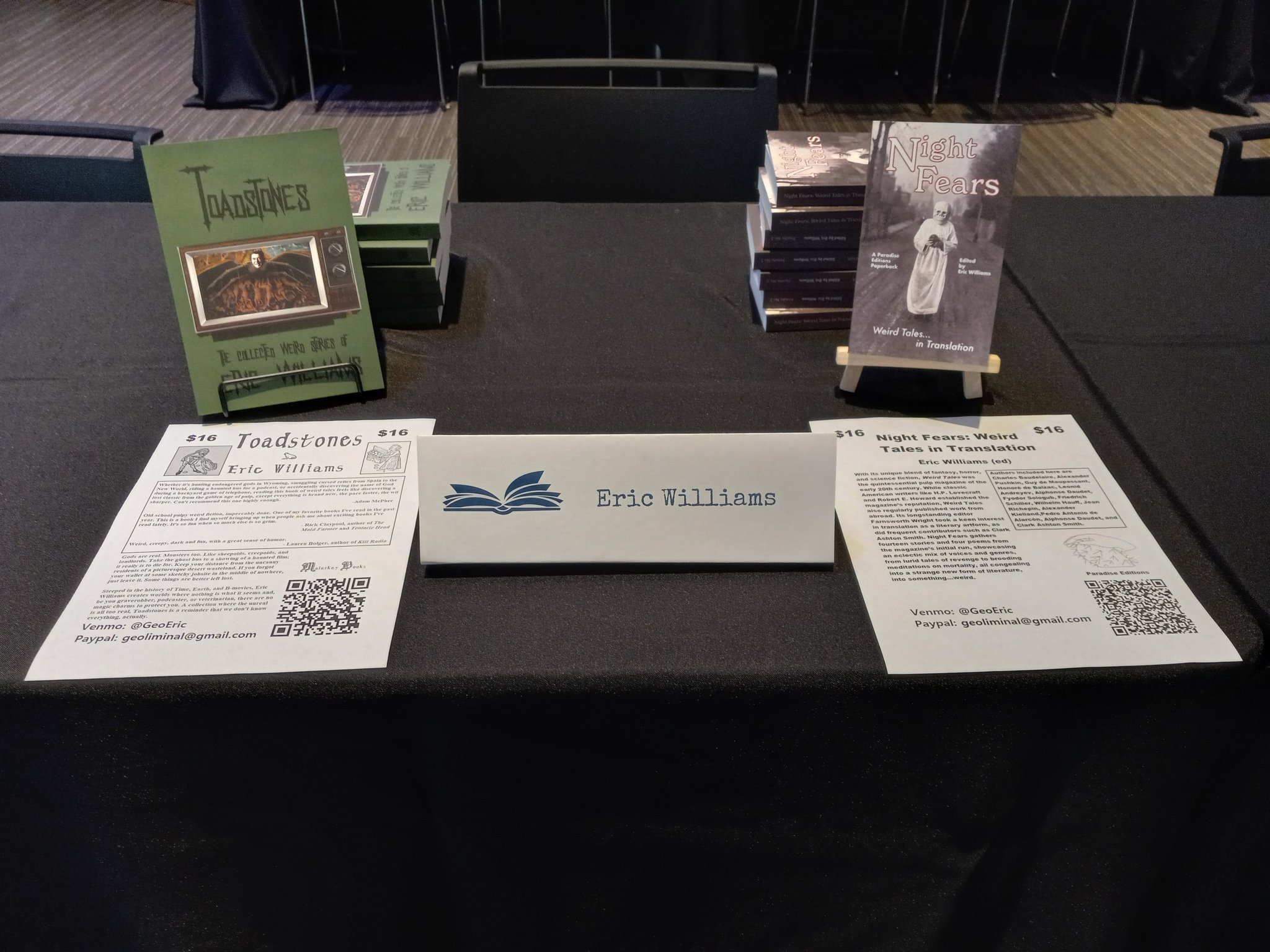
This past weekend, on the 11th, I took part in the Greater Austin Book Fair, a brand new event held at the (pretty schmancy) Central Library here in Austin. I had a good time, sold/traded some books, got some free beer, met some folks. It was my first time attending anything like that, so I thought I’d just jot down some thoughts/reflections here, a kind of after-action report.
First off, the library system here in Austin is really incredible, and what a cool thing that they had the funds, space, and gumption to put something like this together. In particular, the whole thing was free for me – no tabling fee, no registration, free beer and appetizers for the writers the night before, free lunch/snacks/coffee the day off, hell they even validated parking, something almost unheard of in downtown Austin these days. Also, for it being the first time they’ve put this thing on, they did a really nice job – lots of volunteers, everything worked like it was supposed to. Good work all around!
The organizing principle of the whole shebang was to get writers from the “Greater Austin” area involved, which included Travis, Hays, and Williamson counties, and it seems like they held to it. About 80 or so authors were involved, and they were all central Texans, as far as I could tell. It’s a neat idea, and really speaks to our library’s commitment to the whole “community” thing. As an approach, I think it worked really well – people who wandered in seemed to really enjoy the fact that they were, by default, welcomed.
What that produced, in terms of the books on display, was a pretty eclectic floor. Graphic novels, children’s picture books (a surprisingly lot of these!), YA, all alongside the full sweep of adult fiction, literary, genre; it was all roughly spatially organized with similar stuff close together, but it did result in some kind of funny interactions. For instance, a lot of people would come off of the historical/speculative fiction folks next to me and then get spooked out by my books; I had several people say that the covers to both Toadstones and Night Fears were TOO scary, which just speaks to the skill and care that Malarkey Books and Paradise Editions lavished on them.
spookiness is a feature, not a bug
Made me realize, though, that there’s probably a pretty big difference between the Greater Austin Book Fair and a more focused, genre-specific event. Had to spend a lot of time orienting people within the genre itself, something that might be easier if everybody comes in with the idea of lookin’ at spooky books already. Then again, you might be just exchanging one set of explanations for another, in that in a genre-defined setting, I’d have to work to highlight why THESE books deserve attention among all the other spook-em-ups there. We’ll see, I’m planning on doing a very specifically horror-genre convention later this summer.
It was also interesting for me, because I’ve never been to a non-academic conference before – the biggest difference is in the way panels are done, which was kind of odd in that there was just sort of a broad topic, with a mediator asking a few questions and then the panelists kind of just going down the line and answering them. Maybe that’s atypical and just the way this one worked out, but I feel like it could be done better. Not necessarily people coming in to give presentations, but maybe something more structured like a conversation. I dunno, it’s tricky, and I have to admit that I’m also not ever *really* all that interested in hearing writers talk about writing, so maybe that was just on me.
I suppose I should get down to brass tacks, thought: how many books did I sell? Grand total of seven, or about 1/hr for the whole day. Three Toadstones and four Night Fears, and I swapped four (two of each) to folks for copies of their books. I brought twenty of each, which meant I hauled a lot back, but that’s okay… although if anybody out there wants a copy of either (or both) of them, I’d be happy to sell em for, lets say, $20 each? Feel free to shoot me an email at geoliminal [at] gmail [dot] com if that’s the case!
for real, help me out – i got cats to feed, man
What did I learn about conventioning? First off, HUGE thanks to Lauren Bolger (buy her book, Kill Radio!) who, as a veteran of many conventions, gave me so solid advice: in particular, getting some bookstands and printing out papers with book info and QR codes on ’em and such was extremely helpful. In the future, I think I’ll have some cards printed up too, mostly so I could hand over my contact info to other writers I met more easily.
But, all in all, I had a lot of fun, and I’d encourage people to attend these sorts of things, if they can – I don’t think they’re any kind of career-making event, but this one was fun and I’d definitely do it again.
Before it got eclipsed by the Oyler stuff, the nascent lit twitter discourse that threatened to get good and roiling was about whether novels were, inherently, a bourgeois form. I don’t care about that, and neither should you, but it did get me thinking about how novels ARE afforded too much deference, especially given that they’re decidedly the lesser form of prose literature, vastly inferior to the stately and transcendent Short Story. And then THAT got me thinking about the dumb novel list from last post and how you never (or rarely, at least) see a list of favorite SHORT STORIES out there.
So, anyway, I thought I’d take a swing, and make a list of my favorite Short Stories (in no particular order). Here’s 25, and maybe I’ll add some more in future posts as they come to me.
1 – Red Wind(Raymond Chandler, 1938) – This is the short story that immediately comes to mind for me when I start mullin’ over the form. There’s a tightness to this, and even though it’s a bit on the longish side it’s super efficient, packing in a huge amount of characterization and style and depth into something readable in a single sitting. It’s got some great Chandler flourishes too, both in the descriptions of the Santa Ana winds and in the dialog, AND it has one of the greatest endings in all of literature, genre or no. Just a really masterful example of the power of the short story!
2 – The Gutting of Couffignal(Dashiell Hammett, 1925) – while we’re on hard-boiled detectives, we might as well talk about the greatest writer of the genre, Hammett. Fer my money, this is his masterpiece, an inventive and exciting crime story that has another really fantastic ending that springs a sudden depth and humanity on the reader that, I think, a lot of people might not expect.
3 – Neighbors (Raymond Carver, 1971) – I dunno if this is one of the Lish-ed up stories or not, but it’s absolutely my favorite Carver work; nothing else of his even comes close, in my opinion. A real lived-experience kind of story, extremely perceptive and real, that captures something about our innate and sometimes obsessive curiosity about other people.
4 – The Killers (Ernest Hemingway, 1927) – I mean this one doesn’t need a lot of explication, I think; it’s great, a story about gangsters and crime and murder told via a strange interlude before all the more “traditional” action and violence and whatnot.
5 – The Lovely Leave (Dorothy Parker, 1943) – Parker is, of course, a master of the short story, and while there’s a bunch of her funnier ones that belong here, I think this rather serious and wistful story is probably my favorite. The tension and anxiety of expectation, and the way even in the midst of huge earth shattering events our little lives must go in…it’s just really fantastic.
6 – Boule de Suif (Guy de Maupassant, 1880) – THIS was a hard choice, probably the hardest that I’ll be forced to make on this list, because in my opinion Maupassant is the greatest short story writer who ever lived. An absolute MASTER of the form with, like, a hundred stories that belong on a list like this. This one, translated as “Ball of Fat,” is a profound meditation on hypocrisy, cowardice, and dignity, everything precise and perfect and wonderful. Being a monolingual dummy I’ve only ever read it in translation, of course, but given how many home runs ol’ Guy here hit in his tragic lifetime, I think it’s safe to say that his genius shines through in English too. Really, if you haven’t, read some Maupassant, this one and as many others as you can find!
7 – The Overcoat(Nikolai Gogol, 1842) – I mean, look, sometimes things are a classic for a reason, right? Gogol is the greatest Russian writer of all time, and this is his best story. What more can I say?
8 – The Crop(Flannery O’Connor, originally in her ’47 thesis, but not available until 1971) – In terms of American short story writers, O’Connor is definitely near the front of the pack, a genuinely innovative talent. And while she’s certainly famous for her big, apocalyptic, visionary works, I think this littler, quieter, and funnier story is her very best piece. There’s a real playfulness here, which is something that’s in a lot of her work but rarely as centrally placed as it is in “The Crop.” Plus, there’s a precision on display here, with everything humming along in service to story itself, that makes it a joy to just read.
9 – The Last Man Left in the Bar (C.M. Kornbluth, 1957) – Kornbluth is one of the major figures in mid-20th century science fiction, a member of the (vaguely socialistic) Futurians who, despite his small body of work, had an outsized influence on the genre. Anyway, this is a weird little bit of esoterica that I just love, an absolute gem that’s almost experimental in form, something really out of the ordinary for Kornbluth. It’s a lot of fun, kind of weird, and really captures a flavor of the otherwordliness that typifies some of the best of that era’s science ficiton.
10 – And the Moon Be Still as Bright (Ray Bradbury, 1948) – Bradbury’s greatest work was all in his short stories, and his collection “The Martian Chronicles” is absolutely essential reading. This story, which was originally published in the pulps before getting collected, is a a great and very satisfying take down of Western (and, especially, American) colonialist attitudes and behaviors. Bradbury always wore his heart on his sleeve, but here it serves him well, and the sadness and bitterness on display in this story elevates it into something special, in my opinion.
11 – Thanasphere (Kurt Vonnegut, 1950) – unlike Bradbury, Vonnegut’s short stories are generally not his strongest work. They’re often pretty one-note, in my opinion, and oftentimes that note is kind of unpleasant (i.e., Harrison Bergeron). But I do really like “Thanasphere,” which takes the time to really explore its weird conceit.
12 – Major Pugachov’s Last Battle (Varlam Shalamov, 1973) – Shalamov’ collection “Kolyma Tales” is essential reading, grim and humane and wonderful, and this is my favorite story from it, about an escape attempt from the prison colony of Kolyma. What’s so great about Shalamov is that his writing, intense and almost journalistic, is ALSO extremely stylized and vibrant, and the stories he tells are rich, deep, full of a kind of terrible majesty in their unflinching examination of humanity.
13 – The Night-Wire (H.F. Arnold, 1926) – I’ve written at length about this, one of my favorite pieces of weird fiction ever, so I’ll just once again state that the pulp era was THE golden age of the short story, with a huge number of venues publishing short fiction and a truly staggering number of people actually reading them! A wonderful bygone age!
14 – No Woman Born (C.L. Moore, 1944) – In fact, why not just get a few of these stories that I’ve already written about knocked out, eh? I wrote a bunch about this story, too, an example of some great early feminist sci-fi from one of the masters, C.L. Moore!
15 – Worms of the Earth – (Robert E. Howard, 1932) – One more from the blog; I make no apologies for my love of Sword & Sorcery, a unique, vital, and inventive literary genre born in the pages of Weird Tales magazine, and this is the single greatest story in that genre ever written, period.
16 – “Aye, and Gomorrah…” (Samuel R. Delany, 1967) – An unbelievable debut story (it was his FIRST story he ever sold…) from one of the truly great writers of the past 100 years. This appeared in Ellison’s “Dangerous Visions” volume, a seminal piece of literature, and even so it’s probably the best story among a bunch of really phenomenal pieces in there.
17 – Enoch Soames (Max Beerbohm, 1916) – One of the funniest stories ever written, and the weirdness and fantastical elements are really smoothly integrated into a piece that, really, is a send-up of artistic vanity and solipsism.
18 – Jeeves and the Old School Chum (P.G. Wodehouse, 1930) – Speaking of humor, any list of the best short stories absolutely must include Wodehouse, one of the greatest practitioners of The Art ever. In addition to offering, in each story, a master class on the art of plotting, characterization, and dialog, he is also a comedy genius. All of his stuff is remarkable, but this story made me collapse with laughter all alone out in the field in Wyoming once, confusing the hell out of a coyote pack that lived in the next wash over.
19 – The Bloody Chamber (Angela Carter, 1979) – Carter is great, and you should read everything she ever wrote, but this retelling of the Bluebeard legend is one of my favorites. The ending in particular is just a great, liberatory moment in feminist writing, really wonderful stuff!
20 – The Colour Out of Space(H.P. Lovecraft, 1927) – Certainly the greatest writer of weird fiction in the 20th century (and also enormously influential; his fingerprints are all over the past 70 years of pop culture, not just in horror, but in sci-fi, fantasy, comics, games, you name it!), and this is probably his best story (it was certainly HIS favorite).
21 – Gunslinger (Ed Gorman, 1988) – Gorman writes in a variety of genres, but his westerns are my favorite; he’s got both a strong sense of the genre traditions as well as the skill to tweak ’em just enough to make ’em interesting. Highly recommended!
22 – Another Story or A Fisherman of the Inland Sea (Ursula K. Le Guin, 1994) – A beautiful, meditative piece on life and the choices that go into making it, executed by a great artist at the height of her powers.
23 – The Drowned Giant (J.G. Ballard, 1964) – This is one of those stories thats faceted like a gem, with lots of different ways to approach and understand it. Ballard is always wonderful, grotesque and profound in equal (and complementary) ways, and this story basically condenses everything he ever wanted to write about down into one punchy little piece.
24 – Subsoil (Nicholson Baker, 1994) – You’ll never look at ‘taters the same way again!
25 – Second Variety (Phillip K. Dick, 1953) – My favorite Dick short story, one that neatly encapsulates all of his biological/ecological musings along side his (mostly dim) view of human nature.
Anyway, that’s probably enough for now. Go read some short fiction!
Frustratingly, I find myself thinking about the goofy 100+ entry list of “The Great American Novels” that The Atlantic put out last week (I’m not going to link to it…I’ll not give them that satisfaction, at least). It’s not the WORST one of those things I’ve ever seen, of course – I mean, at least it has some genre stuff on there. The inclusion of Shirley Jackson’s The Haunting of Hill House is a relief, and Djuna Barnes is good and correct (Nightwood is legitimately one of the great novels of the 20th c for sure), but there’s also a lot of dumbness on there. For one thing, the restriction of the list to the last 100 years is just plain ridiculous, even with the weakass “modernism!” excuse they offer. I recognize that I’ve definitely got some serious biases; I’m by nature and inclination a very historically-minded reader, but even if you’re not it still seems like a kind of pointless obfuscation of whatever the fuck “American” literature is to not have Jack London, Booth Tarkington, or James Branch Cabell, all of whom were enormously influential writers in America that had a major impact on 20th century literature.
Like I said above, it IS nice to see some genre stuff on the list, but I kind of feel like some of it is rather poorly thought out, a quick grab of some Big Names rather than any serious attempt at identifying any of the actually important or interesting books by some of these folks. I mean, they picked The Dispossessed over The Lathe of Heaven or The Left Hand of Darkness? That’s just dumb “ah but you see this must be SERIOUS sci-fi because it is about Something Else” bullshit. Ditto for PKD’s Do Androids Dream of Electric Sheep? which is, while a fine book, nowhere near his greatest or most quintessentially “American” novels (that’d be A Scanner Darkly, UBIK, or Dr. Bloodmoney). ALSO, with regards to “American lit” and genre: where the fuck are the westerns!? (Blood Meridian doesn’t count).
Anyway, to exorcise my annoyance, I figured I might list up a handful (or two) or some of the more egregious absences on the Atlantic List, with of course the caveat that I’m just a simple country geologist what likes to read.
Dhalgren(1975, Samuel R. Delany) – Right off the bat I text searched “Dhalgren” on the Atlantic List, and when I saw it wasn’t included I knew it was Amateur Night over there. This is the most important novel of the 20th century, period, AND one that is quintessentially about America; Bellona is every city facing deliberate policies of urban decay, and The Kidd is every American trying to navigate them. It’s complex, stylistic, enigmatic, and while it is certainly anchored in Delany’s experiences of 60s/70s America, it is also utterly timeless and mystical and just plain rad as hell.
The Stars My Destination (1957, Al Bester) – yeah yeah, I know, it was originally published in England in ’56 (as Tiger, Tiger!) which precludes it from the original list b/c of the dumb rules the Atlantic made for themselves, but I mean, c’mon…Bester IS an American and this book is a turning point in science fiction, a clear break from older technopositivist and space operatic-modes that had dominated the genre. It’s an early example of science fiction seriously examining cultural, economic, psychological, and social questions, all while reveling in (and taking seriously) the imaginative framework of the genre. It’s a masterpiece that fundamentally changed one of the 20th century’s most important genres!
Lord of Light(1967, Roger Zelazny) – Look, if the Atlantic is gonna put Lincoln in the Bardo (a dumb-as-hell book) on their dumb list, then I get to put Zelazny’s story of religion, rebellion, and neo-mystical culture jamming on MY list, dammit!
Ragtime (1975, E.L. Doctorow) – I mean, ostensibly this list of “Great American Novels” is supposed to be concerned with novels that are written “about” or somehow in conversation with a muzzy, muddled kind of “American-ness,” right? If that’s the case there’s no excuse for NOT including Ragtime on there, which in addition to being all about America, is also very good and interesting to boot. Leaving it off their list smacks of rank contrariness, and it shall not stand!
The Monkey Wrench Gang (1975, Edward Abbey) – Again, if you’re makin’ a list about American literature, not having Abbey on there seems to require some kind of explanation. This is a great novel, vibrant and fun and dynamic, AND it also is talking about some of the quintessential debates of the 20th century, namely wilderness, the history of the Western U.S., conservation, and again, rebellion. It’s weird that it’s NOT on their list!
The Circus of Dr. Lao (1935, Charles Finney) – a wild, weird fantasy book set in a 30s desert town? A meditation on exoticism, early 20th C consumer-culture, myths, religion, and carnies? Fairly obscure, not really read by a lot of people? It’s fuckin’ MADE for this list!
Cugel’s Saga (1983, Jack Vance) – I just like sword and sorcery, okay? No, fuck YOU!
The Vanishing American (1925, Zane Grey) – ANY list about the Great Novels of American Literature that DOESN’T have a real western on it (not just a deconstructionist one like Blood Meridian) is simply wrong. Grey didn’t create the modern genre, but he did perfect it, and this book (his best) shows both his technical prowess as an adventure writer AS WELL AS a keen observer of western history and exploitation. In addition to being an exemplar of a hugely important genre in American Literature, it’s ALSO a remarkable novel that recognizes and condemns the violence and acquisitiveness inherent in white settlers in America. It’s a book of its time, of course, and there’s some uncomfortable bits, but its a remarkable document nonetheless as well as a good novel.
Rum Punch (1992, Elmore Leonard) – speaking of books that incisively and sharply dissect “America,” Elmore Leonard’s absence from the Atlantic List is yet ANOTHER sign that the compilers weren’t taking seriously the “American” part of “The Great American Novel.” For my money, there’s no finer writer about America than Leonard, and while we might disagree which of his novels belongs on here, I think he certainly HAS to be included in the list. Rum Punch in particular is an excellent meditation of the American Dream, warts and all.
Dog Soldiers(1974, Robert Stone) – This one is so obvious that it feels like a provocation that it’s not on the original list. A novel about the way the American war machine chews up and spits out the poor suckers who do the fighting, the death of American optimism, the poisoning of the counter culture, this novel has it all!
Almanac of the Dead (1991, Leslie Marmon Silko) – A legit masterpiece that is also one of those big, sprawling novels that are so impressive to reviewers (Silko earns it here, though, in my opinion). It’s also one of the rare works that takes seriously the idea that “America” is not just the Estados Unidos sensu stricto. It’s weird that the Atlantic put Silko on the list with her earlier book The Ceremony, which is fine but, honestly, feels a little bit like they picked the “arsty” book over the “better” one. Almanac of the Dead is a great novel and should’ve been on the list.
Yo-Yo Boing! (1998, Giannina Braschi) – The only book to rival Joyce in terms of language, intensity, invention, and transcendence, in my opinion.
There you go, a dozen novels that 100% belong on any list of the “Great American Novel” (whatever the fuck that means). They’re all really good, and you should read them if you haven’t. Anyway, hopefully that has exorcised my annoyance with the Execrable List as Presented by The Atlantic.














 Eric Williams