Tag Archives: horror

Five Strainers and a Pulp #25: “Revelations in Black” by Carl Jacobi, Weird Tales v. 21 n. 4, April 1933

Roughly a quarter of the way through the Hallowe’en Season already, how the hell did that happen!? Ah, but let us forget the merciless march of time with some timeless Weird Fiction! And this time, we’re looking at Carl Jacobi’s “Revelations in Black” from the April 1933 issue of Weird Tales!

We’ve met Jacobi before, roughly around this same time last year, when we examined his weird forest/bug/hallucinations story “Mive,” another of ol’ Carl’s appearances in Weird Tales that I really liked. Today’s story is much more traditional and, frankly, staid in comparison to the out-and-out trippy action in “Mive,” but even so (and despite not having any geology or paleontology content) I think it IS a good example of Jacobi’s moody, atmospheric writing.

Jacobi had a VERY long writing career that stretched well into the 80s, and he had a longstanding relationship with August Derleth’s Arkham House that kept a lot of his work in circulation via collections. Interestingly, the Arkham House connection came about because of H.P. Lovecraft, who praised Jacobi’s “Mive” in a letter to ol’ Derleth as having the kind of real, vital weirdness that he (meaning Lovecraft) really dug. The feeling was obviously mutual, as Jacobi would often flit around the edge of the Lovecraft circle – he had been classmates in college with another of Lovecraft’s circle, Donald Wandrei, and as a fellow Midwesterner (Jacobi lived in Minneapolis his whole life) the two of them struck up quite the literary friendship.

With regards to the pulps, Jacobi was a pretty prominent figure – in addition to numerous appearances in Weird Tales, he also wrote detective fiction, adventure stories, and even a little sci-fi. He’s a good example of how a writer can be successful (artistically, at least – he was, like most pulpsters, crushingly poor for most of his life) and then kind of vanish from the scene. Honestly, for his weird fiction at least, I think he’s due for a revival.

Enough jibber-jabber! Onwards!

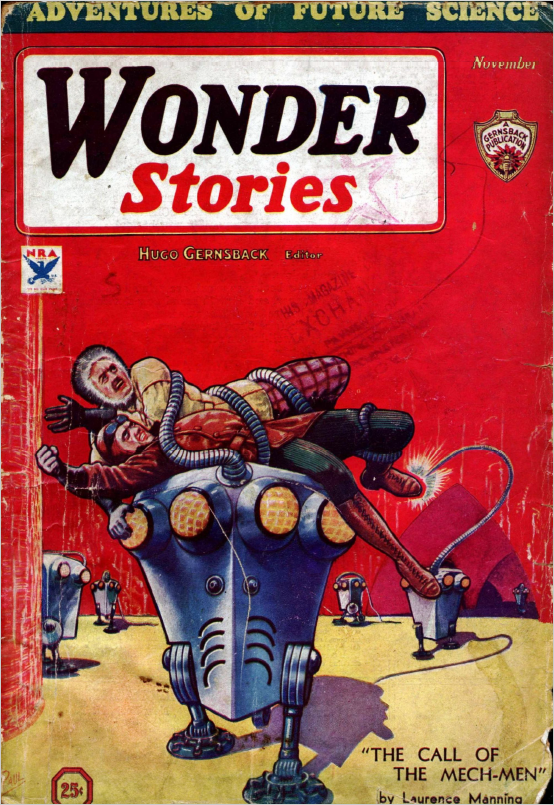
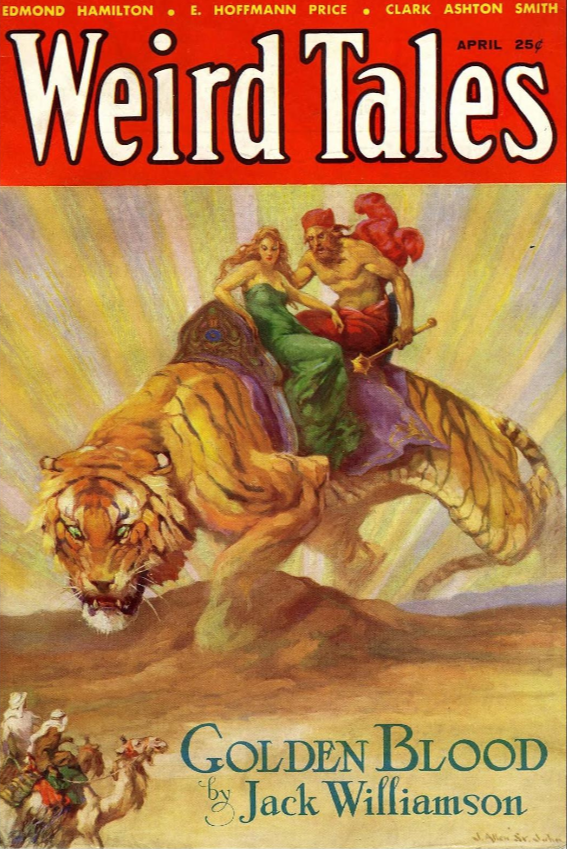
This month’s cover, by J. Allen St. John, isn’t particularly weird, unfortunately, although I like the snarl on that giant ass tiger’s face. Very orientalist, something that editor Farnsworth Wright (and the readership of Weird Tales) loved with a fierce undying passion, so it makes sense that Williamson’s “Arabian” style multi-part novel would be made the cover. Still, c’mon man – gimme a monster!

Still, some fun stuff in the ol’ ToC. I don’t remember the Price story, but I’d love a Perfect Strangers/Weird Tales bit of fanfiction about “The Return of Balki.” Hamilton, Smith, Kline, Counselman, all big names for the readers at the time, along with Jacobi of course. Solid issue, I feel like the reader is getting their twenty-five cents worth this month.

Now, on to “Revelations in Black!”

Classic “Jayem” Wilcox title illustration, down to the whole “we’re giving away most of the story to you right off the bat” aspect too. Yep, this here is a VAMPIRE story, specifically about a LADY VAMPIRE, one of the top tier kinds of Vampires out there. A nice, traditional approach to a Halloween staple, I think.

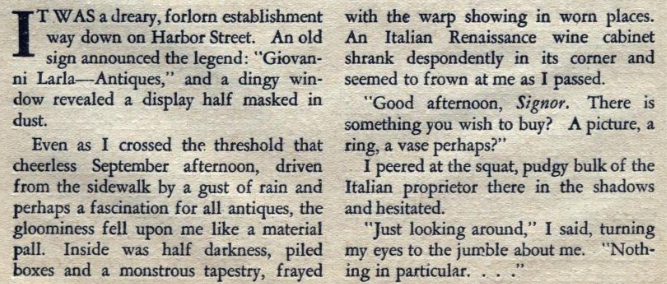
Our story opens with a narrator battling his seasonal affective disorder by going antiquing. What’s funny is that our dude exchanges a dreary rainy day for what is, apparently, an equally dreary shop – the description of the wine cabinet shrinking despondently into its corner is a good bit o’ writing that sets the tone for Larla’s shop, I think. Our guy’s not after anything in particular, of course, but Larla is COMMITTED to his pitch, and even after the narrator suggests he’d like to see some books, Larla makes him go through the whole shop, looking at furniture, paintings, a “muddle of yellowed statuettes,” all kinds of junk. But, eventually, they reach the Old Books in the back.

Carl lays it on a little thick here, I think – the whole “oh, if only I hadn’t done whatever, the horrors I could’ve avoided,” yadda yadda, it’s easily the weakest part of this story, although I DO think that it helps if you read this part (and the whole story) as something very FIRMALY within a certain stylistic tradition. Jacobi is writing a VAMPIRE STORY – he’s not interested in reinventing it or subverting anything, he’s just enjoying the languorous pleasure of playing in a very well-established sandbox, right? In that context, this kind of “ah, would that I hadn’t fucked up so badly back then” stuff is VERY MUCH a part of the genre. Take it for what it is, is what I’m telling you.

But anyway – our guy plucks an interesting book from a shelf, one that Larla the shop-owner says was placed there by mistake and isn’t for sale. In fact, the book was made (literally – we learn that he bound it himself) by his “poor” brother.

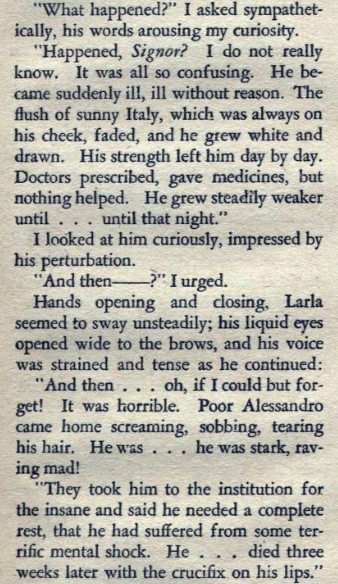
Am I a sucker for the “last ravings of lunatic” macguffin? Yes, and so is our narrator – when he learns it was written BY a guy IN an asylum, he wants it EVEN more badly. Larla explains the Sad Tale of his Brother, Alessandro:

We learn then that there are actually THREE volumes to the “Five Unicorns and a Pearl” series, books that Alessandro had filled with his mad scribblings in his time in the asylum. Now, his brother keeps them as a keepsake, trying to forget the tragedy of his death and remember happier times (something probably not helped by keeping the Black-bound and Skull-embossed Book of Horror he wrote while dying mysteriously, but then again the human mind is a labyrinth, right?).

Like I said, this sort of wild-ass story just makes our guy want these books even more. When he sees he can’t buy it, he ends up RENTING the book for a single night for TEN GODDAMN DOLLARS (that’s like $250 now). He has a single night, and he MUST return it the next day, in perfect condition. A crazy deal, huh?

So, having plunked down a pile of cash for a chance to examine the book, our hero settles in for the night in his apartment to do some readin’. First thing he notices is a weird inscription “in a feminine hand” on the inside of the front cover:

Shoulda signed it “XOXO – The Vampire” to make sure he got the point.

He reads on:

Our boy here is strangely moved by the kind of odd and obviously symbolism-rich language that poor Alessandro used when composing his last work. In fact, he’s so struck and, frankly, troubled by it that he decides to go for a midnight walk!

Indulging in this weird impulse, however, does little to alleviate his mania – in fact, if anything, it increases it. He feels like he’s looking for something, that he’s being drawn towards something, and there’s nothin’ fer it but to wander in search of whatever the hell it is.

Our guy pushes through the strangely unlocked gate and into the preternaturally alluring night garden.

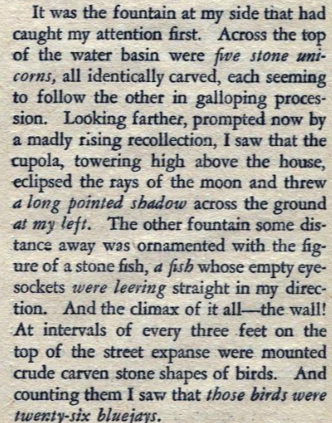
Quelle horreur! Our guy suddenly, shockingly realizes that this garden is, IN FACT, what poor mad Alessandro was writing about in Volume One of his book “Five Unicorns and Pearl,” the very book HE HAD JUST BEEN READING (*thundercrash*)!!!!!1!

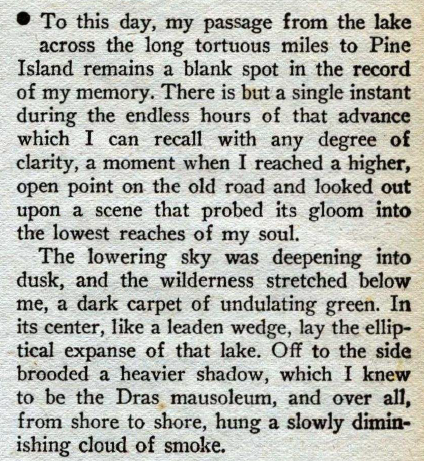
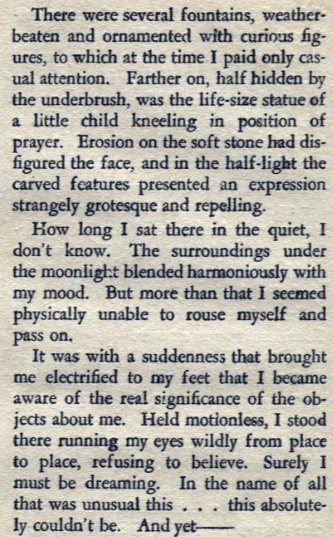
All kidding aside, I DO think that our guy’s entrance into the garden is an extremely well done bit of eerie writing – the scene perfectly captures, a dark, seemingly abandoned garden in the Fall, the plants dead or dormant, and full of odd architecture, ornamentation, and statuary. Gardens are strange places, after all, sites dedicated to specific ideas about aesthetics and nature, carefully curated and maintained, so seeing one at an “off” time (at night, in the autumn, and apparently not being “kept-up”) is automatically a disjointing and unsettling experience. I think Jacobi is one of the great landscape/scenery describers of the pulps, and this garden is a perfect example of his mastery.

While he’s musing about this place, and how perhaps Alessandro wasn’t the hopeless lunatic he’d been labeled as, a strange, pungent perfume assails his nostrils…it’s the scent of heliotrope, powerful and fulgent in the night air…and it’s comin’ from a goddamn LADY he hadn’t even noticed a minute again!

The way Jacobi describes this woman, all in black, veiled, and with only a pale white neck exposed, strikes me as very Arthur Rackham. I mean, everybody has probably guessed what’s happening here, right, but for me that doesn’t detract from the pleasure of the story – honestly, there’s a lot to be said for weird fic/horror that tips its hand early but keeps on heading steadily towards the already-spotted conclusion. You can’t get that kind of slow-burn consummation without letting the reader see the road ahead, and I think when it’s done well, like in Jacobi’s story here today, there’s a lot to appreciate.

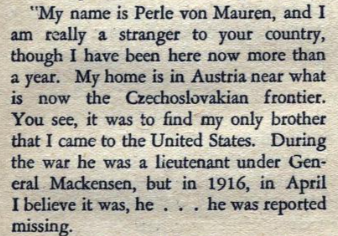
Anyway, this crazy vulpine woman and her enormous dog don’t seem bothered by the fact that some guy has just busted into their garden. In fact, the lady asks him to stay; she’s lonely, and would like someone to talk to. With a curt “fort mit dir, Johann!” she sends her dog away and bids the interloper join her by the fountains. Then, she introduces herself:

I’ll just break in here to post this picture of Field Marshal August von Mackensen, a WWI Imperial German general, because his picture is wild as hell:

Germans, yeesh!

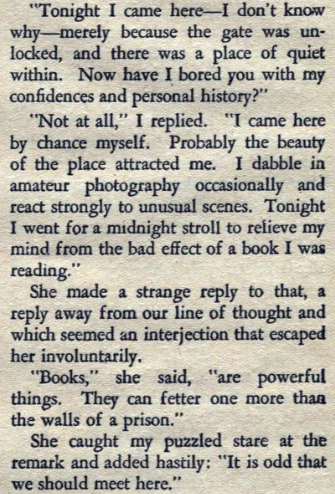
Perle von Mauren continues her tale of woe:

“…found him…no longer living” is one of those “I don’t drink…wine” statements that vampires just love – technically true but omitting certain key information. Fun stuff!

Fun bit of subtle weirdness here – she’s obviously the author of the “feminine hand” that our narrator spotted on the frontpiece of the book, but there’s an implication here that, somehow, the book and she are intimately and causally connected. It could just be dissembling on her part, of course, but it really seems like our guy reading the book has summoned both Him and Her to the garden, together, some kind of weird link being forged between them by the reading of the story. It’s good and interesting, and I don’t think I’ve ever seen anything like it with regards to vampires – the idea that they’re associated with some kind of cursed object like that is neat!

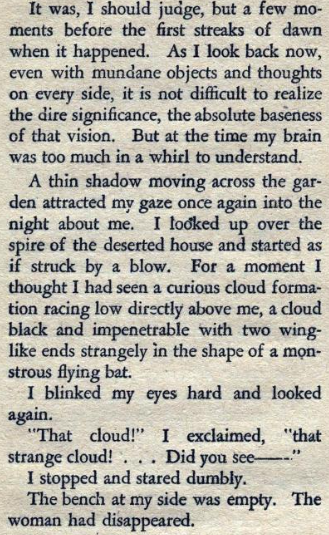
Anyway, our dude spends the whole night talking to this lady in the garden. He’s obviously enchanted by her, even if he has a mounting sense of unease the whole time…why won’t she remove her veil, for instance. Then, just as the night gives way to dawn, something weird (well, weirder) happens!

They call that a “Vampire’s Goodbye.”

The next day finds out guy increasingly preoccupied with Perle and the garden and the books of Larla. He describes himself as addicted to the mystery of the thing, and can’t help but go back to the shop where, despite not returning the first book, he procures the second volume at another ridiculous price. He rushes home, reads it, but the mystery merely deeps for him, and his weird craving to return to the garden grows stronger and stronger. He tries to resist it, to ignore it, but then, in a flash he has the sudden idea that the garden scene and her and all that moonlight would make one hell of a picture, something he could even submit to the International Camera Contest in Geneva next month! Is that a delusion on his part, or an excuse? Regardless, our shutterbug grabs his fancy camera with its newfangled flashbulb and hustles on out to the garden again.

She’s there, of course, and they chat for a long while – she seems weirdly reticent to talk about her brother, and yet simultaneously compelled to tell our narrator about him. There’s an interesting section of his time as a student in Vienna where, as is traditional, he’s considered a weird and potentially dangerous avant garde philosophy student with odd and offputting ideas. His experiences in the war, and in digging graves as a prisoner of war, seem to be a particular focus of her morbid interest. It feels like this is Jacobi gesturing towards an underutilized bit of Vampire Lore here, the idea that a vampire rises out of the grave of a sorcerer. Her brother’s background as a “weird philosophy” student matches that, and she also seems to be suggesting that his terrible experiences in the war somehow “tainted” his soul.

The sky clears and the moon comes out; a perfect time to take a picture. Our guy tells her not to move, hops up, and then snaps a pic.

Lady, I get it – I don’t like to have my picture taken either. But she’s REALLY pissed, because she vanishes into the house and sic’s her big ass dog on our guy! This huge hounds comes hurtling out at him and attacks! It’s only with the greatest difficulty and a bit of luck that our guy survives – he chokes the dog while it’s trying to kill him, then remembers the German Perle had used when ordering the dog to go in. “Fort mit dir, Johann!” he manages to croak out, and it’s enough to confuse the dog that he’s able to escape.

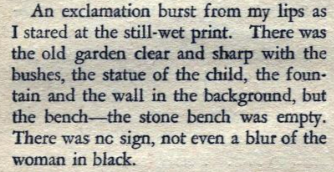
Our guys calls in sick to work the next day, and decides to develop the picture he took. I wonder how it turned out?

Get a clue dude!

Anyway, he’s so shaken by the experience of the picture that he goes to bed. He wakes hours later, seemingly out of some kind of a vague yet terrible nightmare, and he notices that the drapes are fluttering in the breeze from a window that he had thought he’d shut before going to bed. He grows weaker, and ends up staying there for THREE DAYS, worn out, weak, and sick. A doctor visits and tells him he needs to rest and recuperate and, oh, by the way, where’d those two marks on your neck come from?

But even this isn’t enough to curb his NEED to read the third book. He’s been through the first two, and as he lays there in bed a kind of feverish desire builds and builds until he is forced to head to the shop. He, of course, has not returned the first two volumes, and so Larla refuses to “rent” him the third. It’s like, dude, take them off the shelf if you don’t want to sell ’em, right? But our guy’s NEED for the book is too great and, when Larla’s back is turned, he steals it and runs.

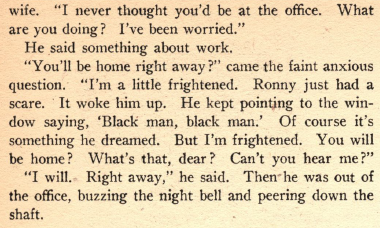
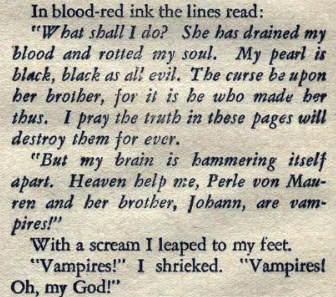
He reads through the mad yet damningly suggestive text of Alessandro Larla’s FINAL book, troubled and unnerved, until he reaches THE FINAL PAGE:

Yeah no shit man, jesus christ. I do like that the dog is her brother though, that’s neat.

He realizes that Alessandro had been ensnared by these things in some way and, although unable himself to escape, had written these books in hope of exposing and destroying them. Then our guy remembers the odd frontpiece…didn’t it say something about “stakes” in there…

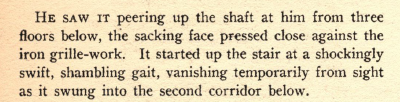
He won’t be a victim, not like Larla! He smashes the legs of his tripod to make two sharp stakes and takes a taxi IN THE DAYTIME over to the house. Inside, he finds a room with coffins and the cloying, masking odor of Heliotrope…and does what needs to be done.

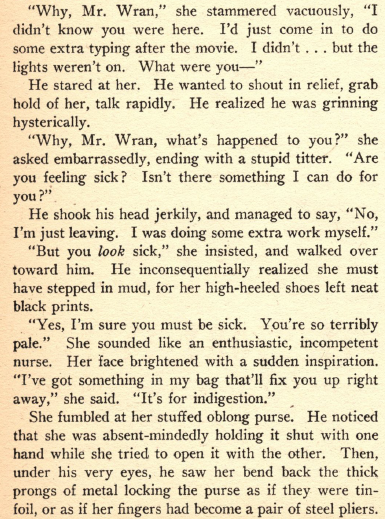
And then there’s a classic Hammer Horror style reveal:

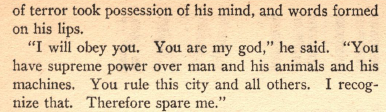
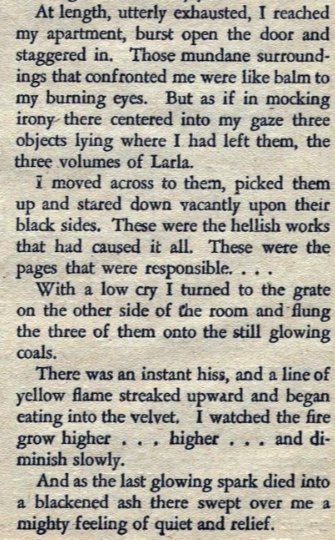
And then, a final coda:

And that’s the end! Hope ol’ Larla the shop keeper had some other stuff of his brother’s to remember him by, because this dude just burns those books.

This story, while very *classical* in format and execution, is still awfully evocative and atmospheric; Jacobi is great at scenes and environments, and I like the way in particular he describes the moonlit garden and the fountain. Apparently, this was a view shared by the editor of Weird Tales Farnsworth Wright – he originally and very firmly rejected this story, only to contact Jacobi a few weeks later to ask if he could publish it! Our narrator discovering the garden had stuck with ol’ Wright, so much so that he’d found himself thinking about that scene long after he’d rejected the story.

And, you know, for all the “seen it” stuff in here, I think there’s some interesting little glimmers of weirdness – the book aspect is inventive and cool, for instance, and I really like the way it seems to summon them ALL to the garden. And would they have returned if he *hadn’t* burned the books? And, of course, some things are a classic for a reason, you know, and damned if a straightforward Vampire Tale isn’t one of ’em! And I mean, c’mon, Jacobi does a GOOD job here with the genre.

Anyway, I hope ya’ll enjoyed a classic bit of Vampire fic fer Halloween. I know I did, but maybe next time around we’ll dig into some weirder stuff, eh? Until then!

Straining the swampy pulp #24: “Frogfather” by Manly Wade Wellman, Weird Tales, v. 39 n.8, November 1946

We recently put in a stocktank water feature in the backyard, got a pump to circulate water and a bunch of pretty good rocks to make a little cascade, and we’ve got grand designs regarding water plants – there’s some good Texas native pond flora out there, including a native pitcher plant from east Texas, that I want – but the real hope is that we’ll have a good habitat for frogs and toads. When we first moved to the neighborhood in 2019, the warm summer nights were FULL of frogsong at every house with a water feature, and we’ve seen plenty of toads and such hanging out in our garden. Big fan of frogs, is what I’m saying here, so HOPEFULLY that will put me in good with the subject of today’s story, “Frogfather” from Weird Tales, November 1946, by the one and only Manly Wade Wellman.

Wellman is, if not obscure, then at least of specialist interest these days – if you’ve ever played Dungeons & Dragons, then you owe him more than you probably realize, since Gygax and Arneson pulled a number of monsters directly from his stories, as well as using his “John the Balladeer” character as the basis for the “Bard” class in the game. In his heyday, however, Wellman was a prolific pulp writer, and in the 40s and 50s was one of Weird Tales’ major talents. He’s an interesting guy with an interesting biography, although it *may* have been a little embellished and romanticized.

Briefly, Wellman was born in 1903 in a port city in what is now Angola. His father, Frederick Creighton Wellman, was stationed there as a medical officer for a British charity, and seems to have been quite a weird and colorful character himself. A specialist in tropical medicine, Wellman pere was famous in the international press for having “gone native” while in Africa, whatever that means. He helped build railroads and ran medical centers while there, and while he was doing missionary work he also apparently took the time to learn local languages and record local stories and beliefs. Old Man Wellman was one of those tropic-lovin’ anglos; he ended up working for United Fruit in central America, and became quite an authority of tropical diseases.

Stories about Manly Wade Wellman’s childhood in Africa are romantic (and suspect in my opinion); he supposedly spoke a native dialect before he learned English, and had been adopted by a “native chief” after his father had cured the potentate of his blindness; to me that sounds like the usual kind of nonsense expats like to brag about. What is true, though, is that his time as a child in Africa was very foundational to his outlook on life – a love of wilderness and a certain (though paternalistic) regard for people of different races, creeds, and backgrounds is evident in his work. He was also one of those people from Old South stock that liked to talk up their Native American ancestry, something that will have relevance in the story today, I think. He was an inveterate Confederate apologist, especially when around “Yankees,” apparently; you get the feeling that he was one of those romantic Lost Cause-ers who felt that there was, shall we say, a certain “order” to the world that those outside of the antebellum South could never truly appreciate or understand. His stories with black American characters clearly reflect this world-view; reminds me a little of Flannery O’Connor’s racism, honestly.

The Wellman family would move back to the U.S. when Manly was a kid; he did his schoolin’ here in the States, got a degree in Literature and Journalism, and went to work as a reporter in the 20s. It was during this time that he toyed around with fiction, selling a few stories to Farnsworth Wright at Weird Tales here and there, mostly based on childhood tales of Africa. He met and became friends with some of the early sci-fi and fantasy writers of that era, like Al Bester and Henry Kuttner, when he moved to New York. He also knew and travelled with the famous Ozark folklorist Vance Randolph, visiting Appalachia and getting a strong sense of the traditions and folklore of the area, something that would loom large over his career, as we’ll see in this story.

A hugely prolific writer, in the 30s and 40s he was also a major contributor to Weird Tales, producing a number of very popular “occult detective” style stories, as well as a lot of straight horror tales, usually set in either Africa or Appalachia. As mentioned above, later in his career, in the 60s, he’d invent his most famous character, “Silver John,” a wandering troubadour country boy who faced eldritch evil and dark magic in the hills and hollers of Appalachia with only his wits and his silver-stringed guitar. They’re good stories and worth hunting up – there was a recently republished collection from Valancourt, “John the Balladeer,” that I’d recommend, if that sort of thing sounds interesting to you.

One last little anecdote that I find hilarious – in 1946 Wellman won the Ellery Queen Mystery Award for a story of his (“A Star for a Warrior”), beating William Faulkner, who was apparently absolutely furious that he’d taken second place to a “mere science fiction” writer. Faulkner was apparently so pissed off that he wrote a long angry letter to the editors of the Ellery Queen Mystery Magazine, wherein he explained that he was, simply, the greatest living American Writer and they could all go to hell. Pretty funny!

Enough of these maunderings! Lets get down to business!

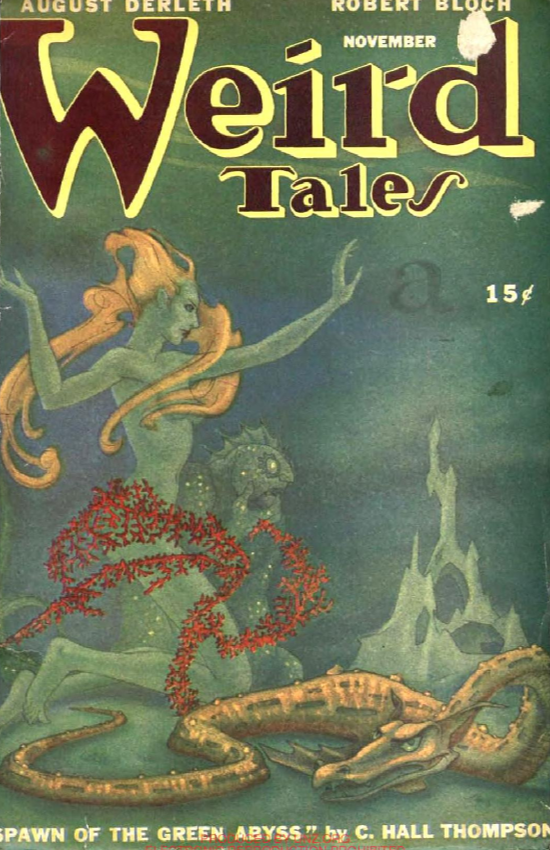
Lookit that cover, hot damn! Spectacular pic from Boris Dolgov, another one of those Maxfield Parrish influenced artists producing some of the best, most vivid work that ever appeared on the cover of a magazine. Dolgov, about whom almost nothing is known, did some spectacular work for Weird Tales in this era – I love the weightlessness of his figures, and the sharp, dangerous feyness that he invested in his otherworldly figures – that nereid or siren or whatever, the naked blue-green lady…she’s delicate and cute, sure, but there’s also a feral otherness to her that is just unbeatable. Spectacular stuff! Between Dolgov, Bok, and Coye, the 40s and 50s editions of The Unique Magazine are some of the best lookin’ ever made.
ToC’s pretty good this time around, too – Quinn is still out there, fightin’ the good fight, and you’ve got the enigmatical Allison V. Harding up there too, a mysterious woman about whom almost nothing is known (there’s some suggestion that she was, actually, Jean Milligan, the wife of Lamont Buchanan, the associate editor of the magazine). Bradbury, Derleth, Bloch, and Wellman – this is a relatively heavy-hitter of an issue for this late 40s era! Anyway, on to our story!

A.R. Tilburne again doin’ great work…guy in a coffin boat bein’ menaced by a Big Frog. Solid, fun piece.

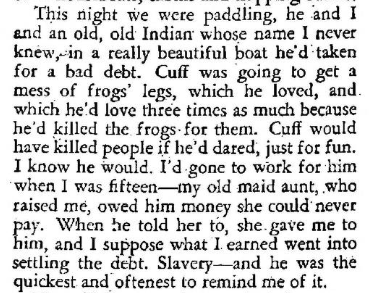
Our story starts with the narrator explainin’ how he never liked frogs’ legs, but he sure as shit wouldn’t eat ’em now, not after what happened. A good, snappy little entry into the story, and one that preserves what I think is the key *tale* part of the genre of the weird tale. This is some guy tellin’ us a tale, and there’s an intimacy and immediacy to that kind of framing device that I think helps us step right into the proper frame of mind to enjoy what is sure to be a weird-ass story. Anyway, our narrator introduces us briefly to Ranson Cuff, a moneyed asshole who, through his financial clout, basically rules the Swamps.

Good, efficient characterization, with the unmistakable “backwoods” voice of Wellman here, setting up a petty tyrant asshole that nobody likes. But what’s Cuff got to do with frogs’ legs?

Not only is Cuff a bastard, he’s flat-out evil too! Cruel, sadistic, and he’s keeping our narrator as an indentured servant. We are quickly establishing the fact that Cuff is the guy who absolutely deserves to die, one of the most important aspects of a horror story. He’s an evil guy in a boat he’s repossessed out huntin’ for frog legs with his slave and an oppressed minority. The frog legs are a nice touch, too – they’re almost automatically a very special kind of prey, you know what I mean? Like they’re a symbol of explicit cruelty already, way more so than if this guy was out fishing or hunting ducks, right? The fact of their dismemberment is right there in the name, and Cuff enjoys that aspect maybe even more than the eating of them. Solid stuff, and again, very efficient.

Cuff and his unfortunate cronies are out paddling around the swamp, looking for frogs to gig and havin’ a hell of a time of it – there doesn’t seem to be any frogs along the banks. Cuff, angry and frustrated, orders his men to paddle him up to a secluded neck of the swamp that he’s never been in before, but where he can hear the frogs calling. Our narrator starts paddling, but his comrade pulls his paddle from the water and stops the boat.

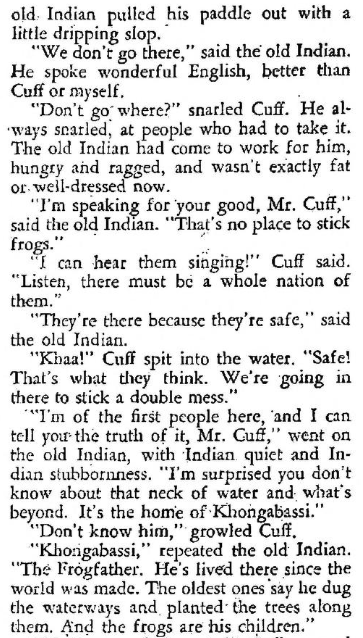
And there he is, the titular Frogfather himself. This old, nameless, stereotyped Indian, who speaks better than either Cuff or the narrator, tries to stop Cuff from heading into that particular stretch of the Swamp, on account of it being home to, basically, a big ol’ Frog God. Wellman has given it a suitably “exotic” sounding name, one he made up whole clothe, and it’s basically the only real misstep in the story, in my opinion. “Frogfather” is, simply, way cooler and way more menacing a name than this fake Native American word that he’s invented. I mean, christ, I wanna start a speed metal band called “Frogfather” right now, don’t you? It’s a rad name!

Of course, Cuff can’t believe what he’s hearing – he don’t give a shit about Frogfathers, he wants some extra-cruelty supper, and he wants it now! He tells the nameless Indian to shut up and get paddling, which, of course, the nameless Indian refuses to do.

Wellman underlining once again what a fuckin’ piece of shit Cuff is for us. He makes the nameless Indian *swim* to shore! No question: Cuff is DEFINITLEY going to die now. One of the fun parts of weird fiction, for me, is the sense of the shape of the story coming along as you read it – we know that Cuff is in trouble, and Wellman WANTS us to know that, which is part of the pleasure – Cuff, that asshole, has no clue what’s about to happen to him!

Johnny, our narrator, paddles them to the distant neck, and they see a strange sight. The water here is phosphorescent, glowing faintly and eerily as they slip silently into this forbidden corner of the swamp. Cuff can’t be bothered with it though, since there’re frogs to kill!

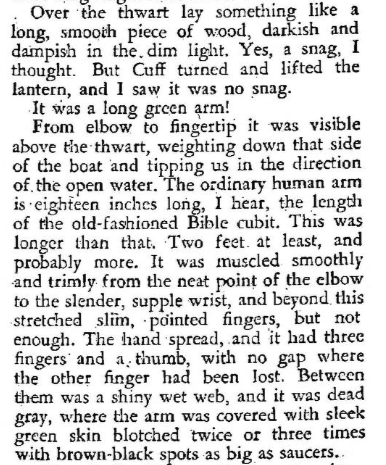
Pretty brutal frog murder there, isn’t it? The gaping mouth, the smacking it alongside the boat to make it stop its squirming, grim stuff. Cuff’s bloodlust is up now – he sees another one and wants more! But, as they’re trying to maneuver towards it, the boat starts to wobble and tip. Cuff curses Johnny, and tells him to hold the boat steady. Johnny says he IS holding the boat steady, it’s Cuff in the prow that’s causing the imbalance, which, of course, Cuff denies. Must be a snag, Johnny figures; he takes the lantern and peers over the side of the boat, trying to spot whatever it is they’re caught up on.

Hell yeah, it’s the Frogfather!

The story wastes NO time – Cuff goes into The Forbidden Swamp, kills a frog, and BAM! Frogfather is on the scene! No lurking about or skulking or haunting – you piss of Frogdaddy, you get walloped.

I like the description of the Big Frog here – the line about the eyes being “every jewel-flashing color known to the vainest woman” is both fun and shows Wellman’s ear for backwoods eloquence. The neat thing, too, about the Frogfather is that it’s purely the size and bulk of the thing that’s alien; other than that it is, simply, a Big Frog, and honestly that’s something I appreciate. There’s no reason for this thing to be some kind of eldritch abomination, or even something “frog-like” akin to Clark Ashton Smith’s Tsathoggua – this thing, which has some mythic, folkloric, primal linkage to frogs and their lives, appears as a truly big frog, simple as. I think that makes the weirdness of its actions, in the section above and what we’ll see in a bit down below, all that much weirder, too. It heaves itself up onto the boat, casually snaps Cuff’s iron gig, and then tips the boat, grabbing Cuff by the head and neck – the monstrousness of the Frogfather is in the incongruity of its very deliberate, almost human-like, actions.

Johnny sees all this and just starts swimming. He’s in the water, which is all lit up from the phosphorescence in the water. This enables him to see something even stranger than just a Big Frog:

“…tucked like a stolen baby” is a a phenomenal line, isn’t it? The whole scene is really strange and evocative – the Frogfather has built a little house down there out of tree trunks, and the weird glow is coming from inside his lair. And, rather than simply gulping down Cuff, he’s swimming away with him into that glow, towards a fate that is implied to much weirder and worse than simple death. That’s great stuff, man, real weirdness here that you might not have expected from a simple Big Frog monster.

Johnny is swimming to safety when he hears a strange whistle, and something dark and swift suddenly bears down on him as he’s treading water…it’s the nameless old Indian, this time in a canoe. He helps Johnny into the boat and lets him gather his thoughts before they talk.

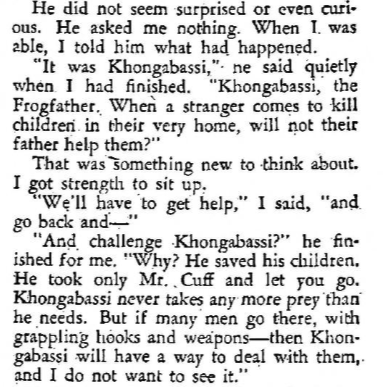
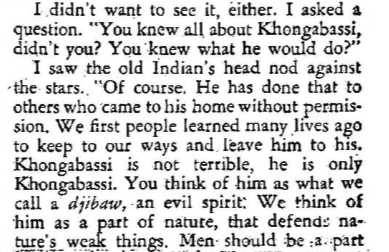
Another nice little glimpse of weirdness there: Frogfather would “have a way to deal with” a lot of people, if they were to go in there and try and do something about him, and buddy, you don’t wanna see what that would be! It’s another well-executed classic bit of weird fiction, where there’s a *hint* or something much stranger at work. Some dude comes in and starts killing frogs where he isn’t supposed to, well, that calls for the Frogfather just comin’ up and grabbing the guy. But a more complicated kind of incursion, with more people and boats and suchlike…well, that would mean the Frogfather would be forced to do something a bit more dire. Great, great stuff.

And that’s the end of Manly Wade Wellman’s “Frogfather!”

I love a good comeuppance story, and Wellman sets Cuff up as the perfect asshole – vindictive, cruel, sadistic, and totally uncaring. This is also a VERY short story, an efficient weirdness delivery system that sets up the scenario, executes its monster, and gets it done, all in a handful of pages.

It’s also interesting as a bit of eco-horror. Cuff is an exploiter of nature – he leads hunting and fishing trips for rich out-of-towners, explicitly the sorts of people who don’t need or appreciate the wilderness, but rather just use it for their own entertainment. Hand-in-hand with this is Cuff’s exploitation of his neighbors and fellow swamp folk – Johnny is an indentured servant, working to pay of his aunt’s debt to Cuff, and the nameless Indian is the definition of exploited labor, an oppressed minority barely scraping by on whatever pittance Cuff is paying him. All of this is in play when the Frogfather makes an accounting of Cuff’s many sins.

Now, speaking of the “nameless Indian,” I do think we have to unpack the racism going on here. This is 100% the kind of “mystical Indian in tune with the rhythms of nature” bullshit that is, unfortunately, still really common to see today. I mean, this guy doesn’t even get a name, he’s so primal and wise and mystical. He’s also just “an Indian,” a kind of undifferentiated and vague “other” that belongs to a different age. Combine that generic bullshit with the honestly very bad fake Indian name of the Frogfather, you end up with a sort of icky paternalism that just feels bad. I mean, at least he can use pronouns and doesn’t talk like Tonto, right? But even there, the fact that he’s better spoken than either of these (presumably) white characters is another part of that myth-making, part-and-parcel with his humble mien and deep-seated wisdom.

That said of course, the ending is great and fairly radical for the era – the idea that these stupid white people can’t handle themselves in the wilderness, even when told to their face what dangers there are out there, is satisfying, as is the explanation that they’ll have to come up with a lie that the white people will believe with regards to Cuff’s disappearance. This is a fairly common thread in a lot of Wellman’s fiction, the idea of indigenous or folkloric knowledge as fundamentally valid and valuable and deserving of respect.

I also like the setting – there’s plenty of backwoods, southern stories in Weird Tales, but the majority of them are honestly just using it as an “exotic” or (morally and geographically) remote locales, or, worse still, as a chance to indulge in some chicken-fried dialog. But Wellman, similar to REH and his Texas tales, has both experiences with the setting and a real affection for it, and that shows in his stories. Cuff isn’t just some dumb hick we’re supposed to laugh at; he’s an evil bastard, and it’s for that, his EVILNESS, that he’s punished.

Anyway, I like this story. Wellman, like I said, was a PROLIFIC writer and worth chasing down if you’re interested in this era of weird fiction and fantasy. He was an influential figure too, with a long shadow on the shadow, and he’s worth reading for that fact too. I’d stay away from the Africa stories; frankly, they’re a little rough, and while he DOES have an affection for the setting and history of the continent, he’s not equipped to really dig into it or approach it correctly. It’s his Appalachian stuff that’s most worth reading, both because he’s a better writer by the time he gets around to it AS WELL AS because he really DOES approach it in a way and with a style that you don’t see much of. Read the Silver John stories, at least; you won’t be disappointed!

Improvised Contraband Prison Pulp Strainer #23: “Cellmate” by Theodore Sturgeon, Weird Tales v. 39, n.9, January 1947

Break out the pumpkins and skulls and eldritch horrors, it’s October, which means it’s fuckin’ spooky season again, baby! And, as is common ’round these parts (i.e., Austin Texas) it’s still in the goddamn mid 90s during the day time, temperatures that are not particularly conducive to the traditional Halloween spirit. So, as in years past, I’m gonna try and get into the spookemup mood by focusing on some particular favorite weird stories of mine, and we got a fun lil’ one this week: it’s “Cellmate” by the great Theodore Sturgeon, from the January 1947 issue of Weird Tales!

Now, we’ve talked about ol Ted Sturgeon just a few pulp strainers ago in the “The World Well Lost” post (number 21 in this series), so we don’t have to spend too much time on him here, biographically – he’s great, one of the absolute top-o-the-heap sci-fi writers of the 20th century, but much like Bradbury, he flit around stylistically (and financially), placing stories where he could. He appeared in the cross-genre pages of Weird Tales with eight of his stories, and this one, Cellmate, is his first appearance in the magazine. It’s also, I think, probably his absolute “weirdest” of the bunch – a lot of the other Weird Tales sturgeon work is very much more science fictional, but this one is basically a straight up weird monster story.

Before we dive in, though, we should take a moment to reflect on Weird Tales. This is a particularly unique iteration of the venerable ol’ mag, and one from much later than I usually sample from. We’re in 1947, a remarkable time in the history of the pulps (in general) and Weird Tales (in particular). The great (and enormously important) editor Farnsworth Wright was long gone, having handed the reins of editorship over to Dorothy McIlwraith in 1940 (and then promptly dying of complications from his Parkinson’s disease). Now, we’ve also talked a little bit about Dorothy McIllwraith before (most thoroughly in last years’ discussion of Fritz Lieber’s “The Automatic Pistol“), so we won’t spend too much time on her here, but, sufficed to say – Dorothy McIllwraith is a hugely important figure in the history of weird fic, someone who was able to navigate a pulp magazine through not only the paper shortages of WWII but ALSO the rise of television (for a while, at least). No mean feat!

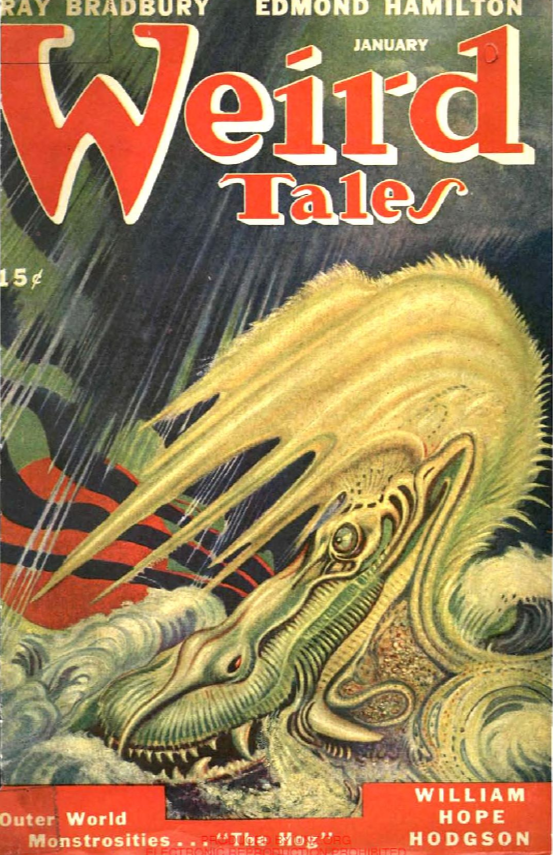
How about that fuckin’ cover, huh? Great, wild stuff from A.R. Tilburne, one of the stand-outs from Weird Tales covers, in my humblest of opinions. This is a perfect example of real weirdness – some kinda weird sea monster? In a storm? Who the hell knows what’s going on, but the mastery of linework and style here is c’est magnifique, n’est-ce pas? I love it, 10/10, nice work A.R.!

A quick glance at the ToC shows us some things:

First off, this is a *much* slimmer Weird Tales than we’ve ever seen – we’re well into the sub-100 page issue era, something unheard of in the glory days before the war. It’s also worth noting that this is now a bi-monthly mag (by which I mean it’s only six issues a year), so you’re getting a lot less weirdness over the course of the year. I mean, it’s lean times in the magazine world, and only getting leaner. Of course, the magazine is also cheaper than it had ever been – fifteen cents in 1947, when it was a quarter a decade ago!

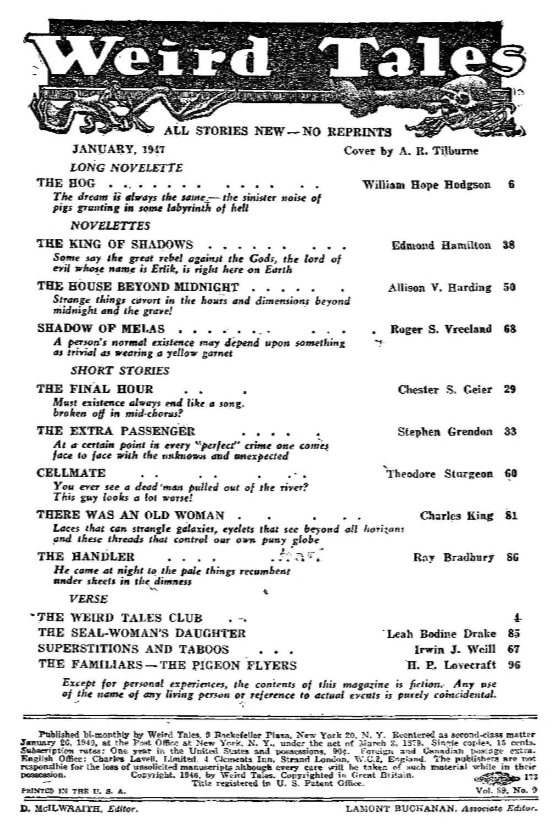
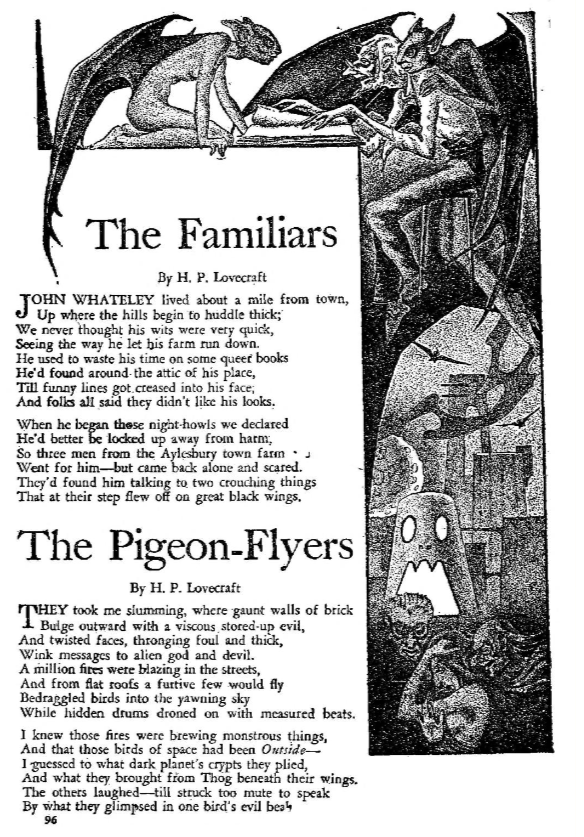
Now, there’ still some excellent and exciting writing going on here – you’ve got Sturgeon and Bradbury, and Hamilton is still slugging away, one of the last of the old generation still writing. Charles King there is an interesting figure, another sci-fi heavy guy who bled over into Weird Tales, and the story in this issue from him is likewise a good one. But it’s interesting to me that the big center piece story this issue is a reprint from William Hope Hodgson, maybe a cost saving measure but also, maybe, indicative that Weird Tales was definitely having a hard time competing against the flashier (and better paying) sci-fi mags out there. That’s also probably why they publish two chunks of Lovecraft’s longer poem “The Fungi from Yuggoth.” In fact, they’re tiny, so I’ll just give you a bonus and reproduce ’em here:

Like I said, these are two smaller sonnets from a larger work. Lovecraft always thought of himself as a poet first and foremost, and in these I think he does actually end up transcending that affectation. I think they’re good, and taken together in the whole singular piece (which is 36 sonnets long, in total) it’s a pretty phenomenal piece of weird poetry. I also think it’s Lovecraft directly responding to T.S. Eliot, but that’s a subject for another day!

But enough! On to…CELLMATE, by THEODORE STURGEON:

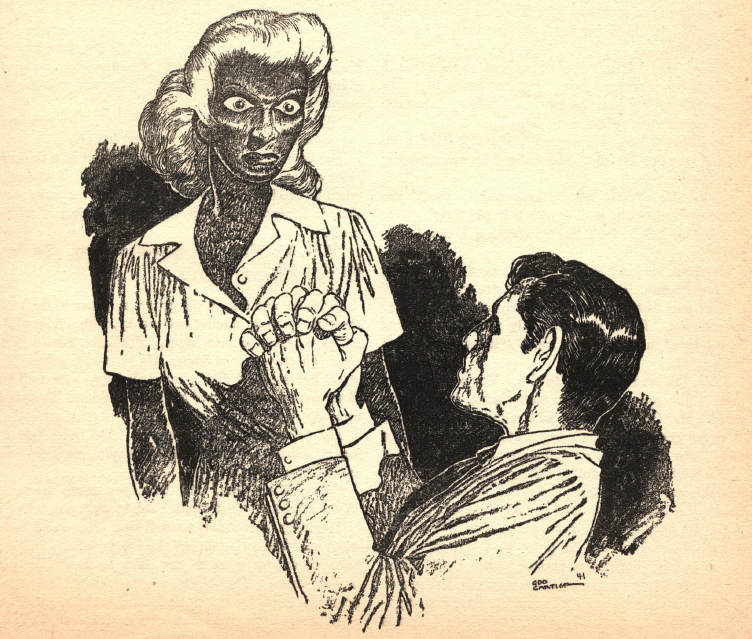
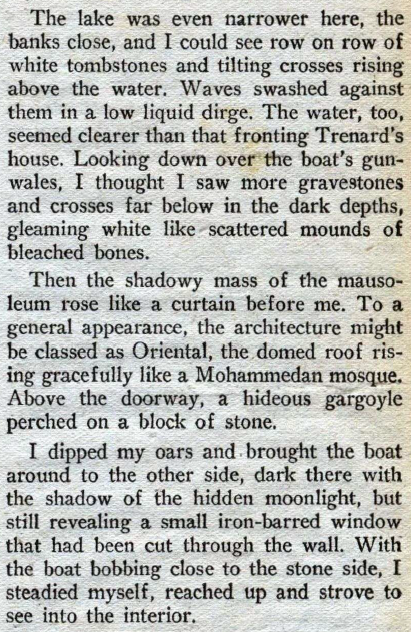
Lookit that title illo – that’s weird right there, yessir! On first past, you can’t really even tell what’s going on here, although by the end of the story this’ll make more sense. But for now, it’s a good bit o’ visual weirdness, and I also think it nicely captures the lonely grimness of prison too – the inky black walls, the high narrow-barred window, even the institutional-lookin’ bed frame thing in the foreground. Nicely executed work from the inimitable Lee Brown Coye!

The beginning of this (pretty short) story wastes no time:

We’re introduced to our narrator, a fairly run-of-the-mill hard boiled criminal who, we’ll learn, is a basic low-level thug, a violent guy who spends a lot of time in and out of jails for various offenses. He’s doing 60 days for some kinda crime (he tells us not to worry about it, which is a surefire way to make you worry about it, right?) when he gets saddled with a cellmate…Crawley.

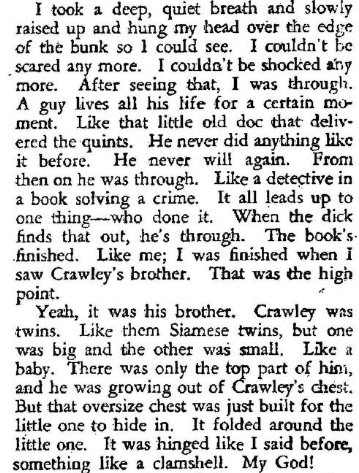
How about that for a description, huh? It’s very strange. Average height sorta guy, but with spindly limbs, a long stringy neck, and a humongous chest. And the narrator makes it very clear that he’s not merely barrel-chested or anything – he’s abnormally, even freakishly proportioned, a “humpback with the hump in front.” A very strange figure, and with the personality to boot – weird voice, weird breathing, something off-putting and unnerving about him. Our narrator takes an immediate dislike to him.

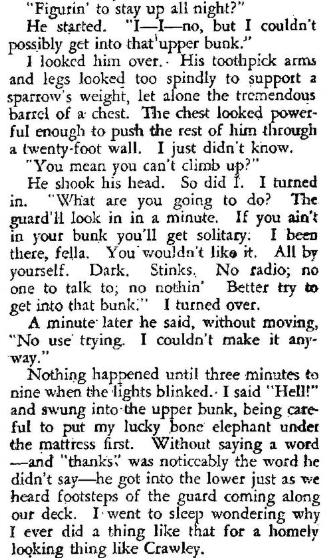
Crawley ain’t been in this cell thirty minutes, and he’s already acting weird. Again, Sturgeon has a real pen for this kind of stuff, these extremely odd little details – the weird, echoey, resonating scratching, and the way he’s described as “burrowing his fingers into his chest” (emphasis mine) is very, very odd. But, anyway, our narrator has informed Crawley that he gets the top bunk (the worst), but Crawley just keeps standing there, lookin’ dumb and scratching, while everybody listens to a radio soap opera that one of the guards is playing loudly. As an aside, it’s those little touches that make Sturgeon so great – the section about these prisoners having nothing else to do but listen to some dumb shit on a radio, night after night, is good writin’ for sure, really captures the banality of jailhouse life.

The radio show ends, and it’ll be lights out soon enough. The narrator is wondering why Crawley hasn’t gotten into his bunk yet. He’ll get in trouble if he’s not in when the guards come by for the final check, not that HE cares. Hell, he doesn’t even like Crawley!

Strange! Maybe our narrator is just a big softy after all?

In the morning, our narrator hops down out of the top bunk, and immediately sees something weird:

Understandably put out by what he’s seen, our narrator decides he truly, sincerely, does not like his new cellmate. When the food cart comes around, he hatches a scheme that he’s going to take Crawley’s food as well, chortling about how he’ll starve him out until, eventually, the guards will be forced to take him away to the hospital and he’ll be left along. But while he’s chortling about this scheme to himself, he starts to feel some eyes on his back…like Crawley is staring and staring and staring…and then he get the idea that he feels TWO sets of eyes…four eyes, looking at him…but it’s only him and Crawley in the cell…!

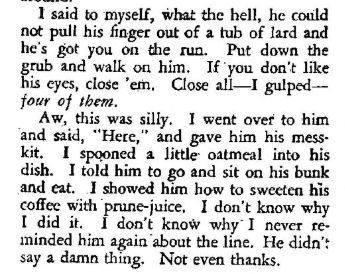
His panic builds, as does his belief that he’s got two pairs of eyes on him, but his horrific reverie is broken by the food cart coming by. He gets his own food, then grabs Crawley’s, just like he’d planned…but he still feels the horror of the eyes, and the loathing that they elicit. He briefly contemplates beating Crawley to death, but then:

Aww…another nice thing! Rather than squashing his weird cellmate like a bug, or even stealing his food liked he’d been planning, he gives him some food, and even shows him how to improve its quality, lets him eat on the bunk, everything all nice and sweat and domestic!

Later that day, our narrator hits on another plan to get Crawley in trouble and out of his hair. The prisoners have to keep their cells and their messkit clean, see, but of course Crawley doesn’t know that and, even if he did, doesn’t seem capable of doing it anyway. So our narrator is going to scrub half the cell, and clean his own messkit – the guards, familiar with his habits, will recognize that Crawley isn’t cleaning, and keeping a dirty a messkit is a punishable offense, so he’ll get sent down to solitary. Yes, a sterling plan! So our narrator commences to clean, gets right up to the half-way point of the cell, and then…

AGAIN our violent criminal ends up doing something nice for Crawley, basically unbidden and, of course, unthanked. Weird how that keeps happening, huh? Especially since, after each incident, our narrator seems to be more and more convinced that he hates Crawley, that he wants nothing to do with him at all. And yet, he keeps on bending over backwards for him, helping him out at every turn.

This kind of wild, crazy level of helpfulness from out narrator towards Crawley continues later when, during an outdoor period, Crawley just straight up tells our narrator to buy him four candy bars (“two marshmallow, one coconut, and one fudge”). And that’s WITH our narrator’s carefully shepherded tobacco money too, mind you. At first our narrator laughs in his face; why the fuck would he do that, spend his own money on candy for a guy he absolutely hates…but he does. In fact, he goes out of his way to make sure he gets the candy. He also seems unable to talk about Crawley to anyone, either – he thinks he’ll get some good laughs telling his buddies in the yard about this freak he’s bunking with, but for some reason he just never can get around to talking about him.

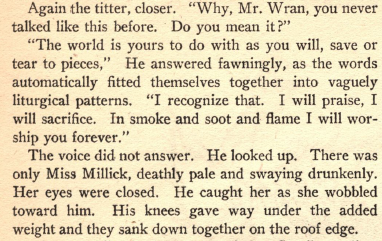
Later that night, after helping Crawley with his blankets (effectively tucking him in), our narrator hops up into the top bunk and tells Crawley he shouldn’t talk to himself in his sleep, which results in a truly weird scene:

I mean, that’s weird, huh? A really strange and unearthly scene, this insane, grating, screaming laughter, and when he looks, Crawley’s mouth is shut, the laughter coming from somewhere deep inside his chest, an unearthly sound that doesn’t make any sense. Our narrator feels himself losing his grip, the laughter is driving him crazy, and it only stops when he, apparently, passes the fuck out.

He comes to sometime in the very early morning, three or four he thinks; he feels like he’s been slugged, groggy and strange, and he hears Crawley talking in his bunk.

And someone else answering!

You might have guessed where this is going, though I think it’s weird enough that it kept me guessing, right up until the reveal. It’s very weird, and honestly spooky, especially after the weird hollow laughing from earlier – imagine being this thuggish narrator, waking up from something and hearing two voices where you only expected one…spooky shit! Our narrator carefully, quietly tries to investigate…

Crawley’s weird clamshell chest is some kinda kangaroo pouch for his weird stunted conjoined twin brother! And whatta twin! It’s the size of baby, but with a shaggy head of hair and a long, lean face and a fanged mouth. It’s a legit monster. And, moreover, our narrator intuits what this thing is, and what it’s been doing:

It’s some kinda psychic dominator stunted twin, living inside of Crawley! If you go back to the picture at the beginning of the story, you’ll recognize the scene it’s depicting now, and see that it’s actually pretty faithful to the story. It’s pretty wild and, like all great reveals in weird fic, it makes you go back into the story and think about the strangeness you’ve read in a slightly different way – clearly this little monster twin has been controlling our narrator from the get-go, getting him to give up the bunk, give big Crawley the food, etc. It also seems to imply that our narrator has probably seen this thing before – it’s why he knew about the four eyes he felt, but he’d probably been ordered to forget it. So, why does little Crawley let him remember now?

Because it’s jail break time, baby!

Little Crawley has put our narrator into berserker mode – he kills two guards with his bare hands, uses a third as a human shield, and causes the death of at least one prisoner from a ricochet round. He’s a one man riot, impervious to pain and utterly fearless, doing everything he can to cause chaos and attract attention.

And that’s the end of “Cellmate” by Theodore Sturgeon!

First thing first: is this the earliest example of the “evil secret conjoined twin” trope in fiction? There’s the movie Basket Case from the 80s, a real goopy gory (and funny) monster movie about an evil conjoined twin that has been removed and is being cared for by his more normal brother, and then there’s that X-Files episode, or that recent movie Malignant. Are there earlier examples though? The interesting thing in all of those, of course, is that the tiny twin is almost all monstrous id, right, a kind of primal and murderous atavism that is either autonomous or takes control of its sibling to do evil, whereas here in this story, the twin and the larger brother have a working relationship, and in fact the littler evil twin is by far the smarter of the two.

Honestly, for me, Crawley’s creepiness come more from the weird hinged chest cavity than from the tiny guy living in it…I mean, yeesh, that’s just plain weird you know? Like big Crawley is a straight up mutant! Oh, there’s another example, Kuato from Total Recall, who is also an example of the little guy being the “boss” (although Kuato, of course, is a good guy).

In fact, in terms of “evil conjoined twin,” the only earlier example that I can think of is the apocryphal and almost certainly fictional story of Edward Mordake, who supposedly had an evil (and female) second face on the back of his head that whispered horrible suggestions to the otherwise morally upright Edward. It was originally published in The Boston Post in 1895 (you can see it here), and there’s lots of obviously made up stuff in the whole article, but it is a weird and interesting precursor to Crawley here.

But, aside from that, I think this is some great weird fiction – the prison setting is fun, spare and claustrophobic, but the narrator’s familiarity with it makes it all seem drab and kind of humdrum. Sturgeon, who is a master at getting into a character’s head and finding their voice, does a great job with the narrator – he’s a violent but somewhat jaded thug. He’s got his routine and he’s used to coming and going from jail all the time, so the imposition of weirdness in the form of Crawley on his “normal” life is really stark and unmooring.

And man, Crawley is just WEIRD right off the bat – the physical description is very strange, with his odd proportions, and then his behavior is just very odd and kind of alien. Like I said, it all makes sense in hindsight – why bother to even try to behave normally if you’ve got a psychic dominator twin living in your weird chest pouch, after all?

Now, you don’t wanna get all Freudian psychoanalytical about this stuff BUT as mentioned in the last Sturgeon write-up I did (here!), ol’ Ted DID spend a fair amount of his time interrogating queer relationships between men. As mentioned, he himself was what we’d call “bisexual” (he certainly would not have used that term, however), and had a number of sexual and romantic relationships with men (while being married with a family to a woman). In “The World Well Lost” we have a kind of interesting mirror-universe version of Crawley and our Narrator, although one not so freakish. Still, there’re some similarities between the two couples; there’re both confined together, there’s a disparity between their physical attributes, etc., and the themes of homosocial male relationships undergirded by “something else” are present in both. Why does the Narrator keep doing so many generous kindnesses for someone he also simultaneously feels repulsion for? You don’t want to read too much into these things; Sturgeon, a working writer, liked to eat hot meals indoors, and so he wrote stories that he could sell, and sometimes that means adhering to certain narrative conventions and such. But he was also an artist, and finding a topic or theme that interests you is a key to making good work, so the thread of his own experiences is certainly worth keeping in mind when reading his stories.

It is a fairly short story, and while I would say that the weirdness is on simmer for most of it, there length means that there’s not much of the slow, mounting dread that I normally like in a weird story. But it works here, particularly because the reveal really puts all the previous actions of the narrator in a different light, kind of retroactively imposing weirdness on them. Speaks to Sturgeon’s skill as a writer that it works so well, that he’s willing to let the scenes just play out fairly straight because he knows that what is coming will force you to look back at them and recognize what was going on.

And, while the slow burn isn’t really there, the creep factor IS high; I think this story is flat out scary, especially the weird laughter scene that builds to the climactic reveal of little Crawley in the chest cavity. The narrator’s murderous fugue is well done too, and the idea that Crawley has escaped and is back out there amongst us is good, classic Weird Tales stuff.

Anyway, I think it’s a good start to this Halloween season, an inventive, weird, and sometimes scary story that will, hopefully, get us all in an appropriately spooky mood!

Corman the Cult King

You can’t call dying at 98 a tragedy, but I definitely had a sense of the Passing of a Heroic Age when I heard that Roger Corman, B-Movie Impresario Extraordinaire, had died. There’re a lot of paths for people to find his work; in terms of monster films, his aesthetic (and sheer output) makes him one of the greats, but “serious” film fans probably also know him for his (sometimes exploitative) role in giving some heavy-hitters their first jobs in the movies. Or they might appreciate the work he did in distributing art-house foreign films through his company New Worlds – Fellini, Kurosawa, Herzog, a bunch of huge international names got work into American theaters because of Corman. And, of course, you’ve probably seen a number of his movies if you’re an MST3K fan (which, apparently, Corman himself was not).

I’m a huge fan of 50s/60s era sci-fi and horror, so of course Corman is one of my favorites. He made cheap, fast movies designed to turn a profit, a very pulp approach to entertainment that I find endearing, but there’s another key to his success that I think got lost in the obits and retrospectives that’ve come out since his death. Corman movies are often slyly and subversively fun. Partly I suspect that’s down to material considerations; teeny tiny budgets meant that they needed to find other ways to engage an audience’s interest, often relying on bonkers ass weird shit to paper over some of the cracks and rough edges. Jack Nicholson’s work in Corman movies is a great example of this: The Terror (1963) is a terrible, barely coherent movie, but Nicholson is absolutely unhinged in it, and his screaming and confusion kicks it into almost transcendent weirdness.

Subversion in Corman’s work is also important. I think there’re often more legitimate and sincere revolutionary ideas and attitudes in popular entertainment than in high-brow art – the simple fact that the former have to be a little more sneaky about their subversion makes that almost a given. But also, I think the ludic qualities of pulp/pop entertainment underscores and reinforces the subversion – you can make a dour and self-serious meditation on Debordian spectacle and commodification of the body under capitalism that nobody will ever see, or you can make Deathrace 2000. And beyond those sorts of societal-scale ideas, a lot of Corman movies proceed from the assumption that “normal” people don’t exist, that there’s a lot of strangeness and oddity in each of us, a refreshing and important reminder I think.

Don’t get me wrong, Corman wasn’t some kind of secret Dadaist using his films for culture jamming or anything like that; dude liked money and found a niche in Hollywood that let him make a lot of it! And of course there’s plenty of laughably bad shit in the Corman oeuvre – if you ever do a marathon of em, the cat fights or women showering scenes will get real old, real fast – but I do think that he (as director and later producer) sometimes created an environment where fun work could be made that used the limitations of production and the conventions of genre in very interesting and, honestly, instructive ways. I mean, goddamn, there’s almost no comparison between the “B” movies of Corman’s heyday and the absolutely vile shit being put out now!

Anyway, he’s obviously an important figure in film history, but in order to help spread some appreciation of the FILMS themselves, I thought I’d put out a little list of some of my personal favorites that you might wanna check out!

Not of this Earth (1955) – This is a spooky, atmospheric bit of paranoid sci-fi, with an alien that presages the MiBs of Point Pleasant and the Saucer era. Weird medical horror and a strange and interesting premise make this one one of Corman’s best, even if he did torture Paul Birch with awful contact lenses.

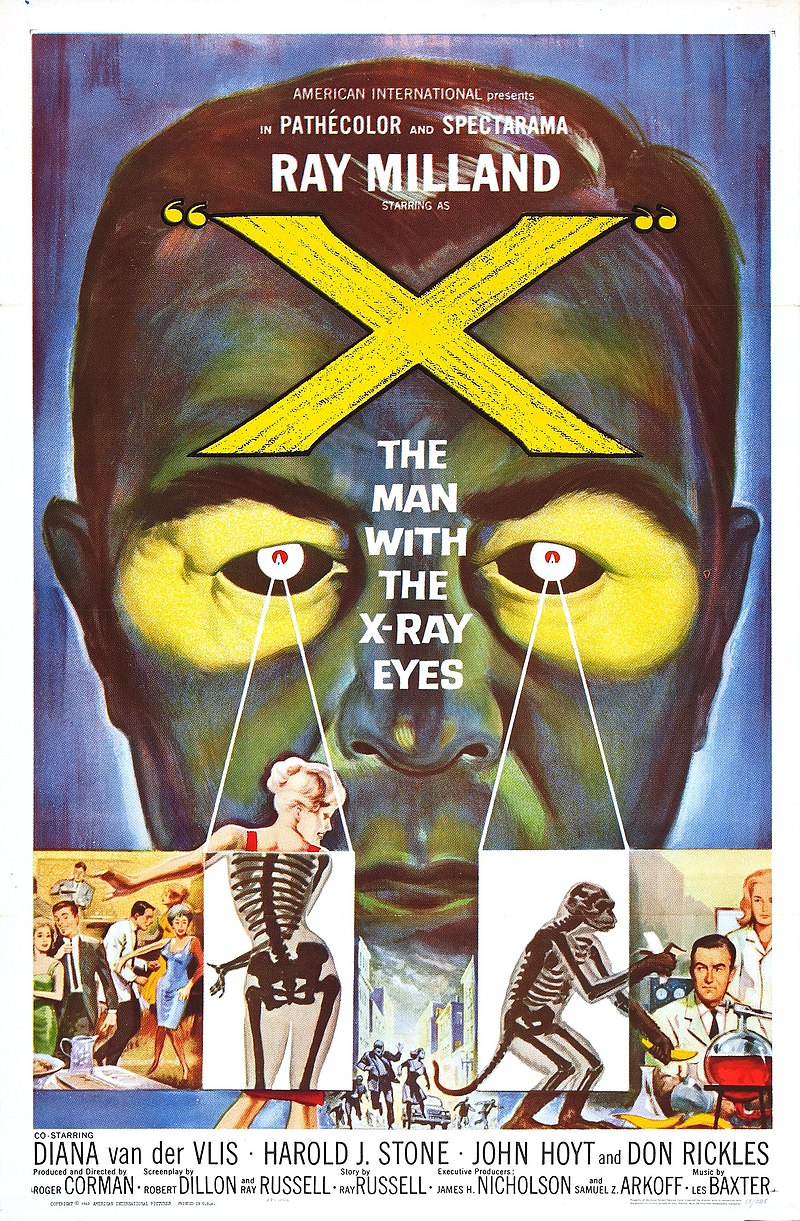
X: The Man with X-Ray Eyes (1963) – a legit classic! Corman often drew water from the same well, and this is a good example. He clearly thought the deadly eyeball stuff in Not of the Earth was an effective bit, so it gets expanded into this wild and very odd story. All sorts of interesting commentary in this one; industry research, snake oil salesmen, and organized religion all get picked apart, and it’s all capped off by a really great cosmic horror ending, one of the few things I’d call truly “Lovecraftian” to ever appear in any movie anywhere!

The Haunted Palace (1963) – ostensibly one of the famous Corman “Poe” series, this one is actually based on the Lovecraft novel (never published in his lifetime) “The Case of Charles Dexter Ward.” Extremely fun to see the Lovecraft stuff get name-checked here of course, but it’s also got a great performance by the master Vincent Price as well as a very brief but very effective glimpse of something living in the pit below the palace. Great stuff!

The Masque of the Red Death (1965) – probably the best of the “Poe” flavored adaptations that Corman did, with beautiful and evocative photography and scenes plus, again, Price is just one of the best actors ever. There’s a lot of atmosphere and menace in this one, and the totentanz scene is one of the great horror set pieces in movie history.

The Dunwich Horror (1970) – probably my favorite Lovecraft adaptation of all time (after the silent Call of Cthulhu from 2005, of course). Dean Stockwell’s Wilbur Whatley is incredible, strange and alien and alluring, a real departure from the source material that nevertheless does manage to keep some of the repulsion in there. Plus this is another great example of the Corman “there’s no money so be creative” school of special effects – turning Yog Sothoth into a writhing mass of hippies is actually pretty inspired and a zillion times more interesting and effective than whatever CGI bullshit they’d try now.

Death Race 2000 (1975) – I mean, holy smokes, this is a masterpiece. Violent, convoluted, and campy as hell. Madcap cornball fun, highly recommended.