Category Archives: Reading

Strained Pulp #9 (Halloweeeeeeen edition): “The Automatic Pistol” by Fritz Leiber, Weird Tales, v.35, n.3, May 1940

Folks, we’re drawing near to the Big Day itself…as I write this, Halloween is less than a full week away. Here, in Texas, it’s been rainy and muggy, although there’s a promise of a powerful cold front that’ll blow in over the weekend and bring temps down low. I like a crisp, wintery pumpkin day; we usually have a fire out in the front yard and hand-out candy, drink some beer, have a nice ol’ time, and I much prefer it to be cold than mosquito-y and sweaty. So, in honor of this gift from the dark gods of halloween, today we’re going to talk about a fantastic story from one of the greatest writers to have ever graced the pages of Weird Tales magazine. Fritz Leiber, Jr., and his story, “The Automatic Pistol.

But, before we get into the Leiber, it’s important to take a moment and note the changes that have come to dear ol’ Weird Tales. Most of the previous stories have been from it’s earlier incarnation; the first and second installments were from the Baird days, while the rest have all been under the (hugely important and very influential) editorship of Farnsworth Wright. But now, in the 40s, the magazine has been bought by Short Stories, Inc, and Wright, suffering from rapidly declining health (he dies in June of 1940 from complications related to Parkinson’s disease) has been replaced by Dorothy McIlwraith.

McIlwraith is an interesting character. A Canadian, McIlwraith had been the editor of Short Stories magazine for several years, successfully running a magazine that operated in a lot of different genres. When she comes in to Weird Tales, she’s confronted with an immediate problem – the magazine was perennially just skating by, always nearly running out of money. Additionally, the late 30s had been rough – Lovecraft died in 1937, Robert E. Howard died in 1936…these had been THE heavy hitters, the authors that, by and large, had defined Weird Tales artistically. Similarly, there were competitors in the weird fiction market; magazines like “Strange Stories,” “Unknown Worlds,” and the various sci-fi pulps has all bitten into the market that Weird Tales had dominated. Add to that the paper shortages of World War II and the general collapse of the magazine market post war, and you can appreciate the work McIlwraith did in keeping the magazine going all the way to 1954!

Now, I’ll admit that I do think there’s a real enormous importance to Wright’s work at Weird Tales; the fact of the matter is, before him, there really wasn’t a genre of “weird fiction,” and it was under his powerful editorship that the genre took shape and was defined. For that alone, his run editing Weird Tales is historically and literarily important (for more on this, see my Introduction in the forthcoming Night Fears from Paradise Editions…stay tuned for more info soon!) Interestingly, Wright was given a much freer hand during his tenure at the helm. McIlwraith was forced to “tone down” some of the scarier and gorier stuff at the orders of the publisher, and so the magazine she oversaw was a different one. That said, she DID exercise her power in interesting ways: she had a serious interest in science fiction, and made a concerted effort to bring it back into Weird Tales. Similarly, there were a number of prominent authors whose work she edited: Ray Bradbury, Robert Bloch, Margaret St. Clare, and today’s author, Fritz Leiber all appeared in the pages of McIlwraith’s Weird Tales.

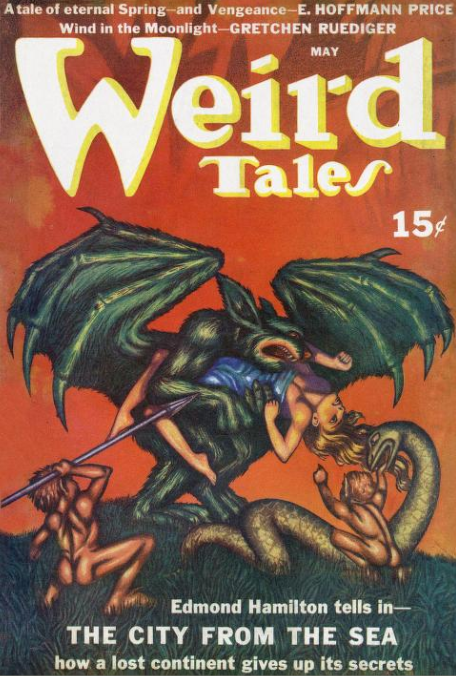
Additionally, she also went all in on Hannes Bok for covers and interior art, and that’s surely gotta be worth something, right!? I mean, look at that cover up there – it’s incredible, and Bok’s style is so dynamic and vibrant and just plain weird, you know? In terms of illustrations and covers, I don’t think Weird Tales was ever better than the 40s run, for sure!

But I’ve rattled on too long! Let’s get stuck in to some two-fisted weird crime with Fritz Leiber’s “The Automatic Pistol!”

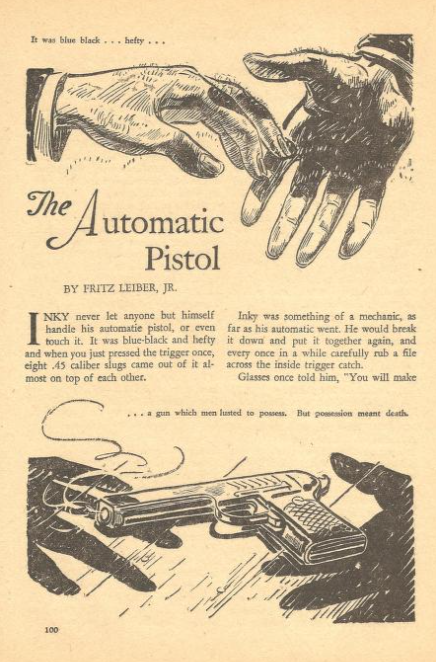
Lookit that spread, gosh! Weird menacing hands, the smoking pistol, the first paragraphs of the story sanwhiched in there between em…a great composition, and a great way to start Leiber’s very first story in Weird Tales magazine.

Leiber wrote in a number of genres, but he’s` probably most famous for his contributions to Sword & Sorcery, a term that he (according to some) actually invented. His Fafhrd and the Grey Mouser stories are legitimately some of the most important and influential fantasy of the 20th century, on equal footing with Robert E. Howard and J.R.R. Tolkien, although he hasn’t had the same popular appeal as either of them. We’ll talk more about that come my Xmas Sword & Sorcery series that I’m planning out, so we’ll leave it alone for now, but just know: Leiber is a big deal.

But before Lankhmar and Nehwon, Leiber was (briefly) a Lovecraft correspondent and wrote some great pure weird fiction. This is actually his FIRST story in Weird Tales, and immediately you know it’s great. Leiber has a wonderful style, more muscular than a lot of “classical” weird fiction. It’s also distinctly and vibrantly modern – right off that bat we’re talkin’ about a gun. And not just ANY gun…it’s that classic of the pulp detective mags, the .45! And it belongs to another classic of the pulps, an indeterminately foreign criminal!

Inky, whose gun it is, is partners with a rough character named Larsen; they run booze, and have hired the the narrator (who will be introduced as “No Nose” later on) and a semi-egghead named Glasses to help them, loading and unloading and driving, basic prohibition stuff. They’re all introduced in a real classic, hard-boiled bit of writing that is, simply, a pleasure to read:

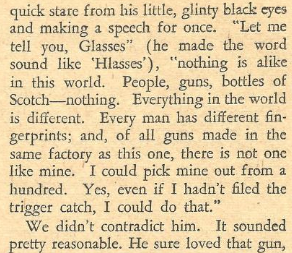
Gosh that’s good stuff, isn’t it? “I was a local small-town policeman until I determined to lead a more honest life.” Fantastic writing. This whole first section in particular is just a really nice, tight little crime story told from the perspectives of the crook, and it’s rich with excellent world-building – there’s corrupt cops, there’s the business of rum running, all of it dropped casually and naturally and efficiently into the story.

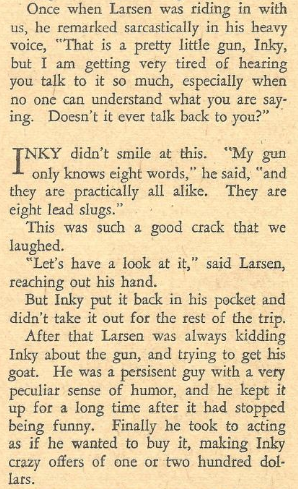
As established, Inky loves his gun. He’s always fiddlin’ with it, even when they’re out on the job, running booze he’ll take it out, pet it, coo to it with words nobody can understand…

The thing is, this fascination with the gun seems to rub Larsen, Inky’s partner in rum running, the wrong way.

Eventually this leads to an altercation where Larsen suddenly loses his temper and tries to grab the gun; if it weren’t for a motorcycle cop looking for a bribe, there might’ve even been blood spilled over it. It’s the first sign that Larsen is strangely obsessed with Inky’s pistol.

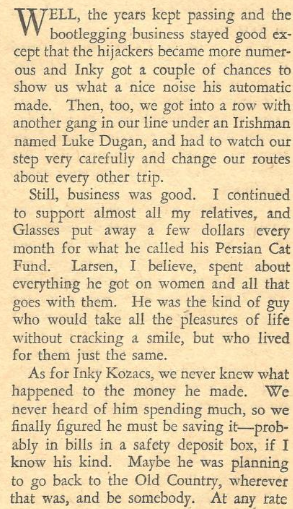
A fair bit of this half of the story is concerned with the ups and downs of the business as the years go by. Our narrator and Glasses keep working for Inky and Larsen, and we learn about the dangers of hijacking and of rival bootlegger gangs. We also get a glimpse of the money involved, and the ways the men spend it:

This sets up nicely the latter half of the story. Glasses reads in the newspaper that Inky has been rubbed out; interestingly, there was no weapon on the body when the police found it, and that gives both Glasses and No Nose pause; feels kinda wrong for someone else to have the automatic that Inky had so doted over all those years. Eventually, Glasses and No Nose are called up by their old boss Larsen, who says his rival Luke Dugan had Inky killed and is now gunning for him. And Larsen wants the two of them to meet him at a safehouse.

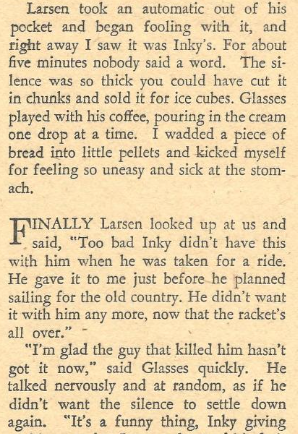
Neither No Nose nor Glasses are particularly enamored of the idea, but Larsen ain’t the sorta guy you say “no” too, so they hunker down with him in a farmhouse way the hell out in the country. After a supper of canned corned beef hash and beer, they’re sitting around the table drinkin’ coffee, just hanging out, when Larsen reaches into his pocket and pulls out a gun. The Gun, in fact.

Right away Glasses, No Nose, and us, the readers, have got a bad feelin’ about all this. There’s more great hard-boiled stuff in here – unvoiced (and unwritten) suspicion that practically shouts at you the whole time, the threat of violence, claustrophobia, fear. And while Larsen is fuckin’ around with Inky’s gun, it suddenly goes off, nearly taking off one of No Nose’s toes. After some panic, Larsen sets the gun on a side table and goes to a back bedroom to sleep. Glasses and No Nose are a little wound up, though, so they stay there in the front and play some cards…and after an hour, they notice somethin’ strange…

No matter how they adjust it, the gun always ends up swinging itself around to point towards the back of the house, where Larsen is sleeping. They fiddle around with is some more and eventually Glasses decides that what’s happening, see, is that the safety right? It juts out a bit, and so it kinda pivots around whenever its set down, yeah? Perfectly reasonable explanation, but No Nose decides that maybe it’d be better if the wiggly gun wasn’t loaded, so he takes the rounds out and pockets em.

Eventually, the boys tire of their card game and go to sleep. Then, in the dark, No Nose hears something…a kinda metallic clicking…

The image of this gun rotating around and then repeatedly trying to fire, all on its own, is great isn’t it? And the fact that it’s empty makes it all the more menacing; the hate propelling this gun must be getting even hotter for all the futile attempts its making! Glasses tries to calm No Nose, telling him it’s nothing, and then laughing that No Nose is ascribing supernatural agency to a dumb gun.

Now that’s the classic Leiber twist – he’s always ziggin’ when you expect him to zagg! You might’ve expected that Inky’s ghost or something was animating the gun, pretty standard ghost story shit, but not when Leiber is writing it! How neat is he instead introduces the idea that the gun is some kind of malevolent thing in its own right, a liaison between Inky and the Dark Side with its own ideas and agency! Later, when No Nose is handling the gun, he notices that the metal feels strange, smooth and slick and strangely alluring in his hand…kinda makes you wanna keep touching it too.

No Nose and Glasses read in an early morning paper that Larsen is, unsurprisingly, wanted for the murder of Inky. Just as they’re discussing this, Larsen wakes up and comes back into the room. There’s more fantastic noirish writing here – the nervousness of the two men, trapped in a situation with a guy who they’re pretty sure killed his partner but who they don’t want to let know that they think that, is really well executed, taut and tense and fun. Larsen seems weirdly listless, like he’s preoccupied with something, or maybe like something is gnawing at his mind. He only really rouses himself when he finds the gun has been emptied and moved. He doesn’t want anybody else to touch the gun but him, see! He demands the bullets back from No Nose too, and reloads the gun. That part is fun – does he want the gun loaded and for himself because he’s planning on killing his two hired hands, or is he jealously fascinated by the weapon. No Nose remembers the weirdly seductive way the gun felt in his hand, and is certainly worried.

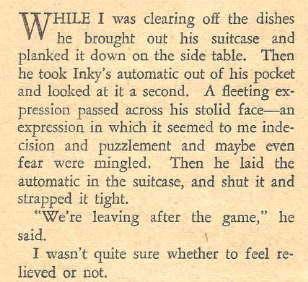
But there’s nothing they can do, really – Larsen has the gun, and they’re unarmed. They gotta stick with him and try and keep him calm. Larsen shaves and gets dressed, and then decides that they all oughta play some cards. It seems like things are coming to head:

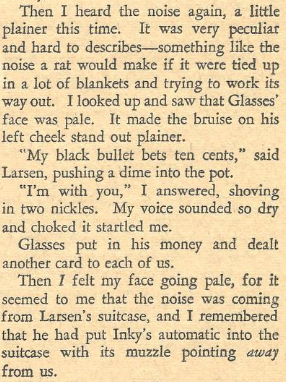
They play poker, but its clear that both Glasses and No Nose aren’t really focusing on they game – understandably, since Larsen seems to have become real menacing, real fast. While they’re playing, No Nose hears a noise, a kinda faint scrabblin’ or rustling that he can’t place. They keep playing, Larsen winning from both of them. Then, dammit, there’s that noise again!

The guns wrigglin’ around in the suitcase, trying to orient itself properly! Glasses, whose kind of a chatterbox when he’s nervous, nearly fucks up big time by mentioning the sound:

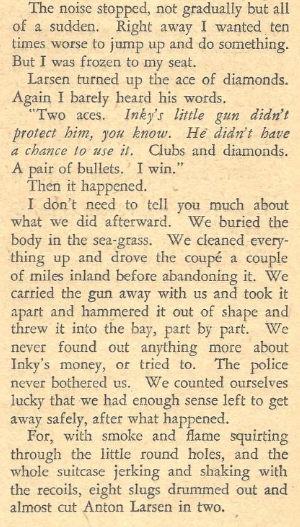
They keep on playing, and it’s a horrible visual, isn’t it? Like there they are, crazily playing cards, two of them trapped with a fully murderous and crazed guy, all while the gun of a dead man is writchin’ around in a suitcase. It’s a great, weird image, a real horrible situation!

As they’re playing, Larsen finally starts to break down, whispering to No Nose that he did kill Inky because he wanted all that money he’d been putting away. He hadn’t brought it with, though, but Larsen knew where it was. How about him and No Nose go and get, it’ll be a cinch for two people, see…

And that’s the end of the story!

It’s just a peach, ain’t it? I mean, it’s a real straight forward story of betrayal and vengeance from beyond, but 1) it’s written really well, with a great tone and voice that successfully blends crime and weird fiction together, and 2) the weirdness is elevated by the whole “gun-as-familiar” bit. It’s maybe not as well developed as it could’ve been, but it’s enough to turn the story into something just *that* much weirder than it would’ve been if, like, Inky’s ghost was doing it, you know, or his lingering psychic obsession were to blame. I think you really get a good taste of Leiber’s style and sensibilities from this story too – his interest in lowlifes and crime, the morally grey quality of his characters, and the truly sinister tinge to his kind of weirdness all come through very strongly here. You get good character work, too – everybody is sharply and quickly drawn and distinguished from one another, something that a lot of writers have a surprisingly hard time doing. I guess don’t have much more to say about the story, really, except that I like it a lot, and it’s worth a read!

Strained Pulp #4: Halloween Edition!!! “The Night-Wire” by H.F. Arnold (Weird Tales v.8 n. 3, Sept, 1926)

It finally cooled down here in Texas (where I live), and with those open windows and brisk overnights in the mid-60s, I’ve finally begun to get all spooked up fer Halloween season! As such, I’m going to be super indulgent in these pulp strainers for this month, picking stories based not on their importance or significance, but rather on how much I like ’em! And we’re going to start with what is certainly one of my personal favorite weird tales of all time, H.F. Arnold’s absolutely incredible “The Night-Wire,” from the September 1926 issue of Weird Tales magazine.

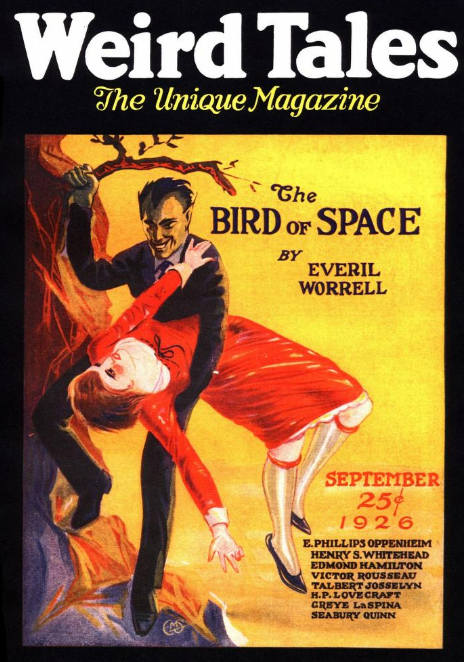
The cover by E.M. Stevenson for this issue of Weird Tales is pretty underwhelming, in my opinion; Stevenson had done a number of covers for the magazine, probably most famously illustrating Robert E. Howard’s first appearance on the cover of the magazine, “Wolfshead.” His style isn’t my favorite, but even so the weakness of this cover probably has more to do with the fact that, other than Arnold’s “The Night-Wire,” this is a pretty lackluster issue.

The Quinn and La Spina stories are nothing like their strongest, and the story they gave the cover to, “The Bird of Space,” is one of the “pseudo-science” stories that would rapidly vanish from Weird Tales, migrating over to the newly invented “science fiction” magazines (fyi, Amazing Stories had only begun publishing this very year, in March 1926; before that, a lot of “planet stories” had had nowhere else to go but Weird Tales). Even the Lovecraft story in this issue, “He,” is really dull, one of his “goddamn I hate living in New York with all these non-WASPs” stories that is just a real slog to get through (although it’s got a good monster at the end). But! There is a single gem in this issue, and it is “The Night-Wire,” an absolutely incredible story by the mysterious and unknown H.F. Arnold.

First off, who the hell is H.F. Arnold, anyway? Well, to cut the chase: we don’t know. He published two stories in Weird Tales, this one in 1926 and a sci-fi two-parter in 1929 titled “The City of the Iron Cubes;” then, in 1937, he presumably also published a two-part sci-fi story in Amazing Stories titled “When Atlantis Was.” I say “presumably” because that’s one hell of a gap, and it’s not like the name is particularly notable or unique. There are some articles, one about cowgirls and one about “loco weed” that were written by a “Henry Arnold” and published in some western pulps in the 20s too, and depending on who is doin’ the writing, these are sometimes attributed to him (though just as often not). But that’s about it! No confirmed birthdate or death date, no bio, no job, no nuthin’! A few years back some folks thought they’d identified him as an Angeleno, but then I’ve seen other people dispute it. On the basis of this story, “The Night-Wire,” some people suggest that he must’ve been a newsman or have worked in a radio news office, but that’s pure conjecture. Just another illustration of Harlan Ellison’s point about the pulps: we don’t know anything about a huge number of the people who wrote em!

But, despite H.F. Arnold’s scant output, they produced at least one masterpiece in their mysterious lifetime. “The Night-Wire” is so good that I want to stress that if you haven’t read it, take the time now and go read it. Here, I’ll even link it again for you, right here. Seriously, don’t deprive yourself of the pleasure of encountering this story blind and unsuspecting, it’s worth it. Plus it’s real short. Just go read it, okay?

Alright, assuming everyone has read it now, let’s dive into:

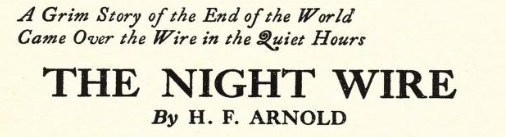
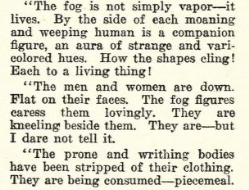
No illustration for this one, sadly – can’t imagine why, the thing seems tailormade for weird imagery! But, oh well! Here’s how it starts:

The news flash right up front is a nice touch, a good contrast with the kind of hard-boiled narration that comes after, and both really set the scene. Immediately you get a sense of isolation, clacking machines, radio beeps and whatnot, a lonely guy sitting waaaaay up atop a concrete and steel needle in the dark, communicating with distant offices via the strange sorcery of radio waves. It’s great! it’s economical! Can’t be beat. Also, interestingly: is the “CP” part, mentioned there, the Canadian Press? Or is it meant to be a generic version of the AP? I don’t know, and it doesn’t matter – it’s just the signifier for the press releases being transmitted.

Our nameless narrator spends a little bit more time musing on the strangeness of being a wire man at night, giving us a sense of the job. This part is a lot of fun for me; I’m honestly a sucker for technical jargon and expertise, especially when it’s done in the pulps like this. There’s something fun about the image of some guy, cigarette wearily clamped in his teeth, methodically going about his work. This idea of someone whose damned good at their job is also something on H.F. Arnold’s mind, because he soon introduces us to the narrator’s companion there at the wire desk, John Morgan, a “double” man who, strangely, can apparently listen to AND transcribe TWO separate news feeds on TWO separate typewriters SIMULTANEOUSLY! Was that ever actually real, I wonder? In the story, Morgan is one of three operators the narrator has known who can perform this bizarre miracle. I have to floss looking away from a mirror I get so turned around, so the idea of someone transcribing two different news reports on two different typewriters boggles my poor clumsy mind.

It’s a quiet night there in the office, so the narrator is surprised when Morgan switches in the second wire and starts banging away on the second typewriter. He gets up and checks on the pile of typed copy for this new, second wire. And what does he see?

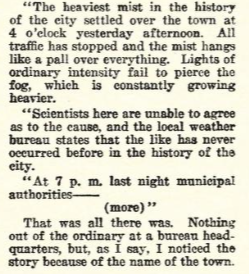
Just right off the bat, the name of this town is really good. There’s a nice, outre euphoniousness to “Xebico” in my opinion; you’ve got an X there, of course, right away that’s plenty weird, but then there’s a kind of indeterminant exoticism to the rest of the name, a vaguely Latinate suffix in the -ico ending that suggest something familiar, but you can’t place it. It’s a peach of a name for a weird city, is my point. And what’s shakin’ in ol’ Xeb town tonight?

Bit o’ fog is all – nothing strange so far, although “scientists” being unable to agree on its origins is neat (fun to imagine them asking, like, a coleopterist and a structural geologist and solid-state physics guy about this fog). The only thing that stands out to the narrator is the weird name for a city he’s never heard of, which is strange to him – as established in the beginning, wire guys get familiar with all these distant, strange places, so running into some place new is a pretty rare occurrence.

At this point in the story, there’s nothing overtly odd going on, although I think Arnold has done a great job laying the ground work; there’s the weird name, sure, but then there’s also the weird “double” typing of Morgan that stands out. It’s a real strange image, isn’t it? Some guy plugging away on two typewriters at once – very reminiscent of automatic writing or, even more occultly, channeled writing being done in a séance. And, as the story progresses, I think we’ll see that that was exactly what Arnold was trying to convey.

Fifteen minutes pass, and Morgan produces more copy:

And more:

It’s a great little escalation, and feels very cinematic, doesn’t it? This strange fog has appeared, no one knows where it comes from, “scientists” can’t come to any consensus…and now some weird guy from the church shows up, screaming about writhing phantoms and the way this unearthly miasma has boiled up from a graveyard. Of course you can’t believe him, he’s hysterical, but maybe we oughta send some folks over there to check it out, just to be sure…

There’s very little narrator interjection, just the guy acknowledging that, yeesh, that’s some weird stuff coming out of Morgan’s typewriter, huh? Spooky on a lonely old night like this, too. It’s all just really great writing, clean and efficient and evocative.

That escalating tension continues, with further stories from Xebico telling how the first search party that was sent out never returned, so a second, larger party was dispatched to figure out what the hell was going on. (I’m sure that’ll work out fine!) Meanwhile, further chaos is engulfing Xebico – families are abandoning their homes and flooding into churches, fearfully praying for salvation, while the fog grows ever thicker. Good stuff! Very atmospheric, and the added layer of hearing about it second-hand, via the narrator’s reading of the wire copy, provides so much to an atmosphere of disconnection; where the hell even is this place, and what the hell is happening there!?

And meanwhile Morgan keeps on transcribing, slumped and strangely still in his chair, the keys clacking monotonously in the quiet office. Fascinated and horrified, the narrator reads over his shoulder.

The image of that is pretty fantastic, isn’t it? Reading what comes next, word by word – it’s very spooky, and you get a sense of real tension as you imagine them coming in, letter by letter, from Morgan’s typing. And what comes in is some pretty wild stuff!

The inexplicable apocalypse only gets weirder from there! The reporter sending the transmission sees the fog part, briefly, and witnesses true horror – the dead and dying bodies of Xebico’s citizens appear, but they’re accompanied by…something else…

The final transmission from the reporter gets a little psychedelic; strange fiery lights of a mysterious and impossible hue fill the sky and seem to pour down into the city. There, some kind of strange transfiguration occurs; is the light somehow a second phase of this disaster, or is it combatting the fog? We never know, because Xebico goes silent, forever. And then, back in the tower, the denouement:

First off, the second wire hasn’t been receiving anything at all! And, stranger still, Morgan has been dead for hours. What, then, was the Xebico transmission? The dying impulses of Morgan’s brain? An etheric communication from somewhere beyond? Thankfully, H.F. Arnold doesn’t tell us, letting the mystery just sit there, like a toad.

Obviously, I love this story – it’s got everything I like in a weird tale, and it does it all so artfully and elegantly that you can’t help but get drawn in. Everything about it is strange and different and just not-quite-right. The technological aspect is interesting: invisible waves travelling thousands of miles to brings information to people, who sit in the dark and scribble it down. It’s modern radio presented in a very gothic style, with the wire men like monks pounding away on their manuscripts. And then the image of Morgan as medium (and a dead one at that!) receiving, in a more visceral and mystical way, a transmission from somewhere else. And then, what the hell is going on in Xebico, anyway? Murder fogs full of strange phantoms, weird lights in the sky?

I guess that’s all I have to say about it. Fer my money, it’s one of the best stories Weird Tales ever published, perfectly spooky and strange. If you’re looking for something fun to read this Halloween season, I’ll once again urge you to check it out!

Straining Pulp #1: “The Closing Hand” by Farnsworth Wright

Alright! I wanna talk about classic weird fiction and pulp sci-fi and shit like that, so I’m gonna do it here! Very cleverly I’ve titled the series “Straining Pulp,” because it’s me sifting and winnowing old pulp magazines (thanks archive dot org!) and talking about stories I find interesting or noteworthy or fun. I’ll probably bop around a bunch of ’em as my mood takes me, but I figured I’d start with a magazine that is very important to me personally, pulps generally, and pop culture broadly. That’s right, it’s WEIRD TALES #1, from March 1923!!!!!

(Just a heads-up, I’m 100% going to spoiling these stories, so chase ’em down and read ’em aforehand if you want!)

First thing to note is the price on the cover there! 25 cents! There’s a misconception generally that pulp magazines were dirt cheap, but 25 cents in 1923 is something like 5 or 6 dollars today. Not gonna break the bank buying this copy of The Unique Magazine, but still… $6 for a magazine is respectable, you know? These weren’t penny-an-issue cheapos for the kiddie crowd to spend their milk money on, is what I’m saying.

Anyway, this is the very first issue of Weird Tales. Its editor at the time was Edwin Baird, a figure of some importance in the history of the detective/crime pulps, but at this point he’s got himself a job working for Rural Publications, editing both “Weird Tales” and “Real Detective Tales” at the same time. There’s a lot of animus towards Baird today; people tend to think that he hated horror and ghost stories, but I don’t think there’s any real evidence for that. He certainly had a PREFERENCE for crime fiction, but who among us doesn’t have their likes and dislikes, right? It’s important to recognize that, Joshi be damned, there’s no such thing as “weird fiction” until the invention of WEIRD TALES magazine – up to this point there was just a disparate morass of “goose-flesh” stories. It’s a topic for another time, but it’s clear that Baird is fighting his entire tenure against the fact that there’re some serious growing pains going on among the readership (and writers) as they try and decide on WHAT a “weird tale” is, exactly. Most of Baird’s comments in the Eerie (the reader letters section of the mag) start off with him telling people what NOT to send to the magazine. He’s seeing some seriously shitty writing in his time, and it’s definitely effecting his mood!

Case in point: this first issue is, honestly, a mess. The cover story, “Ooze,” gets a good painting by R. R. Epperly who, I think, never did another cover for them ever. The weird thing is that in the story the monster is very much a blobby pile of gunk (an “ooze” if you will) but the painting shows what is clearly an tentacular octopus of some sort. Still, I like its haunted eyes. Also, what’s that dude going to do with a shotgun in one hand and a cutlass in the other? Pick one, man!

As an aside, “Ooze” is a fairly middling story – got a fair bit of the ugly racism (and classism!) of the time in it, so be aware if you decide to chase it down. What is interesting is that it’s much more of a sci-fi story than what you’d think of as a “weird tale.” Of course, science fiction didn’t exist yet either (no matter what anyone will tell you!) since Hugo Gernsback’s magazine AMAZING STORIES wasn’t published until 1926. In these early days, and especially before there were dedicated sci-fi magazines, there’s a fair amount of it in Weird Tales, so much so that there’d be huge running gun battles in The Eerie about whether “planet stories” were weird enough for Weird Tales. It’s an interesting point in the evolution of both genres, and it’s right there from the get-go in Weird Tales #1.

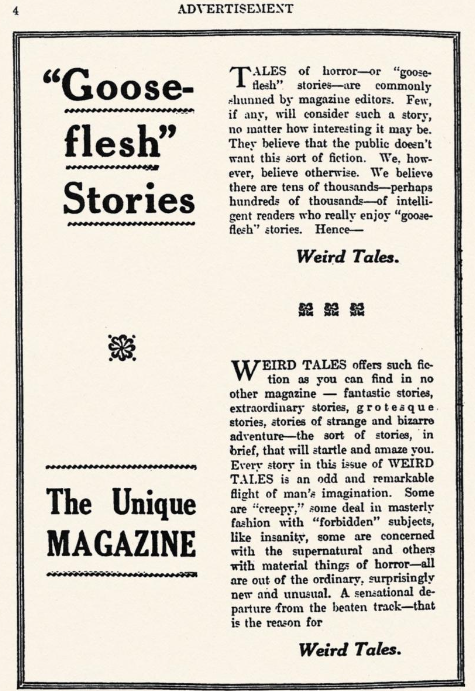
But, anyway, Baird has a hard job – Weird Tales was really the first NEW genre in the pulps, and there wasn’t a depth of writing or writers to draw from, and it shows! Check out this ad, right there on the 4th page of the magazine, just after the ToC:

It’s an advertisement for ITSELF, right there in the magazine, trying to give the reader a way to approach this collection of stories. It’s super interesting to see the creation of a genre in real time in the magazine itself!

Interestingly, the story we’re going to look at today is written by Farnsworth Wright. Wright would step into the editorship of Weird Tales after Baird leaves in 1924, and is probably one of the most important figures in the early history of horror (something for another time, too). At this point, Wright is just a writer; he’ll get another story in the next issue of Weird Tales, at which point he’ll be hired by Baird as an editorial assistant. But, on to his story:

“The Closing Hand” is super short; a scant two-page haunted house story. The writing is overwrought to the point of parody, which I think was Wright’s intention. This isn’t juvenilia; Wright had written and been published in college and afterwards too, and his literary sophistication is evident from those pieces. I think Wright is using this short story to distill the haunted house tale down to it’s barest, most elemental parts, and to do that he’s got to speed-run the language used. Here’s the beginning; note the ripe-to-the-point-of-fermenting purple prose used to set the scene:

Rich, sloppy, bubbling language; it’d be self-indulgent if it was meant to be taken seriously. To be clear, it’s not tongue-in-cheek either; it’s Wright going overboard, reveling in the cliched conventions of the haunted house. There’s decay and abandonment and the aura of wrongness about this place, all very standardized to the point of banality.

We’re then introduced to the victims of the story: two sisters, an elder sceptic and a younger ‘fraidy cat convinced that the terrible old house is haunted. Of course they’ve been left alone, sleeping up in an attic while their mother is out at, I dunno, one of Gatsby’s parties or something. The younger sister wishes they’d gone with her, but the older sister scolds her, pointing out that SOMEONE had to stay in the house because of all the silverware. Get a dog guys, damn!

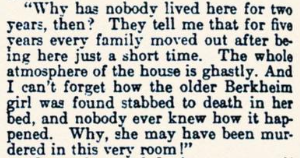
The younger sister than helpfully provides some exposition:

Not gonna find that in the zillow listing, lemme tell you what!

Anyway, the inevitable happens: there are furtive sounds in the night from downstairs, and the older sister heads off to investigate, leaving the scared younger sister alone in the upstairs room. And then she doesn’t come back.

Wind rattles the house, and then there’re strange creeping sounds, as if someone (or…someTHING!!!!) is ascending the stairs towards the attic bedroom. The younger sister begins to imagine what it could be, what horror is climbing towards her, and this is where the story gets the most fun; the sister rattles through a list of the basic horror tropes, scared in turn by the idea it might be a ghost, an undead body fresh from the grave (and “gibbering in terror it could not tear the cerements from its face” which is a great image…the horror itself is frightened by its condition!), a wild animal, or a murderer who, having killed her sister, has come up to finish the job. Then, something enters the dark room, crawling towards the bed…the younger sister reaches out, searching for the thing that comes ever closer, closer, closer, until her hand is suddenly gripped in an iron, cold claw and…she faints!

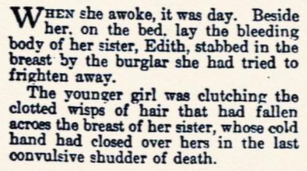
Here’s the end:

Not necessarily the most surprising of endings, sure, but I think it’s interesting for two reasons: 1) it’s pretty gruesome! That’s something Weird Tales, as the magazine where the genre was being created, would have to constantly deal with (maybe we’ll end up talking about C.M. Eddy’s story “The Loved Dead” one of these days…) but also 2) it’s interesting to me that Wright, the future editor of Weird Tales, was writing a barebones genre study in the very first issue of the magazine. I mean, there’s not really any other way to look at this story: it’s like the most economical haunted house tale you could write: 1) Here’s the spooky old house; 2) some victims discussing its spooky old history; 3) something spooky happens to separate them; 4) one of them produces a list of the various spooky things that could happen to the one left behind on their own; 5) oh shit something spooky is happening to the one left behind!!!!

Here’s the thing: Weird Tales is a new magazine. There’s literally been nothing like it on the market before. There’ve been ghost stories and such published in things like Argosy, sure, but here’s a magazine DEVOTED to this inchoate thing they’ve decided to call “the weird tale.” A big part of the magazine is everybody figuring out what that means…what the hell is a “weird tale?” So you end up with a cover story that’s science fiction, and a story by the future editor of the magazine that is dissecting one of the classic expressions of outré literature, the haunted house story. And that’s important, given the way Baird, as the editor, really goes out of his way on many different occasions to tell people not to submit derivative crap.

I think that makes “The Closed Hand” an interesting story – it’ll never be anthologized, because AS A STORY it’s not particularly interesting. But as an exercise, as a genre study, I think it’s really a worthwhile document that shows how, in 1923 at the birth of the formalized “weird tale,” you have people wrasslin’ with these ideas and conventions and clichés, trying to determine what works and what doesn’t, what needs to be discarded and what needs to be explored. That’s fascinating, and it’s fun to get the chance to see how both writers and readers at the time were navigating the dark waters of weird fiction.