
Sword & Sorcery is a wonderful genre, inventive and vital, and the way it’s grounded intimately within the materiality of its world and characters lets you investigate issues of the body, of the environment, of class and wealth and oppression and violence, in surprising and often insightful ways. That being said…there are, like all genres, some, ah, lesser works, where the promise of the form is not entirely fulfilled. C’est la littérature! And that’s what we’re going to be looking at today, a very middling story that, none-the-less, helps illustrate some important things about the genre. And what story is that, you ask? It’s Henry Kuttner’s “Spawn of Dagon” from the July 1938 issue of Weird Tales!
Now, I don’t wanna be too rough on ol’ Hank here – Kuttner is a hugely important figure in the history of speculative fiction, much more so than may be immediately evident, given both his untimely death at age 42 (in ’58, juuuuust on the cusp of a big explosion in science fiction that he would’ve been a huge part of) AND the fact that he wrote under so many goddamn pseudonyms. He was a good writer, with an interesting perspective on complex, psychological science fiction in particular, laying the foundation for what would eventually become the New Wave much later. And when he was working with his wife, C.L. Moore, on one of their collaborations? Well, there are some exceptional bits of work there, sharp and thoughtful, some of the best stories from the time (we’ve talked about a few of ’em on this here blog, even – check ’em out here, here, and here!)
Similarly, Kuttner has the distinction of being a part of the Lovecraft Circle, writing some good Lovecraftian fiction (“The Invaders” is a fun and weird one) as well as his own distinct weird horror too (“The Shadow on the Screen” and “The Graveyard Rats” in particular are worth checking out). He’s a good, fun writer, and he likes a weird monster and a horrible scenario as much as the next guy, so don’t let my forthcoming criticisms of his S&S scare you off of him, okay? Because I think there’s some important context here for Kuttner’s approach to these types of stories.
For one thing, the genre that we call “Sword & Sorcery” didn’t exist yet, not really – there wasn’t a corpus to point to, for instance, though it was in the process of gelling. Robert E. Howard, who died in ’36, left a body of work in Weird Tales that was, in some inchoate way, obviously it’s own thing; two-fisted adventures full of monsters, magic, and peril, centered around recurring, rough-and-ready characters and told in blood-and-thunder prose. They were popular stories, the Conan tales in particular, and the combination of lost prehistories, exotic locales, and grim violence was something new and exciting and vibrant, so it makes sense that Kuttner would chase after ’em; he was a working writer, after all, perfectly happy to go after a market if it meant a check. Also, like Howard, Kuttner was an inveterate Lovecraftian Circler, sharing with REH the same general interests with regards to alien gods and mind-shattering horror, so he’s got a toe in the Howardian door already. But, given that it’s only a couple of years Post-Howard, you can forgive Kuttner for his somewhat clumsy attempts here, I think.
Similarly, something I think you’ll see in today’s story, is that Kuttner is actually in some ways writing against Howard’s work. Kuttner was good friends (and sometimes collaborator) with another Lovecraft Circle writer, Robert Bloch who, somewhat famously, absolutely positively with deep fiery conviction 100% HATED Conan. Hated the character, hated the stories, hated everything about them, thought Howard was wasting his time and ink writing ’em. It was a minority opinion in the magazine, but it was there! Now, I don’t think Kuttner had a similar animus towards the nascent genre as Bloch did – he wouldn’t have written the stories if he had – but I do think he very consciously wrote his Elak stories as a slightly skewed reaction to Conan. That alone makes them interesting, examples of people doing the boundary definition work necessary to creating a genre.
But, we’ll talk about all that when we get there! First – the Cover!
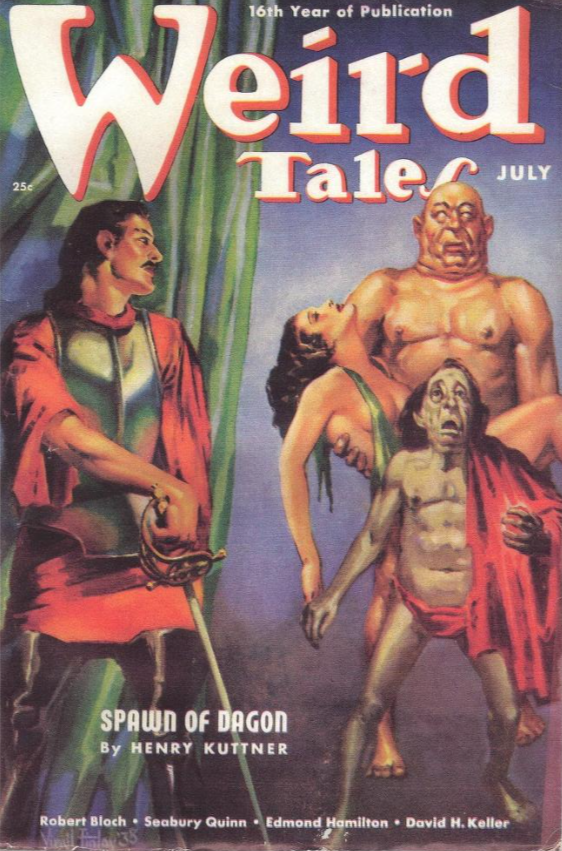
Yes indeed, lookit that, ol’ Hank got himself a cover, and one by the Master Finlay too! Perfectly serviceable cover, Tor Johnson-lookin’ goon luggin a scantily clad unconscious lady, weird little freak at the front, Errol Flynn watchin’ em there. Kind of a shame, though, that Finlay didn’t get a chance to do the monsters in this story – they’re very much in his wheelhouse, and would’ve been neat to see in his inimitable style. Kind of feels like this cover speaks to the popularity of the late Howard’s Conan tales, though; real hunger for anything even approaching The Master’s Work, so Wright et al. would’ve definitely jumped at the chance to highlight a weird fantasy tale. Not the last time Kuttner’s Elak would appear on the cover of WT either – in fact, only the first Elak story failed to get a cover! Crazy!
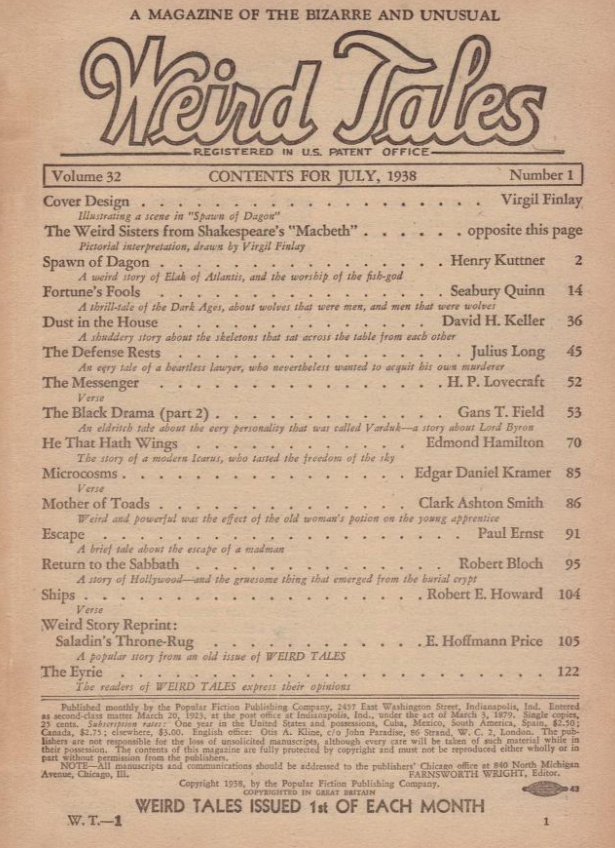
Solid ToC this time – the real highlight is the Smith story, “Mother of Toads,” which is a classic. But there’s Bloch on here, Gans Field (aka Manly Wade Wellman), a Price reprint, posthumous verse from Lovecraft and Howard… even the Quinn here is better than his usual stuff (i.e., it’s not a Jules de Grandin story). All in all a solid late Wright issue, I’d say!
So this is the second Elak story the readers of Weird Tales would’ve come across; the first was a two-parter, “Thunder in the Dawn,” and had appeared in the May and June issues of the same year. Unlike Howard’s introduction of Conan, Kuttner had provided a clear and fairly well defined biography of our pal Elak of Atlantis in his first outing. To orient us all: In a time undreamt of (etc etc), the continent of Atlantis, with many cities and many kings, is out there, being all fantastical and suchlike. One of the many city-states on the continent is Cyrena, the northernmost kingdom that was, once, ruled by some guy named Norian. This king, Norian, had two stepsons, Orander and Zeulas. Zeulas ends up killing his stepfather Norian in an apparently aboveboard duel for which both sides had good cause (we’re told this by a druid, so you know it’s solid info) BUT, as a result of this patricide, Zeulas refuses the crown that is his by birthright and leaves the city in (voluntary, it seems) exile, with his younger brother Orander assuming the crown. Zeulas takes the name Elak and becomes a stateless, homeless adventurer. In the first story, Elak and his drunken thief buddy Lycon are summoned back to save Cyrena from an evil wizard, restore Elak/Zeulas’s brother to the throne, and then voluntarily resume the life of a wandering adventurer. Just stick a pin in that “rightful king in voluntary exile with a complex relationship to his family” stuff for now, because I’ll be mentioning it later.
Anyway, that’s basically the gist of Elak’s life before now; it’s not really relevant to today’s story, but I *do* think it’s probably important to the point I’ll be making at the end (and I also doubt if I’ll ever talk about another Elak story again on here), so just keep it in mind for later. Regardless, now we can get into today’s story “Spawn of Dagon!”
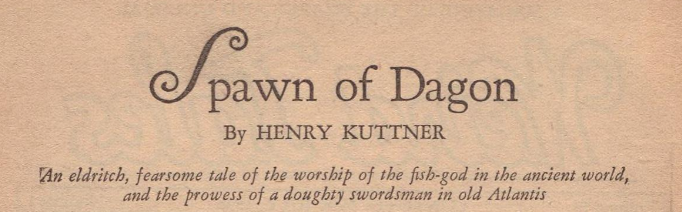
And how does Hank open his tale? Why, with an epigraph from G.K. Chesterton, of course!
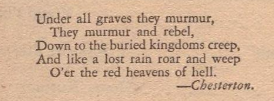
An interesting quote for a couple of reasons; first, it’s from Chesterton’s “Ballad of the White Horse” which was one of REH’s favorite poems, and it’s easy to see why – it’s a super heroic epic about Alfred the Great fighting the Danes in England, full of wild roaring poetry, the force of destiny, civilizational clashes, magic weapons, very much in the mode of what would become sword and sorcery (even if it is super Christian). In fact, REH liked it so much that he used excerpts from it as epigraphs in some of HIS stories too (off the top of my head I *think* it was in the Solomon Kane story “The Moon of Skulls” but I might be wrong). So it’s notable that Kuttner chooses to include a passage from the same work in his story here. He ends up using a lot of Chesterton, all from the same poem, in subsequent Elak tales too. It’s a little funny, of course; after all, this is a tale of Lost Atlantis, from the misty prehistory of the world…so it’s a bit jarring to see it opening up with a poem from Chesterton, very much a contemporary writer.
It’s also interesting because it underlines that Chesterton is in the lineage leading up to modern fantasy literature, something people sometimes forget. There’s his famous essay “Ethics in Elfland” (which *is* great honestly; it’s so frustrating that it came from the pen of a reactionary and sympathetic-to-fascism asshole like Chesterton) of course, but his “Ballad of the White Horse” is a huge and influential part of the genre’s story too – I’ve even read that Tolkien had, at least, a few positive things to say about it.
Anyway, with Chesterton out of the way, we can finally get into the story proper:
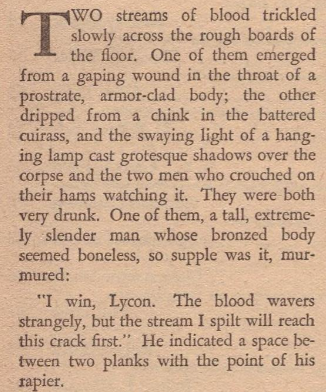
There’s a LOT to unpack here, right off the bat. First – our “hero” Elak is squatting over a corpse with his buddy Lycon, watching two streams of blood oozing from its wounds winding across the floor towards an arbitrary objective…that’s right, they’re gambling over which blood stream reaches a crack in the floor first. I mean, that’s wild, callous shit, truly outrageous! Even crazier, the prize they’re gambling for is the right to loot the body! AND it seems like they killed this guy specifically to rob him – Elak castigates Lycon for picking a fight with a pauper when he doesn’t find any money on him. That’s some grim stuff!
You sometimes see knuckleheads describe Conan as an “anti-hero” which, of course, is nonsense; Conan is 100% a barbarian HERO, rough and uncivilized, but ruled by a strict code of honor and with a clear moral framework. And while it’s true that Conan was a pirate and reaver professionally and therefore certainly must’ve been killing (or at least threatening to kill) folks for their money, he at least had the narrative decency to do it all off camera. Not so with Elak! Here we are, in some Atlantean pub, and right off the bat he’s watching a guy they butchered bleed out, for kicks!
The other interesting thing here is Kuttner’s description of Elak. He’s tall and “extremely slender” with an almost boneless suppleness, a far cry from the mightily-thewed and hairy-chested Conan. To be sure, Elak is strong; we’ll have scenes later in the story demonstrating his superlative physicality (one of the core attributes of S&S character), but it’s of a different sort than the tigerish, muscular dominance of Conan.
Not to harp on it, but I do think that, since Kuttner is writing in the shadow of Howard, it’s worthwhile to see how different he’s making his sword & sorcery hero from the epochal example of the Cimmerian. It’s relevant also because, in terms of plot, Kuttner is clearly cribbing from Howard – there’s a bit of “Tower of the Elephant” in this one, and there’s a later story that is a pretty blatant riff on Howard’s “The Phoenix on the Sword” story. So, in differentiating his stuff from REH, Kuttner has chosen to have a VERY different hero – a willowy, amoral ex-prince…
Hm, who does that sound like?
Honestly, if he had albinism (and an evil sword), he’d *be* Elric; even the names are suspiciously similar, aren’t they? I’ve never encountered Moorcock talking about Kuttner or Elak of Atlantis, but it’s a fair bet that he’s read ’em before, of course, given his deep presence in the genre. And, to be clear, I’m not saying he grabbed Elak or anything; in fact, it’s entirely likely that he independently came up with an anti-Conan the same way Kuttner did, as a direct response to REH’s own work. After all, Howard’s S&S is steeped in his particular interests – clean-bodied and noble barbarism against decadent and effete civilization, rugged frontier individualism, the power of the body to impose one’s will over an unruly world. If you’re taking part in that conversation, there’s a natural counterpoint in a character like Elak (or Elric).
Back to the story: it turns out that Lycon has already pilfered the dead man’s purse, making the blood race game meaningless…but because he’s drunk, he passes out, and Elak is forced to lug his blacked-out buddy out of the tavern and into the night, since the innkeeper has returned with guards who, for some reason, frown on wanton murder. Fleeing through the dark streets, they’re suddenly attacked by a guard!
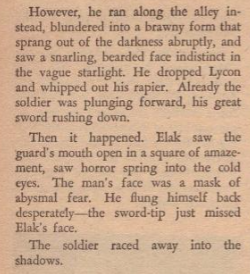
(Brief aside for weapon talk – our boy Elak is armed with a rapier, as befits a slender, supple warrior, emphasizing speed and precision and skill over the brute butchery of a barbarian’s broadsword. It’s an interesting development!)
So, what was it that spooked that guard?
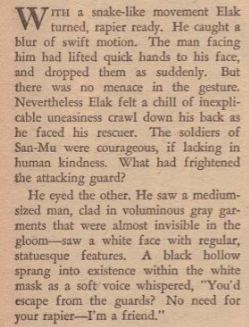
Well, there you go, everything seems to be perfectly in order and extremely normal: the guard was, of course, scared by the sudden appearance of Some Guy. This strangely blank-faced, robed fellow offers help, and Elak is forced to accept it unhesitatingly, since more guards are thundering down the road. A secret passage in the wall yawns wide, and Elak, bearing his drunken pal Lycon, follows the mysterious stranger in.
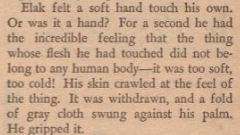
Again, perfectly normal – some people, even robed people with strange, unmoving faces, just have cold, clammy hands! Nothing untoward at all!
Elak follows his new (and normal) friend through a dark tunnel – there’s strange, unnatural sounds in the dark around them, but when they reach a hollow in the earth, there’s light:
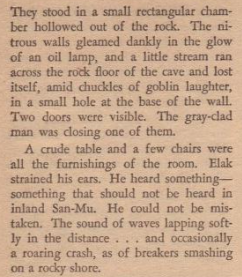
The line “amid chuckles of goblin laughter” is fun, isn’t it? There’s some good flourishes in here, and Kuttner has certainly got a flair for atmosphere. I love a nitred chamber deep in the earth, myself, particularly if there’re mysterious impossible sounds of the sea about.
Anyway, Elak’s mysterious benefactor introduces themselves: they’re Gesti, and please pay no attention to their chalk white complexion or their curiously glazed eyes. In fact, the only thing that does matter is that Gesti would like to hire Elak for a little job:
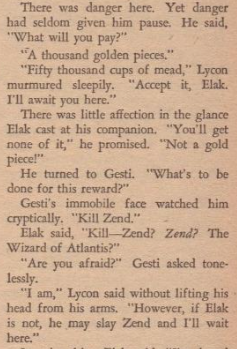
I do kind of like Lycon’s glibly cornball vaudeville schtick, though I also 100% accept that some might find it a bit grating – it is basically his entire character, other than drinking, so it can be a little repetitive. Elak asks for some more details about the job:
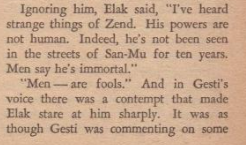
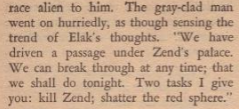
It turns out Gesti and his vaguely defined band have tunneled a secret passage up through the VERY LIVING ROCK OF ATLANTIS and into one of Zend’s basements in his Mighty Tower of Sorcery. All they need is a brave and violent assassin to use their passage, kill the wizard, and smash a red ball up there. Easy peasy, 1000 gold coins. Plus there’s a pile of loot in the tower too, and Elak can have all that too. Seems suspicious, but like we saw earlier: Elak is an amoral and extremely greedy guy. Plus he’s probably still drunk. Gesti offers to babysit Lycon while he sleeps it off, and that’s pretty much it. Elak, our hero, agrees to murder Zend for money! They give him a weird tube-like weapon which will play no part whatsoever in the story, and then they part ways, Gesti unable to advance farther; as he goes, he gives Elak a strange farewell:
Eh, it’s probably nothing.
Elak pushes up through the secret door into the tower basement, which is dusty and mouse-riddled, obviously a space rarely used by the mysterious Zend. He sneaks his way through the dim, empty halls, knowing he must make it to the very top minaret to destroy the Red Sphere there (presumably killing Zend on the way). But as he’s sneaking:
Helluva security system! A living (in some fashion) disembodied head sitting on a pedestal! I mean, that’s pretty gruesome, isn’t it, especially the way Elak spears it (through the eye! yuck!) and “kills” it! Reckon it’s some kind of weird undead horror, maybe, a product of Zend’s dark sorcery. Very strange and a great image, which ol’ Virgil Finlay drew up for us:
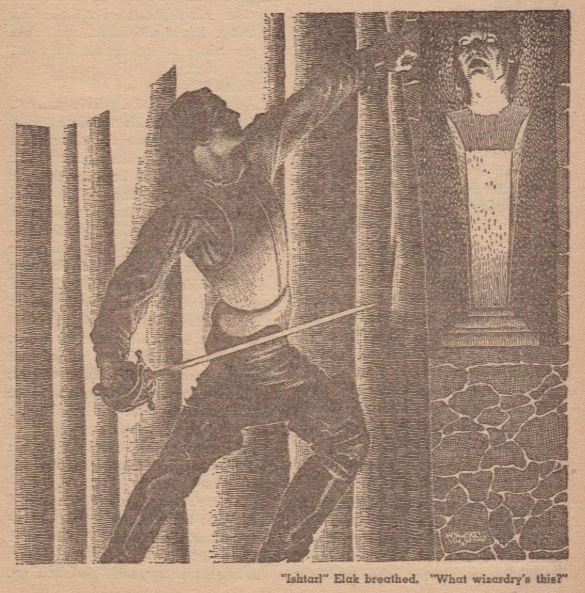
It’s a fun, weird scene…BUT it’s kind of a shame that it doesn’t really amount to anything. The alarm call of the freaky head doesn’t summon any guards or even seem to reach Zend; nothing happens at all, which is a real shame. Personally, if you’ll indulge me, as a writer of S&S myself I 100% would’ve had the headless body of the thing shamble out and fight Elak, directed BY the head on the pedestal. I mean, SOMETHING should’ve happened, you know what I mean? That kind of missed opportunity, and other events-for-no-reason, is a real problem that dogs all of Kuttner’s S&S, so much so that you might be tempted to think he’s actively subverting the expectations from the leanly efficient structures employed by Howard in his stories…but I honestly kinda believe he’s just a little lazy and writing extremely fast, for cash.
Elak continues down the dark corridor, parting a curtain, only to see a group of grotesqueries coming towards him!
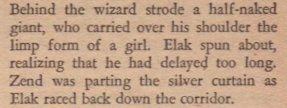
Yes indeed, Kuttner is engaging in the tried-and-true-and-tired convention of having an evil wizard exhibiting some physical deformity, just to really highlight the contrast between them and the clean-limbed and hard-bodied S&S protagonist. It’s unfortunate, but it’s something that goes hand-in-hand with this era of literature, so you have to get use to recognizing it.
Anyway, you might assume that Zend and his Big Guy are coming to get Elak, alerted by the head, but that’s not it at all. They don’t know about Elak, and in fact are out on business of their own, vis-a-vis the unconscious girl being carried by the huge giant. Via some clumsy exposition, we learn that Elak recognizes the giant…he’s a criminal he saw getting beheaded at a public execution, transformed into a monstrous servitor by Zend’s necromantic power! Elak decides that he doesn’t like the thought of fighting a dead man, and reckons he ought to hide, waiting for a chance when Zend is alone to stab him in the back. Unfortunately for him, the best laid plans gang aft agley…for Zend and the Giant turn up the VERY CORRIDOR where Elak is hiding! What’s he to do now!?
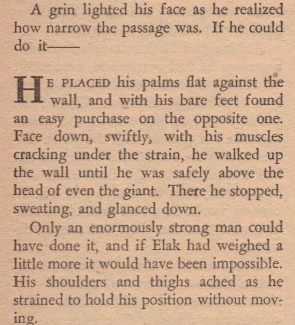
That’s right: Elak mutherfuckin’ Batmans it there in the passage way.
Defining “Sword & Sorcery” as a genre can be a fraught thing, especially if you’re trying to argue it’s something different from other types of Fantasy (which, to go on the record, it is), but this sort of thing is probably the easiest and most important difference to point out, I think: Sword & Sorcery stories are about the heroes’ ability to physically impose their will on a recalcitrant and hostile world, relying on the native strength, grit, endurance, and willpower inherent in their bodies to do so. They don’t have to have physiques of superheroic proportions (though it helps, and often narratively coincides with other themes important to the literature if they do), but they all have to confront threats through the use of their body; even Elric, who is defined as a sickly figure with little bodily strength, still relies on an inborn strength of will (who else could endure the corrupting and murderous effects of his evil sword?) to perform his epic feats. Here, we have Elak, whom we know is a supple, muscular man capable of fighting and running and such, demonstrate even further the superlative prowess of his body by holding himself perfectly still high up in the ceiling of a tunnel while his foes pass by beneath him, all unawares.
Elak gets a chance to ogle the girl while they pass beneath him, wryly musing on how she would express her gratitude if he saves her, but he lets them pass untroubled: that big ol’ giant is still awful threatening. When it’s safe, he drops to the ground; his hands and feet are bruised and bleeding, but he has successfully evaded detection and is able to sneak on after his prey. He enters a chamber with a window to the outside and three curtained doorways, which he peers through in order.
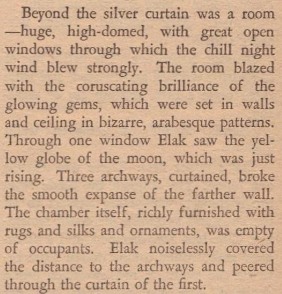
In the first room he encounters a strange, steel-walled room, where an odd mud-colored rock sits absolutely pulsing with terrible, frightful power. Good wizard shit here, I think, with lots of mysterious and unexplained details. Behind the second curtain he sees Zend at work in a sort of wizard’s laboratory, preparing to Do Something Evil to the unconscious girl:
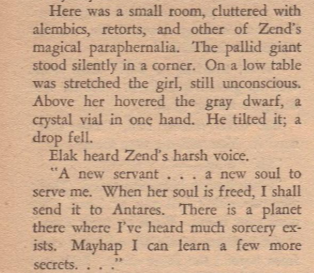
Again, excellent ambient weird wizardry in this section; I especially like the detail that Zend is going to send the girl’s soul to some planet around the star Antares in case there’s some magic he can learn there. It’s fun stuff! But Elak has no time for that; he leaves the girl to her dark fate and checks out the third curtain, where he encounters a rosy glowing light…the chamber of the red sphere! And it’s filled with weird techno-sorcery too, tubes and wires and pipes and things; it reminds me a little of the robo-tower from Leiber’s Fafhrd and the Gray Mouser story “Two Sought Adventure” and, I think, speaks to Kuttner’s more sci-fi interests. But, just as Elak is about to get to work destroying the macguffin, the giant rushes up the stairs and into the room!
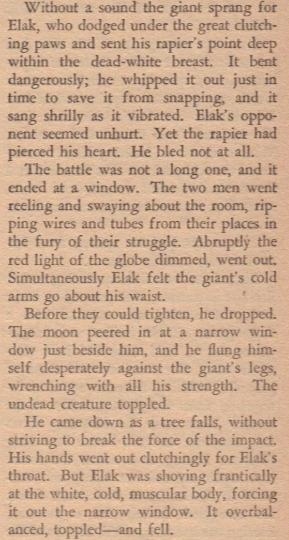
So, a couple of things – first and most importantly for the story, the Red Sphere is unplugged and powered down BUT NOT DESTROYED in the fight. Secondly, it’s a fun fight, honestly – the rapier, bending dangerously as it pierces the giant’s heart, but to no avail, is good stuff, as is the eventual wrestling match that sees Elak pitching the giant out the window. Also, as an aside: I think Kuttner uses “his body fell as a tree falls” or some variant in EVERY SINGLE S&S story he wrote, all the Elaks and even in the two Prince Raynor stories, every single time. Something about the image that he liked, I guess, or it just felt very actiony and sword-and-sorcerous to him, or something. It’s an odd tic. Everybody is always crashing to the ground like a felled tree.
As he’s recovering from the fight, he hears a shriek from the room below; running to investigate, he encounters Zend, fleeing in terror, and hears a babble or horrible voices coming up the passage.
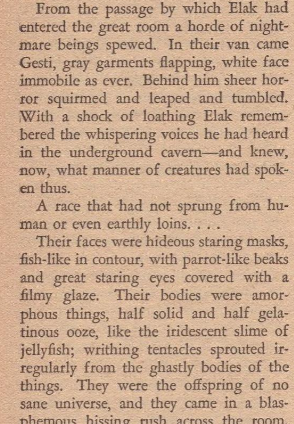
I mean, they’re great monsters, aren’t they? Bubbling, semi-solid tentacle monsters with parrot- (or octopus-) like beaks, slimy and oozy and terrible. Good weird critters, for sure, and much more interesting than the gillmen you might’ve expected, given the title of the story. The Dagon of this story is no Biblical Philistine Fish God; this is Lovecraft’s Dagon, for sure, but these ain’t Innsmouth Deep Ones at all. It’s fun, and nice to see Kuttner really going for a much more alien, deep sea kind of monstrosity here, you know?
Anyway, Elak is quickly trussed up with cords by the Jelly Monsters, and sees that Zend is similarly tied up. Hilariously, Elak seems to be an obstinate optimist because he asks Gesti, who came in with the monsters, for his money.
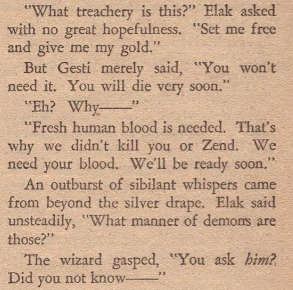
Betrayal! Who could’ve foreseen such a turn of events, particularly since Gesti seemed so nice and normal, a real bro.
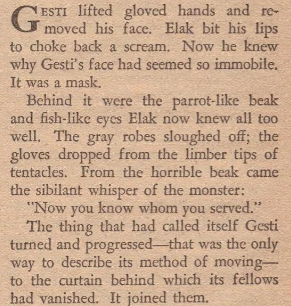
This is why you gotta ask ALL prospective employees if they’re the hellish spawn of an alien god. They gotta tell you if they are, like cops. Zend seems a little surprised that Elak is so dumb:
While he’s wrangling unsuccessfully with the ropes around Elak’s wrists, Zend is able to provide some more exposition with regards to the jellymen’s motivations. Following the state of the art pre-tectonics ideas about the evolution of the earth then current in Kuttner’s day, Zend explains how the Earth was once one vast ocean, ruled by the Spawn of Dagon. The rising of the Continents, in addition to reducing their sovereignty are also an affront to their dignity, and so they have worked tirelessly to sink all the land and return the world to a state of Primal Ocean. There’s some fun bits in here about ancient, prehuman races that got dumped in the drink by the Dagonians, big ol’ weirdos and sphinxes, good ancient fantasy stuff. Zend then explains that, without his intervention, Atlantis would’ve long ago been sunk – it’s his magic alone that keeps the island above water, and the monsters know it. “How’re those bonds coming,” asks Elak:
I really wanted Zend to make an aside to Elak here: “Oh, by the way, you’re, uh, sterile now.” Yes, the weird radiations of the Red Sphere kill the Jellyfish Guys instantly; that’s why they needed a foolish catspaw to break it, so they could get at Zend and bring about a return of their Oceanic Empire. Real shame those ropes are holding strong, an adventurer like Elak might be able to thwart them if he wasn’t trussed up like a Yule Goose.
Yes, despite harboring an insane hatred of all dirt-grubbing humans, the horrors below didn’t bother to kill Lycon when they had a chance or even, apparently, tie him up. So he, rested and sufficiently sobered up, has arrived in the nick of time! Oh, and the sexy girl Zend had kidnapped wakes up, just in time for Elak to promise to help her escape…if they survive!
It seems like our heroes are doomed, however – there are too many of the monsters, and their weapons seem powerless against their gelatinous unearthly bodies…but then they begin to melt away! Zend has gotten his Red Sphere back online, bathing them all in its strange radiation!
Having learned a lesson from Gesti’s betrayal, Elak grabs the girl and the three of them skedaddle, ending up in one of the city’s many municipal parks. Lycon leaves Elak and Coryllis in search of some grog.
And that’s how Kuttner ends his story “Spawn of Dagon,” with his hero having public sex in a park.
Perfectly breezy little story. Are there some problems? Absolutely – the writing in places is sloppy and rushed (the geography of the tower is a bit strange), things happen for no reason and have no impact on the story (the alarm head, the weird weapon that never comes into play), and there’s TWO dei ex machina in here: Lycon’s sudden arrival to cut the ropes and Zend’s offscreen repair job on the Red Sphere. These same problems crop up again and again in Kuttner’s S&S stories too, by the way – there’s lots of unsatisfying action and narrative hops that, frankly, just don’t work very well. So why the hell should you read these, then?
Well, as I mentioned in several places, I really think these Elak stories are interesting historical documents that capture a very specific moment in the S&S genre. Howard is dead, but he’s left behind something new in his stories, something unique and interesting. And so Kuttner is engaging with it, trying to figure out what works and the ways he can make it his own, and while the experiments might not WORK, they are interesting and important failures.
Kuttner recognizes that he can’t (and doesn’t want to) just write a Conan clone, so he makes a decision to create a different protagonist. A strong, physical, brave character, sure, but one without the Noble Savage trappings of Howard’s heroes. Moreover, rather than Conan’s rough but iron-clad sense of honor, Kuttner makes Elak a sneaky, amoral, and largely dissipated character – Conan’s pristine wilderness is discarded for a world-weary urban cynic. Moreover, whereas Conan’s arc is, broadly, defined as the ascent of a vital barbarian to the pinnacle of power as a king, Elak has REJECTED kingship outright, before his stories even begin!
Kuttner simply isn’t interested in the same things that a rural hayseed from Cross Plains TX is – he’s a son of the city, living in Chicago and LA and New York, huge metropolises at the height of the Great Depression! His sword and sorcery is much more interested in cities and power and corruption, something very different from Howard’s preoccupation with nature and wilderness. And I think Kuttner DOES see that there’s something in the genre that lets him wrestle with those topics in a new and interesting way.
So, while I don’t think the Elak stories are necessarily good, they are important. Kuttner’s grasping mercenary characters having adventures in well-developed (or at least, more well-developed than Howard’s) fantasy cities IS a new direction in ’38, part of the current that would produce Fafhrd and the Gray Mouser and Elric later on, evolving out of and in response to Howard’s very sui generis Conan stories. Elak isn’t nearly as well developed or interesting as those later creations, of course, but he’s an important stepping stone leading to them, and therefore an interesting part of the genre’s history!
 Eric Williams
Pingback: Pulp & Pastiche #42: “The Thief of Forthe” by Clifford Ball, Weird Tales v.30 n.1, July 1937 | Eric Williams
Pingback: The Death of Robert E. Howard in the Pages of Weird Tales | Eric Williams
Pingback: The Pulp of Yondo #43: “The Abominations of Yondo” by Clark Ashton Smith (Overland Monthly, v. 84, n. 4, April 1926) | Eric Williams
Pingback: Not Long Before the Pulp #44: Three Kings’ Day Edition! “Not Long Before the End” by Larry Niven, The Magazine of Fantasy & Science Fiction, v. 36 n.4, April 1969 | Eric Williams