Everything seems to stand still when the pale autumnal sun shines wan through gray and misty days, but wise ones know that the millstone of time grinds on. The flight of geese, the yawping of the coyotes in the creeks, the rattle of dry leaves, all these speak the truth: Moorevember is indeed upon us! So stoke the fire, bolt the door, and prepare yourselves for a fun one! It’s “Dust of Gods” by C.L. Moore!
This story is one of MANY that Moore published in 1934, probably her most productive year in terms of publishing – by my count she put FIVE notches on her gun belt that year, all to Weird Tales. That’s three NW Smith stories (including today’s) as well as two Jirel of Joiry stories (which, don’t worry, we’ll get there!), not too bad for someone just starting out! I’m not sure about this, but I have a feeling that Moore must have one of the best batting averages of any Weird Tales author in the famously exacting Farnsworth Wright era – I can only think of one or two stories off the top of my head that got rejected and ended up in the smaller fanzines of the day. For comparison, several of what we consider Lovecraft’s masterpieces were rejected by Wright (mostly for formatting and length issues), and similarly ol’ Robert E. Howard himself had a string of “thanks, but no” from Wright, even when he was writing the immensely popular Conan stories. Moore’s approach, theme, and writing must’ve just resonated with Wright and the readers of Weird Tales, and I think “Dust of Gods” is a good illustration of why that was!
But first, let’s take a look at this issue’s cover!
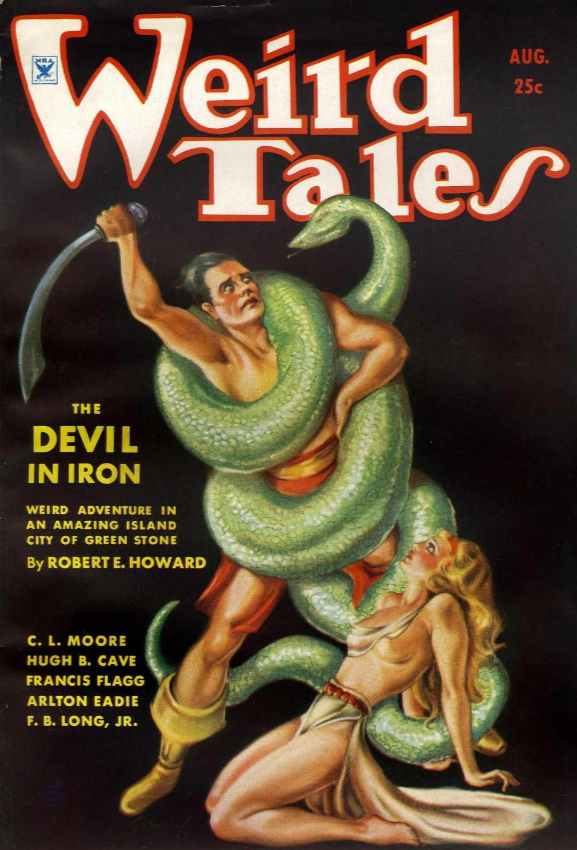
A Brundage Classic! Conan (looking a LOT like Douglas Fairbanks to me) battling a huge and suspiciously phallic snake while a nearly naked blonde girl looks on. REH’s story has a great title here, but it’s only a so-so Conan yarn, in my opinion, fairly bland and straightforward with a kind of improbable deus-ex-machina-esque magic weapon resolution that is extremely unsatisfying to me, personally. BUT I think you can see that ol’ REH was a quick study and had already figured out how to ensure his story got the cover work – he’s WELL into the mode of adding a gratuitous scene of a woman being menaced, well aware that THAT was exactly the sort of thing the mag liked to have for it’s covers. And it worked!

Not a bad ToC – there’s that Mary Counselman story I mentioned last time, the one that at some point was voted by the readers of Weird Tales as the BEST STORY EVER PUBLISHED in the magazine. Honestly kind of inexplicable, to me. Got some Long and some Smith in their two, but again, for my tastes, top-o-the-heap belongs to Moore this issue! So let’s dive in!

The title illustration here is really interesting and, I think, reveals something important about Moore’s work. The composition is great, a figure hanging precariously from a rope and descending into darkness and the unknown. You get a real sense of danger and foreboding, and the menace and mystery of the cave is also well portrayed – with the man hanging helpless over the a pit and the small figure in perspective holding the light and the rope drawn, you get an almost agoraphobic sensation, a feeling that the darkness framing the scene extends on and on (and on) into illimitable gulfs just beyond the edge of the picture. It’s a fantastic illustration for an adventure story, but what’s interesting is that this particular tale is… science fiction!
“Dust of Gods” is a Northwest Smith story; it’s set on Mars, they’ve got heat guns and space ships and such, there’re aliens and planets and all that. But that illustration is a sword and sorcery scene! It wouldn’t be out of place in a dungeons and dragons adventure! They’ve got strange tunic/tabard things, there’s a dagger on his belt, and those helmets are 100% fantasy man-at-arms style basinets, you know? The one incontrovertibly “high technological” piece of equipment is the flashlight the one figure is holding, but that’s it – this is a fantasy illustration, which is fitting because the story is actually all about gods and magic. I think this illustration actually captures something that C.L. Moore did really well, which is the blending of different genres, using their conventions and approaches in interesting ways, something that’s perhaps easier to do in first decade or so after a genre’s establishment. But keep it in mind, this sci-fi/fantasy melding, because we’ll talk about it at the end of this one.
But for now, let’s get into it! We join Northwest Smith and his Venusian buddy Yarol doing what they do best: getting drunk in a Martian dive bar!

That’s the dream, isn’t it? Day-drinkin’ on Mars! What a life! Except, of course, NW and Yarol are broke as hell, carefully nursing their bottle of martian whiskey in the saloon. So great is Yarol’s thirst that he actually suggests they fuckin’ knock the bar over – his heat gun has a fresh charge, so why not? Luckily, NW calms his friend down and suggests they try and find someone to hire them instead:

But it seems like everybody in the bar is as hard up as they are, honestly. Everybody looks pretty hardscabble, especially a pair of roughnecks a table over, a “little red-faced earthman” and a one-eyed martian drylander, that Yarol seems to recognize. The two of them are “hunters,” presumably tough guys who go out into the unforgiving martian wastelands on tough and (most likely) illegal jobs. But NW notes that these two bad asses look less like hunters, and more like the hunted themselves; they’re nervous, looking over their shoulders and watching the door, generally actin’ a little squirrely. What could’ve gotten them like that, he wonders…and a mysterious stranger answers him:
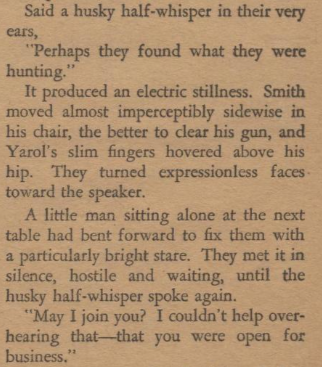
Hangin’ around a bar is better than LinkedIn! Northwest gives the little man the ol’ once over, and is intrigued that he can’t place his species or origin at all – he could be human, venusian, canal-martian or drylander, and his words seems to be carefully generic, utilizing enough spaceman slang to obliterate any telltale idioms of speech that might betray his origin. All in all a mysterious guy, and hey! He’s hiring!
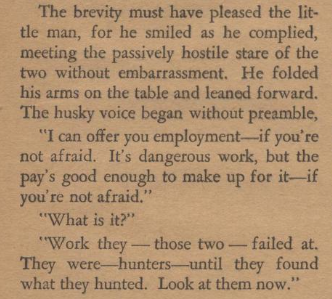
Credit where credit is due, this little weirdo is at least trying to make sure Northwest and Yarol know what they’re getting into. Those other guys were good, but they failed and look at them now. It’s a grim and perilous adventure that is in the offing here.
Smith asks the little guy about the job, and he gets a little bit of space theology as preamble:
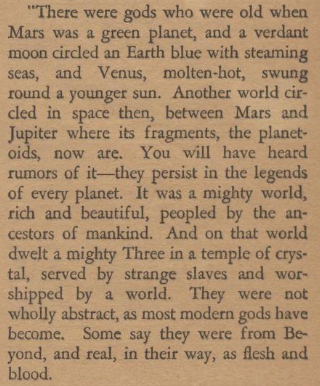
These are some very Lovecraftian gods, in that they’re materially and physically real, albeit in a weird, transcosmic way – their flesh and blood ain’t like ours, and they come from Somewhere Else. Continuing with Sunday School, the little guy explains that these mighty Three reigned over the planet between Mars and Jupiter and are the ultimate source of all the gods and myths on all the other planets. Two of the triumvirate, Saig and Lsa, are long gone and forgotten, but the most powerful member of their ménage yet remains in the minds and myths of people today…Pharol!
If you read the previous story in Moorevember, “Shambleau,” then you might recognize the name “Pharol.” It was used as an explicative a couple times, and it was hinted that Pharol-worship was an evil and secretive thing that people did in the dark.
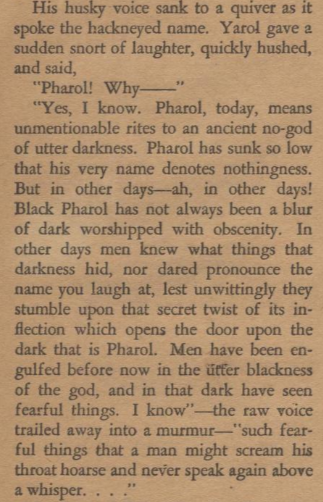
This is just some top-notch “ancient evil gods” stuff, really perfectly done. It has all the hallmarks you want in something like this, ancient mysteries, lost civilizations, hints of secret truths and dark magic…but what, exactly, is the job that this little freak wants done?
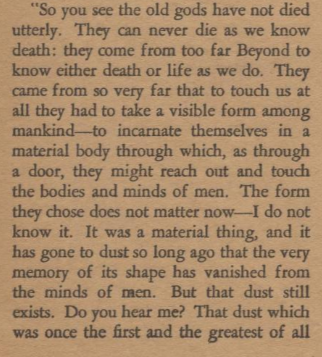
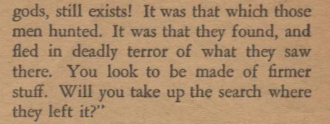
Sounds like a job for Conan, honestly, but if he’s unavailable, maybe Northwest Smith and Yarol the Venusian will do? Now, going in and dustbustering up the remains of a god SEEMS pretty straightforward, but those two hunters look pretty rough…NW asks if the little feller would mind very much if they took a moment to consult with those two about it, and the little guy shrugs and says “go ahead.”
The two hunters are a pretty ragged pair, and up close the madness that seems to be afflicting them is all the more evident – they’ve seen some shit, and even drunk as they are there’s still a sense that these two hunters have gone over the edge and won’t be coming back anytime soon. They mumble about caves and tunnels and polar mountains, and some kind of horrible “white thing” that menaced them. NW and Yarol realize that, aside from spook stories and a general sense of unease, they’re going to have to go in blind on this one. But still, Smith is interested:


Smith and Yarol do end up wanting to know exactly why this little weird dude wants the dust of a dead god, and they get a perfect “mad sorcerer” answer:
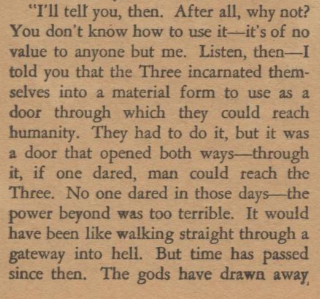
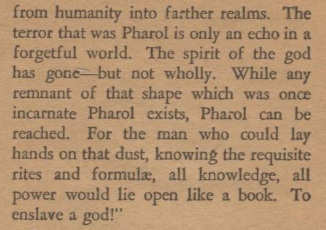
To normal folks like you or me, this answer might give us pause; perhaps the obviously insane guy should not be allowed to rend the veil between realities and enslave an ancient hell god? But for NW and Yarol, it’s just business – a guarantee of $50K for the dust, and they’re off, streaking northward to the Martian pole in search of the remains of Pharol.
Moore is great at describing environments; she imbues the Martian landscape with a lot of portentousness and significance as the two of them spend many days flying over the planet…you get a sense of the weight of time and depth of changes that’re sunk into Mars, the epic grandeur of a dying world. That Deep Time perspective is a key attribute of weird fiction, but I think Moore does a nice job giving us the chance to see and experience it through the characters eyes. I also think that sword and sorcery (a subgenre of weird fiction) is where that environmental kind of writing finds its best expression, so it’s not too surprising that she nails it here, since this is more of a S&S story than a sci-fi or straight weird tale.
They find their million-year old city, a ruin wracked by Martian tectonism. In the twisted cliffs of the polar mountains they spot a cavern and, guns drawn and “Tomlinson tubes” (Martian flashlights) ablaze, they cautiously pierce the darkness and begin their trek.

The darkness that has crashed over them is clearly unnatural; Smith feels the end of his light and notes that it is both warm and still slightly vibrating, indicating that it’s still on. Something alien has engulfed them, a pure and almost tangible darkness. Prepared in a vague way by the maddened hunters they spoke to in the bar, Smith and Yarol wait, guns drawn.
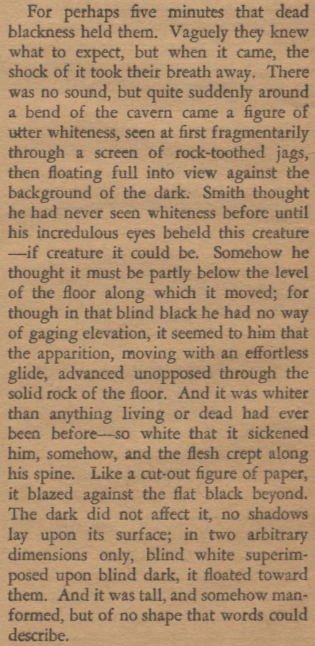
We knew we were deep into Cosmic Weirdness when Moore introduced ancient, alien, unknowable gods back in the bar, but this White Thing in the tunnel is a really perfect example of a real weird menace, isn’t it? I mean, what even is it? Preceded by a shroud of pure, almost elemental darkness, and something so bright and blazingly white that it almost sickens Smith to look at it…that’s some strange stuff!! It’s obviously dangerous, but how? What is the threat this thing represents? Smith and Yarol have, in some way, transgressed a cosmic boundary in the tunnel, leaving our world behind and entering a space where, somehow, different rules apply. Truly gorgeous weirdness.
Smith and Yarol are frozen to the spot, watching this White Thing advance through the perfect darkness towards them. Smith notes that it seems to be moving through the cave floor beneath it, extending below the rock despite have some kind of tangible form. There’s also something else, some kind of dangerous, madness-inducing aura in the thing that seems to be threatening Smith and Yarol’s very minds by being in the Thing’s presence.
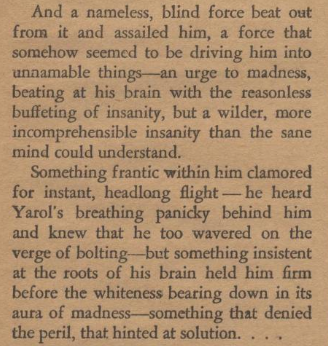
Smith, noticing that there’s no shadow on the White Thing and that it seems to be moving through the real world rather than in it, does what any red-blooded amoral space smuggler would so, and blasts the thing with his heat gun. It has no effect, of course, but that’s telling in itself! The ray has NO effect, with even the deadly blue light from the gun’s blasts failing to be reflected on its surface; the cavern flashes blue, the rocks are tinged with color, but there’s no change in the White Thing’s color or form or shade or nuthin’ which, to Smith, means that the Thing is beyond our reality and incapable of interacting with it. So he grabs Yarol, shouts “come one!” and plunges INTO and THROUGH the White Thing!
That’s some solid sword-and-sorcery hero shit from Northwest Smith there – just fuckin’ GO FOR IT, what, you wanna live forever? And it succeeds, somehow! Now, this is legit kind of confusing, but I think it works thematically, and it gets reinforced by the rest of the story later on, too. What happened was that, like Smith intuited, the White Thing wasn’t physically real; it was something From Beyond, and presumably the madness effect that got the previous hunters and ALMOST got Smith and Yarol is, basically, just the incommensurability inherent to stuff from our universe experiencing stuff from another “dimension” or whatever. This jives with what the wizard at the beginning of the story said about the gods – they had to incarnate in some kind of material sense to actually interact with our worlds, and that that matter produced some kind of connection between our universe and theirs.
This is further elaborated when Smith and Yarol trek further down the tunnel. They encounter a huge stone door sealing the rest of the temple away, burn through it with their heat guns, and release a torrent of liquid-like light that flows out of the chambers and into the tunnel (which is a great, weird image, isn’t it?). Smith suddenly realizes that this inner chamber must be an asteroid, exploded off of the lost planet between Jupiter and Mars, and that that was how the gods arrived on the planet. It also explains the weird White Thing and the strange river of light that’s oozing out into the tunnel – it’s alien stuff, the last little glimmer of whatever alien dimensional weirdness that dwelled with the gods in this asteroid temple chamber.
Smith and Yarol have to contend with ANOTHER threat from beyond, this time the inverse of the White Thing; a thing of perfect and terrible darkness this time that, Smith realizes, is basically bobbing along and caught up in the flow of light pouring out as the asteroid “drains.” Then, finally, they reach the central chamber, a vast crystalline room with three strange, inhuman thrones in the middle. Two are empty, but on the largest central throne-pillar lies a mound of strange gray dust.

Yarol, irreverent Venusian that he is, scrambles up the pillar and calls to Smith to toss him up the box; he’s ready to sweep up the dust and get out of there. But Smith hesitates, and in a moment of nearly telepathic simpatico, both of them realize that they’re dealing with some Serious Shit™ here. There really is weird ultradimensional stuff in this million-year old temple, and the implication is dire. That wizard seemed kinda bonkers, right? Might not be the best guy to give absolute power to, you know? And what if he CAN’T control the dead god like he thinks he can, and instead just opens up a doorway that he can’t close to whatever bizarro hell dimension Pharol calls home?
In the end, Smith and Yarol decide this dust is too dangerous, and so they train their heat guns on it and roast the stuff. Maybe shoulda taken it outside in the open air and done it, though, because as the stuff slowly burns it releases roiling clouds of hallucinogenic smoke.
Drunk off the fumes, Smith witnesses vast psychedelic vistas of time and space, the entire history of the vanished and destroyed world that the Three ancient alien gods had ruled over for so long. Ancient cities razed by nameless weapons wielded by strange beings all in lost, distant ages, and finally the destruction of the world.
And that’s the end!
Obviously, I like this story a lot. I’m a fan of sword and sorcery, of course, and I really think that, sci-fi trappings aside, this one is absolutely a sword-and-sorcery story. It ticks all the boxes in the genre, for sure: the heroes are down on their luck opportunists just trying to make their way through a hard life; the “sorcery” in this story is 100% inimical to human life and ultimately totally alien; and the threats the heroes face are overcome through sheer will, strength, and cunning on their own. Hell, they even start their adventure in a tavern! The fact that it takes place on Mars, that they’ve got heat rays rather than broadswords…none of that really matters, because the themes are there: raw, rugged Humanity (and Venutianity, I guess, in Yarol’s case) ultimately standing bravely against an alien and unnatural force. Smith’s strength is the force of his very human will that lets him both survive the maddening alien energies of the weird monsters he meets as well as realize the correct course of action regarding the god dust at the end of the story.
That said, I think the sci-fi aspect of it DOES give it something that would be missing if it took place in Hyboria or whatever. A big part of this story is about time, particularly at a geological or astronomical scale, and the smallness of civilization in the face of that reality. Now that’s a theme that’s often in sword and sorcery; REH’s stuff, for instance, is explicitly set in a pre-Ice Age world well before anything like recorded history (a common enough idea in a lot of fantasy), and there’re often ancient ruins and lost civilizations of an elder age involved, sure, but I think there’s a difference. By setting it in the future, on another planet, you immediately anchor the story in a way that’s more concrete than just saying “eh, a long-ass time ago.” There’s also, I think, something in the way people engage with sci-fi that is fundamentally different than the way they engage with fantasy – the counternarrative aspect of fictionalized history immediately breaks absolute verisimilitude, which is fine, that’s often the point. But a story set in the future CAN’T be counterfactual since it hasn’t happened yet, and that lets the reader immerse themselves in a different and more realistic way, I think, with the events of the story.
Furthermore, I think there’s an interesting “step-up” effect going on here. Obviously, Smith lives in the future – there’s interplanetary travel, ray guns, all sorts of highly advanced technology, but more importantly there’s very little connecting the world of NW Smith to any of the political, social, or technological entities a reader would be familiar with, right? No “North American League” or “Earth-Venus War of 2122” whatever, right? I mean, they don’t even have flashlights…they have “Tomlinson tubes.” Because of all that, my brain has been eased into something where the time difference feels like many hundreds of years, maybe close to a thousand years, in the future! That’s a long time! But then in the story you’re confronted with even LONGER time frames, millions of years, which makes that first time difference paltry and, realistically, inconsequential. The Martian temple turns out to be a fragment from an exploded planet…it’s LITERALLY older than the mountains it’s trapped in. That kind of kaleidoscopic sense of temporal scale is something that I think you’d struggle to evoke in a pure fantasy story, where you’d just have to tell me “ah this temple is Atlanean” or “it’s from the ancient lost Empire of Magokai,” both of which I as a reader wouldn’t have a visceral connection to, right? There’s no reference point for me to stand on and take in the vast sweep of time there. It takes a science fiction framing, a “realer” world by default, to construct a dialectic of time that REALLY contrasts the future with the past.
There are some similarities in this story to other Moore works, even ones that came out this very same year; in particular, the “tunnel to another world, where alien rules apply” gets cranked up to eleven in the Jirel story “Black God’s Kiss” (which we’ll be doing soon, don’t worry!), but I don’t mind it. Every writer has their themes and interests, and I think Moore wants to play with the way people confront and experience the alien. As weird fiction, the story is a blast too – the strange threats are TRULY bizarre, with nothing you can really hang an interpretation on. They don’t even appear to be made of matter as we understand it, and yet they’re described seriously and hauntingly; I think it’s a real triumph of the genre, something people can spend a lifetime trying to capture in their own writing.
Whew, another long one this week, but I really think Moore is worth the effort, and that she rewards you in the end for thoughtfully enjoying her work. And, aside from the genre tropes and themes, I think honestly the writing is just really good – there’s some good descriptions and evocative language, and the way Smith and Yarol act is natural and believable and real and, honestly, fun. In conclusion, all hail C.L. Moore, I guess!
 Eric Williams
Pingback: Straining the Pulp to the Breaking Point #20: “When the Bough Breaks” by Lewis Padgett, Astounding Science Fiction, Vol.34 No. 3, Nov. 1944 | Eric Williams
Pingback: Clarissa Pulps it All #30: Moorevember already!? “The Children’s Hour” by Lawrence O’Donnell (Nom de Plume of C.L. Moore and Henry Kuttner) Astouding, v.33 n.1, March 1944 | Eric Williams