
Well, another Hallowe’en in the books – here we are, well into November, but BY AZATHOTH we’re STILL going to be talking about pulp stories from Weird Tales! And today’s story is, honestly, one of the best ever published in the magazine, written by one of the True Masters…”Shambleau” by the incomparable C.L. Moore herself!
Catherine Lucille Moore is one of those towering figures who emerged from the pulps and became this hugely important figure in the history of genre literature, both because of the kinds of stories she wrote as well as the fact that she was a woman while she wrote ’em. Now, she’s not the first woman to appear in Weird Tales, of course – Clare Harris had written under her own name in Weird Tales, and Greye La Spina and G.G. Pendarves had appeared in the magazine before her – but she is probably the most famous member of that early pioneering generation. Moore was extremely popular with the readers of Weird Tales (and other magazines, when she branched out), and her works have also been more durable than most of her contemporaries (regardless of their gender), and continue to be anthologized today.
This speaks primarily to the quality of her writing; in my opinion, Moore is one of the greatest genre writers of all time, capably combining complex characters and interesting ideas to make some really remarkable pieces of fiction. We WILL be talking about her sword and sorcery masterpiece “Jirel of Joiry” in December, and we’ll probably have to leap forward in time to talk about her story “No Woman Born” from Astounding (which is one of the greatest short stories of ALL TIME)…in fact, maybe we should just declare a C.L. Moore month right now!
That would be fitting because apparently, when Farnsworth Write pulled “Shambleau” out of the slush pile and read it, he declared it “C.L. Moore Day” at the offices of Weird Tales, closed up shop, and took everybody out for drinks. He thought it was that good and, honestly, he’s right, particularly when you compare it to the other stuff in the magazine around that time. Don’t get me wrong, there’s plenty of good writing in Weird Tales – but Moore is just head-and shoulders above most of it.
Since I’ve convinced myself that we’re doin’ Moorevember this month, we’ll spread her bio and suchlike out over the next few week…so let’s get into it!

Just a Girl and her Skull, that classic pairing. It’s a Brundage, of course, although a fairly chaste one for her…lotta leg and a generous helping of sideboob, but nothing too spicy. She’s not even tied up! It’s also kind of odd that there’s no titles or authors or anything on this cover, and I don’t even think the painting is meant to reflect a story in this issue at all. I don’t know why that is, to tell you the truth. Maybe they were trying something new out? It’s a shame, because I actually would’ve liked to have seen a full Brundage take on “Shambleau.”
But, anyway, the ToC for this Nov 1933 issue:
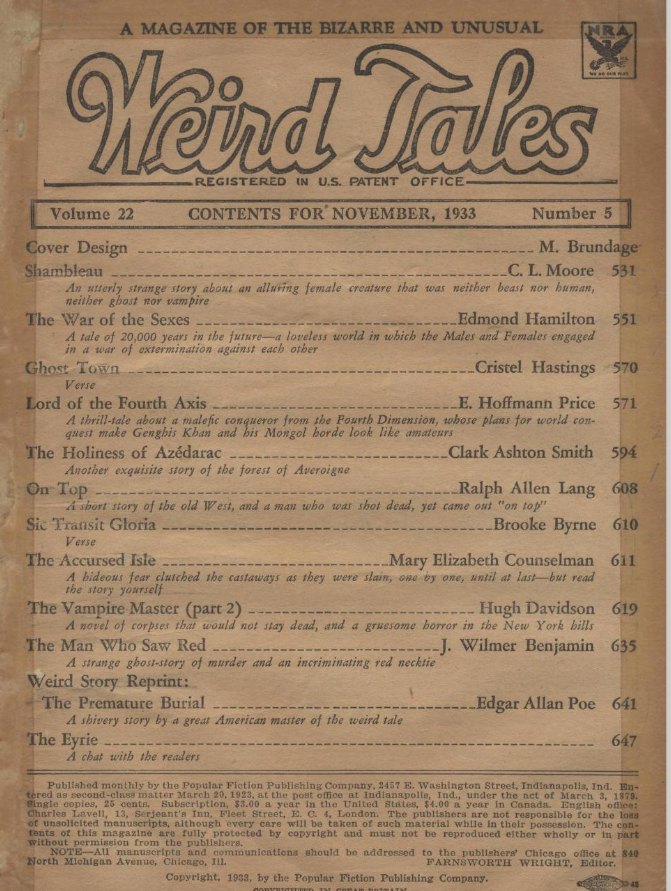
Speaking of women writers in Weird Tales, check out Mary Elizabeth Counselman here…she’s a pretty famous pulp writer, did a lot of poetry and short stories in a lot of different magazines. Mostly she’s known for the story “Three Marked Pennies,” which was one of the most popular stories in Weird Tales history, weirdly – it’s fine, but just goes to show how hard-to-pin-down the tastes of readers can be, in my opinion. She seems like a rad lady though because she lived on a houseboat in Alabama with a zillion cats. Sounds great to me!
There’s also some Clark Ashton Smith with a (slightly silly) Averoigne tale and ol’ E. Hoffmann Price still crankin’ out some serious two-fisted cornball pulp, Yog-Sothoth bless him. But pride of place goes to Moore with this, her very first professional story! So let’s get into it!

Big ol’ title illo for this one, by Jayem Wilcox (aka J.M. Wilcox) which, while kind of giving away too much of the action from the story, is still fun. You can see why I wish Brundage had been able to take a swing at it, though – it’s a total reversal of her usual “woman in peril” scene, and it would’ve been neat to see her take on a seductive and deadly monster girl menacing a big tough space man. But Oh Well!
This story begins with a little italicized intro that I won’t reproduce here. To summarize, it basically says that Humans have been to space before now, that in the distant pass of Atlantis etc there were space ships and such, and what that means is that even after the fall of those starfaring civilizations, tales of space had influenced human culture, and that’s where our monster myths came from. It’s always struck me a little strange, but maybe it was Moore just wanting to set up that, yes, this is a “pseudo-science” story (the parlance that Weird Tales used for science fiction, which was still emerging at the time) BUT there’s weird monsters, so keep reading! I feel like it’s unnecessary though, and actually maybe detracts from the story, at least for me. A little to “here’s what we’re talking about today” for my tastes, I guess. But moving on:
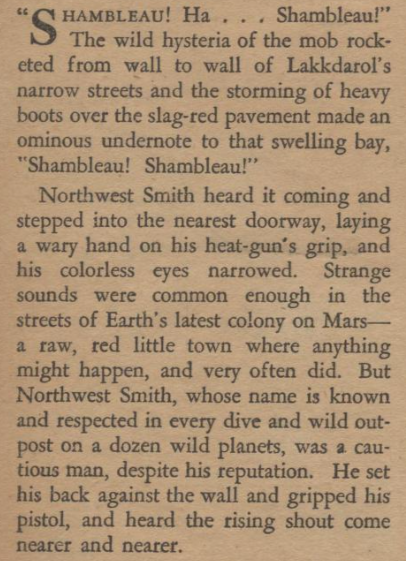
Now THAT’S how you do hard-boiled space noir intros! Here we’re introduced to one of the two major, multi-story, recurring characters that Moore created. This one is Northwest Smith, a grim, cynical, hard-bitten, tough-as-hell spaceman from Earth. He’s a smuggler and a criminal, mostly amoral but with a little glint of heroism beneath all the grime that comes from fighting and surviving in an unforgiving universe. A little Hammett’s Continental Op, a little Han Solo. A great character, and also the sort of people Moore was interested in writing about: complicated but capable.
As a side-note, the name is worth talking about. Apparently Moore, who worked at a Trust Company as a Secretary, addressed an enveloped one day to a “Mr. N.W. Smith” and she just loved the name. She originally wrote him as a western hero, but kept the name (and the gun-slinger mannerisms) when he became a sci-fi hero because she thought it was funny for a guy in space to have a direction as a nickname.
So Northwest Smith is hanging out on Mars in a real frontier town, when he hears a mob shouting the strange word “Shambleau!” in the distance. An odd word, and it really seems to hit you as a reader, doesn’t it? Compared to the harsher and more guttural Martian name of the town (Lakkdarol), it stands out! Smith has no idea what it means, but he knows trouble when he hears it – he steps into a doorway and pulls his ray gun. Then, he sees a girl:


Even a rough customer like Smith can’t help but be touched by the sight of a sexy scared girl! He tucks her behind him just as the mob comes around the corner, still bellowing “Shambleau!” and obviously hunting for her.
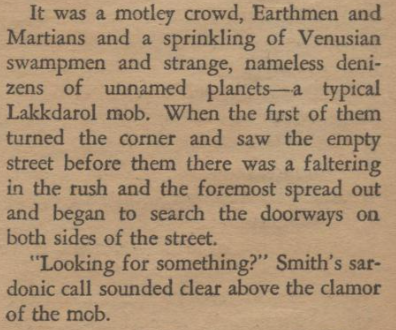
I mean, he’s just cool as hell, you know? Anyway, this mob turns and sees that Smith has the girl. An Earther, acting as a kind of leader of the mob shouts “Shambleau!” again and they rush forwards, apparently intent on taking the girl regardless of Smith’s obvious badassery.
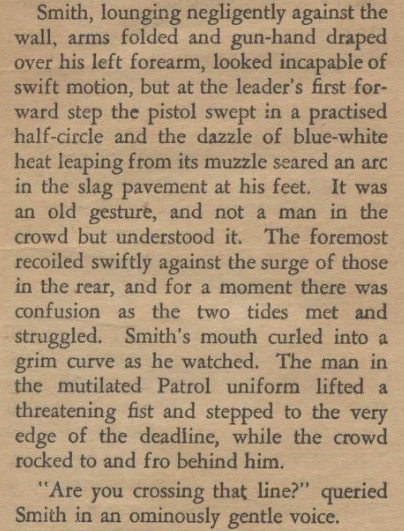
You can see the cowboy influence in Northwest Smith’s literary heritage pretty strongly here. The crowd seems shockingly and specifically bloodthirsty; they want the girl, and demands that ol NW give her up to them, which he resolutely refuses to do. The mob seems almost confused by his defiance.
There’s some more back and forth, and things seem to be deteriorating. Smith knows he’s not going to die for this girl, but he is preparing himself to take a beating from this mob, when something odd happens; he shout’s “She’s mine!” and the mood of the mob shifts suddenly and surprisingly.

A really great, really weird scene, isn’t it? The furious mob turning suddenly away once NW has “claimed” this woman…it’s very sinister, something like out of one of the grimmer fairy tales, maybe. It’s also kind of upsetting, isn’t it? I mean, it’s a straight-up lynch mob, a very real and very unpleasant part of American life then. We’ll circle back around to the topic when we reach the end of the story, but it’s worth noting here, I think.
Smith is as puzzled by the mob’s reaction as we are. He particularly notes the open disgust the crowd now has for him, even as it melts quickly away. As he’s considering it, the girl rises from the slumped heap at his feet, and he gets his first good look at her.

A weird hairless alien, sharp-toothed and with cat-like eyes and claws, but hey – she’s got curves in all the right place, amirite!? She don’t speak Earth language none too good, though, and NW has a kind of strange, confusing conversation with her.

NW asks her what her native language is; he’s an adventurer, after all, and has learned enough to get by in all sorts of alien tongues. This elicits an odd reaction from the alien woman:


Gettin’ steamy in the filthy back alleys of Lakkdarol, huh? Anyway, there’s another encounter with a drunken Martian who apparently recognizes the Shambleau and reproduces in miniature the scene with the mob: fury, then disgust at NW for “claiming” the girl, with a warning to NW to keep her from “getting out.” Smith realizes that the girl isn’t safe on her own in the Martian town, and decides that the only thing he can reasonably do is get her indoors. Since she’s got no place to go, he takes her back to his lodging room. He asks if she’s eaten; she says she will not need to food “for some time” which is the space monster equivalent of dracula’s “I don’t drink…wine.” But he’s got business to attend to, so he leaves her there in his room, fully expecting her to be gone when he gets back.
There’s some great space noir writing here, so let’s just savor it, shall we?
Great stuff! Smith gets his drink on in town, and comes back feelin’ pretty darn good – he’s done the work he needed to do, drank a bunch of weird italicized space booze, and now he’s just got to wait around until his Venusian partner-in-crime Yarol comes back and they can start the obviously criminal enterprise they’re engaged in. But when he gets back to the room, he finds that the Shambleau is still there…and lookin’ pretty good…
But just as things start to get hot and heavy, Smith experiences a sudden wave of revulsion! There’s a good bit of writerly skill on display here, as Moore describes Smith’s appraisal of this sexy alien girl with appropriately sexual and sensual imagery…but then takes that same imagery and recasts it as horrible and animalistic…sure, she’s sexy like a cat, but she’s also a scary predator like a cat. And maybe there’s something deeper there too, because Smith begins to see something truly alien and, maybe, truly loathsome in her weird cat-like eyes. Suddenly squicked out, Smith pushes her away and in the sudden violence her turban shifts a little:
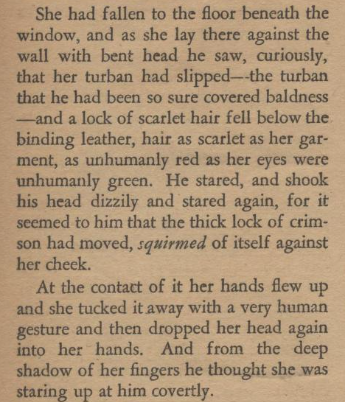
She’s hidin’ some weird wiggly hair under there!
Smith attributes his lust, his revulsion, AND the weird sight of independently moving hair to all the Martian liquor he’d been sucking back all afternoon. He laughs, tosses the Shambleau a heap of blankets, points her to a spot on the floor for her very own, and then decides to sleep it off in his own bed. And then he dreams…

At this point it’s no secret what, broadly, is going on – this Shambleau-girl thing’s weird hard is doing something unnatural to Smith in the night. And he kinda digs it, though he experiences the same sort of weird revulsion at the pleasure he’s experiencing…there’s something deeply existentially wrong about what’s happening, perhaps made more so because it IS so pleasurable.

The weirdness of the dream fades, leaving only Smith with only a vague sense of both wrongness and titillation. He leaves to do some more vaguely crime or crime-adjacent type work, stopping to get a collection of food stuffs for the girl who, OF COURSE, must be getting hungry, right!? There’s also a brief scene that mentions a song that is kind of famous in the world of sci-fi:
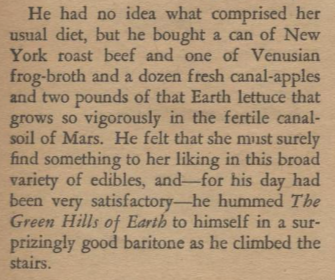
The song mentioned here, The Green Hills of Earth, inspired Heinlein to write a story of the same name, about a wandering space bard whose greatest work is that very song. Heinlein’s story was published in the Saturday Evening Post in 1947, one of the first of the genre works to break out of the pulps and into the fancy slicks, a huge deal for the sci-fi world at the time. Kinda neat to see him calling back to Moore like that!
Anyway, turns out the girl doesn’t like roast beer OR Venusian frog-broth or anything at all! She’ll eat when she’s hungry, she says, don’t worry about it. Seems fine, right? Nothing weird at all going on, I’m sure. Anyway, Smith, exhausted from his hard day of crimes, konks out…and then awakens with a horrible (and yet, somehow, exciting!) sense of foreboding…

Smith watches, hypnotized, as her weird worm hair keeps growing, lengthening and extending out of her head, writhing and squirming as it keeps growing.
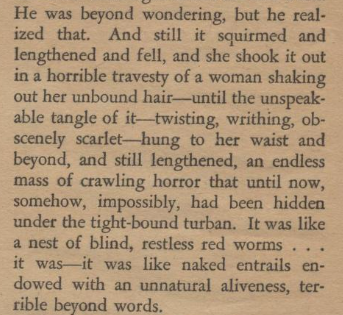
Wild! And gross! Wrapped in her weird wriggling red tendrils, she turns and hits Smith with the ol’ psychic whammy from her green cat-eyes. He’s paralyzed! There’s some great lingering descriptions of this tiny girl nearly lost in a cascade of scarlet, having to part the writhing mass on her head “like a swimmer” in order to move towards him.

That “I shall speak to you now in my own tongue” is pretty great – what IS going on here!?
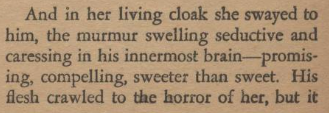

Doesn’t get much more sexual than that, does it? I mean, he’s literally engulfed by this cascade of red organic matter.

And we fade out to tasteful black as Northwest Smith, wrapped in the pulsating red head tentacles of a horrible space monster experiences a mingling of pleasure and horror beyond all human comprehension.

Right away at the beginning of the next section we’re introduced to a sleekly dangerous Venusian, arriving at Smith’s room. This is Yarol, his partner in a crime, and a little further on we learn that he’s arrived to find that none of the footwork he was expecting has been done, and that no one has seen Smith for THREE WHOLE DAYS. Wowzers, huh? Worried, he’s come to check on his friend. And what does he find?
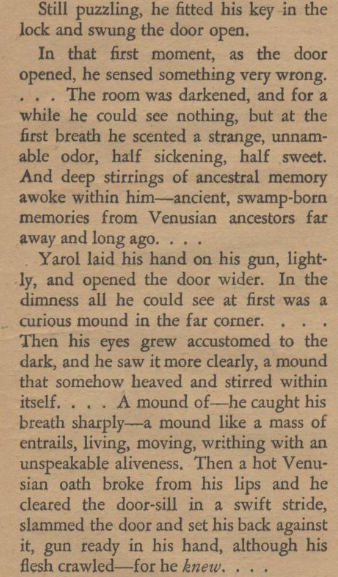
Should’ve put a tie on the doorknob, man! There follows some really great, really viscid description of the scene that Yarol congronts: Smith, entangled in the writhing tendrils, slick head-to-toe from their slime, seems lost to some kind of weird drugged out reverie. Yarol calls to him, and eventually Smith shambles to his feet, still wrapped in a wriggling mass of red wormy tentacles that caress and stroke him with seeming tenderness, but all he can say is “Get out,” over and over again, the words and intonation monotone and devoid of emotion. Undaunted, the Venusian keeps calling to his friend, and apparently annoys the Shambleau enough that it too emerges from the red wiggly lovenest:

Wave after wave of psychic force crash into Yarol, but the depth of Venusian folklore have given Yarol enough sense to know he’s in danger, and that gives him a desperate courage that lets him shake off the mental domination of the Shambleau. He somehow gets a hold of Smith’s shoulder and is able to bodily rip him from the strange embrace of the slimy worm-hair-things. As he does, Yarol comes in contact with the tendrils, and experiences the same confusing blend of pleasure-horror and the secret desire to yield to the lassitude and just sink into the folds of this giant red wiggly mass.
Yarol knows they’re in deadly danger, but luckily, a cracked mirror on the walls lets him pull a Perseus; he uses the mirror to aim his ray gun over his shoulder, and kills the horrible Shambleau!

Smith has been shaken to his core; afterall, he’s been in a clinch with the Shambleau for three goddamn days! Yarol pours more steadying space liquor into him, and then he and Smith do some talking.
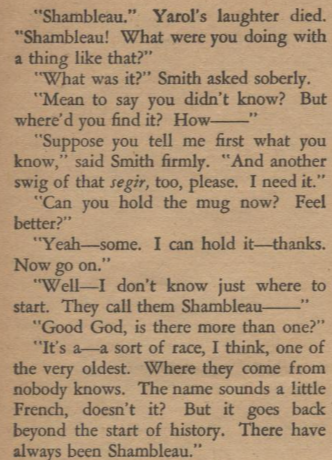
There’s a couple of pages of Yarol talking about the lore and history and rumors of these strange, ancient, monstrous things. They’re an ancient and terrible evil, something whispered about on different worlds and by different peoples. But what ARE they, asks Smith, and Yarol answers:

So the Shambleau is a weird life-force draining predator, something that derives its sustenance from the emotional and vital energies of its victims. It’s good and weird and creepy…but is there more to it? Remember the “now I’ll talk to you in my language!” stuff? Well, seems that while Smith was in the things thrall, he was seeing and remembering things that weren’t his memories or experiences…
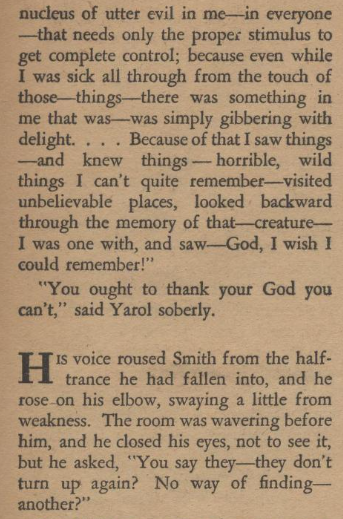
How’s that little quote at the end of that section there for chilling, huh? Has Smith become, in some way, addicted (or nearly so) to the Shambleau’s darkly pleasurable illumination. He can’t remember the strange, alien things he experienced…but has he been freed, actually? Yarol shakes his friend and, since he just saved his life, basically immediately calls in the favor and demands that Smith promise him that, if he EVER runs across a Shambleau again, he’ll cut it down with his ray gun immediately! And Smith’s answer?
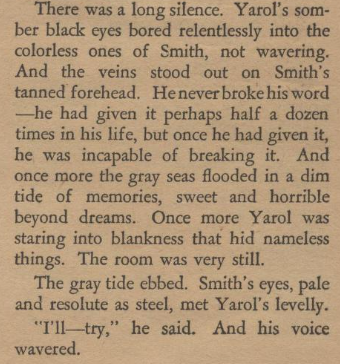
And THAT’S the end of the story.
Hell of a ride, huh? Really some great writing in there, too – the Shambleau is a weird-as-hell monster, and the whole horror of it is so unusual and mysterious and alien. The communication aspect of its feeding mechanism is interesting – there’s an exchange of not just life force but also information, experience, and memory that happens. Is the dark drive that makes the horror of the Shambleau so pleasurable tied up in that, a kind of personal, existential oblivion that overwhelms the need for survival in an individual? Is the Shambleau even conventionally “evil?” There’s the usual “perhaps we are as ants to them” stuff in this story, but it’s so much better developed; the Shambleau is truly and weirdly alien enough that you actually CAN much more easily begin to question whether our morals and ethics can apply to something like that.
It’s SO alien, though, that I kind of think the “ah, it is the medusa of legend” detracts a little from it, you know? I think you could yank ALL that out of here and be left with at least as good of a story (if not a better one), but maybe that’s just me. I sort of feel like that, in an attempt to make it weirder, Moore kind of undercut it by adding all that in.
The attempted lynching is a rough spot though, particularly because in the story the mob is right. The Shambleau is a dangerous monster in their midst, after all, unequivocally so! It’ll hypno you and suck out all your life force, and you’ll beg it to do it! I don’t think Moore is saying anything about lynchings or mobs or trying to make any kind of argument about actual real racial violence, but as readers we’re still forced to confront it and its place in the history of literature. In fact, it’s kind of interesting that Northwest Smith, originally a cowboy character, is introduced in an extremely cowboy story fashion. Take out all the sci-fi trappings of that early section, and you could plop that whole scene into a pulp western story and never even know it had ever been anything else.
I do think that Moore is interested in female agency, though; it’s certainly a topic that comes up again and again in her stories, as we’ll see as we move through Moorevember. Particularly in the pulps of the 30s, there’s a dearth of women characters doing much more than being menaced and/or saved (and that’s when the even show up) so to have a female character AS the menace is interesting here. And while she’s a monster, the Shambleau is also very much portrayed as a woman (even if she’s maybe really a mass of weird worms) – her positionality with regards to Smith makes that clear, and the way that Moore describes her makes her out to be elementally and animalistically female. Importantly though, the Shambleau as written is not using sex to get what she wants, as some sort of trap or lure. It seems very clear that she is, if you’ll excuse my indelicacy, getting off on the weird life force sucking/mental link up too! Now, there’s a long history in lit of portraying how women’s pleasure, when unchecked, becomes monstrous and threatening; maybe this trucks in that same sort of stuff, but it does seem different somehow, doesn’t it? But even if it is as simple as “this sexpot is destructive!” I think there IS a difference in the way that the Shambleau is written – she’s not reductively monstrous, right, meaning that she’s not just this vagina dentata running around eating men because it’s fun – she’s an ancient and alien species, with pride and dignity, and that makes her a much deeper and more interesting threat.
Speaking of sex, you can’t ignore the strange homoerotic undertones to Yarol and Smith either, can you? It’s almost passé, but there IS a kind of rough tenderness between the two of them, particularly when Yarol is nursing Smith back to health.
What’s obvious is the richness of the text, though; I can understand why Wright declared a “C.L. Moore Day” after reading it. It’s really well written and, of course, there’s a good monster in there. But there’s a lot of depth to it, and I think Smith IS one of the great sci-fi characters of that era of writing. He’s hardboiled and two-fisted, but that’s never “the point” with him, and he’s even made the victim in this story, something that I’m sure made some readers at least uncomfortable. I haven’t done it, but it might be worth going through subsequent letter sections of Weird Tales to see what people wrote in about this story.
Anyway, I obviously can’t recommend this one enough! It’s a great story that stands up to anything written today, in my opinion, and I really hope ya’ll have taken the time to read it! And, having read it, I hope ya’ll are excited as me about Moorevember!
 Eric Williams
Pingback: End of Moorevember #15: Sword and Sorcery edition! “The Black God’s Kiss” by C.L. Moore, Weird Tales Oct 1934 (v.24, n.4) | Eric Williams
Pingback: Straining the Pulp to the Breaking Point #20: “When the Bough Breaks” by Lewis Padgett, Astounding Science Fiction, Vol.34 No. 3, Nov. 1944 | Eric Williams
Pingback: Clarissa Pulps it All #30: Moorevember already!? “The Children’s Hour” by Lawrence O’Donnell (Nom de Plume of C.L. Moore and Henry Kuttner) Astouding, v.33 n.1, March 1944 | Eric Williams