
I was far from home, and the spell of the eastern sea was upon me. In the twilight I heard it pounding on the rocks, and I knew it lay just over the hill where the twisting willows writhed against the clearing sky and the first stars of evening. And because my fathers had called me to the old town beyond, I pushed on through the shallow, new-fallen snow along the road that soared lonely up to where Aldebaran twinkled among the trees; on toward the very ancient town I had never seen but often dreamed of.
                                                     -H.P. Lovecraft, "The Festival"
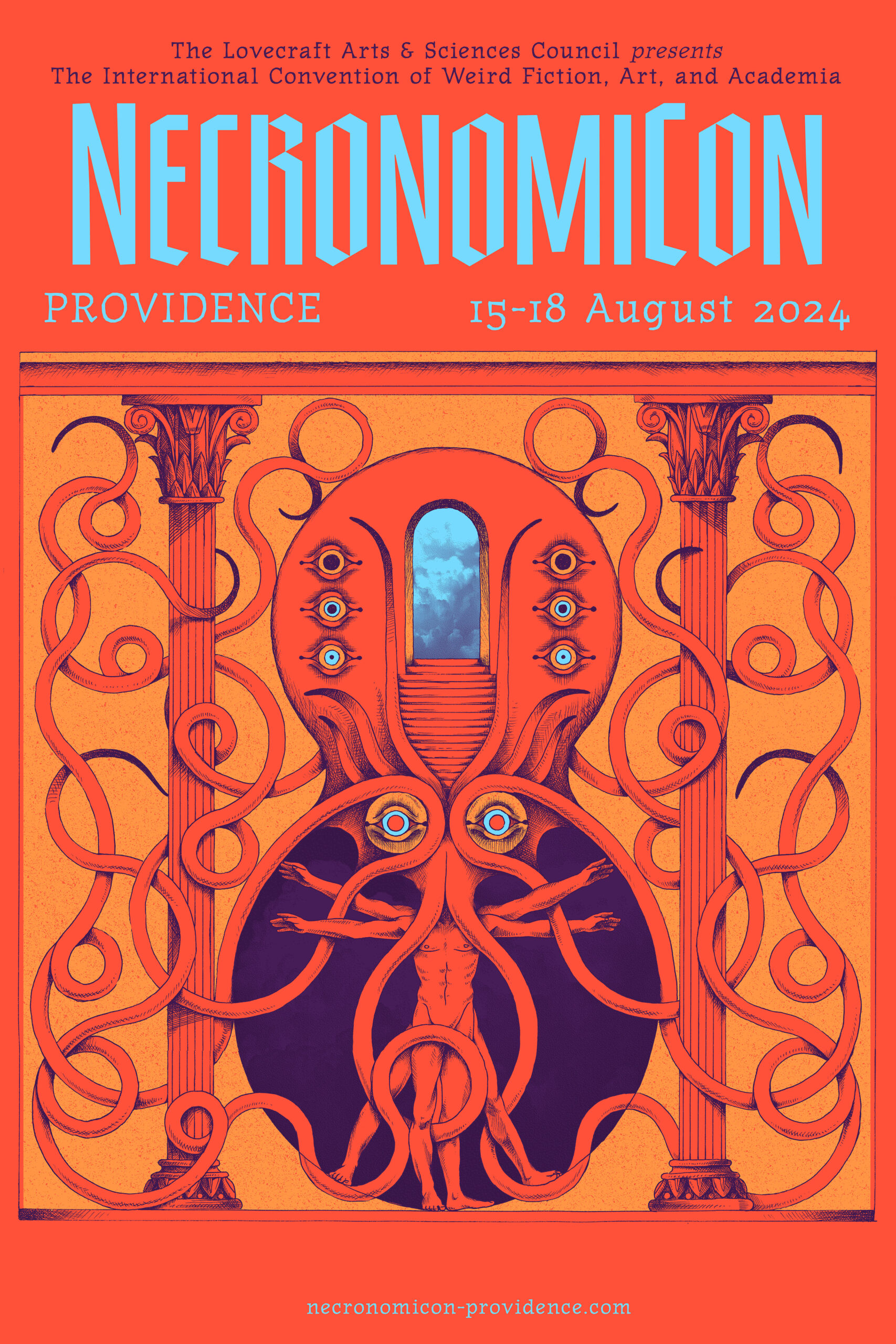
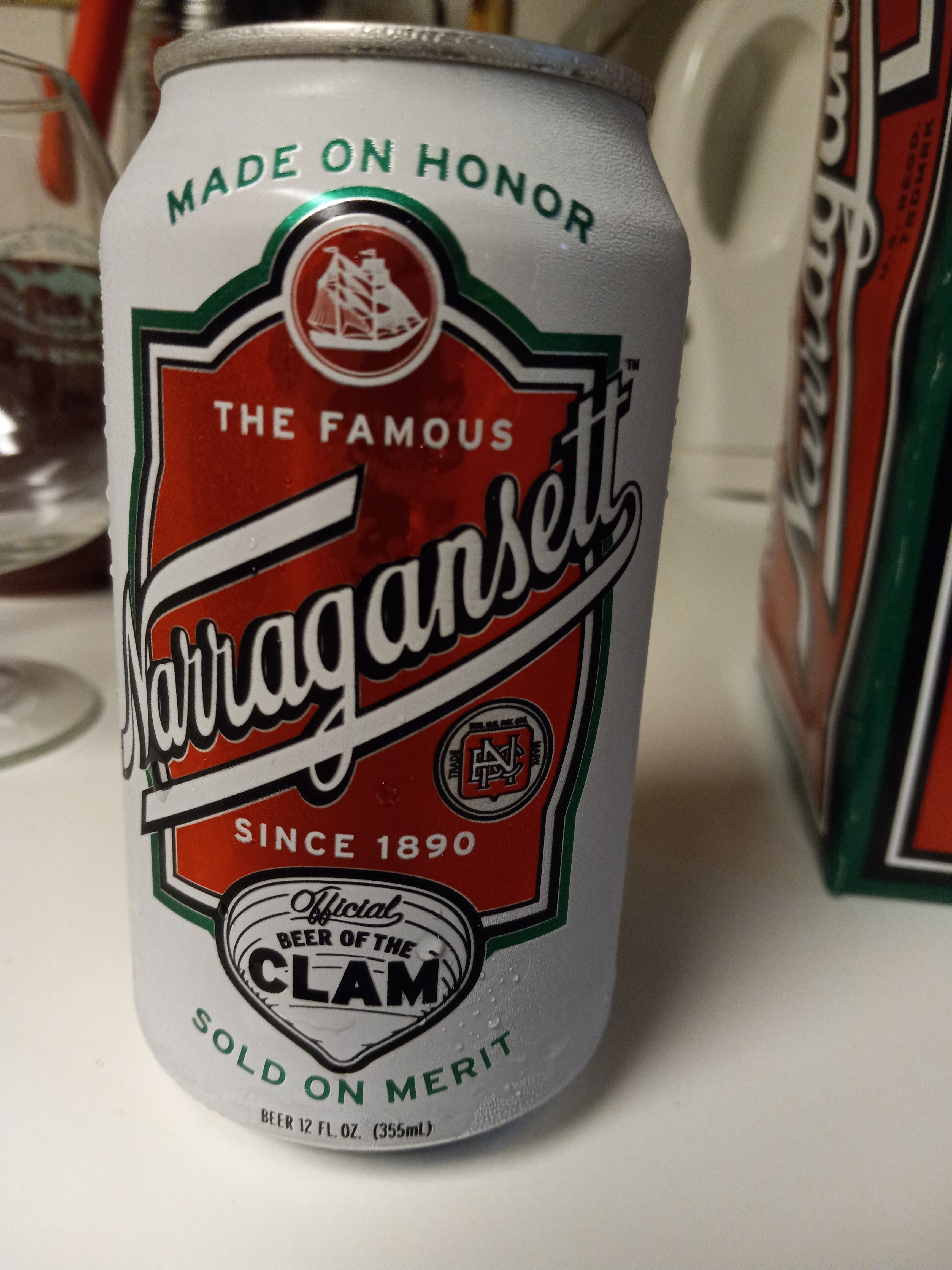
Much like Lovecraft’s narrator in “The Festival,” I too have recently sojourned to the haunted landscape of New England to partake in (un)hallowed rites kept by the mysterious adherent of a strange and ancient faith. But while Lovecraft’s narrator was celebrating a pagan Yule with ambulatory coffin-worms and subterranean evil, I was in Providence, R.I. for the biennial celebration of weird fiction that is NecronomiCon! Less flopping writhing hordes of unspeakable winged things, more Narragansett beer and (affectionately) nerds!
Now, I’m not much of convention-goer – been to lots of academic conferences, of course, mostly geology- or (these days) soil science-related affairs, extremely nerdy, sure, but not really what you’d call “fan” conventions. Never been to one of them, not even a sci-fi convention! As for my work as a writer, the first convention I experienced was this past spring’s Greater Austin Book Fair, a decidedly small and local effort (though very fun). So this one was really jumping into the deep end for me – I mean, this is a BIG conference, with 2000+ people!
In fact, it’s so outside my wheelhouse, I wouldn’t ever have thought to go if not for Rick Claypool, friend, comrade, writer; he contacted me out of the blue in the spring and suggested that I should A) attend and B) split a table with him. It was an awfully generous gesture, something that I would soon learn is the norm at NecronomiCon, which, not to spoil it, had probably the absolute best vibes, atmosphere, and programming imaginable. Anyway, huge thanks to Rick, and I am going to demand ya’ll head over to his site and use the links he’s provided to buy his books; if you like strange, goopy, heartfelt weird horror with a heavy dollop of absurdism and surreality, you’ll love his stuff.
Rick was also helpful in that he, being an old hand at NecronomiCons, understood the somewhat idiosyncratic (at least, to me) ways in which the convention was organized. The first and strangest hurdle for me was understanding how paneling works there. Now, like I said, I’m used to academic conferences; the way those work, there’s a host committee, see, and at some point you and some folks put together a panel suggestion, a topic or problem you want to talk about, say “Tectonics of the Delaware Basin” or “Soil Chelates and Contamination.” This gets approved by the committee, and then other workers (who you’ve mostly already alerted to the fact that there’ll be a relevant panel) submit papers to those panels, which are then evaluated and included or rejected. Well, and perhaps this shows my naivete with regard to fan cons, that ain’t the way things happen in Providence.
Instead, panel topics are decided by the organizers, and then everybody who has paneled before or expressed an interest in paneling gets a list, scans ’em, and says if they’d like to be involved in any. I guess it’s a little different because, unlike academic conferences, you’re not presenting a paper, you’re a panelist having a discussion – less prep, I suppose, and less formality, a bit freer-form. What’s interesting to me is that the moderators of the panel are likewise drawn from the population of people who say they’d be interested in paneling on the topic. So you could go in expecting that you’re going to just sit up there and wax moronic about some topic or another, but end up being forced to ride herd on a bunch of other people who you’ve likely never met or interacted with! A strange scene!
My only prior experience was the Greater Austin Book Festival, where I’d said I’d love to be on a panel…and didn’t get on one. This makes sense, it’s much smaller, there’s lots of horror and genre people, so of course I didn’t get on there. However, what that meant for me was this: I really wanted to be on a panel, so I put myself down for a LOT of panels, assuming that’d give me a chance to get on ONE of them. Similarly, this same form had a spot you could check if you wanted to do a reading. “Why the hell not?” I thought, and clicked the button.
Simultaneously, there IS also an academic track to NecronomiCon. It’s called “The Armitage Symposium,” and rather than discussion panels, it’s a more traditional 15-min presentations of a scholarly sort. I had written a lightly scholarly intro to Night Fears, about Farnsworth Wright and the fiction-in-translation that appeared in Weird Tales magazine in the 20s and 30s, so I figured I could write an abstract based on that and submit it. The whole plan was, with so many chances, surely I’d get something! I’m a nobody author who wanted to sell some books at this Con, and I figured getting on a panel or giving a talk or reading would be necessary for that to work out – otherwise I’d just be some guy at a table.
Well, ask and ye shall receive: I ended up being a moderator for a panel of Translations in Weird Fiction, a panelist on three others (one on Belgian weird writer Jean Ray, one on the letters of Robert E. Howard and H.P. Lovecraft, and one on The Hollow Earth in Weird Fiction)…and the abstract for my paper “Translating the Weird: Farnsworth Wright, World Literature, and the Creation of Weird Fiction” was accepted to the symposium…and I got reading slot. Six scheduled events for a three day conference! Yeesh!
Anyway, the 15th was mostly an open day – I hadn’t moved fast enough to get a walking tour ticket, so instead I used the very helpful map provided by the Con to do one on my own. Lovecraft is an important figure for me personally, so it was a lot of fun to wander around and see some of the important locales from his life and stories live and in person. The first thing I actually saw on the way from the train station, walking up College Hill to the bus stop that would take me to where I was staying in East Providence…it’s the famous Fleur de Lys building from Lovecraft’s “The Call of Cthulhu,” where the psychically sensitive artist Wilcox lived and dreamt of a great lumbering horror.
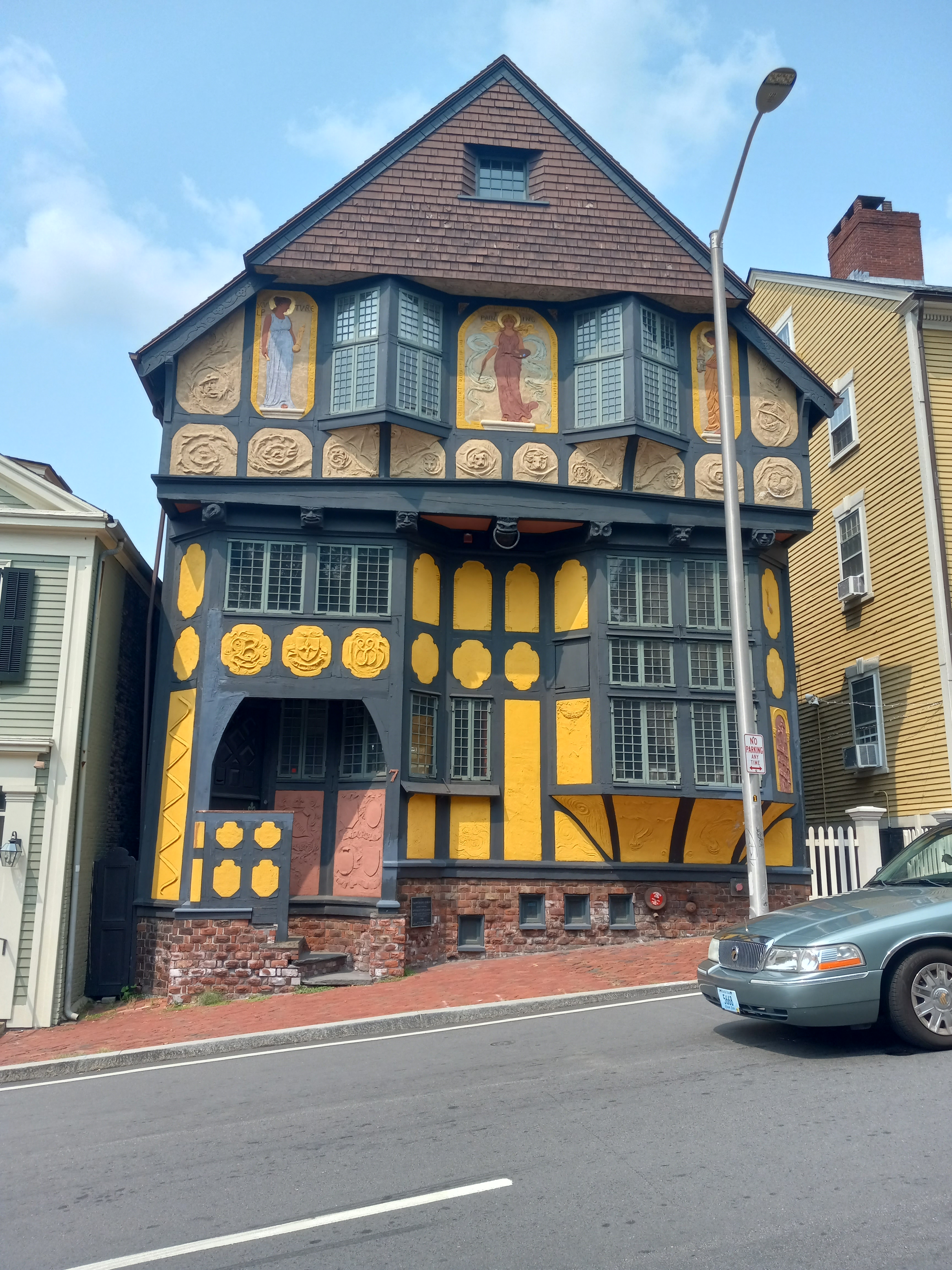
Famously Lovecraft, a bit of a conservative architecture snob, thought this building was ugly as hell…and he might have a point. It is neat looking, in a gaudy, over-the-top kind of way. My understanding is that it’s owned by the Rhode Island School of Design, and they rent out studio space in it to artists, which is fun.
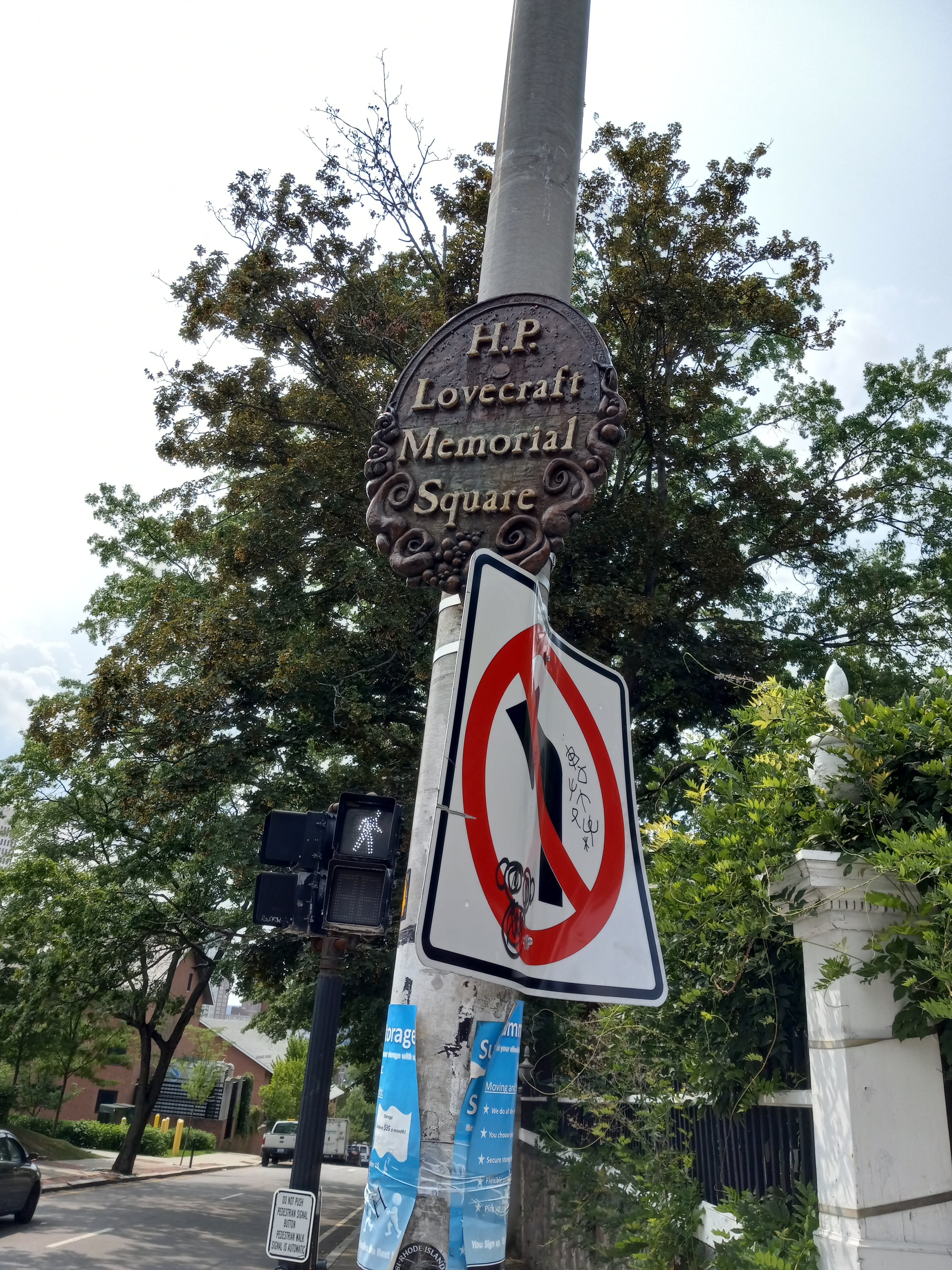
Anyway, I continued up the big ol’ hill to the intersection of Prospect and Angell streets, on the corner of which lil’ Howie Phillips Lovecraft was born in 1890. Now, it’s the “H.P. Lovecraft Memorial Square” which is kind of grandiose for an intersection, but still, nice sign!
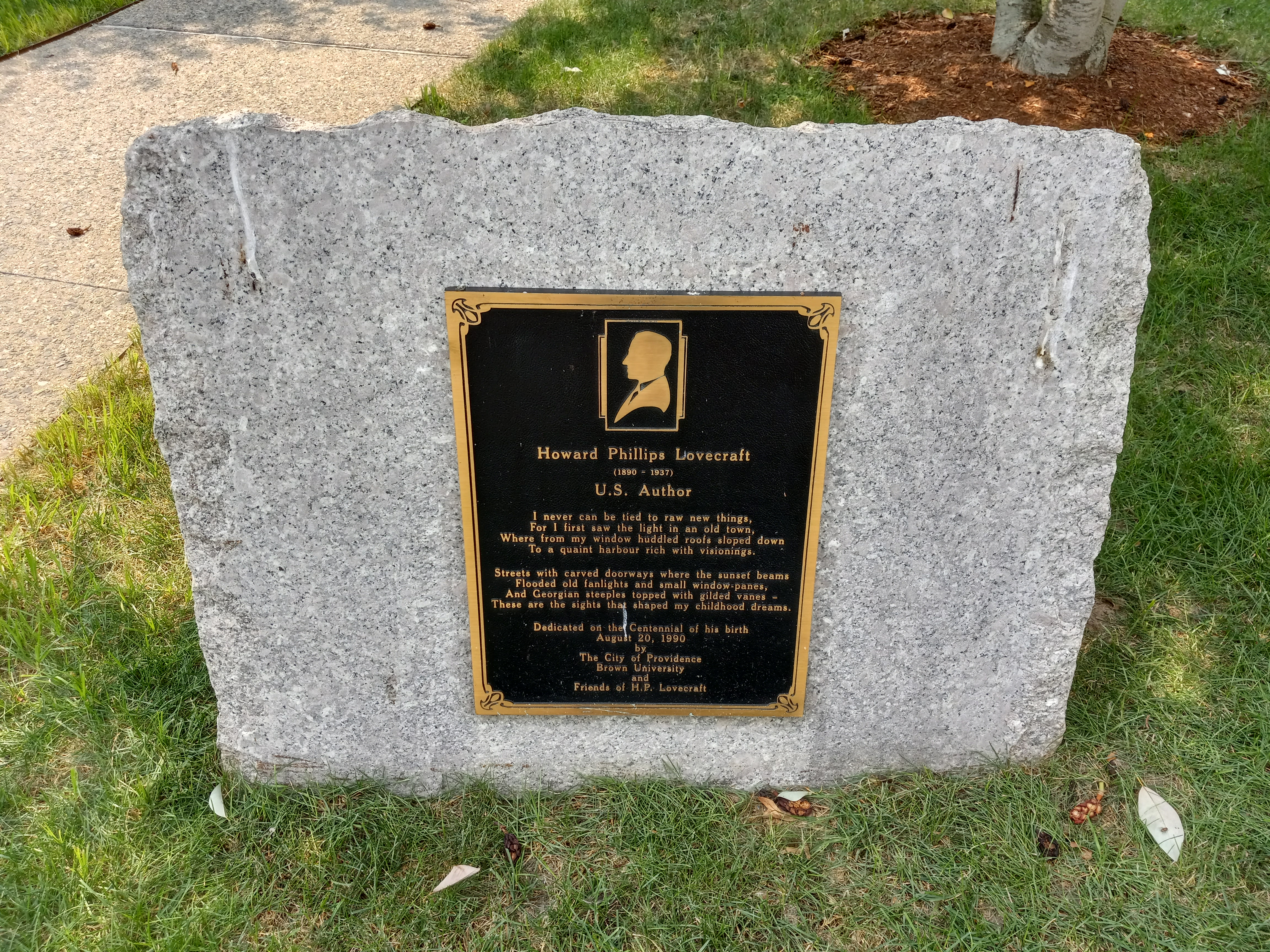
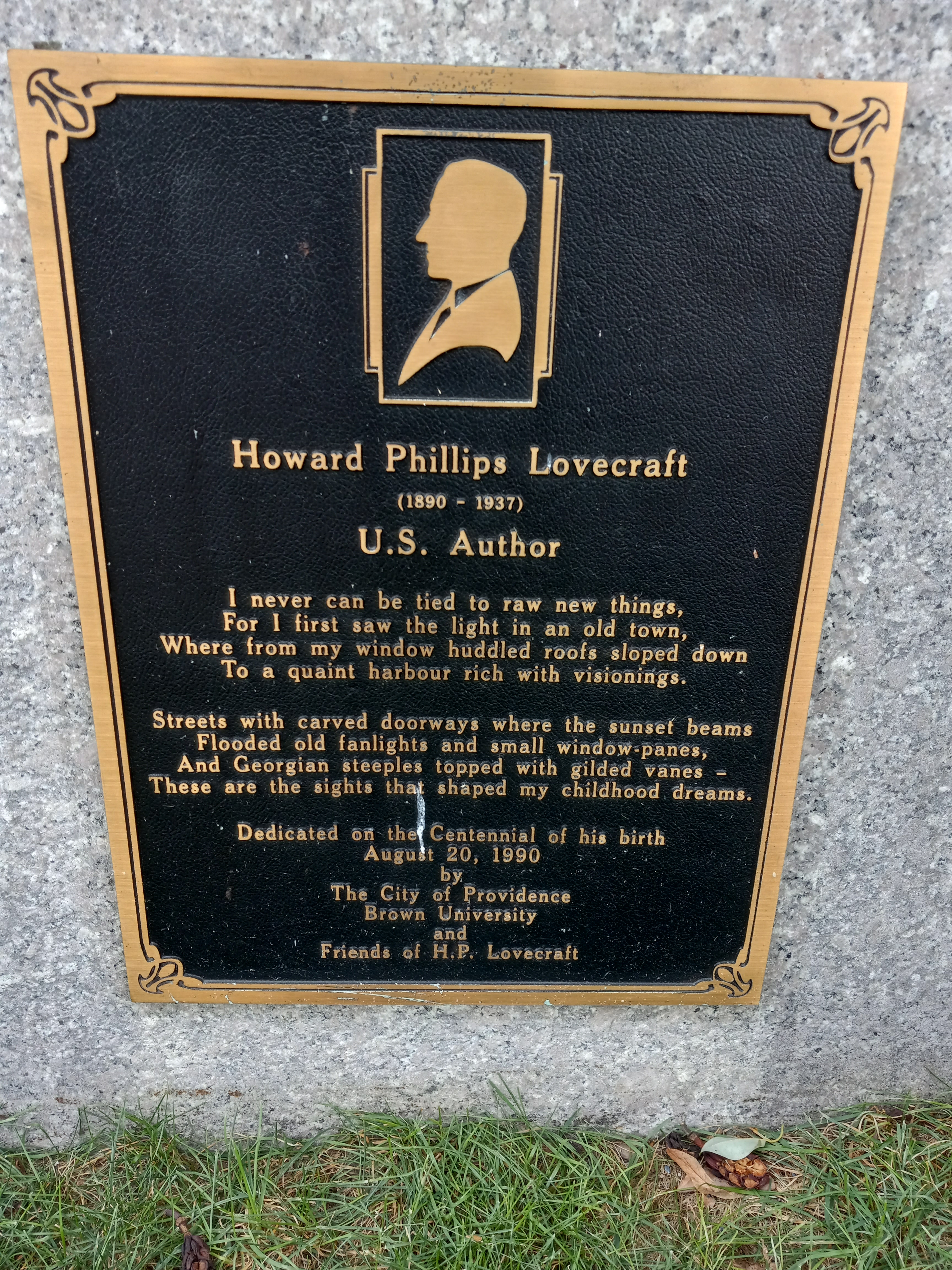
Continuing down Prospect street towards Brown University, I came across a nice little plaque-n-plinth put up near the John Hay Library (itself a Lovecraftian destination). The Hay Library is also where most of Lovecraft’s papers and original manuscripts are housed, something that would probably tickle the Old Gent to no end. It was put up in 1990 on the centennial of his birth, and honestly is remarkably restrained and tasteful!
Here’s the text a little clearer – it’s Sonnet XXX from his long poem cycle “The Fungi from Yuggoth” (which, in my opinion, is a clear response from Lovecraft to modernist poetry in general and T.S. Eliot in particular):
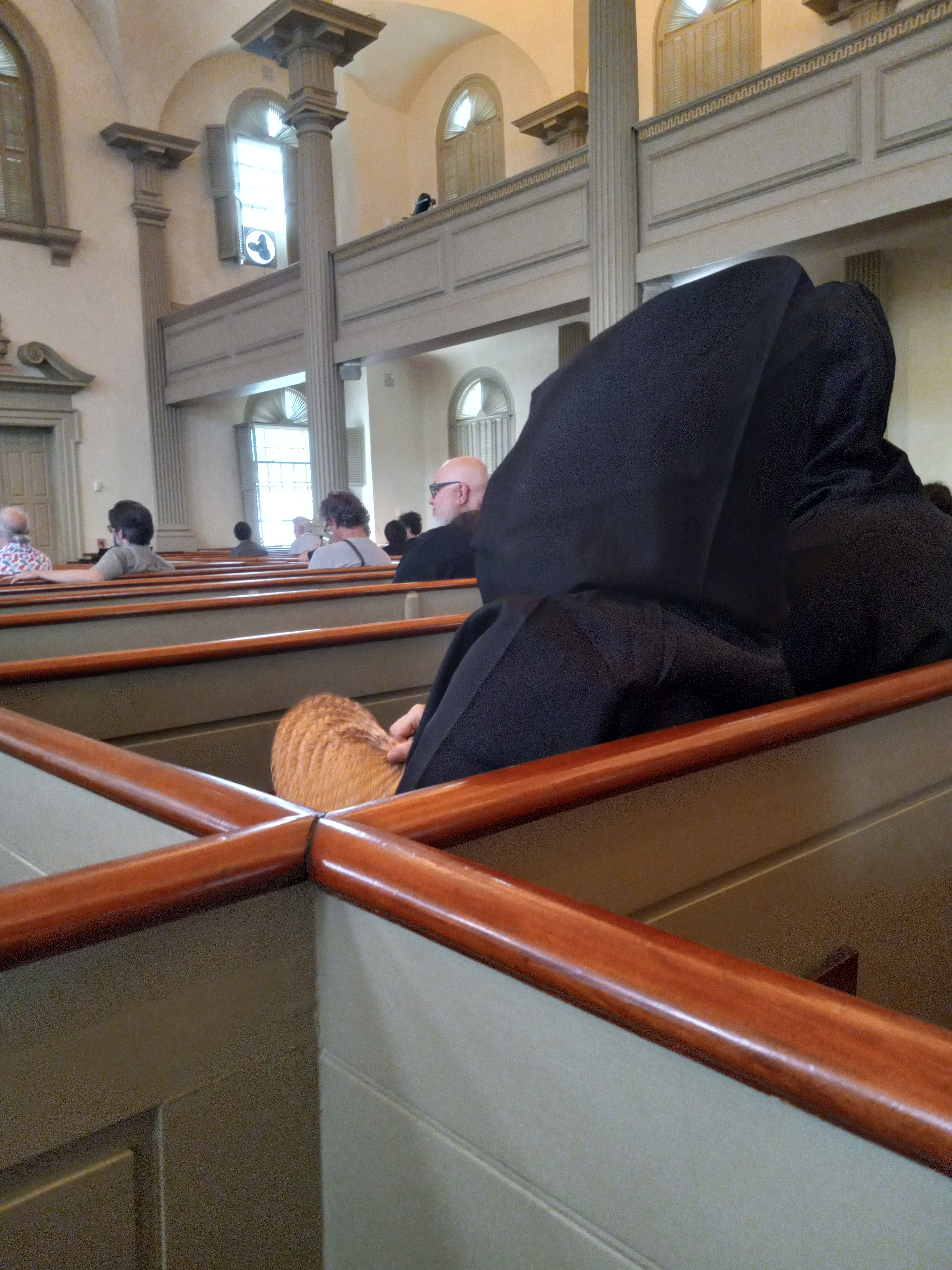
After some more trompin’ about gawkin’ at stuff, I made my way over to the First Baptist Church (literally, it’s the very First Baptist Church in the U.S., ever), where they held the opening ceremonies for the conference. It’s a wild building, huge and with these very strange, box-like pews, so the whole seating arrangement is this odd, chambered affair.

And, if you were wondering, yes, there were cultists there:
Now, like I said, by this point I’d had very little in the way of interactions with the convention or my fellow attendees; I’d registered and got my name tag and program, had gone in and set up my books at the vendors’ table, been to a beer thing out at Narragansett Brewing, all great and fun, but you know how it is…this was my first time there, I didn’t really know what was going on, per say. And with Lovecraft, a reactionary and truly vile racist, that’s kind of important – how was this convention positioning itself with regards to a guy who, basically, represented the aesthetic origins of modern weird fiction? Famously, Lovecraft scholar and one of the architects of the weird revival, S.T. Joshi, was kind of a prick about peoples’ attempts to wrestle with this legacy in any way (sincerely, fuck that guy). Would this conference be more of the same?
I’m happy and heartened to say that was not the case; NecronomiCon in fact very deliberately and proactively sets itself not merely in opposition to the racism, sexism, and homophobia of the Old Ways, but in confrontation with it. The head honcho in charge of organizing the whole Con (and also the head of the Lovecraft Arts and Sciences organization) Niels-Viggo Hobbs got up and, almost immediately, proceeded to articulate a vision of weird horror that specifically sought to correct the biases and prejudices of the past, centering individuals who were exactly the sort of people that Lovecraft would’ve been horrified to see given prominence in the community. Case in point: the poet laureate of the conference was Brandon O’Brien, a poet of the weird from Trinidad and Tobago who gave a great reading of a piece he’d written specifically for the convention, and who represents a new and vital evolution of the weird genre that was really exciting to see in action.
I want to be clear – we’ve all seen the sort of “here’s the land acknowledgement, now we’re done and everybody needs to shut up about it” approach to these problems. As a geologist, one of the whitest and malest of the sciences (seriously, it gives fucking PHYSICS a run for its money in that regard), I’m VERY familiar with this “we’ve tried NOTHING and we’re out of ideas!” approach to fixing this problem. But at the Con, there was constant confrontation with the past, reckoning with Lovecraft and his era at all levels of weird fiction. And it was very clear, from the panels, from the readings, from interactions with people in the hotels or in the big Vendors’ Hall, that this was something integral to the way everyone was thinking about weird fic.
Refreshingly, it went beyond the individualistic “I’m okay, you’re okay” sort of acceptance that dominates a lot of the broadly apolitical and politely centrist neoliberal public sphere – this was an explicitly political program, both among the organizers and among the attendees, who all recognized that the community of weird fiction people could not merely tolerate or accept difference, but rather had to foster it by publicly confronting the past while also encouraging new and underrepresented people to get into the field. More needs to be done, certainly – there are not enough black and brown people there, but nowhere have I seen such a proactive recognition of that fact.
Case in point, so many of the panels were devoted to expanding the canon of weirdness by introducing attendees to new and often non-anglophone writers. That’s remarkable! I moderated a fantastic panel on weird fiction in translation, with five panelists, translators or editors of weird fic in translation, who led a great discussion on the art and science of translation, on their own approaches to the problems, and on the underrepresented literatures of the world. It was really well attended (including by Matthew Spencer, the publisher behind Paradise Editions, who drove all the way up to Providence from PA to support our book, Night Fears) and there was a real excitement about both translations as well as translation as a practice. It was great! Similarly, the academic portion of the conference, the Armitage Symposium, had an entire panel devoted to Weird Fiction in Translation/National Literatures – I gave my talk on Farnsworth Wright and the translations in Weird Tales alongside scholars giving talks on Mariana Enriquez and the Bhagavad Gita. There’s a real hunger for new work out there, and a recognition that there’s more to literature than the traditional english-language stuff. It’s exciting times!
The same forward-thinking approach was applied to the other historical panels I encountered as well. I was on a panel about the “Belgian Poe” Jean Ray, and there were great discussions about his fiction and aesthetic, of course, but also a serious and productive exploration of his truly vile anti-Semitism, something the audience was clearly interested and happy to participate in. And during another panel I was on, about the letters of Robert E. Howard and H.P. Lovecraft, we also were able to integrate the discussion of these two artists’ bad politics and racism into their work, without giving short shrift to either. Same thing in the Hollow Earth panel, which had a lot to discuss regarding both modern conspiracism as well as the poisoned utopias of the older literature. I guess what I’m saying is that I was surprised at how mature and serious these panels were being taken by everybody involved, panelists and audiences alike. These were serious discussions of literature that were being informed by history and placed in context! Nothing at all like what I expected from a “fan” convention! It was remarkable.
I’ll just say I had similar conversations with people outside of the panels too. Folks would stop by the table or get talking in the hallways, and everyone was eager to have a real conversation about these things. Sometimes, particularly in nerd-heavy situations, you’ll encounter the “shut up and let me talk at you!” approach to the conversational arts, but goddammit I didn’t see or experience a single instance of that! Everyone wanted to talk WITH you about something, a rare occurrence these days. But it was definitely the norm at NecronomiCon. Everyone was also just so goddamn friendly and welcoming – really, it was an amazing experience! None of the aloofness or cliquishness you see at conferences, just everybody coming together in celebration of something they love. Honestly heartwarming to see.
I don’t think it’s rose-colored glasses, although maybe I’m in such a good mood because I sold out of all the books I brought (like 40 all together, twenty copies of each) and didn’t have to haul any back home with me on the plane.
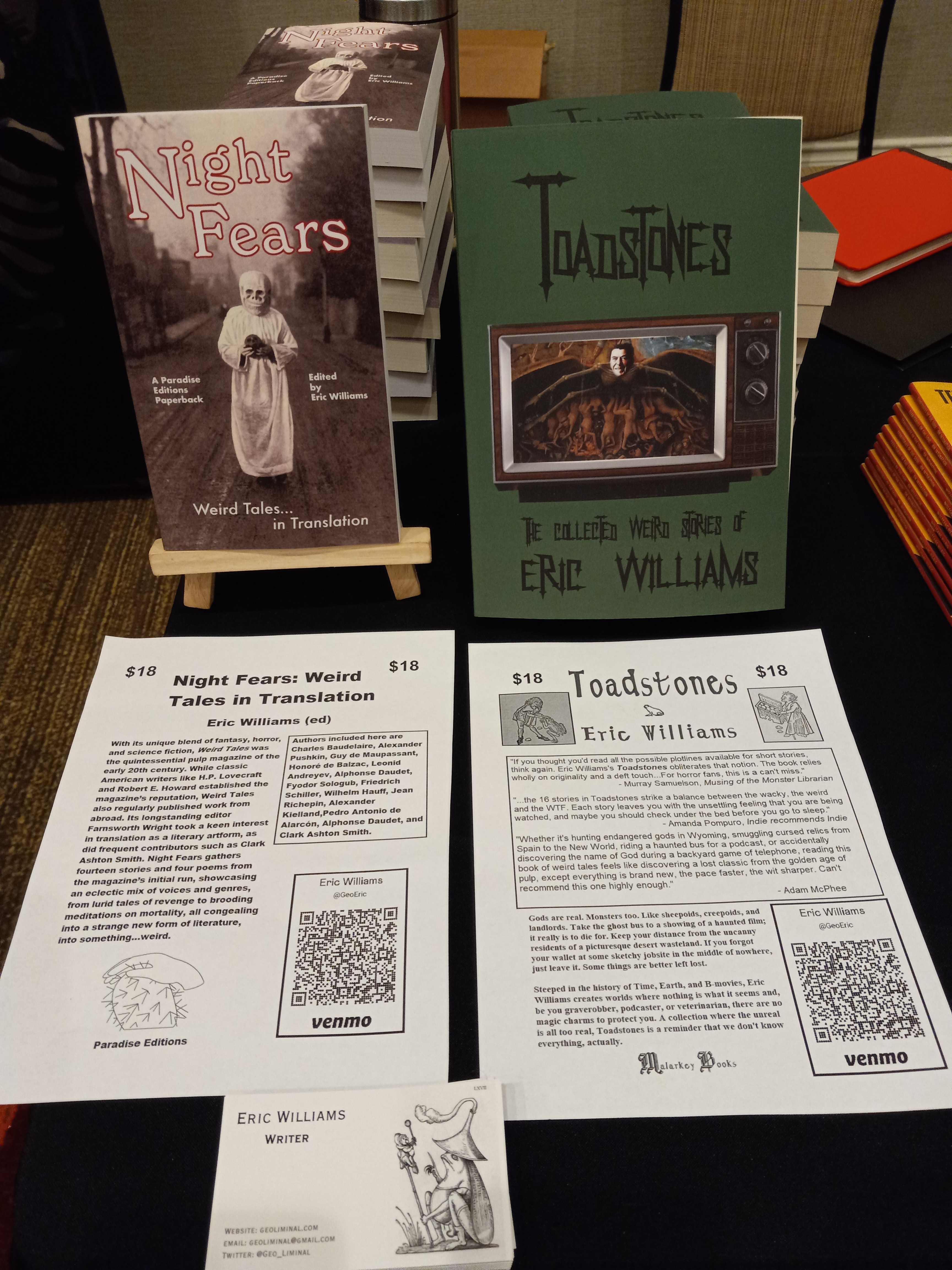
In hindsight, I think being on a million panels plus doing a reading and giving a symposium talk are definitely why I was able to sell these books – I’m just some schmuck nobody has ever heard of, but all of those gave people a chance to see me, hear me, get a sense of me and my writing that, otherwise, would be very heard to come across in the scrum of a vendors’ hall. At first I was thinking I’d want to not do half as much as I did in terms of panels, but honestly I think I’d happily take on a load like that again.
I’ve gone on really long, just trying to unpack my thoughts about this conference which surpassed everything I expected it to be. Really, sincerely, honestly: it was so much fun, everyone was so friendly and welcoming, the community is such a joyful and vibrant one, the programming is absolutely some of the best literary discussions you’ll ever see, and there’s also a pile of amazing shit to buy in the vendors’ hall. And Providence is a great little town! If you’re a weird fic fan (or a gaming fan – there’s like a parallel ttrpg convention that ran concurrently) then it’s absolutely a must. If you’re a weird fic author, I’d really strongly recommend you attend and get on as many panels as you can comfortably do. I had an absolute blast and will definitely be attended the next on in ’26.
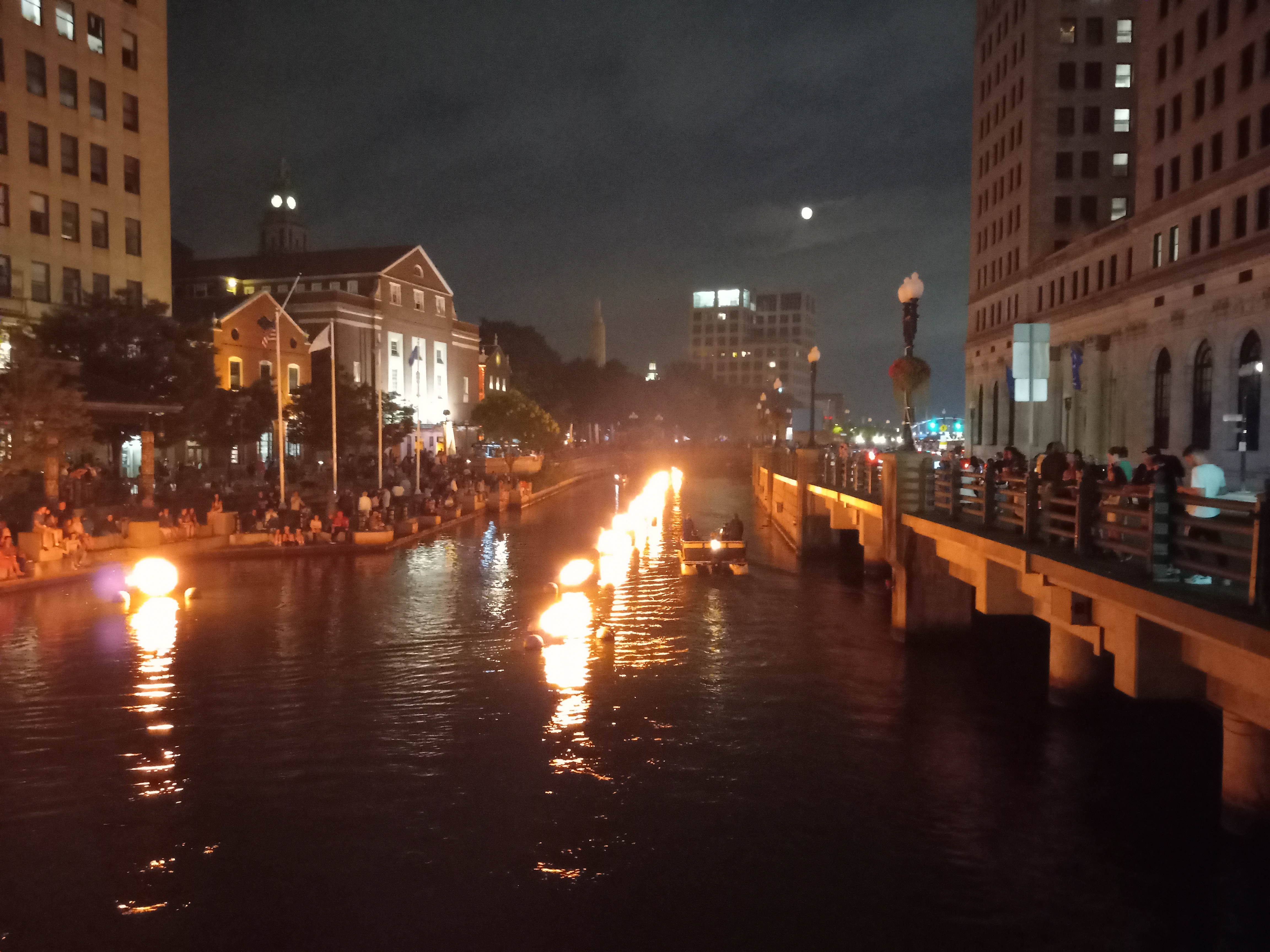
Anyway, let’s end on a picture of the weird thing Providence does sometimes, when they set these braziers in the river on fire amid a carnivalesque scene of revelry and debauchery. Like I said, it’s a fun town!
 Eric Williams