Tag Archives: cosmic-horror

Cthulhu, quo vadis? Cosmic Horror and the 21st century

Now all my tales are based on the fundamental premise that common human laws and interests and emotions have no validity or significance in the vast cosmos-at-large.

H.P. Lovecraft to Farnsworth Wright, July 5 1927

Only at a dread of dark

Quaver, and they quit their form:

Thousand eyeballs under hoods

Have you by the hair.

Enter these enchanted woods,

You who dare.

“The Woods of Westermaine” by George Meredith (1883)

H.P. Lovecraft inaugurated a revolution in modern imaginative fiction when he articulated, in stories, essays, and letters, the philosophical underpinning of his cosmic approach to horror. In perhaps his most autobiographically informed story, “The Silver Key,” Lovecraft wrote that “the blind cosmos grinds aimlessly on from nothing to something and from something back to nothing again, neither heeding nor knowing the wishes or existence of the minds that flicker for a second now and then in the darkness.[1]” This was indeed the key to Lovecraft’s concept of weird fiction, where the horror of a tale arises not from rank supernaturalism or mere physical danger, but from the revelation that the anthropocentric view of the world, with human beings crowned in the center of creation, is not merely mistaken, but actively delusional.

This radical decentering of humanity was a favored “punchline” in many of his stories: humans are revealed to be merely the accidental byproduct of Elder Thing bioengineering in “The Mountains of Madness;” the vanity of human supremacy is punctured by the reproductive machinations of the Deep Ones in “The Shadow over Innsmouth;” the presumed permanence of human civilization is shown to be a mere footnote in the vast sweep of the biological history of Earth in “The Shadow Out of Time;” even our ability to physically comprehend the universe is questioned in “The Colour Out of Space.” In these and other stories, Lovecraft uses the abjectification of humans as the shocking denouement of his weird fiction.

Part and parcel with this is Lovecraft’s twisting of the very idea of the ineffable march of progress. Crawford Tillinghast in “From Beyond” has created a machine that exposes the deeper but otherwise invisible reality of nature, revealing a maddening world of alien existences beyond the ability of our paltry senses to perceive. More to the point, in the famous opening to “The Call of Cthulhu,” Lovecraft completely inverts the positivist narrative of early 20th century science and technology; rather than advancing human knowledge and prosperity,

The sciences, each straining in its own direction, have hitherto harmed us little; but some day the piecing together of dissociated knowledge will open up such terrifying vistas of reality, and of our frightful position therein, that we shall either go mad from the revelation or flee from the deadly light into the peace and safety of a new dark age.[2]

In fact, Lovecraft’s “cosmic indifference” relies on the idea that an increasing knowledge base, whether individually or socially, inevitably overturns the comfortable fiction of the primacy and permanence of humanity.

These two concepts, an indifferent universe in which humanity is menaced by vast forces beyond their comprehension and a world in which the inevitable progress of human knowledge is an existential threat to humanity, represent the major aesthetic and thematic development in horror literature in the early 20th century. Lovecraft’s articulation of them is not entirely sui generis of course (he himself acknowledged his debt to his literary antecedents), but his work is unique in its almost single-minded exploration of what has come to be called “cosmicism.” More to the point, Lovecraft’s popularity, initially as a beloved cult writer but, more recently, as an important figure that has influenced both literary[3] and popular culture[4], has ensured that cosmic horror has become a part of the zeitgeist.

From the perspective of early 20th century America, the aesthetic pleasure and transgressive appeal of cosmicism as a philosophy of horror is evident; it toyed nicely with the very real fear that the grand American experiment was not as unassailable and inevitable as it seemed. It titillated readers by undermining the placidly bourgeois status quo with the threat of displacement by the alien Other, with miscegenation, and with the possibility that the universe was not as neatly Panglossian as all that. In this way, Lovecraft’s cosmic horror simply (though extremely) extrapolated from the conclusions of contemporary science. The realization of the depths of Deep Time in Earth’s history, the identification of extinction as a biological possibility for any species, the Darwinian revolution, and finally the discovery of a whole world of invisible energy and effects in the form of radiation – all of these things factually decentered humanity, making them subject to nature rather than its overlord and highlighting our smallness and fragility.

For cosmic horror’s decentering to be shocking and transgressive, however, it requires first that humans be assumed to be at the center – this is how the revelation of cosmic indifference can function as the frightful climax of a story. In Lovecraft’s milieu of the early 20th century this was indeed the case, with a popular status quo best be described as broadly anthropocentric and positivist.

But in the 21st Century, do these same assumptions exist? And if not, if the wider cultural understanding of humans now is that they have already been decentered, what does that mean for our concept of cosmic horror?

After all, it’s not much of a dark epiphany to state that human beings are small animals in an uncaring world – that’s the lived experience of the 21st century, reinforced daily. Humanity is existentially threatened by maddeningly complex forces that operate on scales we can scarcely conceive. Climate change, pandemics, capitalism; all of these threats represent as profound a reordering of humanity’s relationship to the world around them as anything Lovecraft ever wrote. The primary revelation of cosmicism, that humans are not special and that the universe will not shepherd them safely through danger, is simply the fundamental background noise of day-to-day life. Any real person believing otherwise strikes us as delusional, and it’s laughable to imagine a horror protagonist beginning from a place of such naivety, such that the shattering of that illusion is merely corrective, rather than shocking or transgressive.

Similarly, cosmic horror’s “piecing together” of knowledge into a starkly and bleakly apocalyptic whole seems quaint and ridiculously optimistic in a world of commodified corporatized science, slashed funding for research, a “post-fact” media landscape, and the hallucinogenic world of venture capitalist A.I. schemes. The popular median view of technological “progress” is purely declensionist now[5], with information technology in particular subject to decay, collapse, and abuse. “Reality” is popularly understood to be illusory and malleable, subject to the whims of unknowable and inscrutable forces; similarly, the conspiracism inherent in cosmic horror, with cultists and cabals manipulating events from the shadows, has taken on a very different valence in the 21st century.

Additionally, the very idea of scholarly inquiry into the bleeding edge of human knowledge has been made laughable by recent history. Cosmic horror is built on a world of expertise and specialist knowledge, something under attack in the 21st century. The High Energy Physics Lab at Miskatonic would undoubtably have shut down due to federal funding cuts, while the college administration would probably be investigating the Forbidden Books Department of the Henry Armitage Memorial Library for “radical leftist” DEI practices.

From a thematic perspective, therefore, it is difficult to see what “cosmic horror” in the 21st could even mean. What cosmic revelation is there left to make about humanity, after all? That said, the aesthetics of cosmic horror are definitely going strong – tentacular horrors from other dimensions and cults communing with alien intelligences abound in the literature and have escaped into other genres, like science fiction, fantasy (where secondary worlds may still need decentering), and even literary fiction (see, for example, Thomas Pynchon’s brief but memorable evocation of an alien horror in the tunnels under Montauk in Bleeding Edge).

Within the larger horror genre, the interest in “folk horror” can be seen as partaking of cosmic aesthetics; the countryside is a liminal territory, the folkways of the natives are transformed into ancient rites, animals and plants are twisted and altered. Jeff VanderMeer’s Southern Reach novels are an interesting example of the new ends to which cosmic horror aesthetics can be put – the skewed and altered reality within Area X is as strange as the alien architecture of R’lyeh. Interestingly, the radical decentering of humans (to the point of excision) from Area X suggests a sort of “optimistic” cosmicism, a kind of reading only possible under anthropogenic climate derangement; the removal of humans and the restoration of a (new and alien) “natural” order becomes a comforting corrective to human-caused ecological degradation.

This subversion of cosmicism, where very human evils are countered by the restoration of a natural (or more natural) order is an interesting development in 21st century horror. Many works use the aesthetics of cosmic horror while inverting its themes. For example, P. Djèlí Clark’s Ring Shout uses classic cosmic horror concepts (extradimensional horrors that feed and infect humans and are served by a cult) to explore themes of marginalized identities and resistance. N.K. Jemisin’s The City We Became was written, as per the author, to explicitly explore the history and influence of Lovecraft’s cosmic horror (and his racism) on the genre. In it, an embodied avatar of the extradimensional city of R’lyeh wages a war of gentrification on the communities of New York; tentacles, fungal corruption, and skittering things make numerous appearances. What unifies these (and other) works of modern cosmic horror is that, contrary to the older traditions of the genre, they actually radically recenter humanity, not in a solipsistic way, but rather restoratively, affirming the importance of identity and community in the face of hegemonic cosmic hate.

This is an interesting development, and one that is, actually, anticipated (albeit obliquely) by Lovecraft. In an often overlooked section of “The Call of Cthulhu,” the cultist Castro explains that the time for Cthulhu’s return will be patently evident, for then humans “would have become as the Great Old Ones; free and wild and beyond good and evil, with laws and morals thrown aside and all men shouting and killing and revelling in joy.”[6] Lovecraft here leaves open the way a narrative can enfold human activity within cosmic horror, as Clark or Jemisin have ably done.

Another commonly encountered aspect of modern cosmic horror is the aesthetic deployment of surreality and uncertainty within a work. John Langan, Brian Evenson, and Laird Barron are exemplars of this, making excellent use of the vast and suggestive unknowable in their work, something Lovecraft himself often did to great effect. What differs in the 21st century is, again, the fact that there is no need to decenter the human via incomprehensible and indifferent cosmic weirdness; that is the understood precondition of the modern-day human being. Rather, for these contemporary cosmicists, it is the aesthetic of unknowing that becomes centered, the way people (either as characters or readers) cannot confront meaningfully the alien logic at work. While this is certainly allied to the older expression of cosmic horror, it actually recenters the human and their faculties of apprehension as the site of the uncanny. In other words, it is fundamentally about the trauma of experiencing cosmic horror, rather than the cosmic horror of knowing your experiences don’t fundamentally matter; there is actually very little uncertainty in Lovecraft, for example, where the clarity of the horrific revelation is clear and hard as a diamond for both characters and readers.

The question to ask then is: does the strict, “classic” flavor of cosmic horror still have any relevance or power to startle today? For example, actually existing A.I. has rendered robo-centric science fiction suspect, at least for now; have our constant confrontations with existential crises done the same for cosmic horror? With apologies to Adorno, is it barbaric to write cosmic horror in the 21st century?

I personally hope not. Cosmic horror is an explicitly epistemological literature, a particularly worthy approach these days, it seems to me. Horror as a genre often tries to justify itself as a literature with particular power to comment on the world around us, and the origins of cosmic horror surely illustrate that. But the nature of our epistemologies have, perhaps, changed – if the cosmicism of the early 20th century found horror in the decentering of humanity, where does that leave those of us ontologically decentered in the 21st century? What is the epistemic horror inherent in a modern cosmicism?           

An approach centered around the horror of uncertainty is a dead end, I think – perfectly pleasurable, but hardly revelatory. After all, Heisenbergian indeterminacy has been a potent metaphor in cosmic horror since Lovecraft’s day, where it underlined the breakdown of the comfortably quotidian Newtonian mechanics that underpins our illusion of a stable, “real” world. There is nothing horrific about uncertainty today, if only because it’s become so banal; there’s nothing new or startling in our confronting it. Actually, the breakdown of concrete reality can be seen now as a kind of consolatory epiphany, the revolt of messy and vital organicism against mechanistic and dehumanizing systems, a cri de Coeur that history (and therefore life) has not ended. Uncertainty and unsettlement can be read as an almost heroic epistemology (something common in the New Weird, for example). This is laudable and makes for good literature, but it is the antithesis of horror.

If, as I’ve argued, the baseline understanding of the human condition is one of tininess and powerlessness in the face of vast, incomprehensible forces beyond our understanding, is there horror to be mined from embracing it? In other words, rather than being frightened by the vast indifference of the universe, perhaps modern cosmicism reflects the horror of people becoming like the Great Old Ones, living only to kill and take pleasure? That’s certainly one of the true horrors of our times now, the gleefulness with which some people embrace the degradation of humanity for capitalism and oppression. That’s a subtle but important difference, I think – in other words, it’s not the indifference of the cosmos that’s behind the horror, it’s the way a human can wholeheartedly cast off their own humanity to become a part of that indifference[7]. Cthulhu, then, isn’t the problem – it’s his cultists, human beings who have made a decision, that are the real source of cosmic horror today. But, as I write that, I’m confronted by the fact again that this seems to be recentering humanity, making human agency the source of horror, something totally antithetical to cosmicism.

Maybe, then, the cosmic horror moment has passed? There was a brief time where the positivist anthropocentrism of western culture and the scientific materialist worldview were both equally strong enough to create a kind of horrific frisson, but now that’s long gone, with no hope of ever really recapturing it. We can play with the elements of cosmicism, the nostalgic fun of tentacles from beyond and all that, but it will never have the immediacy or excitement or vitality that it did in the early 20th century. Horror is, simply, different now, dealing with different things in different ways, and maybe it’s time we made that break with the past explicit?


[1] “The Silver Key” H.P. Lovecraft, Weird Tales, v. 13, no. 1, 1929, p. 42.

[2] “The Call of Cthulhu,” H.P. Lovecraft, Weird Tales, v.11, n.2, 1928, p. 159.

[3] Borges dedicated his story “There Are More Things” to Lovecraft, for instance, and Joyce Carol Oates has edited a collection of his fiction; similarly, critical appraisals of his work have become something of a minor academic industry.

[4] The existence of plush “Cthulhus” would be enough to make this point, but Lovecraft’s influence on science fiction, fantasy, comics, movies, cartoons, and games is well documented. See, for example, Mark Jones’s 2013 essay “Tentacles and Teeth: The Lovecraftian Being in Popular Culture.”

[5] Merriam-Webster enshrining “enshittification” in the official English lexicon, for example.

[6] “The Call of Cthulhu,” H.P. Lovecraft, Weird Tales, v.11, n.2, 1928, p. 170.

[7] A great recent example of this kind of horror, of humans making themselves like the cruelly indifferent cosmos, is Mariana Enriquez’s Our Share of Night (tr. Megan McDowell, 2023).
ACAB Includes Strained Pulp #37: “Far Below” by Robert Barbour Johnson, Weird Tales v 34 n 1, 1939

Trying to do these little free writing essay/dissections a bit more frequently because a) it is Hallowe’en season, after all, and b) it seems like we’re in another round of “social media death throes.” This time it’s over on Bluesky where the CEO appears to be following the Elon Musk playbook of going insane to protect the rights of fascists and TERF scum. It’s not like anyone reads blogs either (I know, I’ve got the stats for this little project right here), but we shan’t let that discourage us! So, with our hearts blazing and our eyes open, let us once again enter the mysterious, pathless wilderness that is the Pulps! And for today we have a fun (and interesting!) story: Robert Barbour Johnson’s homage to Lovecraft, “Far Below” from the 1939 June-July megaissue of Weird Tales!

Ol’ Bob Barbour Johnson seems to have been a bit of an odd duck. While a fairly prolific writer, particularly of circus tales later in life, his footprint in Weird Tales is small but deep, if that makes sense; I mean he didn’t actually write a lot for the magazine, publishing I think only six stories between ’35 – ’41, with a couple more weird stories published in other magazines later. But, despite that, readers apparently thought fairly highly of his writing, particularly of today’s story, “Far Below.” Depending on where you’re getting your info, it was either voted by the readers as the single best story published in Weird Tales OR editor Dorothy McIllwraith said it was the best story the magazine ever published.

Both statements are incorrect, although this is a good and fairly interesting story. But that kind of odd indeterminacy around Johnson seems to be fairly typical. For instance, he’s clearly a fan of Lovecraft (as we’ll see when we dive into the story today) but, with great grandiosity, Johnson says that Lovecraft wrote HIM a fan letter after reading Johnson’s 1935 story “Lead Soldiers.” It’s possible that this is true; Lovecraft was both a voluminous letter writer and the sort of person who would certainly praise work he thought good and interesting…but it just doesn’t feel correct, particularly because the story this “fan letter” is supposedly about doesn’t seem like the sort of thing Lovecraft would’ve liked! “Lead Soldiers” is about a tinpot fascist dictator whose delusions of grandeur are leading the world towards another World War, but he ends up getting killed by a bunch of toy soldiers. It’s VERY timely (then and now, sadly), EXTREMELY didactic, and BLUDGEONINGLY allegorical – not really the sort of work Lovecraft generally praised! It seems like this claim of a fan letter from Lovecraft comes out of some memoir/reminiscences type essays Johnson wrote later in life, and while I haven’t chased them down to read them in full, I gather that there’s a general Derlethian tone to them with respect to Johnson’s view of himself.

(As an aside, it appears there was a Joshi-edited-and-introduced collection of Johnson’s work that, in addition to the weird fiction, also included a few of these biographical essays. It was titled Far Below and Other Weird Stories and was published in 2021 by Weird House Press, though it’s out of print and seems like it must’ve been an extremely small run, since I can’t find a copy for sale anywhere. If you know about it or have one, hit me up!)

What is certainly true, however, is that Johnson thought a great deal of Lovecraft, and the story we’re going to be looking at today is, basically, an homage to the Old Gent and a spiritual sequel to his (great) story “Pickman’s Model,” as well as maybe the earliest example of the metafictional appearance of Lovecraft as a Lovecraftian character! But, before we can get to all that, let’s check out the cover and ToC of this big ass issue of Weird Tales!

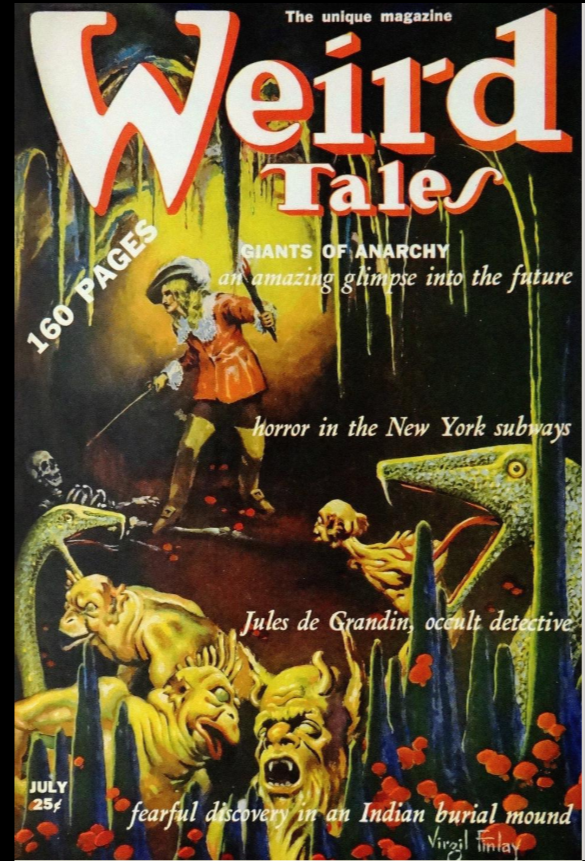
An incredible cover by the inimitable Virgil Finlay, representing a cavalier of some sort exploring a mysterious and ghoul-ridden cavern. Absolute perfection, just a blast all around. No idea what story it’s supposed to be illustrative of, and it’s entirely possible Finlay only had the broadest of scenic outlines provided to him. But who cares! Let Finlay paint up whatever weird shit he wants, he’s one of the best to ever have graced the covers of the pulps with his talents!

ToC-wise, it’s a heavy-hitter, lots of Lovecraft and Howard on here, some CAS. We’re VERY late in the Farnsworth Wright run here, and the magazine is facing some challenges, but you can see they’re still putting up the good fight here, and there’s some fun weirdness in this big ol’ issue. Also, it’s always worthy pointing out the magazine’s commitment to poetry – it’s such a huge part of weird fiction’s history and lineage, and it’s nice that the premier magazine (that, I would argue, actually created the genre by doing the necessary boundary definition work) both recognized and encouraged poetical weirdness within its pages!

Now, on to the story!

Absolutely incredible art from the great Harold DeLay here – those old school NYPD uniforms, on a weird little rail cart, emptying a machine gun into a horde of hellish C.H.U.D.s…truly a classic! Excellent little atmospheric touches here too; the smoke, the beam of light, the expressions, and the way the horrible ghoulish horde recedes into the background of the tunnel. Just incredible, action-packed stuff, immediately eye-catching and exactly the sort of thing that gets people to actually sit down and read the story! DeLay was a great artist, and it shows. He did some excellent Conan illustrations for Weird Tales, including some for “Red Nails,” and would go on to a career in comics, something he’s obviously well suited for, given the compact and propulsive nature of his artwork.

The little italicized summary under the title is evocative and tells you everything you know, nice and succinct without giving anything away from the story. That, and the spoiler-free art, is a nice surprise!

A great, powerful start to the story; the reader is immediately drawn into whatever the hell is happening, and the quick transition from the “roar and the howl” into the revelation that the “thing” is a subway train is really nicely executed. Johnson is a good writer, and there’s some real craft in this story!

It is also, of course, a story of its time, which is why the next part has some eye-rolling White Nonsense™ in it:

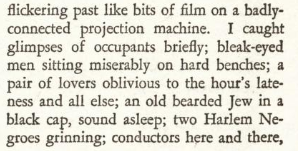
Johnson wants to highlight the big, heterogeneous nature of New York with a tableau of society, specifically calling out the presence of the minorities in the subway car to give us a kind of population sample that is (unknowingly) under threat in this story. It’s cringe-worthy language, of course, and the description of the two black people as “grinning” is particularly unpleasant, an image straight out of minstrel show. It’s something you have to confront in these older stories, but I think a modern reader, acknowledging the racism, can then focus on the narrative function of the scene like we just discussed: the way Johnson is giving us a thumbnail sketch of the civilian population of NYC, dull businessmen, smoochin’ folks, and a substantial proportion of non-WASPs. Very urban and very modern subway commuters!

The medias res beginning opens up and we realize we’re in some kind of little room, where our narrator is hanging out with someone who, apparently, knows the subway system in detail. We learn that the room is actually some kind of command center, with state-of-the-art ultra-modern technology that lets them monitor the passage of the subway cars:

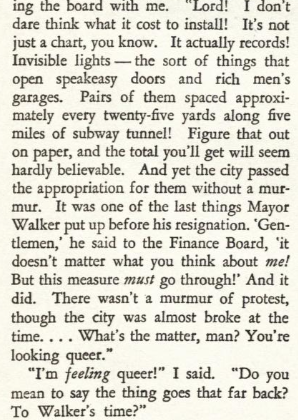
The Mayor Walker here is a real person, good ol’ Jimmy Walker, the mayor of New York City from 1926 to his resignation in disgrace (and at the behest of FDR) in ’36. He had been a Tammany Hall boy, and become a sort of poster child for bribery and corruption at the time; Weird Tales readers, even those not from NYC, would absolutely have recognized the name, as well as the context of his getting this super expensive and super complex monitoring system installed in the subway as he was resigning. It’s an interesting historical, but it functions in the story to really GROUND us in a very specific time and place – this is no Lovecraft country invented landscape, or even a quasi-mythic NYC. This is New York City, 1939, exactly as you know it; it’s an important part of the power of the story, this very precise, very real grounding.

It also offers a convenient date for the Subway Expert to use to explode the ridiculous conception of just how long whatever it is they’re talking about has been going on:

So we get a sense that there’s something old and frightful going on, and that there’s a concerted, directed conspiracy to keep it under wraps because the truth is so terrible, so horrible, that it would destroy civilization (or at least NYC) to know what was happening. The evocation of Chateau-Thierry and Verdun, famously bloody battlefields in WWI, is interesting; this story is a sequel of sorts to Lovecraft’s own “Pickman’s Model,” and in it the narrator mentions how he’d seen some rough stuff in France, but even that hadn’t been enough to prepare him for the horror he encountered (in the story). Here’s Johnson making sure to hit that exact same point – the horrors of modern, mechanized warfare are nothing to the horror down in these tunnels, AND it’s something with a long, deep history.
An interesting meditation from the Subway Expert on what it means to be in contact with Horror, day in and day out, and the ways the mind shifts and adapts to survive.

The story shifts into a multiple-page long monolog from the Subway Expert, another stylistic choice in imitation (or homage) of Lovecraft’s “Pickman’s Model,” which is entirely told as the first person dialog of a character. It’s a very effective narrative trick because in addition to letting the writer give a LOT of exposition very naturally, it also anchors the reader in the very personal, very visceral experiences of the view point character, something that can only help a horror story.

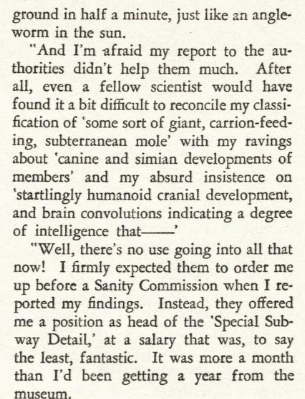
We learn that the Horrible Things that our Subway Expert has been tasked with fighting are seemingly restricted to a very small segment of the subway system, for reasons unknown. This is lucky, because its evident that successful containment of this threat is costly and complicated – there’re a bunch of militarized police stationed down here, with multiple command-and-control centers spaced along the line, and lots of careful, attentive monitoring for signs of “Them!” And it takes it’s toll on these members of the NYPD’s “Special Detail:”

Grim stuff indeed, both from the perspective of people in danger of being transformed by the work of combatting these horrors, as well as from the obvious extrajudiciality of the whole apparatus! We learn that these subway-patrollin’ Special Detail Boys are paid handsomely for their work, and that why they are *technically* part of the NYPD, and wear the uniform, they are outside of the hierarchy, free from usual discipline, and apparently answerable only to themselves. Wild, fascist shit! We also get a little bit more about out interlocuter here:

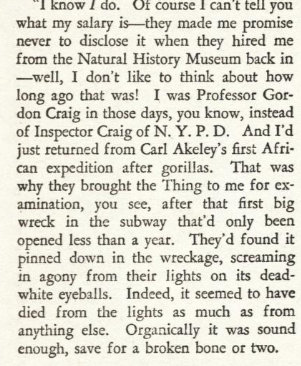
So our guy used to be a Professor who worked at the AMNH, a specialist in gorillas. He mentions that he’d been on Carl Akeley’s first African expedition when he was recruited for this subway hell job. Incidentally, although the “Akeley” name would seem to be another example of Lovecraftian hat-tipping (Henry Akeley was the rural hermit menaced by the Mi-Go in “The Whisperer in Darkness”), Carl Akeley was a real guy, a hugely important figure in museum display technology and taxidermy, perfecting and advocating a method of “life-like” presentation of specimens for museums; the Hall of African Mammals at the AMNH is named after him. Akeley’s first professional visit to Africa was in 1896, but since the NYC subway didn’t open until 1904, I reckon Craig here is referring to Akeley’s first expedition for the AMNH, which would be around 1921 or so. Incidentally, that trip was a turning point for Akeley, who had undertaken it as part of an attempt to learn more about LIVING gorillas and determine whether it was “okay” to kill and stuff them for museums back home – he came to the conclusion that it was not, and was instrumental in starting one of the first Gorilla preserves in Africa.

ANYWAY our guy Craig gets recruited by Delta Green the NYPD Special Detail because he’s an expert in comparative anatomy. He dissects a specimen of the Things (losing 1d10 SAN, presumably), and submits a report detailing the mad truth of the thing:

It turns out that much of what he’d discovered was already known, or at least suspected, by the shadowy cabal of the NYC Transit Authority or whoever it is; they had extensive reports about the subway accident, showing that it was a deliberate, planned attack by horrible anthropophagus mole-men…which sounds familiar, doesn’t it?

That’s from Lovecraft’s “Pickman’s Model” from 1927, and yeah, sure, it’s a subway PLATFORM in Boston, but it’s very clearly the inspiring image for this story!

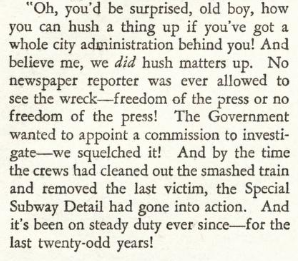
The “accident” as described by Craig is pretty gruesome – men, women, children, all getting munched on in the dark. It’s some grisly shit! Seems like something that’d be difficult to cover up, doesn’t it?

More brutal authoritarian actions by the Special Detail of the NYPD! It’s wild stuff!

Craig goes into the history of their anti-ghoul actions, and how hard the work was at first, before all the modern technology and approaches had been figured out. There’s some great, spooky writing in this section; Craig remembrances of hunting the Things through the dark tunnels, of glinting eyes in the dark, half-seen white forms flitting into the shadows, tittering mirthless laughter…it’s phenomenal, really atmospheric and legitimately unsettling.

Then we get a long section about the historical and geographical distribution of the ghouls – they’ve been here for a long time, there’s evidence that the Indians knew about them and had taken steps to nullify their danger, and there’s even a kind of funny (if tasteless) retconning of the reason for the cheap price the Dutch got for Manhattan. It’s honestly some very good Lovecraftian history, suggestive fictions woven through history and folklore and things like references to darker meanings behind certain passages in the real book “History of the City of New York” by Mary Booth; it’s not easy to do, and you’ll often run across clumsy attempts in the pastiches of Lovecraft, but here it’s pretty adroitly handled, I’d say! And then we get to a real fun bit:

I mean, c’mon – that’s just good plain fun, isn’t it? Lovecraft, presumably while living in the city, took Craig’s Grand Tour of NYC’s Subway from Hell, and much like Pickman’s practice of painting from life, those experiences are what gave Lovecraft’s story a certain hellish “authenticity.” A delightful bit of metafiction, I think!

Craig goes into the details of their work a bit; the Things seem restricted to a certain stretch of the subway, perhaps for some underlying geological reason, he muses. They also seem to restrict their activity to night-time, even though it’s always dark under the earth, which seems to make the NYPD’s Special Detail’s job a whole lot easier, at least. Craig even seems to let slip a hint of bloodlust here:

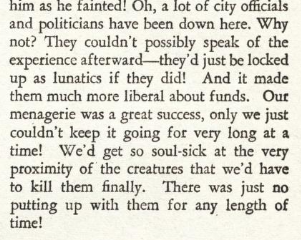
“We run them down howling with terror” is a bit grim, isn’t it, and then of course there’s Craig admission that they sometimes CAPTURE the things, imprisoning them in some kind of insane Hell Zoo. These specimens are used to illustrate the seriousness of the horrors and the need for a ruthless extrajudicial police force to recalcitrate officials, but of course they are stored in Craig’s laboratory…what’s he doin’ in there, you have to wonder. There’s a very unpleasant suggestion of experimentation, vivisections and such like. And, of course, they can’t keep any individual Thing around for very long – they’re too horrible, too alien, so they end up exterminating them eventually. It’s dark stuff:

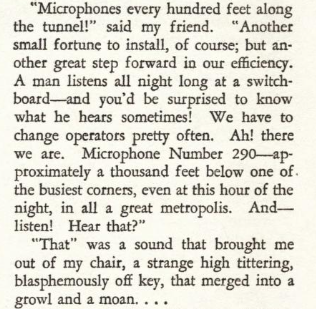
Craig’s discourse on the Things is interrupted by a buzzing from The Big Board – there’s activity in the tunnels, movement and sounds picked up by the vast subterranean panopticon that they’ve built up down in the subway tunnel. Our narrator sees something whirr by the window, and Craig proudly explains that it’s a souped-up electric hand cart, chock full o’ cops w/ heavy artillery, dispatched to take care of the Things in the tunnel. Another one is also coming from the opposite direction; they’ll pin the Things between ’em and gun ’em down.

Because there’re microphones all over the tunnels, Craig and the narrator can hear everything that’s happening:

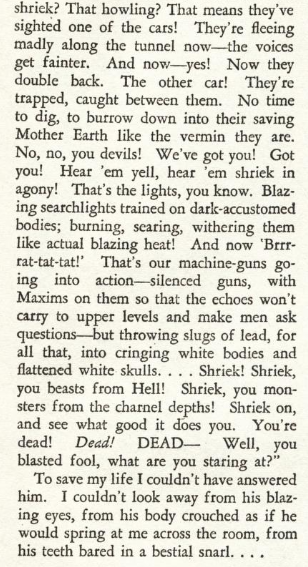
And then we get to the real meat of the story – in a brilliant bit of writing, Johnson has the characters (and us) overhear the action, narrated by Craig, which builds great tension and forces us to confront what, exactly, Craig has become, down here in the dark, hunting monsters:

Just in case you don’t get it, Johnson spells it out in the next section:

Craig is becoming a ghoul; in fact, all the NYPD Special Detail officers are becoming ghoulish, to a greater or lesser extent, but it’s worse and more pronounced for Craig because he’s been down here the longest. And it’s not just a physical transformation, either!

Even in the midst of his horrible decline, Craig can’t help but be scientifically intrigued by the transformation, however. He muses that perhaps the transformation is the explanation for the origins of the Things, and also why they’ll never be able to exterminate Them fully. He suggests that, while there’s some suggestion of cosmic horror chicanery going on, the transformation is simply atavistic retrogradation, something about being driven underground, being made abject in the dark.

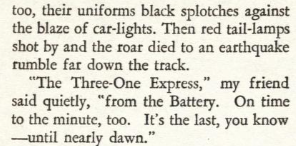
We’re nearing the end of the story; Johnson recapitulates his opening line, the “roar and a howl” bit, as another commuter subway train comes roaring by:

And that’s the end of “Far Below” by Robert Barbour Johnson!

It’s not a long story, and it’s pretty simple structurally, built around a long expository monologue and relying on the neat trick of a character’s second-hand exposure to horror and weirdness. But there’s a lot to unpack, I think!

First off, in our current times (Oct ’25, as of this writing) it’s hard not to read this story as having something to say about both the long history of policing and prisons as well as our very current fascist U.S. government’s use of a militarized, extrajudicial police force to terrorize those it has deemed undesirable. The NYPD Special Detail’s powers are unchecked, their funding unlimited, their remit unrestricted; they are heavily armed, are capable of apparently ignoring any and all oversight, and consider themselves absolutely essential to the continuity of human civilization. And, more importantly, they are completely dehumanized by their task, transforming into literal monsters because of the work they do. It’s pretty on the nose!

Of course, that reading is a little undercut by the fact that, within the text, the Things are ontogenically capital-E Evil, right? They sabotage a subway train and devour the survivors alive, fer chrissake. That complicates the Nietzschean “Beware lest ye become monsters” reading, because these are of course literal monsters; in this way, the horrible degradation Craig and his brave Mole Cops are facing is actually heroically tragic, a sad but necessary sacrifice that must be made for the good of all.

I kind of suspect that, for Johnson, it’s the second one, about brave men sacrificing body and souls, that he wanted us to take away from it. Of course, Johnson was politically-minded; his story “Lead Soldiers,” for all it being a Moral Fable, shows that he was aware of current events and Had Opinions about them, so it is possible that he was thinking about, say, WWI era interment camps or even the crisis in protests and violent police actions post-WWI, and wanted to talk about that. But the way this story is written, and the climax that it’s building to, suggests that he wants us mostly to focus on the horror these cops are facing, and not trying to get us to think about how dehumanizing the Other dehumanizes Us, you know what I mean? That doesn’t mean we have to adhere to that reading, of course; death of the author and all that (literally, in this case; Johnson died in ’87).

As a piece of weird fiction, I think it’s awfully successful. It’s probably in my mind one of the most successful “inspired by Lovecraft” stories I’ve ever written, right up there with Bloch’s “Notebook Found in a Deserted House” or anything by Michael Shea, for example. Obviously based on that little bit of “Pickman’s Model” I excerpted above (which is super evocative, very brief but very striking in the original story), and I think Johnson does it justice, captures the fun and weirdness and horror of a subway being attacked by monsters.

It’s also neat to see Johnson really taking the conspiracy-ball and running with it. Lovecraft creates what is probably the first “widespread gov’t paranormal conspiracy” in his story “The Shadow over Innsmouth” (written in ’31 and published in ’36) – there, the u.s. gov’t comes in (off screen) and raids the town, blows up devil’s reef, sends a submarine against the Deep One’s city, and then sets up concertation camps for the fish-human hybrid survivors. There’s even a mention that the gov’t brings in “liberal activists” and shows them the horrors they’ve imprisoned, which makes the various civil rights organizations shut up about the camps, something echoed in this story by Johnson. It’s a very striking part of Innsmouth, and Johnson does it honor here, establishing a plausible and powerful conspiracy built around directly combatting the mythos menaces out there! Has anybody ever done anything with the story in the Delta Green (a cthulhu ttrpg) setting, I wonder? Craig is even a Call of Cthulhu character, in the way he had an expertise that got him plugged into the darker mythos world (and that he’s going insane and will inevitably die horribly).

Anyway, it’s a fun and interesting story, two things that you can’t always say about work with such clear (and acknowledged) connection to Lovecraft. It’s probably the best thing Johnson ever wrote, at least for Weird Tales, and I think it deserves to be read and remembered for more than just “the sequel to Pickman” that it sometimes seems to be cast as. It’s an inventive story with some good, scary imagery, it uses its source material well, and it’s a fascinating glimpse into the immediate post-HPL world of weird fiction!

Pulp Beyond the Strainer #27: “From Beyond” by H.P. Lovecraft, Weird Tales, v.31 n.2, February 1938

Now, look, I’m not gonna apologize here. Everyone knows Lovecraft, he doesn’t need any exposure or anything, so you might be asking why I’m covering his stories in these little free-writing exercises I’m doing here? Well, first off, he’s without a doubt the single most important horror/weird fic writer of the past 100 years, bar none. In terms of influence, he’s everywhere, with his tentacles extending into sci-fi, fantasy, comics, pop culture, and even modern occultism. His particular brand of cosmicism, a world where alien forces and laws operate in ways we simply cannot understand, has come to DOMINATE weird fiction (for good or ill), and while he didn’t INVENT the idea, I think you can argue he did PERFECT it. So it would be disingenuous to preclude him from discussion here merely for being well known.

A second good reason to read Lovecraft is that he is, simply put, the Best to Ever Do It. I mean, artistically, he’s top-tier – his refinement of and commitment to his particular aesthetic of weirdness is unparalleled, and it lends his writing a real force that you simply aren’t going to find in yer Seabury Quinns or yer Edmond Hamiltons. His writing, while elaborate, isn’t affected or purple – he comes by his vocabulary and style organically through Dunsany, Poe, Bierce, and Blackwood, and his appreciation for both their approach and technique is evident.

Finally, I think a lot of people have some serious misconceptions about Lovecraft – I’ve seen a lot of people online say shit like “oh, Lovecraft, all his stories are the same, like: ‘Look, an old weirdo tells me a story and then it turns out he’s right about a big tentacle monster!'” which is extremely annoying and factually inaccurate. He’s enormously inventive, and all the cliche bullshit you think he did he DIDN’T ACTUALLY DO, you’re thinking about the bullshit pastiches that came AFTER him by OTHER people! It’s very frustrating, because, like I said, for all that his DNA is in so much genre literature, his actual stories remain fresh and strange and unique and GOOD, fer fucksake! It’s the same thing that keeps people from reading, like, Jane Austen or Melville or Sterne! Don’t deny yourself the pleasure of reading them out of some misplaced hipsterish misapprehensions!

So, with that goal in mind, we’re going to talk about his very short and very good story “From Beyond,” published posthumously in Weird Tales in Feb, 1938! As I’m writing this, archive.org remains down, so that link takes you to the whole issue that you’ll probably have to download (it’s ~150 MB or so), fyi.

Anyway, the Cover:

Virgil Finley channeling some horny Margaret Brundage vibes here. As an aside, that lady has some long ass hair, doesn’t she? Like, down to her knees! When they thaw her out that’s gonna be one hell of a soggy mess, huh?

An interesting ToC this time around. “Gans T. Field” is Manly Wade Wellman, and “The Passing of Van Mitten” is one of Roy Temple House’s great translation efforts for the magazine. But, perhaps more importantly: lotta dead guys on here! Lovecraft, who died in ’37, is on here twice, actually; he wrote “The Diary of Alonzo Typer” for crazy ol’ William Lumley, one of his “collaborations” were someone paid him to take a teeny tiny kernel of a story idea and turn it into a story that they then slapped their name on. What’s funny about those is that Lovecraft is such a stylist that there’s no real way to miss it when he’s the one behind the pen, it’s so obviously Lovecraft. This one is a particularly middling effort, an obvious vulgar job for filthy lucre, but it’s got some funny bits in it. Worth a read if you got nothin’ else to do, but don’t expect greatness! Whitehead and Howard, both also dead of course, round out this somewhat macabre ToC.

All these dead guys showing up in Weird Tales reflects a bit of a slow-moving crisis in the magazine. The titans who strode through the pages of the magazine in its glory days are, for the most part, all gone – REH in ’36, HPL in ’37. These two deaths in particular come at a tough time, when Weird Tales is facing some particularly stiff competition, from both weird fiction magazines as well as from the burgeoning sci-fi pulps – the field is crowded, and the sf magazines in particular are able to pay MUCH better than Weird Tales, which further cut into their ability to find and publish good work. As such, and in the shadow of these difficulties, Weird Tales began to mine whatever they could from the back catalog of their heavy-hitters. With REH, that ended up being a lot of his verse (for what that’s worth…), but with Lovecraft, there was a whole world of amateur press publications of his.

And that’s where today’s story, “From Beyond,” comes from! It was originally published in 1934 in The Fantasy Fan, the very first weird fic fan magazine, but he’d written it waaaay back in 1920, which is pretty clear from the work itself – it’s obviously one of his earlier efforts, with a style and pacing very similar to stories like “The Terrible Old Man” or “The Tomb.” But, there’s an important difference here, one that marks a key development for ol’ Howie Lovecraft! So let’s get into it!

No illustrations for this one, which is a damn shame, given the wild visuals we’re going to encounter her. Weird Tales was on a very tight budget, and probably figured that the name itself would be enough to ensure people would read this one, so why bother. Still, it’s too bad!

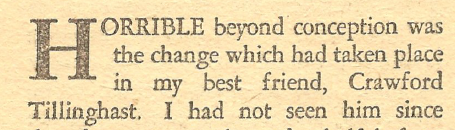
Really dig that first sentence – grabs you and throws you right into the scene, focusing on the terrible transformation that has overtaken Crawford Tillinghast. We learn that Tillinghast, who the narrator considers his BEST FRIEND(!), has become a gaunt, harried shadow of his former stout and vibrant self. Even worse, this transformation occurred over the shockingly short span of ten weeks, following a tremendous argument between the two of them that ended with Crawford chucking our narrator out of the house. What was this argument about, you ask?

Just a fantastic mad scientist speech, isn’t it? Tillinghast has (correctly) identified that fact that our human sensory apparatuses are limited, the product of a messy and lazy evolution that has equipped us well for the mundane world, but which leaves us in the lurch when it comes to deeper and more fundamental layers of reality. Just like the microscope or the spectrograph, Tillinghast has built a machine that will expand human perception into these hidden realms!

Well, this freaked out our narrator, because he knew Tillinghast well enough that he could see this going one of two ways – either he’d fuck it up and be crushed and desolate, OR he’d succeed and discover something horrible, terrible, and overwhelming. Reader, guess which one happened.

So, after balking at his ideas, Tillinghast had thrown our narrator out of the house ten weeks ago, raging and fanatical. Now, he’s suddenly summoned our narrator back again and, despite the row, our dude can’t help but wonder what has happened. So now he’s back, shocked at the change that has come over Tillinghast, and also somewhat perturbed by the fact that the huge old house appears to be utterly empty, except for Tillinghast. Where have all his servants gone?

But our narrator pushes all this aside, because he’s just so danged curious about what Tillinghast hath wrought in those ten weeks. They creep through the dark house with only the lamp for light – Tillinghast seems afraid to turn on the light for some reason – and eventually reach the attic laboratory…and The Machine.

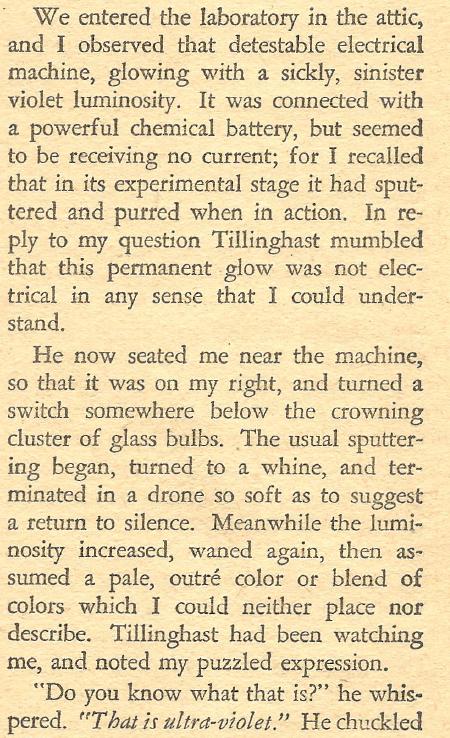
Again, excellent mad science work here – a weird glowing machine, the whine settling into a soft yet pervasive droning, and then, finally, the weird instantiation of an invisible color…ultraviolet made visible.

I mean, crazy cool wave machine weird fiction aside, this is also a remarkable early 20th C. document regarding the popular view of science and the mind, isn’t it? The “shallow endocrinologist, felloe-dupe and fellow parvenu of the Freudian” is just amazing stuff, using the cutting-edge brain science of the day to make weird fiction in 1920. When talking about Lovecraft and science most people reflexively (and not incorrectly) point towards his love of astronomy and physics, both obviously cosmic-scale and important to his world view, but you also run across geology and, here, some great biology (and what we’d now call neuro-psych). That the brain (and, therefore, one’s mind) is a biochemical organ is really just then beginning to be understand, but Lovecraft is putting a weird twist on here – it retains a certain sleeping evolutionary heritage that, properly awoken, allows humans to access the more fundamentally “real” (and terrifying) reality around them!

It can be hard for us, in 2024, to really appreciate how weird the world had been recently made for people back in the early 1900s. I mean, an entirely unknown, totally new, and otherwise INVISIBLE world of rays and mysterious energies had only recently been made manifest! Röntgen had discovered and named X-rays in 1895 and the Curies and Becquerel had been awarded the Nobel in 1903 for their work on radiation; that we were surrounded by processes and waves and things that were mostly invisible was, relatively, a pretty new and newsworthy thing. Likewise, the idea of science as inevitably pushing farther and further into these new invisible worlds was likewise a kind of cultural background noise to daily life. This is one of the KEYS to Lovecraft’s cosmic horror, and this story is where he first articulates it. It’s amazing stuff!

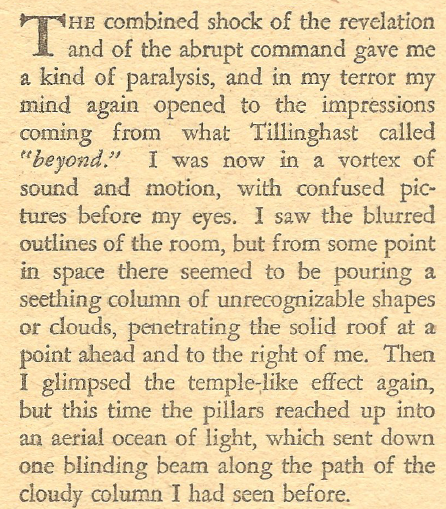
As the machine drones on, our narrator begins to, perhaps, hallucinate…or is he beginning to really see for the first time? The attic laboratory seems to him to become a strange, alien temple of cyclopean black masonry, but then this gives was to an even more unsettling sensation:

This sense of drifting in illimitable space so startles our narrator that he involuntarily draws the revolver that he’s been carrying, a habit that started after he’d been held up in East Providence (as an aside, when I attended the NecronomiCon this past summer, I stayed in East Providence, a lovely little end of the city with some great Portuguese restaurants/bakeries). Tillinghast watches this with sardonic amusement, and it’s clear that as much as our narrator is experiencing, ol’ Crawford is seeing and hearing even more.

I mean, c’mon – “we are able to be seen as well as to see” is just fantastic, isn’t it! And the revelation that something from beyond got the servants when they turned on the lights downstairs…creepy, wonderful stuff. And it gets better!

Kaleidoscopic impressions fill our narrators mind; there’s a great image of him staring at a starry sky and seeing the leering, gloating face of Tillinghast in the constellations. And he somehow senses animate things brushing invisibly past him as the machine continues to work. He also notices that Tillinghast seems be able to see these things with his better tuned third eye…something that begins to awaken in our narrator.

Just an absolute blast, and the effect of these overlapping visions, the weird invisible world (now becoming visible) overlaying the mundane laboratory…great stuff!

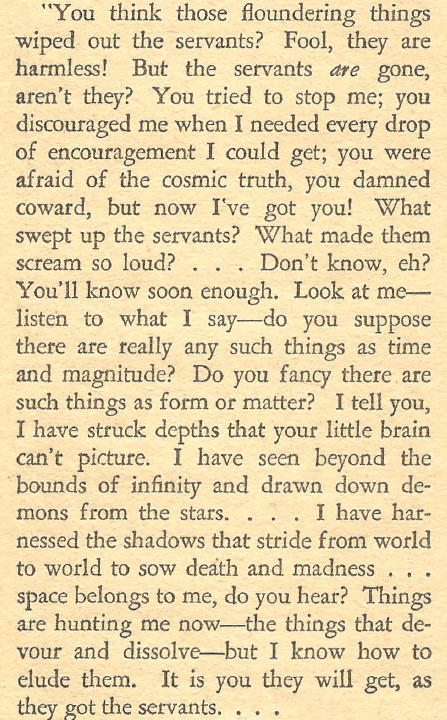
And once again, Tillinghast goes full Mad Scientist:

I mean, how incredible is that! Tillinghast, in his mad questing after knowledge has transgressed some cosmic boundary – now things are hunting him, but he’s got a plan! He’ll sacrifice our narrator to them to escape, the narrator who hurt his feelings and refused to encourage him when he needed all the support he could get! A great little revenge plan in among the ultracosmic horror! And how about the description of the things, huh? “Shadows that stride from world to world to sow death and madness…” is unbelievably great, isn’t it?

And then there’s a mini-cliffhanger, where the action breaks and we leap forward a bit in the narrative…

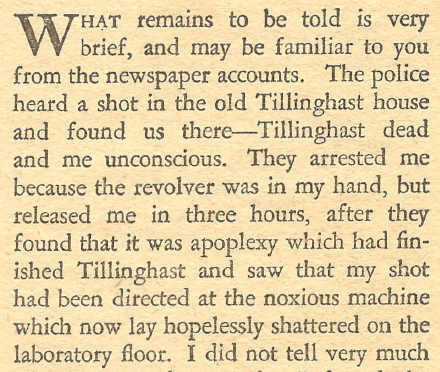
What a twist! Our dude fires the revolver…not at Tillinghast, but at the Machine!!!! Of course, Tillinghast has died, apoplectically struck down by either the noise of the shot, the sudden and jarring destruction of the machine, or perhaps even by the things that he’d been summoning to get our narrator, who knows! Everybody figures that Tillinghast must’ve killed the servants himself and hidden the bodies, and had planned to do the same to our guy here; a doctor even suggest that he’d been hypnotized by Tillinghast, and that the weird shit he’d seen had been the result of suggestion and illusion. How does our guy take that?

And that’s The End!

I mean, really, what more do you want? Short, straightforward, and full of amazing weird ideas and imagery, AND it’s also a major turning point for Lovecraft’s thinking and approach to weird fiction. The things that Tillinghast’s machine make visible are basically at the core of all of Lovecraft’s stories: strange, mysterious presences that lurk just behind the placid delusion that we call “reality.” They’re truly alien, made of different matter and obeying different laws; it’s basically a brief summary of Lovecraft’s entire worldview and approach to weird fiction, all in one short, sweet little package!

The Audient Void #2: HPL OTR Edition

While we’re waiting on poor ol’ archive.org to get back up and running, I thought I’d do a follow up to the previous post about classic old time radio horror shows. Hope ya’ll had a chance to listen to ’em, they’re some of my favorites, but this week’s audient void holds a special place in my heart, because they’re largely the reason why I got into H.P. Lovecraft and Weird Fiction in the first place.

Growin’ up, I was a pretty voracious reader, but my preference was always sci-fi and fantasy. This was due, mostly, to a extremely nice collection of vintage paperbacks that had been my dad’s back when he was a kid in 60s…Heinlein, PKD, Harlan Ellison, Le Guin, really a phenomenal collection that was very important to little Eric’s reading development. With a solid underpinning in the classics, I’d often make a bee-line for the SF and Fantasy section of the bookstore where, more often then not, I’d have a glance at the generally smaller HORROR section that neighbored them.

NOW, I liked spooky shit as a kid – in elementary school I’d been a big fan of John Bellairs, for instance, and I loved a collection of ghost stories or werewolf “histories,” stuff like that, but I’d never been a big reader of horror fiction – I remember trying King and deciding it wasn’t really my cup o’ tea. This opinion was further bolstered by the horror section in the bookstore, and IN PARTICULAR those very gruesome Del Ray Lovecraft paperback covers. You know the one’s I mean, with like flayed torsos hanging on hooks, shit like that? For me, they were simply too disgusting. You gotta remember, at that time, my favorite monster movies were absolutely classic Universal movies, right? Yer Mummies and yer Draculas, nothing to intense and certainly nothing gory, and those Del Ray covers made it seem like this Lovecraft clown’s stories must’ve been nonstop chop-em-ups!

Anyway, skip forward to college, I’m in Gainesville FL listening to the UF public radio station while I’m doing fossil prep work (I was assembling an Aphelops jaw bone). It’s late Oct, they’re doing special Halloween programming, and one night they put on a special Old Time Radio horror block that STARTS with some Lovecraft adaptations, including “The Dunwich Horror” from the 40s, the “Rats in the Walls” and “The Outsider” from the 60s. And I’ll be damned if they’re not an absolute blast, fun and interesting and spooky, nothing at all like what I imagined what they were like based on those ol’ Del Ray covers! After that I spent a lot of time in the library’s Special Collections, reading a bunch of old original Weird Tales that they had.

So, anyway, these three Lovecraft adaptations hold a special place in my heart, and I hope you’ll give ’em a chance!

The Dunwich Horror – Suspense, 1945 – a true classic that takes a fairly long Lovecraft tale and somehow smoothly gets it down to under 30 minutes. Great voice acting in this one, particularly in the case of Wilbur Whatley’s strange horrible voice. Well done, and it’s fun to think about people in the 40s hearing someone shouting “Yog-Sothoth! Yog-Sothoth!” on their radios!

The Rats in the Walls – Black Mass, 1964 – this is one of my favorite Lovecraft stories of all time (terrible racist name of the cat notwithstanding), and this is a great radio adaptation, extremely faithful and with a real sense of building dread. The final descent into madness is really well done, too; not too surprising, but the secret to good audio horror is good voice work, and I feel like this show has some talent in that regard!

The Outsider – Black Mass, 1964 – one of Lovecraft’s lesser stories, but this is still a good, atmospheric adaptation that is a lot of fun. Ganked this one off an old time radio website years ago, so it’s got a modern intro, just fyi.

Anyway, it’s fun stuff, and if you, like me, enjoy Lovecraft, these are some real treats. Enough for now, happy listening!