Category Archives: The Pulps

Pulp, and the Straining thereof, #6! Halloween Edition! “Mive” by Carl Jacobi, Weird Tales, v. 19, n. 1, January 1932

Like the merciless Juggernaut, Halloween season rolls ever onward, smooshing everything in its path beneath its powerful, unyielding spookiness. And so, to do my humble part and remind ya’ll of The Reason for The Season, here’s yet another entry in my continuing series of musings on the spook-em-ups of yesteryear. And it’s an odd one this time, too – Carl Jacobi’s “Mive” from the January 1932 issue of Weird Tales!

But first, as is traditional ’round these here parts, lets take a gander at the cover of this issue! And lucky for us, it’s a C.C. Senf classic!
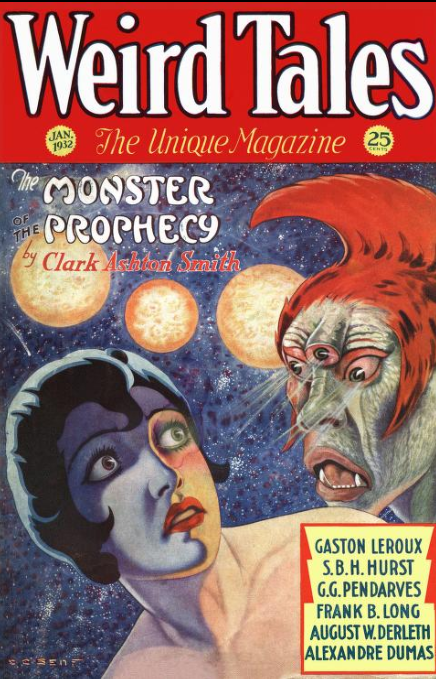
I think last time I said I wasn’t sure if ol’ Clark Ashton Smith had ever had a cover and, well, by god, here it is! And by Senf, no less, one of my favorites of the early Weird Tales cover artists. Curtis Charles Senf did a pretty good number of the early covers for the magazine, a couple dozen at least, plus a lot of great interior art too. This is one of his last, though – I think he has a few more in 1932, but after that he goes on back to commercial illustration work, which I think you can see he clearly had a talent for. I like his style a lot; expressive faces, flapper haircut, weird-ass monster, trippy space background. It’s good! Wild thing is, it has pretty much nothing to do with the story, which is a very goofy space fantasy tale about a suicidal male poet who travels to an alien world, helps foment a revolution, and then makes it with a five-armed space empress babe. It’s not my favorite Smith, by a longshot, but it does have a lot of implied sex, so there’s that.

Of course, a lot of the covers had fuck all to do with the contents; it was practically a requirement! Still, I think the Senf image illustrates nicely one of the biggest draws that pulps had going for them – the cover art is honestly something, often dynamic and a little lurid, really something that grabs your eye! I harp on about how the pulp era was the golden age of the short story, when people could make a living writing fiction AND when millions of people got their entertainment by reading it, but I bet there’s a similar story in illustration – there were so many more markets for your work, and a huge number of people exposed to it too! A heroic age, never to be seen again, sadly.

Ah well, such is the turning of the wheel, huh? Anyway, here’s the ToC:
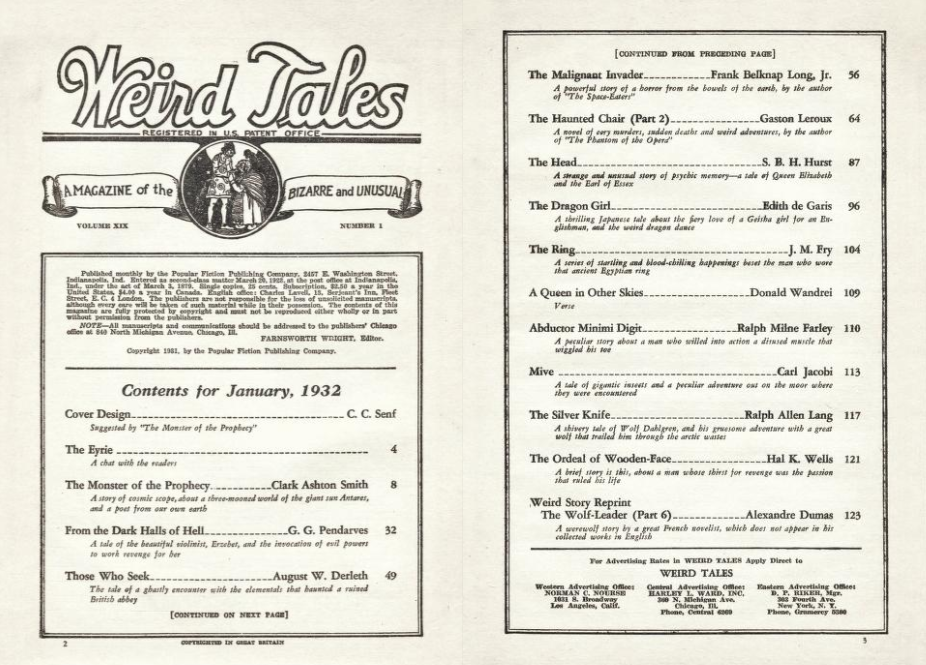
Smith, Pendarves, Derleth, Long, Wandrei – it’s a veritable Who’s-Who of Big Names That Few Now Would Recognize! All of them were fairly major Weird Tales authors; G.G. Pendarves in particular was very popular, and it wasn’t until her death in ’38 that Farnsworth Wright revealed in an obituary that her real name had been “Gladys Gordon.” Again – the pulps offered a chance for people who might otherwise have been stopped at the door to slip in and get their writing published and read!

Our author today, Carl Jacobi, was a prolific and long-lived writer of fiction, with a good number of stories in Weird Tales over his career. His style is good, a little florid for us today but nowhere near as elaborate or languorous as Smith or Lovecraft, for instance – in fact, if you compared his work to others at the time, you’d probably say it was rather fast-paced and propulsive! His work has been anthologized a lot over the years; he’s got a good sense of the creepy and the atmospheric, as well as a real imaginative streak, as we’ll see in today’s fairy short story, “Mive.”
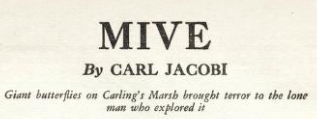
That’s right! It’s a Big Bug story!

Bug fiction, of course, has an important place in the history of outre imaginative fiction; there’s Wells and his ants, and Lafcadio Hearn wrote numerous essays on the cultural and folkloric significance of insects in Japan. Within Weird Tales there’s a kind of interesting history, though, so I hope you’ll pardon a brief digression. In 1925, a few short years into Weird Tale‘s existence, they published a story by J.U. Giesy titled “The Wicked Flea.” Now, if you know yer bible, you might recognize that as a punning take on that old chesnut from Proverbs: “The wicked flee where no man pursueth.” Now, that’s bad enough, but take a quick peek at the cover of that issue:
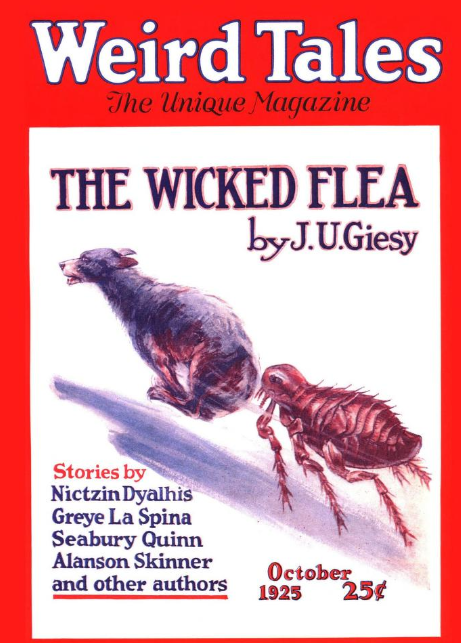
A dog!? being chased!? BY A BIG FLEA!? Why the whole idea is PREPOSTEROUS!? What an amusing reversal!!!!

That’s right: it’s a COMEDY story.

What’s that? You’re asking how the Weird Tales audience received it? Readers, they hated it. Huge number of letters to The Eyrie where they begged Wright to never publish anything like it. A consensus soon built, and basically humor stories of all stripes were banned from the pages of Weird Tales forever. I feel like that actually had a huge effect of the development of the weird tale, too – there’s a deadly seriousness that descended on the genre and never really lifted, so much so that a lot of readers lost their ability to see the often slyly humorous parts of many stories, I think. For instance, when Lovecraft’s “Herbert West – Reanimator” was posthumously published in Weird Tales, a lot of people didn’t recognize that the constant over-the-top joking going on. Oh well!

Anyway, the upswing of it was that, following the furor over the goofy story, Wright kind of summed up the state of the genre in an editorial in The Eyrie in the December 1925 issue, trying to clarify what belonged in Weird Tales and what didn’t. Here’s what he wrote about Big Bug stories:

I dunno, I find this kind of stuff fascinating; the way Wright, in conjunction with an active and participatory fandom, are negotiating and mediating what is and isn’t weird fiction…it’s cool stuff! But on to “Mive!”
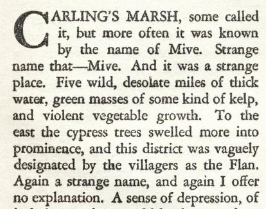
A kind of moody meditation on both wilderness and the way people perceive it – it’s a fun way to start a piece of pulp weird fiction, I think. The sublimity of the environment is a rich vein of weirdness that’s not mined often enough, for my tastes. Actually, this whole beginning, nearly a page, reminds me strongly of Algernon Blackwood’s “The Willows,” with its preoccupation with human interlopers in a wilderness setting; there’s a similar sense of the strange and inhuman atmosphere of this place, evoked by the description of its riotous plant life, its strange geography, AND by the fact that it’s got these really weird names. “Mive” is an odd one…sounds like one of those old, inexplicable celtic/saxon/welsh hold over names you run across in England, you know what I mean? Like it must have some meaning, but it’s just utterly lost to you, now. Similarly, the oddity of a cypress hammock called “the Flan” is notable…right off the bat there’s a real sense of disorientation produced by Jacobi here, really nicely done bit o’ weird fiction writing!
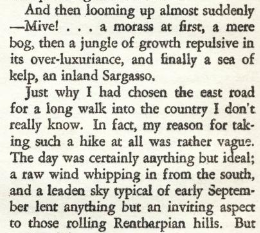
Quick note: “Rentharpian” is a funny word, but it just refers to Jacobi’s own version of “Lovecraft Country.” He mentions a “University of Rentharp” in another story, so it’s like the Miskatonic Valley and Arkham and all that, a generalized fictional location somewhere in the United States that gently connects his stories together. Absolutely love it, one of the best parts of weird fiction in my opinion!

Most people stay away from the Mive, but our narrator has submitted to his particular imp of the perverse and gone for a walk along a disused road that leads along side of the marsh. He reaches the swampy stretch where, for some reason, he’s drawn to the wilderness and plunges headlong into the green hell.
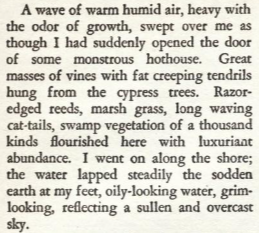
More excellent environmental writing, partaking of that peculiarly White Euro-American horror at the rampant fecundity of nature. This is something right out of 19th century tropical travel narratives, a kind of revulsion at just how furiously ALIVE a forest or a jungle or a swamp can be. Another noticeable undercurrent exists in both that genre of writing AND in our story here: the alienation an animal experiences in a place dominated by plants. In fact, here, in the Mive, the narrator notices the absence of all the usual swamp critters…until…
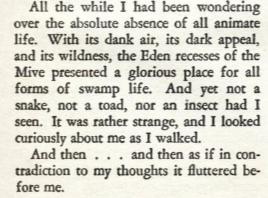
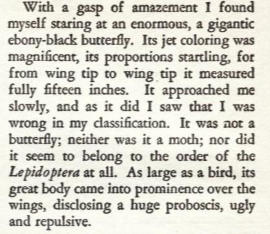
A Big Ass Bug! Kind of an uncalled-for burn on proboscises, though – it’s just a curly cue tongue man! What? Your gustatory apparatus is so much prettier and cooler? Jeez.

Operating under a kind of strange compulsion, the narrator grabs for the gigantic butterfly, but he succeeds only in getting a strange, powdery dust from its wings on his hands. Annoyed, he tries to brush it off, but the sweat from his hands has made it sticky and gooey and damn if it don’t smell good too!
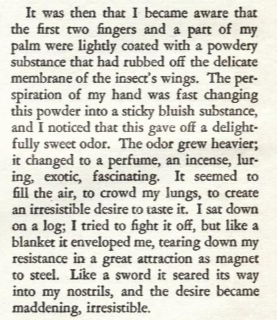
Well, he fights it off as long as he can, but then sticks his fingers in his mouth, and is immediately struck by the foul, bitter taste, nothing at all like the sweet alluring scent. He coughs and sputters and is disgusted at himself; then he gets doubly annoyed because he didn’t catch the giant butterfly and so no one is going to believe that it exists. He decides it’s time to head home. But…
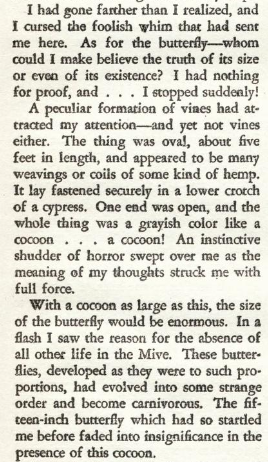
A human-sized cocoon, and it’s hatched too! Makes the previous butterfly seem positively rinky-dink in comparison! And, of course, there’s also the perfectly logical deduction that a big fuckin’ butterfly must’ve evolved carnivory and that’s why the swamp has been denuded of vertebrate life! Our narrator grabs a stick and, feeling a little nauseous, starts trudging his way home. A storm builds overhead, black clouds billowing to darken the sky…but IS it a storm?
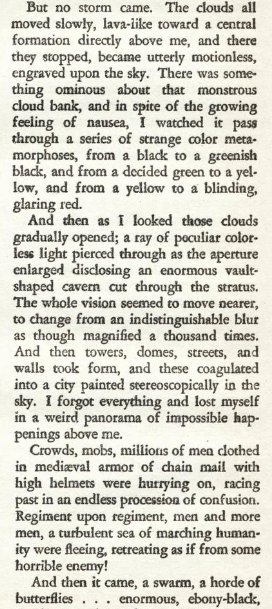
What the fuck, right!? The clouds solidify into some kind of strange, phantasmagoric scene of a medieval city and an army in full retreat from a horde of the black-winged giant butterflies! The defenders fall and the whole city is swallowed by the roiling swarm. Then, the scene dissolved into more chaos, eventually coalescing into the form of a singularly huge butterfly, its vast wings filling the sky.
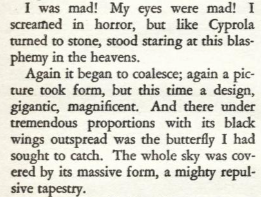
He turns and flees, crashing through the underbrush, squelching through the mud, trying to escape the horrendous vision he’s seen. The forest itself becomes monstrous, the reeds and grasses gripping him, slashing at his arms and legs, all of nature turned into a hellish, predatory monster that seeks to devour him. A storm fills the sky, and the waters of the Mive turn black and oily. Then, a giant butterfly descends from the blackness overhead, pursuing him!
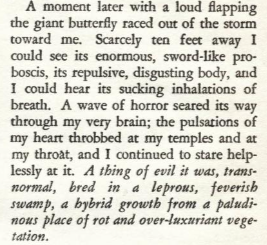
He hides in the underbrush and it misses him; in a mad chase he flees the swamp, eventually reaching the road and collapsing with relief as the storm breaks and rain washes over him. What happened!? You’ve probably guessed, but let’s see what our narrator figures out:
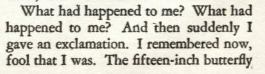
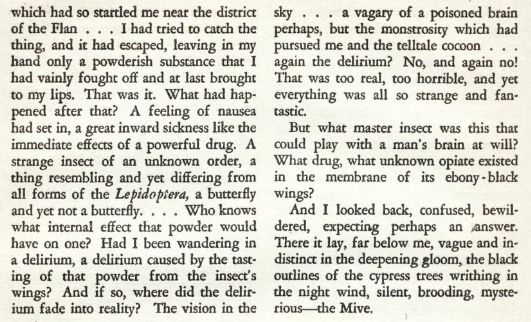
Hallucinatory butterfly dust! Of course! What master insect indeed!

That’s the end. It’s short and to the point, a fairly simple series of events overlain by some weird hallucinatory imagery and descriptions. What I like about it is the way Jacobi approaches a world where people and, indeed, vertebrates, are superfluous interlopers. From other stories of his, I know Jacobi had an interest in geology and paleontology, particularly with regards to early Paleozoic stuff, so this vision of a primal swamp with giant insects seems positively Silurian, a vision of the world 420 million years ago. A geological perspective is, I’ve argued before, one of the main scientific ideas behind weird fiction – Deep Time’s dehumanizing and, indeed, de-mammalizing, perspective forces us to confront a universe that is perfectly happy with other orders of being and types of life. For Lovecraft and Howard and them, this is often oceanic or reptilian life, but here Jacobi has latched onto a vision of life that is botanical and insectoid, both truly strange and alien organisms, at least in comparison to our own particular clade.

The strange vision of a medieval cloud city destroyed by butterflies, as well as being just plain weird, also reinforces this idea, I think – the world of humans, with its projects and monuments and struggles, is just one ephemeral version of life on this planet. The contrast between the perceived fragility of a butterfly and the assumed solidity of a vast walled fortress full of mailed warriors is interesting in its juxtaposition, especially since both prove false – the triumph of the strange butterflies over the “superior” humans is of course a classic weird fiction inversion, but it also resonates with how easily our narrator is overcome by the hallucinatory dust. He’s immediately undone by a big ol’ butterfly, and is powerless in the face of this totally unexpected threat!

It might be a little predictable; I think once the wing dust is mentioned, you’re primed for something like this to happen, especially when he fuckin’ eats it. But for all that, I think it rises above the kind of trite “woah, what a trip!” sort of thing it might’ve become. Jacobi is interested in how people and nature intersect, and the ways the assumed roles of big critters like us might be upended totally. A fun story with a decidedly weird point of view!
Strained Pulp #5! Continuing Halloween-Edition! “The Colossus of Ylourgne” by Clark Ashton Smith (Weird Tales v. 23 n. 6, June 1934)

Indulgence is best enjoyed in huge walloping ladlefuls, so I decided to go big with this one and write about one of the most indulgent weird fiction writers of all time, Clark Ashton Smith, and specifically about one of his best stories, the Averoigne-set, almost-sword-and-sorcery, horror-adventure tale, “The Colossus of Ylourgne.” It’s extremely pulpy, it’s extremely purple, it’s extremely weird, which is just to say, it’s extremely Clark Ashton Smith!

Smith is an interesting character. Today, he’s remembered as one of The Big Three from Weird Tales, right up there with Lovecraft and Robert E. Howard. I think this reflects both the quality and quantity of his output; he wrote unique, inventive stuff, and there’s a lot of it, too. Interestingly, he’s also the only one of that triumvirate to die of old age (in 1961), although that’s not to say that his life wasn’t similarly rough – he was crushingly poor for most of it, and even well into his old age had to take gardening jobs from his neighbors to make ends meet. In his own time as a pulp writer he was very popular with the readers, and there’s the suggestion that it was his work that convinced Edwin Baird, the first editor of Weird Tales, to reconsider his ban on verse in the magazine.

I think there are two relevant things about Smith to keep in mind. ONE, he was a serious poet, and an unabashedly Romantic one – early in his life (before Weird Tales) he published collections of his verse to critical acclaim and was well-plugged into the West Coast’s poetry scene through his mentor, George Sterling. However, his extremely traditional style (very much in the vein of Poe or Swinburne) butted up against the changing aesthetics of poetry in the early 20th century; his refusal to change his style caused him to fall out of favor and turn to pulp prose to try and make some money.

The SECOND thing to keep in mind is that Smith was a Californian his whole life, living in the shadow of the Sierras for much of it, and I think that really colors his writing. It’s especially visible in his descriptions of nature and people’s relationship to wilderness. There’s none of the musty, mouldering, decay of Lovecraft’s New England in Smith’s dark forests and mountains; rather, his landscapes always seem vital and rugged to me, weird and full of menace certainly, but as a result of their magnitude and natural power. Anything inimical in them is a result of that out-of-balance scale difference between nature and humanity. For Smith, horror is a human condition; it’s people and their uniquely human failings who bring corruption into the world.

I guess though there’s also a THIRD thing to keep in mind about Smith – he’s much grosser than Lovecraft or Howard. Lot of wormy, dripping corpses in his stories, and there’s a bloodier and, honestly, more sadistic edge to his horror. A lot of his stories have a sardonic cruelty to them, something he took from his extensive reading of the French Decadents, I reckon; Smith taught himself French to translate Baudelaire’s Les Fleurs du Mal, many excerpts of which appeared in Weird Tales. Anyway, his stuff is just way more sophisticated , if you will, than Lovecraft’s or Howard’s, with a noticeably different (though equally evocative) tone. There’s less scholarship on him than either of the other two, though there is a good Penguin Classics collection of some (but not all) or his stories and poetry (The Dark Eidolon and Other Fantasies, edited by S.T. Joshi). The story I want to talk about today, “The Colossus of Ylourgne,” is NOT in that collection, though, so you gotta follow that link to give it a read in the pages of Weird Tales (courtesy of archive.org!).

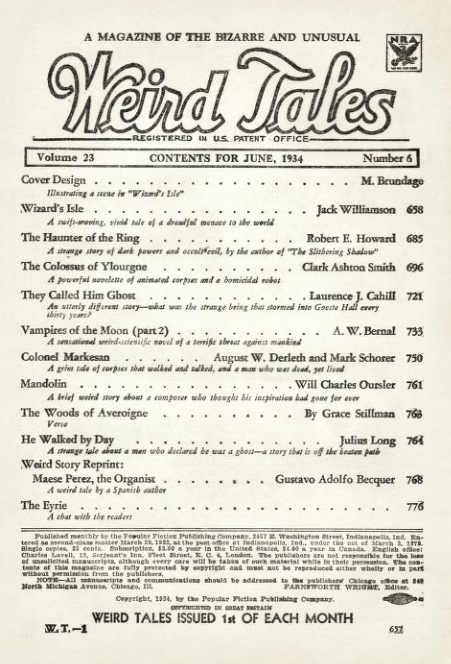
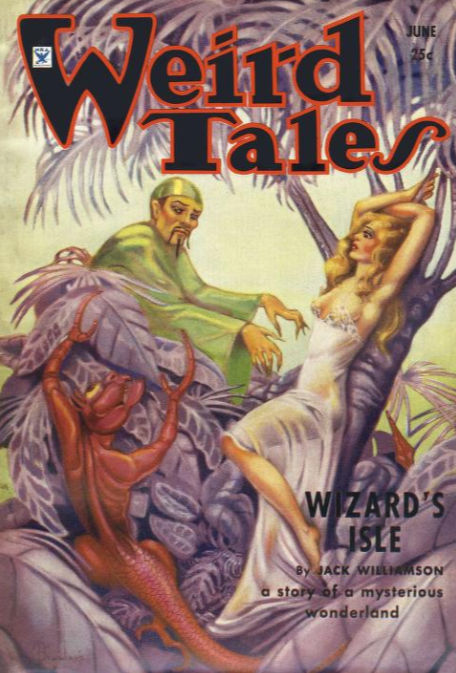
First thing first, let’s talk that cover! I don’t know if any of Smith’s stories ever got on the cover for Weird Tales. One of his stories did get a painting over at short-lived rival magazine Strange Tales, with a pretty striking monster from Smith’s story in that issue “The Hunters from Beyond;” I think it got used as a cover for a collection from that magazine published recently, too. BUT, that’s neither here nor there, since this cover is, yes, a Margaret Brundage original, inspired by Jack Williamson’s “Wizard’s Isle.”

Setting aside the unpleasant racism of the Menacing Chinese Wizard, you gotta appreciate the weird ass little lizard-bug devil there, and of course it has that famous Brundage trademark: a scantily-clad woman being menaced! Brundage specialized in those, and the clever writers (like Seabury Quinn and Robert E. Howard) started to include scenes of a woman being menaced by a monster or a ghost or a racist caricature in order to get on the covers. The covers were always considered a little daring, but interestingly it was only AFTER readers learned that “M. Brundage” was a woman that they really started to complain about the “indecent” art. As a brief aside, Brundage is a fascinating character, a Wobbly and a Free-Thinker whose work hugely influenced both genre fiction as well as bondage/fetish erotic art; she’s definitely someone we should spend some time talking about one day. Here’s a cool pic of her I found, from The Internet:

brundage

But, Margaret Brundage will have to wait! We’re talking about Clark Ashton Smith now! On to this issue’s ToC:
As mentioned, Jack Williamson (another fascinating guy who played a huge role in the development of sci-fi) gets the cover – the story is fine, one of his extremely competently constructed pieces, though the Orientalism is thick on the ground and kind of rough. The Howard story is only middling – it’s one of his occultic Lovecraft pastiches, and for the most part those are his weakest efforts. For my money, Smith’s story is far and away the best thing here, although I would point out the Weird Story Reprint, which is a translation of a story originally in Spanish, “Maese Perez, the Organist.” These translations are super interesting, and, actually, form the subject of an upcoming book with Paradise Editions that I’ve been working on: Night Fears, a collection of some of the translated fiction that appeared in Weird Tales that I think people are going to really enjoy. I’ll plug it more later this month, So Watch This Space for further details!

Briefly, there’s also a bit of verse by “Grace Stillman” that is pertinent to the story today. Her “The Woods of Averoigne” is a celebration of Clark Ashton Smith’s fictional 13th Century France where he set some of his stories (including “The Colossus of Ylourgne”). It’s good and extremely, some might even say, suspiciously faithful to the description and mood of Smith’s work. Between that, and the fact that Grace Stillman ONLY ever published this one poem in any magazine ever, I suspect this is a nom de plume for ol’ Clark himself, although I’ve got no concrete evidence for that. Still, it’s odd!

But, anyway: Our Story!

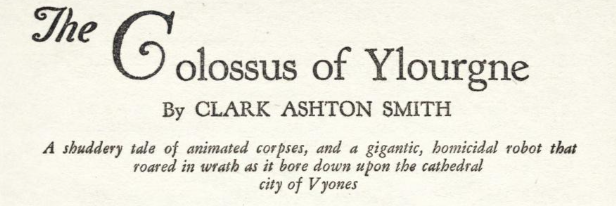
First off, that description, huh? That’s an interesting use of the word “robot” isn’t it, one that I think demonstrates the inchoate state of the nascent genre of science fiction. I hate to keep harping on it (no I don’t), but it was in Pulp Magazines that these genres were created, and this is a good example of that work being done. The lexicon hadn’t solidified, the definition of the term “robot” hadn’t been settled yet; only with time and further writing would “robot” come to mean a manufactured mechanical or technological construct, rather than the very specific Thing (no spoilers, yet) being discussed here.

Our story starts with some of the rich, voluptuous language that Clark Ashton Smith is known for…honestly, people give Lovecraft shit for his purple prose, be he’s positively restrained compared to Clark. Smith ratchets it up all the way to eleven; he’s much more sumptuous in his writing, and his word choice is way more obscure and archaic than anything ol’ H.P. ever did. Now, to be fair, it’s not affection, not fully, because Smith received very little formal education and mostly learned by reading books and memorizing the dictionary and stuff, so I think he comes by his1820s style writing honestly. But if that’s not your thing, you’re going to have a hard time with Smith.

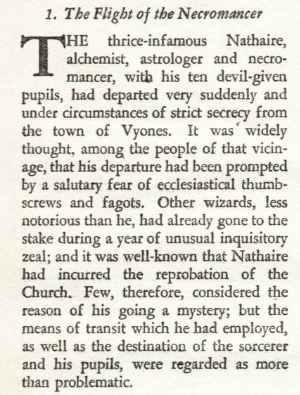
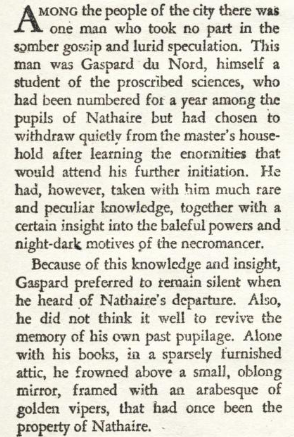
Right away we’re introduced to the villain of the piece, Nathaire, a vile sorcerer, and we learn that he, along with his ten pupils, have vanished from his house in Vyones. A long part of this first chapter is used to give us background: Nathaire is a stunted, twisted little thing, the son of a Devil and a Witch, and he travelled widely through Egypt and Persia and other exotic places, where he learned all the secrets of magic and alchemy that made his so feared and powerful. We also learn that he has run afoul of the Church and the Inquisition before, and is lame in one leg from a stoning that he took at the hands of a mob in Vyones. Consequently, Nathaire hates the clergy and the city with equally fiery passions, so everyone is happy to see him vanish, despite the mysterious circumstances. Everyone, that is, except Gaspard du Nord:

Gaspard uses this magical mirror to try and spy on Nathaire, who is certain is up to something vile and dangerous. He catches glimpses of his former master in the glass, a hint of dark ritual and evil magic, but it’s soon obscured by Nathaire’s counterspell. We, along with Gaspard, are left in the dark.

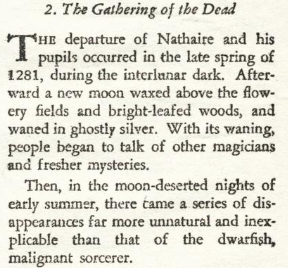
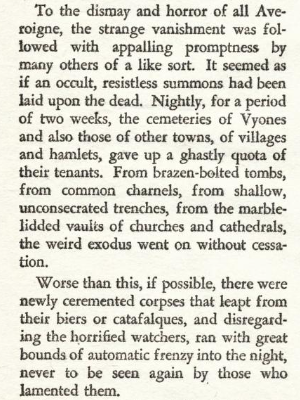
Part 2 is where things start getting weird! In early summer, bodies suddenly start vanishing from the graveyards, and when people investigate, they realize that it’s not graverobbers at work; rather, the dead bodies themselves have clawed their way free from their coffins and tombs and graves! And it just keeps happening!

I mean, that’s pretty good, right? Bodies on their way to being buried leaping up and then running into the night. It’s a good, creepy image, made worse by the suddenness and the sense of urgency in these animated corpses. Something is happening, but no one knows what it is!

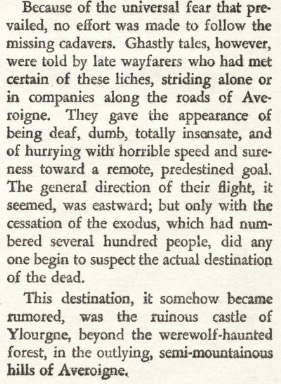
Turns out the ruins of Ylourgne (which, wow, just a great weird fiction name, you know?) is right across the valley of a big ol’ monastery, extremely isolated and cut-off from the world. There, the monks are horrified by the sense of something monstrous going on across the way in the old robber-baron ruins, but they don’t feel like confronting it until one of there own, dead in an accident, is summoned to the castle. There’s a good image of the dead monk, his head lolling on his chest from his broken neck, leaping up and running out of the church towards the ruins while the monks look on, horrified.

Most of the monks want nothing to do with it, but a pair of them, full of zeal and righteous fire, get permission to go to Ylourgne to try and exorcise the evil there. They go armed with crosses and holy water and tromp overland, but are unprepared for the devilry they encounter: piles of corpses being rendered into their constituent parts, bones in one pile, meat in the other, boiled and magicked up by devils and the ten pupils of Nathaire, all overseen by the dying, couch-bound wizard himself. The monks leap into action, shouting prayers, brandishing holy water…and are promptly handled by the wizard and his underlings.

Smith, of course, is a member of the Lovecraft Circle, and so there’s no room for the traditional Christian God in his fiction. And even though there’s plenty of mentions of Satan and all kinds of very pop-medieval theology, it’s sort of understood that that is merely the cultural lens of the characters in the story – in other words, the Devil that Nathaire serves is no horned and winged fallen angel, but probably something more akin to the nebulous transdimensional horrors of the Cthulhu mythos. These monks attempt to use the power of Christ to combat inhuman sorcery, and so of course they fail. It’s a pretty stark image, and a step that not everyone at the time was willing to take – August Derleth, for example, really tried to Manichean-ize the mythos, and even Frank Belknap Long introduced the Cross as a modern representation of an even older Power that could combat the evil forces of madness and chaos. None of that for Smith! The strength of the church is in gold and flame alone, a purely secular and vulgar power, and sorcery is simply of another class altogether.

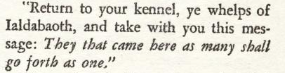
This is hammered home when, brought before Nathaire for a haranguing, the evil wizards says this:

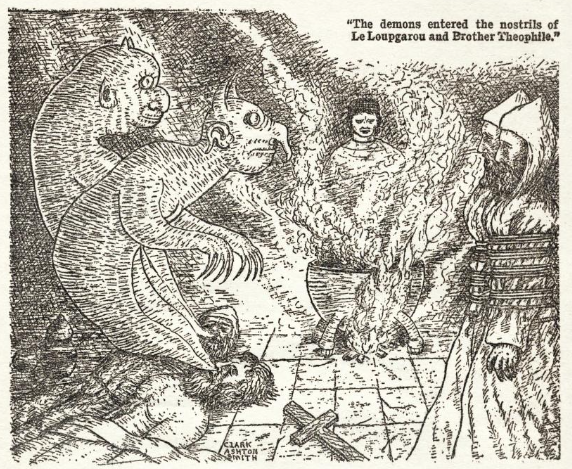
Ialdabaoth or Yaldabaoth is the demiurge, the basely material (and therefore evil) creator of the world in gnostic cosmography. Nathaire is basically calling the god these monks serve a false and lesser power, which, fair enough, since the monks got captured and all. Then Nathaire pumps a couple of corpses full of demons and has these undead bodies chase and beat the monks all the way to their monastery! The scene of the raising is even illustrated by Smith in the story, in his inimitable folk-art style:

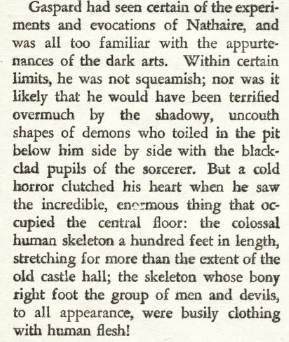
Picture like that would be right at home in a 1st Ed Dungeons & Dragon book, wouldn’t it? Very DIY. Anyway, meanwhile, our buddy Gaspard is back in town, still worrying about what ol’ Nathaire is cookin’ up. With the general sense that since the bodies have been heading towards Ylourgne, that’s the place to get answers, Gaspard heads out overland, eventually reaching the mysterious ruins just as the moon is rising. There’s lots of clambering and crag-hopping, all very fun and conveying just how in-over-his-head our scholarly hero is, and then finally Gaspard breaches the walls and discovers the secret of Ylourgne:

Reduce, Reuse, Recylce! Nathaire has been collecting all these corpses to strip em down to their base parts and BUILD a new, huge body. And not only that, but, after Gaspard gets bonked on the head and captured, Nathaire reveals that he is going to leave his dying body and put his soul into this new, gigantic corpse-salvaged corpus! Nathaire, in fine villanous form, rants a bit, explains his plan to use his new body to terrorize Averoigne, and then has Gaspard tossed in an oubliette.

There’s a somewhat overlong dungeon-escape scene, where Gaspard has to scrape away at a drain to make a passage that takes him to another chamber and some stairs, etc etc. It’s good mechanically and serves to express that time enough has passed for the wizards upstairs to have finished making the giant body. And you gotta remember: Smith is poor and he’s getting paid by the word. I mean, if Charles Dickens can get away with it, so can Clark, right? Anyway, he comes across the huge corpse juuuuust as the ritual is underway and, being reasonable, recognizes that there’s not much he can do about it, so he flees. We then cut to the next section, which sees the horror unleashed on the countryside.

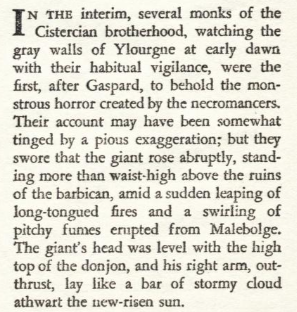
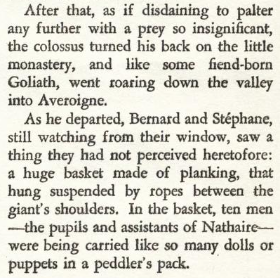
So this huge giant, made from the rendered flesh and bones of countless corpses and driven by the mind and soul of an evil wizard, has risen, and damn if it isn’t having a good time. Giant Nathaire really seems to be playing around, flexing his new muscles and enjoying his strength and size; he lobs some rocks at the monastery, kills some of the monks, but mostly just seems to be goofing off. When he turns and leaves, some of the surviving monks (the same ones who ventured into and were chased out of Ylourgne earlier in the story) witness a strange sight:

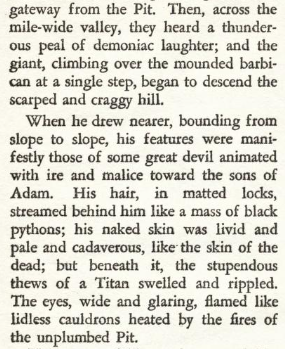
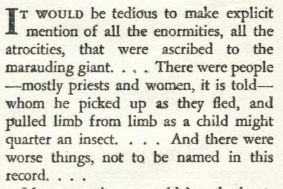
That’s a hell of a funny image, isn’t it? This big monstrous giant, all naked and gross, with like a baby carrier on his back full of his students, along for the ride! It’s a very funny, very strange detail, extremely Smithian in its absurdity. Anyway, the rest of this section is just The Giant wrecking shit all over Averoigne. There’s lots of violence and murder; at one point he covers a church full of people with a huge pile of shit he’s gathered from surrounding farms. It’s alternatingly funny and then, suddenly, very brutal and cruel:

And how about that last part, huh? “…worse things, not to be named…” yikes!

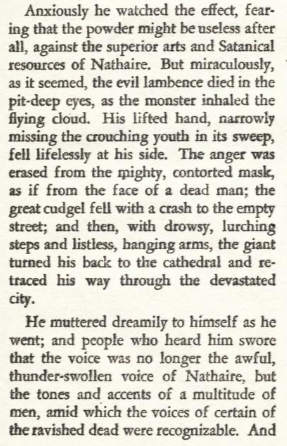
While all this has been going on, Gaspard has been making his way back to the city, which is now packed with refugees fleeing the horrors of the Giant. Back in his meager rooms, Gaspard throws caution to the winds and makes use of the evil sorcery he learned from Nathaire to concoct a sorcerous powder that is used to send undead bodies back to their graves. There’re scenes of violence and horror, Nathaire kills a bunch of soldiers and breaks into the city, but is confronted by Gaspard atop one of the towers, who calls to his former master. Nathaire approaches, intending to smash Gaspard to bits, when the scholar blows the strange powder into the Giant’s nostrils, and…

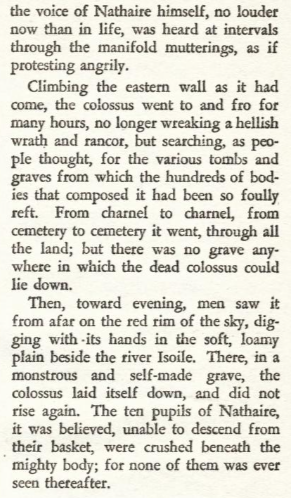
I mean, that’s great, isn’t it? This huge corpse suddenly turns and starts wandering the countryside, going to the graves and tombs from which its bits and pieces were taken before finally just digging its own giant grave and laying down to die. The bit with the voices is fun, as is the payoff with the pupils in the baby bjorn; imagine them just, like, helplessly swinging there the whole time before getting crushed to death in the new grave. I mean, it’s great stuff!

There’s a brief coda where we learn that the stinking giant corpse ended up causing all kinds of health problems, but also that Gaspard was the only sorcery in the country to never have had any subsequent trouble with the inquisition, so, for the most part, it’s a happy ending! Yay!

I really like this one. Smith’s Averiogne is a fun setting, a wooly Dark Ages France full of weird wizards and cruel aristocrats – there’s honestly a very Warhammer Fantasy feeling there, and it must’ve been a big influence on all that stuff. “The Colossus of Ylourgne” is a good weird tale, very inventive and, in places, very surprising – the complete repudiation of Christianity, the dark humor, the violence, it’s all well done and, for the most part, it’s a fairly propulsive story.

Now, if you’re familiar with Lovecraft’s “The Dunwich Horror” (pub’d in Weird Tales in 1929), I think you can see what an inspiration that was for Smith; he’s basically doing a medieval retelling of that story, down to the magical dust at the end even! But he’s changed enough stuff and made it his own that it’s not a problem in my opinion, and he’s clearly having fun writing it. I think there’s also some Robert E. Howard in here too – Conan had appeared in the pages of Weird Tales in 1932, and that kind of rip-roaring sword-and-sorcery clearly influenced Smith, particularly in his wizard characters.

All in all, it’s a good creepy tale in a well-expressed secondary fantasy world, and even if the ending is a little abrupt and overly just-so, the denouement of the big corpse burying itself makes up for it, I think. There’s an inventiveness in Smith’s stuff that makes him worth reading, I think, a real adherence to a style and a vision that was his own while, at the same time, was also a part of the larger Weird Tales movement. He’s not as well as known as ol’ HPL or REH, and I don’t think there’re any comics or movies or video games with his stuff (although his creations bleed into the HPL and REH adaptations), but Smith is a very important influence on both horror and fantasy, and I think there’s a lot to appreciate in his work!

Strained Pulp #4: Halloween Edition!!! “The Night-Wire” by H.F. Arnold (Weird Tales v.8 n. 3, Sept, 1926)

It finally cooled down here in Texas (where I live), and with those open windows and brisk overnights in the mid-60s, I’ve finally begun to get all spooked up fer Halloween season! As such, I’m going to be super indulgent in these pulp strainers for this month, picking stories based not on their importance or significance, but rather on how much I like ’em! And we’re going to start with what is certainly one of my personal favorite weird tales of all time, H.F. Arnold’s absolutely incredible “The Night-Wire,” from the September 1926 issue of Weird Tales magazine.

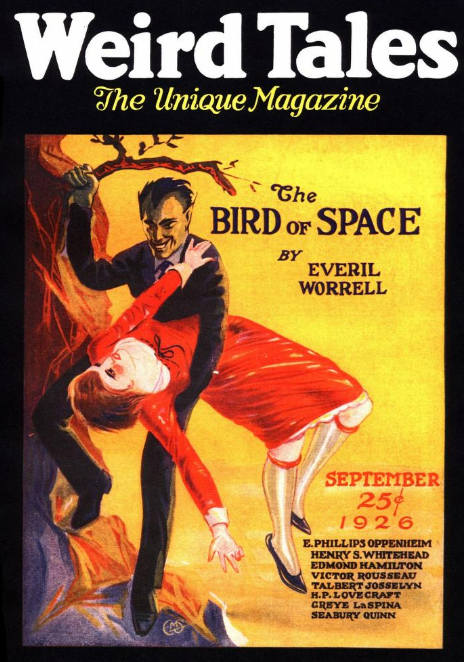
The cover by E.M. Stevenson for this issue of Weird Tales is pretty underwhelming, in my opinion; Stevenson had done a number of covers for the magazine, probably most famously illustrating Robert E. Howard’s first appearance on the cover of the magazine, “Wolfshead.” His style isn’t my favorite, but even so the weakness of this cover probably has more to do with the fact that, other than Arnold’s “The Night-Wire,” this is a pretty lackluster issue.

The Quinn and La Spina stories are nothing like their strongest, and the story they gave the cover to, “The Bird of Space,” is one of the “pseudo-science” stories that would rapidly vanish from Weird Tales, migrating over to the newly invented “science fiction” magazines (fyi, Amazing Stories had only begun publishing this very year, in March 1926; before that, a lot of “planet stories” had had nowhere else to go but Weird Tales). Even the Lovecraft story in this issue, “He,” is really dull, one of his “goddamn I hate living in New York with all these non-WASPs” stories that is just a real slog to get through (although it’s got a good monster at the end). But! There is a single gem in this issue, and it is “The Night-Wire,” an absolutely incredible story by the mysterious and unknown H.F. Arnold.

First off, who the hell is H.F. Arnold, anyway? Well, to cut the chase: we don’t know. He published two stories in Weird Tales, this one in 1926 and a sci-fi two-parter in 1929 titled “The City of the Iron Cubes;” then, in 1937, he presumably also published a two-part sci-fi story in Amazing Stories titled “When Atlantis Was.” I say “presumably” because that’s one hell of a gap, and it’s not like the name is particularly notable or unique. There are some articles, one about cowgirls and one about “loco weed” that were written by a “Henry Arnold” and published in some western pulps in the 20s too, and depending on who is doin’ the writing, these are sometimes attributed to him (though just as often not). But that’s about it! No confirmed birthdate or death date, no bio, no job, no nuthin’! A few years back some folks thought they’d identified him as an Angeleno, but then I’ve seen other people dispute it. On the basis of this story, “The Night-Wire,” some people suggest that he must’ve been a newsman or have worked in a radio news office, but that’s pure conjecture. Just another illustration of Harlan Ellison’s point about the pulps: we don’t know anything about a huge number of the people who wrote em!

But, despite H.F. Arnold’s scant output, they produced at least one masterpiece in their mysterious lifetime. “The Night-Wire” is so good that I want to stress that if you haven’t read it, take the time now and go read it. Here, I’ll even link it again for you, right here. Seriously, don’t deprive yourself of the pleasure of encountering this story blind and unsuspecting, it’s worth it. Plus it’s real short. Just go read it, okay?

Alright, assuming everyone has read it now, let’s dive into:

No illustration for this one, sadly – can’t imagine why, the thing seems tailormade for weird imagery! But, oh well! Here’s how it starts:

The news flash right up front is a nice touch, a good contrast with the kind of hard-boiled narration that comes after, and both really set the scene. Immediately you get a sense of isolation, clacking machines, radio beeps and whatnot, a lonely guy sitting waaaaay up atop a concrete and steel needle in the dark, communicating with distant offices via the strange sorcery of radio waves. It’s great! it’s economical! Can’t be beat. Also, interestingly: is the “CP” part, mentioned there, the Canadian Press? Or is it meant to be a generic version of the AP? I don’t know, and it doesn’t matter – it’s just the signifier for the press releases being transmitted.

Our nameless narrator spends a little bit more time musing on the strangeness of being a wire man at night, giving us a sense of the job. This part is a lot of fun for me; I’m honestly a sucker for technical jargon and expertise, especially when it’s done in the pulps like this. There’s something fun about the image of some guy, cigarette wearily clamped in his teeth, methodically going about his work. This idea of someone whose damned good at their job is also something on H.F. Arnold’s mind, because he soon introduces us to the narrator’s companion there at the wire desk, John Morgan, a “double” man who, strangely, can apparently listen to AND transcribe TWO separate news feeds on TWO separate typewriters SIMULTANEOUSLY! Was that ever actually real, I wonder? In the story, Morgan is one of three operators the narrator has known who can perform this bizarre miracle. I have to floss looking away from a mirror I get so turned around, so the idea of someone transcribing two different news reports on two different typewriters boggles my poor clumsy mind.

It’s a quiet night there in the office, so the narrator is surprised when Morgan switches in the second wire and starts banging away on the second typewriter. He gets up and checks on the pile of typed copy for this new, second wire. And what does he see?

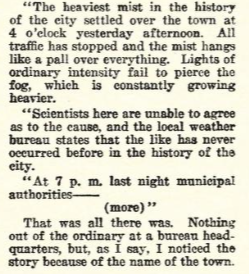
Just right off the bat, the name of this town is really good. There’s a nice, outre euphoniousness to “Xebico” in my opinion; you’ve got an X there, of course, right away that’s plenty weird, but then there’s a kind of indeterminant exoticism to the rest of the name, a vaguely Latinate suffix in the -ico ending that suggest something familiar, but you can’t place it. It’s a peach of a name for a weird city, is my point. And what’s shakin’ in ol’ Xeb town tonight?

Bit o’ fog is all – nothing strange so far, although “scientists” being unable to agree on its origins is neat (fun to imagine them asking, like, a coleopterist and a structural geologist and solid-state physics guy about this fog). The only thing that stands out to the narrator is the weird name for a city he’s never heard of, which is strange to him – as established in the beginning, wire guys get familiar with all these distant, strange places, so running into some place new is a pretty rare occurrence.

At this point in the story, there’s nothing overtly odd going on, although I think Arnold has done a great job laying the ground work; there’s the weird name, sure, but then there’s also the weird “double” typing of Morgan that stands out. It’s a real strange image, isn’t it? Some guy plugging away on two typewriters at once – very reminiscent of automatic writing or, even more occultly, channeled writing being done in a séance. And, as the story progresses, I think we’ll see that that was exactly what Arnold was trying to convey.

Fifteen minutes pass, and Morgan produces more copy:

And more:

It’s a great little escalation, and feels very cinematic, doesn’t it? This strange fog has appeared, no one knows where it comes from, “scientists” can’t come to any consensus…and now some weird guy from the church shows up, screaming about writhing phantoms and the way this unearthly miasma has boiled up from a graveyard. Of course you can’t believe him, he’s hysterical, but maybe we oughta send some folks over there to check it out, just to be sure…

There’s very little narrator interjection, just the guy acknowledging that, yeesh, that’s some weird stuff coming out of Morgan’s typewriter, huh? Spooky on a lonely old night like this, too. It’s all just really great writing, clean and efficient and evocative.

That escalating tension continues, with further stories from Xebico telling how the first search party that was sent out never returned, so a second, larger party was dispatched to figure out what the hell was going on. (I’m sure that’ll work out fine!) Meanwhile, further chaos is engulfing Xebico – families are abandoning their homes and flooding into churches, fearfully praying for salvation, while the fog grows ever thicker. Good stuff! Very atmospheric, and the added layer of hearing about it second-hand, via the narrator’s reading of the wire copy, provides so much to an atmosphere of disconnection; where the hell even is this place, and what the hell is happening there!?

And meanwhile Morgan keeps on transcribing, slumped and strangely still in his chair, the keys clacking monotonously in the quiet office. Fascinated and horrified, the narrator reads over his shoulder.

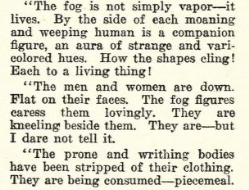
The image of that is pretty fantastic, isn’t it? Reading what comes next, word by word – it’s very spooky, and you get a sense of real tension as you imagine them coming in, letter by letter, from Morgan’s typing. And what comes in is some pretty wild stuff!

The inexplicable apocalypse only gets weirder from there! The reporter sending the transmission sees the fog part, briefly, and witnesses true horror – the dead and dying bodies of Xebico’s citizens appear, but they’re accompanied by…something else…

The final transmission from the reporter gets a little psychedelic; strange fiery lights of a mysterious and impossible hue fill the sky and seem to pour down into the city. There, some kind of strange transfiguration occurs; is the light somehow a second phase of this disaster, or is it combatting the fog? We never know, because Xebico goes silent, forever. And then, back in the tower, the denouement:

First off, the second wire hasn’t been receiving anything at all! And, stranger still, Morgan has been dead for hours. What, then, was the Xebico transmission? The dying impulses of Morgan’s brain? An etheric communication from somewhere beyond? Thankfully, H.F. Arnold doesn’t tell us, letting the mystery just sit there, like a toad.

Obviously, I love this story – it’s got everything I like in a weird tale, and it does it all so artfully and elegantly that you can’t help but get drawn in. Everything about it is strange and different and just not-quite-right. The technological aspect is interesting: invisible waves travelling thousands of miles to brings information to people, who sit in the dark and scribble it down. It’s modern radio presented in a very gothic style, with the wire men like monks pounding away on their manuscripts. And then the image of Morgan as medium (and a dead one at that!) receiving, in a more visceral and mystical way, a transmission from somewhere else. And then, what the hell is going on in Xebico, anyway? Murder fogs full of strange phantoms, weird lights in the sky?

I guess that’s all I have to say about it. Fer my money, it’s one of the best stories Weird Tales ever published, perfectly spooky and strange. If you’re looking for something fun to read this Halloween season, I’ll once again urge you to check it out!

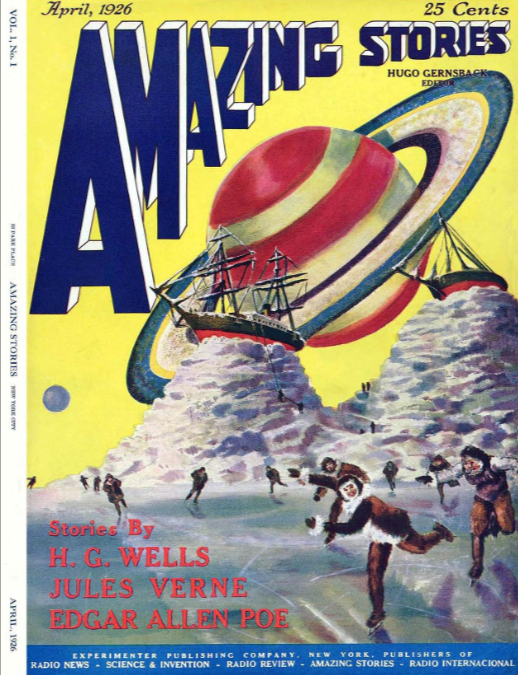
Strained Pulp #3: “The Man from the Atom” Parts 1 & 2 by G. Peyton Wertenbaker (Amazing Stories #1 and #2, April 1926 and May 1926)

Lookit us, breaking out of “Weird Tales” and into some honest-to-gosh science fiction (or, as Hugo Gernsback preferred, “scientifiction”)!

This is the first issue of the very first magazine devoted to science fiction ever, making 1926 basically the date at which you can pin the creation of the genre. I know people like to wax moronic about Lucian of Samosata and Mary Shelley and all that older stuff, and certainly it’s important, but the fact of the matter is that, until Hugo Gernsback started publishing magazines, no one would have said that what they were reading (or writing) was “science fiction.” It was in this magazine right here that the genre was defined and delimited and created, by readers, writers, editors, and publishers, who had a dedicated space to wrangle and argue and pontificate about what was (and wasn’t) science fiction!

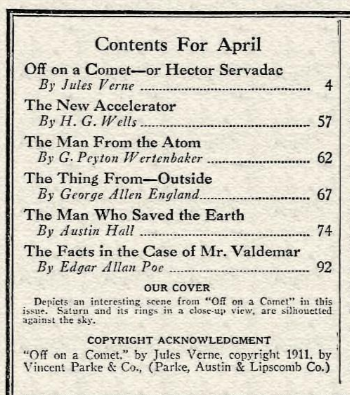
That being said, there’s also an interesting aspect to the creation of the genre that’s immediately noticeable right there on the cover of the magazine. Take a look at those authors: Wells, Verne, and Poe. If you look inside at the ToC, you see that there’re other names there too, though interestingly NONE of the fiction in this first issue was written for the magazine; they’re all reprints, either of “classics” or of stories that were previously published in Gernsback’s older radio and electronics news magazines.

It would actually take a while for the stories to start being “originals” for the magazine – the whole first year of Amazing Stories is absolutely dominated by Verne and Wells, often with their longer works stretching over multiple issues. This is, interestingly, different from Weird Tales, which actively made a call for submissions in writers’ magazines and professional journals before it’s first issue was published. I haven’t run across any advertisements like that for Amazing Stories, and it certainly seems like Gernsback had a very definite plan in mind to use these older and “classic” works in his magazine.

ALSO interesting, to me, is that Poe is such a major figure in here. This is 1926, Weird Tales has been chugging along for 3 years already at this point, but the tangle of “science fiction” and “weird fiction” is still very evident in both of the magazines. Interestingly the George Allen England story there (“The Thing From – Outside”) is also 100% a weird fiction “monster from beyond” horror story. These broadly speculative and imaginative literatures are so intimately intertwined at this time, and only with the nichification of the pulps did they develop the kind of rigid boundaries that we tend to think about today.

Anyway, the story that we’re going to talk about today is Wertenbaker’s “The Man From the Atom,” which is a two-parter that stretches over these first two issues. The first part, written as a standalone, was originally published in an earlier issue of Gernsback’s Popular Science-like magazine “Science and Invention.” The sequel to the story is actually the first original fiction published in Amazing Stories. Wertenbaker is an interesting guy; he’d write a bit more sci-fi early in his career, then turn to historical and regional novels, then became an editor at some major magazines. After WWII he’d end up at NASA as a speech writer, and would eventually become a big part of their space medicine program as a documentarian and historian. Interesting dude!

A thing to note about “The Man From the Atom” part the first is that Wertenbaker wrote it when he was fifteen, and it shows! It’s really overwritten, even for the time, with extremely purple prose and some brutally tortured sentences. The science in it is goofy as hell, of course, but it illustrates just how big of a deal Einstein was at the time, and how influential relativity was on popular culture.

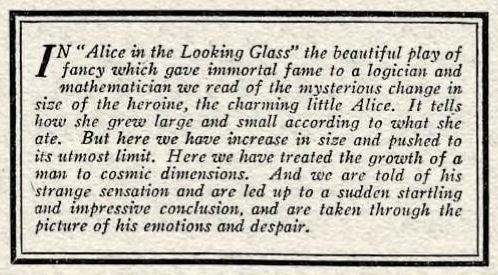
First thing first, though, are these little intro boxes that Gernsback (or one of his flunkies, although I’m inclined to think they’re from ol’ Hugo) wrote at the beginning of each of these stories. Here’s the one for “The Man From the Atom:”

A big part of Amazing Stories, especially early on, was the lengths to which Gernsback went to argue that scientifiction was an “improving” literature – it was both artistically sophisticated as well as educational. In fact, later editorials by Hugo would go on to claim that many scientists were writing him to let him know that they chose their careers BECAUSE of his magazine. This text is interesting, because he’s really playing up the literary merits of the story rather than it’s science-y aspects, probably because even for Amazing Stories the science in “The Man From the Atom” is pretty fantastical.

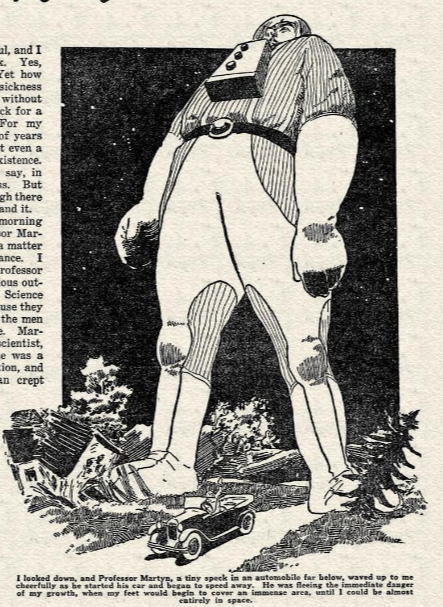
But before we get into it, check out this incredible title page art for the story! Amazing Stories had such great interior art, right from the beginning, it’s really a treat.

Between that art and the little blurb box, you know what’s coming: this is a story about a Boy what gets Big.

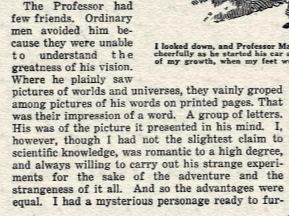
It starts with the narrator lamenting his fate, real sad-sack style. But then he buckles down and shares with us His Strange Tale. Seems our boy, called Kirby later in the story, is basically a Guinea Pig for a wild-eyed weirdo inventor names Professor Martyn. Their relationship is summed up on the first page fairly succinctly, if oddly:

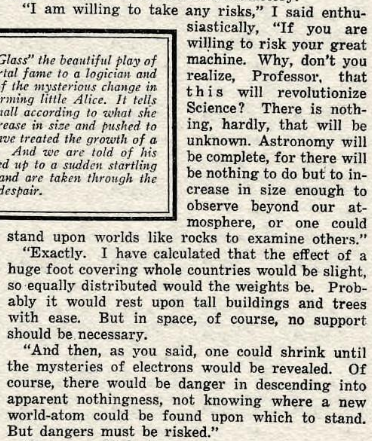
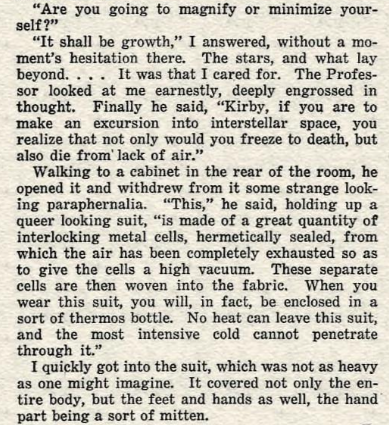
This maniac Professor Martyn basically invents weird stuff and Kirby eagerly tries ’em out, which is hilarious. Imagine being so “romantic” that you’re like, “yeah man, blast me with that ray!” or “sure, I’ll drink this bubbling vial of strange fluid, no problem.” But Kirby doesn’t give a shit; he’s down for anything. And that includes the Prof’s most recent invention, a machine that he accidently invented and doesn’t fully understand, but that basically can shrink or grow a person infinitely. And Kirby is pumped as hell to try it out:

It’s really funny to imagine embiggening as the secret to unlocking all astronomical mysteries. Glad to know a giant foot isn’t going to smash the Earth though, good that the Prof has already determined that. They soon get down to brass tacks:

Suited up, Kirby prepares to expand himself to cosmic scale. It’s kind of fun to consider the writing of this story from the perspective of a nerdy teen sometime before 1923. Rocketry as a viable discipline was still well down the pike, and the question of exactly how people are going to explore the universe and learn about space was still, really, a wild and fully speculative exercise. So the idea that this character is going to learn about planets and stars and stuff by just getting fuckin’ huge is, while extremely silly, also extremely imaginative and unprecedented.

Kirby and the Prof drive out to a secluded spot and begin their test. There’s some fun writing in this part, a real attempt by the author to describe the sensation and observations of someone growing exponentially to cosmic proportions.

It’s all fun and games though until Kirby grows to such a large size that he begins to experience the rotation of the earth under his feet, like he’s balancing on a ball. It’s very disorienting, and eventually he simply slips off the tiny earth, and floats powerless in space, watching the planets and the sun whizz by in every faster arcs. And as he keeps right on growing, the planets vanish and other stars come to dominate his vision; he grows beyond our solar system.

Fun cameo from “the ether” here, the old and, even in the 1920s, discredited idea of the interstellar medium that allowed for the transition of energy. It’s an idea that persists a long time in the pulps, even though it was largely debunked in the late 19th C. and was killed by Einstein’s own work. There’s a whole dissertation to be written on the incomplete and sometimes inchoate way that physics and science in general were incorporated into the pulps!

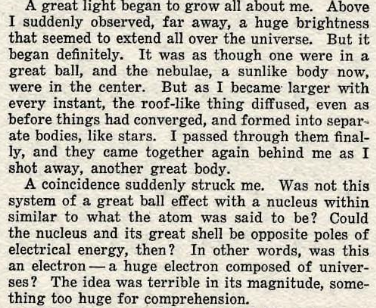
Anyway, Kirby expands beyond the galaxy eventually, watching the nebula recede until it itself is proven to be but a speck of light in an even larger nebula, and on and on, an ever expanding recursion of eternity, infinitely scalable. Kirby even experiences a moment of transcendent illumination, linking this the largest of scales with the tiniest expression of reality at the atomic level:

Like, woah, man, you know?

But this is too much for Kirby! He gets spooked, and starts to shrink back down. But he’s faced with a conundrum…how is he supposed to find the Earth again? He’s literally as big as the universe, and everything has been in motion around him, and now he’s supposed to find a specific speck in the vastness of space? The first planet he lands on, a warm weird water world, is clearly not the Earth. So, after a recuperative freakout, he decides to try again, expanding and then shrinking, aware of the difficulty but willing to give it a try. And at first it seems like it’s working, he finds the nebula, the right stars, and expects to find the sun soon…but…it’s gone! Then the final horrible revelation:

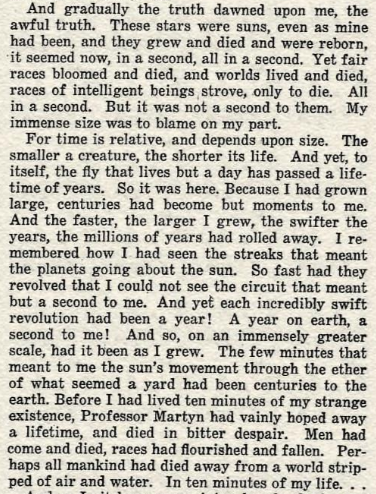
That’s right! By gettin’ big, Kirby experienced time at a fundamentally bigger scale – his brief sojourn among the stars, mere moments to him, was millions of years back home. He ends up shrinking down and finding a planet full of big-brained aliens, all of them hugely intellectually superior and scientifically way more advanced than he is; he’s a “savage” among them, a dumb curiosity who can’t learn their language (though they easily learn his). “The Man From the Atom” ends with Kirby trapped forever, unable to ever return to a long dead Earth…

…or IS HE!?!?

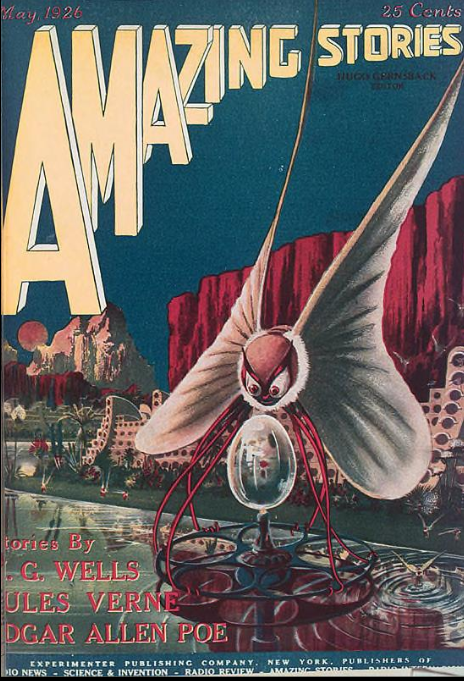
The sequel to “The Man From the Atom” is, like I said, the first piece of original fiction published in Amazing Stories. Here’s the cover from that issue, with a rad alien on it:

Our story picks up with Kirby saying that, yeah, he might’ve come off a little dramatic and despondent in his previous story, but it wasn’t ALL bad. For one thing, he met this big-brained cutie named Vinda!

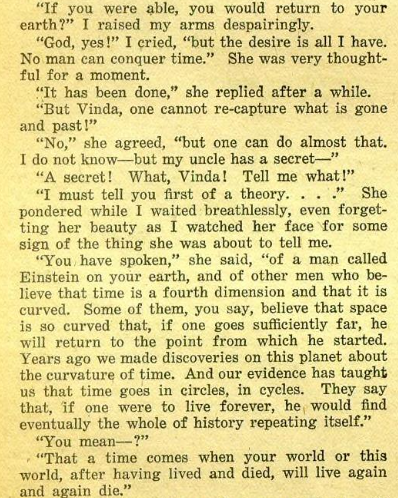
Vidna digs him, and makes his time on the alien world almost pleasant. Of course, he still yearns for the Green Hills of Earth and all that, so one day, Vinda comes to see him with a plan.

That’s right: the curvature of space-time = yuga cycles, basically, and if Kriby just gets himself big again and lets the universe spin for a few zillion years, he’ll come back around to, basically, the same Earth that he left, reborn in one of the infinite cycles of existence. It’s a fully bonkers idea, but it resonates kind of nicely with the spatial scaling stuff in the previous story, where the universe is like an atom in a bigger universe etc etc. Fully stoner sci-fi, but it’s absolutely non-derivative and novel in 1926.

Of course, nothing is ever easy, is it? It turns out that there’s some sort of weirdly “progressive” direction to history, so that even with its cyclic nature Kirby will return to a slightly changed, slightly more advanced world than when he left. It’s never really explained why this is, in the story; rather, it’s just an obvious, natural function of time cycles. Kind of a weirdly comforting idea, and one that you can absolutely see as coming out of the particular moment of the post-World War I american boomtime, what with the wonders of the modern age – it’s a particularly golden age sort of science fiction concept, that of course everything will always be somewhat better, at least iteratively.

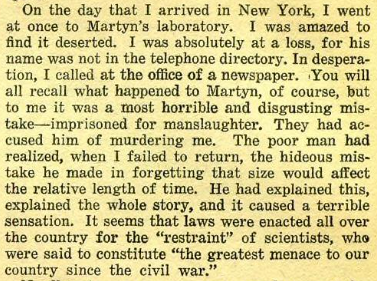
Anyway, Vinda helps Kirby write up a star chart from when he left Earth, which will help him ID the time and location of Earth. He does his cosmic expansion thing and, with his careful preparations, actually does cycle back and finds the Earth at roughly the time when he left it. He shrinks down and finds himself in the Sahara, back home in good old’ late 1840s, although its actually as advanced as the 1940s of Kirby’s original timeline/cycle/whatever! He finds himself back in New York and discovers that Professor Martyn is in jail for his murder! It seems that in this cycle they did the experiment also, and everybody blamed Martyn for Kirby’s dissaparence. In fact:

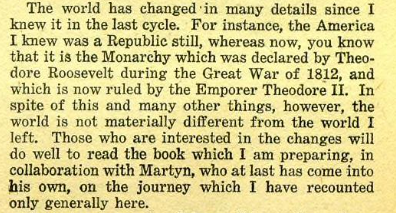
Kirby’s reappearance causes quite a stir, and Martyn is released from jail and presumably scientist are taken off the terrorism watch list. There’s then a chunk of the story that explores some of the alternative history of this cycle of the Earth:

That bit about Teddy Roosevelt and the Great War of 1812 is weird – in our “cycle” of course Roosevelt wasn’t born until 1858, and the “Great War” of 1812 seems to imply that WWI happened nearly a hundred years earlier. I guess that this is some of that “accelerating advancement” stuff that is inherent to these cycles, but I wonder why the author chose those particulars. Guess we’ll just have to wait for the book by Kirby and Martyn. Anyway, who cares, because tomorrow Kirby is going to travel the cycles again in search of Vinda, whom he now realizes he’s passionately in love with. Of course, the inescapable logic of this cyclic universe crap leads to some odd musings:

So that’s it, the very first piece of original sci fi written for Amazing Stories. It’s an odd one, and I don’t know why the author wanted to write a follow up – honestly, to me, the ending of the first part feels perfectly satisfactory. I think the interesting thing is how, in these early days of pulp sci-fi, the fantastical elements of modern physics and invention has an absolute stranglehold on the imagination. These kind of way-out ideas, like a device that makes you grow so huge that you experience time in a fundamentally different way, are a lot of fun and also speak to a very different mode of science fiction. In a couple years, E.E. “Doc” Smith will start publishing his Skylark stories in Amazing, and that’ll be a huge change – those stories, and Smith in general, kind of invent the Space Opera subgenre, and two-fisted thrilling action sci-fi comes to quickly dominate the early pulps. Similarly, socialist science fiction writers in the 30s, as well as the general collapse of the economy in the Great Depression, will lead to a newer, grimmer, more psychologically and socially oriented flavor of sci-fi. But in these early years of the genre, and particularly as envisioned by Gernsback, there’s a real, honest-to-goodness “gee whiz” style to these stories, not necessarily in a kiddie way; rather, there’s real excitement about invention and imagination in them, and an emphasis on humans interacting with weirdness on the bleeding edge of science. They’re fun, is the thing, and they’re also so very original, that they’re honestly just a pleasure to read.

Strained Pulp #2: “A Square of Canvas” by Anthony Rud (Weird Tales #2, April 1923)

I promise these won’t all be about stories from Weird Tales! I’ve got some stuff from Amazing Stories, Black Mask, and Astounding that I want to hit eventually, but Weird Tales is such a huge, important magazine, and its story is so interesting, that we’re definitely going to be seeing a lot of it. And this week is no exception, with Anthony Rud’s (kind of unpleasant) story of grisly murder, art, and madness, “A Square of Canvas.”

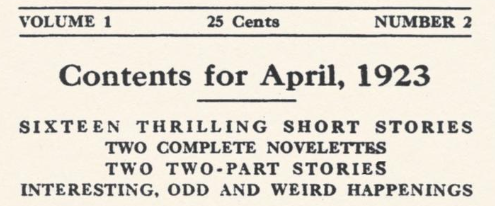
This is the second issue of Weird Tales, from May, 1923, with a cover by (I think) R.M. Mally. You can definitely tell that Baird is still trying to find his footing with the stories and general thrust of the magazine. Take a look at this little descriptor above the ToC:

It’s interesting for a couple of reasons, one being that there’s a lot of “two-part” stories, meaning that they’re being spread across multiple issues. This is something that you see a fair amount in Weird Tales, especially early on, and man, did the readers hate it. Lots of miffed letters complaining about how annoying it is to wait for a month to find out the next part of the story, with all the attendant dangers of forgetting what happened or missing an issue. It’s obviously an attempt at hooking an audience, since it’s used a LOT in the Baird era (1923-1924), even though the magazine is incredibly long at that point and could easily have accommodated these longer pieces; this issue, #2, is nearly 200 pages! You’ll see some things split up later on, but after Baird leaves and Wright takes over, there’s an effort to avoid it, much to the appreciation of the readers.

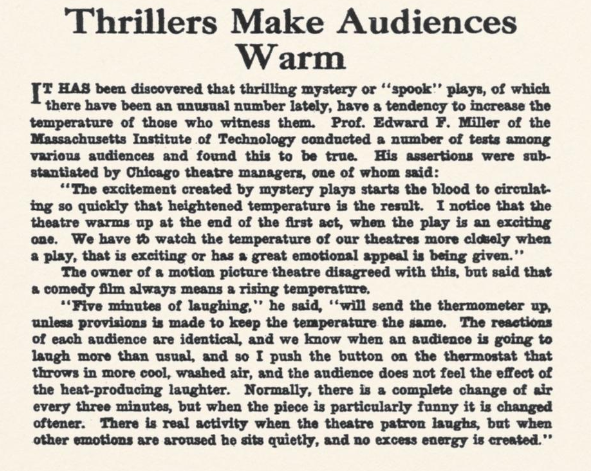
The second interesting thing in that little description is the “interesting, odd, and weird happenings” bit, which refers to things like this:

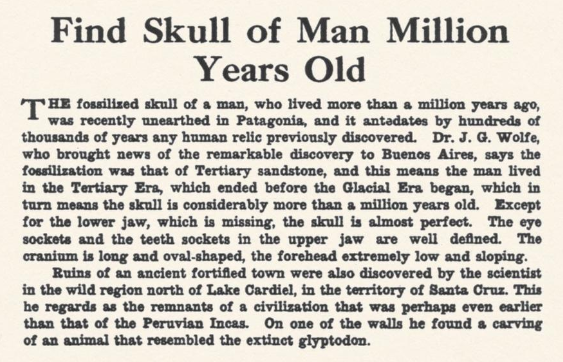
These goofy little articles appear as page filler below the endings of stories throughout these early issues, unattributed and unsubstantiated and generally of a broadly defined “weird” flavor. The one above seems tenuously related at best (a brief allusion to “spook” plays seeming to be the only weird thing to recommend it), but it DOES have a common thread with a lot of the other “strange interludes” scattered throughout the magazine: a scientific bent. Here’s another:

(As a side note, this one is 100% false – the earliest human remains in South America date to, at the oldest, 40,000 years, though most workers accept 26,000 years before present as much more likely).

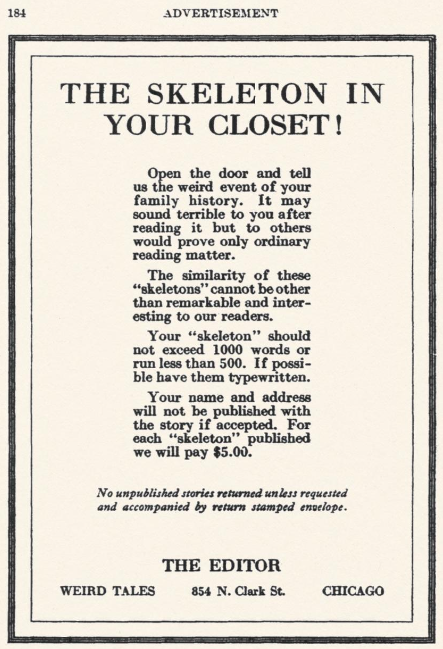
A lot of these, as mentioned above, are science-y at least, although there’re also a fair number of “horrible murders” included. But you can really see by their inclusion that the idea of “weird fiction” is still being hashed out; there’s a lot of strange, abortive attempts at including things like this in the magazine, seeing what sticks and what doesn’t, conceptually, as weird. Baird, a fan of crime fiction and a veteran of the detective pulps, clearly thought stuff like this was important, since he actively solicits “weird shit that happened to you!” in the back of this issue:

These sorts of things eventually go away, replaced by art or better page layouts that eliminate white space, but ALSO because the second editor, Farnsworth Wright, hated this shit. Time and time again, he studiously ignores the calls from readers in The Eerie to include “real life” ghost stories, Fortean-type reports of weird stuff, and even “strange dreams” that readers wanted to submit. Wright (thankfully) had a clearer, exclusively literary idea of what the weird genre could be, and took a lot of strong editorial decisions to put it into practice.

But that’s all in the future! Here, in May of 1923, with Baird at the helm, we’ve got the second issue of Weird Tales, and it’s really not good! The only recognizable names on the ToC are Farnsworth Wright, Otis Kline (who will be hired alongside Wright by Baird after this issue as a reader and editorial assistant) and Anthony Rud. Reading through the issue, what really stands out is how much crime/murder stories still dominate Weird Tales – there’s some occultism and some supernaturalism, a monster here or there, and some weird science, but a solid half of these stories are just “watch this psycho brutalize someone.” Which brings us to our story today, Rud’s “A Square of Canvas.”

Now, first thing first – this is not a good story per se. There’s some neat bits, and it’s interesting (though ultimately inconsequential) that the narrator is a woman. But there’s also some real unpleasantness here in the form of cruelty to animals, so be warned! What makes it worthy of contemplation, at least in my mind, is that it’s a very early version of the “Freaky Artist” trope, which has a long history in both horror and weird fiction. Perhaps its most famous expression will come in 1927, when H.P. Lovecraft publishes “Pickman’s Model” in Weird Tales, but Rud’s take on it here is a striking early example.

It starts, as these things often do, in a sanitarium:

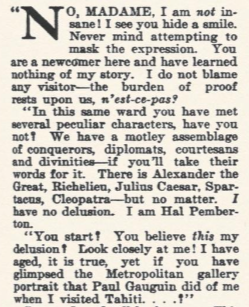
This is a fun bit of dialog, very vital and effective; you can feel the urging and the eagerness of the speaker who, clearly, is coming off a little intense. It also employs one of weird fiction’s most versatile and fun little tricks, the mixing of fact with fiction. This weirdo is trying to convince a woman that, while he recognizes that he’s in an insane asylum full of people who think they’re famous figures from history, HE at least is who he says he is, and he does this by referencing a portrait of himself done by Gauguin and hanging in the Met! A fun little example of something very much specific to the weird genre, this blending of reality with strangeness.

The woman Hal Pemberton is speaking to is, it turns out, also an artist, and so she is certainly familiar with the Gauguin portrait he’s speaking of. With a gasp she realizes that she DOES recognize this guy – he’s older, with greyer hair and more wrinkles, but he DOES in fact resemble the picture! Gratified by this, Pemberton confides in her that he has been imprisoned in this institution by mistake, and hopes that, by unfolding his tale, this unnamed woman will help to get him released, for he is an Artist, and has much Great Work to do!

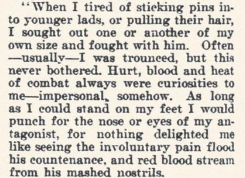
This begins the the meat of the story; Pemberton, the scion of an affluent family, has a hard time in school as a child. He finds his lessons boring, and in fact the only thing he takes pleasure in is tormenting his classmates. He likes to pinch them, kick them, pull their hair, eventually graduating to full on brawls. He loses as many of them as he wins, but for Pemberton, that’s beside the point. What he likes is pain:

This is pretty good writing – you get a reeeeeeeal uncomfortable feeling reading this, a pretty effective sense of a deeply and fundamentally fucked-up kid. You also probably see where this is going by this point; unfortunately, the story is going to take its time to get there, with some unpleasant detours along the way.

Pemberton ends up getting kicked out of school and goes through a succession of tutors, all of whom are implied to have quiet as a result of Pemberton’s weirdness or stubborn refusal to learn. His last tutor makes the mistake of leaving him alone with some live beetles that they’re studying, and Pemberton does the thing that you knew was coming. He tortures the beetles, and while he’s doing it he sketches something, specifically using their agony and suffering to fuel whatever it is he’s drawing. His tutor returns and sees what he’s done, but also sees the drawing he’s made. Hilariously, his horror at his pupil’s cruelty leads him to quit, but not before telling Pemberton’s dad that he’s a good artist and should be sent to art school. Can you imagine that scene? “Hal’s a fuckin’ sadistic little creep, but damn can he draw!”

Pemberton is exiled to Paris to study art, where he’s perfectly competent but not as “inspired” as he was with the beetles. Again, you know what’s going to happen, but it doesn’t make it any less unpleasant of a read. There’s some very unpleasant stuff with some rabbits and a horse, and a through-line of the need for escalating violence to spur the artistic inspiration sought after by Pemberton. It’s all quite ugly. I do think it’s interesting how Rud clearly makes his freaky artist a sadist for ARTIST REASONS ONLY; there’s not a hint of sadistic sexuality in this story, not even an upcoming section where you’d expect it. I wonder if there was any in the original and it got cut or edited out? From the editorial statements of Baird, there’s a clear worry, even this early on, that people might think Weird Tales was a little too degenerate for public consumption, so it could’ve been removed. But it also might reflect Rud’s actual intention – he wants to focus on weirdness, and, honestly, a freak who does the sort of shit that’s in this story not for fetishistic but, rather, purely aesthetic reasons is way weirder than some run-of-the-mill sadosexual guy.

Pemberton’s new art is a big hit, initially, but when his teacher in Paris learns about how he went about getting inspired for its creation, he’s horrified. The story gets out and Pemberton is ruined in Europe; so he flees to America where, the facts unknown, his animal-torture inspired work is a huge hit! Oddly, this leads to Pemberton becoming a famous and rich portraitist of the moneyed elite – is that a bit of subtle satire from Rud? Pemberton, whose work is inspired by brutal violence inflicted on the innocent, somehow just resonates with these high society types and becomes their go-to guy for getting a portrait done. Is he, with his horrible insight, capturing something of the truth about these people?

Whether satirical or just silly, Pemberton meets his wife, Beatrice, through this work, and they fall in love, get married, and have a daughter. Now, at this point, interestingly, Pemberton has basically renounced his older work and has chosen to stick to mundane portraits. The trouble is, he’s bored to death by it all, but he’s scared to try and recreate his “experiments” because he knows they might not be enough for him anymore. Trying to stave off despair at his artistic blockage, he abandons portraiture for landscapes, choosing as his subject “dirty, sordid, or powerful” scenes. These include fish markets, ghetto streets, and industrial seascapes; the implication here is that he’s seeking out grim and gritty realism, trying to find the spark of abjectness that always gave his art the fire he was after, but he can’t quite get it.

Finally, driven to a frenzy by his need to produce “real” work, he escapes to the countryside, buys a horse, and does his awful thing, producing a canvas that he calls “Cannibalism.” Now, this is the only real description in the story of the product of his particular method, and it suggests that the cruelty and torture are a sort of spiritual or emotional inspiration for him, since the painting he produces doesn’t have anything to do with horses (rather, it’s a casually racist depiction of “savages gorging themselves on human flesh”). It’s not fully satisfying to Pemberton though, and it almost gets him in trouble when it’s exhibited; his wife ends up making him burn it. But the artistic failure just makes his need all that much greater.

You know where this is all going.

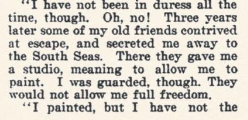
In an inversion of Dante, Pemberton tortures his Beatrice to death, finally creating a painting he’s happy with. The servants, horrified, call the police and Pemberton, afraid that they’ll destroy his masterpiece, hides it. He’s taken in, tried, convicted, but found insane and sent to the asylum. Interestingly, there’s a little interlude in his imprisonment:

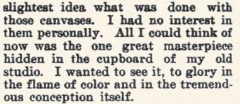
That’s a weird part, right? It’s very enigmatical – it COULD be that Pemberton’s society pals like him and want to help him out and send him to Tahiti (where he meets and gets painted by Gauguin), but there’s the odd bit about them basically keeping him under lock and key and forcing him to paint. Are they providing him with “inspiration” too? This part, very creepily, sort of implies that there’s this snuff-painting ring being run with Pemberton at its heart, not that he’s interested; all he can think about is his masterpiece hidden away in his old house. Anyway, let’s wrap this up:

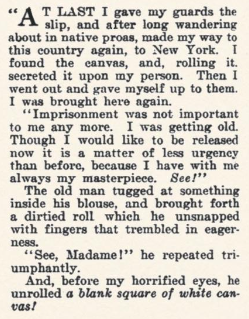
That’s it, The End of “A Square of Canvas” by Anthony Rud.

First thing first: gotta love an italicized ending, right? Just a real classic move, and they’re always delightful when you encounter them. This one is a little strange, and leaves you (or me, at least) with a few questions. Obviously Pemberton is off his onion, but in what way, specifically? Did the torture and murder of his wife break his last tenuous grasp on reality, or is his whole story a fabrication, start to finish? Maybe you’re just supposed to be shocked that, after all this build-up, there’s not even a painting to “justify” it all? Or has Pemberton realized his true art is in the monstrous acts, and no representation of them can ever come close? Maybe Rud just got tired of writing, figured he’d locked in his quarter-of-a-cent per word, and moved on to something else? Dunno! S’weird though, which I reckon is what counts.

The whole story is interesting, although like I said, the animal torture stuff is extremely distasteful – it’s not overly graphic, but for me it’s plenty, and I can’t fault anyone for not wanting to read it. Like I said way up above somewhere, though, I do think it’s really interesting as an early (and possibly influential) example of the Mad Artist trope, something that’s nearly as well represented in weird fiction as the Mad Scientist. Both of them posit an answer to C.P. Snow’s “Two Cultures” dilemma, which is that both disciplines, striving towards some kind of transcendent truth, can lead to madness, ultimately. It’s a deep part of horror and weird fiction; I’d lay good money that it started with E.T.A. Hoffmann’s murderous jeweler in “Mademoiselle de Scudéry,” but it’s all over the pulps.

Lovecraft has a number of mad artists in his stories, the most notable being the painter Richard Upton Pickman from “Pickman’s Model.” In that story, the SHOCKING TWIST is that Pickman, a painter of horrendous and terrible phantasmagoric scenes, is actually a strict REALIST, and he’s been painting not nightmare visions but, rather, accurate representations of real life scenes!!!!!! That’s a story worth reading, by the way, and one I kind of suspect has some kind of relationship to this story – we know Lovecraft was a Weird Tales reader from the get-go, so he certainly read this story, although I don’t know if he ever mentioned it in his voluminous letters. But there’re some things that seem to connect the two – the chatty narration from a character, the emphasis on horror revealed in art, even the description of Pemberton’s “Cannibalism” seems to resonate with Pickman’s “Ghouls Feeding” painting mentioned in Lovecraft’s story.

We tend (rightly) to talk about how the modern scientific age influenced weird fiction (and sci fi, of course) – Deep Time and evolution displaced Paley’s Watchmaker and humanity’s centrality in Nature, an absolute necessity in weird fiction’s decentering of humans in favor of stranger and older forces and agencies. Similarly, early atomic science discovered the reality of invisible and heretofore unmeasurable rays and energies; in a world of X-rays and radiation, who knows what alien processes may be impinging on our placid, narrow little lives? But of equal importance to these revolutions in the sciences are the contemporaneous upheavals occurring in the arts and humanities in the early 20th century. Modernism and Futurism are as big a part of the weird fiction story as Darwinism and astronomy, and the idea of art as a dangerous door to the unknown and madness is one of the major themes of outré literature. Actually, it’s interesting that Rud writes a science horror story for the first issue of Weird Tales, and then produces this mad artist tale for the second issue! Just goes to show how intricately interwoven these ideas are in the history of weird fiction!

Straining Pulp #1: “The Closing Hand” by Farnsworth Wright

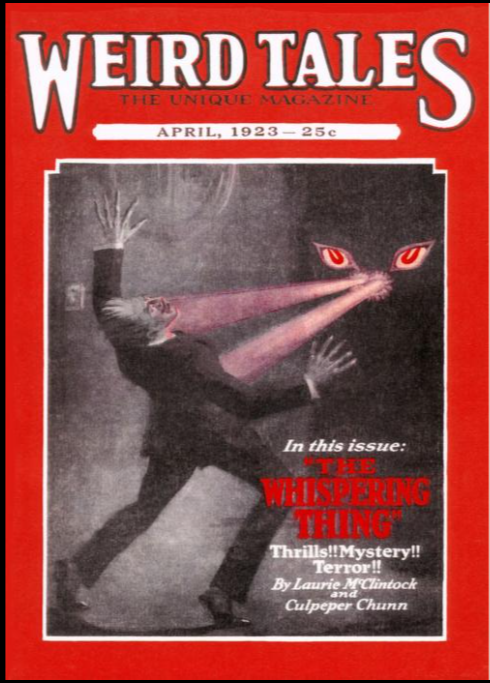
Alright! I wanna talk about classic weird fiction and pulp sci-fi and shit like that, so I’m gonna do it here! Very cleverly I’ve titled the series “Straining Pulp,” because it’s me sifting and winnowing old pulp magazines (thanks archive dot org!) and talking about stories I find interesting or noteworthy or fun. I’ll probably bop around a bunch of ’em as my mood takes me, but I figured I’d start with a magazine that is very important to me personally, pulps generally, and pop culture broadly. That’s right, it’s WEIRD TALES #1, from March 1923!!!!!

(Just a heads-up, I’m 100% going to spoiling these stories, so chase ’em down and read ’em aforehand if you want!)

First thing to note is the price on the cover there! 25 cents! There’s a misconception generally that pulp magazines were dirt cheap, but 25 cents in 1923 is something like 5 or 6 dollars today. Not gonna break the bank buying this copy of The Unique Magazine, but still… $6 for a magazine is respectable, you know? These weren’t penny-an-issue cheapos for the kiddie crowd to spend their milk money on, is what I’m saying.

Anyway, this is the very first issue of Weird Tales. Its editor at the time was Edwin Baird, a figure of some importance in the history of the detective/crime pulps, but at this point he’s got himself a job working for Rural Publications, editing both “Weird Tales” and “Real Detective Tales” at the same time. There’s a lot of animus towards Baird today; people tend to think that he hated horror and ghost stories, but I don’t think there’s any real evidence for that. He certainly had a PREFERENCE for crime fiction, but who among us doesn’t have their likes and dislikes, right? It’s important to recognize that, Joshi be damned, there’s no such thing as “weird fiction” until the invention of WEIRD TALES magazine – up to this point there was just a disparate morass of “goose-flesh” stories. It’s a topic for another time, but it’s clear that Baird is fighting his entire tenure against the fact that there’re some serious growing pains going on among the readership (and writers) as they try and decide on WHAT a “weird tale” is, exactly. Most of Baird’s comments in the Eerie (the reader letters section of the mag) start off with him telling people what NOT to send to the magazine. He’s seeing some seriously shitty writing in his time, and it’s definitely effecting his mood!

Case in point: this first issue is, honestly, a mess. The cover story, “Ooze,” gets a good painting by R. R. Epperly who, I think, never did another cover for them ever. The weird thing is that in the story the monster is very much a blobby pile of gunk (an “ooze” if you will) but the painting shows what is clearly an tentacular octopus of some sort. Still, I like its haunted eyes. Also, what’s that dude going to do with a shotgun in one hand and a cutlass in the other? Pick one, man!

As an aside, “Ooze” is a fairly middling story – got a fair bit of the ugly racism (and classism!) of the time in it, so be aware if you decide to chase it down. What is interesting is that it’s much more of a sci-fi story than what you’d think of as a “weird tale.” Of course, science fiction didn’t exist yet either (no matter what anyone will tell you!) since Hugo Gernsback’s magazine AMAZING STORIES wasn’t published until 1926. In these early days, and especially before there were dedicated sci-fi magazines, there’s a fair amount of it in Weird Tales, so much so that there’d be huge running gun battles in The Eerie about whether “planet stories” were weird enough for Weird Tales. It’s an interesting point in the evolution of both genres, and it’s right there from the get-go in Weird Tales #1.

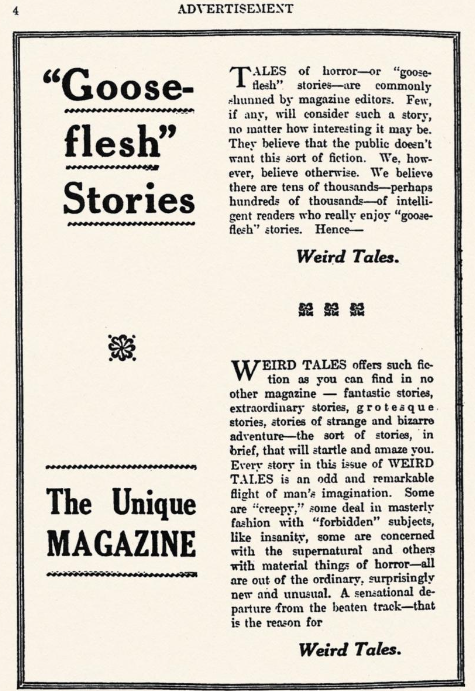
But, anyway, Baird has a hard job – Weird Tales was really the first NEW genre in the pulps, and there wasn’t a depth of writing or writers to draw from, and it shows! Check out this ad, right there on the 4th page of the magazine, just after the ToC:

It’s an advertisement for ITSELF, right there in the magazine, trying to give the reader a way to approach this collection of stories. It’s super interesting to see the creation of a genre in real time in the magazine itself!

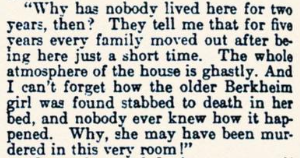
Interestingly, the story we’re going to look at today is written by Farnsworth Wright. Wright would step into the editorship of Weird Tales after Baird leaves in 1924, and is probably one of the most important figures in the early history of horror (something for another time, too). At this point, Wright is just a writer; he’ll get another story in the next issue of Weird Tales, at which point he’ll be hired by Baird as an editorial assistant. But, on to his story:

“The Closing Hand” is super short; a scant two-page haunted house story. The writing is overwrought to the point of parody, which I think was Wright’s intention. This isn’t juvenilia; Wright had written and been published in college and afterwards too, and his literary sophistication is evident from those pieces. I think Wright is using this short story to distill the haunted house tale down to it’s barest, most elemental parts, and to do that he’s got to speed-run the language used. Here’s the beginning; note the ripe-to-the-point-of-fermenting purple prose used to set the scene:

Rich, sloppy, bubbling language; it’d be self-indulgent if it was meant to be taken seriously. To be clear, it’s not tongue-in-cheek either; it’s Wright going overboard, reveling in the cliched conventions of the haunted house. There’s decay and abandonment and the aura of wrongness about this place, all very standardized to the point of banality.

We’re then introduced to the victims of the story: two sisters, an elder sceptic and a younger ‘fraidy cat convinced that the terrible old house is haunted. Of course they’ve been left alone, sleeping up in an attic while their mother is out at, I dunno, one of Gatsby’s parties or something. The younger sister wishes they’d gone with her, but the older sister scolds her, pointing out that SOMEONE had to stay in the house because of all the silverware. Get a dog guys, damn!

The younger sister than helpfully provides some exposition:

Not gonna find that in the zillow listing, lemme tell you what!

Anyway, the inevitable happens: there are furtive sounds in the night from downstairs, and the older sister heads off to investigate, leaving the scared younger sister alone in the upstairs room. And then she doesn’t come back.

Wind rattles the house, and then there’re strange creeping sounds, as if someone (or…someTHING!!!!) is ascending the stairs towards the attic bedroom. The younger sister begins to imagine what it could be, what horror is climbing towards her, and this is where the story gets the most fun; the sister rattles through a list of the basic horror tropes, scared in turn by the idea it might be a ghost, an undead body fresh from the grave (and “gibbering in terror it could not tear the cerements from its face” which is a great image…the horror itself is frightened by its condition!), a wild animal, or a murderer who, having killed her sister, has come up to finish the job. Then, something enters the dark room, crawling towards the bed…the younger sister reaches out, searching for the thing that comes ever closer, closer, closer, until her hand is suddenly gripped in an iron, cold claw and…she faints!

Here’s the end:

Not necessarily the most surprising of endings, sure, but I think it’s interesting for two reasons: 1) it’s pretty gruesome! That’s something Weird Tales, as the magazine where the genre was being created, would have to constantly deal with (maybe we’ll end up talking about C.M. Eddy’s story “The Loved Dead” one of these days…) but also 2) it’s interesting to me that Wright, the future editor of Weird Tales, was writing a barebones genre study in the very first issue of the magazine. I mean, there’s not really any other way to look at this story: it’s like the most economical haunted house tale you could write: 1) Here’s the spooky old house; 2) some victims discussing its spooky old history; 3) something spooky happens to separate them; 4) one of them produces a list of the various spooky things that could happen to the one left behind on their own; 5) oh shit something spooky is happening to the one left behind!!!!

Here’s the thing: Weird Tales is a new magazine. There’s literally been nothing like it on the market before. There’ve been ghost stories and such published in things like Argosy, sure, but here’s a magazine DEVOTED to this inchoate thing they’ve decided to call “the weird tale.” A big part of the magazine is everybody figuring out what that means…what the hell is a “weird tale?” So you end up with a cover story that’s science fiction, and a story by the future editor of the magazine that is dissecting one of the classic expressions of outré literature, the haunted house story. And that’s important, given the way Baird, as the editor, really goes out of his way on many different occasions to tell people not to submit derivative crap.

I think that makes “The Closed Hand” an interesting story – it’ll never be anthologized, because AS A STORY it’s not particularly interesting. But as an exercise, as a genre study, I think it’s really a worthwhile document that shows how, in 1923 at the birth of the formalized “weird tale,” you have people wrasslin’ with these ideas and conventions and clichés, trying to determine what works and what doesn’t, what needs to be discarded and what needs to be explored. That’s fascinating, and it’s fun to get the chance to see how both writers and readers at the time were navigating the dark waters of weird fiction.