Indulgence is best enjoyed in huge walloping ladlefuls, so I decided to go big with this one and write about one of the most indulgent weird fiction writers of all time, Clark Ashton Smith, and specifically about one of his best stories, the Averoigne-set, almost-sword-and-sorcery, horror-adventure tale, “The Colossus of Ylourgne.” It’s extremely pulpy, it’s extremely purple, it’s extremely weird, which is just to say, it’s extremely Clark Ashton Smith!
Smith is an interesting character. Today, he’s remembered as one of The Big Three from Weird Tales, right up there with Lovecraft and Robert E. Howard. I think this reflects both the quality and quantity of his output; he wrote unique, inventive stuff, and there’s a lot of it, too. Interestingly, he’s also the only one of that triumvirate to die of old age (in 1961), although that’s not to say that his life wasn’t similarly rough – he was crushingly poor for most of it, and even well into his old age had to take gardening jobs from his neighbors to make ends meet. In his own time as a pulp writer he was very popular with the readers, and there’s the suggestion that it was his work that convinced Edwin Baird, the first editor of Weird Tales, to reconsider his ban on verse in the magazine.
I think there are two relevant things about Smith to keep in mind. ONE, he was a serious poet, and an unabashedly Romantic one – early in his life (before Weird Tales) he published collections of his verse to critical acclaim and was well-plugged into the West Coast’s poetry scene through his mentor, George Sterling. However, his extremely traditional style (very much in the vein of Poe or Swinburne) butted up against the changing aesthetics of poetry in the early 20th century; his refusal to change his style caused him to fall out of favor and turn to pulp prose to try and make some money.
The SECOND thing to keep in mind is that Smith was a Californian his whole life, living in the shadow of the Sierras for much of it, and I think that really colors his writing. It’s especially visible in his descriptions of nature and people’s relationship to wilderness. There’s none of the musty, mouldering, decay of Lovecraft’s New England in Smith’s dark forests and mountains; rather, his landscapes always seem vital and rugged to me, weird and full of menace certainly, but as a result of their magnitude and natural power. Anything inimical in them is a result of that out-of-balance scale difference between nature and humanity. For Smith, horror is a human condition; it’s people and their uniquely human failings who bring corruption into the world.
I guess though there’s also a THIRD thing to keep in mind about Smith – he’s much grosser than Lovecraft or Howard. Lot of wormy, dripping corpses in his stories, and there’s a bloodier and, honestly, more sadistic edge to his horror. A lot of his stories have a sardonic cruelty to them, something he took from his extensive reading of the French Decadents, I reckon; Smith taught himself French to translate Baudelaire’s Les Fleurs du Mal, many excerpts of which appeared in Weird Tales. Anyway, his stuff is just way more sophisticated , if you will, than Lovecraft’s or Howard’s, with a noticeably different (though equally evocative) tone. There’s less scholarship on him than either of the other two, though there is a good Penguin Classics collection of some (but not all) or his stories and poetry (The Dark Eidolon and Other Fantasies, edited by S.T. Joshi). The story I want to talk about today, “The Colossus of Ylourgne,” is NOT in that collection, though, so you gotta follow that link to give it a read in the pages of Weird Tales (courtesy of archive.org!).
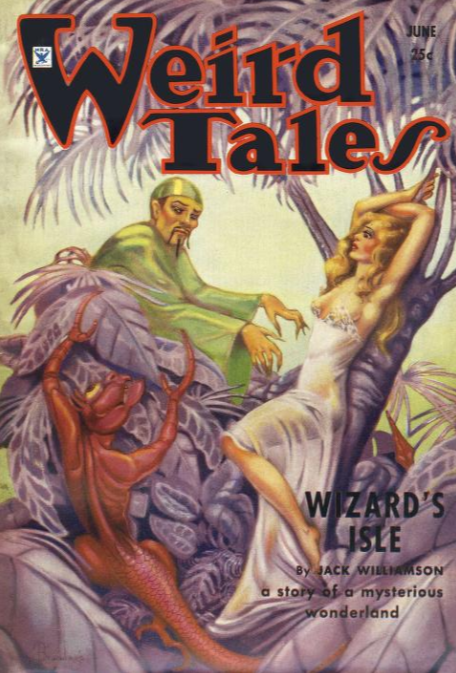
First thing first, let’s talk that cover! I don’t know if any of Smith’s stories ever got on the cover for Weird Tales. One of his stories did get a painting over at short-lived rival magazine Strange Tales, with a pretty striking monster from Smith’s story in that issue “The Hunters from Beyond;” I think it got used as a cover for a collection from that magazine published recently, too. BUT, that’s neither here nor there, since this cover is, yes, a Margaret Brundage original, inspired by Jack Williamson’s “Wizard’s Isle.”
Setting aside the unpleasant racism of the Menacing Chinese Wizard, you gotta appreciate the weird ass little lizard-bug devil there, and of course it has that famous Brundage trademark: a scantily-clad woman being menaced! Brundage specialized in those, and the clever writers (like Seabury Quinn and Robert E. Howard) started to include scenes of a woman being menaced by a monster or a ghost or a racist caricature in order to get on the covers. The covers were always considered a little daring, but interestingly it was only AFTER readers learned that “M. Brundage” was a woman that they really started to complain about the “indecent” art. As a brief aside, Brundage is a fascinating character, a Wobbly and a Free-Thinker whose work hugely influenced both genre fiction as well as bondage/fetish erotic art; she’s definitely someone we should spend some time talking about one day. Here’s a cool pic of her I found, from The Internet:

But, Margaret Brundage will have to wait! We’re talking about Clark Ashton Smith now! On to this issue’s ToC:
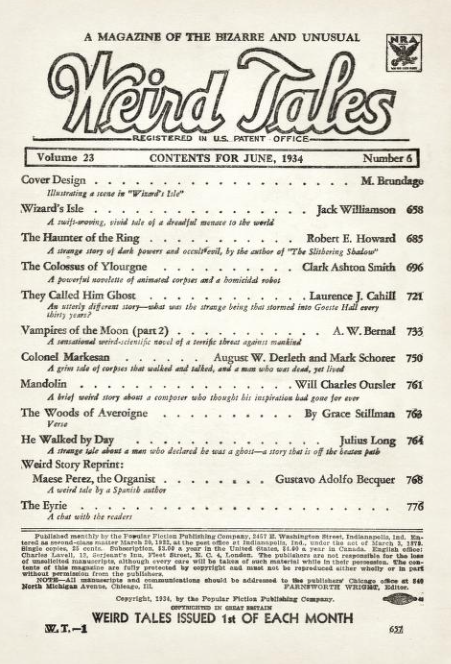
As mentioned, Jack Williamson (another fascinating guy who played a huge role in the development of sci-fi) gets the cover – the story is fine, one of his extremely competently constructed pieces, though the Orientalism is thick on the ground and kind of rough. The Howard story is only middling – it’s one of his occultic Lovecraft pastiches, and for the most part those are his weakest efforts. For my money, Smith’s story is far and away the best thing here, although I would point out the Weird Story Reprint, which is a translation of a story originally in Spanish, “Maese Perez, the Organist.” These translations are super interesting, and, actually, form the subject of an upcoming book with Paradise Editions that I’ve been working on: Night Fears, a collection of some of the translated fiction that appeared in Weird Tales that I think people are going to really enjoy. I’ll plug it more later this month, So Watch This Space for further details!
Briefly, there’s also a bit of verse by “Grace Stillman” that is pertinent to the story today. Her “The Woods of Averoigne” is a celebration of Clark Ashton Smith’s fictional 13th Century France where he set some of his stories (including “The Colossus of Ylourgne”). It’s good and extremely, some might even say, suspiciously faithful to the description and mood of Smith’s work. Between that, and the fact that Grace Stillman ONLY ever published this one poem in any magazine ever, I suspect this is a nom de plume for ol’ Clark himself, although I’ve got no concrete evidence for that. Still, it’s odd!
But, anyway: Our Story!
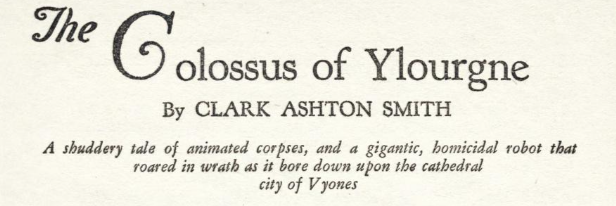
First off, that description, huh? That’s an interesting use of the word “robot” isn’t it, one that I think demonstrates the inchoate state of the nascent genre of science fiction. I hate to keep harping on it (no I don’t), but it was in Pulp Magazines that these genres were created, and this is a good example of that work being done. The lexicon hadn’t solidified, the definition of the term “robot” hadn’t been settled yet; only with time and further writing would “robot” come to mean a manufactured mechanical or technological construct, rather than the very specific Thing (no spoilers, yet) being discussed here.
Our story starts with some of the rich, voluptuous language that Clark Ashton Smith is known for…honestly, people give Lovecraft shit for his purple prose, be he’s positively restrained compared to Clark. Smith ratchets it up all the way to eleven; he’s much more sumptuous in his writing, and his word choice is way more obscure and archaic than anything ol’ H.P. ever did. Now, to be fair, it’s not affection, not fully, because Smith received very little formal education and mostly learned by reading books and memorizing the dictionary and stuff, so I think he comes by his1820s style writing honestly. But if that’s not your thing, you’re going to have a hard time with Smith.
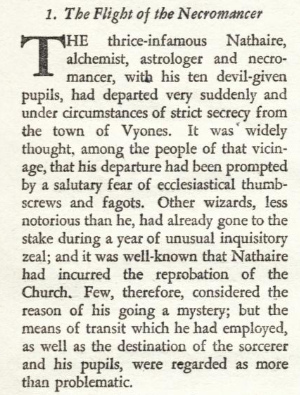
Right away we’re introduced to the villain of the piece, Nathaire, a vile sorcerer, and we learn that he, along with his ten pupils, have vanished from his house in Vyones. A long part of this first chapter is used to give us background: Nathaire is a stunted, twisted little thing, the son of a Devil and a Witch, and he travelled widely through Egypt and Persia and other exotic places, where he learned all the secrets of magic and alchemy that made his so feared and powerful. We also learn that he has run afoul of the Church and the Inquisition before, and is lame in one leg from a stoning that he took at the hands of a mob in Vyones. Consequently, Nathaire hates the clergy and the city with equally fiery passions, so everyone is happy to see him vanish, despite the mysterious circumstances. Everyone, that is, except Gaspard du Nord:
Gaspard uses this magical mirror to try and spy on Nathaire, who is certain is up to something vile and dangerous. He catches glimpses of his former master in the glass, a hint of dark ritual and evil magic, but it’s soon obscured by Nathaire’s counterspell. We, along with Gaspard, are left in the dark.
Part 2 is where things start getting weird! In early summer, bodies suddenly start vanishing from the graveyards, and when people investigate, they realize that it’s not graverobbers at work; rather, the dead bodies themselves have clawed their way free from their coffins and tombs and graves! And it just keeps happening!
I mean, that’s pretty good, right? Bodies on their way to being buried leaping up and then running into the night. It’s a good, creepy image, made worse by the suddenness and the sense of urgency in these animated corpses. Something is happening, but no one knows what it is!
Turns out the ruins of Ylourgne (which, wow, just a great weird fiction name, you know?) is right across the valley of a big ol’ monastery, extremely isolated and cut-off from the world. There, the monks are horrified by the sense of something monstrous going on across the way in the old robber-baron ruins, but they don’t feel like confronting it until one of there own, dead in an accident, is summoned to the castle. There’s a good image of the dead monk, his head lolling on his chest from his broken neck, leaping up and running out of the church towards the ruins while the monks look on, horrified.
Most of the monks want nothing to do with it, but a pair of them, full of zeal and righteous fire, get permission to go to Ylourgne to try and exorcise the evil there. They go armed with crosses and holy water and tromp overland, but are unprepared for the devilry they encounter: piles of corpses being rendered into their constituent parts, bones in one pile, meat in the other, boiled and magicked up by devils and the ten pupils of Nathaire, all overseen by the dying, couch-bound wizard himself. The monks leap into action, shouting prayers, brandishing holy water…and are promptly handled by the wizard and his underlings.
Smith, of course, is a member of the Lovecraft Circle, and so there’s no room for the traditional Christian God in his fiction. And even though there’s plenty of mentions of Satan and all kinds of very pop-medieval theology, it’s sort of understood that that is merely the cultural lens of the characters in the story – in other words, the Devil that Nathaire serves is no horned and winged fallen angel, but probably something more akin to the nebulous transdimensional horrors of the Cthulhu mythos. These monks attempt to use the power of Christ to combat inhuman sorcery, and so of course they fail. It’s a pretty stark image, and a step that not everyone at the time was willing to take – August Derleth, for example, really tried to Manichean-ize the mythos, and even Frank Belknap Long introduced the Cross as a modern representation of an even older Power that could combat the evil forces of madness and chaos. None of that for Smith! The strength of the church is in gold and flame alone, a purely secular and vulgar power, and sorcery is simply of another class altogether.
This is hammered home when, brought before Nathaire for a haranguing, the evil wizards says this:
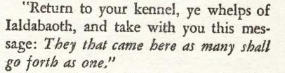
Ialdabaoth or Yaldabaoth is the demiurge, the basely material (and therefore evil) creator of the world in gnostic cosmography. Nathaire is basically calling the god these monks serve a false and lesser power, which, fair enough, since the monks got captured and all. Then Nathaire pumps a couple of corpses full of demons and has these undead bodies chase and beat the monks all the way to their monastery! The scene of the raising is even illustrated by Smith in the story, in his inimitable folk-art style:
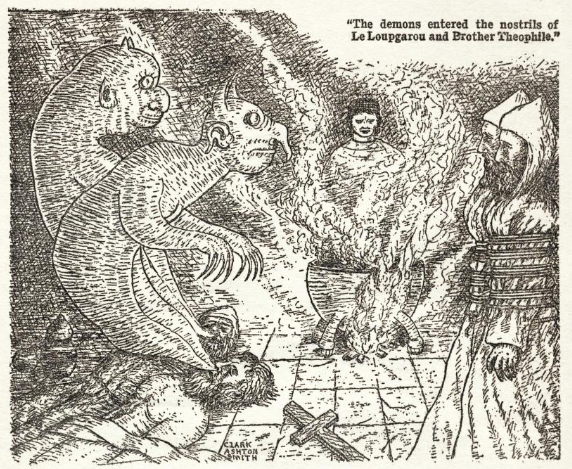
Picture like that would be right at home in a 1st Ed Dungeons & Dragon book, wouldn’t it? Very DIY. Anyway, meanwhile, our buddy Gaspard is back in town, still worrying about what ol’ Nathaire is cookin’ up. With the general sense that since the bodies have been heading towards Ylourgne, that’s the place to get answers, Gaspard heads out overland, eventually reaching the mysterious ruins just as the moon is rising. There’s lots of clambering and crag-hopping, all very fun and conveying just how in-over-his-head our scholarly hero is, and then finally Gaspard breaches the walls and discovers the secret of Ylourgne:
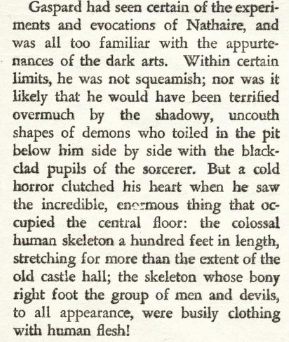
Reduce, Reuse, Recylce! Nathaire has been collecting all these corpses to strip em down to their base parts and BUILD a new, huge body. And not only that, but, after Gaspard gets bonked on the head and captured, Nathaire reveals that he is going to leave his dying body and put his soul into this new, gigantic corpse-salvaged corpus! Nathaire, in fine villanous form, rants a bit, explains his plan to use his new body to terrorize Averoigne, and then has Gaspard tossed in an oubliette.
There’s a somewhat overlong dungeon-escape scene, where Gaspard has to scrape away at a drain to make a passage that takes him to another chamber and some stairs, etc etc. It’s good mechanically and serves to express that time enough has passed for the wizards upstairs to have finished making the giant body. And you gotta remember: Smith is poor and he’s getting paid by the word. I mean, if Charles Dickens can get away with it, so can Clark, right? Anyway, he comes across the huge corpse juuuuust as the ritual is underway and, being reasonable, recognizes that there’s not much he can do about it, so he flees. We then cut to the next section, which sees the horror unleashed on the countryside.
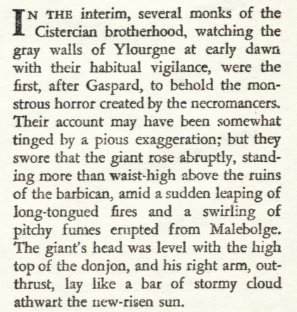
So this huge giant, made from the rendered flesh and bones of countless corpses and driven by the mind and soul of an evil wizard, has risen, and damn if it isn’t having a good time. Giant Nathaire really seems to be playing around, flexing his new muscles and enjoying his strength and size; he lobs some rocks at the monastery, kills some of the monks, but mostly just seems to be goofing off. When he turns and leaves, some of the surviving monks (the same ones who ventured into and were chased out of Ylourgne earlier in the story) witness a strange sight:
That’s a hell of a funny image, isn’t it? This big monstrous giant, all naked and gross, with like a baby carrier on his back full of his students, along for the ride! It’s a very funny, very strange detail, extremely Smithian in its absurdity. Anyway, the rest of this section is just The Giant wrecking shit all over Averoigne. There’s lots of violence and murder; at one point he covers a church full of people with a huge pile of shit he’s gathered from surrounding farms. It’s alternatingly funny and then, suddenly, very brutal and cruel:
And how about that last part, huh? “…worse things, not to be named…” yikes!
While all this has been going on, Gaspard has been making his way back to the city, which is now packed with refugees fleeing the horrors of the Giant. Back in his meager rooms, Gaspard throws caution to the winds and makes use of the evil sorcery he learned from Nathaire to concoct a sorcerous powder that is used to send undead bodies back to their graves. There’re scenes of violence and horror, Nathaire kills a bunch of soldiers and breaks into the city, but is confronted by Gaspard atop one of the towers, who calls to his former master. Nathaire approaches, intending to smash Gaspard to bits, when the scholar blows the strange powder into the Giant’s nostrils, and…
I mean, that’s great, isn’t it? This huge corpse suddenly turns and starts wandering the countryside, going to the graves and tombs from which its bits and pieces were taken before finally just digging its own giant grave and laying down to die. The bit with the voices is fun, as is the payoff with the pupils in the baby bjorn; imagine them just, like, helplessly swinging there the whole time before getting crushed to death in the new grave. I mean, it’s great stuff!
There’s a brief coda where we learn that the stinking giant corpse ended up causing all kinds of health problems, but also that Gaspard was the only sorcery in the country to never have had any subsequent trouble with the inquisition, so, for the most part, it’s a happy ending! Yay!
I really like this one. Smith’s Averiogne is a fun setting, a wooly Dark Ages France full of weird wizards and cruel aristocrats – there’s honestly a very Warhammer Fantasy feeling there, and it must’ve been a big influence on all that stuff. “The Colossus of Ylourgne” is a good weird tale, very inventive and, in places, very surprising – the complete repudiation of Christianity, the dark humor, the violence, it’s all well done and, for the most part, it’s a fairly propulsive story.
Now, if you’re familiar with Lovecraft’s “The Dunwich Horror” (pub’d in Weird Tales in 1929), I think you can see what an inspiration that was for Smith; he’s basically doing a medieval retelling of that story, down to the magical dust at the end even! But he’s changed enough stuff and made it his own that it’s not a problem in my opinion, and he’s clearly having fun writing it. I think there’s also some Robert E. Howard in here too – Conan had appeared in the pages of Weird Tales in 1932, and that kind of rip-roaring sword-and-sorcery clearly influenced Smith, particularly in his wizard characters.
All in all, it’s a good creepy tale in a well-expressed secondary fantasy world, and even if the ending is a little abrupt and overly just-so, the denouement of the big corpse burying itself makes up for it, I think. There’s an inventiveness in Smith’s stuff that makes him worth reading, I think, a real adherence to a style and a vision that was his own while, at the same time, was also a part of the larger Weird Tales movement. He’s not as well as known as ol’ HPL or REH, and I don’t think there’re any comics or movies or video games with his stuff (although his creations bleed into the HPL and REH adaptations), but Smith is a very important influence on both horror and fantasy, and I think there’s a lot to appreciate in his work!