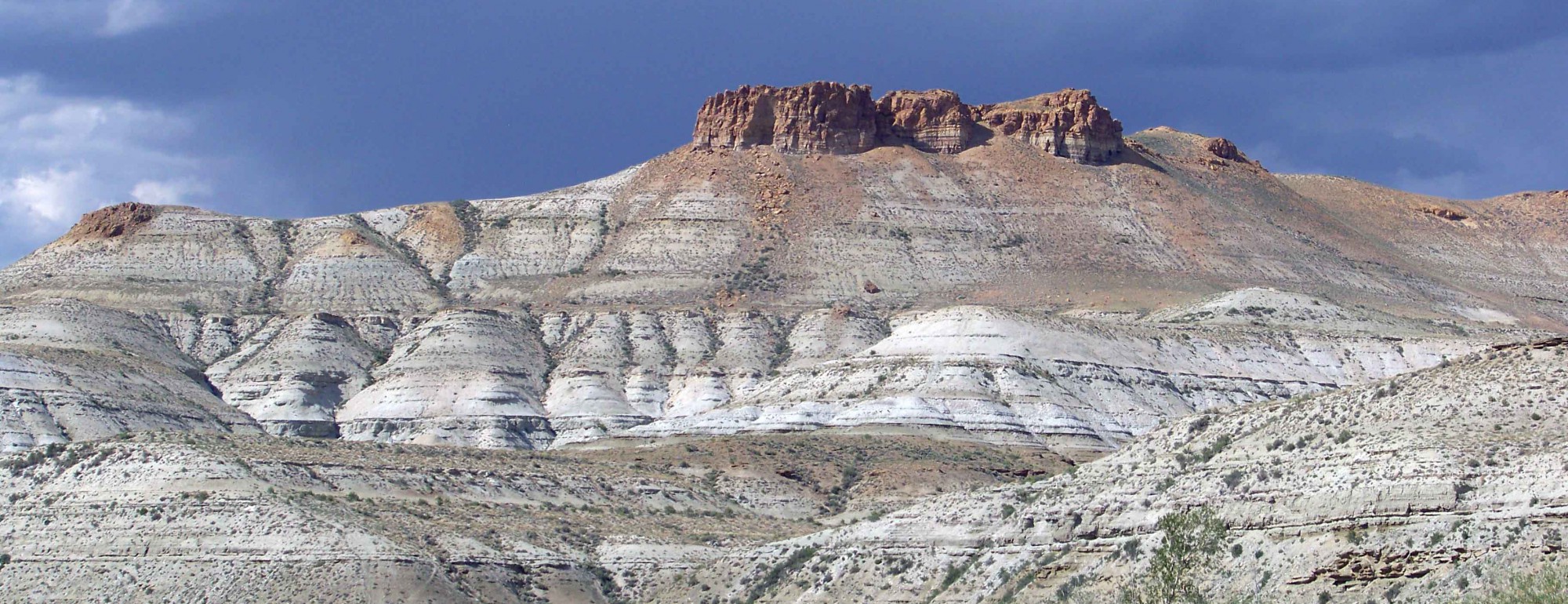
Spring has sprung, at least down here in Texas; in fact, there might not be much more of it, since we’re looking at some mid-90s later this week. Regardless, this is one of the lovelier times in these parts, with everything green and flowering, so I thought I’d take a break from work and write up a short, fun, outdoorsy and landscape-o-centric bit of Weird Fic from the March 1932 issue of Weird Tales. Our story today is “The Milk Carts” by Violet Methley!
Methley is an interesting if enigmatical figure. Not much in the way of biographical information on her out there, despite being a fairly prolific and apparently popular writer of children’s adventure novels. At least some of her output was what we’d now consider “weird” – in addition to a couple of short stories appearing in Weird Tales she also wrote a novel about a bunch of Australian schoolgirls hunting for Bunyips. But she must’ve been a fairly versatile writer with wide-ranging interests, because her first published book was a biography of the journalist, revolutionary, and friend-of-Robespierre Camille Desmoulins, which is kind of wild. She’s English, though, and was born in Kent in the late 1800s, a relevant bit of information for this story, I think.
As for this issue of Weird Tales:
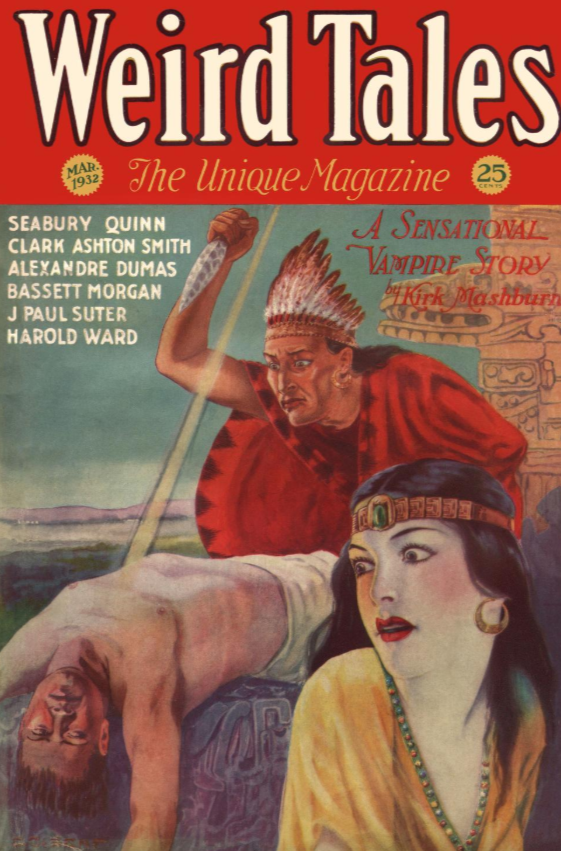
Good ol’ C.C. Senf doing the cover, based on the Kirk Mashburn story “The Vengeance of Ixmal,” one of the countless Aztec/Mayan (they played fast and loose with the definition) stories that appeared during the great flowering of interest in Central and South American archeology/history in the 20s-50s. Good example of the lurid exoticism inherent in a lot of these stories, where well-meaning but stupid anglos end up getting menaced by swarthy religious zealots with a mania for liturgical heart extraction.
The ToC is kind of interesting this month:
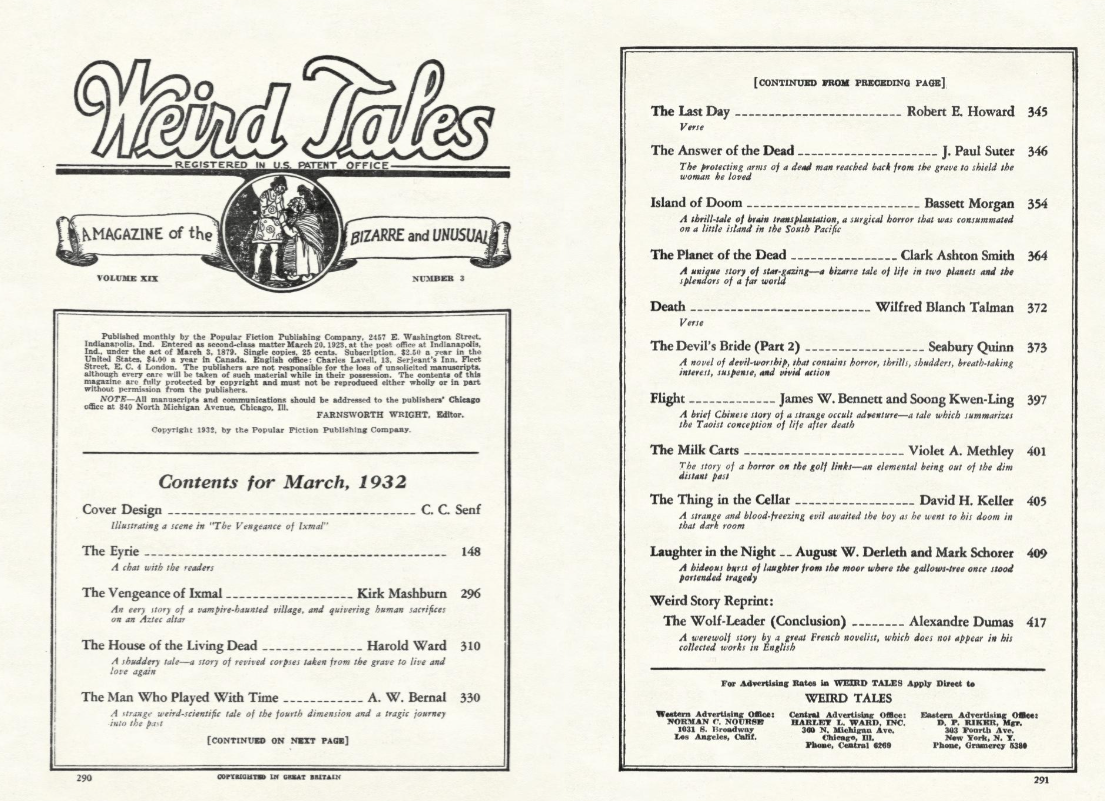
Some CAS and Quinn on here, they’re what you’d call the Heavy Hitters, and some REH verse too. A solid if unspectacular offering, I’d say, perfectly middle-of-the-road. It’s always good to see the reprint series still going strong, though if you’ll indulge me a minute, I’d like to point out some kind of silly things about this version of Dumas’ werewolf novel. First off, check out this little footnote which has a remarkable density of incorrect things in it:
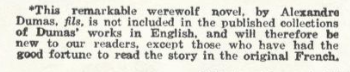
First off, Le Meneur de Loups was NOT written by Alexandre Dumas fils, but by Alexandre Dumas pere, he of Three Musketeers and Count of Monte Cristo fame (among others). Strange to see Weird Tales get that wrong, especially since the editor here is Farnsworth Wright, who spoke, read, and translated French fluently and was familiar with classic French literature. Another thing that’s wrong about it is the claim that this was the first English translation of the work – it was translated in the 1904 in England! In fact, despite some light editing by Wright himself (and the inclusion of the summaries), the version in Weird Tales IS that translation, by Alfred Allison, though of course the translator is never named or acknowledged! Makes me wonder if the errors aren’t some way to help elide the fact that Wright and Weird Tales almost certainly didn’t pay to publish this translation. Ah well, c’est le pulps!
Anyway, enough perfidy! On to “The Milk Carts!”
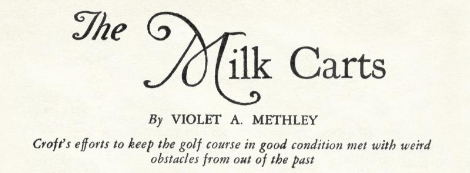
We’re well in the back of the magazine, without any illustrations or ornamentation for these (often shorter) stories. A decent summary too, without too much in the way of a spoiler or anything, so that’s good.
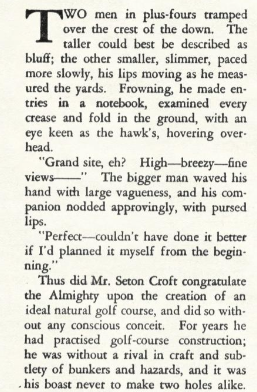
A nice, economical beginning – two guys in those baggy, classic golf pants are tromping around the great outdoors. One of them is Seton Croft, golf-course architect, and he’s busy writing notes and making measurements, all with an eye towards turning this stretch of green turf (owned by the bluff fellow who we’ll learn is named Scayles) into a premiere bit o’ golfing!
In particular, it seems like this spot, where these two have stopped and agreed to begin work, is ideal for what Croft is envisioning:

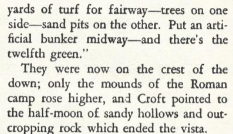
There’s a damn Roman encampment in the middle of these downs! I mentioned earlier that the author, Violet Methly, was born in Kent, and there’s clearly a bit o’ the Kentish countryside in this story, a place rich in Roman history; the initial Roman invasion of Britain started in Kent, and it was always one of the the strongest points of its far-flung colony. It’s a landscape with a deep history that is still visible today!
Anyway, Croft’s golf course musings are interrupted rudely!
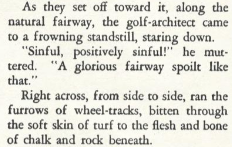
I’m a sucker for landscape descriptions, and that’s a particularly nice bit of work about these wheel-track furrows, I think – “the soft skin of the turf” ripped down to “the flesh and bone of chalk and rock beneath” is really good. In particular, I think it really nicely captures Croft’s view of the situation – after all, it’s just some wheel-ruts in the downs, not exactly an open-pit mine or anything, you know? But for Croft, this landscape must be adhere to an ideal, a particularly managed and manicured vision of Golf, artificially and meticulously pristine, and this cart track has no part in it! It’s a fun bit of characterization, and really highlights the centrality of landscape AND land usage in this story.
Anyway, Scayles, the owner of the land, is likewise aghast at this brutalization of the grass, and vows to have it turfed and repaired immediately! After all, he wants this fairway done and opened for golfing by Easter, and Croft promises it will be done!
I really like the little sandbox he’s using to do a scale-model of the project, complete with teeny tiny little flags and everything. A fun glimpse of the way Croft is managing and shaping this land, I think.
But all is not well! Back at the 12th hole, those damned cart tracks have appeared…again!
Scayles vows to make enquiries among his neighbors, but all the various cart-owning locals deny having driven across the greens. After all, it’s not a short-cut to anywhere, so why would they? Still, SOMEONE is wrecking Croft’s beautiful fairway, because shortly after levelling and turfing the ruts…they’re back! Croft and his wife are out looking over the site, when they run across the ruts again!
How great is that, “they plaguey milk-carts” with all their cans a-jangling? Great bit of gnomic mutterings from a weird old guy, classic ghost story stuff. And the idea that the wheel-tracks will ALWAYS come back, that there’s nuthin’ to do about ’em, is a lot of fun. Croft, of course, is still trapped in the mundane world so beloved of golf architects – he and Scayles investigate if there’re any dairies near by, but no dice. So, Croft does the obvious thing – he’s going to stand guard out by the 12th hole and catch the mad cart drivers in the act!
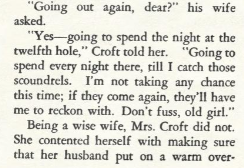

Whisky and sandwiches in the moonlight it is!
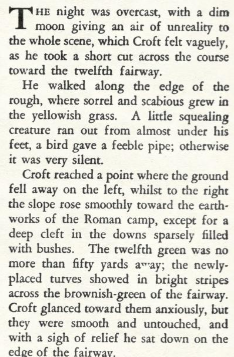
Again, this is a very short story, but the writing is economically evocative, I think – love the squeaking critter and the feebly piping bird, really conveys the loneliness of the wide-open rough here. We get another gesture towards the hummock of the Roman earthworks, just to remind us that this landscape is not a primeval wilderness or anything – the Romans were here long before Croft, and they too had modified the landscape to fit their purposes.
Croft’s peaceful vigil is interrupted by a clanging and a clanking – the milk carts have arrived!
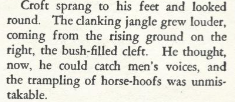
Croft is pissed! He hops up, intent on confronting these cart hooligans who keep running roughshod over his golf course!
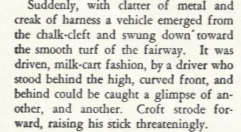
Tweedy little golf architect Croft is ready to crack some skulls! He’s got a stick, and he yells at the figures, telling them to fuck off (not is so many words, of course)…but the off cart drivers don’t seem to be paying him ANY attention. Furious, Croft grabs at the bridle of the nearest horse…
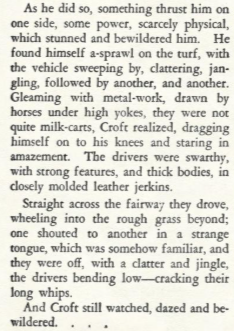
Those aren’t milk carts at all! Why, they look like…
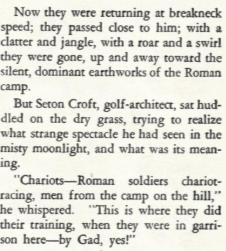
Roman ghost chariots! How rad is that? They’re still practicing, all these centuries later, in the same spot that they’d chosen for their recreation, the land they’d levelled and modified and built up, just the same as Croft was doing now! With this new realization, Croft heads home and meets his wife:
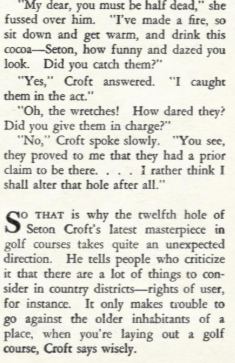
And that’s the end of “The Milk Carts!”
A short, placid little tale, and much more of a classic English ghost story than what I’d call a “weird tale,” but still, I like it – there’s a surprising amount of depth to it, I think, a kind of interesting meditation on landscapes and history that I really like. Plus, it’s extremely short, and that kind of efficient brevity is something worth studying too. And not everything needs to end in tentacular horror and madness either – I like Croft’s simple “they proved to me that they had a prior claim” and his later enigmatical justification for altering his design around the 12th hole. I like the way this story uses landscape and embedded history to good, spooky effect. And the idea of these spectral Roman charioteers circling their track night after night, especially in a spot that was being transformed into another location for sport and recreation, is a lot of fun!
 Eric Williams