
More than half-way through November, and though things have conspired to bum everybody out, I think there’s still some merit to spitting the blood from our mouths, telling the bastards to go fuck themselves, and then getting on with it all. So, in that spirit, let me welcome one and all to yet ANOTHER Moorevember!
Last year, following Halloween, I spent November discussing some of my favorite stories from one of my favorite writers, C.L. Moore. You can read those older editions here, here, here, and…here, if you want to – it was a lot of fun to go back and revisit the work of a remarkable writer like’ ol’ Cathy Moore, a towering and formidable talent that everyone should be reading and appreciating. So why not do it again? So this, our first Moorevember entry for ’24, is a fun one: The Children’s Hour by Moore and Kuttner, writing under the pseudonym Lawrence O’Donnell.
The collaboration between Moore and Kuttner (introduced to each other through the letter-writing circle of H.P. Lovecraft) is the stuff of legend – the two of them really, truly seemed to mostly mesh together perfectly, so much so that they said that they often couldn’t even tell who had written what after a story was done. That may very well be the case, though in my opinion, I think you can get a hint of who was doin’ what in their stories – Moore, to me, is the better, more cerebral writer, interested in complexity and ambiguity and “big” topics (like violence, or love, or whatnot), whereas Kuttner is more action-oriented, plot-focuses, jokey, and often more mechanically- or technically-interested, particularly where they’re writing sci-fi. But, even if you think you can parse out Cathy vs Hank in these stories, I think you can admit that they are remarkably well-done collaborations, without any of the obvious and unsightly seams that often mar multi-author works.
Moore and Kuttner, both singly and together, were a good fit for ol’ John W. Campbell Jr.’s Astounding, which had definitely positioned itself as the Thinking Man’s pulp magazine – they wanted brainy stories, eschewing outright science fantasy and space opera type stuff, with a clear preference for imaginative interrogation of science fictional concepts, particularly as they pertained to “social” concepts (I mean, within reason – Campbell, an inveterate and proud racist, was not interested in stories having black main characters, for instance). This was in contrast to ol’ Hugo’s whiz-bang kind of science fiction, and actually led to a number of running-gun battles between the two camps of fans in something very similar to dumb “sick puppies” controversy of a decade ago. Anyway, that kind of commitment to contemplative, strange, and often experimental work was custom made for Moore and Kuttner, and today’s story is a prime example of that! So let’s get to it!

Nice moody cover – the dark scenery and the ambush of the mutant there setting one hell of a scene. The art in Astounding is always good, very genre-y without getting kitschy, something that can’t be said for all the mags! Anyway, I like this one. A lot of fun and a good color scheme, and it’s telling a little story, very imaginatively engaging.

An interesting ToC this time around too, with van Vogt by far the most recognizable “big” name on here. “Wesley Long” is another pseudonym, this time for George O. Smith (who wrote the article here) and who we’ve mentioned before, a real “hard sf” type whose wife left him for editor John Campbell in the late 40s! Drama among the pulps!
Anyway, ON TO THE STORY ALREADY, yeesh!
I’d once again strongly suggest everybody go read this one, though, before diving into the spoilers ahead – it’s a very long one, but it’s a great story, very strange and atmospheric and with some psychedelic scenes and a good punchline, so you don’t wanna ruin it by reading by ramblings ahead of time. Here, I’ll even post a link to the pdf again: READ IT!

Some good abstract illustrations in this story, which makes sense, since so much of the “action” is phantasmagoric and weird and almost surrealist in its description. Also, a good, solid hook there – you’ve really got no fuckin’ clue about what this story is about, but the little info you do have makes it seem very mysterious, really pulls you in. Well done, I say, and, as always, I appreciate Astounding‘s restraint with these title pages – very VERY rare to find one of those “here’s the CLIMAX!!!” scenes right off the bat, like you often do in Weird Tales, for instance.
Our story starts by introducing us to an enlisted man, sitting in a waiting room, cooling his heels until an appointment with a Lt. Dyke who, we soon learn, is some kinda Army psychologist/hypnotist specialist. There’s some fun world building in, background stuff that provides a necessary-to-the-plot mechanism for all the mind-bending that’s about to happen, but it’s also kind of fun and a little menacing in its own right, isn’t it? Our enlisted fella, Lessing, is described as a perfect candidate for the apparently wide-spread use of “psychonamics,” some kind of First Earth Battalion-style mind-over-matter stuff that lets soldiers ignore bodily hardship (and who knows what else…) in pursuit of The Mission. It’s grim stuff, very science fictional, and its preoccupation with Building a Better Soldier reminds you when Moore and Kuttner were writing it.
But, in terms of the story, it serves to introduce the Problem and the Method of Addressing it. It turns out, that in all this MKUltra hypno stuff, they’ve discovered something. When Lessing is put under, there’s a gap in his memory, three months total…but when he’s AWAKE, there is no gap; he’s got a perfectly bland and banal memory of living a perfectly normal life during the SAME interval. It’s only when he’s hypnotized that there appears evidence of some kind of brain block or tampering. It’s very weird, and a great intro to the story.
What’s ALSO interesting is that, reading through this, there’s kind of an assumption that this must be taking place in the future…hypno-soldiers capable of transforming themselves into superbeings via mind powers is very science fictional, after all. BUT, we soon learn that this mind block in Lessing’s brain is from five years in his past, some time shortly BEFORE Pearl Harbor! So this story, published in ’44, takes place in ’47, basically modern times (for then, I mean). Very interesting, in that it posits a world remade by the needs of the world war and the military-psychological complex.
But, anyway, the background provided us, we soon move into the meeting proper:
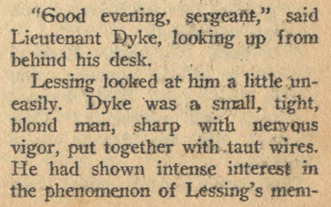

There’s some chitchat, but we VERY quickly move directly into Lessing getting hypno’d by Dyke – it’s very clear that this sort of rapid-fire hypnotism is the norm, and that Lessing has been prepared for it by his training as a soldier. Again, it’s not really a part of the story, but it is evocative and menacing.
The regression begins, and Lessing is instructed to travel back to the blockage, back to the summer of ’41:


The poem quoted here is the first chunk of Longfellow’s “The Children’s Hour.” Taken as a whole, the poem is super maudlin and sentimental (I mean, it’s Longfellow, so of course it is), but here in this context, it is made menacing – the idea of this liminal, spooky state, between day and night, where the normal functioning of the world ceases. We’ve seen Moore use these older works as inspiration before, of course; she was very allusive in “No Woman Born,” for example, and this story today has a LOT of that in it.
In fact, we get some immediately, when Lessing’s memory coalesces itself around a summer walk in the park with…Clarissa!


Bit of Shakespeare for you, and an interesting one at that – it’s Mercutio making fun of Romeo for pining over Rosaline, a tragedy that Romeo will soon completely forget about when he sees Juliet. So this is what’s at the core of his excised memory – he had completely forgotten about Clarissa, a girl he’d met in the park and fallen deeply, madly in love with back in ’41. How is that possible!? He’d been obsessed with Clarissa, so much so that he even uses the word glamour to describe the effect she had on him, like an elf princesses or some fey creature of the forest, enchanting and otherworldly. And there was something weird about her, and about their relationship, but he can’t quite put his finger on it. And yet, somehow, she’d been snipped out of his memory totally…by some strange, shadowy force, it seems…
Lessing continues to mine his suddenly discovered memories, realizing that there was a presence that had seemed to have been dedicated to keeping him apart from Clarissa, some, a threatening and antagonistic presence…Clarissa’s aunt! Strangely, he can’t remember her face, or anything about her, not really, just a sense of her being a darkness behind Clarissa, an obstacle between their love.
Dyke, the hypnotist, tries to get Lessing to organize his thinking – it’s all a muddle, a broad wash of experiences and sensations and the knowledge that his memories had been taken from him by something. Dyke wants him to concentrate on the first time he’d noticed something strange about Clarissa. And boy, does he!

They witness a bad car accident while they’re walking, and at the noise Clarissa slips out of his hand and into…somewhere else!

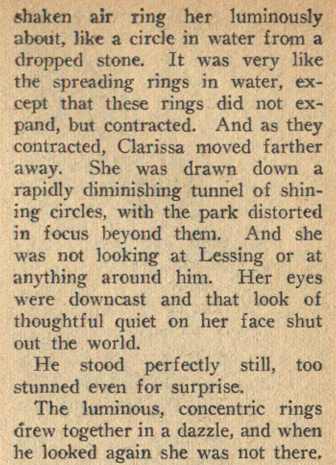
Yeah, Clarissa walks into some kinda weird light portal and vanishes, only to reappear down the path a little later, after the accident has occurred and whatever danger there was had passed. It’s weird, and the imprecise and impressionistic way its described really conveys how Lessing’s mind can’t really comprehend what’s he’s witnessed – he’s trying his best, but its something totally alien and beyond his experience or conception, so he’s really incapable of describing it in any real, sensible detail. There’s also another fun bit of art on this page:

Kind of captures the otherworldiness even better than the words do, doesn’t it?

Importantly, it seems like Clarissa herself didn’t recognize what was happening, that maybe something outside of her had intervened?
Dyke and Lessing continue the therapy session, with Lessing digging deeper into his memories, which seem to be flooding back over him with greater clarity and insistence, now that the mental dam has broken. There’s another memory, of a house vanishing during a storm; they had been running to it to seek shelter from the rain, but it had been taken away from them and then they’d been soaked and Clarissa had gotten a terrible fever. This leads Lessing to articulate the thought that something had been guiding Clarissa, that it had protected her from the car accident but then had wanted her to get soaked and get sick – again, Moore and Kuttner do a really good job of having Lessing very naturally sifting through these memories as they come and extracting his sensations and surmises as they arise. It’s some good, strange writing too, all very dream-like and unusual.
Clarissa’s fever, from when the house vanished and they’d been caught in the storm, necessitated some time apart, and the fairy-like quality of their interactions is highlighted again since, when he can’t be near her, he feels like the color is draining out of the world. Clarissa too experiences something like this – she’s almost deliriously happy to see him again when he can visit, as if she also needed him in her life, desperately. Although that’s a weird scene too – he goes to her apartment, and it’s a windowless room full of mirrors.

It’s really great writing, isn’t it – hard to do justice in this kind of jumpy summation way I’m doing, because it’s really building on the sense of Lessing’s memories of these things, and the way he’s now retrospectively evaluating them. Good sense of weirdness and, honestly, melancholy in all this, a glimpse into a strange world that seems, oddly, constructed for Clarissa. Lessing becomes convinced that Clarissa’s experiences in the world are being curated for her, that nothing happens to her without a plan and, in some weird way, purpose. It’s honestly deeply paranoid, but the strange glamour effect that Clarissa has seems to be keeping Lessing from questioning it too much, in the moment.
Besides, for Lessing, life is otherwise great; his love for Clarissa is some kind of furious ecstasy. He almost seems drunk with it, and it seems like it’s something shared with Clarissa. She too seems to be full to the brim with life and some kind of nameless, indescribable sense of the future, of becoming…something. So giddy are they that Lessing and Clarissa even begin to discuss marriage, which suddenly everything changes.
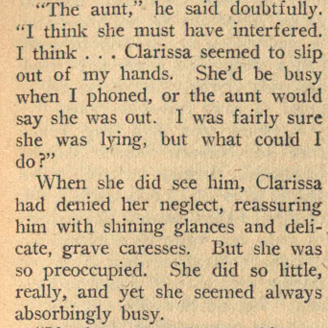
Again, we get a sense that Lessing is trying to put into human terms and human words concepts of ideas that’re simply beyond him. The apartment full of mirrors, the dark faceless aunt whose name he can’t remember…these all have a kind of weird archetype flavor to them, as if he’s groping after some way to make sensical his glimpses into a different, alien world. It’s fun stuff, and in the reading of it, without knowing what exactly is going on, it’s very compelling and weird, isn’t it?
Convinced that he’s being kept from Clarissa, Lessing goes to the apartment unannounced and, enraged, forces his way into the room. And then things get weird!

Lessing is strangely non nonplussed by this, as if his mind and perceptions are being manipulated – he finds himself, suddenly, in some kind of a weird fantasy world, with an armored knight and a strange guy with a whip…and Clarissa, who simultaneously seems to be both “his” Clarissa and a different Clarissa…it’s all very strange, and you get the feeling that Lessing’s brain would overheat, if he’d been allowed to perceive it all pure and uncut in the moment. Then, just as things in the Fantasy World are getting a little hairy, he suddenly gets vertigo!

Really kind of funny to imagine Lessing in Dyke’s office, trying to convey all this absolutely bonkers shit to his Officer-Hypnotist without getting kicked out of the army for being insane.
Lessing becomes convinced that Clarissa, some kind of perfect woman, has become the obsession of, basically, a god of some sort. Like Zeus jealously guarding his crushes, this omnipotent being has been keeping Clarissa apart from Lessing, micromanaging her life and keeping her in the odd mirror prison of the apartment. Lessing figures that all the weirdness around Clarissa, and the unknown thing that she seems, in some dim way, to expect to happen to her is some kind of apotheosis, a way for the jealous god to uplift Clarissa into a new plane of existence so they can be together. Lessing decides he must fight against this god, and so goes to the apartment to try and convince Clarissa not to discard her humanity for divinity…but he gets brain whammied and leaves.
Lessing takes Clarissa dancing and, drunk and all crazied-up, they try and run off, speeding through the city…but the strange forces “protecting” Clarissa intervene, and even Clarissa can’t seem to resist their strange effect. There’s some fun, obviously interposed traffic jams and suchlike that force their car to make detours that keep from leaving, until finally there’s a deus ex machina that simply spins the streets around under them. They end up back outside the apartment and Clarissa leaves him again, drawn back into the weird mirror apartment again, and Lessing is left alone. Again.
Lessing tries one last time to go to Clarissa and confront whatever the hell is going on, at which point Clarissa seems to have some sudden realizations, both about the way her life has been “shepherded” and her role in it, a kind of sudden maturation. At this point, the god-like “aunt” intervenes, telling him that he’s served his purpose and that he’s gotta go now, at which point the memory block is put on him and Lessing is sent on his way.
Now, there’s still a LOT of this story still to go, but we’re gonna skip along pretty quickly here. Basically, Dyke tries to rationalize (in a weird way) what has happened, pish-poshing Lessing’s ideas about jealous gods. I think this must be a Kuttner part, because it gets really oddly “technical” in its explanations, which is something that Campbell might’ve required, since he always wanted to have some kind of “science-y” part, even in a weird, dreamlike mythopoetic fantasy like this story.
Dyke first, by way of humoring Lessing, suggests that Clarissa is some kind of Homo superior (like the weird baby from “When the Bough Breaks”), a kind of super-human child who needed some time among the knuckleheads on earth to develop properly; Dyke uses the example of a precocious kid who, while very smart and advanced, still needs to be socialized among children, otherwise it grows up into a weird asshole. Thus, the “aunt” had tossed Clarissa in among humans, watched over her, and then, when she’d reached a certain maturity, had taken her back and mind-wiped Lessing. Simple as!
Of course, Dyke dismisses this, and posits that really the two of them had just gotten bad fevers from the storm, and that everything odd and weird and strange afterwards had been residual brain problems from that. Lessing decides that if he’s going to figure this out, he’s just going to have to got back to the apartment and see if he can’t get some answers directly! So he goes to the apartment (which he last saw like 5 years ago!) and:

It gets trippy again, but the upshot of it is that “Clarissa” is a fragment of a transcendent being, one that is recapitulated across time and space many zillions of times over, each one an individual part of a larger whole, like cells in a single body.


Basically, all these “Clarissas” out there had to develop and grow until they could recognize one another, in that way becoming the crazy ultracosmic thing that they really were. The other weird visions of alien worlds and other Clarissas were brief glimpses that Lessing had had of this process. Total transcendence, man – and, as Lessing realizes that he was a small, strange part of this process, a kind of universe-beholding-itself sort of thing, he’s hit with one final mind-whammy:
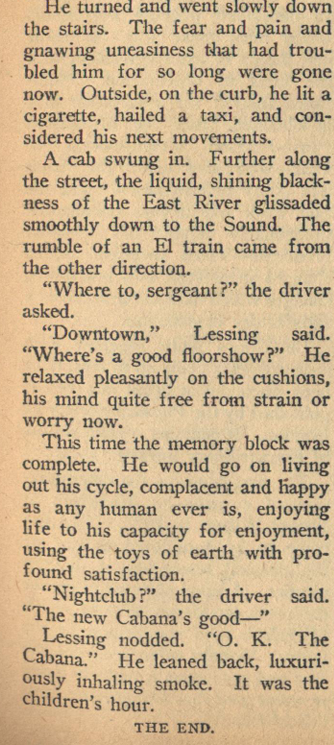
And that’s the end of “The Children’s Hour!”
It’s a long story for sure, and I’m not really certain that we need the long Dyke part about Homo superior kids needing acclimatization – honestly much better if he’d just been like “uh, remember that fever you talked about? That’s gotta be the problem here.” But, that aside, I think the story is really great, full of weird imagery and based on a really original idea. As mentioned, both Moore and Kuttner had been Lovecraft circle people, and so the idea of truly alien beings was something they were very familiar with. Moore in particular is very proficient at writing about truly weird landscapes and beings – just go read the weird hellworld in “The Black God’s Kiss” – and I think she really has a lot of fun here talking about a limited human trying to make sense of the unlimited cosmic being he’s interacting with. There’s just some good writing in here to that effect, and it’s a fun read.
I also like to see Moore returning to the themes that interest her – much like in “Shambleau” there’s a destructive edge to the love shared between this human and alien being, something beautiful and moving but also incomprehensible and, maybe, cruel, if not intentionally so then at least inadvertently. I think that’s what I like most about Moore’s writing (and it’s Moore, exclusively, doing this – Kuttner is a lot of things, but he never dips into that well of introspection, not like Moore does), this ambiguous and often merciless examination of love and memory and the way people relate to one another. It’s good, subtle, beautiful stuff, and I like it a lot!
I was also struck by just how wild it is that this story was published in ’44. If you’d handed it to me blind I’d have sword in was New Wave, something from the 60s. There’s some real interesting resonances here between Moore and the later New Wave folks, in terms of themes, approach, and style, and I really think Moore needs to be talked about in terms of a real early, foundational part of the later (and best) expression of the science fiction genre.
Anyway, even for me this one feels long and rambly, so I’ll wrap it up, but I hope everybody takes the time to read this story – I really think it’s worth it, even if it is pretty damn long and the Dyke rationalization part is boring and unnecessary. Anyway, Happy Moorevember everybody!
 Eric Williams
Pingback: Pulp Solidarity Forever! #31, “A Gnome There Was” by Henry Kuttner (and C.L. Moore), Unknown Worlds, v.5, n.3, Oct 1941 | Eric Williams
Pingback: Spawn of Pulp #41: “Spawn of Dagon” by Henry Kuttner, Weird Tales v.32 n.1, July 1938! | Eric Williams