
Now, look, I’m not gonna apologize here. Everyone knows Lovecraft, he doesn’t need any exposure or anything, so you might be asking why I’m covering his stories in these little free-writing exercises I’m doing here? Well, first off, he’s without a doubt the single most important horror/weird fic writer of the past 100 years, bar none. In terms of influence, he’s everywhere, with his tentacles extending into sci-fi, fantasy, comics, pop culture, and even modern occultism. His particular brand of cosmicism, a world where alien forces and laws operate in ways we simply cannot understand, has come to DOMINATE weird fiction (for good or ill), and while he didn’t INVENT the idea, I think you can argue he did PERFECT it. So it would be disingenuous to preclude him from discussion here merely for being well known.
A second good reason to read Lovecraft is that he is, simply put, the Best to Ever Do It. I mean, artistically, he’s top-tier – his refinement of and commitment to his particular aesthetic of weirdness is unparalleled, and it lends his writing a real force that you simply aren’t going to find in yer Seabury Quinns or yer Edmond Hamiltons. His writing, while elaborate, isn’t affected or purple – he comes by his vocabulary and style organically through Dunsany, Poe, Bierce, and Blackwood, and his appreciation for both their approach and technique is evident.
Finally, I think a lot of people have some serious misconceptions about Lovecraft – I’ve seen a lot of people online say shit like “oh, Lovecraft, all his stories are the same, like: ‘Look, an old weirdo tells me a story and then it turns out he’s right about a big tentacle monster!'” which is extremely annoying and factually inaccurate. He’s enormously inventive, and all the cliche bullshit you think he did he DIDN’T ACTUALLY DO, you’re thinking about the bullshit pastiches that came AFTER him by OTHER people! It’s very frustrating, because, like I said, for all that his DNA is in so much genre literature, his actual stories remain fresh and strange and unique and GOOD, fer fucksake! It’s the same thing that keeps people from reading, like, Jane Austen or Melville or Sterne! Don’t deny yourself the pleasure of reading them out of some misplaced hipsterish misapprehensions!
So, with that goal in mind, we’re going to talk about his very short and very good story “From Beyond,” published posthumously in Weird Tales in Feb, 1938! As I’m writing this, archive.org remains down, so that link takes you to the whole issue that you’ll probably have to download (it’s ~150 MB or so), fyi.
Anyway, the Cover:

Virgil Finley channeling some horny Margaret Brundage vibes here. As an aside, that lady has some long ass hair, doesn’t she? Like, down to her knees! When they thaw her out that’s gonna be one hell of a soggy mess, huh?

An interesting ToC this time around. “Gans T. Field” is Manly Wade Wellman, and “The Passing of Van Mitten” is one of Roy Temple House’s great translation efforts for the magazine. But, perhaps more importantly: lotta dead guys on here! Lovecraft, who died in ’37, is on here twice, actually; he wrote “The Diary of Alonzo Typer” for crazy ol’ William Lumley, one of his “collaborations” were someone paid him to take a teeny tiny kernel of a story idea and turn it into a story that they then slapped their name on. What’s funny about those is that Lovecraft is such a stylist that there’s no real way to miss it when he’s the one behind the pen, it’s so obviously Lovecraft. This one is a particularly middling effort, an obvious vulgar job for filthy lucre, but it’s got some funny bits in it. Worth a read if you got nothin’ else to do, but don’t expect greatness! Whitehead and Howard, both also dead of course, round out this somewhat macabre ToC.
All these dead guys showing up in Weird Tales reflects a bit of a slow-moving crisis in the magazine. The titans who strode through the pages of the magazine in its glory days are, for the most part, all gone – REH in ’36, HPL in ’37. These two deaths in particular come at a tough time, when Weird Tales is facing some particularly stiff competition, from both weird fiction magazines as well as from the burgeoning sci-fi pulps – the field is crowded, and the sf magazines in particular are able to pay MUCH better than Weird Tales, which further cut into their ability to find and publish good work. As such, and in the shadow of these difficulties, Weird Tales began to mine whatever they could from the back catalog of their heavy-hitters. With REH, that ended up being a lot of his verse (for what that’s worth…), but with Lovecraft, there was a whole world of amateur press publications of his.
And that’s where today’s story, “From Beyond,” comes from! It was originally published in 1934 in The Fantasy Fan, the very first weird fic fan magazine, but he’d written it waaaay back in 1920, which is pretty clear from the work itself – it’s obviously one of his earlier efforts, with a style and pacing very similar to stories like “The Terrible Old Man” or “The Tomb.” But, there’s an important difference here, one that marks a key development for ol’ Howie Lovecraft! So let’s get into it!

No illustrations for this one, which is a damn shame, given the wild visuals we’re going to encounter her. Weird Tales was on a very tight budget, and probably figured that the name itself would be enough to ensure people would read this one, so why bother. Still, it’s too bad!
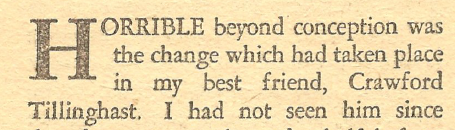
Really dig that first sentence – grabs you and throws you right into the scene, focusing on the terrible transformation that has overtaken Crawford Tillinghast. We learn that Tillinghast, who the narrator considers his BEST FRIEND(!), has become a gaunt, harried shadow of his former stout and vibrant self. Even worse, this transformation occurred over the shockingly short span of ten weeks, following a tremendous argument between the two of them that ended with Crawford chucking our narrator out of the house. What was this argument about, you ask?

Just a fantastic mad scientist speech, isn’t it? Tillinghast has (correctly) identified that fact that our human sensory apparatuses are limited, the product of a messy and lazy evolution that has equipped us well for the mundane world, but which leaves us in the lurch when it comes to deeper and more fundamental layers of reality. Just like the microscope or the spectrograph, Tillinghast has built a machine that will expand human perception into these hidden realms!
Well, this freaked out our narrator, because he knew Tillinghast well enough that he could see this going one of two ways – either he’d fuck it up and be crushed and desolate, OR he’d succeed and discover something horrible, terrible, and overwhelming. Reader, guess which one happened.
So, after balking at his ideas, Tillinghast had thrown our narrator out of the house ten weeks ago, raging and fanatical. Now, he’s suddenly summoned our narrator back again and, despite the row, our dude can’t help but wonder what has happened. So now he’s back, shocked at the change that has come over Tillinghast, and also somewhat perturbed by the fact that the huge old house appears to be utterly empty, except for Tillinghast. Where have all his servants gone?

But our narrator pushes all this aside, because he’s just so danged curious about what Tillinghast hath wrought in those ten weeks. They creep through the dark house with only the lamp for light – Tillinghast seems afraid to turn on the light for some reason – and eventually reach the attic laboratory…and The Machine.
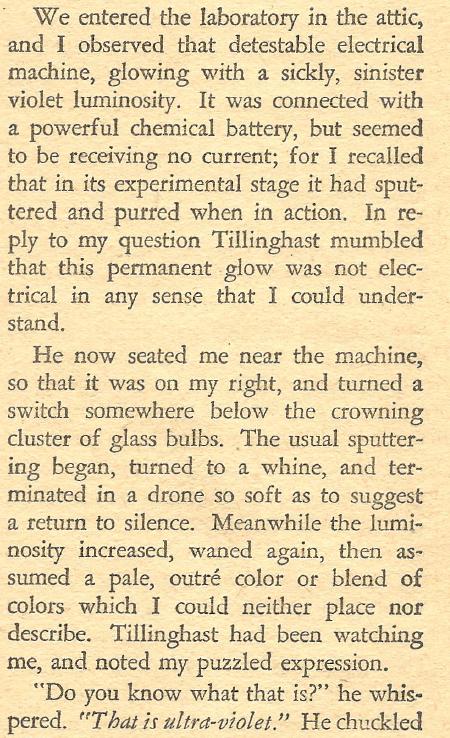
Again, excellent mad science work here – a weird glowing machine, the whine settling into a soft yet pervasive droning, and then, finally, the weird instantiation of an invisible color…ultraviolet made visible.

I mean, crazy cool wave machine weird fiction aside, this is also a remarkable early 20th C. document regarding the popular view of science and the mind, isn’t it? The “shallow endocrinologist, felloe-dupe and fellow parvenu of the Freudian” is just amazing stuff, using the cutting-edge brain science of the day to make weird fiction in 1920. When talking about Lovecraft and science most people reflexively (and not incorrectly) point towards his love of astronomy and physics, both obviously cosmic-scale and important to his world view, but you also run across geology and, here, some great biology (and what we’d now call neuro-psych). That the brain (and, therefore, one’s mind) is a biochemical organ is really just then beginning to be understand, but Lovecraft is putting a weird twist on here – it retains a certain sleeping evolutionary heritage that, properly awoken, allows humans to access the more fundamentally “real” (and terrifying) reality around them!
It can be hard for us, in 2024, to really appreciate how weird the world had been recently made for people back in the early 1900s. I mean, an entirely unknown, totally new, and otherwise INVISIBLE world of rays and mysterious energies had only recently been made manifest! Röntgen had discovered and named X-rays in 1895 and the Curies and Becquerel had been awarded the Nobel in 1903 for their work on radiation; that we were surrounded by processes and waves and things that were mostly invisible was, relatively, a pretty new and newsworthy thing. Likewise, the idea of science as inevitably pushing farther and further into these new invisible worlds was likewise a kind of cultural background noise to daily life. This is one of the KEYS to Lovecraft’s cosmic horror, and this story is where he first articulates it. It’s amazing stuff!
As the machine drones on, our narrator begins to, perhaps, hallucinate…or is he beginning to really see for the first time? The attic laboratory seems to him to become a strange, alien temple of cyclopean black masonry, but then this gives was to an even more unsettling sensation:

This sense of drifting in illimitable space so startles our narrator that he involuntarily draws the revolver that he’s been carrying, a habit that started after he’d been held up in East Providence (as an aside, when I attended the NecronomiCon this past summer, I stayed in East Providence, a lovely little end of the city with some great Portuguese restaurants/bakeries). Tillinghast watches this with sardonic amusement, and it’s clear that as much as our narrator is experiencing, ol’ Crawford is seeing and hearing even more.


I mean, c’mon – “we are able to be seen as well as to see” is just fantastic, isn’t it! And the revelation that something from beyond got the servants when they turned on the lights downstairs…creepy, wonderful stuff. And it gets better!
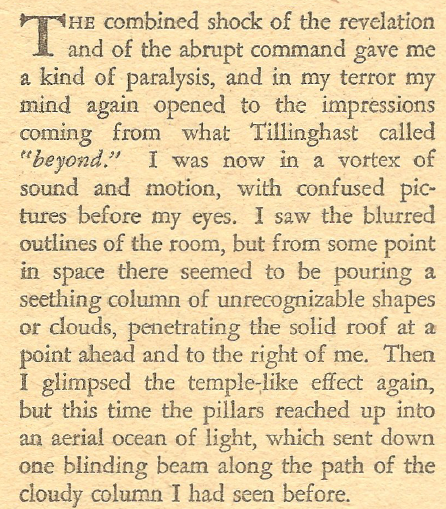
Kaleidoscopic impressions fill our narrators mind; there’s a great image of him staring at a starry sky and seeing the leering, gloating face of Tillinghast in the constellations. And he somehow senses animate things brushing invisibly past him as the machine continues to work. He also notices that Tillinghast seems be able to see these things with his better tuned third eye…something that begins to awaken in our narrator.

Just an absolute blast, and the effect of these overlapping visions, the weird invisible world (now becoming visible) overlaying the mundane laboratory…great stuff!

And once again, Tillinghast goes full Mad Scientist:

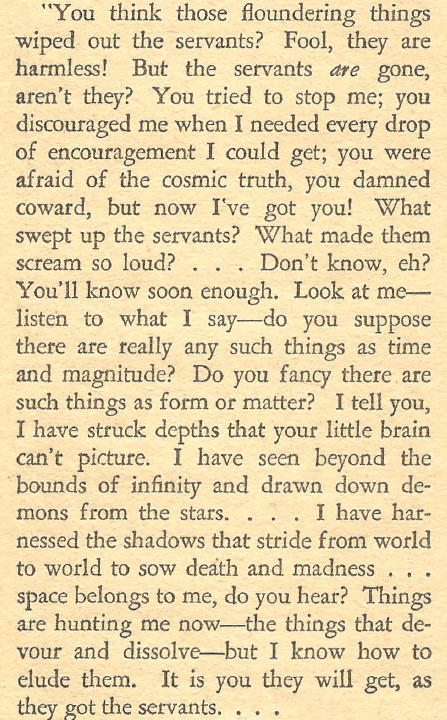
I mean, how incredible is that! Tillinghast, in his mad questing after knowledge has transgressed some cosmic boundary – now things are hunting him, but he’s got a plan! He’ll sacrifice our narrator to them to escape, the narrator who hurt his feelings and refused to encourage him when he needed all the support he could get! A great little revenge plan in among the ultracosmic horror! And how about the description of the things, huh? “Shadows that stride from world to world to sow death and madness…” is unbelievably great, isn’t it?

And then there’s a mini-cliffhanger, where the action breaks and we leap forward a bit in the narrative…
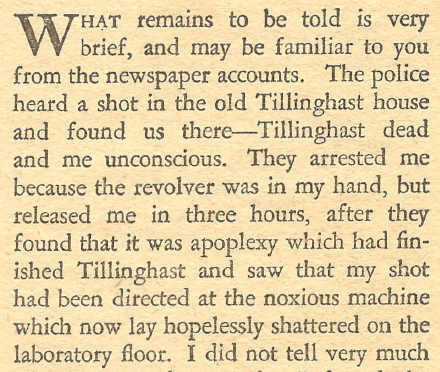
What a twist! Our dude fires the revolver…not at Tillinghast, but at the Machine!!!! Of course, Tillinghast has died, apoplectically struck down by either the noise of the shot, the sudden and jarring destruction of the machine, or perhaps even by the things that he’d been summoning to get our narrator, who knows! Everybody figures that Tillinghast must’ve killed the servants himself and hidden the bodies, and had planned to do the same to our guy here; a doctor even suggest that he’d been hypnotized by Tillinghast, and that the weird shit he’d seen had been the result of suggestion and illusion. How does our guy take that?

And that’s The End!
I mean, really, what more do you want? Short, straightforward, and full of amazing weird ideas and imagery, AND it’s also a major turning point for Lovecraft’s thinking and approach to weird fiction. The things that Tillinghast’s machine make visible are basically at the core of all of Lovecraft’s stories: strange, mysterious presences that lurk just behind the placid delusion that we call “reality.” They’re truly alien, made of different matter and obeying different laws; it’s basically a brief summary of Lovecraft’s entire worldview and approach to weird fiction, all in one short, sweet little package!
 Eric Williams