
After last time’s fairly straightforward Vampire Story, I promised something weirder, and I think I’m gonna deliver. This time around we’ve got a very enigmatical, very thoughtful, very weird short story from a writer famous for her enigmatical, thoughtful, weird writing…it’s Brenda, by the great Margaret St. Clair, from the very last year that Weird Tales saw print (in it’s original incarnation…the later revivals don’t count!).
Before we go any farther, you’ve probably noticed that the link to the story I’ve provided you doesn’t go to the Internet Archive. That’s because, as I’m writing this, some assholes have taken it down with a DDoS, so you’ll have to navigate your way through that pdf to the story on your own. When the Archive is back up I’ll come in an add a link directly to the story, but as always: go read it now! This is a great one!
Margaret St. Clair is one of my favorite writers, endlessly inventive, marvelously talented, and deeply incisive – everything she wrote is worth reading, and in a just world she’d be remembered right alongside Issac Asimov and PKD and Harlan Ellison as one of the great authors of fantasy and science fiction from that era. Like C.L. Moore, Joanna Russ, James Tiptree Jr., and Samuel R. Delany, she recognized that imaginative genre fiction provided a startlingly robust toolset with which a writer could break down and rebuild the world around them.
In addition to her skills as a writer, I ALSO love Margaret St. Clair because she was UNABASHADLY a pulp magazine writer. She began her career in the late 40s, at the tale end of the era, but she never had any ambitions for the “slicks” and, luckily, her interest in science fiction short stories coincided nicely with the growth in 50s and 60s sff mag culture. She wrote a LOT of short fiction, something like a 100+ stories easy over her life, as well as some novels (which are good, but, of course, I prefer her shorter work). She was also a card-carrying and practicing Wiccan (along w/ her husband), something that becomes a large influence on her later work, in particular. All in all, a fascinating woman and a great writer.
And her she is, the dawn of her writing life coinciding with the death of Weird Tales. Yes, we’re in 1946, that dolorous year when The Unique Magazine ceased to Be, and merely Had Been. It’d been a helluva run, of course – March 1923, v.1.n.1, through the Depression and WWII and the rise of Television, but The Reaper comes for us all in the end. The final issue of Weird Tales would be September of 1946, volume 46, number 4. Ask not for whom the bell tolls…

Generic ass cover, as was usual for the time. Gone are the heady days of Margaret Brundage! Nothing special here, sorry Evan Singer, whoever the hell you were.
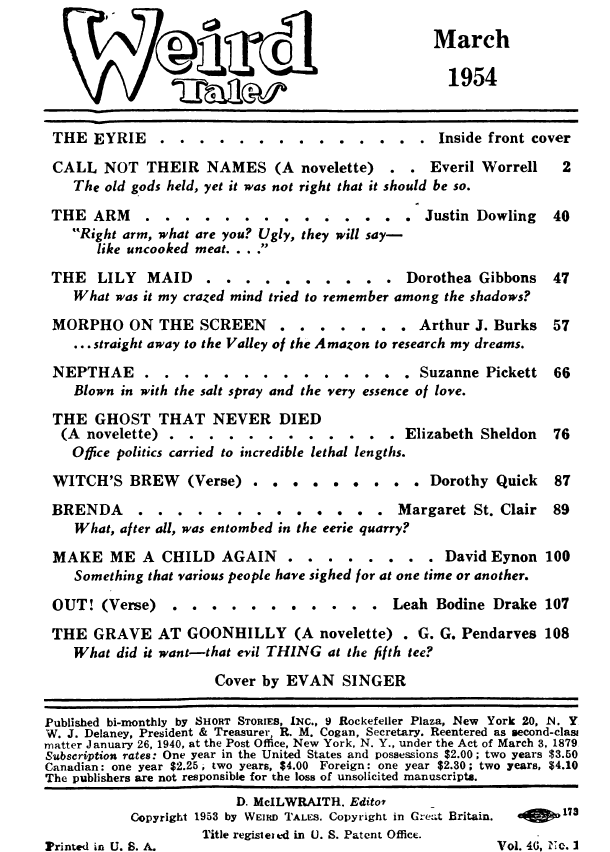
The ToC is interesting though, not least for the fact that there’s an awful lotta women on it. For sure, there had always been women writing (and reading) Weird Tales, but you gotta think that Dorothy McIlwraith, editor of the mag and a lover of the genre, must’ve been interested in cultivating more gender equity in the pages of her magazine. Anyway, she’s got some heavy hitters here – Elizabeth Sheldon, Suzanne Pickett, and good ol’ G.G. Pendarves making a posthumous appearance. But we’re here for the star of this issue – Margaret St. Clair! So let’s get on with it already, yeesh!
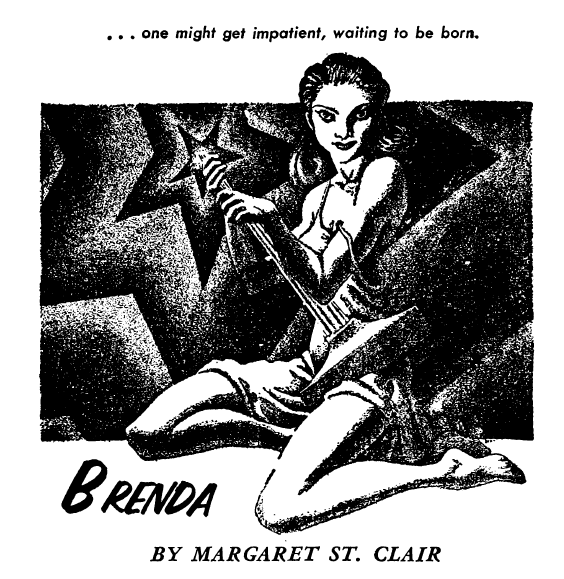
An odd little title illo, especially since is has nothing to do with the story and, arguably, doesn’t even portray the eponymous Brenda, a tomboyish blonde. Oh well! It’s 1954, what the hell do you want!? It’s entirely possible that they weren’t even paying for specific art at this point, and were just running through the catalog.


Great job of character introduction here – Brenda, poor child, is on vacation on Moss Island with her parents who, if not cruel, are certainly not kind either. She’s an outsider, tall and gangly and without any friends among the children on the island, largely left to her own devices. Good standard protagonist kid for a genre story – a loner, misunderstood, left to themselves. And, since there’s not much to do on the island and no kids to play with, she spends a lot of time in the woods, like you do. But on that particular Monday, there’s something else in the woods with her:
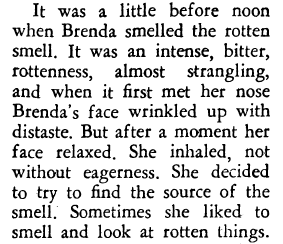
I mean, that “Sometimes she liked to smell and look at rotten things” is a fantastic line, more of St. Clair’s genius, little knives she sticks in the reader to make sure they’re paying attention to the characters in the story. It’s such a great bit of characterization for Brenda too – there’s a sense of rebellion to it, but also a bit of secretiveness there, a sense that Brenda knows it’s something morbid about her that others might look down on.
Anyway, Brenda hound dogs her way through the woods, following the odd stink as best she can, until she finds “the man.”

I mean, what the fuck!? A weird blobby, greasy, disgusting muddy gray man-thing in the woods, holding a dead bird, all clotted up and sloppy? Brenda stops and stares, but then the gray man extends a blobby arm towards her and she fuckin’ books it.
At first, driven by panic, she’s running flat out, trying to escape. The grey man is following her, too – she can hear it and smell it pursuing her. But, when she chances a look backwards, she sees that he’s much farther back than she hoped he would be. In fact, while he IS chasing her, he’s doing it very clumsily and slowly. Implacable, sure, but she realizes she doesn’t have to run full tilt to get away from it. With that realization, comes a plan. Brenda, rather than running home, turns and goes through the woods, leading the stumbling, shambling grey man thing towards a deep, steep-walled quarry on the island.
She tricks the thing into the quarry where it stumbles around, searching, until finally it gives up. But, when it tries to escape, it can’t – the walls are too steep, and its weird blobby arms aren’t strong or dexterous enough for it to actually climb up, out of the pit. She’s trapped it there!
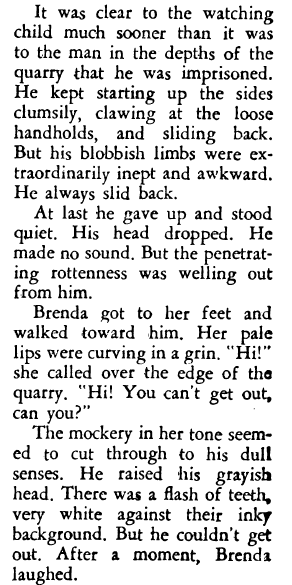
The flash of teeth is a great image, this weird blob man thing trapped in a quarry and grinning/snarling/??? up at her, very spooky and unsettling.
Brenda “hug[s] her secret to herself for the rest of the day,” another fun bit of characterization for this kid. She’s got a goo man trapped in a quarry, and that fact is HERS and HERS alone. But what fun is a secret if you can’t share it?

An interesting dynamic going on here, isn’t it? Ol’ Chuck is the closest thing to a friend that Brenda has on (and, possibly, off) the island, and it is to him that Brenda goes with this new, strange thing that has entered her life. Interestingly, it’s that touch though that convinces him not to go – something about the way she touches him is upsetting to Charles, and he tells her to, basically, fuck off.
She helps her dad with a barbecue pit out back, but the whole time she can only think about the gray man in the quarry. Unable to share her secret, she decides on a rather dramatic course of action; she’s going to set him free. She uses some planks to build a kind of ramp that lets the gray man clamber on up out of the quarry.

Great, chilling stuff – imagine being on an island with a Weird Thing that YOU released and YOU know is out there, but no one else does? Spooky and paranoiac, all while being a plausible action from a frustrated and probably petulant child. Nobody wants to see this thing that I captured? Fine, they can see it when it comes to THEM!
Brenda chooses not to head out to the woods the next day, a wise choice given that she overhears her parents discussing a rather disturbing event:

Brenda is sent to her room for eavesdropping, where she mulls over the gray man, trying to figure out what it could be, and where it could have come from, inventing some answers and writing them down, then deciding to tear them up and flush the pieces down the drain.
And then, before bed, she slips into her parents’ room and unlatches their windows. Yikes!
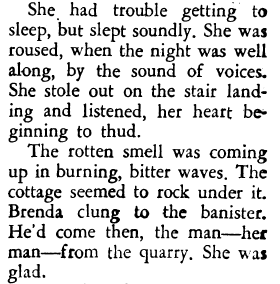
The blob man is in the house, and her parents are (quietly) trying to confront it. Her dad has it trapped in a beam of light from a flashlight, which is apparently enough to dazzle and confuse it while her mother, giggling nervously, is calling a neighbor to bring his gun over and shoot this thing. It’s pretty comical, par for the course for Margaret St. Clair, who often wrote about the absurdities of petit bourgeois suburbanites in her fiction.
The neighbor brings his gun over, but it really do much to the gray man – he’s made of goop, after all. Instead, the neighbor and Brenda’s father use a torch to drive it out of the house and, in a bit of synchronicity, through the woods and into the quarry where they trap and, eventually, bury the thing under a huge cairn of loose stone, which Brenda discovers when she is able to slip away the next afternoon.

And this signals a major change in Brenda’s life. For starters, no one on the island seems to want to talk about the thing under the cairn. Secondly, the children that had previously avoided her start showing up and following her around. Brenda becomes something of a leader to them, in fact, and they end up getting into all sorts of trouble.

Brenda eventually comes back to the island the next summer, having been left on the mainland after the school term by her exhausted and annoyed parents. She has continued to change, however, and it seems that, perhaps, she has finally started to grow into something more acceptable to her parents.
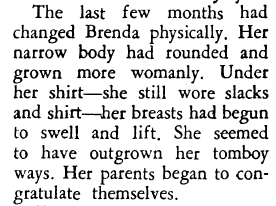
She waits until nearly the end of the summer before making a trip to the quarry and the cairn.


And that’s the end of “Brenda” by Margaret St. Clair!
Honestly, it’s kind of a masterpiece. It avoids the crude, stereotypical pitfalls of a “coming of age” story, instead relying on the weirdness of the gray man and Brenda’s relationship to it to arrive at something altogether stranger and more poignant. There’s obviously a puberty aspect to this tale – the interaction between Brenda and Charles is fraught, like all early adolescent encounters, but then there’s also the question of Brenda and her parents. Clearly there’s tension there, her parents obviously not understanding her in any way. The trapping of the gray man under the rocks by her father is ripe for a Freud Reaction meme, you know what I mean?
St. Clair, a student of Greek mythology, is also evoking the myth of Theseus here; the thing trapped under the rocks, which “one day” she’ll move to set it free, echoes Theseus having to wait until he comes of age and is strong enough to move the boulders that hide the symbols of his manhood (his sandals and sword). Both Brenda and Theseus know that their destinies lie under their respective rocks, and they know that they’ll have to wait to get strong enough to free them.
And, as weird fiction, I think it’s a blast too – the sense of the uncanny is strong all through this story, from Brenda’s own oddity, to the gray man (of course), and persisting in the weird mythic way Brenda changes after the gray man is trapped. It’s not a very long story, but there’s a lot of subtext and complexity at work here, but St. Clair is a good enough writer that she never lets either that OR the need for weirdness come into conflict; rather, they reinforce each other, like all great speculative fiction.
Anyway, Margaret St. Clair is a great writer, and there’re a few other works of hers that we’ll certainly be looking at in the future. There’s a pretty good collection of some of her short stories out there that you can get, easily and cheaply, from Dover Books, titled “The Hole in the Moon and Other Tales.” I’d highly recommend it!
 Eric Williams