
Roughly a quarter of the way through the Hallowe’en Season already, how the hell did that happen!? Ah, but let us forget the merciless march of time with some timeless Weird Fiction! And this time, we’re looking at Carl Jacobi’s “Revelations in Black” from the April 1933 issue of Weird Tales!
We’ve met Jacobi before, roughly around this same time last year, when we examined his weird forest/bug/hallucinations story “Mive,” another of ol’ Carl’s appearances in Weird Tales that I really liked. Today’s story is much more traditional and, frankly, staid in comparison to the out-and-out trippy action in “Mive,” but even so (and despite not having any geology or paleontology content) I think it IS a good example of Jacobi’s moody, atmospheric writing.
Jacobi had a VERY long writing career that stretched well into the 80s, and he had a longstanding relationship with August Derleth’s Arkham House that kept a lot of his work in circulation via collections. Interestingly, the Arkham House connection came about because of H.P. Lovecraft, who praised Jacobi’s “Mive” in a letter to ol’ Derleth as having the kind of real, vital weirdness that he (meaning Lovecraft) really dug. The feeling was obviously mutual, as Jacobi would often flit around the edge of the Lovecraft circle – he had been classmates in college with another of Lovecraft’s circle, Donald Wandrei, and as a fellow Midwesterner (Jacobi lived in Minneapolis his whole life) the two of them struck up quite the literary friendship.
With regards to the pulps, Jacobi was a pretty prominent figure – in addition to numerous appearances in Weird Tales, he also wrote detective fiction, adventure stories, and even a little sci-fi. He’s a good example of how a writer can be successful (artistically, at least – he was, like most pulpsters, crushingly poor for most of his life) and then kind of vanish from the scene. Honestly, for his weird fiction at least, I think he’s due for a revival.
Enough jibber-jabber! Onwards!
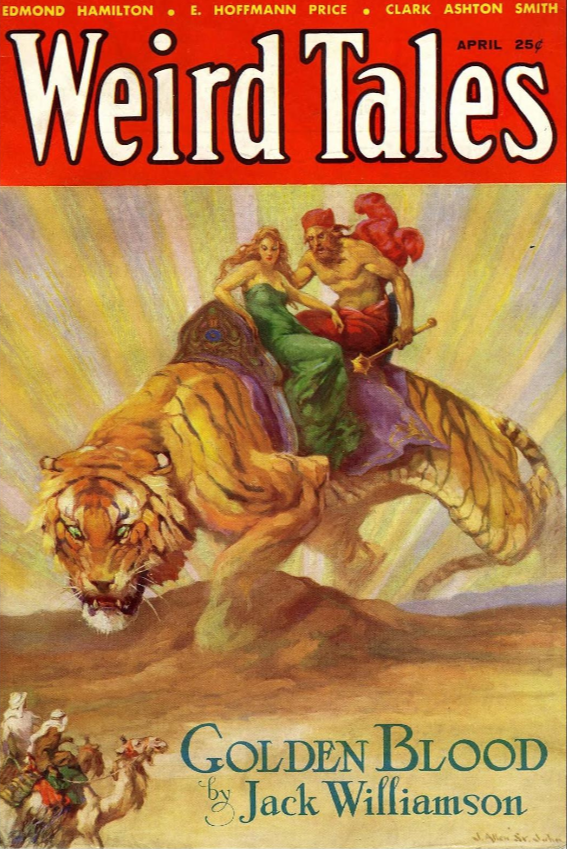
This month’s cover, by J. Allen St. John, isn’t particularly weird, unfortunately, although I like the snarl on that giant ass tiger’s face. Very orientalist, something that editor Farnsworth Wright (and the readership of Weird Tales) loved with a fierce undying passion, so it makes sense that Williamson’s “Arabian” style multi-part novel would be made the cover. Still, c’mon man – gimme a monster!

Still, some fun stuff in the ol’ ToC. I don’t remember the Price story, but I’d love a Perfect Strangers/Weird Tales bit of fanfiction about “The Return of Balki.” Hamilton, Smith, Kline, Counselman, all big names for the readers at the time, along with Jacobi of course. Solid issue, I feel like the reader is getting their twenty-five cents worth this month.
Now, on to “Revelations in Black!”

Classic “Jayem” Wilcox title illustration, down to the whole “we’re giving away most of the story to you right off the bat” aspect too. Yep, this here is a VAMPIRE story, specifically about a LADY VAMPIRE, one of the top tier kinds of Vampires out there. A nice, traditional approach to a Halloween staple, I think.
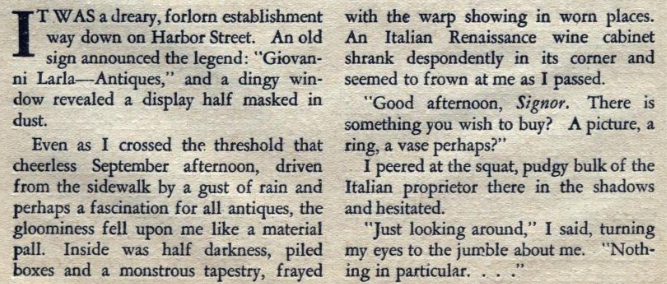
Our story opens with a narrator battling his seasonal affective disorder by going antiquing. What’s funny is that our dude exchanges a dreary rainy day for what is, apparently, an equally dreary shop – the description of the wine cabinet shrinking despondently into its corner is a good bit o’ writing that sets the tone for Larla’s shop, I think. Our guy’s not after anything in particular, of course, but Larla is COMMITTED to his pitch, and even after the narrator suggests he’d like to see some books, Larla makes him go through the whole shop, looking at furniture, paintings, a “muddle of yellowed statuettes,” all kinds of junk. But, eventually, they reach the Old Books in the back.


Carl lays it on a little thick here, I think – the whole “oh, if only I hadn’t done whatever, the horrors I could’ve avoided,” yadda yadda, it’s easily the weakest part of this story, although I DO think that it helps if you read this part (and the whole story) as something very FIRMALY within a certain stylistic tradition. Jacobi is writing a VAMPIRE STORY – he’s not interested in reinventing it or subverting anything, he’s just enjoying the languorous pleasure of playing in a very well-established sandbox, right? In that context, this kind of “ah, would that I hadn’t fucked up so badly back then” stuff is VERY MUCH a part of the genre. Take it for what it is, is what I’m telling you.
But anyway – our guy plucks an interesting book from a shelf, one that Larla the shop-owner says was placed there by mistake and isn’t for sale. In fact, the book was made (literally – we learn that he bound it himself) by his “poor” brother.

Am I a sucker for the “last ravings of lunatic” macguffin? Yes, and so is our narrator – when he learns it was written BY a guy IN an asylum, he wants it EVEN more badly. Larla explains the Sad Tale of his Brother, Alessandro:
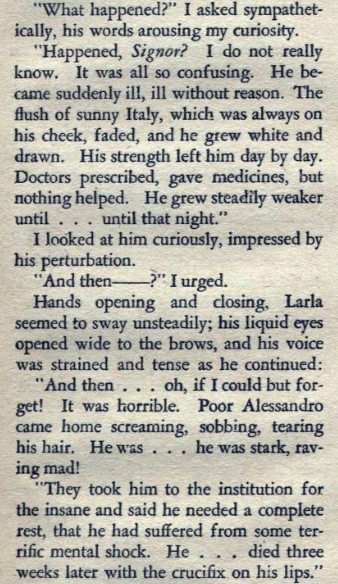
We learn then that there are actually THREE volumes to the “Five Unicorns and a Pearl” series, books that Alessandro had filled with his mad scribblings in his time in the asylum. Now, his brother keeps them as a keepsake, trying to forget the tragedy of his death and remember happier times (something probably not helped by keeping the Black-bound and Skull-embossed Book of Horror he wrote while dying mysteriously, but then again the human mind is a labyrinth, right?).
Like I said, this sort of wild-ass story just makes our guy want these books even more. When he sees he can’t buy it, he ends up RENTING the book for a single night for TEN GODDAMN DOLLARS (that’s like $250 now). He has a single night, and he MUST return it the next day, in perfect condition. A crazy deal, huh?
So, having plunked down a pile of cash for a chance to examine the book, our hero settles in for the night in his apartment to do some readin’. First thing he notices is a weird inscription “in a feminine hand” on the inside of the front cover:

Shoulda signed it “XOXO – The Vampire” to make sure he got the point.
He reads on:

Our boy here is strangely moved by the kind of odd and obviously symbolism-rich language that poor Alessandro used when composing his last work. In fact, he’s so struck and, frankly, troubled by it that he decides to go for a midnight walk!

Indulging in this weird impulse, however, does little to alleviate his mania – in fact, if anything, it increases it. He feels like he’s looking for something, that he’s being drawn towards something, and there’s nothin’ fer it but to wander in search of whatever the hell it is.

Our guy pushes through the strangely unlocked gate and into the preternaturally alluring night garden.
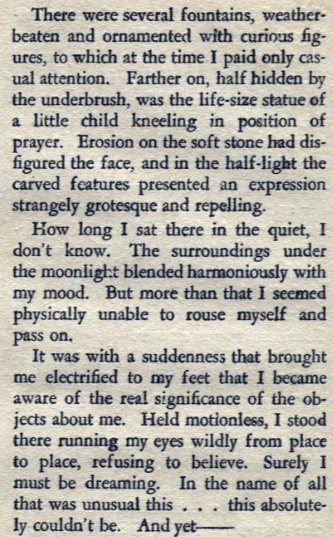
Quelle horreur! Our guy suddenly, shockingly realizes that this garden is, IN FACT, what poor mad Alessandro was writing about in Volume One of his book “Five Unicorns and Pearl,” the very book HE HAD JUST BEEN READING (*thundercrash*)!!!!!1!
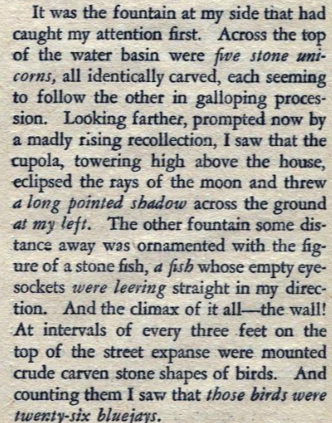
All kidding aside, I DO think that our guy’s entrance into the garden is an extremely well done bit of eerie writing – the scene perfectly captures, a dark, seemingly abandoned garden in the Fall, the plants dead or dormant, and full of odd architecture, ornamentation, and statuary. Gardens are strange places, after all, sites dedicated to specific ideas about aesthetics and nature, carefully curated and maintained, so seeing one at an “off” time (at night, in the autumn, and apparently not being “kept-up”) is automatically a disjointing and unsettling experience. I think Jacobi is one of the great landscape/scenery describers of the pulps, and this garden is a perfect example of his mastery.
While he’s musing about this place, and how perhaps Alessandro wasn’t the hopeless lunatic he’d been labeled as, a strange, pungent perfume assails his nostrils…it’s the scent of heliotrope, powerful and fulgent in the night air…and it’s comin’ from a goddamn LADY he hadn’t even noticed a minute again!

The way Jacobi describes this woman, all in black, veiled, and with only a pale white neck exposed, strikes me as very Arthur Rackham. I mean, everybody has probably guessed what’s happening here, right, but for me that doesn’t detract from the pleasure of the story – honestly, there’s a lot to be said for weird fic/horror that tips its hand early but keeps on heading steadily towards the already-spotted conclusion. You can’t get that kind of slow-burn consummation without letting the reader see the road ahead, and I think when it’s done well, like in Jacobi’s story here today, there’s a lot to appreciate.
Anyway, this crazy vulpine woman and her enormous dog don’t seem bothered by the fact that some guy has just busted into their garden. In fact, the lady asks him to stay; she’s lonely, and would like someone to talk to. With a curt “fort mit dir, Johann!” she sends her dog away and bids the interloper join her by the fountains. Then, she introduces herself:

I’ll just break in here to post this picture of Field Marshal August von Mackensen, a WWI Imperial German general, because his picture is wild as hell:

Germans, yeesh!
Perle von Mauren continues her tale of woe:

“…found him…no longer living” is one of those “I don’t drink…wine” statements that vampires just love – technically true but omitting certain key information. Fun stuff!
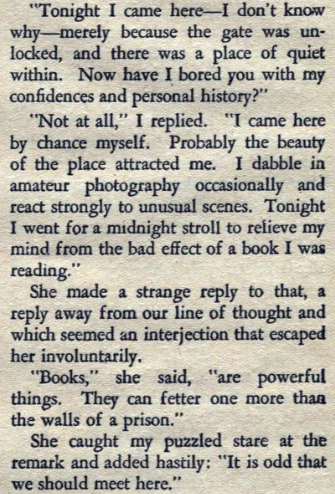
Fun bit of subtle weirdness here – she’s obviously the author of the “feminine hand” that our narrator spotted on the frontpiece of the book, but there’s an implication here that, somehow, the book and she are intimately and causally connected. It could just be dissembling on her part, of course, but it really seems like our guy reading the book has summoned both Him and Her to the garden, together, some kind of weird link being forged between them by the reading of the story. It’s good and interesting, and I don’t think I’ve ever seen anything like it with regards to vampires – the idea that they’re associated with some kind of cursed object like that is neat!
Anyway, our dude spends the whole night talking to this lady in the garden. He’s obviously enchanted by her, even if he has a mounting sense of unease the whole time…why won’t she remove her veil, for instance. Then, just as the night gives way to dawn, something weird (well, weirder) happens!
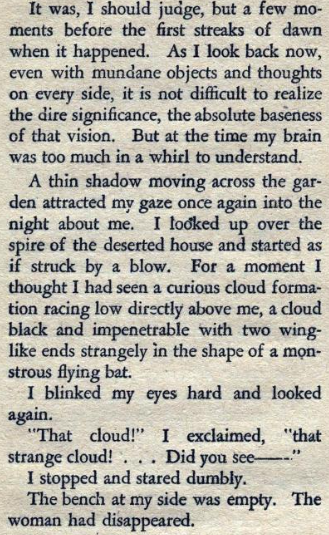
They call that a “Vampire’s Goodbye.”
The next day finds out guy increasingly preoccupied with Perle and the garden and the books of Larla. He describes himself as addicted to the mystery of the thing, and can’t help but go back to the shop where, despite not returning the first book, he procures the second volume at another ridiculous price. He rushes home, reads it, but the mystery merely deeps for him, and his weird craving to return to the garden grows stronger and stronger. He tries to resist it, to ignore it, but then, in a flash he has the sudden idea that the garden scene and her and all that moonlight would make one hell of a picture, something he could even submit to the International Camera Contest in Geneva next month! Is that a delusion on his part, or an excuse? Regardless, our shutterbug grabs his fancy camera with its newfangled flashbulb and hustles on out to the garden again.
She’s there, of course, and they chat for a long while – she seems weirdly reticent to talk about her brother, and yet simultaneously compelled to tell our narrator about him. There’s an interesting section of his time as a student in Vienna where, as is traditional, he’s considered a weird and potentially dangerous avant garde philosophy student with odd and offputting ideas. His experiences in the war, and in digging graves as a prisoner of war, seem to be a particular focus of her morbid interest. It feels like this is Jacobi gesturing towards an underutilized bit of Vampire Lore here, the idea that a vampire rises out of the grave of a sorcerer. Her brother’s background as a “weird philosophy” student matches that, and she also seems to be suggesting that his terrible experiences in the war somehow “tainted” his soul.
The sky clears and the moon comes out; a perfect time to take a picture. Our guy tells her not to move, hops up, and then snaps a pic.

Lady, I get it – I don’t like to have my picture taken either. But she’s REALLY pissed, because she vanishes into the house and sic’s her big ass dog on our guy! This huge hounds comes hurtling out at him and attacks! It’s only with the greatest difficulty and a bit of luck that our guy survives – he chokes the dog while it’s trying to kill him, then remembers the German Perle had used when ordering the dog to go in. “Fort mit dir, Johann!” he manages to croak out, and it’s enough to confuse the dog that he’s able to escape.
Our guys calls in sick to work the next day, and decides to develop the picture he took. I wonder how it turned out?
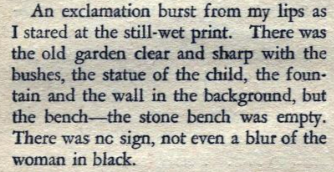
Get a clue dude!
Anyway, he’s so shaken by the experience of the picture that he goes to bed. He wakes hours later, seemingly out of some kind of a vague yet terrible nightmare, and he notices that the drapes are fluttering in the breeze from a window that he had thought he’d shut before going to bed. He grows weaker, and ends up staying there for THREE DAYS, worn out, weak, and sick. A doctor visits and tells him he needs to rest and recuperate and, oh, by the way, where’d those two marks on your neck come from?
But even this isn’t enough to curb his NEED to read the third book. He’s been through the first two, and as he lays there in bed a kind of feverish desire builds and builds until he is forced to head to the shop. He, of course, has not returned the first two volumes, and so Larla refuses to “rent” him the third. It’s like, dude, take them off the shelf if you don’t want to sell ’em, right? But our guy’s NEED for the book is too great and, when Larla’s back is turned, he steals it and runs.
He reads through the mad yet damningly suggestive text of Alessandro Larla’s FINAL book, troubled and unnerved, until he reaches THE FINAL PAGE:
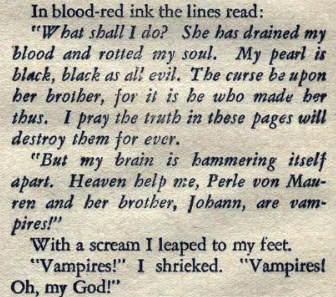
Yeah no shit man, jesus christ. I do like that the dog is her brother though, that’s neat.
He realizes that Alessandro had been ensnared by these things in some way and, although unable himself to escape, had written these books in hope of exposing and destroying them. Then our guy remembers the odd frontpiece…didn’t it say something about “stakes” in there…
He won’t be a victim, not like Larla! He smashes the legs of his tripod to make two sharp stakes and takes a taxi IN THE DAYTIME over to the house. Inside, he finds a room with coffins and the cloying, masking odor of Heliotrope…and does what needs to be done.

And then there’s a classic Hammer Horror style reveal:

And then, a final coda:
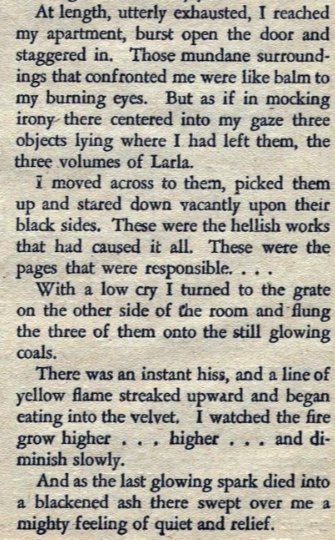
And that’s the end! Hope ol’ Larla the shop keeper had some other stuff of his brother’s to remember him by, because this dude just burns those books.
This story, while very *classical* in format and execution, is still awfully evocative and atmospheric; Jacobi is great at scenes and environments, and I like the way in particular he describes the moonlit garden and the fountain. Apparently, this was a view shared by the editor of Weird Tales Farnsworth Wright – he originally and very firmly rejected this story, only to contact Jacobi a few weeks later to ask if he could publish it! Our narrator discovering the garden had stuck with ol’ Wright, so much so that he’d found himself thinking about that scene long after he’d rejected the story.
And, you know, for all the “seen it” stuff in here, I think there’s some interesting little glimmers of weirdness – the book aspect is inventive and cool, for instance, and I really like the way it seems to summon them ALL to the garden. And would they have returned if he *hadn’t* burned the books? And, of course, some things are a classic for a reason, you know, and damned if a straightforward Vampire Tale isn’t one of ’em! And I mean, c’mon, Jacobi does a GOOD job here with the genre.
Anyway, I hope ya’ll enjoyed a classic bit of Vampire fic fer Halloween. I know I did, but maybe next time around we’ll dig into some weirder stuff, eh? Until then!
 Eric Williams
Pingback: Pulp Strainer #26: Special Coming-of-age Edition! “Brenda” by Margaret St. Clair, Weird Tales, V.46, n.1, March 1954 | Eric Williams
Pingback: The Pulp…Entombed! “The Tomb from Beyond” by Carl Jacobi, Wonder Stories, Vol.5 No.4, November 1933 | Eric Williams