
Try as you might, you can never really escape the shadow of H.P. Lovecraft when you’re talkin’ about weird fiction. Easily one of the 20th century’s most important figures in horror, science fiction, AND pop culture, his influence looms over basically everything – Borges, Bradbury, Harlan Ellison, Fantasy, Joyce Carol Oates, Horror, Stephen King, Video Games, Role Playing Games, Comic books…I mean hell, there’s even a Ghostbusters cartoon with Cthulhu in it! Tentacular horrors from beyond our dimension, cosmic nihilism, insane cultists making dark deals with incomprehensible forces…while these weren’t Lovecraft’s inventions, they were certainly perfected and, I daresay, communicated most effectively in his stories – there are strange gibbering horrors and alien gods and bizarre tales of a hostile inhuman universe before him, but his unique ability to synthesize these influences while developing his own aesthetic makes him kind of unique.
And, of course, he had the pulps, giving his stories an unprecedented audience – Weird Tales had an estimated distribution of 40,000 magazines per issue at its height! Can you imagine 40,000 people reading ANY single short story now? And that’s not counting the well-documented tradition of sharing single issues among multiple people, making that audience number a definite lowball estimate. Hard to even imagine short stories being that huge of a part of popular entertainment!
His popularity means there’s a glut of Lovecraft these days, both in terms of his own stories as well as scholarship on the man. Because of this, I was generally trying to avoid talking too much about him here…but when I did a previous installment on Long’s “Men Who Walk Upon the Air” and saw today’s story on the ToC, I knew I’d have to give in. My only defense is that, like I said in that previous post, I really do think today’s story is both A) extremely good and also B) not as appreciated as ol’ Howie Lovecraft’s other, tentacle-ier writing. So let’s take fifteen, ya’ll go read “The Music of Erich Zann” and, when you’re done, come back here for a little discussion/dissection/discursion on it, okay?

Great title image of the story from good ol’ Andrew Brosnatch there. The viol, the shabby garret, the wide-open window with the dark outside and the curtains billowing and the candle flickering in the wind…it’s great stuff, an atmospheric little illustration of what is, basically, the key element of this story.
“The Music of Erich Zann” was originally published (in ’22) in one of the countless amateur magazines that Lovecraft was a part of. I’ve seen some people describe these as basically the zines of their day, but I think that’s incorrect – while these were printed and put together by hand by individuals as an act of love and artistry, I think they were a lot more similar to the online literary mags we have today. They actively solicited articles, fiction, and prose from their members, and had well established lines of editorial practice and distribution. Lovecraft was a HUGE part of the amateur press scene, and it was only with great hesitation that he got into the pulp market, considering anything you got paid for as being, by definition, not something done for art. That being said, once Lovecraft DID start selling his stories, he was fairly quick to dive into his archives and submit his previously published stuff to Weird Tales.
But let’s get in there, shall we?
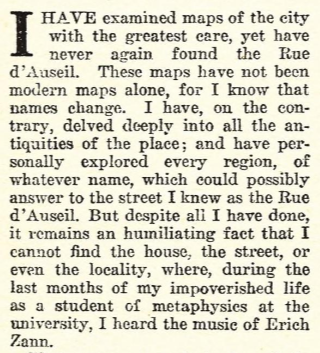
For me, that’s one of the great openings in not only Lovecraft, but all of weird fiction. We get right into things and are immediately introduced to the mystery of this missing street and, more fundamentally, the idea that it was there, in the Rue d’Auseil, that this narrator encountered the music of Erich Zann, something that must’ve profoundly affected him. Great, lean, efficient writing!
The narrator goes on to explain that he knows that his time on the Rue d’Auseil was kind of a rough patch for him both physically and mentally, and maybe it had an effect on his memory. Still, he goes on to say, it’s weird that he can’t find the place, because it was SO characteristic and idiosyncratic; it was very close to the University for one thing, but it was a strange, dark neighborhood full of ancient buildings and strange, seemingly very old people. And, interestingly, the river stank in a particularly unique way, something that might help him identify it if he ever smelled it again. This story relies on some kind of unique sensory descriptions to convey weirdness – there’s that smelly river for one thing, but also the central conceit of the story is the strange properties that Erich Zann’s music has. Speaking of which:

Our student of metaphysics does manage to meet Zann one night as the musician is coming home after his shift in the orchestra pit, but it’s an odd meeting. Zann is described as lean and goatish, and there’s a shabby furtiveness to him and, in fact, at first he seems kinda pissed off that this weird college student has been listening in to his music. Still, our narrator perseveres, and eventually the musician brings him up to his room waaaaay at the top of the house and starts playin’ on his viol.
The music is good, stuff that Zann has clearly written himself, but it’s got none of the weird wildness to it that he’d overheard before.

Zann’s freakout it pretty great and unexpected, and his sudden fearfulness of the closed and curtained window when the whistling starts is pretty remarkable. He even goes so far as to try and manhandle the student out of the room, an intolerable boorishness that makes our narrator a little huffy. Mollified, Zann tries a friendlier tact, setting the student down in a chair and writing a note to explain his actions.
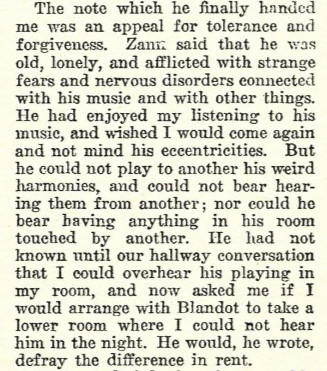
A pretty strange note, all in all, and the contorted explanation of being strangely sensitive about his “weirder” music is pretty funny. As is his willingness to get the student to move to another room! Whatever it is about the music, Zann is serious about it! Moved by the old man’s obvious nuttiness, the student agrees, and soon moves to a different and more expensive room on the third floor, leaving Zann alone on the fifth and no one on the fourth.
But it turns out that maybe Zann’s apparent friendliness was a bit of a front – he doesn’t ever invite the student back up, and when the student goes out of his way to invite himself up there, the music is “listless” and kind of dull. And so, to get his weird music fix, our boy starts creeping up there secretly to listen in on Zann:
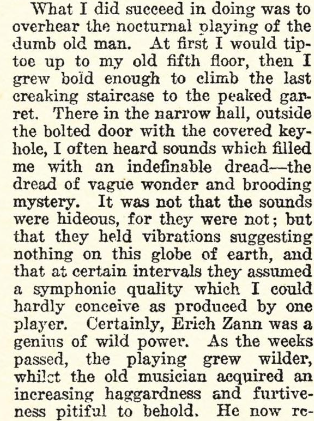
The building fury of Zann’s playing, and his concomitant physical and mental deterioration, are pretty great images, aren’t they? I mean, imagine it: you sneak up to listen to this crazy music that just keeps getting crazier and crazier, and every day the guy playing it looks rougher and rougher. Extremely evocative, extremely weird!
And then, one night…

Again, good use of aural information here, you can imagine the sound of the window being closed and the sashes drawn before the old man hobbles over to the door to let in our strangely persistent narrator. Zann looks like he’s been going ten rounds with the champ, and he’s preoccupied with that window, listening hard, only finally relaxing a little when he seems satisfied that nothing is happening outside. Then, Zann writes a quick note in his execrable French, imploring the narrator to wait while he writes out a full and detailed account of what has been happening in his native German. Our narrator spends a hour just sitting there in silence while Zann writes furiously, page after page stacking up on the table as he recounts the “marvels and terrors” that he’s been experiencing. Then, suddenly, horribly, there’s a sound from the closed window, and it sends Zann into a frenzy.
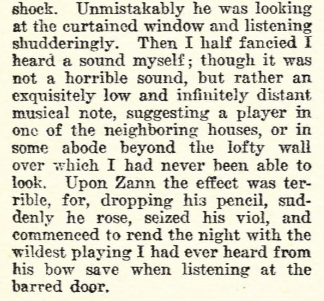
Zann’s playing is furious, wild, a kind of mad noisemaking that, the narrator realizes, is inspired by fear alone, fear of something on the other side of the window, something trying to get inside, perhaps? Sweating and contorted with the effort of playing, Zann is desperately sawing at his viol when, steadily, there rises a sound from outside.

A sudden gust catches up Zann manuscript and whirls it towards the window! Oh no!
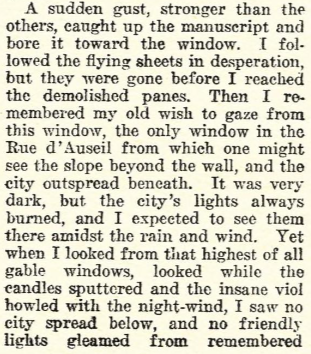

Absolutely fantastic stuff, top shelf weird writing! Chasing the papers to the open window our narrator sees not Paris, but rather a vast expanse of interstellar space full of motion and music and strange, hostile agency. And it seems like it wants to come into the room, through the window.
The horror of whatever it is that lies beyond the window fills our narrator with terror. He gropes his way in the dark towards where Zann is still madly playing. He’s struck by the bow as Zann keeps sawing, and then feels, horribly, that Zann’s skin is ice cold – he’s been dead for a while, but still he plays on. Mad with terror, our narrator escapes, and the story ends:
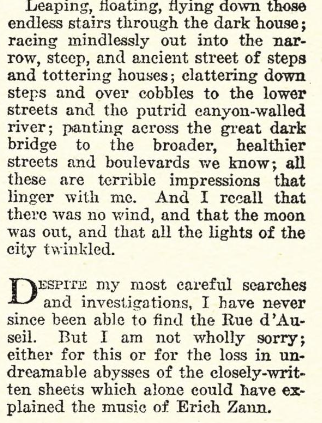
What a story, huh? It’s short, but it’s packed with so much fantastic stuff, perhaps the best of which is the lost story within the story that Zann’s manuscript held. There were the answers to all our questions, and they’re just gone! I mean, it’s a perfect bit of metafiction, you know? There, in Zann’s manuscript, was a Weird Tales story, but Lovecraft has written a story around that story, and the loss of it just highlights the great mysterious pleasure of weird fiction.
Unsurprisingly, this was one of Lovecraft’s favorites of his own writing. It’s a really fine piece of work, and was actually anthologized in a Dashiell Hammett edited collection in 1931 titled Creeps by Night. Apparently, this was also the only Lovecraft story that famous snob Robert Aickman liked. There’s a real and legitimate understated quality in it that’s really rare – a lot of weird fiction tries to use that kind of “what’s happening!?” approach, but often they’re only winking at it, right? Like, a character might be confused, but we, the reader, generally have a sense of what’s happening, even if that sense is just “this is a lovecraftian story.” But here there’s really NO hint at what’s happening, is there? A musician is playing crazy music to try and do something related to a window that, apparently, opens up to Another Place. Has his music attracted it, or has he done something else to bring it here? Does his music keep it away? We’ll never know, because the answers flew out the window!
It’s a really unique piece of weird fiction, evocative and strange and a lot of fun packed into a very short little bit or writing. Really one of my favorites, both of Lovecraft’s work and the genre in general! Well worth a read this Halloween eve!
 Eric Williams