
Folks, we’re drawing near to the Big Day itself…as I write this, Halloween is less than a full week away. Here, in Texas, it’s been rainy and muggy, although there’s a promise of a powerful cold front that’ll blow in over the weekend and bring temps down low. I like a crisp, wintery pumpkin day; we usually have a fire out in the front yard and hand-out candy, drink some beer, have a nice ol’ time, and I much prefer it to be cold than mosquito-y and sweaty. So, in honor of this gift from the dark gods of halloween, today we’re going to talk about a fantastic story from one of the greatest writers to have ever graced the pages of Weird Tales magazine. Fritz Leiber, Jr., and his story, “The Automatic Pistol.“
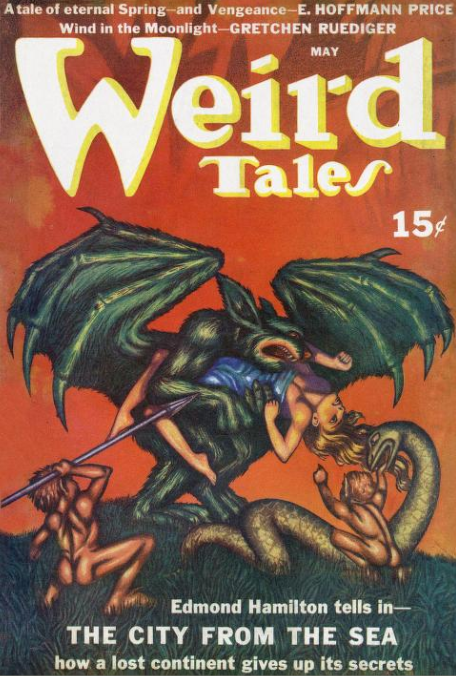
But, before we get into the Leiber, it’s important to take a moment and note the changes that have come to dear ol’ Weird Tales. Most of the previous stories have been from it’s earlier incarnation; the first and second installments were from the Baird days, while the rest have all been under the (hugely important and very influential) editorship of Farnsworth Wright. But now, in the 40s, the magazine has been bought by Short Stories, Inc, and Wright, suffering from rapidly declining health (he dies in June of 1940 from complications related to Parkinson’s disease) has been replaced by Dorothy McIlwraith.

McIlwraith is an interesting character. A Canadian, McIlwraith had been the editor of Short Stories magazine for several years, successfully running a magazine that operated in a lot of different genres. When she comes in to Weird Tales, she’s confronted with an immediate problem – the magazine was perennially just skating by, always nearly running out of money. Additionally, the late 30s had been rough – Lovecraft died in 1937, Robert E. Howard died in 1936…these had been THE heavy hitters, the authors that, by and large, had defined Weird Tales artistically. Similarly, there were competitors in the weird fiction market; magazines like “Strange Stories,” “Unknown Worlds,” and the various sci-fi pulps has all bitten into the market that Weird Tales had dominated. Add to that the paper shortages of World War II and the general collapse of the magazine market post war, and you can appreciate the work McIlwraith did in keeping the magazine going all the way to 1954!
Now, I’ll admit that I do think there’s a real enormous importance to Wright’s work at Weird Tales; the fact of the matter is, before him, there really wasn’t a genre of “weird fiction,” and it was under his powerful editorship that the genre took shape and was defined. For that alone, his run editing Weird Tales is historically and literarily important (for more on this, see my Introduction in the forthcoming Night Fears from Paradise Editions…stay tuned for more info soon!) Interestingly, Wright was given a much freer hand during his tenure at the helm. McIlwraith was forced to “tone down” some of the scarier and gorier stuff at the orders of the publisher, and so the magazine she oversaw was a different one. That said, she DID exercise her power in interesting ways: she had a serious interest in science fiction, and made a concerted effort to bring it back into Weird Tales. Similarly, there were a number of prominent authors whose work she edited: Ray Bradbury, Robert Bloch, Margaret St. Clare, and today’s author, Fritz Leiber all appeared in the pages of McIlwraith’s Weird Tales.
Additionally, she also went all in on Hannes Bok for covers and interior art, and that’s surely gotta be worth something, right!? I mean, look at that cover up there – it’s incredible, and Bok’s style is so dynamic and vibrant and just plain weird, you know? In terms of illustrations and covers, I don’t think Weird Tales was ever better than the 40s run, for sure!
But I’ve rattled on too long! Let’s get stuck in to some two-fisted weird crime with Fritz Leiber’s “The Automatic Pistol!”
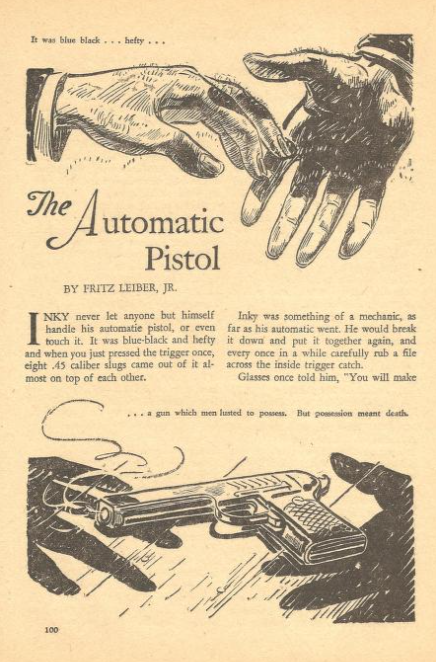
Lookit that spread, gosh! Weird menacing hands, the smoking pistol, the first paragraphs of the story sanwhiched in there between em…a great composition, and a great way to start Leiber’s very first story in Weird Tales magazine.
Leiber wrote in a number of genres, but he’s` probably most famous for his contributions to Sword & Sorcery, a term that he (according to some) actually invented. His Fafhrd and the Grey Mouser stories are legitimately some of the most important and influential fantasy of the 20th century, on equal footing with Robert E. Howard and J.R.R. Tolkien, although he hasn’t had the same popular appeal as either of them. We’ll talk more about that come my Xmas Sword & Sorcery series that I’m planning out, so we’ll leave it alone for now, but just know: Leiber is a big deal.
But before Lankhmar and Nehwon, Leiber was (briefly) a Lovecraft correspondent and wrote some great pure weird fiction. This is actually his FIRST story in Weird Tales, and immediately you know it’s great. Leiber has a wonderful style, more muscular than a lot of “classical” weird fiction. It’s also distinctly and vibrantly modern – right off that bat we’re talkin’ about a gun. And not just ANY gun…it’s that classic of the pulp detective mags, the .45! And it belongs to another classic of the pulps, an indeterminately foreign criminal!
Inky, whose gun it is, is partners with a rough character named Larsen; they run booze, and have hired the the narrator (who will be introduced as “No Nose” later on) and a semi-egghead named Glasses to help them, loading and unloading and driving, basic prohibition stuff. They’re all introduced in a real classic, hard-boiled bit of writing that is, simply, a pleasure to read:

Gosh that’s good stuff, isn’t it? “I was a local small-town policeman until I determined to lead a more honest life.” Fantastic writing. This whole first section in particular is just a really nice, tight little crime story told from the perspectives of the crook, and it’s rich with excellent world-building – there’s corrupt cops, there’s the business of rum running, all of it dropped casually and naturally and efficiently into the story.
As established, Inky loves his gun. He’s always fiddlin’ with it, even when they’re out on the job, running booze he’ll take it out, pet it, coo to it with words nobody can understand…

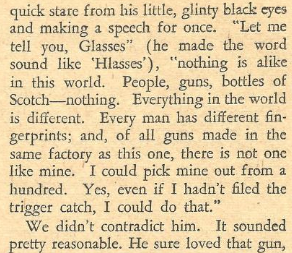
The thing is, this fascination with the gun seems to rub Larsen, Inky’s partner in rum running, the wrong way.
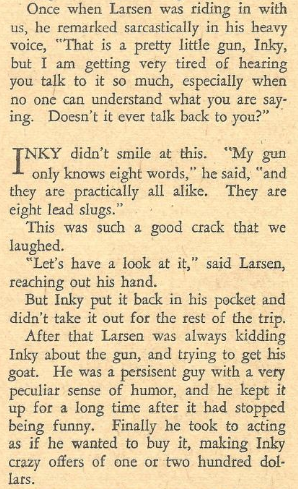
Eventually this leads to an altercation where Larsen suddenly loses his temper and tries to grab the gun; if it weren’t for a motorcycle cop looking for a bribe, there might’ve even been blood spilled over it. It’s the first sign that Larsen is strangely obsessed with Inky’s pistol.
A fair bit of this half of the story is concerned with the ups and downs of the business as the years go by. Our narrator and Glasses keep working for Inky and Larsen, and we learn about the dangers of hijacking and of rival bootlegger gangs. We also get a glimpse of the money involved, and the ways the men spend it:
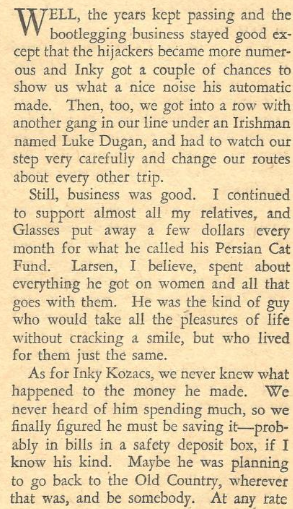
This sets up nicely the latter half of the story. Glasses reads in the newspaper that Inky has been rubbed out; interestingly, there was no weapon on the body when the police found it, and that gives both Glasses and No Nose pause; feels kinda wrong for someone else to have the automatic that Inky had so doted over all those years. Eventually, Glasses and No Nose are called up by their old boss Larsen, who says his rival Luke Dugan had Inky killed and is now gunning for him. And Larsen wants the two of them to meet him at a safehouse.
Neither No Nose nor Glasses are particularly enamored of the idea, but Larsen ain’t the sorta guy you say “no” too, so they hunker down with him in a farmhouse way the hell out in the country. After a supper of canned corned beef hash and beer, they’re sitting around the table drinkin’ coffee, just hanging out, when Larsen reaches into his pocket and pulls out a gun. The Gun, in fact.
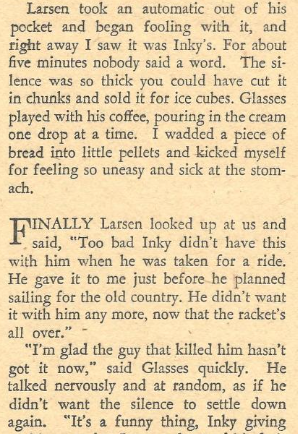
Right away Glasses, No Nose, and us, the readers, have got a bad feelin’ about all this. There’s more great hard-boiled stuff in here – unvoiced (and unwritten) suspicion that practically shouts at you the whole time, the threat of violence, claustrophobia, fear. And while Larsen is fuckin’ around with Inky’s gun, it suddenly goes off, nearly taking off one of No Nose’s toes. After some panic, Larsen sets the gun on a side table and goes to a back bedroom to sleep. Glasses and No Nose are a little wound up, though, so they stay there in the front and play some cards…and after an hour, they notice somethin’ strange…

No matter how they adjust it, the gun always ends up swinging itself around to point towards the back of the house, where Larsen is sleeping. They fiddle around with is some more and eventually Glasses decides that what’s happening, see, is that the safety right? It juts out a bit, and so it kinda pivots around whenever its set down, yeah? Perfectly reasonable explanation, but No Nose decides that maybe it’d be better if the wiggly gun wasn’t loaded, so he takes the rounds out and pockets em.
Eventually, the boys tire of their card game and go to sleep. Then, in the dark, No Nose hears something…a kinda metallic clicking…

The image of this gun rotating around and then repeatedly trying to fire, all on its own, is great isn’t it? And the fact that it’s empty makes it all the more menacing; the hate propelling this gun must be getting even hotter for all the futile attempts its making! Glasses tries to calm No Nose, telling him it’s nothing, and then laughing that No Nose is ascribing supernatural agency to a dumb gun.


Now that’s the classic Leiber twist – he’s always ziggin’ when you expect him to zagg! You might’ve expected that Inky’s ghost or something was animating the gun, pretty standard ghost story shit, but not when Leiber is writing it! How neat is he instead introduces the idea that the gun is some kind of malevolent thing in its own right, a liaison between Inky and the Dark Side with its own ideas and agency! Later, when No Nose is handling the gun, he notices that the metal feels strange, smooth and slick and strangely alluring in his hand…kinda makes you wanna keep touching it too.
No Nose and Glasses read in an early morning paper that Larsen is, unsurprisingly, wanted for the murder of Inky. Just as they’re discussing this, Larsen wakes up and comes back into the room. There’s more fantastic noirish writing here – the nervousness of the two men, trapped in a situation with a guy who they’re pretty sure killed his partner but who they don’t want to let know that they think that, is really well executed, taut and tense and fun. Larsen seems weirdly listless, like he’s preoccupied with something, or maybe like something is gnawing at his mind. He only really rouses himself when he finds the gun has been emptied and moved. He doesn’t want anybody else to touch the gun but him, see! He demands the bullets back from No Nose too, and reloads the gun. That part is fun – does he want the gun loaded and for himself because he’s planning on killing his two hired hands, or is he jealously fascinated by the weapon. No Nose remembers the weirdly seductive way the gun felt in his hand, and is certainly worried.
But there’s nothing they can do, really – Larsen has the gun, and they’re unarmed. They gotta stick with him and try and keep him calm. Larsen shaves and gets dressed, and then decides that they all oughta play some cards. It seems like things are coming to head:
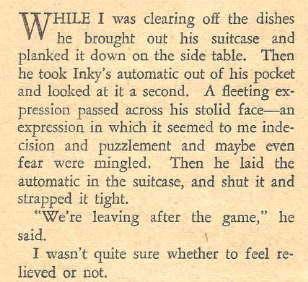
They play poker, but its clear that both Glasses and No Nose aren’t really focusing on they game – understandably, since Larsen seems to have become real menacing, real fast. While they’re playing, No Nose hears a noise, a kinda faint scrabblin’ or rustling that he can’t place. They keep playing, Larsen winning from both of them. Then, dammit, there’s that noise again!
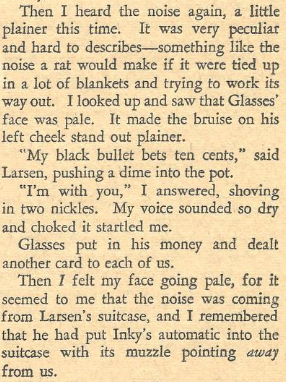
The guns wrigglin’ around in the suitcase, trying to orient itself properly! Glasses, whose kind of a chatterbox when he’s nervous, nearly fucks up big time by mentioning the sound:

They keep on playing, and it’s a horrible visual, isn’t it? Like there they are, crazily playing cards, two of them trapped with a fully murderous and crazed guy, all while the gun of a dead man is writchin’ around in a suitcase. It’s a great, weird image, a real horrible situation!
As they’re playing, Larsen finally starts to break down, whispering to No Nose that he did kill Inky because he wanted all that money he’d been putting away. He hadn’t brought it with, though, but Larsen knew where it was. How about him and No Nose go and get, it’ll be a cinch for two people, see…
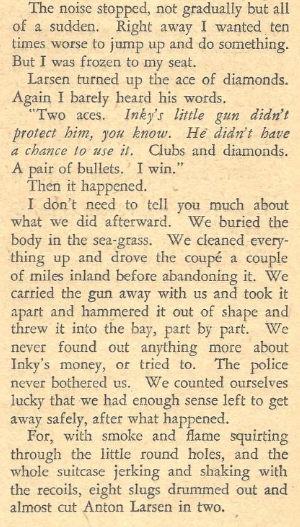
And that’s the end of the story!
It’s just a peach, ain’t it? I mean, it’s a real straight forward story of betrayal and vengeance from beyond, but 1) it’s written really well, with a great tone and voice that successfully blends crime and weird fiction together, and 2) the weirdness is elevated by the whole “gun-as-familiar” bit. It’s maybe not as well developed as it could’ve been, but it’s enough to turn the story into something just *that* much weirder than it would’ve been if, like, Inky’s ghost was doing it, you know, or his lingering psychic obsession were to blame. I think you really get a good taste of Leiber’s style and sensibilities from this story too – his interest in lowlifes and crime, the morally grey quality of his characters, and the truly sinister tinge to his kind of weirdness all come through very strongly here. You get good character work, too – everybody is sharply and quickly drawn and distinguished from one another, something that a lot of writers have a surprisingly hard time doing. I guess don’t have much more to say about the story, really, except that I like it a lot, and it’s worth a read!
 Eric Williams
Pingback: Pulp and the Gray Strainer #18: “Two Sought Adventure” by Fritz Leiber, Jr., Unknown, Aug 1939, v.1 n.6 | Eric Williams
Pingback: Improvised Contraband Prison Pulp Strainer #23: “Cellmate” by Theodore Sturgeon, Weird Tales v. 39, n.9, January 1947 | Eric Williams
Pingback: The Pulp (of Capitalism) Strainer #29: “Smoke Ghost” by Fritz Leiber, Unknown Worlds, V. 5, n. 3, Oct 1941 | Eric Williams
Pingback: Pulp Strained…from Beyond the Grave! #36 “The Vyrkolakas” by Robert C. Sandison, Weird Tales v. 19, n. 4, 1932 | Eric Williams